Security teams log 54% of successful attacks and alert on just 14%. The rest move through your environment unseen.
The Picus whitepaper shows how breach and attack simulation tests your SIEM and EDR rules so threats stop slipping by detection.





Google is rolling out new privacy controls for Search services and Google Play, giving you more control over saved history and personalized recommendations.
In an email titled “New privacy settings for Search services,” sent to users and seen by Bleeping Computer, Google said it is “updating our settings to give you even more control over saved history and personalized recommendations across Google Search services and Google Play.”
Google noted that Search services include “Search, Maps, Shopping, Hotels, Flights, Translate, and News,” and users will see the change in their Google Account in the next few days.
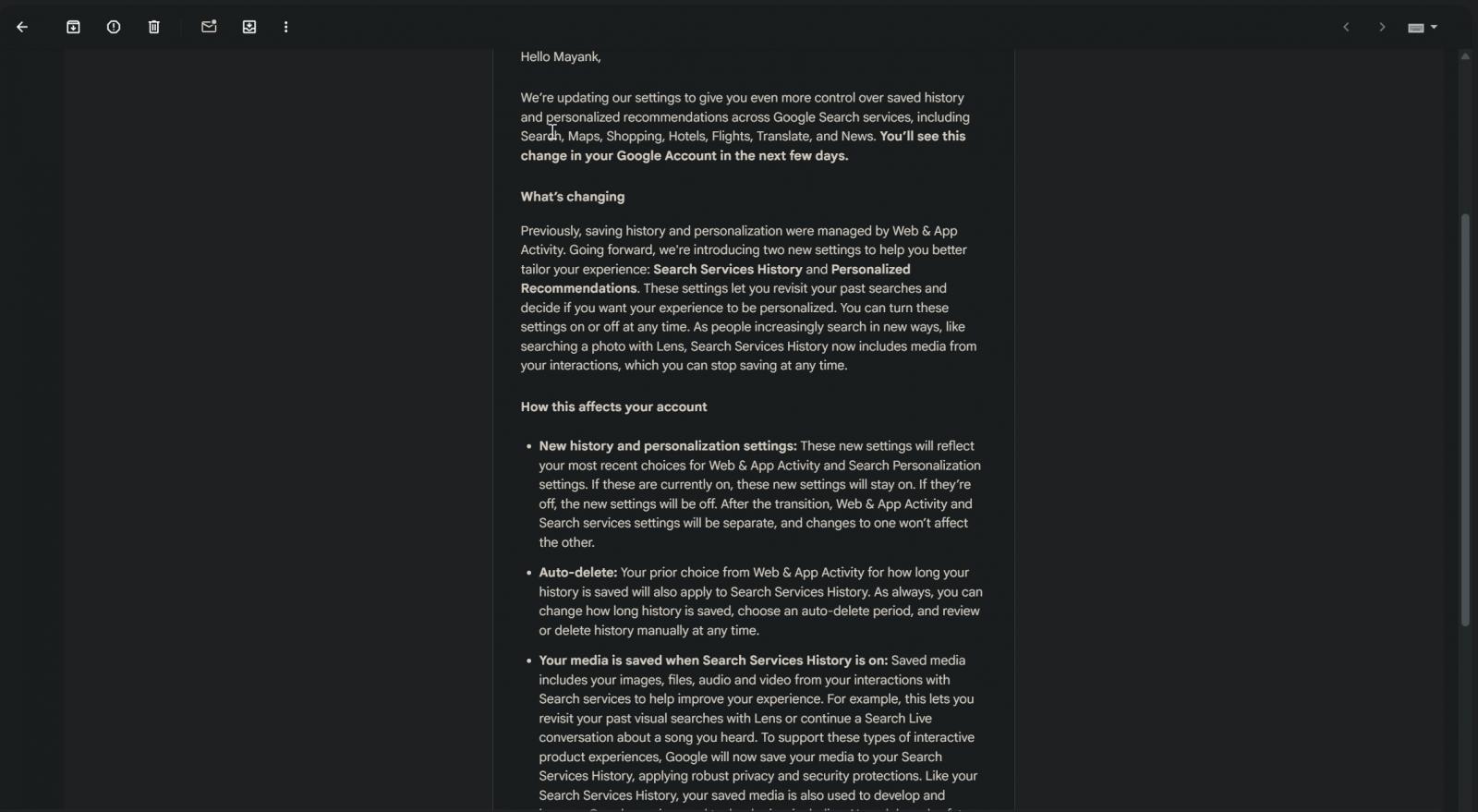
The company said it will offer separate settings for saved history and personalized recommendations. However, if you have turned on the “Web & App Activity” feature, Google’s new media-saving option for Search services will also be turned on after the transition.
Until now, Google has allowed you to manage history and personalization for Google services through Web & App Activity.
For example, the Web & App Activity page allowed you to keep track of your web visits and the apps you use on your phone.
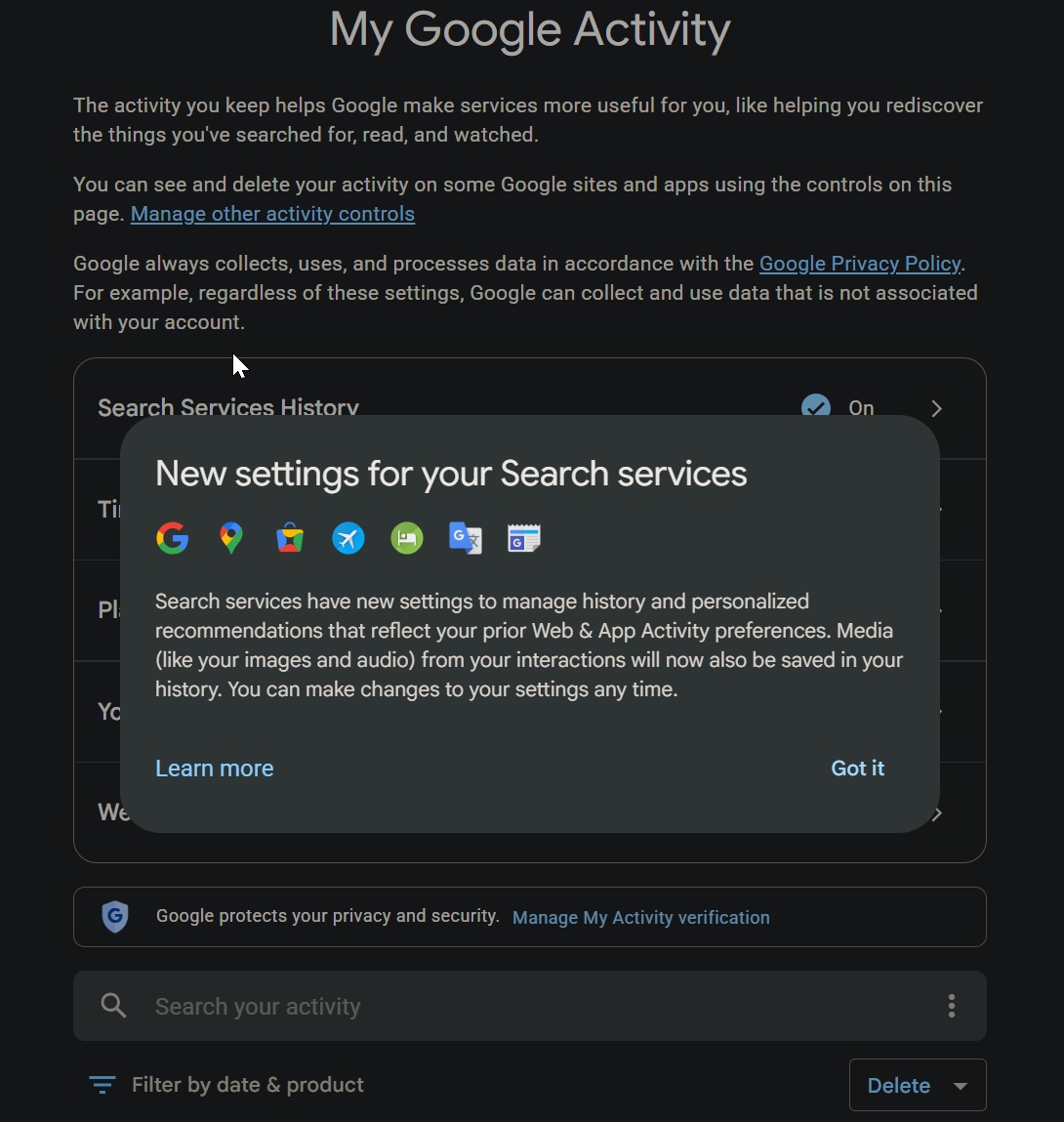
Google is now separating some of that into new controls called Search Services History and Personalized Recommendations.
“Previously, saving history and personalization were managed by Web & App Activity,” Google said in the email. “Going forward, you can better tailor your Search services experience using your new Search Services History and Personalized Recommendations settings.”
“These settings let you revisit your past searches and decide if you want your experience to be personalized,” Google added.
Going forward, Search Services History will control whether Google saves your activity from Search services to your Google Account. This can include your searches, Maps activity, Shopping searches, Flights and Hotels activity, Translate usage, News activity, and more.
Google says this will make it easier for you to revisit previous searches and continue using newer interactive Search experiences.
“As people increasingly search in new ways, like searching a photo with Lens, Search Services History now includes media from your interactions, which you can stop saving at any time,” Google noted in the email.
While Google’s announcement gives you more direct controls, there is an important detail worth checking.
In the email, Google says saved media can include images, files, audio, and video from your interactions with Search services.
“Saved media includes your images, files, audio and video from your interactions with Search services to help improve your experience,” Google said.
This can include visual searches with Google Lens or audio from voice-based interactions. According to Google, this helps support interactive product experiences.
“For example, this lets you revisit your past visual searches with Lens or continue a Search Live conversation about a song you heard,” Google noted in the email. “To support these types of interactive product experiences, Google will now save your media to your Search Services History, applying robust privacy and security protections.”
However, saved media, like Search Services History, can be used to develop and improve Google services and technologies, including AI models and safety systems.
“Like your Search Services History, your saved media is also used to develop and improve Google services and technologies, including AI models and safety measures,” Google said.
Google says it applies privacy and security protections, and the company says you can turn off the Save Media subsetting at any time. You can also delete individual pieces of media from your history.
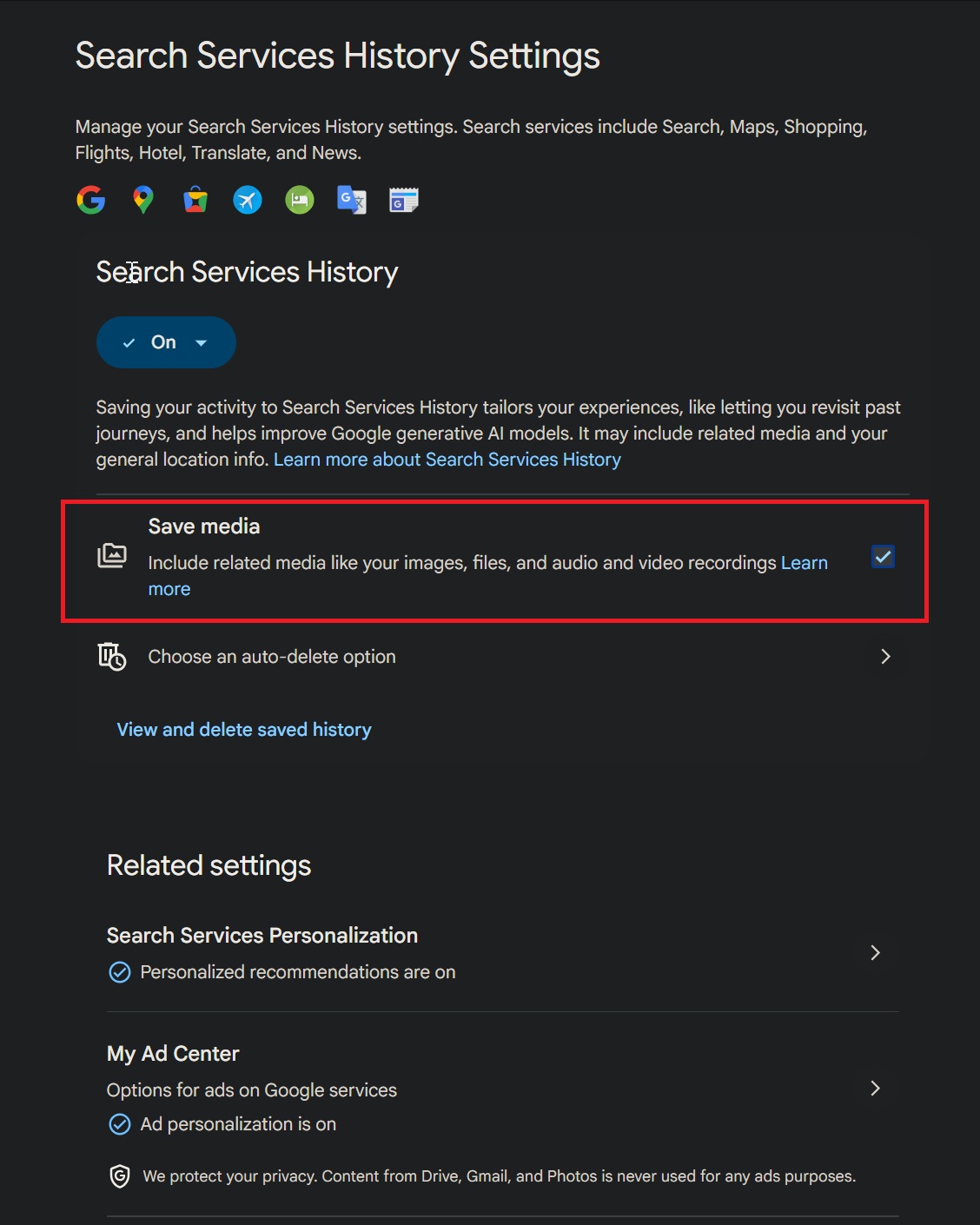
If Web & App Activity is currently turned on for your account, Google says Search Services History will be turned on after the transition, and the Save Media subsetting will also be turned on.
Google also confirmed that you can turn off the media-saving option later and “delete individual pieces of media from your history.”
Google is also introducing a separate Personalized Recommendations setting for Search services.
This will allow you to control whether Google personalizes your Search services experience.
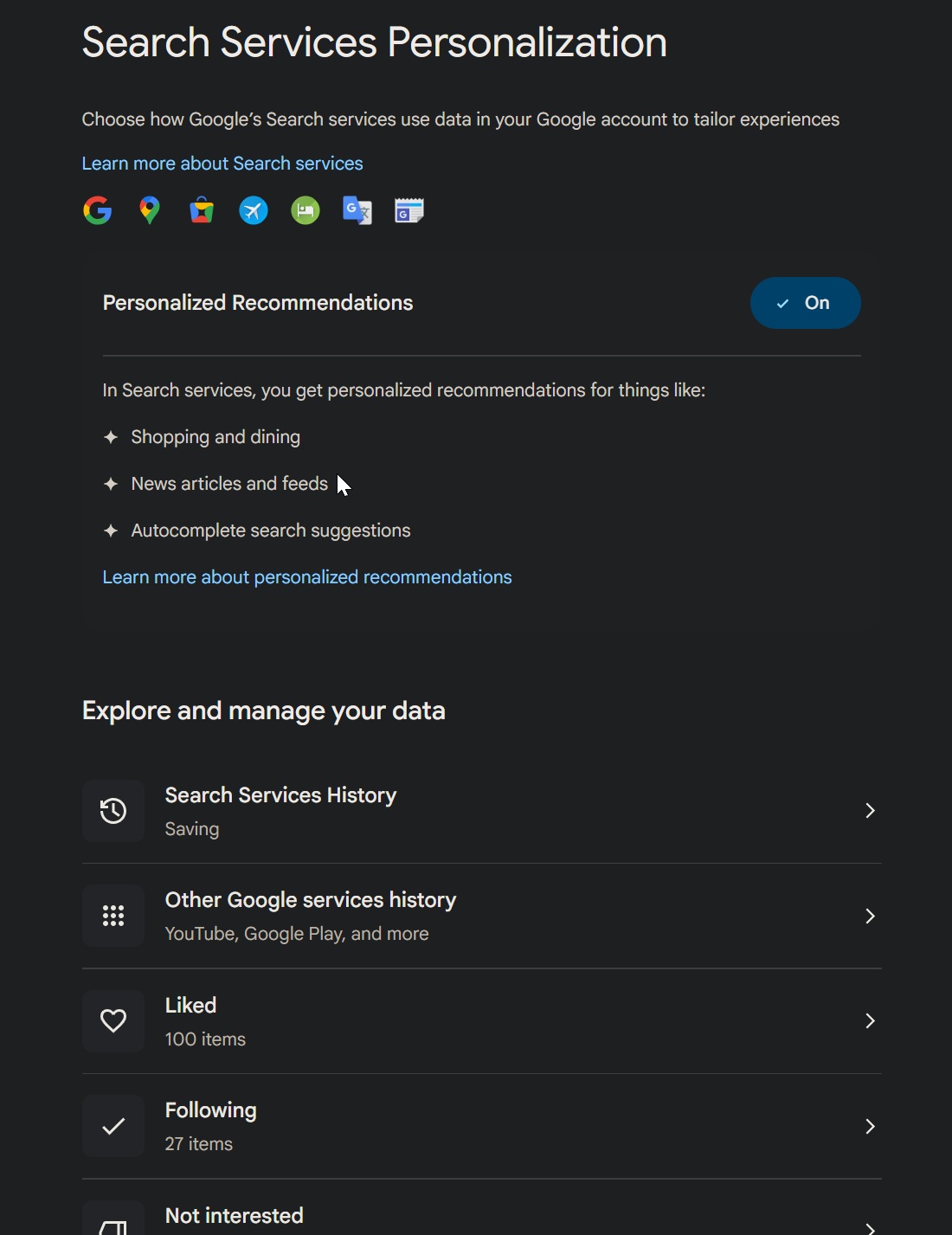
In other words, Search Services History controls whether the activity is saved, while Personalized Recommendations controls whether Google uses that saved data to tailor what you see.
That separation is helpful because some people may want their history saved for convenience, but may not want Google to personalize recommendations based on it.
After the transition, Web & App Activity will be separate from Search services’ history and personalization settings. Google says changes to one setting will not affect the others.
In the same email, Google says these settings will appear even if you have never used Google Play. Like the Search settings, they can be turned on or off at any time.
“For Google Play, you’ll have new Play History and Personalization in Play settings, even if you’ve never used this service,” Google said.
Google says the new Search services and Google Play settings will reflect your most recent choices for Web & App Activity and Search Personalization settings.
“Your prior choice from Web & App Activity for how long your history is saved will also apply to Search Services History and Play History,” Google said.
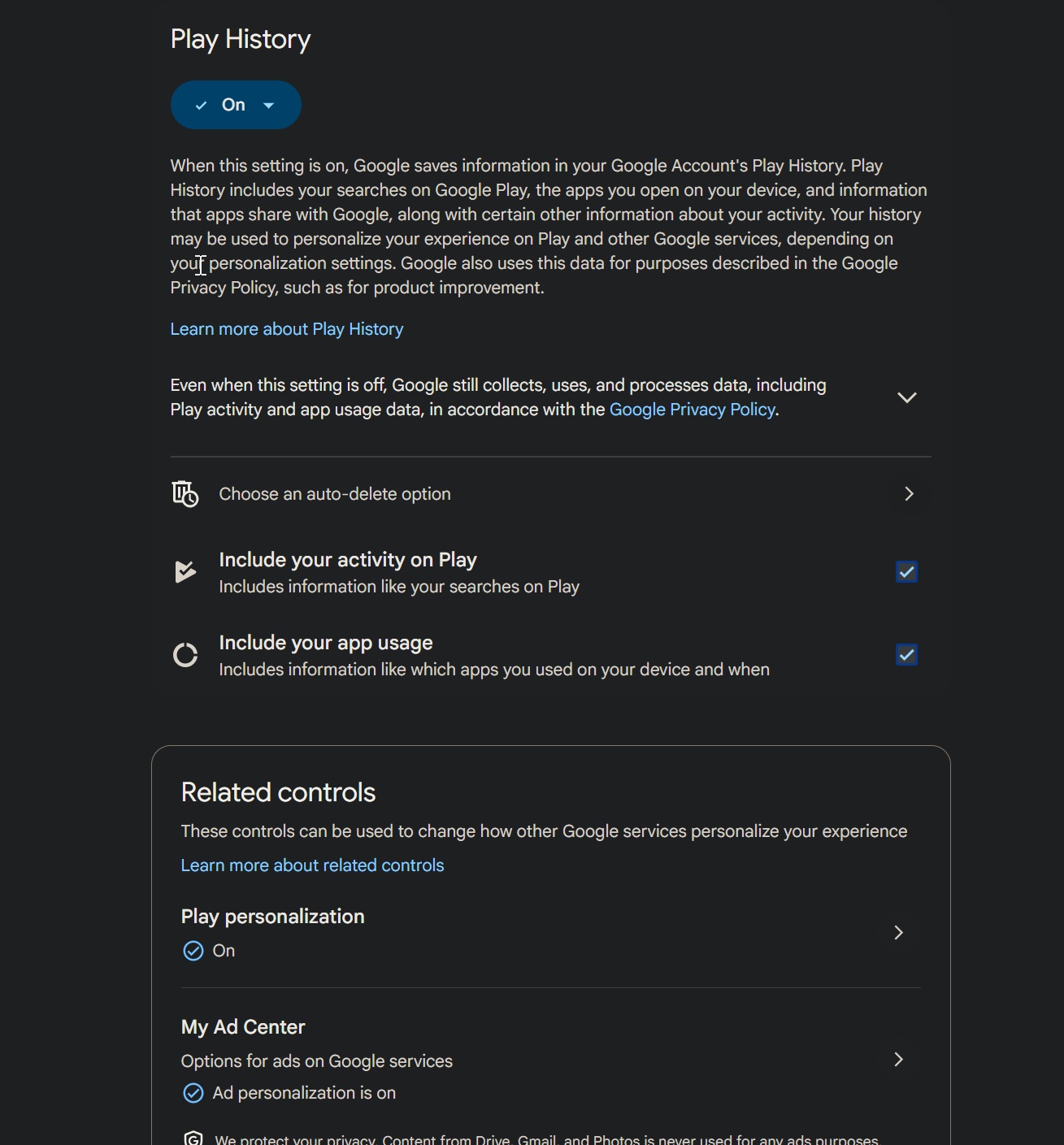
So if you previously told Google to delete activity after a certain period, that choice should carry over to the new settings. You can still change the auto-delete period, manually review your history, or delete activity at any time.
This change is not necessarily bad. In fact, separating Search history, Search personalization, Google Play history, and Google Play personalization gives you more direct control than one broad Web & App Activity switch.
However, you should still check the settings once they appear in your Google Account, especially if Web & App Activity is currently turned on.
Google says users will see the change in their Google Account over the next few days.

Security teams log 54% of successful attacks and alert on just 14%. The rest move through your environment unseen.
The Picus whitepaper shows how breach and attack simulation tests your SIEM and EDR rules so threats stop slipping by detection.
Micron Q3 revenue hit $41bn, quadrupling year-over-year on surging AI memory demand, with gross margins above 81 percent and Q4 guidance of $50bn.
Micron Technology posted fiscal third-quarter revenue of nearly $42bn, quadrupling from just over $9bn a year earlier and beating Wall Street estimates by a wide margin. The results, reported on Tuesday, confirm that the company riding the AI memory boom hardest is the one whose stock has already climbed roughly 700 percent over the past year.
Adjusted earnings came in above $25 a share, compared with analyst expectations of roughly $21. GAAP net income exceeded $28bn, or nearly $25 a share, up from just under $2bn in the year-ago quarter. Gross margins hit above 81 percent, up from 69 percent in the prior quarter and 27 percent a year earlier.
The headline number is revenue growth. Micron brought in nearly $42bn against a consensus estimate of roughly $36bn, driven almost entirely by surging demand for high-bandwidth memory, the stacked DRAM chips that sit next to GPUs inside AI accelerators built by Nvidia and Google. HBM has become the binding constraint on AI infrastructure expansion, and Micron is one of only three companies in the world that can make it.
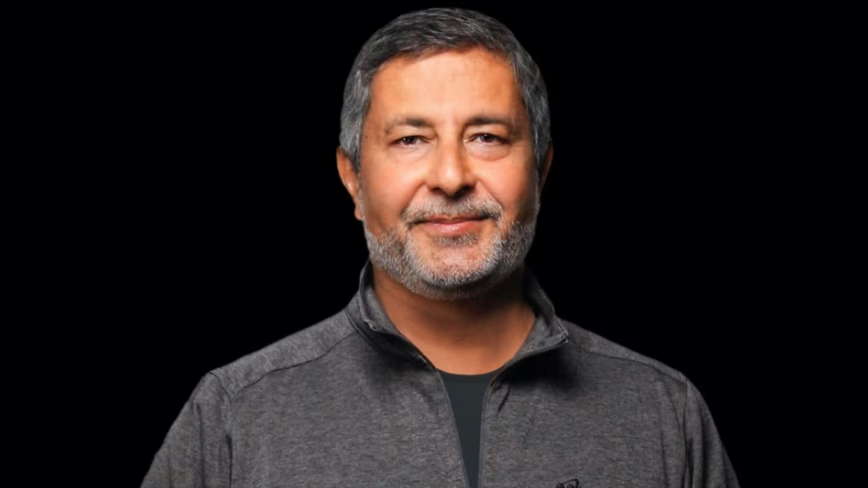
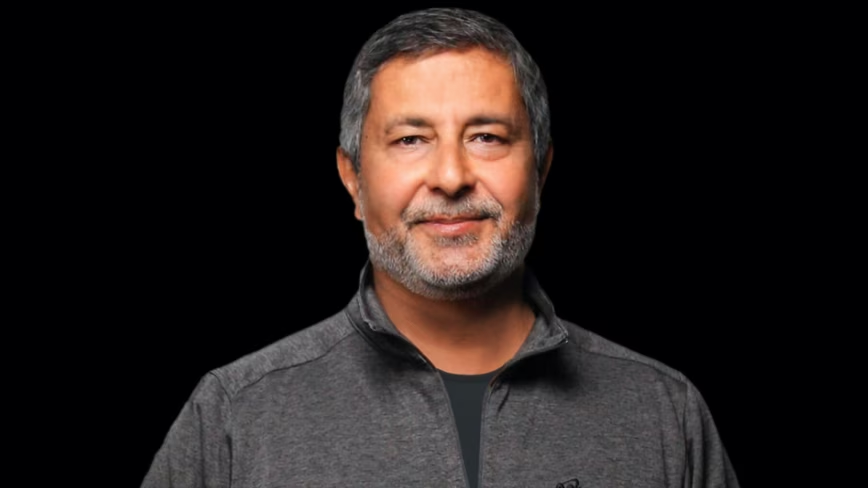
CEO Sanjay Mehrotra said Micron can currently fulfil only between half and two-thirds of customer demand for HBM. The company’s entire 2026 HBM supply is sold out under multi-year contracts, and it has collected $22bn in customer cash deposits, essentially prepayments from hyperscalers desperate to lock in supply.
Micron’s next-generation HBM4 chips are ramping what the company described as twice as fast as the previous HBM3E generation. HBM4 revenue has already exceeded one billion dollars. The technology is essential for the latest accelerators from Nvidia and Google, where memory bandwidth rather than raw compute increasingly determines inference throughput.
The forward guidance was equally aggressive. Micron projected fiscal fourth-quarter revenue of approximately $50bn, plus or minus one billion, against analyst estimates of roughly $44bn and a year-ago figure of just over $11bn. The company raised its full-year capital expenditure forecast to more than $25bn, up from a previous target of $20bn, to expand production capacity for HBM and advanced DRAM.
Micron’s market capitalisation crossed one trillion dollars on 26 May, making it the latest memory chipmaker to reach that threshold as the AI-driven memory supercycle reshapes valuations across the semiconductor industry. The stock’s roughly 700 percent gain over the past year reflects a market that is pricing memory not as a cyclical commodity but as structural AI infrastructure.
The company said it expects the total addressable market for HBM to grow at a compound annual rate of roughly 40 percent through 2028, rising from approximately $35bn in 2025 to around $100bn. Micron plans to return 100 percent of excess free cash flow to shareholders, a commitment enabled by the cash deposit programme that reduces the capital risk of its expansion.
There are caveats worth noting. Micron remains the smallest of the three HBM suppliers, behind SK Hynix and Samsung, and its share of Nvidia’s HBM4 allocations is the thinnest of the trio. The broader memory market is also shifting, with Chinese manufacturers like CXMT expanding aggressively into consumer DRAM segments that the Big Three have deprioritised in favour of AI chips.
Memory pricing is cyclical by nature, and the current supercycle depends on hyperscaler capital expenditure continuing at its current pace. If AI infrastructure spending slows or HBM supply catches up with demand, the margins that Micron reported this quarter would compress rapidly. The 81 percent gross margin is historically extraordinary for a memory company and reflects shortage economics as much as product superiority.
For now, the numbers speak for themselves. Revenue that quadruples in a year, margins that triple, and a guidance print that exceeds estimates by more than $6bn are not normal results for any company, let alone one that was losing money two years ago. Micron’s earnings confirm that the AI memory shortage is intensifying, not easing, and that the companies making the chips inside AI accelerators are capturing value at a rate the market is still recalibrating to price.

Anthropic accused Alibaba’s Qwen lab of using 25,000 fake accounts for nearly 29 million Claude exchanges, the biggest such campaign yet.
Anthropic has accused Alibaba of waging the largest distillation campaign yet against a US AI company, telling senators and White House officials that operators linked to Alibaba’s Qwen AI lab used nearly 25,000 fraudulent accounts to extract Claude’s capabilities between April and June. The letter, a copy of which was seen by Bloomberg, described nearly 29 million exchanges with Claude targeting software engineering and agentic reasoning, the model’s most commercially valuable skills.
The accusation marks the first time Anthropic has named a major Chinese technology conglomerate as the source of a distillation attack. Previous allegations in February targeted smaller Chinese AI startups, including DeepSeek, MiniMax, and Moonshot AI, which Anthropic said had collectively generated more than 16 million exchanges through about 24,000 fake accounts. The Alibaba campaign alone exceeded the combined volume of all three earlier efforts.
Distillation is the practice of feeding carefully constructed queries to a frontier AI model, collecting its responses, and using those responses to train a cheaper rival system that approximates the original’s capabilities. The White House flagged the technique as a national security concern in April, when OSTP Director Michael Kratsios published a memo committing the government to share intelligence with US AI labs about foreign distillation campaigns. Anthropic said in its letter that the Alibaba campaign took place after the Kratsios memo, in defiance of the administration’s warnings.

The 💜 of EU tech
The latest rumblings from the EU tech scene, a story from our wise ol’ founder Boris, and some questionable AI art. It’s free, every week, in your inbox. Sign up now!
Alibaba had no comment on the allegations. An Anthropic spokesperson declined to discuss specifics but emphasised the importance of combating distillation through coordinated action between government and industry.
Alibaba’s American depositary receipts fell more than three percent on the news, dropping below $100 in afternoon trading on Wednesday. The stock decline adds to a difficult period for the company in Washington, where it faces pressure on multiple fronts.
The Pentagon added Alibaba to its Chinese military companies blacklist on 8 June, a designation Anthropic cited in its letter. Alibaba sued the Defense Department this week to win removal from that list, calling the label baseless and arguing it has no military affiliation. The distillation accusation now opens a second front, framing Alibaba not just as a company with alleged military ties but as an active participant in what Anthropic calls the systematic theft of American AI capabilities.
In its letter, Anthropic warned that adversarial distillation lets Chinese labs replicate frontier AI at a fraction of the training cost, and that models built this way often lack safety guardrails. The company urged the Trump administration to clarify antitrust guidelines so US labs can share more information about distillation attempts, reiterated its support for export controls on advanced AI chips, and called for penalties against firms that use the technique.
Lawmakers are moving in parallel. Senators Bill Hagerty and Andy Kim plan to introduce an amendment to must-pass defence legislation that would blacklist or sanction any Chinese firm found to be improperly accessing US AI model output. A related bipartisan bill in the House, backed by Representatives Bill Huizenga and Sydney Kamlager-Dove, is also being considered, though whether either proposal survives to the final version of the defence bill is uncertain.
The timing is sensitive for Anthropic as well. The company, now valued at $965bn after a $65bn Series H round, filed confidentially for an IPO this month and is preparing for a listing that could come as soon as this autumn. US officials have estimated that unauthorised distillation costs Silicon Valley labs billions of dollars, and the threat of cheaper imitation products from China that siphon away customers is a material risk for a company heading to public markets.
Anthropic’s calls for government support may not find a fully receptive audience, given that the company is embroiled in a separate dispute with the Trump administration over export controls imposed on its Fable 5 and Mythos 5 models less than two weeks ago. Commerce Secretary Howard Lutnick signed an order blocking foreign nationals from accessing those models, citing security concerns, and Anthropic disabled them to comply. Even after meetings between the company’s technical staff and White House officials, little progress has been made to restore service.
The result is a company caught between two fronts of its own. Anthropic needs the government to crack down on Chinese labs extracting its technology, but it is simultaneously fighting the same government’s decision to restrict its own products. The letter to senators is an attempt to separate the two issues, arguing that protecting US models from distillation and allowing those models to be deployed commercially are complementary rather than contradictory goals.
Whether Washington agrees will shape both the regulatory environment for US AI companies and the competitive dynamics of the industry’s most consequential rivalry. Anthropic has now named four Chinese labs as distillers of its technology, with the Alibaba accusation by far the largest in scale. If the legislative proposals gain traction, the consequences could extend well beyond Anthropic’s models to the broader question of how the US enforces an intellectual property border around AI systems that exist as software, not hardware, and that can be copied over the internet through nothing more than a well-crafted prompt.

Looking for the most recent Mini Crossword answer? Click here for today’s Mini Crossword hints, as well as our daily answers and hints for The New York Times Wordle, Strands, Connections and Connections: Sports Edition puzzles.
Need some help with today’s Mini Crossword? It’s not terribly tough, though I always hate it when two clues rely on each other, like 4-Across and 7-Across do today. Read on for all the answers. And if you could use some hints and guidance for daily solving, check out our Mini Crossword tips.
If you’re looking for today’s Wordle, Connections, Connections: Sports Edition and Strands answers, you can visit CNET’s NYT puzzle hints page.
Read more: Tips and Tricks for Solving The New York Times Mini Crossword
Let’s get to those Mini Crossword clues and answers.
The completed NYT Mini Crossword puzzle for June 25, 2026.
1A clue: Texter’s “Wow!”
Answer: OMG
4A clue: With 7-Across, something often marked with a star in elevators
Answer: FIRST
7A clue: See 4-Across
Answer: FLOOR
8A clue: Currency of Ireland and Italy
Answer: EURO
9A clue: Went illegally fast
Answer: SPED
1D clue: Not working
Answer: OFF
2D clue: A marathon has a little over 26
Answer: MILES
3D clue: Airline boarding section
Answer: GROUP
5D clue: Feeling it the next day
Answer: SORE
6D clue: Walked
Answer: TROD

I’ve been using the Nintendo Switch 2 since its launch week, playing practically every title released for the platform either as part of my work covering games here at TechRadar Gaming or my own personal enjoyment.
I’ve spent hours in everything from big new entries in first-party franchises like Mario Tennis Fever and Mario Kart World to groundbreaking ports such as Cyberpunk 2077 Ultimate Edition. I’m not just playing the big hitters either, and have invested loads of time in getting to grips with underrated gems including Kunitsu-Gami: Path of the Goddess and Raidou Remastered: The Mystery of the Soulless Army.
• View all of Amazon’s current prices and deals on Nintendo Switch 2 games this Prime Day
While many of these games will be discounted over the course of the ongoing Amazon Prime Day deals, every title that I’ve included is well worth your time and attention regardless of its price.

Follow TechRadar on Google News and add us as a preferred source to get our expert news, reviews, and opinion in your feeds. Make sure to click the Follow button!

Grand Theft Auto 6 preorders started at midnight your local time after publisher Rockstar Games finally confirmed the new installment’s price. The likely Game of the Year winner for 2026 will cost $80 when it releases on Nov. 19 for PS5 and Xbox Series X|S consoles, according to a statement from Rockstar.
Along with the standard edition, Rockstar is also offering an Ultimate Edition of the game that comes with more content, including exclusive vehicles and cosmetics, for $100.
Calling GTA 6 a highly anticipated game doesn’t do it justice. It’s been more than a decade since the release of GTA 5, and after multiple delays, the latest entry in the GTA franchise is finally on its way. Will GTA 6 be the greatest game ever created? Who knows, but the excitement has already hit a fever pitch with three months left before launch.
GTA 6 is currently slated to be released on Nov. 19, 2026. The game was initially scheduled for a 2025 release, but was twice delayed, to a May 2026 release, then to November.
The standard edition for GTA 6 will cost $80. This makes it one of the few games with a price tag above the typical $70. Mario Kart World for the Switch 2 was the first game with a regular price tag of $80 when it launched last year.
A GTA 6 Ultimate Edition is also available for $100. This version comes with a collection of vehicles, weapons, apparel and customizations. Here’s what comes in the Ultimate Edition:
Rockstar says the content will unlock for players who own the Ultimate Edition as they play through the single-player campaign.
GTA 6 preorders started on June 25 at midnight local time for PS5 and Xbox Series X|S consoles. Those who preorder will receive the Vintage Vice City pack that includes:
So far, GTA 6 is coming to the PS5 and Xbox Series X and S consoles. GTA 6 will likely come out on PC, but it won’t be at launch. There is currently no word on GTA 6 coming to the Switch 2.
Not really. Rockstar confirmed there will be a physical edition of GTA 6 sold at retailers, but it won’t include a disc. Instead, it will just have a code to download the game. Some gamers have expressed their disappointment with the lack of a physical disc on social media sites like Reddit.
Rockstar did say that pre-loading for GTA 6 will take place starting Nov. 12.
GTA 6’s setting is the state of Leonida, the fictional version of Florida. It’ll include some time in the big city and surrounding areas, including the coasts and swamplands. The star of the game will be the return to Vice City, a fictitious version of Miami. GTA 6 takes place in a modern setting, so don’t expect the ’80s version players first experienced in GTA: Vice City.
Jason Duval and Lucia Caminos are two criminals in love. Jason has been working for drug runners, and in the opening, he’s on his way to pick up Lucia from the Leonida Penitentiary. She was serving time for an unknown crime, but it involved protecting her family. The two will work together to improve their lives one crime at a time.
The big innovation coming to GTA 6 is the dual protagonists. This system will be similar to the three-protagonist setup from GTA 5, but expect Jason and Lucia to be playable in certain missions. Rockstar includes RPG elements that let the protagonists customize their bodies based on the food they eat and the exercises they do. There will also be a wealth of changes that modernize the gameplay, such as making melee attacks more realistic and improving gun controls.
Rockstar has yet to confirm that there will be a new GTA Online with GTA 6 at launch. It is likely that the online mode will be made available sometime after launch, which is what the studio did with the launch of the original GTA Online, as well as Red Dead Online.
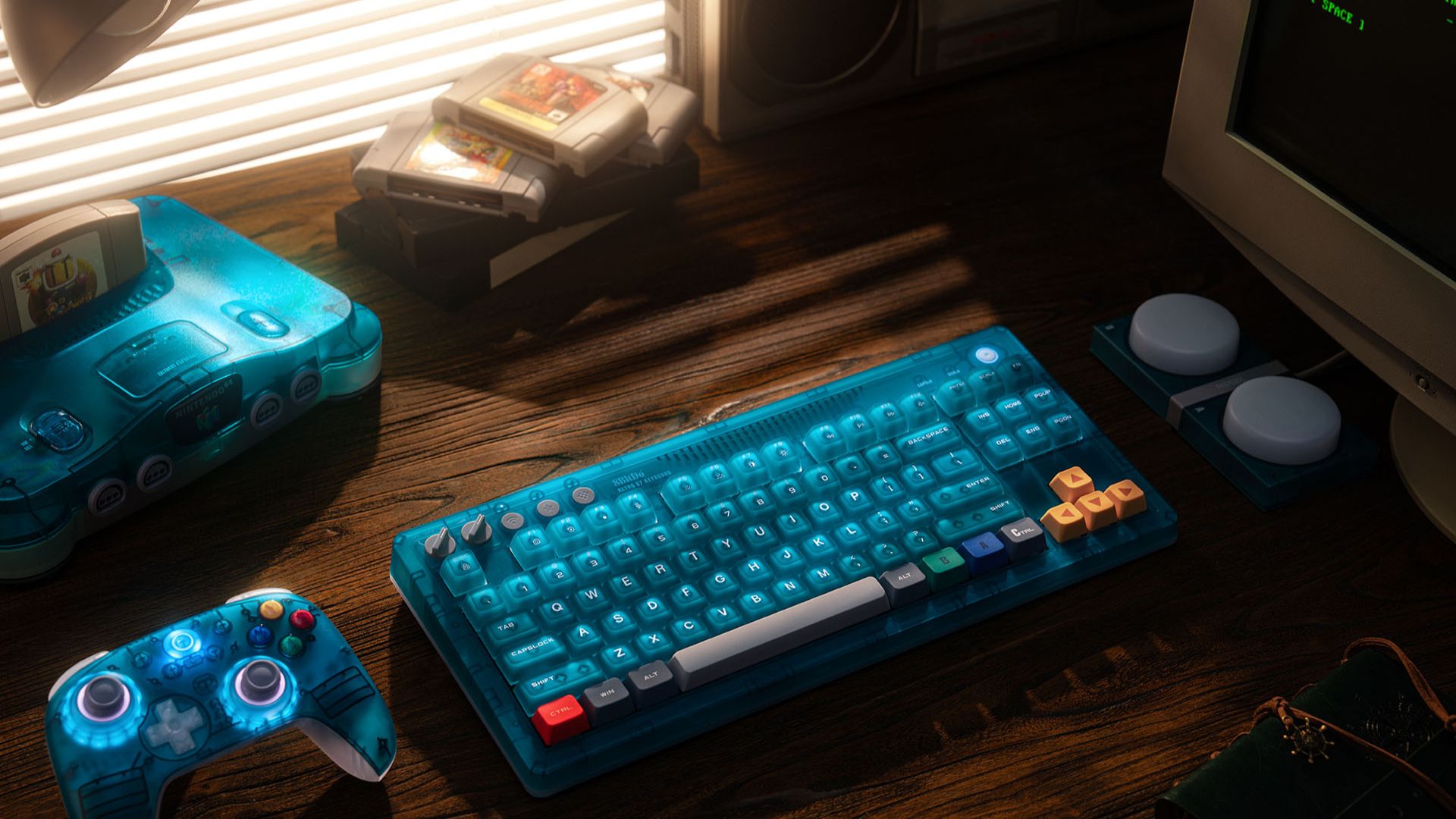
8BitDo is celebrating the Nintendo 64’s 30th anniversary with new versions of two of its most popular accessories. It is giving the Retro 87 Mechanical Keyboard and Ultimate 2 Wireless Controller a translucent blue makeover inspired by the classic console.
The new “Clear Blue” editions were initially announced in China. However, both products are also heading to the US, where they’re priced at $99.99 and $59.99 respectively.
The Retro 87 Mechanical Keyboard leans heavily into Nintendo 64 nostalgia. Alongside its translucent blue shell, it features yellow arrow keys modelled after the N64 controller’s iconic C-buttons. Meanwhile, the A, B and Start keys borrow the same blue, green and red colour scheme as the original gamepad.
Beyond the retro styling, the keyboard retains the same feature set as the standard model. That includes an aluminium plate, hot-swappable PCB and 8BitDo’s Cloud Gray linear switches. These were developed in partnership with HUANO. It supports Bluetooth, 2.4GHz wireless and wired connectivity. Moreover, it works with Windows and Android, and can be customised through the company’s Ultimate Software V2.
The keyboard also ships with two matching Super Buttons, though unlike some previous special editions, these aren’t wireless.
The Ultimate 2 Wireless Controller receives a similar treatment. It combines a translucent blue top shell with coloured ABXY buttons and grey thumbsticks. Also, a translucent white lower shell closely resembles some of the Nintendo 64’s most recognisable colour variants.
Thankfully, the cosmetic refresh doesn’t come at the expense of features. The controller still includes TMR thumbsticks, RGB lighting rings, a six-axis motion sensor and a 1000Hz polling rate. This rate applies when used in wired or 2.4GHz wireless mode. Furthermore, compatibility extends across Windows, Android, SteamOS and Apple devices.
While 8BitDo regularly releases game-themed accessories, this marks the first Ultimate 2 Wireless Controller designed around a console rather than a specific title.
The Ultimate 2 Wireless Controller N64 Edition is available now. Meanwhile, the Retro 87 Mechanical Keyboard N64 Edition is scheduled to launch on August 14, with pre-orders already open through 8BitDo’s online store.
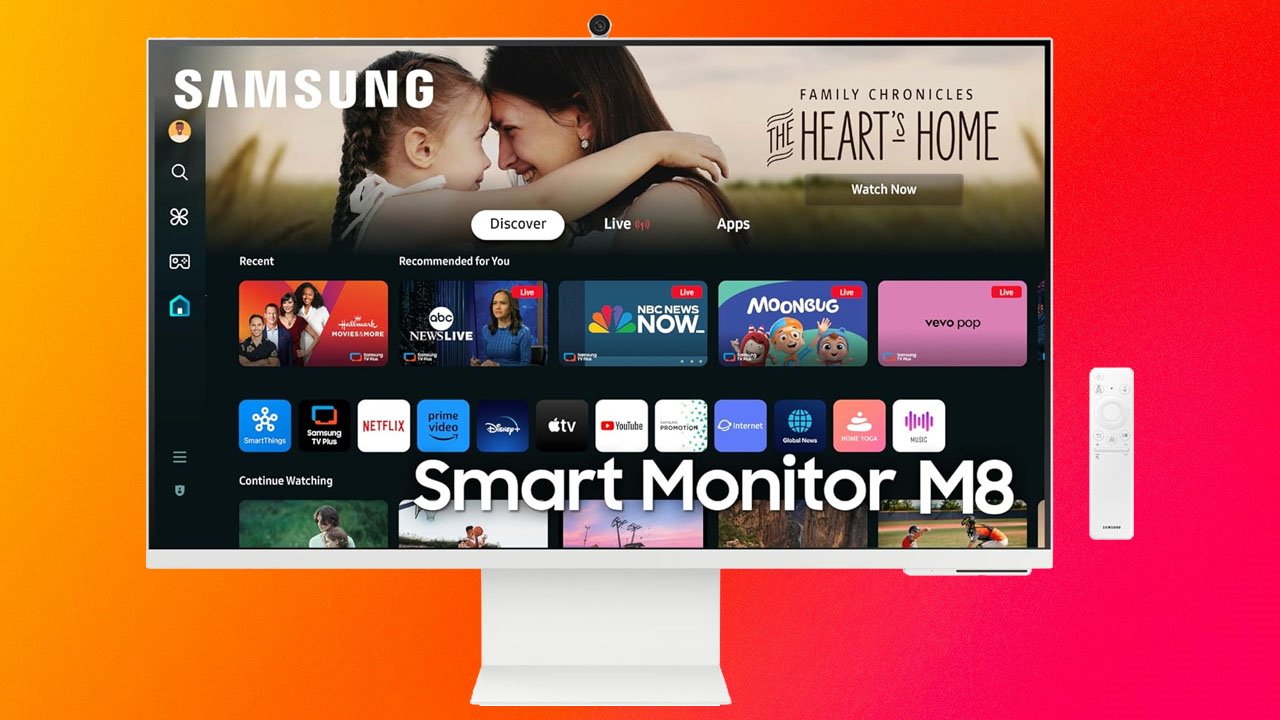
Today only, B&H Photo is selling Samsung’s 32-inch M8 4K monitor for $299.99 via a $400 in-cart coupon.
Beating Amazon’s Prime Day price by $85, B&H Photo has dropped the Samsung M8 display to just $299.99 during its 24-hour Deal Zone event.
Save $400 on Samsung M8 monitor
The $400 discount, which is in the form of an in-cart coupon, delivers the lowest price anywhere on the 32-inch monitor. Equipped with both HDMI and USB-C ports, this monitor, now at a budget-friendly price, pairs well with modern Macs.
Along with the robust discount, B&H is throwing in free 2-day shipping within the contiguous U.S. on the M80F monitor in Warm White, so you can begin using it quickly.
If you’re looking for a budget-friendly MacBook to pair with the monitor, B&H is offering AppleInsider readers an exclusive deal on a closeout M4 13-inch MacBook Air with 512GB of storage, bringing the price down to $899.
You can also browse our roundup of the top Apple Prime Day deals throughout the last days of the sale.


The Seattle Seahawks are in search of a buyer — but first they’ve locked up the organization’s first-ever global partner, signing a multi-year partnership with Accenture this week.
The deal pairs one of the world’s largest technology consulting firms with the NFL’s reigning Super Bowl champions, with Accenture bringing data and AI capabilities to bear on the franchise’s business operations and fan engagement.
Starting with data infrastructure and platform design, Accenture will work to modernize the Seahawks’ technology foundation with an eye toward broader innovation down the road.
The collaboration launches with a tangible fan-facing element: an Accenture-presented “Trophy Tour” taking the Seahawks’ Super Bowl LX hardware on the road to Germany, Australia and Canada — markets where NFL interest is growing and fans can connect to Seattle’s football story.
“This partnership brings together two organizations committed to innovation and global engagement, and is an exciting step forward for the Seahawks as we continue to expand our international efforts,” Isabelle Van Coevorden, Seahawks managing director of global markets, said in a statement.
The deal also has a local giving component, with plans for scholarship support, volunteer engagement and community access programs in Seattle. For Accenture, it extends a broader push into sports — the firm already works with the NFL, women’s tennis and golf organizations on technology and operations.
Accenture has a significant Seattle-area presence, and the Seahawks have been intertwined with tech since Paul Allen — the late Microsoft co-founder and billionaire philanthropist — bought the team in 1997, kept it in Seattle, and turned it into Super Bowl champs.
Allen died in 2018, and his estate put the Seahawks up for sale in February — shortly after the team’s Super Bowl LX victory over New England — with all proceeds directed toward philanthropy. The franchise is expected to fetch upwards of $7 billion.
Several high-profile names have surfaced as potential buyers. Former Boston Celtics majority owner Wyc Grousbeck and ArcelorMittal CEO Aditya Mittal were reported in May to be preparing a bid. Todd Boehly, who owns the Los Angeles Dodgers, L.A. Lakers and Chelsea Football Club, emerged as another potential suitor in June.
Accenture employs 799,000 people in offices around the world, including locations in Seattle, Redmond and Kirkland. The company says it serves approximately 9,000 clients and generated about $70 billion in FY25 revenue.

Shares of Cerebras Systems dropped almost 20% on Wednesday, even after the company delivered better-than-expected first-quarter earnings on Tuesday.
That’s because in its first earnings report since going public, the AI chipmaker forecast a narrower gross margin in its core business, guiding for a full-year margin of 38% to 41%, compared with the 47% reported in the first quarter. The stock hit a new low on Wednesday, almost hitting the company’s IPO price.
Cerebras CEO Andrew Feldman told CNBC that investors had misunderstood the company’s margin guidance, noting that Cerebras will need to rent back some equipment from one of its largest customers.
The company said during its earnings call that it decided to make more capacity available sooner by temporarily renting its own systems back from an existing customer while it builds out and deploys its own data center capacity. The company said this would cut into profit margins this year.
According to the company’s earnings report, revenue for the quarter reached $193 million, up 94% year-over-year. Net loss narrowed to $14 million, down from $23.9 million a year earlier.

In a world marred with oppression and strife, one injustice rises above all else: Elon Musk is not currently a trillionaire.
When SpaceX went public earlier this month, Musk became the world’s first trillionaire. He declared in a victory lap-slash-speech that he aspires to take all of us to the moon, Mars, and “maybe beyond the solar system.” He awkwardly threw his fists in the air while his acolytes cheered him on.
But stock prices fluctuate, so right now he’s merely a several-hundred-billionaire, according to Bloomberg’s Billionaires Index.
Frankly, it’s embarrassing. How will Musk support his legion of offspring? Can he even afford to keep expanding his already considerable brood, given his outspoken pronatalism? The math is getting complicated.
We wish him the best as he navigates this trying time. And, Elon, if you need a good rice and beans recipe, or some tips on how to win big at the thrift store, we can point you in the right direction.





Weekend Open Thread: Miami – Corporette.com


Renter of Home in Anne Heche Crash Denies Settlement With Son

Two goals and an assist by sheer aura: Cristiano Ronaldo just entered the World Cup chat


Microsoft accidentally kills epic Outlook email threads


Soccer-U.S. defends Iran World Cup travel restrictions, says discussions ongoing
Bitcoin (BTC) Dips Below $62K, Ethereum (ETH) Plunges 6% Daily: Market Watch


Andy Burnham and the meaning of Makerfield


BBC Reporter Discusses Cross Party Criticism Of Trumps Iran Deal


Securitize Wraps Roubini's SEC-Registered ETF as Dubai VARA Digital Security
Entergy settles forward sale agreements, raises $672 million in cash proceeds


Keir Starmer Allies Question His Chances For No 10

Wall Street Week Ahead: Investors see Micron earnings as pulse check of AI rally momentum


AWS enters the context layer race with a graph that learns from agents, not manual curation

Can Charles Hoskinson Really Rescue Cardano?


HIVE shares jump as $220M AI deal speeds Bitcoin mining pivot


Jake Chervinsky accuses CME of protecting derivatives monopoly

Signal’s Meredith Whittaker says AI chatbots ‘are not your friends’ and calls Copilot agents a backdoor


Jose Alvarado Wants Taylor Swift at More Knicks Games

Nearly 7,000 fake Amazon domains registered ahead of Prime Day 2026, researchers warn


Brexit cost 6% of UK economy, Bank of England company data suggests



You must be logged in to post a comment Login