
Tech
Group of bipartisan lawmakers ask US government to ban several hack-for-hire firms


A bipartisan group of U.S. lawmakers has asked the U.S. government to ban several hack-for-hire firms — companies that carry out cyberattacks on behalf of paying clients. The lawmakers accuse the firms of targeting Americans and abusing foreign courts to silence U.S. reporting on their activities.
Democratic senators Ron Wyden of Oregon and Sheldon Whitehouse of Rhode Island, and Republican congressman Pat Harrigan, on Wednesday sent a letter to U.S. Secretary of Commerce Howard Lutnick, urging him to add three Indian companies to the department’s economic sanctions “entity list.”
The list effectively bars U.S. businesses from transacting with a named entity, with the aim of restricting the companies from accessing critical technology needed to function, including software licenses and cloud infrastructure.
In the letter sent to Lutnick and shared with TechCrunch, the lawmakers say BellTroX, CyberRoot, and Sunkissed Organic Farms (which previously operated under its former name, Appin) have for more than a decade conducted cyberattacks and targeted espionage against Americans, business owners, and their lawyers, to “manipulate ongoing litigation.”
The lawmakers say that these mercenary hacking companies have stolen data from thousands of Americans, and accuse the hackers of an “aggressive censorship campaign” to suppress public awareness of their alleged activities.
“This coordinated effort effectively allows foreign entities to use foreign courts to keep the American public in the dark about cyber threats to their own country and undermines the fundamental constitutional rights of U.S. citizens,” the lawmakers said.
It’s not clear if the Commerce Department will add the companies to its entity list, and a spokesperson did not respond to TechCrunch’s request for comment.
The letter’s request to add the companies to the entity list follows extensive reporting and media investigations on the hack-for-hire industry, documenting how hackers are paid to break into the inboxes and devices of executives, lawmakers, and military officials to gain an advantage in lawsuits or influence their outcomes.
One of the companies, Appin, previously secured a global court order from an Indian court forcing Reuters to take down its reporting on the company while Reuters appealed the order. The notice that appeared on the page at the time said that Reuters “stands by its reporting.” The order was later lifted and the report republished.
The digital rights group Electronic Frontier Foundation previously defended two news organizations, Techdirt and the MuckRock Foundation, from legal threats after Appin engaged in “a campaign of bullying and censorship seeking to wipe out stories” about the company’s involvement in mercenary hacking.
The lawmakers’ letter said that the hack-for-hire companies “operated at the behest of the Qatari government” and that their targets included a former senior Republican lawmaker.
Appin has been linked to Qatar before. Earlier reporting tied Appin to a campaign of cyberattacks against FIFA officials, reportedly directed by Qatar as part of an effort to protect its plans to host the 2022 World Cup.
A representative from the Qatari government in Washington, D.C. did not respond to TechCrunch’s request for comment.
An email from TechCrunch to Anuj Khare, a director at Sunkissed Organic Farms, went unreturned.
Separate reporting by The New Yorker and digital investigative unit The Citizen Lab has also documented espionage activity by the two other hack-for-hire firms named in the lawmakers’ letter, BellTroX and CyberRoot.
TechCrunch sought comment from representatives at CyberRoot, but did not hear back prior to publication. BellTroX could not be reached for comment.
When you purchase through links in our articles, we may earn a small commission. This doesn’t affect our editorial independence.

Tech
Samsung’s Galaxy Z Fold8 is a Passport-Sized Smartphone That Puts a Tablet in Your Hands, Perfect iPhone Ultra Alternative
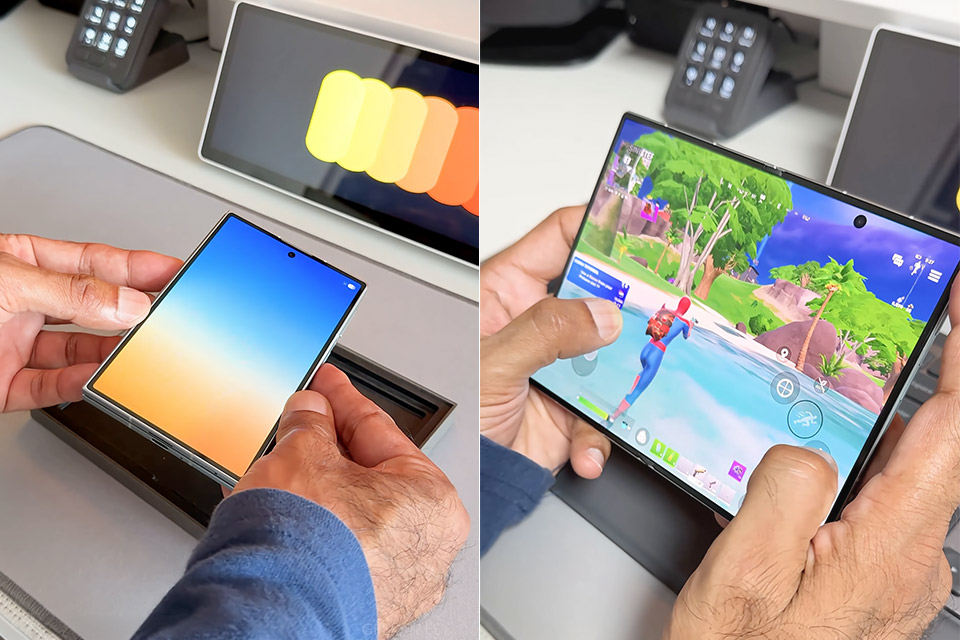
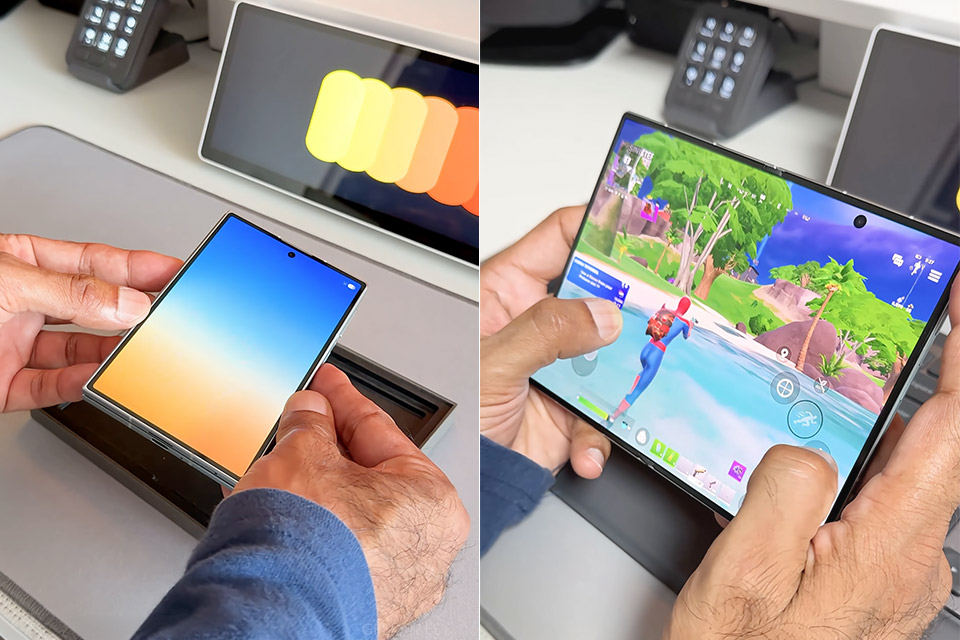
Samsung spent countless hours stretching book-style foldables taller and slimmer. Galaxy Z Fold8, priced at $1,649.99 (was $1,900), goes the other direction, folding into a short, wide slab that sits in a pocket like a passport and opens into a 7.6-inch screen built for movies, books, and two apps at once. Folded, the phone measures 123.9 by 81.9 by 9.7 millimeters and weighs 201 grams, light enough that reviewers keep comparing it to a regular flagship rather than a hinge-and-glass experiment. Opened, the body thins to 4.5 millimeters. Armor aluminum, Gorilla Glass Victus Ceramic 3 on the cover, and an IP48 rating (dust over 1 millimeter, 1.5 meters of water for 30 minutes) keep the package from feeling fragile after a month of daily carry.
A 5.5-inch Dynamic LTPO AMOLED 2X panel with 1248 by 1972 resolution, 428 pixels per inch, and a refresh rate of 1-to-120 Hz takes care of the cover duty. That outer screen is wide enough for two-thumb typing and social feeds, short enough that some testers shrink fonts to see more at once. Most people continue to rely on it for 80 percent of their daily needs. When unfolded, you’ll find a 7.6-inch inner panel with a resolution of 1848 by 2448, approximately 403 ppi, HDR10+, and a peak brightness of 3,000 nits.
Sale

Samsung Galaxy Z Fold8, 256GB, Cream
- CREATED FOR YOUR CONTENT: Any way you turn it, the new Galaxy Z Fold8 gives you a fuller viewing experience. Designed with your content in mind, this…
- WORLD’S LIGHTEST FOLD¹: Galaxy Z Fold8 is the newest foldable phone for content on the go. Unfolded, it fits movies and books for an immersive…
- THE BRIGHTEST DISPLAY ON A GALAXY PHONE: Our brightest smartphone display² provides you with a comfortable view, whether you’re inside or outside…
Flex Titanium has flattened the crease into a line that is only noticeable if you look for it. The aspect ratio is close to 4:3 in portrait and 16:10 in landscape, which is suitable for documents and video without the skinny-book cut that older Folds imposed on everything. Apps still stretch or letterbox from time to time, but One UI 9 on Android 17 improves on that with split view, pop-up windows, and DeX for desktop access. Seven significant OS updates are promised.
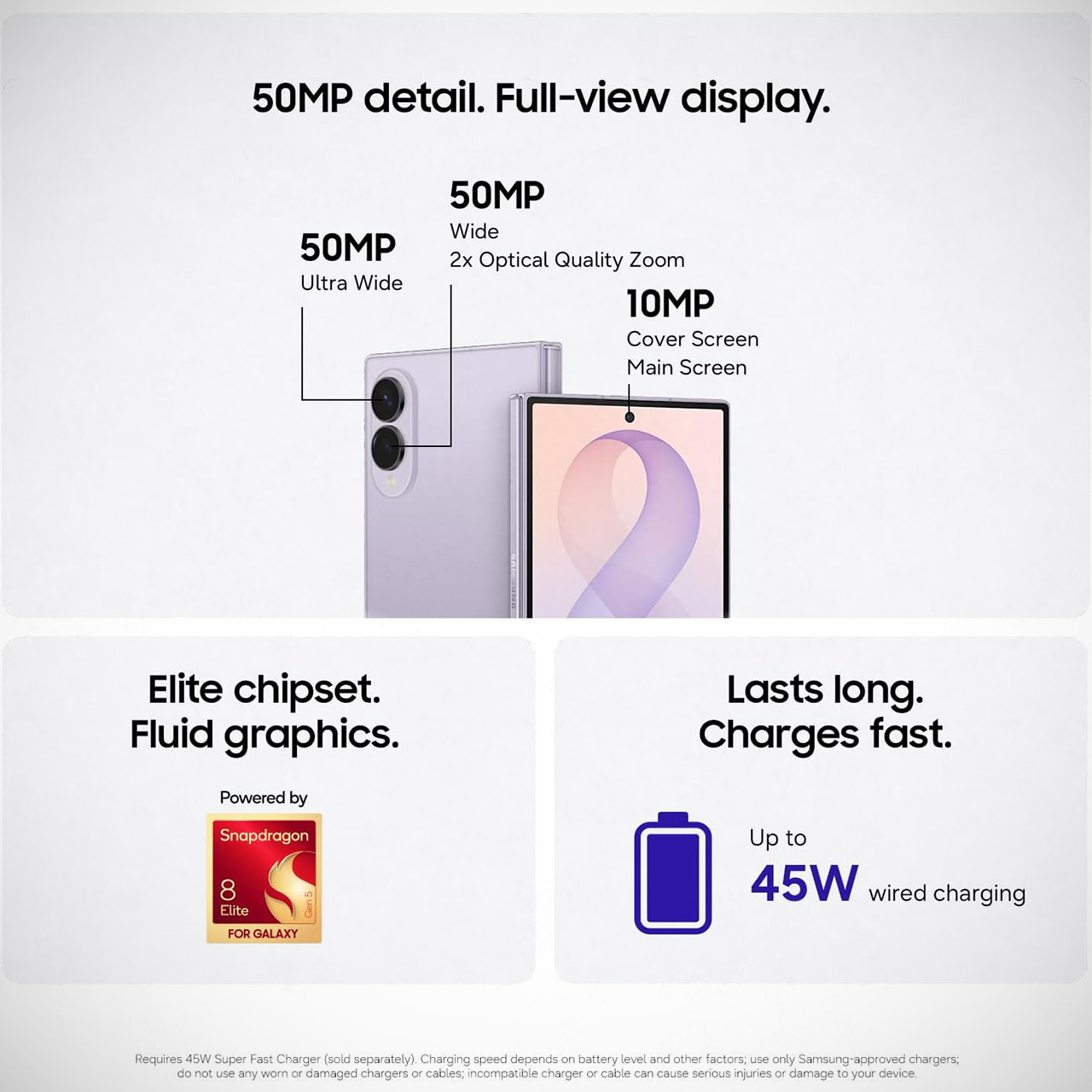
Qualcomm’s Snapdragon 8 Elite Gen 5 Samsung Galaxy, which uses the same 3-nanometer CPU as the S26 series, drives 12 GB of RAM on the 256 GB and 512 GB variants, and 16 GB on the 1 TB version. Everyday tasks, games, and three-app setups remain zippy. Sustained loads continue to produce heat and some throttling after half an hour, therefore many owners leave the performance profile set to lighter. The battery is a 4,800 mAh silicon-carbon cell, up from 4,400 mAh last year. Mixed use across both displays results in a full day, with video playback testing lasting more than 21 hours and Samsung claiming up to 26. Wired charging is 45 watts, or approximately 63% in 30 minutes. Wireless has a power output of 20 watts, whereas reverse wireless has 4.5 watts. The cycle rating spans from 1,200 to 80 percent, making it shorter than prior Folds, which is a minor trade-off for thinner cells.

Cameras are the standout feature. The rear duo has a 50-megapixel f/1.8 main camera with OIS and in-sensor 2x, as well as a 50-megapixel f/1.9 ultrawide camera with 120-degree coverage. Both 10-megapixel selfies are at f/2.2, one on the cover and one inside. Daylight stills and 8K or 4K footage appear clear. Ultrawide attention is advantageous. There is no dedicated telephoto lens, so zooming beyond 2x is digital, and the main sensor is smaller than the 200-megapixel units on the S26 Ultra and Fold8 Ultra. This Fold is not suitable for long-range photography. The speakers are stereo, but they only fire from one side when the phone is in landscape mode, causing movies to lose breadth. The remaining features include a side fingerprint scanner, Wi-Fi 7, Bluetooth 6.0, UWB, and dual eSIM.


Many drivers have been there — a sudden fender bender or a loss of control on a rainy day. When the worst happens, we rely on auto insurance to cover the damage. Almost every state requires auto insurance by law, and for good reason. If you cause an accident or damage another person’s property, you’re responsible. Even a minor accident can cause thousands in repair bills. You could also be on the hook for hospital and legal bills. If you finance your vehicle when you buy it, of course, your lender will likely require you to carry a certain amount of insurance coverage.
One policy makes sense, even if you don’t go with the highest-ranked auto insurance company, but what about two? If you use your vehicle for both work and pleasure or you want to cover expensive aftermarket additions that your standard policy excludes, you may have thought about purchasing a second policy. While no U.S. law prohibits carrying multiple insurance policies on one vehicle, paying for both is usually a waste of money.
Sometimes we accidentally end up carrying multiple policies for the same vehicle — it’s especially common when you change insurance companies and forget to cancel your old policy. Accidental or otherwise, you cannot make two claims after an accident to get double the payout. If you try, it could slow down the payout process, and both insurers may try to claim the other is responsible. Double-insuring may also go against an insurer’s policies, and could lead to you losing perks like good driver or bundling discounts.
What to know, and when two policies actually makes sense

Even when the process of filing an insurance claim goes smoothly, a payout takes time. If you have more than one insurance policy on your vehicle, it may delay the process even further. Your insurance companies will do something called a coordination of benefits to determine which policy is responsible for the claim. Unless one company pays first and the second company only pays for anything the first company did not cover, you’re committing insurance fraud.
Ultimately, paying two premiums for two insurance policies makes little sense for most drivers. You’re paying for double the coverage but only receiving benefits from one policy when you file a claim. If your insurance policy doesn’t offer all the coverage you need or want, you should shop around for a better policy rather than purchasing a second. Stay away from cheap car insurance, which may come with high deductibles, minimal coverage, and poor claims support.
For most people, the only instance when buying two policies makes sense is if you’re transitioning from one policy to another and need to fill a coverage gap. To avoid accidentally paying for two policies at once, know when the cancellation of your old policy is effective and start your new policy with as little overlap as possible. If you and your spouse share a vehicle, you only need one policy, with both of you listed as drivers. If you share a car with a significant other who doesn’t live with you, they likely fall under your insurance company’s permissive use clause, which lets them drive your vehicle with your consent, eliminating the need for a second policy.
Tech
US Authorities Accuse Chinese AI Companies Of Industrial-Scale Campaigns To Copy American Models


American authorities are accusing Chinese companies of “distillation activities at an industrial scale.” The National Security Agency (NSA), Cybersecurity and Infrastructure Security Agency (CISA) and Federal Bureau of Investigation (FBI) have issued a joint cybersecurity advisory, warning organizations that Chinese AI companies are extracting the “proprietary functionalities and capabilities” of frontier American models.
Specifically, the agencies are accusing DeepSeek, Moonshot AI, Alibaba, MiniMax, StepFun and Z.AI of extracting “billions of tokens across millions of exchanges/requests” from American models, including Anthropic’s Claude, OpenAI’s GPT, Google’s Gemini and xAI’s Grok, since 2024. Distillation is the term for a method in AI development in which the output of a powerful model is used to train newer ones.
The warning states that DeepSeek used data and capabilities from various Claude, Gemini, GPT and Grok models to train its own, including the R1. That’s the powerful, open-source reasoning model the company released in early 2025. Moonshot AI, the agencies said, extracted “significant” data from Claude’s Fable to train Kimi K3, which is considered one of the most advanced models developed by a Chinese company. Anthropic created Fable to bring some of the capabilities of Mythos, its state-of-the-art cybersecurity model exclusively available to Project Glasswing participants, to the public. Similarly, Moonshot’s Kimi K2 used GPT-4o data, the agencies add.
The warning lists the American frontier models the Chinese companies allegedly used to train their own, along with the mitigations US firms can implement to combat “malicious distillation campaigns.”
American companies have long alleged that Chinese firms are trying to copy their technologies. Shortly after DeepSeek became the top free iPhone app early last year, OpenAI said that, along with Microsoft, it had been banning accounts it suspected of “distilling” its technologies. DeepSeek was one of the companies it investigated. Earlier this year, Anthropic also accused DeepSeek, Moonshot and MiniMax of wide-scale distillation campaigns. But it’s not just Chinese companies: In OpenAI’s announcement about pulling its models from Cursor, it noted that Elon Musk admitted to using OpenAI’s output to train xAI models during cross-examination in the lawsuit he filed against the company.
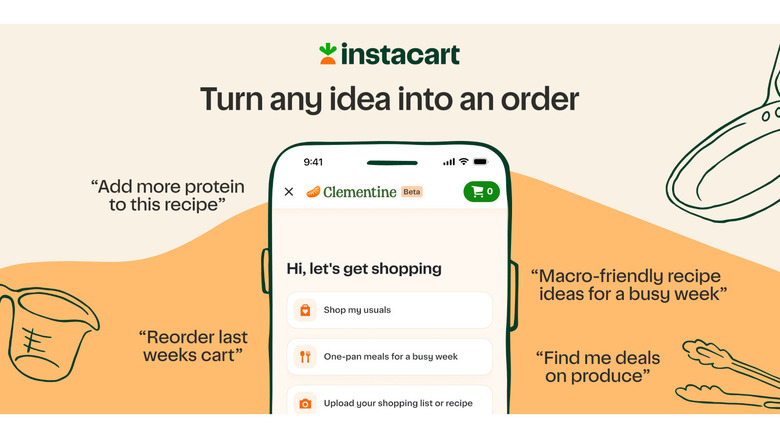
It can recommend recipes with ingredient lists you can quickly add to your cart.
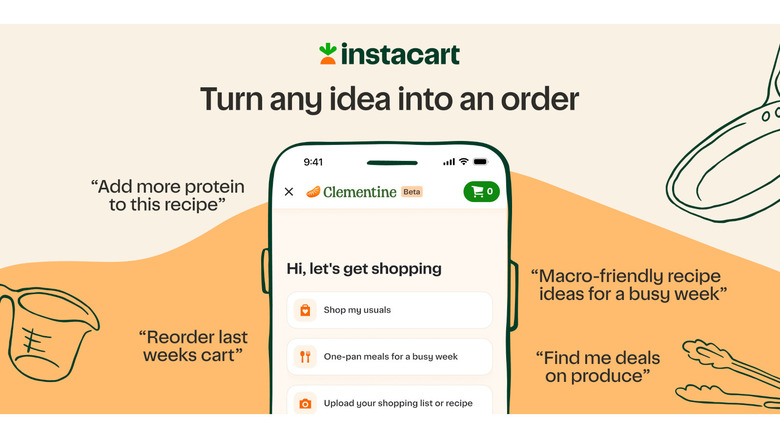
Instacart has launched Clementine, its own AI shopping assistant, which it says was designed to tackle the hardest parts of grocery shopping: deciding what to cook while staying within budget. Clementine, which is now available across North America on the Instacart Marketplace, understands natural language like other AI chatbots. You can tell it that you need “to make a high-protein easy dinner for two,” and it will respond with a recipe that comes with a list of items you can add to your cart with a tap.
The company says Clementine’s responses will be based on what’s currently available in your chosen store location, so you won’t end up considering a recipe that you can’t get ingredients for. If you already have some items in the ingredients list, you can remove them before adding the rest to your cart. Clementine can also make suggestions based on the choices you set in its preference center. For example, you can tell it to suggest only nut-free, vegetarian or gluten-free recipes to make sure it recommends food your household can actually eat.
In addition to helping you decide what’s for dinner, you can also use Clementine to quickly shop for your staple items. If you tell it to restock your pantry or to shop your usuals, it will take information from your previous orders to present you a list that you can swiftly add to cart and pay for. And if you like jotting down your grocery list by hand, you can take a photo and have Clementine turn it into an item list you can add straight to your cart. That said, you may want to review the assistant’s suggestions checking out: Instacart says orders placed with Clementine typically exceed its $115 average basket size, probably because it’s so easy just paying for everything it recommends.
While Clementine is Instacart’s own AI chatbot, it’s not the only one that works with its system. Over the past few months, the company has teamed up with tech companies to bring grocery integration to ChatGPT, Claude, Gemini or AI Mode in Google Search.

Choosing places to visit or the best flights just got a lot easier with Gemini.

Planning a great trip can be a lot of fun, especially if you’re the kind of person who really likes to know all the details. But it can also get exhausting pretty quickly. It usually involves diving into blogs, Reddit posts or YouTube vlogs. Not to mention all the long reviews you need to check on Google Maps. The result is probably a bunch of tabs in your browser — and you can really waste a lot of time doing all of that. Well, that’s how it used to be before AI. Tools like Gemini can make planning your next trip much easier. It’ll probably make you never want to plan a trip the old-fashioned way again.
Creating full travel itineraries with Gemini
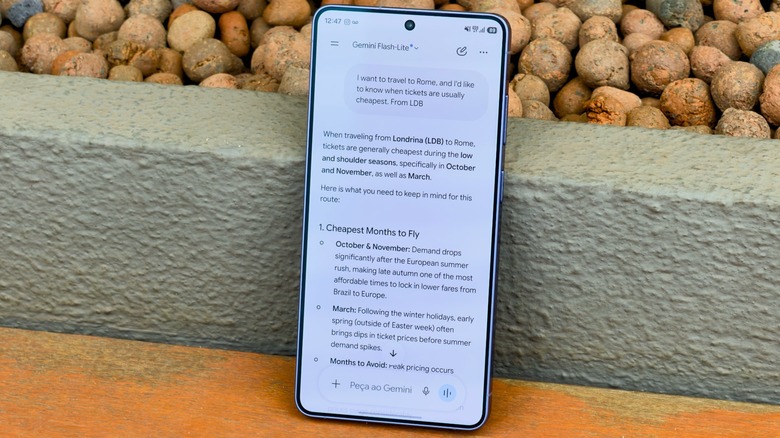
Of course, there are plenty of AI chatbots you can use to plan your trips — ChatGPT, Claude, even the new Siri app in iOS 27. But Gemini is even more interesting because it has deep access to other Google services like YouTube and Maps. Remember all those places you used to explore for travel ideas? Gemini knows them all very well. It also goes way beyond just providing you with a bunch of tourist attractions to visit. Here, the integration with Google Flights makes it especially powerful. Price tracking and Flight Deals are built in.
Let’s say you’re planning a trip to Rome. Ask Gemini when plane tickets are usually cheapest. It will give you a full breakdown of the best time to buy and the recommended flights from your local airport. You can even ask Gemini to handle your flight and hotel reservations for you — although a human touch might still be the best option for big decisions like these. And the results are quite accurate, though AI may get you into trouble sometimes. Looking for a good place to stay? Ask for a budget option. Or maybe spring for a fancy one. It’s up to you.
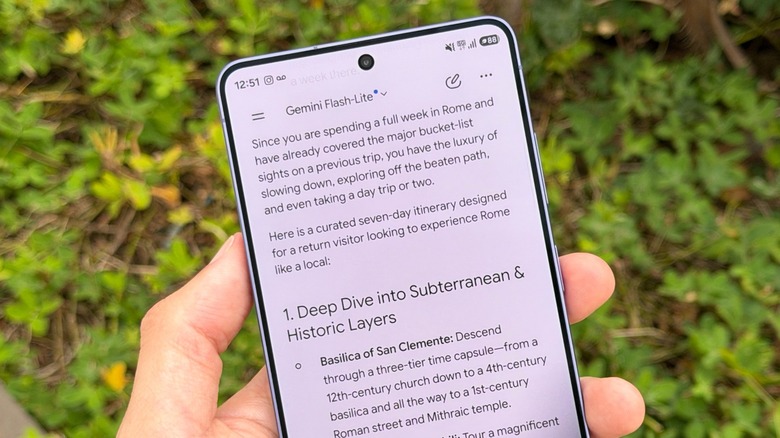
Maybe you’ve been to Rome before. If you use Gmail, there’s a good chance Gemini knows that. Or you can remind it, just to be sure. You’ll get a list of things to do that most people skip on their first trip there. And the more specific you are in your prompts, the more likely Gemini is to give you the best results. Tell it what you like and the schedule you have in mind.
AI can also save you during your trip
When it’s time to travel, Gemini can also make things easier. Ask it to create checklists for you with everything you need. That feeling of leaving something behind is the worst. And it’s always worth double-checking to make sure you have all your documents with you. It can even find a rental car or train tickets for you. And if you’re into having printed copies of everything, Gemini can create some handy printouts for you using your entire trip itinerary.
But the best part comes during the trip. Not just because you’re there, but because Gemini helps you with everyday navigation, too. Use the camera button to take photos of your surroundings. It can tell you the whole story behind that painting or statue you have no idea about. Sometimes it really feels like you’re talking to someone about your trip instead of just using a tool. Give it a try on your next trip, and going back to two dozen open tabs might feel impossible.

ASUS is getting ready to give its Vivobook lineup a major style refresh in India. The company has confirmed that its next-generation Vivobook laptops will launch on September 16 at 12 PM, bringing new colors, premium all-metal builds, and up to 38 hours of battery life under the campaign tagline “Your Vibe. Your Color.” The lineup will span both traditional clamshell and 2-in-1 convertible models powered by AMD, Intel, and Snapdragon processors.
Fun Asus Vivobook Colors and Design

The biggest visual change is the introduction of three new finishes: Light Blue, Cool Silver, and Matte Gray. While Silver and Gray cater to users who prefer understated, professional-looking machines, the new Light Blue variant adds a more youthful and lifestyle-oriented option to the lineup. All models will feature an all-metal chassis with a refined metallic finish, giving the laptops a more premium feel than traditional plastic-bodied notebooks. ASUS also claims the new Vivobooks can deliver up to 38 hours of battery life, though the exact endurance will depend on the processor and configuration.
The refreshed portfolio will include the Vivobook 14 Flip, Vivobook S14 Flip, Vivobook S14, Vivobook S16, and Vivobook 16. ASUS has confirmed that the lineup will span AMD, Intel, and Snapdragon-powered configurations, giving buyers a wider choice across traditional laptops and 2-in-1 convertibles. While the company has yet to reveal detailed specifications, the teaser suggests the new Vivobooks will continue to target users looking for everyday performance across work, studying, entertainment, and creative tasks.
ASUS is also bundling an introductory protection offer alongside the launch. Buyers will be able to purchase a package that includes two years of extended warranty and three years of accidental damage protection for just ₹99, despite the bundle being valued at ₹5,599.

Small and medium-sized business owners can lack the time and budget required to keep their audience engaged. If you work to fill in the gap and offer related services, getting things done in the right and professional way for your clients can be an easy flow at the onset, but it can become complex over time. From keeping the audience engaged with graphics, videos, and catchy captions, social media content requires extra effort.
However, using AI on the side changes the equation and makes it easier to handle these tasks for SMB clients. You can generate consistent visuals across platforms with a professional finish. Here is how you can scale the content production process.
Outline the Brand Details
Creating professional social media content for small and medium-sized business clients requires outlining and clearly defining the brand details. It is the first step, and it determines how the audience embraces the information. This ranges from the visuals to other elements. For your visuals, outline the colour codes, font families, and logo placement rules. In addition to your image style preferences, languages and audience engagement styles are extra details to state clearly and put forward. However, these details must be convertible into AI parameters.
Set up your Social Media Pages Guidelines
Social media platforms are more than one, with different rules applying to their use. To create professional content with AI, you need to set up approaches that will fit into any of the usage and aid your brand’s consistency. For instance, X is well-suited for short messaging, and you can easily engage in real-time conversations. LinkedIn comes in as more professional, usually best suited for long-form explanations and business-focused visuals. Facebook and Instagram present a broader channel for visual and text-based posts as well as community-driven conversations.
Select and Train the AI Tool
There are various available AI tools for content creation, both free and paid. Whether you are choosing any, the initial setup is essential for the overall content you want to create. You can make adjustments or refine your assets to match the auto-processing. This step-by-step process to set up these tools includes
- Upload brand assets, including logos, fonts, and colour palettes, to the AI tool you are using.
- Layout your preferred post types, themes, and message formats.
- You can generate professional sample posts that meet your brand standards.
- Make your custom adjustments from the feedback received from the tool.
Create Your Content Workflow
With assets and setup all in place, you can build a structured process for creating and managing social media content posts. For instance, you can generate multiple posts for SMB clients’ media platforms and schedule them for the day or week. Creating a professional content workflow also revolves around mapping out themes and campaign priorities.
Ways You Can Use AI for Social Media Content for Small Businesses
There are several ways of using AI to create professional social media content for small and medium-sized businesses. These help SMB clients cut work hours, improve work standards, and maintain brand consistency across platforms.
If there is multiple content to brainstorm before sharing across social media pages, AI tools are handy for breaking them down. Rather than going on long deliberations with a blank slate, you can input a few ideas on AI tools for suggestions. These include ideas about the business, production, and target audience.
- Repurpose Long-form Content
Aside from expanding ideas, you can repurpose and cut down long-form content with AI to match the demands of social media pages. Turn blog posts or newsletter articles into guides for X posts or Instagram carousel headings. You can also convert this content to generate Facebook reels.
- Schedule Posts and Hashtags
You can inquire from AI on the best posting time and lead on non-saturated hashtags that match your niches.
With an AI, you can generate alt-texts for photos and social media content to make it more professional. It helps patch product details like material, colours, and size that social media platforms can index.
- Automated Response Templates
Beyond creating content, one of the leverages of AI is automated professional responses. You can easily create polite and human-like reply templates for common questions. Training your AI tool over time best positions it to act on your behalf when you’re absent.
What are the Best AI Tools for Professional Social Media Content
Zawa
Zawa offers a worksuite for creating and coordinating social media content. The AI branding agent is an ideal tool for small and medium-sized business owners. And you can leverage it for content creation and marketing. Outline your business details and create an ideal brand kit – from logos to flyers and social media posts. Zawa AI image upscaler is a plus for enhancing image quality and conveying your content in all shades of professionalism.

Zawa AI Agent for Creating Social Media Content and SMB Clients
Zawa is a professional branding tool that helps designers serve SMB clients faster. The AI agent comprises a full-featured worksuite with various tools to plan, modify, and adjust brand content from scratch. Simply put, it is an add-on for creativity and branding. From logos to posters to social media posts, you can incorporate it into a small business’s workflow, especially if you are particular about professionalism. It allows you to establish a consistent visual identity without a design team and to bring your ideas to life across channels in high-quality formats.
With the Zawa AI Product Video Generator, you can easily create videos with your product image. The AI supports shoppable videos and UGC-style, ready-to-use videos in a few minutes while you select your preferred avatar. Also in the worksuite are smart social media tools that you can use to create standard captions and images for your page. Other tools, like the video text remover, video remix and logo generator, video enhancer, come in handy for your media creations.

Buffer
One of the best AI tools to share your content in a professional format is Buffer AI. Social media comprises multiple channels with different rules. And going through all of it at a time can be taxing. Buffer puts you in the mainstream by running multi-channel campaigns. You can bring together content topics, promotions, and schedule your posts. It helps adapt the content calendar with social channels, making feeds more valuable.

Canva
Canva is handy for creating professional social media content and images – for yourself and clients. You can generate media designs using AI-powered template suggestions and image placement. The tool features an extensive template library. As a small business owner, you can adopt the background removal, image enhancement, and text-to-image generation features.

Content Studio
For small business owners, following online leads and updates is essential for tracking and modifying media content. However, you cannot stay there all day. Content Studio reduces the scroll work and lets you track preferred topics. In addition to adding preferred topics, you can view metrics for each content piece, including your post. These range from news articles to social media posts.
Tech
Suno replaces its AI models with a new one trained on licensed music as copyright suits pile up

AI music model maker Suno on Wednesday unveiled a new model family called Suno v6, which it says was developed using licensed data from music labels and distributors such as Warner Music Group, BMG and Believe.
Suno has faced multiple lawsuits from record labels, which accused the startup of using copyrighted data to train its AI models, which let you generate music with prompts. Suno settled with Warner Music Group last year, and struck a deal with BMG last month.
The company said Suno v6 is not trained using the data it used to train previous versions of its music-generating model.
The startup is releasing three versions of the model: The base Suno v6 model is available to paying users, and is said to be reliable and steerable for controlled outputs; Suno v6 wild is an experimental model, also available to paying users, that’s meant to be used for ideation and getting unexpected results. Lastly, Suno v6 mini is a faster version available to all users. The company plans to retire its older models.
Suno says the new model lineup offers greater flexibility in how you use them. Suno v6 lets you edit a part of a song using a prompt or a word in the lyrics, and even lets you use text, images or video as references to create tracks. You can separate an instrument from a sample and create a new beat with it.
The startup also said it plans to add new features such as letting users remix songs — provided the respective artists opt-in to a new program it is setting up with music labels that lets Suno use their songs for AI-generated features.
Jack Brody, Suno’s chief product officer, said through derivative work, there is more opportunity for revenue generation for all stakeholders
“I think the music ecosystem and our partners are always looking for ways to create more revenue opportunities for their rights holders and artists. So a big part of this release is creating additional revenue streams there,” Brody told TechCrunch in an interview.
Last month, Suno said it plans to add a watermark to songs generated using its platform. It also recently also introduced new download limits based on the account’s tier.
“We can help manage some of the broader ecosystem challenges like streaming fraud and kind of mass exportation and uploading to distributors that are low intent. At the end of the day, we think it is up to the distributors and the platforms to govern what content goes on there,” he said.
Suno is still facing lawsuits from labels like Sony and Universal Music Group, artists like Jason Isbell, and users alleging it ignored security while chasing profits. The model announcement comes a day after the company admitted to training its models using YouTube videos.
Despite these controversies, Suno has raised over $819 million in funding to date, according to PitchBook data.
When you purchase through links in our articles, we may earn a small commission. This doesn’t affect our editorial independence.

A last-minute report ahead of Apple’s iPhone 18 Pro unveiling says that the Dynamic Island will let users display more Live Activities.
It’s been regularly reported that Apple has reduced the size of the Dynamic Island on the iPhone 18 Pro, despite clear limits on what it can do. But now according to Bloomberg, Apple is adding a little more functionality even as it cuts back on the size of the feature.
Specifically, it’s claimed that the reduced Dynamic Island will display three ongoing tasks as Live Activities. At present, two can be displayed and it’s possible that will continue, but the new version will let users toggle between three.
Live Activities were added to the iPhone 14 Pro in 2022, and provide at-a-glance information. Flight details can be displayed there, for instance, or sports scores, or the time until an Uber arrives.
Originally this was Apple making the most of the cutout necessary for Face ID. By adding black pixels either side of the cutout, it could switch to displaying icons or text in that space when wanted.
Users could see continuously what was happening with an activity. Then they could tap on the Dynamic Island to have a pop-up showing more detail
It was a clever move that, as ever with Apple’s design, has been copied by Android. But as useful as Live Activities are in their present form, they may be changing soon.
That’s because Apple is reportedly still working toward removing the cutout entirely. It would do so by having the Face ID sensor entirely under the display, and may even do so by 2027.
Live Activities have proven too useful to be abandoned, so Apple will surely still display them. Apple is unveiling the iPhone 18 Pro during its September 9, 2026 event.

I’ve spent years reviewing smartphones, and if there’s one aspect where Honor never fails to impress, it’s the bold design experiments. Earlier today, Honor gave us our first glimpse at the Magic 9 Pro Max flagship phone with ARRI camera imaging tech. The phone is scheduled for launch later this month in China, followed by wider availability in other markets.
Before we dig into the hardware specs, let’s talk about the design. The phone borrows inspiration from the iPhone 17 Pro, specifically the large camera island at the back and the dual-tone finish on the rear shell that combines glass and metal. Where the phone actually stands out is a separate circular camera bump that also houses the periscope-style telephoto zoom camera.

Another standout aspect, of course, is the paint job. This is the first time that I’m seeing a distinctively grass-inspired green shade on a smartphone. And I have to say, it looks fresh. The only other brand that has tried something similar is Google, which is offering a shade of olive green on its Pixel 11 Pro Fold foldable and the Pixel 11 Pro smartphones.
Honors China division, through a series of teasers, has already confirmed that the Honor Magic9 Pro Max will come equipped with two 200-megapixel camera sensors at the back. The main snapper employs a 200MP 1/1.28-inch sensor, while the telephoto camera relies on a 1/1.4-inch sensor with a matching resolution.

Taking the zoom output to the next level is a new 500mm teleconverter kit, tagging alongside the 200mm teleconverter hardware. Dedicated zoom extender kits are all the rage these days, as we have seen with the likes of Oppo Find X9 Ultra and the Vivo X300 Ultra. Over the front, you get a pill-shaped cutout for the front camera. It is significantly smaller than what you see on Apple’s current crop of smartphones.
Notably, the iPhone 18 Pro is expected to feature a smaller Face ID cutout, with some improvements to the underlying Live Activities system, as well. As far as the partnership goes, Honor is promising some big upgrades for creators. “For creators, ARRI LogC3 preserves more highlight and shadow information for post-production, while ARRI Wide Gamut 3 provides a broader color space and ARRI Looks offer controlled cinematic color styles,” says the company.

Politics Home Article | Police Launch Criminal Investigation Into Reform UK Donations

My daughter gives me money for babysitting her son #shorts #grandparents #babysitting

Nintendo Direct today LIVE UPDATES: Start time, leaks, predictions and more

Memory prices are slowing because buyers ran out of money

Phones confiscated, players sent home: Pakistan’s England tour turmoil revives memories of Mohammad Amir, Salman Butt and Mohammad Asif’s 2010 Lord’s spot-fixing scandal | Cricket News

Bitcoin price risks $76K drop as $78K support weakens
My daughter gives me money for babysitting her son #shorts #grandparents #babysitting

“History Will Be Made in 2026! The Crypto Market Will Go Absolutely Bananas:” Raoul Pal & Tom Lee

How the Bank of England moves billions every day #podcast #bankofengland #money #ukeconomy #finance
-
Tech1 day ago
Memory prices are slowing because buyers ran out of money
-
Sports1 day ago
Phones confiscated, players sent home: Pakistan’s England tour turmoil revives memories of Mohammad Amir, Salman Butt and Mohammad Asif’s 2010 Lord’s spot-fixing scandal | Cricket News
-
 Crypto World13 hours ago
Bitcoin price risks $76K drop as $78K support weakens
-

 NewsBeat1 day ago
England up in reading, maths and science rankings as Scotland and Wales dip
-

 Crypto World13 hours ago
Ethereum price stalls below $2,500 as ADX drops to 11
-

 Business1 day ago
Egyptian TV Presenter Sarah Khalifa, 11 Others Sentenced To Death In Major Drug Trafficking Case In Cairo
-

 Crypto World1 day ago
Visa expands stablecoin card network to 160 programs
-
 Tech1 day ago
Strong Password Policy and Password Manager Guide
-

 Business11 hours ago
Meta debuts long-awaited personal AI agent, Muse
-

 Crypto World24 hours ago
Brent Crude Oil Moves Above $100 for the First Time in 3 Months
-

 Crypto World21 hours ago
Robinhood Stock: How To Take Advantage With Reduced Risk
-
 NewsBeat23 hours ago
Tehran’s assertive rhetoric signals a new and dangerous phase in conflict
-

 Tech23 hours ago
Google’s revived nuclear power plant gets $1.9B loan from US government
-

 Sports20 hours ago
Ballon d’Or 2026 Nominees: Lionel Messi In, Cristiano Ronaldo Out; Erling Haaland Included In Top 30
-
 Crypto World21 hours ago
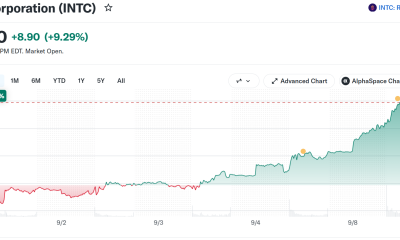
Intel Stock Jumps 9% on Chip Price Hike Report, US Stake Gains $36 Billion
-
 Business17 hours ago
Oil Higher on Hormuz Escalation, Weighing on Sentiment
-

 Business1 day ago
Claim Your Share Of $50 Million Disney Streaming Price Settlement By Sept. 8 Tonight
-

 Tech1 day ago
Stoke Space raises another billion to rival SpaceX at re-flying rockets
-

 Politics1 day ago
Critics Rip Trump After He Revives His Most Dubious 9/11 Claim
-

 Politics23 hours ago
The Ultimate September Reset Guide: How To Refresh Your Mind And Life This Autumn
You must be logged in to post a comment Login