Email apps have spent years trying to make inbox management feel faster, smarter, and less soul-crushing. But Avec seems to have looked at all that and decided the real answer was right in front of us. Just make the emails behave like a dating app.
Avec is a new mobile email app that presents your inbox to you as a stack of swipeable cards instead of the usual list view. While it may sound like a big change, the idea is pretty simple in terms of functionality. Swipe left to deal with an email later, swipe right to mark it done or archive it, and swipe down to throw less important messages into an “unimportant” pile that the app can later group together for easier cleanup.
Avec
Why this is such an interesting solution
The card-based interface is the headline here, and yes, the Tinder comparison is doing a lot of the marketing work. But Avec is aiming to reduce in-box fatigue on mobile phones, where email usually feels cramped, tedious, and too easy to ignore. The app includes a regular list-based inbox for people who aren’t ready to fully make the jump to a swipe-card style.
But this design alone could’ve made Avec into just another quirky email client. Instead, it is also leaning into voice inputs and AI.
How does AI play into this?
Avec lets users hold a button to dictate an email reply by voice. And once you stop speaking, the app turns that recording into a draft that you can review, edit, and send. This, according to founder Jonathan Unikowski, gives Avec an edge over separate keyboard-based dictation tools because the app can see the full email context, understand names, and better match tone and writing styles.
Advertisement
Avec
But there’s a catch.
For now, Avec is only available in the US, and it is exclusive to the iPhone. Though it is free to use for Gmail users. Outlook support is reportedly in the works, and the company says paid tiers will come later. However, what these premium features will offer has yet to be finalized.
A new attack type, dubbed ConsentFix v3, has been circulating on hacker forums as an improved technique that automates attacks against Microsoft Azure.
The first version of ConsentFix was presented by Push Security last December as a variation of ClickFix for OAuth phishing attacks, which tricks victims into completing a legitimate Microsoft login flow via the Azure CLI.
Using social engineering, the attacker fooled victims into pasting a localhost URL containing an OAuth authorization code that can be used to obtain tokens and hijack the account without passwords, despite multi-factor authentication (MFA).
ConsentFix v2 was developed by researcher John Hammond as a refined version of Push’s original, replacing manual copy/paste with drag-and-drop of the localhost URL, making the phishing flow smoother and more convincing.
Advertisement
ConsentFix v3 preserves the core idea of abusing the OAuth2 authorization code flow and targeting first-party Microsoft apps that are pre-trusted and pre-consented.
However, it brings an improvement by incorporating automation and scalability.
ConsentFix v3 attack flow
According to information retrieved from hacker forums where the new technique is promoted, the attack begins by verifying the presence of Azure in the target environment by checking for valid tenant IDs.
This is followed by gathering employee details such as names, roles, and email addresses to support impersonation.
Advertisement
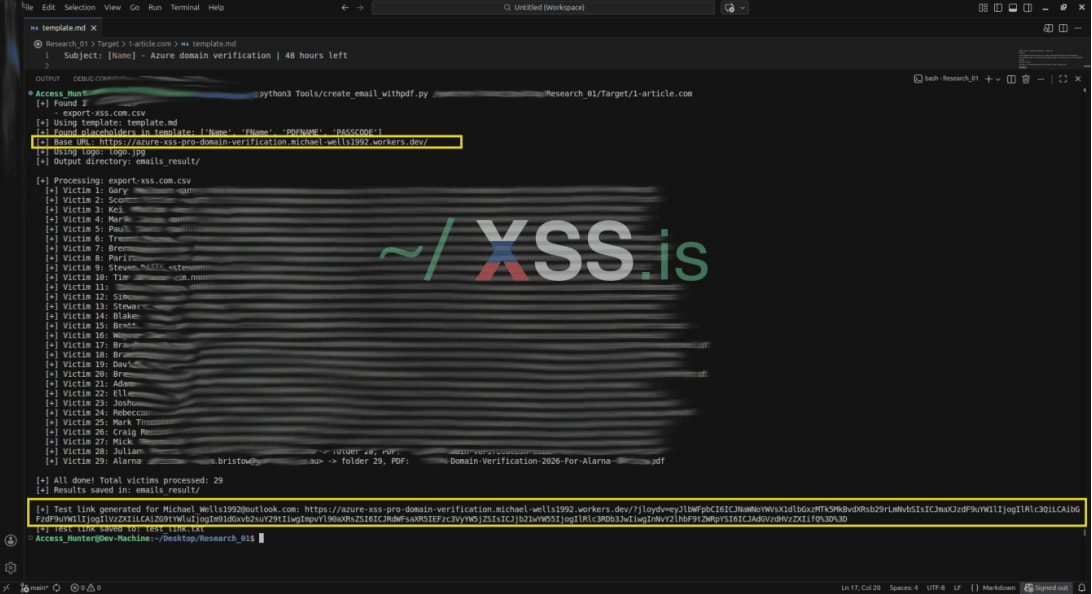
Next, the attackers create multiple accounts across services such as Outlook, Tutanota, Cloudflare, DocSend, Hunter.io, and Pipedream to support phishing, hosting, data gathering, and exfiltration operations.
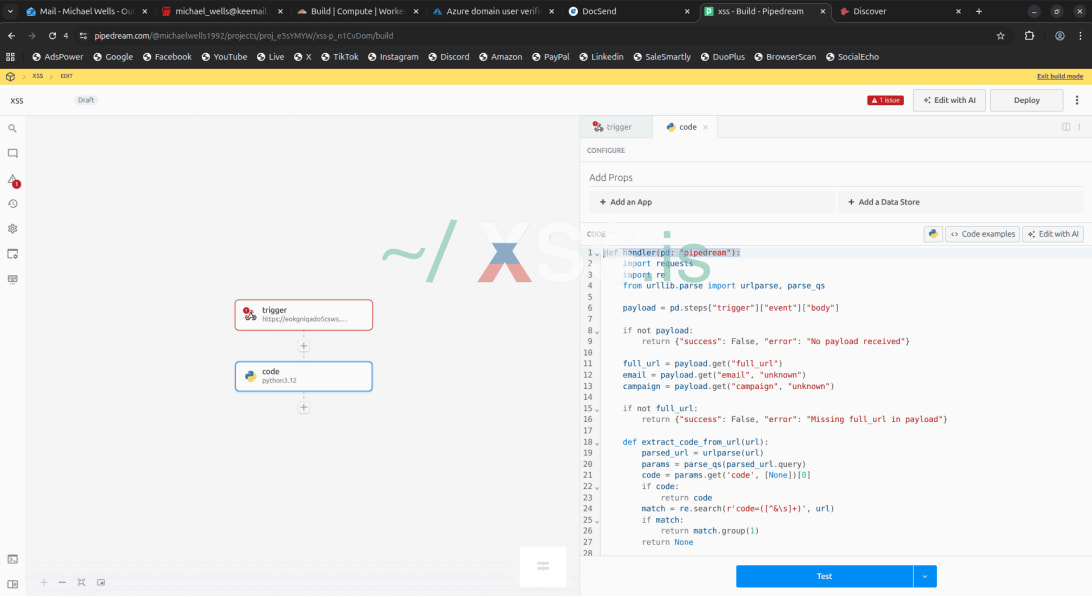
Push Security researchers explain that Pipedream, a free-to-use serverless integration platform, plays a central part in automating the attack, serving three critical roles:
Is the webhook endpoint that receives the victim’s authorization code
It is the automation engine that immediately exchanges that code for a refresh token via Microsoft’s API
It is the central collector that makes captured tokens available to us in real time.
Creating the Pipedream model Source: Push Security
In the next phase, the attacker deploys a phishing page hosted on Cloudflare Pages that mimics a legitimate Microsoft/Azure interface and initiates a real OAuth flow through Microsoft’s login endpoint.
When the victim interacts with the page, they are redirected to a localhost URL containing an OAuth authorization code, which they are tricked into pasting or dragging back into the phishing page.
This enables the data exfiltration pipeline, in which the page sends the captured URL to a Pipedream webhook, and the backend automation immediately exchanges the authorization code for tokens.
Advertisement
The phishing emails can be highly personalized, generated from harvested data, and feature malicious links embedded inside a PDF hosted on DocSend to improve credibility and bypass spam filtering.
In the post-exploitation stage, the obtained tokens are imported into Specter Portal, allowing the attacker to interact with compromised Microsoft environments and access resources permitted by the token, such as email, files, and other services tied to the account.
Push Security noted that its testing of ConsentFix v3 relied on its personal Microsoft accounts; as a result, it is difficult to fully appreciate the impact, which depends on permissions, services, and tenant settings, among other factors.
In terms of mitigating ConsentFix risks, Push notes that the endeavor is complicated because trust in first-party apps is architectural, and that Family of Client IDs (FOCI), Microsoft applications that share permissions and refresh tokens, is useful otherwise.
However, there are still steps administrators can take, such as applying token binding to trusted devices, setting up behavioral detection rules, and applying app authentication restrictions.
Advertisement
While ConsentFix attacks are used in actual campaigns, it is unclear if the v3 variant has gained any traction among cybercriminals yet.
AI chained four zero-days into one exploit that bypassed both renderer and OS sandboxes. A wave of new exploits is coming.
At the Autonomous Validation Summit (May 12 & 14), see how autonomous, context-rich validation finds what’s exploitable, proves controls hold, and closes the remediation loop.
A garlic-herb salmon with risotto was probably the best among the family meals I tried. The chopped asparagus was less than visually appealing when drizzled in garlic butter, but still tasty and a bit crisp. The salmon was tender and flaky. And the sweet pea risotto had no choice but to be delicious. There was so much cheese, butter, and lemon it was pretty much a concert of fats and acid.
That chicken parm was likewise a mountain of cheese and salt. It reminded me, pleasantly, of countless family meals I had as a child in the 1980s: cheese-topped chicken, garlic bread, shells stuffed with ricotta and topped with even more cheese. The big difference is that there is simply no way my mother would have cooked this meal without a vegetable.
Toval app via Matthew Korfhage
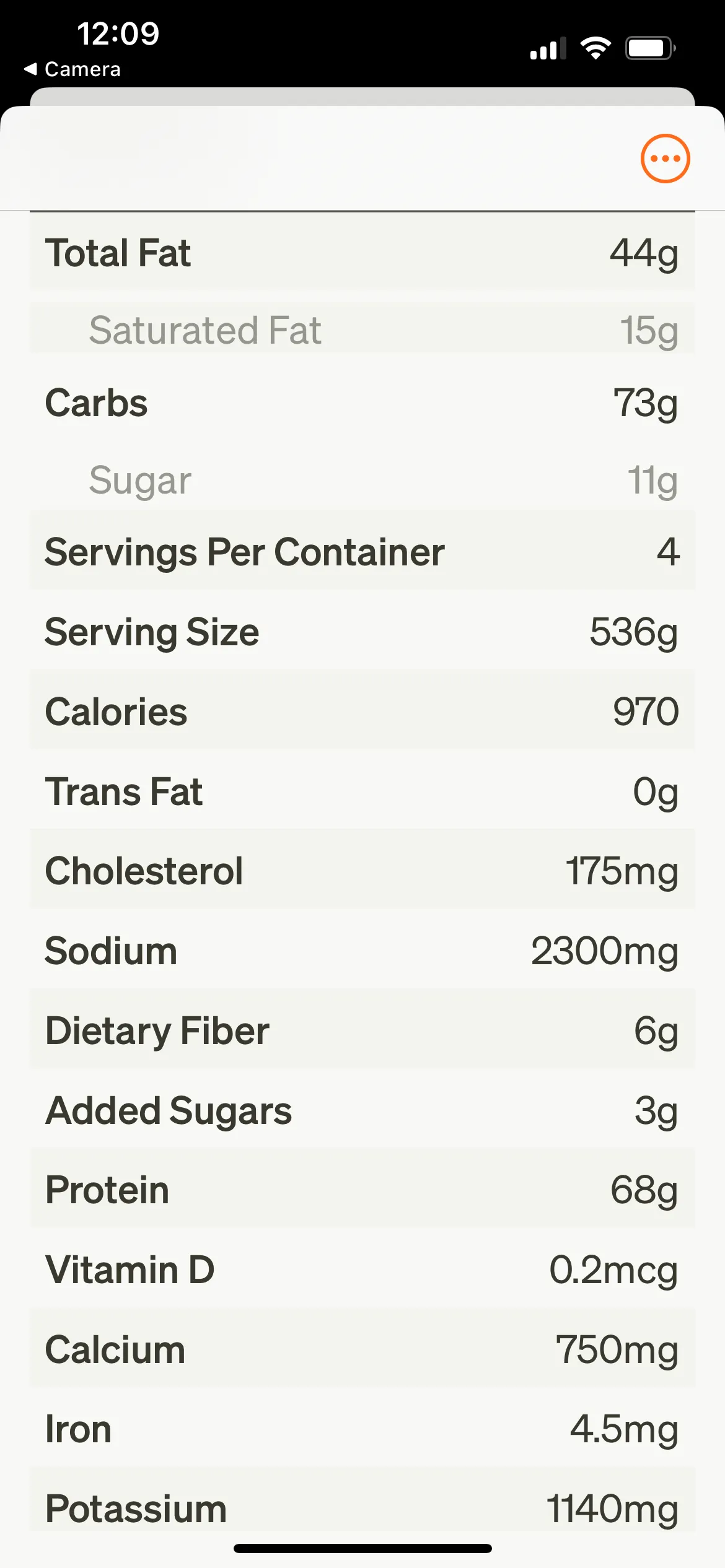
And nutrition is where Toval runs aground a little. The nutritional notes on that chicken parm meal betray 2,300 milligrams of sodium per serving, pretty much the entire daily allowance for an adult human. This is also on par with comparable servings of Stouffer’s meat lasagna. The Tovala meal also carried about 10 times the cholesterol as Stouffer’s.
Many other meals followed a similar pattern, loading up on fats and salt in order to make meals tasty. The net effect is that it’s a lot more like rich restaurant food than what most people prepare at home. Whether this is a good or a bad quality is up to you.
Advertisement
Only one meal of the seven I tried failed utterly: I flagged a teriyaki chicken dinner to my editor as a possible cultural crime against Japan. The meal was sweet soy drenching pale and steaming chicken, with an implausible side of thick egg rolls and some loose, unseasoned broccoli. It felt like the “Japanese” food you’d get at a mall food court in the ’90s. But again, this was a rare major misstep.
A more pernicious issue, in meals designed for the whole family, is the near-universal high-fat, cholesterol, and sodium content. Many with the income and inclination to eat hearty, low-effort meals like the ones from Tovala are either parents with children, or people in the retirement bracket. Each has their own reason to desire a little more nutrition, and less fat and salt.
By the end of a couple of weeks of testing recipes, I’ll admit I felt a little relieved. I was grateful to feel my arteries slowly reopen. Tovala’s culinary model makes a lot of sense to me, as a smart way of splitting the difference between prepared meals and fresh food. And the company has proven it can cook well. It might be nice if they’d also cook a diet that felt more sustainable.
Writing an email is already one of the more lifeless parts of modern work, so of course the tech industry decided to automate it. AI was meant to ease workloads by managing “grunt” work—dealing repetitive junk, trimming down inbox overload, and giving people their time back. It really sounded like the right idea. But in reality, we are nowhere close to removing the misery of email.
The kind of email you’re already sick of seeing
AI lowers the effort required to produce corporate-sounding language. That means every “just following up,” every “circling back,” every “gentle reminder,” and every “happy to connect” becomes even easier to generate and even harder to escape.
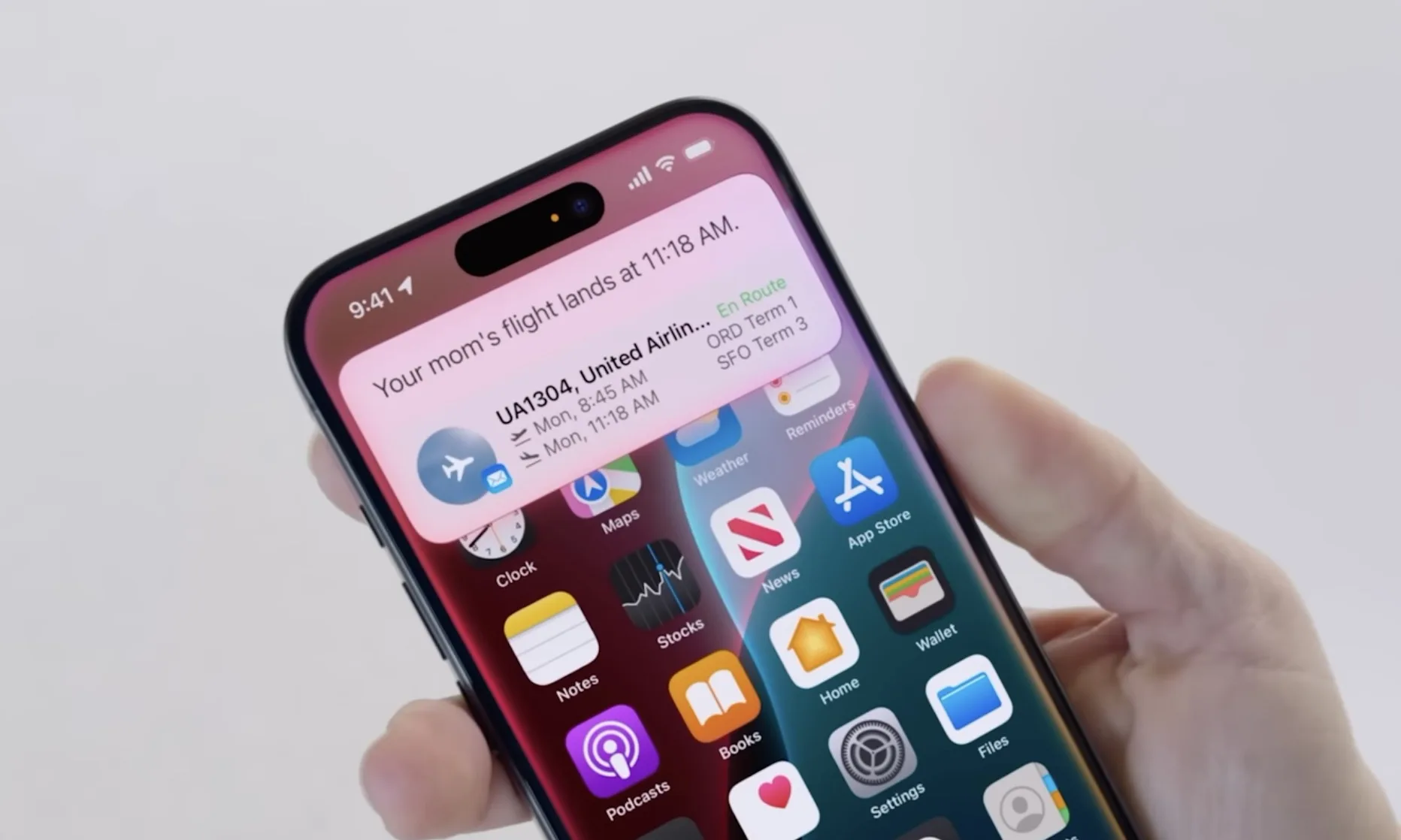
Apple
A person who might have skipped sending a pointless email before can now ask AI to draft one in seconds. And the person replying might once have wrapped things up in two short sentences. Now there is always a cleaner, longer, more “professional” version waiting from a chatbot. The Guardian recently reported on worker frustration around AI-generated workplace output, including what some employees now call “workslop.”
AI just gave bad email habits some steroids
Email was never only about communication. It also became a way to signal responsiveness, usefulness, and motion. A fast reply, a full calendar, and a long thread make things look more productive, even when nobody actually needed any of it. AI slides neatly into this culture. It can answer faster, summarize faster, schedule faster, and keep the illusion of progress running all day.
Office email already rewards performance as much as usefulness. Now every half-formed thought can become a polished paragraph. Sentences can be improved, and low-value updates can be padded into something more formal, diplomatic, corporate, and even lifeless. Using AI does not make your communication any better. What you’re getting instead is just more of it. Your inbox has more messages, fillers, and new language designed to sound productive without necessarily being useful.
Things get worse when everyone starts doing it, compounding the issue. One person sends a slick AI-polished email. The reply comes back with its own AI-assisted phrasing. Someone added to the thread later uses AI to summarize the whole exchange before sending another response. And now you have a conversation that technically keeps moving, but feels less and less human with every pass.
So who’s talking to whom?
At that point, bots emailing bots does not sound like a joke anymore. Dedicated tools like AI email assistants and scheduling bots may be useful in isolation, but they are still part of the same problem. Tools like Read AI’s Ada can handle meeting logistics and participate in email threads, which makes the whole “AI talking to AI” scenario feel a lot less ridiculous now.
It started with people leaning on AI for one harmless email, which quickly steamrolled into the whole culture of email becoming even more bloated and more performative. We were supposed to get relief from one of the most draining parts of digital work. And now it feels like new technology is just keeping that machine running rather than getting rid of it.
After landing agreements with Google, SpaceX, and OpenAI, the U.S. Defense Department said on Friday that it has signed deals with Nvidia, Microsoft, Amazon Web Services, and Reflection AI that allow it to deploy their AI tech and models on its classified networks for “lawful operational use.”
“These agreements accelerate the transformation toward establishing the United States military as an AI-first fighting force and will strengthen our warfighters’ ability to maintain decision superiority across all domains of warfare,” the statement reads.
The deals come as the U.S. Department of Defense has accelerated its diversification of AI vendors in the wake of its controversial dispute with Anthropic over usage terms of its AI models. The Pentagon wanted unrestricted use of Anthropic’s AI tools, but the AI lab insisted on guardrails to prevent Anthropic’s tech from being used for domestic mass surveillance and autonomous weapons.
The two are fighting it out in court at the moment, though Anthropic in March won an injunction against the Pentagon’s move to brand the company a “supply-chain risk.”
Advertisement
“The Department will continue to build an architecture that prevents AI vendor lock-in and ensures long-term flexibility for the Joint Force,” the statement reads. “Access to a diverse suite of AI capabilities from across the resilient American technology stack will give warfighters the tools they need to act with confidence and safeguard the nation against any threat.”
The DOD said the companies’ AI hardware and models will be deployed on Impact Level 6 (IL6) and Impact Level 7 (IL7) environments to “streamline data synthesis, elevate situational understanding, and augment warfighter decision-making.” IL6 and IL7 are high-level security classifications for data and information systems that are deemed critical to national security and require that these systems be protected physically, through strict access controls and audits.
The Pentagon said more than 1.3 million DOD personnel have so far used its secure enterprise platform for generative AI, GenAI.mil, which provides access to large language models (LLMs) and other AI tools within government-approved cloud environments. It is designed to help primarily with non-classified tasks like research, document drafting, and data analysis.
Techcrunch event
Advertisement
San Francisco, CA | October 13-15, 2026
When you purchase through links in our articles, we may earn a small commission. This doesn’t affect our editorial independence.
Europe should be known for BottleCap AI, not bottle cap memes. With its tongue-in-cheek name, this Prague-based AI startup is one of the teams that VCs think you should know.
It is not that European startups never cut through the noise — Lovable and Mistral AI are proof of it. But there are many more that don’t have nine digits in annual recurring revenue yet and that insiders are still tracking very closely.
That’s where this list comes in. Over the last few weeks, we asked investors at some of Europe’s best known venture funds to recommend two startups each: one from their portfolio (because they liked the startup well enough to invest) and one outside of it (because they are the startup experts but can’t invest in them all). We also threw in a few picks of our own.
From pre-launch to unicorn, these startups are at different stages in their journey, and from different sectors. Due to our methodology, they may not reflect where the region’s hottest hubs are, but they do reflect how deep tech talent could help Europe play its own cards in the AI race.
Advertisement
Alta Ares
Recommended by Julien Codorniou, general partner, 20VC.
What it does: Alta Ares develops AI-powered counter-drone systems.
Why it’s worth watching: Defense tech has gone from pariah to trending, particularly in Europe, where the war in Ukraine was a wake-up call for armies to modernize. Alta Ares’ interceptors answer a need for cheaper solutions to detect and fight drone incursions.
Techcrunch event
Advertisement
San Francisco, CA | October 13-15, 2026
Apron
Recommended by Jan Hammer, partner, Index Ventures (investor).
Why it’s worth watching: SMBs can be a lucrative segment for fintech companies; business owners are willing to spend at least some money to save time, and there are millions of them.
Botify
Recommended by Claire Houry, general partner, Ventech (investor).
What it does: Botify helps brands increase their visibility in AI searches.
Advertisement
Why it’s worth watching: Companies are still scrambling to replace SEO with generative engine optimization (GEO) — but this Disrupt NY 2016 alum has already embraced the shift. Botify has competitors in its new field, such as Otterly.AI and Profound, but also big customers, from Macy’s to The New York Times.
BottleCap AI
Recommended by Julien Codorniou, general partner, 20VC (investor).
What it does: BottleCap AI develops efficiency-focused foundational LLMs and apps.
Why it’s worth watching: With a founding trio that includes an entrepreneur who sold his previous company to Meta and two AI researchers, BottleCap adopted a dual approach. The startup is building its own models and releasing apps built on top of them, including Pulse, an AI-powered news app.
Advertisement
Cailabs
Recommended by Flavia Levi, investment manager, Join Capital.
What it does: Cailabs develops photonics for aerospace, defense, and industrial applications.
Why it’s worth watching: Cailabs is based on advanced research on the science of light, which it now applies to faster and more robust data transmission. Backed by public and private investors, it plans to deploy 50 optical ground stations to support growing demand for laser communications with satellites.
Cailabs’ turnkey optical ground station.Image Credits:Cailabs
Cala
Recommended by TechCrunch’s Anna Heim.
What it does: Knowledge graph for AI agents.
Advertisement
Why it’s worth watching: Cala plans to build the knowledge layer that AI agents are missing. Its founder is Elisenda Bou-Balust, a high-profile Spanish entrepreneur and AI expert who sold her previous company Vilynx to Apple in 2020.
Flower
Recommended by Pär-Jörgen Pärson, partner, Northzone (investor).
What it does: Renewable energy management.
Why it’s worth watching: Wind and solar energy are inherently variable. Flower leverages AI and battery energy storage systems to make their use more predictable. This Swedish company also recently raised over $60 million in bonds to keep on scaling.
Advertisement
Fundamental
Recommended by Jonathan Userovici, general partner, Headline (investor).
What it does: Foundation AI for big data analysis.
Why it’s worth watching: Fundamental’s foundation model, Nexus, focuses on helping enterprises draw insights from their data. The company just emerged from stealth in February, but it is already valued at $1.4 billion following a $255 million Series A.
Gradium
Recommended by Jonathan Userovici, general partner, Headline.
Advertisement
What it does: AI voice models.
Why it’s worth watching: Gradium’s AI models can be used for real-time text-to-speech that gives AI agents a voice in multiple languages. A spinout of French AI lab Kyutai, this ElevenLabs challenger raised a $70 million seed round of its own.
HappyRobot
Recommended by Pablo Ventura, general partner, Kfund.
What it does: AI agents for complex use cases.
Advertisement
Why it’s worth watching: HappyRobot, a startup backed by a16z and Y Combinator, is one of many building AI agents, but its focus is on making sure that these can be deployed and deliver ROI. It is headquartered in the U.S., but its three co-founders and part of its team are Spanish.
Inbolt AI robot in deployment.Image Credits:Inbolt
Inbolt
Recommended by Claire Houry, general partner, Ventech.
What it does: Physical AI for factories.
Why it’s worth watching: Mixing AI and robotics, Inbolt improves and expands automation in manufacturing, from the automotive industry and electronics to home goods production lines. The startup says it is already active in more than 70 factories.
Legora
Recommended by Pär-Jörgen Pärson, partner, Northzone.
Recommended by Floriane de Maupeou, principal, Serena Data Ventures.
What it does: AI training data infrastructure.
Advertisement
Why it’s worth watching: “Every strong model starts with great data,” Macrodata Labs claims on its “coming soon” landing page. But the startup won’t build that data; its upcoming platform will provide other companies with tooling to create solid training datasets.
Multiverse Computing
Recommended by TechCrunch’s Julie Bort.
What it does: Offers compressed versions of open weight models like OpenAI, Meta, DeepSeek, and Mistral AI.
Why it’s worth watching:Multiverse Computing‘s tech takes a proven model and makes it smaller and less expensive to operate, especially on a company’s own hardware. Co-founded by CTO Román Orús, a professor at the Donostia International Physics Center, the Spanish startup has raised $250 million.
Advertisement
Optics11
Recommended by Flavia Levi, investment manager, Join Capital (investor).
What it does: Fiber-optic sensing systems.
Why it’s worth watching: Optics11’s technology makes it possible to monitor equipment underwater and in similarly harsh conditions. Its potential in preventing disruptions to subsea infrastructure and energy grids helped the startup secure venture debt from the European Investment Bank.
Pennylane
Recommended by Jan Hammer, partner, Index Ventures.
Advertisement
What it does: Finance management platform for SMBs.
Why it’s worth watching: Pennylane started out with accounting, but it has bigger plans. Like many other growth-stage fintechs, this French unicorn has expanded its scope, with the ambition to build a unified financial operating system for SMBs in Europe.
PLD Space
Recommended by TechCrunch’s Anna Heim.
What it does: Launches rockets.
Advertisement
Why it’s worth watching: PLD Space is part of Europe’s push for space autonomy. After successfully launching a suborbital rocket in 2023, it is currently developing a reusable orbital launcher for small satellites. Last month, the Spanish company secured a $209 million Series C round led by Mitsubishi Electric that brought its funding to more than $350 million.
PLD Space’s MIURA 1 space rocket during its presentation in Madrid in 2021.Image Credits:Eduardo Parra / Europa Press via Getty Images / Getty Images
Proxima Fusion
Recommended by Daria Saharova, general partner, World Fund.
Recommended by Floriane de Maupeou, principal, Serena Data Ventures (investor).
Advertisement
What it does: Software for AI model deployment on advanced chips.
Why it’s worth watching: University spinout Roofline bridges the gap between AI and an increasingly fragmented hardware layer with software that lets users deploy models efficiently on different types of chips.
Space Forge
Recommended by Daria Saharova, general partner, World Fund (investor).
What it does: Space Forge manufactures semiconductor components in space.
Advertisement
Why it’s worth watching: In-space manufacturing is on the rise — for pharmaceutical applications and for chips, which are Space Forge’s focus. With extra tailwinds from geopolitics, the startup is already forging ahead: It recently generated plasma in low Earth orbit.
Theker
Recommended by Pablo Ventura, general partner, Kfund (investor).
What it does: Robots as a service.
Why it’s worth watching: Theker is one of several startups backed by Zara owner Inditex through a dedicated fund managed by Mundi Ventures. Theker’s AI-enabled robots could help the retail giant improve its logistics, but the startup is also pursuing use cases in waste management and food and beverage production.
Advertisement
When you purchase through links in our articles, we may earn a small commission. This doesn’t affect our editorial independence.
Instructure, the company behind the widely used Canvas learning platform, has disclosed that it recently suffered a cybersecurity incident and is now investigating its impact.
The U.S.-based education technology company is best known for developing Canvas, a widely used learning management system that helps schools, universities, and organizations manage coursework, assignments, and online learning.
“Instructure recently experienced a cybersecurity incident perpetrated by a criminal threat actor. We are actively investigating this incident with the help of outside forensics experts,” reads a statement from Steve Proud, Chief Security Officer.
“We are working quickly to understand the extent of the incident and actively taking steps to minimize its impact. Maintaining your trust is our highest priority, and we are committed to transparency throughout this process.”
Advertisement
Instructure says that it will provide new information regarding its investigation as it becomes available.
Since May 1, some services, including Canvas Data 2 and Canvas Beta, have been under maintenance, with customers warned they may experience issues with tools that rely on API keys.
The company has not stated whether this maintenance is related to the security incident.
BleepingComputer contacted Instructure earlier today with questions about the incident, but has not received a response.
Advertisement
BleepingComputer previously published and retracted an earlier report about this incident after determining it was based on incorrect information from a prior disclosure.
Targeting education technology firms
Threat actors have increasingly targeted education technology firms due to the large amounts of personal information they hold on students and teachers.
AI chained four zero-days into one exploit that bypassed both renderer and OS sandboxes. A wave of new exploits is coming.
At the Autonomous Validation Summit (May 12 & 14), see how autonomous, context-rich validation finds what’s exploitable, proves controls hold, and closes the remediation loop.
GameStop is reportedly preparing a potential offer for eBay, an unusually ambitious move given that eBay’s roughly $46 billion market value is nearly four times GameStop’s. Reuters reports: GameStop is preparing an offer for eBay as CEO Ryan Cohen pursues plans to boost the struggling videogame retailer’s market value more than tenfold, the Wall Street Journal reported on Friday. Shares of eBay, which has a market capitalization of about $46 billion, soared about 14% in extended trading. GameStop gained 4%. The company has a market value of nearly $12 billion.
GameStop has been quietly building a stake in eBay’s shares ahead of a potential offer, the report said, citing people familiar with the matter. If eBay is not receptive, Cohen could decide to take the offer directly to the e-commerce company’s shareholders, the Journal said.
Microsoft has confirmed that Windows 11 is getting a new modern Run dialog with dark mode support and faster performance in a new preview build 26300.8346.
The Run dialog has been around since the Windows 95 era, and it is one of those small Windows features that many power users still rely on every day.
You just need to press Win + R, type a command, open a file path, launch a tool, or quickly jump to a location without opening File Explorer first.
With the new version, Microsoft is trying to modernize Run without changing what makes it useful.
Advertisement
Unlike the legacy Run, modern Run matches Fluent Design, supports dark mode out of the box, and is actually faster than the legacy Run.
That is interesting because modern counterparts usually have a reputation for slower performance.
Source: BleepingComputer
Microsoft noted that designing a modern Run dialog for Windows 11 was challenging, as the company had to maintain the same performance and retain the minimal user interface, similar to the original Run that shipped with Windows 95.
“When we set out on creating the new experience, we knew the existing dialog was fast. We also knew we needed to be sure we deeply understood how you all used it. Modernize, be opinionated, and evolve it,” Microsoft explained in a blog post.
“To help evolve, we added a measure briefly to the dialog to see what was being used and to measure time-to-show. This confirmed a few key things that helped the design process.”
Advertisement
Microsoft says performance was one of the most important factors when designing the modern Run dialog. That’s because quite a lot of people use the existing Run dialog to paste text from the clipboard, then copy it again to remove text formatting.
This experience mostly works because of how fast the existing Run is. The legacy Run dialog takes approximately 103ms to appear after you press the Win + R keyboard shortcut.
Interestingly, the modern Run is actually faster. It has a median time-to-show of just 94ms.
“This was a huge team effort – we’ve collaborated tightly with partners across the platform to get these UI surfaces loading snappy. Improvements we’ve made to the platform don’t just make Run fast, but they help make the whole OS more efficient,” the company said.
Advertisement
Microsoft says it expects these numbers to improve as well as there is still room for improvement,
Microsoft drops ‘Browse’ feature in new Run
Microsoft looked at how people use the existing Run dialog before deciding what should stay and what could be removed. One example is the Browse button, which lets you browse a specific directory to open a program.
According to Microsoft, the Browse button usage is less than 0.0038%. This number is based on a sample of 35 million users who open Windows Run.
As a result, Microsoft has dropped the Browse button from the modern Run. The company argues that it researched how Run was being used and how fast it was, which helped form a baseline to build the modern Run.
Advertisement
Modern Run also supports ~\, which allows you to quickly access your home directory. It also shows icons in the list, which should make entries easier to identify without making the dialog feel too heavy.
How to enable or disable modern Run
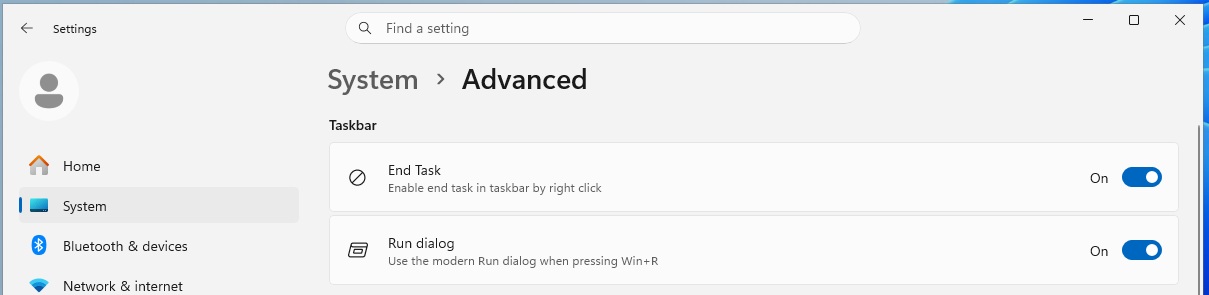
While modern Run looks great and works well in our test, some of you may not like the idea, which is why the feature is entirely optional and tied to Advanced Settings in Windows.
According to Microsoft, modern Run does not get turned on automatically. Instead, you need to open Settings > Advanced Settings and manually enable modern Run, which replaces the legacy Run.
Enable or disable modern Run dialog
Source: BleepingComputer
There are also plans to add more features to modern Run, and Microsoft says it is collecting feedback before rolling it out more broadly.
Other changes rolling out with today’s preview update
In addition to the Run dialog upgrade, Microsoft is improving Windows Share UI for AAD users.
Advertisement
Until now, if you wanted to add an app to the share dialog, you had to open the MS Store, install the app first, and then find it in the Share list. Now, you can install apps directly from the Share UI.
Last but not least, Magnifier now gives you more control over how you zoom, including preset zoom levels of 5%, 10%, 25%, 50%, 100%, 150%, 200%, and 400%.
These changes will roll out to everyone in the coming months, but for now, you’ll need to download Windows 11 Build 26300.8346 from the new Experimental Channel.
AI chained four zero-days into one exploit that bypassed both renderer and OS sandboxes. A wave of new exploits is coming.
At the Autonomous Validation Summit (May 12 & 14), see how autonomous, context-rich validation finds what’s exploitable, proves controls hold, and closes the remediation loop.
ByteDance’s drug discovery unit Anew Labs presented its first AI-designed therapy at a major immunology conference in Boston, showing a generative-AI-designed small molecule targeting IL-17, a protein-protein interaction long considered undruggable.
The unit also published AnewOmni, a generative framework trained on 5 million biomolecular complexes that claims to be the first to design functional molecules across all scales. ByteDance has entered the AI drug discovery race alongside Isomorphic Labs, Anthropic, and Insilico Medicine.
Advertisement
The company that built TikTok’s recommendation algorithm, the system that predicts with unsettling accuracy what a person wants to watch next, is now using a related class of AI to predict how molecules will behave inside a human body. ByteDance’s drug discovery unit, Anew Labs, presented its first AI-designed therapy at the American Association of Immunologists’ annual meeting in Boston in mid-April, showing data on a small molecule designed by generative AI to inhibit IL-17, a cytokine involved in autoimmune diseases including psoriasis, rheumatoid arthritis, and ankylosing spondylitis.
The molecule targets a protein-protein interaction, a category of drug target that the pharmaceutical industry has spent decades calling undruggable because the binding surfaces are too large and too flat for conventional small molecules to disrupt. Anew Labs says its AI found a way in.
The presentation in Boston was the first time ByteDance showed the world what its drug unit has built. It will not be the last. The company is registered to exhibit at the BIO International Convention in San Diego in June, and its head of computational chemistry will present at the Free Energy Workshop in Barcelona next week.
The unit
The 💜 of EU tech
Advertisement
The latest rumblings from the EU tech scene, a story from our wise ol’ founder Boris, and some questionable AI art. It’s free, every week, in your inbox. Sign up now!
Anew Labs operates from Shanghai, Singapore, and San Jose, California, with 36 core team members listed on its website and a scientific advisory board that includes Liu Yongjun, former president of Innovent Biologics, Ji Ma, a former principal scientist at Amgen, and Hua Zou, scientific director of protein chemistry at Takeda California.
The advisory board reads like a recruitment list from the companies that dominate biologics and immunology, disciplines where the targets Anew Labs is pursuing have historically required injectable antibody therapies costing tens of thousands of dollars per year. The unit’s ambition is to replace those injections with oral pills, using generative AI to design small molecules that can do what antibodies do but in a form that patients can swallow.
Chris Li, head of biology, presented one of Anew Labs’ four pipeline drug candidates in Boston. The molecule is a pan-spectrum IL-17 inhibitor, meaning it is designed to block multiple forms of the IL-17 cytokine rather than a single variant. Existing IL-17 therapies, including Novartis’s secukinumab and Eli Lilly’s ixekizumab, are injectable antibodies that generated billions in annual revenue by treating psoriasis and other inflammatory conditions. An oral small molecule that achieves comparable efficacy would be commercially transformative, both cheaper to manufacture and easier for patients to take.
Advertisement
The challenge is that IL-17’s binding surface with its receptor is a protein-protein interaction, a broad, shallow interface that gives small molecules very little to grip. The gap between what AI can do in a laboratory and what it delivers to patients remains the defining tension of health technology, and IL-17 is precisely the kind of target where that gap is widest.
The model
In March, Anew Labs published a preprint on bioRxiv describing AnewOmni, a generative AI framework trained on more than five million biomolecular complexes. The model is designed to work across molecular scales, from small chemical compounds to peptides to nanobodies, assembling chemically meaningful building blocks at atomic resolution.
In the preprint, the researchers demonstrated that AnewOmni could design functional molecules targeting KRAS G12D, one of the most studied oncology targets in the world, and PCSK9, a cholesterol-related protein, achieving success rates between 23 and 75 per cent with only low-throughput laboratory validation. The model uses programmable graph prompts that allow researchers to steer the generation process by specifying chemical, geometric, and topological constraints.
The technical approach is significant because it attempts to solve a problem that has limited AI drug discovery across the industry: most generative models work well at one molecular scale but fail when asked to design across scales. A model that designs small molecules cannot typically also design peptides or protein-based therapeutics.
Advertisement
AnewOmni claims to be the first framework to succeed at functional molecular design across all scales, which, if validated in clinical settings, would give Anew Labs a platform capability rather than a single-programme capability. Isomorphic Labs, the DeepMind spinoff backed by Eli Lilly and Novartis, released its own drug design tool in February that doubles the accuracy of AlphaFold 3, and has partnership agreements with combined milestone values of up to $3 billion. The race to build the definitive AI drug design platform is global, and ByteDance has entered it with a model that, on paper, addresses a limitation that its competitors have not yet publicly solved.
The context
ByteDance is not the first technology company to move into drug discovery. Anthropic acquired Coefficient Bio for $400 million in an acqui-hire that brought fewer than ten people into the AI company’s biological research efforts. Google’s DeepMind has been working on protein structure prediction since AlphaFold’s breakthrough, which won the 2024 Nobel Prize in Chemistry. Microsoft has invested in biology-focused AI through its partnership with Paige, a computational pathology company.
Nvidia has built BioNeMo, a platform for training and deploying biomolecular AI models. The pattern is consistent: the companies with the most advanced AI infrastructure are redirecting a portion of that capability toward biology, because drug discovery is a problem shaped like the problems AI is good at, searching vast combinatorial spaces for rare solutions that satisfy multiple constraints simultaneously.
What distinguishes ByteDance’s entry is the source of its AI expertise. TikTok’s recommendation engine is, at its core, a system that models human behaviour by processing enormous quantities of data and predicting which combinations of content will produce the desired response.
Advertisement
Anew Labs’ generative models do something structurally similar: they process enormous quantities of molecular data and predict which combinations of atoms will produce the desired biological response. The mathematical architectures are not identical, but the organisational capability, the ability to train large models on massive datasets, iterate rapidly, and deploy at scale, is transferable. ByteDance’s AI infrastructure, built to serve 1.5 billion TikTok users, is now being applied to a problem where the users are molecules and the engagement metric is binding affinity.
The test
More than 173 AI-discovered drug programmes are now in clinical development globally, with 15 to 20 entering large-scale trials this year. Whether AI will revolutionise drug development depends on how it is used, and the industry’s 90 per cent clinical failure rate has not yet demonstrably improved.
Insilico Medicine’s rentosertib, a first-in-class drug for idiopathic pulmonary fibrosis where both the target and the molecule were discovered using AI, showed positive Phase IIa results published in Nature Medicine. The Recursion-Exscientia merger created the most comprehensive AI drug discovery platform in the industry, but then discontinued its lead AI-discovered candidate after long-term data did not confirm earlier efficacy trends. The pattern across the field is promising early data followed by the same biological reality that has always made drug development difficult: molecules that work in a dish do not always work in a body.
Anew Labs has four pipeline candidates and a generative platform that, if its preprint results hold, can design functional molecules across scales. It has the backing of a parent company valued at roughly $300 billion with AI infrastructure that dwarfs most pharmaceutical companies’ computational resources. It has advisors from Innovent, Amgen, and Takeda.
Advertisement
What it does not yet have is clinical data. The IL-17 molecule presented in Boston was preclinical. The distance from a poster at an immunology conference to an approved oral therapy that replaces injectable antibodies is measured in years and billions of dollars, and most molecules that start that journey do not finish it. The most ambitious AI-biology startups are the ones whose founders understand that the algorithm is the beginning, not the end.ByteDance built an algorithm that changed how a billion people consume content. Whether the same company can build an algorithm that changes how a disease is treated is a question that no conference presentation can answer. Only a clinical trial can.
Joby Aviation completed the first point-to-point eVTOL demonstration flights in New York City history, flying from JFK to Midtown Manhattan heliports in seven minutes as part of a week-long campaign. With FAA Stage 4 cleared and a type certificate expected by late 2026, Joby is the most advanced Western eVTOL company, backed by Toyota, Delta, and Uber, though the economics of $200 per-seat air taxi trips at scale remain unproven.
The flight from John F. Kennedy International Airport to the East 34th Street Heliport in Midtown Manhattan took seven minutes. By car, depending on the time of day, the same journey takes between 60 and 120 minutes. On Friday, Joby Aviation landed its all-electric air taxi at the heliport as part of a demonstration hosted by VertiPorts by Atlantic, the infrastructure company that operates the site. The aircraft, registration N545JX, had been flying across New York’s existing heliport network all week, touching down at the Downtown Skyport and the West 30th Street and East 34th Street heliports in Midtown after departing JFK. The flights were demonstrations, not commercial service. No passengers paid for a ticket. But the distinction between demonstration and operation is narrower than it has ever been. Joby cleared Stage 4 of the FAA’s five-stage type certification process in late March. Stage 5 is the final conformity inspection and operational demonstration. If it passes, and the company says it expects to by late 2026, the type certificate it receives will be the first ever issued for an electric vertical takeoff and landing aircraft in the United States.
Advertisement
The aircraft
The Joby S4 is a tiltrotor with six electric motors, four on the wings and two on the V-tail, that give it the vertical lift of a helicopter and the forward flight efficiency of a fixed-wing aircraft. It carries one pilot and up to four passengers, cruises at approximately 200 miles per hour, and has a range of roughly 150 miles on a single charge. The propellers tilt from vertical to horizontal after takeoff, allowing the aircraft to transition from hovering to cruising flight. A full recharge takes under 20 minutes. The aircraft weighs 4,800 pounds at maximum takeoff weight, roughly the same as a large SUV, and its wingspan of 39 feet means it fits on a standard helipad. The noise profile, according to Joby, is 100 times quieter than a conventional helicopter at the same distance, a claim that New York’s noise-sensitive residential neighbourhoods will have the opportunity to test if commercial operations begin.
Backed by $500 million from Toyota, which is also providing manufacturing expertise, Joby has built the aircraft through a vertically integrated model that includes in-house development of the electric motors, flight control software, and battery management systems. Joby has partnered with Air Space Intelligence to build the air traffic management systems that will coordinate eVTOL flights across urban airspace, a problem that becomes critical the moment more than a handful of aircraft are operating simultaneously above a city of eight million people.
The route
The New York demonstrations are the second stop on Joby’s 2026 Electric Skies Tour, a national campaign timed to the United States’ 250th anniversary. The tour launched in March with a flight over the Golden Gate Bridge in San Francisco, piloted by Andrea Pingitore, and moved to New York in late April. Joby has not disclosed which cities are next. The routes demonstrated in New York, JFK to Downtown Skyport, JFK to West 30th Street, JFK to East 34th Street, trace the commercial network the company plans to operate. Through partnerships with Delta Air Lines and Uber, Joby intends to offer an integrated travel experience: a passenger books a trip on the Uber app, takes a ground vehicle to the nearest vertiport, flies to the airport in minutes, and boards a Delta flight. The reverse works on arrival.
New York was selected in March as one of eight projects under the federal eVTOL Integration Pilot Programme, established by executive order under President Trump’s Unleashing American Drone Dominance directive. The programme, which spans 26 states, allows selected projects to begin supervised operations during a three-year pilot period, bypassing the traditional certification timeline for operational approvals. The Port Authority of New York and New Jersey and the New York City Economic Development Corporation are both partners. The infrastructure already exists: New York’s heliport network, built for helicopter traffic, can accommodate eVTOL aircraft with minimal modification. Dedicated vertiport infrastructure is being developed in other cities, but Joby’s New York strategy relies on the heliports that are already there, which means it does not need to wait for new construction to begin commercial service.
The economics
Joby has not announced official pricing. The company has said its target is pricing comparable to Uber Black, approximately $3 to $6 per mile. A trip from JFK to Midtown, roughly 15 miles by air, would cost approximately $200 per seat at the Uber Black rate, which is comparable to what Blade charges for its existing helicopter service on the same route and competitive with ride-share services that can charge $150 to $250 depending on traffic and surge pricing. The difference is time. Seven minutes versus 90 minutes changes the value proposition even if the price is similar. As fleet size increases and operations scale, Joby expects pricing to move toward Uber X rates of $2 to $3 per passenger mile, though that projection depends on manufacturing volume, battery costs, and utilisation rates that have not been achieved at commercial scale.
Advertisement
The financial picture for the broader eVTOL industry is mixed. European eVTOL startups have faced repeated delays amid certification hurdles, and at least six manufacturers have entered insolvency since 2023, including Lilium and Volocopter. Volocopter’s planned air taxi flights at the Paris Olympics were scrapped over certification failures. Joby’s principal American competitor, Archer Aviation, is also progressing through FAA certification and has said it expects to see first commercial revenue in 2026. But Joby is the most advanced Western eVTOL company by certification stage, and its partnerships with Toyota, Delta, and Uber provide manufacturing capacity, distribution channels, and a booking platform that no competitor currently matches.
The question
For a decade, the eVTOL industry operated primarily in PowerPoint. Concept renders of sleek aircraft gliding between rooftop vertiports, projected market sizes in the hundreds of billions, and timelines that slipped by years with each quarterly update. Joby’s own certification target has moved from 2023 to 2024 to 2025 to late 2026. The difference now is that the aircraft is flying, in public, over one of the most complex airspace environments in the world, on the routes it intends to serve commercially, using the infrastructure it intends to use. The FAA has confirmed that the propulsion system reliability and fly-by-wire redundancy meet Stage 4 requirements. What remains is Stage 5: the final conformity inspection that leads to the type certificate.
The question that the New York demonstrations answer is not whether the technology works. It does. An electric aircraft took off vertically from JFK, flew across the East River at 200 miles per hour, and landed at a helipad next to the FDR Drive without incident. The industry has been promising this for years. Joby has now shown it. The question the demonstrations do not answer is whether the economics work at scale, whether noise levels are acceptable to communities beneath the flight paths, whether the air traffic management systems can handle hundreds of daily flights over Manhattan, whether battery degradation will affect range and recharge times in commercial service, and whether passengers will pay $200 for a seven-minute flight when the same journey by car costs less and only takes longer. The car takes longer, but it does not require a booking on an app, a ride to a heliport, a security process, and a ride from a helipad to the final destination. The total door-to-door time advantage narrows when you count the ground segments on both ends. Joby’s bet is that the time advantage is large enough, and the experience is compelling enough, that a meaningful number of New Yorkers and travellers will choose the air. Late 2026 will determine whether they are right.









.PNG)









.png)












































You must be logged in to post a comment Login