

Connect with us
DAPA Banner
DAPA Coin
DAPA
COIN PAYMENT ASSET
PRIVACY · BLOCKDAG · HOMOMORPHIC ENCRYPTION · RUST
ElGamal Encrypted MINE DAPA
🚫 GENESIS SOLD OUT
DAPAPAY COMING

Tech

How Can Soccer Players Bend Their Shots in Midair?

Published

on

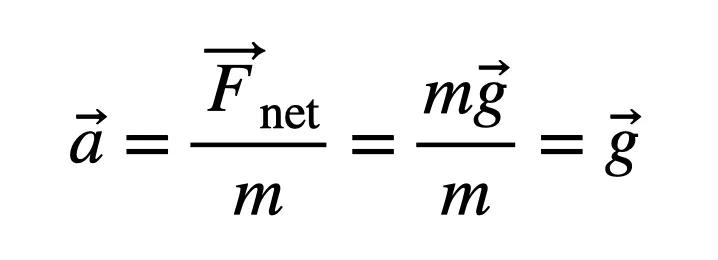
We need one more thing—how about Newton’s second law? This says the acceleration depends on the net force (Fnet) and the mass (m) of an object. It’s usually written as Fnet = m × a, but we can rearrange it like this: a = Fnet/m. Combining this with our gravitational force, we get something pretty interesting:

Image may contain Text Number and Symbol

Courtesy of Rhett Allain

Since both gravity and acceleration depend on the mass of the ball, the mass cancels. We find that any object on Earth has a downward acceleration of 9.8 meters per second per second (m/s2). This means that if you drop a bowling ball and a marble at the same time, they’ll hit the ground at the same time—even though the gravitational force on the bowling ball is thousands of times higher. Weird, right?

Anyway, now, in the presence of gravity, if you kicked a ball at an upward angle, it’s vertical velocity would slow, halt, and reverse, with the speed increasing as it falls. In other words, it starts accelerating in the downward direction as soon as it’s kicked, even while it’s moving upward.

What about the horizontal motion? Ah, since there’s no horizontal force after the initial kick, the ball continues traveling forward at the same speed, just like in space. People tend to think a ball falls because its forward motion slows, but actually it’s the opposite. Without air drag it doesn’t slow down at all. It only stops because the ground gets in the way.

Advertisement

So what we get for a trajectory is that familiar upside-down parabola, often called a ballistic trajectory because it’s the path of any unpowered projectile, like a cannon ball, a bullet, or a basketball. Any flying object for which gravity is the only (significant) force acting on it will move this way.

Soccer With Air

Happily, the Earth does have air. But it drastically changes the game. Now there is a continuous force acting horizontally, which we call air resistance, or drag, and it pushes in the direction opposite to the ball’s motion.

Think of air molecules as a bunch of tiny ping-pong balls. As a soccer ball moves through the air it collides with gazillions of these little air balls, and each collision exerts a backward-pushing force; all combined, this creates the total air-resistance force. The bigger the object, the more collisions it has to fight through.

Source link

Advertisement
Continue Reading
Click to comment

You must be logged in to post a comment Login

Leave a Reply

Tech

Justice Department seizes websites that published deepfake nudes of famous women

Published

on

What just happened? The US government has seized two domains accused of hosting non-consensual deepfake pornography of female celebrities, marking what prosecutors say is the first domain seizure under the Take it down Act. CFake.com and SOCFake.com now point to law enforcement notices after the Justice Department and Homeland Security Investigations obtained federal warrants to redirect the sites.

The DOJ says the domains were used to publish digitally forged nude and sexual images and videos of women without their consent. According to the Justice Department, the material involved thousands of “digital forgeries,” while the US Attorney’s Office for New Jersey describes the sites as hosting hundreds of thousands of deepfake pornographic images and videos.

The targeted women included heads of state, first ladies, royalty, legislators, government officials, journalists, TV presenters, athletes, entertainers, and other public figures. Investigators said users could browse material by tags including “rape,” “forced,” “degradation,” and “slave.” Those categories are a big reason why prosecutors framed the case as abuse and exploitation rather than a copyright or impersonation dispute.

The affidavit supporting the seizure says CFake’s landing page described the content as digitally retouched and altered photos of well-known people. Its terms and conditions reportedly told any upset celebrity to contact the operators, then asked why they felt disadvantaged when “practically every female celebrity in the world” was also on the site. HSI also interviewed one victim in February who said the images were forged, non-consensual, and had caused psychological harm.

Advertisement

The Take it down Act, enacted in May 2025, makes it a federal crime to publish sexually explicit digital forgeries of identifiable adults without consent when the material is not a matter of public concern and is intended to cause harm or actually does so. It also gives authorities forfeiture powers over property used to facilitate violations, which in this case meant the domains themselves.

US authorities were alerted to the site by Italian cyber police, who shared evidence with France under the Budapest Convention on Cybercrime. French authorities arrested a 47-year-old man in Nice on June 10, accusing him of being a CFake administrator. CyberScoop reports that French investigators identified about 300,000 images and 7,000 videos depicting 14,000 people, along with 200,000 user accounts and 4 million monthly views.

Deepfakes have been a problem for years, from Scarlett Johansson calling attempts to stop them a “lost cause” in 2019 to the Taylor Swift AI nude images that spread across X in 2024. Google later banned ads for deepfake porn services, while San Francisco sued 16 AI “undressing” websites. As generative AI becomes more advanced, easier to use, and convincing in its output, the issue is arguably getting worse, not better.

Advertisement

Source link

Continue Reading

Tech

Mystery Orb Videos, Other UFO Records Released By White House

Published

on

The Trump administration released another large batch of government UAP records, including videos of glowing orb-like objects appearing to split and rejoin, witness accounts, illustrations, and decades-old investigative documents. Axios reports: The documents indicate that government agents have spent years monitoring, investigating and documenting suspected UAP incidents. At lease some of the sightings took place near sensitive government facilities, according to the reports. Videos showing red and yellow light-emitting orbs, some of which appear to split apart and then reattach as they fly across the sky. The videos were taken by witnesses whom the government deemed “credible.”

Illustrations and videos showing reenactments of what observers saw, and the positions they were in when they viewed them.
Memos from government agents describing their experiences seeing flying objects.
An illustration of a grayish-white balloon-like object hovering above an area near Colorado Springs, Colo. An illustration depicting a series of incidents that took place in the “western United States” where government officials reported seeing UAPs in 2023.

There also are decades-old records documenting the government’s involvement in investigating UAPs, including a 1949 letter then-FBI Director J. Edgar Hoover wrote federal agents after receiving a message from an American citizen expressing their belief they’d seen a non-human-made flying object. The records released by the administration do not express any conclusions as to whether the government believes the UAPs represent the existence of alien life. They also do not indicate any conclusions as to whether UAPs represent a national security threat to the U.S.

Source link

Advertisement
Continue Reading

Tech

Apple has finally put the planned obsolescence rumors to bed

Published

on

Every time Apple released a new iOS update, people swore their iPhones suddenly felt slower. This rumor has followed Apple for years and while the company always denied it, the suspicion never really went away. With its latest iOS 27 update, I believe Apple has finally put this rumor to rest. 

I installed the beta on my iPhone Air, but the bigger story is what’s happening on the older models. Reports from people running iOS 27 on even older iPhones say their phones feel faster, not slower.

That’s the opposite of what the planned obsolescence crowd has been claiming all these years, and it’s happening in a developer beta, which is usually the buggiest, least-optimized version you can get.

So what changed this time around?

According to Apple, the speed gains come from rebuilding how the system handles things like CPU scheduling, memory, and background tasks. In plain terms, your iPhone is now smarter about where it spends its energy, so older chips don’t get bogged down doing work they don’t need to.

Advertisement

Apple is throwing out some crazy numbers. It claims app launches are up to 30% faster, AirDrop is 80% faster, Photos load about 70% faster, and a few other improvements across the board. I usually take these figures with a pinch of salt, since there’s no way to quantitatively test them. But with the results I am seeing on my iPhone Air, I will say that something genuinely feels different. 

I am especially impressed by the new AirDrop. You can actually feel the improvement in transfer speeds. Smaller files transfer in a jiffy, and even larger video files take almost half as long to transfer as they did on iOS 26.

But the best part is that Apple didn’t lock these improvements behind the newest iPhones. Every device that can run iOS 26 can run iOS 27, going all the way back to the iPhone 11. Yes, older devices might miss out on the new AI features, but they all get the speed and stability improvements that will prolong the life of these devices. 

Does this mean the rumors were always wrong?

I wouldn’t say so. Older iPhones do slow down over time, but it’s not some evil master plan. New features require more powerful chips, apps get heavier, and battery health naturally declines, which can throttle performance. Apple itself admitted to slowing down the performance of older iPhones to eke out more battery. The company even had to pay more than $600 million to settle lawsuits. 

iOS 27 update has changed this narrative. Instead of adding flashy new features that need the latest hardware to run well, Apple spent this year making the experience better for everyone, including people holding on to older phones. For this reason, the iOS 27 is the most important update Apple has released in years.

It ensures that my iPhone will last me for a long time, and that I’m not on some invisible countdown to my next upgrade. I have always argued for a maintenance update every few year if not every other year. If Apple keeps on delivering such updates, these planned obsolescence rumors will quietly fade away.

Advertisement

Source link

Continue Reading

Tech

Windows 11 finally finds files when you type two characters instead of three

Published

on

TL;DR

Windows 11 can now search with two characters instead of three. Local files also rank higher than web results and Copilot suggestions. June Patch Tuesday.

Microsoft’s June 2026 Patch Tuesday update quietly fixes one of Windows Search’s longest-standing irritations. The search box now finds files with as few as two characters, down from the previous three-character minimum. Files named Q3, V2, or any other short label are no longer invisible.

The update also changes how results are ranked. Local files now surface near the top instead of getting buried beneath web results, app suggestions, and Copilot prompts. For anyone who names files with short, practical labels, the improvement removes a small friction that compounded every time they searched.

Windows Latest called the June release the biggest Patch Tuesday of the year. Beyond the search fix, it includes the record 200 security patches that addressed 33 critical vulnerabilities and three publicly disclosed zero-days.

Advertisement

Dropping one character from the search minimum sounds trivial. It is not. Most people who work with dozens of files daily use two-character naming conventions without thinking about it. The old three-character floor meant those files required a third keystroke before Windows would even start looking, and when it did, the actual file often appeared below web links and AI suggestions that nobody asked for.

Advertisement

The fix is the kind of usability improvement that feels obvious only after it ships. Microsoft’s AI-first restructuring has dominated the company’s public messaging this year. But the most useful change it shipped in June was not an AI feature. It was letting you find a file called Q3.

Source link

Advertisement
Continue Reading

Tech

How To Use AirPods To Control Your iPhone Camera

Published

on

If you don’t own an Apple Watch, this is another way you can control your iPhone’s camera.

When Apple released iOS 26 last September, it added a handful of new AirPods features. One of those was Camera Remote. As you can probably guess from the name, it allows you to use your AirPods as a wireless shutter release for your iPhone.

This is useful if you don’t have an Apple Watch handy and therefore can’t access the dedicated Camera Remote app. Instead of placing your iPhone on a surface, setting a 10-second timer and running back to take a selfie, you can just click your AirPods to trigger the camera whenever you’re ready. If that sounds useful, here’s how to configure your AirPods for camera controls.

Advertisement

What you’ll need to control your iPhone camera with AirPods

Before I explain how to enable Camera Remote, let’s go over what you’ll need.

Unfortunately, older models of AirPods, like the original Pro release, don’t support Camera Remote.

Advertisement

How to enable Camera Remote

By default, Camera Remote is turned off. To start, if your iPhone and AirPods aren’t already paired, follow our guide to do so before returning here. Once you’re ready, follow these instructions:

  1. Open the Settings app on your iPhone.
  2. Tap the name of your AirPods. If they don’t appear, open your AirPods case.
  3. Scroll down and find the Camera Control section.
  4. Tap the Camera Remote field and select either Press Once or Press and Hold.

Now, with Camera Remote enabled, any time you have the Camera app on your iPhone open, you can snap a photo or start and stop recording a video by pressing on the stem or Digital Crown of your AirPods or AirPods Max. It’s worth pointing out here that (at least one of) your AirPods have to be in your ears for this to work. If you just have them sitting on your desk or in your palm, you won’t be able to control your camera with them.   

Note that if you enable the setting, you won’t be able to use your AirPods to wake Siri or switch between listening modes when the Camera app on your phone is open. As Apple explains in the Settings app: “When using AirPods for camera actions, if you select Press Once, media control gestures will be unavailable, and if you select Press and Hold, listening mode and Siri gestures will be unavailable.”

Advertisement

Source link

Continue Reading

Tech

Michigan Lawmakers Want To Ban Chinese-Tagged Vehicles From Even Visiting The State. You Know, For Privacy.

Published

on

from the performative-fixes dept

Michigan lawmakers are pushing legislation that wouldn’t just ban the sales of Chinese-made cars in the The Great Lakes State, it would ban cars with Chinese tags from even visiting. The Protecting America From Chinese Cars Act joins the Connected Vehicle Security Act aiming to protect U.S. car companies from cheaper Chinese EV competition in an election season where every campaign contribution dollar matters.

This new legislation is required, we’re told by Michigan Democratic Senator Elissa Slotkin and Rep. Haley Stevens, because the country simply cares that much about jobs, consumer privacy, and national security:

“We’re gonna be aggressive here because Michigan jobs are on the line, but also so is national security. So close our border to Chinese vehicles and Chinese technology in the vehicles, even for day trips. That’s how aggressive we believe we need to be right now,” Stevens said while speaking at a policy conference.

Her partner in the legislation went much further. “They can certainly come across the border, drive up to Selfridge Air Force base, take some video with the car. The car is a traveling surveillance package. And all of that data that the car is collecting is being sent straight back to Beijing,” Slotkin said.”

So, a few things. One, it’s curious how normally very vocal “free market” Libertarian groups always mysteriously get quiet when this sort of obvious anti-competitive pandering to large corporate campaign donors pops up. Two, it’s adorable how Slotkin and Stevens want you to believe that simply banning Chinese cars somehow solves the major privacy issues inherent with modern, connected cars.

Advertisement

For one, U.S. and most of the overseas vehicles sold in the U.S. basically have nonexistent security standards. Carmakers collect an ocean of biometric, location and phone data, and then sell that data to a parade of largely unregulated data brokers, who in turn sell access to that data to any random asshole with money to spend — including domestic and foreign intelligence.

They then lie about it when asked. And if they do openly acknowledge it, they insist it’s okay because the resulting data has been “anonymized” (a term that means absolutely nothing).

Which is to say the Chinese, if they really want access to detailed U.S. street information and public movement data, don’t need to sell their cars in the U.S. to obtain it. Because Congress has been too corrupt to pass a meaningful internet-era privacy law any time in the last quarter century. In part because we’re greedy, but also in part because the U.S. government also buys this data to avoid getting warrants.

As a result of this country’s grotesque corruption, we’ve been awash in major privacy and national security scandals for 25 years, including the recent revelation that sensitive U.S. location data obtained by telecoms, apps, and every other device we use (whether it’s made in China or not) is being bought from data brokers by other countries and then utilized to track, target, and kill U.S. troops.

Advertisement

So maybe Stevens and Slotkin actually care about this stuff, but generally privacy is used as a lazy talking point by politicians who have other motivations; in this case making giant U.S. carmakers who don’t want to face meaningful price competition happy ahead of the midterms to ensure the campaign financing funding keeps flowing.

Slotkin was one of numerous Dems who supported the “banning of TikTok,” which really just involved offloading most of the app and its profits to Trump’s billionaire friends, who are as bad, if not worse, on issues like privacy and propaganda than ByteDance ever was. Now Slotkin is going around calling cheaper Chinese EVs “TikTok on wheels,” as if the whole Dem TikTok face plant never happened.

Pretending you’re being extra tough on privacy by going so far as to even ban cars with Chinese tags from visiting from Canada (as if Canadians want to visit the U.S. right now anyway) is particularly weird, performative, and ignores the real problem.

U.S. politicians need to pass a meaningful internet-era privacy law and tightly regulate data brokers, or shut up about how much they care about consumer privacy and national security.

Advertisement

Filed Under: anti-competition, cars, china, chinese, competition, elissa slotkin, EVs, free market, haley stevens, privacy, protecting america from chinese cars act, security, vehicles, warrants

Source link

Advertisement
Continue Reading

Tech

A Sealed 1985 Super Mario Bros. Just Sold for $3 Million and Took the Title of Most Expensive Video Game Ever

Published

on

Heritage Auctions Sealed 1985 Super Mario Bros. Game $3-Million
Bidders drove one exceptional sealed copy of Super Mario Bros. to a final price of $3 million during Heritage Auctions’ Video Games Signature event on June 12. The result cleared the previous high mark by a full million dollars and established a new record for any video game sold at public auction. Heritage presented the cartridge as lot 28025 in its June 12–13 sale. Professional graders at PSA assigned it a 9.6 A++ rating, the strongest score this particular variant has received. The copy carries Nintendo’s gloss sticker seal, a detail that places it in the second production run from early 1986.

Nintendo began distributing the NES and its launch software in late 1985. Some of the first sealed copies used a gloss sticker to seal the box, rather than the shrink wrap that became popular later. The boxes from the second batch, with the sticker seal, are the first known sealed Super Mario Bros. There have never been any confirmed public collections with sealed copies from the first production run.

There are only three known examples of this specific gloss sticker and second-production version, and this one is most likely the highest graded. What makes it even more rare is that it is the first time a sealed copy of this particular seal type has been sold in a public auction. According to accounts, this book was only recently made available to collectors, and its sealed state has greatly enhanced the bid. Last year, Heritage sold another unopened Super Mario Bros. for a cool $660,000. The only distinction was that each came from a different production run.

Heritage Auctions Sealed 1985 Super Mario Bros. Game $3-Million
The previous record of $2 million was set by a separate sealed Super Mario Bros with hangtab packaging, was sold in 2021 via a fractional ownership agreement. Earlier this year, a sealed copy of Super Mario 64 sold for an incredible $1.56 million. And now comes this new record, which easily outperforms all past sales.

Heritage Auctions Sealed 1985 Super Mario Bros. Game $3-Million
This sale was just one part of a much more comprehensive Heritage auction, which included a host of rare sealed NES titles from the original black box era, as well as hangtab versions of some of the all-time favorites. The overall sale has now garnered nearly $4.8 million, with another sealed Super Mario Bros earning $575,000, highlighting how prices can vary depending on production specifications and condition.


When it comes to exceptionally rare items, condition is paramount. The glossy sticker seal reveals the cardboard surface and black cover, thus minor dents, creases, or wear can eliminate a copy from consideration for a high grade. That’s not all; collectors have discovered that even little variations in seal type, box construction, and manufacturing run can make the difference between a fine sealed copy and an extremely valuable one. As long as Mario is popular, serious purchasers will continue to buy rare sealed copies, making them long-term investments.
[Source]

Advertisement

Source link

Continue Reading

Tech

Meet the New Dyson Vacuums: V16 Piston Animal, V10 Konical, V8 Cyclone (2026)

Published

on

Dyson’s vacuum lineup had a new look planned for this year. Some of the vacuums have already arrived, like the Dyson PencilVac and Dyson Spot+Scrub robot vacuum, but others we’ve still been waiting to see. That wait is over as of this month, as Dyson has finally dropped the rest of its anticipated models.

Dyson now has three new cordless vacuums you can shop, plus one with a Submarine head variant: the Dyson V16 Piston Animal ($980) and Dyson V16 Piston Animal Submarine ($1,100), the Dyson V10 Konical ($500), and the Dyson V8 Cyclone ($400). On top of the other vacuums the brand has launched this year, Dyson’s lineup is bigger than ever.

Here’s what’s different about each of the new models, what’s still to come, and whether or not it’s time to start shopping for a new Dyson vacuum.

Table of Contents

Advertisement

The Dyson V16 Piston Animal

Image may contain Electrical Device and Microphone

Courtesy of Dyson

Dyson calls the V16 Piston Animal ($980) its most powerful cordless vacuum yet. It has 315 air-watts of suction power and a new Dyson Hyperdymium 900-watt motor. There’s a new cleaner head—the All Floor Cones Sense—with conical brush bars that look a bit like the PencilVac Fluffycones, with a similar design and color scheme. The All Floor Cones Sense head also promises to detect changes in floor type and respond automatically (hence the “Sense”). It also still comes with the Fluffy Optic cleaner head for hard floors, as seen on the V15 Detect and Gen5detect.

The V16 Piston Animal also has a debris bin that can compress dust and debris, allowing it to hold up to 30 days’ worth. It also has an emptying mechanism now that lets you push out the debris, making it easier to empty. Dyson has promised a self-emptying docking station for this model, but it’s not yet available; Dyson says it’ll be available to purchase in the future.

There’s also a Submarine variant that retails for $1,100. That version adds on a wet roller head similar to the V15 Detect Submarine, but Dyson says this version has new hydration control technology for more targeted water use while cleaning, and a boost mode when you’re dealing with stains.

Advertisement

Dyson V10 Konical

Image may contain Electrical Device Microphone Device and Appliance

Courtesy of Dyson

The Dyson V10 Konical ($500) is Dyson’s first self-emptying vacuum, but the massive docking station you’ll sometimes see it photographed with—the auto-empty Dok, which will retail for $150—won’t be available to purchase until August.

Source link

Advertisement
Continue Reading

Tech

Apple AirPods Pro 3 hit their lowest price to date, and they’re an absolute steal

Published

on

There is a particular kind of commute where the noise around you stops being background and starts being an active drain, the kind where you arrive at your destination already tired before the day has properly begun.

The fix most people reach for is a decent pair of earbuds with noise cancellation, but the gap between what sounds convincing in a shop demo and what actually holds up across a full working week has always been wide enough to make the decision feel like a gamble.

The Apple AirPods Pro 3 close that gap decisively, and at $179 down from $249 they are currently at their lowest price since launch, saving you 28% on earbuds that Apple claims deliver up to twice the noise cancellation of AirPods Pro 2.

Airpods 3 Pro on a pastel backgroundAirpods 3 Pro on a pastel background

Apple AirPods Pro 3 hit their lowest price to date, and they’re an absolute steal

Advertisement

While Apple products are usually expensive, at this price the AirPods Pro 3 are the best budget option the company has offered in a while.

View Deal

Advertisement

That figure is not a marginal improvement dressed up in marketing language — the new acoustic architecture is a genuine generational step, with a multiport design that widens the soundstage and delivers the kind of three-dimensional audio that makes familiar tracks feel newly recorded.

Battery life extends to eight hours with active noise cancellation running, which is enough to cover a full working day of commuting and desk time without reaching for the case, and IP57 dust and water resistance means the AirPods Pro 3 hold up through a workout without any particular care required.

Advertisement

The Whatsapp LogoThe Whatsapp Logo

Get Updates Straight to Your WhatsApp

Advertisement

Join Now

Heart rate sensing is new to this generation and tracks calories burned across 50 workout types with iPhone, so the AirPods Pro 3 quietly double as a fitness companion without requiring a separate wearable on the wrist to log the same data.

Advertisement

The Hearing Aid feature, now with automatic Conversation Boost and active Hearing Protection, adds a layer of utility that goes well beyond what most earbuds in this category attempt, and Live Translation handles real-time language conversion for anyone who travels regularly for work.

Anyone already in the Apple ecosystem will find the automatic device switching between iPhone, iPad, and Mac works exactly as it should, which at this price makes the AirPods Pro 3 one of the more straightforward buying decisions Apple has offered in a while.

SQUIRREL_PLAYLIST_10148964

Advertisement

Advertisement

Source link

Continue Reading

Tech

Some Advocates Concerned as States Push for Cameras in Special Ed

Published

on

As federal and state legislation swirls over the usage of cellphones and personal devices in classrooms, there is a renewed push for another form of technology: surveillance cameras.

Legislators in Florida, Iowa, Maryland, South Carolina and Tennessee introduced video surveillance bills this year, proposing placing cameras into self-contained special education classrooms, which are rooms solely for students with special needs.

The move comes as a handful of states – Louisiana, West Virginia, Georgia and Alabama – adopted the legislation over the last decade in an attempt to curb harmful physical practices. That includes teachers using restraints on students with behavioral issues and, in some cases, placing them in seclusion rooms or resorting to physical violence.

“There’s usually an impetus for why these pieces of legislation are being introduced, and it’s often because something happened where an educator probably felt overwhelmed, or didn’t quite know what to do in a situation,” says Lindsay Kubatzky, director of policy and advocacy at the National Center for Learning Disabilities.

Advertisement

The latest surge of legislation comes amid a wave of technology crowding in — and getting pushed out — of the classroom. Districts are busy banning cellphones in classrooms as parents and experts debate the ethical use of education technology. Installing cameras, however, is something many parents of children in special education support.

“This protects everyone; this is your eyewitness in the room, that no one can say [someone] got it wrong,” says Jacqui Luscombe, who leads the Exceptional Student Education advisory board in Broward County School District.

But the move is controversial, even among disability advocates. Some believe it poses a privacy risk for both students and teachers, and further alienates an already “othered” population.

“What the big struggle seems to come down to is the tension of invading privacy versus the benefit of stronger accountability,” Denise Marshall, CEO of the Council of Parent Attorneys and Advocates, says.

Advertisement

The Controversy

The push for cameras in special education classrooms is not new. Texas was the first to pass legislation in 2015, and four other states (Louisiana, West Virginia, Georgia and Alabama) eventually followed.

NEWSLETTERS

STAY AHEAD IN EDUCATION.

Sign up for EdSurge newsletters for timely news, insights and analysis.

But as technology use of all kinds has grown in classrooms, there’s been a surge recently to include classroom cameras. “I do think we’re in the technology age where it’s not as cost-prohibitive as it used to be, and there’s all these apps that lend [themselves] to greater use,” Marshall says.

Advertisement

The Broward County School District in Florida had a three-year pilot program beginning in 2021. Under the pilot program, a parent could request a camera be placed in any classroom serving students solely with special needs. As the program neared its end in 2024, Luscombe urged the school board to make it permanent.

“The feedback I received was never anything other than, ‘Let’s have cameras,’” she says. “I’m sure there were plenty of parents saying, ‘We don’t need that,’ but for those who wanted it, it was empowering.”

The board approved a permanent version of the program, and the district has installed cameras in 80 of its more than 1,000 Exceptional Student Education classrooms.

Florida legislators attempted to make it a statewide move, but the measure failed to make it out of the Senate committee.

Advertisement

Tennessee, Maryland, South Carolina and Iowa are in the process of reviewing legislation. Tennessee is the only state of the bunch that would require a majority of parents to sign off on the cameras. The latter three propose placing cameras in all special education classrooms.

Louisiana recently expanded its existing law. Initially, it allowed cameras to be installed at a parent’s request. Now the law requires cameras in all self-contained special education classrooms – rooms dedicated to special education students.

West Virginia also requires all self-contained special education classrooms to have cameras, while Texas requires it only by parental request. Georgia allows schools to use their own discretion for placing cameras in self-contained special education classrooms, while Alabama requires cameras in classrooms where over half the students have special education needs.

Some of the legislation proposed, and Louisiana’s recently expanded law, explicitly ban restraints and seclusion rooms. Broward County’s does not, although the district requires teachers to learn de-escalation training. Luscombe acknowledges the district could do more training, particularly in under resourced schools.

Advertisement

“I personally have had conversations with the superintendent about more professional training, of, let’s not shove someone in a classroom, say ‘In you go,’ and then it becomes an exercise for survival,” Luscombe says.

Each state also has its own methods for reviewing footage, with some including footage leading up to and after a disputed incident. Others allow only administrators – not parents – to review footage.

It plays into the concern of student privacy. All states with current laws, except South Carolina, reference the federal Family Educational Rights and Privacy Act, better known as FERPA, in their legislation. That was passed in 1974 and serves as the standard for student privacy.

Most advocacy groups – including the Council of Parents Attorneys and Advocates and the National Center for Learning Disabilities – have not taken an official stance on the issue. “[In 2015] was the first time we’ve started to really debate even how we felt about it,” COPAA’s Marshall says, adding that opinions in the group are mixed. “I think it’s too early to tell with the research what the effects are, and I don’t think the states are collecting the data to help understand.”

Advertisement

TASH, a Nashville-based disability advocacy group, condemned the decision when it was first up for debate after Texas passed its law. The group declared in a statement at the time that the video surveillance has become “an easy substitute for and distraction from the ongoing hard work of cultivating schoolwide inclusion, communication, trust and community. What is needed instead is a systemic framework from which to approach a culture shift around issues of safety.”

Necessity or Distraction?

There is no hard data, for Broward County or others, about whether the cameras have a direct impact on the number or intensity of incidents in classrooms.

There are also concerns mandatory cameras in classrooms could discourage people from entering the profession of special education – worsening an already depleted workforce. According to federal data from the 2024-25 school year, special education had the most reported teacher shortages, affecting 45 states.

But Jacquelie Rodriguez, CEO of the National Center for Learning Disabilities, says she believes that argument is a distraction.

Advertisement

“The fact that we have what is considered a leaky bucket pipeline, where we have more people coming into the field and yet, we still don’t have enough to fill the vacancies, that’s not a product of video cameras,” she says. “I think that when people say that, they’re addressing a symptom, not the root cause of the concern.”

Rodriguez says instead of focusing on recording incidents, districts should concentrate on training teachers better to handle high-stress situations.

“I don’t even think [cameras are] a Band-Aid; I think [they’re] a red herring,” Rodriguez says. “I think it’s the ability for someone to check a box and say they did something about it, when either they do know that they’re not doing anything about it, or they don’t realize that this is not going to solve the problem that they’re actually trying to address.”

Source link

Advertisement
Continue Reading

Trending

Copyright © 2025