

I was the kind of kid who dug holes, the deeper the better. I vividly recall the ecstasy of once splaying out my fingers in a bucket full of backyard dirt, a bliss punctuated only by a sudden burning sensation in my right hand that turned out to be my first-ever encounter with a fire ant.
Tech
How touchscreens rewired our relationship with the physical world


The textures of my childhood loom larger in my memory than sights or sounds. My first paper cut, on a piece of sheet music, and the rush of cold water my older sister used to wash away the blood. The warmth of my mother’s hug and the tender squeeze of my grandmother’s hand in mine. The whoosh of air I’d get from barreling a scooter down a hill, and the pristine crunch of stepping out into a winter’s first snow.
Eager to break my own screen addiction, I toggled my iPhone into grayscale a few years ago, an accessibility setting that renders everything in black and white. In the days that followed, I’d look up from my phone and marvel at the sense that suddenly, the world’s colors appeared more vibrant than they were before, dulled by my adjustment to highly saturated displays. It was as if I’d just kicked a really bad sugary candy habit, and could once again appreciate the natural sweetness of a piece of fruit.
I’ve since been fascinated by the ways that our senses warp to adapt to our largely digital lives, and the extent to which those changes have seeped across our perceptions of the real world. I wanted to write this piece because I had a hunch that in the same way that screens had desensitized my eyes to color, making the world appear washed out, perhaps the opposite was happening with our sense of touch: By spending so much time tapping on a screen, we’d become hypersensitive to the point of aversion to the textures of the world around us.
I found some evidence to this effect, including links between excessive screen use and sensory issues, like the overwhelm many neurodivergent children feel in response to certain textures. But in conversations with experts, I also learned there has been a much longer societal arc away from engaging dynamically with our sense of touch, a loss that has had a profound impact on how we understand the world around us.
This was the world where many of us grew up, one in which we felt our way toward understanding, sometimes playfully, sometimes a little painfully, sometimes both. To make a phone call, you once had to rotate a dial. Entering an apartment building meant turning a key inside a wobbly knob. Calculators and cameras used to be clunky, and writing was something you did with a pencil you sharpened yourself.
But now, almost everything gets done through the touch of a screen, and the sharper that resolution becomes the fuzzier sense of what’s real and what’s not becomes. We’re starved for clarity, and as we fall out of touch with the world — both literally and figuratively —we’re only getting more ravenous.
“We’re aching for friction; we need and we crave friction,” said Mark Paterson, an expert on the sociology of touch at the University of Pittsburgh, because “it affirms ourselves and the boundaries between the self and the world.”
To be an adult today is to literally lose touch, to recede into the contours of your workaday life, and to reserve your exertions to do or to produce, but less frequently to explore. And to never willingly expose yourself to the fire ants lurking in the dirt.
Growing up isn’t the only reason why the textures that stitched together my early memories — those lines between real and imaginary play — now fall as flat as a crushed juice box or a deflated birthday balloon. Like most Americans, I spend far too much of my time with my nose pressed to a glossy screen, electroconductive feedback loops replacing the many discrete activities my younger hands mastered.
If kids once grew up surrounded by a smorgasbord of textures, many of today’s iPad babies struggle to hold crayons or zip up their jackets by the time they enter kindergarten. Socializing is something we now do overwhelmingly online with teens hanging out with their friends face-to-face nearly half as often as they did 20 years ago. We’re told to touch grass, but we keep touching screens: Americans spend 90 minutes less outside of the house now than they used to, and two-thirds of parents say they spent far more time outdoors as kids than their children do now.
“If the screen could imagine what its users look like,” Paterson told me, “then we’d be one big set of eyes and just one finger.” That one finger — or at most, two to four — is the dominant medium through which most young adults engage their sense of touch for over seven hours each day, tapping and texting and swiping for the equivalent of 106 days per year.
What so many people experience as screen fatigue might actually be better described as touch hunger, the unyielding sense that we don’t touch grass, touch one another, or touch textures — neither buttons, pens, nor dials — as often as we used to. In the quest to make our daily lives as frictionless as possible, we might be losing out on some of what makes life feel like life itself.
“The world is a wonderful interface to engage with,” said Rachel Plotnick, an expert in human-technology relationships at Indiana University. “Giving that up comes with a real loss.”
How the world became flatscreen
As the 19th century yawned into the 20th, an Italian physician named Maria Montessori opened up an experimental preschool for children cooped up in an impoverished tenement in Rome.
The first Casa dei Bambini, as Montessori called it, embraced a pedagogy of touch, eschewing lectures in front of a blackboard in favor of sensory activities such as fastening buttons, sorting blocks, and sweeping corridors. In their tactile environment, the students who arrived to the schoolroom “wild and uncivilized,” Montessori once said, soon “showed extraordinary understanding, activity, vivacity, and confidence. They were happy and joyous.” At a time when only half of Italian adults were literate, many of these children quickly became the first in their families to learn to read and write.
“In order to form and maintain our intelligence, we must use our hands,” Montessori said decades later in 1946, by which time hundreds of schools around the world had adopted her methods and her name.

The anxieties that first made Montessori’s educational innovations take off around the world will feel familiar to anyone nursing a smartphone addiction today. In the wake of the industrial revolution, nobody seemed to use their hands like they used to anymore. By 1920, more Americans lived inside cities than outside of them. As that shift continued, entire generations of workers began to earn their living primarily using their minds, not their hands, for the first time.
But the dawn of mass production also led to “real concern about bodily disengagement from the world,” said David Parisi, a professor of touch and digital technologies at New York University. Americans began buying their bread instead of baking it. They did away with churning butter, spinning yarn, chopping wood, and pickling produce in favor of buying packaged margarine sticks, factory-woven fabrics, coal furnaces, and canned vegetables.
There were ultimately tremendous benefits to these industrial era innovations, like more abundant food, the birth of modern medicine, and dramatically longer lifespans. But as transformative as those innovations were, they also represented an early manifestation of the “loss of what I like to think of as a certain type of epistemology, a certain mode of knowing or being in the world,” Parisi said. “That sense of knowing through touch.”
In the century since sliced bread began appearing on market shelves, our daily lives have only become more and more tactilely convenient, which is another way of saying still more physically disengaged. And while earlier technologies still involved some “differentiation of the interface,” said Parisi — think of a button versus a knob — now ubiquitous touch screens, despite their name, have flattened even those differentiations.
Plotnick, who wrote a definitive history of the button’s electrified early days, notes that there was plenty of fear at the turn of last century that all forms of touch would one day be replaced by the pushing of a switch. “Electric buttons have become the masters of the world, overcoming distance, doing away with the necessity for forethought,” a French nobleman that she quotes complained in 1903. “And, for that matter, for thought at all. Everything is changed.”
But today, most of what we do is achieved not through a push, which at least requires a modicum of pressure, but through a fleeting tap or swipe. What Plotnick refers to as “touchscreen mania” has flattened even those once ubiquitous buttons, levers, and knobs into a glossy lifeless display.
Even branding has gone flat in deference to the smartphone, which favors the legibility of 2D design at the expense of the richness that even a veneer of texture brings. If you’ve wondered why the logos for brands like BMW, PayPal, and Olive Garden look so sterile and interchangeable now, blame the fact that most advertising now happens through your phone, which can make anything remotely textured — like Spotify’s much-maligned disco ball icon — look distorted. Like most of modern life, it seems, branding has contorted itself to fit into the deflated topography of a largely digital world.


“We are tactile creatures,” Plotnick said. “How boring is it that all of the digital experiences that we have in the world are just touching the same slick flat glass over and over again.”
And boy, do we spend a lot of time touching that slick flat glass, often at the expense of touching more important things, like nature — and one another.
Americans check their phones nearly 200 times per day. It is the first thing they see in the morning and the last thing they see when they go to sleep. Nearly one-third of adults under 30 spend over nine hours per day looking at screens, which means that if nothing changes, they will spend over 20 years of their lives under the cool blue glow. Their dexterity, and even grip strength, appears to be atrophying away the handwriting or even typing mastery of older generations, and collapsing toward the great plains of the smartphone screen.
Worry not for the grown-ups, whose motor skills are more or less fully baked, but for the iPad babies, whose fingertips have been expeditiously wired like those of a prodigious violinist to deftly navigate the contourless landscape of their devices, as anyone who’s seen a toddler navigate an iPhone can attest.
Montessori’s hands-on learning methods remain popular, particularly among well-to-do parents. But many toddlers are glued to their screens, spending about 2.5 hours per day with them on average, instead of stacking blocks or painting with their fingers. And, while affluent families might be able to afford the Montessori preschools, $80 audio toys, and screen-free summer camps, many families can’t afford the increasingly premium experience of an unplugged childhood. According to a 2019 study, tweens from low-income families use their phones two hours more per day than high-income kids. Kindergarteners from low-income families spent a startling six hours per day on screens at the height of the Covid-19 pandemic.
It’s no wonder that over three-quarters of preschool teachers say their students can’t hold scissors, crayons, or pencils as well as they used to anymore, according to a 2024 survey by Education Week. Nearly 70 percent of teachers said kids have a harder time tying their own shoes. “The only place I’ve seen crayons given to kids is on airplanes,” said Field, the developmental psychologist, who believes that children’s motor skills have increasingly molded around their use of screens, rather than around the hexagonal barrel of a pencil or the steel frame of the monkey bars.
But this haptic atrophy is about more than pure playground nostalgia. As Montessori spent a lifetime pointing out, children — and teens and adults for that matter — learn better when they learn with their hands. Kids who count on their fingers are better at math, and writing by hand lights up your brain in all the right places for encoding new memories and information. For every additional hour per day that children spend on screens, they score 10 percent lower on standardized tests, a correlation that probably helps explain why American kids have been testing precipitously worse on math and reading ever since the smartphone took over about a decade ago.

“How do kids learn about the world? Well, they need to feel if something is lumpy or soft or hard or hot or rough,” said Plotnick, who becomes concerned at times when she sees her own kids learning math on the computer. “If they’re not moving around pieces and they’re not erasing with an eraser,” she said, they might not be able to “process that content in as rich a way as if they were using their hands.”
While adults may be less vulnerable to the worst effects of screen time, they’re not immune to its dangers. Smartphone-addicts are more prone to vertigo and balance problems, meaning that the majority of Americans may be clumsier than they used to be. And if you spend all of your free time spiking your dopamine levels on your phone, then you have less time for using your hands to knit, cook, and garden, which all measurably improve your mood and can ward off depression.
“Even just writing, holding a crayon or pen, is stimulating the pressure receptors under your skin” leads to “a more relaxed neurological state” in which “your nervous system slows down, your heart rate slows down, your blood pressure slows down,” Field said. “You can trace a whole path towards ill health” from failing to adequately engage your sense of touch.
Like most technologies, the touchscreen is not inherently evil. It is not predestined to be cast as the cartoonish bad guy siphoning kids away from their cowboy dolls like LilyPad the tablet does in the latest Toy Story sequel. During the pandemic, for example, touchscreens were arguably an overwhelming force for good, allowing people to preserve some slimmer of connection with one another when being physically together became unsafe.
Arko Ghosh, a professor at Leiden University, has studied patients going through brain surgery. After they come out of anesthesia, “one of the most difficult moments of their life,” almost all of them “grab their phone, because it’s so easy and it immediately connects you to your loved ones,” he marveled. “There’s a magic going on through your fingertips that wasn’t there before.”
“How do kids learn about the world? Well, they need to feel if something is lumpy or soft or hard or hot or rough.”
— Rachel Plotnick, Indiana University
But there are also inescapable tradeoffs to outsourcing your social life to the screen instead of rubbing shoulders and shaking hands in the real world. Touch starvation or skin hunger — the yearning for human contact — reached a much–discussed fever pitch during the pandemic, but many people never shook off the itch, in part because its roots long precede the pandemic.
Teens and young adults today spend 70 percent less time hanging out in person than they did two decades ago, and a poll in the UK found that 40 percent of adults go days without speaking to another person face-to-face. Americans have far fewer friends and have way less sex than they did a few decades ago. Even when they hang out with one another, most admit that they can’t stop checking their phones.
“There is more touch on the screen than there is on other people,” Field said, “and that is a sorry experience.” Holding hands or hugging have been shown to reduce cortisol levels and flood your brain with happy hormones. Touching grass has a similar effect, and so does collaging or ceramics.
It’s no wonder that people feel existentially lonelier, far less trusting, and I would argue, fundamentally less grounded in reality than they were when they, like me, spent their childhoods literally digging into the ground. When we no longer feel the grain of the world, how can we hold onto what’s real or not?
Have we reached peak screentime?
There are some indications that the world has reached its anti-tactile breaking point.
Dissatisfaction with our touch-deprived status quo has spilled out in the form of fidget spinners and the revival of the printed word, flip phones, clackity keyboards, wristwatches, and grannycore hobbies like ceramics or crochet. “People want that tactility, that physicality,” Parisi said, of textures as benign as “the play button on a cassette deck.” They crave the subtle etched sound grooves of a vinyl record — sales of which surpassed $1 billion last year for the first time since last century — or the feel of a cool metal needle pressed against a fuzzy bunch of yarn.
“I’m of that generation where I used to love taking the record home from the store and lifting the needle” of a new vinyl, Paterson said. “There was a tactile element that’s missing in digital streaming.” He believes their resurgence may belie “an appetite to introduce more friction into people’s lives again,” he said. “I think the tide is turning.”
Naturally, as with Montessori schooling, one’s digital detox now comes with a premium price tag: An app blocker can run for $60, ceramics classes are prohibitively expensive for many hobbyists, and some dumb phones — devices with far more limited access to apps and other functions — cost far more than their “smart” counterparts. But there are other reasons to be hopeful too.

Critically, schools (and in some cases, indie musicians) have begun locking up kids’ phones altogether, mandating recess, and forcing students to go back to handwriting essays in blue books. Quite suddenly, the lunchroom is loud again.
Even car companies, which so eagerly began adopting their big ugly touchscreens a decade ago, have begun bringing back the button. “People seem to have a hunger for physical buttons, both because you don’t always have to look at them — you can feel your way around for them — but also because they offer a greater range of tactility and feedback,” said Plotnick, who’s advised companies looking to make the switch. “I do think we are seeing that pendulum swing back.”
If you are not a neo-luddite, and the idea of a small computer wrapped around your index finger doesn’t make you seethe, then there is also the promise of wearables — like Oura rings, Apple watches, and Meta glasses — which could portend a more ambient technological future, one where people spend less time staring at screens and more time living in life.
“We don’t want to romanticize buttons and demonize touchscreens or vice versa,” said Plotnick. “We don’t have to live in a world where you have to only have one or the other.”
Haunting all of this, an actual ghost in the machine, is the spectre of artificial intelligence. On the one hand, it could push us towards an entirely frictionless future, Plotnick said, one where people need not even tap or swipe anything anymore to send out a message or get food delivered to your door. On the other hand, AI calls into question the very premise that led many people to value the cerebral over the corporeal in the first place. After all, the dawn of the white-collar workforce helped crystallize the idea of an America that worked — and by extension, defined itself — within the contours of the mind. Disrupting that premise — combined with the dawn of reality-warping AI photos, videos, and misinformation — could force a reassessment of the value of a human touch.
Over half of Americans now say they have a hard time knowing what’s true, and perhaps even more importantly, more than half feel isolated from one another, and three-quarters say they’re more stressed about their country’s future than they used to be. Over 65 percent of Americans don’t feel like they belong in this country, and over three-quarters said the same of their neighborhoods. The nodes that once connected people to their surroundings, to one another, and to their own personal truth appear to be eroding.
You really can’t believe everything that you see anymore. But with the almost quaint certainty that comes from a fresh blade of grass or a fire ant’s sting, you can in fact believe almost everything you can touch. If we choose to outsource our sense of reality, and even our precious early memories, to our frictionless digital lives then we are dooming ourselves to a life in a sea of slop, that thankless mire of the proverbial metaverse. At worst, we risk stripping away the textured frictions that help define where our selves end and where the rest of the world begins.

Continue Reading

from the maybe-don’t-compound-your-evilness-with-stupidity dept
Some readers might look at this headline and think there’s something off about it. And I’ll grant you that. There are several ways music can be played: to, for, not at all. Sometimes though, the only way to describe the playing of music is “at.”
One of Trump’s many vindictive “surges” targeting cities and states run by Democratic party members occurred in Washington DC. Not content to flood the streets with tons of federal officers, the administration decided these forces needed backup from the National Guard. Of course, Trump claimed the crime problem in DC was so bad it could only be dealt with by a surge that blended choice bits from “police state” and “martial law” into an unpalatable whole.
DC residents were less than thrilled. One resident — Sam O’Hara — made his displeasure known by doing the thing in the headline: playing music at National Guard troops.
Here’s how that mild act of protest was described in his lawsuit against the city by his ACLU legal reps:
Given the roughly 200-year-old tradition of civilian law enforcement in the United States, Mr. O’Hara was deeply concerned about the normalization of troops patrolling D.C. neighborhoods. And so, he began protesting the Guard members’ presence by walking several feet behind them when he saw them in the community. Using his phone and sometimes a small speaker, he played The Imperial March as he walked, keeping the music at a volume that was audible but not blaring. Mr. O’Hara recorded the encounters and posted the videos on his TikTok account, where millions of people have viewed them.
And here’s how it looked, from O’Hara’s POV:
I really hate to begin a sentence with “if you’re not familiar with The Imperial March.” And so I haven’t, via the clever use of punctuation. Just in case the presiding judge was unfamiliar, the lawsuit included a brief explainer:
In the Star Wars franchise, The Imperial March is the music that plays when Darth Vader or other dark forces enter a scene or succeed in their dastardly plans.
One of the National Guard troops objected to being Bluetoothed in public. Sgt. Devon Beck threatened to call the cops if O’Hara didn’t stop. Then he did exactly that. The DC Metro PD immediately fell down on the job, arresting O’Hara for crimes he couldn’t have possibly committed. He was not “harassing” the troops, as one of the officers claimed. Nor was he impeding their movement. Nor was he preventing people from entering a nearby store, as Officer Campbell alleged. He was standing to the side of it.
Officer Campbell wasn’t done being stupid quite yet.
In response to Mr. O’Hara’s statements that he was engaged in protest, Officer Campbell said, “That’s not a protest. You better define protest. This isn’t a protest. You are not protesting.”
You are wrong, Officer Campbell. Demonstrably wrong, which is a play on words or something… So enjoy that, readers. I’m taking English and grammar for a rough ride in this post, to borrow a bit of law enforcement vernacular. My apologies in arrears.
Anyway, O’Hara gets the last laugh, some money, and the unfortunate confirmation of the implication he made musically. And, while his original salvo targeted National Guard interlopers, it was the Metro PD officers who accosted/arrested him that truly proved the point.
The District of Columbia has reached a settlement agreement for an undisclosed amount of money with a resident who claims police illegally detained him for following an Ohio National Guard patrol while playing Darth Vader’s theme song from “Star Wars” on his phone — an act of protest against the Trump administration’s federal law-enforcement surge in the nation’s capital.
No one is saying how much the settlement is, but it seems like it’s big enough to mean something.
In an email on Friday, an ACLU spokesperson referred to the settlement’s financial terms as “a significant amount” that O’Hara “is pleased with” but said they aren’t disclosing the dollar figure to protect his privacy.
It also may not be O’Hara’s settlement check from the government. There’s still the matter of the National Guard troop who decided to call the police because he personally didn’t care for O’Hara’s playlist. Beck is still defending himself against the lawsuit, but I have no idea what kind of defense this is:
Attorneys for the Guard member, Sgt. Devon Beck, has asked a judge to dismiss O’Hara’s claims against him.
“He was there because that was his assigned duty,” Beck’s lawyers wrote. “This was not an accidental encounter or a one-time disagreement on a public sidewalk.”
So… Beck isn’t responsible for his direct (or contributory) rights violations because he didn’t ask to be deployed to Washington DC? It probably doesn’t matter. Members of the military are rarely sued by US citizens for rights violations because, well, until very recently they were never asked to patrol US neighborhoods or provide support for law enforcement. There are likely layers of immunity that haven’t even been probed yet, but even if the courts decide the troops were acting as federal officers, it’s almost impossible to successfully sue federal officers. If the government agrees to a settlement, it will because it’s afraid its lawyers might fuck things up so badly adverse precedent might be set.
But for now, some justice has been done. O’Hara gets his money. The Metro PD gets a lesson in why it’s rarely a good idea to provide backup to federal forces and, more hopefully, learns something about how to handle people engaged in protected speech.
Filed Under: 1st amendment, dc metro police, evil empire, free speech, mass deportation, michael perloff, mpd, national guard, trump administration, washington dc


If you’ve ever wanted to see fighter pilots performing at their superhuman best, then you should get to a Blue Angels air show. The Blue Angels are the US Navy’s elite demonstration team and operate a busy schedule across the U.S. Whether you’re lucky enough to have seen them before or you’re planning to catch them for the first time, making the effort to see one of their displays won’t leave you disappointed.
A Blue Angels show is a breathtaking display of teamwork, skill, aerial choreography, and immense courage. The team flies the Navy’s frontline carrier-based fighter — the F/A-18 Super Hornet – and they can be made combat-ready within 72 hours if needed, so you really are seeing the real deal in action. It’s a jet that’s also considered one of the best fighters ever made by Boeing.
This summer, the Blue Angels will be performing across the USA, with shows like the Great State of Maine Air Show in Brunswick, the Pensacola Beach Air Show on Florida’s Gulf Coast, Seattle’s Boeing Seafair Air Show, and the Thunder Over Louisiana Air Show among the highlights of a busy schedule. So, if the thought of watching the Blue Angels performing such maneuvers as the Opposing Knife Edge, the Diamond Aileron Roll, and the Sneak Pass, here’s a handy guide to where you can watch the Blue Angels this summer.
The best places to catch the Blue Angels in July and August

Among the highlights of July’s Blue Angels air shows is the Great State of Maine Air Show in Brunswick. This takes place on the 11th and 12 of July at the Brunswick Executive Airport, and the Blue Angels are scheduled to perform on both days. Tickets are available online only and can be purchased from the Great Maine Air Show website.
Next is the Pensacola Air Show, which takes place on Saturday, July 18. This is the Blue Angels “home” show, so it’s got to be worth catching if you get the chance. There is no admission fee for this one, and the best views are from Casino Beach. You can find out more from the Visit Pensacola website.
Moving on to August, the Boeing Seafair Air Show in Seattle runs from Friday, July 31, to Sunday, August 2. The event’s website lists the Blue Angels performing all three days at 3:30pm local time, with two practice runs on July 30th — though the latter are not set in stone. However, according to the Blue Angels website, the team is only performing on the Saturday and Sunday, so count on the weekend performances. Full details of the show can be found on the Boeing Seafair website. For fans of other military jets, you can also catch the F-35B, one of the most advanced fighter jets in the world here.
Rounding off August highlights, we have the Thunder Over Louisiana Air Show, which takes place on Friday, August 28, to Sunday, August 30, 2026, at Chennault International Airport, Lake Charles, Louisiana. If you fancy saying goodbye to August in style, then you can buy tickets for this event online from the Thunder Over Louisiana website.
Other Blue Angel summer shows

As for some other performances this summer, the Joint Base Elmendorf-Richardson in Alaska is hosting the appropriately named Arctic Thunder Open House on Saturday, August 8, and Sunday, August 9, 2026. You can also catch them at the Oregon International Air Show, which takes place at McMinnville Airport from Friday, August 14, to Sunday, August 16, 2026.
September highlights have got to include the Cleveland National Air Show. This event takes place over Labor Day Weekend from Saturday, September 5, to Monday, September 7, 2026. and is a Labor Day weekend tradition in Cleveland. The shows take place at Burke Lakefront Airport in downtown Cleveland, and tickets can be purchased from the Cleveland National Air Show website.
Finally, as fall approaches and the days shorten, you can still catch the Blue Angels one more time at the MCAS Miramar Air Show at the Marine Corps Air Station Miramar, San Diego, California. Running from Friday, September 25, to Sunday, September 27, 2026, this one technically happens in the fall, but in sunny San Diego, you’ll still be feeling that summertime weather. Full details can be found on the Miramar Air Show website. Of course, this is not an exhaustive list, so you can catch the full slate of shows at the Blue Angels website.

Meta is introducing a subscription for expanded access to advanced smart-glasses features. According to Wired, “[U]sers will need the Meta One Premium Plan to unlock expanded access to some features for their smart glasses, whether it’s the Ray-Ban, Oakley, or Meta-branded version.” They’ll still be usable with a subscription, but “certain features will be limited,” the report says. From the report: Specifically, a feature called Conversation Focus, which boosts the audio of the person you’re speaking with so you can hear them better in loud environments. You’ll get three hours per month without a subscription, but if you want to use it more often, then you’ll need to pay up. Though even then, you’re still capped at 15 hours. Subscribing also nets you “Premium Device Support,” where you’ll get faster access to what Meta says are “human experts” trained on the smart glasses’ features, should any problems arise. Guess humans are better at some things after all.
A Meta spokesperson tells WIRED that this is “not an AI rate limit.” Rate limits are common on other AI platforms — users get free access to a feature until they hit a certain cap, then they’ll need to subscribe to use it more until the limit resets at the end of the month. However, the Conversation Focus feature runs on-device, meaning it doesn’t need to head to Meta’s servers for AI processing. There’s no real-time way to monitor how many hours you’ve used Conversation Focus, but you’ll receive a notification when you get near the limit.
“The subscription supports that ongoing work and gives power users expanded access along with premium device support,” the spokesperson says. “We’re going to start testing new optional subscription plans that offer more premium features and advanced capabilities for those who want to unlock more from our apps and AI glasses.”
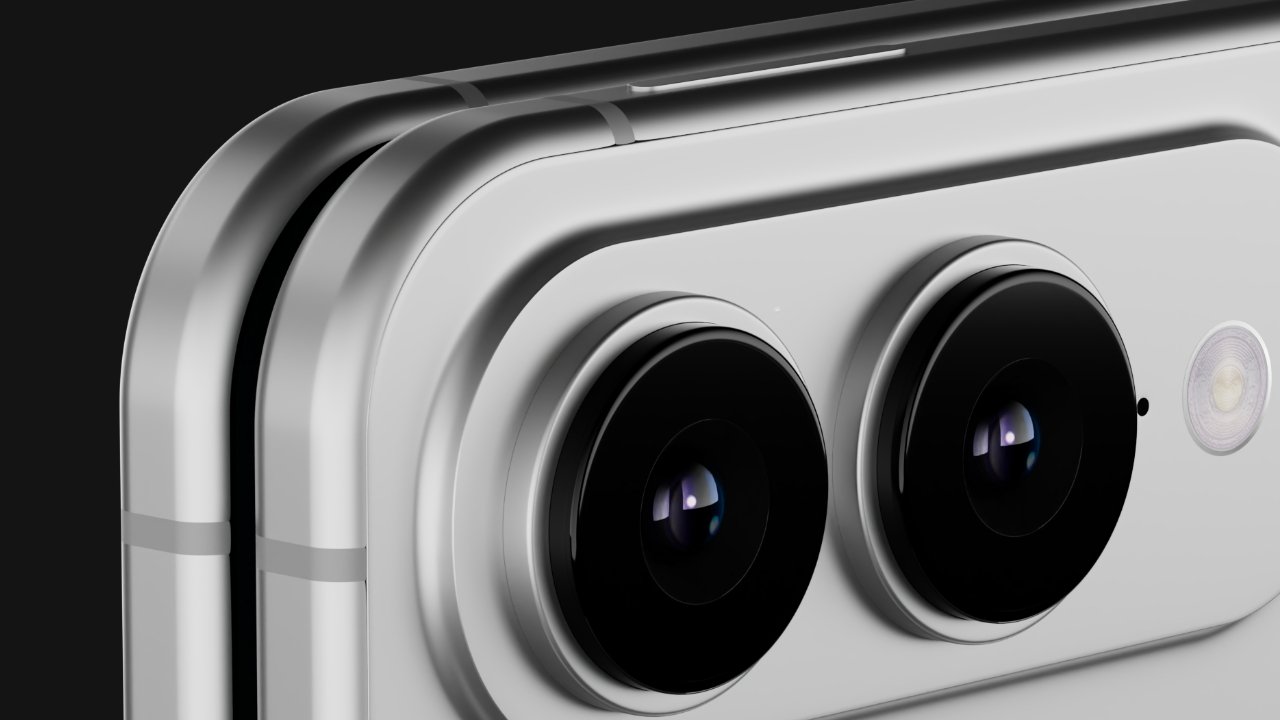
A new report claims that Apple expects to sell 10 million of the iPhone Fold in 2026 and into early 2027, considerably up from most previous estimates.
Nothing varies quite like the rumors that the iPhone Fold is or is not going to be launched in September, but the number Apple will make comes close. In April 2026, for example, Nikkei Asia and most other analysts believed that Apple was ordering 7 million to 8 million for the year.
At the same time leaker Digital Chat Station claimed it was 11 million.
Now Nikkei Asia has met the leaker halfway, and says that Apple is ordering ten million of the iPhone Fold for the rest of 2026. In total, across the whole of the year and all of its iPhone models, Apple expects to produce over 220 million devices.
That compares to late 2025, when it was estimated that Apple’s sales for the year would be around 247 million iPhones. In September 2025, it was reported that Apple was looking for options to speed up production of the iPhone Fold, and that it was predicting a 10% increase in all iPhone sales across 2026
The new report follows estimates that the iPhone Fold will account for 29% of all folding display orders in 2026. That compares to Samsung’s estimated 31%, and Huawei’s 24%.
If the report’s figure of 10 million iPhone Fold devices being produced in 2026 is correct, it bolsters claims that Apple has resolved the claimed manufacturing problems regarding the device’s hinge and circuit board.
Given that the figure is specifically for Apple’s 2026 orders for iPhones, it suggests the iPhone Fold will be launched in September, with shipments not delayed into 2027 as previously rumored. That’s not certain, however, and it remains possible that Apple could announce it in September, but not ship it until later.
Generally, Apple orders around 30 million of its Pro iPhone models for the weeks after launch. It’s not yet clear what the order volume will be, with the folding iPhone in the mix.
The global chip shortage may alter these figures. But generally Apple aims to order 20 million of the various non-Pro models to sell in September. This is likely not on the table for 2026, as the present rumors suggest the non-Pro iPhone 18 will be launched in the spring of 2027.
In May 2026, it was rumored that Apple was changing these ratios for the iPhone 17 range because of both demand, and possible delays for the iPhone 18. Those delays may be due to the expectation that Apple is to move its next non-Pro iPhone launches from September 2026 to spring 2027.
However, regardless of this, the new report also claims that Apple has asked suppliers to reserve an unknown number of iPhone 17 components. That suggests that Apple is looking to mitigate against shortages as much as possible.
Tech
Q Acoustics Q SUB100 Review: A Powerful 10-Inch Subwoofer for Music and Home Theater You Can Afford
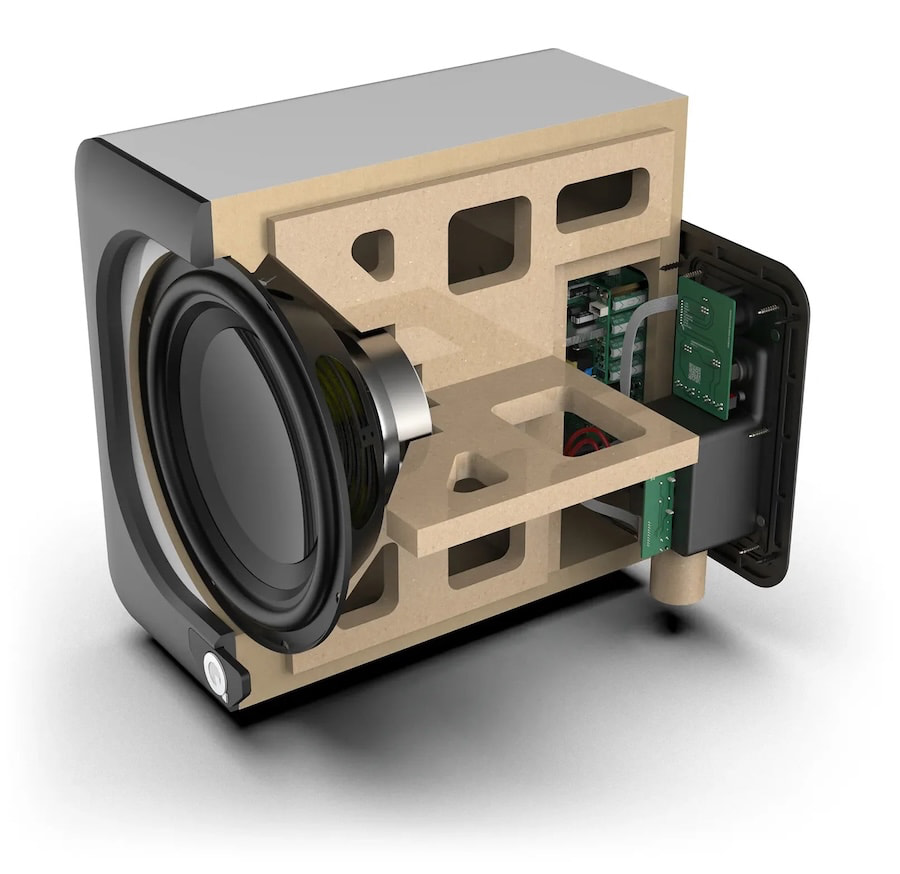
Q Acoustics has spent the past three years methodically rebuilding its loudspeaker lineup, and the new Q SUB100 subwoofer is the long overdue final piece of that puzzle. The 5000 series raised the company’s game in the affordable high end category, while the newer 3000c series brought genuine refinement to the budget end of the market. The excellent 3020c proved that a compact standmount can still deliver real musical substance without forcing a yard sale of older hi-fi purchases or a sternly worded note from the HOA.
Please, Mrs. Cohen, do not make me pace the patio in a Speedo while listening to Aphex Twin outdoors; the neighbourhood has already endured enough.
The Q Acoustics M40 also earned our Editor’s Choice Award as one of the better wireless speaker systems available, and it remains an appealing foundation for a compact 2.1 system in rooms where space is at a premium. Add a capable subwoofer, however, and that modest-looking system can become something far more complete for music, movies, television, and late-night sessions; right until the neighbours respond by banging on the wall like Keith Moon has risen from the dead and taken up residence next door. Keep your bass handy for the Entwistle comeback.
That missing low-frequency component has been the one obvious hole in the Q Acoustics catalog. The new Q SUB Series finally addresses it with three active subwoofers: the 8-inch Q SUB80 ($1,099), 10-inch Q SUB100 ($1,199), and flagship 12-inch Q SUB120 ($1,399).
The Q SUB100 is likely to be the sweet spot of the range. Its 10-inch driver, compact sealed enclosure, and 300-watt amplification promise enough authority for medium-sized rooms and properly assembled 2.1 or home-theater systems, without requiring the floor space, financial commitment, or structural reinforcement associated with a larger subwoofer.
It is the model most likely to appeal to Q Acoustics owners who want deeper, more convincing bass but have no desire to turn the living room into a local World Cup watch party, complete with 14 people shouting at the referee and one bloke treating every corner kick like the Normandy landings.
Specifications & Technology
The Q Acoustics Q SUB100 uses a sealed, or “infinite baffle,” enclosure rather than a ported cabinet. That matters because a properly executed sealed design generally favors tighter, more controlled bass, while giving the onboard DSP a more predictable platform from which to work. It is also a more forgiving approach for real rooms, where subwoofers often end up near a wall or corner out of necessity.
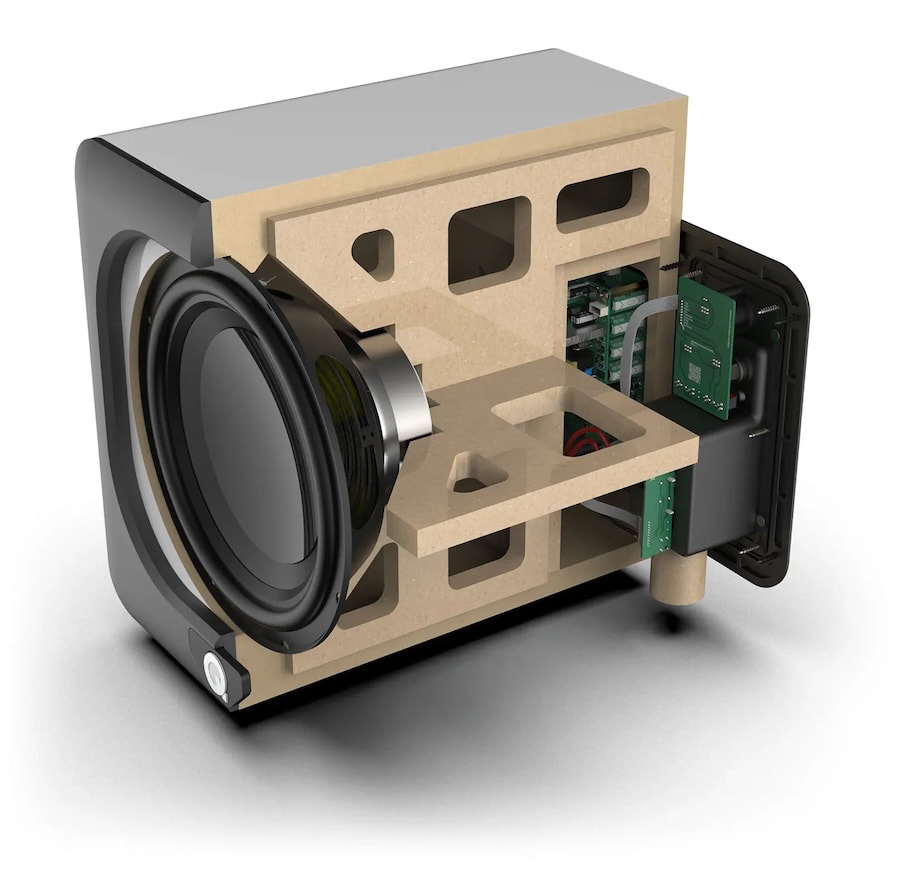
The Q SUB100’s 23.5-litre cabinet is constructed from 18mm high-density MDF, with a 36mm double-thickness front baffle to keep the enclosure from adding its own low-frequency commentary. Internal dart bracing further stiffens the structure and helps reduce cabinet “ballooning” under pressure. Q Acoustics has also paid attention to the less glamorous details: airtight amplifier mounting, a tightly secured 15mm MDF grille, and adjustable locking spikes with protective cups for leveling on hard floors.
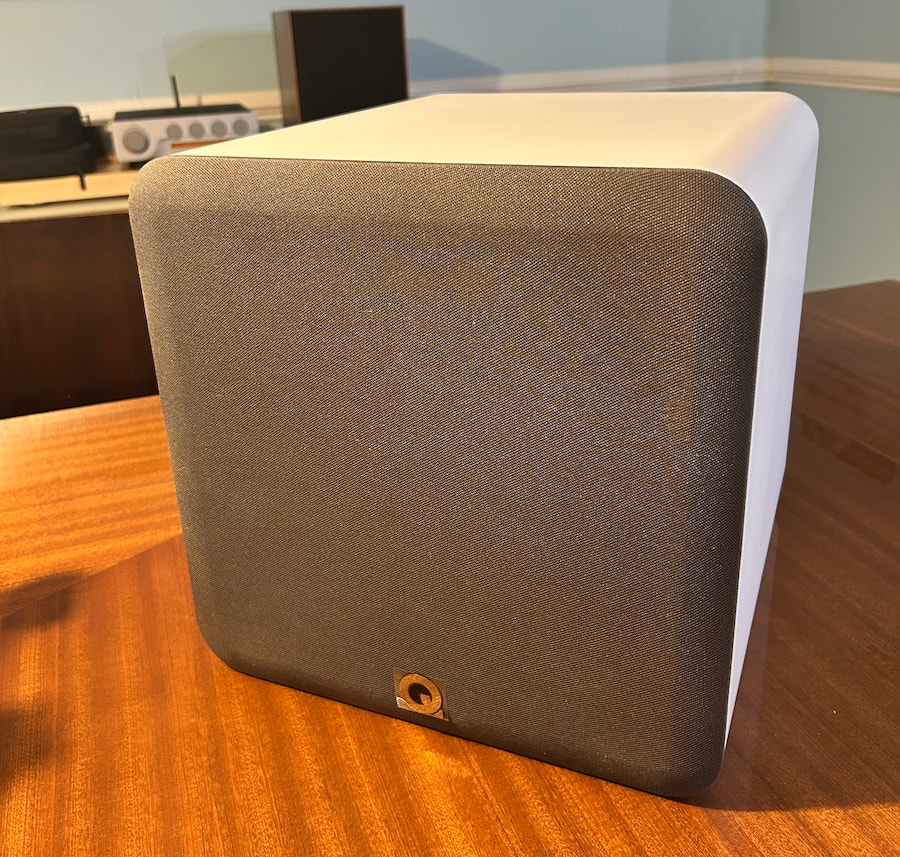
The Q SUB100 is available in Satin Black or Satin White, both of which suit its understated, clean-lined cabinet design and make it easier to integrate into a living room without looking like a misplaced PA speaker.
At 13.7 x 13.7 x 15 inches and 36.8 pounds, the Q SUB100 is not tiny, but it remains manageable enough for medium-sized rooms where a 12-inch subwoofer might start looking like a misplaced piece of airport infrastructure. Not looking at you Wilson Audio or McIntosh. Maybe just a little
A 10-Inch Driver Built for Control
The Q SUB100 employs a 254mm (10-inch) driver with a heavy-duty steel chassis, paper cone, and rubber surround. Paper remains an entirely sensible material for a subwoofer cone when properly engineered, combining low mass with the rigidity and damping needed for controlled, articulate bass.
A 38mm voice coil and aluminium demodulation ring are part of the design, with the latter intended to reduce distortion caused by changes in inductance as the driver moves through its travel. The goal is not simply more bass, but cleaner bass when the driver is working hard.
Q Acoustics rates the Q SUB100 down to 32Hz at -6dB, with a maximum SPL of 111dB at one metre. Those numbers suggest genuine low-frequency authority for music, television, and home theater in appropriately sized rooms, without promising that a compact 10-inch cabinet will recreate the seismic activity of Shore traffic driving through your living room.
DSP, Serious Power, and Easier System Integration
The Q SUB100’s custom amplifier module delivers 250 watts of continuous power and up to 500 watts peak. It uses four digital amplifier stages in a parallel bridge-tied load configuration, a design intended to reduce output impedance, improve driver control, and limit heat dissipation. Q Acoustics specifies total harmonic distortion at 0.09% at rated power.
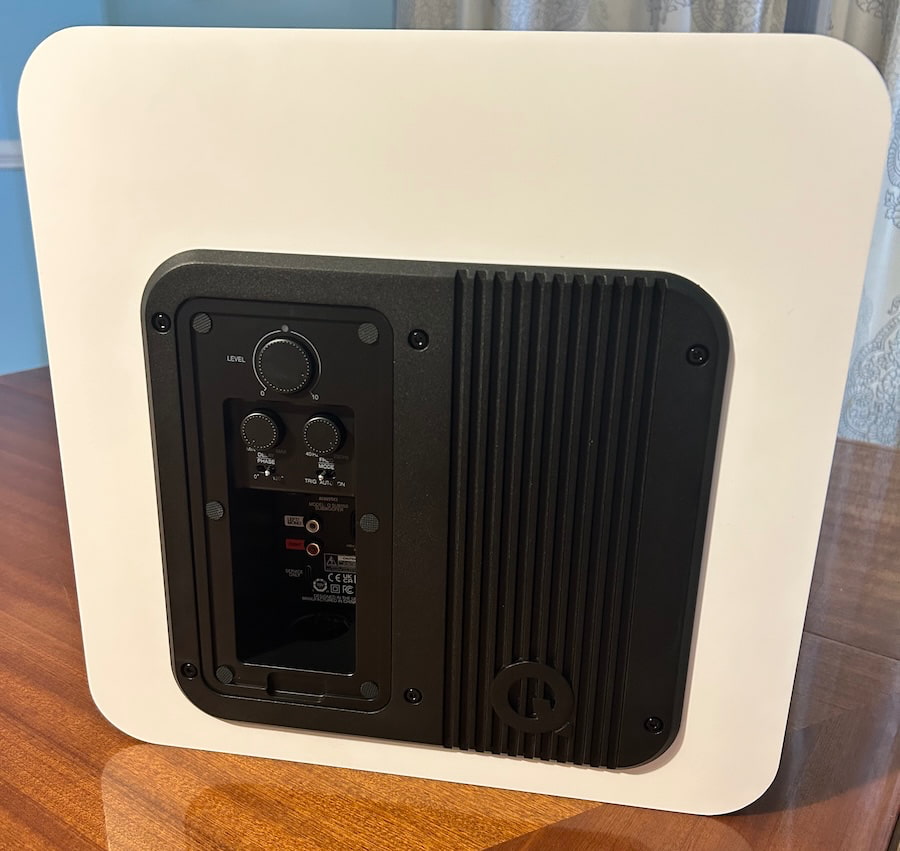
The DSP handles more than basic housekeeping. Along with helping shape the sealed enclosure’s response, it offers fine delay adjustment and a phase inversion switch to help the Q SUB100 integrate more cleanly with the main speakers. Its adjustable low-pass filter spans 40Hz to 250Hz, allowing it to work with everything from compact standmounts to active wireless speakers and home theater systems. Q Acoustics has also included source detection that identifies whether the incoming signal is stereo or mono and automatically adjusts gain accordingly.
What’s Missing: Room Correction, Wireless, and App Control
For all of the useful engineering inside the Q SUB100, there are a few omissions worth noting. The big one is automated room correction. Q Acoustics gives users DSP, phase inversion, fine delay adjustment, and a wide 40Hz to 250Hz low-pass filter range, but there is no supplied microphone-based calibration system to measure the room and smooth out bass peaks. In fairness, most subwoofers at this level still depend on the user, AVR, streaming amplifier, or external room correction platform to handle that job. Bass remains rude like that. Dirac to the rescue.
There is also no built-in wireless connectivity, which means the Q SUB100 still needs to be connected the old-fashioned way. That is hardly a tragedy, especially for users building a 2.1 or home theater system, but anyone hoping to hide the subwoofer across the room without running a cable will need to plan accordingly.
The other missing piece is deeper app-based control. A subwoofer with this much DSP potential would benefit from a proper control app with preset storage, parametric EQ, room-position presets, and easier fine tuning from the listening seat. Having to crouch behind a subwoofer while adjusting bass is one of those hi-fi rituals that makes non-audio people wonder if we have joined a small but expensive cult that enjoys arguing online about measurements and pretending that we have friends.
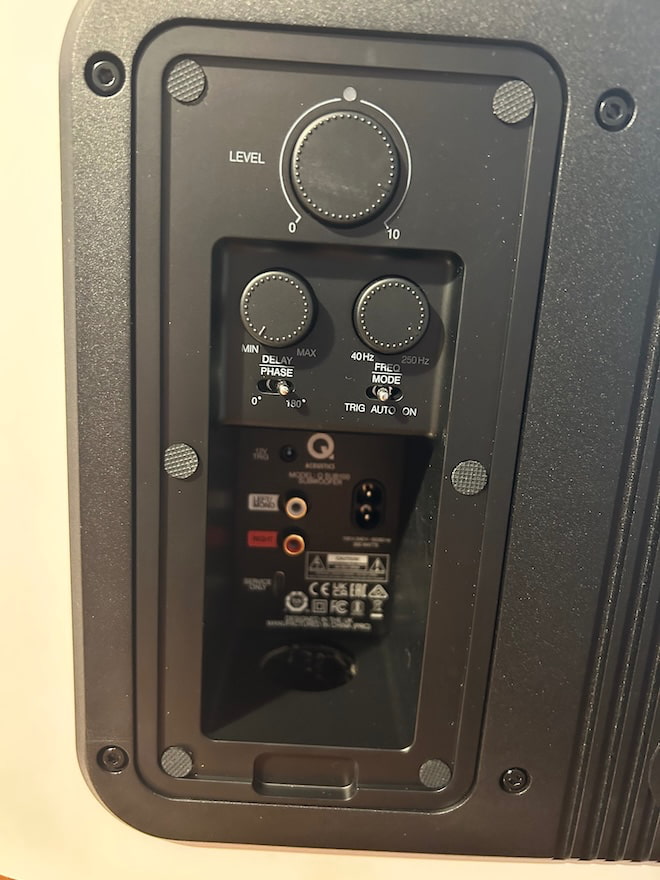
The Q SUB100 also omits high-level, or speaker-level, inputs of the type used by many of REL’s music-first subwoofers. REL’s approach uses a Neutrik Speakon connection tapped from the amplifier’s left and right speaker terminals, feeding the subwoofer the same signal received by the main speakers while placing virtually no additional load on the amplifier. REL argues that this preserves more of the system’s tonal character and timing cues, which is why the connection remains popular with two-channel listeners using integrated amplifiers without a dedicated subwoofer output.
Setup and Listening: Toronto, Two Subwoofers, and the First Complaint
My education in proper subwoofer setup began in the early 1990s, shortly after college, in my first apartment: a pre-war building in midtown Toronto with a 16 x 19 x 9-foot living room that was not acoustically disastrous, which already put it ahead of most rental properties and several respected listening rooms. The system was built around NHT’s original SuperZero mini-monitors and a pair of passive SW2 subwoofers driven by NHT’s MA-1 amplifier — the arrangement marketed as the SW2P powered subwoofer system.
I was also friends with Corey Greenberg, then of Stereophile, who sent me a pair of his homemade “Aunt Corey” high-pass filters. Inserted into the system, they kept the bottom octaves away from the tiny two-way NHTs and let the subwoofers handle the heavy lifting. That was not some occult audiophile ritual involving quartz blocks and a magical clock; it was simple, sensible bass management.
The difference was immediate. The SuperZeros sounded more open, the soundstage grew appreciably larger, and the system gained the weight and balance that my largely non-audiophile music collection required. Two subwoofers felt like the intelligent choice for a young man beginning his audiophile journey and already convinced that accurate bass mattered as much as a convincing midrange.
The flaw in this otherwise splendid plan was that bass does not respect property lines. It leaked into the flat next door, for which I still owe an apology to the former Minister of Justice, and annoyed the elderly gentleman downstairs, who had little patience for electronic music, new wave, or 11 p.m. sessions of 2112. Learning how to position, level-match, and properly integrate a subwoofer became less an audio hobby than an essential survival skill.
Jump ahead to 2026, and while subwoofers have remained part of my home theater systems for years, an aging REL T Series model has been my only regular partner for two-channel listening. It has survived moves from Toronto to New Jersey, down to Florida, and back to New Jersey again, which is more relocation experience than most touring bands and considerably more than I ever intended to inflict on a subwoofer.
That is about to change. Two of REL’s latest subwoofers, including one of the new Planar on-wall models, are scheduled to arrive for review in August. The timing is rather good, as I am moving into a new home office with enough flexibility to experiment properly with a smaller subwoofer positioned discreetly along a wall or mounted to it, without turning the room into a shrine to black boxes, power cords, and making it a target for Tyrion the Westie.
The Q SUB100 is also the sort of subwoofer that makes sense in that context. Its compact sealed cabinet should be easier to accommodate than a larger ported design, but the real question is whether it can provide the scale, weight, and integration that make a two-channel system sound more complete without announcing its existence every time the kick drum arrives.
Listening with the Q Acoustics 5040, M40, and 3020c
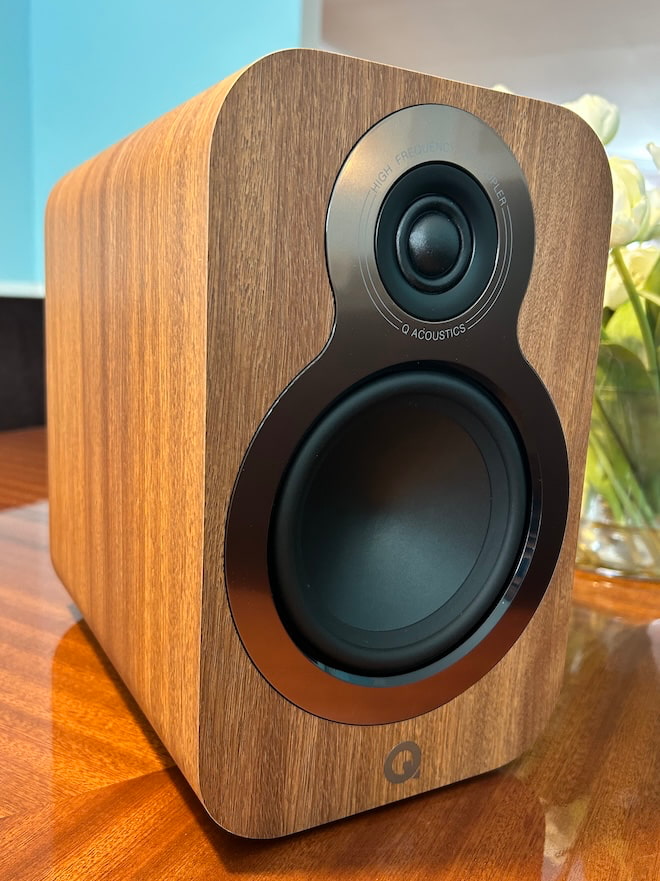
The Q SUB100 is not lightweight, and I put a small amount of Blu Tack beneath its feet and cup before placing it on the hardwood floor. My 16 x 13 x 9-foot den offers enough space to position a subwoofer two to three feet from the wall and clear of the corners, which matters. Experience has taught me that corner placement can overload this room rather quickly, especially with a subwoofer of this size.
The room also opens into the front foyer at one end and the kitchen at the other, adding a few more variables to the bass equation. Rooms, as ever, refuse to read the manual.
Before replacing my Magnepan LRS with the Q Acoustics speakers that I use daily, I spent some time moving the Q SUB100 forward and back in small increments until the balance finally locked in. The sweet spot was 24 inches from the wall behind it to the rear of the cabinet, and roughly 30 inches from the nearest sidewall.
That placement delivered the best balance of impact, speed, and integration with the main speakers. I went back and forth between the 5040, M40, and 3020c to find the most convincing blend; not because I enjoy moving a 37-pound subwoofer around the room for sport, but because subwoofer placement remains one of those things that either clicks or stubbornly refuses to.
Crossover settings were not identical across the three Q Acoustics systems. I settled on 80Hz with both the 3020c and 5040, which gave the Q SUB100 enough room to add real foundation without drawing attention to itself or thickening the midbass.

The M40 worked best with a lower 60Hz setting. Its dual 5-inch drivers already produce more bass weight than their compact micro tower proportions suggest, so crossing over any higher began to add more overlap than the system needed in my room. At 60Hz, the M40 retained its own quick, satisfying bass character, while the Q SUB100 handled the lowest octaves with greater authority and no obvious handoff between the speakers and subwoofer.
That is not a universal prescription. Room dimensions, placement, and the distance from the nearest wall still get the final vote, because bass remains the one part of hi-fi most likely to ignore both specifications and common decency.
The M40 offers a dedicated subwoofer input on the rear of its primary speaker, and there were moments when the move from 2.0 to 2.1 made the system considerably more engaging. That said, the M40 is not remotely lightweight in the bass department for a compact active speaker, and the Q SUB100 never felt as though it was trying to correct a deficiency. It simply gave the system more scale, weight, and low-end confidence when the recording called for it.
The tonal match with all three Q Acoustics models was exceptionally seamless. That matters because the newer 5040 and 3020c do bass differently from the older 3000 series: leaner, faster, and more clearly defined, with better control and less midbass warmth doing the heavy lifting. The Q SUB100 complemented that character rather than smothering it, adding impact and extension without turning the presentation into a thick mess.
From a cost perspective, the M40 and Q SUB100 feel like a slight mismatch; they strike me as products aimed at somewhat different buyers. The smaller and less expensive Q SUB80 is probably the more natural partner for Q Acoustics’ active wireless speaker, particularly in a compact room where the M40’s own surprising bass output already carries much of the load.
The 3020c is more affordable than the M40, but its likely owner is not necessarily the same customer. Paired with the Q SUB100, the 3020c sounds far more authoritative, gaining scale and low-frequency weight without losing the clarity and imaging that make it such a strong compact standmount. The 5040 benefits in a different way. Its wall-to-wall soundstage remains intact, but the system takes on the authority of a more powerful mid-level floorstander.
The subwoofer does not suddenly blow the soundstage through the walls, which would be awkward to explain to the insurance company and family, but it gives both speakers a greater sense of physical presence while allowing the midbass and upper bass to retain their impressive clarity, detail, and resolution.
Listening to Nick Cave’s “Avalanche” and “Comancheria” from Hell or High Water, a great film, the Q SUB100 added real weight to Cave’s piano. You could feel the instrument’s low register, while its natural decay remained intact. Just as importantly, his gravelly voice was never overwhelmed by the added bass below 80Hz.
The same held true with Jason Isbell, Bryan Ferry, and Roxy Music. Percussion and synthesizer lines hit with greater force, but there was no loss of definition or separation. The presentation sounded properly full range in the room rather than merely louder and thicker.
Electronic music had considerably more presence and definition. Deadmau5, Aphex Twin, The Orb, Kraftwerk, and Boards of Canada all benefited from the Q SUB100’s ability to deliver greater low end weight without blurring the rhythmic pulse or layering of the recordings. Synth lines reached some interesting club levels, briefly taking me back to Washington, D.C. in the 1990s, when I was a college student and certain establishments, along with certain nocturnal activities, are best left unnamed.
Talking Heads and Peter Gabriel were equally revealing. The bass lines hit harder, percussion gained more physical presence, and the system still retained the clarity that makes these recordings worth revisiting. I did not even bother reading my text messages from upstairs. Nothing you could say to the Rabbi.
Switching to movies and television, I have become slightly obsessed with The Pitt, A Knight of the Seven Kingdoms, and the latest season of Fauda. It is remarkable how much some shows leave on the table without a properly integrated subwoofer. The impact of weapons landing against a knight’s chest, charging horses, gunshots, frantic runs through hospital corridors, machine gun bursts, and cars racing down narrow streets all gained convincing weight and physical force.
The Q SUB100 did not turn every scene into a multiplex trailer mixed by someone with unresolved childhood issues. It simply filled in the low frequency information that smaller speakers cannot fully reproduce, making each sequence feel more immediate, tense, and involving.

The Bottom Line
Subwoofers are strange products. They have to reproduce the lowest octaves already present in the music or soundtrack without making a mess of everything else. Some do that far better than others. The Q SUB100 fills a major need within Q Acoustics’ own speaker lineup, and it does so very well.
Its sealed cabinet, useful DSP controls, compact footprint, and substantial 10-inch driver make it an especially effective match for the 3020c and 5040, adding scale, impact, and low frequency extension without clouding their excellent imaging or midbass clarity. It also works well in a home theater or television system, where its 250 watts of continuous power and 32Hz extension add genuine weight to action sequences without calling attention to themselves.
What it does not offer is equally clear: no automated room correction, app based EQ, wireless connectivity, or REL style high level input. Those omissions will matter to listeners with older two channel amplifiers, difficult rooms, or a strong preference for adjusting everything from the sofa.
The Q SUB100 is for Q Acoustics owners who want a serious, well controlled subwoofer for music, television, and movies, but do not need a larger 12-inch cabinet or a more elaborate calibration ecosystem. It is not inexpensive, but it sounds like a proper component rather than an obligatory black cube purchased to make explosions louder.
You might want to put your text messages on silent mode before using it. The people around you may become rather animated once the walls begin contributing to the conversation.
Pros:
- Deep, controlled bass with strong definition and convincing impact
- Seamless tonal match with the Q Acoustics 3020c, 5040, and M40
- Sealed cabinet offers easier placement than many ported alternatives
- Excellent blend of speed, scale, and low frequency weight for music
- Adds real authority to movies, television, and gaming without muddying dialogue
- Solid construction, useful DSP controls, and adjustable crossover settings
- Compact enough for medium sized rooms without looking like a small appliance
Cons:
- No high level speaker inputs for REL style two channel integration
- No app control, parametric EQ, or automated room correction
- No built in wireless option
- Heavy enough to make repeated placement experiments less charming
- Q SUB80 may be the more sensible match for the less expensive M40
- Premium price places it above many buyers’ expected subwoofer budget
Our Ratings
★★★★★★★★★★ Bass Quality
★★★★★★★★★★ Build Quality
★★★★★★★★★★ Features
★★★★★★★★★★ Value
Where to buy:
Related Reviews:


From AI and upskilling, to new technologies and experimentation, there is much for professionals in the future health sector to get excited about.
Regardless of your role or industry, for the majority of professionals, a key concern is often finding an element of the job that drives excitement and motivation. Frequently, it is this drive that creates long-term satisfaction and career longevity.
For Deepak Chaudhari, the country head at TCS Ireland, of the aspects he finds most compelling within the healthcare and health-tech spaces, among them is being at the forefront of modernisation.
“One of the most exciting opportunities we are working on is enabling data‑driven, patient‑centred healthcare systems, aligned to Sláintecare’s vision for integrated and efficient care,” he said.
Chaudhari explained that there are significant challenges in ensuring that rapid digital transformation has the power to deliver on real-world clinical and operational demands, noting TCS addresses this through “data platforms, automation and responsible AI that improves both patient outcomes and workforce productivity”.
For Sohini De, the head of healthcare and innovation at BearingPoint Ireland, GenAI is playing a key role in generating excitement in her role.
“One of the most significant opportunities we are advancing is BearingPoint’s custom-built GenAIQ platform, an agentic, retrieval augmented generation-based solution designed to help organisations move from AI experimentation to practical, governed impact,” she explained.
For De, AI in healthcare is at its most valuable when it can be used to merge benefits across a wide array of groups, such as clinicians and patients. This can be in earlier diagnosis, better triage, stronger population health management and improved patient flow across acute, community and primary care.
Specifically for clinicians, she added: “AI can reduce administrative burden, support documentation and summarisation, and surface relevant information at the point of need, freeing more time for direct patient care. Its role should be to strengthen, not replace, clinical judgement and human-centred care.”
AI ability
De also finds that, as more and more organisations grow out of the experimental AI phase and start to develop realised AI strategies, it is becoming apparent that “technology in isolation will not deliver the benefits expected”.
“Much of our work remains focused on the alignment of organisations, processes, people and data to realise the benefit of new technologies,” she said. “From a workforce planning perspective we are seeing that it is professionals who can bridge policy, technology, clinical practice and change management will be critical to turning AI ambition into measurable improvements in access, quality, safety and experience.”
This was echoed by Chaudhari who explained that he is seeing increasing demand for professionals with the skills to work at the intersection of healthcare, technology and data.
He is of the opinion that vital abilities include digital health and EPR delivery experience; data and analytics expertise for reporting, insights and population health; automation and AI skills with a strong understanding of governance and ethical use; cloud‑native and interoperability capabilities, including API and FHIR‑based integration; and change, delivery and stakeholder management, which is critical in complex health environments.
“We value backgrounds in health informatics, data science, engineering, life sciences and clinical disciplines, alongside strong collaboration and problem‑solving skills. Above all, we look for people motivated by purpose and impact. We seek individuals who want to play a role in shaping the future direction of healthcare through thoughtful, responsible use of technology.”
De added: “Ultimately, the goal is to support a resilient, future-ready healthcare ecosystem in Ireland, one where AI is used responsibly to improve patient outcomes, reduce avoidable variation, support clinicians, maintain compliance and help services respond more effectively to growing demand.”
Don’t miss out on the knowledge you need to succeed. Sign up for the Daily Brief, Silicon Republic’s digest of need-to-know sci-tech news.
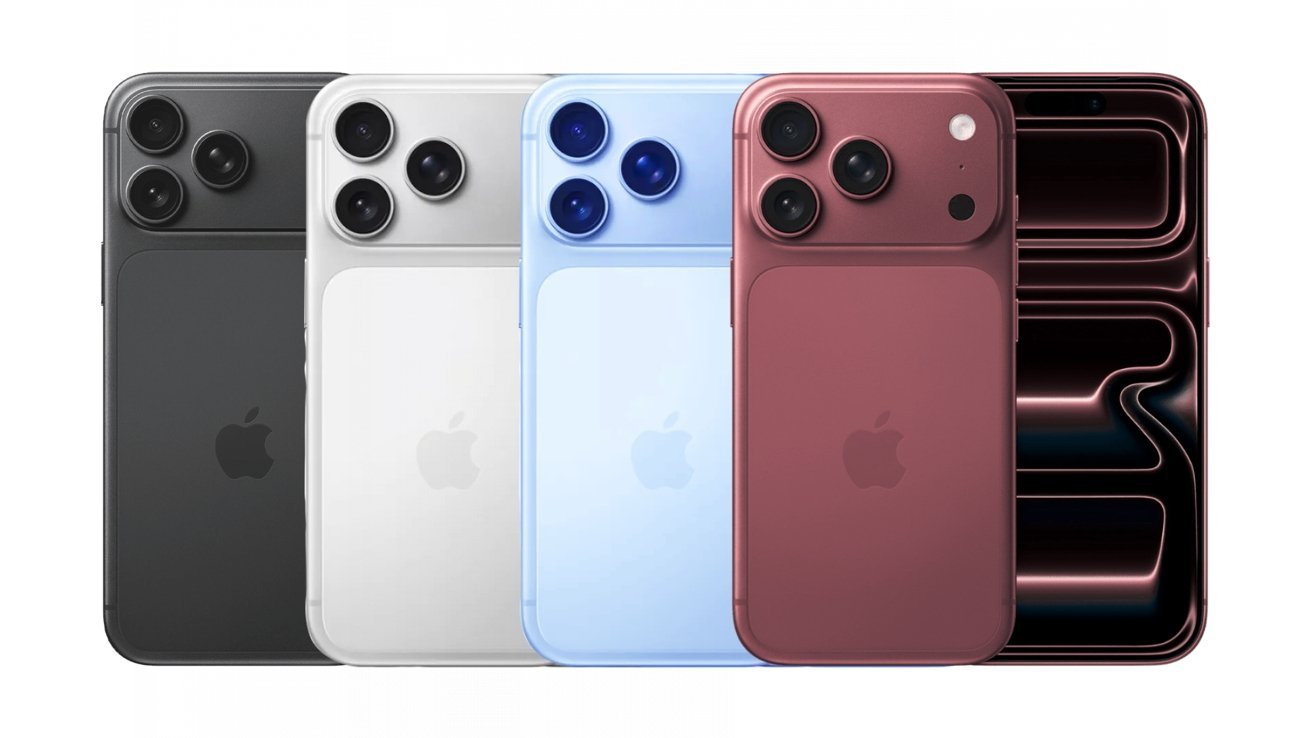
A new rumor claims that some iPhone 18 Pro models will use slower QLC NAND storage, mimicking a similar 2024 iPhone 16 Pro report. It makes more sense now than it did then, but doesn’t matter much in practical usage.
This latest report suggests that Apple will use the faster TLC storage for the iPhones that people are most likely to buy. But those choosing the larger 1TB and 2TB capacities may be left with a slower QLC alternative from SK Hynix.
Companies like Apple continue to struggle to source the storage components required for new products. With that in mind, it may not be surprising to see Apple go this route. Sourcing 1TB and 2TB TLC components may be difficult, if not impossible.
And, certainly, it will be spendy given the current economic environment surrounding flash media.
However, we’ve heard this story before. And it doesn’t seem to have been accurate that time around. And as we discussed back then, it’s unclear whether the use of QLC storage would be a real issue for iPhone owners.
QLC or TLC for iPhone 18 Pro
This latest report centers around the iPhone 18 Pro and iPhone 18 Pro Max. WCCFTech shared details of a post by the leaker “Reptalica” which claims Apple will use different storage types for different models.
According to the X post, Apple will use TLC NAND provided by SK Hynix, Kioxia, and SanDisk when building 256GB and 512GB iPhone Pro/Pro Max models. The 1TB model will use a mixture of SK Hynix QLC storage and Samsung TLC chips.
It’s then argued that Apple will solely use SK Hynix’s QLC storage for the 2TB model.
A rumor, repeated
If this all sounds familiar, it’s because we saw very similar claims in January 2024, prior to the iPhone 16 Pro’s unveiling in September of that year. We were told then that Apple would use QLC storage for iPhones with 1TB of storage or more.
Getting concrete information on whether that actually happened isn’t easy. That being said, we’ve only seen reports of high-capacity iPhone 16 Pro models with the fast TLC storage. That doesn’t mean there aren’t some QLC NAND chips floating around.
If there are, we’ve yet to see one.
The differences between QLC and TLC
Triple-Level Cell (TLC) NAND flash and Quad-Level Cell (QLC) NAND flash are both types of storage. But they aren’t the same.
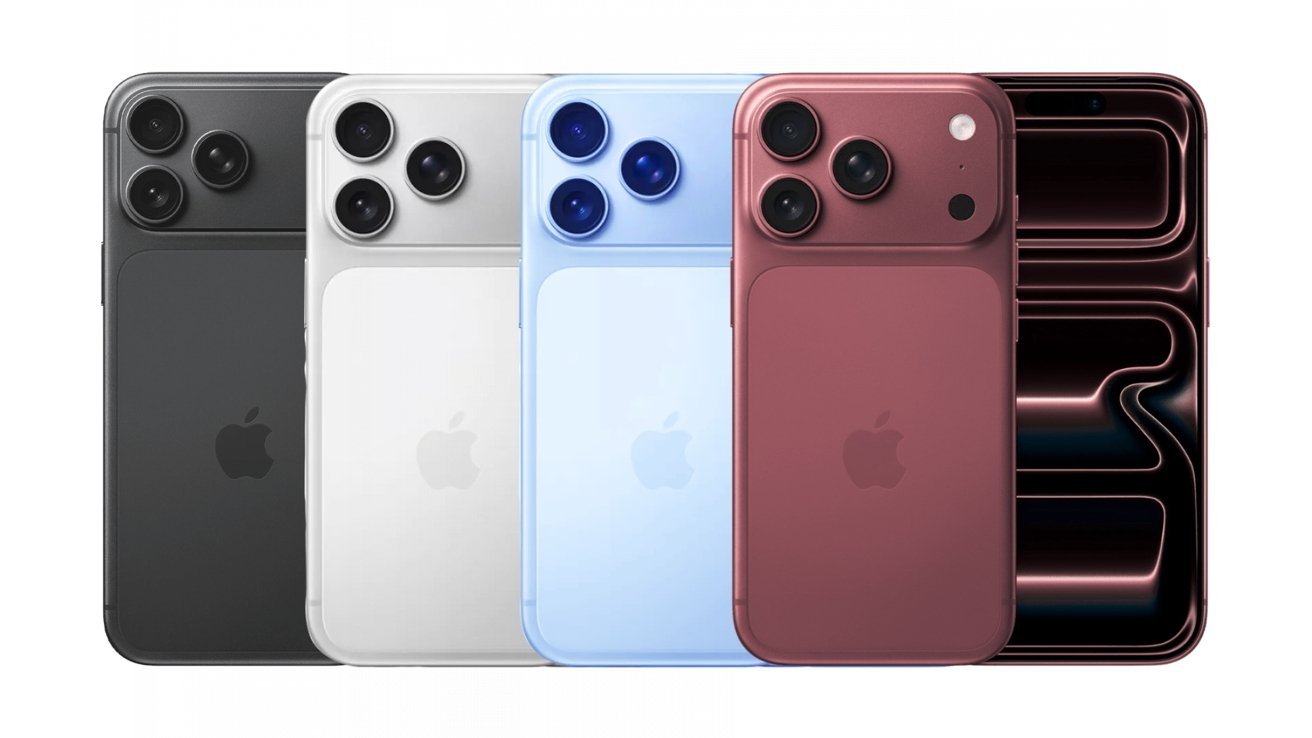
The iPhone 18 Pro storage may be a hot topic this hear.
One difference is the way QLC can store four bits of data per cell of memory, rather than the three of TLC. This then allows QLC NAND to store more data, which is why it’s sometimes used in larger-capacity storage. It’s also cheaper to produce.
Unfortunately, QLC is also thought to be less reliable than TLC and, importantly, it’s also slower as it is rewriting all four bits instead of the three.
How much slower in the real world, on mobile, is a matter for debate. The report notes that QLC storage is particularly slow when reading random data. But it’s unclear how that would impact the way people use iPhones.
Smartphone loads on flash storage are generally in bursts, instead of sustained transfers. As such, the difference in performance is likely to be imperceptible to users who don’t resort to benchmarking tools.
It’s also important to remember that this rumor did the rounds two years ago and, as far as we can see, turned out to be incorrect. Only time will tell if this latest report is more accurate.

OpenAI is reportedly in early talks to give the U.S. government a 5% stake, potentially alongside similar contributions from other major AI companies. “Such a deal would help improve the industry’s relations with the Trump administration and could help garner political support by sharing wealth generated by the AI boom with the public,” reports The Guardian. From the report: [OpenAI CEO Sam Altman] and other OpenAI bosses have suggested that each of the biggest AI developers in the US should give 5% to their equity to an investment vehicle such as the Alaska Permanent Fund, a sovereign fund that invests US oil wealth into stocks and pays dividends to the state, the FT reported.
The talks are “conceptual” and in early stages, it said, and any deal could require an act of Congress to implement. Both OpenAI and Anthropic have previously suggested in policy papers that a public or sovereign wealth fund may be required in the future to distribute shares to the public. In April, OpenAI said that a “public wealth fund” could provide “every citizen — including those not invested in financial markets — with a stake in AI-driven economic growth.” Further reading: Bernie Sanders Unveils $7 Trillion Plan To Give Americans Control of AI Industry
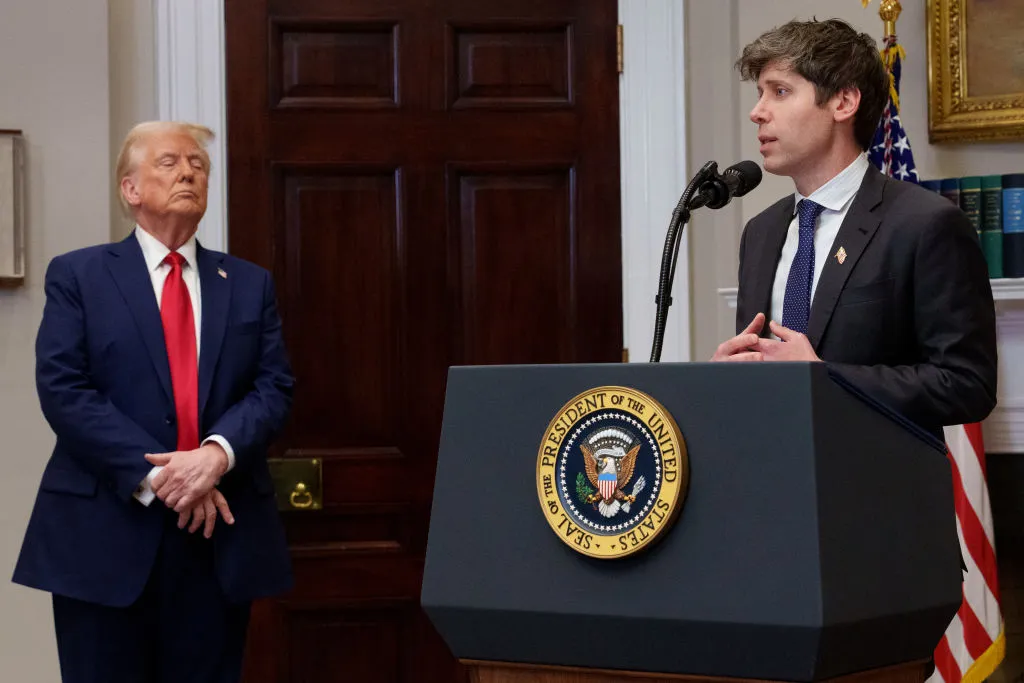
OpenAI CEO Sam Altman has proposed giving 5% of the company’s equity to a U.S. sovereign wealth fund, the Financial Times reported on Thursday, citing two people familiar with the matter. Under the proposal, other AI companies would donate similar stakes, although significant questions remain about the specifics.
According to the FT’s reporting, the donation would be meant to “secure good relations with the administration and … address political blowback.”
Similar discussions were reported by CNBC in June and were subsequently confirmed by President Trump, who said he had discussed “concepts where pieces could be given to the American public, where the American public essentially becomes a partner with the companies.” At the time, no specific size for the proposed equity stake was given.
The talks remain preliminary and, per the FT, it’s likely that any formal action would require congressional approval, which would significantly complicate the matter.
The idea of a public AI fund has also been publicly discussed by Altman, and OpenAI has grown increasingly specific in its proposals for how such a fund could be structured. Most recently, a policy paper titled “Industrial Policy for the Intelligence Age,” released by OpenAI in April, proposed a public wealth fund that could invest directly in AI labs and companies deploying their technology.
“Returns from the Fund could be distributed directly to citizens, allowing more people to participate directly in the upside of AI-driven growth, regardless of their starting wealth or access to capital,” the document reads.
A more aggressive version of the policy was proposed by Sen. Bernie Sanders (I-VT) in June, calling for a one-time 50% tax on AI company stock, with the collected shares being deposited into a public wealth fund. The bill, called the American AI Sovereign Wealth Fund Act, would apply to all “systemically important” AI companies, including those dealing with data centers, infrastructure, or robotics. Under the proposal, companies like Google and SpaceX that include AI as only part of their business would be allowed to spin off non-AI portions of the company to avoid taxation.
The bill has yet to advance to committee.
When you purchase through links in our articles, we may earn a small commission. This doesn’t affect our editorial independence.
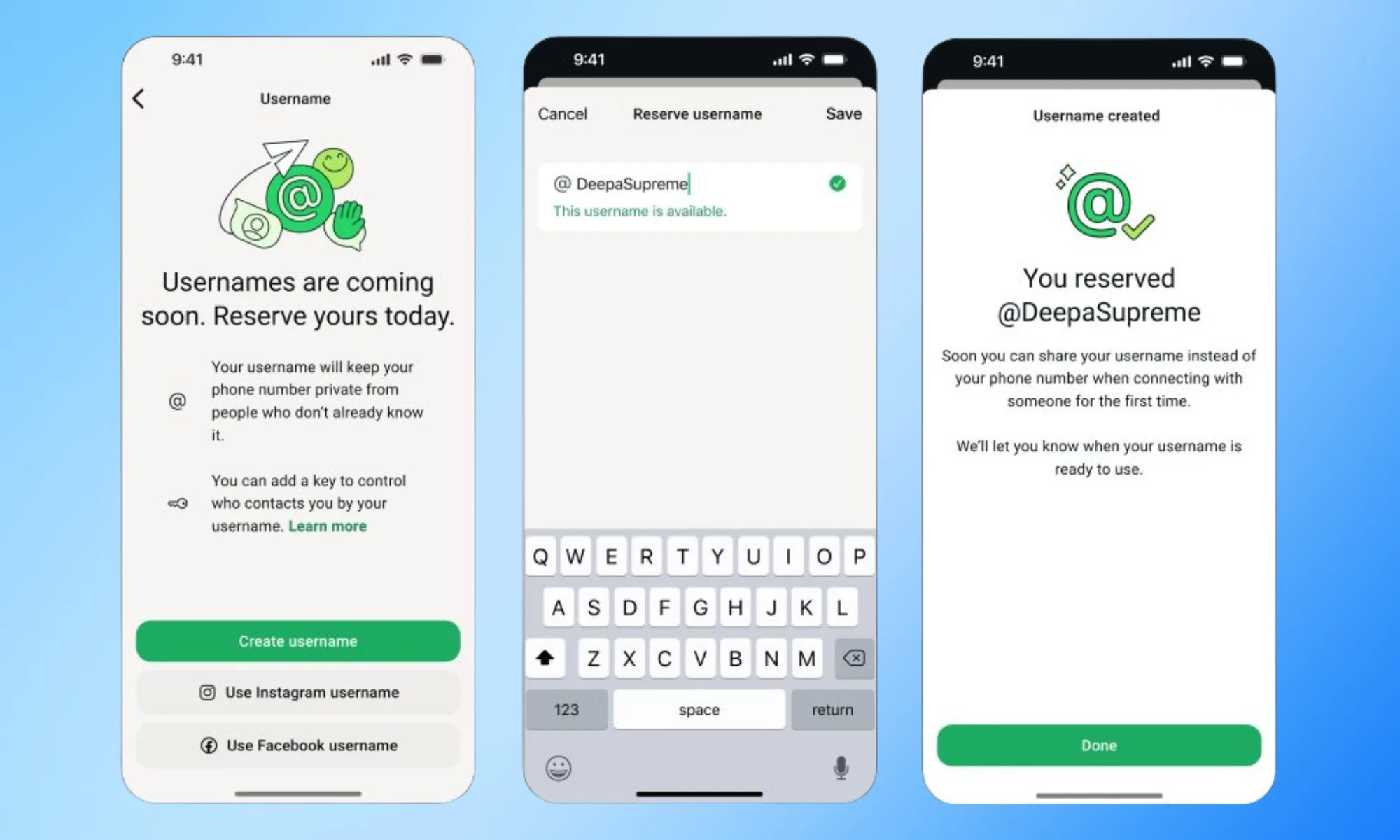
WhatsApp’s plan to let people use usernames instead of phone numbers has run into trouble in India, its biggest market. This newly introduced feature is meant to improve privacy by letting users connect without immediately sharing their phone number. Indian authorities, however, are worried that the same feature could make scams and impersonation harder to control.
India’s Ministry of Electronics and Information Technology (MeitY) has asked WhatsApp to pause the username rollout until consultations with the government are complete. That is a major intervention, since WhatsApp has more than 500 million users in the country, who rely on the app for their everyday personal and professional communications.
Why India is worried
WhatsApp has already started letting users reserve usernames ahead of the wider rollout. Once active, the feature would let people connect through a handle instead of a phone number, which could be useful in large groups, business chats, creator pages, and conversations where users do not want to share their personal number.
WhatsApp says usernames will be optional, not publicly searchable, and protected by safeguards. Users will need to know the exact username to start a chat, and an optional username key can add another layer of protection.
The concern is that scammers could still use familiar-looking handles, display names, and profile photos to impersonate others. That risk is especially sensitive in India, where WhatsApp-related fraud is already common. In “digital arrest” scams, criminals pretend to be police officers, CBI officials, RBI representatives, telecom workers, or Enforcement Directorate officers, then pressure victims over WhatsApp or video calls to send money.
There is also the everyday impersonation problem. Scammers often pose as friends or family members, claim there is an emergency, and push targets into transferring money quickly. WhatsApp’s move into creator subscriptions adds another layer to this issue, since fake or lookalike creator accounts could also be used to mislead followers, collect payments, or exploit trust built around public figures.
What experts are saying
Apar Gupta of the Internet Freedom Foundation says usernames come with both privacy benefits and safety risks. On one hand, they can help users avoid sharing phone numbers, which can expose people to harassment, unwanted contact, and cross-platform identification. On the other hand, usernames could create impersonation risks if someone reserves a recognizable name and uses a familiar profile photo.
Gupta also said WhatsApp’s own privacy claims should be viewed carefully, pointing to prompts that encourage users to link their Instagram and Facebook accounts to WhatsApp while reserving a username. IFF has also argued that MeitY has not clearly identified the legal provision under which it can pause the rollout of a software feature before launch.
For now, WhatsApp’s username feature sits between two concerns. It could reduce phone-number exposure for ordinary users, but India’s fraud problem means WhatsApp will need to show that the feature cannot be easily misused at scale.

Crypto World24 seconds ago
Lucid Group (LCID) Stock Drops 7.6% Following Q2 Results and Executive Overhaul

Sports2 minutes ago
Tim Bradley sees only one winner in Jaron ‘Boots’ Ennis vs Vergil Ortiz: “He’ll cook him”

Tech3 minutes ago
Man Arrested For Playing Darth Vader’s Theme Music At National Guard Troops Scores Settlement


-

 Fashion6 days ago
Weekend Open Thread: Staud – Corporette.com
-

 Politics7 days ago
The House | Manchesterism won’t survive the painful trade-offs unless it gets citizens on board
-

 Crypto World3 days ago
Strategy authorizes up to $1.25B in Bitcoin sales under new capital plan
-

 Politics7 days ago
Potential 2028er World Cup attendee leaderboard
-

 Business6 days ago
Asia stock markets slide as tech shares slump
-

 News Videos4 days ago
MAJOR BITCOIN & MARKET UPDATE!!!! (MUST WATCH ASAP!!!)
-

 Tech7 days ago
A Look At A Gaggle Of Transputer Boards
-

 Crypto World5 days ago
Coinbase, Circle Deepen Crypto Stock Losses Despite Resilient S&P 500
-

 Tech3 days ago
Anonymous researcher drops 0-day ‘exploitarium’ repo
-

 Business3 days ago
Australia treasurer says alleged access of prime minister’s bank data ’incredibly concerning’
-

 Crypto World6 days ago
Kraken's xStocks Opens Bending Spoons IPO Registration to EEA Retail
-

 Crypto World7 days ago
Bitcoin Sparks $600M Hourly Liquidations With $65,000 Set To Become Resistance
-

 Sports6 days ago
FIH Pro League: India defeat Pakistan 7-1, register biggest win of campaign | Other Sports News
-

 Tech5 days ago
Bluekit phishing kit adopts browser-in-the-middle for login theft
-

 Tech5 days ago
Russian hackers now target Signal backup recovery keys
-
Crypto World6 days ago
Hyperliquid Named on Singapore MAS Investor Alert Register
-

 Crypto World6 days ago
RTX holders must register wallets before token distribution begins
-

 Crypto World6 days ago
Tether (USDT) Passes Ether in Market Cap as ETH Drops Toward $1.5K
-

 Sports1 day ago
Broncos roster: OL Ben Powers (No. 74) entering final year of contract
-
 Business3 days ago
The AI boom won’t burst all at once. It will pop in ‘rolling bubbles’: Macquarie
You must be logged in to post a comment Login