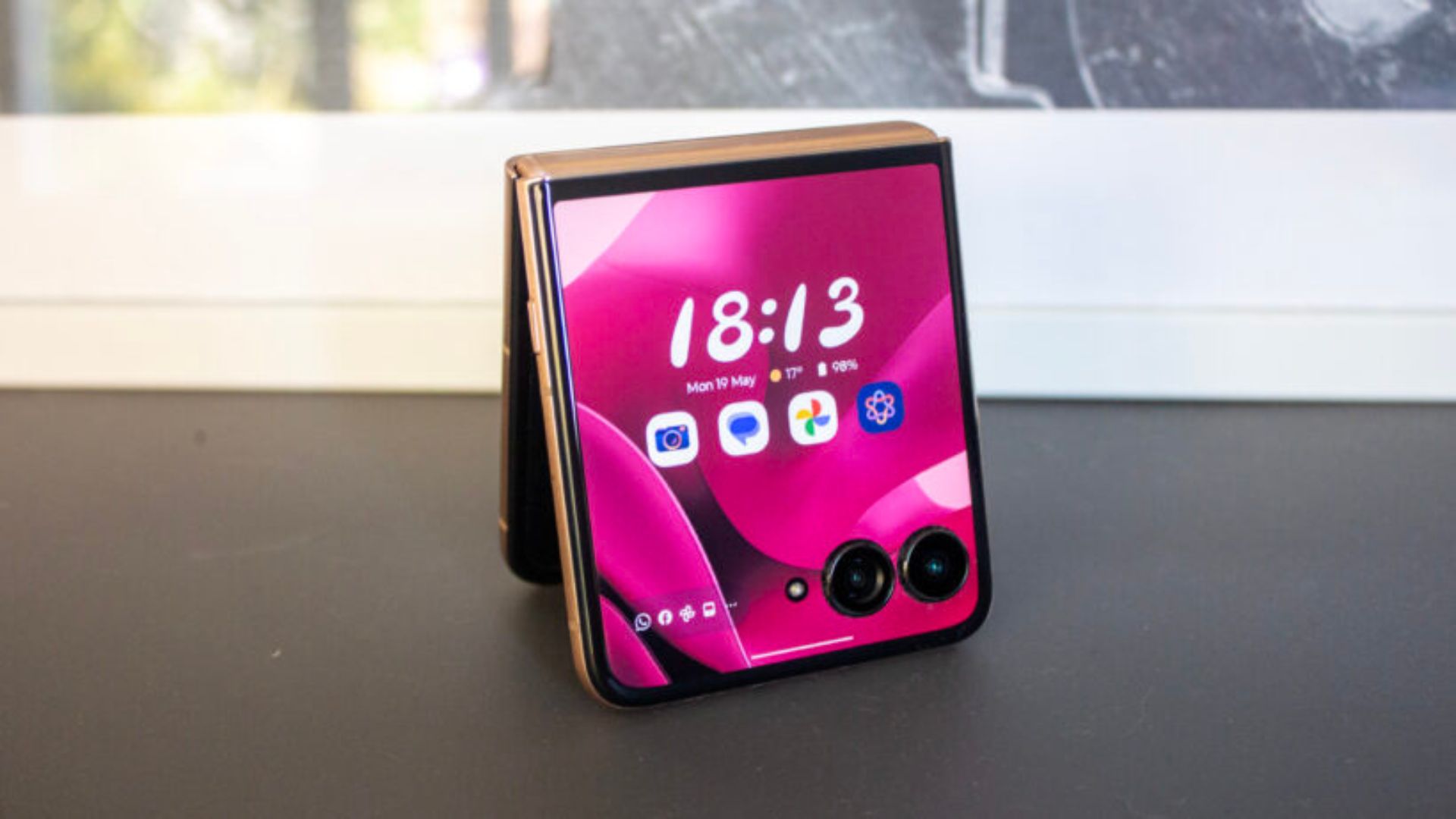
Motorola’s mid-range flip foldable looks set to follow a familiar formula, with leaked render images of the Razr 70 showing a device that retains much of its predecessor’s design while introducing a new processor, a significant camera upgrade, and three fresh colour options.
The renders, published by Ytechb, show the Razr 70 in Pantone Sporting Green, Pantone Hematite, and Pantone Violet Ice, with the handset expected to launch as the Razr 2026 in the US market, continuing Motorola’s regional naming convention from the current generation.
The Razr 70 leak follows hot on the heels of separately surfaced renders of the Razr 70 Ultra, which point to two striking new material finishes, including a wood-grain option and an Alcantara variant in a new purple-blue tone.
Display and design
The cover display carries over from the Razr 60 at 3.63 inches with a resolution of 1,066 x 1,056 pixels, retaining the wide chin visible at the bottom edge that has characterised the range, while the inner foldable OLED panel measures 6.9 inches with a 2,640 x 1,080 pixel resolution.
Advertisement
Despite the design continuity, the camera configuration does change, with rumours pointing to the 13-megapixel ultra-wide lens being replaced by a 50-megapixel telephoto camera, a meaningful upgrade for a mid-range foldable that has previously lagged behind more premium flip phones on versatility.
Advertisement
Processor and storage
Under the hood, the Razr 70 is expected to arrive with a new eight-core chip clocked at up to 2.75GHz, supported by a choice of 8GB, 12GB, or 16GB of RAM and storage options spanning 256GB, 512GB, and 1TB.
Rounding out the spec sheet are a 32-megapixel front camera and a 4,500mAh battery, the latter a generous capacity for the flip foldable category, where compact chassis dimensions have historically limited battery size.
Advertisement
With the Razr 60 launching in late April 2025, the Razr 70 and Razr 70 Ultra look set to follow a similar schedule, suggesting an official reveal could arrive within the next few weeks.
We’ve put several Motorola’s phones through their paces over the years, and our broader Motorola’s mobile phone coverage is worth checking out for anyone looking to get a sense of where the brand stands heading into this next release.
Pellet grill converts aren’t shy about their love for these versatile outdoor cookers, and many, including CNET, regard Traeger as the best in the booming alternative-grill category. Traeger’s pellet grills allow for precise temperature control via convection heat, easy low-and-slow cooking with minimal oversight and wood-fired flavor you won’t get from gas or charcoal setups. But they aren’t cheap.
A full-sized Traeger typically costs the would-be pellet griller about $1,000, but the brand just launched its most budget-friendly line, the Westwood series, ahead of summer 2026. That means you can haul in one of Traeger’s cult-favorite pellet grills with most of its signature bells and whistles for less than $700.
Advertisement
Pellet grills are praised for delivering woodfire flavor and precise temperature control.
Traeger
The new standard Westwood has 653 square inches of grilling space and sells for $699. The XL sports 823 square inches and will cost you $799 — still cheaper than any other large grill in the Traeger lineup. Until now, the cheapest full-sized Traegers, the Ridgewood series, started at $899.
The Westwood series builds on the advanced engineering and flavor-forward technology that Traeger has refined across its top-of-the-line grills, according to a press release shared with CNET, and fuses them into a grill designed for everyday cooking.
Key Features of the Traeger Westwood series:
Woodfire flavor with minimal fuss: Natural hardwood pellets and convection airflow work together to deliver richer wood‑fired flavor and consistent results.
Easy use: WiFIRE with Bluetooth compatibility lets users monitor and control their grill from the Traeger App for effortless, precise cooking.
More cooking options than most grills: Grill, slow cook, smoke or bake with Traeger’s precise temperature control and convection technology.
Generous cooking space: Dual‑tier grilling area provides room to cook multiple dishes at once.
Space to prep: Integrated shelves and storage create a streamlined workspace, keeping tools, ingredients and pellets within easy reach.
With the launch of its Westwood Series, Trager’s pellet grills are more affordable than ever.
Advertisement
Traeger
The Westwood Series is now available online and in stores through Traeger retailers.
Per the agreement, Amazon will take ownership of Globalstar’s existing operations including its low Earth orbit satellite network and supporting infrastructure, as well as related assets like mobile satellite service spectrum licenses. Amazon is paying $90 per Globalstar share – available either as cash or in Amazon stock – which… Read Entire Article Source link
512GB of fast, well-organised storage changes how you actually use a phone, especially when you are shooting 8K video and saving high-resolution 50MP images without a second thought.
The camera is the obvious starting point, and on the Pixel 10 Pro it earns genuine attention rather than just marketing language, because the triple rear system pairs a 50MP main sensor with 100x Pro Res Zoom for the kind of detail you would normally need a much bigger camera to capture.
Advertisement
That reach is backed by Google’s Tensor G5 chip, which has been purpose-built with an improved TPU and CPU to run Google’s AI processing on-device, meaning tasks like computational photography and Gemini Live happen faster and with less reliance on a network connection.
Gemini Live itself is worth dwelling on, because it turns the phone into something closer to an always-available visual assistant, letting you point the camera at your surroundings and have a natural back-and-forth conversation about what it sees, which feels meaningfully different from tapping through menus.

The 6.3-inch Super Actua OLED display hits 3,300 nits of peak brightness, so reading the screen outdoors in direct sunlight stops being a frustrating experience, and the 120Hz refresh rate keeps scrolling and transitions feeling fluid regardless of what you are doing.
Advertisement
Build quality matches the ambition, with durable aluminium framing and Corning Gorilla Glass Victus 2 on the back meaning the phone can survive the kind of daily contact that would leave cheaper handsets visibly worse for wear.
The Pixel 10 Pro is a strong fit for anyone who wants Google’s best camera and AI experience without paying the full flagship price, and at $969 this is the most accessible that combination has been since launch.
The RAMpocalypse continues. Microsoft just revealed across the entire Surface line of products, . The updated pricing has already hit the official Microsoft Store, with other retailers expected to follow suit in the near future.
These are fairly significant upticks. For instance, the base model 15-inch Surface Laptop 7 now starts at $1,600. It cost $1,300 when the laptop was first released back in 2024. It did receive a price increase last year to $1,500, so today’s increase tacks on another $100.
The cost balloons even further when upgrading components, as a top-end Laptop 7 with a Snapdragon X Elite, 64GB of RAM and 1TB of SSD storage now costs a whopping $3650. As a comparison, a 16-inch MacBook Pro with an M5 Pro, 64GB of RAM and a 1TB SSD comes in at $3,300, and the .
Microsoft
This trend continues with the Surface Pro line of hybrid computers. The 12-inch Surface Pro starts at $1,050, after launching at just $800. The flagship 13-inch Surface Pro cost $1,000 in 2024 and now starts at $1,500. That’s a $500 increase in just two years, though the base hard drive did get a bit bigger.
Advertisement
These price increases are, of course, being blamed on generative AI’s penchant for . “Due to recent increases in memory and component costs, Surface is updating pricing on Microsoft.com for its current‑generation hardware portfolio,” Microsoft wrote in a statement.
Industry reports that the company is currently readying refreshes across the Surface line. It’s highly likely these new prices if component prices don’t decrease.
These aren’t the due to AI. Motorola recently instituted increases that even . Samsung has also pushed up the cost for its .
The PS5 when compared to the 2020 launch price, though Sony didn’t explicitly blame these increases on RAM, but rather “continued pressures in the global economic landscape.” There are also rumors that the continued RAM shortage has made it difficult for and likely pushed back the release of the .
There was a time, not terribly long ago, when manual transmissions were everywhere. In fact, back in the 1980s, ’90s, and even into the 2000s, manual transmissions were standard equipment on many of the new vehicles sold in North America. This was true not just on inexpensive economy cars or high-performance sports cars — but on family sedans, pickup trucks, and SUVs as well. While stick shifts are enjoyed by car enthusiasts today, opting for a manual used to be something mainstream auto buyers did just to save money on their purchase or perhaps to get a bit better fuel economy. That’s not the case anymore.
Today, the decline in manual offerings is well known, with what seems to be an ever-dwindling list of new vehicles available with a stick shift and a clutch pedal. As you’d expect, with the manual transmission very much becoming a niche option for drivers, the vast majority of today’s manual offerings come on enthusiast-oriented sports cars, hot hatchbacks, and muscle cars.
Advertisement
So what about manual SUVs? While SUVs and crossovers dominate the sales charts overall, you’ll need to search far and wide for a manual-equipped SUV on a dealer lot, with just two models currently offering buyers the option of a stick shift. Those two models are the Ford Bronco and Jeep Wrangler, both of which are adventure-oriented 4x4s, rather than mainstream family SUVs. Even on these models, manuals are only found on certain trim levels and with certain engines.
Advertisement
SUVs with manual transmissions are rare breeds
With their iconic names and rugged body-on-frame construction, the Ford Bronco and Jeep Wrangler make sense as the only two SUVs available with a manual transmission. Both 4x4s are offered in two or four-door body styles, and both have removable tops and doors for an open-air adventure experience. A manual simply makes them that much more fun.
However, you can’t simply add the manual option to any Bronco or Wrangler model. The Bronco offers an available seven-speed manual transmission — which is technically a six-speed with an extra crawler gear — but only on models powered by the base 2.3-liter EcoBoost four-cylinder engine. The more powerful EcoBoost V6-powered Broncos are automatic only.
The Jeep Wrangler is available with a few different powerplants, including a 2.0-liter turbocharged four-cylinder and a 6.4-liter HEMI V8. However, Jeep’s six-speed manual is only available on Wranglers powered by the 3.6-liter naturally aspirated V6. For a time, the Wrangler’s V6 engine was actually manual-only, though Jeep recently brought back the V6-automatic combo following customer demand.
Advertisement
There is some evidence more stick shift SUVs are on the way
There’s one more new vehicle sold with a manual transmission that deserves an honorable mention here, and that’s the Toyota Tacoma — which was as of this writing the only pickup truck sold in the United States with a manual transmission. While it’s, of course, an open-bed pickup rather than an SUV, a Tacoma with a camper shell is the closest you can get to having a new Toyota SUV with a stick shift. Despite having a similar powertrain and essentially being the Tacoma’s SUV counterpart, the Toyota 4Runner is only available with an automatic.
Toyota has said that there’s low demand for a manual 4Runner, yet there’s also some evidence that the manual transmission has been undergoing a bit of a resurgence as drivers look for an extra connection between them and their vehicles. So, is it possible that we could see other manual-equipped SUVs joining lineups in the future?
Advertisement
Subaru recently generated some speculation by asking its buyers if they’d be interested in a new, manual Subaru SUV. The company had previously offered its Crosstrek CUV with a manual, but the stick shift was cut from the option sheet for 2024. Whether or not Subaru’s interest pans out into an actual product remains to be seen, but manual lovers can at least have some optimism for the future. Until something else comes to the market, though, SUV buyers who desire a manual will have to make do with a Bronco or Wrangler.
There’s a reason almost every driver you know has a story of pothole frustration. It’s because it’s largely inevitable that you’ll fall victim to one somewhere at some point. What’s important, though, is what you do next. When our cars bump a curb or take a small jolt from a pothole, sometimes it seems so minor that we just grit our teeth and go about our day. Bear in mind, though, that you may not have gotten off as easily as you first thought.
The fact that you felt only a minor impact doesn’t necessarily mean that your vehicle hasn’t sustained damage. If it has, it’s vital to determine what’s happened and what needs to be done next. This can prevent worse harm being done to the vehicle, as well as keep you and other drivers safe. There are also potential ways to secure compensation for the damage done by a pothole, if you know the avenues you can try to take and the time frame you have to do so.
There are some things you can do in the immediate aftermath of hitting the pothole, while there are others that are jobs to be done in the days and weeks ahead. In either instance, though, as they’re such a ubiquitous threat on the roads, all drivers should know what to do after striking a pothole.
Advertisement
Pull over and check your vehicle
Bgwalker/Getty Images
Of course, any time your vehicle takes a bump or a ding, all kinds of things immediately run through your mind. The first step is to pull over as soon as possible to determine what you’re dealing with. After all, it may be dangerous to drive any further. Even if that’s not the case, your vehicle may require prompt service.
There are some immediate signs of major damage, such as buckling of the wheel arches, that will tell you that you need to see a mechanic ASAP after the pothole encounter. It’s also important to keep in mind that you may have been driving when visibility was poor, such as in the dark, so it definitely pays to have a flashlight in your vehicle as part of your emergency kit for these sorts of situations.
Advertisement
You should take your time to thoroughly inspect your vehicle. If you’re not a mechanic who’s experienced with all the subtle yet important signs, the first thing to ascertain is that there hasn’t been catastrophic damage to the underside of your vehicle.
It may not even be something visible. Have a careful listen for escaping gas or any sounds that your vehicle wasn’t making before, which could indicate suspension damage or similar. It may well be a case for a mechanic, and the more information you can give them about any changes to your vehicle afterward, the better they’ll be able to diagnose and resolve problems.
Advertisement
Report the offending pothole
Anna Barclay/Getty Images
After you’ve determined that your vehicle hasn’t been damaged (or arranged proper care if it unfortunately has), your next priority should be reporting the troublesome pothole in question. To do so, you’ll first need to find out which body is responsible for that particular road.
State highways, etc., are typically administered by the state’s Department of Transportation. If on a California highway, for instance, you can use the Caltrans Division of Maintenance Customer Service Request form, which allows users to identify a pothole using a drag-and-drop pin-on-a-map graphic. As Texas’s own Department of Transportation notes, though, other roads, such as those within a city’s boundaries, are that city’s responsibility, not the state’s. Of course, these authorities usually have huge areas to maintain and significant backlogs of other repairs and improvements to make, so there’s no telling how long it may take for the repair to ultimately be made.
Still, you’re raising critical awareness about the issue, and that could save many tires and suspensions from needless extra strain or damage. On top of that, such reports can also serve as important evidence should a motorist seek compensation from the relevant authority for damage caused to their vehicle. This is because, as CNN Legal Analyst and Atlanta attorney Cody Randall put it in an Instagram post on the matter, “the city or the county, whoever’s maintaining that road, has to have knowledge that the defect exists and an opportunity to remediate it” for them to be found liable for damage caused by a pothole.
Advertisement
Consider making a claim for the damage your vehicle has sustained
Maksimenko Taras/Shutterstock
As the Los Angeles Times reported in 2024, 44 million drivers in the United States had their vehicles damaged by potholes in 2023. Looking a little further back, the American Automobile Association reported that pothole damage had cost the country’s drivers approximately $26.5 billion in total in 2021.
Compensation claims can be made if you act quickly. The time limit is up to 90 days after the collision in New York City, for instance, potentially differing a lot by location, though successfully receiving compensation for it is another matter. The onus is on the driver to demonstrate irrefutably that the responsible body was not taking care of the road as they should. This is why those who hit potholes should take the time to take photographs of the section of road, the pothole itself, their vehicle, and any damage.
Be prepared to have little success with your claim. In fact, the Michigan Department of Transportation notes that “the majority of damage claims are denied under governmental immunity laws.” While Michigan law says that government agencies must “maintain the highway in reasonable repair,” defining a failure to do so is a tricky matter. As CNN Legal Analyst and Atlanta attorney Cody Randall explained on Instagram, counties and states often have “sovereign or qualified immunity,” which means, in effect, “you actually have to ask them for permission to sue them,” and they must choose to allow it.
Advertisement
Determine whether your existing insurance coverage will help you
Phiwath Jittamas/Getty Images
If you determine that your chance of receiving compensation from the local authorities is low, there’s another course of action that could help: Your existing car insurance. As State Farm reports, “pothole damage is usually covered with collision coverage, minus the deductible,” the latter typically being up to around $1,000. After a quote for the price of a repair, you might find that you’d end up parting with more money in the long run by taking this route.
The Insurance Information Institute clarifies that adding collision coverage to a standard policy can cover the driver against impacts from potholes or other similar road hazards, though “it does not cover wear and tear to a car or its tires due to bad road conditions.” Such conditions often come hand in hand with potholes because of the way they form (rain freezing in existing cracks in the road expands and causes them to become larger), which also contributes to spring being the absolute worst time for potholes. A driver must prove that it was a collision with a pothole that caused the damage to get their insurance to pay out.
Advertisement
An additional complication to keep in mind is that your no-claims status may also be at stake from using it. All in all, as is so often the case with auto insurance, there’s a lot that needs to be considered prior to any claim. It can be important to avoid cheap car insurance to ensure your coverage is comprehensive, should it be needed for reasons like this.
Advertisement
Check your tire warranty
Hryshchyshen Serhii/Shutterstock
Claims, whether through your personal vehicle insurance or for compensation from the relevant body, may be a non-starter. They may also result in lots of paperwork and evidence-gathering that adds up to much more time and/or money spent than the payout would ultimately be worth. There’s something much less time-consuming that you can consider first, though: Check the warranty on your tires.
According to Edmunds, road hazard coverage can be added to a typical tire warranty to cover dangerous objects that could be on the road and potentially puncture a tire. Without this addition, the warranty will typically only be applicable for manufacturing defects, not accidental damage. This is why the road hazard add-on could be valuable, but it certainly doesn’t simply mean a free tire in every case. Additional fees, such as those for road hazard coverage on an additional tire, may also be added to the bill you end up receiving. The circumstances, the type of tire, and the damage it sustained are important to consider.
Ultimately, a driver has several options available to them if they hit a pothole, and while each incident will be different and have different effects, the immediate priority is damage control. Often, the aim is to recoup as much of the expense as possible in the circumstances, which is a result in itself and better than not getting anything back at all.
YouTube announced this week that it will now hold back ads during livestreams if chat engagement is at its peak, and if users show support with Super Chat, Super Stickers, or gift purchases. Until now, the only way to avoid seeing ads was by paying for a YouTube Premium subscription.
The Google-owned platform said in a blog post that when a chat explodes with energy, it wants to “protect that collective vibe.” When YouTube’s system recognizes that engagement is high, the platform will automatically hold back ads for everyone.
The idea behind this change is to help creators maintain momentum for viewers without interruptions from ads, the company says.
On the other hand, when a fan shows support with a Super Chat, Super Stickers, or gifts, they will be rewarded right away with a personal ad-free window right after their purchase. For context, Super Chat allows viewers to pay to highlight their messages, while Super Stickers are images that users can purchase to make their messages stand out in chats.
Advertisement
YouTube announced these changes alongside other updates for live creators. The company shared that more creators around the world are now eligible to receive gifts from viewers, as gifts are now live in Canada, Korea, Indonesia, Thailand, Australia, and New Zealand.
Additionally, viewers can now send GIFs on creators’ horizontal livestreams, not just vertical ones, directly from their mobile devices.
YouTube also announced that creators can now go live in both vertical and horizontal formats at the same time, with all viewers being able to connect in a single shared chat. The company says over 30% of live watch time in the U.S. came from connected TVs in 2025, which is why it wants creators to be able to customize their streams for all sorts of screens.
Techcrunch event
Advertisement
San Francisco, CA | October 13-15, 2026
The move comes a few days after YouTube raised subscription prices for YouTube Premium in the U.S. The YouTube Premium individual plan is increasing from $13.99 to $15.99 per month, while the family plan is going from $22.99 to $26.99 per month.
Last year, Samsung introduced its first Micro RGB TV, but that model was only available in a massive 115-inch size and had an equally enormous price tag of $27,000. For 2026, it unveiled two ranges — the R85H and R95H — with sizes between 55 and 100 inches, and prices starting at a much more reasonable $1,600.
Why are these called Micro RGB TVs? Firstly, they’re LCD TVs, like most of Samsung’s lineup, but the key difference here is that they use a different backlighting system. Where most LCD TVs use a specialized filter to generate colors, the premium R95 and more affordable R85 models use clusters of red, green and blue micro LEDs to either replace or augment the filters.
Samsung says the R95H hits 100% of the BT.2020 color area, which is more colors than most TVs could ever hope for. Yet, having seen this TV, and others that make the same claim, I don’t think it’s all that important. At least, not right now.
The competing TVs I’ve witnessed hitting this number have had a lot of colors, yes, but accuracy has been reduced in the process, even according to each company’s own test data. It’s more vital that a TV reproduce the color that’s present in the content you’re watching, rather than invent a whole new one. It’s worth adding that the TVs typically hit these numbers in Vivid mode, which is notorious for being cartoonishly bright and colorful.
The Samsung R95H is the company’s high-end Micro RBG TV.
Advertisement
Samsung
A much more compelling feature of these TVs, however, is their use of Samsung Glare Free technology, which is designed to virtually eliminate reflections from windows or overhead lights on the screen. I’ve seen it in person, and it’s one of the best antireflective systems out there.
The TVs will also be capable of displaying Samsung’s own answer to Dolby Vision 2: HDR10 Plus Advanced, though it’s yet to be seen if this format will be supported through content.
The TVs are designed for gaming, too, and have dedicated gaming modes. For smooth movement, they include Samsung’s own Motion Xcelerator 165Hz and Motion Xcelerator 144Hz tech, on the R95H and R85H, respectively.
The R95H is compatible with the Wireless One Connect box if you want to keep your sources and TV separate. Both TVs come with the new Slim Fit Wall Mount, which allows access to existing ports with a hinge at the top of the TV.
Advertisement
As with most of the TVs announced at CES, these models have a plethora of AI modes, from the image and audio processors to the onboard chatbots from either Microsoft Copilot or Perplexity. Two of the most notable modes are AI Soccer Mode Pro (which can make the World Cup look like a video game) and AI Sound Controller Pro, which can amplify or cut different parts of the soundtrack, such as sound effects or dialogue.
While a 130-inch R95H was announced at CES, the company has yet to detail any pricing or availability for that model.
At a briefing earlier this year, I got a look at a preproduction version of the R95H, and Samsung representatives told me that the OLED TVs were still the best choice for picture quality, while the Micro RGBs were better for brightness and color. With their antireflective coatings and gaming features, I can see that these TVs will be popular with console gamers, especially.
However, Samsung is not the only manufacturer to announce Micro RGB TVs for 2026, and it’s harder to find one that isn’t. While I’m skeptical about the benefits of hitting 100% of BT.2020, this is a factor I’ll test when I get my hands on compatible models.
Samsung’s first ‘affordable’ Micro RGB TV confirms the technology has a bright future
Unprecedented colour response
Uncompromising Filmmaker Mode
Exceptional backlighting
No Dolby Vision support
Slight motion blur
Expensive for an LCD TV
Squirrel Widget
Advertisement
Key Features
Micro RGB screen
Replaces the traditional white or blue light shone through colour filters LED TV approach with tiny, separate red, green and blue LEDs
Advertisement
Up to 8 HDMI inputs
You can buy an optional Wireless One Connect box for the set that adds another four that send picture and sound to the TV wirelessly
Advertisement
Tizen smart system with AI
Comprehensive collection of streaming apps and lots of AI support for content searching and learning your viewing habits
Advertisement
Introduction
Having dipped a (very big) toe into Micro RGB technology waters towards the end of 2025 with an ultra-expensive 115-inch model, Samsung has now followed that up with the much more affordable (though still premium) R95H TV series.
Does the technology still feel as exciting and cutting edge on smaller, more affordable screens? And is the huge colour gamut it’s capable of delivering really worth worrying about?
Advertisement
Price
The 75R95H costs £4299 in the UK, and $4499 in the US. The 65-inch model that’s also available from the range’s launch goes for £3399 and $3199.
Advertisement
This means Samsung is pitching the R95H range below – albeit only slightly – its flagship S99H OLED TVs. Though the closest screen size to the QE75R95H in the S99H range is two inches bigger.
While this shows that Samsung sees its QD OLED TVs as the absolute pinnacle of its TV performance, the still-premium pricing of the R95H series suggests Samsung believes Micro RGB capable of doing some pretty special things.
Design
Slender sides and rear
Centrally mounted stand with floating effect
Anti-reflection screen and Art Store create an artwork effect
The R95H has no truck with the wide frame Samsung added to the S99H OLED series. In fact, both the R95H’s screen frame and rear are exceptionally slim by LCD TV standards.
This makes it a great all hanging option – thoughh it actually ships with a desktop stand. This stand slots without screws into to grooves near the centre of the bottom edge, meaning the TV can be placed on even quite narrow bits of furniture. The neck of this stand wears a mirrored finish that creates the optical illusion that the screen is somehow just hovering above the base plate.
Advertisement
Advertisement
Image Credit (Trusted Reviews)
The TV carries well defined and extensive cable channelling on its rear panel to try and stop dangling cables from spoiling the 75R95H’s minimalist chic. Though actually, in a highly unusual move, it’s possible to connect four sources to the TV without any cabling if you add one of Samsung’s new, optional Wireless One Connect boxes to the R95H.
This lets you attach up to four HDMI sources to it, and then broadcasts their pictures and sound wirelessly to the TV from potentially metres away.
One last unusual design feature is the 75R95H’s combination of Samsung’s digital store of digital art screensavers, and an extremely effective anti-reflection screen. Put these together and you can make the TV look like a painting when you’re not watching it.
Image Credit (Trusted Reviews)
Connectivity
Wireless One Connect box option
Four gaming-friendly HDMI 2.1 ports as standard
Wi-Fi, Bluetooth and Airplay 2 support
Advertisement
I’ve already obliquely covered the R95H’s main connection story: Its potential for adding an optional Wireless One Connect Box. This warrants further attention, though, for as well as opening up the potential for cable free connection of up to four external sources to the TV, it also opens up the possibility of the QE75R95H taking in as many as eight HDMI sources at once.
The four HDMI ports built into the R95H’s bodywork and the four on the optional Wireless One Connect box are all fully HDMI 2.1 specified – something I’ll come back to in the Gaming section.
Advertisement
Image Credit (Trusted Reviews)
The Wireless One Connect hosts a couple of USB ports too, again doubling the number of those available.
There are also optical digital audio outputs on the TV and Wireless One Connect box, while the TV’s own ‘built in’ wireless capabilities include Wi-Fi, Bluetooth and AirPlay 2.
Image Credit (Trusted Reviews)
Advertisement
User Experience
Tizen OS smart system
Voice and Gesture control
Two remote controls
The Tizen OS that provides your main interface with the R95H’s smart features is pretty effective. The appearance of the home screen has been improved by shifting the usual roster of sub-menu links from down the side to along the top of the screen, and Samsung has also added a new AI home menu accessed via a direct button now included on the smart remote control.
This AI menu provides manual access to the third-party Co-Pilot and Perplexity AI systems, as well as a Generative AI image creation system that lets you create your own images from a few prompts.
The R95H’s extensive use of AI extends to its support for both the Bixby and Alexa voice recognition systems, and impressively sophisticated tools for coming up with relevant content recommendations based on your viewing habits. This can include the viewing habits of other members of your household, too, thanks to the TV supporting multiple individual user profiles.
Tizen carries a huge array of apps and streaming services, including the individual catch up apps for the UK’s main terrestrial broadcasters. Though there’s no support for Freely ‘wrappers’ carried by some rival brands these days.
Advertisement
Image Credit (Trusted Reviews)
Advertisement
The R95H ships with two remote controls: One traditional button-heavy one, and a much more slender affair with a stripped back button count and a solar panel on its rear that means you’ll never have to change its batteries again. This ‘smart’ remote also carries a built-in mic and Samsung’s new AI button when the other remote doesn’t, so all in all I’m confident this smart remote will be the one most users stick with.
The R95H can also be controlled to some extent via gestures if you’re wearing a Samsung Galaxy Watch, or you can add the TV to Samsung’s SmartThings app for iOS and Android devices, and then control it from your phone via a ‘virtual remote’
The sophistication of the R95H’s Tizen OS makes it a little intimidating initially, but after exploring it for a little while you start to appreciate its depths. Its biggest flaw, ultimately, is its desire to get you to accept adverts on the UI. You can opt out of these during the initial install, but if you do the basic layout of the UI remains unchanged, leaving areas where ads might have appeared often feeling like a fairly substantial waste of space.
Features
Micro RGB panel
Local dimming
Dedicated Micro RGB AI processor
The R95H is the second TV Samsung has released to use Micro RGB technology. This new tech, which is set to appear in 2026 from other brands too, under different names such as RGB LED, Mini RGB and True RGB, replaces conventional LCD TV lighting systems, which shine white or blue lights through colour filters, with dedicated red, green and blue LEDs.
This an approach which has the potential to greatly increase colour gamuts, colour volumes (colour plus brightness), power efficiency and general brightness
Advertisement
Advertisement
The Micro RGB lights on the QE75R95H are working within a VA type of panel, backed up by a potent local dimming system. In the QE75R95H’s case this local dimming zone system operates across a commanding 1792 individually controlled LED clusters. On top of this, of course, there’s the extra dimming effect you can get from each red, green and blue LED.
Image Credit (Trusted Reviews)
Samsung has created a dedicated Micro RGB AI processing system for its new screen technology to, among other things, drive the backlighting system, deliver high-level upscaling of HD sources, and apply the huge colour gamut the screen can provide to real-world content.
The R95H supports the HDR10, HLG and HDR10+ HDR formats, and will eventually, following a firmware update later this year, support the new HDR10+ Advanced format (designed to take on the recently announced Dolby Vision 2 format) by boosting brightness, cloud gaming, motion and the approach the TV takes to different content genres. As ever with Samsung TVs, the R95H doesn’t support Dolby Vision in either of its formats.
Gaming
Up to 165Hz frame rate support
VRR support including AMD FreeSync
Game Hub source screen and dedicated Game menu screen
The R95H leaves no stone unturned on the gaming front. For starters all four onboard and all optional Wireless One Connect HDMI ports support high frame rates for gaming up to 165Hz. They also all support variable refresh rates right across its frame rate range, with the VRR support encompassing the AMD FreeSync Premium Pro format.
Advertisement
Advertisement
Auto low latency support enables the R95H to automatically switch to its Game mode, in which mode the time the screen takes to render graphics drops to 10.4ms. Slightly higher than the S99H OLED, but not by enough for even the most competitive gamer to notice.
Where lag might become an issue, though, is if you’ve connected your console or PC to one of the HDMI inputs on an optional Wireless One Connect Box. The wireless transmission process associated with these boxes adds just under 20ms extra lag time.
The R95H helpfully organises all of your game sources, be they connected by HDMI or streamed via the many cloud gaming services Samsung support, onto a dedicated Game Hub home screen within the Tizen OS GUI, and also calls up a dedicated gaming menu if you press and hold the play button on the remote while playing a game.
Image Credit (Trusted Reviews)
This menu provides detailed information on the incoming gaming feed, and provides a host of cheats – sorry, gaming aids – such as mini map zooming, brightening dark areas so enemies are easier to spot, calling up an onscreen crosshair, and calling in different levels of motion smoothing for those (increasingly rare) occasions where you find yourself playing a low frame rate game.
As a tasty prelude to the video picture quality we’re going to cover in the next section, gaming on the Samsung R95H is a mostly a fantastically fun but also seriously immersive experience. The huge colour vibrancy the Micro RGB screen can achieve (I measured almost 150% of the DCI-P3 colour spectrum) together with brightness that hits peaks as high as around 2200 nits, results in colours that explode off the screen, making titles as varied as Crimson Desert, Forza Horizon and Rayman Legends look radiantly engaging to a degree they’ve seldom looked before.
Advertisement
Advertisement
HDR titles are handled well, with the screen doing a good job of optimising game HDR engines to its capabilities without the results looking clipped or unstable, and gaming feels responsive via the TV’s built-in HDMI ports.
My only gripes with gaming are that blooming around stand-out bright objects seems a little more noticeable if you’re sat off to the side of the screen than it does with video, and that fast pans and rapidly moving objects can look a touch soft compared with the S99H. Though they do look equally fluid.
Picture Quality
Remarkable colour range
High brightness
Excellent backlight controls
While we’ve become pretty accustomed now to TVs that push brightness far beyond the levels commonly used by content creators, doing the same thing for colour is for me much more noticeable – and, therefore, trickier to do convincingly.
Samsung’s Micro RGB AI processor, though, makes a remarkably good job of it. Especially considering it’s dealing with such a new technology.
Advertisement
Starting with just how aggressively the R95H leans into Micro RGB’s wider colour gamut capabilities, measurements taken using Portrait Displays’ Calman Ultimate software, G1 signal generator and C6 HDR5000 light meter reveal that the screen can deliver essentially 150% of the DCI-P3 colour range. An unprecedented figure that at least some of Samsung’s picture presets seek to venture into when showing today’s more constrained HDR images.
Advertisement
The Dynamic preset really goes for it, and is worth checking out for the fullest evidence of the sort of spectacle Samsung’s TV can deliver. While this mode is surprisingly even-handed in how it expands colours across the spectrum, and how little noise it suffers with compared with some rival similar modes I’ve seen on some early Micro RGB/Mini RGB samples, it still looks forced sometimes, particularly when it comes to skin tones.
The Standard preset, while certainly not measuring accurately, is for the most part a joy to watch. I watched multiple favourite 4K Blu-ray test discs in this default mode (having turned off the interfering Eco and ambient sensor-related modes) and for most of the time was both dazzled by seeing such familiar titles looking like they’d been remastered in some new next-gen HDR format, and amazed at how well this ‘expansion’ of their native images had been achieved.
Advertisement
Image Credit (Trusted Reviews)
Especially when it came to avoiding such potentially distracting nasties as exaggerated colour noise, certain tones suddenly jumping out of the picture more than others, and saturations so extreme that the screen is no longer able to express the sort of subtle colour blends required to make objects feel three-dimensional and natural.
Just as importantly as the spectacular but surprisingly authentic feeling colours to the Standard mode’s appeal is the prowess of the Samsung R95H’s backlight system. The more than 1700 local dimming zones in the QE75R95H’s screen together with the extra light control created by using separate red, green and blue LEDs for each lighting ‘unit’ creates light control mechanics which, under the watchful eye of Samsung’s dedicated Micro RGB processor, deliver both fantastically deep black colours by LCD TV standards, but also impressive stability and freedom from either general clouding and backlight blooming around stand-out bright objects.
What’s more, even when a little blooming can occur around extremely bright, colourful objects, unlike normal LED TVs the blooming actually adopts the chief colour tone of the ‘offending’ object. This makes it much less noticeable than the usual grey blooming effect, as your eye more often than not perceives the bloom as natural colour radiance.
Advertisement
Making the capabilities of the backlight controls even more impressive is the fact that the R95H can deliver its deep black colours and clean local dimming effects despite it also being extremely bright.
Advertisement
Calman Ultimate tests reveal brightness peaks of nearly 2300 nits on 10% and more than 660 nits on full 100% light windows, which contributes to an outstanding HDR sensation in terms of baseline brightness and the intensity of classic HDR highlights like sunlight reflecting on glass or metal, or bright streetlights against a night sky.
This impressive brightness doesn’t remotely start to overwhelm the screen’s huge colour capabilities. In fact, far from any tones looking faded or pallid in bright areas, the screen delivers huge levels of colour volume that complete the sense that RGB TVs are in a world of their own where colour is concerned.
Exciting though all of this is, many home cinema fans will still want the QE75R95H to be able to handle movies in a much more ‘as the director intended’ fashion as well, at least for serious film nights.
As with its S99H OLED flagships, Samsung has again managed to cater for this need much more successfully than we might have expected given the extravagant capabilities of the R95H’s screen. Right out of the box, the Filmmaker Mode achieves DeltaE 2000 average measurements with every Calman Ultimate HDR test I tried it with bar one below the 3.0 level beyond which deviations from industry standards might potentially be visible to the human eye. And even on that one test where it strays further than three, it only does so by a half mark.
Advertisement
Filmmaker Mode images inevitably look much less bright and much less vibrant than Standard mode, simply because sticking to today’s common mastering standards means using much less of what the screen can do. But this is as it should be – and the demands of switching into accurate settings don’t cause subjective viewing issues such as pale colour tones, heavily reduced backlight controls or poor dynamic peaking of bright light sources.
Advertisement
Image Credit (Trusted Reviews)
The R95H delivers SDR content in the Standard mode with just as much measurable and subjectively enjoyable precision, while again managing to drastically open SDR up in terms of brightness and colour in the Standard mode – and/or when using a pretty effective SDR to HDR conversion option – without the results looking gaudy.
Inevitably the R95H isn’t perfect. Sometimes the mostly excellent Standard mode can push skin tones, especially in dark scenes, too much, that they look too ripe. A slight pinkish tone can sometimes appear over bright shots in Standard mode too, and very occasionally subtle colour differences, especially over misty backgrounds, can become too overt.
Blooming around bright objects, while disguised by its colour component versus regular LED TVs, is present in a way it isn’t with OLED, and becomes slightly more noticeable if you’re watching the TV from an angle. The Standard mode can sometimes exhibit obvious baseline brightness ‘jumps’ during hard cuts between dark and light shots.
Advertisement
Motion looks slightly softer than it does on Samsung’s regular premium LCD TVs, as well as looking too smooth and noisy if you leave the Standard present’s default Picture Clarity settings in play.
Finally, while for the majority of the time I think most viewers in typical home viewing conditions will love the way the R95H’s anti-glare filter suppresses basically all reflections, it can flatten black levels a little in really extreme bright ambient light.
Advertisement
Upscaling
Well controlled processing side effects
Impressive, 4K-like sharpness and detail
Good noise suppression
The potent, heavily AI-influenced processors in Samsung’s premium TVs over the past few years have consistently delivered some of the best upscaling around – a handy benefit, I suspect, of Samsung’s longer devotion to the 8K TV cause than any other brand.
This trend continues with the Micro RGB AI processor, happily, as the R95H turns HD and even SD into convincing 4K look-a-like territory when it comes to detailing and clarity, without exaggerating source noise or grain, or generating distracting side effects such as colour shift or haloing around hard object edges.
Advertisement
The fact that the upscaling holds up well on a screen as big as 75-inches underlines how effective Samsung’s processing is, too.
Sound Quality
Object Tracking Sound works well
Good power and soundstage creation
Can struggle with sustained deep bass
For most of the time the R95H sounds good. Despite its slender bodywork, for starters, it manages to produce impressive volume levels capable of satisfying pretty substantial rooms. Especially as the sound is projected well beyond the TV’s physical extremities, creating a soundstage larger than even the 75-inch screen.
Advertisement
This large soundstage is exceptionally coherent, too, thanks to the ear-catching efforts of Samsung’s Object Tracking Sound system. Combining clever audio processing with a multi-speaker set up that places speakers all around the screen, OTS does a remarkably accurate job of placing key effects in the right place.
Image Credit (Trusted Reviews)
This applies to everything from dialogue to gunfire and engine noise from moving vehicles, and the number of objects that the OTS engine is capable of handling in any given scene is remarkable.
There’s a lovely crisp, clean but also rounded quality to the QE75R95H’s detailing, and shrill trebles sound controlled, even and free of warbling or buzzing distortions.
Advertisement
The R95H doesn’t quite hold it together at the low frequency end of the sound spectrum, though. Short, impactful bass sounds hit fine, but where there are longer, really deep and pressurised rumbles to handle the pair of dedicated low frequency speakers can descend into various distortions, including buzzing noise, crackling, and a general coarsening of the low frequency sound as the speakers try to push beyond what they’re really capable of achieving.
Squirrel Widget
Advertisement
Should you buy it?
Advertisement
It delivers colours like you’ve never seen before
With a measured ability to cover nearly 150% of the DCI-P3 colour spectrum and nearly 95% of the most extreme BT2020 colour spectrum, and equipped with presets that actually venture into such colour extremes, the 75R95H can deliver some genuinely remarkable colour extremes
Advertisement
Content needs to catch up
While the 75R95H delivers an unprecedented LCD colour response, there’s no real content out there that can fully exploit such wide colour. Though Samsung’s processing does a very good job in some picture presets of mapping current pictures to the TV’s capabilities.
Advertisement
Final Thoughts
With the QE75R95H Samsung has not only proven that Micro RGB and similar technology is relevant even in a world where content doesn’t yet exist that could fully unlock its capabilities, it’s delivered a TV that also breaks new ground with its LCD backlight control and AI features.
And which does things in the colour department that even Samsung’s S99H OLED can’t but that’s not to say you should necessarily buy it over the S99H. There are also areas, inevitably, where the pixel-level light control of OLED remains unmatched.
But the fact that the 75R95H even stands as a credible alternative to a TV as brilliant as the S99H is an outstanding achievement for such a new technology.
How We Test
The R95H was tested over a period of 10 days in both dark test room and regular living room environments.
It was fed a wide variety of content, including console games, 4K Blu-rays, streams of various resolutions and HDR formats from all of the main streaming platforms, as well as broadcast tuner footage.
All of this content was watched on the 75R95H in both daylight and dark conditions, and we explored all of the TV’s many picture setting options to find the best set ups for both regular living room environments and blacked out home cinemas.
Finally, the Samsung 75R95H was tested for both SDR and HDR playback in multiple presets using Portrait Display’s Calman Ultimate software, G1 processor and a C6 HDR5000 colorimeter.
Advertisement
Tested in dark and bright room settings
Tested with real-world content
Benchmarked with Portrait Displays’ Calman Ultimate Software, G1 signal generator and KC6 HDR5000 colorimeter
Gaming input lag was measured with a Leo Bodnar signal generator
FAQs
What HDR formats does the Samsung R95H support?
The 75R95H supports HDR10, HLG, and HDR10+ right away, and the new HDR10+ Advanced system will be added via firmware update later in the year.
What panel technology does the Samsung R95H use?
The QE75R95H uses Samsung Display’s second generation Micro RGB display, applied to a VA panel with more than 1700 local dimming zones.
Advertisement
Test Data
Samsung QE75R95H
Input lag (ms)
10.4 ms
Peak brightness (nits) 5%
2190 nits
Peak brightness (nits) 2%
2000 nits
Peak brightness (nits) 100%
654 nits
Set up TV (timed)
360 Seconds
Full Specs
Samsung QE75R95H Review
UK RRP
£4299
USA RRP
$4499
Manufacturer
Samsung
Screen Size
74.5 inches
Size (Dimensions)
1658.8 x 349.1 x 1019.2 MM
Size (Dimensions without stand)
946.2 x 1658.8 x 29.8 MM
Weight
30.1 KG
Operating System
Tizen
Release Date
2026
Resolution
3840 x 2160
HDR
Yes
Types of HDR
HDR10, HLG, HDR10+, HDR10+ Advanced
Refresh Rate TVs
48 – 165 Hz
Ports
Four HDMI 2.1, two USB, Ethernet, RF input, optical digital audio output; (optional wireless One Connect box) – four HDMI 2.1 ports, two USBs, optical audio port, RF and satellite tuner inputs
Lasers are cool and all, but they can be somewhat difficult to control at times. This is especially true when you have hundreds, thousands, or millions of lasers you need to steer. Fortunately, the MITRE Corporation might have created exactly what’s needed to accomplish this feat. While you might expect this to be done in a similar fashion as a DLP micro mirror array, these researchers have created something a bit different.
A ski slope like a MEMS array is used to contort light as needed. Each slope is able to be controlled in such a way so precise that entire images are able to be displayed by the arrays. This is done by using a “piezo-opto-mechanical photonic integrated circuit” or (POMPIC). Each slope is constructed from SiO2, Al, AlN, and Si3N4. All of these are deposited in such a way to allow the specific bending needed for control.
While quantum computing hasn’t hit these slopes yet, that doesn’t mean you can’t look into the other puzzles needed for the quantum revolution. Quantum computing is something that people have been trying for a long time to get right. Big claims come from all the big players. Take Microsoft, for example, with claims of using Majorana zero mode anyons for topological quantum computing.
You must be logged in to post a comment Login