
Tech
IBM’s next-gen mainframe chip is the first to run Arm and Z workloads on the same cores

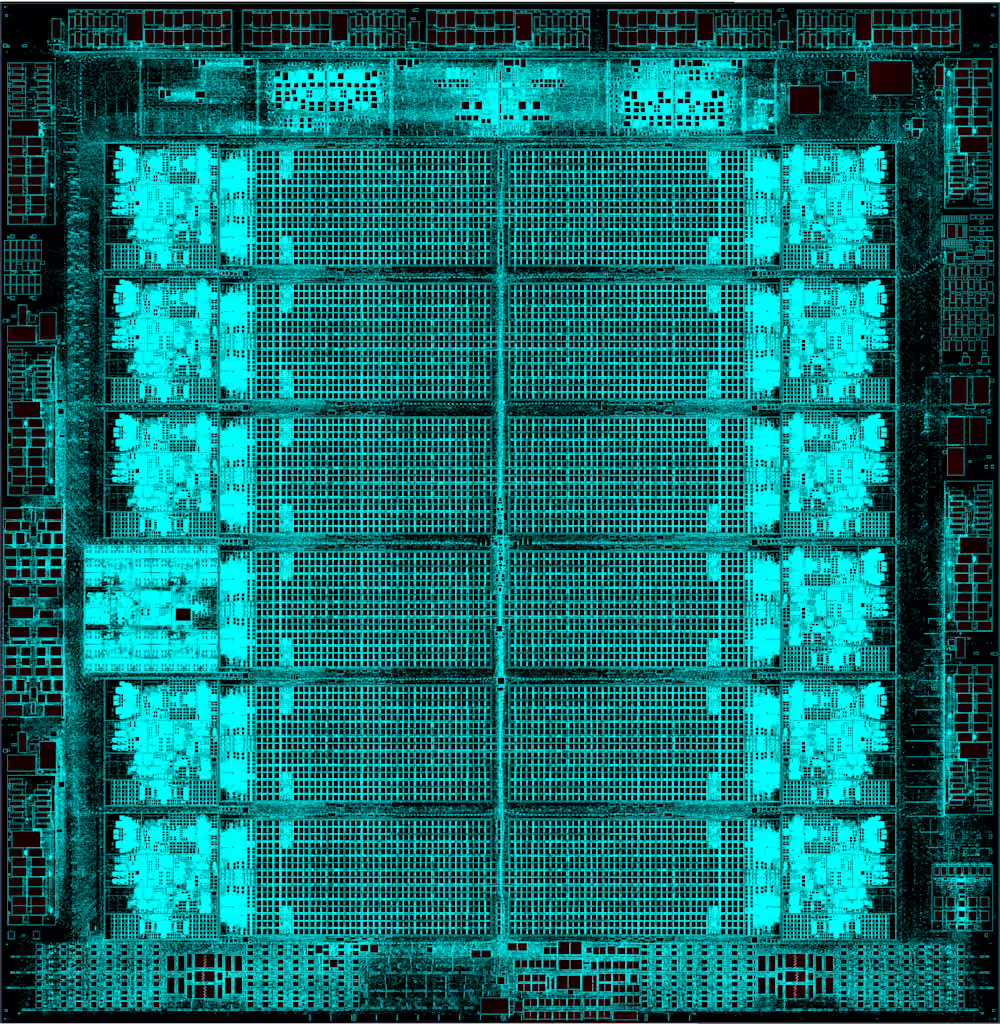
IBM is announcing today at the annual Hot Chips conference what may be the most consequential change to mainframe architecture in decades: a processor whose cores can natively execute both IBM’s own instruction set and Arm’s — switching between the two in nanoseconds.
The chip, which will power the next generation of IBM Z and LinuxONE systems, is the first dual-architecture mainframe processor ever built. It is designed to let enterprises run the vast and fast-growing ecosystem of Arm-native Linux software — including the AI frameworks that increasingly define modern infrastructure — directly alongside the z/OS transaction-processing workloads that anchor the world’s banks, insurers, and governments.
“As technology enthusiasts on both sides, we’re really excited about being what I would consider one of the most powerful commercially available processors that’ll be dual architecture,” Tina Tarquinio, chief product officer for IBM Z and LinuxONE, told VentureBeat in an exclusive interview ahead of the announcement.
The announcement marks the first hardware milestone from the strategic collaboration IBM and Arm unveiled in April, and it offers an unusually direct answer to a question that has shadowed the mainframe for years: can the machine that processes most of the world’s regulated financial transactions remain a first-class citizen in an AI era built largely on other people’s silicon?

How IBM engineered a processor core that speaks two instruction sets
The most striking engineering decision is what IBM chose not to do. The company could have bolted a handful of standalone Arm cores onto the side of its processor — a simpler design that other chipmakers have used for heterogeneous computing. Instead, IBM built every core on the chip to be bilingual.
“On this chip are 11 cores, and each core can dynamically switch back and forth between Arm software mode and traditional Z software mode,” Jacobi explained in an exclusive interview with VentureBeat. “That enables us to run the mission-critical enterprise software right next, on the same chip, to the much broader software ecosystem of Arm applications.”
The mechanism relies on the open-source KVM hypervisor. Enterprises can run Arm64 Linux virtual machines and Linux on Z virtual machines side by side, and as the hypervisor dispatches each virtual machine onto a physical core, the core flips into the corresponding mode. The performance penalty, Jacobi said, is effectively zero. “That switch takes about the nanosecond scale,” he said. “Because you’re running for many milliseconds in the virtual image, this switching overhead sort of amortizes to zero — pretty much no impact at all.”
Traditional z/OS workloads run in a separate partition on the same chip, outside KVM — meaning a bank’s core ledger, its fraud models, and a modern Arm-native monitoring stack can all share the same silicon, the same memory fabric, and the same reliability guarantees. Jacobi was candid that IBM debated the easier path and rejected it. “We’re really not addressing their need if we just have a few, I’d say, loosely Arm cores in the corner of the chip,” he said. “It really needed to be deeply integrated into the entire system design for it to have the same qualities of service that clients are used to.”
The specifications underscore that this is no compromise design. Built on a leading-edge 2-nanometer process node, the chip runs its 11 high-performance cores at a base frequency above 5.7 GHz — extraordinarily fast by industry standards — with on-chip AI inference accelerators for in-transaction fraud detection, a dedicated data processing unit for I/O acceleration, and a large cache architecture. Full systems will scale to hundreds of cores and tens of terabytes of memory. “That’s really, really fast compared to what you otherwise get in the industry,” Jacobi said. “It’s just another example of how mainframe technology is not old technology. It’s very modern, leading-edge technology.”
Why the mainframe needed Arm’s 22 million developers
The strategic logic behind the chip is about software, not hardware. IBM’s s390x architecture runs an enormous share of the world’s mission-critical transactions, but the broader universe of enterprise software — monitoring tools, security agents, cloud-native middleware, and above all the AI stack of PyTorch, ONNX Runtime, and container workloads — was built for x86 and, increasingly, for Arm. By Arm’s own estimates, close to half of the compute shipped to major hyperscalers in 2025 was Arm-based, driven by AWS Graviton, Google Axion, and Microsoft’s Arm silicon. Arm counts more than 22 million developers worldwide.
Porting each application to s390x has been a grinding, one-ISV-at-a-time effort, and Tina Tarquinio, chief product officer for IBM Z and LinuxONE, described the calculus bluntly. “No matter how great our ecosystem team is, we would never be able to work with all of them and port them all,” she told VentureBeat. “There’s a lot of ISVs out there, and so we wanted to make a fundamental, big step-function forward. We took a swing from a technology point of view.”
Notably, she said customers weren’t asking for a dual-architecture chip per se — they were asking for outcomes. “I wouldn’t say our clients were saying, ‘Can you please make me a dual-architecture environment?’ But they were saying, ‘Help me get these surround workloads, or different types of workloads, to run in a quicker-to-market fashion.’”
The compatibility promise is ambitious: Arm Linux binaries should run unmodified. “The new Arm capabilities are designed to be 100% binary compatible,” Jacobi said. “Once you have, for example, Red Hat Linux for Arm, and you have applications that run on Red Hat Linux for Arm, they will run on the system without modifications.” Arm defines the instruction set architecture and supplies validation tooling to guarantee that IBM’s implementation behaves identically to every other Arm chip — while IBM designs and builds the silicon entirely in-house. “Very good partnership. Very solid engineering partnership as well,” Jacobi said of the collaboration.
What a next-generation Spyre accelerator means for enterprise AI on the mainframe
IBM is also previewing the next generation of its Spyre AI accelerator at Hot Chips, and the pairing is not coincidental. The current architecture already offers two tiers of AI: an on-processor accelerator, introduced with the Telum chip in 2022, that handles ultra-low-latency inference such as fraud scoring inside a payment transaction, and the Spyre accelerator card sitting in the I/O subsystem for heavier models.
The new Spyre raises the ceiling considerably. “We’re also bringing a much higher performance chip that is capable of running large language models for agentic workflows,” Jacobi said — both AI-ops workflows that administer the system itself and business workflows “for things like document understanding and insurance adjudication.” The new accelerator will ship with high-bandwidth memory to feed those models.
Here the dual-architecture bet and the AI bet converge. Enterprises want to run inference next to their data; the data lives on the mainframe; and the AI tooling is overwhelmingly Arm-native. Mohamed Awad, Arm’s executive vice president for cloud AI, framed the announcement in exactly those terms: “As AI scales, more of the computing landscape is converging on Arm. Bringing Arm compute and its software ecosystem to these platforms will extend that momentum into mission-critical enterprise infrastructure to give organizations greater choice in how they deploy AI.”
The timing tracks with where enterprise AI actually stands. McKinsey’s most recent State of AI survey found that while 88% of organizations now use AI in at least one business function, nearly two-thirds have not yet scaled it across the enterprise — and the companies capturing the most value are those redesigning core workflows rather than running detached pilots. For regulated industries whose systems of record sit on IBM Z, running AI where the transactions happen is arguably the most direct route to that kind of integration.
When the dual-architecture IBM Z system will ship — and why existing customers shouldn’t worry
Buyers will need patience. The chip will debut in the successor to the z17, which shipped in the second quarter of 2025, and IBM holds to a roughly three-year product cadence — pointing to a launch around 2028. But Tarquinio insisted the program is well past the concept stage. “It’s more than being on the drawing board. We’re full steam ahead on the whole system,” she said, adding that IBM will release more details in the run-up to launch.
For IBM’s installed base, the reflexive question is whether embracing Arm signals a slow sunset for the traditional architecture. Both executives pushed back hard. “This is a big and. It is not an or,” Tarquinio said. “I have a roadmap that goes out 10 or 15 years of hardware systems. Many of our teams are working on this next system; many are also working on the one after that, and the one after that.”
Jacobi cast the move as continuity rather than rupture. “The traditional mainframe that we have today as a z17 system is not just a faster version of what we built 25 years ago,” he said. “We didn’t have pervasive encryption capabilities. We didn’t have on-processor AI capabilities. Adding the Arm capability is the next big iteration in this continuous evolution.”
The competitive subtext is the cloud. Asked why an enterprise would run Arm workloads on a mainframe instead of a hyperscaler, Tarquinio pointed to the platform’s availability numbers: “We’re talking eight nines of availability — that’s 0.3 seconds of downtime a year. If you’re running your ledger, if you’re running your fraud detection, any of these mission-critical apps, you want that.” The pitch, she said, is fit for purpose: match the infrastructure to the SLA, not the fashion.
There are real caveats. IBM’s own press release notes that statements of future direction “represent goals and objectives only.” The Arm support is Linux-only for now, and the hardest engineering — running a foreign instruction set at production performance, with mainframe-grade fault detection and recovery, under real customer workloads — remains to be proven over the next two years.
But the ambition is unmistakable. For sixty years, the mainframe has survived every wave of technology that was supposed to kill it — minicomputers, client-server, the cloud — by absorbing what it needed from each. Now IBM is attempting its boldest act of absorption yet: teaching the machine that runs the world’s money to speak the language of the AI era, fluently and natively, on the same silicon. “Bringing something that’ll really be first of its kind in production,” Tarquinio said, “showcases again what IBM is capable of from a technology point of view.” The mainframe, it turns out, isn’t being left behind by the future. It’s learning to run it.

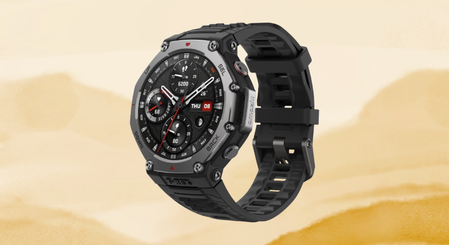
Feature-packed smartwatches are expensive, so when a discount comes around, it certainly stands out.
You can now get the Amazfit T-Rex 3 for £188.99; that’s the lowest price we’ve seen this watch drop to since Prime Day.
Amazfit’s Garmin rival gets a serious discount, saving 32%
For only £188.99, this deal gets you a rugged smartwatch with weeks of battery life and built-in GPS, while also saving £90.91.
Rugged outdoor watches with military-grade certification and multi-week battery life rarely fall this far, since most rivals with comparable build quality and GPS accuracy still sit above the £250 mark even during major sales.
The T-Rex 3 wraps a 316L stainless steel bezel around a body rated to withstand 70 degrees of heat and temperatures as low as minus 30 degrees, the kind of engineering that turns a broken heatwave or a sudden mountain frost into a non issue rather than a reason to leave the watch at home. That same resilience carries into the water, where the watch holds a 100 metre water resistance rating and is certified for freediving to a depth of 45 metres, meaning a pool session, a coastal swim, or a proper dive all sit comfortably within what the T-Rex 3 was built to handle.

Battery life stretches to 27 days of typical use and up to 180 hours in GPS Long Battery Life mode, a serious gap between the T-Rex 3 and most touchscreen smartwatches that still need a nightly charge just to survive a single workday. Free global, contour, and snow maps also come loaded onto the watch, paired with dual-band GPS across six satellite systems for a fast connection, giving hikers and cyclists precise turn-by-turn navigation without a subscription or patchy signal in unfamiliar terrain.
All those maps and metrics still need to be seen clearly outdoors, which is where a 1.5 inch AMOLED display peaking at 2,000 nits comes in, backed by Night Mode for glare after dark and Glove Mode for touchscreen use through gloves 2mm thick.
For only £188.99, you are getting a rugged Garmin rival with military-grade toughness, weeks of battery life, and built-in GPS mapping.
SQUIRREL_PLAYLIST_10148964

Apple is wasting little time following the recent record-breaking “Ted Lasso” season premiere, with production on a fifth season to begin in early 2027.
“Ted Lasso” recently had its fourth season premiere, which drew nearly 300 million U.S. viewing minutes across its first two days. It has officially become the biggest launch for Apple TV to date.
Now, it seems like Apple’s ready to get the ball rolling on season five. According to Sigmund Judge, production is provisionally set to kick off in January.
Judge suggests that season 5 of “Ted Lasso” could return to the small screen as soon as 2027. Of course, that assumes that production hits no snags.
Initially, the series was slated to end after the third season. However, after much negotiation with Jason Sudeikis, who plays the titular Ted Lasso, Apple announced that the series would return for a fourth season.
Recently, Sudeikis said he’d like to see the series get two more seasons. Apple’s own Eddy Cue seems content to keep the series on for the foreseeable future, signing the cast to a three-year contract in 2025.

China has delayed its ambitious Chang’e 7 lunar mission until at least 2027 after scrubbing an August 24 launch. Poor weather conditions were likely a factor, with China’s Manned Space Agency (CMSA) saying the decision reflects the need for “absolute safety.” Scientific American reports: China and the U.S. are in a race to send humans back to the moon, a feat that that U.S. accomplished in the 1960s and that has never been achieved by any other country. Chang’e 7 is to play to a crucial part in China’s ambitions: the probe is designed to search for frozen water in the Shackleton Crater, a pit that spans some 21 kilometers (13 miles) and sits beside the lunar south pole.
No spacecraft has ever landed in that region, which scientists consider to be among the likeliest places to find water on the moon. Locating water that can be used by humans is vital to establishing any long-term lunar presence. NASA and China are eyeing the region to establish a crewed base — and because this real estate is so precious, it matters who gets their first. Ars Technica notes in its reporting that the delayed launch was “most likely” due to Typhoon Narra, “which has 45 mph winds (equivalent to a moderate Tropical Storm) and continues to meander around in the waterway separating Hainan Island, where the spaceport is located, and mainland China.”
As for why the next launch window won’t open until next February or March? “It likely is a combination of factors, including sunlight conditions in polar landing zones as well as the mission plan that requires a 90-day lunar orbit reconnaissance before landing,” reports Ars. There’s also a possibility, albeit an unlikely one, that “some technical issue was discovered at the last minute with either the complex Chang’e 7 payload, or the rocket.”


Read more of this story at Slashdot.
Upgrading to a new Android phone in 2026? With so many options from the likes of Samsung, OnePlus and Honor, you’re absolutely spoilt for choice, but if you prioritise the software experience above all then the latest Google Pixel phones are made with you in mind.
While Xiaomi phones are great for cameras, and the latest Oppo and OnePlus devices are renowned for their impressive battery life, Pixel phones are better recognised as solid all-rounders. Just like the best Samsung phones, Pixel phones place more of an emphasis on ecosystem than most other Android devices, but that’s exactly why they can be so alluring to iPhone users.
The aforementioned stock Android features practically no bloatware beyond Google’s own-brand apps, and the continued improvements to Google Gemini mean that Pixels have one of the best AI suites around. Google’s AI platform can instinctively react to what you’re looking at onscreen, such as immediately offering up an answer to a question you’ve been asked over WhatsApp.
Thanks to Google’s computational processing, Pixel phones are also known for their impressive photography skills, particularly when it comes to capturing skin tones in a natural way. All of these aspects are exactly why Pixel handsets regularly feature in our round-ups for the best phones overall as well as the best camera phones.
To see if the latest Pixels are good enough to replace their predecessors, our tech experts will use them as their main handset for at least a week, testing out the camera and battery in real-world scenarios, whilst also utilising benchmarking tests to see how well the chipsets compare to the competition. Only the Pixel phones that clear the bar for our high standard of quality are then featured on this list.
Buy the new Pixel 10a and get up to £350 back with eligible phone trade-in, along with a £75 bonus. – In partnership with Google

Best Google Pixel phone at a glance
SQUIRREL_ANCHOR_LIST
/deals/de/sqEvery Google Pixel phone included in the below list has been properly tested and used for an extended period by one of our product experts. We don’t review phones based purely on specs or a manufacturer’s claims – we use them as our everyday device for at least five days and usually for much longer. Our review process includes a mixture of real-world tests, along with more than 15 measured tests and industry-standard benchmarks. We believe this gives the most rounded view of a device.
Lovely colour choices
Reliable triple camera setup
Great to still have a top-end Android this size
Some properly useful Gemini additions
Rambler is great
Poor GPU performance
Gets warm in use
Base model only has 12GB RAM
Not all Gemini features in the UK
If you want the best Google Pixel phone around right now, the Pixel 11 Pro is the one to beat. It isn’t going to win any prizes for gaming, but the camera work and AI toolkit are strong enough to more than compensate for that shortcoming.
Around the back you get a triple-camera setup consisting of a 50MP main sensor, a 48MP ultrawide and a 48MP telephoto. Google has reworked the image pipeline with a new ISP baked into the Tensor G6 chipset, alongside a suite of software tweaks.
Then there’s what Google has done with Gemini. Magic Capture can fire off photos and video automatically when it spots a moment worth grabbing, and a teleprompter feature overlays text on the screen for you to read while you’re recording. It’s the kind of feature that sounds like a gimmick, but it’s really not.
All of this runs on the Tensor G6, a chip Google has clearly tuned for AI workloads rather than raw processing grunt. It comes with a beefier TPU, and Gemini Nano runs noticeably quicker on-device as a result. As with previous Tensor chips, the GPU is where things fall down, and demanding games will stutter under sustained load with the phone running noticeably warm in the process. Away from gaming, there’s a lot to love here, and this is particularly true for iPhone users considering a switch to Android. If you want a more compact flagship and are happy with the trade-offs that come with it, the Pixel 11 Pro is worth a close look.
SQUIRREL_PLAYLIST_10208683
Superb high resolution display
Excellent triple cameras
Solid battery life
Slick Android software with seven years of updates
Big and heavy
Tensor chip can’t cope with top tier games
AI can be tiresome, if ignorable
Incredibly expensive
The Pixel 11 Pro XL is the most expensive non-folding Pixel Google has ever made, starting at £1279/$1299, so the question of whether it earns that premium is a fair one. The short answer is that it mostly does, and for those already deep into the Google ecosystem, it’s a compelling package.
The biggest story here is Gemini. Google’s AI platform is more deeply embedded in the software than it has ever been before, changing how you interact with the phone at every level. It fields questions directly from the home screen and powers the new Rambler voice-to-text feature. It’s worth noting that some of the more advanced Gemini features are US-only, but even with those caveats, this feels like a step forward for AI on a Pixel handset. Photography remains Google’s strongest suit, and the Pixel 11 Pro XL keeps the same triple-camera configuration as its predecessor: a 50MP main sensor alongside a 48MP ultrawide and a 48MP 5x telephoto. The combination delivers sharp, punchy images regardless of whether you’re shooting in bright midday sun or low-light conditions, and it continues Google’s strong track record when it comes to accurate skin tones and reliable point-and-shoot results.
The 6.8-inch OLED display is another highlight, hitting 3600 nits at peak brightness, which makes it a great screen for streaming.
Where things get more complicated is the Tensor G6 chipset. It handles AI tasks brilliantly and breezes through everyday use, but it can’t match the raw performance of the Qualcomm and MediaTek processors found in rival flagships at this price. Serious mobile gamers will likely find it wanting.
Strip away the premium asking price and the GPU limitations, and the Pixel 11 Pro XL still delivers on everything that makes a Pixel worth buying: clean stock Android and a build that feels suitably premium. SQUIRREL_PLAYLIST_10208684
Really solid, durable build for a foldable
IP68 is the highest dust-water resistance in a folding phone
Gorgeous, colour-rich displays with great stereo sound
It’s big and heavy
Underpowered compared to competitors
Zoom and ultrawide cameras are underwhelming in lower light
It’s no secret that Google’s range of foldable phones didn’t have the smoothest start, particularly as it entered a space largely dominated by Samsung and with plenty of great alternatives available from the likes of Honor, but the Pixel 10 Pro Fold now feels like the phone that Google always wanted to make. For all the foldable fans out there, this is a great option to consider in 2026.
The main thing that separates the 10 Pro Fold from the competition is its unparalleled durability. We’re talking full IP68 dust and water resistance which, for a form factor that has always had an underlying element of concern regarding long-term durability, is a big win. There’ll be no need for a minor panic attack if you spill a drink over the 10 Pro Fold as you can just dry it off and get straight back to using it.
Unlike other brands, Google has doubled down on its more squat build for the Pixel 10 Pro Fold and what this means is that you have a foldable phone that fits quite comfortably in one hand. The smaller 6.4-inch external display is perfect for just whipping out of a pocket and quickly interacting with apps like Spotify or WhatsApp, without needing to break out the larger display. However, with an almost square-like eight-inch display inside, the 10 Pro Fold is perfect for a bit of productivity and multitasking on the go. For instance, when doing a spot of research and writing, you can have Google Docs open on one side and Google Chrome open on the other, and it all works brilliantly. The fact that it all runs on the clean aesthetic of stock Android is even better.
At the time of its release, the 10 Pro Fold is also the only foldable phone of any kind that features magnetic Qi2 charging. Branded by Google as Pixelsnap, this helpful concept lets you attach the 10 Pro Fold to MagSage-compatible accessories such as wireless power banks or phone holders in your car. All of this makes the 10 Pro Fold far more versatile than the competition, and especially helpful for a quick battery top-up without having to bring cumbersome cables with you.
SQUIRREL_PLAYLIST_10207883
Pixel software is fluid, customisable and feature-rich
Reliable camera performance in the daytime
Bright, vibrant display is great for media consumption
No LTPO display on a nearly £900 phone is hard to stomach
Battery life isn’t amazing
Performance not significantly better than the Pixel 10
The Google Pixel 11 finds itself at a crossroads. For years, the standard Pixel was the most sensible way to buy into the lineup, sitting at a friendlier price point than its Pro siblings. That’s shifted with the Pixel 11, which now starts at £879, with 256GB of storage set as the new baseline in a clear attempt to soften the increase. What saves it is the software. Google’s take on Android remains the best version of it going: clean, playful, easy to live with and customisable.
The Tensor G6 chip reinforces that by turning the Pixel 11 into one of the most AI-forward handsets you can buy right now. Gemini writes your replies, summarises your emails and threads itself through pretty much every corner of Google’s apps.
The display is a treat, too. A 120Hz OLED panel that doesn’t quite match the Pro on paper still looks bright, punchy and honestly great for daily scrolling and catching up on content.
Combine that with the 5x telephoto lens and Google’s computational photography skills and you have a strong case for the Pixel 11 being the most point-and-shoot friendly camera phone on this list right now. There are caveats worth knowing about. The headline AI features are still locked to specific regions, so depending on where you are, some of those Gemini-powered tricks may not be accessible.
Raw performance also trails what Samsung and Apple are putting out at the top end by a decent margin, which is worth keeping in mind if intensive gaming is a priority. But if clean software and a genuinely capable camera are what you’re after, the Pixel 11 still has a strong argument to make.
SQUIRREL_PLAYLIST_10208682
Completely flat rear
Flagship-level AI features
Great camera performance
Too many similarities with Pixel 9a
Older Tensor G4 chipset
Bezels remain relatively thick
No PixelSnap support
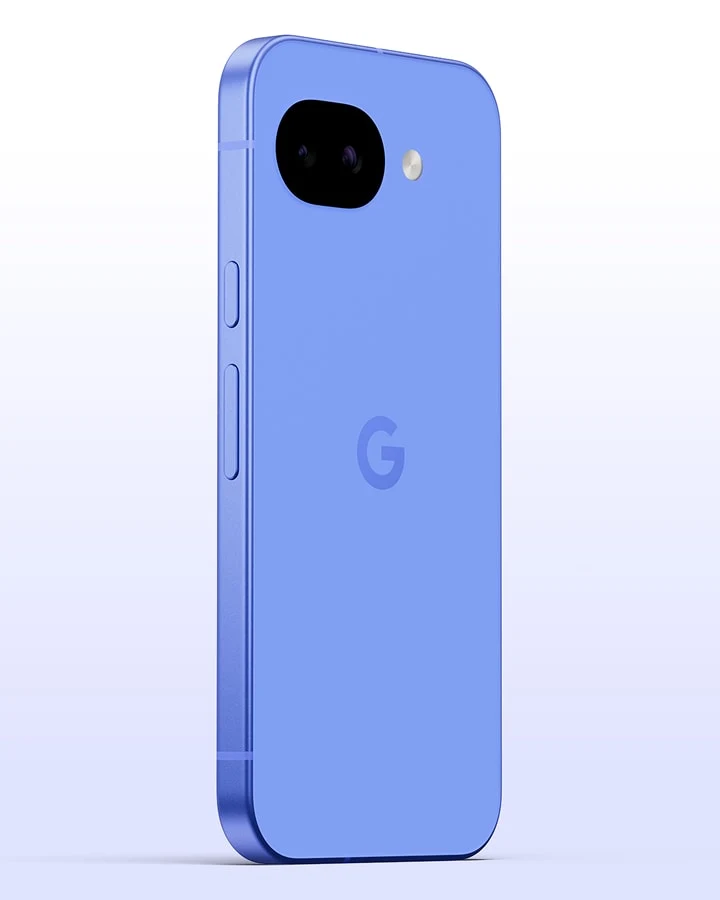
If your first thought when laying eyes on the Pixel 10a is that it looks almost identical to the previous-gen Pixel 9a then don’t worry, you’re no alone. As far as upgrades go, the Pixel 10a is far more iterative than what we’ve seen from Google’s mid-range handset, but that doesn’t mean that there isn’t plenty to love about it. For starters, in what is sure to be a boon to anyone who’s tired of having their smartphone cameras bulging from their pockets, Google has done away with having a camera bump completely. Instead, the two rear-facing cameras now sit flush within the device itself to create a completely smooth backing that just feels great in the hand.
The display has also been given an upgrade here, reaching a new peak brightness of 3000 nits, which makes the phone a lot easier to use outdoors. You won’t be squinting when trying to read Google Maps directions on the Pixel 10a. The display is more resistant as well, now using Gorilla Glass 7i to better withstand scratches over time.
Of course, the real reason why you’d want to buy the Pixel 10a over competing mid-rangers like the Samsung Galaxy A56 or the Nothing Phone (4a) Pro are the cameras onboard. Thanks to Google’s computational processing, its mid-range phones consistently put out the type of photos that can oftentimes outdo handsets at the flagship end of the market.
The biggest omission here is definitely the Pixelsnap feature that allows for magnetic wireless charging and is available on every other phone in the Pixel 10 range. There’s also a case to be made that if you’re tied to a strict budget then you’ll be able to find the Pixel 9a for even less nowadays, but the 10a will be supported for a bit longer into the future, making it more of a solid investment. SQUIRREL_PLAYLIST_10208265
None of the phones included in our Best Pixel Phone list comes with a charger in the box, so you’ll have to provide your own. They all come with a USB-C cable and work with the PD charging standard.
Google’s Tensor chipset is very capable and plays games just fine in our tests. You will, however, get better GPU from more recent phones with Apple’s A-series chips or a recent 8-series Snapdragon version.Learn more about how we test Google Pixel phones
FAQs
Test Data
Google Pixel 11 Pro
Google Pixel 11 Pro XL
Google Pixel 10 Pro Fold
Google Pixel 11
Google Pixel 10a
Geekbench 6 single core
2420
1605
2317
2657
1753
Geekbench 6 multi core
5852
4766
6251
7326
4551
Geekbench 6 GPU
7759
7912
–
7642
8803
Geekbench 7 single core
2083
1438
–
2282
–
Geekbench 7 multi core
6177
4731
–
6856
–
Geekbench 7 GPU
–
7561
–
–
–
3DMark Solar Bay
–
–
–
19.3 fps
–
AI performance
–
–
–
4883
1287
1 hour video playback (Netflix, HDR)
–
–
7 %
–
–
30 minute gaming (light)
–
–
5 %
–
–
Time from 0-100% charge
110 min
107 min
–
90 min
98 min
Time from 0-50% charge
47 Min
40 Min
–
28 Min
31 Min
30-min recharge (no charger included)
35 %
37 %
–
54 %
49 %
15-min recharge (no charger included)
17 %
16 %
–
27 %
19 %
3D Mark – Wild Life
–
–
3328
3215
2608
3D Mark – Wild Life Stress Test
21 %
–
–
74.4 %
91 %
GFXBench – Aztec Ruins
–
–
49 fps
–
–
GFXBench – Car Chase
–
–
52 fps
–
–
Full Specs
Google Pixel 11 Pro Review
Google Pixel 11 Pro XL Review
Google Pixel 10 Pro Fold Review
Google Pixel 11 Review
Google Pixel 10a Review
Manufacturer
Google
Google
Google
Google
Google
Screen Size
6.3 inches
6.8 inches
8 inches
6.3 inches
6.3 inches
Storage Capacity
256GB, 512GB, 1TB
256GB, 512GB, 1TB
256GB, 512GB, 1TB
256GB, 512GB
128GB, 256GB
Rear Camera
50 MP wide, 48 MP ultrawide, 48 MP telephoto
50MP main, 48MP 5x telephoto, 48MP ultrawide
48MP + 10.8MP + 10.5MP
48MP + 10.8MP + 13MP
48MP + 13MP
Front Camera
42MP
42MP
10MP
10.5MP
13MP
Video Recording
Yes
Yes
Yes
Yes
Yes
IP rating
IP68
IP68
IP68
IP68
IP68
Battery
4850 mAh
5115 mAh
5015 mAh
4985 mAh
5100 mAh
Wireless charging
Yes
Yes
Yes
Yes
Yes
Fast Charging
Yes
Yes
Yes
Yes
Yes
Size (Dimensions)
71.9 x 8.4 x 152.7 MM
x x INCHES
150.4 x 5.2 x 155.2 MM
72 x 8.6 x 152.8 MM
73 x 9 x 153.9 MM
Weight
204 G
226 G
258 G
197 G
183 G
Operating System
Android 17
Android 17
Android 16 (Material 3 Expressive)
Android 17
Android 16
Release Date
2026
2026
2025
2026
2026
First Reviewed Date
19/08/2026
24/08/2026
08/10/2025
20/08/2026
04/03/2026
Resolution
1280 x 2856
1344 x 2992
2076 x 2152
1080 x 2424
1080 x 2424
HDR
Yes
Yes
Yes
Yes
Yes
Refresh Rate
120 Hz
120 Hz
120 Hz
120 Hz
120 Hz
Ports
USB Type-C 3.2
USB-C 3.2
USB-C
USB-C
USB-C
Chipset
Google Tensor G6
Tensor G6
Google Tensor G5
Google Tensor G6
Google Tensor G4
RAM
12GB, 16GB
12GB, 16GB
16GB
12GB, 16GB
8GB
Colours
Canyon, Olive, Fog, Obsidian
Olive, Black, Canyon, Fog
Moonstone, Jade
Frost, Pistachio, Hibiscus, Obsidian
Obsidian, Fog, Berry, Lavender
Stated Power
–
–
30 W
30 W
30 W
UK RRP
£1079
£1279
£1749
£879
£499
USA RRP
$1099
$1299
$1799
$899
$499
EU RRP
€1199
€1399
–
–
–
CA RRP
CA$1755
CA$1799
–
–
–
AUD RRP
AU$1849
AU$2099
–
–
–
Tech
Marvel Recreated the Entire Avengers: Doomsday Trailer Brick by Brick, and the LEGO Version Somehow Feels Bigger


Marvel just released an official LEGO version of the first full Avengers: Doomsday trailer, and the whole thing runs shot for shot against the live-action cut that dropped in July. Disney Consumer Products, Marvel Studios, and the LEGO Group built it together as part of their “All Moments Lead to Doomsday” campaign. Real cast voices stay in place, including Robert Downey Jr. delivering Doctor Doom’s lines. The result lasts almost exactly as long as the original, missing only the final countdown clock, and it pulls off a level of precision most fan stop-motion attempts never reach.
It starts the usual way: a tattered sign for Xavier’s School for Gifted Youngsters sits in the dirt. Then Doctor Doom’s voice booms in over the debris, “Something’s coming. Something we may not be able to deter. Before this day is done, we shall be faced with an unthinkable decision.” The sign, being LEGO, is aged but still legible, while the surrounding clutter is built of LEGO bricks that catch the light and appear slightly cleaner than the real thing. Professor X has just come and is shielding his eyes from a beam of light in the sky. In LEGO form, the blast of light is significantly sharper and brighter, resembling a spotlight, as opposed to the soft glow in live-action.

LEGO Marvel Iron Man Mark 3 Collectors’ Edition Building Set – Poseable Super Hero Construction Kit…
- MODEL KIT FOR ADULTS – The LEGO Marvel Iron Man Mark 3 Collectors’ Edition (76344) building set for adults ages 18 and up stands over 15 in. (38 cm…
- POSEABLE SUPER HERO – Recreate Iron Man’s iconic Mark 3 suit of armor from Marvel Studios’ Avengers: Infinity Saga with authentic details including…
- ICONIC MARK 3 MINIFIGURE – Model kit includes a Mark 3 Iron Man minifigure that can be displayed alongside the larger model or on its own

Doctor Doom appears shortly after, his hood, mask, and green robes simply placed into a minifigure that appears to have been designed to be knocked into a shelf the moment you take it out of the box. The LEGO lighting keeps everything in place, and the molded features on his armor are as clear as crystal. The trailer then shifts to the New Avengers Tower. Thor leads the Fantastic Four into a meeting with Sam Wilson, Bucky, Scott Lang, and the rest of the team. In this LEGO rendition, the set designers used the new 76352 New Avengers Tower model as a backdrop, meaning the real skyscraper is made of LEGO bricks rather than being generated digitally. Characters are loosely clustered together – the Fantastic Four on one side and the New Avengers on the other – and they all behave similarly to the live-action version, listening as Thor begins to speak.
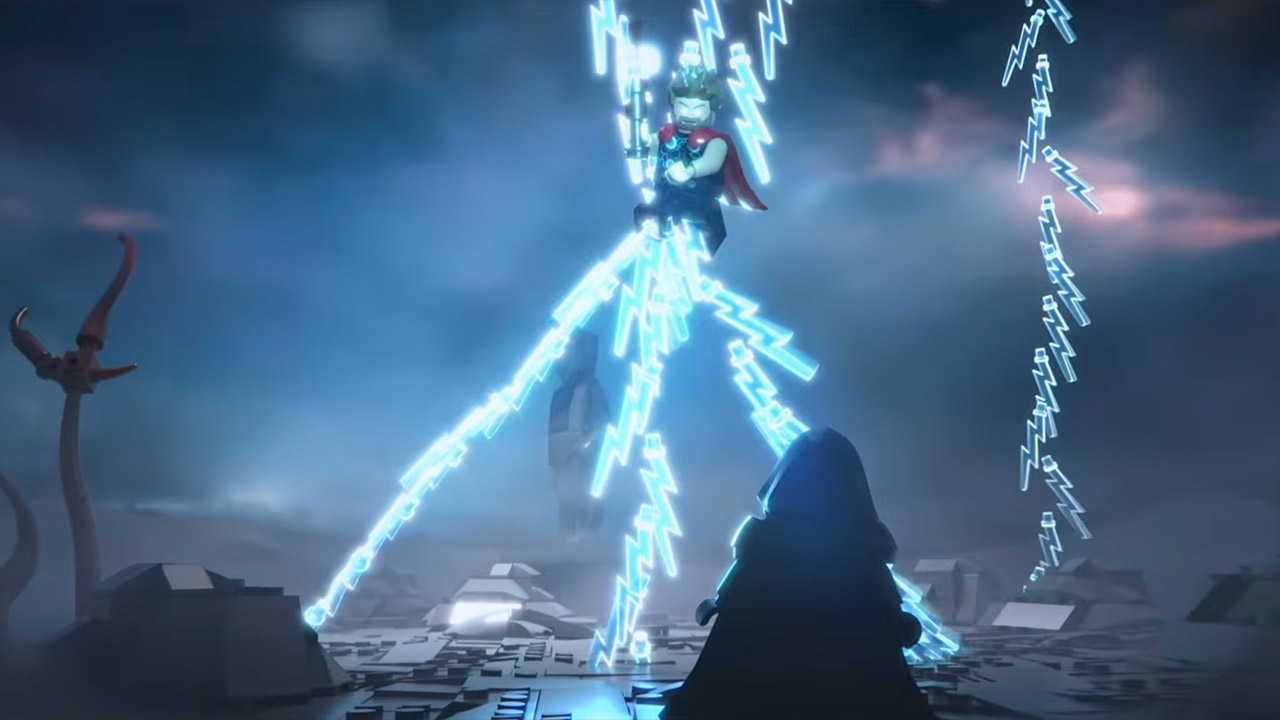
Just before the finale, Thor fights Doctor Doom on a battlefield of toppled statues, swinging Stormbreaker down at Doom but freezing the axe’s descent with one extending finger. In LEGO, that’s a rather clean moment, as the plastic ax comes to a halt in mid-air against the molded gauntlet, and the relative scale of the two figures makes the power disparity between them feel quite immediate. “But mark my words, we’re going to need a miracle,” Thor says. He turns. Steve Rogers walks into frame in a casual outfit, calls for Mjolnir, and catches it. “Hey, pal.” Thor’s reply is the same quiet disbelief: “It’s not possible.”

The entire thing is made up of pieces from the new Doomsday LEGO wave, so we get to see the Quinjet and the New Avengers Tower in the mix. Essentially, the surroundings serve as product previews. And in the center of important scenes are new minifigure designs for characters who have yet to appear in official LEGO sets, giving the impression that there would be a plethora of new builds. The live-action trailer aimed for subdued browns, yellows & greys, but the Lego version pushes those colours open wide so you can actually see what’s going on, especially in the brighter Wakanda things. Strangely, it makes a few of the fight moments appear faint. That’s basically the only noticeable difference in tone.
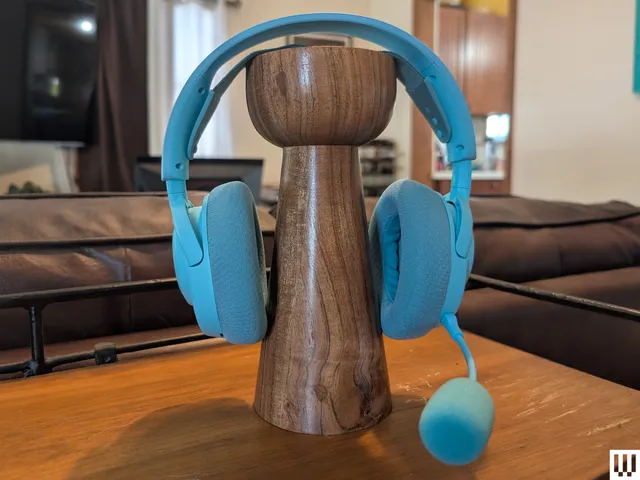
I recently took over testing for our guide to the best gaming headsets, but before that, I purchased our top pick in March, with my own money, for $100. I’ve used it every day since. Right now, three of the four available color options are on sale. SteelSeries’ Arctis Nova 3P usually fluctuates between $110 and $90, so while $90 is still a decent price, snagging one of the less expensive color options, like white, makes the deal even better.


SteelSeries
Arctis Nova 3P Wireless
The Arctis Nova 3P works seamlessly with PC and most consoles. Note that the Xbox version will work with PlayStations, but the PlayStation version won’t work with Xbox. Both versions are on sale (pick your version just below the price) and will work wirelessly or wired with computers, phones, and Nintendo Switch. I’ve tested quite a few headsets, and I have yet to find one I like more than this one. The battery lasts for around 35 hours for me. The mic sounds clear. The ear cups are supremely comfortable, and the whole headset is lightweight. My only gripe is that the pop cover on the mic seems to come off easily, but that also might just be user error. (I shake my head a lot while gaming due to my teammates—not at all my own actions.)
It can be a little tricky to swap between devices (like from a console to your phone to your PC again) if you aren’t using the USB-C dongle every time, but it’s not so cumbersome as to warrant an unenthusiastic recommendation. I’ve never used the app, but it has presets for different games like Fortnite or Grand Theft Auto.
Alternatively, you can get the cheapest price by picking up the aqua color for $60 at Woot (an Amazon-owned discount store). Woot is trustworthy, but by purchasing there, you’ll only get a three-month warranty instead of the standard one-year warranty. Either way, I think this headset offers fantastic value at full price. Picking it up for less is a no-brainer if you’re in the market.
Power up with unlimited access to WIRED. Get best-in-class reporting and exclusive subscriber content that’s too important to ignore. Subscribe Today.
The FDA has cleared the first Alzheimer’s blood test for symptomatic patients as young as 40. The test measures amyloid and tau biomarkers from a single blood draw and identified positive biomarkers with 97.6% accuracy in a validation study. New Atlas reports: PrecivityAD2 is a single blood test that quickly assesses the proteins amyloid and tau, using mass spectrometry to measure plasma AB42/40 and p-tau217/np-tau217. The results are then scored, qualifying as negative, likely positive, or positive for AD. “Just over a year ago, there were no FDA-cleared blood tests for Alzheimer’s, and now we have three,” Isobel Coleman, chief executive officer of the Alzheimer’s Drug Discovery Foundation (ADDF), said in a statement. “This is a proof point that sustained, early investment in translational science plays a catalytic role in moving promising ideas from the lab to patients.”
In a recent clinical validation study, 1,142 symptomatic adults were tested using PrecivityAD2. The process accurately identified 97.6% of positive biomarkers. What’s more, the results remained consistent even in patients with comorbidities like chronic kidney disease and diabetes, which can distort plasma amyloid samples. It’s worth noting that the test isn’t intended for general health screenings, but for patients who already show some cognitive decline. “As PrecivityAD2 and tools like it move further into clinical practice, they will enable earlier detection, sharpen clinical trials, and build the foundation for precision medicine and combination therapies,” Coleman added.
Read more of this story at Slashdot.
If you want to cancel your subscription, you’ll need to go through the same payment system you used to sign up.
Canceling a ChatGPT subscription only takes a few clicks. But if your goal is to quit ChatGPT entirely, stopping the recurring charge may be only one part of it. You might also want to delete your account, keep new chats out of model training or simply stop paying for features you no longer use. Canceling the subscription handles only the billing, so the right next step depends on what you actually want to stop.
Reasons to reconsider a paid ChatGPT plan
A paid plan makes the most sense when you regularly run into the Free tier’s limits or rely on tools reserved for higher tiers. If that’s no longer true, paying every month gets harder to justify. One option is ChatGPT Go, a lower-cost paid tier that OpenAI now offers in every country where ChatGPT is supported. Spending less doesn’t necessarily require giving up a paid plan altogether.
AI subscriptions have another unusual wrinkle: the product can change while you are paying for it. OpenAI retired GPT-4o from ChatGPT on February 13, 2026, after previously restoring it when some Plus and Pro users said they preferred its conversational style. For someone who subscribed partly for access to a particular model, that’s a reminder that a paid AI service can change substantially from one month to the next.
Features and price aren’t the only reasons someone might reconsider a paid ChatGPT plan. After OpenAI’s February 2026 agreement with the US Department of Defense to deploy its models on the department’s classified network, Sensor Tower data reported by TechCrunch showed US ChatGPT app uninstalls jumping 295 percent day over day. OpenAI later amended the agreement to explicitly prohibit domestic surveillance of US persons and said its services would not be used by Defense Department intelligence agencies such as the NSA without a new agreement. The Sensor Tower figure measures app uninstalls, though, not paid subscription cancellations.
How to cancel your ChatGPT subscription
For a personal subscription purchased on chatgpt.com, log in, select your profile icon, open Settings, choose Billing and select Cancel under Cancel plan. OpenAI recommends canceling at least 24 hours before the next billing date to avoid another charge.
If you subscribed through Apple, open the iPhone Settings app, tap your name, tap Subscriptions, select ChatGPT and tap Cancel Subscription. On Android, open Google Play, make sure you’re signed in with the Google account used for the purchase, then go to Subscriptions > ChatGPT and tap Cancel subscription. Uninstalling the app does not cancel an App Store or Google Play subscription.
If you can’t find the cancel option, first check where you originally subscribed. Web, Apple and Google subscriptions are managed separately, and OpenAI warns that it’s possible to end up with more than one active subscription across those platforms. If you have lost access to the ChatGPT account or its email address, OpenAI support can also cancel the subscription after locating the account using the email address, the last four digits of the payment card and the date of the most recent payment.
What canceling a ChatGPT subscription does and doesn’t change
Canceling the subscription stops future renewals, but it doesn’t delete your OpenAI account or erase existing chats. Standard chats remain saved to your account until you delete them, so canceling a paid plan is not the same thing as removing your data.
Whether your chats are used for model training is controlled separately. Under Settings > Data Controls, turning off Improve the model for everyone prevents new conversations from being used to improve OpenAI’s models while leaving those conversations in your history. Temporary Chats are another option for individual conversations: they don’t appear in history or get used to improve the models, and OpenAI says it may keep a copy for up to 30 days for safety purposes.
Deleting your OpenAI account is separate from canceling the subscription. Account deletion is permanent, prevents access to OpenAI services and triggers deletion of account data within 30 days, apart from limited information OpenAI may retain where required or permitted by law. If Apple or Google is billing you, cancel the subscription through the relevant app store before deleting the account.
What happens after you cancel ChatGPT
Canceling doesn’t remove paid features immediately. OpenAI says the cancellation becomes effective the day after the next billing date, so you can keep using the paid plan through the current billing period.
Canceling also doesn’t automatically result in a refund. If you subscribed through chatgpt.com or Google Play, you can request one through OpenAI’s Help Center. App Store refunds must be requested directly from Apple. For chatgpt.com and Google Play purchases, accidental purchases are generally eligible for a refund if you contact OpenAI within 14 days of the charge.
Customers in the EU, UKand Turkey are also eligible for a prorated refund if they cancel within 14 days of purchase.
Once the paid period ends, your account remains available along with any chats you haven’t deleted. Canceling the subscription stops the recurring payment without requiring you to decide whether to keep using ChatGPT.

New York-based General Intuition, the startup building a foundation model that trains generalized AI agents to move through space and time, is in talks to raise funding at a $6 billion pre-money valuation from new investors including Valor Equity Partners, Point72 Ventures, and Seven Seven Six, according to sources familiar with the matter.
Existing investors including Khosla Ventures and General Catalyst are also participating in the round. The fresh funds would come just weeks after General Intuition raised $320 million at a $2.3 billion valuation.
The news confirms earlier reporting on the deal for what is becoming one of the hottest startups tackling physical AI.
CEO Pim de Witte spun out General Intuition last October from his video game clip-sharing platform Medal, using its hundreds of millions of hours of gameplay and “action labels” — records of which buttons a player pressed and when — as an initial dataset.
Investor Vinod Khosla recently told TechCrunch that he believes those action labels will be a key part of the “emergence of intuition,” or the ability for a model to truly generalize across tasks that it wasn’t explicitly trained on.
General Intuition is still finalizing the round, and a source close to the deal said that it is oversubscribed as the startup continues to field interest from investors. The company intends to use the funds to focus to improve its general model with a focus on robotic embodiments. That means spending more on compute infrastructure (the company has a partnership with neolab CoreWeave) and hiring more talent.
Valor Equity Partners is known for backing SpaceX. TechCrunch has reached out to confirm its investment in General Intuition, which would be the first AI lab the fund has invested in since SpaceX.
This story is developing. Please check back in for updates.
When you purchase through links in our articles, we may earn a small commission. This doesn’t affect our editorial independence.


Old railway handcars appear in classic films as simple machines with a long beam that two people push up and down in opposite rhythm. That motion turns a crank and spins the wheels, sending the cart rolling along the rails at a steady, unhurried pace. Sam Barker and Tom decided the idea deserved a modern remake built almost entirely from plastic.
They spent long nights on FaceTime perfecting the design until every single item could be printed using a 3D printer. The majority of the cart is built of 3D prints from a Prusa XL, Core One, and Markforged machine, all of which are using Prusament PLA Freeze to produce items. Prusament PC Blend was applied to the crank, which bears strong stresses, to increase its strength. Bearings, steel shafts, and scooter tires are the last pieces that don’t come from a printer. The finished contraption weighs approximately 32 kg, yet it can still transport two large persons without complaint.
Sale

Bambu Lab A1 mini 3D Printer + LED Lamp Kit, Ready-to-Use for Beginners
- A1 mini + LED Lamp Kit for Creative Light Projects: Bring your ideas to life with the included LED Lamp Kit. Simply print compatible lamp models and…
- The Perfect 3D Printer for Beginners: A1 mini 3D Printer is designed to make 3D printing easy from day one with automatic calibration, simple setup…
- Experience the Bambu Lab Ecosystem: Access MakerWorld’s huge library of ready-to-print models, manage prints through the Bambu Handy app, and enjoy…
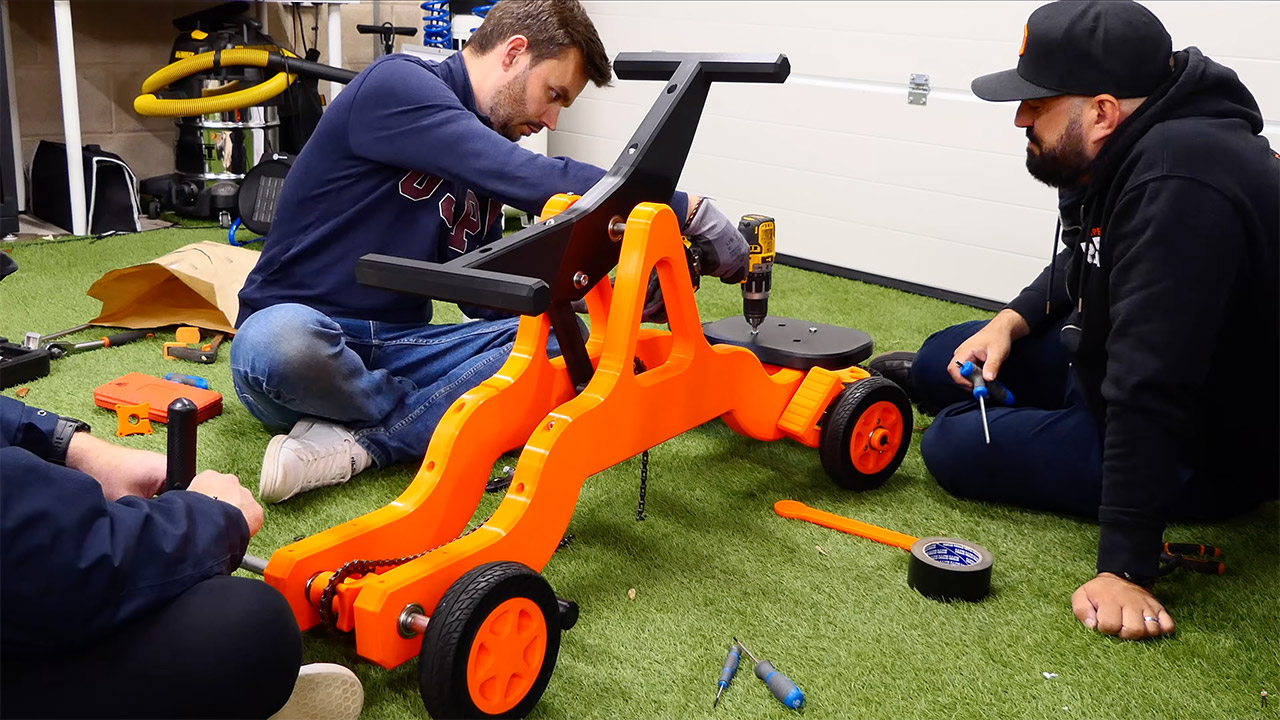
Size proved to be the most difficult issue to address, since the duo required the entire thing to fit in a standard airplane suitcase and return together in a hotel room before the Open Sauce event in San Francisco. Forget about standard-gauge rails; the cart has to be low and tiny, designed for amusement rather than as an industrial machine. The drive’s two-to-one gear ratio allows the operators to pump at a little faster rate than in previous versions, making it much more efficient to convert muscle strength into forward motion.
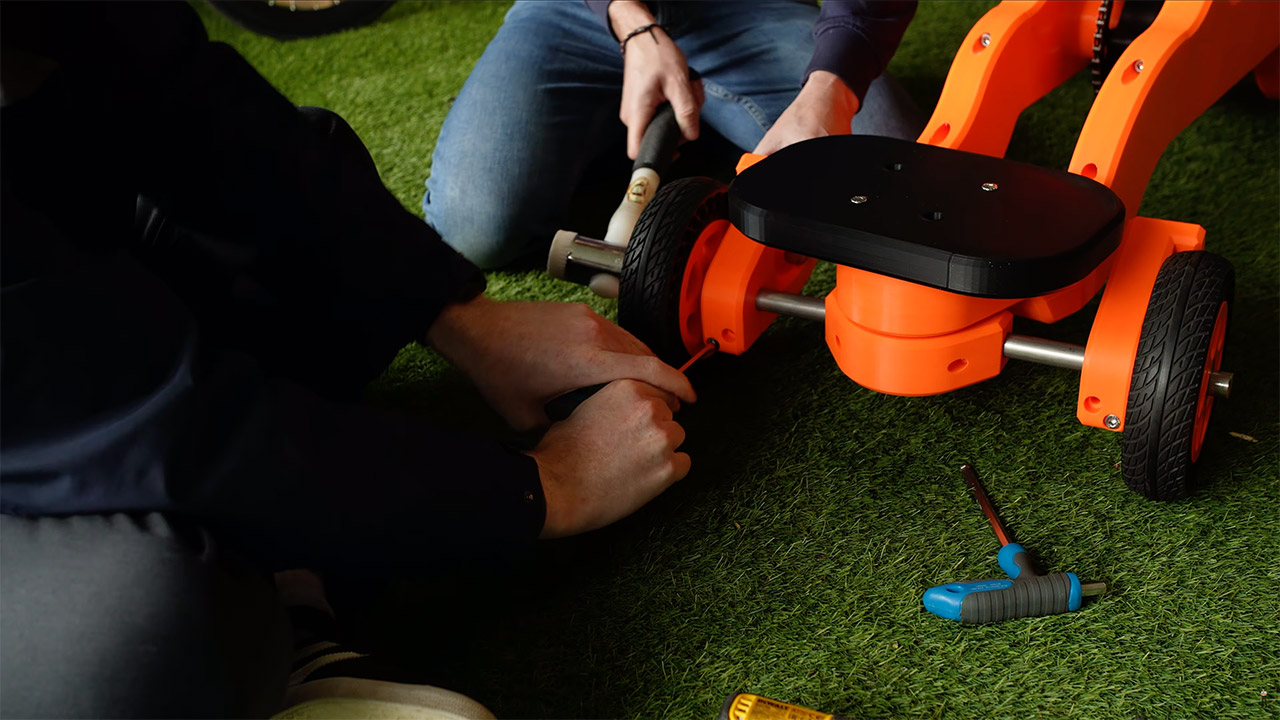
Assembly still revealed a few surprises, as tolerances that appeared to be flawless on screen would occasionally lock the shafts in place, demanding a careful whack with a hammer and a few snips. The wheel hubs were little faulty at first, but the crew repaired them. Once everything was in place, everything just rolled. Downhill in a hotel driveway, the two reached speeds of roughly four miles per hour, but on flat ground, they had to work hard. They both agreed that pumping felt harder than it appeared in the movies, but neither wanted to give up.

At Open Sauce, the bright orange object drew a crowd all day. People came to witness the seesaw beam rise and fall, the wheels revolve over, and they immediately understood why the previous design had lasted so long. This contraption only has two people working in sync, no motors, no batteries, and a pile of precisely printed pieces holding it all together.

The project files are now available on Printables, allowing anyone with a large enough printer to create the same thing. The hardware specifics for the bolts and shafts are still being finalized, but the overall construction is complete. Barker and Tom demonstrated that a classic piece of railroad history can simply roll out of a 3D printer, fit into a suitcase, and carry two grown men along the street with no more than some coordinated effort.
[Source]
Prince Harry steps down from board of wildlife charity ahead of return to UK with Meghan | UK News

Austin, Sacramento top cities where renting beats buying by $1,000
Tom Lee’s BitMine Buys $81 Million in Ethereum as ETH Hits $2,500





-

 Fashion3 days ago
Weekend Open Thread: Madewell – Corporette.com
-

 Business6 days ago
SMA Solar Technology AG (SMTGY) Q2 2026 Earnings Call Transcript
-

 Crypto World3 days ago
anatomy of crypto’s biggest liquidation event since 2021
-

 Business2 days ago
Musk’s Tesla, SpaceX Confirm $16.8 Billion ‘Terafab’ Chip Plant as World’s Largest Building in Texas
-

 Tech7 days ago
Qwen3.8-27B runs frontier-class coding agents and reasoning locally, no cloud API required
-

 Crypto World7 days ago
OCC Greenlights Trump Family Crypto Firm for Trust Charter
-

 Politics2 days ago
6 months on, Irish renters crushed by effects of government housing bill
-
 NewsBeat2 days ago
The ‘Lucky Dip Gang’ causing carnage for clicks: After five thugs were killed speeding in the wrong direction on a motorway, GUY ADAMS investigates a sick new trend… and why police aren’t even allowed to pursue them
-

 Crypto World7 days ago
NAVI Prime launches institutional lending framework on Sui
-

 Tech5 days ago
GLM-5.3 hits the API at $1.4/$4.4 per million tokens
-

 News Videos5 days ago
Don’t Leave Your Financial Future To Chance | August 19, 2026
-
Tech7 days ago
5 Of The Most Reliable Car Brands To Consider If You’re Buying A Used SUV
-
 Crypto World7 days ago
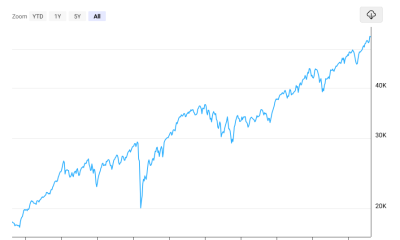
Dow’s 3-Year Winning Run Isn’t a Crash Signal, Still 49% Odds of Double-Digit Gains
-

 Tech7 days ago
Keychron K8 Ultra 8K review: a great value keyboard with comfort issues
-
 Tech7 days ago
Nvidia discloses $21B stake in SpaceX
-

 Business6 days ago
Stock Market Today: Tech Futures Slide As Treasury Yields Jump; Nvidia, Micron, Sandisk Sell Off
-

 Business5 days ago
Marvell Shares Jump 7% as Google Chip Deal Confirms Custom AI Silicon Partnership, Analysts
-

 Business4 days ago
Five Below: Kids Discount Retailer Reaps Rich Rewards
-

 Business1 day ago
Mystery AI Model ‘Ox Alpha’ Draws Developers With Free Access as Chinese Lab Origins Remain Debated
-
Business7 days ago
Fabrinet (FN) Q4 2026 Earnings Call Transcript
You must be logged in to post a comment Login