Tech
If You Grew Up In The ’60s, You Definitely Remember These Cars


Every generation has its iconic cars. From the hot rods of the 1930s to the sleek sports cars of the 1980s, each era can be defined by its unique take on the age-old idea of how to make cars that are fast, cool, and expressive.
Across all of automotive history, the 1960s stand out as a special time for cars. High-performance vehicles were incredibly affordable, and gas wasn’t the premium product it is now. Many houses had one- or two-car garages, and most had a car that served as an extension of their own personality. The cars of this era had not yet settled into the homogenized style of the 1970s, retaining much of the hot-rod flair of earlier decades without becoming luxury status symbols reserved for only the wealthiest elites.
Let’s travel back in time to the golden age of automobiles and look at some of the most legendary vehicles of that one-of-a-kind decade. If you grew up in the ’60s, you definitely remember these cars. And if you didn’t, you surely still find yourself looking at them with an envious wistfulness of vicarious nostalgia. Simply put, they don’t make ’em like that anymore.
1965 Pontiac GTO
Over the years, Jay Leno’s Garage featured tons of iconic and expensive cars, but few are as downright legendary as this one. When the 1965 Pontiac GTO Royal Bobcat was featured on an episode of Jay Leno’s Garage, the former Tonight Show host described the vehicle as the first true supercar, an early example of the burgeoning American muscle car scene. He even went so far as to say, “This was the dream car when I was 14 or 15 years old.”
The Pontiac GTO was special because it broke, or at least sidestepped, the rules. Back in the day, General Motors limited the size of a midsize car’s engine to 330 cubic inches. Big cars get big engines, small cars get small engines. But the engineers at Pontiac managed to stuff a 389-cubic-inch V8 engine into a midsize car, and the rest was history. Initially pitched as an optional engine upgrade for the Pontiac Tempest, its popularity led to the invention of the 1966 GTO as its own bespoke vehicle, and the birth of the American muscle car.
There’s nothing like the rev of an oversized V8 engine that’s just a little (or a lot) too big for the car it’s powering. Every child of the ’60s who sat in a car and felt the entire frame vibrate as the driver revved the engine had the exact same thought: “When I grow up, I want one of these.” Chances are, that car was a Pontiac GTO.
1968 Ford Mustang
For many automotive enthusiasts, love for cars comes from exposure to TV and movies. In that regard, the 1960s had some of the most legendary vehicles ever to grace the screen. There’s the 1966 Batmobile driven by Adam West in “Batman” and the Mach 5 from “Speed Racer,” as well as the Black Beauty from “The Green Hornet” and the Elva Mk VI, driven by none other than Elvis Presley in “Viva Las Vegas.”
However, if there’s a single scene that represents the blending of cars and cinema, it’s the 1968 Ford Mustang driven by Steve McQueen in “Bullitt.” For the most part, “Bullitt” is a by-the-numbers detective movie bolstered by McQueen’s cool charisma in the title role. However, it kicks into overdrive during the show-stopping ten-minute car chase sequence, which was a turning point in action cinema. The entire car chase genre, including the “Fast & Furious” series, would not exist without “Bullitt.” McQueen does much (but not all) of his own driving in the scene, which sees Frank Bullitt outmaneuver hitmen in a pulse-pounding pursuit through the streets of San Francisco.
The movie and its car chase inspired a whole generation of car fanatics. Everyone who saw “Bullitt” wanted a Ford Mustang. More than five decades later, Ford is still releasing modern Mustangs inspired by the one used in the film, such as the 2020 Ford Mustang Bullitt, named after the movie. As for the original 1968 Mustang used in the movie, it was sold for $3.74 million at a 2020 auction, making it the single most valuable Mustang of all time.
1967 Chevrolet Camaro
In 1966, Car and Driver magazine went hands-on with the 1967 Chevrolet Camaro SS 350 and came away impressed, though with more than a hint of melancholy. The Camaro, they surmised, was aimed at the youth market, which had been sideswiped by the escalation of the Vietnam War. The Camaro was hip and relatively inexpensive but hindered by the fact that its target audience of young men had been drafted into military service.
Nevertheless, the Camaro was priced reasonably, with both the hardtop and convertible versions retailing for less than $3,000 each, competitive with its main rival, the Ford Mustang. One of the more popular versions of the Camaro was the RS, or Rally Sport, variant, which featured concealed headlights, mag wheels, options for vinyl roof customization, and rally stripes. They don’t make the car any faster, but they sure look neat!
The car was marketed toward young people, though it earned the respect of auto enthusiasts due to its use as the Pace Car in the 51st Indy 500 in 1967, with none other than three-time Indy 500 champion Mauri Rose behind the wheel, thus giving the vehicle credibility among the gearhead community. As a result, the Camaro ingratiated itself with Indy 500 fans of all ages. There would be many Camaro variants over the decades, but the 1967 version is among the best-looking Chevy Camaros of all time. Not bad for a car approaching 60 years old.
Volkswagen Van
Even if you’re not a “car person,” you know what a Volkswagen van is. It’s the iconic “hippie bus,” and it’s instantly recognizable as an iconic car of the era. Design-wise, it had a ton of room in the back, which was perfect for road trips and the nomadic lifestyle of counterculture kids. Remember, back in, say, 1967, gasoline was only 33 cents per gallon on average, so going on even a cross-country trek wasn’t as difficult as it is now. If you wanted to drive for days at a time, you could just go without selling off all of your possessions first.
The original run of the Volkswagen Transporter was actually introduced way back in 1950, and it became popular in the beach scene. Teenagers of the era would pack into a VW and head to the beach for fun in the sun. Later on in the 1960s, however, the bus would become the de facto automobile mascot of the hippie scene. It was perfect for packing in many riders to go to protests, and there was plenty of room in the back for a little “free love,” if you will.
In 1967, the second-generation iteration of the vehicle was introduced, though it lost some of its bus-like novelty with the removal of the iconic split windshield design in favor of a more traditional single-pane windshield, among other changes that sacrificed the classic identity of the original Transporter. The VW Bus would evolve considerably over the years, but the original is still a fan favorite.
1963 Porsche 911
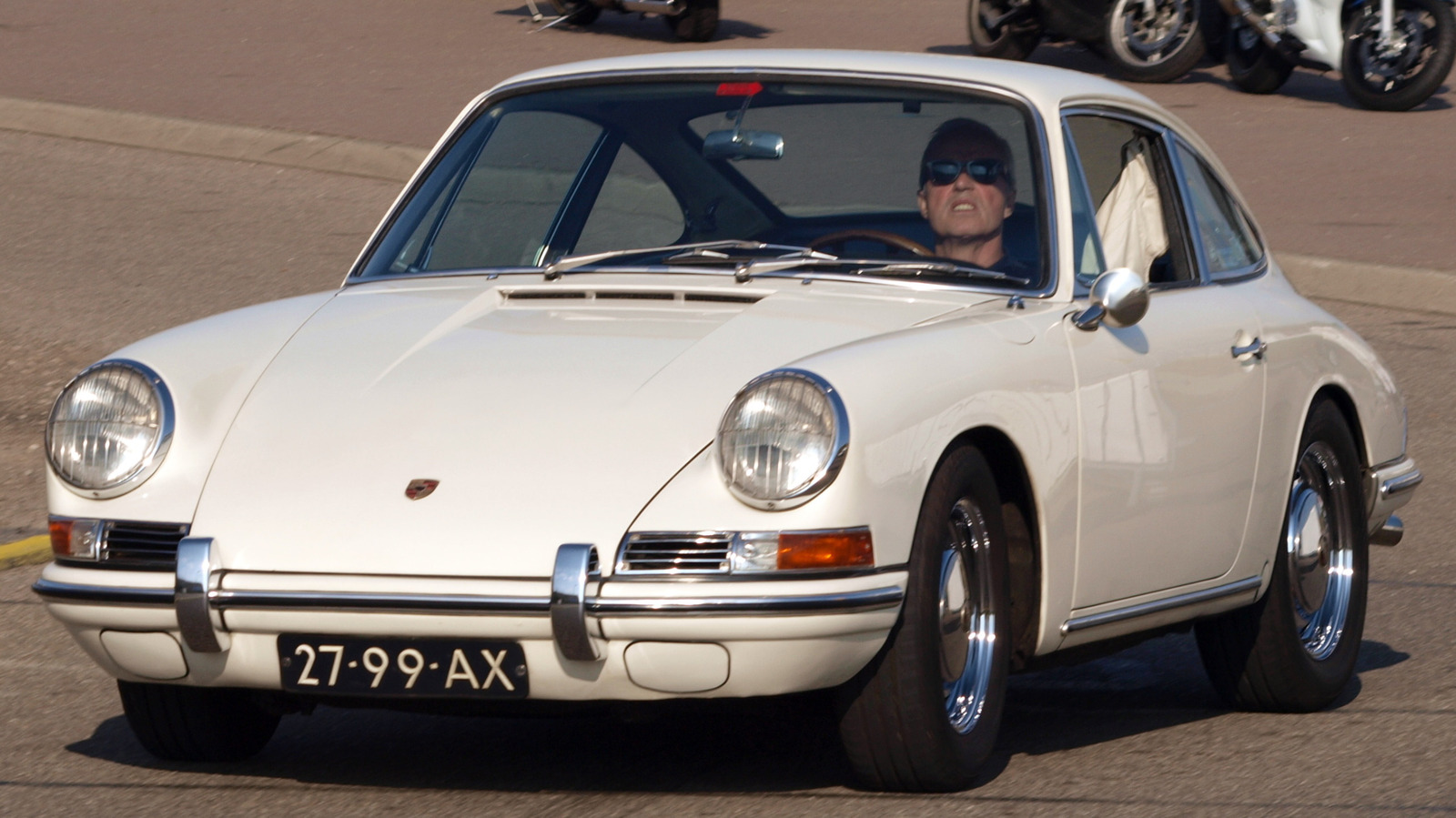
There were sports cars before Porsche, but the 1963 Porsche 911 changed the game. It wasn’t the first classic Porsche, but it was sleek and small with an instantly recognizable silhouette. Under the hood, the 911 boasted an air-cooled engine that delivered 130 HP. Despite making sports cars, Porsche also had a reputation for being (relatively) affordable and would go on to develop the Porsche 912 in 1965 as a less expensive alternative to the regular 911.
The Porsche 911 is an iconic car for bringing luxury sensibilities to everyday suburbia in the 1960s. Its engine may not have been able to compete with the muscle cars of Pontiac or Ford, but Porsche would upgrade the engine over the years. In 1966, the Porsche 911S boosted the engine to a more palatable 160 HP, and by 1971, the Porsche Carrera RS would boast a stellar 210 HP engine.
For many young people in the 1960s, Porsche was their introduction to the very concept of a sports car. For those who didn’t see the appeal of a bulky, muscular hot rod but still wanted to go fast, Porsche was the origin point for a lifetime of aspirational thinking.
You must be logged in to post a comment Login