Watch the Black Caps vs. India live in New Zealand
Advertisement
Sky Sport
The 19th edition of the world’s richest cricket tournament gets underway this weekend, with Virat Kohli’s defending champs Royal Challengers Bengaluru taking on Sunrisers Hyderabad in the opening game of the new Indian Premier League season on Saturday.
Advertisement
Among the big talking points in the run-up to the new campaign is Kolkata Knight Riders’ heavy investment in Cameron Green. The Australian all-rounder became the most expensive overseas signing in IPL history after being bought for $2.7 million by KKR in the 2026 auction. Chennai Super Kings will meanwhile be hoping for a huge improvement after their worst-ever season in 2025, with Ruturaj Gaikwad taking over as captain from MS Dhoni.
The 2026 edition of the IPL also looks set to herald the arrival of a new cricketing superstar, with 15-year-old Vaibhav Suryavanshi widely tipped to shine for Rajasthan Royals.
Elsewhere, the new term brings a slight format change, with a modified group stage where teams now play opponents from their own group once and the opposite group twice.
The 2026 Indian Premier League season starts on Saturday, March 28, with the match between Royal Challengers Bengaluru and Sunrisers Hyderabad, and ends with the final on Sunday, May 31. A full schedule can be found on the official Indian Premier League website.
Advertisement
Virat Kohli led the Royal Challengers Bengaluru to a six-run win over the Punjab Kings in last year’s final. It was their first IPL title.
Arun Sankar/AFP/Getty Images
How to watch the 2026 IPL season online from anywhere using a VPN
If you’re traveling abroad and want to keep up with the action from the Indian Premier League while away from home, a VPN can help enhance your privacy and security when streaming.
Advertisement
It encrypts your traffic and prevents your internet service provider from throttling your speeds, and can also be helpful when connecting to public Wi-Fi networks while traveling, adding an extra layer of protection for your devices and logins. VPNs are legal in many countries, including the US and Canada, and can be used for legitimate purposes such as improving online privacy and security.
However, some streaming services may have policies that restrict VPN use to access region-specific content. If you’re considering a VPN for streaming, check the platform’s terms of service to ensure compliance.
If you choose to use a VPN, follow the provider’s installation instructions, ensuring you’re connected securely and in compliance with applicable laws and service agreements. Some streaming platforms may block access when a VPN is detected, so verify whether your streaming subscription allows VPN use.
Price $13 per month, $75 for the first year or $98 total for the first two years (one- and two-year plans renew at $100 per year)Latest Tests No DNS leaks detected, 18% speed loss in 2025 testsJurisdiction British Virgin IslandsNetwork 3,000 plus servers in 105 countries
ExpressVPN is our current best VPN pick for people who want a reliable and safe VPN, and it works on a variety of devices. Prices start at $3.49 a month on a two-year plan for the service’s Basic tier.
Advertisement
Note that ExpressVPN offers a 30-day money-back guarantee.
73% off with 2yr plan (+4 free months). Now only $3.49/month
Livestream the Indian Premier League season in the US and Canada
The 2026 T20 World Cup final is being broadcast live in North America on the cricket streaming service Willow TV.
Advertisement
Willow TV
A direct Willow TV subscription is available in the US for $10 per month or $80 per year, allowing you to watch a wide range of matches from around the world via your browser or the service’s very own app.
The dedicated cricket-streaming service is also available from various cable providers, including Spectrum, Dish and Xfinity as well as OTT providers Sling TV (via its Desi Binge Plus or Dakshin Flex plans) and Fubo (via an add-on).
Advertisement
Livestream the IPL 2026 in India
This year’s IPL is being televised on Star Sports linear channels in India, and can be livestreamed via JioHotstar.
JioHotstar
JioHotstar is available in three different tiers. The streaming service’s Mobile plan currently costs Rs 79. The new Super Plan (Ads, 2 Devices, 1080p) will meanwhile set you back Rs 149 per month, while the top tier Premium Plan (Ad-Free, 4 Devices, 4K, Includes Hollywood) is now priced at Rs 299 per month.
Advertisement
Watch the Indian Premier League in the UK
Live coverage of Sunday’s final is exclusive to Sky Sports in the UK and will be broadcast on its Sky Sports cricket channel. If you already have Sky Sports as part of your TV package, you can stream the tournament via its Sky Go app, but cord-cutters will want to set up a Now account and a Now Sports membership to stream the game.
Now TV
Sky subsidiary Now offers streaming access to Sky Sports channels with a Now Sports membership. You can get a day of access for £15, or sign up to a monthly plan from £35 per month right now.
Advertisement
Livestream the Indian Premier League in South Africa
In South Africa, IPL matches are being broadcast live this season on SuperSport.
If you can’t watch on your TV, you can also watch via the network’s streaming service for PC and Mac, as well as via SuperSport’s mobile app.
SuperSport
Advertisement
Pay TV network SuperSport boasts exclusive live coverage of Indian Premier League matches in South Africa.
The main ways to stream SuperSport is through DStv Stream Premium which currently costs R799 per month.
Stream the Indian Premier League in Australia
Cricket fans Down Under can watch Indian Premier League action on Fox Sports via Foxtel. If you’re not a Fox subscriber, your best option is to sign up for the streaming service Kayo Sports.
A Kayo Sports subscription starts at AU$30 a month and lets you stream on one screen, while its Premium tier costs AU$46 a month for simultaneous viewing on up to three devices.
The service gives you access to a wide range of sports, including F1, NRL, NFL, NHL and MLB, and there are no lock-in contracts.
Better still, if you’re a new customer, you can take advantage of a one-week Kayo Sports free trial.
Advertisement
Stream the Indian Premier League in New Zealand
Cricket fans in New Zealand looking to cheer on the Black Caps in Sunday’s final will need a subscription to pay-TV broadcaster Sky Sport, which has the broadcast rights to show the T20 World Cup live.
Pay-TV broadcaster Sky Sport will be showing the T20 World Cup final live in New Zealand. That also means you can also watch every game online using the network’s Sky Go streaming service.
Advertisement
Cord-cutters can opt for the online-only Sky Sport Now service, which costs $30 for a weekly pass, $55 for the monthly option, or $550 for a full year of viewing.
Apple has snatched up Lilian Rincon, a nearly decade-long Google veteran, as it continues to retool its Apple Intelligence team.
Apple Intelligence continues to undergo changes
Before working at Apple, Rincon served as Vice President of Product Management at Google since 2024. However, before that she held various product management roles in the company since 2017. According to9to5Mac, Rincon will lead product marketing and product management for its AI platforms, including Apple Intelligence and Siri. In the role, she’ll report directly to Greg Joswiak, Apple’s senior vice president of worldwide marketing. Continue Reading on AppleInsider | Discuss on our Forums
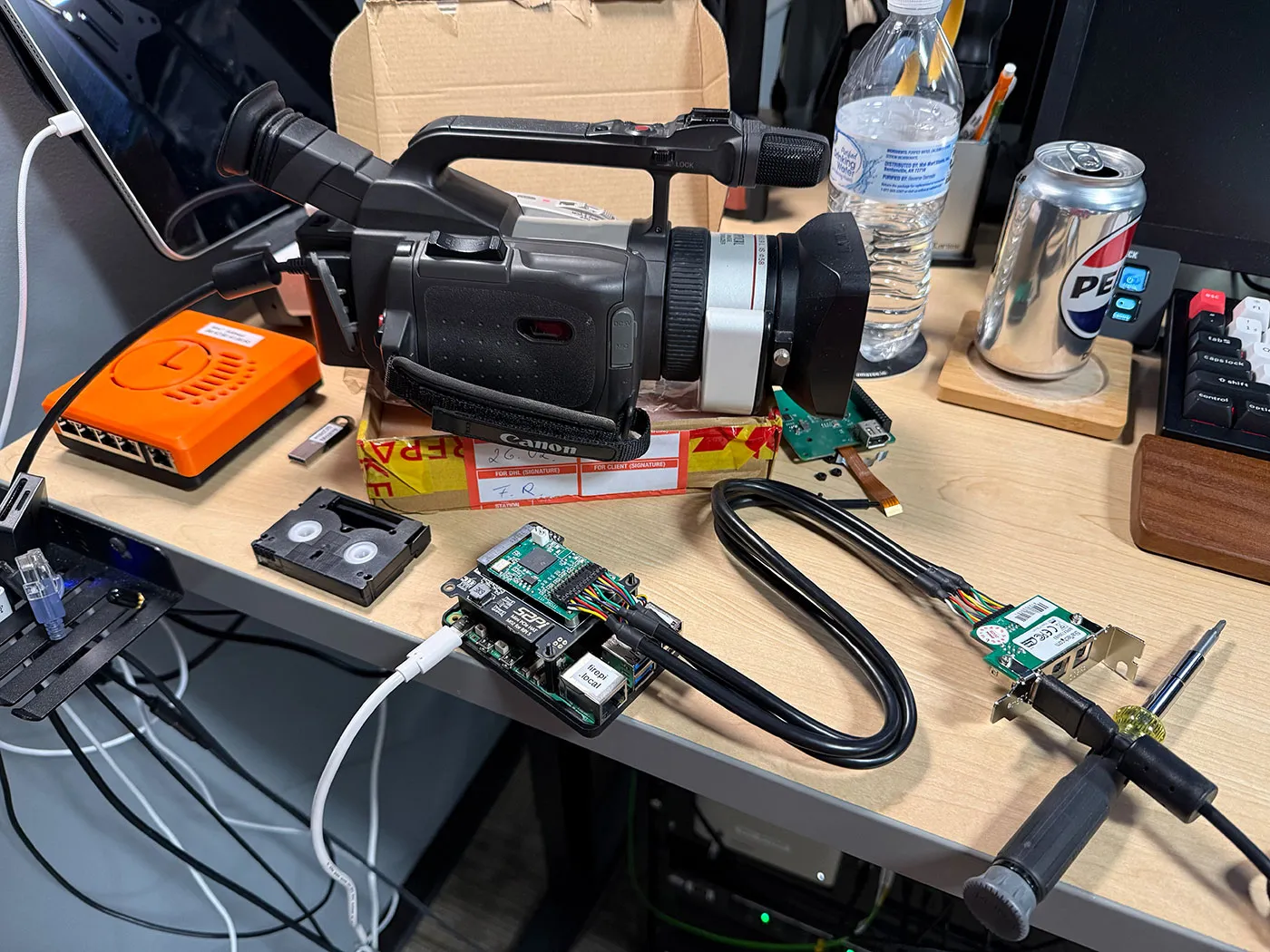
Once the premium option for data transfers and remote control for high-end audiovisual and other devices, FireWire (IEEE 1394) has been dying a slow death ever since Apple and Sony switched over to USB. Recently Apple correspondingly dropped support for it in MacOS 26, and Linux will follow in 2029. The bright side of this when you’re someone like [Jeff Geerling] is that this means three more years of Linux support for one’s FireWire gear, including on the Raspberry Pi with prosumer gear from 1999.
If you’re not concerned about running the latest and greatest – and supported – software, then using an old or modern Mac or PC is of course an option, but with Linux support still available [Jeff] really wanted to get it working on Linux. Particularly on a Raspberry Pi in order to stay on brand.
Adding a FireWire port to a Raspberry Pi SBC is easy enough with an RPi 5 board as you can put a Mini PCIe HAT on it into which you slot a mini PCIe to Firewire adapter. At this point lspci shows the new device, but to use it you need to recompile the Linux kernel with Firewire support. On the Raspberry Pi you then also need to enable it in the device tree overlay, as shown in the article.
With this you now have FireWire 400 support right off the bat, but to use the FireWire 800 port you need to also connect external power to the adapter, which [Jeff]’s Canon GL1 video camera with its FW400 port does not require, so he didn’t bother with that.
Advertisement
Capturing the video from the GL1 via FW400 was done using the DVgrab utility, with a subsequent capture attempt successful. This means that at least until 2029 [Jeff] will be happily using his GL1 camera this way.
Meanwhile over on the Dark Side, you can still happily install FireWire drivers made for older Windows versions on Windows 10 and 11, which is great news for e.g. people who have expensive DAW gear kicking around. Perhaps the demise of FireWire is still a long while off as long as you’re not too picky about the OS you’re running.
Looking for an all-in-one soundbar that sounds as big as it looks? Sennheiser’s Ambeo Max uses its oversized body to produce beefy, enveloping sound, and right now you can grab it for just $2,000 at Best Buy, a sizable $1,000 markdown from the usual list price. It’s one of our favorite stand-alone premium soundbars, particularly if you don’t want to deal with an exterior subwoofer but still want bigger bass than you’re likely to find on smaller options.
While it might be a bit larger than your average soundbar, Sennheiser uses the space well, packing a ton of functionality and drivers into the less-than-compact body. There are both full-range and 1-inch tweeters combined in every conceivable direction, and the result is an impressive reproduction of true spatial audio, something few other stand-alone bars can claim. As a result, it also has an impressive low-end, with bass that doesn’t rival dedicated subwoofers, but comes really close for how much simpler the setup process will be.
The larger footprint also allows for a huge number of inputs, more than you’re likely to find on those tiny soundbars that slide under your screen. In addition to an HDMI 2.1 output with eARC, you’ll get three HDMI inputs with 4K pass-through at 60Hz, USB, Ethernet, and optical audio. There are even RCA ports in case you want to hook this up to your turntable. There’s also a dedicated subwoofer output, in case you decide you want to add one to your setup down the road, giving you a ton of options should you decide to put the Ambeo Max at the center of your home audio setup.
We’ve been talking a lot of about the use of artificial intelligence lately, for obvious reasons. Many of those conversations have revolved around the video game industry and I’ve been fairly vocal about pushing back against the “all AI is bad everywhere forever” dogma that I see far too often. There are plenty of folks in our community that don’t agree with me on that, and that’s fine. But if the picture you’re getting is that I’m an AI evangelist, that’s simply not true. There are potentially good uses of AI in my view, as well as a whole lot of potential negative outcomes of its use. I’m not blind to that.
And, in the video game industry specifically, one bit of pushback that seems to be sorely needed is on game developers that use generative AI in their games, fail to say so, and then excuse its use as accidental after the fact. That is becoming as common a refrain from game developers as the laughable excuse in trademark instances that is, “Well, I have to be an aggressive jerk about my trademarks or else I lose them.” Neither is true.
The most recent version of this concerns the recent hit launch of Crimson Desert. In what is becoming something analogous to the antiquated process by which people who watch golf tournaments on TV looking for missed rules violations could then send into the PGA, which I’ve coined as McPromptism, new game releases get put under a microscope by people looking to find AI uses within them. Crimson Desert went through this process and, wouldn’t you know it, people found clear uses of AI-generated assets in the game.
The game’s extremely high fidelity and impressive graphics are a big part of the sales pitch, which made it all the more disappointing when players began to come across what appeared to be AI-generated artwork littered throughout the game. In light of the disappointment, developer Pearl Abyss has apologized for including the slop in their game, promising to remove and replace all of it.
“We also acknowledge that we should have clearly disclosed our use of AI,” the Crimson Desert account posted on X. “We are currently conducting a comprehensive audit of all in-game assets and are taking steps to replace any affected content. Updated assets will be rolled out in upcoming patches. In parallel, we are reviewing and strengthening our internal processes to ensure greater transparency and consistency in how we communicate with players moving forward.”
Advertisement
Like I said above, this excuse is getting old. Very old. Game developers and publishers will be more than aware at this point that a sizable percentage of the gaming public is very allergic to the use of AI in games, particularly when that use is not acknowledged at the forefront. If placeholder assets generated by AI are to be used at all in the development of a game, it is inexcusable for a developer to not have a process to remove them in place of human-created art before the game is published. That’s sloppy at best, and a lie of an excuse at worst.
Especially because it’s not like there aren’t other options that have nothing to do with AI.
The practice is becoming more common in AAA developer spaces, but critics argue that setting aside the use of AI in your game, it’s pretty foolish to use temporary assets that don’t call obvious attention to themselves. In games of such massive scale, BRAT-green blocks that scream “DO NOT USE” are much easier to flag than something approximating the final product.
I’m struggling to come up with a counter-argument to that.
I’m still in a place where I think there are valid uses of AI in gaming development. If a dev or publisher wants to explore those uses and, importantly, is upfront about it, there may be a place for that.
Advertisement
But the excuse of laziness when it comes to stripping AI assets out when their use was not intended is lame and needs to go away.
In today’s technological landscape, the only constant is the rate of obsolescence. As engineers move deeper into the eras of 6G, ubiquitous artificial intelligence, and hyper-miniaturized electronics, a traditional degree is only a starting point.
To remain competitive in today’s job market, technical specialists must evolve into future-ready professionals by cultivating more than just niche expertise. Success now demands a high degree of adaptive intelligence and strategic communication, allowing specialists to translate complex data into actionable business decisions as industry shifts accelerate.
To bridge the gap between technical proficiency and organizational leadership, the IEEE Professional Development Suite offers training on programs designed to build the strategic competencies required to navigate today’s complex landscape. The suite provides deep technical dives into domains such as telecommunications connectivity and microelectronics reliability. Organizations can stay ahead of the curve through informed decision-making and a future-ready workforce.
Mastery of electrostatic discharge and 5G networks
IEEE’s targeted training—the online Practical ESD Protection Design certificate program—equips teams with technical protocols to mitigate the risks and ensure long-term hardware reliability. Specialized ESD training has become essential for chip designers and manufacturing professionals seeking to improve discharge control.
As 5G network capabilities expand globally, so does the demand for engineers who can master the protocols and procedures required to manage complex telecommunications systems. The IEEE 5G/6G Essential Protocols and Procedures Training and Innovation Testbed, in partnership with Wray Castle, takes a deep dive into the 5G network function framework, registration processes, and packet data unit session establishment. The program is designed for system engineers, integrators, and technical professionals responsible for 5G signaling. Stakeholders such as network operators, equipment vendors, regulators, and handset manufacturers could find the program to be beneficial as well.
“The IEEE Professional Development Suite ensures that learners are not just keeping pace with change but helping to drive it.”
Advertisement
To bridge the gap between theory and practice, the course includes three months of free access to the IEEE 5G/6G Innovation Testbed. The secure, cloud-based platform offers a private, end-to-end 5G network environment where individuals and teams can gain hands-on experience with critical system signaling and troubleshooting.
Leadership training programs
Technical knowledge alone is not enough to climb the corporate ladder. To thrive today, engineering leaders must have a strategic vision and people-centric leadership skills.
The IEEE Leading Technical Teams training program focuses on the challenges of managing engineers in R&D environments and fostering creative problem-solving through an immersive learning experience. It’s designed for professionals who have been in a leadership position for at least six months. Participants can gain self-awareness.
The program includes a 360-degree assessment that gathers feedback about the individual from peers and direct reports to build a personalized development plan. The goal is to help technical professionals transition from high-performing individual contributors into leaders who drive innovation by inspiring their teams rather than just managing tasks.
Advertisement
Organizations can enroll groups of 10 or more to learn as a cohort—which can ensure that everyone stays on the same page while setting a training schedule that fits the team’s deadlines.
In collaboration with the Rutgers Business School, IEEE offers two mini MBA programs to bridge the gap between technical expertise and executive leadership. The programs offer flexibility to fit the demanding schedules of senior professionals. The online format lets participants engage with content as their time permits, while live virtual office hours with faculty provide opportunities for real-time interaction.
During the mini MBA for engineers 12-week curriculum, technical professionals master core competencies such as financial analysis, business strategy, and negotiation to effectively transition into management roles.
The mini MBA in artificial intelligence embeds AI literacy directly into business strategy rather than treating the technology as a standalone subject. Participants learn to evaluate AI through financial modeling and governance frameworks, gaining a practical foundation to lead initiatives that incorporate the technology.
Advertisement
The programs are offered to individuals as well as to organizations interested in training groups of 10 employees or more.
Earning credits that count
All the programs within the IEEE Professional Development Suite offer continuing education units and professional development hours.
Earning globally recognized credits provides a professional advantage, signaling a commitment to growth that often serves as a prerequisite for advancing into senior, lead, or principal roles. Additionally, the credits satisfy annual professional engineering license renewal requirements, ensuring practitioners remain compliant while expanding their capabilities.
Why curated content matters
Developed by IEEE Educational Activities, the training programs are peer-reviewed and built to align with industry needs. By focusing on upskilling (improving current skills) and reskilling (learning new ones), the IEEE Professional Development Suite ensures that learners are not just keeping pace with change but helping to drive it.
Disclaimer: Unless otherwise stated, any opinions expressed below belong solely to the author.
Since last year, Singapore’s Ministry of Manpower has been trying to help fresh graduates in their job search by periodically publishing a list of entry-level vacancies available in the country, and what the expected pay brackets are for each job.
While this list lags the market by about three months, with Dec figures only published in Mar, it still serves as a good indicator of where the openings appear, what jobs are worth looking at and how much they pay—both at the bottom and top end.
This data is collected from companies employing at least 25 people—so not micro businesses—and the figures are rounded up to the nearest 10.
Advertisement
Here are the latest findings:
List of entry-level PMET job opportunities for fresh graduates (Dec 2025)
Industry
Job Title
Vacancies
Median Min. Salary ($)
Median Max Salary ($)
Transportation & Storage
Computer engineer
20
S$5,000
S$10,000
Arts, Entertainment & Recreation
Sports coach
10
S$4,250
S$8,250
Financial & Insurance Services
Financial/Investment adviser
70
S$5,000
S$8,000
Financial & Insurance Services
Operations officer
30
S$4,000
S$8,000
Public Admin & Education
Research and development manager
190
S$4,500
S$7,000
Public Admin & Education
Secondary school teacher
40
S$4,000
S$7,000
Information & Communications
Software developer
240
S$4,500
S$6,550
Manufacturing
Process engineer
70
S$4,000
S$6,000
Manufacturing
Mechanical engineer
60
S$3,800
S$6,000
Wholesale Trade
Sales manager
30
S$3,800
S$6,000
Financial & Insurance Services
Financial compliance officer/Risk analyst
50
S$4,000
S$6,000
Public Admin & Education
Research officer
220
S$4,000
S$6,000
Arts, Entertainment & Recreation
Film, stage and related directors and producers
10
S$4,200
S$6,000
Professional Services
Resident technical officer
70
S$4,800
S$5,800
Construction
Building construction engineer
280
S$3,500
S$5,500
Information & Communications
Systems designer/analyst
110
S$4,000
S$5,500
Real Estate Services
Premises and facilities maintenance manager
50
S$4,000
S$5,200
Construction
Quantity surveyor
340
S$3,500
S$5,000
Construction
Civil/Structural engineering draughtsman
140
S$3,500
S$5,000
Professional Services
Auditor
80
S$4,000
S$5,000
Health & Social Services
Registered nurse and other nursing professionals
200
S$3,000
S$5,000
Manufacturing
Quality control/assurance engineer
70
S$3,500
S$4,800
Wholesale Trade
Electrical engineer
10
S$3,500
S$4,800
Transportation & Storage
Assistant mechanical engineer
10
S$2,400
S$4,800
Accommodation
Sales manager
30
S$4,000
S$4,800
Retail Trade
Retail manager
30
S$3,500
S$4,550
Transportation & Storage
Logistics/production planner
40
S$3,000
S$4,500
Real Estate Services
Quantity surveyor
20
S$3,500
S$4,500
Administrative & Support Services
Management executive
60
S$2,800
S$4,500
Administrative & Support Services
After sales adviser/Client account service executive
40
S$3,500
S$4,500
Health & Social Services
Social worker
180
S$3,820
S$4,500
Health & Social Services
Pre-primary education teacher
120
S$3,000
S$4,500
Food & Beverage Services
Food and beverage operations manager
40
S$3,150
S$4,350
Food & Beverage Services
Retail manager
10
S$3,100
S$4,150
Accommodation
Hotel operations/Lodging services manager
30
S$3,500
S$4,100
Accommodation
Customer service manager
10
S$3,450
S$4,000
Real Estate Services
Premises and facilities maintenance officer
90
S$3,100
S$4,000
Information & Communications
IT support technician
120
S$2,800
S$3,800
Administrative & Support Services
Business development executive
30
S$2,900
S$3,800
Arts, Entertainment & Recreation
Exhibition/Conference/Event planner
10
S$3,200
S$3,800
Food & Beverage Services
Management executive
60
S$2,800
S$3,700
Wholesale Trade
IT support technician
20
S$2,800
S$3,500
Retail Trade
Merchandising/Category executive
30
S$2,800
S$3,500
Retail Trade
IT support technician
20
S$2,800
S$3,300
Professional Services
IT support technician
80
S$2,600
S$3,200
Right off the bat, you can see a surprising entry at the very top of the list—a computer engineer—not in the IT industry but in Transportation & Storage.
This could be a good tip, since most computer science graduates may be looking for a job in tech when there might be a more attractive position available in a different sector.
In second place, we have another unexpected profession: a sports coach. Unfortunately, MOM doesn’t say specifically what kind of “sport” we’re talking about here and what the expectations are, but it is still quite informative that fresh entrants could see offers paying over S$8,000 per month.
Advertisement
Further down the list, we have more predictable vacancies in Finance, but, as it turns out, S$7,000 could be earned in Public Administration jobs under Research & Development and as a Secondary School Teacher.
Then, at the very bottom, we have IT support technicians in non-tech industries and other support roles.
When it comes to the quantity of openings, by far the most are still in construction, with a few hundred Quantity Surveyors and Construction Engineers needed. There are also shortages in Nursing, Teaching, Social Work, and, despite murmurs of a crisis, Software Development.
Youth unemployment in Singapore among the lowest in the world
The vacancy list coincided with the release of a MOM report dedicated to the employment situation of Singapore youths (that is, people aged 15 to 24). While most in this age bracket still pursue education, the ones who have already completed it and joined the labour force have mostly found employment.
Advertisement
While the unemployment rate among them is 6.6%—so, a bit more than twice the 3.0% for the entire country—it is considerably below the 14.3% average reported by OECD, and would place Singapore among the best performing countries:
Source: Youths in the Labour Market 2025/ Singapore Ministry of Manpower
This figure has largely stayed at the same level over the years, with the exception of the pandemic period:
Source: Youths in the Labour Market 2025 / Singapore Ministry of Manpower
What’s more, Singapore also does very well in long-term unemployment statistics, as only 1.1% of local youths looking for work are out of a job for six months or longer.
Source: Youths in the Labour Market 2025 / Singapore Ministry of Manpower
The labour market may be becoming more competitive as companies invest in AI and offload unnecessary workers, but compared to other developed economies, Singapore still seems to be doing very well.
Read other articles we’ve written on Singapore’s current affairs here.
Featured Image Credit: kandal stock/ Shutterstock.com
For more than 40 days and 40 nights, the US Congress failed to come to a deal that would restart paychecks for many Department of Homeland Security employees. The evidence is all over the country’s airports, in the form of hours-long waits to go through security.
Workers with the Transportation Security Administration have been forced to call out as they struggle to pay for gas, rent, childcare, and groceries, according to officials from the American Federation of Government Employees, which represents some 47,000 TSA agents. Nearly 12 percent of agents called out on Thursday, compared to a usual average of 4 percent.
On Friday, President Donald Trump signed an executive order directing DHS to pay TSA workers; the department said employees could see paychecks “as early as Monday,” though union representatives said it could take longer than a week for agents to receive back pay. (Congress still hasn’t voted to fund the department and fully reopen the government.) But it’s unclear whether airports can avert disaster over the upcoming spring holiday weekend. Record-setting long lines still snake around some of the nation’s largest airports.
So if you’re flying, show up early and be prepared to wait. Emphasis on “prepare.” WIRED’s got some especially WIRED-y ideas to pass the time.
Advertisement
Consider TSA PreCheck
Photograph: The Washington Post/Getty Images
Think of a line as a sort of ritual liminal space, a threshold specially made for contemplation. Ponder, perhaps, your mistakes. Top of the list: Not signing up for TSA PreCheck. If you’re already in line, it’s too late right now, but it need not always be so. Those who can swing the $80 fee—good for five years—get expedited boarding, and therefore the right to stand in the security lines that seem to be moving the quickest right now. The online sign-up process takes just a few minutes. What a great way to kill some time!
Applicants then have to sign up for (or walk into) 10-minute in-person document check meetings at local Enrollment Centers, which are located everywhere from airports to local Office Depot and Staples locations. After that, actual enrollment can take anywhere from three to 60 days, the TSA says.
Read WIRED
You’re here already! Nose around. Check out our latest magazine package, The War Machine, which examines how technology has changed how the world fights and then tries to recover. Or head to the Gear homepage to read about the latest in gadgets and gadget trends. If you’re feeling more nostalgic, check out this list of some of WIRED’s best stories from the past 30 years.
Breathe Easy
Just because you’re nice and calm right now doesn’t mean that everyone around you is acting the same way. Escape with some deep breathing, your headphones, and, perhaps, a meditation app. Some options are right here.
Advertisement
While You’ve Got Those Headphones Out
Turn on a podcast! WIRED just updated its list of top ones. Best tech- and science-related recommendations include Flesh and Code, about the dark side of AI love; Your Undivided Attention, a pod hosted by tech-industry veterans about the downsides to living online and how we might make it better; and Ologies, which delights in taking listeners down various scientific rabbit holes. Oh, and Uncanny Valley, WIRED’s insider look at the people, power, and influence of Silicon Valley.
Organize Your Photos
Is your photos folder a hellscape? Us, too. What a great time to tackle the task of deleting what no longer serves you. Going through pictures one-by-one is always an option, but WIRED has also tested—and liked!—two apps to help phone users declutter. Rodeo organizes screenshots by location, and helps you organize reminders and lists to share with friends and family. Swipewipe is the Tinder for photos: Just swipe left to remove images from your phone forever ever.
Finally Figure Out How to Solve a Rubik’s Cube
Photograph: Getty Images
This one requires some forethought, but a Rubik’s Cube might be the perfect line-waiting companion. No flailing limbs, loud noises, or even screens. It’s just you, your fingers, and sheer geometric logic. Here’s our step-by-step guide.
Belatedly Hear the Gospel of Horizon Worlds (on Mobile!)
Meta’s Horizon Worlds is going through some weirdness, as the tech giant shifts away from its (titular) metaverse and VR bets to focus on AI. After announcing Horizon Worlds would be sunset in virtual reality, Meta reversed course just a day later. Whatever: It’s definitely around on mobile! Visit a comedy club! Make some friends! Avoid the children (unless you yourself are a child)!
Advertisement
Ski (Digitally)
There are plenty of mobile gaming options. WIRED senior writer Jeremy White especially loves Grand Mountain Adventure and Grand Mountain Adventure 2 (Android, iOS), open-world skiing and snowboarding games that take you to the most beautiful mountains and ski resorts to cliff hop, slalom, or even cruise the backcountry. We have more mobile game recs here.
Ponder the Line
Photograph: Vital Pictures/Getty Images
If you’d rather spend your time contemplating the world in front of you, there has perhaps never been a better time to learn about the theory behind perfect queues. There’s a whole cottage industry of crowd-science consultants and scientists working out the math and psychology behind the most efficient way to get a bunch of people from here to there. Learn about them here, then consider how your own airport could be doing this better.
Disavow Airport Theory
Last year, TikTokers fell for “airport theory,” the idea that life could be better (?) and more relaxing (??) if flyers arrived at the airport as late as possible, rolling right through security to the boarding line. This gives us angina, and—look around!—feels like an especially bad idea right now. Here are other airport hacks to consider on your next trip, hopefully after Congress has decided to pay federal employees for their work.
Verizon will waive late fees and offer flexible payment arrangements for workers affected by the partial government shutdown. The carrier has made similar offers in the past, like during the COVID-19 pandemic when it gave customers extra mobile data at no additional cost.
The Department of Homeland Security has been hit the hardest by the partial shutdown, but Verizon’s offer covers any federal worker who’s able to offer employment verification. Verizon says employees can call 1-800-Verizon (1-800-922-0204) to get their late fees waived and set up a payment plan.
The partial government shutdown started in February after Congress failed to pass a new DHS funding bill. The lack of funding has not affected all of DHS’ sprawling organizations equally, however. While the Transportation Security Administration is no longer able to pay its employees — leading to significant delays in airport security lines over the last week — both Immigration and Customs Enforcement and Customs and Border Protection have been spared thanks to a separate funding pool established by a previous bill.
Lawmakers continued inability to fund DHS also happens to hinge on both agencies. Democratic senators and congresspeople are demanding ICE agents wear body cams and remove masks before making arrests, among other restrictions, and refusing to fund DHS until those restrictions are worked into the bill. Both Republicans and Democrats have also separately proposed funding the entire department except for ICE and CBP, but while that bill passed in the Senate, it hasn’t been taken up in the House.
CASPIR is expected to significantly enhance Ireland’s high-performance computing capacity.
Ireland is getting a new supercomputer called Computational Analysis and Simulation Platform for Ireland (CASPIR).
The computer is currently being procured by the University of Galway and the European High-Performance Computing (EuroHPC) joint undertaking (JU), and will be managed by the Irish Centre for High-End Computing (ICHEC). A hosting agreement for the supercomputer was signed last October.
Once operational, the CASPIR supercomputer is expected to significantly enhance national high-performance computing capacity and benefit the country’s research and innovation ecosystem.
Advertisement
Commenting on the procurement, Minister for Further and Higher Education, Research, Innovation and Science James Lawless, TD said: “Ireland’s new supercomputer will provide the technological means for researchers and innovators to tackle key scientific and societal challenges in areas including health, environment and climate, artificial intelligence, materials science and transport.
“Procuring a supercomputer will be a landmark moment for research and innovation in our country.”
The EuroHPC JU is a funding entity which enables EU countries, European countries associated with the Horizon Europe programme, as well as private organisations to coordinate efforts and pool resources to build a supercomputing ecosystem.
Established in 2018, EuroHPC JU promotes the development of high-performance computing, quantum and AI innovation in involved countries. Ireland is a founding member of the funding entity.
Advertisement
The Government announced last year it received European funding for a €10m AI Factory Antenna. The Antenna will be implemented by ICHEC, CeADAR – Ireland’s centre for AI – alongside enterprise accelerators, including PorterShed, Dogpatch Labs, RDI Hub and Republic of Works, as well as digital skills networks, including Innovation Technology AtlanTec Gateway and Digital Technology Skills.
Meanwhile, CloudCIX’s Cork data centre launched the ‘Boole supercomputer’ in late January this year. The Cork-based supercomputer, a joint venture between CloudCIX and AlloComp, is reportedly one of Europe’s first liquid-cooled Nvidia B200 GPU deployments in Europe – and the first in Ireland.
Months earlier, University College Dublin (UCD) announced that it was procuring a new nearly €724,000 Nvidia supercomputer expected to perform 50-times faster than UCD’s existing high-performance compute cluster.
Don’t miss out on the knowledge you need to succeed. Sign up for the Daily Brief, Silicon Republic’s digest of need-to-know sci-tech news.
If you own any modern gadget, be it a smartphone, laptop, headphones or even a game controller, there’s a good chance that it will sport a USB-C port.
USB-C is quickly becoming the universal port of choice in the technology world, both for power delivery and data transfer. This universal adoption means you won’t need to worry about stocking multiple cable types, being able to use a single charger for multiple devices, which is not only more sustainable but also more convenient.
The initial universal adoption of USB-C was a slow process, especially as Apple took its time to ditch the iPhone Lightning port for USB-C, only doing so back in 2023 with the iPhone 15 series.
But what exactly is USB-C, and how does it compare to alternative connection types such as USB-A, HDMI and Lightning? Why was Apple under pressure to adopt the port in the first place? We’ve created this guide to explain everything you need to know about USB-C.
Advertisement
What is USB-C?
USB-C is an industry-standard connector that can charge a device as well as transmit data, making it one of the most convenient and versatile port options currently available.
Advertisement
One of the most appealing aspects about USB-C is that it offers multiple functions beyond charging up the battery. For example, the Nintendo Switch and the Nintendo Switch 2 use USB-C to output their display to an external TV, while USB-C can also be used to transfer data (such as documents, photos and videos) between devices.
The iPad Pro packs a useful USB-C port
Its popularity and benefits have also seen it accepted by PC manufacturers since it can transfer data at high speeds, which we’ll go into more detail with later. This is useful for transferring large video files and the like. However, because USB-C currently has restrictions on how much power can be transferred through it, the port connection is generally not used for power delivery on high-end systems like gaming laptops.
How fast is USB-C?
It’s important to note that not all USB-C connections are the same. This means the power delivery and data transfer speeds will differ between devices, depending on which iteration of USB-C is being used.
Advertisement
It’s best to think of USB-C as the physical connector, while the likes of USB 2.0, USB 3.1, USB 3.2, USB4, USB4 v2, Thunderbolt 3, Thunderbolt 4 and Thunderbolt 5 will determine the level of performance instead.
Thunderbolt 5 is currently the most powerful version of USB-C, allowing up to 120Gbps speeds for data transmission, as well as up to 240W charging.
Advertisement
Although it’s been available for some, time Thunderbolt 5 still seems reserved for more premium devices, such as the MacBook Pro M5 Pro or M5 Max. Instead, many more devices offer Thunderbolt 4 support instead. Just make sure to check the performance speeds of the USB-C connector for each individual device.
Advertisement
If you’re not sure how the Gbps speed metric relates to real-world performance, Belkin claims that 10Gb/s translates to transferring a high definition feature-length film over to another device in just 30 seconds when working at peak performance.
Looking at the charging front, USB-C can go up to 240 watts. For comparison, Apple’s Lightning charger capped out at just 30W.
So while it is convenient to use the same charger between your tablet, laptop and phone, it’s also the more powerful option, which should result in less time waiting around waiting for your phone’s battery to be fully replenished.
Is USB-C the same as Thunderbolt?
USB-C and Thunderbolt are not the same thing, and so shouldn’t be mixed up.
Advertisement
Advertisement
USB-C is just the name of the physical oval-shaped port. This means that all Thunderbolt technology uses the USB-C connector, but this isn’t true vice versa as there are other compatible connectivity standards such as USB 3.2 Gen 1 etc.
Thunderbolt has its own features and max speeds, with new iterations intermittently released as the technology improves.
Thunderbolt 5 is the latest iteration, supporting up to 120Gb/s, making data transfer even faster. Thunderbolt can also move as much as 240W of power over an interface, which further adds to its impressive speed and overall benefits.
Lightning to USB-C cable
Thunderbolt can be used to transfer large data or media files (such as 4K video) over to a computer or PC without long waiting times.
It can be seen as the supercharger version of a USB-C connector, with Intel deciding to stick to the universal connector to ensure cables are backwards compatible and can work with a large range of devices.
Advertisement
Advertisement
What’s the difference between USB and USB-C?
We’ll start by explaining what USB actually is. Short for Universal Serial Bus, USB is a technology that’s used to connect computers to external devices such as printers, keyboards or controllers. USB is also used for charging devices via an adaptor or power bank, and transferring files from one device to another.
Most computers and peripherals will sport some kind of USB port, whether that’s USB-A, USB-B (usually reserved for printers and scanners) or a USB-C connection.
With the above in mind, the “difference” between USB and USB-C is just that the latter is a type of the former. Both are designed to connect two devices together, but USB is the umbrella term for the different types of ports, such as USB-C for example.
Advertisement
Does the iPhone use USB-C?
Since the launch of the iPhone 15 back in September 2023, all iPhones have sported a USB-C port in lieu of the rather dated Lightning alternative. Apple was seemingly reluctant to move ahead with this change, however an EU court ruling essentially forced the brand, alongside other smartphone manufacturers, to opt for the USB-C port as standard.
It’s a welcome move too, as it means regardless of whether you’re an iOS or Android user, you’ll be able to use the same cables.
Advertisement
USB-C port plugged into iPhone 15 Pro Max. Image Credit (Trusted Reviews)
How can I tell if my USB cable is A or C?
The easiest way to determine whether you have a USB-A or USB-C port is simply by looking at the shape. USB-A has a rectangular shape that can only plug into a port one way, whereas USB-C is more of an oval and can be plugged in either way round. While some devices do still sport USB-As, USB-C is undoubtedly more of an industry standard now.
Even so, if you have an older computer or other device with USB-A ports, it is still possible to connect your USB-C device, with the help of an external adapter.






























































You must be logged in to post a comment Login