Finch Capital has previously supported Ireland’s NomuPay, AccountsIQ and Webio.
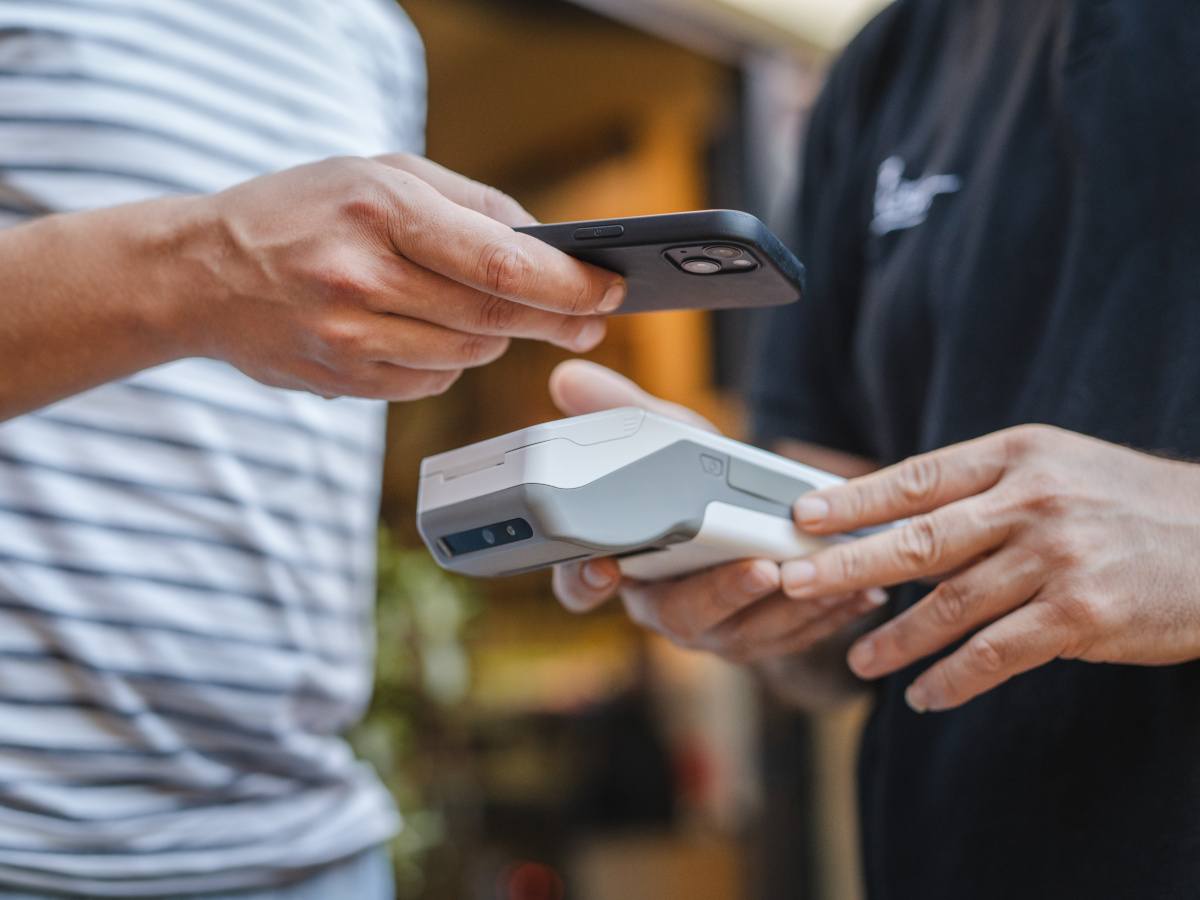
UK payments company Apexx Global has bagged strategic investment of up to $10m from Dutch VC group Finch Capital.
Apexx, co-founded by Irishman Peter Keenan, specialises in merchant-centric payment orchestration. Its platform enables enterprise merchants to access the entire global payments ecosystem through a single API, it said.
By allowing transactions to route across the ecosystem, the company targets increased acceptance rates, lower processing costs and improved conversion rates.
Advertisement
Investment from Finch comes after the 2016-founded Apexx bagged some big name customers, including Jet2, Iglu.com and Norse Atlantic, towards the end of last year. According to the company, these additions take it to the brink of break-even revenue.
Finch’s investment will be used to power Apexx’s next phase of growth, it said, supporting product innovation and international expansion as the demand for smarter payment orchestration continues to rise.
As part of the investment, Finch Capital managing partner Radboud Vlaar will be joining Apexx Global’s board as chairperson.
“Apexx Global has built a truly differentiated payment orchestration platform with a clear focus on merchant outcomes,” Vlaar said.
Advertisement
“Payments is a global, complex and rapidly evolving space, and Apexx’s ability to intelligently optimise acceptance and cost at scale positions them exceptionally well.”
Finch Capital deals with more than €500m in assets under management and has backed more than 50 portfolio companies across Europe and the US.
“Finch Capital brings exactly the combination of payments expertise, international perspective and growth experience we were looking for,” said Keenan, the Apexx’s CEO.
Advertisement
“This investment is a strong validation of our strategy and technology, and Radboud’s appointment as chairman further strengthens our leadership as we scale globally.
“Our focus remains clear – delivering measurable value for merchants by simplifying payments and driving better outcomes.”
Don’t miss out on the knowledge you need to succeed. Sign up for the Daily Brief, Silicon Republic’s digest of need-to-know sci-tech news.
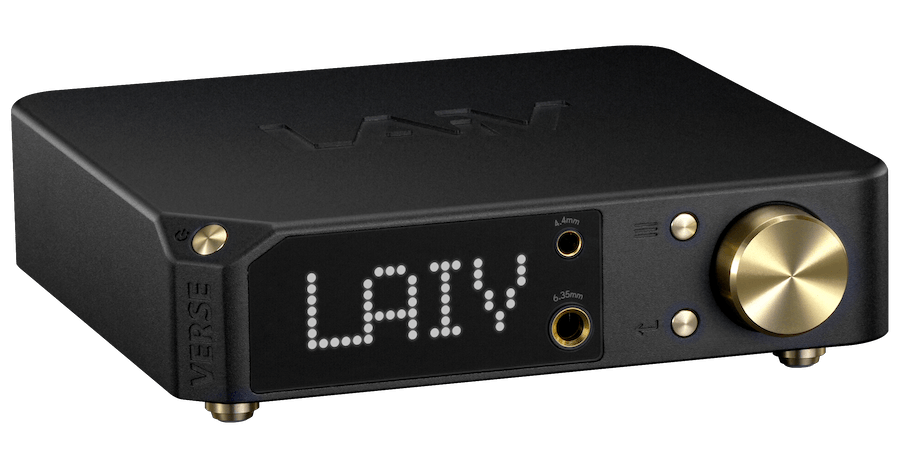
The LAiV Crescendo VERSE lands at a moment when hi-fi is quietly being redefined. LAiV’s new component combines an R2R ladder DAC, discrete headphone amplifier, and active preamp into a single compact chassis priced under $1,000; exactly the kind of “one box” solution more listeners are gravitating toward as systems shift away from racks of separates and toward streamlined setups built around headphones, powered speakers, or compact amplifiers.
The idea that serious high-end sound can’t exist below four figures is starting to look outdated, and products like this are a big reason why.
What’s Inside the LAiV Crescendo VERSE: R2R, FPGA, and Full Digital Control
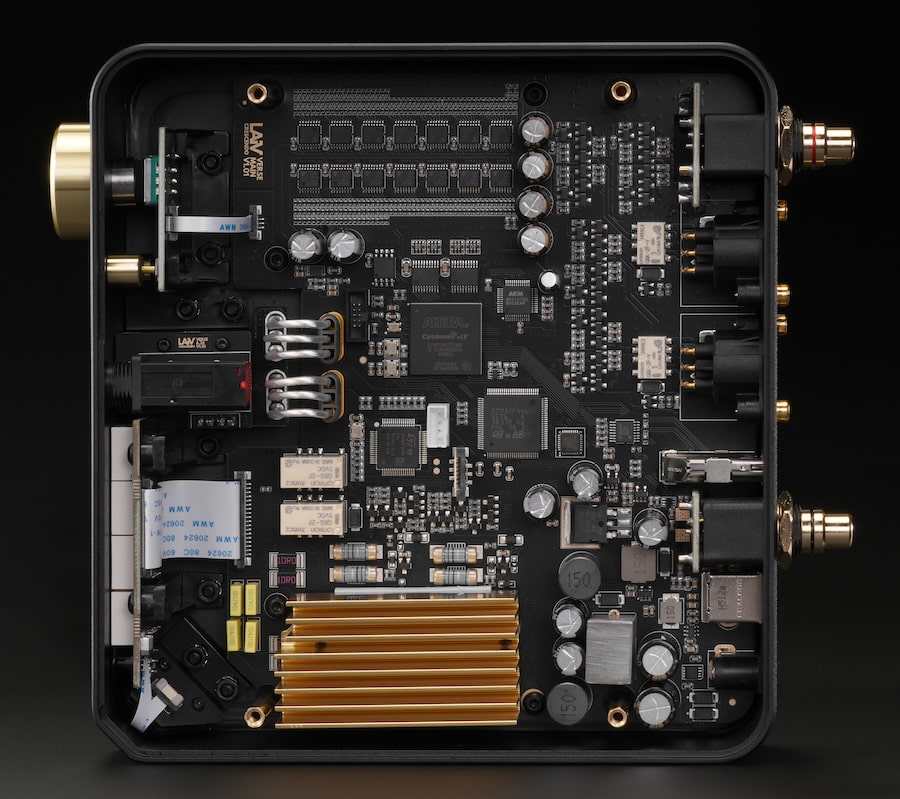
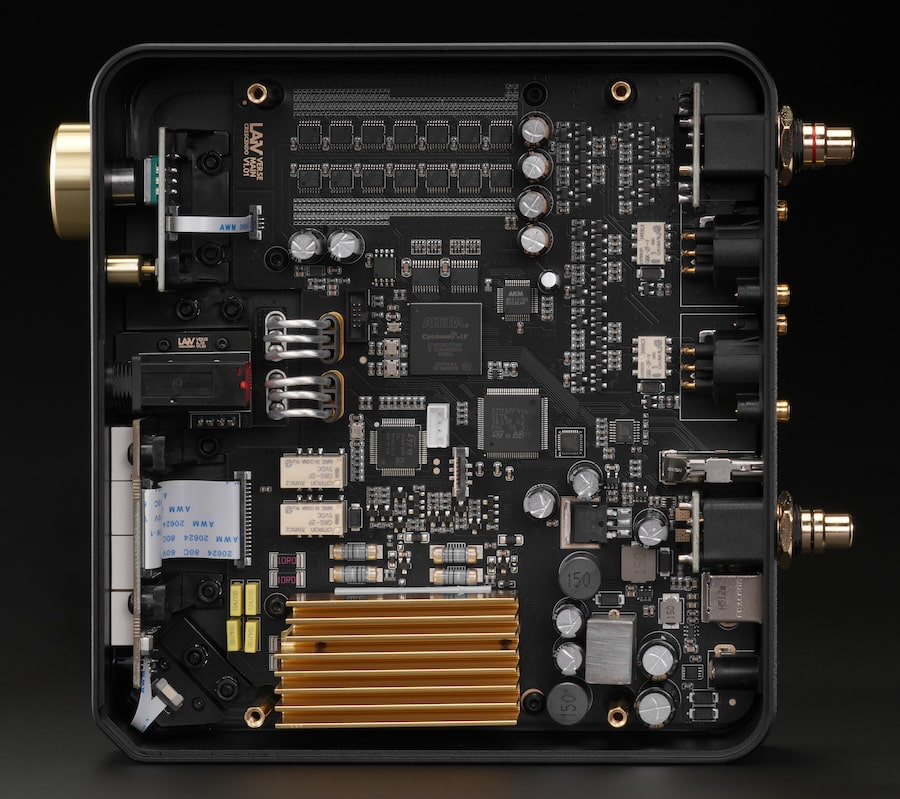
At the core of the Crescendo VERSE is LAiV’s proprietary balanced R2R ladder DAC architecture, built from tightly matched resistors (0.05% tolerance) to prioritize tonal accuracy, stable imaging, and long-term listenability. This is not a chip-based DAC. It’s a discrete ladder design aimed at delivering a more natural, less processed presentation; the kind of approach usually reserved for significantly more expensive hardware.
Supporting that DAC stage is an FPGA-based digital processing platform, which handles signal management and gives the VERSE its flexibility in playback modes and resampling.
Advertisement
The VERSE is designed to give users control over how their digital signal is handled rather than forcing a single approach.
The Crescendo VERSE supports native 1-bit DSD playback, keeping DSD signals in their original format without converting them to PCM, while also handling high-resolution PCM up to 768kHz and DSD up to at least DSD256 via its digital inputs. An integrated sampling rate converter (SRC) adds further flexibility, enabling PCM upsampling from 1x to 16x and DSD resampling up to DSD512 for those who want more control over how their digital content is processed.
There are also selectable playback modes (including NOS and SRC behavior), which means users can prioritize either signal purity or smoother multi-format playback depending on their system and library.
LAiV does include a small but important caveat: switching between PCM and DSD tracks in a mixed playlist can produce audible clicks or pops when using native mode. If your library jumps between formats, the multi-bit DSD mode converts everything to PCM for uninterrupted playback.
Advertisement
Digital Only Connectivity?
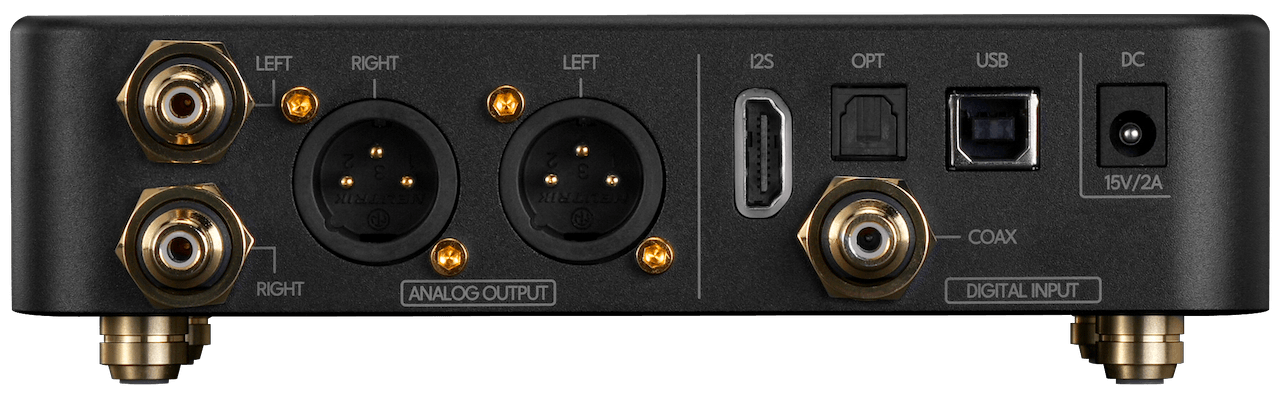
LAiV made a deliberate call with the Crescendo VERSE: this is a digital first component. It offers USB, optical, coaxial, and I2S inputs, with the latter configurable and clock aware for more advanced setups. All inputs support high resolution playback, with USB and I2S handling up to 768kHz PCM and high rate DSD. What you will not find here are any analog inputs. That omission is not an oversight, it is a statement. The VERSE is designed to be a dedicated digital front end, not a catch all hub trying to do everything at once, which may not be ideal for those who may wish to add an analog source.
Active Preamplifier
The Crescendo VERSE includes a discrete, output buffered preamplifier stage rather than a simple variable DAC output. It uses analog domain volume control to preserve signal integrity and maintains low output impedance for proper matching with downstream gear. Both balanced XLR and single ended RCA outputs are available and can be used simultaneously, which makes integration straightforward whether you are running active speakers, a power amplifier, or a hybrid system. This is where the one box concept starts to make practical sense in a real system.
Enough for Your Planars in Balanced Mode
The headphone stage is fully discrete and built with flexibility in mind, offering selectable gain settings to accommodate everything from sensitive in-ear monitors to more demanding full size headphones. Output is available via 4.4mm balanced and 6.35mm single ended connections. Power output reaches up to 1100 mW per channel in balanced mode and roughly 230 to 290mW single ended, which is enough for the majority of headphones people are actually using, although high impedance dynamic headphones are definitely a stretch and there is way to drive electrostatic headphones.
Advertisement. Scroll to continue reading.
Advertisement
Physical Design & Usability
The Crescendo VERSE is built around a compact, desktop friendly chassis measuring approximately 230 mm wide (9.1 inches), 220 mm deep (8.7 inches), and just under 50 mm tall (about 2 inches), with a weight of about 0.9 kg (just under 2 pounds).
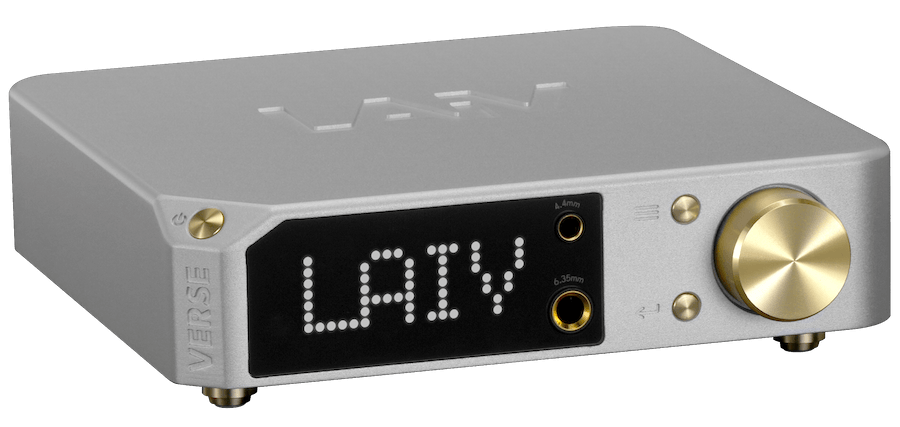
The enclosure uses a precision machined aluminum housing with a thick front panel and tight panel tolerances that give it a more serious, component grade feel than most devices in this price range. Finish options include a silver chassis with gold accents or a darker variant, both of which lean into a more distinctive, design forward aesthetic rather than disappearing into the background.
On the front, a dot matrix LED display provides clear readouts for input selection, volume level, sample rate, and playback status, while a central rotary encoder handles volume, input switching, and menu navigation with direct, tactile control. A full function remote is also included, allowing access to key settings such as gain, input selection, and playback modes without needing to interact directly with the unit.
The Bottom Line
What LAiV has created with the Crescendo VERSE is not a lifestyle product and not a stripped down DAC. It is a focused digital control center built around an R2R DAC for tonal character, a proper preamp stage for system integration, and a capable headphone amplifier for personal listening. There is no streaming platform, no analog input stage, and no attempt to be everything to everyone. That focus is the point.
Advertisement
At $849, it is a direct challenge to the idea that meaningful high end performance has to be expensive or complicated. The Crescendo VERSE is trying to be enough: a compact, high performance hub that can anchor a serious desktop or small room system without the cost and complexity that used to define the category. If it delivers on the promise of R2R performance at this level, the definition of affordable high end audio may need a reset.
We will know soon enough. James Fiorucci’s full review drops later this week, and if this category is on your radar, it is one you will want to read.
Fosi Audio has built its reputation the hard way by delivering affordable gear that actually works as promised, earning a loyal following in the entry-level category where expectations are low and competition is relentless. Now it is stepping into a far more crowded and scrutinized arena with the S3, a $259 balanced HiFi music streamer, DAC, and preamp designed to anchor a modern two channel system.
That puts it directly in the crosshairs of established players like WiiM and Bluesound, both of which have already set a high bar for usability, ecosystem integration, and streaming performance at relatively accessible price points.
The S3’s pitch is straightforward. Combine network streaming, high resolution DAC capability, and preamp functionality into one compact and affordable component. Execution is where this category gets brutal. Fosi Audio has proven it can win on value. The question now is whether it can compete on polish, software, and long term usability where the real battles are fought.
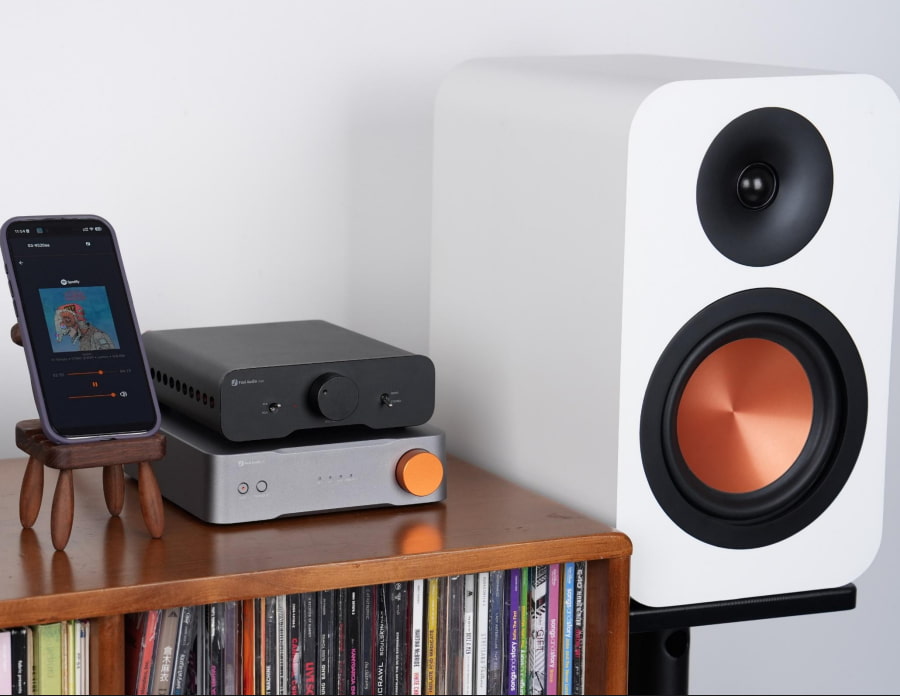
Fosi Audio S3 balanced HiFi streamer under ZA3 balanced stereo amplifier with SP601 speaker.
Streaming Platform, Architecture, and Real World System Flexibility
The Fosi Audio S3 Balanced HiFi Music Streamer is built around the Amlogic A113X streaming platform, paired with an AKM 4493SEQ DAC and OPA1612 op amps in a fully balanced circuit design. That combination forms the foundation of its digital and analog performance, aiming for a low noise signal path and consistent channel separation at a price point where that is not always guaranteed. It is a familiar architecture on paper, but one that has proven effective when properly implemented.
Advertisement
On the streaming side, the S3 supports dual band Wi-Fi across 2.4 GHz and 5 GHz, along with a 10/100 Ethernet port for more stable wired operation. Bluetooth 5.3 is included with SBC and AAC codec support, which covers basic wireless playback but does not target higher quality Bluetooth use cases. Streaming protocol support is broad and practical, including Spotify Connect, TIDAL Connect, AirPlay 2, Google Cast, DLNA, and Roon Ready (still awaiting certification), allowing the S3 to integrate into multiple ecosystems without forcing users into a single platform or app.
Playback capability varies depending on the input path. HDMI and optical inputs support up to 24-bit/192kHz PCM, while Wi-Fi streaming is also capped at 24-bit 192kHz. Google Cast reaches 24-bit/96kHz, AirPlay 2 is limited to 16-bit/48kHz, and Bluetooth tops out at 24-bit/48kHz. For users within the Roon ecosystem, the S3 supports up to 32-bit384kHz PCM, which represents its highest resolution playback scenario.
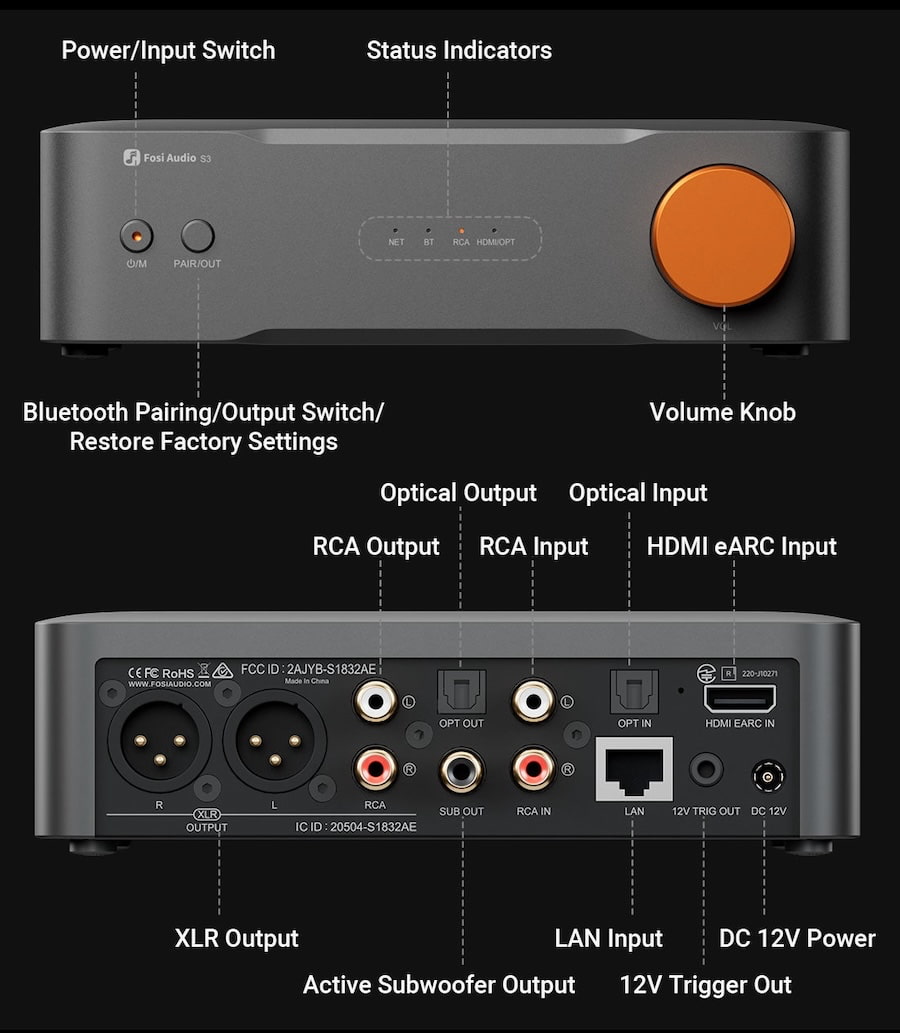
As a component, the S3 is designed to function as more than just a streamer. It can operate as a digital transport, standalone DAC, or preamp, making it suitable as the central source in a compact two channel or 2.1 system. Connectivity reflects that goal, with HDMI eARC, RCA and XLR outputs, optical input, and a dedicated subwoofer output, allowing it to integrate into both traditional HiFi systems and TV based setups without additional hardware.
Control and system management are handled through the Fosi Audio app, which manages setup, input selection, and playback, along with a built in 5-band EQ for basic tuning. A Bluetooth remote with a range of over 15 meters is also included for direct control.
Advertisement
Power is supplied via a 12V 1.5A external adapter, and the compact chassis measures 17.3 by 17.3 by 4.7 cm, or 6.81 by 6.81 by 1.85 inches, making it easy to integrate into space conscious desktop or rack based systems.
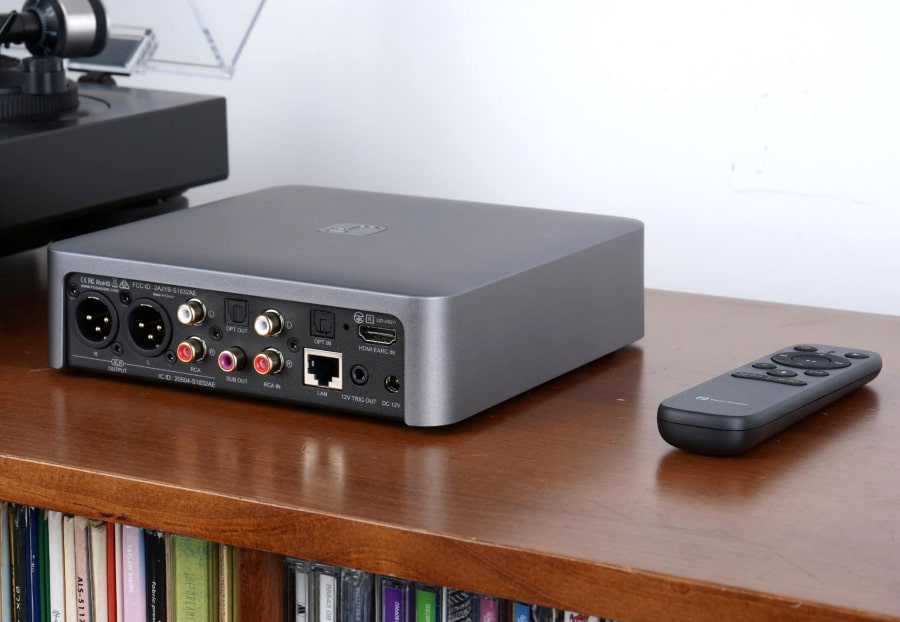
Fosi Audio S3 rear angle with remote control
The Bottom Line
The S3 is Fosi Audio taking a serious swing at becoming the center of an affordable modern system. At $259, what makes it stand out is the combination of balanced XLR output, HDMI eARC, subwoofer integration, and broad streaming protocol support in a single compact box. That is not common at this price, and it positions the S3 as more than just a basic streamer. It is a true digital front end for someone building a clean, minimal two channel or 2.1 setup without stacking multiple components.
What it does not offer is just as important. There is no room correction, no advanced DSP beyond a basic 5-band EQ, and Bluetooth is limited to SBC and AAC with no LDAC, aptX HD, or aptX Lossless support. Qobuz Connect is also not supported at launch. Roon Ready certification is also not available yet, which matters in this category, even if AirPlay 2 and Google Cast provide a workaround. Long term usability will also depend heavily on the stability and refinement of the Fosi control app, where competitors already have a clear edge.
Advertisement. Scroll to continue reading.
Advertisement
This is aimed squarely at users who want a simple, affordable, and flexible streaming hub with modern connectivity, especially those building their first real Hi-Fi system or upgrading from a basic Bluetooth or single box solution. It is less compelling for experienced users who prioritize mature software ecosystems, advanced room correction, or higher end wireless codec support.
The competition is not forgiving. The S3 goes directly up against WiiM with the Pro and Pro Plus, and Bluesound with the NODE, both of which offer more established software platforms and, in some cases, features like room correction or broader ecosystem support. Fosi is betting that its hardware value and connectivity will be enough to pull buyers in. Whether that is enough will come down to execution, because in this category, good hardware is only half the story.
Watch the 2026 Japanese Grand Prix live streams to find out whether Ferrari, which looked better in China than in Australia, can push even closer to challenging Mercedes’ dominance. Speaking of which, Antonelli, after picking up his first-ever F1 win in Shanghai, is now a serious title contender alongside George Russell.
We will also likely see an end to Max Verstappen’s dominance at Suzuka. He has won the last four races here, but with Red Bull now firmly in the midfield, he’s unfortunately far off from challenging the top teams.
Speaking of top teams, McLaren had a shocker in China, recording a double DNS, both related to power unit systems. It’s worth noting that they run the Mercedes power unit, but so far haven’t been able to extract performance the way Mercedes has. Oscar Piastri, in fact, has not started either of the two races this season, so he’ll be keen to get off the line cleanly in Japan.
Advertisement
Of course, the new energy management system will be the talk of the paddock throughout the weekend. While Suzuka is a fast track, it also features several significant braking zones, creating opportunities for energy harvesting. That could lead to more overtaking at a circuit not traditionally known for it.
Here’s how to watch the Japanese Grand Prix 2026 online from anywhere and potentially for FREE.
Japanese Grand Prix 2026 Schedule
Practice 1: Friday, March 27 | 2:30am GMT / 10:30pm ET (Thu.) Practice 2: Friday, March 27 | 6am GMT / 2am ET Practice 3: Saturday, March 28 | 2:30am GMT / 10:30pm ET (Fri.) Qualifying: Saturday, March 28 | 6am GMT / 2am ET Japanese Grand Prix: Sunday, March 29 | 6am BST / 1am ET
Advertisement
How to watch the Japanese Grand Prix 2026 for FREE
The 2026 Japanese Grand Prix isn’t available for free in every country. However, in these select destinations lucky F1 fans can catch the practice sessions, qualifying, and the entire race/highlights for FREE.
Traveling abroad during the 2026 Japanese Grand Prix? You can use a VPN to watch all the action free of charge as if you were right at home.
Advertisement
How to watch the Japanese Grand Prix 2026 from anywhere
🌎 ABROAD? The Japanese Grand Prix 2026 is broadcast in many countries around the world but if you’re traveling outside your country you should consider using one of the best VPNs to unlock your domestic streaming service provided it does not infringe any terms and conditions.
How to watch the Japanese Grand Prix 2026 in the US
How to watch the Japanese GP 2026 in the UK
Advertisement
How to watch the Japanese Grand Prix 2026 in Australia
How to watch the Japanese Grand Prix 2026 in Canada
(Image credit: Other)
F1 fans may also enjoy…
We test and review VPN services in the context of legal recreational uses. For example: 1. Accessing a service from another country (subject to the terms and conditions of that service). 2. Protecting your online security and strengthening your online privacy when abroad. We do not support or condone the illegal or malicious use of VPN services. Consuming pirated content that is paid-for is neither endorsed nor approved by Future Publishing.
Test tasting soda mead. (Credit: Golden Hive Mead, YouTube)
You can certainly just chug down that bottle of soda you purchased, but if you accept the premise that the preparation of food and drink is just a subset of chemistry, and that chemistry is fun, then it naturally follows that using soda as the basis for brewing up some mead makes perfect sense. Thus the [Golden Hive Mead] blokes over on YouTube decided to create some Coca Cola flavored mead.
Mead is essentially just water mixed with honey that is left to ferment after adding yeast, resulting in what is also called ‘honey wine’, with an ethanol content of usually between 3.5% and 20%. Since soda is mostly water and comes with its own supply of sugar for yeast to feast on, this isn’t such a crazy choice in that respect. Just make sure to remove the carbonation, as the CO2 makes the soda too acidic for the yeast to be happy.
Instead of straight honey, caramelized honey was used for extra flavor after which the brew was left to ferment for a while. For extra flavor notes aged oak, vanilla and cinnamon were added as well, to ensure that the fermentation didn’t erase those core notes of the coke. The result was apparently rather flavorful, with about a 10.5% ethanol content, receiving the full approval of both tame test tasters.
IEEE 802.11bn introduces the ultra-high reliability amendment that will serve as the basis for Wi-Fi 8. Unlike previous Wi-Fi generations that focused primarily on increasing peak throughput, IEEE 802.11bn targets measurable improvements in real-world performance: a 25% throughput increase under rate-versus-range conditions, a 25% reduction in 95th-percentile latency, and a 25% decrease in packet loss probability during basic service set transitions. The amendment retains the core physical layer parameters of Wi-Fi 7 — up to 320 MHz channel bandwidth, 4096-level quadrature amplitude modulation, and eight spatial streams — while adding new physical layer capabilities such as distributed resource units and enhanced long range protocol data units, alongside advanced medium access control features including multi-access point coordination and seamless roaming within a mobility domain.
David Sacks has used up his days as Donald Trump’s AI and crypto czar.
Speaking with Bloomberg on Thursday, the longtime entrepreneur, investor, and podcaster, confirmed that his non-consecutive 130-day stint as a special government employee is over and that he’s moving on to co-chair the President’s Council of Advisors on Science and Technology (PCAST) alongside senior White House technology adviser Michael Kratsios.
“I think moving forward as co-chair of PCAST, I can now make recommendations on not just AI but an expanded range of technology topics,” he told Bloomberg via a video interview. “So yes, this is how I’ll be involved moving forward.”
What that means in practice is Sacks will be much further from power center in Washington than since the outset of this second Trump administration. As AI czar, Sacks had a direct line to Trump and a hand in shaping policy. PCAST is a federal advisory body, so while it studies issues, produces reports, and sends recommendations up the chain, it doesn’t make policy.
Advertisement
The council has existed in some form since FDR, though Sacks made a point to Bloomberg of noting that this particular iteration has “the most star power of any group like this” ever assembled, and it’s hard to argue he’s wrong. The initial 15 members include Nvidia’s Jensen Huang, Meta’s Mark Zuckerberg, Oracle’s Larry Ellison, Google co-founder Sergey Brin, Marc Andreessen, AMD’s Lisa Su, and Michael Dell, among others. (That’s a lot of billionaires.)
Sacks told Bloomberg the council will take up AI, advanced semiconductors, quantum computing, and nuclear power, and that near-term attention will go toward pushing Trump’s national AI framework, released just last week. The framework is aimed at replacing what Sacks described to Bloomberg as a mess of conflicting state-level rules. “You’ve got 50 different states regulating this in 50 different ways,” he said, “and it’s creating a patchwork of regulation that’s difficult for our innovators to comply with.”
What Sacks didn’t address head-on was why the transition is happening now and whether his recent comments were a factor. Earlier this month, on the popular “All In” podcast that he co-hosts, Sacks publicly urged the administration to find an exit from the U.S.-backed war with Iran, walking through a set of worsening scenarios — attacks on oil infrastructure in neighboring countries, the destruction of desalination plants, the possibility of nuclear use by Israel — and calling for a polite way out. Trump responded by telling reporters that Sacks hadn’t spoken to him about the war. (The U.S.-Israel war on Iran has now been going on for approximately 27 days.)
Techcrunch event
Advertisement
San Francisco, CA | October 13-15, 2026
Asked about the podcast episode on Thursday by Bloomberg, Sacks figuratively threw his hands in the air: “I’m not on the foreign policy team or the national security team,” he said, adding that his podcast comments represented his personal view, not an official one.
Advertisement
For all the marquee names Sacks is bringing to PCAST, it’s worth reflecting on what the council has historically been, which is an advisory body with some influence in some administrations and almost none in others.
President Obama’s version was seemingly the most productive on record, churning out 36 reports over eight years — two of which led to concrete policy changes, including an FDA rule that opened the market for over-the-counter hearing aids.
President Trump’s first-term council, by contrast, took nearly three years just to name its first members, produced a handful of reports, and made no particular mark, while President Biden’s council skewed heavily academic — Nobel laureates, MacArthur fellows, National Academy members — and issued a modest number of reports before the administration ended.
The current PCAST is a completely different animal, built almost entirely from the executive suites of the companies shaping the technology it will advise on.
Advertisement
Now, Sacks is again one of those unencumbered executives, free to resume his life as an investor and entrepreneur. A spokesperson for Craft Ventures, the firm Sacks co-founded and where he remains a partner, has not yet responded to related questions about next steps; TechCrunch reported last year on the ethics waivers Sacks obtained to maintain financial stakes in AI and crypto companies while shaping federal policy in both areas — an arrangement that drew sharp criticism from ethics experts and lawmakers.
An anonymous reader quotes a report from 404 Media: Apple provided the FBI with the real iCloud email address hidden behind Apple’s ‘Hide My Email’ feature, which lets paying iCloud+ users generate anonymous email addresses, according to a recently filed court record. The move isn’t surprising but still provides uncommon insight into what data is available to authorities regarding the Apple feature. The data was turned over during an investigation into a man who allegedly sent a threatening email to Alexis Wilkins, the girlfriend of FBI director Kash Patel.
“On or about February 28, 2026, Person 1 received an email from the email address peaty_terms_1o@icloud.com,” the affidavit reads. Earlier on, the document explicitly says that Person 1 is Alexis Wilkins. […] The affidavit says Apple then provided records that indicated the peaty_terms_1o@icloud.com email address was associated with an Apple account in the name of Alden Ruml. The records showed that account generated 134 anonymized email addresses, according to the affidavit.
Law enforcement agents later interviewed Ruml and he confirmed he had sent the email, the affidavit says. Ruml said he sent the email after reading a February 28 article about how the FBI was using its own resources to provide security to Wilkins. The specific article is not named or linked in the affidavit, but a New York Times article published that same day described how Patel ordered a team to ferry his girlfriend on errands and to events.
Set to debut on April 14 in more than 200 countries and regions, Apple Business brings together the company’s existing enterprise programs – Apple Business Connect, Apple Business Essentials, and Apple Business Manager. The new service represents Apple’s most comprehensive effort yet to provide small and mid-sized companies with integrated… Read Entire Article Source link
When you hear the term humanoid robot, you may think of C-3PO, the human-cyborg-relations android from Star Wars. C-3PO was designed to assist humans in communicating with robots and alien species. The droid, which first appeared on screen in 1977, joined the characters on their adventures, walking, talking, and interacting with the environment like a human. It was ahead of its time.
Before the release of Star Wars, a few androids did exist and could move and interact with their environment, but none could do so without losing its balance.
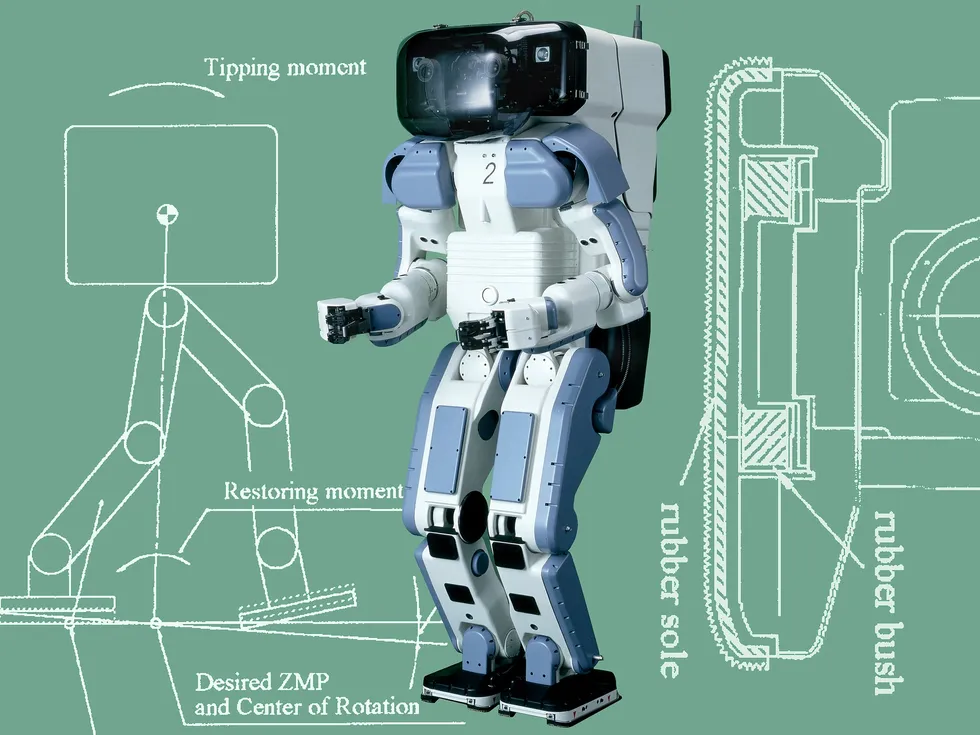
It wasn’t until 1996 that the first autonomous robot capable of walking without falling was developed in Japan. Honda’s Prototype 2 (P2) was nearly 183 centimeters tall and weighed 210 kilograms. It could control its posture to maintain balance, and it could move multiple joints simultaneously.
In recognition of that decades-old feat, P2 has been honored as an IEEE Milestone. The dedication ceremony is scheduled for 28 April at the Honda Collection Hall, located on the grounds of the Mobility Resort Motegi, in Japan. The machine is on display in the hall’s robotics exhibit, which showcases the evolution of Honda’s humanoid technology.
In 1986 Honda researchers Kazuo Hirai, Masato Hirose, Yuji Haikawa, and Toru Takenaka set out to develop what they called a “domestic robot” to collaborate with humans. It would be able to climb stairs, remove impediments in its path, and tighten a nut with a wrench, according to their research paper on the project.
“We believe that a robot working within a household is the type of robot that consumers may find useful,” the authors wrote.
But to create a machine that would do household chores, it had to be able to move around obstacles such as furniture, stairs, and doorways. It needed to autonomously walk and read its environment like a human, according to the researchers.
Advertisement
But no robot could do that at the time. The closest technologists got was the WABOT-1. Built in 1973 at Waseda University, in Tokyo, the WABOT had eyes and ears, could speak Japanese, and used tactile sensors embedded on its hands as it gripped and moved objects. Although the WABOT could walk, albeit unsteadily, it couldn’t maneuver around obstacles or maintain its balance. It was powered by an external battery and computer.
To build an android, the Honda team began by analyzing how people move, using themselves as models.
That led to specifications for the robot that gave it humanlike dimensions, including the location of the leg joints and how far the legs could rotate.
Once they began building the machine, though, the engineers found it difficult to satisfy every specification. Adjustments were made to the number of joints in the robot’s hips, knees, and ankles, according to the research paper. Humans have four hip, two knee, and three ankle joints; P2’s predecessor had three hip, one knee, and two ankle joints. The arms were treated similarly. A human’s four shoulder and three elbow joints became three shoulder joints and one elbow joint in the robot.
Advertisement
The researchers installed existing Honda motors and hydraulics in the hips, knees, and ankles to enable the robot to walk. Each joint was operated by a DC motor with a harmonic-drive reduction gear system, which is compact and offered high torque capacity.
To test their ideas, the engineers built what they called E0. The robot, which was just a pair of connected legs, successfully walked. It took about 15 seconds to take each step, however, and it moved using static walking in a straight line, according to a post about the project on Honda’s website. (Static walking is when the body’s center of mass is always within the foot’s sole. Humans walk with their center of mass below their navel.)
The researchers created several algorithms to enable the robot to walk like a human, according to the Honda website. The codes allowed the robot to use a locomotion mechanism, dynamic walking, whereby the robot stays upright by constantly moving and adjusting its balance, rather than keeping its center of mass over its feet, according to a video on the YouTube channel Everything About Robotics Explained.
“P2 was not just a technical achievement; it was a catalyst that propelled the field of humanoid robotics forward, demonstrating the potential for robots to interact with and assist humans in meaningful ways.” —IEEE Nagoya Section
Advertisement
The Honda team installed rubber brushes on the bottom of the machine’s feet to reduce vibrations from the landing impacts (the force experienced when its feet touch the ground)—which had made the robot lose its balance.
Between 1987 and 1991, three more prototypes (E1, E2, and E3) were built, each testing a new algorithm. E3 was a success.
With the dynamic walking mechanism complete, the researchers continued their quest to make the robot stable. The team added 6-axis sensors to detect the force at which the ground pushed back against the robot’s feet and the movements of each foot and ankle, allowing the robot to adjust its gait in real time for stability.
The team also developed a posture-stabilizing control system to help the robot stay upright. A local controller directed how the electric motoractuators needed to move so the robot could follow the leg joint angles when walking, according to the research paper.
Advertisement
During the next three years, the team tested the systems and built three more prototypes (E4, E5, and E6), which had boxlike torsos atop the legs.
In 1993 the team was finally ready to build an android with arms and a head that looked more like C-3PO, dubbed Prototype 1 (P1). Because the machine was meant to help people at home, the researchers determined its height and limb proportions based on the typical measurements of doorways and stairs. The arm length was based on the ability of the robot to pick up an object when squatting.
When they finished building P1, it was 191.5 cm tall, weighed 175 kg, and used an external power source and computer. It could turn a switch on and off, grab a doorknob, and carry a 70 kg object.
P1 was not launched publicly but instead used to conduct research on how to further improve the design. The engineers looked at how to install an internal power source and computer, for example, as well as how to coordinate the movement of the arms and legs, according to Honda.
Advertisement
For P2, four video cameras were installed in its head—two for vision processing and the other two for remote operation. The head was 60 cm wide and connected to the torso, which was 75.6 cm deep.
A computer with four microSparc IIprocessors running a real-time operating system was added into the robot’s torso. The processors were used to control the arms, legs, joints, and vision-processing cameras.
Also within the body were DC servo amplifiers, a 20-kg nickel-zinc battery, and a wireless Ethernet modem, according to the research paper. The battery lasted for about 15 minutes; the machine also could be charged by an external power supply.
The hardware was enclosed in white-and-gray casing.
Advertisement
P2, which was launched publicly in 1996, could walk freely, climb up and down stairs, push carts, and perform some actions wirelessly.
P2, which was launched publicly in 1996, could walk freely, climb up and down stairs, push carts, and perform some actions wirelessly.King Rose Archives
The following year, Honda’s engineers released the smaller and lighter P3. It was 160 cm tall and weighed 130 kg.
In 2000 the popular ASIMO robot was introduced. Although shorter than its predecessors at 130 cm, it could walk, run, climb stairs, and recognize voices and faces. The most recent version was released in 2011. Honda has retired the robot.
Advertisement
Honda P2’s influence
Thanks to P2, today’s androids are not just ideas in a laboratory. Robots have been deployed to work in factories and, increasingly, at home.
“P2’s development shifted the focus of robotics from industrial applications to human-centric designs,” the Milestone sponsors explained in the wiki entry. “It inspired subsequent advancements in humanoid robots and influenced research in fields like biomechanics and artificial intelligence.
“It was not just a technical achievement; it was a catalyst that propelled the field of humanoid robotics forward, demonstrating the potential for robots to interact with and assist humans in meaningful ways.”
A plaque recognizing Honda’s P2 robot as an IEEE Milestone is to be installed at the Honda Collection Hall. The plaque is to read:
In 1996 Prototype 2 (P2), a self-contained autonomous bipedal humanoid robot capable of stable dynamic walking and stair-climbing, was introduced by Honda. Its legged robotics incorporated real-time posture control, dynamic balance, gait generation, and multijoint coordination. Honda’s mechatronics and control algorithms set technical benchmarks in mobility, autonomy, and human-robot interaction. P2 inspired new research in humanoid robot development, leading to increasingly sophisticated successors.
Administered by the IEEE History Center and supported by donors, the Milestone program recognizes outstanding technical developments around the world.
The Link light rail 2 Line heads east toward Lake Washigton with downtown Seattle and Lumen Field in the background. (Sound Transit Photo)
Sound Transit’s Link light rail will carry passengers across Lake Washington for the first time on Saturday with the opening of the Crosslake Connection, and celebrations are planned at every stop.
Trains will begin running between Seattle and the Eastside at around 10 a.m. following a 9 a.m. street fair and ribbon-cutting ceremony at Sam Smith Park, across the street from the Judkins Park Station.
Events will take place at 10 stations across the expanded 2 Line from the International District to Bellevue and Redmond, lasting until 2 p.m. Here are a few tech-related highlights:
Microsoft is donating 3,000 commemorative ORCA cards, loaded with the value of one light rail round-trip. The cards will be available at the welcome tent at Sam Smith Park and from Sound Transit and Microsoft ambassadors while supplies last.
Lime is offering free electric bike and scooter rides on opening day with the code CROSSLAKE26.
The Seattle Orcas, the professional cricket team backed by big names in tech, will host a celebration at the Marymoor Village Station. Visitors can learn about the sport, get a picture in the photo booth with the Orcas mascot, and more.
Microsoft is also hosting activities at the Redmond Technology Station, with entertainment, complimentary food and coffee, photo opportunities, lawn games and more.
The opening of the Crosslake Connection could alter commute habits for thousands of tech workers from Microsoft, Amazon and other companies who travel in both directions between major office hubs in Seattle, Bellevue and Redmond.
Sound Transit projects that the fully integrated 2 Line will serve about 43,000 to 52,000 daily riders in 2026.
Trains over Lake Washington will operate at speeds of 55 mph, running every 10 minutes from approximately 5 a.m. to midnight seven days a week.





















































You must be logged in to post a comment Login