The first time I got my hands on a Vitamix blender, I was in culinary school. While I sincerely believed I had been making some nice soups and purees with my immersion blender or conventional smoothie model, the Vitamix made that all seem like child’s play after one go.
Gone was the minuscule, vegetal particulate matter that otherwise defined my early attempts at a velvety butternut squash soup. A truly emulsified, homogeneous mixture was apparently only available with a professional device, a truth I would acknowledge time and time again, no matter which Vitamix model I encountered in various restaurant kitchens.
Professional devices come with professional price tags, however, and I never enjoyed the exceptional outcome available from a Vitamix in the privacy of my own home. But small kitchen appliances have come a long way in the last decade, and with high-functioning brands like Ninja in the mix, it begs the question: Is a Vitamix worth it?
Advertisement
What makes a Vitamix blender better?
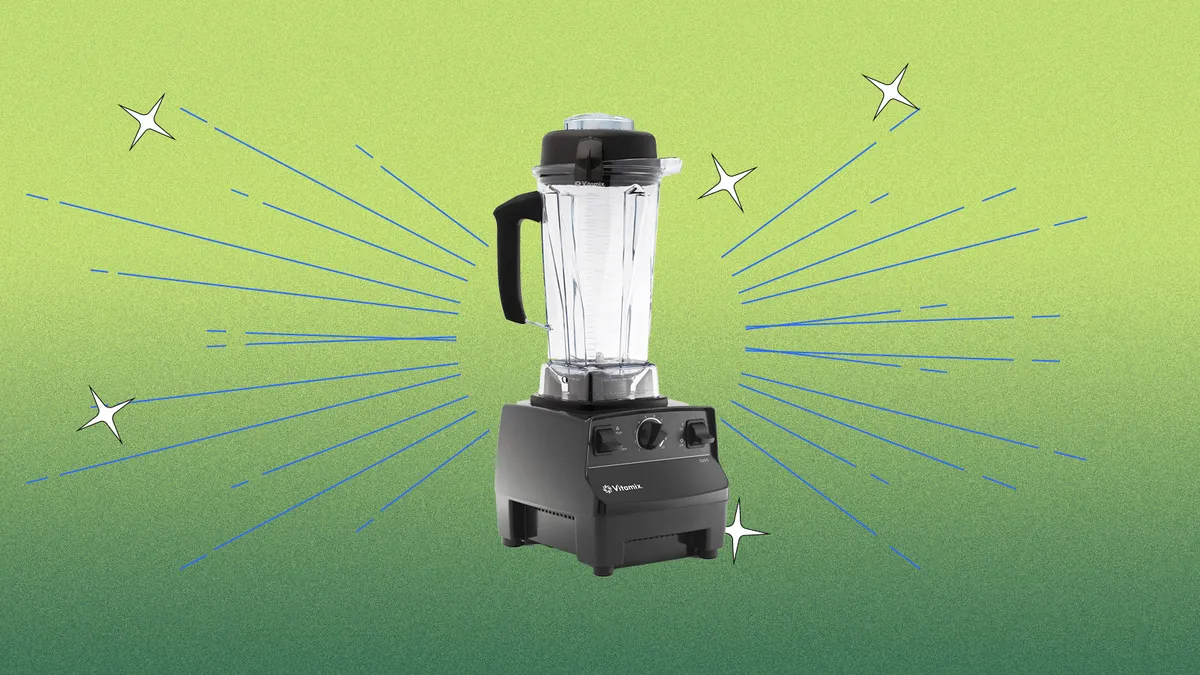
Vitamix blenders have high-powered motors, but other brands offer similar pop for less money.
Vitamix
One of the primary attributes that sets Vitamix apart from many other blenders is its high-speed motor. If you’ve also had the privilege of ever using one, you will know well that the speed of its highest setting puts most other blenders squarely in the rearview mirror. Its power feels like something that could reasonably be put to use for supersonic travel.
Unlike a food processor and some standard blenders, which contain sharp blades that vivisect their contents into smaller and smaller bits, a Vitamix also relies on stainless steel, dull-edged blades that basically pulverize your food when combined with its ultra-rapid rotation and the gravitational pull of the vortex it creates. This is what creates its unparalleled smoothness, since nothing inside the jug is actually getting chopped to bits.
Advertisement
Vitamix vs. Ninja Twisti
The Ninja Twisti next to a full-sized blender with 64-ounce blending jar.
David Watsky/CNET
In our most recent lineup of the best blenders, the Ninja Twisti model was neck-and-neck with the entry-level Vitamix Explorian for top honors. Here’s a side-by-side look at how they compare in terms of features, power and price.
Price
Advertisement
$370
$140
Power
1400 watts
Advertisement
1600 watts
Blades
Laser-cut, stainless steel
Hybrid-edge stainless steel
Advertisement
Jug
48-oz, BPA-free plastic
34-oz, BPA-free plastic
Settings
Advertisement
10 variable speeds plus pulse
5 speeds plus additional pre-set functions
Dishwasher safe
Yes
Advertisement
Yes
Self-cleaning
Yes
Not mentioned
Advertisement
Weight
10.5 lbs
7.2 lbs
Warranty
Advertisement
5-year full
1-year limited
One thing that stands out here is that, while the Ninja model has more available power, its lighter base may make blending less stable at top speed, especially with harder items such as nuts. The jug is smaller, which is fine for smoothies, but may make blending soups more cumbersome, assinceyou’ll likely need to do it in several batches. The warranty also pales in comparison to Vitamix. Does that warranty justify the Vitamix price, though, at nearly 2.5 times what you can pay to take home the Ninja?
Is a Vitamix worth it? Experts weigh in
Advertisement
Vitamix uses heavier, high-grade plastic that gives it a premium feel.
David Watsky/CNET
I asked several chefs and kitchen experts to share their thoughts on whether a Vitamix is worth it. Similar to the results of the same experience with Le Creuset — the (expensive) standard-bearer for Dutch ovens — brand loyalty is real, though everyone I queried brought up valid considerations about functionality, longevity, warranty, origin and whether or not you’re going to actually use the thing often enough to justify it.
First, “ask yourself, ‘how often do I use a blender?’” suggests Joanne Gallagher, co-founder and recipe developer at Inspired Taste. “Consider what you actually cook in a week. If a blender lives on your counter and gets consistent use, the investment is worth it,” she says. “If you make a smoothie every day, love to make your own nut butter, or blend hot soups straight from the pot, a Vitamix could be your best friend.”
Perhaps you believe you would do all of this more regularly if only you had a world-class appliance that inspired you to do so. “I end up cooking and trying new things the more confident I feel in the kitchen,” Gallagher says, and the right appliance can help. “When you know you’ll get the perfect tomato soup, for example, you’re likely to branch out and try new recipes and cooking methods,” she says. There is merit in that thinking, of course, but it’s a potentially expensive gamble if you don’t those sorts of things on a regular basis already.
Vitamix blenders start at around $300 and go up — way up — from there.
Advertisement
Vitamix
As for the quality of output, “in the past, I struggled with cheap blenders that left smoothies chunky and couldn’t handle hard spices like cinnamon when making homemade mole sauce,” says Jessica Randhawa, founder and head chef at The Forked Spoon. “I now own two Vitamix blenders, one in each of my test kitchens,” she says. “One is an entry-level model, which is an amazing blender and does everything a blender should do perfectly every time.
Vitamix controls aren’t overly complicated, something we appreciate.
David Watsky/CNET
The other is one of Vitamix’s newer, top-of-the-line models with food processor attachments, which allowed me to get rid of my old food processor in that kitchen.” The latter point here is a worthwhile consideration. If a Vitamix can do the work of two appliances, the price tag starts to feel a little less like a reach.
Advertisement
Not every chef believes that it is worth it if you’re not really using it all the time. “For most home cooks, I don’t think a Vitamix is truly worth the price,” says Rena Awada, head chef and owner of Healthy Fitness Meals. “Unless you’re making soups, nut butters, etc., daily, or running a small food business, the speed and smoothness it offers rarely justify the cost.”
Chef Molly Pisula of Vanilla Bean Cuisine offers up a workaround. “The price point is high, but refurbished blenders are available, and even sold directly on the Vitamix website,” she says. (“Reconditioned” in Vitamix-speak.) “And Amazon often runs a great Black Friday sale on Vitamix blenders.”
Advertisement
If you do take the gamble on the cost of a new model, though, Randhawa points out some serious upside: “I love that Vitamix is made in the USA,” she says, “and comes with a warranty better than most cars.”
My own Vitamix alternative experiment: Chefman Obliterator
This $75 blender can match a Vitamix. How well it holds up over time is another question.
Pamela Vachon/CNET
I recently came into possession of a Chefman Obliterator, which has specs very similar to the Vitamix Explorian model, including a self-cleaning mode and speed dial that goes up to 5. (Each speed setting is subdivided by 5 hashmarks, making for effectively 25 speed settings.) Its price is listed at $75 on Amazon, putting it squarely in the budget blender camp. Despite not wanting to give up the moral of the story too soon, without taking you through my process: Run, don’t walk to pick up this blender at that price.
Advertisement
I freely admit that I was initially drawn to the Obliterator on hyperbole alone. “Obliterate” is a serious claim that feels like the blender should also come with a wand and a book of spells. Turns out, those props aren’t even necessary.
Chefman’s $75 blender offers similar power to the Vitamix models we’ve tested, albeit with a less premium build.
Pamel Vachon/CNET
Since butternut squash soup is apparently my personal benchmark for evaluating the success of a given blender, butternut squash soup was made. Into the Obliterator’s generous chamber went the chunky, “country style” pre-puree concoction, and then out came something that could reasonably be called obliterated, but in a good way. It was as smooth and ungranular as that which could have been served at any high-end restaurant, and pretty much obliterated the fantasy that I might someday actually spring for a Vitamix.
The first mission when it comes to this machine was to dump the ROMs, which have thus far not been preserved in any major archive. With that done, [beaumotplage] worked to hack a version of MAME that could emulate the Three Monitor Version’s unique mode of operation. As it turns out, each screen is driven by its own arcade board, with the three boards linked via C139 serial links. To emulate this, the trick was simply to write some C139 linkup code and run three versions of MAME all at once, letting them communicate with each other as the original boards would have. It’s a little janky in operation right now, but it does work!
You can download the hacked version of MAME for three-monitor operation here, though note that this does not include the ROM dumps from the machine itself. We look forward to seeing if the hardware ends up getting a full restoration back to operational standard, too.
Statistics from Google show a steady rise in global IPv6 usage, climbing from near zero in early 2012 to 50.1% on March 28, briefly surpassing IPv4. Although the milestone did not hold, usage now hovers between 45% and 50%. Read Entire Article Source link
Apple has secured a major victory for its redesigned smartwatches as per the latest decision from the US International Trade Commission. The federal agency ruled against reinstating an import ban on Apple Watches, allowing the tech giant to continue selling its devices with a reworked blood-oxygen monitoring technology.
The ITC decided to terminate the case and refer to a preliminary ruling from one of its judges in March that claimed that Apple’s redesigned smartwatches don’t infringe on patents held by Masimo, the medical tech company that has long been embroiled in lawsuits surrounding the Apple Watch. Apple thanked the ITC in a statement, adding that “Masimo has waged a relentless legal campaign against Apple and nearly all of its claims have been rejected.” We reached out to Masimo for comment and will update the story when we hear back.
The latest decision could offer some closure to the longstanding legal feud between Masimo and Apple. The patent battle dates back to 2021 with Masimo’s first filing against Apple that requested an import ban on Apple Watches. The ITC ended up ruling that Apple violated Masimo’s patents, resulting in the previous import ban and the Apple Watch maker redesigning the blood-oxygen reading feature in certain models. However, Masimo wasn’t satisfied with this conclusion and sought another import ban on the updated Apple Watch models. Now that the ITC has ruled against that, Masimo is left with the option to appeal the decision with the US Court of Appeals for the Federal Circuit.
While Masimo may currently be on the losing side of this legal battle, it’s confronting Apple on multiple fronts. In November, a federal jury sided with Masimo and ruled that Apple has to pay $634 million in a separate patent infringement case.
A judge has granted the makers of the “ICE Sightings – Chicagoland” Facebook group and the Eyes Up app a preliminary injunction to stop the Trump administration from coercing platforms to take these projects down. Judge Jorge L. Alonso of the United States District Court for the Northern District of Illinois found that the plaintiffs, Kassandra Rosado and Kreisau Group, are likely to succeed in their case, which alleges that the government suppressed protected speech under the First Amendment by strong-arming Facebook and Apple into removing ICE monitoring efforts.
Both Eyes Up and ICE Sightings – Chicagoland use publicly available information to keep tabs on ICE activity. But after pressure from Trump officials, they were removed from Apple’s App Store and Facebook, respectively. Similar apps including ICEBlock and Red Dot were also taken down from the App Store and Google Play. The lawsuit cites social media posts by former US Attorney General Pam Bondi and former Secretary of Homeland Security Kristi Noem that demanded and took credit for the removal of these apps. In a document filed on Friday, Alonso called these posts “thinly veiled threats.”
The Foundation for Individual Rights and Expression (FIRE), which is defending the plaintiffs, wrote in a post on X that it is “extremely encouraged by this ruling.” It continued, “Even though it’s not the end of the case, it bodes well for the future of our legal fight to ensure that the First Amendment protects the right to discuss, record, and criticize what law enforcement does in public.”
Research and development engineer Romain Marchand of Paris headquartered Quarkslab obtained a telematic control unit (TCU) from a salvage yard in Poland… Marchand tore down the TCU, which is based on a Qualcomm system on a chip, and extracted the Linux-based file system from the Micron multi-chip package (MCP) which contained NAND-based non-volatile storage memory. The non-volatile storage contained sensitive information, including system configuration data and more importantly, logs that revealed the vehicle’s GPS positions over time.
None of that information was encrypted, Marchand told iTnews, which made it possible to collect and retrieve sensitive data of interest. What’s more, the global navigation satellite system (GNSS) logs with GPS positions covered the BYD’s full journey from the factory in China to its operational life in the United Kingdom, and to its final wrecking in Poland, Marchand explained in an analysis… The issue is not restricted to BYD, and Marchand added that the hardware architecture of the Chinese car maker’s TCU is broadly similar to what can be found in other brands.
Not everyone had the money for the original Neo Geo Advanced Entertainment System when it released in the ’90s, but there’s still a chance to experience it as an adult with disposable income. SNK and Plaion Replai, who is also behind the all-black remake of the Commodore 64, announced a faithful remake of the high-end retro console, called the Neo Geo AES+.
To bring the original console into the modern day, the collaborating companies added HDMI compatibility for resolutions up to 1080p and DIP switches on the bottom of the console to allow for language selection, overclocking and switching display modes. Rounding out the upgrades, SNK and Plaion Replai included a permanent way to retain high scores on a memory card and a low-power usage mode. For the purists out there, the Neo Geo AES+ still works on those chunky CRT displays since it has the original AV output.
Preorders are currently open for two versions of the Neo Geo AES+, including an all-white 35th anniversary edition bundle that includes an Arcade Stick, a limited-edition Metal Slug game cartridge and a memory card, for $349.99. The standard edition in classic black will only come with an arcade stick, but will be available for $249.99. Coinciding with the console release, Replai Plaion will release 10 modernized game cartridges, including Metal Slug, The King of Fighters 2002 and other classics, for $89.99 each. If you think those prices are high, don’t forget the original Neo Geo AES’ release price was $649.99. The Neo Geo AES+ is set to start shipping on November 12.
Looking for the most recent regular Connections answers? Click here for today’s Connections hints, as well as our daily answers and hints for The New York Times Mini Crossword, Wordle and Strands puzzles.
Today’s Connections: Sports Edition gets a bit wild in the blue and purple categories. If you’re struggling with today’s puzzle but still want to solve it, read on for hints and the answers.
Connections: Sports Edition is published by The Athletic, the subscription-based sports journalism site owned by The Times. It doesn’t appear in the NYT Games app, but it does in The Athletic’s own app. Or you can play it for free online.
Hints for today’s Connections: Sports Edition groups
Here are four hints for the groupings in today’s Connections: Sports Edition puzzle, ranked from the easiest yellow group to the tough (and sometimes bizarre) purple group.
Yellow group hint: Play ball!
Advertisement
Green group hint: Gridiron roles.
Blue group hint: Like Ted Lasso.
Purple group hint: LA team that came from Brooklyn.
Answers for today’s Connections: Sports Edition groups
Yellow group: AL East teams.
Advertisement
Green group: First words of football positions.
Blue group: Premier League managers.
Purple group: Nicknames for the Dodgers franchise, over time.
Users looking to create nonconsensual deepfakes of unknowing individuals can simply perform an App Store search. If App Review has a job, it clearly isn’t doing it.
It is trivially easy to search for deepfake tools when they take out ads
It isn’t just the Grok app that lets users create nonconsensual deepfake nudes and pornography. Apple did remove at least 28 such apps in January, and even threatened xAI with a Grok removal, but that clearly hasn’t been enough. According to a report from The Tech Transparency Project that was first shared by 9to5Mac, “nudify” apps are appearing in search ads and suggestions in the App Store. Pornography isn’t banned from the App Store if it isn’t the app’s sole purpose, but illegal or harmful products are. Continue Reading on AppleInsider | Discuss on our Forums
If you own a Samsung smartphone and want earbuds to go along with it, the company’s Galaxy Buds are a tempting option. They have several features that only work with Samsung products, and they can often be included for free with the purchase of a new phone. Moreover, they sound good, too, especially the premium Galaxy Buds Pro — possibly thanks to Samsung’s ownership of some of the most respected audio brands on the market, including Harman International, Bowers and Wilkins, and JBL.
Samsung recently launched the Galaxy Buds4 Pro, the fourth generation of its premium true wireless earbuds, for $249. However, the Buds3 Pro, which launched in mid-2024, are still available for purchase, as are the Buds2 Pro and the original Buds Pro. All support active noise cancellation (ANC) and transparency mode, as well as a range of smart features. Sure, the newer products have a few extra tricks, like the live translation feature exclusive to the Buds3 series and up, or the ability to use head gestures, which is exclusive to the Buds4 Pro. With only minor differences, though, you might wonder whether you really need the latest and greatest, or whether you can skate by on a budget by scooping up an older pair of Galaxy Buds Pro.
To put that question to rest, I picked up all four pairs of Samsung’s top-line true wireless earbuds and put them through their paces. After comparing their ANC performance and sound quality, I found some surprising results.
Advertisement
Which pair of Galaxy Buds Pro has the best ANC?
Max Miller/SlashGear
To gauge the relative active noise canceling abilities of each, I used my studio reference monitors to play simulated jet cabin noise at 90 decibels, which is around the upper range of what you’ll experience at cruising altitude. I also used each pair of earbuds at my favorite coffee shop during the mid-afternoon rush.
Across the board, the original Galaxy Buds Pro had the worst ANC performance. It performed reasonably well in the airplane test, at least for lower frequencies and engine rumble, but it wasn’t so good at the higher-pitched whine. In the cafe setting, they did a decent job tamping down on the sound of an espresso machine, but couldn’t consistently mask sudden noises like chairs shifting or people laughing.
Advertisement
The best performer was the Galaxy Buds4 Pro. They muffled a much wider range of airplane engine noise and greatly reduced the most problematic noises at the cafe. However, it’s hard to say they’re that much better than the Galaxy Buds3 Pro. I had to A/B test both for several minutes before the differences became obvious to me. The Buds2 Pro is no slouch, either. Although ANC performance is a step behind the Buds3 Pro, they have longer eartips that protrude deeper into my ear canal, creating a better passive seal in my ears.
It’s worth noting that I used foam eartips from Comply instead of the standard ones. I cannot stand silicone eartips and prefer the superior comfort and sound isolation of foam. This likely affected my testing, but since foam tips were used for all tests, the relative results should be unaffected.
Advertisement
The Galaxy Buds Pro lineup sounds great across the board
Max Miller/SlashGear
When it comes to sound quality, the original Samsung Galaxy Buds Pro sounded the worst in my tests. That’s not to say they sound bad; none of these earbuds do. They are, however, less refined and do not support high-resolution Bluetooth on Samsung devices like the other models. The Galaxy Buds2 Pro are where Samsung’s earbuds graduate from good to great. They sound delightful, tracking closely to the Harman 2025 preference target aside from some elevated low-end and a large peak around 12,000 Hz.
When it comes to the Buds3 Pro and Buds4 Pro, things aren’t as simple. Both of these earbuds sound excellent, so which ones you’ll prefer likely comes down to taste. Samsung started using dual drivers with the Buds3 Pro, meaning there’s both a woofer and a tweeter inside; I found them to have the most V-shaped, or “exciting,” response. If you enjoy heavy, clear bass with a parallel emphasis on the upper range, the Buds3 Pro are your winners. They excel in genres such as dubstep and other EDM, pop, and some hip hop, but can be less impressive for rock n’ roll or country. However, I did notice some distortion at higher volumes.
The Buds4 Pro are a refinement of that approach, and my overall pick for sound quality. Samsung enlarged the dual drivers this year, but the V-shaped response is more toned down compared to the Buds3 Pro. Bass is far less forward, and there’s less excitement in the highs. It’s a much more balanced (but less fun) sound, and the Samsung app’s nine-band adaptive EQ makes it easier to tune them.
Advertisement
Fit and build quality vary across models
Max Miller/SlashGear
Build quality and fit vary across the models. The Buds Pro and Buds2 Pro use an in-ear design with fins to help them stay put. The Buds3 Pro and Buds4 Pro use a stemmed “elephant trunk” design similar to Apple AirPods. It’s a tradeoff. The stemless design of the first two models is harder to knock loose with a finger or bike helmet strap, but the touch controls are finicky, and I often paused music by accident while adjusting them. The stem on the later models reduces unintentional inputs, but makes them easier to dislodge accidentally.
The first two models use charging cases with identical external dimensions, like a ring box that opens clamshell style. This pattern is interrupted by the Buds3 Pro, which has a more AirPods-esque case. It’s by far the most pocketable, but it tends to open a bit in the pocket. It is also plagued by charging issues that afflicted my unit, and I often found one bud close to dead when I pulled them out. The Buds4 Pro returns to the ring box case, but is slightly larger and more squared off. It also has a clear plastic top so you can see the buds inside.
Where the original Buds Pro and Buds3 Pro use glossy finishes, the Buds2 Pro have a matte finish on the case and the buds themselves. It can begin to discolor over time (especially the lovely, lilac-colored version I own), but does not get disgustingly oily during use. Conversely, the Buds3 are especially nasty after a long listening session. The Buds4 Pro split the difference with a recycled plastic that isn’t too shiny, nor too matte. The material doesn’t get dirty easily.
Advertisement
Some features are exclusive to newer Galaxy Buds
Max Miller/SlashGear
Lastly, I investigated the difference in smart features across Galaxy Buds Pro models. All four have ANC and ambient mode, but the Buds3 and Buds4 Pro can automatically switch to ambient mode when they detect voices or emergency sirens. They are also the only models with voice controls — a feature I frankly cannot live without any longer. It’s simply too convenient to say, “Next song” or “Volume up” while I have wet or dirty hands. The Buds4 Pro also support head gestures, letting you nod or shake to answer or reject calls. Since my Samsung devices do not yet have the One UI 8.5 update, I wasn’t able to test this.
Although all four pairs of earbuds can automatically switch between your Samsung devices and Windows PCs with the Galaxy Buds app installed, the feature is inconsistent on all but the Buds4 Pro. I could rarely get the other three to notice when I stopped music on my phone to start a video on my tablet, but the latest model did much better. It only failed when trying to switch from my Windows PC back to a mobile device, an issue I attribute to Windows 11, not to Samsung.
Advertisement
All four Buds Pro models have 360-degree audio, a feature I’ve always found gimmicky. It’s hard to find many songs mixed in Dolby or other spatial formats, and their stereo mixes are usually superior, anyway. As for other media, I don’t watch movies or TV on my phone. All said, the Buds4 Pro win out for their more consistent performance.
Advertisement
The Galaxy Buds4 Pro are peak Samsung, but the Buds2 Pro are a value pick
Max Miller/SlashGear
After two full weeks of side-by-side testing, I’m going to hang onto the Samsung Galaxy Buds4 Pro as my main true wireless earbuds. They outperform their predecessors in terms of ANC, smart features, and battery life (which is excellent and beats Samsung’s estimates in my testing). Sound quality is subjective, but I think Samsung gave the Buds4 Pro a balanced, yet consumer-friendly sound that almost everyone will appreciate. Previous models sound good, but perform best with music that leans into their respective strengths. Fit, while very personal, is passable, and their build quality is the best overall.
While the Buds4 Pro are great, budget-conscious consumers should strongly consider the Buds2 Pro. Samsung no longer sells them directly, but you can pick up a renewed pair on Amazon for just $55 at the time of this writing. With Amazon’s notoriously generous return policy, that’s a deal worth rolling the dice on. Considering how little you’re missing out on compared to the brand-new Buds4 Pro, you should pick the Buds2 Pro up if you can find a new or factory-certified pair for under $100. I suggest checking local retailers for old stock, as well.
If you’ve already got the Buds2 Pro or Buds3 Pro and aren’t experiencing issues, there’s not a ton compelling you to upgrade (unless you buy a new Galaxy S26 and get the Buds4 Pro bundled for free). Those still using the original Galaxy Buds Pro, though, are likely to appreciate the improvements Samsung has made over the years.



















































You must be logged in to post a comment Login