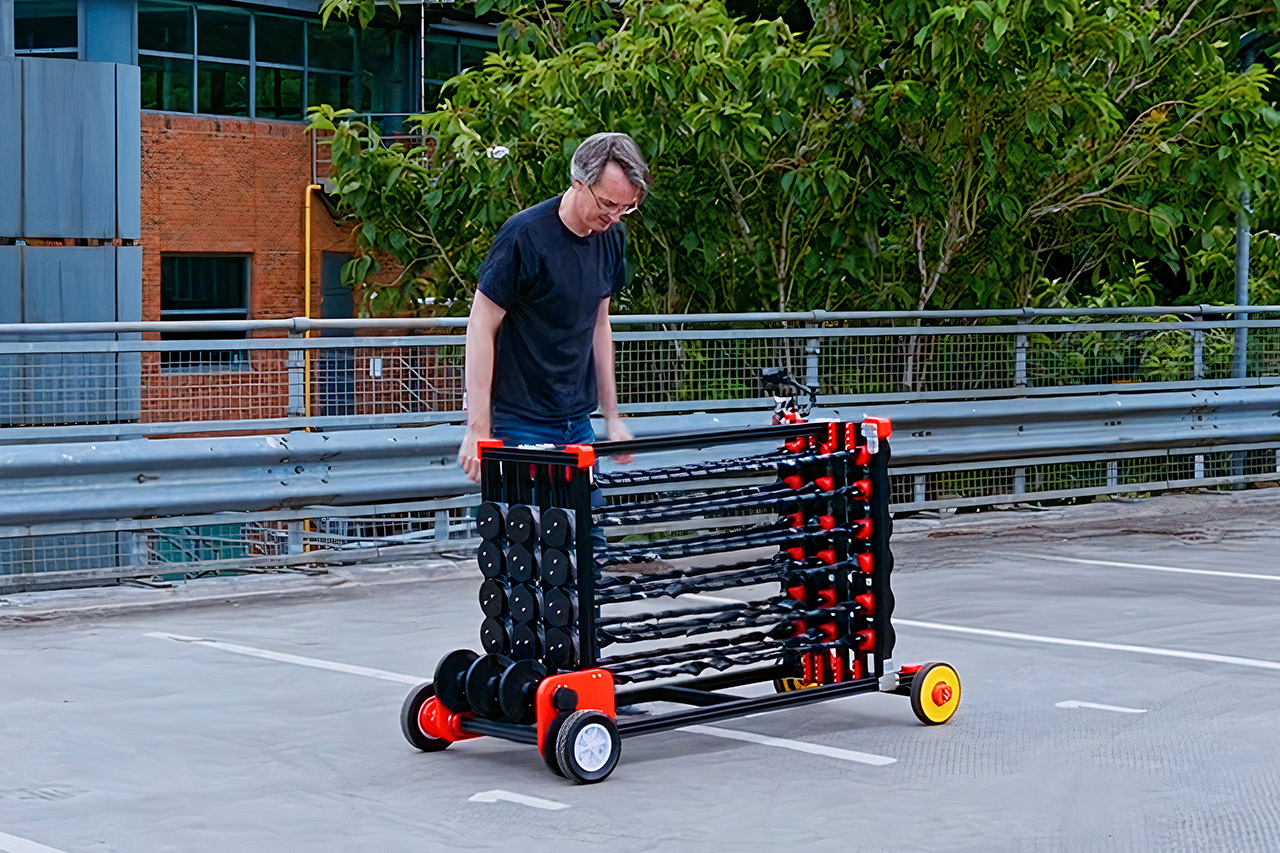
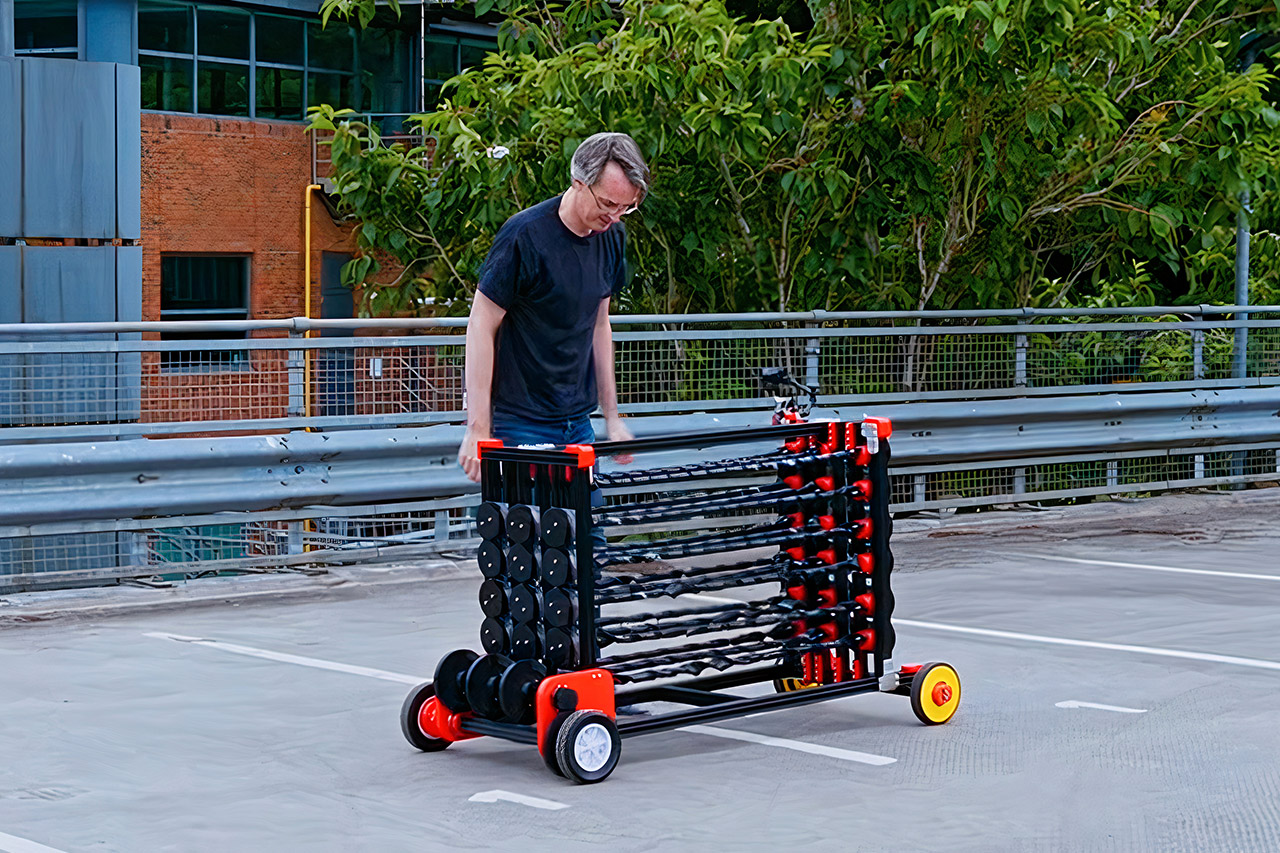
James Bruton has fabricated many rideable machines over the years. This one began with a simple question: could ordinary elastic bands, the thick variety offered for exercising, store enough energy to propel a full-size cart carrying a person? The solution emerged after weeks of testing, gear ratios, special plates, and meticulous winding. The final contraption rolled approximately ten meters using nothing but twisted resistance bands.
He started with a 50-millimeter resistance band suspended from a sturdy frame made of high-grade aluminum extrusion. One end was held in place, while the other was attached to a shaft that rotated on bearings from inexpensive lazy Susans. Bruton wound the band by repeatedly twisting it in his palm until it was completely knotted up. When he let go, the unwinding band turned the shaft around. Early versions, without wheels or gearing, could only travel approximately 2 meters, even with a 2-to-1 bevel gear set. Despite having excellent connection sites, the band consistently snapped or became slack in the middle.
Extreme Speed: Race at a thrilling 26.7 mph in Race Mode, delivering an electrifying go-karting experience that leaves you exhilarated and hungry for…
Versatile Riding Modes: Personalize your ride with ECO, Sport, Race, and Manual Modes, providing a diverse range of speed and control options to suit…
Long-lasting Adventure: Extend your fun with a typical range of 15.5 miles, ensuring hours of non-stop excitement and enjoyment on the track without…
Clearly, they needed to boost torque, so he added another stage of gearing, resulting in a 6-to-1 reduction. The extra leverage allowed him to coil the band up a little further without it breaking, resulting in around 2.8 meters of travel this time. That was a nice sign, but it was clear that a single band could never carry anyone very far. Attempting to use a longer band produced its own set of problems, as the longer it became, the less efficient it became, and the twist became uneven, causing the band to bounce around rather than generate nice crisp torque.
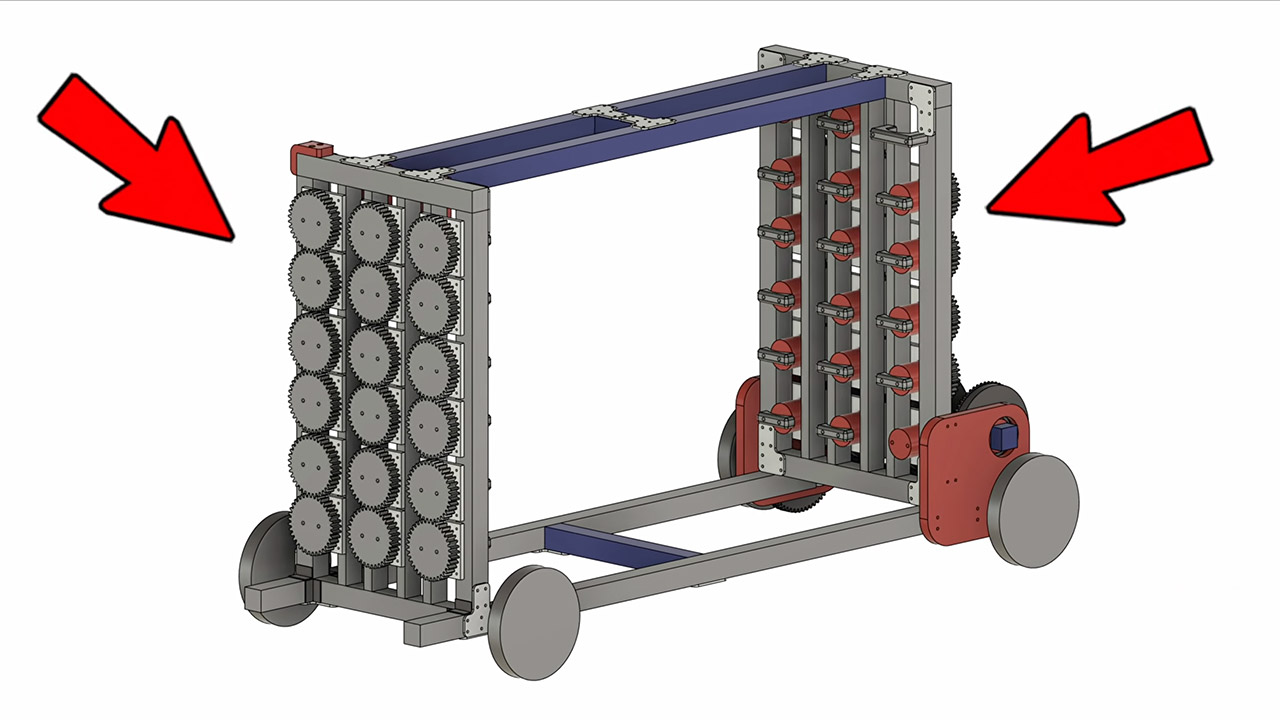
The aim was to use a series of shorter bands that worked together to increase the energy without making the whole thing overly large. Bruton devised the concept of routing the bands through additional gears, allowing them to flow back and forth inside the frame like a folded ribbon. Three columns of bands, each with six bands, totaled 18. Bevel gears at either end allow the columns to transfer their torque to a single common axle. Some unique aluminum plates were carved out using a CNC router to combine the extrusion into a beautiful solid box. A couple of vertical rails at either end ran six lazy Susan bearings each, allowing the winding shafts to spin freely.
Testing is now moved outside, where Bruton winds the bands by driving the cart in reverse, allowing the wheels and gears to accomplish the hard twisting rather than raw effort. He’s taking it carefully at this point, aiming for a clean run of around 9.88 meters. That is the maximum distance the cart can travel before the front wheels lift up and prevent it from moving any farther. If he winds it up a little more, a little more “aggressive,” it adds a little more distance because of the velocity, but it also causes a problem where some of the bands are twisted a lot more than the others due to small little changes in friction in the gear box. Bands that are wound up later in the sequence frequently underperform.
Bruton is already brainstorming about where to go next. If he winds the bands one at a time instead of all at once, he may be able to extend the power delivery and smooth out the acceleration. Alternatively, a clutch system might be an excellent option, as each stage can only begin working after the one before it has almost completely run out of gas. So far, the build has demonstrated that the main concept is viable at human scale.
Looking for the most recent Strands answer? Click here for our daily Strands hints, as well as our daily answers and hints for The New York Times Mini Crossword, Wordle, Connections and Connections: Sports Edition puzzles.
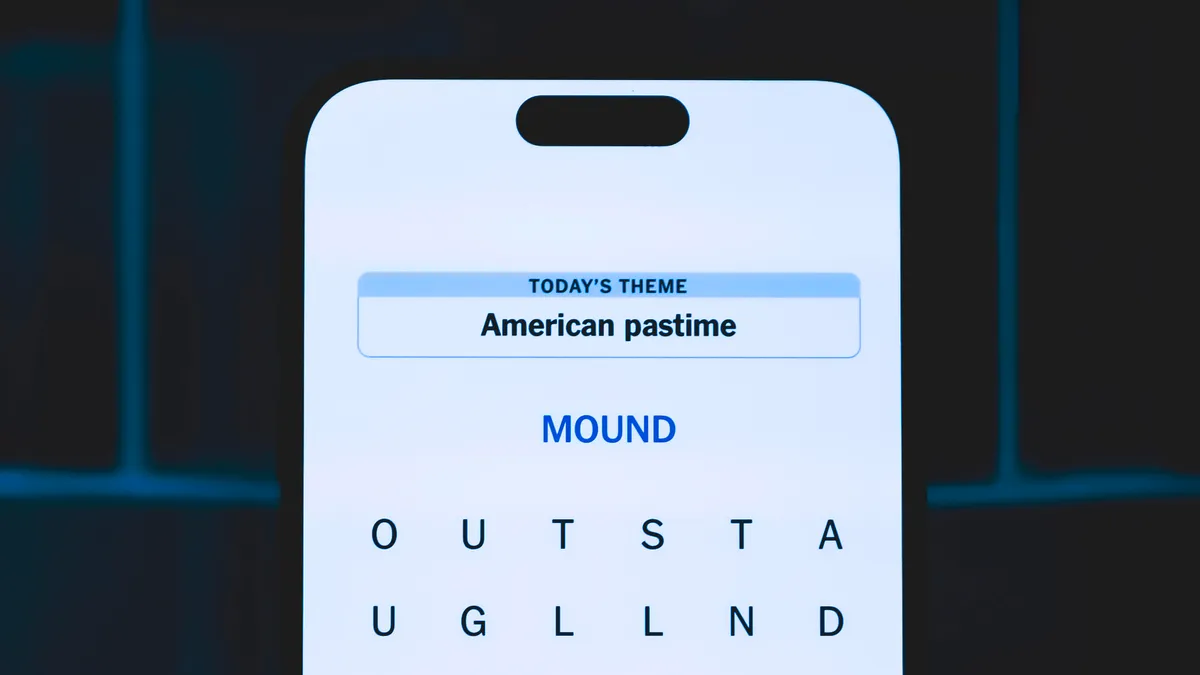
Today’s NYT Strands puzzle was kind of tough. Some of the answers are difficult to unscramble, so if you need hints and answers, read on.
If that doesn’t help you, here’s a clue: Go another way.
Clue words to unlock in-game hints
Your goal is to find hidden words that fit the puzzle’s theme. If you’re stuck, find any words you can. Every time you find three words of four letters or more, Strands will reveal one of the theme words. These are the words I used to get those hints but any words of four or more letters that you find will work:
These are the answers that tie into the theme. The goal of the puzzle is to find them all, including the spangram, a theme word that reaches from one side of the puzzle to the other. When you have all of them (I originally thought there were always eight but learned that the number can vary), every letter on the board will be used. Here are the nonspangram answers:
TACK, TURN, VEER, PIVOT, SWERVE, ZIGZAG, DEVIATE
Today’s Strands spangram
The completed NYT Strands puzzle for July 16, 2026.
NYT/Screenshot by CNET
Today’s Strands spangram is CHANGECOURSE. To find it, start with the C that is four letters down on the far-left vertical row, and wind a twisty path to spell it out.
Environmental groups seek broader review before massive satellite constellations receive approval
More than one million proposed satellites face increased regulatory scrutiny
FCC is reconsidering satellite environmental review rules
Environmental groups have petitioned federal regulators to pause approval of orbital data center satellite constellations pending a full environmental review process.
Earthjustice recently filed a petition on behalf of DarkSky International, Environment America, and Public Employees for Environmental Responsibility, known as PEER.
Combined proposals from SpaceX, Starcloud, Blue Origin, and Cowboy Space could place well over a million satellites into low Earth orbit.
Latest Videos From
Why regulators are being asked to slow down
The petition asks the Federal Communications Commission (FCC) to prepare a Programmatic Environmental Impact Statement before approving any pending applications currently under review.
Advertisement
Such a review, required under the National Environmental Policy Act, would examine risks, alternatives, costs, and cumulative impacts together across every proposal.
Environmental groups argue the agency’s current approach treats satellite licenses as automatically excluded from any detailed environmental scrutiny under existing federal rules.
They say that framework no longer fits proposals measured in hundreds of thousands, or potentially millions, of individual spacecraft rather than dozens.
Advertisement
Sign up to the TechRadar Pro newsletter to get all the top news, opinion, features and guidance your business needs to succeed!
The filing lists specific concerns, including rocket emissions, reentry pollutants, ozone depletion, orbital debris, and disruption to astronomy research conducted worldwide.
The petition specifically challenges the FCC’s default assumption that these projects individually and cumulatively carry no environmental impact whatsoever on nearby ecosystems.
It further warns that light pollution and wildlife disruption cannot be properly assessed through isolated regulatory reviews conducted individually rather than collectively.
Advertisement
The petition states that these proposals compound risk “synergistically and cumulatively” in ways single-project reviews cannot capture on their own.
Industry ambitions collide with regulatory uncertainty
Backers of orbital computing describe their projects in sweeping, civilization-changing language while offering few environmental details in return for regulatory approval.
Advertisement
Companies including SpaceX, Blue Origin, Starcloud, and Cowboy Space have not publicly detailed environmental mitigation plans for their satellites currently under regulatory review.
MOL and Hitachi have separately explored floating data center concepts, showing wider commercial interest beyond traditional orbital satellite proposals currently facing regulatory review.
The FCC is separately reconsidering its environmental review rules, acknowledging rapid growth across the broader commercial space industry over the past decade.
If the commission agrees, orbital data center operators could face considerable regulatory delay before launching any additional hardware skyward into low Earth orbit.
Advertisement
Some industry analysts have already questioned whether orbital data center economics make sense given high launch and maintenance costs involved in space deployment.
Analysts note that environmental reviews of this scope could take years, delaying deployment timelines.
This could delay deployment schedules and extend regulatory timelines if a comprehensive environmental review becomes mandatory.
Whether the FCC ultimately requires a full review remains uncertain, given ongoing industry pressure and competing national security interests tied to space dominance.
Advertisement
Until regulators decide, the fate of orbital computing may depend as much on environmental politics as on rocket technology or launch capacity itself.
A hacker who breached Suno reportedly revealed source code and training-library details showing the AI music generator scraped millions of songs and lyrics from sources including YouTube Music, Deezer, Genius, Pond5, Jamendo, Freesound, and podcast RSS feeds. “The hacked data is a rare look at exactly how AI models and tools are built,” reports 404 Media. “Suno is one of the largest AI music generation tools on the internet, and has been the subject of several major lawsuits from the record industry, which accused the company of training on millions of copyrighted songs.” Suno maintains that its models were trained on publicly available music files and metadata as fair use. 404 Media reports: The Recording Industry Association of America accused Suno of ripping songs directly from YouTube; the hacked data seen by 404 Media confirms this. The hacked material includes source code that appears to be from 2023 and 2024 that includes scraping instructions and details about the scope of at least some of the scraping. For example, the comments in one file note that they will pull from “genius_hq, youtube_music, freesound, jamendo, imp, deezer, ytm_tagged,” and that “non-music will be filtered out.” A file called “youtube_music” notes that at the time the file was last updated, it had ingested “2,013,545 music clips.” Another file contains comments about different datasets Suno had created, which included “113,879 hours of youtube_music,” “17,615 hours of genius_hq,” “410 hours of free sound,” “19,514 hours of imslp,” “3,726 hours of jamendo,” “62,117 hours of pond5_music,” “12,287 hours of deezer,” “152,162 hours of ytm_tagged,” and “103 hours of musescore_lyrics.” In total, this is at least decades worth of music.
Other code the hacker shared with 404 Media appeared to look specifically for vocals by searching specifically for acapella versions of songs on YouTube. The code also suggested that Suno was using proxies to scrape songs from YouTube through a company called Bright Data, which sells scraping tools, infrastructure, and data services. Additional code shows that with the help of an online tool called PodcastIndex, Suno identified 420,000 different podcasts that had at least five, 30-minute episodes and sought to download roughly 1 million hours of podcasts.
[…] The hacker, ellie.191, told 404 Media they breached the company by hacking an individual employee using the Shai-Hulud worm, a supply chain attack that allowed hackers to harvest GitHub and cloud service credentials. They said they also accessed Suno’s customer list, which included customers’ emails and/or phone numbers and Stripe payment details, depending on what they used to login. The hacker provided a sample of some of the customers, some of whom confirmed to 404 Media they had used their phone number to sign up for Suno and said they were never notified of a breach. The hacker told 404 Media they had no specific motivation for hacking Suno and said “I like to hack anything and everything.”
Linux supremo says contributors opposed to AI use can ‘just walk away’
Chief penguinista Linus Torvalds has declared that Linux is not an “anti-AI” project, telling contributors who object they can either walk away or fork the kernel.
It is one area where Torvalds said he was willing to “absolutely put my foot down as the top-level maintainer … Linux is not one of those anti-AI projects, and if somebody has issues with that they can do the open-source thing and fork it.”
“Or just walk away.”
Ever the pragmatist, Torvalds described AI as a tool, “just like other tools we use. And it’s clearly a useful one. It may not have been that ‘clearly’ even just a year ago, but it’s no longer in question today.
“Anybody who doubts that clearly hasn’t actually used it.”
Advertisement
In October 2024, the Linux kingpin branded 90 percent of AI as marketing hype, saying he hated the hoopla generated by the tech industry. He said at the time: “I really don’t want to go there, so my approach to AI right now is I will basically ignore it.”
He predicted things would change in five years, though he has softened his stance in 21 months.
AI can be a “somewhat painful tool, both for maintainer workloads and just from an ‘it keeps finding embarrassing bugs’ standpoint,” Torvalds conceded this week. “But the solution is not to put your head in the sand and sing ‘La La La, I can’t hear you’ at the top of your voice like some people seem to do.”
The solution, he said, is to make sure LLM tools help maintainers rather than cause them pain. “We’re not forcing anybody to use it, but I will very loudly ignore people who try to argue against other people from using it.”
Advertisement
The kernel project continues to be about technology, Torvalds added, and while the social angle of developing open source software is an important aspect, it is a “side benefit, not the point of the project.”
“In the kernel community we do open source because it results in better technology, not because of religious reasons. And so we make decisions primarily based on technical merit. Not fear of new tools.”
“Something happened a month ago, and the world switched. Now we have real reports… All open source projects have real reports that are made with AI, but they’re good, and they’re real.”
Advertisement
Torvalds in May said AI tools were only useful if they help “rather than cause unnecessary pain and pointless make-believe work.”
Work still lies ahead before AI consistently proves it’s more help than hindrance.
“AI isn’t perfect,” said Torvalds in the mailing-list post on Tuesday. “But Christ, anybody who points to the problems at AI [sic] had better be looking in the mirror and pointing at themselves at the same time. Because it’s not like natural intelligence is always all that great either.”
Last year, the Marco Rubio-run State Department announced that it would start denying visas to people who worked in misinformation/disinformation research, content moderation, fact-checking, or other compliance and trust & safety roles. So, yeah, if you were an EU-based person who worked on preventing child sexual abuse material from appearing online, the US government decided you were not allowed in the country, bizarrely (and falsely) claiming you engaged in “censorship of protected expression.”
Except, as we’ve explained over and over again, that makes no sense. Only government officials or those working directly at the behest of the government can engage in censorship of protected expression. Otherwise it’s just private parties using their own rights of association to figure out what content they wish to associate with. And the actual reality (which MAGA culture warriors refuse to recognize) is that nearly all trust & safety work has fuck all to do with removing content. Much of it is literally about making platforms better and more trusted overall.
But, because the MAGA crew has been whipped up into a misinformation frenzy over the last decade that any research regarding mis- or disinformation is “censorship,” Trump and Rubio decided to throw the base some red meat and claim they were going to deny visas to people who worked in the field.
Thankfully, a federal court has pointed out that the only one engaging in censorship here is the Rubio State Department. By designating a group of people to be denied visas based on their own speech and association regarding disinformation research, the State Department engaged in unconstitutional viewpoint discrimination.
Advertisement
Judge Boasberg (who traditionally has been pretty conservative, but with Trump nonsense appearing before him quite frequently seems to now recognize that this administration is full of shit) notes how silly all of this is. After highlighting that most users of websites actually do want those sites to block scams and spam (what most content moderation is), though admitting that some people think of it as censorship, he points out that Rubio’s policy punishes researchers (the plaintiffs in this case) for trying to research and fact check disinformation.
The First Amendment reflects “a profound national commitment to the principle that debate on public issues should be uninhibited, robust, and wide-open.” N.Y. Times Co. v. Sullivan, 376 U.S. 254, 270 (1964). That commitment is not confined to stump speeches, editorials, or familiar forms of political advocacy….
Those principles cover the activity chilled here. CITR’s work depends on researchers who study how platforms structure public debate, report on misinformation and disinformation, advocate for access to platform data, petition officials, speak to the press, and collaborate with one another to set standards and press for reform. Some of that work culminates in reports, interviews, comments, petitions, and testimony. Some of it occurs before publication, in the candid exchange among researchers and organizations that makes public-facing work possible. Those activities, at least as reflected in this record, fall within the Amendment’s protection for speech, publication, petitioning, and expressive association. They also sit directly within the contested public debate over how online platforms structure discourse and whether, when, and how they should moderate harmful or false content….
CITR’s asserted injury is therefore not merely derivative of what its noncitizen members might say or what CITR might hear. The policy allegedly impairs CITR’s own work: who will contribute to its reports, what those reports can say, who will attach their names to them, and whether researchers will participate in the convenings and candid exchanges from which CITR’s public work emerges. See supra Section III.A.2.a. That is itself a First Amendment burden, as the Amendment protects both an organization’s creation and dissemination of information, Sorrell v. IMS Health Inc., 564 U.S. 552, 570 (2011), and the associational activity that makes collective speech possible….
The judge points out that the visa policy is already having an impact on this kind of research:
Advertisement
The reaction here was not merely predictable; it was all but ordered. Announcing the enforcement actions against leaders of two CITR member organizations, Rubio warned others engaged in the same work to “reverse course” or face the same. … The record shows that the message landed. Member A has refrained from international travel, including to CITR’s 2025 summit in Berlin, because of fear of being denied reentry under the policy; has limited public advocacy with CITR to a behind-the-scenes role because of fear of detention and deportation; and says that he or she would be substantially more likely to resume public association with CITR were the policy no longer in place…. Dr. Emma L. Briant, a U.K. citizen and Visiting Associate Professor at Notre Dame, likewise avers that the policy has caused her to self-censor in her writing and public speaking, hesitate to travel internationally, and evaluate even domestic speaking invitations against the risk of detention or deportation.
The judge calls out how the State Department started combing through visa applications to block “ordinary work” done by researchers and fact checkers, not limited to anyone actually engaged in any “censorship.”
The December cable supplies part of the answer. It directed consular officers to “thoroughly explore” visa applicants’ work histories, resumes, social-media profiles, and media appearances for involvement in “combatting misinformation, disinformation or false narratives, fact-checking, content moderation, compliance, and trust and safety,” and, on locating it, to pursue a finding of ineligibility…. Those categories do not describe the exercise of foreign sovereign power. They describe the ordinary work of researchers, fact checkers, platform employees, compliance officers, and nonprofit advocates who study, criticize, participate in, or press for content moderation. A cable that treats that work as evidence of immigration ineligibility reaches far beyond the coercive acts described in the May Memo: threats of arrest, payment freezes, legal compulsion, detention, fines, and demands for private data directed at American platforms or persons in the United States.
While the Court declines to review specific visa denials, it notes that the State Department clearly seems to be denying visas to people by claiming “censorship” when they had nothing to do with censorship. Indeed, the denials usually were about the State Department punishing people for First Amendment protected speech that the US government didn’t like. None of the justifications appear to actually be censorial:
The actions matter because State held them out as examples of the policy at work. Its public rationales identify the activity it treats as “complicity” in “censorship”: a report on hate speech and disinformation, advocacy directed at advertisers and platforms, disinformation-risk ratings, a petition for researcher access to platform data, a broadcast interview, and nonprofit leadership in organizations that help targets of online abuse seek removal of content aimed at them… Some of those justifications are tied to familiar First Amendment activity: reporting, speaking, petitioning, advocating for platform regulation, and associating through nonprofit leadership. Id. At least as to the private researchers and nonprofit leaders in CITR’s field, the public explanations do not identify any exercise of foreign sovereign power akin to the coercive acts the May Memo enumerates.
As Judge Boasberg notes, if you call all of that “complicity in censorship” then the term “censorship” has no real meaning:
If disinformation-risk ratings, reports on hate speech, petitions for platform-data access, advocacy, or nonprofit work seeking to limit abusive content can count as “complicity” in “censorship,” the policy has no clear stopping point short of the field itself — a concern sharpened by the Department’s announcement that it “stands ready and willing to expand” the list…. A lawful permanent resident working on a platform’s trust-and-safety team, a noncitizen researcher urging stronger disinformation labels, a compliance employee helping apply moderation rules, or an advocacy leader pressing advertisers away from sites that spread falsehoods could reasonably understand the policy to place their immigration status at risk — not because they wield foreign sovereign power or facilitate its censorship, but simply because they work in content moderation.
In its response, the DOJ pulled the usual MAGA nonsense of stomping its feet and just repeating “but content moderation is censorship” and making vague assertions about how these researchers aid foreign governments in censorship. The judge is not impressed.
Advertisement
The trouble is that the enforcement record does not honor that line. The Government has tied none of the private researchers and nonprofit leaders targeted in December to any exercise of foreign sovereign power. Pressed on that gap, counsel did not supply the missing connection. The Government stepped back from the five examples, explaining that it lacked “the full factual records or the reasons for those determinations” and that it would not be “fair to rely on those five” in gauging the policy’s scope…. But Defendants cannot publicly announce examples of the policy at work, warn that the Department stands ready to expand them, and then — when those examples prove inconvenient — deny that they reveal anything about the policy’s reach. A limiting principle that the Government cannot reconcile with its own enforcement record is no limit at all.
And thus, all this is classic, unconstitutional, viewpoint discrimination:
The policy, at its core, does not burden all speech about platforms, all research into content moderation, or all advocacy about online harms. It presses its enforcement thumb against one side of the scale: the view that platforms should do more to moderate content, label disinformation, restrict abuse, share data with researchers, or take responsibility for the harms their systems amplify. The Government, in other words, has not set itself against everyone who speaks about platform governance. It has set itself against those whose work favors more moderation rather than less. A noncitizen calling for less moderation, after all, has no comparable reason for concern under the policy.
Such action lies at the core of viewpoint discrimination. “At its most basic, the test for viewpoint discrimination is whether — within the relevant subject category — the government has singled out a subset of messages for disfavor based on the views expressed.” ….
The First Amendment does not permit officials to resolve that dispute by attaching legal burdens to the side they condemn
But that’s exactly what Rubio did here. If you worked on calling out disinformation, you could get your visa denied (or if you already had it, pulled). Judge Boasberg notes that if the policy were actually limited to foreign officials engaged in censorship, then the State Department might have an argument. But it’s not.
Advertisement
Even better, the court states that you can’t just call disinformation research “censorship” and pretend that’s a fact when reality says otherwise:
Protecting Americans from foreign officials who use sovereign power to suppress protected expression in the United States is in the Government’s interest. But the record does not show that the policy serves only that end. It instead brands a range of private expressive and platform-governance activity as “censorship,” without identifying any foreign-sovereign power that those actors exercised or helped exercise. The Government cannot make protected private expression a facially legitimate and bona fide basis for immigration consequences simply by placing it under the capacious and contested label of “censorship.”
He even notes that policy would violate the First Amendment under lower levels of scrutiny, meaning that even if the government could convince the court there was some justification for the policy, it still wouldn’t survive First Amendment scrutiny.
The judge doesn’t kill the policy entirely, noting that there may be cases where the State Department has a legitimate reason to deny a visa to someone actually engaged in efforts to silence Americans. It also hurts that when the Court sought evidence of visas being denied to actual censorship by sovereign officials, the State Department apparently came up empty:
The Department reportedly examined whether European regulators were using the Digital Services Act to censor American speech and found “no evidence that Member States of the European Union are overreaching the [Digital Services Act] to censor and criminalize online content.”
Oops! Sure, that goes against the narrative Rubio and MAGA folks have spun up about the EU being nothing but a bunch of censors, but when they can’t show the court any proof that they’re using this policy to go after actual government censors (while the plaintiffs can show where the policy was used to suppress or punish the speech of non-government censors) the end results are unlikely to make Rubio happy.
Advertisement
Measured against one another, the policy’s legitimate applications ultimately do not carry the day. The mismatch between Defendants’ asserted interest and the policy’s demonstrated operation is stark…. The defect identified above is not a feature of any one application; it is the policy’s selection criteria itself, and it travels wherever the policy does — into visa screening, exclusion, and removal alike. The policy’s legitimate applications, by contrast, remain episodic and largely undemonstrated. Whatever arithmetic might refine the comparison, the overbreadth inquiry asks whether a measure “prohibits a substantial amount of protected speech relative to its plainly legitimate sweep,” Hansen, 599 U.S. at 770, and a policy that selects its targets by an unconstitutional criteria, while its lawful uses remain occasional and largely unproven, answers that question.
Thus, the Court throws out this particular visa policy, though it doesn’t go quite as far as the researchers asked in requesting a protective order that would bar the government from using information related to this case in an immigration enforcement action. The judge recognizes that it’s still possible that the government could retaliate against these researchers, but hopes that this ruling will make them think twice about doing so. It also notes that if the government ramps up threats or actual retaliation against the researchers in this case, they can return to the courtroom to contest those actions.
For years, the loudest voices screaming about a “Biden censorship industrial complex” falsely insisted that pointing out disinformation was itself an attack on free speech. Now a federal court has found an actual, textbook case of unconstitutional censorship — carried out by the Secretary of State explicitly stripping visas from researchers based on their protected speech. I’m sure we’ll be hearing the same kind of outrage about Biden officials asking social media companies if they could be better in stopping health misinformation from spreading?
BMS’s Tom Shortt discusses the early factors that influenced his career and led to his role as an engineering director.
An engineering director at Bristol Myers Squibb (BMS), Tom Shortt has been with the organisation for more than nine years, but his passion for engineering began much earlier.
Shortt told SiliconRepublic.com, “While still in secondary school in Tipperary, I worked part‑time as a farm machinery mechanic, travelling across the county to diagnose faults, rebuild engines and restore agricultural equipment to service.”
He explained that the experience cemented within him a technical curiosity and an appreciation for practical problem‑solving in real‑world conditions, making a future in mechanical engineering the clear choice.
Advertisement
He added, “That role taught me as much about people as it did about engineering. Our customers ranged from large agricultural contractors to elderly farmers working in isolation.
“Understanding their challenges, listening carefully and earning trust were just as important as fixing the machinery.”
Could you tell us more about your role today and what is involved?
I lead a multidisciplinary engineering organisation that underpins the compliant and sustainable delivery of medicines to patients worldwide. My leadership approach is grounded in technical experience, operational discipline and a strong belief in the value of empowered teams. At the BMS Cruiserath Campus in Dublin, I lead an engineering function with a broad and critical remit. The team is responsible for facilities management, utilities operations, manufacturing and laboratory maintenance, capital project delivery, site master planning and validation activities.
In addition, the Cruiserath Campus engineering organisation provides facilities management oversight for two other BMS sites in Ireland.
Advertisement
To ensure consistency and visibility across this complexity, the engineering organisation operates within a robust governance framework. Tiered management processes and service provider governance forums provide structured oversight, clear escalation pathways and data‑driven performance management.
Tools such as A3 problem‑solving enable disciplined root‑cause analysis and effective resolution of issues.
While the engineering team does not directly manufacture BMS’s products, its impact on patient outcomes is significant. Engineering provides stable, high‑quality inputs that enable the value stream to operate predictably and compliantly, from reliable utilities and high‑purity water systems to safe engineering controls and dependable manufacturing and laboratory equipment.
When engineering systems perform as designed, the value stream has a much higher probability of producing consistent outputs that ultimately become medicines for patients. Every day, I feel grateful to have such a strong engineering team, where many of the day‑to‑day scheduling, resourcing or technical decisions are resolved close to the work with empowered teams. The escalations that do make it to the engineering leadership for direction are generally resolved quickly and with input from the relevant subject matter experts.
Advertisement
As a member of the Cruiserath Campus senior leadership team (SLT), I also play an active role beyond engineering. The SLT holds shared accountability for site performance and patient delivery, requiring close integration across operations, quality, supply chain, finance and human resources. Stepping into an SLT role broadened my perspective significantly. It reinforced the importance of enterprise thinking and governance in ensuring the site delivers safely, compliantly and sustainably.
Do you have a typical day and, if so, how does it look?
I guess it’s a cliché, but no two days are the same. The BMS engineering team is responsible for delivery of a wide scope of services, from facilities management to utilities operations, manufacturing and lab maintenance, capital project management, site master planning, and validation.
With that very broad range in scope, a variety of issues can arise, from breakdowns in manufacturing to developing proactive reliability strategies or hosting regulatory auditors.
What do you enjoy most about your job?
Among many proud moments at BMS, one stands out for me – the drug substance manufacturing shutdown in 2025. The programme involved critical first‑time maintenance, major project execution and an accelerated return to production. It was a significant technical and organisational challenge. Seeing it delivered so successfully reinforced the impact that a well‑coordinated, disciplined engineering effort can have across the entire site.
Advertisement
Another aspect of the role that brings me satisfaction is working to meet the challenge of decarbonisation. In collaboration with enterprise colleagues, the Cruiserath Campus has developed a comprehensive carbon-reduction roadmap, targeting approximately a 45pc reduction by 2033.
The Campus has already achieved zero waste to landfill and zero scope-2 emissions through renewable electricity procurement. Current engineering efforts therefore focus on scope-1 emissions, including decarbonising space heating and hot-water systems and eliminating inefficient steam usage. Looking further ahead, the demand for high-grade heat for clean steam and water for injection generation presents a more complex challenge. However, emerging technologies offer promising solutions.
I also find great fulfilment in supporting the evolution of the Cruiserath Campus. The site continues to evolve from its origins as an API facility to a drug substance biologics site and now toward becoming a fully end‑to‑end biologics campus, including sterile drug‑product filling and stability‑testing capabilities. This evolution positions the site to play a key role in launching new medicines for patients with unmet medical needs.
I am particularly excited about the potential of digital tools to accelerate data analysis, improve decision‑making and remove waste from engineering and operational processes. It feels like we’re only scratching the surface of what these tools will enable in the years ahead. The opportunity to combine strong engineering fundamentals with advanced data and analytics is incredibly exciting.
Advertisement
Don’t miss out on the knowledge you need to succeed. Sign up for the Daily Brief, Silicon Republic’s digest of need-to-know sci-tech news.
Dave Brown, departing AWS executive, in 2023. (GeekWire Photo / Todd Bishop)
Dave Brown, who joined Amazon Web Services as one of its earliest EC2 engineers and rose to lead its compute, AI and machine learning services, is leaving after nearly 19 years.
AWS CEO Matt Garman told employees in a memo posted publicly Wednesday that Brown will depart at the end of July for an unspecified “new role outside of the company.” Amazon exec Dave Treadwell, who joined the company in 2016 after 27 years at Microsoft, will take over the group Aug. 1.
Dave Treadwell. (Amazon Photo)
Brown’s exit comes about three months after Amazon promoted him to senior vice president. Brown had been on the company’s senior leadership team since 2023.
His tenure stretched back to the early days of the cloud. He joined AWS in 2007 in Cape Town, South Africa, where Amazon based part of its early EC2 engineering, before relocating to the Seattle area.
In an interview with GeekWire earlier this year, as the company marked the AWS 20th anniversary, Brown recalled Amazon CEO Andy Jassy, then the company’s top cloud executive, gathering the small Cape Town team in those days and telling them the business could one day be worth a billion dollars.
Brown said he could barely grasp the figure at a time when the service was bringing in tens of dollars a day: “I couldn’t even imagine how much a billion dollars was. It sounded like a lot of money.”
Advertisement
AWS today runs at roughly $150 billion in annualized revenue, and grew 28% in its most recent quarter — its fastest pace in nearly four years.
Brown’s role grew with the business. After starting as an engineer on EC2, or Elastic Compute Cloud, he went on to lead its broader compute organization, including close collaborations with the executives running Amazon’s custom silicon business. His purview also expanded to include the machine learning and AI services now central to AWS, such as the Bedrock and SageMaker platforms.
Treadwell has run Amazon’s eCommerce Foundation, the technical backbone of the company’s online retail operations, since joining in 2016. Before that he spent 27 years at Microsoft, where as a corporate vice president he worked on Windows, Xbox, and the .NET software framework.
In his memo, Garman described Treadwell — known internally as “Tread” — as one of AWS’s largest and most vocal internal customers, someone who pushed the cloud group to innovate and will now lead it.
Advertisement
Brown will remain through the end of July to help with the transition. In his own farewell note, he said it felt like the right time to begin a new chapter. “I’ll be cheering you all on from the sidelines,” he wrote.
There has always been a lot of information that could be gathered from Beta Pictoris, which is the best place to learn about the formation of planets in our galaxy. It’s located just 63 light years away from us, and it was formed some 23 million years ago. There is a lot of debris material around this star, along with two heavy impacting planets.
The James Webb Space Telescope was aimed at Beta Pictoris b, which is the innermost planet in this region. Scientists employed the NIRSpec integral field spectrograph for taking images of the sky region and the entire spectrum of it, hoping to study the gases around planet B. However, the results were not what they expected to see.
BUILD AN OFFICIAL NASA ROCKET – Kids prepare to explore outer space with the LEGO Technic NASA Artemis Space Launch System Rocket (42221) building…
3-STAGE ROCKET SEPARATION – Young builders can turn the hand crank to watch the rocket separate in 3 distinct stages: solid rocket boosters, core…
STEM BUILDING TOY FOR KIDS – This educational rocket kit was created in collaboration with NASA and ESA to showcase the authentic system that will…
As they were investigating one region of the disk where they expected to see a uniform light display, they saw a distinct pattern of absorption that shares a rather creepy similarity with carbon monoxide in the atmosphere of a planet, a uniform distribution of wavelengths, like some sort of clandestine message is being broadcast right under everyone’s nose, and was clearly more pronounced than the usual dust display. At a later date, they obtained spectra from the MIRI device on the Webb telescope, showing signs of water vapor and methane.
The team was then able to confirm the motion of the planet using the same data, by looking at how the lines were shifting, and that showed that the planet was orbiting around the sun in a plane similar to that of the two other bigger planets. This confirmation was achieved through the cooperation of the European Southern Observatory’s Very Large Telescope with the NIRCam on board the Webb space telescope
This particular planet has been named Beta Pictoris d because it is the smallest of the three planets that have been found until now. Being twice the size of Jupiter in terms of mass, it is indeed small, but then again it is a planet, and being at a distance 30 times farther from the sun than the Earth, it is quite far from the two other bigger planets, yet still inside the dust disk. This all results in the conclusion that as expected, this particular planet turned out to be everything we were hoping for.
Investment bank cites messy customer data and a product that ‘just isn’t there’; Salesforce counters by saying it the fastest-growing product in its history
Salesforce’s flagship AI agent platform is struggling to convince customers of its value, according to an investment bank.
The SaaS giant has bet the farm on AI agents, hoping they will fetch and carry data from its systems into a conversational UI, according to its vision of headless CRM.
Advertisement
The cornerstone of the strategy is Agentforce, which the vendor promises will help customers build, test, deploy, manage, and orchestrate AI agents in the enterprise.
However, a report from KeyBanc Capital Markets cites its recent CIO survey, which found customers did not view the CRM plan favorably.
“Our checks and customer conversations have not been strong, nor has the feedback been on Agentforce. What we can piece together in the disclosed numbers does not signal building momentum and, most recently, our CIO survey delivered another blow with Salesforce being a standout for the wrong reasons,” the report says.
The report, authored by Jackson Ader, the investment bank’s managing director for software equity research, and three other analysts, says KeyBanc Capital Markets view of Salesforce was not down to the negative perception of software companies generally — the so-called SaaS-pocalypse.
Advertisement
“We attend more Salesforce partner and customer events than any other company in our coverage, and feedback from those customers has been consistent in two ways: 1) customers’ data is not in order to do meaningful AI work; and 2) Agentforce, as a product, just isn’t there,” it claims.
“Partners we speak with are just now beginning to convert Agentforce proof of concepts into deals in the pipeline, and more CIOs in our survey expect to deprioritize Salesforce within their IT budget than the other way around over the coming 12 months.”
A Salesforce spokesperson told The Register: “Agentforce is the fastest-growing product in Salesforce history, with customers like Engine, Falabella, and AAA going live in weeks, not months. We’re focused on helping customers move faster, including through forward-deployed engineers and out-of-the-box agents.”
The KeyBanc report says Salesforce is presiding over “aggressive price increases” while the majority of customers are “not willing to pay for AI capabilities through their CRM provider.” Salesforce, nonetheless, has retained a commanding position in the CRM market, the investment bank says.
Advertisement
Speaking of pricing, back in January, Gartner warned Salesforce users that a capped enterprise agreement for its AI and data platforms may not be available when they come to renew these deals, potentially meaning customers could struggle to predict costs and understand value – although Salesforce strongly disputed this contention at the time. Bill Patterson, Salesforce EVP, Corporate Strategy, told us at the time, “The claim that we are moving away from capped agreements is inaccurate.”
Meanwhile, an earlier report from global equity research firm Bernstein said Agentforce was “still in early stage of adoption” and would not drive Salesforce’s growth in the short term.
“Consumption-driven monetization at AgentForce will take longer than most expect. We also believe that AgentForce will be most successful in the company’s core CRM market and not that well-used outside the core as there are other AI platforms and many SaaS vendors and the hyperscalers are offering their own AI functionality,” the report says.
Wall Street bettors seem to share this bearishness toward the company in general, sending its stock down over 36% this year. ®
OpenAI did not agree to pay roughly $5 billion in stock for the remaining 77% of Jony Ive’s io Products because the world desperately needed another fabric-covered cylinder that can set a kitchen timer and misunderstand the name of your favorite jazz pianist.
According to a new Bloomberg report, OpenAI’s first major consumer hardware product is expected to be a portable, screenless smart speaker built around ChatGPT. The still-unannounced device reportedly includes microphones, a camera, additional environmental sensors, a rechargeable battery and mechanical components capable of moving on their own. OpenAI reportedly wants to reveal the product before the end of 2026 and begin shipping it in 2027.
OpenAI has not confirmed the design, specifications, price or release date. This is therefore not a product launch, regardless of how many tech websites have already written headlines this morning pretending that one occurred.
It is, however, the clearest indication yet of what OpenAI and Ive believe should come after the smartphone: an AI companion that lives in your home, understands its surroundings and communicates without requiring you to stare into another glowing rectangle.
Advertisement
That sounds more ambitious than an Amazon Echo or Google Home.
It also sounds like something Philip K. Dick would have removed from the wall with a hammer.
Related Reviews:
What Is OpenAI Reportedly Building?
The device is described as resembling a smart speaker, although that may undersell what OpenAI has in mind.
It will reportedly be able to play music and other media, answer questions, control smart home products, respond to messages and access the broader capabilities of ChatGPT. A camera and other sensors would allow it to interpret objects, people and activity in the room rather than relying entirely on spoken commands. Its rechargeable battery would let users move it around the house instead of permanently tethering it to a kitchen counter.
Advertisement
Jony Ive (left) and Sam Altman (right)
Bloomberg also reports that the device will use GPT-Live, OpenAI’s new voice technology. GPT-Live is designed for full-duplex communication, meaning it can listen and respond continuously, recognize interruptions and pauses, and decide whether to continue speaking or wait for the user. That should make conversations feel less like issuing instructions to a hotel-room alarm clock and more like speaking with something that understands conversational rhythm.
The strangest reported feature involves mechanical elements that move independently. Nobody outside the project appears to know whether that means a rotating camera, a speaker that physically turns toward the user, or something more disturbing that follows you into the garage during a phone call to Moscow and then into the bathroom for some deeply unauthorized OnlyFans surveillance.
A moving camera could improve visual tracking and microphone positioning. A device that nods sympathetically when you complain about the mortgage would be another matter entirely.
Advertisement. Scroll to continue reading.
Advertisement
Previous reporting suggested a price between $200 and $300, although that figure has not been confirmed and could change before release. Reports have also pointed to a larger OpenAI hardware roadmap containing approximately five products, potentially including smart glasses and other home devices.
Why Start With a Speaker?
A speaker gives OpenAI direct access to the interface it already understands best: conversation.
Building a smartphone would require OpenAI to compete immediately with Apple, Google and Samsung across displays, processors, cellular radios, operating systems, app stores, cameras and carrier relationships. That is a wonderful way to turn billions of dollars into a warehouse filled with unsold phones.
A screenless speaker is a more manageable first step. It can rely heavily on cloud processing, use existing Wi-Fi networks and connect with services people already use. It also allows OpenAI to position ChatGPT as something that exists throughout the day rather than an app that must be opened.
Advertisement
OpenAI and Ive have repeatedly criticized the limitations of traditional interfaces. In announcing the io acquisition, they argued that modern AI capabilities remain trapped inside familiar products and screens. Ive and his independent design company LoveFrom now have broad creative responsibilities across OpenAI, while the former io hardware team has been absorbed into the company.
The speaker is therefore unlikely to be marketed primarily as an audio product. It will be marketed as the physical body of ChatGPT.
Whether it also sounds good remains a very different question.
Advertisement
Is This Really a Smart Speaker?
OpenAI will have to explain whether this is a speaker designed for music or an AI appliance that happens to contain a loudspeaker.
Amazon, Apple, Google and Sonos have spent years developing microphones, acoustic echo cancellation, multiroom synchronization, voice pickup, loudspeaker protection and room-adaptive processing. OpenAI has world-class AI researchers and an expensive collection of former Apple engineers, but it does not have an established home-audio platform.
Portable operation also creates compromises. Batteries, cameras, processors, motors and thermal management all consume internal space that could otherwise be used for drivers and acoustic volume. If the product is small enough to carry from room to room, nobody should expect it to replace a proper stereo system unless OpenAI has discovered a new branch of acoustics while the rest of the industry was attending another cable demonstration.
The product will also need broad support for Spotify, Apple Music, Amazon Music, YouTube Music, TIDAL, Qobuz and internet radio if OpenAI expects anyone to use it as a serious music source. Smart home support will require Matter, Thread and integrations with lighting, security, thermostats, cameras and appliances.
Advertisement
OpenAI currently controls none of those ecosystems.
Advertisement. Scroll to continue reading.
That leaves partnerships, APIs and a great deal of account authorization. The AI may be clever, but it still needs permission to open your calendar, send a message, change the thermostat and play Kind of Blue from the correct service.
What Could OpenAI Offer That Amazon and Google Cannot?
The existing smart-speaker companies are hardly asleep.
Advertisement
Amazon’s Alexa+ already uses generative AI for conversational responses, personalization, smart home control, shopping, reservations and multi-step tasks. Amazon has also introduced Echo hardware built specifically for Alexa+, including sensor fusion intended to make the assistant more proactive and aware of what is happening in the home.
Google’s new $99.99 Google Home Speaker was designed for Gemini for Home. It supports more natural language, multiple commands within a single request, conversational corrections, smart home control and optional advanced features through Google Home Premium.
Apple has introduced Siri AI, a substantially more conversational assistant integrated across Apple devices and personal data. HomePod already offers music playback, HomeKit control, messaging and personalized voice recognition, while Apple continues to emphasize privacy and integration with the iPhone.
Sonos Voice Control is narrower, but it performs music and system commands locally without sending voice data outside the home. That is not as dazzling as asking an AI to reorganize your life, but some consumers may prefer a speaker that knows less about them and reliably plays the correct album.
Advertisement
OpenAI’s potential advantage is the combination of stronger conversational reasoning, visual understanding, long-term memory and agentic behavior.
The reported device may not merely wait for “turn on the lights.” It could understand a request such as, “The room is getting dark and I am starting a movie,” then lower the lights, close compatible shades, adjust the temperature and switch the television system to the correct input.
A camera could allow someone to hold up an unfamiliar cable, medication bottle, appliance component or piece of audio equipment and ask what it is. It might help troubleshoot why a television has no sound by examining the connected hardware. It could remember which family member prefers which music, when the dog was last fed or where someone left an object.
That contextual awareness is the feature most likely to separate it from a conventional smart speaker.
Advertisement
It is also the feature most likely to make people unplug it before Thanksgiving dinner.
AI Is Already Inside Your Headphones
The broader concept is not new. Artificial intelligence and machine learning have already become important parts of headphones, earbuds and hearing products.
Advertisement. Scroll to continue reading.
Manufacturers have long used machine learning for adaptive noise cancellation, beamforming, voice isolation, personalized hearing tests and automatic transparency modes. Those systems generally analyze audio locally and adjust the hardware without attempting to become your confidant.
Advertisement
Generative AI has pushed headphones further.
Google’s Pixel Buds Pro 2 were designed around Gemini access, allowing users to conduct hands-free conversations with the assistant through a connected phone. Google’s Live Translate system can also provide real-time spoken translation through compatible headphones.
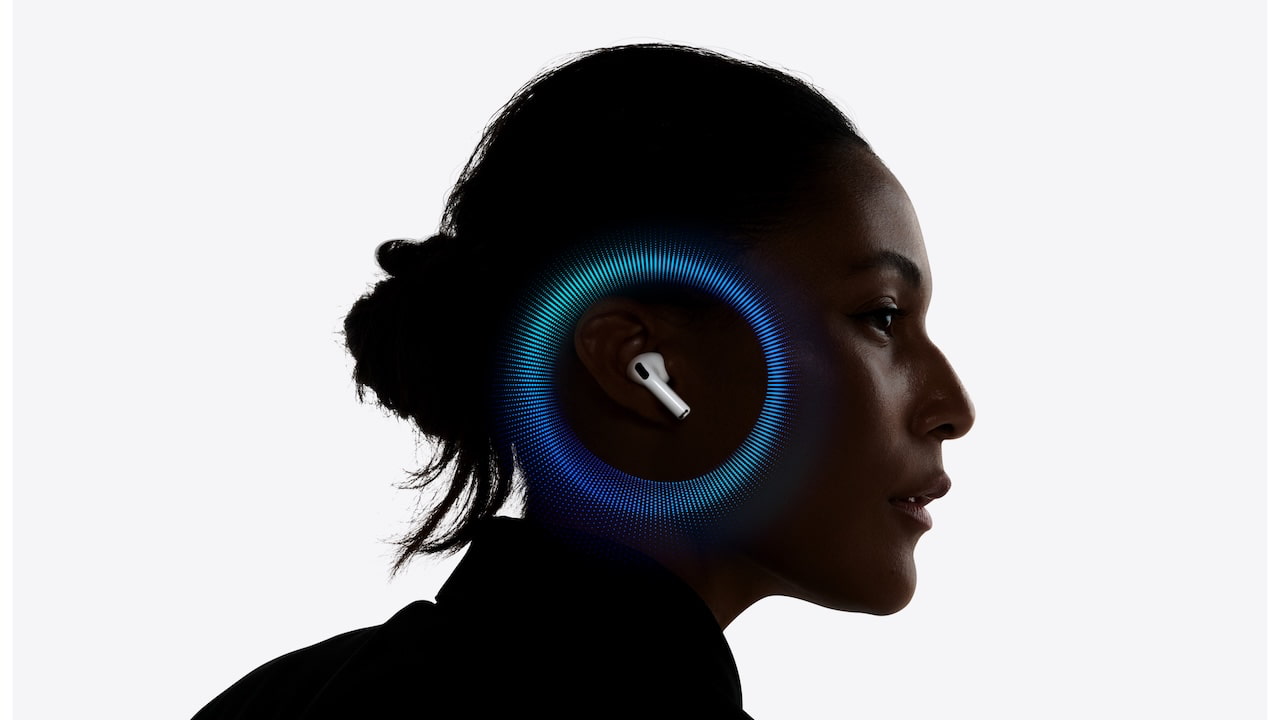
Apple AirPods Pro 3 (2025 Model)
Apple Intelligence powers Live Translation through AirPods Pro 3, AirPods 4 with ANC and AirPods Max 2 when paired with a compatible iPhone. Apple also uses computational processing for Adaptive Audio, Conversation Awareness, Voice Isolation and environmental response.
Meta’s AI glasses may represent the closest current comparison to OpenAI’s reported device. They combine cameras, microphones, open-ear speakers and an AI assistant capable of answering questions about what the wearer is seeing. Unlike a home speaker, however, Meta’s glasses travel into public spaces, where everyone else gets to participate in the privacy experiment whether they volunteered or not.
Advertisement
The OpenAI speaker appears to take those same ingredients and place them inside the home.
Big Brother Is Listening, but Is He Recording?
Smart speakers have always created privacy concerns because their microphones must remain active enough to detect a wake word.
That does not automatically mean every conversation is uploaded or stored. Conventional smart speakers generally perform wake-word detection locally and begin transmitting audio only after activation. False activations, retention policies and human review programs have nevertheless damaged consumer trust over the years.
OpenAI has not disclosed how its hardware will handle wake words, local processing, camera data, stored memories or active listening. Until it does, nobody can honestly claim that the device will be either invasive or private.
Advertisement
Current ChatGPT Voice policies provide some indication of OpenAI’s approach, but they cannot be assumed to apply unchanged to future hardware. OpenAI says standard voice audio is deleted after transcription unless the user chooses to share recordings. Audio and video clips are not used for model training unless the user opts in, although transcripts may be used when the “Improve the model for everyone” setting is enabled.
A home device raises additional questions that an app does not.
Will its camera remain active between requests? Will visual analysis occur locally or in the cloud? Will it recognize individual household members? Can visitors disable it? Will parents be able to prevent children from forming persistent personal histories with the assistant? Can stored memories be inspected, corrected and permanently deleted?
Advertisement. Scroll to continue reading.
Advertisement
There should be a physical microphone switch and a genuine mechanical camera shutter, not merely an icon that promises the software has stopped watching. Clear lights or audible signals should indicate when audio or video is being processed.
Anything less deserves suspicion.
Learning From You Could Be Useful and Uncomfortable
Personalization is central to OpenAI’s likely strategy.
A genuinely useful assistant must know which services you use, what devices you own, who lives in the house, what music you prefer and which requests require confirmation. It becomes more effective as it accumulates context.
Advertisement
That same context could create an extraordinarily detailed map of a household.
A camera-equipped assistant could potentially know when people arrive, which rooms they occupy, what objects they use and how they interact. Combined with calendars, messages, purchase history, music preferences and smart home activity, it might understand daily routines better than some family members do.
That information could improve accessibility, elder care, reminders and home automation. It could also become extremely valuable to hackers, litigants, insurers, advertisers or anyone who gains unauthorized account access.
The product’s commercial model matters. Powerful cloud-based AI is expensive to operate. OpenAI has not disclosed whether the speaker will require a ChatGPT subscription, include a separate monthly plan or offer reduced functionality without one.
Advertisement
Consumers should also ask what happens if the subscription ends or the company discontinues the service.
The Humane AI Pin provides a useful warning. Humane shut down its cloud-dependent wearable after selling parts of the company to HP, leaving the AI Pin unable to perform most of its intended functions. A sophisticated connected device can become an expensive paperweight when its servers disappear.
The Problem With an AI That Can Act
Answering a question incorrectly is irritating.
Taking an incorrect action is potentially dangerous.
Advertisement
Advertisement. Scroll to continue reading.
A conversational AI controlling locks, appliances, purchases, messages and home security requires stricter safeguards than a chatbot generating a restaurant recommendation. Commands involving money, safety, identity or access should require confirmation and, in some cases, authentication from a phone or wearable.
The device must also understand which person is speaking. A child, visitor or television commercial should not be able to unlock a door, order $700 worth of Pokémon cards or send your employer a message explaining that you have chosen to pursue your true calling in artisanal cheese.
Hallucinations remain another concern. GPT-Live may sound natural and confident, but fluency is not the same as reliability. A voice assistant that speaks smoothly can make incorrect information feel more trustworthy because users do not see citations, uncertainty indicators or alternative answers on a screen.
Advertisement
A screenless interface removes visual clutter. It also removes the easiest method of reviewing what the AI thinks it heard before allowing it to act.
Why Does It Need to Move?
The mechanical movement may be functional. A rotating camera could follow the user, improve room coverage or direct microphones and speakers toward the person speaking.
It may also be intended to create personality.
Humans instinctively respond to movement, eye contact, voices and gestures. A device that turns toward someone, pauses at the right moment and remembers personal details will feel more socially present than a stationary speaker.
Advertisement
That could make it easier and more enjoyable to use. It could also encourage emotional attachment, particularly among children, isolated adults and elderly users.
OpenAI will need to decide whether it is building a tool or a relationship, and parents may have strong feelings about that distinction. Then again, we have already surrendered an entire generation to smartphones, social media and algorithms before breakfast. June and Ward Cleaver would probably have been removed by Child Protective Services in 2026 for allowing Wally and the Beaver to roam the neighborhood unsupervised without location tracking.
A tool should make its limitations clear. A companion is designed to make people forget them.
The Apple Lawsuit Could Complicate Everything
The report arrived only days after Apple sued OpenAI, io Products and former Apple employees Tang Tan and Chang Liu for alleged trade-secret misappropriation.
Advertisement
Apple claims former employees accessed confidential hardware files, engineering specifications, supplier information and unreleased product details after leaving the company. It also alleges that OpenAI recruits were encouraged to bring confidential materials and physical parts to interviews. These are Apple’s allegations and have not been proven in court. OpenAI says it has no interest in other companies’ trade secrets and is not aware of evidence supporting the complaint.
Advertisement. Scroll to continue reading.
Apple is seeking damages and preliminary and permanent injunctions preventing OpenAI and the other defendants from possessing or using Apple’s trade secrets. It also wants relevant material returned and evidence preserved.
The lawsuit does not automatically block OpenAI from releasing hardware. A court would have to determine whether protected information was taken, used and connected to the products under development.
Advertisement
It does create risk. An injunction, discovery dispute or required redesign could delay the reported 2027 release. The case may also expose details about OpenAI’s hardware program long before Jony Ive is ready to reveal it from a perfectly lit room containing one chair and no visible cables.
The Bottom Line
OpenAI’s reported speaker could become the first smart home product to place a genuinely capable conversational AI at the center of everyday life.
Its potential advantages are substantial: natural dialogue, visual understanding, long-term context, portability and the ability to perform multi-step tasks across services. For users with disabilities, mobility limitations or complicated smart homes, a well-designed ambient assistant could be transformative.
The difficult questions are equally substantial. OpenAI must explain what the device sees, when it listens, what it remembers, where the information is processed and how much control users retain. It must create safeguards for purchases, messages, locks and other consequential actions. It also needs to prove that the product offers something a smartphone, pair of earbuds or existing smart speaker cannot already provide.
Advertisement
And because eCoustics readers will ask the question that most technology publications will forget, OpenAI must tell us whether the speaker can actually reproduce music without sounding like a Bluetooth-enabled soup can.
A more intelligent smart speaker could be useful.
A camera-equipped AI companion that learns the household, turns when summoned and depends on a permanent cloud connection could become the most articulate surveillance appliance ever placed on a kitchen counter. The future may not arrive wearing jackboots. It may speak softly, remember everything and ask whether we would like to renew our subscription.





























































You must be logged in to post a comment Login