As part of its global 80th Anniversary celebration, JBL has announced the L100 Classic 80, a strictly limited special edition of one of the most recognizable loudspeakers in audio history. This is not a new model, not a redesign, and not an acoustic experiment. It is a commemorative edition of JBL’s modern L100 platform, created to honor eight decades of engineering, cultural relevance, and a speaker that helped define what high-performance home audio looked like in the first place.
Let’s get something out of the way immediately: the JBL L100 Classic 80 is acoustically and sonically identical to the L100 Classic MKII currently in production. Same drivers. Same crossover. Same cabinet volume. Same tuning. The only L100 Classic that differs sonically is the relaunched original 2018 version, which was replaced by the MKII in 2023. Every version since—the MKII, the Black Edition, the 75th Anniversary, and now the Classic 80—shares the same acoustic package. What changes here is the cosmetic execution and collectability, not the sound.
That matters, because JBL isn’t trying to reinvent an icon. They’re preserving it.
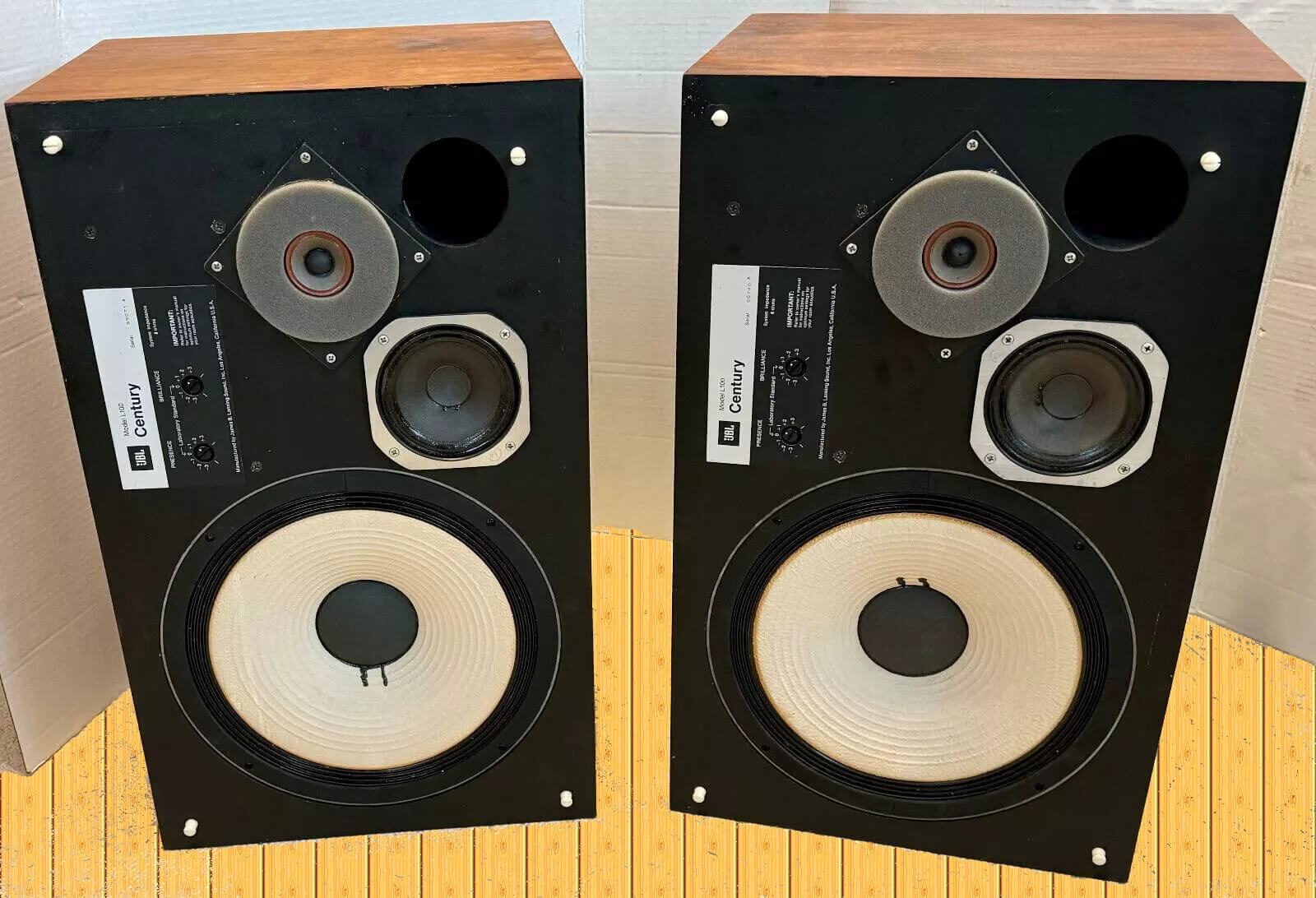
JBL L100 Century Loudspeakers (1970s model)
Originally introduced in the 1970s, the JBL L100 became one of the most commercially successful and visually recognizable loudspeakers the brand ever produced. It wasn’t subtle, it wasn’t polite, and it didn’t apologize for sounding big, dynamic, and alive. The L100 became synonymous with the rise of serious home stereo systems and remains a reference point for JBL’s identity to this day.
Advertisement
“The JBL L100 is more than a loudspeaker. It’s a symbol of JBL’s role in shaping how people experience music at home,” said Jim Garrett, Senior Director of Product Strategy and Planning, HARMAN Luxury Audio. “The JBL L100 Classic 80 honors that legacy while reflecting the engineering standards and listening expectations of today. It’s a celebration of where we’ve been and how far we’ve come.”
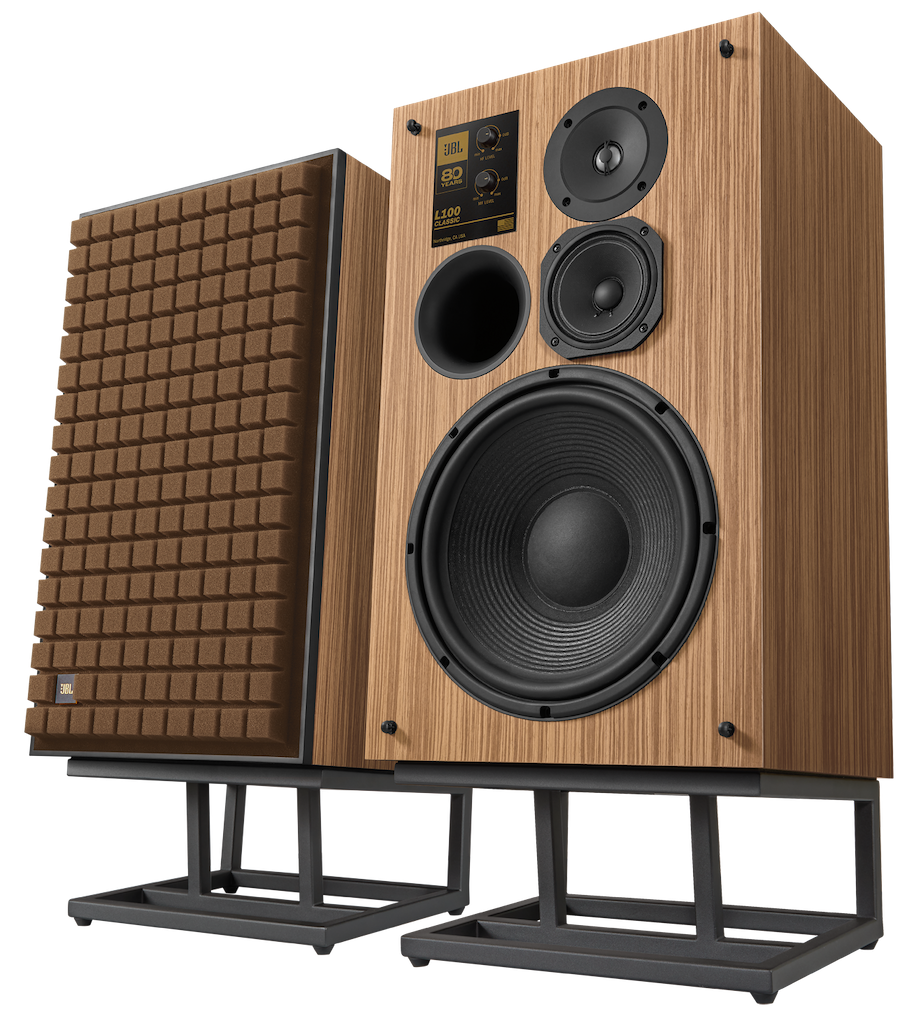
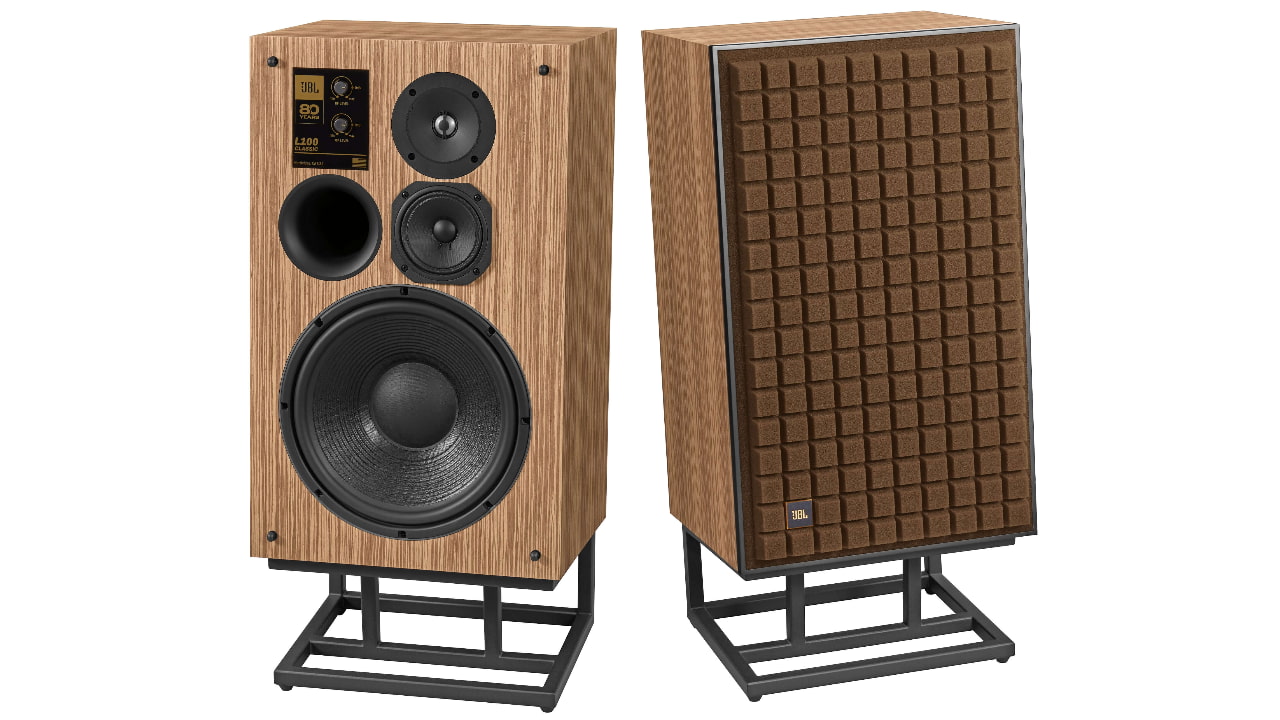
JBL L100 Classic 80 Anniversary Edition Loudspeakers
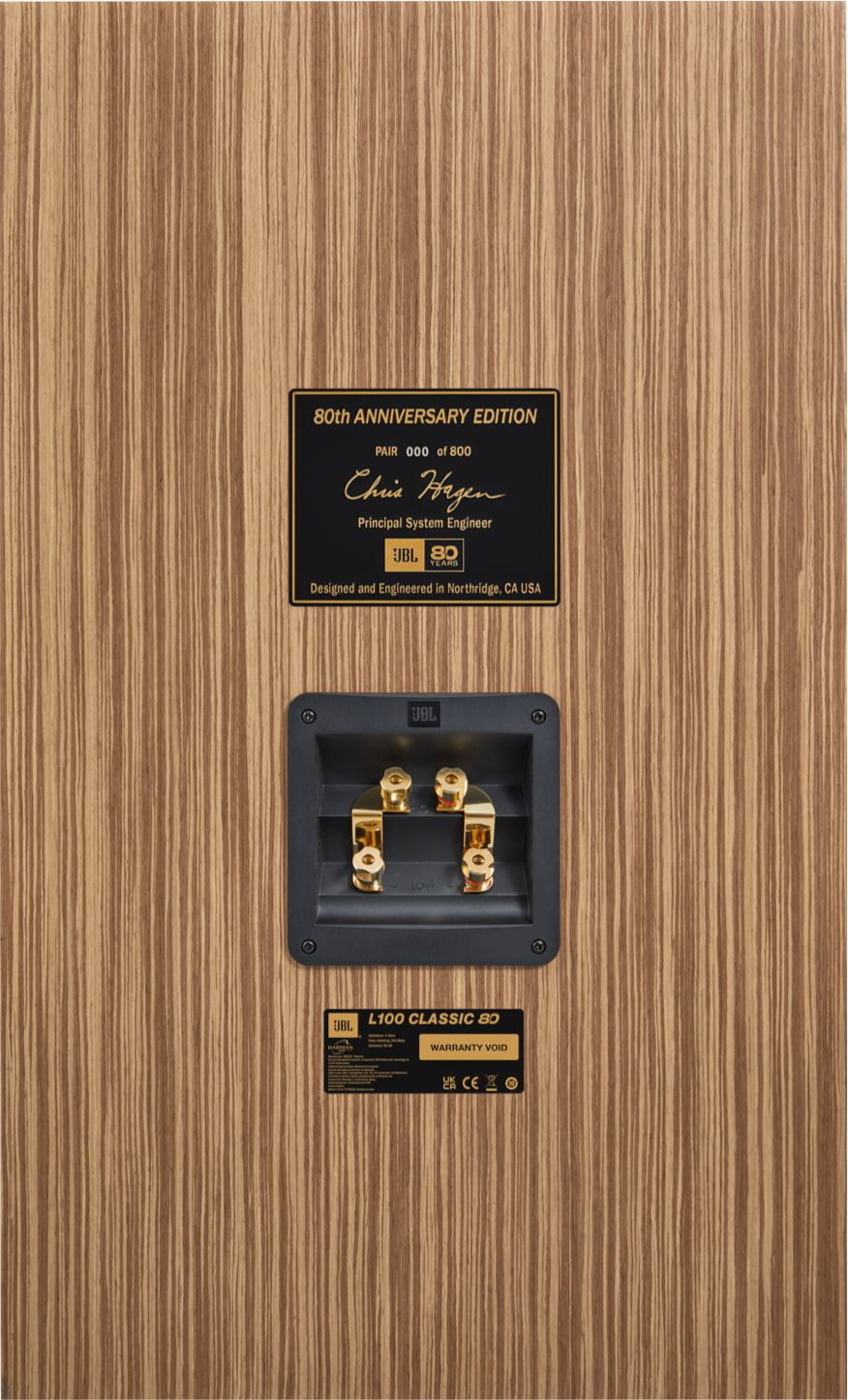
Visually, the JBL L100 Classic 80 Anniversary Edition leans hard into heritage. It’s finished exclusively in California oak veneer, paired with a vintage-inspired brown Quadrex foam grille and accented by a gold-and-black JBL logo. A black satin baffle frame and anniversary badging on both the front and rear further distinguish it from the standard MKII. The 12-inch woofer features a black cone, chosen purely for visual cohesion with the overall package—it is the same woofer used in the white-cone L100 Classic MKII.
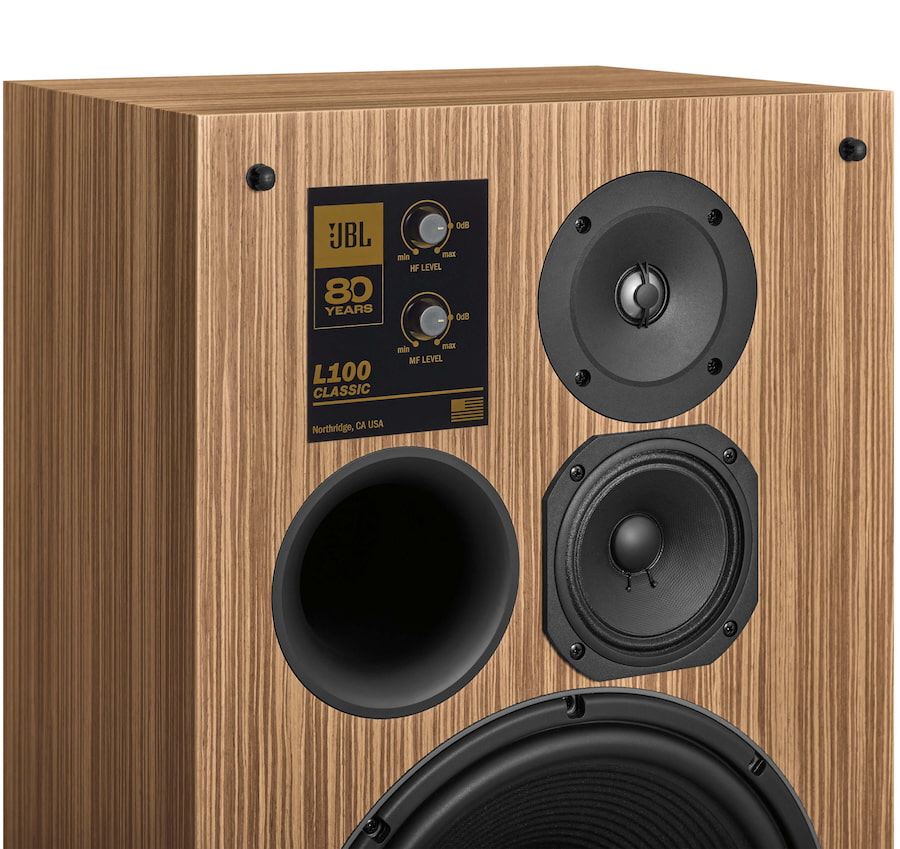
Under the hood, nothing changes—and that’s the point. The L100 Classic 80 remains a three-way, front-ported bookshelf loudspeaker built around a cast-frame 12-inch pure pulp cone woofer, a 5.25-inch polymer-coated midrange, and a 1-inch titanium dome tweeter paired with JBL’s acoustic lens waveguide. Front-panel mid- and high-frequency level controls allow fine tuning, preserving the lively, adjustable character that made the L100 famous.
JBL L100 Classic MKII Loudspeaker
What truly separates the L100 Classic 80 Anniversary Edition from every other modern L100 variant is availability—and finality.
Production is capped at 800 matched pairs worldwide. That’s it. Each pair includes JS-150 speaker stands, ships in a custom wooden crate, and features an individually numbered commemorative plaque signed by principal system engineer Chris Hagen. This is a one-and-done release, with no follow-up runs planned.
Advertisement
For context, every previous special L100 edition has already vanished:
The 75th Anniversary Edition (2021 model) was limited to 750 pairs and sold out in 2021
The Black Edition (2022 model) ended production in late 2024
The L100 Classic (2018 model) was discontinued when the MKII arrived in 2023
That leaves just two L100 options going forward: the standard L100 Classic MKII, available in walnut with multiple grille colors, and the L100 Classic 80, which exists solely to mark JBL’s 80th year—and then disappear.
Advertisement. Scroll to continue reading.
The Modern Reference Behind the L100 Classic 80 Anniversary Edition
At a glance, the L100 Classic 80 looks like it time-traveled straight out of the 1970s—and that’s intentional. Its physical dimensions (25 x 16 x 15 inches) have barely changed across more than five decades of L100 history. Weight is also in the same neighborhood: just under 60 pounds per speaker, compared to roughly 55 pounds for the original. This has always been a substantial loudspeaker, just not one that fits neatly into modern categories. It’s too large to be a true bookshelf design and too compact to qualify as a traditional floorstander.
Back in the day, L100s were often parked directly on the floor, flanking a stereo cabinet and sitting only a few feet apart. Today, they’re more commonly placed on low stands—about 7 inches off the floor, tilted slightly rearward, with 8 to 10 feet between them. Same speaker, different era, better placement.
The L100 Classic 80 remains a three-way design built around a 12-inch woofer, a 5.25-inch midrange driver, and a 1-inch tweeter. The midrange sits next to a 5-inch front-firing bass port, and the cabinet retains the classic look: black front and rear panels with walnut veneer on the sides, top, and bottom. Visually, it checks every L100 box.
Advertisement
Internally, it’s a completely different animal.
The cabinet is significantly stiffer than earlier versions, using inch-thick front and rear panels, ¾-inch side panels, and substantial internal bracing. JBL also developed a custom internal damping material with higher absorption than standard Dacron fill, helping control internal reflections and cabinet resonances.
The crossover network has been thoroughly updated as well. Heavier-gauge wiring, larger capacitors, and a mix of iron-core and air-core inductors are used, with crossover points set at 450 Hz and 3.5 kHz. The midrange operates across that entire span using second-order filters, while the tweeter employs a third-order high-pass. This approach keeps vocal fundamentals and presence squarely in the midrange driver’s wheelhouse, rather than splitting them awkwardly between drivers, which helps avoid phase issues and preserves clarity.
On the front panel, the L100 Classic 80 retains one of its most distinctive features: adjustable midrange and treble attenuators. These controls don’t boost anything—they only reduce output. While the center position is marked as “neutral,” there’s meaningful range available to dial things back. In practice, it’s possible to cut the 600 Hz to 2 kHz region by nearly 10 dB with the midrange control, and similarly reduce energy above roughly 5.5 kHz with the treble attenuator. It’s a practical tool for room matching, not a tone control gimmick.
Driver-wise, the tweeter is JBL’s JT025Ti-4, a 1-inch titanium dome mounted in a shallow waveguide with an acoustic lens. This same tweeter appears in the L52 and L82 models, but what sets it apart is the use of a large ferrite magnet rather than the neodymium magnets common today. Ferrite acts as a better heat sink, allowing the tweeter to operate at lower temperatures and reducing distortion caused by thermal compression at higher output levels.
Advertisement
The midrange and woofer, however, are unique to the L100 Classic MKII and Classic 80.
The midrange is the 105H-1, a 5.25-inch polymer-coated pure pulp cone driver designed as a sealed unit. Unlike the open-back midrange used in the smaller L52, this sealed design prevents cabinet air pressure from interfering with the driver’s motion, which helps maintain consistency and control through the critical vocal range.
Bass duties are handled by the JW300PW-8, a 12-inch pure pulp cone woofer with a cast aluminum frame and a substantial 3-inch voice coil. Its magnet assembly measures 7 inches in diameter and over an inch thick, allowing for significant excursion. That magnet structure alone accounts for nearly a third of the speaker’s total weight, with the woofer tipping the scales at close to 22 pounds by itself.
On paper, the L100 Classic MKI is rated at 40 Hz to 40 kHz (-6 dB), with a sensitivity of 90 dB (2.83V/1m) and a nominal 4-ohm impedance. Those numbers tell you what you need to know: this is a speaker that plays loud without being fussy, rewards solid amplification, and delivers scale in a way that smaller modern designs simply can’t fake.
Advertisement
Advertisement. Scroll to continue reading.
JBL L100 Classic MKII
Specifications
Speaker Type
12-inch (300mm) 3-way Bookshelf Loudspeaker
Low Frequency Driver
12-inch (300mm) cast-frame Pure Pulp cone woofer with Dual Spider (JW300SW-8)
Mid Frequency Driver
5.25-inch (130mm) Polymer-coated Pure Pulp cone (JM125PC-8)
High Frequency Driver
1-inch (25 mm) Titanium dome tweeter mated to acoustic lens and waveguide (JT025Ti2-4)
Recommended Amplifier Power
25-200 Watts RMS
Impedance
4 ohms
Sensitivity (2.83V/1m)
90dB
Frequency Response
40Hz-40kHz (-6dB)
Crossover Frequencies
450Hz, 3.5kHz
Dimensions With Grille (HxWxD)
25.3-inch x 15.4-inch x 14.4-inch
Controls
Attenuators for MF and HF level control
Connector Type
Dual sets of Gold-plated Binding Posts
Product Weight
63 lbs (28.6 kg) each
JBL L100 Classic 80 Anniversary Edition
The Bottom Line
The JBL L100 Classic MKII and Classic 80 Anniversary Edition are not subtle, not trendy, and not pretending to be something it isn’t. It’s a big, physical loudspeaker with modern engineering underneath a very deliberate old-school attitude. Same proven acoustic platform used across every recent L100 variant, built solid, tuned right, and unapologetically dynamic.
This is for listeners who actually turn the volume knob, have the space to let a speaker breathe, and don’t need their gear to vanish into the décor. If you want scale, punch, and the ability to dial the sound to your room, the L100 delivers. If you’re chasing minimalist boxes, ruler-flat graphs, or lifestyle cred, keep scrolling.
Where to buy
Note: All other L100 Classic models have been discontinued. A set of Quadrex foam grilles are included, but can also be purchased separately in different colors for $394.95/pair at Crutchfield. The companion JS-150 or JS-120 speaker stands are not included, but are available for $364.95/pair at Crutchfield.
Sikorsky has completed flight testing and handed the first UH-60MX Black Hawk over to the US Army this week. The aircraft has landed at Fort Eustis, Virginia, where the Combat Capabilities Development Command will put it through its paces. From here the real testing begins, with the helicopter expected to demonstrate just how much it can handle on its own.
This project has been in the works for nearly a decade. Sikorsky partnered with DARPA through the ALIAS program to develop a kit that adds advanced autonomous flight control to existing helicopters, and the UH-60MX is the result of that work, built on the familiar UH-60A airframe that the Army knows well. In 2025 the original mechanical flight controls were replaced with fly-by-wire electronics, giving the MATRIX autonomy system the ability to step in and take over whenever the mission calls for it.
Due to platform compatibility issue, the DJI Fly app has been removed from Google Play. DJI Neo must be activated in the DJI Fly App, to ensure a…
Lightweight and Regulation Friendly – At just 135g, this drone with camera for adults 4K may be even lighter than your phone and does not require FAA…
Palm Takeoff & Landing, Go Controller-Free [1] – Neo takes off from your hand with just a push of a button. The safe and easy operation of this drone…
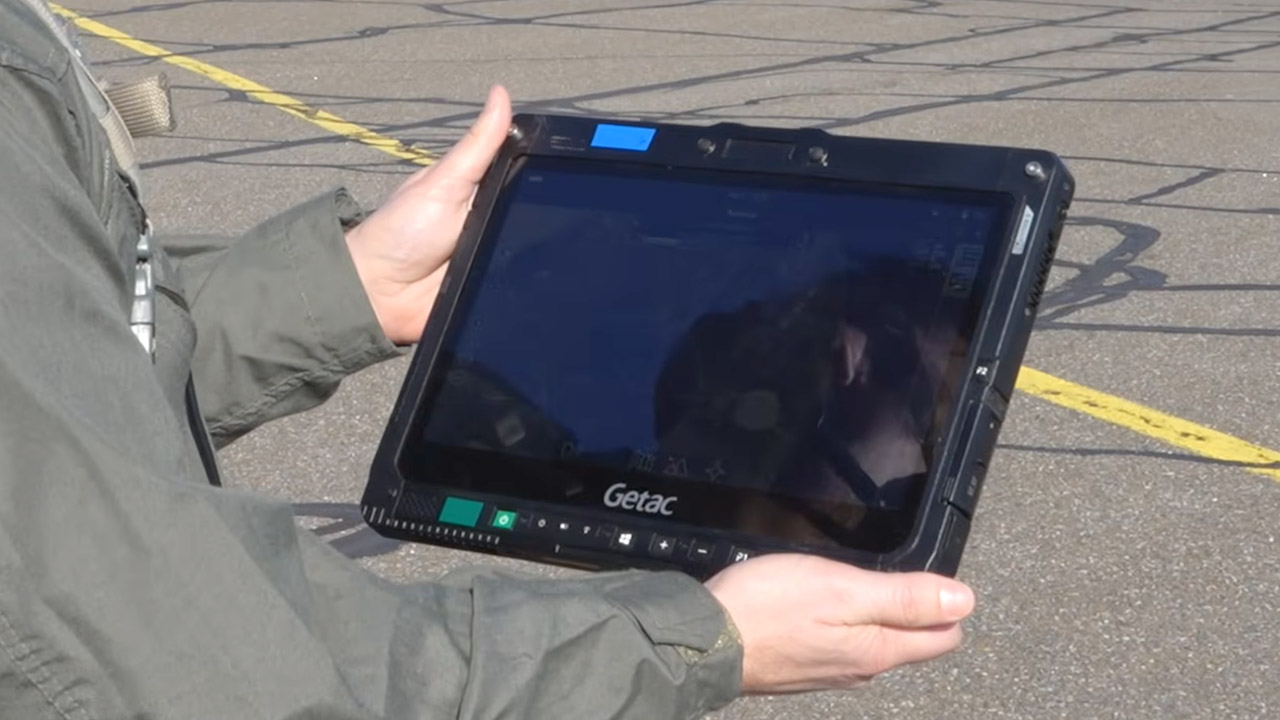
MATRIX essentially acts as the helicopter’s brain, with onboard sensors continuously scanning the surrounding environment and feeding data into the system, which then handles flight path planning, landing zone selection, and obstacle avoidance in real time. Pilots on board see their workload drop significantly as the routine tasks are handled automatically, and ground operators can direct the aircraft from a tablet. Soldiers with no flight experience have been learning to manage basic missions in around an hour of practice time.
The same autonomy package has already been tested across the UH-60A, UH-60L, and UH-60M variants, accumulating hundreds of flight hours on a Sikorsky owned test aircraft and proving itself reliable across a wide range of conditions. A standout run in 2022 saw the helicopter complete its own pre-flight checks, take off, fly a full route autonomously, and land successfully, all while handling simulated equipment failures along the way.
Now in the US Army’s hands, the focus shifts to real world evaluation. Testing will push the helicopter through demanding environments to see how it performs under pressure, how smoothly it transitions between crewed and autonomous modes, and how effectively the ground stations handle remote oversight. All of it feeds into the Strategic Autonomy Flight Enabler initiative, which is working toward a single kit that can be deployed across the entire Black Hawk fleet and carried forward into future designs.
Helicopters will soon be able to support troops in areas too dangerous to send a crew into or too remote for regular human oversight, and missions can be flown in low visibility conditions or contested airspace without putting soldiers at risk. The open architecture of MATRIX also means new sensors and software can be added down the line without tearing the whole system apart and starting over. [Source]
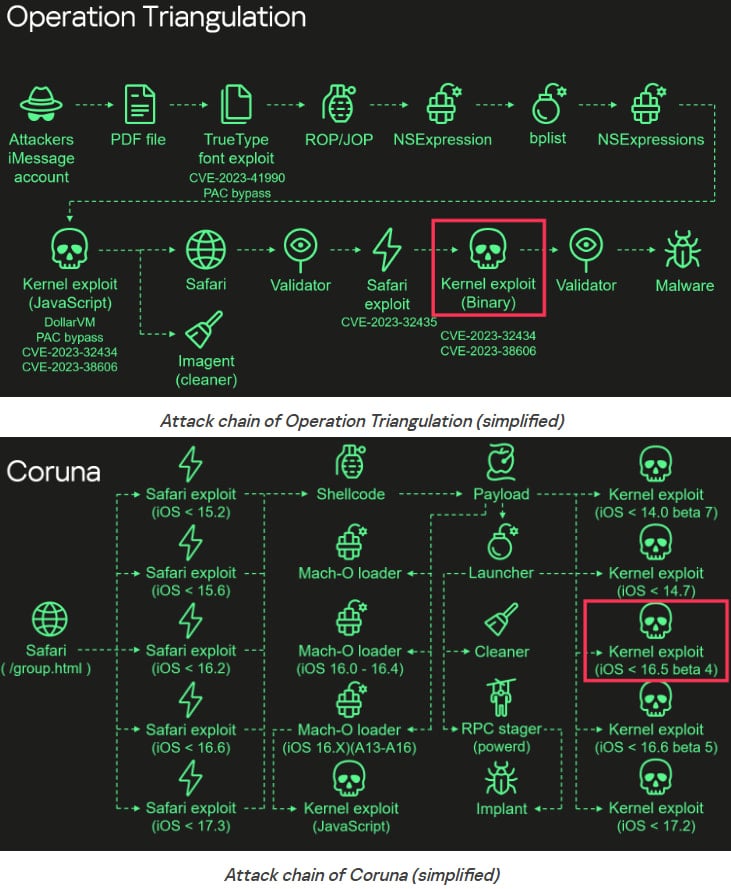
The Coruna exploit kit is an evolution of the framework used in the Operation Triangulation espionage campaign, which in 2023 targeted iPhones via zero-click iMessage exploits.
The software has been expanded to target modern hardware, specifically including Apple’s A17 and M3 chips, as well as operating systems up to iOS 17.2.
Coruna contains five full iOS exploit chains leveraging 23 vulnerabilities, among them CVE-2023-32434 and CVE-2023-38606 also used in Operation Triangulation.
After analyzing the exploit code for the two security issues, Kaspersky researchers determined that Coruna ran an updated version of the exploit used in Operation Triangulation that had started since 2019.
Advertisement
Additional code similarities led to the conclusion that the kit is the successor to the malicious framework leveraged in the Triangulation campaign that also targeted iPhones on Kaspersky’s network.
“During our analysis we’ve discovered that the kernel exploit for CVE-2023-32434 and CVE-2023-38606 vulnerabilities used in Coruna, in fact, is an updated version of the same exploit that was used in Operation Triangulation,” the researchers say in a report today.
Source: Kaspersky
Kaspersky’s analysis shows that the attack begins in Safari with a stager that fingerprints the device, selects suitable RCE and PAC exploits, and then retrieves encrypted metadata for subsequent stages.
The payload downloads additional encrypted components, decrypts them using ChaCha20, decompresses them with LZMA, and parses custom container formats to obtain package information.
Based on the device’s architecture and iOS version, it selects and executes the appropriate kernel exploit, Mach-O loader, and launcher to deploy the spyware implant.
Advertisement
Kaspersky’s findings indicate that the payloads support targeting ARM64 and ARM64E architectures, with explicit checks for A17, M3, M3 Pro, and M3 Max chips.
Also, the package IDs and system checks indicate that the exploits can target:
iOS < 14.0 beta 7
iOS < 14.7
iOS < 16.5 beta 4
iOS < 16.6 beta 5
iOS < 17.2
Boris Larin, principal security researcher at Kaspersky Global Research and Analysis Team (GReAT), says the connection with Triangulation became evident after analyzing Coruna’s binaries.
“Coruna is not a patchwork of public exploits; it is a continuously maintained evolution of the original Operation Triangulation framework.”
Additionally, the developers continued to update the framework by including checks for newer processors (e.g., M3) and iOS builds.
Advertisement
Since Coruna has also been used in financially-motivated campaigns aiming to steal cryptocurrency via fake exchange websites, Larin notes that “what began as a precision espionage tool is now deployed indiscriminately.”
Operation Triangulation was a highly sophisticated iOS espionage campaign that used multiple zero-day exploits to silently infect iPhones and deploy spyware implants.
It was discovered by Kaspersky during internal WiFi network monitoring in June 2023, though the campaign had started four years earlier.
In late 2023, the same researchers found that these attacks leveraged undocumented features in Apple chips to bypass hardware-based security protections.
Advertisement
Another exploit kit, dubbed DarkSword, was disclosed earlier this month by researchers at mobile security companies Lookout and iVerify, and Google.
Like Coruna, DarkSword is being used by multiple threat actors, but all appear to be leveraging it for espionage operations. It should be noted that DarkSword is now publicly available, which increases the risk of cybercriminals starting to leverage it against unpatched iPhones.
Apple has published a bulletin to address all these recently uncovered exploit kits, noting that fixes for all flaws have been made available via security updates for the latest, as well as earlier, iOS versions.
Malware is getting smarter. The Red Report 2026 reveals how new threats use math to detect sandboxes and hide in plain sight.
Download our analysis of 1.1 million malicious samples to uncover the top 10 techniques and see if your security stack is blinded.
Sony has shut down Dark Outlaw Games one year after its founding
The studio was reportedly in the early stages of developing its project
Sony is making additional cuts elsewhere, including in mobile development, and “around 50 people” have been laid off
Sony has shut down Dark Outlaw Games one year after its founding, and is also making cuts across mobile game development.
As spotted by Eurogamer, ResetEra user J-Soul first broke the news that a new project was “still in the early stages” of development when Sony pulled funding from the “incubation studio” founded last year under Call of Duty Zombies veteran Jason Blundell.
This is now reportedly the second game project helmed by Blundell that Sony has shut down after Deviation Games. Deviation Games was formed in 2020 and was working on an original AAA IP, but the studio was later closed in March 2024.
Article continues below
Advertisement
J-Soul also reported that there have been “an unspecified number of layoffs within PlayStation in the US and UK” and that the number is said to be “small.”
The ResetEra user also claimed that PlayStation is moving away from the mobile game market, but will continue to support previously announced titles like MLB The Show Mobile, Ratchet & Clank: Ranger Rumble, and other NCSOFT titles but “outside of these titles, we will be scaling back in this space” to “focus our efforts on a few select high impact projects.”
Bloomberg’s Jason Schreier later confirmed the closure of Dark Outlaw Games on BlueSky, and also verified that PlayStation is making other cuts, “including in mobile development,” and that “around 50 people” have been laid off.
Sign up for breaking news, reviews, opinion, top tech deals, and more.
Sony Interactive Entertainment CEO Hermen Hulst released an internal statement at the time, suggesting that “rising development costs” were a factor in the studio’s shuttering.
The closure came five years after Sony acquired the developer, and after PlayStation canceled Bluepoint’s live-service God of War project, which it had been working on until January 2025. It reportedly spent the last year pitching new ideas before it was officially closed down last month. An estimated 70 employees were laid off.
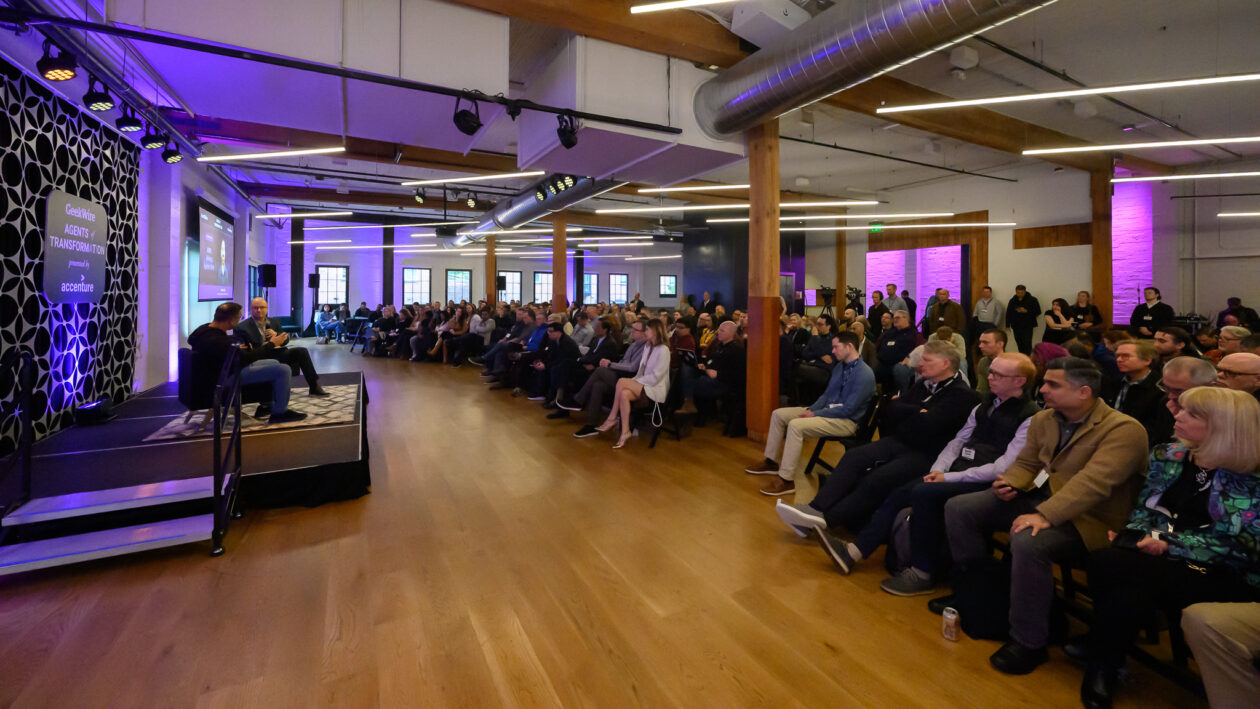
GeekWire’s Agents of Transformation AI summit drew a full house to Block 41 in Seattle on Tuesday. (GeekWire Photo / Kevin Lisota)
The debate over whether AI will transform industries is over.
At GeekWire’s Agents of Transformation summit in Seattle on Tuesday, the founders, executives and engineers in attendance had moved on to harder questions — what’s working, what isn’t, and how fast everything is moving. The through-line across nearly every conversation was a shift from AI as a chat tool to AI as an autonomous actor — software that doesn’t just answer questions but acts on its own, improving as it goes.
Speakers from Microsoft, Amazon Web Services, OpenAI and elsewhere described a world where the constraints that defined their work for decades are dissolving, and where the biggest obstacle to capturing that value isn’t the technology — it’s figuring out how to redesign work processes and organizations that weren’t built with any of this in mind.
Agents of Transformation was presented by Accenture, and builds on an ongoing GeekWire editorial series, also underwritten by Accenture, spotlighting how startups, developers and tech giants are using intelligent agents to innovate.
Keep reading for quick recaps and key takeaways — with the help of AI, of course — from each fireside chat and panel discussion.
Advertisement
Charles Lamanna, Microsoft’s executive vice president of Business Applications & Agents, during GeekWire’s Agents of Transformation event in Seattle. (GeekWire Photo / Kevin Lisota)
Charles Lamanna, Microsoft’s executive vice president of Business Applications & Agents, opened with a moment that caught everyone’s attention: an AI agent declined 17 meetings on his behalf. Not summarized them, not flagged them — declined them.
For Lamanna, that was the moment AI crossed from information retrieval into genuine action. The era of AI as chat assistant, he argued bluntly, is behind us. “The sun has set.”
Three key highlights:
Don’t invent new metrics for AI. The biggest trap Lamanna sees companies fall into is building elaborate AI systems disconnected from business outcomes. His rule: use the metrics you already have — revenue, retention, customer satisfaction, cost to serve. “No one’s business metric should be 15 agents deployed,” he said. If the AI isn’t moving a number the CEO already cares about, it’s a hobby.
Give everyone great AI, focus on a few big bets. Successful AI transformations share two traits: broad access to tools across the entire workforce, and a small handful of high-priority projects tracked from the top down. Companies with 250 “Gen AI projects” are a red flag, not a success story.
Token budget is the new headcount. Lamanna’s teams are already measuring AI spend per engineer as a hiring factor — and candidates are negotiating for it. One engineer told him he’d only take the job if his team had sufficient daily token allocation. “If you hire an engineer that has lived this way of agentic code and you told them your token budget per day is $1,” he said, “they’ll be like, ‘see ya.’” (Read more about that point here.)
Andy Tay, left, global lead – Accenture Cloud First, interviews Julia White, CMO and VP of Worldwide Marketing at Amazon Web Services, during GeekWire’s Agents of Transformation event in Seattle. (GeekWire Photo / Kevin Lisota)
Julia White, CMO of AWS, has spent nearly three decades in marketing — and says her biggest challenge right now is unlearning much of it. Goals she gave up on years ago, like truly personalized one-to-one marketing at scale, are suddenly back on the table.
“I’m daily having to stop and unlearn things that I thought were just true,” she told moderator Andy Tay, global lead – Accenture Cloud First. The constraints that made those dreams impractical simply don’t exist anymore.
Three key highlights:
Advertisement
Let it rip — selectively. White’s team sends thousands of emails a month, and for years every one required a human sign-off before it went out. They’ve since built a monitored process that gradually earned enough trust to remove that step entirely. Meanwhile, an experiment using AI for high-production TV ads taught them just as much by failing — they took what worked and applied it to digital display ads, going from roughly 100 variations to vastly more, almost effortlessly.
Start with what people hate doing. The fastest path to team buy-in isn’t a big transformation project — it’s eliminating the annoying small stuff. White demoed a new content workflow at an all-hands that cut a three-hour publishing process to 30 minutes. The room broke into spontaneous applause. “That is a new high bar” for rolling out technology, Tay added.
Hire people who don’t know the rules. White said she’s deliberately hiring more new graduates than ever — people with no assumptions about how marketing has always worked. Her logic: fresh eyes don’t have to unlearn anything.
Deepak Singh, vice president of Kiro at AWS, during GeekWire’s Agents of Transformation event in Seattle. (GeekWire Photo / Kevin Lisota)
Deepak Singh has spent nearly 20 years at Amazon Web Services building tools for software developers, and his four-word summary of his daily routine says everything about where things stand: “I live with agents.”
The VP behind Kiro, Amazon’s AI-powered developer environment, runs four custom agents every day — one for research, one that writes in his personal style, one that processes email, and one that drafts internal documents. Not a demo. How he actually works.
Three key highlights:
How you adopt matters more than whether you adopt. An Amazon internal study of 40-50 engineering teams found a stark divide: teams that bolted AI agents onto existing workflows got 20-40% faster. Teams that restructured their entire environment around agents — cleaner repositories of coding changes, better documentation, clear instructions — got 3 to 10 times faster. The difference wasn’t the tools. It was the setup.
Your guardrails were built for humans. Singh’s sharpest point on agent safety: every policy and permission in your organization was designed for human speed. Agents don’t get tired, don’t give up, and don’t stop to ask for help — they just keep going, which means they can repeat the same mistake a hundred times before anyone notices. Permissions designed for people need to be rethought entirely for systems that never sleep.
Use them at home, not just at work. Singh’s closing advice went a step further than most: don’t just deploy agents professionally, live with them personally. The more fluent you become, the more you’ll get out of them when it matters.
From left: Liat Ben-Zur of LBZ Advisory, Jeremy Tryba Ai2, Angela Garinger of Outreach, and Emily Parkhurst of Formidable Media during GeekWire’s Agents of Transformation event in Seattle. (GeekWire Photo / Kevin Lisota)
Three practitioners who spend their days in the messy middle of AI deployment — not selling it, actually doing it — kept returning to the same uncomfortable theme: the technology is the easy part.
Angela Garinger of Outreach, Jeremy Tryba of AI research nonprofit Ai2, and Liat Ben-Zur of LBZ Advisory have each watched promising AI rollouts stall not because the tools failed, but because the humans around them did. The panel was moderated by Emily Parkhurst of Formidable Media.
Key highlights:
Advertisement
Narrow beats broad, every time. The panel agreed that companies announcing sweeping AI transformation across entire organizations are the ones most likely to fail. The winners are being surgical — picking one particularly tedious task, inserting an agent, measuring the outcome, then scaling. “The ones that are really successful are being very discerning about which high-friction workflow they want to take on first,” Garinger said.
Fear is the real adoption blocker. Ben-Zur described a pattern she sees constantly: a pilot works beautifully, early adopters love it, and then rollout just … stops. When teams dig in, the reason is almost always fear — fear of replacement, fear of being judged when the tool makes a mistake.
Clarity unlocks everything. Tryba described watching even technically sophisticated researchers hesitate to use AI tools because they weren’t sure what they were allowed to do with them. The fix was simple: a clear matrix of approved uses, posted in Slack. The next day, everyone had signed up. Permission, it turns out, is a forcing function.
Track meaningful metrics. Leaders like to tout the hours saved and what percent of employees are using AI, but Ben-Zur said they need to look at the metrics they’ve always valued — has revenue improved, is retention higher, is a feature better performing. “I wouldn’t measure how many hours people save — like, ‘Joey saved five hours.’ I don’t care. What does that translate to for the business?”
Vijaye Raji, left, CTO of apps and head of engineering at OpenAI, talks with GeekWire co-founder Todd Bishop during GeekWire’s Agents of Transformation event in Seattle. (GeekWire Photo / Kevin Lisota)
Vijaye Raji, CTO of apps and head of engineering at OpenAI’s new Bellevue office, has a signature move: propping his laptop open in meetings so Codex — the company’s AI coding tool — can keep building while he’s away from his desk. It’s a fitting metaphor for how he thinks about AI right now — always running, always compounding. The Meta veteran and founder of A/B testing company Statsig spoke about what it actually looks like to live at the frontier.
Three key highlights:
Everyone’s a builder now. Raji built himself a personal Slack and email summarizer — running locally, no cloud, no security overhead — in an afternoon using Codex. His point: the barrier to making custom software for yourself has essentially collapsed. “Everyone is going to be a builder,” he said.
Capability overhang is the real problem. Models have sprinted ahead of how most people use them. Raji calls this the “capability overhang” — and the people closing that gap, he said, are already many times more productive than those who haven’t noticed it’s there.
Engineers are becoming agent managers. The next wave isn’t just AI-assisted coding — it’s a bottleneck shift. Productivity gains from AI are now so fast that the new constraint is humans reviewing all the code coming in. The job title of the future, he suggested, is essentially “manager of agents.”
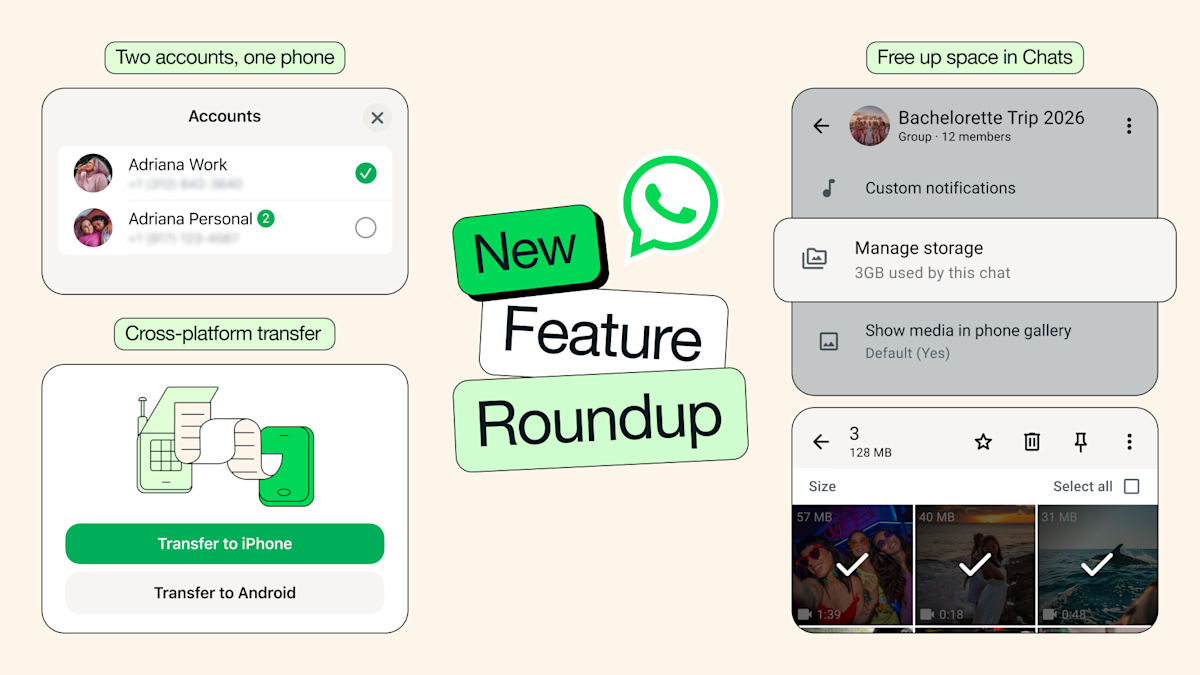
WhatsApp shared multiple quality of life updates coming to its messaging platform starting today. The first is a long awaited option to have two accounts on a single iOS device. The option has been available for years on Android, and iPhone users can now be logged into two separate accounts at once. The profile photo for the account will be visible in the bottom tab to double-check which persona you’re messaging as.
The other new features allow for easier movement of chat histories, both between platforms and devices in the same ecosystem. This chat transfer should make it easier to retain messages when upgrading to a new phone, especially if you’re switching between iOS and Android. There’s also a new option to delete large files directly from a WhatsApp chat to avoid storage clutter. It’s available under the Manage Storage option when you tap a chat’s name. It includes an option to delete just media files from a conversation.
And of course it wouldn’t be a tech news announcement without at least some AI features present. WhatsApp now supports using Meta AI for light photo editing, including removing backgrounds, changing aesthetic styles and deleting elements from the composition. There’s also a Writing Help prompt that uses AI to help draft a message, although Meta’s blog post states that using this still keeps chats private. The above features should be arriving to all WhatsApp users “soon,” according to the company.
We spoke with Sarthak Kumar Barik and Stephen Conneely about the engineering sector and how team dynamics are evolving with the times.
As technologies advance, siloed working environments have the potential to become a thing of the past, particularly as we find more convenient and effective ways to stay in contact with globally dispersed peers.
The engineering space is no different and for Stephen Conneely, the director of QA engineering at Fidelity Investments Ireland, interdisciplinary engineering has reshaped how teams deliver results, especially in an environment where AI-assisted development has become more commonplace.
Conneely told SiliconRepublic.com, “Teams bring together software engineers, quality engineers, analysts and platform specialists to jointly own problems end‑to‑end, with AI tools supporting activities such as test design, code review, and documentation.
Advertisement
“This shared ownership reduces hand‑offs and allows risks to surface earlier, while maintaining strong governance and accountability. Quality is designed in from the start, with disciplines collaborating to decide where AI accelerates delivery and where human validation remains critical.”
He explained, this is all happening in an atmosphere where engineers are expected to understand how their work impacts adjacent systems, data integrity and the client experience. “The result is teams that move faster with confidence, using AI as an enabler rather than a shortcut and delivering more predictable outcomes in complex environments.”
This is echoed by Workhuman’s Sarthak Kumar Barik, a principal engineer who stated, “As a platform team, our work does not exist in isolation. Product teams across the organisation own use cases built on the same legacy foundation and they face the same migration challenges, often without the same depth of context.”
It is the responsibility of engineers and other employees, he finds, to close that gap in knowledge. He explained this can be achieved by translating the migration experience into reusable patterns, clear guidance and well-defined integration points that other teams can adopt without starting from scratch.
Advertisement
He said, “We work alongside product teams as active partners, helping them map their existing behaviour to the new platform, identifying where the gaps are, and making sure each migration they undertake is faster and less risky than the one before. The goal is that knowledge compounds across the organisation rather than staying locked within a single team.”
A more tangible example of this reshaping, he explained, is in how the organisation uses artificial intelligence in the engineering workflow. Workhuman ran an AI-assisted workshop where developers provided context about the system, its architecture, data flows and constraints and used this as the foundation for AI-generated code.
He said, “The difference compared to generic prompting was striking. When AI is given the real context of your system it becomes a genuine accelerator, producing code that is relevant, grounded and faster to review and adapt. This has changed how both our team and the product teams we support think about velocity.”
Adding, “Interdisciplinary engineering, for us, is less about organisational charts and more about shared context. When platform and product teams work from the same understanding of the system, the target and the tools available, progress accelerates across the board.”
Advertisement
With that in mind, what skills and processes do engineers need to be on top of to ensure they are keeping pace with change across the sector?
Fundamentals and the future
For Conneely, the most in demand skills, in today’s engineering landscape, are a combination of the fundamentals alongside the adoption of emerging technologies. He said, “We continue to prioritise deep capability in software engineering, quality engineering, cloud platforms and data, but increasingly value engineers who can use AI‑assisted tooling responsibly to improve productivity, quality and decision making.”
Engineers should also prioritise the ability to critically evaluate AI‑generated output, apply sound engineering judgement and develop the ability to understand where human oversight is essential. As well as adopt a systems thinking, automation-first approach and risk-based decision making, which he said are as important as framework or language expertise.
Advertisement
“Just as critical are communication skills, particularly in regulated environments where engineers must explain technical decisions, including AI usage, in clear business terms. As technology evolves, learning mindset and adaptability are now core competencies rather than nice‑to‑haves.”
Similarly, for Barik, the challenge is often in matching critical but older systems, with newer, more advanced models and processes. He explained, the challenge is not just technical, but more intuitive, as you have to figure out whether you are actually making progress when the system is deeply coupled and cannot be taken offline.
He said, “We defined the target architecture upfront, not as an aspiration but as a concrete end state against which every decision is measured. From there, we decomposed the system into smaller subsystems with a roadmap of agreed milestones. Each milestone represents a discrete, verifiable unit of progress, a subsystem dialed down in the legacy platform and enabled in the new one.
“Every pragmatic shortcut taken along the way is recorded as technical debt, so the team always knows exactly what remains rather than discovering it later. The most powerful measure of progress has been observability. By instrumenting both old and new systems, we track in real time what percentage of load is flowing through the new platform versus the legacy one.
Advertisement
“A subsystem is not truly migrated until the traffic data confirms it. Progress is not a milestone ticked off, it is a measurable, visible shift in where the load is flowing.”
Don’t miss out on the knowledge you need to succeed. Sign up for the Daily Brief, Silicon Republic’s digest of need-to-know sci-tech news.
The signs that AI could lead to mass job displacement are already piling up: entry-level job postings in the U.S. have sunk 35% since 2023, mass layoffs have swept across Big Tech, and even AI leaders themselves are warning about what’s coming.
Backstage at the Axios AI Summit in Washington on Wednesday, Sen. Mark Warner (D-VA) said a venture capitalist recently told him he’s writing software investments down to zero in large part due to the strides of Anthropic’s Claude, and a major law firm told him it’s not hiring first-year associates because AI can now handle much of the work once assigned to junior lawyers.
Warner says the fear of AI-related job loss is “palpable,” even as data from one AI company suggests AI hasn’t yet started taking jobs. As those fears grow, they’re bleeding over into a different fight, which is who should foot the bill.
Warner has a proposal: tax the data centers powering the AI boom and use that revenue to help workers through the transition. He hasn’t introduced legislation yet, but the idea is gaining urgency as public anger toward AI and data centers grows.
Advertisement
Across the U.S., there’s been pushback on data centers, including a bill on Wednesday introduced by Sen. Bernie Sanders (D-VT) and Rep. Alexandria Ocasio-Cortez (D-NY), calling for a data center moratorium. The loudest concerns are about noise, pollution, and rising electricity costs. But there’s a bubbling resentment underneath those concerns, a resistance to suffering the potential ill effects of having a data center in your backyard that powers the technology some fear will replace workers.
Warner doesn’t plan to support his colleagues’ bill. On stage at the event, he said: “A data center moratorium simply means China is gonna move quicker, and this is one where we can’t lose.”
There’s no stuffing the genie back into the bottle when it comes to AI and data centers, he added. And while Warner believes in strict requirements that ensure data centers don’t pass their water and power costs to residents, he told TechCrunch he thinks there’s another way for communities to extract their “pound of flesh” in a way that addresses the underlying job loss fears.
Techcrunch event
Advertisement
San Francisco, CA | October 13-15, 2026
“I’ve thought for a long time there’s an obligation from the industry to help figure this out and help pay for it, but one of the questions I was asking was, Who should pay?” Warner told TechCrunch. “Should it be the chip makers, Jensen [Huang, Nvidia’s CEO]? Should it be the large language model companies? Should it be the Goldman Sachs of the world who are using these tools to cut back on a number of first-year associates?”
Advertisement
Ultimately, he said, he thinks the “easiest place to extract the pound of flesh is probably going to be from the data centers.”
That could look like putting data center tax revenue toward training for new nurses or funding AI upskilling programs — so long as there’s a “tangible benefit to communities” as they navigate this economic transition AI companies have foisted on them.
Warner sees it as a way to balance the need to build data centers with some obligation to the communities bearing their costs
The idea is not without precedent. Warner pointed to Henrico County, Virginia which used the tax revenue from a local data center to kickstart a new affordable housing project.
Advertisement
Finding a way to connect data centers to a tangible benefit to the community will be essential, he says, because otherwise, “the pitchforks are coming out.”
The public mood suggests he could be on to something. According to a recent NBC News poll, AI has a lower public approval rating than Immigration and Customs Enforcement (ICE), with 46% of registered voters viewing AI negatively compared to only 26% viewing it positively. In Virginia, that is playing out in a proposal to repeal the state’s tax breaks for data center buildouts, which cost the state and localities nearly $2 billion a year in lost tax revenue in one of the world’s largest data center markets. Warner says other states might follow suit.
AI and data centers, he said, are “easy to demonize.”
Harvey’s platform uses AI agents to reduce manual effort for lawyers by running complete workflows for high-volume and increasingly complex tasks.
AI legal-tech start-up Harvey has raised $200m at a valuation of $11bn.
The new funds will be used to further develop the company’s AI agents for legal firms and in-house legal departments, and grow the engineering teams that support them.
The funding round was co-led by returning investors GIC and Sequoia, with participation from existing investors Andreessen Horowitz, Coatue, Conviction Partners, Elad Gil, Evantic and Kleiner Perkins.
Advertisement
Harvey’s platform uses AI agents to reduce manual effort for lawyers by running complete workflows for high-volume and increasingly complex tasks, according to the company, which has now raised more than $1bn to date.
“AI isn’t just assisting lawyers. It’s becoming the system through which legal work gets done,” said Winston Weinberg, CEO and co-founder of Harvey.
“The law firms and in-house teams leading the way are building agents that execute complex workflows so lawyers can focus on judgement, strategy and outcomes.”
The company said it runs more than 25,000 custom agents executing work in fields such as contracts, compliance, litigation, due diligence, and mergers and acquisitions.
Advertisement
“Harvey has become the platform on which legal work runs,” said Pat Grady, partner at Sequoia.
“More than 100,000 lawyers around the world run their most critical work on Harvey, and we believe it’s positioned to become one of the most important companies of the next decade.”
Harvey was founded in 2022 and is based in San Francisco. It claims more than 1,300 customers – including “global law firms and Fortune 500 enterprises” – in more than 60 countries around the world.
In January, Harvey began hiring for roles at a new Dublin office. At the end of last year, the company was valued at $8bn.
Advertisement
The legal-tech start-up sector is a lively one at the moment.
Two weeks ago, Swedish player Legora announced a Series D raise of $550m, bringing the company’s valuation to $5.55bn.
Last November, Canadian company Clio closed a $500m Series G funding round, taking it to a $5bn valuation, and also unveiled its plans for an office in Dublin.
Norwegian software company Newcode will also open a Dublin office after raising more than $6.5m this week, adding to its existing locations in the US and Europe.
Advertisement
And last November, Ireland and UK-based company TrialView secured $4.1m in a growth funding round led by Elkstone Ventures.
Don’t miss out on the knowledge you need to succeed. Sign up for the Daily Brief, Silicon Republic’s digest of need-to-know sci-tech news.
In a unanimous judgment for Cox Communications, the Court ruled that an ISP is contributorily liable for user infringement “only if it intended that the provided service be used for infringement,” and that intent can be shown “only if the party induced the infringement or the provided service is tailored… Read Entire Article Source link
Reddit is rolling out human-verification checks for accounts that show signs of bot-like behavior, while also labeling approved automated accounts that provide useful services. The social media company stressed that these checks will only happen if something appears “fishy,” and that it is “not conducting sitewide human verification.” TechCrunch reports: To identify potential bots, Reddit is using specialized tooling that looks at account-level signals and other factors — like how quickly the account is attempting to write or post content. Using AI to write posts or comments, however, is not against its policies (though community moderators may set their own rules).
To verify an account is human, Reddit will leverage third-party tools like passkeys from Apple, Google, YubiKey, and other third-party biometric services, like Face ID or even Sam Altman’s World ID — or, in some countries, the use of government IDs. Reddit notes this last category may be required in some countries like the U.K. and Australia and some U.S. states, because of local regulations on age verification, but it’s not the company’s preferred method. “If we need to verify an account is human, we’ll do it in a privacy-first way,” Reddit co-founder and CEO Steve Huffman wrote in the announcement Wednesday. “Our aim is to confirm there is a person behind the account, not who that person is. The goal is to increase transparency of what is what on Reddit while preserving the anonymity that makes Reddit unique. You shouldn’t have to sacrifice one for the other.”



























































You must be logged in to post a comment Login