Connect with us

Tech

Jimi Hendrix’s Analog Wizardry Explained

Published

on

3 February 1967 is a day that belongs in the annals of music history. It’s the day that Jimi Hendrix entered London’s Olympic Studios to record a song using a new component. The song was “Purple Haze,” and the component was the Octavia guitar pedal, created for Hendrix by sound engineer Roger Mayer. The pedal was a key element of a complex chain of analog elements responsible for the final sound, including the acoustics of the studio room itself. When they sent the tapes for remastering in the United States, the sounds on it were so novel that they included an accompanying note explaining that the distortion at the end was not malfunction but intention. A few months later, Hendrix would deliver his legendary electric guitar performance at the Monterey International Pop Festival.

“Purple Haze” firmly established that an electric guitar can be used not just as a stringed instrument with built-in pickups for convenient sound amplification, but also as a full-blown wave synthesizer whose output can be manipulated at will. Modern guitarists can reproduce Hendrix’s chain using separate plug-ins in digital audio workstation software, but the magic often disappears when everything is buffered and quantized. I wanted to find out if a more systematic approach could do a better job and provide insights into how Hendrix created his groundbreaking sound.

My fascination with Hendrix’s Olympic Studios’ performance arose because there is a “Hendrix was an alien” narrative surrounding his musical innovation—that his music appeared more or less out of nowhere. I wanted to replace that narrative with an engineering-driven account that’s inspectable and reproducible—plots, models, and a signal chain from the guitar through the pedals that you can probe stage by stage.

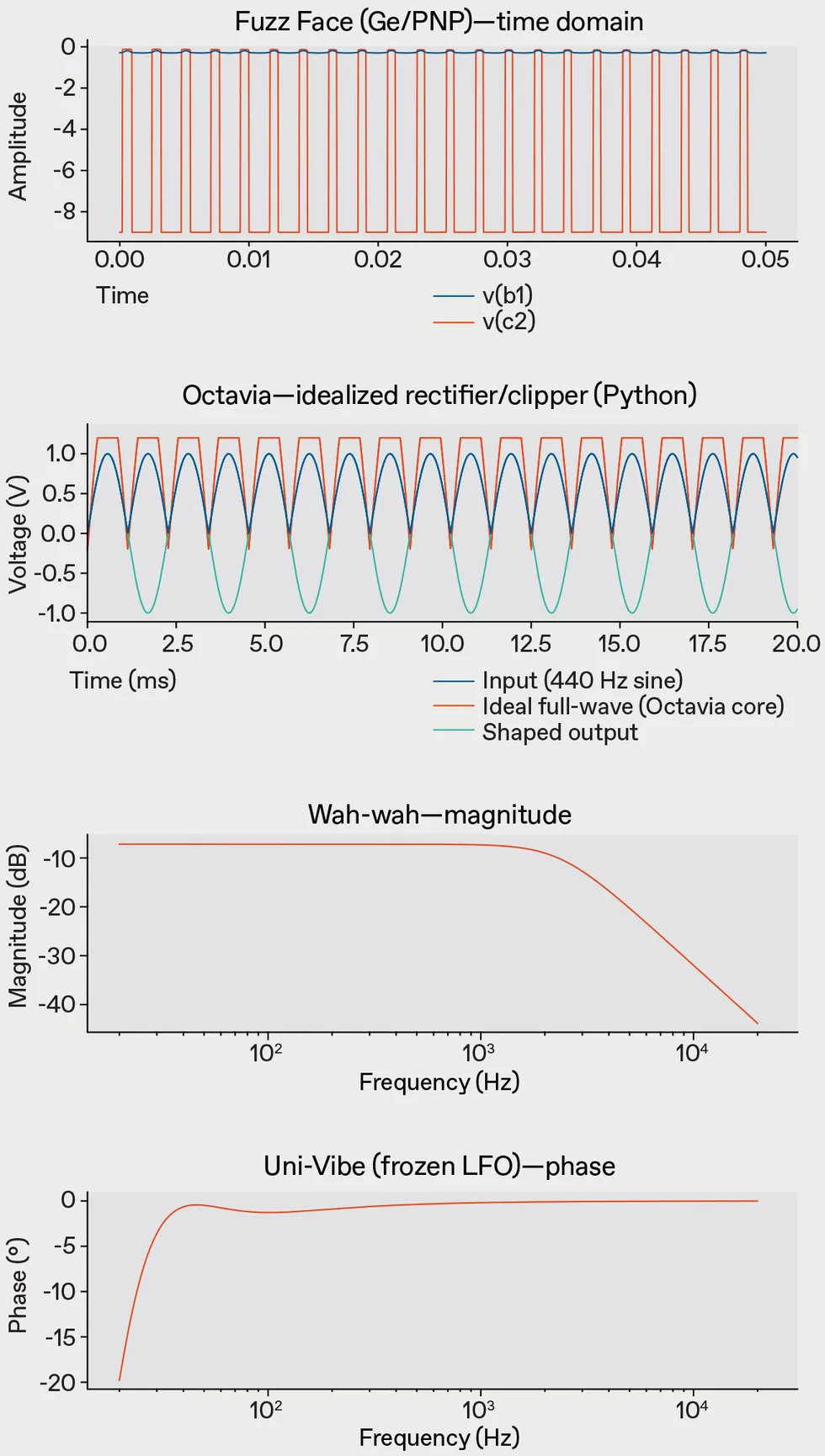
Four plots showing magnitudes plotted against time and frequency. Each effects pedal in Hendrix’s chain contributed to enhancing the electric guitar beyond its intrinsic limits. A selection of plots from the full-circuit analysis shows how the Fuzz Face turns a sinusoid signal from a string into an almost square wave; how the Octavia pedal inverts half the input waveform to double its frequency; how the wah-wah pedal acts as band-pass filter; and how the Uni-Vibe pedal introduces selective phase shifts to color the sound.James Provost/ Rohan S. Puranik

Although I work mostly in the digital domain as an edge-computing architect in my day job, I knew that analog circuit simulations would be the key to going deeper.

Advertisement

My first step was to look at the challenges Hendrix was trying to address. Before the 1930s, guitars were too quiet for large ensembles. Electromagnetic pickups—coils of wire wrapped around magnets that detect the vibrations of metal strings—fixed the loudness problem. But they left a new one: the envelope, which specifies how the amplitude of a note varies as it’s played on an instrument, starting with a rising initial attack, followed by a falling decay, and then any sustain of the note after that. Electric guitars attack hard, decay fast, and don’t sustain like bowed strings or organs. Early manufacturers tried to modify the electric guitar’s characteristics by using hollow bodies fitted with magnetic pickups, but the instrument still barked more than it sang.

Hendrix’s mission was to reshape both the electric guitar’s envelope and its tone until it could feel like a human voice. He tackled the guitar’s constraints by augmenting it. His solution was essentially a modular analog signal chain driven not by knobs but by hands, feet, gain staging, and physical movement in a feedback field.

Hendrix’s setups are well documented: Set lists, studio logs, and interviews with Mayer and Eddie Kramer, then the lead engineer at Olympic Studios, fill in the details. The signal chain for “Purple Haze” consisted of a set of pedals—a Fuzz Face, the Octavia, and a wah-wah—plus a Marshall 100-watt amplifier stack, with the guitar and room acoustics closing a feedback loop that Hendrix tuned with his own body. Later, Hendrix would also incorporate a Uni-Vibe pedal for many of his tracks. All the pedals were commercial models except for the Octavia, which Mayer built to produce a distorted signal an octave higher than its input.

Hendrix didn’t speak in decibels and ohm values, but he collaborated with engineers who did.

Advertisement

I obtained the schematics for each of these elements and their accepted parameter ranges, and converted them into netlists that ngspice can process (ngpsice is an open source implementation of the Spice circuit analyzer). The Fuzz Face pedal came in two variants, using germanium or silicon transistors, so I created models for both. In my models, Hendrix’s guitar pickups had a resistance of 6 kiloohms and an inductance of 2.5 henrys with a realistic cable capacitance.

I chained the circuit simulations together using a script, and I produced data-plot and sample sound outputs with Python scripts. All of the ngspice files and other scripts are available in my GitHub repository at github.com/nahorov/Hendrix-Systems-Lab, with instructions on how to reproduce my simulations.

What Does The Analysis of Hendrix’s Signal Chain Tell Us?

Plotting the signal at different points in the chain with different parameters reveals how Hendrix configured and manipulated the nonlinear complexities of the system as a whole to reach his expressive goals.

A few highlights: First, the Fuzz Face is a two-transistor feedback amplifier that turns a gentle sinusoid signal into an almost binary “fuzzy” output. The interesting behavior emerges when the guitar’s volume is reduced. Because the pedal’s input impedance is very low (about 20 kΩ), the pickups interact directly with the pedal circuit. Reducing amplitude restores a sinusoidal shape—producing the famous “cleanup effect” that was a hallmark of Hendrix’s sound, where the fuzz drops in and out as desired while he played.

Advertisement

A photograph of three young men beside a recording studio mixing desk. The Jimi Hendrix Experience, (left to right) Mitch Mitchel, Jimi Hendrix, Noel ReddingFred W. McDarrah/Getty Images


Second, the Octavio pedal used a rectifier, which normally converts alternating to direct current. Mayer realized that a rectifier effectively flips each trough of a waveform into a peak, doubling the number of peaks per second. The result is an apparent doubling of frequency—a bloom of second-harmonic content that the ear hears a bright octave above the fundamental.

Third, the wah-wah pedal is a band-pass filter: Frequency plots show the center frequency sweeping from roughly 300 hertz to 2 kilohertz. Hendrix used it to make the guitar “talk” with vowel sounds, most iconically on “Voodoo Child (Slight Return).”

Fourth, the Uni-Vibe cascades four phase-shift sections controlled by photoresistors. In circuit terms, it’s a low-frequency oscillator modulating a variable-phase network; in musical terms it’s motion and air.

Finally, the whole chain became a closed loop by driving the Marshall amplifier near saturation, which among other things extends the sustain. In a reflective room, the guitar strings couple acoustically to the speakers—move a few centimeters and you shift from one stable feedback mode to another. To an engineer, this is a gain-controlled acoustic feedback system. To Hendrix, it was part of the instrument. He learned to tune oscillation with distance and angle, shaping sirens, bombs, and harmonics by walking the edge of instability.

Advertisement

Hendrix didn’t speak in decibels and ohm values, but he collaborated with engineers who did—Mayer and Kramer—and iterated fast as a systems engineer. Reframing Hendrix as an engineer doesn’t diminish the art. It explains how one person, in under four years as a bandleader, could pull the electric guitar toward its full potential by systematically augmenting the instrument’s shortcomings for maximum expression.

This article appears in the March 2026 print issue as “Jimi Hendrix, Systems Engineer.”

From Your Site Articles

Related Articles Around the Web

Advertisement

Source link

Continue Reading
Click to comment

Leave a Reply

Your email address will not be published. Required fields are marked *

Tech

Today’s NYT Mini Crossword Answers for Feb. 26

Published

on

Looking for the most recent Mini Crossword answer? Click here for today’s Mini Crossword hints, as well as our daily answers and hints for The New York Times Wordle, Strands, Connections and Connections: Sports Edition puzzles.


Need some help with today’s Mini Crossword? Read on for all the answers. And if you could use some hints and guidance for daily solving, check out our Mini Crossword tips.

If you’re looking for today’s Wordle, Connections, Connections: Sports Edition and Strands answers, you can visit CNET’s NYT puzzle hints page.

Advertisement

Read more: Tips and Tricks for Solving The New York Times Mini Crossword

Let’s get to those Mini Crossword clues and answers.

completed-nyt-mini-crossword-puzzle-for-feb-26-2026.png

The completed NYT Mini Crossword puzzle for Feb. 26, 2026.

Advertisement

NYT/Screenshot by CNET

Mini across clues and answers

1A clue: Tesla or Toyota
Answer: CAR

4A clue: What the “M” of BMX stands for
Answer: MOTO

5A clue: Leafy lunch
Answer: SALAD

Advertisement

6A clue: Weighing device
Answer: SCALE

7A clue: “To be,” in Latin
Answer: ESSE

Mini down clues and answers

1D clue: Pepsi and Coke
Answer: COLAS

2D clue: Dickens’s “___ of Two Cities”
Answer: ATALE

Advertisement

3D clue: Took to another floor, as the [circled letters]
Answer: RODE

4D clue: Apple computers
Answer: MACS

5D clue: Dir. from San Francisco to Santa Monica
Answer: SSE

Advertisement

Source link

Continue Reading

Tech

Samsung Galaxy S26 Ultra's privacy screen is the most interesting upgrade this year

Published

on


The Galaxy S26 lineup runs on a customized version of Qualcomm’s latest Snapdragon 8 Elite Gen 5 SoC. Compared to last year’s Snapdragon 8 Gen 4, the new silicon delivers a 19% uplift in CPU performance, a 24% gain in GPU power, and a 39% boost in AI acceleration via…
Read Entire Article
Source link

Continue Reading

Tech

The Galaxy S26 lineup makes one thing clear: Samsung wants you in the Ultra

Published

on

Samsung‘s new Galaxy S26 lineup is by no means a reinvention of the popular smartphone brand. Instead, it’s a collection of design tweaks and some important, even one-of-a-kind, under-the-hood updates that could change the way you use your phone.

The best features, like the actually unique Privacy Display (a first for mobile phones), are confined to the Galaxy S26 Ultra. Not surprising when you consider it’s the true flagship, and the S26 and S26 Plus are more or less like bridesmaids carrying the bride’s lengthy train.

Advertisement

Source link

Continue Reading

Tech

How Petlibro is using AI to catch feline health issues early

Published

on

This post is brought to you in paid partnership with Petlibro

We spend a significant amount of time optimizing our own health: tracking our sleep, monitoring our heart rates, and dialing in our nutrition. But when it comes to our pets, we’re usually left guessing. Cats, in particular, are notorious for hiding pain or illness until a condition becomes severe.

Petlibro is shifting that dynamic with the Luma Smart Litter Box. Since its quiet launch late last year, it has quickly become a staple in thousands of modern households. It moves the concept of a self-cleaning litter box past mere convenience, turning an unpleasant daily chore into a sophisticated system for early health awareness.

AI waste analysis and health tracking

For the data-driven pet owner, the Luma Smart Litter Box provides a level of insight that was previously impossible to get without a vet visit. It’s equipped with an AI waste analysis system that differentiates between pee and poop, and can even identify the consistency of the waste.

Advertisement

Every time your cat uses the box, the system logs their weight and tracks their bathroom behavior. If your cat skips the box for 24 hours, or if there’s a sudden shift in their routine, the app sends a smart alert to your phone. For senior cats or those with sensitive stomachs or kidney issues, this continuous cat health monitoring gives you a critical head start on potential medical problems.

Multi-cat recognition and safety

If you have more than one cat, tracking who did what is usually a guessing game. Luma solves this with a built-in 1080p HD camera and advanced AI that recognizes up to 10 different cats from any angle, even from behind. You get individualized logs and video records for each pet, so you always know exactly whose health you are looking at.

Safety is also a non-negotiable factor with autonomous tech. Since hitting the market in November 2025, Luma has maintained a 100% safe-use record. It features a wide-open, spacious design rather than a cramped globe, and uses triple-check sensors with an anti-pinch system to ensure your cat is completely clear before the cleaning cycle begins.

Autonomous cleaning and odor control

Beyond the health metrics, this is still a highly engineered piece of smart home hardware designed to keep your space clean. It automatically sweeps waste into a sealed drawer after each visit, holding up to seven days of waste for two cats.

Advertisement

To ensure your home doesn’t smell like a pet sanctuary, it utilizes an active odor-control system. A built-in fan pulls air through carbon filters, filtering out 97% of odors, with adjustable fan speeds controlled directly from the app. It’s a quiet, seamless integration into a well-kept home.

The bottom line

The Petlibro Luma represents a maturation in pet technology. It is a smart litter box for cats that respects the aesthetics of your home while acting as a daily preventive care tool for your pets. It replaces guesswork with hard data, offering peace of mind that your cat’s health is always being monitored.

Source link

Advertisement
Continue Reading

Tech

The AirPods Pro 3 Are $20 Off

Published

on

Looking for a new pair of earbuds to pair with your favorite iPhone or iPad? Right now, you can grab the Apple AirPods Pro 3 for just $229 on Amazon or Best Buy, a $20 break from their usual price. They’re our favorite wireless headphones for iPhone owners, with great noise-canceling, easy connectivity, and unique features like heart rate and live translation.

  • Review: Apple AirPods Pro 3

  • Review: Apple AirPods Pro 3

The active noise-canceling on the third generation AirPods Pro has improved a great deal, with our reviewer Parker Hall comparing them to the Bose QuietComfort Ultra 2 Earbuds when it comes to filtering out all but the highest frequency, loudest noises. The improved ear tips, now lined with foam, are more comfortable and fit better in smaller ears, with four different sizes to choose from. They also have better sound isolation, which improves the noise canceling and transparency mode performance noticeably.

While Android owners have a variety of choices when it comes to earbuds and headphones, iOS users will appreciate the extra features specifically built for anyone in the Apple ecosystem. If you’re into running with minimal devices, the AirPods Pro 3 can actually take your heart rate through your ears, a neat trick that we found surprisingly consistent with other fitness trackers. Another unique feature, live translation, will bring up the Translate app on iOS and relay what someone else is saying directly into your ears in your own language. Once again, we were impressed by how fast and accurate the system was, and as more languages are added it will become even more useful.

We really only had two minor complaints about the AirPods Pro 3, one of which was that the default EQ is a bit V-shaped, with a slightly overdone bass that’s either really appealing or slightly grating. Thankfully you can tweak your EQ in Spotify or Apple Music to dial in that experience. The other issue is that these have limited compatibility with Android devices, so if you’re on a Samsung or Pixel, you’ll want to check out our other favorite earbuds. For iPhone and iPad owners looking for the latest and greatest for their listening experience, the discounted AirPods Pro 3 are an excellent choice.

Advertisement

Source link

Continue Reading

Tech

Webb Peels Back the Layers of the Cranium Nebula

Published

on

NASA James Webb Space Telescope Cranium Nebula
Photo credit: NASA/Chris Gunn
The Cranium Nebula has piqued astronomers’ interest, due to some stunning new images from NASA’s James Webb Space Telescope. These photos reveal the layers of a faraway cloud of gas and dust wrapped tightly around a star as it begins to die. This planetary nebula, officially known as PMR 1 and informally known as the exposed Cranium due to its uncanny appearance to a brain tucked inside a phantom skull, sits quietly in a backwater area of space that has only recently gained attention.


Webb captured the entire scene with two of its most powerful tools, beginning with its Near-Infrared Camera, or NIRCam, which produces a crystal clear image with innumerable background stars and distant galaxies piercing the nebula’s veil like tiny needles. A prominent dark channel runs vertically down the center, plainly dividing the entire image into left and right parts that resemble cerebral hemispheres. The outer edge has a faint, almost white glow, while the middle is a deep orange, with clouds that appear to be pushed outwards from the center in a sequence of waves, as if they were colliding in midair.


LEGO Icons Project Hail Mary Collectible Building Set for Adults – Room or Office Decor for Men & Women…
  • PROJECT HAIL MARY SCI-FI MODEL – Launch into the world of cinematic science fiction with the LEGO Icons Project Hail Mary (11389) microscale…
  • WHAT’S IN THE BOX – Includes everything you need to build a microscale replica of the Hail Mary spacecraft, a functional display stand, plus a…
  • FUNCTIONAL SPACE MODEL – Turn the crank on the display stand to send the crew module into orbit, simulating the spaceship’s centrifugal gravity…


When you switch to the Mid-Infrared Instrument (MIRI), the entire picture changes. The cosmic dust blazes brightly in a variety of tones that can make you just feel the texture. The same center black lane remains visible, of course, but you can now see where all of the material being emitted by the central star is heading. Stuff is rushing out at the top and bottom, probably in two large opposing jets that chisel their way through the inner gas, providing intricacy to the nebula’s overall shape.

NASA James Webb Space Telescope Cranium Nebula
That level of information is a significant improvement over what the Spitzer Space Telescope was capable of more than a decade ago. Spitzer was the first to reveal the brain-like shape, but it was like gazing at the Cranium from a distance; all you could see was the overall outline. The Webb, on the other hand, allows you can see the fine features much more clearly and demonstrates how different wavelengths of light can highlight different parts of the nebula. The near-infrared shows the dust getting blown away, while in the mid-infrared, the dust itself is lit up like a stage.

NASA James Webb Space Telescope Cranium Nebula
With its rapid-fire bursts, this nebula tells the story of a star that is running out of fuel and beginning to shed its outer layers. The inner area is a jumble of heavier gases and more intriguing patterns, whereas the outside shell is primarily composed of hydrogen that was expelled early. Things are becoming quite crazy in there, as evidenced by the central dark channel, which is most likely the result of a big outburst or couple of jets. It could finish up as a tiny, slowly cooling white dwarf or explode as a supernova, depending on the star’s initial characteristics, size, and other factors.

Advertisement

Source link

Continue Reading

Tech

Using Camera Noise to Build a True Random Number Generator Isn’t Easy, But Possible

Published

on

Camera Noise True Random Number Generator
Since the power of a true random number generator comes from the actual unpredictability of the physical world, software equivalents are simply constrained by patterns in the algorithms they employ after the starting point is known. Hardware techniques become somewhat more intriguing, utilizing chaotic phenomena such as quantum effects or thermal movements. One project just followed the easiest route, extracting randomization directly from a camera sensor’s noise.


YouTuber “Maker Theory to Thing” started by attachin an OV3660 camera module to an ESP32 microcontroller. Then, to totally block light, they placed a sheet of black electrical tape directly over the lens. The sensor is still able to detect minute changes even in almost complete darkness. Heat builds up and begins to jostle the electrons inside each pixel as the device heats up and operates, producing a variety of noise speckles across what should be a nice, even black picture.

He began by focusing on the least important aspect of each individual pixel after obtaining the raw pixel data from a few frames. That one bit would oscillate between a zero and a one, reacting excessively to even slight variations. They gather all of those bits and combine them into streams of lovely, unpredictable data because even a single electron moving from one place to another can tip it.

Camera Noise True Random Number Generator
When he initially tested it, the findings weren’t very promising because there was a slight imbalance, with 51 percent ones and 49 percent zeros. As it happens, some of the camera’s pixels would remain fixed on the same value from frame to frame (due to dust, a scratch, or simply a manufacturing quirk somewhere along the line). Some predictable aspects would be added to the mix by those consistent pixels. They therefore devised a straightforward method for comparing the frames and eliminating the regions that remained unchanged. The distribution of ones and zeros became considerably closer to being lovely and even after that phase.

Camera Noise True Random Number Generator
The results are collected and streamed over the air by the ESP32. Users can access a simple online interface and ask yes-or-no queries. When you press a button, you will receive a response from the noise-derived randomness. It’s much faster because everything stays local and you don’t require the internet. The camera’s ability to quickly scan across thousands of pixels is what gives it speed.

Camera Noise True Random Number Generator
Though the real entropy comes from sensor noise in photos of the moving blobs, similar concepts have previously been applied, such as when Cloudflare employed lava lamps. While other builders used diode avalanche effects or optical mouse sensors, this version is notable for having fewer parts. Since no additional components produce the core entropy, a cheap ESP32-CAM board gets the job done.

Under controlled conditions, thermal noise in image sensors provides some fairly consistent unpredictability. Just be aware that bias may be introduced by light leaks or abrupt temperature changes, although this won’t be a problem if the lens is covered. All of the statistical checks verify that the output acts randomly, which is ideal for sporadic or experimental purposes.
[Source]

Advertisement

Source link

Continue Reading

Tech

NASA astronaut who suffered serious medical issue on ISS steps forward

Published

on

The NASA astronaut whose serious medical issue prompted the early return of SpaceX’s Crew-11 from the International Space Station (ISS) has spoken out about the incident.

In a statement posted on NASA’s website on Wednesday, NASA astronaut Mike Fincke stepped forward to say that while in orbit aboard the ISS, he experienced a medical event “that required immediate attention from my incredible crewmates,” adding that “thanks to their quick response and the guidance of our NASA flight surgeons, my status quickly stabilized.”

Fincke, 58, continued: “After further evaluation, NASA determined the safest course was an early return for Crew-11 — not an emergency, but a carefully coordinated plan to be able to take advantage of advanced medical imaging not available on the space station.”

Crew-11 arrived at the ISS in August 2025 and weren’t due to return until at least a month later. But it became apparent that all was not well aboard the orbital outpost on January 7 when NASA called off a spacewalk involving Fincke and colleague Zena Cardman that was scheduled for the following day.

Advertisement

In his statement, Fincke declined to give any details about the nature of his medical condition, but at the time the situation was deemed serious enough for newly installed NASA administrator Jared Isaacman to bring the four-person crew home early aboard their SpaceX Dragon spacecraft, which splashed down off the coast of San Diego on January 15.

“I am deeply grateful to my fellow Expedition 74 members — Zena Cardman, Kimiya Yui, Oleg Platonov, Chris Williams, Sergey Kud-Sverchkov, and Sergei Mikayev — as well as the entire NASA team, SpaceX, and the medical professionals at Scripps Memorial Hospital La Jolla near San Diego,” Fincke said in his statement. “Their professionalism and dedication ensured a positive outcome.”

He added that he’s “doing very well and continuing standard post-flight reconditioning at NASA’s Johnson Space Center in Houston,” describing spaceflight as “an incredible privilege,” and how it sometimes “reminds us just how human we are.”

Crewed space missions have, very occasionally, been shortened due to technical issues, but the rescheduling of Crew-11 marks the first time in NASA’s history that an astronaut mission has been cut short over health concerns.

Advertisement

While the ISS has various medical facilities to cope with health emergencies, in this case it was clear that the safest way forward was to bring the crew home.

Source link

Advertisement
Continue Reading

Tech

Valve Software sued by New York AG, accused of promoting illegal gambling via video game loot boxes

Published

on

(Valve Software Image)

A new suit filed by the New York attorney general seeks to stop Valve Software’s use of “loot box” mechanics in its popular PC games, accusing the Bellevue, Wash.-based company of making billions of dollars by luring children and teenagers into gambling on rare Counter-Strike skins.

The lawsuit alleges that Valve’s first-party games are essentially an illegal gambling operation aimed at younger players. It seeks to stop Valve from implementing loot box mechanics in its games going forward, as well as hit the company with a fine equal to “three times the amount of its gain from the illegal practices alleged herein.”

While it’s arguably best known for running the digital gaming marketplace Steam, Valve Software also owns and operates several of its own popular PC games, including Counter-Strike 2, Dota 2, and Team Fortress 2.

All three games feature an optional mechanic where players can pay real money in exchange for “loot boxes”: a virtual item that drops a randomly-generated piece of cosmetic gear that can be used in-game. Most of these items have no mechanical impact and are there strictly for looks, such as silly hats in TF2 or neon-painted “weapon skins” in CS2. This might not make sense to you, but there are people in this world who will pay any price to get an appropriately ugly virtual rifle, and these people are part of why Valve CEO Gabe Newell has a superyacht.

Despite their lack of actual effect, loot boxes and item trading are both an extraordinarily lucrative market for Valve. Virtual items for these three games have been sold for staggering amounts of real money. One estimate cited by the AG’s office indicates that the market for Counter-Strike skins alone was worth over $4.3 billion as of last year.

Advertisement

While Valve absolutely benefits from the strangely frenetic market for virtual items in CS2, TF2, and Dota 2 — it sell these loot boxes in the first place, and hosts the secondary market for them via the in-app Steam Marketplace — the occasionally shocking prices for these items is part of a player-created economy.

In an official press release, New York Attorney General Letitia James wrote that “illegal gambling can be harmful and lead to serious addiction problems… Valve has made billions of dollars by letting children and adults alike illegally gamble for the chance to win valuable virtual prizes. These features are addictive, harmful, and illegal, and my office is suing to stop Valve’s illegal conduct and protect New Yorkers.”

GeekWire reached out to Valve for further comment.

The suit against Valve marks the latest in a series of moves by James to tamp down on gambling operations within New York state, such as shutting down 26 online casinos last year, as well as taking aim at Meta and TikTok for those platforms allegedly posing “harms to young people’s mental health.”

Advertisement

Source link

Continue Reading

Tech

Technics has given its excellent turntable a much-needed upgrade

Published

on

Panasonic has unveiled two very different additions to its audio lineup: the audiophile-focused Technics SL-1500CS direct drive turntable and the party-ready SC-BMAX30 transportable speaker.

The Technics SL-1500CS marks the return of the well-regarded SL-1500C. It has been updated with the company’s latest audio innovations such as the ΔΣ-(Delta Sigma) Drive technology, which it has borrowed from more expensive models in its line-up.

Technics SL-1500CS MunichTechnics SL-1500CS Munich
Image Credit (Trusted Reviews)

The addition of the ΔΣ-Drive, as well as reducing motor vibrations and improving the rotational stability of the platter, is whyTechnics claims the SL-1500CS delivers “best in class” standard for sonic performance.

A built-in phono equaliser is included, making it easier to connect the deck directly to amplifiers or speakers without the need for dedicated phono preamp. Given the SL-1500C came out seven years, the design has also been a much-needed lick of paint refreshed, with a metallic grey colourway that retaining Technics’ minimalist aesthetic.

Advertisement

Advertisement

The SL-1500CS will retail for £1,099 when it goes on sale from March 2026 onwards.

Panasonic SC-BMAX30 party speakerPanasonic SC-BMAX30 party speaker
Image Credit (Trusted Reviews)

From the Panasonic side of the audio department comes a new flagship party speaker in the SC-BMAX30. It’s able to deliver 320W of power, a speaker that’s main intent is to boom out a deep bass performance. We were at Panasonic’s Experience Event in Germany and ti delivers plenty low frequency welly.

Despite its size, portability is clearly a priority. The SC-BMAX30 has wheels, a telescopic handle, and can reportedly last up to 14 hours of battery life.

A metal grille conceals a dynamic lighting system designed to sync with your music, and the design is also rated to IPX4 to protect this party speaker from splashes and light weather.

Advertisement

Advertisement

For connectivity options include Bluetooth Multipoint for pairing two devices simultaneously and Wireless Chain Connection for linking multiple units together. Moreover, there are dedicated mic and guitar inputs for karaoke or live sessions, though as one person pointed out, it could do with some RCA connections.

The SC-BMAX30 goes on sale March 2026, and it is priced at £399.99 / €449.

Source link

Advertisement
Continue Reading

Trending

Copyright © 2025