


Connect with us

Tech

JLab Blue XL Speaker Headphones: For People Who Hate Earbuds, Over-Ears, and Being Told How to Listen

Published

on

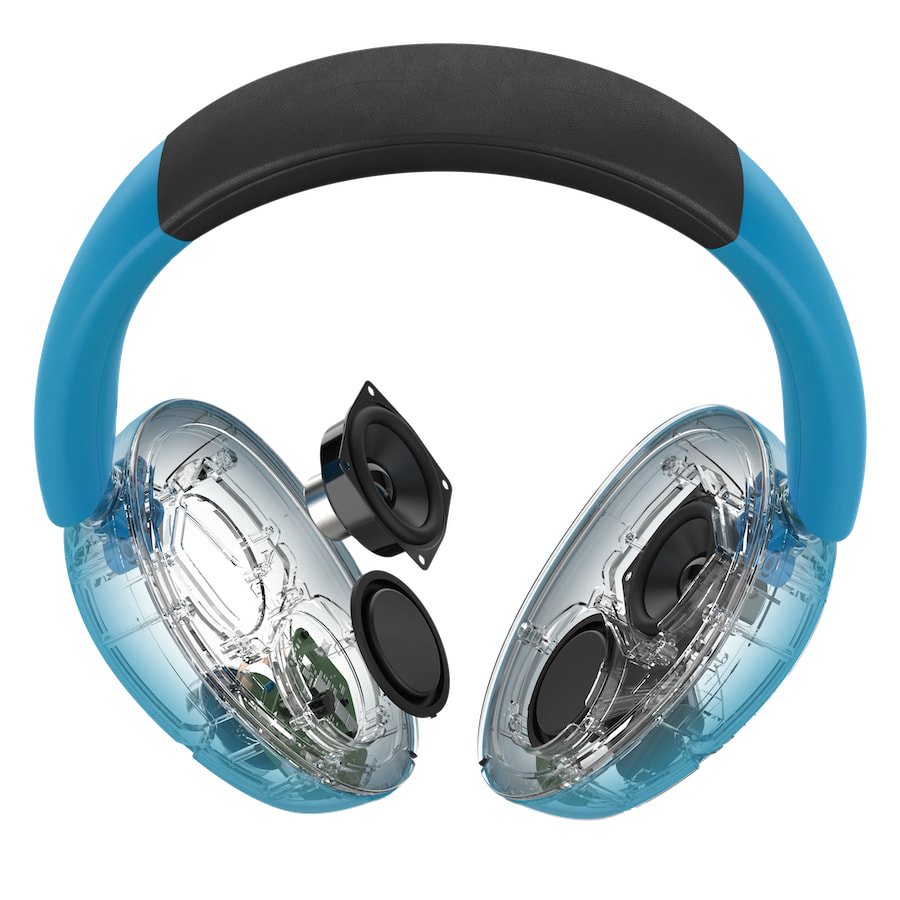
Some products look ridiculous at first glance; and then you realize they’re only ridiculous if you’re not the exact person they were built for. The JLab Blue XL speaker headphones are one of those rare cases where “that’s dumb” quietly turns into “okay, that actually makes sense.” At $99.99, these aren’t headphones pretending to be serious audio gear. They’re wearable Bluetooth speakers with dual 2.5-inch drivers, passive radiators, and a claimed 30 watts of output that can hang around your neck or sit on a table when the party migrates.

Twenty hours of battery life seals the deal for tailgates, backyard wins, hotel rooms, and let’s be honest, places like Mardi Gras, where wearing them a certain way may result in beads, questionable life choices, and stories you don’t repeat at work.

Are there physical implications? Absolutely. Are they practical for commuting or critical listening? Not even remotely. But for a very specific American use case—celebrating loudly, publicly, and without shame the Blue XL makes an oddly convincing argument. Only in America.

JLab Blue XL Speaker Headphones: 30-Watt Wearable Bluetooth Speakers

jlab-blue-xl-win-cramer-around-neck

The JLab Blue XL speaker headphones are about brute force and convenience, not subtlety. Audio is handled by dual 2.5-inch drivers with a rated frequency response of 100 Hz to 20 kHz and a 4-ohm load, which tells you right away these are tuned for output and impact rather than finesse.

There’s onboard EQ switching via a physical control knob. No app, no firmware rabbit hole, no “just update it” nonsense. They fold, support Wireless Share Mode, and use faux-leather ear cushions that are less about luxury and more about keeping this thing from feeling like gym equipment hanging off your neck.

Advertisement
jlab-blue-xl-speaker-parts

Connectivity is straightforward and current: Bluetooth 5.4 with SBC and AAC codec support, a claimed range of 30+ feet, and the usual protocol alphabet soup (A2DP, AVCTP, AVDTP, AVRCP, SPP) to keep everything talking without drama. Power comes from 2 x 3,000 mAh batteries, good for up to 20 hours of playtime, charged over USB-C in about 3 hours. No charger is included; welcome to 2026. So you’ll need a 5 V / 2 A source delivering between 2.5 and 5 W to hit maximum charging speed.

Wear them around your neck like oversized headphones or drop them on a table and let them do their thing. Are they elegant? Not even close. Are they honest about what they are and who they’re for? Absolutely—and that’s why they work.

The Bottom Line

The JLab Blue XL speaker headphones do one thing well—they play loud, hands-free, and without pretending they’re something refined. Dual 2.5-inch drivers and real output make them genuinely useful for backyard hangs, tailgates, garage nights, or parked next to the BBQ while you grill in -19° weather like a person who has fully given up on comfort.

Advertisement

What they do poorly or rather, what’s absurd—is the idea of wearing them on public transit, at the beach, or anywhere involving water, dust, or other humans with patience. There’s no water resistance, no dust protection, and absolutely no reason to wear these on the subway unless you’re looking for something solid to swing at a mugger.

At $99.99, they’re reasonably priced if they sound decent, but this is not a Super Bowl party savior if you’re ordering late, and it’s definitely not a lifestyle product. These are for a very specific user: someone who wants loud, social sound without earbuds, without fragility, and without shame. Leave them on a table, keep them out of the sand, don’t take them on public transit and suddenly, they make a weird amount of sense. Sounds about right for the times.

Where to buy: $99.99 at JLab

Advertisement. Scroll to continue reading.
Advertisement

Source link

Continue Reading
Click to comment

Leave a Reply

Your email address will not be published. Required fields are marked *

Tech

First multi-coronavirus vaccine enters human testing, built on UW Medicine technology

Published

on

A model of a new vaccine targeting a family of coronaviruses that includes the virus that causes COVID-19. The image highlights pieces of several different viruses attached to a computer-designed nanoparticle to trigger an immune response. (Ian C. Haydon Image)

A candidate vaccine that fights a suite of coronaviruses including COVID-19 and related, deadly respiratory diseases is starting human clinical testing in Australia. The vaccine was developed using technology from the University of Washington’s Institute for Protein Design.

South Korean pharmaceutical company SK bioscience is leading the trial for the new coronavirus vaccine, called GBP511. SK bioscience previously partnered with UW researchers on a COVID-19 vaccine that received regulatory approval.

The Coalition for Epidemic Preparedness Innovations has provided the GBP511 program with approximately $65 million in funding. 

Unlike most vaccines that target a single virus or strain, GBP511 aims to protect against multiple coronaviruses at once.

Neil King (left) and David Veesler are University of Washington biochemistry professors developing computer-designed protein vaccines. (UW Photo / Ian C. Haydon)

“GBP511 is the first vaccine to reach human testing that is intended to protect against multiple strains of the virus that causes COVID-19 as well as related coronaviruses with the potential to spark dangerous outbreaks,” Neil King, associate professor of biochemistry at UW Medicine, said in a statement.

King, who is deputy director of the Institute for Protein Design, co-invented the self-assembling nanoparticle technology that was used to generate the vaccine. The institute is on the cutting edge of AI-assisted protein innovation and perhaps best known as the home of David Baker, a 2024 Nobel Prize winner in chemistry.

Advertisement

The new vaccine recognizes sarbecoviruses, a subgroup of coronaviruses that include the virus that causes COVID-19, as well as those responsible for other major disease outbreaks: the original SARS-CoV-1 virus that caused widespread illness in the early 2000s and MERS-CoV, which caused outbreaks primarily in the Middle East. The family also includes viruses found in animals such as camels and bats, some of which have already infected humans and others that potentially could.

The vaccine features pieces of four different coronaviruses attached to a computer-designed nanoparticle, triggering an immune response to a variety of invaders.

“The beauty of this approach is that by presenting the immune system with multiple related antigens at once, we can train it to recognize features that are conserved across the entire sarbecovirus family,” said David Veesler, a professor of biochemistry at UW Medicine who led the preclinical studies.

The international Phase 1/2 trial launched its enrollments last month and aims to include approximately 368 healthy adults in Perth, Western Australia. Results from the study examining the vaccine’s safety and effectiveness are expected by 2028. 

Advertisement

Source link

Continue Reading

Tech

How Elon Musk is rewriting the rules on founder power

Published

on

Elon Musk has merged SpaceX and xAI, creating what might be the blueprint for a new Silicon Valley power structure. With his $800 billion net worth already rivaling historic conglomerate GE’s peak market cap, and Musk being vocal about his view that “tech victory is decided by velocity of innovation,” the question isn’t whether a personal conglomerate can be built, but rather how far Musk himself is going to take it. 

Watch as Equity dives into this new era of the “everything” business, whether we’ll see others like Sam Altman follow suit, and more of the week’s headlines. 

Subscribe to Equity on YouTube, Apple Podcasts, Overcast, Spotify and all the casts. You also can follow Equity on X and Threads, at @EquityPod. 

Advertisement

Source link

Continue Reading

Tech

Harbor Freight Just Dropped A New Purple Color For Several US General Tool Cabinets

Published

on


Harbor Freight has hit the ground running in 2026, debuting a selection of products that aren’t power tools, including smartphone-compatible OBD II code readers and foldable welding tables. It’s not just introducing new offerings for 2026, though; it’s also expanding color options for several of its U.S. General tool boxes and cabinets, with purple the latest addition to the lineup.

U.S. General is one of Harbor Freight’s in-house brands and focuses primarily on tool storage solutions. In late 2025, Harbor Freight announced it was adding three colors to the list of exterior color options for U.S. General products: purple, slate gray, and green. Green and gray arrived first, with purple now the newest shade customers can choose from at the time of writing. Many of U.S. General’s third-generation of tool chests, such as its triple-bank roll cab, work center hutch, and 22-inch end locker, are all now available in purple.

Advertisement

Certain attachments and accessories, such as folding side trays for U.S. General carts, also come in purple. This helps those opting for the new color to keep their tool setup looking uniform. However, many U.S. General accessories, like its Magnetic Power Strip and Magnetic Glove/Tissue Dispenser, are not currently sold in purple as of early February 2026.

Advertisement

Harbor Freight likely has another new color on the horizon

Another U.S. General product that is now available in purple is the Snap-On-esque Mini Steel Toolbox. Originally perceived by many as a gimmick, the store’s compact, 10-pound toolbox eventually became a very popular item, due in part to its simple functionality and sub-$20 price tag. 

Like other U.S. General products, the Mini Steel Toolbox comes in black, red, and blue, as well as the newer green, slate gray, and purple colors. However, Harbor Freight is capitalizing on the Mini Toolbox’s virality by asking followers to vote on the next color option for the product. In August 2025, the retailer announced a seventh color would be added in 2026, with voters able to choose from light pink, hot pink, yellow, or orange.

Harbor Freight provided mock-ups for the vote, but it wouldn’t be hard to imagine what the Mini Toolbox would look like in either orange or yellow anyway. That’s because a lot of other equipment from the brand, like the U.S. General Series 3 72 x 22-inch Triple-Bank Roll Cab, already comes in yellow and orange, as well as white, and that’s in addition to the six colors currently available for the Mini Toolbox. Thankfully, cost needn’t be a factor when deciding which color is right for you, as the price remains the same for these U.S. General products regardless of color.

Advertisement


Source link

Advertisement
Continue Reading

Tech

Disney+ loses access to Dolby Vision and HDR10+ in some European countries

Published

on

Disney+ subscribers in some European countries have lost access to advanced HDR features like Dolby Vision and HDR10+, TechRadar and FlatpanelsHD report. The issue was first spotted by German Disney+ subscribers on Reddit, but currently also impacts subscribers in Portugal, Poland, France and the Netherlands, according to FlatpanelsHD.

“Dolby Vision support for content on Disney+ is currently unavailable in several European countries due to technical challenges,” Disney said in a statement. “We are actively working to restore access to Dolby Vision and will provide an update as soon as possible. 4K UHD and HDR support remain available on supported devices.”

If the issue is in fact a technical one, it seems like it could be around for the long-term. Disney has removed any reference to Dolby Vision from its Disney+ video quality support page in Germany. As of now, the company lists HDR10 as its default HDR format, despite Dolby Vision support being a feature of Disney+ for several years now.

FlatpanelsHD writes that the real issue might be legal, rather than technological. A company called InterDigital won an injunction in a German court against Disney in November 2025 because it violated at least one of the company’s patents on streaming video technology. The injunction specifically requires Disney to stop violating InterDigital’s patent on “a method for dynamically overlaying a first video stream with a second video stream comprising, for example, subtitles.” It’s not entirely clear how that plays into the company offering Dolby Vision and HDR10+ in Europe, but it would explain why subscribers in Germany were some of the first people to notice Dolby Vision’s absence.

Advertisement

Engadget has contacted Disney for more information about Disney+’s missing HDR support and whether InterDigital’s injunction played a role. We’ll update this article if we hear back.

Mentions of Dolby Vision and HDR10+ were also stripped out of the US version of Disney+’s video quality support page. InterDigital hasn’t won an injunction in the US, but the company is pursuing a patent case against Disney in the United States District Court for the Central District of California. That doesn’t necessarily mean Dolby Vision support will be taken from US subscribers next, but it does suggest there’s more happening here than just technical challenges.

Source link

Advertisement
Continue Reading

Tech

The US Marine Corps Unveils First Modular 3D-Printed Drone

Published

on


Drone technology has prompted military forces around the world to innovate defensive techniques as remote-controlled war machines get more capable, and affordable. Ukraine says its new mini-drone can go as fast as some hypercars and is using WWII-era prop planes to take out Russian attack drones. A joint U.S. military task force published new guidelines to defend the country from drones in January, and the nation’s Marine Corps has a new 3D-printed drone that was designed by and built entirely by Marines. It’s the Marines’ first 3D-printed drone to be greenlit under the National Defense Authorizing Act, or NDAA. It’s also cleared anti-spyware checks to get flight clearance from NAVAIR, the US Navy command responsible for managing naval equipment. The Marines are a separate branch from the Navy with its own wing in the Pentagon, but the two forces were joined as sister services in 1834 by Congress and President Andrew Jackson.

The Hanx is intended to be a “one-way attack” drone that deploys its weapons payload in a way that destroys the craft. This precludes the need for a return flight  that an enemy could track, which has U.S. military commanders more than curious. In December 2025 the The Marines tested their first ship-launched one-way drone. The HANX is also modular, and when not tasked with delivering explosive payloads it could be outfitted for surveillance or logistics support. The Marines will also be able to produce spare parts for and repair damaged or malfunctioning HANX drones quickly. Instead of waiting for purchase orders to go through and a contractor to make and deliver parts, all the Marines need to fix a Hanx are digital blueprints and a 3D printer. It’s the very same reason aircraft carriers are now using 3D-printed parts.

Advertisement

Who designed the Hanx drone?

The Marine Corps has a Lego club and the COVID-19 pandemic partially to thank for its new drone. Sgt. Henry David Volpe joined a Lego robotics club in middle school, and in an interview on the Marine Corps website he credited his family with inspiring his love for technology. “Both my parents are engineers, so I feel like I’ve always had that encouragement to tinker and experiment with things,” he said. Volpe started working as an auto mechanic while studying to be one in college, but the COVID pandemic made it hard for him do both simultaneously. He joined the Marines with the 2nd Maintenance Battalion, where he learned about the Expeditionary Force Innovation Campus at Camp Lejeune that worked with 3D printing and robotics. As he recalls, “I immediately went over to the innovation campus, shook hands with the master sergeant, and said, ‘I want to work over here, I’ve got experience with this.’”

Advertisement

Volpe’s problem solving skills (he was quickly able to repair a broken 3D printer at the facility) impressed Matthew Pine, the officer in charge of the campus. Pine and Volpe observed an Army drone project at Fort Campbell during a visit there. Volpe recalls being impressed, “but what I saw was a big price tag. I knew I could make something far cheaper without sacrificing too many features.” Pine assembled a team of Marines to bring Volpe’s vision to the workshop, and they were able to produce a prototype in just 90 days. The name “Hanx” comes from Volpe’s nickname Hank, but he deflects credit for creating it. “This was only possible because of the collaboration with the team around me,”he explained. “I designed it, but I didn’t work on it alone.”


Advertisement

Source link

Continue Reading

Tech

AI.com Sells for $70 Million, the Highest Price Ever Disclosed for a Domain Name

Published

on

Kris Marszalek, the co-founder and CEO of cryptocurrency exchange Crypto.com, has paid $70 million for the domain AI.com — the highest price ever publicly disclosed for a website name, according to the deal’s broker Larry Fischer of GetYourDomain.com.

The entire sum was paid in cryptocurrency to an undisclosed seller. Marszalek plans to debut the site during a Super Bowl ad this weekend, offering a personal “AI agent” that lets consumers send messages, use apps and trade stocks. The previous domain sale record was nearly $50 million for Carinsurance.com, per GoDaddy.

Source link

Continue Reading

Tech

Save up to 81 percent on ExpressVPN two-year plans right now

Published

on

ExpressVPN is back on sale again, and its two-year plans are up to 81 percent off right now. You can get the Advanced tier for $88 for 28 months. This is marked down from the $392 that this time frame normally costs. On a per-month basis, it works out to roughly $3.14 for the promo period.

We’ve consistently liked ExpressVPN because it’s fast, easy to use and widely available across a large global server network. In fact, it’s our current pick for best premium VPN. One of the biggest drawbacks has always been its high cost, and this deal temporarily solves that issue.

Image for the small product module

ExpressVPN

Get two years (plus four bonus months) for $88.

Advertisement

In our review we were able to get fast download and upload speeds, losing only 7 percent in the former and 2 percent in the latter worldwide. We found that it could unblock Netflix anywhere, and its mobile and desktop apps were simple to operate. We gave ExpressVPN an overall score of 85 out of 100.

The virtual private network service now has three tiers. Basic is cheaper with fewer features, while Pro costs more and adds extra perks like support for 14 simultaneous devices and a password manager. Advanced sits in the middle and includes the password manager but only supports 12 devices.

Source link

Advertisement
Continue Reading

Tech

Why cloud strategies are pivoting from reaction to precision

Published

on

Kyndryl Ireland’s Des Ryan discusses how businesses are changing their cloud strategies due to data sovereignty and AI.

Cloud computing remains one of the tech sector’s biggest industries, with the global cloud market being valued at more than $900bn last year.

Toward the end of 2025, enterprise technology services provider Kyndryl published its annual Cloud Readiness report, highlighting how businesses are navigating cloud strategies – with particular attention being paid to the technology’s relationship with AI.

As shown by Kyndryl’s report – which compiled insights from 3,700 business leaders across 21 countries – cloud’s importance within organisations is clear, with the tech becoming a significant backbone of enterprise operations.

Advertisement

But while cloud is cited as a significant consideration for organisations, 70pc of CEOs stated they arrived at their current cloud environment “by accident, rather than by design”. But this reactive approach to cloud seems to be shifting, according to the report.

“After years of rapid migration, many organisations are reassessing environments that were built reactively rather than by design,” says Des Ryan, managing director of Kyndryl Ireland.

“Hybrid and multi-cloud are now firmly the norm. 84pc of leaders intentionally use multiple clouds, while 41pc are bringing at least some workloads back on-premise to strike a better balance between control, performance and compliance.

“Cloud is increasingly about locating workloads where they make the most sense.”

Advertisement

Defining forces

As Ryan explains to SiliconRepublic.com, sovereignty and security are majorly reshaping cloud strategies.

According to the report, three-quarters of business leaders are concerned about geopolitical risks linked to global cloud environments, while 65pc have already modified their cloud approach in response to new data sovereignty regulations.

“Digital sovereignty has moved from a regional compliance issue to a global strategic concern,” says Ryan. “Geopolitical uncertainty and new regulations are pushing organisations to reassess where data lives, how it is accessed and who controls it.”

He explains that many organisations are adopting “more flexible architectures” as a result, which is “enabling workloads and data to move across providers and locations without disruption”.

Advertisement

“Some are also moving sensitive data or workloads to on-premise environments to reduce exposure and increase control. Put simply, sovereignty concerns are encouraging more deliberate, interoperable designs that preserve choice while meeting regulatory obligations.”

Unsurprisingly, AI is another “defining force” of shifting cloud strategies – particularly in relation to AI deployment and computational demand.

“While 89pc of leaders say cloud investments have made it easier to deploy AI, 35pc cite integration challenges as a major barrier to realising a return on their investment,” says Ryan.

“This is driving interest towards more specialised infrastructure, including private AI environments and GPU-optimised neoclouds which are designed to support AI workloads efficiently while keeping costs and computational requirements in check.”

Advertisement

Cloud disparities

In terms of cloud strategies, Ryan says the biggest divide he’s seeing is between organisations that treat cloud as a strategic platform and those still managing a fragmented infrastructure.

“Many leaders acknowledge that their current environments evolved without a clear plan, which limits their ability to respond quickly to regulatory change, security threats or AI demand,” he says.

“A successful cloud strategy starts with intentional design. That means aligning architecture, governance and data, and security from the outset, rather than adding controls afterwards.

“This includes the need for hybrid capabilities, which provides the option to run workloads seamlessly across on-premise, public and private environments, while managing them through a consistent operational and security framework.”

Advertisement

Ryan emphasises that security and compliance must be embedded by design in an organisation’s cloud strategy.

“As threats increase and regulation evolves, adaptable architectures are critical,” he says. “This is why such a large number of organisations are now investing in AI-driven cybersecurity.

“Integration is key, particularly relevant when it comes to AI. While cloud enables AI adoption, the results depend entirely on how well data, platforms and processes connect across environments.”

Cloud’s future

The renewed focus on strategy highlighted by the Cloud Readiness report is set to continue according to Ryan, who predicts that the future of cloud will be “less about scale alone and more about precision”.

Advertisement

He believes that organisations will continue to move towards hybrid, interoperable environments designed to support AI, security and regulatory agility simultaneously, while specialised infrastructure for AI – especially private AI and GPU-optimised platforms – will grow.

“At the same time, cloud security will continue to evolve rapidly, driven by real-world outage experience and the expanding AI threat landscape,” he says.

“Ultimately, cloud will become more intentional, more regulated and more deeply integrated into business strategy, delivering a flexible foundation for whatever comes next.

“One thing is clear, however, and that’s the fact that cloud utilisation is on the rise. What that looks like and who provides it may be very different in the years to come, and that’s something we can only guess.”

Advertisement

Don’t miss out on the knowledge you need to succeed. Sign up for the Daily Brief, Silicon Republic’s digest of need-to-know sci-tech news.

Source link

Advertisement
Continue Reading

Tech

Gen Z is obsessing over 2016 songs, fashion and more. Why???

Published

on

At the start of this year, it seemed like everybody was reminiscing about the year 2016. In January alone, Spotify saw a 790 percent increase in 2016-themed playlists. People were declaring that the 2026 vibe would match the feel-good vibes of 2016.

The only problem is that the experience of living through 2016 was far different from what Gen Z in particular remembers.

Daysia Tolentino is the journalist behind the newsletter Yap Year, where she’s been chronicling online affinity for the 2010s for almost a year now. Gen Z tends to blend all of the years together causing them to hype up the fun cultural parts and ignore the international and political turmoil that marked 2016. Tolentino says 2016 nostalgia might actually be a sign that young people are ready to break out of these cycles of nostalgia and reach for something new.

Tolentino spoke with Today, Explained host Astead Herndon about how 2016 has stuck with us and what our nostalgia for that time might reveal.

Advertisement

There’s much more in the full podcast, so listen to Today, Explained wherever you get your podcasts, including Apple Podcasts, Pandora, and Spotify.

Where did this 2016 trend start?

It’s been building up since last year, especially on TikTok. People have been slowly bringing back 2016 trends, whether that’s the mannequin challenge with the Black Beatles song, or pink wall aesthetics, and these really warm, hazy Instagram filters. When we entered the New Year in 2026, there were a lot of TikToks saying that 2026 was going to be like 2016.

I was curious about that. What does that even mean? I don’t actually think people know what that means at all. Then, a couple weeks ago, you see a lot of people on Instagram, especially peak Instagram influencers, posting themselves at their peak in 2016, which inspired everybody to post their own 2016 photos.

Advertisement

In your newsletter, you’ve tried to define what the 2016 mood board is. Can you explain that for me? When we’re thinking 2016 vibes, what do we mean?

When I look at 2016, I see makeup gurus on YouTube blow up at this time, and the makeup at the time is extremely maximalist. It’s very full glam, full beat, very matte, very colorful, some neon wigs at this time. You have the King Kylie of it all.

2016 was such a pivotal moment in internet culture. I think that is when we started to really enter this influencer era in full force. Prior to that, we had creators, but we didn’t have as much of this monetization infrastructure to make everything online an ad essentially. People were posting whatever they wanted to post.

It was the year that social media companies started pushing your news feed toward an engagement-based algorithm versus a friends-only chronological feed. In 2016, you see this flip toward influencer culture and this more put together easily consumable image and vibe to everything, and that trickles down into the culture of Instagram, so then people start posting as if they’re influencers themselves.

Advertisement

Even if you are a teenager like me at the time, if I look at my own Instagram, I could see my own posts mimicking influencers, becoming more polished, and becoming more aesthetic. I think people have missed that a lot, although I think people romanticize 2016 and forget a lot about what that year is actually like.

What do you think this says about 2026?

The entire 2020s so far, people on TikTok, especially young people, have been romanticizing the 2010s. I think, in general, people associate the 2010s with a sense of optimism, especially post-2012. Young people have grown up in such a tumultuous time with the pandemic, the economy, with politics and the world in general. It feels really hopeless at times, so people are looking back to that time that literally looked so sunny, and positive, and wonderful, and low stakes. I think it’s really easy for people to become really fixated on this time period, even if that wasn’t the actual reality, right?

Why do you think people are only cherry picking the good parts of 2016?

Advertisement

It was one of the last years in which we engaged in a monoculture together, and we had shared pieces of culture that we could remember. We could all remember “Closer” being on the radio like 24/7 at the time. I think a lot of people romanticized 2016, because it is the last time they remember unification in any way. It feels like the last kind of moment of normalcy before this decade of turmoil.

As much as there was so much change and disruption happening in 2016, whether that’s Donald Trump, whether that’s Brexit, or even the rise of Bernie Sanders, there were so many people who were so excited about that. I think there was a feeling of disruption that could be mistaken for general optimism. Then, this hope for something different to come that began in 2016 did not materialize in maybe the ways that people wanted them to. But I think a lot of people can remember that feeling and the shared culture that we all had that nobody really is able to share in these days.

I’m 32. I can’t imagine me 10 years ago thinking that the best years were behind me and not in front of me. Am I just being old, or does some of this feel like a generation that’s been raised on remakes and sequels looking back instead of looking forward?

Yeah, that is something I’m concerned about frequently. I’m 27; I shouldn’t be like, “Being 17 was the best years of my life.” It is too obsessed with looking back, because you are unable to imagine a better future forward. That is always really concerning. That is always an indication that there’s a loss of hope,

Advertisement

But, I think that this year, it seems like the energy from people online is about creating something new, and introducing friction, and moving forward from this constant need for escapism that the internet has provided us for the past 10 years. I have seen that rise alongside this nostalgia that has been so widely publicized and widely talked about.

I think people are ready for new things. I think people are ready to move on from constant escapism that the internet and social media brings, including constant nostalgia.

Source link

Advertisement
Continue Reading

Tech

Videos: Autonomous Warehouse Robots, Drone Delivery

Published

on

Video Friday is your weekly selection of awesome robotics videos, collected by your friends at IEEE Spectrum robotics. We also post a weekly calendar of upcoming robotics events for the next few months. Please send us your events for inclusion.

ICRA 2026: 1–5 June 2026, VIENNA

Enjoy today’s videos!

To train the next generation of autonomous robots, scientists at Toyota Research Institute are working with Toyota Manufacturing to deploy them on the factory floor.

[ Toyota Research Institute ]

Advertisement

Thanks, Erin!

Okay but like you didn’t show the really cool bit…?

[ Zipline ]

Advertisement

We’re introducing KinetIQ, an AI framework developed by Humanoid, for end-to-end orchestration of humanoid robot fleets. KinetIQ coordinates wheeled and bipedal robots within a single system, managing both fleet-level operations and individual robot behaviour across multiple environments. The framework operates across four cognitive layers, from task allocation and workflow optimization to VLA-based task execution and reinforcement-learning-trained whole-body control, and is shown here running across our wheeled industrial robots and bipedal R&D platform.

[ Humanoid ]

What if a robot gets damaged during operation? Can it still perform its mission without immediate repair? Inspired by self-embodied resilience strategies of stick insects, we developed a decentralized adaptive resilient neural control system (DARCON). This system allows legged robots to autonomously adapt to limb loss, ensuring mission success despite mechanical failure. This innovative approach leads to a future of truly resilient, self-recovering robotics.

[ VISTEC ]

Advertisement

Thanks, Poramate!

This animation shows Perseverance’s point of view during drive of 807 feet (246 meters) along the rim of Jezero Crater on Dec. 10, 2025, the 1,709th Martian day, or sol, of the mission. Captured over two hours and 35 minutes, 53 Navigation Camera (Navcam) image pairs were combined with rover data on orientation, wheel speed, and steering angle, as well as data from Perseverance’s Inertial Measurement Unit, and placed into a 3D virtual environment. The result is this reconstruction with virtual frames inserted about every 4 inches (0.1 meters) of drive progress.

[ NASA Jet Propulsion Lab ]

Advertisement

[ Unitree ]

Representing and understanding 3D environments in a structured manner is crucial for autonomous agents to navigate and reason about their surroundings. In this work, we propose an enhanced hierarchical 3D scene graph that integrates open-vocabulary features across multiple abstraction levels and supports object-relational reasoning. Our approach leverages a Vision Language Model (VLM) to infer semantic relationships. Notably, we introduce a task reasoning module that combines Large Language Models (LLM) and a VLM to interpret the scene graph’s semantic and relational information, enabling agents to reason about tasks and interact with their environment more intelligently. We validate our method by deploying it on a quadruped robot in multiple environments and tasks, highlighting its ability to reason about them.

[ Norwegian University of Science & Technology, Autonomous Robots Lab ]

Thanks, Kostas!

Advertisement

We present HoLoArm, a quadrotor with compliant arms inspired by the nodus structure of dragonfly wings. This design provides natural flexibility and resilience while preserving flight stability, which is further reinforced by the integration of a Reinforcement Learning (RL) control policy that enhances both recovery and hovering performance.

[ HO Lab via IEEE Robotics and Automation Letters ]

In this work, we present SkyDreamer, to the best of our knowledge, the first end-to-end vision-based autonomous drone racing policy that maps directly from pixel-level representations to motor commands.

[ MAVLab ]

Advertisement

This video showcases AI WORKER equipped with five-finger hands performing dexterous object manipulation across diverse environments. Through teleoperation, the robot demonstrates precise, human-like hand control in a variety of manipulation tasks.

[ Robotis ]

Autonomous following, 45° slope climbing, and reliable payload transport in extreme winter conditions — built to support operations where environments push the limits.

[ DEEP Robotics ]

Advertisement

Living architectures, from plants to beehives, adapt continuously to their environments through self-organization. In this work, we introduce the concept of architectural swarms: systems that integrate swarm robotics into modular architectural façades. The Swarm Garden exemplifies how architectural swarms can transform the built environment, enabling “living-like” architecture for functional and creative applications.

[ SSR Lab via Science Robotics ]

Here are a couple of IROS 2025 keynotes, featuring Bram Vanderborght and Kyu Jin Cho.

Advertisement

YouTube www.youtube.com

[ IROS 2025 ]

From Your Site Articles

Related Articles Around the Web

Advertisement

Source link

Continue Reading

Trending

Copyright © 2025