Connect with us
DAPA Banner

Tech

Kia cuts EV target, confirms electric pickup, and plans to put Atlas robots in its Georgia factories

Published

on

In short: On the day that 25% US tariffs on South Korean imports took effect, Kia held its 2026 CEO Investor Day in Seoul and presented a plan built for a changed world: a quietly reduced EV sales target for 2030, a major expansion of its hybrid range, the first confirmation of a North American electric pickup truck, and a commitment to deploy Boston Dynamics’ Atlas humanoid robots in its Georgian factories from 2028. The five-year investment plan reaches KRW 49 trillion, and the company is targeting KRW 170 trillion in revenue by 2030.

Kia President and CEO Ho-sung Song opened the event with a statement of direction: “EVs, HEVs, autonomous driving, and robotics will serve as key drivers for Kia’s fastest growth to date.” The framing is deliberately broad,  a recognition that the path to Kia’s 2030 ambitions no longer runs through battery-electric vehicles alone, and that the company must build revenue across multiple technology bets simultaneously.

A lower EV target, a bigger hybrid push

The most numerically significant announcement at this year’s event is one Kia did not frame as a retreat. The company’s 2030 EV sales target now stands at 1 million units annually, across a lineup that will expand to 14 models. That figure represents a reduction of roughly 20% from the approximately 1.26 million target set at last year’s investor day, and a sharper fall from the 1.6 million target Kia set at its 2023 event. The causes are well understood: the elimination of US EV subsidies, the slowdown in US battery-electric sales, and the weight of import tariffs that cost the group KRW 3.3 trillion (approximately $2.3 billion) in 2025 alone.

In place of the lost EV volume, Kia is expanding its hybrid offer substantially. Annual HEV sales are now targeted at 1.1 million units by 2030, supported by a lineup growing to 13 models. Combined with the EV target, Kia plans to sell 2.1 million electrified passenger vehicles per year by the end of the decade, out of a total of 4.13 million units and a targeted global market share of 4.5%. Its purpose-built vehicle (PBV) range, comprising the PV5, PV7, and PV9 commercial models, adds a further 232,000 unit target by 2030. Regionally, Kia is targeting 1.02 million units in the US, 746,000 in Europe, and 1.48 million in emerging markets.

Advertisement

The immediate financial picture is more pressing than the 2030 targets. For 2026, Kia is projecting KRW 122.3 trillion in sales and KRW 10.2 trillion in operating profit — a recovery from the tariff-hit prior year, premised on the 15% tariff rate established under the Korea-US agreement in late 2025, which replaced the previous 25% rate. Whether that rate holds under continued trade policy pressure remains an open question.

The 💜 of EU tech

The latest rumblings from the EU tech scene, a story from our wise ol’ founder Boris, and some questionable AI art. It’s free, every week, in your inbox. Sign up now!

A pickup truck for America, and for the tariff era

The announcement that received the most immediate attention is Kia’s confirmation that it will build a mid-size electric pickup truck aimed specifically at North America. The model will be built on a next-generation EV platform, and the company is targeting a 7% share of the North American pickup truck market, implying annual sales of approximately 90,000 units in the medium to long term.

Advertisement

Kia did not confirm where the vehicle will be manufactured, but the strategic logic is clear. Both of the group’s US facilities — Hyundai Motor Group Metaplant America in Georgia and Kia’s own manufacturing plant in West Point, Georgia — are positioned to produce vehicles that avoid import tariffs, including both the longstanding “Chicken Tax” applied to light trucks and the newer EV import levies. The timing of the announcement, made on the same day that 25% reciprocal tariffs on South Korean imports came into force, underlines the degree to which Kia is reconfiguring its product strategy around US production.

Atlas on the factory floor

Kia also used the investor day to advance its timeline for deploying Boston Dynamics’ Atlas humanoid robots in its manufacturing operations. Atlas robots — trained at Hyundai Motor Group’s Robotics Metaplant Application Centre — are scheduled to begin sequencing tasks at HMGMA in 2028, with more complex assembly operations beginning by 2030. The programme will then expand to Kia AutoLand Georgia in the second half of 2029.

The contest to deploy humanoid robots in production environments at scale has been building for several years, with automakers positioned as early adopters given the structured and predictable nature of assembly line work. Boston Dynamics unveiled a production-ready version of Atlas at CES 2026 and said all 2026 deployments were already committed. As humanoid robots move from demonstration to production-line deployment, manufacturers are working out what tasks the technology can handle reliably and which require further development before genuine integration into complex assembly. Kia’s roadmap, sequencing tasks first, assembly later — reflects that staged approach.

Boston Dynamics is a subsidiary of Hyundai Motor Group, which gives Kia preferential access to Atlas deployments. Alongside the factory programme, Kia is exploring last-mile logistics applications that combine its PBV range with Boston Dynamics’ Stretch logistics robot for warehouse operations and its Spot quadruped for on-site delivery.

Advertisement

Software-defined vehicles, autonomy, and the financial plan

Kia’s technology roadmap beyond hardware commits the company to completing its first software-defined vehicle model, equipped with highway-level 2+ autonomous driving capability, by the end of 2027. Urban autonomous driving at Level 2++ is targeted for rollout from early 2029. The competitive context for higher-level autonomy is shifting quickly, with robotaxi operators expanding their geographic footprints and the gap between technology leaders and production vehicle manufacturers becoming harder to ignore. Kia’s AV programme, while more conservative than pure-play autonomous operators, is designed to bring meaningful driver assistance into high-volume production vehicles rather than limited commercial fleets.

The financial scaffolding for all of this is KRW 49 trillion in investment over the five-year period from 2026 to 2030, of which KRW 21 trillion is earmarked for future business areas including robotics, SDVs, and autonomous driving. The year 2025 crystallised how unevenly the AI and technology dividend was being distributed across industries, and Kia’s investment plan reflects an explicit attempt to ensure that the automotive business captures value from the automation and software transitions rather than ceding it to technology companies entering the mobility space. By 2030, Kia is targeting KRW 170 trillion in annual revenue and a 10% operating profit margin, implying KRW 17 trillion in operating profit. Whether that margin is achievable depends heavily on how trade policy, EV demand, and the pace of hybrid uptake develop over the next four years. The convergence of automotive hardware and AI-driven mobility software is accelerating, and Kia’s investor day is, in aggregate, a bet that traditional automakers can compete in both domains if they act now.

Source link

Advertisement
Continue Reading
Click to comment

You must be logged in to post a comment Login

Leave a Reply

Tech

This ultra-cheap, water-based iron battery could last 16 years without degrading

Published

on


Researchers at the Chinese Academy of Sciences have developed an alkaline all-iron flow battery capable of more than 6,000 charge-discharge cycles without measurable capacity decay, according to a paper published in Advanced Energy Materials. The team estimates that performance is equivalent to around 16 years of daily use.
Read Entire Article
Source link

Continue Reading

Tech

Today’s NYT Connections: Sports Edition Hints, Answers for May 2 #585

Published

on

Looking for the most recent regular Connections answers? Click here for today’s Connections hints, as well as our daily answers and hints for The New York Times Mini Crossword, Wordle and Strands puzzles.


Today’s Connections: Sports Edition features a mix of difficulty. If you’re struggling with today’s puzzle but still want to solve it, read on for hints and the answers.

Connections: Sports Edition is published by The Athletic, the subscription-based sports journalism site owned by The Times. It doesn’t appear in the NYT Games app, but it does in The Athletic’s own app. Or you can play it for free online.

Advertisement

Read more: NYT Connections: Sports Edition Puzzle Comes Out of Beta

Hints for today’s Connections: Sports Edition groups

Here are four hints for the groupings in today’s Connections: Sports Edition puzzle, ranked from the easiest yellow group to the tough (and sometimes bizarre) purple group.

Yellow group hint: Steel City sports.

Advertisement

Green group hint: Baseball info.

Blue group hint: She shoots, she scores!

Purple group hint: Giddy up!

Answers for today’s Connections: Sports Edition groups

Yellow group: A Pittsburgh athlete.

Advertisement

Green group: Seen on an MLB scorebug.

Blue group: Teams in the PWHL playoffs.

Purple group: Horse racing Triple Crown winners.

Read more: Wordle Cheat Sheet: Here Are the Most Popular Letters Used in English Words

Advertisement
completed NYT Connections: Sports Edition puzzle for May 2, 2026

The completed NYT Connections: Sports Edition puzzle for May 2, 2026.

NYT/Screenshot by CNET

What are today’s Connections: Sports Edition answers?

The yellow words in today’s Connections

The theme is a Pittsburgh athlete. The four answers are Panther, Penguin, Pirate and Steeler.

The green words in today’s Connections

The theme is seen on an MLB scorebug. The four answers are count, inning, outs and score.

Advertisement

The blue words in today’s Connections

The theme is teams in the PWHL playoffs. The four answers are Charge, Fleet, Frost and Victoire.

The purple words in today’s Connections

The theme is horse racing Triple Crown winners. The four answers are Affirmed, Citation, Justify and Whirlaway.

Source link

Advertisement
Continue Reading

Tech

Seattle mayor’s ‘bye’ to millionaires who leave state over taxes is no laughing matter to some in tech

Published

on

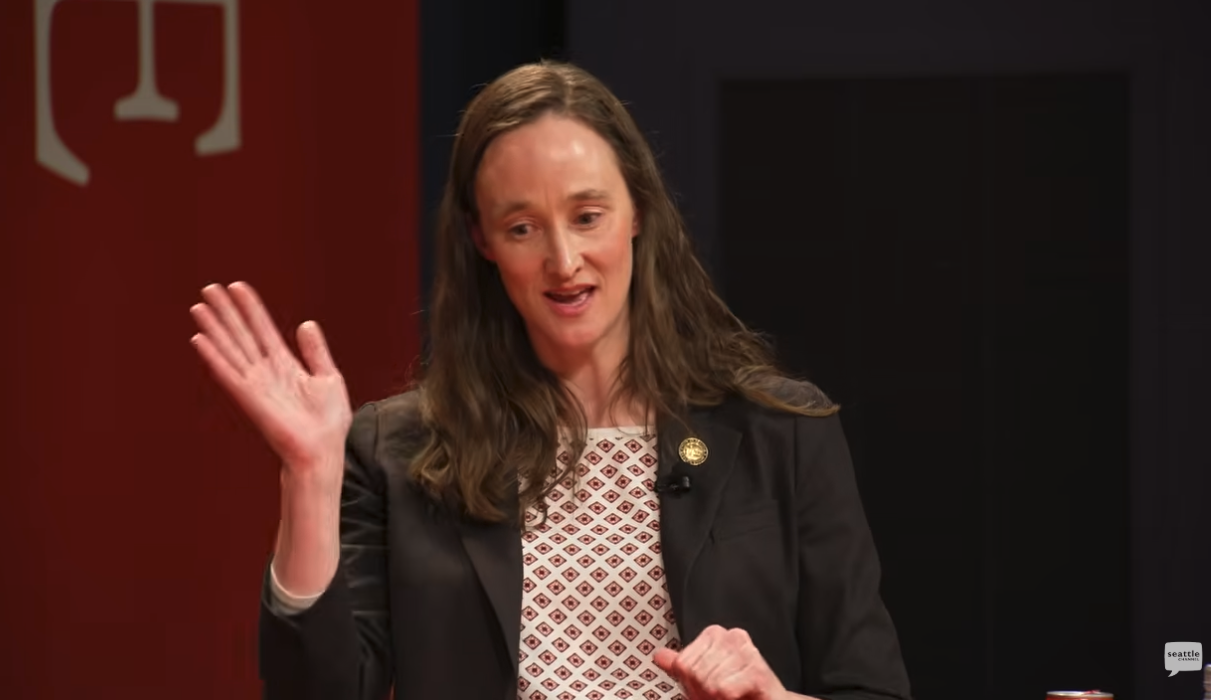
Seattle Mayor Katie Wilson makes a waving gesture while commenting on millionaires threatening to leave Washington state during her appearance at Seattle University earlier this month. (Screenshot via YouTube / Seattle Channel)

Seattle Mayor Katie Wilson is being greeted with a bit of backlash over a recent “goodbye.”

During a conversation earlier this month at Seattle University, Wilson offered her take on the supposed threats of millionaires in Washington state who say tax policy will drive them to leave.

“I think the claims that millionaires are going to leave our state are, like, super overblown. And if — the ones that leave, like, bye,” Wilson said while offering a wave before laughing amid cheers from the crowd. (See the exchange at 39:09 in video below.)

The comments, which resurfaced online this week, have drawn criticism from some in Seattle’s tech community, who see them as emblematic of a broader hostility toward business in the region.

Wilson was joined by King County Executive Girmay Zahilay for an April 14 conversation with moderators about how their progressive approaches to politics and policies shape the future of the Puget Sound region. Both were elected in November.

Advertisement

The mayor was asked whether she thought progressive taxes — like the state’s recently passed 9.9% tax applied to taxable, personal annual income that exceeds $1 million — are an “easy and promising solution.”

“As someone who has been fighting for progressive taxes for a very long time, I can tell you they are not easy,” Wilson said, adding that she was “excited” to see the so-called millionaires tax pass the state Legislature.

Wilson acknowledged that Washington’s tax structure remains heavily regressive overall, and said her office is actively exploring progressive taxation options available to the city. While she noted that Seattle has more local taxing flexibility than the county, she cautioned that Seattle can’t stray too far from its neighbors — pointing to Bellevue as an example — without risking its competitiveness as a place to do business.

GeekWire reached out to the mayor’s office for comment and we’ll update if we hear back.

Advertisement

The debate over progressive taxation in Washington state has been building for months, with the tech community largely — though not uniformly — alarmed by what it sees as a hostile policy environment.

When the millionaires tax was still a proposal, a coalition of AI researchers, founders, and investors wrote to Gov. Bob Ferguson urging him to pause both the income tax and a proposed expansion of the capital gains tax, warning that the measures would push top talent and future startups out of the region.

Earlier, some startup leaders called a related capital gains proposal targeting startup equity an “extinction-level event,” with founders testifying in Olympia against the bill. The measure failed to pass.

Prominent voices like Microsoft President Brad Smith have been pointed in their criticism, warning that Washington risks taking its tech sector for granted and urging lawmakers to focus on economic development — not just revenue extraction.

Advertisement

Wilson’s wave and “bye” are drawing fresh scrutiny among some in Seattle’s tech community.

“Seattle is so f**ked,” longtime Seattle investor and entrepreneur Chris DeVore wrote on LinkedIn Friday. “When the person running the city doesn’t seem to understand that all jobs and tax revenue come from private employers, and driving employers away permanently hollows out her capacity to pay for her social programs, it’s clear that we’re in for a rough decade, if not a permanent decline.”

In an opinion piece earlier this month for GeekWire, DeVore expressed his frustration with Democrats at both the state and national level today who he said are turning capitalism into the enemy, “pursuing confiscatory tax policies that villainize entrepreneurial wealth.”

Charles Fitzgerald, another Seattle-area investor, warned earlier this year on GeekWire about the danger of Seattle becoming “the next Cleveland,” stating that the city’s success could unravel quickly in the wake of a deteriorating business environment.

Advertisement

On his Platformonomics blog on Friday, Fitzgerald posted several items — including a New York Post story about Wilson’s comments — under the “Don’t be Cleveland” header. Others included a report citing record office vacancy rates in Seattle, a downgrading of the state’s credit rating, and more.

Not everyone in the tech community shares the alarm. Jacob Colker, managing director at the AI2 Incubator, pushed back earlier this year on what he called a “breathless narrative” that Seattle is one tax bill away from collapse, arguing that a few points of additional taxation don’t outweigh the region’s deep bench of AI talent, investment capital, and quality of life.

“Should we be thoughtful about tax policy? Heck yeah,” Colker wrote. “But the breathless narrative that Seattle is one bill from collapse is not serious analysis.”

While Wilson’s physical goodbye wave ignited some backlash, a comment on DeVore’s LinkedIn post from Seattle entrepreneur and investor Diego Oppenheimer summed up some of the frustration with a single, wordless emoji comment — the facepalm.

Advertisement

Source link

Continue Reading

Tech

Here’s what a touchscreen Mac may be like

Published

on

For years, Apple has been rumored to be bringing native touch functionality to the Mac. A new display gives us an early look at what that may be like, for better and worse.

Recently, I got an early look at the Aspekt Touch, a new monitor from Alogic. This isn’t the first touchscreen monitor from the brand, but the tilt functionality combined with macOS Tahoe gives early impressions about how a first-party solution could be implemented.

Feel free to check out Mike’s initial hands-on of the Aspekt Touch, but here’s the high-level. It’s a 32-inch 4K display that is also able to house a Mac mini in the bottom of the stand, and it can tilt nearly flat to be used more comfortably as a touchscreen.

A skeptic, early

I’m conflicted about the idea of a touchscreen Mac. I’ve been a detractor for ages, agreeing with Apple’s official stance that the iPad is the best touchscreen computer.

Advertisement
Modern adjustable desktop computer with a large tilted touchscreen on a white desk, accompanied by a keyboard, mouse, potted plants, and soft background lighting

Aspekt Touch tilted back

By and large, I haven’t felt the need for a touch interface on my Mac. Recently, though, that’s started to change.

I’ve gone from using my iPad and the Magic Keyboard over to my Mac and inadvertently kept poking at the display. If the iPad can get trackpad functionality, why can’t we get supplemental touch functionality on the Mac?

After a lot of thought, I think what matters is the approach. Based on current rumors, that approach could be what sets it apart.

Advertisement

Over on iPad, it is designed as touch first, with cursor support added for certain users when it makes sense. On the Mac, it will still be cursor first, with touch added as a supplemental interaction method.

Hand using the touchpad on a slim black keyboard attached to a tablet displaying a photo gallery, on a clean white desk

Magic Keyboard for iPad Pro

During Windows’ push toward touch-first design, the UI was watered down to accommodate it. The result was a hodgepodge interface that felt smashed together, inconsistent, and didn’t seem to work well.

As long as macOS remains macOS, I think there could be some potential here, and it has been fun to explore with the Aspekt Touch.

Advertisement

Aspekt Touch monitor brings touch to macOS, with caveats

Alogic provides a simple driver package to add touch support to the Mac. You download the installer and grant it a few permissions, and you’re ready to go.
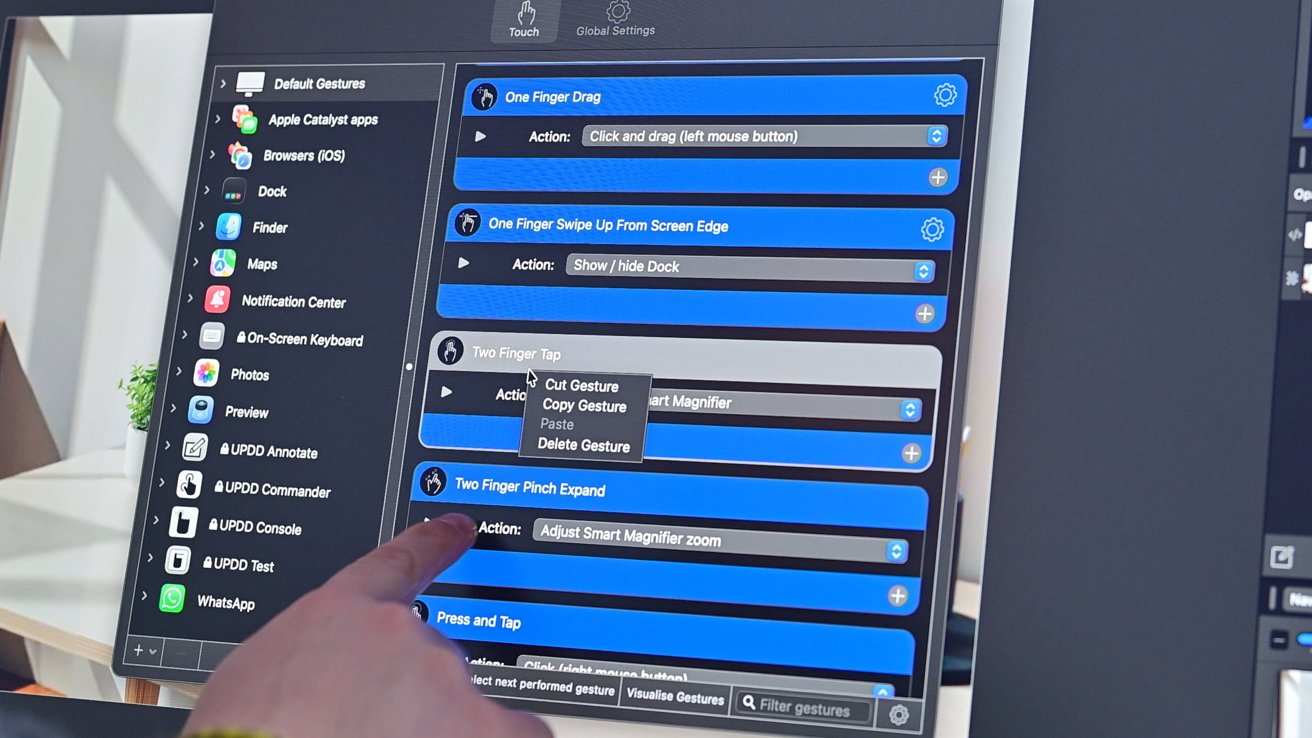
Person pointing at a computer screen showing accessibility or gesture settings with blue highlighted options and a sidebar list of apps and controls

Alogic’s software to enable and customize the touch controls

Once done, I could just start tapping away on the large 32-inch screen. I could scroll through Safari, zoom by pinching in and out, and even initiate a right-click.

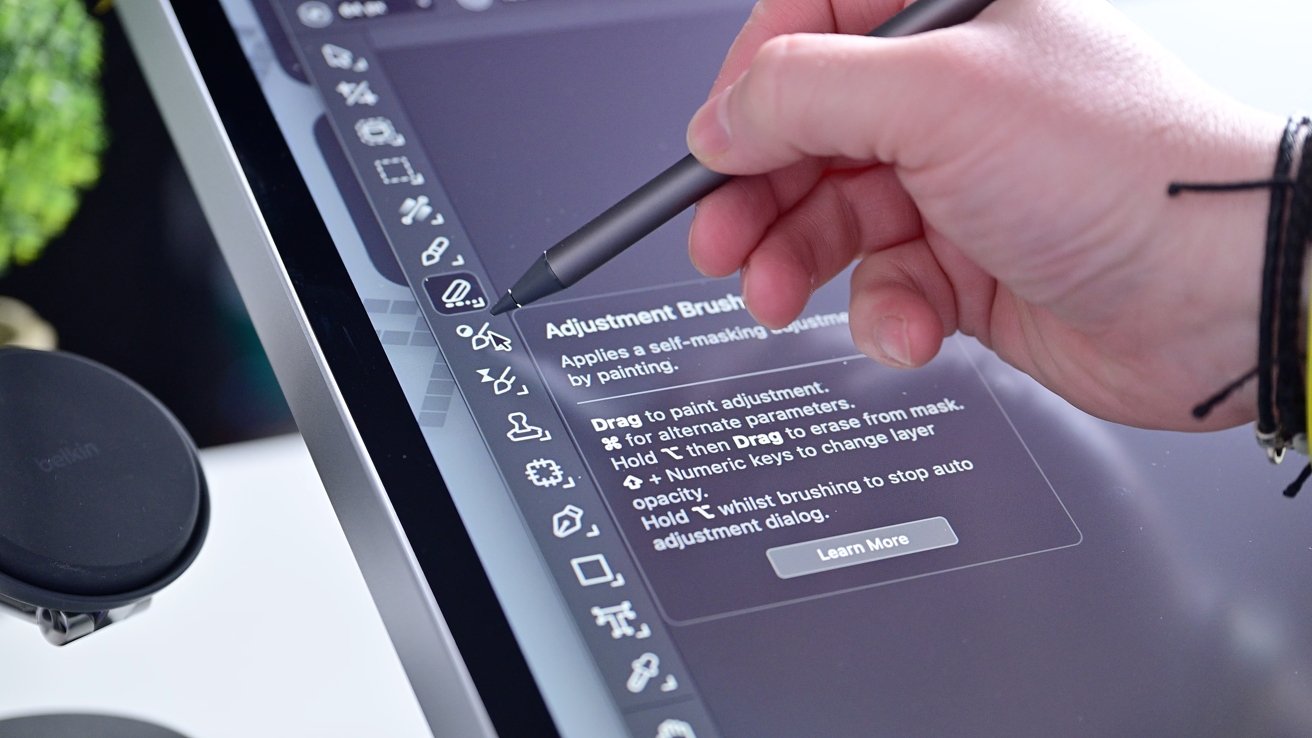
Using the stylus was a solid experience, too. Any capacitive stylus will work, but Alogic has its own with some extra features.
Advertisement
Hand using a digital stylus on a graphics tablet, selecting tools and reading an on-screen help tooltip in a photo editing or design software interface

Hover support on the Alogic stylus

The stylus supports hover effects, so as I work in Affinity, I can see tooltips appear over the different tools. When you flip the stylus around, you can use the other side as an eraser to erase what you’ve drawn.

The stylus supports varying degrees of pressure, and I didn’t seem to have any issues with palm rejection.

Person touching a computer monitor displaying a photo of unboxed electronics, including a small black device and white accessories, on a desk with a tropical beach desktop background

Zoom in and out by pinching in Safari

Advertisement

When you dig into the Alogic app, you can fine-tune your experience. You can customize the touch effects on a per-app basis to get very granular in how you interact with macOS.

Overall, it’s a solid experience for being added with a third-party plugin. However, a native experience would need to go even further.

Liquid Glass arrives in macOS Tahoe

The problem with the non-native experience is that it’s cobbled together piecemeal from different existing macOS features. There’s no native touch layer that works universally, and many UI elements aren’t designed for touch.

Person using a large desktop touchscreen, dragging a blue circle over a tech review website, with gadget photos on-screen and a bright beach wallpaper surrounding the browser window

The magnifier effect

Advertisement

For example, when using the zoom feature, many times it just initiates the magnifier from the accessibility settings. This gets the job done, sure, but not in the way I expected.

I also struggled tapping certain elements, like when editing in Affinity or Pixelmator. The sheer number and size of items made it hard to tap the exact one, especially if I was trying to move with any degree of urgency.

Close-up of a hand using an iPad control center, tapping Bluetooth and WiFi settings, with part of a potted plant blurred in the background

Liquid Glass is easy to touch

My biggest takeaway was how great Liquid Glass was. The UI elements that were skinned with Liquid Glass were easier to tap and felt more natural.

Advertisement

This offers an early glimpse of how touch functionality might be implemented. Liquid Glass may be divisive, but it suggests a more consistent cross-platform experience, and that includes touch support.

I’d also love to see native support for Apple Pencil. I don’t draw, but I do edit a lot of photos, and Apple Pencil is great for getting that done on iPad.

Hand holding a stylus draws bold black squiggles and strokes on a white digital canvas displayed on a tablet or computer screen

The Alogic stylus still has lag when drawing or writing

The Alogic stylus has noticeable lag, which is hardly ideal. I’d like to think that an Apple first-party implementation wouldn’t have that issue, just as it doesn’t on iPad.

Advertisement

Other Apple Pencil features could also debut, like the squeeze gesture to open up a tool palette or maybe something specific for Mac. I’d love it if I could squeeze the Apple Pencil Pro and see a collection of my favorite shortcuts to quickly run.

Probably not a 2026 experience

My biggest concern is that if touch is added, it needs to complement macOS. It shouldn’t try to replace what’s already there.

At the moment, it appears the first touchscreen Mac will be the redesigned M6 OLED MacBook Pro. Clearly, a keyboard and trackpad will be front and center to that experience.

Hand reaching toward a large horizontal computer monitor displaying a technology website, on a bright desk with keyboard, mouse, speakers, plants, and a tropical beach wallpaper in the background

Touching macOS Tahoe

Advertisement

That means we won’t be getting an iPad form factor running macOS, at least any time soon. I think that’s a good thing, but opinions vary amongst the AppleInsider staff, given that the Magic Keyboard with trackpad exists.

We’ll likely have to wait a bit longer to see though, as recent rumors say Apple’s redesigned MacBook Pro, first slated for the end of 2026, is now likely going to ship in early 2027. This isn’t because of developmental reasons, but rather component shortages that are plaguing the industry.

I’m still a bit skeptical here on whether macOS needs touch support or not. After using it for the last couple of weeks, I’m at least leaning towards more “for” than “against” at the moment.

Maybe we’ll get a clearer picture come WWDC with the preview of macOS 27. We’ll find out soon.

Advertisement

Source link

Continue Reading

Tech

Samsung's chip profit jumped nearly 50-fold in a single year, execs warn the shortage will get worse

Published

on


Operating profit in semiconductors climbed to 53.7 trillion won ($36.15 billion) for the January – March period, up sharply from 1.1 trillion won a year earlier. The figure accounted for roughly 94% of Samsung’s total operating profit of 57.2 trillion won. Revenue rose 69% year over year to 133.9 trillion won.

Read Entire Article
Source link

Continue Reading

Tech

Musely secures $360M from General Catalyst without giving up equity

Published

on

Musely, a direct-to-consumer telemedicine platform, has secured over $360 million in non-dilutive capital from General Catalyst’s Customer Value Fund (CVF).

The company specializes in compounded treatments for skin, hair, and menopause care. Musely co-founder and CEO Jack Jia told TechCrunch that when CVF investors reached out to him last year, he wasn’t looking to raise capital.

That’s because Musely, which was founded in 2014 as a wellness community before pivoting to prescription skincare in 2019, has been cash flow positive for years, he said. Jia didn’t want to reduce his ownership in the company by selling off a chunk of it to VCs. They frequently approached him about a potential round and he consistently turned them down, he said.

But unlike traditional venture capital, CVF wasn’t looking to take an equity stake, nor was it offering a loan that would carry interest rate charges. Instead, CVF’s alternative financing is similar to a tiny revenue-share agreement: Companies with predictable revenue streams borrow capital, and then repay the funds along with a fixed, capped percentage of revenue it generates from the use of General Catalyst’s fund.

Advertisement

Although Jia was initially skeptical, he quickly realized CVF’s terms were more favorable than a standard bank loan and far less costly than a dilutive equity round.

“When I mathematically modeled it, I found this absolutely compelling,” he said.

While Musely has been growing its revenue on average 50% year-over-year and has served over 1.2 million patients, acquiring new customers for DTC brands like Musely can be very costly, Jia explained. “When you become a billion-dollar revenue company, you need another billion in order to grow to the next billion,” he said. “That’s why most of the DTC companies, if you look at the capital burn, it is huge.”

Techcrunch event

Advertisement

San Francisco, CA
|
October 13-15, 2026

The funding from CVF solves this problem, providing Musely with a capital war chest to support its customer growth. The funding will support sales, marketing, and other customer acquisition efforts.

Advertisement

Musely joins a CVF portfolio that includes Grammarly, Lemonade, and Ro. The fund maintains its own distinct limited partners, and the capital it invests was not included in General Catalyst’s last $8 billion fundraise.

Unlike many of its peers, Musely has been remarkably capital-efficient. After raising $20 million from DCM and other investors in 2014, the company has not raised a single dollar of equity capital since, according to Jia. Musely allows patients to access prescription products through asynchronous consultations with board-certified dermatologists and OB-GYNs.

When you purchase through links in our articles, we may earn a small commission. This doesn’t affect our editorial independence.

Source link

Advertisement
Continue Reading

Tech

Salesforce launches Agentforce Operations to fix the workflows breaking enterprise AI

Published

on

Enterprise AI teams are hitting a wall — not because their models can’t reason, but because the workflows underneath them were never built for agents. Tasks fail, handoffs break, and the problem compounds as organizations push agents deeper into back-office systems. A new architectural layer is emerging to address it: workflow execution control planes that impose deterministic structure on processes agents are expected to run.

One of the companies bringing this to the forefront is Salesforce, with a new workflow platform that turns back-office workflows into a set of tasks for specialized agents to complete. Users can upload their processes or use one of the set Blueprints provided by Salesforce, and Agentforce Operations will break it down for agents. 

Salesforce senior vice president of Product, Sanjna Parulekar, told VentureBeat in an interview that the problem is that many enterprise workflows are not built for agents. “What we’ve observed with customers is that a lot of times, the brokenness in a process is probably in your product requirements document,” Parulekar said. “So when that’s uploaded into a product, it doesn’t quite work. We can optimize it and cut out some things and replace it with an agent.”

Without this control panel layer, enterprises could risk deploying agents that increase cost rather than fix their workflow problems.

Advertisement

Making the workflow work for agents, not just humans

Enterprises deploying agents are learning a costly lesson: Their workflows were designed around human judgment gaps, not machine execution. Processes that evolved through years of workarounds — loosely defined steps, implicit decisions, coordination that depends on individuals knowing what to do next — break when agents are asked to follow them literally.

Even with all of an enterprise’s context at its fingertips, AI systems will have difficulty completing tasks if it is not clear what it’s supposed to do. 

Parulekar said her team found that focusing on what makes the process tick and breaking it down into more explicit steps and workflows makes the system more deterministic. Then, when platforms like Agentforce Operations introduce agents, those agents already know their specific tasks.  

“It forces companies to rethink their processes and introduces observability into the mix because of the session tracing model in the system,” she said.

Advertisement

Parulekar said human checks can be built into the system, so the process is more transparent.

What makes this approach different from other workflow automation offerings is that it doesn’t rely on agents to decide what to do next; the system does. Unlike more traditional automation tools that route tasks and agents on probabilistic decision-making, this enforces execution on a more pre-defined, deterministic structure.

The problem it introduces

Codifying a workflow doesn’t fix a broken one. If a process has flawed steps, encoding it for agents locks in the problem at scale. And once workflows are distributed across agents, the challenge shifts from execution to governance: who owns the process, who validates it, and how it evolves when business conditions change.

It puts the onus on teams to take a hard look at what works for them and what doesn’t.

Advertisement

Organizations need to consider that, along with the execution control plane offered by platforms like Agentforce Operations, someone should be made responsible for task completion and success. 

Brandon Metcalf, founder and CEO of workforce orchestration company Asymbl, told VentureBeat in a separate interview that the key to both humans and agents following a workflow is a shared goal. 

“You have to understand the goal or the agent or human won’t complete the task successfully,” Metcalf said. “Someone has to manage that outcome that has to be delivered. It can be a person or an agent.”

The bottleneck has moved. As Metcalf framed it, the question is no longer whether agents can reason through a task, it’s whether the workflow underneath them is coherent enough to execute. For enterprises that built their processes around human judgment and institutional memory, that’s a harder fix than swapping in a smarter model.

Advertisement

Source link

Continue Reading

Tech

Magnetic Induction Heats Water | Hackaday

Published

on

Producing hot water off-grid is a surprisingly energy-intensive activity, and although it looks simple on its surface it can get quite complicated especially when used in large scale for something like providing hot water for an entire home. When using combustion to heat the water there needs to be proper venting as well as control of the fuel, and even storage of the hot water needs to be meticulous to avoid certain pathogens. [Greenhill Forge] has built an off-grid solution for heating hot water that doesn’t necessarily rely on any combustion, though, provided he can find something to spin his custom electric machine.

The machine in question is, of course, an induction heater. It works similar to any simple electric motor, generator, or transformer except in this case the eddy currents generated are exploited rather than minimized. Normally these currents, generated when a magnet passes by a metal, are wasted heat in other machines but in this induction heater it’s the goal. The machine’s stator is built from copper tube wound in a spiral which allows water to flow through and absorb heat. The tube is soldered into one electrically solid mass to maximize the eddy currents. The rotor is taken from a previous generator built by [Greenhill Forge] which holds the permanent magnets.

During the initial tests using a power drill to drive the generator, he was able to heat 1.5 liters of water from 7.9C to about 24.4 C in three minutes. The math works out to providing 575 watts of power to the heater, and with something that could spin the generator faster it might have the potential to provide around 14.5 kW. Provided that there’s a source of energy around, such as a wind or water turbine, this could be a fairly sustainable way of generating hot water in off-grid situations. Some of [Greenhill Forge]’s other projects are centered around this idea as well, like one of his builds which uses waste sawdust to heat his workshop with a custom-built stove.

Advertisement

Source link

Advertisement
Continue Reading

Tech

Ubuntu infrastructure has been down for more than a day

Published

on

Servers operated by Ubuntu and its parent company Canonical were knocked offline on Thursday morning and have remained down ever since, a situation that’s preventing the OS provider from communicating normally following the botched disclosure of a major vulnerability.

Attempts to connect to most Ubuntu and Canonical webpages and download OS updates from Ubuntu servers have consistently failed over the past 24 hours. Updates from mirror sites, however, have continued to work normally. A Canonical status page said: “Canonical’s web infrastructure is under a sustained, cross-border attack and we are working to address it.” Other than that, Ubuntu and Canonical officials have maintained radio silence since the outage began.

A decades-long scourge

A group sympathetic to the Iranian government has taken credit for the outage. According to posts on Telegram and other social media, the group is responsible for a DDoS attack using Beam, an operation that claims to test the ability of servers to operate under heavy loads but, like other “stressors,” are, in fact, fronts for services miscreants pay for to take down third-party sites. In recent days, the same pro-Iran group has taken credit for DDoSes on eBay.

Advertisement

Source link

Continue Reading

Tech

Spotify unveils verified badge to distinguish humans from AI

Published

on

Last year, Spotify removed more than 75m spam tracks from its platform.

The world’s biggest music streaming platform, Spotify, does not ban AI-generated music, but does admit that it finds it hard to detect it.

In its latest attempt to tackle growing AI spam on the platform, Spotify is introducing a vetted artist verification badge to help users identify human-made music from AI-generated ones.

Fraudulent music distribution is especially an issue for the platform, whose total artist payouts have grown from $1bn in 2014 to $10bn in 2024. However, artist payout per stream has reduced on average since 2021, further incentivising spam music to increase earnings.

Advertisement

Artists who receive this verification badge are understood to show consistent listener activity and engagement, compliance with Spotify’s policies and signal a human artist behind the account. The company said that it would also look for off-platform presence such as concert dates and social media accounts.

It added that at launch, “profiles that appear to primarily represent AI-generated or AI-persona artists are not eligible for verification”.

The new badges will begin rolling out in the coming weeks, Spotify said. These will appear next to artist names in search, represented with a light green checkmark icon.

“In today’s music landscape, the concept of artist authenticity is complex and quickly evolving, and we’ll continue to develop our approach over time,” Spotify said in a blogpost on 30 April.

Advertisement

“At launch, we have ensured that more than 99pc of the artists Spotify listeners actively search for will be verified, representing hundreds of thousands of artists – the majority independent – spanning genres, career stages and geographies.”

The company already has a number of other features, including ‘expanded song credits’, ‘about the song’ sections and AI credits, which help listeners find more information about the artists they listen to.

The new standards for verification, according to the company, would be paired with human reviews to identify “real artists” behaving in good faith, Spotify said. It also has an AI impersonation policy, as well as mechanisms to “better” stop fraudulent music distribution.

Last year, Spotify said that it removed more than 75m spam tracks from its platform. It acknowledged that AI is used by bad actors and content farms to create deepfakes and spam to deceive artists, pushing “slop” into the ecosystem. Spam tactics also include mass uploads, duplicates, SEO hacks and artificially short track abuse.

Advertisement

The verification badge comes after publisher Sony Music requested the removal of 135,000 songs by fraudsters impersonating its artists on streaming services.

Meanwhile, direct-to-fan music platform Bandcamp took a more aggressive approach in January by outright banning songs “generated wholly or in substantial part by AI”.

“Any use of AI tools to impersonate other artists or styles is strictly prohibited,” the company said in a post on Reddit. Spotify, however, allows artist impersonations as long as consent is provided.

Last October, Spotify’s founder and CEO Daniel Ek stepped down from his role and became the company’s executive chair in January.

Advertisement

Don’t miss out on the knowledge you need to succeed. Sign up for the Daily Brief, Silicon Republic’s digest of need-to-know sci-tech news.

Source link

Advertisement
Continue Reading

Trending

Copyright © 2025