Tech
Klipsch The Sevens II Review: Wireless Speakers for Music, Movies and TV

Back in 2021, Klipsch’s The Fives were the first powered speakers I’d encountered with an HDMI ARC connection, making them as friendly with your TV as they were with the rest of your components. When I first reviewed them, I called them the soundbar solution for people who don’t like soundbars. Klipsch raised the stakes with increasingly larger versions in The Sevens and The Nines, each of which helped usher in a new era of plug-and-play home theater speakers. While each pair has its place, The Sevens hit the sweet spot for me, delivering big, bold sound from a beefy footprint that still, just barely, fits on regular speaker stands.
Of course, HDMI-ready powered speakers are everywhere now, so The Sevens II really needed to up the ante to stand out. In that regard, Klipsch did not disappoint, upgrading its Goldilocks pair in nearly every way. The improvements range from an absolute smorgasbord of connection options and supported audio formats, including virtual Dolby Atmos, to the addition of the Wi-Fi and network connectivity missing from the original pair. There’s even a spare HDMI input for modern gaming consoles, a first among the powered speakers I’ve tested.
Unfortunately, I had real trouble connecting the speakers to my Wi-Fi network during setup, to the point that I eventually plugged in an Ethernet cable and called it a day. Otherwise, there’s not much The Sevens II don’t get right. They offer impressive immersion and clarity, fantastic bass response, and a wealth of extras in a nearly comprehensive take on the all-in-one speaker system.
Related Reviews:
Setup: Wi-Fi Woes

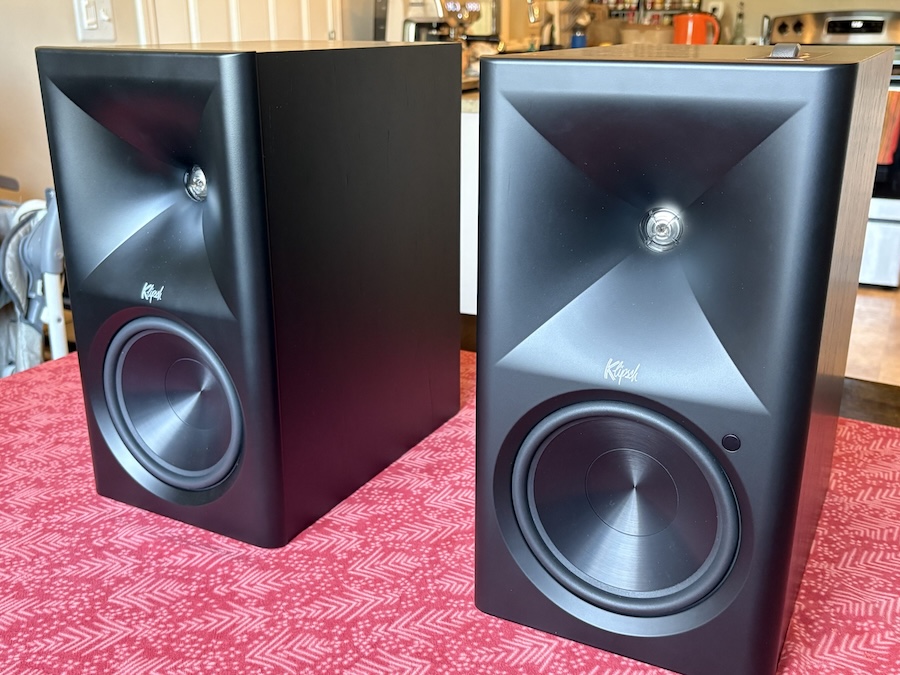
Let’s get the annoying part out of the way. While fishing these 15-inch-tall mega-cabinets from their housings is something of a chore, connecting to my network created the real headache. The biggest issue seemed to be that, while the speakers connected right away and were active in the Klipsch Controller app, they weren’t receiving network information, at least not fast enough for their mandated firmware update, which is apparently integral to functionality.
After five tries, multiple 30-to-45-minute waits, and at least two power cycles, I finally tried Ethernet, and the speakers seemed to jump at the chance to update. After around 10 minutes, they had the latest software, and I experienced no further network issues over two weeks of testing.
Ostensibly, the speakers can go wireless in multiple ways, allowing you to connect the primary speaker, which harbors the inputs and controls, to the secondary cabinet wirelessly. This limits resolution to 48 kHz, as opposed to 96 kHz with the included four-meter CAT6 cable, and besides, I wasn’t taking any more chances after my Wi-Fi issues.
To be fair, these aren’t the first speakers to have trouble on my network, and a colleague who reviewed The Nines II had no such issues. Still, the vast majority of devices I’ve tested connect seamlessly, so it’s something to note if your network is finicky and/or you don’t have a handy Ethernet connection.
Connecting The Sevens II to other components was as breezy as you’d expect from modern powered speakers, including a quick connection to the TCL QM7K TV I’m currently reviewing. This provides seamless control from your TV remote for power and volume, and unlike many premium speakers, there were no handshake issues or connection flubs.
Design and Features: Fully Connected

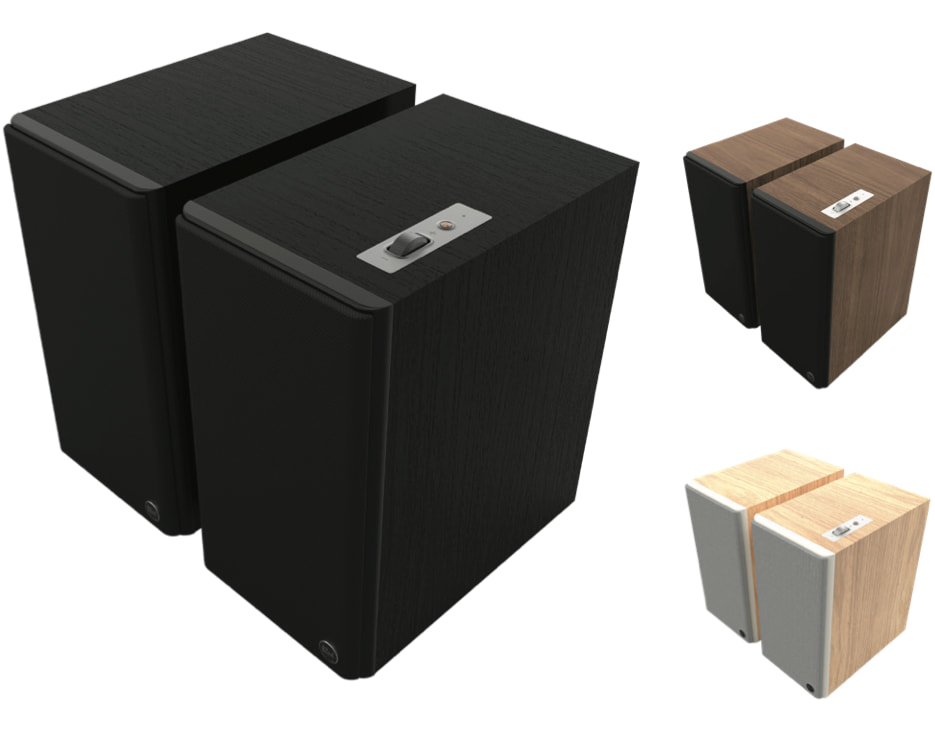
Even after my Wi-Fi frustrations, it was hard not to fall for The Sevens II’s chic yet brawny design, which perfectly matched my review TV’s 75-inch obsidian screen. Along with the Ebony MDF cabinets I reviewed, they come in Walnut and a tantalizing new Red Oak finish with a white front, each of which boasts “real wood” veneer. On top of the right speaker is the same tactile volume wheel found on the original pair, alongside a metallic input key, giving them a vintage vibe.
The package includes magnetic acoustic grilles for a more demure look, but unless you’ve got curious kids in the house, it’d be a shame to hide those drivers. The combination of Klipsch’s hefty “Jet Ceramic” 6.5-inch woofers and titanium LTS tweeters, set behind the brand’s signature Tractrix horns, really spruces up the room.
Other accessories include an HDMI cable, an omnidirectional microphone for calibration, and a simple backlit remote. The latter offers some helpful input keys, and it’s useful for pausing sound on the go, but the majority of controls and settings are handled by the app.
The input hub at the back of the main speaker, which can be placed on either the right or left for convenience, provides an embarrassment of riches. The digital coaxial input is especially useful for connecting a CD transport or CD player while relying on The Sevens II’s internal DAC and keeping the lone RCA analog input free for another source.
That’s joined by an optical digital port, RCA and MM phono analog inputs, and USB-C. Dual HDMI 2.1 ports, including HDMI eARC, provide high-bandwidth passthrough for 8K, HDR10+, and Dolby Vision video, as well as support for VRR (Variable Refresh Rate) and ALLM (Auto Low Latency Mode) with gaming consoles.
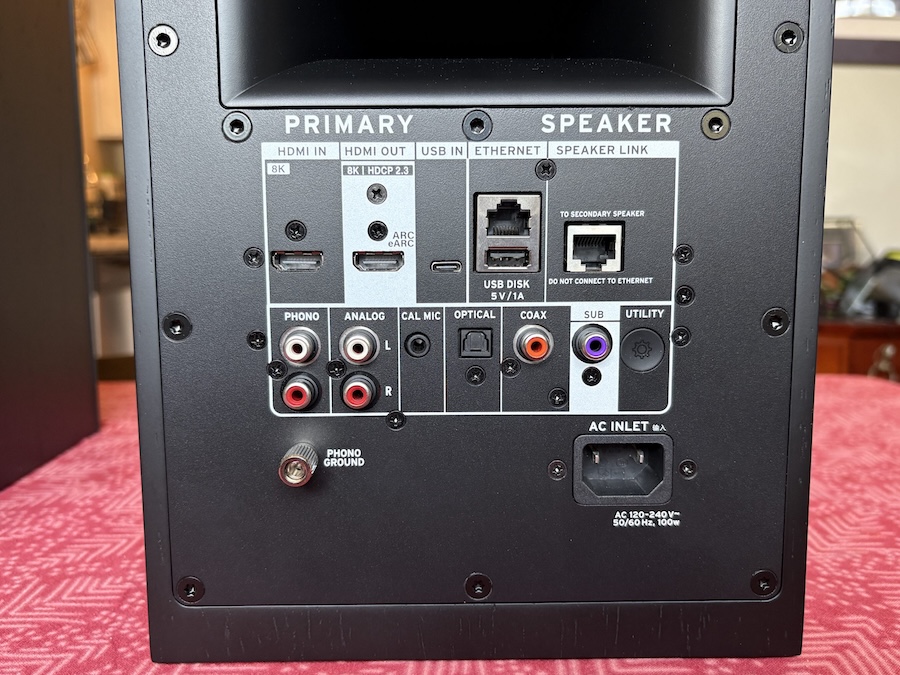
There’s also a subwoofer output to add more punch and clear up some space in the higher registers. It’s worth employing if you’ve got a spare subwoofer on hand, but part of the value proposition here is that The Sevens II have plenty of bass on tap, reaching down to a claimed 39 Hz and handling the upper-bass region around 50 to 60 Hz with relative authority.
On the audio side, Klipsch goes well beyond the limited PCM support found in most of the powered speakers I test, thanks to its use of Onkyo AVR circuitry. While DTS support is limited to The Nines II, The Sevens II get a loaded Dolby suite with support for Dolby TrueHD and even Dolby Atmos decoding, though without upfiring speakers, the effect is limited.
Streaming support is a major upgrade over the original pair’s Bluetooth-only system, supplementing Bluetooth 5.4 with support for Apple AirPlay, Google Cast, Spotify Connect, TIDAL Connect, and Qobuz Connect.
Dirac Live Room Correction calibration is also included to help adapt the sound to your room, though only for bass control up to 500 Hz by default. If you want to upgrade, you can do so through Dirac’s website for $100, which allows multiple “filters,” or calibration options across the frequency range, for different seating positions or room setups.
The app provides plenty of other ways to adjust the sound, including a five-band EQ and presets, along with extras such as Dynamic Bass, Dialogue Enhancement, and Night Mode. There are also three sound modes: Movie, which is on by default; Music; and Direct, for unfiltered sound.
Oddly, switching between modes creates a two- or three-second delay, accounting for the only real app trouble during my review. It’s especially frustrating because video tends to sound best in Movie Mode; otherwise, dialogue can sound boomy, while music is clearer and more open in Music or Direct Mode. Aside from that, the app was impressively stable and responsive, with only the occasional delay when connecting to Spotify.
Listening: Bold, Clear and Immersive

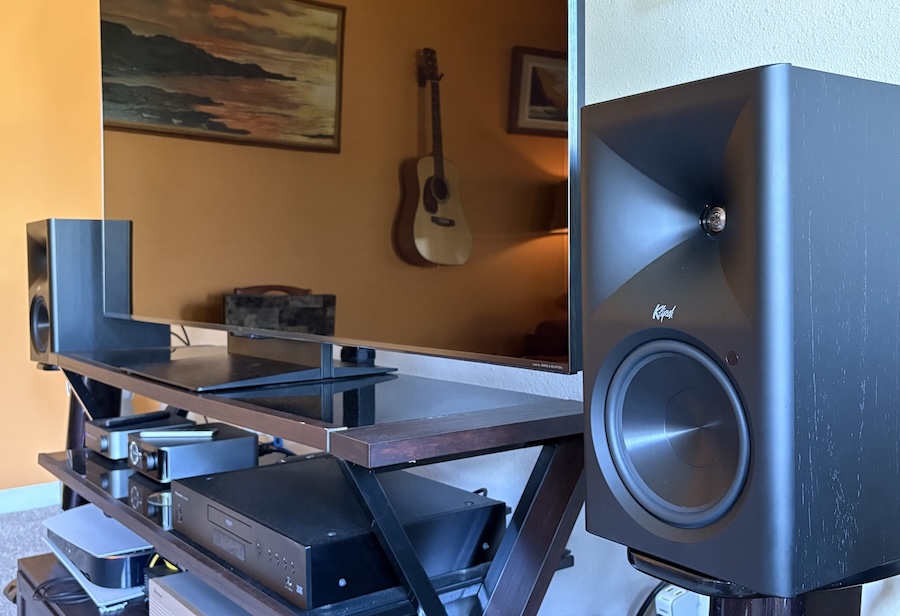
Though powered speakers like The Sevens II are generally designed as a music-first way to enhance your home theater, it will come as no surprise to those familiar with the original pair that their best use case is souping up your favorite TV shows and movies. That’s not to say they’re not excellent for music, but their large size and support for multiple home theater formats make them brilliant for TV sound.
Switching them on was an instant upgrade, not only over the reasonably capable TV speakers in the TCL QM7L I’m currently reviewing, but also over powered reference speakers such as the SVS Prime Wireless and even my beloved KEF LSX, especially with more cinematic fare. Their sheer size and acoustic design get much of the credit, using those large cabinets to produce an immersive soundstage marked by bold, powerful sound and plenty of foundational bass that rarely gets boomy.
Just as importantly, they’re very well attuned to subtle details. From the creak of a door or the click of a revolver’s hammer to pointedly soft dialogue or padded background noises, such as the din of printers and phones in The Office, everything feels elevated.
In one of my favorite test scenes from The Mandalorian episode “The Mines of Mandalore,” I was enamored with all the little moments: the dramatic punch of the ship as it breaks through the atmosphere; the metallic rattles placed deep in the soundstage; the purring of the ship’s engines; and even the tactile sound of his helmet light turning on. All of it was fantastically immersive, pulling me deeper into the moment.
I’m not sure how much of this can be credited to The Sevens II’s virtual Dolby Atmos support. Without upfiring speakers, Atmos’ height element—the part that makes it feel spherical and encompassing—is obviously limited. Even so, the sound is dimensional and articulate, while preserving plenty of bombast for moments such as explosions or the thundering beat of a soundtrack. Even in stereo, it goes well beyond your average flagship soundbar.
Listening to lossless music over Spotify Connect was also impressive, especially when using the Music or Direct modes. While the upper midrange and lower treble can sometimes sound a little tight, they never become sharp, and there’s plenty of detail across the frequency range, with notably expansive sound in larger mixes.
The brass in Sinatra’s “Luck Be a Lady” has convincing weight and presence, while the saxophones retain plenty of texture without becoming strident. The percussion in Tom Petty’s “You Don’t Know How It Feels” snaps with convincing attack, pushing the song’s signature snare to the forefront while preserving the laid-back groove that drives the track.
Bass reaches deeper than expected, even for speakers this size. The Weeknd’s “Starboy” delivers solid low-frequency impact without overwhelming the mix, while Caroline Polachek’s “Welcome to My Island” showcases the speakers’ ability to separate layers of synthesizers and electronic effects across a wide, stable soundstage that occasionally extends beyond the cabinets. Polachek’s voice remains clean and expressive throughout, even as the arrangement becomes increasingly dense.
Moving to vinyl with my go-to test album, Dave Brubeck’s Time Out, The Sevens II did a convincing job with the piano’s body and attack, the soft cymbal work and brushed snare positioned to the left, and the saxophone anchored firmly in the center. I preferred the built-in phono preamp in my U-turn Audio Orbit Theory turntable to Klipsch’s, which sounded quieter and less immediate, though the difference was not substantial.
If there’s one area where the speakers could improve, it’s the separation between instruments in dense arrangements. Radiohead’s “Everything in Its Right Place” remained clear, but individual layers were not as sharply defined as they could have been. That’s where Dirac Live comes in.
Dirac Live: Better Separation, Recessed Vocals
One of the most respected third-party calibration systems available, Dirac Live is designed to address room-related frequency problems, improve bass response, and refine imaging and clarity. For the most part, that’s what it did.
On many tracks, Dirac created more space between instruments and widened the stereo image without making the presentation feel disconnected. Returning to Tom Petty’s “You Don’t Know How It Feels,” the individual instruments and backing vocals were easier to distinguish within the mix.
Bass response also became more prominent, sometimes excessively so in my small listening room. On bass-heavy tracks such as Too Short’s “Just Another Day,” the low end became overbearing, though reducing the 80 Hz band in the EQ brought it back under control.
The larger issue was that Dirac sometimes pushed vocals farther back in the mix. That was noticeable on Depeche Mode’s “Personal Jesus” and Nickel Creek’s “Reasons Why.” The latter stood out in particular because Sara Watkins’ voice is normally positioned firmly at the center, with clear diction and strong presence.
Because of that tradeoff, I generally preferred The Sevens II without Dirac Live enabled. Other listeners may reach a different conclusion, especially in square, reflective, or otherwise difficult rooms where acoustic treatment is impractical.

The Bottom Line
The Sevens II offer the best of both worlds, combining the format support of a soundbar with the connectivity, scale, and stereo presentation of a capable pair of powered speakers. In many ways, that makes them and their sibling models, The Fives II and The Nines II, an appealing solution for anyone who wants a plug-and-play system that works across multiple sources, including a TV.
You’ll find greater clarity, precision, and stereo imaging from speakers such as KEF’s LS50 Wireless II, but The Sevens II counter with deeper bass, greater output, and more convincing handling of film and television content. That combination helps them stand out in a crowded market.
My Wi-Fi problems and smaller usability complaints, including the pause when switching sound modes, are the biggest marks against them. Even so, The Sevens II make a strong case for listeners who want one pair of speakers to handle music, movies, gaming, vinyl, and digital sources without adding an amplifier, streamer, or soundbar. For that buyer, their broad connectivity and powerful presentation help justify the substantial price.
Pros:
- Big and bold sound with deep bass response
- Articulate and immersive soundstage
- Impressive Dolby support, including virtual Atmos
- Class-leading connectivity options
- Stylish design and good build quality
- Solid accessories, including a backlit remote
Cons:
- Finicky Wi-Fi setup and firmware update
- Odd delay in audio when switching sound modes
- Imaging and instrumental separation is good not great
Ratings
★★★★★★★★★★ Performance
★★★★★★★★★★ Usability
★★★★★★★★★★ Build Quality
★★★★★★★★★★ Value
You must be logged in to post a comment Login