








Tech
Leica Cine Compact 1 Projector Debuts: 4K RGB Laser Performance in a Smaller Package for $2,000
Compact 4K laser projectors are having a moment, and not because everyone suddenly wants to bolt a giant chassis to the ceiling again. More buyers are looking for serious big-screen performance in smaller, more living-room-friendly designs that can fit into real homes without turning the space into a demo room at an AV trade show. Leica clearly sees the same shift.


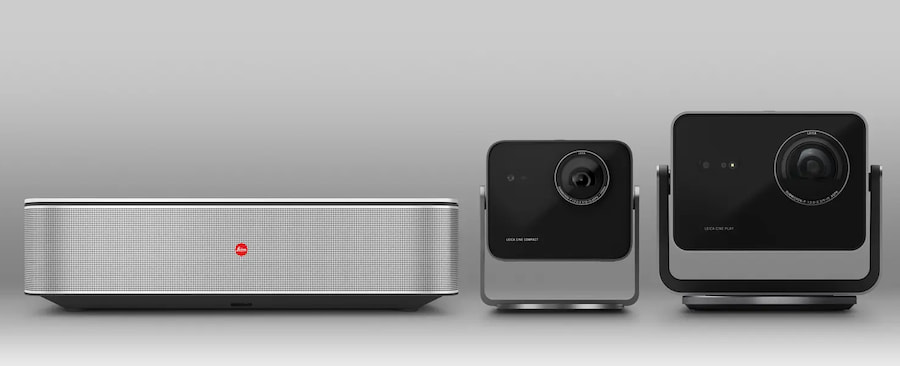
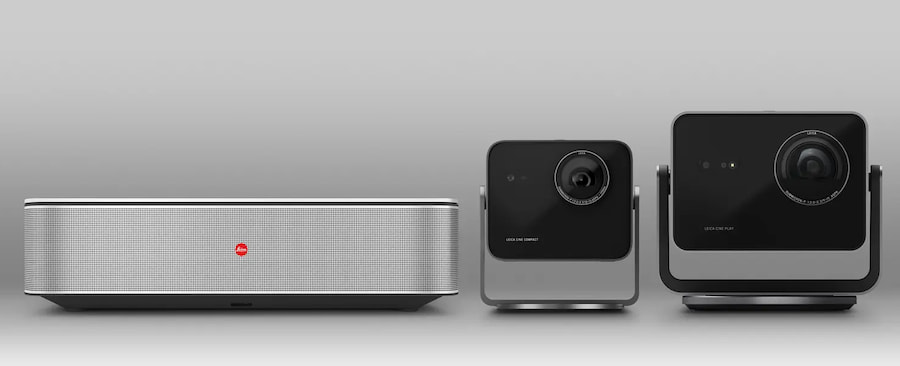
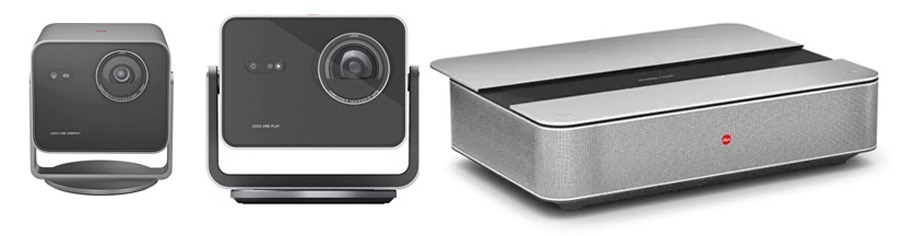
In 2023, Leica entered the ultra-short-throw projector category with the Hisense-built Cine 1, a $9,000 UST model bundled with either a 100-inch or 120-inch ALR screen. In 2024, it followed with the Cine Play 1, a lifestyle-focused standard-throw projector priced at $3,795. For 2026, Leica is expanding the lineup again with the Cine Compact 1.
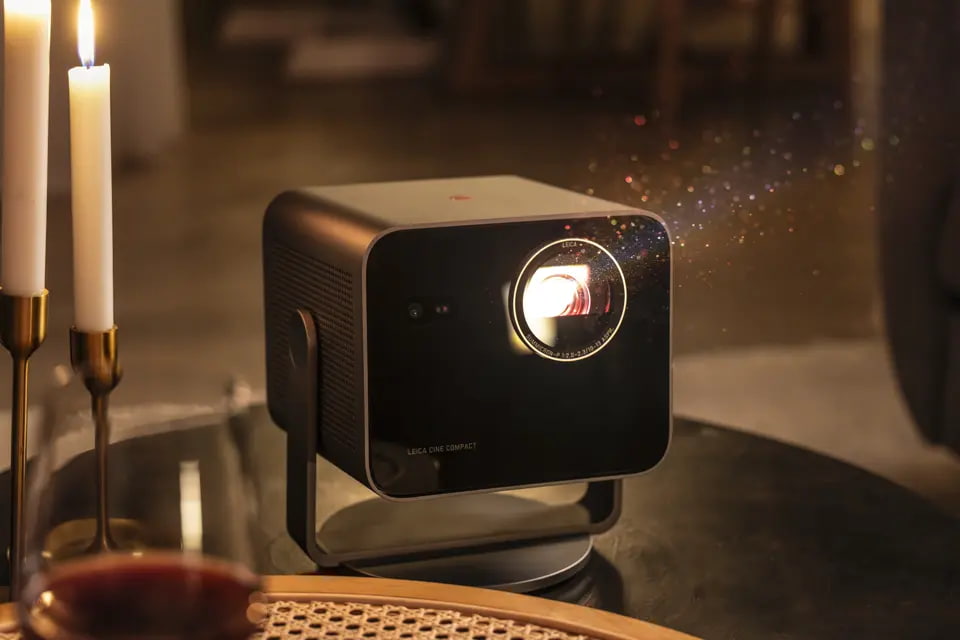
Priced at $2,000, the Leica Cine Compact 1 is now the smallest projector in the company’s range, borrowing much of its concept and feature set from the Cine Play 1 but placing it in a smaller, more compact chassis.
That makes it less of a “take it anywhere” projector and more of a smaller premium 4K laser option for buyers who want the Leica badge without handing over Cine 1 money.

Smaller Leica, Still Big-Screen Ambitions
Like the Cine Play 1, the Leica Cine Compact 1 combines RGB laser light source technology with Leica’s premium imaging approach and support for 4K resolution via pixel shifting. The key difference is scale. While the Cine Play 1 can project images up to 300 inches, the Cine Compact 1 tops out at 220 inches, which is still absurdly large for most living rooms unless your sofa came with its own ZIP code.
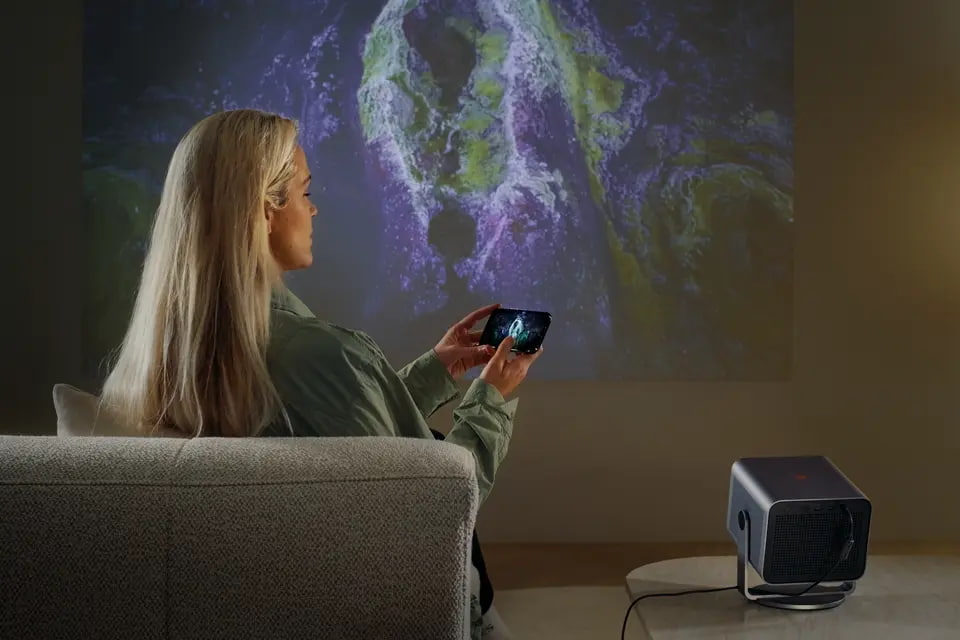
Leica is positioning the Cine Compact 1 as a more convenient home cinema option for both indoor and outdoor use, helped by built-in smart features and user-friendly setup tools. That outdoor angle comes with the usual projector reality check: it will work best after dark and away from ambient light. Daytime backyard cinema still belongs in the same fantasy file as affordable Leica lenses.
RGB Laser, Leica Optics, and the Usual Brightness Reality Check

The Leica Cine Compact 1 uses a triple RGB laser light source rated for up to 25,000 hours of operation, which should cover a lot of movies, streaming binges, and questionable franchise reboots before anyone starts worrying about the light engine.
Leica rates the Cine Compact 1 at up to 1,700 ANSI lumens, which means it should be capable of producing a clear, high-contrast image in darker rooms or outdoor spaces with minimal ambient light. That last part matters. This is still projection, not witchcraft. If you aim it at a wall during a bright afternoon barbecue, the sun is going to win.
HDR support is also broad, with compatibility for Dolby Vision, HDR10, HDR10+, and HLG. The Cine Compact 1 also includes Leica Image Optimization, or LIO, which uses image-processing algorithms designed to improve color rendition, color gradation, and contrast.
And because Leica is not going to put its name on a projector without making the lens part of the story, the Cine Compact 1 incorporates a genuine Leica Summicron zoom lens. That gives the projector a real optical talking point beyond the badge, which matters at $2,000.
Audio
For the best listening experience with the Leica Cine Compact 1, an AVR and surround sound speaker system would still be the preferred option. At minimum, a good soundbar makes sense, especially since HDMI eARC connectivity is supported. That said, a full external audio setup is not always practical with a compact projector designed to move more easily between rooms or support occasional outdoor use.
To make the Cine Compact 1 more self-contained, Leica includes a 2 x 10-watt onboard audio system with DTS Virtual:Xprocessing. That will not replace a proper surround system or a serious soundbar, but it should provide a more spacious and usable listening experience than the tiny speaker systems found in many lifestyle projectors.

Streaming, AirPlay, and Just Enough Physical Connectivity
The Leica Cine Compact 1 is not just about image quality and onboard sound. It also includes both wireless and physical connectivity, which matters if the goal is to make the projector easy to use without adding a stack of external boxes.
With built-in smart TV features, users can access streaming services directly from the projector, provided it is connected to the internet via Wi-Fi or Ethernet. Leica uses Hisense’s VIDAA streaming platform, which provides access to major apps, including Netflix. The remote control also includes direct-access buttons for Netflix, Prime Video, Disney+, and YouTube.
Wireless support includes Apple AirPlay and Bluetooth. AirPlay allows users to stream compatible content from Apple devices, while Bluetooth can be used for wireless audio streaming from smartphones, tablets, and laptops.
Physical connectivity is more limited. The Cine Compact 1 includes one HDMI port and one USB port. The HDMI connection supports eARC, making it easier to connect the projector to a compatible AVR or soundbar. The USB port can be used to play compatible media files stored on a USB flash drive.
Flexibility
The Leica Cine Compact 1’s biggest advantage is flexibility. Weighing under 10 pounds, it can be moved from room to room and set up without a permanent installation.
Its integrated 360-degree rotation system allows projection from multiple angles onto walls, ceilings, or other suitable surfaces, while automatic zoom, autofocus, keystone correction, and intelligent screen framing help align the image with minimal manual adjustment. Because spending 20 minutes fixing geometry before the movie starts is nobody’s idea of premium.
For added placement options, the Cine Compact 1 can also be used with the same optional stand as the Cine Play 1, with a stand adapter included.
Comparison

| Leica Model | Cine Compact 1 | Cine Play 1 | Cine 1 |
| Price | $1,995 | $2,995 | $8,995 (w 100-inch screen) $9,495 (w 120-inch screen) |
| Projection Screen Size | 60 – 220” | 65 – 300” | 100″ or 120″ |
| Imaging Chip | DLP 0.47” Pico DMD | DLP/0.47” 4k XPR | DLP/0.47” 4k XPR |
| Image Resolution | 3840x2160px (4K) via pixel shifting | 3840x2160px (4K) via pixel shifting | 3840x2160px (4K) via pixel shifting |
| TV Tuner | No | No | ATSC 3.0 / Next-Gen TV / QAM on cable |
| Gaming Mode | Yes – Latency ≤ 20ms in gamer mode ≤ 60ms in all other modes
Refresh Rate 4K @ 60Hz 2K @ 240Hz 2K @ 120Hz |
Yes, Latency < 12 ms 1080px@120Hz | Yes, Latency < 60ms 4K@60Hz |
| Lumen Output | Up to 1700 lm (Ultra Mode) | Up to 3000 lm (Ultra Mode) | > 2500 lm |
| Dynamic Contrast | Not Indicated | Approx. 2 Mio. :1 | Approx. 2 Mio. :1 |
| Contrast Ratio | Up to 1500:1 | Up to 1500:1 | Approx. 1000:1 |
| BT 2020 Support | > 100 % | > 100% | > 100% |
| HDR Support | Dolby Vision® / HDR10 / HDR10+ / HLG | Dolby Vision® / HDR10+ / HLG | Dolby Vision® / HDR10+ / HLG |
| 3D Support | Yes, DLP Link Active Shutter | Yes, DLP link active shutter | Not Indicated |
| Throw Ratio | Optical: 1.0 – 1.3 Digital: 1.3 – 3.2 |
0.9 – 1.5 | 0.25 |
| Leica Image Optimization (LIO) | Yes | Yes | Yes |
| Light Source | Direct Triple RGB-Laser | Direct Triple RGB-Laser | Direct Triple RBG-Laser |
| Light Source Use Hours | 25,000 | 25,000 | 25,000 |
| MEMC | Yes | Yes | |
| HDMI | 1x HDMI 2.1 with eARC Support | 2x HDMI 2.1 (1x eARC Support) | 2x HDMI 2.1 (1x eARC Support) 1x HDMI 2.0 Type |
| USB | 1x USB A 3.0 | 2x USB 3.0 | 2x USB (1x USB 2.0 & 1x USB 3.0) |
| USB Recording | Not Indicated | Yes | Not Indicated |
| Ethernet RJ45 | – | Yes | Yes |
| Digital Connections | – | 1 x S/PDIF 1 x Optical (Toslink) |
1 x Optical (Toslink) |
| Physical On/Off Button | Yes | Yes | Yes |
| Earphone/Audio Output | No | 1x | 1x |
| Audio Output Power | 2 x 10 Watt | 2 x 10 Watt | 2 x 25 Watt |
| Number of Channels | 2.0 | 2 | 4 |
| DTS Virtual:X | Yes | Yes | No |
| Dolby Audio | Yes | Yes | No |
| Dolby Atmos | – | – | Yes |
| Dolby Digital Plus | Dolby Digital Plus, Dolby Digital | Not Specified | Yes |
| WiFi (Plus) | 6 (IEEE 802.11a/b/g/n/ac/ax) (2.4G, 5G) | 6 (IEEE 802.11 a/b/g/n/ac/ax) | 6 (IEEE 802.11 a/b/g/n/ac/ax) |
| Bluetooth | Version 5.4 | Yes | Yes |
| Screen Mirroring | Yes | Yes | Yes |
| Works with AirPlay | Yes | Yes | Yes |
| Operating System | VIDAA | VIDAA U7.6 | Google TV |
| Streaming Direct Buttons on Remote | Yes, for Netflix, Prime, Disney, YouTube | Yes, for Netflix, Prime, Disney, YouTube | |
| Voice Assistant | Yes (VIDAA Voice) | Yes | Yes |
| Web Browser | Yes (Odin) | Yes | Yes |
| Child Protection | Yes | Yes | |
| OTA Software Updates | Yes | Yes | Yes |
| Remote Control | Bluetooth / IR in Aluminum Housing with Microphone | Bluetooth / IR in Aluminum Housing with Microphone | Bluetooth / IR in Aluminum Housing with Microphone |
| Voice Command | Yes | Yes | Yes |
| File Formats | AV-Container AVI / MP4 / MKV / TS / FLV
Video AVI / WMV / MP4 / MOV / MKV / MPG / MPEG / FLV / WebM Audio WMA / WAV / FLAC / MP3 Image JPEG / BMP / PNG / GIF |
AV-Container: AVI / MP4 / MKV/ TS / FLV
Video: AVI / WMV / MP4 / MOV / MKV / MPG / MPEG / FLV / WebM Audio: WMA / WAV / FLAC / MP3 Image: JPEG / BMP / PNG / GIF |
AV Container: AVI / MP4 / MKV / TS / FLV / OGG
Video: AVI / WMV / MP4 / MOV / 3GP / MKV / MPG / MPEG / VOB / FLV / WebM / OGM Audio: WMA / WMV / MP4 / FLAC / MP2 / MP3 / AAC / WMA / WAV Image: JPEG / BMP / PNG / GIF / WEBP |
| Voltage | 100V – 240V | 100V – 240V | 120V -240V |
| Power Consumption | Standard Mode / Standby / Network Standby 120W / 0.5W / 2W |
On 180W / Standby 0.5W | Max. 300W / 0.5W |
| Dimension | 209 x 226 x 193 mm (8,2 x 8,9 x 7,6 inch) | 242 x 261 x 229 mm (10,3 x 9,5 x 9,0 inch) | 600 x 378 x 149 mm Approx. |
| Weight | Approx. 4.4 kg (9,70 lbs) | Approx. 6.7 kg (14,7 lbs) | 14.5 kg (32 lbs) |
| In The Box | Leica Cine Compact 1
Remote control 2 AAA batteries Power cable Power supply Case Adapter for Leica Floor Stand Operating instructions/warranty |
Leica Cine Play 1
Remote control 2 AAA batteries Power cable Power supply unit Accessory bag Operating Instructions & Warranty |
Leica Cine 1
Remote Control 2 x AAA Batteries Power cable Quick Start Guide 100-inch or 120-inch Screen 3 Year Warranty |
The Bottom Line
The Leica Cine Compact 1 is the company’s most accessible projector so far, but “entry-level” is doing some heavy lifting at $2,000. What makes it unique is the combination of RGB laser projection, broad HDR support, automatic setup tools, built-in streaming, DTS Virtual:X audio, and a genuine Leica Summicron zoom lens in a smaller sub-10-pound chassis.
What is missing? More HDMI inputs, higher light output, and a price that does not immediately invite comparisons with Hisense’s own M2 Pro, which costs $1,299.99 and offers a very credible alternative, albeit with slightly lower brightness. Leica’s advantage remains optics and image refinement, but buyers are still paying a premium for the red dot. Funny how that works.
Price & Availability
The Leica Cine Compact 1 will be available for $1,995 beginning June 18, 2026 with optional floor stand priced at $495 through Leica Authorized Dealers.
For more information: leicacamerausa.com
Related Reading:
Tech
Apple’s New Siri AI Assistant Finally Understands, Gains Context, Conversation, and Real Capability

Apple has delivered the deeper Siri overhaul that many expected years earlier. The new version, officially called Siri AI, moves beyond simple voice commands into a system that reads the screen, pulls relevant personal details from across apps, and taps current information from the web to give answers that actually fit the moment.
Users are no longer required to repeat the same basic information each time they seek assistance; this is simply inconvenient. Siri may now catch up on restaurant details in Messages or hotel confirmations in Mail and return to them later without prompting. Similarly, for photographs from prior vacations or calendar entries, the algorithm evaluates them discreetly and extracts the necessary information.
Sale
Apple iPad Pro 11-inch (M5): Ultra Retina XDR Display, 256GB, Landscape 12MP Front Camera/12MP Back…
- WHY IPAD PRO — iPad Pro with the Apple M5 chip delivers extraordinary performance for effortless productivity on a stunning display. Take on pro…
- PERFORMANCE AND STORAGE — iPad Pro with M5 brings next-generation speed and the power of on-device AI to all your tasks.* Featuring up to 2TB of…
- IPADOS — Run pro apps and get more done with iPadOS 26 with Liquid Glass design and game-changing capabilities.* With an intuitive and flexible…
On-screen awareness has changed how people interact with the information in front of them. Ask Siri a question about a place you see in an open Instagram post or a document on your screen, and she’ll respond without you having to explain or copy anything. This works in compatible apps, such as screenshots on iPad and quick picks on Mac.
Real-world actions feel more natural now that Siri can generate an email or message that sounds exactly like what you’d normally send to someone. It even promises to edit and proofread your material across a range of apps. The Camera app can even break down a meal bill using a photo of a receipt, which is excellent. With expanded Visual Intelligence, you can simply aim your camera or snap a screenshot, then ask follow-up questions or initiate associated steps.

The interface has also been updated. Using the Dynamic Island results in a cleaner, more subdued show instead of the original vibrant radiance. A new Siri app allows you to sync your conversation history across all of your devices, including iPhone, iPad, and Mac, using private iCloud syncing, so you can always retrieve earlier conversations. Voice capabilities have also been expanded. Siri’s pace and expressiveness can now be modified to fit the context, making long conversations feel more natural, and dictation has improved dramatically, so you don’t have to worry about spelling, punctuation, or capitalization.

The majority of the heavy lifting is still done on the device, allowing for speedy results while remaining private. When greater power is required, requests are sent through Apple’s Private Cloud Compute, which secures your personal information. This foundation underpins the rest of Apple Intelligence’s operations, which are now integrated with system-wide search, writing tools, and app interactions.

Betas of iOS 27, iPadOS 27, macOS 27, and visionOS 27 are now being tested by developers. Compatible devices include the iPhone 15 Pro and later, modern iPads, Macs with Apple hardware, and a variety of Apple Watch as well as Vision Pro models. Improved on-device voice and dictation capabilities require cutting-edge technology and enough of RAM.
[Source]
Tech
OpenAI Confidentially Files for IPO on the Heels of SpaceX and Anthropic
OpenAI has filed confidential paperwork for an initial public offering, the company announced on Monday, kicking off what could be a monthslong process toward debuting on a US stock exchange. The move makes it the third company to file for what could be a trillion-dollar IPO this year.
Tech companies pursuing the most powerful AI models, including publicly traded giants Alphabet, Amazon, Meta, and Microsoft, are hungry for tens of billions dollars each to build out more data centers and recruit scientists to grow their services.
An IPO would be yet another fundraising opportunity for OpenAI after the company privately raised $122 billion in March. Going public, which brings many workers closer to a life-altering payday and increases transparency about a business’ financial health, could also boost employee morale and customer confidence as OpenAI tries to regain its position as the clear front-runner in frontier AI.
OpenAI did not specify timing for the IPO nor how much it plans to raise. “We recently submitted a confidential S-1,” the company said in an unsigned, one-paragraph blog post. “We expect it to leak so we’re just announcing it. We have not decided on timing yet; it may be a while because there are things we want to do that are likely easier as a private company. But it’s a complicated set of tradeoffs and this gives us the option to go public sooner if that ends up being best.”
OpenAI declined to comment further. But by having paperwork ready, the company could draft off a potentially successful debut by Anthropic. If the rival runs into any challenges, OpenAI could hold off and recalibrate.
A Three-Way Race
Anthropic, which was founded in 2021 by former OpenAI employees, filed its confidential IPO paperwork on June 1. Just days before the filing, Anthropic’s latest fundraising brought its valuation to $965 billion, topping OpenAI’s $852 billion mark—both record-breaking figures in the world of tech venture capital. Elon Musk’s SpaceX, which makes rockets, sells satellite internet, and also develops some of the world’s most capable AI models, publicly filed its IPO papers last month.
The IPOs could value each of these companies at over $1 trillion despite all of them being unprofitable and having roughly 80 percent to 90 percent lower sales than nearly every existing trillion-dollar public company. The only IPO to have broken the $1 trillion mark was oil company Saudi Aramco in 2019.
OpenAI’s revenue from subscriptions, ads, and service fees grew to somewhere between $10 billion and $20 billion last year, according to previous company disclosures. But it spent far more money on cloud computing and thousands of staff, leading to billions of dollars in losses. In recent months, the company has carried out several restructurings due to executive illnesses and an attempt to focus on fewer projects.
OpenAI executives have debated for months whether the company is prepared to go public, according to two people familiar with the matter but not authorized to discuss confidential information. At one point last year, OpenAI was targeting an IPO in late 2027 or early 2028, according to another person familiar with the discussions.
Last week, President Donald Trump said his administration would look into the possibility of the US government taking a stake in AI companies as they go public. OpenAI has discussed the idea for months as a way to broaden public benefits of AI development, according to one of the people familiar with company discussions. An OpenAI blog post coauthored by CEO Sam Altman on Monday said “a good AI future” requires that “many people, companies, communities, and countries can build, benefit, and hold power.”
Legal Challenges
In 2019, OpenAI created a for-profit subsidiary to allow it to fundraise vastly more sums than it believed people would be willing to donate. Today, the nonprofit owns roughly 25 percent, or more than $200 billion, of the company. It also has the power to block major business decisions and fire the company’s executives. Undoing the nonprofit is legally challenging.
Recently, OpenAI cleared a major hurdle on the road to its IPO by defeating a lawsuit brought by Musk, which accused the ChatGPT-maker of straying from its nonprofit mission. Musk’s claims were dismissed last month after a federal judge and jury ruled that he filed his lawsuit too late.
Tech
The iOS 27 Beta Pretty Much Confirms That An Apple Foldable Is Happening
Can’t a multi-trillion-dollar company have secrets any more?
Everybody knows that Apple has been working toward creating a foldable phone. Maybe the company hasn’t given the official word about the project, but we’ve had more than a few signals about it, such as the experimental iPhone Air that debuted last year. But today’s inaugural developer beta of the new iOS 27 also had a few dead giveaways.
Sam Henri Gold spied the latest indications that a foldable is in the works in the iOS 27 frameworks. The documentation contains references to terms such as “foldState” and “angleDegrees” as well as language for the total number of built-in displays on the host device. Each of those point to the operating system being used on a foldable rather than a traditional, single-screen smartphone. 9to5Mac confirmed the existence of these references in iOS 27 and that they were not present in iOS 26.
iOS 27 framework references “foldState” and “angleDegrees” but I’m sure that’s nothing pic.twitter.com/PcYNVvymms
— sam henri gold (@samhenrigold) June 8, 2026
Further intrigue came from Apple’s own developer State of the Union, where the company said it was adding support for resizing iPhone apps in both macOS’ mirroring feature and on iPad. That does sound useful for iPad and Mac users, but sure seems like a prelude to introducing an iPhone with a new form factor to us.
In Apple’s defense, it’s hard to hide an item once people know what they’re looking for. Between the presence of many other foldables already on the market and the level of detail developers get access to about new operating systems, it’d be pretty tricky to disguise this type of prep work for a new form factor. Especially since we’re anticipating that the iPhone Fold could be announced this fall, meaning it would be running iOS 27.
For everything Apple actually wanted people to know about during today’s WWDC keynote, we’ve got you covered.
Tech
For the 2nd time in weeks, Microsoft packages laced with credential stealer
Dozens of cryptographically verified open source packages from Microsoft were compromised late last week to add advanced credential-stealing code that was triggered when developers opened them in AI coding agents.
In all, multiple researchers said, 73 packages were flagged as malicious when automated systems on GitHub blocked them on the platform. Rather than noting they are malicious—and that developers who used AI agents to work with them should assume their systems are compromised—the Microsoft-owned GitHub said it disabled the packages “due to a violation of GitHub’s terms of service.” The text went on to encourage the package owner to contact GitHub.
Devs: Assume compromise and proceed accordingly
It wasn’t until Monday that Microsoft even raised the possibility the packages were infected. In an email, the company stated: “We have temporarily removed some repositories as we investigate potential malicious content.”
The incident is the second supply-chain attack in as many months to breach an official Microsoft repository account. In mid May, the firm StepSecurity documented the compromise of Microsoft’s durabletask Python SDK on PyPI. The package is a framework for building fault-tolerant workflows and orchestrations to automate distributed transactions and other workflows. It receives 400,000 downloads per month.
The compromise packages executed a 28 KB payload that steals credentials from AWS, Azure, GCP, Kubernetes, password managers, and over 90 developer tool configurations. It then spreads laterally through cloud infrastructures to infect other developer machines. The attack, which has been linked to a threat actor tracked as TeamPCP, poisoned the durabletask package after compromising Microsoft credentials for publishing the package. The technique allows attackers to bypass the repository’s build pipeline entirely.
The malware used in the attack is tracked as Miasma. It’s essentially a clone of TeamPCP’s Mini Shai-Hulud toolkit, which the threat actor open-sourced recently. Security firm Cloudsmith said the malware harvests OIDC (OpenID-Connect) token credentials that are used in SLSA (Supply-chain Levels for Software Artifacts) provenance attestation, a method for providing cryptographically signed guarantees of a software’s integrity.
As was the case in the May compromise of Microsoft’s durabletask, the one last week made use of the functionality to steal a legitimate Microsoft OIDC token. It was also used in a separate supply-chain attack poisoning dozens of Red Hat packages.
Tech
IEEE Celebrates Technology’s Brightest at Annual Event
New York City was the backdrop of this year’s IEEE Honors Ceremony, held on 24 April.
The event celebrates engineering pioneers who have developed technologies that have changed how people connect and learn about the world. This year’s celebrants included the engineers behind innovations such as text-to-donate technology, AI-powered diagnostic tools, and the graphics processing unit, among many others.
Prior to the Honors Ceremony, IEEE hosted a forum on 23 April for a select group of early-career achievers to exchange ideas and experiences with laureates and awardees, speakers, and IEEE leaders. Attendees from around the world, working in a variety of technical areas, shared their journeys and explored the intersections of technologies, disciplines, and missions.
The event culminated in Friday evening’s black tie Honors Ceremony, where IEEE celebrated medal laureates, including Jensen Huang, who received IEEE’s highest recognition, the IEEE Medal of Honor. Huang is a cofounder of Nvidia and its chief executive.
“IEEE has always been a home to those who see the future before others see it,” Mary Ellen Randall, IEEE president and CEO, said in her welcome speech.
Video highlights and photos from the event are available on the IEEE Awards website.
Exploring mission-driven tech and AI in art
Friday morning began with a conversation between Randall and Marian Croak, the recipient of this year’s IEEE Founders Medal. Croak was honored for “leadership in communication networks, including acceleration of digital equity, responsible artificial intelligence, and the promotion of diversity and inclusion.”
Croak, who serves as vice president of engineering at Google, headquartered in Mountain View, Calif., pioneered Voice over Internet Protocol (VoIP) technologies. When a person speaks into a telephone, VoIP converts their voice into digital signals that are transmitted over the Internet rather than traditional phone lines. Her work enabled audio and video conferencing. She also developed text-to-donate technology to raise money for those affected by Hurricane Katrina, which devastated New Orleans in 2005. The technology enables customers to donate money to a charity via their mobile service provider, which then bills them.
“Empathy has always been a driving force in the engineering that I’ve done,” she said.
She shared advice on how to stay creative: “Get out of the office. Go to an art museum, exercise, or play with children.” Croak said her grandchildren inspire her.
The daytime program also spotlighted AI’s use in the visual arts. Kathleen Kramer, the 2025 IEEE president, interviewed artist Refik Anadol, who is scheduled to open an AI art museum on 20 June in Los Angeles. Dataland’s exhibits are powered by an open-access model developed by Anadol’s studio.
For the museum’s first exhibition, “Machine Dreams: Rainforest,” the model collected visual data about the natural world from the Smithsonian National Museum of Natural History, London’s Natural History Museum, and the Cornell Lab of Ornithology, with their permission. The information, including up to a half billion images, will form the basis for a variety of AI-produced art, Anadol said.
Anadol said he was inspired to mix AI with art by the movie Blade Runner. He said he believes “machines can become collaborators,” as “data is a form of pigment.”
Data also plays an important role in the work of artist and author Giorgia Lupi. The artist is a partner at design firm Pentagram.
Lupi said she uses data to tell stories, including chronicling her struggles with a chronic illness.
“Data is an abstraction of our reality,” she said.
One of her recent projects, “A Data Love Letter to the Subway,” was shown last year in the Dey Street Passageway in New York City. The video was made using data from the Metropolitan Transportation Authority about each train line, including timetables, ridership, and people’s travel habits. Based on the information Lupi gathered, she documented how commuters traveling on different subway lines encountered one another without realizing it.
By exploring data on this year’s IEEE award recipients, she collaborated with IEEE to create an animated video illustrating the shared pathways and collaborations among the honorees. It debuted at the Honors Ceremony.
Honoring engineering giants
The Honors Ceremony, held at Cipriani 42nd Street, recognized more than 20 laureates and innovators.
More than 92 million selfies are taken worldwide every day, PhotoAiD estimates. A selfie wouldn’t be possible without Eric Fossum’s invention of the CMOS image sensor. Developed at NASA’s Jet Propulsion Laboratory, in Pasadena, Calif., the “camera on a chip” was intended for use in space, but it is now found in smartphones, medical devices, and vehicles. Fossum, an IEEE Life Fellow, received the IEEE Jun-ichi Nishizawa Medal, which recognizes outstanding contributions to materials and device science and technology.
“Engineering is a pursuit of what must be possible. [IEEE is] the spirit, the conscience, of our profession.” —Jensen Huang, founder and CEO of Nvidia
The medal, he said, “is at the top of the IEEE staircase of being recognized by your peers.”
The IEEE Holonyak Medal for Semiconductor Optoelectronic Technologies went to Steven P. DenBaars, a professor of materials and electrical and computer engineering at the University of California, Santa Barbara. DenBaars was honored for his work in semiconductors, which laid the foundation for high-resolution LED and laser displays, modern solid-state lighting, and more.
“This work has always been a team effort…I’m excited and curious about the role gallium nitride micro LEDs will play in optical communications,” he said in his acceptance speech.
The ceremony ended with the Medal of Honor presentation to Huang, who received a standing ovation. He was recognized for his “leadership in the development of graphics processing units and their application to scientific computing and artificial intelligence.”
The IEEE honorary member donated his cash prize to IEEE TryEngineering, which provides teachers with a library of lesson plans and offers educational summer camps. The Jen-Hsun and Lori Huang Foundation matched his gift, and the additional donation is destined to fund scholarships for new graduates.
“Engineering is a pursuit of what must be possible. [IEEE is] the spirit, the conscience, of our profession,” Huang said.
From Your Site Articles
Related Articles Around the Web
Tech
Mercor’s Brendan Foody calls out Sequoia over ‘dual-pricing’ valuation tricks
In recent days, founders and founders-turned-investors took to X to share horror stories about being mistreated by VCs. Their complaints ranged from VCs falling asleep during pitch meetings to investors suggesting a founder fire a co-founder.
Brendan Foody, co-founder of the AI talent platform Mercor, which was last valued at $10 billion, went so far as to call out Sequoia, arguably one of the most elite VC firms in the world.
“The “sequoia scam” is worse than a single horror story,” Foody wrote on X. “in the last 6 [months] ive seen a half dozen rounds where sequoia invests in 2 tranches. everyone pretends they only did the higher valuation. founders misrepresent this to their employees & then shop it to angels too.”
TechCrunch has previously reported on VCs investing in the same round at different valuations. Under this mechanism, the lead VC firm invests a significant chunk of its capital at a lower, preferential valuation, while putting a much smaller portion of capital in at a drastically higher price. The massive “headline” valuation that gets announced manufactures the perception of a dominant market winner, masking the fact that the lead investor’s actual average entry price was significantly lower.
The disparity can be stark. For example, when the AI-driven IT helpdesk startup Serval announced a $75 million Series B at a $1 billion valuation, the announcement didn’t tell the whole story. According to The Wall Street Journal, Sequoia’s actual lowest entry point valued the company at just $400 million — less than half the headline figure. The gap between those two numbers is the gap between perception and reality that Foody is pointing at.
Serval isn’t alone. At Aaru, a startup that uses AI to simulate user behavior for market research, lead investor Redpoint backed the company at a $450 million valuation despite an announced $1 billion headline price.
Sequoia’s Shaun Maguire pushed back on Foody’s characterization directly. “TBH I have seen some of this behavior but I think it’s unfair to call it the ‘Sequoia scam,’” Maguire wrote in response to Foody on X. “This has happened approximately five times during my seven years at Sequoia. What happens is other investors are willing to pay a high price for a hot company — usually AI — at multiples above what we’re willing to pay. So we try to decouple the company-building relationship with our partner from the capital, and this leads to two tranches at different valuations in close succession.
“I’m not aware of anything shady here,” Maguire continued, “but if you’ve seen it I’d love to know. VC is a repeated game, so it just doesn’t make sense for us to try to mislead people. And if anyone has, I’d love to know. And in general, congrats on the success of Mercor — it was a miss for us.”
Maguire’s response frames the practice as a market reality rather than a deliberate maneuver — Sequoia, he suggests, is simply unwilling to pay what competitors will pay for the hottest deals, so it structures its participation differently. Whether that explanation fully holds up depends on a question Maguire doesn’t address: what founders are telling the people who don’t already know about the lower tranche.
Although Sequoia appears to use this pricing mechanism most frequently, Foody acknowledged it isn’t the only firm using this tactic. And while the dual-pricing structures certainly inflate a startup’s perceived worth and help attract top talent, calling the practice a “scam” may be going too far.
That’s because the stock options granted to employees should theoretically be valued based on the blended price of all tranches, said Jason Woo, partner in valuation and financial modeling at Armanino. Woo’s group provides the independent 409A valuations that startups use to price employee stock options. A 409A is an independent appraisal that’s supposed to set the fair market value of a private company’s shares — it’s the number that determines what employees actually pay for their options, regardless of what valuation gets announced in a press release.
There’s a catch, however: 409A valuations are widely understood to skew low. Because the 409A sets the strike price of employee options — and a lower strike price means a smaller tax bill for the company — there is a structural incentive to keep that number down. Which means the independent appraisal that’s supposed to protect employees from an inflated headline valuation is also, by design, not trying particularly hard to reach the top of the range. Employees may not be paying the headline price for their options, but they may not be getting the full picture either.
The angel question is more complicated. Unlike employees, angels are writing checks, not receiving options. There is no independent appraiser standing between an angel investor and whatever number a founder chooses to share.
The dual-pricing structure is just one of way VCs and founders game the perception of success in a hyper-competitive market. Another, more pervasive tactic involves manipulating or outright overstating annual recurring revenue (ARR).
The VC Niko Bonatsos, a longtime veteran of General Catalyst who more recently founded Verdict Capital, addressed this issue during one of TechCrunch’s events in Athens last month. “We [at Verdict] mostly invest before metrics, before product, before the company [has fully taken shape] but I do have a past portfolio, and sometimes the conversations are telling. I’ll get a call or an email with a very high ARR number. I’ll think: I didn’t remember that company doing so well. So I reach out to the founder: ‘What happened? Why are the numbers so strong?’ And the answer is: ‘Oh yeah, it’s 365 times the revenue we made yesterday because one of our campaigns hit.’ So yeah, some of these terms have lost meaning.”
Foody declined to comment further. Sequoia didn’t immediately respond to a request for comment.
— With additional reporting from Connie Loizos
When you purchase through links in our articles, we may earn a small commission. This doesn’t affect our editorial independence.
Tech
Mexico’s Olinia Uno Brings Six Seats of Practical Electric Mobility to City Streets for Around $8,600

President Claudia Sheinbaum drove immediately into the stage set up inside a Mexican air force hangar in Mexico City, giving the world its first glimpse of the Olinia Uno, a 100% Made-in-Mexico electric vehicle. The project was spearheaded by a team of Mexican engineers and academics who worked tirelessly to create a vehicle that could help propel the country into the electric-vehicle era. The Olinia Uno is a compact six-seater van that starts at 150,000 pesos, or around $8,000 to $8,600 USD at current exchange rates. Its intended demographic is, as expected, people who take short trips about the city, which is exactly what most driving in Mexico’s cities involves.
The vehicle adopts a no-nonsense design, pairing a boxy shape with a high roof to maximize interior space and ease of access.. There are multiple wide windows along the sides and back, which improve the driver’s visibility and allow the passengers to enjoy some natural light inside. The styling is quite apparent, with a solid basic two-tone white and black scheme that looks clean and utilitarian, and because the doors open wide and have grab handles on the side, getting in and out of the van is a snap for families or anyone with a lot of gear to haul around.
Sale
Hiboy S2 Electric Scooter – 8.5″ Solid Tires – Up to 17 Miles Long-Range & 19 MPH Portable Folding…
- Powerful Motor And Long Battery Life – The 350W electric brushless hub motor allows for speeds up to 19mph. High capacity battery(36V 7.8AH) with a…
- Stable And Durable For Commuting – Extremely smooth when accelerating and turning, Hiboy electric scooter have been made of solid and durable quality…
- Being Safer With Technology – Hiboy Electric Scooter Adults S2 is made with front, middle, and rear 3 lights. The double braking system features a…
Engineers picked a 13-kilowatt electric motor and a 14.7-kilowatt-hour lithium iron phosphate battery to power the van, which should have a top speed of roughly 50 kilometers per hour and a range of more than 100 kilometers on a standard city trip. The Olinia Uno also offers standard safety features like front disc brakes and electronic power steering to make it stable at low speeds, as well as a reverse camera and LED lamps for enhanced safety.

Charging the Olinia Uno is simple; users simply connect it into an ordinary household outlet like any other appliance. The recharge time will be approximately 4 hours if you have 220-volt energy and up to 8 hours if you have 110-volt power. This requires neither a pricey wall box nor a public fast charger. And the running expenses are modest. After accounting for gasoline, maintenance, and reliability, it costs around 0.50 pesos per kilometer, which is much less than a gas-guzzling cab or even many motorcycles.

The interior is meant to seat six people, all with enough seatbelts, and because the designers took wheelchair users into account, there is enough room to accommodate a full-sized wheelchair without having to fold it up. There is also adequate inside lighting to help with nighttime boarding. The dashboard has a 7-inch central screen that shows speed, some basic gauges, and media controls. Bluetooth 5.0 connectivity, USB and USB-C ports, power windows, and central locking are all standard. The canopy totally protects against rain and heat, giving it a substantial benefit over an open motorcycle for day-to-day transportation as safely as possible.

It took 18 months to bring the Olinia Uno to market, with the help of many public colleges, research organizations, and over 80 Mexican academics and engineers. The plan is for 50% of the parts to be made in Mexico from the start, with the goal of increasing to 75% by 2030. They’re opening an assembly plant in Puebla later this year, with plans to increase production to 20,000 units per year by 2027. If that wasn’t enough, they’re also planning to install 2,000 public charging points in Mexico City, the State of Mexico, and Puebla to make it even easier for people to get behind the wheel of the Olinia Uno or set up taxi fleets.
[
Tech
Apple’s new foundation models don’t contain a drop of Gemini
Apple confirmed at WWDC that its Foundation Models aren’t a cut and paste of Gemini, and are all-Apple through-and-through. We’ve been telling you this all along.
WWDC 2026 was a rollercoaster event that primarily focused on Apple’s latest AI upgrades. This time, though, they had a little help from Google.
Apple pre-announced that Google was providing Gemini technology to help develop the new Apple Foundation Models, but didn’t say much else. The rampant speculation painted a portrait of scrambling and failure, as usual.
The reality is exactly what AppleInsider has been reporting all along, which makes sense. All of the information was there if you were willing to see it for what it was.
Simply, it’s this:
The upgraded Apple Foundation Models power a new Siri AI and Apple Intelligence that utilize private, safe, and secure on-device and Private Cloud Compute server-side operation. The new models were built with the aid of Google Gemini and its technologies, but through distillation and training, not full replacement.
Apple has confirmed the end result is pure Apple technology and code. When you interact with Apple Foundation Models, you never touch a drop of Google code, Gemini agents, or even Google Search.
It’s Apple software all the way down.
Apple’s new models
A short talk was held with a few Apple executives after the main WWDC 2026 keynote. Apple SVP of Software Engineering, Craig Federighi, was joined by Sebastien Marineau-Mes, Mike Rockwell, and Amar Subramanya on stage to discuss the new Apple Foundation Models (AFM).
Here’s what was shared:
The on-device models are AFM Core and AFM Core Advanced. The advanced version is natively multi-modal with a sparse architecture that enables more capable features without leaving your device.
AFM Cloud is the Private Cloud Compute base model that handles more taxing AI requests that can’t be run on-device. The AFM Cloud Image model is for image generation and editing.
Each of these four models is custom-built for Apple Silicon, trained using proprietary data, and further polished with distillation from the loaned Gemini models.
Then there’s AFM Cloud Pro that will be used for agentic tools and the most demanding tasks. It is going to use infrastructure provided by Google’s cloud servers and NVIDIA’s GPUs while remaining Private Cloud Compute certified.
Third parties can review the servers used by Apple to independently verify Private Cloud Compute certification. Basically, this means external entities can prove whether Apple is keeping or mishandling user data in its AI servers.
What the rumors got wrong
Apple did flub its initial Apple Intelligence rollout. It overpromised on features that would never be able to perform as expected due to AI hallucination rates and Siri’s ML-based backend.
That slow launch and delay in early 2025 led people to believe Apple would never be able to deliver “good AI.” Meanwhile, the world saw the grift grow as other companies promised world-changing or world-ending features that amounted to slop generators and nudify apps.
As AI sentiment waned, Apple powered through and had one record-breaking quarter after another without a strong AI offering. Even so, pundits claimed Apple’s next AI announcement would inevitably be a whiff unless they gave up and relied on someone else’s models.
They seemingly got their wish when Apple shared that it was partnering with Google to utilize Gemini technologies as the foundation of Apple Foundation Models. The pundits saw what they wanted to see and ran with it — Apple had given up and Apple Intelligence would now be Gemini.
Whether they called it “white label Gemini” or suggested Gemini agents would operate alongside Apple’s weaker models, they universally couldn’t imagine a world where Apple simply didn’t use Google in its AI revamp. Obviously, they were wrong.
Apple and Google may have been deliberately opaque in their press release around this partnership. One thing was clear, though.
Apple clearly said at the time that Siri and Apple Intelligence would be powered by Apple Foundation Models.
And on Monday, June 8, they exposed exactly that.
Tech
Crank Up the Nostalgia with LEGO’s Super Mario World Mario and Yoshi Set

Many adults who spent hours navigating Mario through Dinosaur Land on their old Super Nintendo still like seeing the red-capped plumber ride alongside Yoshi. LEGO has transformed this throwback to the past into an actual model, called LEGO Super Mario World: Mario & Yoshi (set 71438), priced at $104 (was $130), that can be built, displayed, and even interacted with.
The finished model is around fifteen and a half inches tall and ten inches wide, perfectly replicating the blocky appearance of the original 16-bit sprites. Mario is perched high on Yoshi’s back, where he prefers to be, with his cape flowing behind him. Yoshi has been designed to match, with a green body and a white tummy / egg pouch that are perfectly blocky and sharp, just like in the original game.
Sale
LEGO Super Mario World: Mario & Yoshi Building Set for Adults, Ages 18+ – Gift Idea for Birthdays – DIY…
- LEGO Super Mario collectible set for adults – Return to a nostalgic era of side-scrolling Nintendo games with this brick-built Super Mario World…
- Pixelated Nintendo figures – Turn the handle at the base of the model to make Yoshi run with Mario on his back, and turn the dial behind Yoshi’s…
- Interactive experience – The set includes an Action Tag so you can also add LEGO Mario, LEGO Luigi or LEGO Peach (figures not included) and see…
The entire thing can be moved by turning a handle on the base’s side. Yoshi’s legs move in a running stride, while Mario bounces up and down in time with each step. It’s really smooth and enjoyable to see, comparable to what the duo used to accomplish on your screen years before. You may control Yoshi’s tongue by rotating a little dial on his head. Give it a turn, and the red tongue emerges before snatching it back with another turn. It’s not much, but it’s nice to witness one of Yoshi’s most well-known moves in action.

The build takes 1215 pieces, which are neatly divided into 15 numbered bags and include a full instruction booklet. Builders say this one is a lot of fun but not too challenging; the game’s pixelated style appears to flow naturally as you add layer after layer of plates and tiles. If you prefer to follow along on a screen, the official LEGO app has a digital version of the instructions.

The box includes an Action Tag, which is essentially an extra layer for those who already own some of the other Super Mario LEGO figures. Place one of the tiny Mario, Luigi, or Peach figures near your build and scan it with the app’s Action Tag to trigger a range of hilarious digital reactions. It’s a really unique way to connect the main display piece to your smaller interactive figures.
Tech
What’s The Gas Brand With A Torch In Its Logo & Are They Still Around?
Drive around the country, and you’ll see gas stations operated by dozens of different brands, with some brands being more instantly recognizable than others. One brand you might have seen more of in recent years has a distinctive logo with a torch in the center. That brand is Amoco, and in March 2026, it celebrated the opening of the 1,000th gas station in its current network. This marks a reversal of fortune for the brand, which until relatively recently was being phased out by its parent company, the British oil giant BP.
Amoco was bought by BP in 1998, but it had been in operation for over 100 years before its acquisition. The company was originally founded as the Standard Oil Company (Indiana) back in 1889, and it quickly grew alongside America’s burgeoning automotive industry. It became known as the American Oil Company in 1961, which was often shortened to Amoco. The company officially became known as Amoco in 1985. After it was acquired by BP in the late ’90s, the Amoco branding of many of its locations was slowly replaced with BP’s branding.
All the while, many Americans continued to remember the Amoco name fondly. The giant Amoco sign that sat atop a gas station in St. Louis had even become a tourist attraction, with locals convincing BP to keep it even when the gas station itself was rebranded. The sign remains in place today, and it’s now arguably one of the coolest old-school gas stations in America.
Amoco’s decline and recent revival
Eventually, BP decided that phasing out a brand with such strong consumer recognition was hurting the company rather than helping it. In 2017, it announced that it would start bringing back Amoco gas stations, and over the following years, it rapidly added to the network. In recent years, BP has kept the momentum going, adding around 160 new Amoco locations around the country in 2025 alone.
The revival of Amoco isn’t stopping anytime soon either, with BP noting that the brand now forms a key part of its long-term plan for the American market. So, even if you haven’t got a gas station adorned with the famous torch logo near you at the moment, there might be one opening nearby in the future.
Amoco might be one of the most well-known American brands owned by BP, but it isn’t the only one. The British company also owns the ampm chain of convenience stores, the Thorntons chain, and TravelCenters of America.
-
Fashion3 days agoWeekend Open Thread: Evereve – Corporette.com
-
Crypto World4 days ago
Jensen Huang Approves Samsung, SK Hynix, and Micron for NVIDIA (NVDA) HBM4 Memory Supply
-
Sports6 days agoFrench Open 2026 results: Alexander Zverev beats Rafael Jodar and will play Jakub Mensik in semi-finals
-
Tech7 days agoCryZENx Releases Fresh Playable Content Deep Inside Jabu-Jabu for His Ocarina of Time Remake
-
Business6 days agoTrump Taps Housing Chief Bill Pulte as Acting Intelligence Director After Gabbard Exit
-
NewsBeat6 days agoRepublicans balk at Trump’s attempt to appoint a MAGA enforcer to lead National Intelligence
-
Business2 days agoThe Pain Points Taking a Fragile Tech Rally Down a Notch
-
Crypto World4 days ago
LBank Surpasses 25 Million Users Worldwide as AFA Partnership Continues to Drive Global Growth
-
Tech4 days agoMicrosoft launches MXC, an OS-level sandbox for AI agents, with OpenAI and Nvidia already on board
-
Crypto World2 days agoTrump’s AI Ownership Plan Could Benefit Anthropic at OpenAI’s Expense
-
Tech4 days agoRCS Messages Between iPhone and Android Get End-to-End Encryption With iOS 26.5
-
Crypto World2 days agoSenator Cynthia Lummis Calls CLARITY Act the Most Consequential Financial Legislation of This Generation
-
Crypto World6 days ago
Seagate (STX) Stock Surges to Record High on AI Boom and Legal Settlement
-
Tech3 days agoMeta steals a tactic from Tesla and builds data centers in tents
-
Business4 days ago(VIDEO) Justin Bieber Delivers Surprise Happy Birthday Serenade to Diners at Los Angeles Mexican Restaurant
-
Crypto World6 days agoEU AI Data Center Project Faces Delays as Funding Gaps Grow
-
Crypto World2 days agoBybit opens tokenized SpaceX access through IPO Express
-
Entertainment6 days agoDid The Mandalorian And Grogu Already Ruin The Next Star Wars Movie?
-
Crypto World3 days ago
Merlin (MRLN) Stock Soars 32% on Major USSOCOM Autonomy Milestone
-
Business6 days agoAehr Test Systems Stock Soars 17% Amid Surging AI Demand and Conference Spotlight


You must be logged in to post a comment Login