Connect with us
DAPA Banner

Tech

LG Electronics and Nvidia are in talks on robotics, AI data centres

Published

on

The discussions, triggered by a visit from Nvidia’s Madison Huang, would deepen LG’s physical AI ambitions and give Nvidia another major consumer electronics partner at a moment when physical AI is moving from lab to factory floor.


LG Electronics confirmed on Wednesday that it has been in discussions with Nvidia over potential cooperation in three areas: robotics, AI data centres, and mobility.

The announcement, reported by Reuters, came after Madison Huang, Nvidia’s senior director for physical AI platforms, and the eldest daughter of CEO Jensen Huang, visited LG Electronics’ headquarters in Yeouido, Seoul, along with several other major South Korean technology companies. LG CEO Ryu Jae-cheol attended the meeting directly.

No formal agreement has been announced. The talks are at an exploratory stage, and no specific products, investment amounts, or timelines have been confirmed. But the three areas under discussion map precisely onto both companies’ most publicised strategic priorities, and the breadth of the conversation signals this is more than a courtesy call.

Advertisement

What each side brings to the table?

The 💜 of EU tech

The latest rumblings from the EU tech scene, a story from our wise ol’ founder Boris, and some questionable AI art. It’s free, every week, in your inbox. Sign up now!

For LG, the strategic logic is straightforward. The company is one of the world’s largest home appliance manufacturers, but its growth thesis has shifted decisively towards AI-powered physical systems.

At CES 2026 in January, LG unveiled CLOiD, a home robot with two articulated arms, seven degrees of freedom per arm, and five individually actuated fingers per hand, the physical expression of what the company calls its ‘Zero Labor Home’ vision, in which connected robots and appliances automate the manual and cognitive load of household tasks.

Advertisement

LG’s broader CES presentation framed its AI strategy around three pillars: device excellence, an orchestrated smart home ecosystem, and expansion into AI-defined vehicles and AI data centre HVAC solutions.

The CLOiD robot runs on LG’s own ‘Affectionate Intelligence’ platform, which handles contextual awareness, natural interaction, and continuous learning from the home environment.

What it does not have is Nvidia’s Isaac robotics stack: the simulation environment, the pre-trained manipulation models, the Omniverse-based digital twin infrastructure, and the GPU compute optimised for real-time physical AI inference that Nvidia has been building out over the past two years.

Integrating Nvidia’s physical AI platform with CLOiD would give LG what every other serious robotics company is currently racing to access: a proven development-to-deployment pipeline that can compress the time between prototype and production.

Advertisement

For Nvidia, the attraction is consumer scale. Its existing robotics partnerships, including the Siemens factory trial, where a Humanoid HMND 01 Alpha running on Nvidia’s physical AI stack completed eight hours of live logistics operations at a factory in Erlangen, are concentrated in industrial and enterprise settings.

LG would represent a different category entirely: a company with mass-market distribution, a global installed base of connected home appliances through its ThinQ ecosystem, and specific plans to put a robot in people’s homes.

If Nvidia’s Isaac platform becomes the AI stack inside CLOiD, it gains access to one of the most data-rich training environments imaginable: real homes, real tasks, real variability.

The robotics thread is the most visible, but the data centre and mobility conversations are arguably of greater near-term commercial significance.

Advertisement

On data centres: LG’s CES presentation explicitly positioned the company as a provider of high-efficiency HVAC and thermal management solutions for AI data centres, a product category that is exploding in relevance as the power density of GPU clusters makes conventional cooling infrastructure inadequate.

Nvidia’s data centre business, which accounted for the overwhelming majority of its record revenues over the past two years, is the most important AI infrastructure deployment context in the world.

A partnership on data centre thermal management would position LG as a hardware supplier inside Nvidia’s ecosystem at the infrastructure level, complementing the AI compute layer rather than competing with it.

On mobility: both companies have well-established automotive AI programmes that are logical fits for collaboration. Nvidia’s DRIVE platform is among the most widely deployed AI computing systems in autonomous and semi-autonomous vehicles.

Advertisement

LG’s automotive components division, which produces in-vehicle infotainment, camera systems, EV components, and what it calls ‘AI-powered in-vehicle solutions’ including gaze-tracking, adaptive displays, and multimodal generative AI platforms, is one of the company’s fastest-growing segments.

The two companies are already operating in adjacent layers of the same vehicle; a formal collaboration would potentially integrate LG’s in-cabin AI experience layer with Nvidia’s DRIVE compute platform.

Wednesday’s announcement is the latest signal that the physical AI race, the deployment of AI in robots and autonomous systems operating in the real world, as distinct from software models running in the cloud, is accelerating beyond the controlled trials of the past two years into commercial partnership structures.

For example, Sereact raised $110 million to scale AI that makes any robot adaptable, underscoring how capital is flowing into the intelligence layer of the robotics stack. The Siemens–Nvidia factory deployment demonstrated that physical AI can run in live production environments; the LG talks suggest it is now extending into the consumer home.

Advertisement

For Nvidia, the expansion of physical AI partnerships beyond purely industrial settings into consumer electronics is strategically significant. The company’s Omniverse and Isaac platforms are designed to be the universal development infrastructure for physical AI, in the same way its GPU architecture became the universal infrastructure for cloud AI.

Every major robotics company that adopts the Nvidia stack strengthens that position. LG, with its scale in home appliances and its explicit commitment to bringing robots into the home, is a materially different kind of partner than a German factory or a logistics warehouse, and potentially a much larger one.

Source link

Advertisement
Continue Reading
Click to comment

You must be logged in to post a comment Login

Leave a Reply

Tech

The retrieval rebuild: Why hybrid retrieval intent tripled as enterprise RAG programs hit the scale wall

Published

on

Something shifted in enterprise RAG in Q1 2026. VB Pulse data spanning January through March tells a consistent story: the market stopped adding retrieval layers and started fixing the ones it already has. Call it the retrieval rebuild.

The survey covered three consecutive monthly waves from organizations with 100 or more employees, with between 45 and 58 qualified respondents per month across platform adoption, buyer intent, architecture outlook and evaluation criteria. The data should be treated as directional.

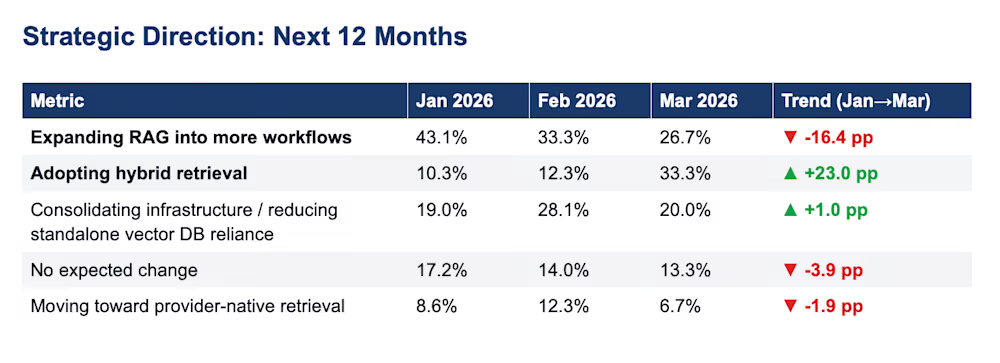
Enterprise intent to adopt hybrid retrieval tripled from 10.3% to 33.3% in a single quarter — even as 22% of qualified enterprise respondents reported having no production RAG systems at all. For data engineers and enterprise architects building agentic AI infrastructure, the data reveals a market in active transition: the RAG architecture most enterprises built to scale is not the one they expect to run by year-end. 

VB RAG study strategic direction

Credit: VentureBeat Pulse survey

Advertisement

Hybrid retrieval has become the consensus enterprise strategy. Unlike single-method RAG pipelines that rely on vector similarity alone, hybrid retrieval combines dense embeddings with sparse keyword search and reranking layers, trading simplicity for the retrieval accuracy and access control that production agentic workloads require.

The standalone vector database category is under pressure. Weaviate, Milvus, Pinecone and Qdrant each lost adoption share across the quarter in the VB Pulse data. Custom stacks and provider-native retrieval are absorbing their displaced share.

A growing minority of enterprises are stepping back from RAG altogether — a signal that the market’s maturity narrative has meaningful exceptions.

Organizations that went wide on RAG in 2025 are hitting the same failure point: the architecture built for document retrieval does not hold at agentic scale.

Advertisement

Enterprises that scaled RAG fast are now paying to rebuild it

The two largest intent movements in Q1 are directly connected — enterprises confronting retrieval quality problems at scale, and hybrid retrieval emerging as the consensus answer.

Investment priorities shifted in parallel. Evaluation and relevance testing led budget intent in January at 32.8% and fell to 15.6% by March. Retrieval optimization moved in the opposite direction, from 19.0% to 28.9% — overtaking evaluation as the top growth investment area for the first time. 

VB RAG survey investment priorities

Credit: VentureBeat Pulse survey

Steven Dickens, vice president and practice lead at HyperFRAME Research, described the operational burden enterprise data teams are facing in a VentureBeat interview in March on Oracle’s agentic AI data stack. “Data teams are exhausted by fragmentation fatigue,” Dickens said. “Managing a separate vector store, graph database and relational system just to power one agent is a DevOps nightmare.”

Advertisement

That fatigue shows directly in the platform data. The custom stack rise to 35.6% is not a rejection of managed retrieval — many organizations run both. It is a consolidation response from engineering teams that have hit the limits of assembling too many components.

Not every enterprise has made it that far. The VB Pulse data includes a signal that complicates the market’s overall growth narrative: 22.2% of qualified respondents reported no production RAG by March, up from 8.6% in January.  The report attributes this cohort to organizations that have “not yet committed to any retrieval infrastructure, or have paused programs” — concentrated in Healthcare, Education and Government, the same sectors showing the highest rates of flat budgets.

Standalone vector databases are losing the adoption argument but winning the reliability one

Recent reporting by VentureBeat illustrates why the dedicated retrieval layer still matters in production. 

Two enterprises building on Qdrant show why purpose-built vector infrastructure still wins in production.

Advertisement

 &AI builds patent litigation infrastructure and runs semantic search across hundreds of millions of documents. Grounding every result in a real source document is not optional — patent attorneys will not act on AI-generated text. That requirement makes the architectural choice clear.

“The agent is the interface,” Herbie Turner, &AI’s founder and CTO, told VentureBeat in March. “The vector database is the ground truth.”

GlassDollar, a startup that helps Siemens and Mahle evaluate startups, runs an agentic retrieval pattern across a corpus approaching 10 million indexed documents. A single user prompt fans out into multiple parallel queries, each retrieving candidates from a different angle before results are combined and re-ranked. That query volume and precision requirement is what drove the choice of purpose-built vector infrastructure.

“We measure success by recall,” Kamen Kanev, GlassDollar’s head of product, told VentureBeat in March. “If the best companies aren’t in the results, nothing else matters. The user loses trust.”

Advertisement

The VB Pulse data shows that framing — retrieval as ground truth rather than feature — is gaining traction across the broader enterprise market, even as standalone vector database adoption declines. 

Why enterprises say they need a dedicated vector layer shifted significantly across Q1. In January the top reasons were access control complexity (20.7%) and retrieval precision (19.0%). By March, operational reliability at scale had surged to 31.1% — more than doubling and overtaking everything else. Enterprises are no longer keeping vector infrastructure primarily for precision. They are keeping it because it is the part of the stack they can rely on when query volumes scale.

How enterprises are redefining what good retrieval means

How enterprises judge their retrieval systems shifted notably across Q1 — and the direction of that shift points to a market getting more sophisticated about what good retrieval actually means.

In January, response correctness dominated evaluation criteria at 67.2% — far above anything else. By March, response correctness (53.3%), retrieval accuracy (53.3%) and answer relevance (53.3%) had converged exactly. Getting the right answer is no longer enough if it came from the wrong document or missed the context of the question.

Advertisement

Answer relevance was the only criterion that rose across the quarter, gaining five percentage points. It is also the hardest to measure — whether the retrieved context is actually the right context for that specific question requires purpose-built evaluation infrastructure, not just pass-or-fail correctness checks. Its rise signals that a meaningful share of enterprise buyers have moved past basic RAG testing entirely. 

VB RAG survey top evaluation

Credit: VentureBeat Pulse survey

The market’s verdict: RAG isn’t dead. The original architecture is

The “RAG is dead” narrative had real momentum heading into 2026. It rested on two claims. The first: that long-context windows — models capable of processing hundreds of thousands of tokens in a single prompt — would make dedicated retrieval unnecessary. The second: that agentic memory systems, which store what an agent learns across sessions rather than retrieving it fresh each time, would absorb the knowledge access problem entirely.

The VB Pulse data is the enterprise market’s answer to the first claim. The long-context-as-dominant-architecture position collapsed from 15.5% in January to 3.5% in February before partially recovering to 6.7% in March. January’s sample was heavily weighted toward Technology and Software respondents — the segment most exposed to long-context model announcements in late 2025. As the sample diversified, the position evaporated.

Advertisement

On the memory question, Jonathan Frankle, chief AI scientist at Databricks, framed the architecture clearly in a March interview with VentureBeat: a vector database with millions of entries sits at the base of the agentic memory stack, too large to fit in context. The LLM context window sits at the top. Between them, new caching and compression layers are emerging — but none of them replace the retrieval layer at the base. New agentic memory systems like Hindsight, developed by Vectorize, and observational memory approaches like those in the Mastra framework address session continuity and agent context over time — a different problem than high-recall search across millions of changing enterprise documents.

The most consequential signal: the share of respondents not expecting large-scale RAG deployments by year-end grew from 3.4% to 15.6% — nearly 5x. That is not a verdict against retrieval. It is a verdict against the retrieval architecture most enterprises built first.

VB RAG survey expected dominant architecture

Credit: VentureBeat Pulse survey

The retrieval rebuild is not optional

The retrieval rebuild is the cost of scaling RAG without first deciding what architecture could actually support it.

Advertisement

If your organization is among the 43.1% that entered Q1 planning to expand RAG into more workflows, the VB Pulse data suggests that plan has already changed for many of your peers — and may need to change for you. Hybrid retrieval is the consensus destination. Custom stack growth to 35.6% reflects teams building retrieval infrastructure around requirements that off-the-shelf products do not fully address.

RAG is not dead. The architecture most enterprises used to implement it is. The data suggests the rebuild is not a future decision. For 33% of enterprises, the rebuild is already the stated priority.

Source link

Advertisement
Continue Reading

Tech

Emergency First Responders Say Waymos Are Getting Worse

Published

on

Emergency first-responder leaders told federal regulators in a private meeting last month that they were frustrated with the performance of autonomous vehicles on their streets—that city firefighters, police officers, EMTs, and paramedics are forced to spend time during emergencies resolving issues with frozen or stuck cars. One fire official called them “a safety issue for our crews as well as the victims.” WIRED obtained an audio recording of the meeting.

Officials from San Francisco and Austin, where Waymo has been ferrying passengers without drivers for more than a year, said the vehicles’ performance is getting worse. “We are actually seeing something interesting: backsliding of some things that had improved upon,” Mary Ellen Carroll, the executive director of San Francisco’s Department of Emergency Management, told officials with the National Highway Traffic Safety Administration (NHTSA), which oversees self-driving vehicle safety in the US. “They are committing more traffic violations.”

“We’ve seen some behavior we haven’t seen in a few years … Waymo is frequently now blocking our fire stations from access,” added Chief Patrick Rabbitt, the head of the San Francisco Fire Department. “Their default is to freeze.” The situation can prevent firetrucks from responding to emergencies in a “timely and appropriate” way, he said.

In Austin, first responders have been frequently stymied by Waymos “freezing up,” said Lieutenant William White, head of Highway Enforcement Command at the Austin Police Department. White said that, contrary to what Waymo had told first responders, the vehicles often fail to recognize or respond to officers’ hand signals, which can lead to cascading delays during emergencies or unusual road incidents.

Advertisement

“I believe the technology was deployed too quickly in too vast amounts, with hundreds of vehicles, when it wasn’t really ready,” White said. NHTSA did not respond to WIRED’s request for comment.

The complaints come as Waymo embarks on an ambitious expansion across the US and the world. Today, the company offers driverless rides in parts of 10 US cities, with plans to launch service in 10 more before the end of the year, including London. Waymo said last month that it’s now providing 500,000 paid rides weekly—a figure that’s still dwarfed by human-powered ride-hail services (Uber provides some 400 times that number weekly) but has grown tenfold since last year.

But these comments from cities where the service is already operating threaten to slow the rollout of driverless technology, which, according to Waymo’s data, reduces serious crashes compared to human-driven cars. Waymo is already facing political opposition, especially from organized labor, in several dense, blue, and potentially lucrative cities, including Boston, New York City, Seattle, and Washington, DC.

In a statement, Waymo spokesperson Julia Ilina wrote: “We deeply value our partnership with first responders and our shared commitment to safety. Their ongoing feedback has been instrumental in driving impactful improvements to the Waymo service.” The company says it has conducted in-person training for more than 35,000 emergency responders across the country.

Advertisement

Public Comment Periods

The comments made in the private meeting are blunter than what government officials have generally said in public. But they reflect long-simmering and sometimes vocal frustrations expressed by city leaders since at least late last year. Since autonomous vehicle operations are regulated in California and Texas by state rather than city officials, local first-responder departments and those who represent them can generally only request that developers like Waymo make specific changes to their operations.

On Wednesday, Austin first responders appeared before the City Council to discuss Waymo’s response to an incident last month in which a driverless vehicle blocked an ambulance for two minutes that was responding to a shooting in the city’s downtown, which killed three people and injured at least 14. Though officers were able to connect quickly with Waymo operators to move the vehicle, they reported that it had taken up to three minutes to connect with a remote agent in the past. They reiterated that Waymos don’t always respond well to hand signals, especially ones from police mounted on motorcycles.

Waymo declined to attend the meeting, and two front-row chairs labeled “RESERVED FOR: WAYMO” remained empty throughout the two-hour session.

Source link

Advertisement
Continue Reading

Tech

Joby Demos Its Air Taxi In NYC

Published

on

Joby Aviation has completed demonstration flights of its electric air taxi over New York City, testing real routes between JFK and Manhattan helipads as it prepares for a future commercial service. The company says its eVTOL could turn a 60- to 120-minute airport trip into a flight of under 10 minutes, though commercial launch still depends on FAA certification. Electrive reports: To launch operations in New York City, Joby acquired Blade Urban Air Mobility last year. Blade already enables helicopter flights for affluent travelers between Manhattan and airports such as JFK or Newark in just five minutes, avoiding up to two hours of traffic and typical airport hassles. Joby aims to replace this service with quiet, electric air taxis as soon as possible, transitioning Blade’s existing customers to the new technology.

However, introducing a new aircraft into commercial service requires a years-long certification process, overseen in the US by the Federal Aviation Administration (FAA). Joby is now in the final phase of FAA certification. Following a series of demonstration flights in the San Francisco Bay Area, the company has tested its air taxi in New York City on real flight routes and under real-world conditions. During these tests, Joby demonstrated the acoustics and performance metrics critical for entering the urban air taxi market.

During these demonstration flights, Joby’s air taxi took off from John F. Kennedy International Airport (JFK) and landed at various helipads across the city, including Downtown Skyport and the helipads at West 30th Street and East 34th Street in Midtown, where Blade Air Mobility’s premium passenger lounges are located. These locations represent some of the commercial routes Joby plans for New York […]. Fun fact: Joby’s eVTOL aircraft are over 100 to 1,000 times quieter than a conventional helicopter, operating at roughly 55-65 dB during takeoff and landing compared to 90+ dB for helicopters.

Source link

Advertisement
Continue Reading

Tech

Ubuntu’s AI Plans Have Linux Users Looking For a ‘Kill Switch’

Published

on

Canonical’s plan to add AI features to Ubuntu has sparked pushback from users who are concerned it could follow Windows 11’s AI-heavy direction. “After Canonical’s announcement earlier this week that it’s bringing AI features to Ubuntu, replies included requests for an AI ‘kill switch‘ or a way to disable the upcoming features,” reports The Verge. Canonical says it has no plans for a “global AI kill switch” but it will allow users to remove any AI features they don’t want. From the report: In his original post, [Canonical’s VP of engineering, Jon Seager] said the upcoming AI features will include accessibility tools like AI speech-to-text and text-to-speech, along with agentic AI features for tasks like troubleshooting and automation. Canonical is also encouraging its engineers to use AI more and plans to begin introducing AI features in Ubuntu “throughout the next year.”

In a follow-up comment, Seager clarified that, “my plan is to introduce AI-backed features as a ‘preview’ on a strictly opt-in basis in [Ubuntu version] 26.10. In subsequent releases, my plan is to have a step in the initial setup wizard that allows the user to choose whether or not they’d like the AI-native features enabled.” Ultimately, he said, “All of these capabilities will be delivered as Snaps to the OS, layered on top of the existing Ubuntu stack. That means there will always be the option of removing those Snaps.” Users who prefer to avoid AI entirely could switch to other distros like Linux Mint, Pop!_OS, or Zorin OS. “These distros have some similarities to Ubuntu, but may not necessarily adopt the new AI features Canonical is rolling out,” adds The Verge.

Source link

Continue Reading

Tech

China threatens the EU with broad retaliation

Published

on

Beijing’s commerce ministry has formally submitted a 30-page document warning the European Commission that its draft Cybersecurity Act, which would make vendor removal mandatory for the first time, could trigger reciprocal measures against European companies in China.


China has formally threatened the European Union with retaliation if a sweeping new cybersecurity law leads to the exclusion of Chinese firms, including Huawei and ZTE, from European critical infrastructure.

The Chinese Ministry of Commerce submitted a 30-page document to the European Commission, reported earlier by the South China Morning Post, explicitly warning that Beijing is prepared to invoke its Foreign Trade Law and State Council Supply Chain Security Regulations, legal frameworks that allow China to restrict trade, investigate foreign entities, and impose reciprocal bans on European companies, if Chinese firms face what it calls discriminatory treatment.

The document was submitted on April 17 to the Commission. MOFCOM spokesperson He Yongqian confirmed the submission at a press briefing on April 24, framing China’s core objection as the draft law’s use of ‘non-technical risk’ factors, a mechanism Beijing argues is a subjective political tool designed to exclude Chinese companies regardless of the actual security properties of their equipment.

Advertisement

What the EU Cybersecurity Act proposes?

The revised EU Cybersecurity Act, announced by the European Commission on January 20, represents a fundamental shift in how Brussels approaches network security. Since 2020, the EU’s ‘5G toolbox’ has recommended that member states avoid high-risk vendors in 5G networks.

The 💜 of EU tech

The latest rumblings from the EU tech scene, a story from our wise ol’ founder Boris, and some questionable AI art. It’s free, every week, in your inbox. Sign up now!

That recommendation has been implemented unevenly: only 13 of 27 member states had acted on it by the time the new law was announced, and several of the bloc’s most significant economies, including Germany, where Huawei provided equipment across approximately 60% of 5G sites as recently as late 2024, had been slow to act.

Advertisement

The new law changes the legal basis from recommendation to obligation. It would require member states to remove equipment from vendors designated as high-risk suppliers from communications networks within three years of the law entering into force.

It also creates a mechanism under which the Commission can designate an entire country as a ‘cybersecurity threat,’ which would trigger exclusions extending beyond telecoms into 18 critical sectors, including energy, transport, and information technology.

The law does not name Huawei or ZTE explicitly, but the intent is unambiguous: EU Tech Commissioner Henna Virkkunen said it would give the bloc ‘the means to better protect our critical supply chains,’ and Strand Consult data puts Chinese vendors’ share of European 5G infrastructure at between 33% and 40%. A full removal would be the largest forced replacement of telecoms infrastructure in European history.

The precedent that makes Beijing’s threat credible

China’s retaliation threats have a documented track record. When Sweden banned Chinese vendors from its 5G networks in 2020, Ericsson’s revenues in China fell 46% the following year.

Advertisement

The company has never recovered that business. Nokia, which has maintained a small footprint in the Chinese market, has watched its China revenues fall from roughly €2.5 billion in 2018 to approximately €913 million last year.

Nokia executives have told the company internally that it faces a total ban in China for national security reasons, with Nokia’s president of mobile networks, Tommi Uitto, publicly stating that the combined China market share of both Nordic vendors has dropped to 3%.

The asymmetry is pointed. China has already been restricting Nokia and Ericsson, the two European companies that stand to benefit most from a Huawei ban, while simultaneously warning the EU that it will face consequences if it formalises its own exclusions.

That double standard is increasingly being called out. Nokia CEO Justin Hotard has contrasted Europe’s continued openness to Huawei with China’s restrictions on European vendors, and Ericsson’s Börje Ekholm has estimated the EU revenue opportunity from replacing Chinese kit at a ‘sizeable’ number given Huawei and ZTE’s combined European market share.

Advertisement

The Swedish precedent also illustrates the implementation challenge the EU faces independently of Chinese pressure. The UK mandated the removal of Huawei from 5G networks by the end of 2027. BT missed the 2023 deadline for its core network.

Germany ordered Huawei removed from the 5G core by the end of 2026, a deadline that applies to a part of the network Huawei was not even present in when the rules were announced, while allowing retention of Huawei’s radio access network until 2029. The practical reality of a three-year EU-wide rip-and-replace at scale is, as Light Reading noted, ‘ambitious and compliance is not certain.’

What Beijing is threatening and why?

China’s 30-page submission argues on four grounds. First, the ‘non-technical risk’ framework is discriminatory on its face, targeting companies by country of origin rather than by demonstrated security flaw. Second, the law violates WTO principles of non-discrimination and proportionality.

Third, that designating China as a ‘country of cybersecurity concern’ would, if triggered, extend exclusions far beyond telecoms into clean energy, automotive, and industrial supply chains where Chinese companies are deeply embedded in European markets.

Advertisement

Fourth, that European companies operating in China, German automakers with €90 billion in annual exports, Dutch chipmakers, French luxury and aerospace firms, would face reciprocal market access restrictions.

The legal mechanisms cited, China’s Foreign Trade Law and the State Council’s Supply Chain Security Regulations, are the same frameworks Beijing has used in previous technology trade disputes. They permit retaliatory trade restrictions, procurement bans, investigations into foreign entities, and entity list designations that mirror the US model China publicly decries.

The spokesperson’s framing, that China ‘still views cooperative dialogue as the correct path’, is the standard diplomatic hedging that accompanies formal coercive submissions of this kind.

A geopolitically loaded moment

The Trump administration has simultaneously been pressuring the EU to accelerate Huawei removal while threatening tariffs over EU enforcement actions against US tech companies.

Advertisement

The EU is navigating a position in which it faces pressure from Washington to act on Huawei and pressure from Beijing not to, while also trying to maintain economic relationships with both.

Germany, the member state with the most at stake both in terms of Huawei infrastructure and Chinese market exposure for its automotive sector, has been the most cautious about implementation pace.

For Nokia and Ericsson, the stakes are direct. Both were among the companies expected to meet EU leadership precisely around the question of European tech competitiveness and strategic supply chain policy.

A full European Huawei ban would represent the single largest new revenue opportunity the Nordic vendors have had in years. Whether the EU actually follows through, given member state reluctance, the implementation timeline, and Beijing’s explicit threat, is now the central question.

Advertisement

The Cybersecurity Act must still be negotiated with EU governments and the European Parliament before it becomes law. No timeline for that process has been confirmed.

China’s formal submission is designed to influence that negotiation, and the governments most exposed to Chinese trade retaliation, Germany, the Netherlands, and France, are also the ones whose implementation of the existing 5G toolbox has been most limited.

Source link

Advertisement
Continue Reading

Tech

Today’s NYT Wordle Hints, Answer and Help for April 30 #1776

Published

on

Looking for the most recent Wordle answer? Click here for today’s Wordle hints, as well as our daily answers and hints for The New York Times Mini Crossword, Connections, Connections: Sports Edition and Strands puzzles.


Today’s Wordle puzzle is a bit tricky, thanks to its repeated letter. If you need a new starter word, check out our list of which letters show up the most in English words. If you need hints and the answer, read on.

Read more: New Study Reveals Wordle’s Top 10 Toughest Words of 2025

Advertisement

Today’s Wordle hints

Before we show you today’s Wordle answer, we’ll give you some hints. If you don’t want a spoiler, look away now.

Wordle hint No. 1: Repeats

Today’s Wordle answer has one repeated letter.

Wordle hint No. 2: Vowels

Today’s Wordle answer has one vowel.

Wordle hint No. 3: First letter

Today’s Wordle answer begins with C.

Advertisement

Wordle hint No. 4: Last letter

Today’s Wordle answer ends with K.

Wordle hint No. 5: Meaning

Today’s Wordle answer can refer to a thick earthenware pot or jar.

TODAY’S WORDLE ANSWER

Today’s Wordle answer is CROCK.

Advertisement

Yesterday’s Wordle answer

Yesterday’s Wordle answer, April 29, No. 1775, was RURAL.

Recent Wordle answers

April 25, No. 1771: WOMEN

April 26, No. 1772: GLOSS

April 27, No. 1773: EERIE

Advertisement

April 28, No. 1774: QUACK

Source link

Advertisement
Continue Reading

Tech

Schiit Buf Tube Buffer Launches at $99: A Subtle Upgrade or Sonic “Buf”?

Published

on

Schiit Audio is taking a more practical swing at tubes with the $99 Buf. It’s a compact tube buffer designed to sit in your signal chain, not take it over.

Buf isn’t a preamp and it’s not a DAC. There are no inputs for sources beyond basic line level, no volume control, and no system control duties. You place it between components; typically between a DAC and amplifier, or between a source and powered speakers, and it inserts a tube stage into the chain. If you don’t want that, it can be switched out and used as a straight pass through.

That makes it easy to experiment without committing to a full tube setup. It can be used to slightly reshape a solid state system, take the edge off a brighter chain, or add some variation to a desktop or headphone rig. It’s also flexible enough to move around depending on the system or use case, which fits Schiit’s usual modular approach.

At $99, Buf is less about replacing components and more about giving users a simple way to try a tube stage in different setups and decide if it works for them.

Advertisement
schiiit-buf-front-angle
Schiit Buf

Tubes Anywhere Without Rebuilding Your System

Schiit Audio isn’t pretending the $99 Buf is neutral. In fact, they’re leaning in the opposite direction.

Buf is a tube buffer. It adds a ton of low-order harmonic distortion, without adding a bunch of noise. It destroys the big perfect of ‘measurement gear.’ At the same time, lots of people, including those who use Audio Precisions all day, think it sounds better. So we figured we’d make this thing and let you find out for yourself,” said Jason Stoddard.

That’s the pitch. Not accuracy in the lab sense, but a different presentation that some listeners may prefer, especially in systems that lean hard into ultra-low distortion solid state performance.

Despite the price, this isn’t a stripped-down implementation. The Schiit Buf runs a 100V plate voltage, uses a linear power supply, and incorporates higher-grade parts including Panasonic film capacitors. Schiit’s Coherence topology is also in play, maintaining absolute phase and offering selectable gain; either 0dB or 12dB from a front panel switch.

Advertisement

Stoddard is also clear that this isn’t a generic design.

It’s not just another cathode follower,” he explained. “It’s more akin to our Lyr and Vali tube amps, but it’s different than both—a simple Class A stage optimized for line level use, rather than driving headphones.”

That last part matters. Buf isn’t trying to power anything. It’s there to sit in the chain and influence it, subtly or not, depending on the system and gain setting.

Advertisement. Scroll to continue reading.
Advertisement

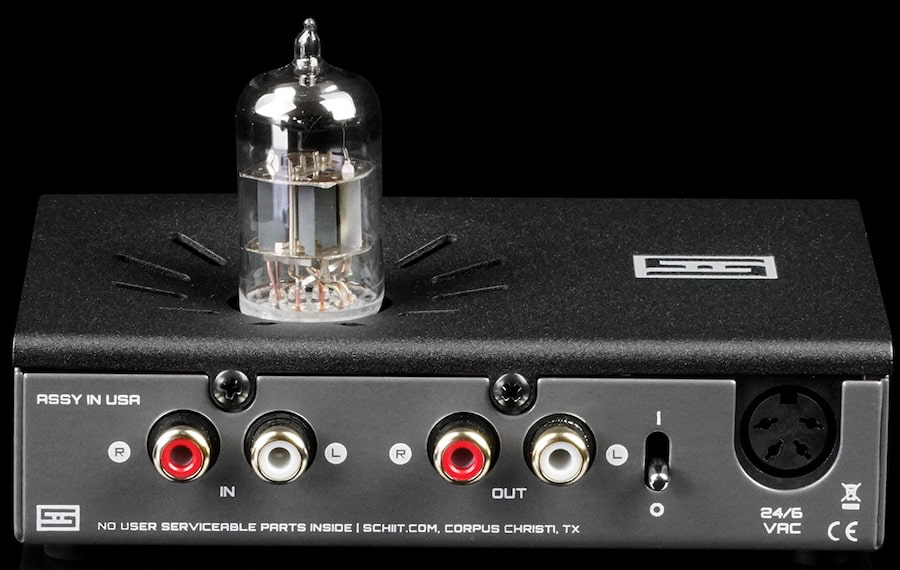
Connectivity is simple: RCA in, RCA out. It will work in most two-channel or desktop setups without much thought. And because it can be fully bypassed, it’s easy to evaluate in real time without pulling cables.

schiiit-buf-back

Schiit Buf Specifications

  • Gain Modes
    • Low Gain (0dB): 20Hz–20kHz ±1dB, THD <0.5%, IMD <0.6%, SNR >106dB, Crosstalk -90dB
    • High Gain (12dB): 20Hz–20kHz ±1dB, THD <0.2%, IMD <0.4%, SNR >97dB, Crosstalk -80dB
  • Performance & Design
    • Output Impedance: 75 ohms
    • Input Impedance: 470k ohms
    • Maximum Output: 8.2V RMS
    • Topology: Coherence tube gain with BJT inverter, Class A
    • Protection: Delayed start, fast shutdown, muting relay
  • Power & Build
    • Power Supply: External 24VAC and 6VAC wall adapter, linear regulated rails, 6V AC heater
    • Power Consumption: 6W
    • Dimensions: 5 x 3.5 x 2.75 inches
    • Weight: 1 lbs
schiiit-buf-pcb

Schiit Buf Setup, Tube Use, and Basics

Buf can be added to a system in two straightforward ways. You can place it between a preamp and power amplifier, which allows it to affect every source connected to the preamp. Alternatively, you can insert it between a single source such as a DAC and an integrated amplifier, preamp, or headphone amplifier. In that setup, Buf only influences that specific source.

Tube lifespan is typically around 5,000 hours of use. That figure reflects active operating time, so it’s best to turn the unit off when it’s not in use to extend tube life.

Buf is compatible with tubes that use a standard 6922 pinout, with heater current up to 600mA. Supported types include 6N1P, 6922, ECC88, and 6DJ8. For simplicity and consistency, using the included tube is the most straightforward option.

Like the rest of Schiit’s lineup, Buf is built in the USA, with assembly in Texas and chassis work in California. It carries a 3-year warranty, with the tube itself covered for 90 days.

Advertisement

The Bottom Line

The $99 Schiit Buf is a simple way to add a tube stage to almost any system without changing your core components and you can bypass it when you don’t want it. What’s unique is the price, true tube implementation, and flexibility. What’s missing is everything else: no volume control, no inputs beyond basic RCA switching, no DAC, no remote. This is for users who already have a system and want to experiment with tube character without committing to a full tube preamp or amplifier.

Where to buy: $99 at Schiit

Source link

Advertisement
Continue Reading

Tech

LG’s Wireless TVs are the first in the world to offer this feature

Published

on

LG has secured the first True Wireless Lossless Vision certification from testing body TÜV Rheinland for its premium wireless TVs, independently verifying that the OLED evo W6 and Mini RGB evo MRGB9M deliver visually lossless 4K picture quality over a wireless connection.

The certification addresses a longstanding concern with wireless TV technology, where the absence of a physical cable connection has introduced compromises with colour accuracy, HDR tone reproduction and image detail that made wireless displays a harder recommendation against wired equivalents at the same price point.

TÜV Rheinland’s evaluation confirmed that both LG models maintain colour reproduction, image detail, and HDR tone performance within defined tolerance levels relative to the input signal, with the OLED evo W6 additionally certified for wireless transmission at refresh rates up to 165Hz, a figure relevant to gaming use cases where motion clarity and input lag are primary concerns.

The OLED evo W6 sits at the centre of LG’s certified lineup as the company’s Wallpaper TV, a 9mm panel that ships with a separate Zero Connect Box housing all physical inputs, which can be positioned up to 10 metres from the screen to eliminate visible cable runs between source devices and the display itself.

Advertisement
LG TUV Rheinland certifiedLG TUV Rheinland certified
Image Credit (LG)

Advertisement

Extending the certification beyond OLED, the Mini RGB evo MRGB9M brings TÜV-verified wireless performance to LCD technology. Available in 65-inch, 75-inch, and 86-inch screen sizes, the panel applies image processing techniques more commonly associated with OLED-class displays to provide better colour accuracy and contrast management at larger scales.

The True Wireless Lossless Vision standard itself was developed by TÜV Rheinland to evaluate wireless display products against factors including input lag, colour accuracy and gamma tracking, establishing a repeatable test framework against which future wireless TV products from any manufacturer can be assessed.

Neither pricing nor regional availability for the LG OLED evo W6 or LG Mini RGB evo MRGB9M has been confirmed, with LG stating only that availability may vary by market.

Advertisement

Source link

Continue Reading

Tech

SpaceX quietly warns its space AI data center dream may never work, even as Elon Musk keeps selling it as inevitable

Published

on


  • SpaceX admits orbital AI data centers may never become commercially viable
  • SpaceX S-1 filing reveals unproven technologies behind space-based computing infrastructure
  • Harsh space conditions threaten the reliability of sensitive AI hardware systems

SpaceX has warned potential investors its ambitious plans to build AI data centers in orbit may never become commercially viable due to unproven technologies and the harsh realities of space.

The company disclosed these risks in its pre-IPO S-1 filing, which US securities law requires to inform investors of potential pitfalls while shielding the company from future legal liability.

Source link

Advertisement
Continue Reading

Tech

New Releases on Prime Video in May 2026: Jack Reacher, Spider-Noir and More

Published

on

Nicolas Cage stars in the new live-action series Spider-Noir, based on the Marvel comic Spider-Man Noir. The show marks Cage’s first leading role in a TV series. In it, he plays Ben Reilly, a down-on-his-luck private investigator in 1930s New York who was once a superhero known as “The Spider.” When he’s offered a new case, Ben assumes his old alter ego one more time. 

While we’re excited to see what Cage can do in this role, we’re also looking forward to the choose-your-own-viewing-experience aspect of the show. The series will be available to stream two ways: “Authentic Black & White” for an especially noir feel, or in “True-Hue Full Color,” a stylized, color-saturated option. Lamorne Morris, Li Jun Li, Karen Rodriguez, Abraham Popoola and Jack Huston all co-star. The series will debut on MGM Plus’s broadcast channel on May 25 and arrives on streaming on Prime Video on May 27 as a binge release.

Source link

Advertisement
Continue Reading

Trending

Copyright © 2025