Connect with us

Tech

Limerick’s H&MV Engineering taps fresh funding, shares hiring plans

Published

on

The company wants to grow its headcount by 1,000 in the next five years.

H&MV Engineering has tapped around €750m in extended investments led by European private equity company Exponent and plans to recruit across its international operations. The fresh funding values the Limerick-headquartered business at €1.4bn.

The critical power infrastructure services provider said the funding will help its next phase of growth, with a focus towards US expansion. The continuation vehicle also brings in new investors Apollo S3, Pantheon and SQ Capital. Exponent has backed H&MV since 2022.

Power infrastructure providers play a key role in enabling the expansion of newer technologies including AI and data centres (whose power consumption has grown at a 12pc rate every year since 2020), and battery storage systems.

Advertisement

H&MV is at the “centre of some of the world’s fastest-growing infrastructure markets, where demand for specialist engineering expertise and reliable power infrastructure continues to increase”, said John Moore, operating partner at Exponent and board chair at H&MV Engineering.

The company currently has more than 24GW of projects in design and construction, and operates from 20 international offices across Ireland, the UK, Europe, the US and Asia.

“This transaction gives H&MV the long-term backing to scale at the pace of the markets we serve and to deliver on our five-year growth ambition,” said PJ Flanagan, the company’s CEO.

“As we enter our next phase of growth, we’ll continue investing in the team, our engineering capability and the culture that has enabled us to grow while delivering for clients around the world.”

Advertisement

Earlier this year, the company agreed to provide BnM with electrical and infrastructure support as it builds the Oweninny Wind Farm in Co Mayo.

Since 2020, H&MV has increased revenue from €61m to roughly €1bn this year and grown its workforce from around 300 to nearly 2,000, it said. It wants to triple its revenues to €3bn in the next five years and grow its headcount by another thousand.

Recruitment will be focused on the US, alongside continued hiring in Ireland, the UK and Europe, H&MV told SiliconRepublic.com.

H&MV purchased Texas-based Cooke Power Services this year in preparation for its expansion plans. It now plans to open its North American headquarters in Dallas later this year.

Advertisement

Don’t miss out on the knowledge you need to succeed. Sign up for the Daily Brief, Silicon Republic’s digest of need-to-know sci-tech news.

Source link

Advertisement
Continue Reading
Click to comment

You must be logged in to post a comment Login

Leave a Reply

Tech

Amazon’s new Texas data center could become the single largest polluter in the US

Published

on

A hot potato: A proposed Amazon data center in Texas has sparked concerns that its massive on-site power plant could become the single-largest source of pollution in the US, threatening to affect local communities, farmland, and small businesses. The facility is planned for Pecos County as part of Amazon’s growing push into AI and cloud services.

In a statement to The New York Times, an Amazon spokesperson said the data center will be powered entirely by an on-site power plant, ensuring it won’t raise electricity costs for local residents. The plant is expected to run on natural gas, with 35 turbines combining to generate up to 7.65 gigawatts of power.

The facility has regulatory approval to release up to 33 million tons of carbon dioxide per year, which would make it the largest single source of greenhouse gas emissions in the US – more than any other factory or power plant nationwide.

Advertisement

Critics say the permitted emissions level is far too high, noting that the projected output would rival the total emissions of entire countries, including Switzerland, Ireland, and Bulgaria.

Notably, Amazon co-founded The Climate Pledge in 2019, promising to reach net-zero carbon emissions by 2040. Since then, though, its emissions have climbed sharply: the company’s emissions tied to purchased electricity rose 34% in 2025 alone.

Asked about the pledge, Amazon spokeswoman Margaret Callahan told the Times that “the world looks different now than when we co-founded the climate pledge,” but added that “our commitment [to a carbon-neutral future] hasn’t changed.”

Advertisement

The Pecos County plant falls under the so-called “Ratepayer Protection Pledge,” which requires tech companies to source their own power for new AI data centers rather than drawing from existing grids.

The pledge was signed last March at the insistence of President Trump by several leading American tech companies, including Google, Microsoft, Meta, Amazon, Oracle, OpenAI, and xAI.

US investment in data center infrastructure hit record levels last year, and as major tech companies continue pouring money into AI, demand for electricity is expected to keep climbing sharply in the years ahead.

Advertisement

Source link

Continue Reading

Tech

Agentic orchestration: Enterprise AI organizations know how to govern agents but still can’t meter what they cost

Published

on

Across 107 enterprises, agentic orchestration is not a choice of a single platform.

The typical enterprise runs three orchestration platforms at once, and selects them for flexibility across models rather than affinity to any single one. Microsoft leads primary usage while Anthropic leads forward consideration by a wide margin. 

The AI control plane enterprises expect is deliberately hybrid, meaning it includes use of the leading AI providers, but also provider-independent technologies — and the risk they fear most from provider-resident control is not lock-in but the provider’s own security and permissioning limits. 

One in five enterprises still has no real-time way to stop a runaway agent before the bill arrives.

Advertisement

This wave of VentureBeat Pulse Research examines enterprise agent orchestration: which platforms enterprises run on, what drives the choice, what they optimize for, how they expect agent control to be structured, and — most revealingly — how orchestrated their deployed “agents” actually are and how tightly they control the cost of running them.

The central finding is that orchestration has become plural. Eighty-five percent of enterprises run two or more orchestration platforms and 64% run three or more, with a mean of 3.1 platforms per organization. Microsoft AI Foundry / Copilot Studio appears in 70% of stacks and OpenAI’s Agents SDK in 68%, with Anthropic’s Claude Platform in 47%. Asked to name a single primary platform, respondents who gave one unambiguous answer put Microsoft first (41%) and Anthropic second (28%). Nobody in this sample is running one orchestration layer and calling it a strategy.

The selection logic follows from that plurality. Flexibility across models and tools is the leading purchase driver at 29%, nearly three times the share naming model gravity — native alignment with a state-of-the-art base model — at 10%. Enterprises are not choosing the orchestration environment that comes with their favorite model; they are choosing the one that does not commit them to any model. Security and permissions (17%), production reliability (15%), and control over agent execution (15%) fill out a buying logic focused on governance and optionality rather than developer convenience.

A clear majority (53%) expect a hybrid control plane by the end of 2026 — provider-native plus external orchestration — and the risk they most associate with provider-resident control is security and permissioning limitations (37%), ahead of vendor lock-in (23%) and limited visibility (22%). Investment has moved accordingly: agent monitoring and debugging leads the spend at 31%, with security and permissions enforcement at 30%, while workflow tooling draws 19%. Enterprises are spending to see and govern agents, not merely to build them.

Advertisement

Most companies admit that a majority of their “agents” are really just chatbots. A plurality of 47% of respondents say that between 26 and 50% of their agents are genuinely orchestrated, with 37% at a quarter or below and 16% past the halfway mark. 

But fiscal control remains the soft spot: 21% of enterprises track agent spend only through post-hoc logs, with no real-time way to halt a runaway execution loop.

Methodology

VentureBeat fielded this survey as part of its ongoing Pulse Research series, with this instrument focused on enterprise agent orchestration. Responses are filtered to organizations with 100 or more employees (n=107), drawn from a single July 2026 wave; because this is one wave rather than a pooled multi-month sample, the report reads cross-sectionally and does not infer month-over-month trends. All figures in this report come from the July fielding only. Where questions were multiple-select, shares can sum to more than 100%.

This wave draws a notably large-enterprise, technology-heavy sample, and that shapes every finding in it. By organization size, more than half sit at 10,000 employees or above: 50,000+ (26%) and 10,000–49,999 (25%) lead, followed by 2,500–9,999 and 500–2,499 (19% each) and 100–499 (11%). Technology/Software accounts for 53% of respondents, with Government/Public Sector (16%) and Manufacturing/Industrial (10%) next. By role the sample is hands-on and technical: software and ML engineers (22%), product and program managers (21%), directors of data/AI/analytics (17%), and VPs of data/AI/analytics (12%). On purchasing, 90% are recommenders, influencers, or final decision-makers for AI solutions (63% recommender/influencer, 27% final decision-maker).

Advertisement

A note on the primary-platform question. Forty-six of 107 respondents registered more than one selection on a question intended to capture a single primary platform. Because those responses cannot be resolved to one answer, primary-platform shares are reported on the 61 respondents who gave a single unambiguous answer, and are labeled as such wherever they appear. Platform footprint figures — which platforms an enterprise uses at all — use the full n=107 base and are unaffected. The ambiguity is worth noting on its own terms: on a question asking for one platform, more than four in 10 respondents could not or would not narrow to one, which is consistent with the multi-platform pattern documented in Finding 1.

At 107 respondents the sample is robust enough to read directionally with reasonable confidence, though it remains self-selected and is not a probability sample. Because each subgroup here only includes about 50 to 60 respondents, splits between them are less precise than the full-sample findings.

Finding 1: Orchestration is a portfolio, not a platform

The typical enterprise runs three orchestration platforms at once

We asked which agent orchestration platforms enterprises use, and which one they treat as primary. The first answer is that almost nobody has just one.

Advertisement

Finding 1 — Orchestration Is a Portfolio, Not a Platform

70%

have Microsoft AI Foundry / Copilot Studio somewhere in the stack (75 of 107)

Advertisement

68%

use OpenAI’s Agents SDK / Responses API; 47% use Anthropic’s Claude Platform & Agent Skills

32%

Advertisement

use Google’s Enterprise Agent Platform; 24% LangChain / LangGraph; 24% Salesforce Agentforce or a comparable enterprise app platform

22%

run custom in-house orchestration; 13% Amazon Bedrock Agents; 6% LlamaIndex

Advertisement

85%

run two or more orchestration platforms; 64% run three or more, at a mean of 3.1 per enterprise

Advertisement

The defining feature of this layer is plurality. Only 15% of enterprises run fewer than two orchestration platforms; the median organization runs three, and one in six runs five or more. Read that way, the platform “shares” below describe overlapping deployments rather than a divided market — Microsoft and OpenAI each appear in roughly seven of ten stacks precisely because most stacks have room for several.

Asked to name one primary platform, the 61 respondents who gave a single unambiguous answer put Microsoft AI Foundry / Copilot Studio first at 41%, Anthropic’s Claude Platform second at 28%, LangChain / LangGraph at 10%, and OpenAI’s Agents SDK at 7%, with Google, Amazon, Salesforce, and custom in-house builds at 3% each. Microsoft’s lead on primary usage alongside OpenAI’s near-equal footprint on any usage is the signature of an enterprise-weighted sample: the Microsoft platform arrives through an existing enterprise agreement and becomes the default seat of record, while other platforms are added around it for specific work.

Advertisement

A note on reading these shares: As described in the methodology section, the respondents are self-selected, this wave skews heavily toward large technology organizations, and the primary-platform figures rest on a 61-respondent subset. The numbers measure where this cohort has placed its orchestration bets today, within a self-selected audience of AI-active technical practitioners. A sample built this way can diverge substantially from spend-weighted market measures, and each VB Pulse survey draws its own sample with its own company-size and industry mix, so vendor figures should not be compared across our surveys, either.

Respondents rate the platforms they run at 4.17 out of 5 for overall satisfaction, 3.91 for ease of implementation, and 3.63 for value for money — with value for money the weakest of the three by a clear margin. That ordering is itself a finding: enterprises are broadly happy with what these platforms do and distinctly less happy with what they cost, which is the same nerve the fiscal-control finding touches at the end of this report. Satisfaction sits alongside a two-thirds intent to change platforms within the year; this remains a layer enterprises work with rather than settle on.

Finding 2: Flexibility, not model gravity, drives selection

Enterprises buy the orchestration layer that doesn’t commit them

We asked what most influenced the orchestration platform choice, and optionality leads by a distance.

Advertisement

Finding 2 — Flexibility, Not Model Gravity, Drives Selection

29%

name Flexibility across models and tools — the leading factor (31 of 107)

Advertisement

17%

name Security and permissions

15%

Advertisement

name Production reliability; 15% name Control over agent execution

10%

name Model Gravity — native alignment with a state-of-the-art base model

Advertisement

8%

name Ease of development; 4% Total Cost of Ownership; 2% Performance (latency/memory)

Advertisement

Flexibility across models and tools (29%) is the selection-side explanation for the multi-platform reality in Finding 1: enterprises are choosing orchestration environments on the strength of what they leave open rather than what they lock in. Model gravity — picking the orchestration layer that comes with a preferred frontier model — draws just 10%, less than a third of the flexibility share, which places the pull of any single base model well down the list of what actually decides this purchase.

The next tier reinforces the governance emphasis. Security and permissions (17%), production reliability (15%), and control over agent execution (15%) together account for 47% of responses: nearly half of enterprises pick their orchestration platform on whether they can constrain and depend on what it runs. Ease of development draws 8% and total cost of ownership 4%, an inversion of how these platforms are usually discussed in engineering circles. Performance sits last at 2% — at this stage of adoption the binding constraints are optionality and control, not raw speed.

Advertisement

Finding 3: The job is reliable multi-step execution

Enterprises judge orchestration by whether it completes the work

We asked what enterprises optimize for — their primary success metric for orchestration. Reliability and multi-step workflow management lead, with developer productivity closer behind than in the buying criteria.

Finding 3 — The Job Is Reliable Multi-Step Execution

30%

Advertisement

name Task completion reliability — the leading metric

27%

name Multi-step workflow management

Advertisement

23%

name Developer productivity

Advertisement

13%

name Operational stability

7%

Advertisement

name End-user experience

Advertisement

Task completion reliability (30%) and multi-step workflow management (27%) together account for 57% of responses: orchestration succeeds, in the enterprise view, when it reliably carries a task through multiple steps to completion. Developer productivity takes a substantial 23% — notably higher than ease of development’s 8% as a purchase driver in Finding 2, which suggests enterprises do not expect to buy developer velocity so much as to earn it once the platform is in place. End-user experience is a minor concern at 7%, consistent with orchestration being an internal execution problem rather than a UX one.

This reliability-first standard is the yardstick against which the portfolio-maturity finding later in this report should be read: enterprises define success as dependable multi-step execution, and a little over a third of them still say a quarter or fewer of their deployed agents do multi-step work at all.

Finding 4: Two-thirds plan to move — and Anthropic leads the consideration set

The installed base and the pipeline point to different vendors

We asked whether enterprises plan to adopt a new, additional, or replacement orchestration platform in the next 12 months, and which platforms they are considering.

Advertisement

Finding 4 — Two-Thirds Plan to Move — and Anthropic Leads the Consideration Set

33%

have no plans to change

Advertisement

28%

plan to move within 6–12 months — the largest cohort in motion

24%

Advertisement

within 3–6 months; 15% within 0–3 months — 67% in total plan a change within the year

43%

of those in motion are considering Anthropic’s Claude Agent SDK / Managed Agents — the leading candidate (31 of 72)

Advertisement

31%

are considering Google’s Enterprise Agent Platform; 31% custom in-house orchestration; 25% OpenAI

Advertisement

Two-thirds of enterprises (67%) intend to adopt a new, additional, or replacement orchestration platform within the year, but the clock runs longer than the intent suggests: the largest cohort sits at 6–12 months (28%) and only 15% expect to move within a quarter. This is deliberate re-platforming on a planning horizon, not urgent churn.

The consideration set is where this finding earns its headline. Among the 72 enterprises in motion, Anthropic leads at 43% — well ahead of Google (31%), custom in-house builds (31%), OpenAI (25%), LangChain / LangGraph (17%), and Microsoft (17%). Set that against Finding 1, where Microsoft leads primary usage and appears in 70% of stacks: the installed base and the forward pipeline point at different vendors. Anthropic draws roughly two and a half times Microsoft’s forward consideration despite trailing it on current primary usage, and custom in-house control planes draw as much interest as any external platform besides Anthropic. A further 18% of movers are evaluating with no shortlist at all.

Advertisement

Read alongside the flexibility-first selection logic in Finding 2, the shape of the next twelve months is legible: enterprises expect to add rather than replace, they are shopping for platforms that preserve model choice, and a substantial minority intend to solve the problem themselves rather than buy it.

Finding 5: Investment flows to watching and governing agents

Monitoring and permissions lead the spend; workflow tooling trails

We asked which orchestration-related investment will grow most next year. Observability and governance take the top two places.

Finding 5 — Investment Flows to Watching and Governing Agents

Advertisement

31%

name Agent monitoring and debugging — the top growth area

30%

Advertisement

name Security and permissions enforcement

19%

name Agent workflow tooling

Advertisement

18%

name Infrastructure for scaling agents

Advertisement

3%

report that their budget is not increasing

Advertisement

Monitoring and debugging (31%) and security and permissions enforcement (30%) are effectively tied at the top and together account for 61% of planned growth. The money is going to seeing what agents do and constraining what they are allowed to do — the two capabilities that matter once agents are running in production rather than being built toward it. Workflow tooling (19%) and scaling infrastructure (18%) trail, and almost no one is standing still: just 3% report a flat budget.

The emphasis is consistent with the buying logic in Finding 2, where security and permissions was the second-ranked selection factor, and with the control-plane architecture in Finding 6. Enterprises that have decided to run agents across three platforms have a visibility and permissioning problem by construction, and they are funding it directly.

Finding 6: The control plane will be hybrid — and security is why

Enterprises split control, and fear the provider’s permissioning more than lock-in

Advertisement

We asked where enterprises expect the primary control plane for agents to live by the end of 2026, and what worries them most if that control sits inside a model-provider platform.

Finding 6 — The Control Plane Will Be Hybrid — and Security Is Why

53%

expect a Hybrid control plane — provider-native plus external orchestration (57 of 107)

Advertisement

14%

expect a Provider-managed agent service; 13% a Custom in-house control plane

Advertisement

11%

expect External platforms abstracted from model providers; 8% do not expect to deploy autonomous agents at scale

37%

Advertisement

name Security and permissioning limitations as the top risk of provider-resident control (40 of 107)

23%

name Vendor lock-in; 22% Limited visibility and observability; 16% Inflexibility across models and tools

Advertisement

Hybrid control is the dominant expectation by a wide margin (53%). Taken together, the hybrid, custom in-house, and externally-abstracted options — every architecture that keeps control at least partly outside the provider — sum to 78% of enterprises, against 14% willing to hand control to a provider-managed service outright.

Advertisement

The reason enterprises give is worth separating from the one usually assumed. Security and permissioning limitations lead the risk question at 37%, well ahead of vendor lock-in at 23%, with limited visibility and observability close behind at 22%. Combining the security and visibility answers, 59% of enterprises name a control-and-oversight concern rather than a commercial one. The worry is less that a provider platform will be hard to leave than that it will not let them see or constrain what their agents are doing while they are on it — the same concern funding the monitoring and permissions spend in Finding 5. Only 2% say provider-resident control is not a concern at all.

Finding 7: The chatbot trap is loosening, not broken

“Bridging the gap” is now the modal answer on portfolio maturity

We asked enterprises to assess their portfolios honestly: What share of their deployed “agents” are true multi-step orchestrated workflows versus simple single-prompt chatbot wrappers.

Finding 7 — The Chatbot Trap Is Loosening, Not Broken

Advertisement

47%

say 26–50% of their agents are true orchestration — bridging the gap, and the modal answer

35%

Advertisement

say only 1–25% of their agents are true orchestration — most deployments remain basic assistants

14%

say 51–75% are complex, multi-agent pipelines

Advertisement

3%

say 0% — every deployment is a chatbot or prompt wrapper

Advertisement

2%

say 76–100% — advanced, largely autonomous systems

Advertisement

The center of gravity has moved into the middle band. Just under half of enterprises (47%) now put between a quarter and half of their portfolio in genuinely orchestrated, stateful workflows, and 16% are past the halfway mark. The bottom two bands — a quarter or fewer genuinely orchestrated — account for 37%, and outright pure-chatbot portfolios have nearly vanished at 3%. Against the reliability-first success standard in Finding 3, this is a portfolio that has started to do the work the orchestration layer exists for, without most of it being there yet.

Maturity tracks platform count. Enterprises reporting a quarter or less genuine orchestration run 2.8 platforms on average; those in the 26–50% band run 3.5. The organizations furthest into real multi-step work are the ones running the most orchestration platforms at once, which is the practical case for the flexibility-first selection logic in Finding 2 — multi-step portfolios appear to accumulate platforms rather than converge on one.

One split that might be expected does not appear. Organization size makes no difference to portfolio maturity in this wave: 38% of enterprises at 10,000+ employees report a quarter or less genuine orchestration, against 37% of smaller ones, and the shares past the halfway mark are equally close (16% and 15%). Whatever separates the mature portfolios from the immature ones here, it is not headcount.

Advertisement

Finding 8: Fiscal control is still reactive for one in five

A fifth of enterprises learn about a runaway agent from the logs

Finally, we asked how enterprises enforce fiscal control over agent token consumption — the risk that an autonomous loop exhausts a budget before anyone intervenes. The approaches split four ways, fairly evenly.

Finding 8 — Fiscal Control Is Still Reactive for One in Five

30%

Advertisement

rely on Native Platform Controls — built-in budget caps and throttling

25%

build Custom Gateway Plumbing — proxy middleware to intercept runaway runs

Advertisement

24%

use Dynamic Routing Arbitrage — offload heavy work to low-cost models

Advertisement

21%

have Reactive Monitoring Only — post-hoc logs, no real-time kill switch

Advertisement

One in five enterprises (21%) has no real-time, programmatic way to stop an agent before a budget-breaking bill arrives — they learn of it from the logs afterward. Another 30% lean entirely on the native caps and throttles built into their primary platform, a control only as good as the provider’s tooling and one that sits awkwardly beside the hybrid, keep-control-outside posture of Finding 6. Roughly half of enterprises — those building custom gateways (25%) or exploiting cross-model routing to arbitrage cost (24%) — are treating token burn as an engineering problem to be controlled deterministically, and the routing group is doing so in a way that only works because they run several platforms at once.

Unlike previous waves, no size split appears here: 18% of enterprises at 10,000+ employees exercise only reactive control against 23% of smaller ones, a difference well within sample noise. The gap in fiscal control in this wave is not between large and small enterprises but between those that have built a cost-control plane and those still relying on whatever their provider ships. Read against the satisfaction scores in Finding 1 — where value for money was the weakest of three ratings at 3.63 — the picture is of a cohort that is unhappy about what agents cost and, in half of cases, not yet instrumented to do much about it.

The bottom line: Plural by design, governed by intention, metered by hope

Organizations with 100 or more employees describe an orchestration strategy built around optionality rather than commitment. They run three platforms on average, choose them for flexibility across models rather than affinity to any one, and judge them on whether they carry multi-step work reliably to completion. Microsoft anchors the installed base and appears in seven of ten stacks; Anthropic leads forward consideration by a wide margin among the two-thirds planning a change; and a substantial minority intend to build their own control plane rather than buy one. Today’s footprint describes where these enterprises are, and clearly does not describe where they intend to stay.

Advertisement

The governance posture is deliberate and consistent. A hybrid control plane is the majority expectation, 78% intend to keep control at least partly outside the provider, and the reason is not commercial but operational — security and permissioning limits (37%) and limited visibility (22%) outrank vendor lock-in (23%) as the fear attached to provider-resident control. The budget follows the fear: monitoring and debugging and security and permissions enforcement together take 61% of planned investment growth, ahead of the tooling used to build agents in the first place.

Where the strategy thins out is cost. Portfolio maturity has moved into the middle — 47% now report between a quarter and half of their agents genuinely orchestrated, and pure-chatbot portfolios have nearly disappeared — but 21% still cannot stop a runaway agent in real time, another 30% depend on whatever caps their provider ships, and value for money is the lowest-rated attribute of the platforms they run. Enterprises have worked out how they want agents governed well before they have worked out how to meter them.

At 107 respondents in a single July wave, skewed toward large technology organizations, this reads as a clear directional signal rather than a precise measurement. The questions for subsequent waves are whether the middle band of portfolio maturity keeps climbing, whether the forward consideration for Anthropic and for in-house control planes converts into deployment, and whether fiscal control catches up to a cost that enterprises already say they are not getting their money’s worth on.


Based on survey responses from 107 qualified enterprise respondents (100+ employees), drawn from a single July 2026 wave. This is a self-selected sample rather than a probability sample, and figures should be read directionally rather than as precise measurement. Respondents include software/ML engineers, product/program managers, directors and VPs of data/AI/analytics, enterprise architects, and directors of engineering/IT, across technology/software, government/public sector, manufacturing/industrial, and financial services organizations.

Advertisement

Source link

Continue Reading

Tech

French media ask the competition watchdog to make Google pay for its AI answers

Published

on

French media have asked the country’s competition authority to rein in Google’s use of artificial intelligence, filing a complaint that seeks to put a price on the AI-generated summaries quietly siphoning readers away from the outlets that produced the underlying journalism.

The grievance, lodged by a trade association representing publishers, lands as the fight over AI Overviews and collapsing referral traffic spreads across the industry.

Google’s AI Overviews answer a user’s question directly at the top of the results page, stitched together from articles the search engine has crawled, so readers get the gist without ever clicking through to the publisher, who is left with neither the visit nor a fee for the content that made the answer possible.

The publishers are not asking the watchdog to invent a remedy from scratch. Instead they want the Autorité de la concurrence to mirror a decision it took in July against Meta, which required the company to draw up a payment plan and return to negotiations with traditional media pressing for compensation.

Advertisement

Applied to Google, that would mean forcing the search giant to resume talks it has shown little appetite for and to develop a concrete scheme for paying the newsrooms whose work feeds its models.

Google had no immediate comment on the filing, which is roughly the response the industry has come to expect whenever money and machine-generated summaries are mentioned in the same breath.

France is not a random venue for this fight, and that is rather the point. The country has spent years pursuing Google over “neighbouring rights”, the branch of copyright that governs how news snippets are reused, and it has fined the company before when the two sides failed to agree on terms, which is why its regulators carry more scar tissue and more leverage than most.

That history gives the complaint a sharper edge than a similar move might have elsewhere. French officials have already established, in previous rounds, that Google must negotiate in good faith and pay for the journalism it surfaces.

Advertisement

Thus, the publishers are not arguing an abstract principle so much as asking the watchdog to extend a precedent it has enforced once already.

The timing is no accident either. Publishers across Europe and the United States have reported steep declines in the clicks that once flowed from search, because an AI summary that satisfies the reader on the results page removes any reason to visit the source, and the numbers have grown alarming enough to draw regulators in on both sides of the Atlantic.

Other jurisdictions are already moving. Britain has forced Google to let publishers opt out of AI search results without being punished in the ordinary rankings, an attempt to break the bind in which opting out of the summaries once meant vanishing from search altogether.

The courts are stirring too. A German court has found Google liable for its AI Overviews, a ruling that chips away at the company’s long-held argument that it merely organises information rather than republishing it, and one that European regulators will read closely.

Advertisement

Brussels, for its part, has kept up the pressure through the Digital Markets Act, and Google has already offered concessions on news-search ranking to head off a fresh fine, a sign that even modest regulatory threats can move the needle when the sums involved are large enough.

Whether the French complaint lands is another matter, since the Autorité de la concurrence will take its time, and Google will resist any obligation to pay for answers it insists send traffic the other way.

Yet the venue is well chosen, the precedent is fresh, and Europe’s publishers have decided that the quiet erosion of their audience is worth fighting over before the habit of never clicking through hardens into the way the web simply works.

Advertisement

Source link

Continue Reading

Tech

5 Car Brands With Plans To Bring Back The Mid-Gate Pickup

Published

on


It’s hard to understate the importance of the pickup truck in America as both an economic and cultural force. Going all the way back to the dawn of American motoring and maybe even more so in the modern era, the pickup truck symbolizes the American spirit of both work and play. A pickup’s tailgate in particular has become a symbol of American truck culture — so much so that the word “tailgate” can also be used as a verb to describe the act of partying around the back of your vehicle. 

The familiar tailgate at the rear of a pickup bed isn’t the only cargo door trucks have used, though. Back in the 2000s, the midgate became a bit of a trend in the pickup market, appearing on a few different models, including the Chevrolet Avalanche and Cadillac Escalade EXT, as well as the short-lived Subaru Baja. What exactly is a midgate? It’s basically a door between a truck’s cab and its cargo bed that opens to extend bed length and add carrying capacity. 

Advertisement

For a while, the midgate was seen as a bit of forgotten truck novelty, but the idea hasn’t gone away. In fact, it’s currently undergoing a bit of a resurgence. Not only can you find midgates on certain new production trucks, but several brands appear to be considering midgates for their future trucks. Below are five of them to look out for. 

Advertisement

Chevy and GMC

Back in the early 2000s, General Motors was a pioneer of the midgate on the Chevy Avalanche pickup, so it’s fitting that GM would be leading the charge to revive the midgate in the 2020s. GM currently sells two pickup trucks with available midgates — the Chevy Silverado EV and GMC Sierra EV. While other brands have hinted at bringing them back, GM is the only company out there building trucks with midgates right now.

Yes, the Silverado EV might be a pricey pickup, but its midgate is a cool touch regardless of its powertrain. So far, the addition of the midgate to these trucks has been well received, and not just because of the extra cargo capacity they offer. For example, those who want to use their Silverado or Sierra EV for outdoor adventures can buy aftermarket midgate-compatible bed toppers that can convert the truck’s cab and bed into a spacious camping area.

While the Silverado and Sierra EVs are still available as of mid-2026, General Motors, like other automakers, is navigating rough waters regarding its future EV plans. There have been mixed signals about the company’s commitment to future electric truck models, but if this midgate revival has been successful, it’s possible we could see the feature coming to gas-powered GM trucks.

Advertisement

Nissan

While Nissan isn’t known for offering midgates on its production pickups, the company actually experimented with a midgate design on its SUT pickup truck concept way back in 1999. That concept feature never made it to production, but patent filings show the brand has been experimenting with several midgate ideas. 

One of the patents involves a complete overland system for the Frontier that includes a removable soft top, a bed cap with removable panels, and, most notably, a removable pass-through between the cab and bed. Given the modifications needed to alter the bed and cab in such a way, this would likely need to be a dedicated production version of the Frontier rather than an add-on accessory kit. We had decidedly mixed feelings about the 2025 Nissan Frontier, but having a removable top and midgate would radically change the vibe of this mid-sized pickup.

Advertisement

Nissan has also filed patents for other midgates, including one that would include rear-facing seats in the bed like on the old Subaru BRAT. Rather than the current Frontier, the patent illustrations suggest this feature could be used on a new compact truck model that Nissan has been rumored to be developing for a while. However, we could also see a midgate of some sort on one of Nissan’s next-gen body-on-frame models.

Advertisement

Hyundai

Hyundai has not been a major player in the pickup truck market. The brand’s only real pickup offering is the stylish and compact Hyundai Santa Cruz, which is reportedly scheduled to be phased out at the end of 2026. With its unibody, car-based construction, the Santa Cruz is a unique offering in the pickup market — but a midgate is not on its options list. 

However, recent patents suggest that Hyundai is considering a midgate option for future pickup models. Simply adding a midgate would be a fairly big deal on its own, but Hyundai’s patent actually shows an improved midgate design which includes a drainage system to keep water away from the cab. This makes sense, as one of a midgate’s downsides is that it exposes the truck’s interior to the elements when it’s opened. 

It is unclear which Hyundai pickup would have this midgate, if it were ever to enter production. If Hyundai discontinues the Santa Cruz, that would mean the midgate may end up featuring on the brand’s body-on-frame midsize truck, which it plans to debut before 2030. Hyundai faces stiff competition from established pickups in this competitive segment, and adding a midgate could be a good way to set its new truck apart when it arrives later in the decade.

Advertisement

Ford

A new midgate isn’t likely something an automaker will talk about publicly without a coinciding vehicle launch, so a lot of the information out there comes from patents that carmakers have filed. One of these patents was filed by Ford in 2024, showing a relatively simple midgate design on a pickup that clearly resembles a Ford Maverick. 

The affordable and fuel-efficient Maverick has been a huge hit for Ford, but there’s no escaping the reality that its cargo bed is fairly small. The addition of a midgate to the Maverick would allow the truck to carry much larger items while retaining its small footprint, making an already versatile pickup truck even more versatile. 

Advertisement

The patent is now over two years old, and so far, a midgate option hasn’t appeared on the current Maverick. That said, the Maverick is likely nearing the end of its current generation, having been on sale for five model years now, so it’s possible that a midgate could arrive on the next-generation Maverick — or perhaps even on something else, like the small EV pickup truck that Ford is aiming to launch for 2027. 

Advertisement

Methodology

The brands on this list were chosen based on current production trucks, concept vehicles, and recent patent filings for midgate designs. It’s important to remember that just because a patent has been filed does not mean that the design is confirmed — or even likely — to reach production. Often, these ideas never get beyond the patent stage. However, given the volume of midgate-related patents filed by automakers in recent years, these can at least be taken as a sign of a possible midgate revival across the American truck market.


Advertisement

Source link

Continue Reading

Tech

Hundreds Of Drone-as-First-Responder Programs Could Soon Be Launched Across The Country

Published

on

from the spies-in-the-skies dept

Police departments across the country are lining up to launch drone-as-first-responder (DFR) programs, and hundreds have cleared a necessary hurdle toward making deployment a reality, expanding aerial surveillance and data collection even in areas patrol officers typically can’t reach.

As of February 2026, over 1,000 public safety agencies—including police, fire, and other emergency management agencies—had received Federal Aviation Administration (FAA) waivers needed to automate drone operations and launch a DFR program, according to a recent Freedom of Information Act (FOIA) release listing agencies that have obtained Part 91 waivers since the FAA streamlined and sped up the process in April 2025.

The changes led to a massive increase in the number of waivers issued. Only 976 DFR waivers had been granted since the first DFR program launched in 2018 through April 2025, according to an FAA representative. The agency issued more waivers between April 2025 and February 2026 than it had in the previous seven years combined.

A map illustrating the locations of police departments and other public safety agencies that have received Part 91 waivers, making it possible for them to launch drone-as-first-responder programs. (This map image links to Google Maps, which is governed by Google’s privacy policy)

The new FAA process for waivers and the rush of police departments to obtain them signifies a shift in law enforcement’s use of drones: from human-operated aerial surveillance to AI-based autonomous drone use. 

Typically, a drone operator is only permitted to fly in areas that can still be seen by the pilot, and that drone pilot needs to be certified under FAA Part 107. To fly drones “Beyond Visual Line of Sight” (BVLOS) requires additional approval from the FAA, as do flights above 200 feet, due to the risk of colliding with planes and other aircrafts. Without such approval, an officer could not pilot a drone from a desk inside a building and fly it to a call across the city because they could not possibly have line of sight on the drone. 

Advertisement

FAA rules for police drones also required a human operator to manually fly the device to a scene, but DFR technology has become a more common and more automated police technology. DFR programs increasingly rely on artificial intelligence to automate drone flights from launchpads placed around the city, often atop municipal buildings, and make it possible for one drone operator to “fly” multiple devices at once. Though not every police department that has received BVLOS has launched a DFR program yet, by going through this process, every department on this list has signified it has strong enough interest to clear the necessary regulatory hurdles.

Police departments and the companies that sell DFR equipment claim that these drones make it easier for officers to establish “situational awareness” of a scene before they arrive. Early drone adoption centered on similar claims, particularly related to high-risk situations like vehicular accidents or incidents involving an armed suspect. However, these kinds of situations may make up only a small portion of deployments, which often occur in response to low-risk calls for service related to unhoused people, mental health concerns, and loud music, as a Government Technology analysis of the system in Chula Vista, California, found. 

DFR programs have become important sources of revenue for companies like Flock Safety and Axon, the latter of which reported that its DFR platform has become one of the company’s fastest growing sectors. Axon is also known for products like the TASER and the Fusus camera system that lets police integrate viewing of public and private cameras. 

Footage from drone flights is streamed back to a police office, and it can be stored, shared, and analyzed like other video. Turning drone footage into fodder for automated license plate reader (ALPR) networks, for example, requires very little additional software, and Flock Safety was quietly able to turn its drones into “flying ALPRs” last year

Advertisement

The normalization of police DFR programs jeopardizes privacy in communities across the country. As flying cameras, drones can capture footage from areas typically inaccessible to a casual patrol officer—backyards, roofs, through windows—at distances that leave subjects of surveillance completely unaware of the spy in the sky. A recent leak of drone footage from the San Francisco Police Department illustrated the ease with which surreptitious drone flights could observe innocent individuals for minutes without them realizing it. EFF’s Atlas of Surveillance contains a list of police departments with drones, including those with DFR programs.

While daytime DFR use grows, police departments are exploring other ways to expand overhead surveillance. In October 2024, the Campbell Police Department in California announced it had received the first FAA approval for BVLOS operations at night, claiming it was the “first to incorporate radar technology with electro-optical sensors to enhance airspace monitoring, enabling a single remote pilot to safely deploy drones both day and night.”  

As communities consider drone use, it’s crucial that they have a say in whether the program is acquired at all, not just how it’s run once purchased. Throughout the process, police should be transparent with the community and comply with local regulations about its adoption.

Many cities provide portals that log the flight paths and reasons for each drone flight, often in real time, an important transparency practice. In California, under AB 481, police departments are required to provide advance notice of intent to acquire drones, establish policies before they’re procured, and provide annual updates on their uses—giving communities and city councils the opportunity, before any contract is signed, to weigh in or object to the acquisition itself. 

Advertisement

For police departments and communities considering drone use, clear policies on appropriate use, transparency around deployment, and regular re-evaluation—including the choice to discontinue a program that isn’t working—are all vital for protecting people’s privacy and security. 

Originally published to the EFF’s Deeplinks blog.

Filed Under: dfr, drone as first responder, drones, faa, police, police drones, surveillance drones

Advertisement

Source link

Continue Reading

Tech

GIGABYTE AORUS MASTER 16 Gen 2 With Ryzen 9 & RTX 5070 Ti Launched in India

Published

on

GIGABYTE has launched a new AMD Ryzen 9-powered variant of the AORUS MASTER 16 Gen 2 in India. The latest configuration pairs AMD’s Ryzen 9 processor with an NVIDIA GeForce RTX 5070 Ti Laptop GPU and GIGABYTE’s GiMATE AI companion. The laptop is aimed at gamers, creators, developers, and users working with demanding AI workloads. It also features a 16-inch OLED display and a cooling system designed to maintain performance during intensive workloads.

AORUS MASTER 16 Gen 2 Brings Ryzen 9 and RTX 5070 Ti Performance

The AORUS MASTER 16 Gen 2 is powered by an AMD Ryzen 9 processor and an NVIDIA GeForce RTX 5070 Ti Laptop GPU. The combination is designed to handle demanding workloads, including AAA gaming, AI applications, software development, 3D rendering, and content creation.

For visuals, the laptop features a 16-inch OLED display, which should be particularly useful for gaming and creative workloads where contrast and color reproduction matter. GIGABYTE has also equipped the laptop with an advanced thermal system to help manage heat during sustained workloads.

The laptop includes a range of connectivity options and an upgraded audio system, although GIGABYTE has not detailed the complete port and audio specifications in its announcement.

Advertisement

GiMATE Adds Smart AI Features to the Flagship Laptop

AORUS MASTER 16 GEN 2

The new AORUS MASTER 16 Gen 2 also comes with GiMATE, GIGABYTE’s AI-powered companion and system control interface. GiMATE allows users to manage various system settings and performance modes from a centralized interface. The software can be used to adjust the laptop based on different scenarios, including gaming, productivity, creative workloads, and other demanding tasks. GIGABYTE says GiMATE is designed to learn user preferences and workflows, bringing more personalized controls to the laptop.

The AMD Ryzen 9-powered AORUS MASTER 16 Gen 2 is launching in India through GIGABYTE’s authorized retail network and leading online platforms. However, GIGABYTE has not yet announced the price of this configuration. The company is expected to share pricing and additional availability details separately.

Source link

Continue Reading

Tech

PlayStation 5 Is Getting a Wolverine Yellow Makeover, and It’ll Cost You $650

Published

on

Sony and Marvel are once again partnering up for a limited-edition PlayStation 5, DualSense Wireless Controller and console covers to build hype for the PS5-exclusive superhero game Wolverine, as the two companies did with the release of Spider-Man 2. This time, however, it’s going to be a bit more expensive to get these items than it was three years ago.

The Limited Edition Marvel’s Wolverine bundle and accessories showed up on the PlayStation Blog on Tuesday and will be available on Sept. 15, the same day as the release of the Wolverine game. The PS5 console, controller and console covers will all cost more than the current elevated price tag for PlayStation 5 hardware and accessories, but they’ll likely still sell out quickly.

The PS5 Digital Edition – Marvel’s Wolverine Battle Yellow Limited Edition Bundle comes in a distinctly Wolverine yellow. On the console itself is the face of the comic book hero and his iconic claw marks. The DualSense controller has the same color scheme and slashes, just inverted.

Advertisement

For those who want just a limited-edition controller, there will be one in battle yellow as well as the adamantium color, which is similar to silver.

PS5 console owners who don’t have the urge, or the funds, to drop almost $700 on a new console can buy the limited-edition console covers. Console covers are easy to install on a PS5 – they snap on and off the system. PS5 Slim owners will be limited to the battle yellow color, while PS5 Pro console owners have their pick between battle yellow and adamantium.

wolverine limited edition ps5 pro console coverSony

The prices for the console and accessories are:

  • PlayStation 5 Digital Edition – Marvel’s Wolverine Battle Yellow Limited Edition Bundle: $650
  • DualSense Wireless Controller – Marvel’s Wolverine Battle Yellow Limited Edition: $85
  • DualSense Wireless Controller – Marvel’s Wolverine Adamantium Limited Edition: $85
  • PlayStation 5 Console Covers – Battle Yellow Limited Edition: $75
  • PlayStation 5 Pro Console Covers – Marvel’s Wolverine Battle Yellow Limited Edition: $75
  • PlayStation 5 Pro Console Covers – Marvel’s Wolverine Adamantium Limited Edition: $75

Preorders for the limited-edition PS5, controllers and console covers will start on Aug. 19 at 10 a.m. local time, according to Sony. The limited-edition PS5 and battle yellow DualSense controller will be available at the Sony Direct Store and select retailers, which Sony has not yet detailed. The adamantium DualSense controller and console covers will only be available at the Sony Direct Store. These will likely sell out, and as with the Spider-Man 2 limited-edition items, there will be minimal restocks, if any.

Marvel’s Wolverine, developed by Insomniac Games, is a PS5 exclusive coming on Sept. 15 for $70.

Source link

Advertisement
Continue Reading

Tech

Hank Green’s AI controversy shows why everyone needs a personal AI policy

Published

on

Everyone is wrong about Hank Green.

In case you missed the controversy: The veteran YouTube star, writer, and science comms entrepreneur was recently “canceled” after he acknowledged using AI for research.

“I have been relying too heavily on AI as a research aid,” he wrote in a statement on Reddit. “It can be very useful for this task, giving me access to a lot of papers I didn’t know existed really fast, but I think that has been to the detriment of my work because it has not given me the freedom to find all of my own ways into and around a topic.” Although Green wrote that the words in his videos are his own, his reliance on AI as a research aid still gave the finished work an ineffable “AI feel.” And his relationship with AI, he wrote, had become “not healthy for me or good for the world.”

Some of Green’s followers, known by the cheerfully dorky moniker “Nerdfighters,” turned on him for daring to use AI in any capacity. Just as quickly, that backlash produced its own backlash, aghast not at Green’s use of AI but at his prostration before an anti-AI mob — “self-canceling,” as some put it, over a legitimate use of the technology.

Advertisement

I think both of these camps are misguided and have flattened a complex issue into a set of binary extremes. And it surprised me that, despite robust societal debate on AI’s impacts on our ability to think, write, and produce original ideas, the debacle hasn’t prompted more thoughtful conversation about the limits of AI in creative work.

I felt this because I recognized myself in Green’s statement: the feeling that even using AI for research can start to take over your creative process, that it can become hard to know where your own brain ends and where AI begins, and that the technology can simply push you to work too fast. I don’t use AI to generate writing and would not do so — but its use need not rise to that level to raise profound questions about how much of our work to automate, and what happens to our ability to think for ourselves when we do.

In a follow-up video published late last week, Green laid out a new AI policy for his work. He wrote:

1. No portion of any script will be written, edited, or outlined by an LLM.

2. The thesis of a video will always originate with a human.

Advertisement

3. No image or music in a video will be generated by AI. If something is accidentally included, best efforts will be made to remove it.

4. LLM outputs are not trusted as a source.

These are all good ideas for any creator trying to avoid AI creep in their craft. But still, they raise a bigger, harder-to-answer question: The very structure of generative AI makes it hard to use without offloading human thought and judgment, which can lead to a widely discussed phenomenon known as “cognitive surrender.” And it pushes us toward uses — like synthesizing research, brainstorming, generating ideas and angles — that short-circuit the original thinking and discovery that we ought to be doing ourselves. What, then, can we even responsibly use AI for? How can we set guardrails that allow us to avail ourselves of its usefulness, without melting our brains in the process?

The most tempting uses of AI are precisely those best avoided

Advertisement

Remember late 2022, when ChatGPT first came out and everyone mocked its crappy research skills and propensity to hallucinate in every other sentence? I am so wistful for those days.

Many people who abstain from AI may not know it, but in the time since, and especially in recent months, large language models have gotten way smarter (especially the paid premium versions). It’s become unnervingly good at summarizing niche, complex research areas and debates, and producing ideas, often without being asked, for further research or writing on the same subject.

Whenever I have a research question these days (which is pretty much any time I’m working on a story), I’m more likely to fire up an LLM than a traditional search engine. If I ask, “Why are old-growth trees still being logged in North America?” it produces a synthesis of research, news, opinion, and whatever else its training absorbed on the subject: “We’re using an essentially nonrenewable ecological asset to smooth a temporary transition to a renewable timber resource,” it says. Probe it further, and it’ll suggest arguments for you: “Instead of conservationists having to prove that every old forest deserves protection, logging companies should have to demonstrate that cutting a centuries-old stand serves a need that cannot reasonably be met with second-growth or engineered wood.”

LLMs are designed to make cognitive work effortless, but that feels so icky because for it to be worthwhile at all, it has to be effortful.

Advertisement

These aren’t particularly smart or creative ideas — they’re perfectly replacement-level, which makes them plausible substitutes for the thoughts of most people. The AI can supply pat answers to every conceivable question and follow-up you might have while working on a project, relieving you of the need to mentally engage with the shape of a problem. Contrast that with Googling in the pre-AI overview days, which, while certainly not without its problems, at least used to send you to a list of sources that you then had to read and make sense of on your own.

Most of us who’ve engaged with LLMs know what this feels like. They make it easy for users to skate on the surface of a subject and feign understanding or insight, and in the process they can become involved in interpretive decisions that should be our own. In my experience, even more narrowly designed generative AI models don’t escape these problems. Google’s Gemini Notebook (formerly NotebookLM), for example, allows you to upload all of your sources for a project — books, reports, papers, audio and video recordings — and ask it questions based on what they contain, rather than searching the entire internet. It’s less prone to generating outright slop than general-purpose AIs. I use it for most stories I write — it’s an incredibly useful, time-saving tool. But it also enables me to engage with sources in a perfunctory, contextless manner: The AI can surface precisely the bit I need rather than forcing me to form the deeper connections that come from reading a text as a whole.

The best creative work (including not just art and writing, but also technological and medical breakthroughs) probably comes from having a wide range of background associations, and being able to combine them in unexpected ways. The French mathematician Henri Poincaré put this beautifully in his essay “Mathematical Creation,” where he wrote that it’s the tedious, sustained conscious effort that ultimately leads to flashes of insight.

I think this is what Green meant when he wrote that AI can prevent him from finding his “own ways into and around a topic.” LLMs are designed to make cognitive work effortless, but that feels so icky because for it to be worthwhile at all, it has to be effortful. This argument has already been made about AI-generated writing: Letting an LLM write for you defeats the point, because writing is thinking. But it can also be true, as Green’s example has shown, of using AI for the research that feeds the creative process.

Advertisement

If you use AI, consider creating a personal AI policy

Perhaps all these concerns are overblown — humans are hardly less prone to lazy and logically unsound thinking than AI. That’s absolutely true, but the point of doing our own thinking isn’t that we’re inherently good at it. To the contrary, it’s that we can only get better at reasoning by practicing it.

I don’t want to suggest that using AI for research is illegitimate. It’s too useful a tool to take off the table entirely, and we can’t put that genie back in the bottle. It can be extremely helpful with identifying the best sources that you wouldn’t find otherwise, but those very abilities can make it double-edged, foreclosing a slower, more open-ended exploration process. But AI’s greatest strength — its endless variety and flexibility — can be used to steer it away from the most tempting uses, especially those that ultimately harm us.

How to practice good AI hygiene

Advertisement
  • Don’t use AI to form your thesis or core arguments.
  • Use AI to find, not replace, sources, and avoid depending on AI-generated syntheses of sources. Read through source material yourself.
  • Keep creative borrowing of AI-generated language microscopic, not much different from how you’d use a thesaurus.
  • Watch out for compulsive chatbot use.

There are very obvious things that any LLM user should do to that end, like never assuming that a claim from an AI is accurate and always reading original sources. Beyond that, the necessary guardrails depend on your own use patterns, but above all, I think it’s helpful to avoid training ourselves to expect immediate answers to difficult questions.

One of my colleagues refrains from using it to brainstorm ideas entirely, instead using it to provide sources for narrow factual questions and to aid in the fact-checking process (emphasis on “aid”) after a story is written. To generalize from this, I think it’s a good idea to resist having AI do much synthetic work on a subject before you have drafted your project yourself. The less you do that, the less you will, to paraphrase Green’s recent video, see every problem as an “LLM-shaped problem,” and the less you’ll feel like you’re in the singularity where your brain is merging with AI.

One way that I like to use AI is as an enhanced thesaurus, to find the precise word or short phrase to express what I want to say in a sentence. When done right, I don’t find this harmful any more than using a traditional thesaurus; I find that it can enrich my working lexicon. But it must be used carefully and surgically, by setting a clear limit on the length of a phrase used from AI — like two or three words max — and avoiding sharing much of your writing with the tool at all, lest it start recommending extensive rewrites.

When interrogating the contents of specific sources or a body of work, or stress testing your own arguments, AI would be better for our intellectual development if it took a Socratic approach — pushing you to discover an answer rather than simply giving you one. It might say, for example, “there might be some relevant caveats to your idea on pp. 42-43 of the source.” LLMs can be directed to behave this way in their custom instructions. It also helps to simply touch grass — find the sources you need, and rather than interviewing the AI about what they say, just close the chatbot and read them from start to finish.

Configuring AI in a way that’s healthier for our brains would also make it less addictive — when you find yourself getting sucked into a long back-and-forth with an AI, that’s often a sign that something has gone amiss. Green evidently struggled to set that boundary, referencing the unhealthy “level of dopamine I’ve been getting from interacting with LLMs.” AI labs have very strong commercial incentives to want us to be addicted to their products, and unless they build different constraints into models themselves, it’s hard to expect the average person, who has far less autonomy over the terms of her work than Green does, to change these conditions on her own.

Advertisement

Although researchers at some AI labs are thinking about the societal risks of cognitive atrophy, it’s another matter to expect these companies, which compete on ease of use, to introduce friction into their models. We shouldn’t count on that happening soon — but we’re far from powerless against AI’s impacts. We can set our own personal AI use policies, and we can enforce social norms against AI-induced brain rot. Like, at bare minimum: Don’t send me your AI-generated writing. It’s rude!

Source link

Advertisement
Continue Reading

Tech

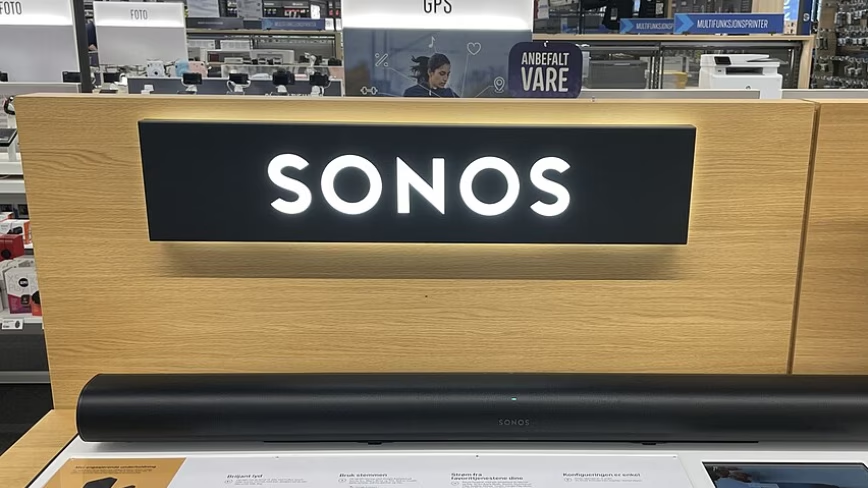
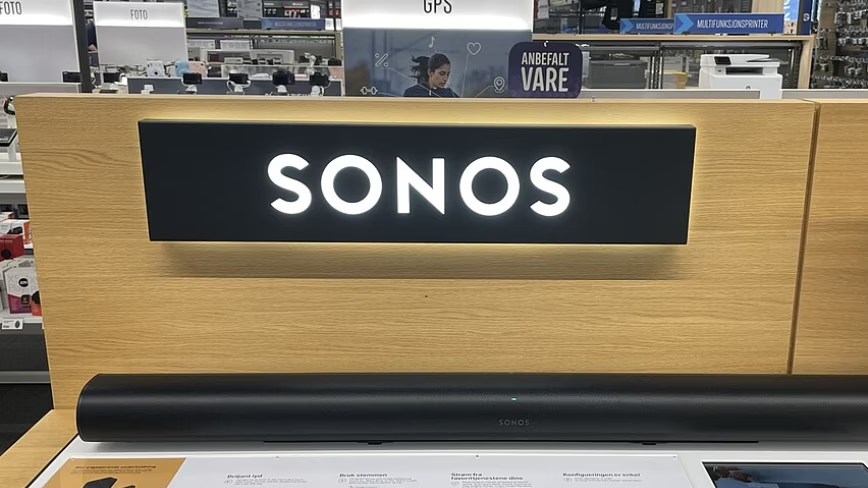
Sonos Plans September Launch Event and Deeper Push Into Home AI

Published

on

Sonos chief executive Tom Conrad says model quality will converge and the advantage will sit with hardware that already knows a home. An FCC filing names the first product of that push, the Ace Ultra headphones, expected at a September launch event.

Sonos is betting that the value of AI in the home sits in the hardware rather than the model. “Much of the industry conversation about AI in the home is about who has the best model,” chief executive Tom Conrad told analysts. “We think that’s the wrong question.

Access to strong models “is going to be everywhere, and the differences between them will narrow,” he said. What lasts instead, in his telling, is “the hardware that can converse with quality across every room, the system that already knows the shape of a home and the way a family lives in it.

The company has some ground to make that argument from. Sonos counts 53 million connected devices across 17 million homes, and posted third-quarter revenue of $375mn, up 9%. Conrad said it has been “competing with the biggest of big tech for customers in the home for nearly a decade.

Advertisement

The first hardware of that push arrives next month. A Federal Communications Commission filing published Monday, first reported by Lowpass, names the Sonos Ace Ultra, a sequel to the 2024 headphones, in as many as five colours against the original’s two. Technical details in the filing suggest it supports voice commands, which the first Ace did not.

That original landed badly. It shipped alongside a 2024 app rewrite that broke the platform, cut sales and forced Sonos to pause new hardware releases. The headphones were part of why the app went out early, having been built for the new software and left incompatible with the old.

Reviewers liked the industrial design but found little connection to the rest of the system beyond private TV listening through a soundbar. Buyers who expected to hand music from their speakers to their headphones on the way out did not get it. Conrad has since said shipping without that integration was a mistake.

The do-over falls to a thinner team. Sonos cut senior design and product staff in July, around 3% of the company, in a move Conrad framed as buying speed rather than saving money.

Advertisement

He has also pitched Sonos as a home for third-party AI models, though that has been slow going. Amazon’s Alexa+ is still absent from Sonos hardware nearly a year after the company appeared on a partner slide, while Amazon has moved on to putting Alexa in the search bar.

A marketing campaign under Colleen DeCourcy, who joined as chief marketing officer in January, lands this autumn. Conrad has called it “the clearest expression in a decade of what makes Sonos singular in the world.

Source link

Advertisement
Continue Reading

Tech

Nvidia’s Switchyard router reshuffles AI models mid-task, cutting task costs to a third in its own tests

Published

on

Enterprises running always-on AI agents keep hitting the same tradeoff. Send every task to a frontier model and the bill climbs fast. Build custom routing logic to send easy tasks to cheaper models and that becomes its own engineering project, one that has to be maintained every time a workflow changes.

Nvidia is proposing a fix that touches both ends of that problem at once. The company is out on Tuesday with Nemotron 3.5 Lightning, a 30-billion-parameter open mixture-of-experts model built for high-volume, specialized agent tasks, alongside NeMo Switchyard, an open-source library that routes each step of an agent workflow to whichever model fits it best.

The headline numbers: According to Nvidia, Lightning delivers up to 4x faster output than comparable models in its class, completing agentic tasks roughly 30% faster than Qwen3.6-35B at matching accuracy. Paired through Switchyard, Nvidia says the combination holds frontier-level task completion while cutting benchmark costs to roughly a third of running Opus 4.8 alone.

The timing puts Nvidia in the middle of the busiest open-weight stretch the industry has seen in months. Alibaba, Moonshot, Zhipu and DeepSeek have all shipped competitive open models out of China since the spring, several landing at or near frontier performance while undercutting US labs on size or price. Meta added to that pressure by releasing its own 30-billion-parameter open agentic model, Muse Glimmer. Open weights have gone from a differentiator to table stakes in a matter of months, and Nvidia’s release lands squarely inside that shift rather than ahead of it.

Advertisement

The pairing is the point. A model alone doesn’t solve the cost problem, and a router alone has nothing efficient to route to. Nvidia is betting that open source, applied at both the model layer and the routing layer, is what actually moves the cost needle on agentic AI, not a single cheaper model and not a smarter router bolted onto someone else’s stack.

Switchyard’s real rivals aren’t other open models — they’re Not Diamond, which already powers OpenRouter’s Auto mode, and RouteLLM, the open-source framework from UC Berkeley and LMSYS. Neither ships its own model. Nvidia’s bet is that owning both sides of the decision, under one open license, is what a router-only or model-only competitor can’t match.

“That is the power of a system of models, matching the right model to each step of the workflow,” Kari Briski, vice president of generative AI at Nvidia, said in a briefing.

How the router actually changes the workflow

Model routing isn’t a new category. OpenRouter, LiteLLM and a handful of standalone routing startups already let developers point traffic across multiple providers. Switchyard plugs into several of them rather than replacing them outright.

Advertisement

The core problem Switchyard solves is that the right model changes as an agent moves through a task. An agent’s state shifts as tools return results, errors show up, or a step turns out to be routine rather than complex, and a fixed model choice can’t adapt to any of that.

Briski described routing strategies that respond to that shifting state rather than a static task category.

“It has many types of routing strategies,” Briski said. “You can have a random router, which is not that great, or you can have an agent state route or a classifier route. Depending on your routing strategy, it wants to choose the best model. In some cases you want to go with a model like Lightning for really efficient tasks, and the router will actually choose Lightning if it’s set up in your pool of models.”

Cost enters the routing decision directly, not as an afterthought. In response to a question from VentureBeat, Briski said Switchyard can evaluate model verbosity, meaning how many tokens a given model tends to produce for a task, and use that prediction to steer work toward the cheaper option before the call is made.

Advertisement

The part that keeps this from becoming its own integration project is where Switchyard sits. Nvidia split its partners into two groups: agent frameworks that call Switchyard directly, including Cognition, LangChain and Nous Research, and LLM gateways that have built Switchyard support into their own products, including Kong, LiteLLM and OpenRouter. Kong ships Switchyard natively inside Kong AI Gateway. Briski pointed to that same list of gateway partners when describing how the library fits into the existing routing ecosystem.

“We are an ecosystem lover, and we want to make sure that we are integrated,” Briski said. “We’ve partnered with OpenRouter, LiteLLM and Kong, and they’ve already integrated our routing algorithm, so you can pick it up right where you’re already using the best tools.”

Nvidia shared results from nine companies testing Switchyard, several with specific figures attached. LangChain reported a 74% cost reduction across 145 multi-turn Deep Agents tasks by routing just 7% of calls to a frontier model, at a 6% accuracy tradeoff. Ramp said it matched a frontier model’s performance on Ramp SWE-Bench while cutting costs 58% and runtime 33%. Cognition integrated Switchyard’s staged router into Devin Desktop for internal use and reported near-frontier performance on FrontierCode Main while cutting mean cost 28% relative to routing everything to a single frontier model.

Lightning’s architecture and performance gains

Nemotron 3.5 Lightning is a standalone open model in its own right, built for high-volume, specialized agent tasks rather than general-purpose use.

Advertisement

It extends the hybrid Mamba-Transformer, latent mixture-of-experts architecture Nvidia introduced with the Nemotron 3 family in December 2025, the same line behind Nemotron 3 Super, which Nvidia uses as Lightning’s own baseline in its post-training comparisons. Positioned within a routing setup like Switchyard, it’s built to sit at the fast, cheap end of the decision rather than the frontier end, but it runs and ships independent of any router.

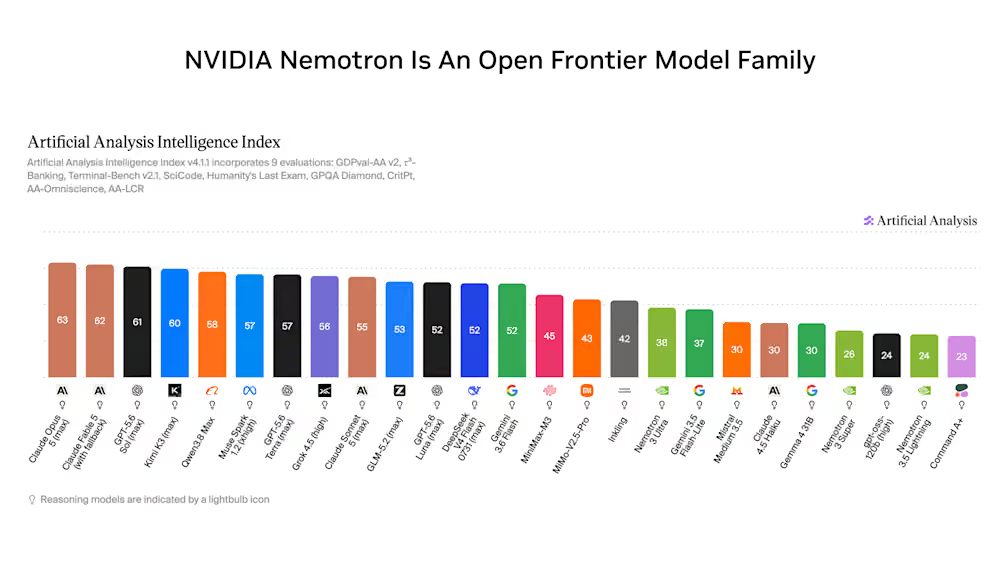
According to the Artificial Analysis Intelligence Index, a general capability benchmark spanning nine evaluations, Lightning scores 24, tied with gpt-oss-120b and behind Nemotron 3 Super, Gemma 4 31B, Claude 4.5 Haiku and Mistral Medium 3.5, all at 30. Lightning isn’t a general-intelligence leader in its size class, and Nvidia isn’t claiming it is.

The actual claim is narrower: according to PinchBench data supplied by Nvidia, Lightning matches Qwen3.6-35B’s accuracy roughly 30% faster and beats Gemma 4 26B’s accuracy at a similar completion time on PinchBench, a real-world agent task benchmark spanning coding, research and file management. That’s a speed-to-accuracy tradeoff, not a capability win.

Nemotron artificial analysis

Post-training is where Nvidia says the bigger gains show up. The company shared before-and-after figures from four early-access partners: CrowdStrike’s malicious-content recall against a Nemotron 3 Super baseline, CodeRabbit’s coding router against a GPT 5.4 Nano baseline, Harvey and Trajectory’s legal task completion against an Opus 4.6 baseline, and Lila Sciences’ energy simulation work against an Opus 4.8 baseline. CodeRabbit’s case is the most specific: Nvidia says the standard NeMo Auto model recipe, trained for one epoch, built into a working router agent for $85 in about two hours.

Customization Chart - NVIDIA Nemotron 3.5 Lightning

What this means for enterprises

There is no shortage of competitive offerings in the growing market for open models. The new Nemotron Lightning release will be yet another option for organizations to consider.

On the model side, Lightning’s own benchmark chart picks Qwen3.6-35B as its direct comparison point. Asked by VentureBeat directly how Lightning compares to Chinese models more broadly, Briski didn’t offer a head-to-head benchmark, pointing instead to openness and customizability as the differentiator.

Advertisement

“Our value proposition is not just open and it’s very customizable,” Briski said.

For enterprises building agentic infrastructure, three trends stand out:

The routing decision is becoming dynamic instead of static. Enterprises that built agent pipelines around a single default model are being pushed toward per-step routing based on live signals like agent state and token cost, not a fixed assignment set at design time.

Open source is now a cost lever at two layers, not one. Pairing an open model with an open router a vendor controls end to end is a newer argument than cheaper weights alone, and worth watching for whether other labs follow the same pattern.

Advertisement

The competitive question shifts from best model to best system. As routing libraries mature, the differentiator moves from which model an enterprise defaults to, toward how well its routing layer matches models to tasks in production, a harder thing to benchmark and a harder thing to market.

Source link

Continue Reading

Trending

Copyright © 2025