
Tech
Man pleads guilty to hacking nearly 600 women’s Snapchat accounts



An Illinois man pleaded guilty to hacking nearly 600 women’s Snapchat accounts to steal nude photos that he kept, sold, or traded online, including accounts he compromised at the request of a former university track coach who was later convicted of sextortion.
26-year-old defendant Kyle Svara admitted in federal court in Boston to phishing access codes from hundreds of victims between May 2020 and February 2021, and accessed at least 59 Snapchat accounts without permission to download private photos.
According to court documents, Svara used social engineering tactics to obtain victims’ emails, phone numbers, and Snapchat usernames, then texted more than 4,500 targets requesting access codes while impersonating Snap representatives. Using these tactics, he successfully harvested credentials from roughly 570 victims and accessed at least 59 accounts without permission to steal compromising images.

Svara advertised his “services” on multiple online platforms, trading stolen content, offering to “get into girls snap accounts” for clients, and asking potential clients to contact him through the encrypted messaging app Kik.
One of his clients, former Northeastern University track and field coach Steve Waithe, hired Svara to hack Snapchat accounts of students at Northeastern and members of the women’s track and field and soccer teams. Waithe was sentenced in March 2024 to five years in prison for cyberstalking, cyber fraud, and sextortion after targeting at least 128 women.
Between paid hacking jobs, Svara also independently hacked into the accounts of women in Plainfield, Illinois, and students at Colby College in Maine.
Svara now faces charges of aggravated identity theft (carrying a minimum sentence of two years), wire fraud (up to 20 years in prison), computer fraud (up to five years), and making false statements related to child pornography (maximum of eight years).
“When Svara was interviewed by investigators, he falsely stated that he did not know anything about hacking Snapchat,” the Justice Department said on Thursday.
“Additionally, he falsely stated that had no interest in child pornography and had never actively sought out or accessed child sexual abuse material (CSAM). Contrary to these statements, the defendant collected, distributed and solicited CSAM.”
Svara is scheduled for sentencing in federal court before U.S. District Court Judge Brian E. Murphy on May 18th.

Modern IT infrastructure moves faster than manual workflows can handle.
In this new Tines guide, learn how your team can reduce hidden manual delays, improve reliability through automated response, and build and scale intelligent workflows on top of tools you already use.

We’re all familiar with mixing red, yellow, and blue paint in various ratios to instantly make all kinds of colors. This works great for oils or watercolors, but fails when it comes to cans of spray paint. The paint droplets can’t be blended once they are aerosolized. Consequently, although spray cans are great for applying even coats of paint to large areas very quickly, spray-paint artists need a separate can for every color they want to use—until now.
Back in 2018, when I first saw professional spray artists lugging dozens to hundreds of cans to their work sites, I was inspired to start noodling on a solution. I’ve worked at Google X, Alphabet’s “moonshot factory,” as a hardware engineer, and I’m now building a startup in mechanical-design software. I’m no painter, but I know my way around mechatronics.
I wanted my solution to be inexpensive and simple enough to build as a DIY project and functional enough for an artist to use, without breaking their flow. So I began prototyping a system that combines base colors while they are still in pressurized form from off-the-shelf cans.
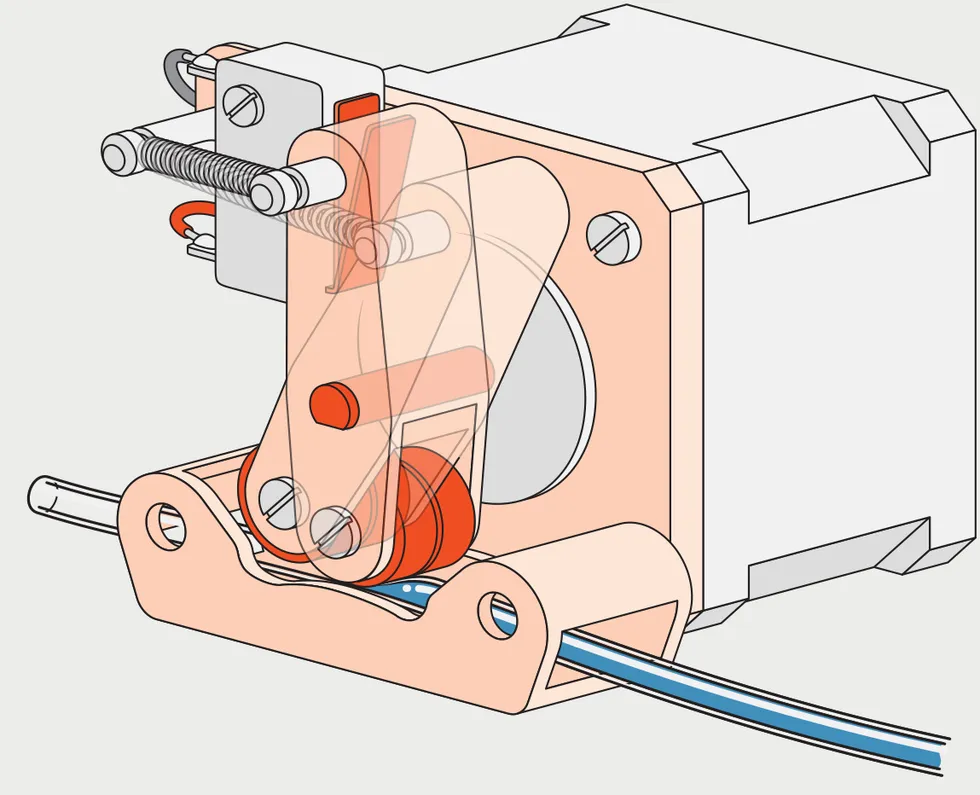
 This new rotary pinch valve can be opened and closed in tens of milliseconds and prevents backpressure from clogging lines.James Provost
I tried a few approaches where pres-surized paint from the base-color cansfed through tubes into a mixing channel, before emerging from a spray head. To control the ratios, I decided to borrow a trick that would be familiar to anyone who’s ever had to control the bright-ness of an LED using a microcontroller: pulse-width modulation. Initially, I used electronically controlled solenoid valves to release the paint from the cans. The paint would flow into a mixing channel for a relative duration that corresponded to the ratio of the base colors required to make a given hue. However, this failed because different cans never have the same internal pressure. Whenever two valves were open at the same time, the pressure difference would make paint flow backward into the lower-pressure can.
As an alternative, I removed the mixing channel and tried making the paint pulses from each can sequentially converge into a tube so that no more than one valve would ever be open at a time. Surprisingly, this worked perfectly. The backflow was eliminated, and it turned out that the natural turbulence of the flow was sufficient to mix the paints. Let’s say you want to produce a clementine orange color. This requires yellow and red paint in a ratio of 1:2, so the yellow valve opens for a period of time, and then the red valve opens for twice as long. The system then keeps repeating this cycle of pulses in a rapid pace to instantly create the spray-paint color you want.
The theory is straightforward, but making this work in practice took quite a bit of experimentation. First, I had to determine the actual durations of pulses that would produce evenly mixed colors, not just their ratios. I also needed to work out the size of the tubing (too narrow and you’d get low spray force; too wide and you’d have paint accumulating in the tubes). Eventually I settled on a maximum pulse duration of 250 milliseconds and a tube diameter of 1 millimeter.
Inventing A New Valve
Even though the system worked, the solenoid valves I used constantly clogged up. Designed for water purifiers, the valves didn’t prevent paint from entering the mechanism, where the paint would harden. Moreover, when the valves were turned off, they could stop backflow only if the inlet remained pressurized. So disconnecting a paint can from the system would cause instant leaking. Other off-the-shelf valves I tried couldn’t cycle fast enough and were too expensive.
I had some spectacular failures along the way of the sort that only pressurized paint can provide.
So I created my own mechanism: a high-speed, electronically controlled, rotary pinch valve. It has a stepper motor that rotates a lever with a rolling bearing to constrict fluid flow inside a flexible tube. This concept isn’t new—there’s something like them in every peristaltic pump. But I added a spring to firmly hold the lever in the closed position against any back pressure when the motor isn’t powered, making it a normally closed valve that isolates the attached can. Additionally, the valve is fast enough to be open for as little as 30 milliseconds.
I went through four major prototypes of the system before reaching a working version, and I had some spectacular failures along the way of the sort that only pressurized paint can provide. The final version uses four base colors—red, yellow, blue, and white—with the color mix controlled by four knobs attached to an Arduino Nano and a small display. The flow of paint is triggered by a push button placed above the spray head, similar to a spray can’s nozzle.
 Cans holding base colors (A) are attached to valves (B). An Arduino-based control panel (C) opens and closes valves to mix paint before it is aerosolized (E). By quickly opening and closing valves with varying durations in sequence (D), you can mix paint in specific ratios to create desired colors.James Provost
The length of time a base color’s paint valve can be open is one of eight values between 30 and 250 ms. This means that the entire system—which I coincidentally dubbed Spectrum—can create hundreds of distinct spray-paint colors instantly. It produces less than 84 (or 4,096) colors because duration ratios that are a multiple of each other will produce the same color—for example, 2:3 and 4:6. I added a force sensor to the push button, which allows for a gradient: Two color mixes can be dialed in, and as I increase my thumb’s pressure on the button, the paint mix shifts from one color to the other.
Spectrum’s various fixtures are 3D-printed, and project files and videos are available through my website at https://www.sandeshmanik.com/projects/spectrum. Preprints of technical descriptions of the rotary pinch valve and mixing methodology are available on TechRxiv. The total cost for the bill of materials is less than US $150.
Working on and off on the side for about seven years, I finally finished developing my system and writing the documentation in late 2025. After I posted a video to social media, I was heartened by the immediate positive response from spray-paint artists around the world. I’m now creating step-by-step instructions so that nontechnical people can build their own Spectrum paint sprayer. I look forward to seeing what creations artists out in the wild make!
From Your Site Articles
Related Articles Around the Web
Tech
Beat-based dungeon crawlers, card-battling soccer sims and other new indie games worth checking out

Welcome to our latest roundup of what’s going on in the indie game space. As ever, we’ve got some new games for you to dive into this weekend, and a glimpse at some upcoming titles. But, first, a look at indie studio Albatross Interactive’s take on a multiplayer mode from a much-loved blockbuster.
Terminal War is a 4v4 third-person shooter and it seems like the small team of developers is trying to keep things grounded. Ammo and supplies are scarce, and there’s an emphasis on melee combat with the promise of “brutal executions.” The action is set in the late ’90s, a few years after a global war, with three factions battling for control and survival in a collapsed version of the United States.
Albatross Interactive isn’t shy about the inspiration behind Terminal War. “They canceled The Last of Us Factions 2,” the team wrote on X. “So we’re building it [sic] our version.”
In September 2019, nine months before the game’s eventual release, Naughty Dog confirmed The Last of Us Part 2 wouldn’t have a multiplayer mode. At the time, it told players “you will eventually experience the fruits of our team’s online ambition.”
That still hasn’t exactly come to pass. The studio formally announced The Last of Us Online in June 2022 and canceled it 18 months later. As such, the Factions mode in 2014’s The Last of Us Remastered for PS4 remains the franchise’s only remaining multiplayer mode.
Albatross Interactive, which says it’s building Terminal War from scratch, plans to reveal more gameplay soon. The game is slated to hit Steam in early access as soon as this summer.
The team expects Terminal War to remain in early access for around 12-18 months, though it noted that “we’re a small studio and we’d rather take the time to get it right than rush to a finish line. The timeline will ultimately be shaped by community feedback, the scope of content we deliver, and the standard of quality we hold ourselves to.” The studio plans to bring the game to consoles as well.
New releases
I’m into the current iteration of Acclaim as an indie publisher (albeit one with a plan to revive its own historic franchises). Its latest title, GridBeat from Ridiculous Games, is a rhythm-based dungeon crawler in which you’re trying to escape from a corporate network after pinching a trove of valuable data. Malware and security protocols are on your tail. Navigating the mazes, interacting with objects and boss battles are all synced to a beat.
GridBeat is available on Steam and Nintendo Switch. It typically costs $20, but there’s a 10 percent discount on Switch until April 2. It’s 15 percent off on Steam until April 9.
Given how much time I spent playing Football Manager 26 last year, Nutmeg is right up my alley. Getting veteran commentator Jim Rosenthal to pitch the soccer management sim in the launch trailer certainly doesn’t hurt.
This is a card-battler take on soccer management and it’s set in the ’80s and ’90s. You can start out in the lower divisions and can work your way up to the top of the English soccer system. You’ll hire and fire staff, and select your team and formation before taking on an opponent. Completing challenges and doing well in training will earn you more card packs.
The trailer reminds me of collecting Panini stickers as a kid as well as the smell of my friends’ Subbuteo figures. I would have said my favorite thing about this is that everything takes place at an era-appropriate desk with a TV that shows results and standings in the style of Teletext and an old computer that has some retro mini-games you can play. However, Sumo Sheffield and Publisher Secret Mode are donating a small portion of every sale of Nutmeg to charity, which is a nice gesture.
Nutmeg is out now on Steam. It’ll usually cost you $25, but there’s a whopping 40 percent discount until April 2.
Devil Jam is a metal-themed spin on the roguelite formula that Vampire Survivors popularized with a dash of Hades-esque characterization mixed in. It’s been out on Steam since November and it hit consoles this week. It costs $8 on PS5 and Switch, and $7.59 on Xbox Series X/S.
You’ll wield a cursed guitar as you battle demonic enemies and bosses. As ever with this type of game, it’s all about finding fun, powerful builds by synergizing abilities. You can put those together in a 12-slot gear system. I dig the art style and animation in this game from Rogueside too. I especially love that one character dashes by powersliding on their knees.
A couple of months after its debut on Steam, Space Warlord Baby Trading Simulator landed on Xbox Series X/S for $20 this week. The latest game from prolific studio Strange Scaffold is a stock market simulator in which you speculate on the “simulated lives of babies” and how successful (or not) said alien sprogs will be in the future. It takes aim at real-life prediction markets where people can gamble on everything from the Time Person of the Year to nuclear tests.
Upcoming
Here’s another game you can actually check out this weekend, as a playtest is taking place on Steam until March 31. Salvation Denied is a co-op construction sim/tower defense game from Firevolt and publisher Digital Vortex Entertainment.
You can get together with up to three friends to build experimental structures at the behest of a foreman who looks like he’s stepped right out of Team Fortress 2. You’ll have tools like a gravity gun, foam gun and jetpacks on hand to help you form these structures, along with heavy machinery that can move or recycle sections of the build. Coordinating with proximity voice chat could be critical as you and your buds deal with natural disasters like acid rain and meteor showers.
I’m almost always going to be on board with a game that’s all about chaos, so I’m interested in checking out Salvation Denied. It’s set to hit Steam this fall before landing on PS5 and Xbox Series X/S in 2027.
Someone has stolen the sun. Reclaiming it is your goal in Light Dude, which is from solo developer Ramy of Dergham Games. It’s an action game in which the lights go out when you move, so you’ll need to figure out your approach to each level and how to avoid hazards before moving forward. There’s a first-person mode here too.
Light Dude is slated to hit Steam sometime this spring. A demo is available now.
Solo developer Mateo Covic (aka ZoroArts) is looking to follow up on the success of Paddle Paddle Paddle with another friendslop game. Covic said it took just four weeks to create Cool Story Bro. Up to four players each have five minutes to write a short story that includes four words. These are picked at random or taken from a pool of player suggestions.
Special items appear throughout each round, such as a revolver, which can take another player out of the game for 10 seconds, and one that swaps everyone’s stories. If you’re the first player to type an item’s name, you can use it.
After everyone has finished writing their story, players take turns to read theirs out for the rest of the group. The others vote on whether they liked the tale. If you really hate someone else’s short story, you can blow them up with a rocket launcher. If only I had that option at some of the poetry readings I’ve been to.
This seems fun and silly, and the kind of thing that could easily blow up on Twitch (there’s an integration that allows viewers to suggest words). Cool Story Bro is slated to hit Steam sometime in April.
Fittingly enough, it’s been a long time since Third Shift announced its debut project, Forever Ago. Six years, in fact. The game re-emerged this week during the Xbox Partner Preview showcase. Publisher Annapurna Interactive is bringing it to Xbox Series X/S, PS5, Nintendo Switch 2, Xbox on PC, Steam and Epic Games Store this fall. It’ll be available on Xbox Game Pass (and Xbox Cloud) on day one.
This is a road trip adventure in which you take on the role of Alfred. Following a personal tragedy, he ventures north in his minivan to seek redemption. With an instant camera in hand, Alfred will meet new people and explore forests, deserts and mountains. It’s another narrative-heavy game from Annapurna, which appears to be leaning heavily into nostalgia this year given that Mixtape is only a few weeks away.

Apple says that nobody has ever been successfully hacked when their iPhone or other device was in Lockdown Mode, showing just how vital the security feature can be.

Lockdown Mode on iPhone is for users facing grave threats to their digital security
Lockdown Mode was launched in 2022 and has to be specifically enabled by the user. Once enabled, the feature hardens the device’s security and has become the go-to option for people who could be a target for hacking.
While most regularly used on an iPhone, Lockdown Mode can also be enabled on Macs, iPads, and even Apple Watches. So long as the device is running iOS 16 or later, iPadOS 16 or later, watchOS 10 or later, and macOS Ventura or later, Lockdown Mode can be enabled.
Continue Reading on AppleInsider | Discuss on our Forums

Disneyland had a huge 2025 when it kicked off its 70th anniversary. This year, we’ll see the original Disney theme park continue to celebrate the milestone — all while building three new rides at California Adventure and a whole new Disneyland entrance and Avatar area.
Over at Walt Disney World in Florida, four new lands are being built right now, themed around villains, Pixar characters and more.
Here’s everything you need to know about Disneyland, Disney World and Disney Cruise Line in 2026 and beyond.
Bluey has arrived at Disneyland
Concept art of the Bluey show coming to Disneyland in 2026.
Spring break saw a new character move into Disneyland, with Bluey and family now hosting a stage show and themed area. Debuting on Sunday, March 22, Bluey’s Best Day Ever is located at the Fantasyland Theatre next to Mickey’s Toon Town, and has seen hours-long queues lining up to get inside during its debut week.
The theater has been transformed into Bluey’s school classroom and grounds, including a gnome village and fairy garden. Bluey and her sister, Bingo, will appear several times each day, along with actors and musicians, to “bring to life the popular music and games emblematic of beloved Bluey episodes.” Those games will include Keepy Uppy and the Grannies, as well as appearances by Chattermax and Unicorse.
There are also puzzles, games and photo ops throughout the Bluey area. Disneyland is also serving up Bluey-themed foods at Troubadour Tavern.
The hugely popular Australian cartoon about a family of dogs is a worldwide hit, and Disney is slated to release a Bluey movie in 2027. (In the meantime, you can watch Bluey episodes and minisodes on Disney Plus.)
California Adventure celebrates 25 years
The second Disney theme park built in Anaheim opened 25 years ago on Feb. 8, 2001. While the look of the park has changed a lot over those years, California Adventure has a few ways it’s celebrating the quarter-century milestone: It’s switching the Soarin’ attraction back to Soarin’ Over California until July 1; dressing Mickey Mouse and Minnie Mouse on Buena Vista Street with new outfits, featuring sun motifs like the one originally on the roller coaster; and offering various special anniversary-themed food items, merchandise and drinks.
Soarin’ Across America from coast to coast
At both Disney’s California Adventure and Disney World’s Epcot, the Soarin’ Around the World attraction is getting a US-themed makeover. Soarin’ Across America will arrive on July 2, 2026, and will feature scenes, sounds and scents from more than a dozen cityscapes and scenic areas.
Disney released a trailer starring Patrick Warburton, the original Soarin’ narrator and pilot, in which he says we’ll soon “sail across spacious skies” and may see “amber waves of grain” and “purple mountain majesties.” It’s part of Disney’s celebration of America’s 250th anniversary.
Disneyland’s 70th anniversary continues
Disneyland is continuing to celebrate its 70th anniversary this year, following its kick-off in May 2025. You’ll have plenty of time to get there as its last day is Aug. 9, 2026 — after which it’ll transition back to Halloween on Aug. 21, then the holidays on Nov. 18, before fully returning to its natural state in early 2027.
While many of the 70th anniversary shows were paused for Halloween and the holidays in 2025, they made a comeback in January, including the Paint the Night parade, Celebrate Happy Cavalcade and the Wondrous Journeys fireworks and projection show on the castle. Mickey and friends are also back in their 70th celebration outfits.
You can catch 70th anniversary-themed merchandise, food and drink items as well as a projection show at Carthay Circle and a 50-foot sculpture of Sleeping Beauty Castle on the esplanade between Disneyland and California Adventure; you can also find decorations sprinkled throughout Downtown Disney, Main Street USA, Disney’s hotels and even inside the Toy Story Midway Mania ride.
Check out the 70th anniversary decorations throughout the Toy Story Midway Mania ride.
Discounted Disneyland tickets and a new Magic Key
California residents can currently get a three-day Park Hopper ticket for $249, a 50% discount. You can visit from now until May 21 using this ticket. After that is a Kids’ Summer Ticket deal, with a one-day Park Hopper ticket costing $50 per child, ages 3 through 9. You can purchase it now and use it between May 22 and Sept. 7.
Disneyland is also adding (and removing) a Magic Key option: The Explore Key will replace the current Enchant Key. All California residents will be able to purchase it — not only Southern California residents. It will allow access on weekdays in June and July, which are currently blocked out for Enchant Key holders.
The Explore Key went on sale last month. It costs $999, with a $99 down payment and 0% APR on repayments for 12 months. Disney said its “full value” can be unlocked in just four visits to the parks, thanks to Park Hopper admission, 25% off parking, Lightning Lane Multi-Passes and 10% off merchandise and dining.
Disney World discounted summer tickets
For what Disney World is calling Cool Kids’ Summer, it’s offering two free nights and two free theme park days when you buy a four-night, four-day Disney hotel and ticket package for a visit during May 26 through Sept. 15. You can also save up to 30% on some Disney hotels between May 1 and Oct. 4.
Also part of Cool Kids’ Summer is a free day at a Disney water park (Typhoon Lagoon or Blizzard Beach) on your check-in day when staying at a Disney hotel between May 26 and Sept. 8; and a free dining plan for kids aged 3-9 when you buy a dining package for guests over 10 and a room at a Disney hotel.
Villains Land: 1 year closer
While it won’t be ready in time for 2026, construction is well underway for Disney’s first villains-themed area. Villains Land, which will celebrate all the classic baddies from Disney films, is coming to the Magic Kingdom at Disney World in Florida.
Imagineers have been drawing inspiration from architectural structures in Paris and Barcelona — like Gaudí’s buildings in the latter — to design Villains Land, Disney revealed during Destination D23 in August 2025.
Concept art for the new Villains Land.
“Paris is a city full of classic Art Nouveau … natural motifs and swirling designs there make nature appear to be ‘cursed,’ like magic has frozen it into place,” Disney said on its Parks Blog. “Barcelona’s art style is Modernisme, which has less natural patterns but gives the architecture an otherworldly, unnerving appearance.”
Villains Land, first teased during D23 2022, will be positioned on the other side of Big Thunder Mountain at the top left edge of the current Magic Kingdom map and will stretch around to where the Haunted Mansion is.
Two major attractions are planned, along with dining and shopping. Still no word yet on when it’ll open.
Dinosaur closes to make way for Tropical Americas Land
Concept art of Tropical Americas.
Animal Kingdom’s DinoLand USA area is no more, with the area on the Disney World map now a blank sea of grass as Disney slowly builds out the new Tropical Americas Land.
Construction began in the fall of 2024, with TriceraTop Spin and the midway area closing down in January 2025. The Dinosaur ride remained open until Feb. 1 this year but has now closed its doors as it’s transformed into a new Indiana Jones ride through a Maya temple (a relatively easy overlay since Disneyland’s Indiana Jones reportedly follows almost exactly the same ride track as Disney World’s Dinosaur).
The Pueblo Esperanza area will be themed like a South American village, with an Encanto-themed attraction, where you get to explore Antonio’s rainforest room inside the Casita, as well as a huge quick-service dining location, a fountain and a carousel.
Tropical Americas is planned to open in 2027.
First peek at Piston Peak
Piston Peak National Park: the setting for the new Cars-themed land at Magic Kingdom.
The Rivers of America and Tom Sawyer Island at Disney World’s Magic Kingdom have been closed and removed from the online map, as Disney works to construct a new land themed after Pixar’s Cars movies. Cars Land, which was added to Disney’s California Adventure back in 2012, remains extremely popular in the west, so it was only a matter of time before it was added to the eastern outpost.
In an expansion of Frontierland — which also includes Tiana’s Bayou Adventure and Big Thunder Mountain Railroad — Route 66 will feature a look inspired by the Rocky Mountains and the “American Frontier and its national parks.”
The Disney Parks Blog described the new area as “an awe-inspiring wilderness filled with towering trees, snowcapped mountains, breathtaking waterfalls, roaring rivers and impressive geysers.” Disney Imagineers are “using a style of architecture called ‘Parkitecture,’ which was developed by the National Park Service to create structures that harmonize with the natural environment.”
Concept art of the Cars rally race attraction coming to Disney World.
There will be two attractions, one of which is a rally race. Pixar Chief Creative Officer Pete Docter and Imagineer Michael Hundgen spoke about the new ride vehicle for this, and you can see a TikTok of Imagineers testing out off-road vehicles in the Arizona desert to create what the ride will feel like. Each rally car will have its own personality, name and racing number, Docter said.
“These are all things Lightning McQueen and Mater haven’t experienced before, like racing over rocky terrain, ascending to mountain peaks and dodging around geysers — how do you take these real-world elements and put a Cars spin on it?” Disney Parks said in a previous blog post.
While construction has begun and Disney has even released a map showing what the land may look like (geysers shooting water, a running river, an off-road rally track, mountains, a visitor’s lodge, a Ranger HQ and walking trails), we don’t expect Piston Peak to open until at least 2027 or 2028.
Disneyland expansion begins as the Avatar area is constructed
Concept art showing an aerial shot of the Avatar-themed area coming to Disneyland Resort.
Disneyland is finally expanding after unveiling plans almost five years ago. The expansion is expected to take a couple of years to complete and will push the park’s current boundaries past Downtown Disney and into the nearby parking lots. It’ll also transform “a portion of the current Hollywood Backlot area,” leading to the closure of the Monsters Inc. attraction permanently in 2027.
The biggest part of the expansion will be adding an Avatar-themed land, based on the second film, The Way of Water, as well as Avatar: Fire and Ash. It will include a dark boat ride much like Pirates of the Caribbean, “taking guests all the way to the wide-open seas of Pandora.”
It follows the success of the world of Pandora, based on the original Avatar film, in Disney World’s Animal Kingdom. Disney has no dates or details yet on when it’ll be complete.
Coming sooner than the Avatar land, however, is a new esplanade entry “experience” to replace the current walkway entry at the east side of Disneyland, as well as a new parking structure and pedestrian bridge over Harbor Boulevard. Construction on this begins in the fall.
Concept art of the new pedestrian bridge that will cross Harbor Boulevard.
A Coco ride is coming
It won’t be launching this year, but construction has begun backstage at California Adventure to build a new dark ride. It’ll be themed for the beloved Pixar movie Coco and populated by audio-animatronics.
The Coco ride will be located in the area near Pixar Pier and Paradise Gardens, in what is primarily backstage areas for cast members currently. It’ll have characters and music from the movies as you travel through the land of the dead with Miguel.
Concept art for the new Coco ride.
Coming Soon: Rock ‘n’ Roller Coaster Starring The Muppets
While the Monsters, Inc. ride is being removed from California Adventure, its animatronics and props are expected to be repurposed in Disney World, as an entire land themed around the Monsters Pixar movies is being built at Hollywood Studios.
Replacing the Muppets area of the theme park, Monstropolis — home of the Monsters, Inc. movies, shorts and Disney Plus streaming series — will feature Disney’s first-ever suspended roller coaster inside the city’s laugh/scream factory.
“The first time I saw Monsters, Inc., all I wanted to do was ride on one of those doors like Mike and Sulley,” Disney Experiences Chair Josh D’Amaro said at D23 in 2024. “Remember in the movie how those claws grab the doors and hoist them up into the air to take them away? We’re doing that too. And you’re going along for the ride.”
Concept art of the Monsters, Inc. suspender coaster.
A TikTok shows the design concept for the Monsters Inc. ride.
MuppetVision 3D closed permanently on June 8, 2025, but we don’t expect Monstropolis to be complete for another year or two.
On the bright side, the Muppets are being moved to the Rock ‘n’ Roller Coaster, and that overlay apparently won’t take long. Rock ‘n’ Roller Coaster Starring Aerosmith had its last day of operation on March 1, and the Muppets-themed version will open in the summer.
“Thanks to new management under legendary Muppets tycoon and owner of The Muppet Theatre, J. P. Grosse, groovy vibes will take over the Rock ‘n’ Roller Coaster Courtyard, including a new psychedelic wrap on the giant guitar marquee,” Disney said in August 2025.
California Adventure: 2 more Avengers rides
Avengers Campus already has two rides: Spider-Man Web Slingers and Guardians of the Galaxy. Soon, this will double as Disney builds two more Marvel attractions at California Adventure.
“We’re doubling the size of the land with two new attractions,” a structural engineer said in a video posted to Walt Disney Imagineering’s Instagram account on Feb. 26. The engineer showed off how the Avengers Infinity Defense structure is looking now, including its columns, foundations and a catwalk that will “support projectors, speakers and other types of show elements.”
Avengers Infinity Defense will see you assemble alongside the Avengers, battling King Thanos — set in a multiverse — featuring appearances by Black Panther, Ant-Man and Hulk.
Concept art of the Avengers Infinity Defense attraction coming to California Adventure.
Stark Flight Lab, the second ride, will see you help test Tony Stark’s latest tech.
“In Stark Flight Lab, guests will sit in ‘gyro-kinetic pods’ and roll along a track before stopping in front of a giant robot arm,” Disney said. “This robot arm will hoist you into the air where you’ll make several high-speed maneuvers inspired by Iron Man and some other Avengers.”
Construction began in 2025, but no launch dates have been revealed yet.
More Disney Cruise Line ships
Disney has been all in on launching cruise ships over the last few years, including the Disney Wish in 2022, the Disney Treasure in 2024 and the Disney Destiny in 2025.
The Disney Adventure is next up in 2026, part of the next four ships embarking soon. The other ship names and destinations have yet to be revealed, but they’ll set sail between 2027 and 2031.
Everything else coming soon
Here’s what else is new and coming soon to the theme parks:
- Animal Kingdom replaced the long-running show It’s Tough to Be a Bug inside the Tree of Life with a Zootopia-themed show. Zootopia: Better Zoogether features Judy Hopps, Nick Wilde and new character Heidi Howler, and will take you through several different areas of the city as they celebrate a holiday. It opened in November 2025, so you can experience it throughout 2026.
- Cinderella Castle at Magic Kingdom is currently being repainted in its original theme colors: gray, cream, blue and gold.
- A 3D-printed prop canoe was added to the Jungle Cruise ride in January.
- Disneyland and Hollywood Studios are adding Mandalorian and Grogu missions to the Millennium Falcon: Smuggler’s Run ride in Star Wars: Galaxy’s Edge, tying in with the release of The Mandalorian and Grogu in cinemas. The new missions will launch on May 22, 2026.
- Disney World’s water park Blizzard Beach reopened on Feb. 15, and Typhoon Lagoon is reopening on May 12.
- From July onwards, you’ll be able to book a wedding at the Haunted Mansion in Disneyland. Weddings will be hosted at the courtyard right outside the mansion’s front doors. The area can seat up to 25 guests. Unfortunately, it doesn’t include thematic midnight ceremonies — you can only host your wedding there in the early morning before park opening. Other new Disneyland wedding venues include the Magnolia Park Gazebo (right outside Tiana’s Palace), Magnolia Park Terrace (right outside the new Haunted Mansion queue) and Fantasy Faire Garden (opposite the castle).
- Buzz Lightyear’s Space Ranger Spin closed at the Magic Kingdom in August to get new ride vehicles with video monitors and two handheld blasters with always-on lasers that come in two different colors (so you can finally see which laser is yours). It’s also getting a new scene at the start, starring Buddy the friendly robot, and static Z targets will light up when you hit them. The ride reopens on April 8.
- Big Thunder Mountain Railroad is reopening in the spring at Magic Kingdom after a lengthy refurbishment. It will include “a journey through the spectacular natural phenomena of the Rainbow Caverns.”
- Bluey and Bingo meet-and-greets are coming to Disney World at the Conservation Station at Animal Kingdom as part of the Cool Kids’ Summer celebration, which goes from May 26 until Sept. 8.
- Following the release of the Walt Disney animatronic at Disneyland, Disney announced that a similar animatronic will be added to Disney World’s Carousel of Progress at Magic Kingdom in a new introductory scene to the ride.
Concept art of the overhauled version of Buzz Lightyear’s Space Ranger Spin, which will have two different colored lasers in each ride vehicle.

A titanium-framed phone running the same A19 Pro chip as the iPhone 17 Pro is not the kind of spec you would normally expect at this end of the price range.
The moment you pick up the iPhone Air, the 5.6mm chassis and 165-gram weight tell you immediately that this is something different, which makes the fact that it has dropped to £699, a full £300 off its launch price, all the more worth acting on.
iPhone Air just hit its lowest price ever, making the ultra‑thin model far cheaper than usual
iPhone Air has dropped to its lowest price ever, turning Apple’s ultra‑thin, feather‑light handset into one of the most tempting buys of the moment.
The A19 Pro is the most efficient chip Apple has put in an iPhone, pairing a 6-core CPU with a 16-core Neural Engine and hardware-accelerated ray tracing, which means the Air handles everything from everyday tasks to demanding apps without the chassis needing to be any thicker to accommodate it.
The 6.5-inch OLED display is sharp, bright, and smooth enough that switching back to anything slower feels immediately noticeable, which is not something you always get on a phone positioned as the thin and light option in a lineup.
Camera-wise, the 48MP Fusion main sensor with sensor-shift optical image stabilisation handles everything from portraits to low-light shots, and a 2x Telephoto option gives you a second focal length without any additional lens bulk, given how thin the chassis already is.
The 18MP Center Stage front camera tracks movement automatically to keep you in frame during video calls, and Dual Capture lets you record from the front and rear cameras simultaneously, which is more useful than it sounds once you have tried it.

You also do not have to worry about durability, with Ceramic Shield front glass offering 3x better scratch resistance than previous generations, IP68 water resistance rated to six metres for 30 minutes, and Apple Intelligence running entirely on-device, so none of your data leaves the phone to be processed elsewhere.
For anyone who has been watching the 4.5-star iPhone Air since launch and waiting for the price to move, £699 is the answer.
The iPhone Air is Apple’s most interesting, fun and likely divisive phone in a decade. It’s surprisingly durable, designed with such flair that it feels wonderful to pick up and does what it sets out to do very well. But, there are sacrifices here – and for some, they will simply be too much.
-
Sublime looks and feel
-
Lovely ProMoton screen
-
Great camera
-
Excellent performance
-
Battery life can’t quite match the Plus phones
-
Single camera lacks versatility
-
A hard sell for some when the iPhone 17 is so much cheaper
SQUIRREL_PLAYLIST_10148964
Cars come in many shapes and forms. Engine locations, gearing ratios, drivetrain layouts, seating configurations, cylinder counts, brake materials, and so much more are all subject to the will of the designers and engineers behind each automotive creation. A car is only a car when all its parts come together, and each is important in its own way, but if one part is paramount, it has to be the engine. The vast majority of cars are developed with engines designed specifically for them, but as always, there are outliers.
Enter the motorcycle-powered car. This strange realm encompasses a small but fascinating corner of the automotive world, where engineers deem an engine meant for two wheels suitable for their four-wheeled creations. As the following list shows, the reasoning behind this decision can range from fuel economy to track performance. Sometimes this marriage of motorcycle heart and car body is unnoticeable until you pop the hood; sometimes you wonder if the result is more motorcycle than car; and sometimes you get something that opens up a whole new no-man’s-land that bridges the gap between the two. Here are 5 unique cars powered by motorcycle engines.
1. Ariel Atom 500
The English have a thing for building strange, lightweight track cars for the road. Before Ariel was building track cars like the Atom and off-roaders like the Nomad, the man behind the company, James Starley, was improving the weird and wonderful Penny Farthing bicycle. In 1898, Starley built the Ariel Tricycle, a motorized three-wheeled bike that would evolve into a four-wheeler called the Quadricycle, a sort of proto-quad bike. Then, in 1901, Ariel built its first motorcycle, powered by a 10-horsepower two-cylinder engine.
Despite the motorcycle engine being woven into the brand’s early days, Ariel decided to outsource a bike engine to power their modern road-going track weapon. The Atom 500 is powered by a V8, so naturally, you might be wondering where Ariel found a V8-powered bike. The short answer is that they didn’t, but they found the next best thing in the Suzuki Hayabusa — one of the fastest bikes in the world. The Hayabusa lineage has been powered by a few editions of mighty four-cylinder engines, so the Ariel engineers did what any good-hearted petrolhead would do and bolted two of them together. The result is a Frankensteinian 10,000-rpm V8 that produces 500 horsepower. This Hayabusa-hearted machine shows the creativity, or insanity, depending on who you ask, that frequents the minds of those who want to build something that goes fast.
2. Peel P50
The Peel P50 looks like something out of a Richard Scarry book. Built on the Isle of Man, a place that knows a thing or two about motorcycles, the Peel P50 was only produced from 1962 to 1965. Most gearheads’ first exposure to this whimsical little three-wheeler came from a Top Gear bit, where Jeremy Clarkson takes the P50 to work and wheels it around the BBC offices behind him like you would a suitcase at the airport. This P50 almost looks like a child’s toy, measuring just 54 inches long and 41 inches wide.
Riding on what looked like a set of bicycle training wheels, the P50 was advertised as the ultimate economy car with the company claiming it was, “almost cheaper than walking.” Under the hood, if you can call it that, is a tiny 49cc single-cylinder, two-stroke DKW motorcycle engine. This little pocket engine made just 4.2 horsepower but could push the little P50 to a top speed of 40 mph. The P50 sold for just £199 and got nearly 100 mpg thanks to being one of the lightest cars ever to hit the road. The P50 is one of the more comical examples of what happens when you stuff a motorcycle engine inside a car.
3. BMW Isetta
Nowadays, it’s hard to imagine BMW as anything but one of Germany’s finest automakers. The Bavarian marque is known for its high-performance and ultra-luxurious models, and its position and reputation in the car world are unquestioned. However, that wasn’t always the story. After the Second World War, BMW was in shambles. The German economy was wrecked, and most of the brand’s offerings were not the most economical and proved undesirable for the average financially struggling German consumer. With the country split by the Cold War, many of BMW’s facilities were suddenly separated, creating a fractured corporate network.
To pull themselves out of the mud, BMW built the Isetta. To be clear, it didn’t actually come up with the Isetta; it bought it. An Italian firm called ISO dreamt up and created it before selling the manufacturing rights to BMW. BMW scooped up the cutesy bubble design and made it into the poster child of an economy car. Powered by BMW’s own 300 cc motorcycle engine, the Isetta produced just 13 horsepower. The Isetta was so small it didn’t even have traditional doors. To step into the Isetta, one needs only to pull open the front fascia, which reveals a small set of pedals, a tiny steering wheel, and a bench seat. The Isetta went on to sell over 160,000 units, helping to save BMW from bankruptcy.
4. Morgan 3 Wheeler
The story of the Morgan Motor Company began in 1909. Henry Fredrick Stanley Morgan founded the company on the principle goal of building lightweight, handcrafted cars made for the enjoyment of the driver. After an on-again, off-again relationship with the U.S. due to regulatory constraints, Morgan finally re-entered the market in 2011 with the Morgan 3 Wheeler, which would enjoy a 10-year production run, with final models coming off the line in 2021.
The street-legal 3 Wheeler lives up to its name in a literal sense. Say what you will about British naming creativity, there’s no denying the 3 Wheeler is a truly unique car. It looks like something out of a Jules Verne novel. A steampunk Spitfire fighter that traded its wings for side pipes. It’s a love letter to British eccentricities that would please a royal family member as well as a lorry driver. The 3 Wheeler is only about as big as a motorcycle, so it’s no surprise that Morgan chose to fit it with a V-Twin engine sourced from American Harley Davidson supplier S&S Cycles. The engine produces a respectable 82 horsepower, which is delivered through a five-speed Mazda gearbox. The result is a creation that balances the best of both four and two-wheeled automobiles, and puts it all together in a package that is as wonderful as it is strange.
5. Radical SR1 XXR
If you’ve noticed a trend in that most of the entries on this list come from the U.K., you’ll not be surprised to learn that the Radical SR1 XXR is yet another motorcycle-powered creation born of the British mind. Radical started in 1997 in Cambridgeshire, England, with its first car being the Clubsport. The Clubsport would set the standard for Radical’s mission to build the world’s most exciting racecars that don’t come with seven-figure price tags or a brand-loyalty prerequisite. Over the next few years, Radical improved and expanded upon the idea it pioneered with the Clubsport, and the world would see a wide variety of British-made race cars.
Within the current Radical lineup, the so-called entry-level car is the Radical SR1 XXR. You’d be right to feel like that name has too many scary-sounding letters to denote an entry-level car, because even though it’s advertised as “the first step on the Radical ladder,” the SR1 XXR is a serious car. Double wishbones, adjustable roll bars, a brake bias adjuster, a detachable steering wheel, a fire extinguisher, and more onboard goodies on the SR1 XXR show that this is a true track weapon. With a mid-engined configuration, sitting in the heart of the car is a 1340 cc Hayabusa-sourced engine that can rev up to 9,000 rpm, all housed in a package that weighs just 1,124 pounds.


The Dutch National Police (Politie) says a security breach resulting from a successful phishing attack has had a limited impact and hasn’t affected citizens’ data.
It also stated that the incident is still under investigation by the agency’s security experts and that the attackers’ access to compromised systems has been blocked.
“The police have been the target of a phishing attack. The police’s Security Operations Center detected the incident very quickly and immediately blocked access,” the police said in a Wednesday press release.
“The impact is still being investigated but appears to be limited. Citizens’ data and investigative information were not exposed or accessed. The police have also launched a criminal investigation.”
The law enforcement agency has yet to disclose when the attack was detected and if any employees’ data was exposed during the breach.
A Police spokesperson didn’t immediately reply when BleepingComputer reached out for more information about the incident, including which systems or accounts were affected and whether any police officers had their data stolen, if any.
The Dutch police corps also disclosed a data breach in September 2024 following a cyberattack linked to a “state actor” that stole work-related contact information for multiple police officers, including their names, email addresses, phone numbers, and, in some cases, private data.
A follow-up investigation looking into the “nature, scope, and consequences of the data leak” is still ongoing, and the police have not publicly attributed the attack to a specific threat group or explained how it was carried out.
Following the attack, the police said they implemented stronger security measures to prevent future incidents, including continuously monitoring all systems for signs of suspicious activity and requiring officers to use two-factor authentication to log in to their accounts more frequently.
In February, Dutch authorities also arrested a 40-year-old man for an extortion attempt using confidential documents mistakenly shared by the Dutch police.

Automated pentesting proves the path exists. BAS proves whether your controls stop it. Most teams run one without the other.
This whitepaper maps six validation surfaces, shows where coverage ends, and provides practitioners with three diagnostic questions for any tool evaluation.

If you watch anime, Apple just made things a bit more convenient. Crunchyroll is now available as a channel inside the Apple TV app, where you can subscribe and watch directly without switching apps. The rollout is live in the U.S., UK, Canada, and Australia, and it comes just in time for the spring anime season.
Here’s what you get with Crunchyroll inside the Apple TV app
Apple TV users in supported regions can now subscribe to Crunchyroll directly through the app. There is a 7-day free trial, after which it costs $9.99 per month. The subscription is handled entirely through Apple’s billing system.

But there is one important catch. This version is separate from existing Crunchyroll accounts, so you cannot link your current subscription. If you want to use it through Apple TV, you will need a new subscription through the platform.
The channel includes Crunchyroll’s full catalog, depending on availability in your region. Since it is part of Apple TV Channels, you can watch everything inside the app, download content for offline viewing, and even share access with up to six people through Family Sharing.
Why is Crunchyroll expanding beyond its own app?

This partnership is a part of Crunchyroll’s efforts to reach more viewers across platforms. The service has already expanded to places like Prime Video and free streaming channels on Pluto TV, The Roku Channel, and Samsung TV Plus.
Recently, Crunchyroll increased its subscription prices, with plans now ranging from $10 to $18 per month. Bringing it to Apple TV adds another way for users to access anime without being locked into a single app.
For you, it comes down to convenience. If you want everything in one place, Apple TV makes it easier. But if you already have a Crunchyroll account, you might want to think twice before subscribing again.

A month-end streaming deal discounts Paramount Plus to $2.99 per month for two months, and the best part is you can choose any plan.

Get Paramount Plus for just $2.99 per month for 2 months – Image credit: Paramount
From sports to original dramas, Paramount Plus has thousands of programs to watch this spring. And with this month-end streaming deal that gives new and former subscribers access to any plan for $2.99 per month for two months, there’s no better time to sign up for the service.
Get Paramount+ $2.99/mo deal
Continue Reading on AppleInsider | Discuss on our Forums

Apple’s budget-friendly iPhone, the iPhone 17e, was launched just one year after its predecessor, the iPhone 16e.
With that in mind, what are the differences between the two iPhones? Did Apple do a complete overhaul with the iPhone 17e, or is the iPhone 16e still a great choice for most budget-seekers?
We’ve reviewed both the iPhone 17e and iPhone 16e, and highlighted the key differences and noteworthy similarities between them below. Keep reading to see what really separates the handsets.
Otherwise, visit our iPhone 17e vs iPhone 17 comparison to decide whether you should splurge on Apple’s standard model instead. Finally, our best mid-range phones list has all our affordable favourites from the past year.
Pricing and Availability
The iPhone 17e is Apple’s current affordable handset, with a starting price of £599/$599 for the 256GB handset.
SQUIRREL_PLAYLIST_10208288
Although it just launched back in 2025, the iPhone 16e is no longer available to buy directly from Apple and can only be purchased through authorised resellers instead. The price will vary depending on the retailer, however you can expect to pay around £499 for its 128GB iteration.
SQUIRREL_PLAYLIST_10207301
Design
- Both the iPhone 17e and iPhone 16e share the same general design
- iPhone 17e benefits from Ceramic Shield 2 at its front
- Neither are fitted with Apple’s Camera Control button
Put the iPhone 17e and iPhone 16e next to one another and you’d be hard-pressed to find a difference. Although the iPhone 17e comes in a Pink shade alongside Black and White, both share the same dimensions, have a back glass and sport the customisable Action Button in lieu of the ringer switch.
However, the iPhone 17e does benefit from Ceramic Shield 2 at its front, which is promised to offer three times the scratch resistance compared to Ceramic Shield which the iPhone 16e is decked out in. Otherwise, neither handset includes the Dynamic Island nor the Camera Control button found in the iPhone 17 or iPhone 16.
Winner: iPhone 17e
Screen
- Ceramic Shield 2 is the only difference between the iPhone 17e and iPhone 16e’s screens
- Both have 6.1-inch OLED panels
- Neither are fitted with ProMotion
The main difference with the iPhone 17e and iPhone 16e’s screens is that the former sports Ceramic Shield 2 for better scratch resistance. Otherwise, both are 6.1-inch OLED panels with a 60Hz refresh rate, as neither boast Apple’s ProMotion technology.

Overall, both devices have decent screens, however they certainly don’t measure up to the iPhone 17 or even the iPhone 16. In fact, even if you’re upgrading from a three or four-year old iPhone, you’re unlikely to really notice the difference here.
Winner: iPhone 17e
Camera
- Both have a single 48MP Fusion camera at their rear
- No selfie camera changes
- iPhone 17e has the next-generation portrait mode
There aren’t many changes with the iPhone 17e’s camera hardware compared to the iPhone 16e as both are fitted with just two cameras altogether: a 48MP Fusion lens at the rear and a 12MP selfie lens at the front.
If you enjoy more versatility with your camera, and want to play around with different lenses, then neither iPhone here will likely suit your needs. Instead, you’d be better off with at least the iPhone 16 or iPhone 17, or checking out our best camera phones guide.

Having said that, both the iPhone 17e and 16e have capable and reliable cameras that produce detailed and vibrant shots. Even in darker conditions, both cameras are able to pull in enough light to capture decent shots.

The iPhone 17e also benefits from next-generation portrait shots with focus and depth control too, which the iPhone 16e missed out on. For this reason, we’ll give the win here to the iPhone 17e, however it’s still a close call.
Winner: iPhone 17e
Performance
- iPhone 17e runs on Apple’s A19 chip while the iPhone 16e sports the A18 chip
- iPhone 17e comes with 256GB by default
- iPhone 17e includes Apple’s latest C1X modem
The iPhone 17e runs on Apple’s A19 chip while the iPhone 16e, unsurprisingly, runs on the year-older A18 chip. Although both chips have one-less GPU compared to the iPhone 17 or iPhone 16, we conclude that the two handsets run brilliantly in everyday use. In fact, both the iPhone 17e and iPhone 16e took everything from intense gaming to photo editing with ease.

Dive deeper under the hood, and you’ll find that Apple uses its own modems within the two iPhones. While the iPhone 16e was the first to include the C1 modem, the iPhone 17e benefits from the newer C1X alternative. Essentially, the modems promise users faster and more reliable mobile connectivity, without using too much power.
While the iPhone 17e promises even faster connectivity, in our review we didn’t really notice that much of a difference between it and the iPhone 16e.
Finally, the iPhone 17e comes with 256GB storage as standard which is double that of the iPhone 16e. This is a welcome upgrade, as games and apps are larger than ever so extra storage is always beneficial.
Winner: iPhone 17e
Software
- Both have the Emergency SOS via Satellite and Crash Detection safety features
- Both feature Apple Intelligence
- Both support iOS 26
There’s very little difference between the two iPhones’ software. Both support iOS 26, and therefore sport the somewhat divisive Liquid Glass finish, and both surprisingly run the entire Apple Intelligence toolkit.
While it’s good that both the iPhone 16e and 17e support Apple Intelligence, we wouldn’t say this should be the reason you upgrade. Sure, some features like Live Translation and notification summaries are useful, but overall it doesn’t quite have the same oomph as Samsung or Google’s AI toolkits.

Otherwise, both handsets also support Emergency SOS via Satellite and Crash Detection too. These features will be a welcome addition for anyone coming from an older iPhone.
Winner: Tie
Battery Life
- We found the iPhone 17e and iPhone 16e run for a similar amount of time
- iPhone 17e supports MagSafe for faster 15W wireless charging than the 16e
- Both support 20W wired charging
The biggest difference between the iPhone 17e and iPhone 16e’s respective batteries is the inclusion of MagSafe in the former. Not only does this enable support for plenty of magnetic accessories but it offers 15W wireless charging, compared to the 7.5W on the 16e. Sure, it’s not as fast as the Xiaomi 15T Pro’s 50W, but it’s still an upgrade.
Otherwise, it’s pretty much business as usual with both iPhones here. Both support 20W wired charging speeds and both can comfortably last for a full day before needing a recharge.
Winner: iPhone 17e
Verdict
Firstly, if you own the iPhone 16e then we’d argue there’s very little reason to upgrade to the iPhone 17e. Although Apple has made a few tweaks, overall the differences are negligible to really warrant splurging on the newer model.
However, if you’re coming from an older iPhone and want a cheap way to upgrade to a newer iteration, then the iPhone 17e is a brilliant option. Not only will you benefit from a speedy chip, but the camera is solid and Apple Intelligence is present too.
Having said that, if your budget is really tight, then the iPhone 16e is still a great option. Not only will you still benefit from a decent chip, Apple Intelligence support and a solid camera, but you can also pick the phone up with a hefty price drop.
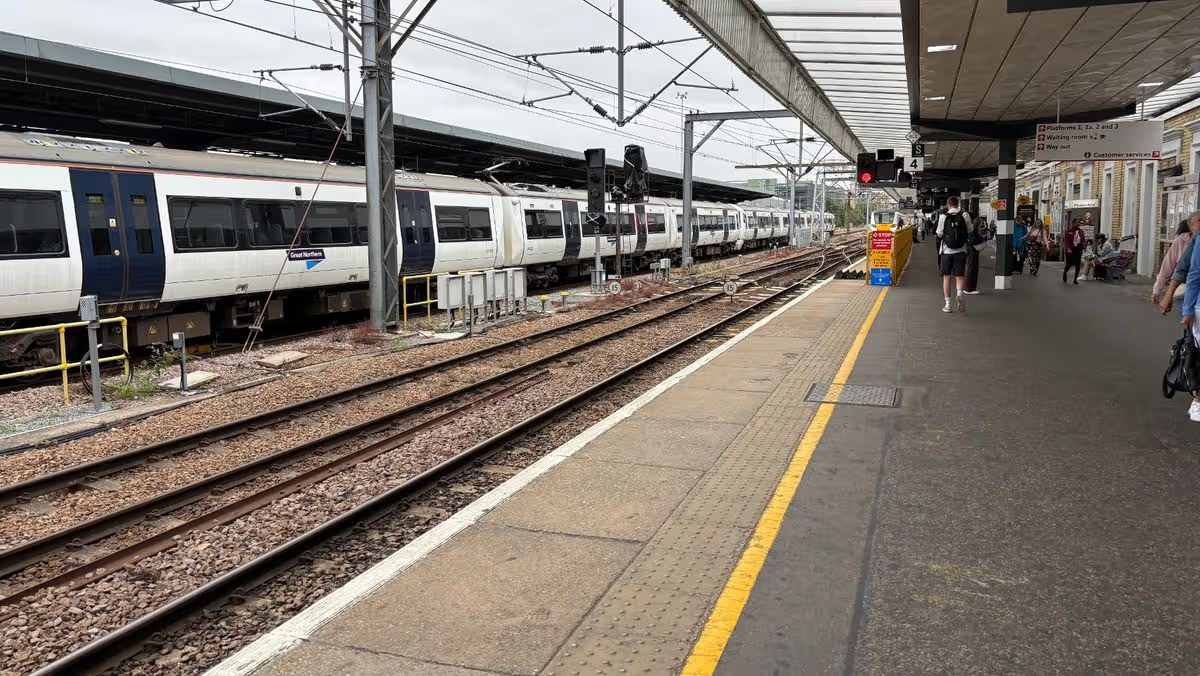
Cambridgeshire trains cancelled over Easter weekend with rail replacements instead
Arcutis presents trial data on roflumilast cream for infants

Retail shares under Elon Musk are increased by the SpaceX IPO plan


-
 NewsBeat3 days ago
Manchester United reach agreement with Casemiro over contract clause amid transfer speculation
-

 News Videos3 days ago
Parliament publishes latest register of MPs’ financial interests
-

 Crypto World7 days ago
Best Crypto to Buy Now: Strategy Just Spent $1.57 Billion on Bitcoin During Fear While Early Investors Quietly Enter Pepeto for 150x Potential
-

 Crypto World7 days ago
Bitcoin Price News: Bhutan Sells $72 Million in BTC Under Fiscal Pressure, but the Smart Money Entering Pepeto Sees What the Market Does Not
-

 Sports5 days ago
Remo Stars and Kano Pillars Strengthen Survival Hopes in NPFL
-

 Sports5 days ago
Gary Kirsten Accuses Pakistan Cricket Board Of ‘Interference’, Mohsin Naqvi Responds
-

 Business6 days ago
No Winner in March 21 Drawing as Prize Rolls to $133 Million for Next
-

 Tech6 days ago
Give Your Phone a Huge (and Free) Upgrade by Switching to Another Keyboard
-

 Tech6 days ago
AI enters the chat: New Seattle dating app relies on tech to facilitate meaningful human connections
-

 News Videos5 days ago
Ch 9 Financial Management Part 1 | Detailed One Shot | Class 12 Business Studies Boards 2026
-

 Tech7 days ago
Today’s NYT Connections Hints, Answers for March 22 #1015
-

 Business2 days ago
Instagram, YouTube Found Responsible for Teen’s Mental Health Struggle in Historic Ruling
-

 Business6 days ago
Will Duke Basketball Win It All? Duke Basketball Enters Second Round as Third Favorite to Claim NCAA Title
-

 Sports5 days ago
2026 Kentucky Derby horses, odds, futures, preview, date: Expert who hit 12 Derby-Oaks Doubles enters picks
-

 NewsBeat18 hours ago
The Story hosts event on Durham’s historic registers
-
 Entertainment5 days ago
Cynthia Bailey Dishes on ‘RHOA’ Season 17, Discusses Kandi
-

 Tech5 days ago
Samsung will soon let you control smart home devices from your car’s dashboard
-
 NewsBeat6 days ago
Update on Wisbech river crash as search for teenage boy enters fifth day
-

 Fashion4 days ago
Does It Matter What You Wear When You’re Laid Off and Looking?
-
 NewsBeat3 days ago
Tesco is selling new Cadbury Dairy Milk bar and people can’t wait to try it
You must be logged in to post a comment Login