Connect with us

Tech

McKesson discloses breach after ShinyHunters claims patient data theft

Published

on

McKesson headquarters

Healthcare and pharmaceutical distribution giant McKesson has disclosed a cybersecurity incident involving unauthorized access to third-party applications and data theft, with the ShinyHunters extortion group claiming it stole 284 million patient data records.

McKesson is a major U.S. healthcare company and pharmaceutical distributor that provides medicines, medical supplies, technology, and services to healthcare providers and pharmacies.

CyberInsider first reported the breach earlier today, and McKesson later disclosed it in a Form 8-K filing with the U.S. Securities and Exchange Commission.

image

McKesson says it discovered the cybersecurity incident on August 25, 2026, and that its investigation remains in the early stages.

“Information about the incident, including any updates, is available on the company’s website at www.mckesson.com/cybersecurity,” McKesson said in its SEC filing.

Advertisement

“As of the date of this filing, the company has not determined that the incident is material or that the incident has had, or is reasonably likely to have, any material impact on the company, including its financial condition or results of operations.”

In a separate notice to customers, McKesson confirmed that the incident involved third-party applications and the unauthorized access and exfiltration of data.

“We take the security and privacy of our partners, customers and their patients very seriously. Upon discovery, we immediately activated our incident response protocols, launched an investigation, and engaged leading cybersecurity industry experts to assist in our response,” reads McKesson’s notice.

The company said its investigation is ongoing to determine the full scope of the incident.

Advertisement

McKesson also warned that customers may experience intermittent service degradation believed to be related to the attack, although the company said it was not proactively disconnecting systems within its environment.

At this time, McKesson has not publicly disclosed which third-party applications were compromised, how the attackers gained access, or what information was stolen.

McKesson says its investigation remains ongoing and that it will provide additional information as it develops a more complete understanding of the incident.

ShinyHunters claims responsibility

The ShinyHunters extortion group told BleepingComputer that it was behind the attack, claiming it gained access after conducting voice phishing, or vishing, social engineering attacks against multiple McKesson employees.

Advertisement

ShinyHunters declined to provide many technical details about the social engineering attacks, including the domain used during the campaign. However, BleepingComputer learned from another source that the threat actors used the mckesson[.]claims domain as part of the attack.

This domain matches a ShinyHunters campaign recently documented by ReliaQuest’s Threat Research team, which said the extortion group was registering .claims domains containing the names or abbreviations of targeted companies to impersonate their help desks and IT teams.

“ReliaQuest is tracking a widespread ShinyHunters campaign using domains that follow the company[.]claims pattern. These domains incorporate the targeted organization’s name or abbreviation under the .claims TLD,” ReliaQuest said in a now-deleted post on X.

ShinyHunters told BleepingComputer that the vishing attacks led to the compromise of multiple employees’ Okta single sign-on accounts, which they then used to access the company’s Salesforce and Snowflake environments.

Advertisement

The threat actor claims it fully compromised the Salesforce environment, including support cases. The threat actor also allegedly stole a much larger collection of patient-related data from Snowflake.

According to ShinyHunters, the threat actor exfiltrated about 1TB of data over four days, between August 21 and August 25.

The threat actor also claims the stolen Snowflake data contains approximately 284 million data records of patient-related information. However, this does not mean that the breach impacted 284 million patients.

Previous reporting stated that information belonging to 284 million patients had been exposed. ShinyHunters clarified to BleepingComputer that the figure is actually a raw count of approximately 284 million data records, or lines, rather than a count of unique individuals.

Advertisement

The threat actor told BleepingComputer that it has not fully analyzed the stolen data and does not know how many unique people are in those records.

ShinyHunters claims the stolen information includes names, addresses, dates of birth, Social Security numbers, patient IDs, phone numbers, email addresses, Medicaid numbers, medical record numbers, medication and allergy information, illnesses, disabilities, appointment information, and physician information.

The group also claims the data contains information related to deceased and terminally ill patients, prescriptions and medication shipments, invoices, employee information, Salesforce records, internal communications, and healthcare providers and clinics using McKesson’s services.

BleepingComputer has not independently verified these claims, and McKesson has not publicly disclosed what information was stolen.

Advertisement

The group says it contacted McKesson after completing the data theft on August 25 and demanded a $55,236,150 ransom, giving the company 72 hours to respond. According to ShinyHunters, McKesson did not respond to or negotiate over the ransom demand.

The attack comes amid an ongoing wave of data-theft attacks targeting healthcare and health technology organizations attributed to ShinyHunters.

Health-ISAC recently warned healthcare organizations about increasing ShinyHunters attacks involving social engineering designed to compromise corporate accounts and gain access to cloud and SaaS platforms.

Other healthcare technology companies targeted in recent ShinyHunters data-theft attacks include MedtronicDentaQuestiRhythm, OneMedical, and AdaptHealth.

Advertisement

article image

Overall prevention scores can hide what happens after initial access. Once attackers are using valid credentials, prevention drops sharply.

The Blue Report 2026 measures defenses technique by technique across 338 million simulations run in customer production environments.

Get the report

Source link

Continue Reading
Click to comment

You must be logged in to post a comment Login

Leave a Reply

Tech

New York City 911 System Missed 1,700 Calls Due To Software Update

Published

on

Longtime Slashdot reader belmolis writes: Part of New York City’s 911 emergency system was offline from about 3:13 a.m. to 10 a.m. on August 18th due to a software update, according to Medical Daily. Of 5,659 calls to the Bronx call center during that period, about 1,700 calls connected but could not be heard by emergency operators. Some were rerouted to other call centers, but an estimated 400 human callers never got through. The potentially serious consequences of delayed response to emergencies are not yet known. The city did not notify the public and only released information when journalists inquired. How buggy software came to be installed on a running system is not yet known. The early-morning software update was pushed by Motorola, though exactly what it changed or why it caused the failure remains unknown. The city is still investigating whether the update was adequately tested and whether the same software release was deployed elsewhere.

Read more of this story at Slashdot.

Source link

Advertisement
Continue Reading

Tech

Plaud has put its fantastic AI transcription tech into 4G earbuds

Published

on

Plaud has unveiled the Plaud One Explorer Edition, a new pair of AI-powered earbuds designed to capture conversations and turn them into actionable tasks.

The $249.99 wearable combines earbuds with a standalone case, built-in 4G connectivity and Plaud’s latest AI platform, with pre-orders now open in selected markets.

Unlike conventional earbuds, Plaud One is designed primarily around conversation rather than music. It can capture phone calls, online meetings, face-to-face conversations and ideas on the go, with the company positioning it as a new interface for interacting with AI.

One of the more interesting aspects is that the earbuds don’t need to stay connected to a phone to upload recordings. Plaud One has a built-in eSIM and 4G LTE connectivity, allowing conversations to be uploaded for transcription and summarisation as they happen. The standalone case can also be used to capture conversations.

Advertisement

The captured information feeds into Plaud Intelligence, the company’s conversation-focused AI platform. At its centre is Plaud Agent, which is designed to understand the context and intent behind conversations and then act on that information.

Advertisement

That includes connecting to services such as Gmail, Google Calendar, Notion and Slack. Plaud says its AI can use predefined workflows, called Skills and Plugins, to handle specific tasks, while its Artifacts feature can produce finished work such as emails, documents and presentations.

The idea is that you could leave a client meeting and have Plaud prepare a follow-up email, or ask for a briefing on a previous conversation before another meeting. Plaud also says the system builds up memory and context over time, allowing it to connect information from different conversations.

Advertisement

The hardware itself includes three microphones, with the company claiming they’re tuned to work together for clearer calls and voice recordings. There’s also a 3.5mm headphone jack, speakers positioned above and below the display, a barometric pressure sensor and support for microSD cards up to 2TB.

Plaud One Explorer Edition costs $249.99 and comes with $200 in Plaud Credits for the company’s upcoming agent features and other AI capabilities. Pre-orders opened on August 27, with shipments expected to begin in Q4 2026.

Opinion

I have a Plaud Note Pro, and it’s great. It’s a credit-card-sized device that records meetings and then transcribes that content and uploads it to the cloud. It works very well, and it’s very discreet.

I’m sure the tech inside these buds will be great. I am not sure though, whether having AI earbuds is something I would ever want. I’d much rather keep it within a more subtle product, rather than have it on my face.

Advertisement

Maybe I can be convinced, but currently I am struggling to see the issue this solves.


Max ParkerMax Parker

Advertisement

Advertisement

Source link

Continue Reading

Tech

PaperCut releases second emergency patch for exploited flaws

Published

on

PaperCut

PaperCut has released a second emergency security update for two actively exploited vulnerabilities in its PaperCut NG and MF print management software after researchers discovered multiple ways to bypass the initial fixes.

As BleepingComputer reported yesterday, PaperCut warned that hackers were exploiting a vulnerability in zero-day attacks against customer servers and released an initial emergency patch for PaperCut NG/MF versions 25 and 26.

At the time, however, the company had not disclosed CVE identifiers or technical details about the vulnerabilities, saying it was withholding information while it investigated the attacks and gave customers time to apply emergency fixes.

image

PaperCut has now shared technical details and CVE identifiers for the two vulnerabilities, tracked as CVE-2026-82078 and CVE-2026-81578. These vulnerabilities can be chained to bypass authentication and execute code on vulnerable servers.

CVE-2026-81578 is a high-severity authentication bypass vulnerability rated 8.8 that impacts the PaperCut NG/MF web management interface.

Advertisement

“Under specific conditions, unauthenticated remote requests targeting administrative functions can trigger backend actions prior to the completion of access validation checks,” explains PaperCut’s updated advisory.

The second vulnerability, tracked as CVE-2026-82078, is a critical unsafe dynamic class-loading flaw rated 9.4 that exists in PaperCut’s database connection utilities.

The application loads database driver classes based on configurable driver names without validating them against an approved allowlist. 

“If an attacker can manipulate system configuration parameters, this enables the execution of arbitrary Java bytecode residing on the application classpath under the security context of the PaperCut server process,” explains PaperCut.

Advertisement

Cybersecurity firm watchTowr, which has been working with PaperCut during the incident, said on LinkedIn that the vulnerabilities allow unauthenticated attackers to bypass authentication and gain remote code execution on affected PaperCut NG/MF instances.

Second emergency patch released

On Friday, PaperCut released Emergency Patch Release 2, an updated security fix that includes additional hardening developed after further analysis with its internal security team and researchers at Huntress and watchTowr.

“Following further work with our internal security team and external researchers, including Huntress and watchTowr, we have released an updated Emergency Patch (Release 2) that includes additional hardening beyond the original emergency patch,” PaperCut said.

The company is urging all customers to install Release 2 even if they already installed the first emergency patch.

Advertisement

This second release comes after watchTowr said its researchers fully reproduced the vulnerabilities, discovered multiple patch bypasses, and identified an additional authentication bypass vulnerability.

Huntress, which has been working with PaperCut during the incident, says it observed exploitation in two customer environments and reproduced the full pre-authentication RCE chain.

The company told BleepingComputer that PaperCut logs captured commands used by the attackers for system reconnaissance, while hex-encoded Java `.class` files found in the logs acted as an RCE bridge between PaperCut and the underlying operating system, allowing commands to be executed and files to be read or written.

The commands observed by Huntress appear to have been used for reconnaissance rather than to deploy malware or establish persistence.

Advertisement

Huntress also says it discovered multiple bypasses for the original emergency patches and an additional authentication bypass vulnerability, which it shared with PaperCut.

Emergency Patch Release 2 is available for PaperCut NG and MF versions 24, 25, and 26 on Windows, Linux, and macOS. Customers running version 23 or earlier are advised to upgrade to the latest version rather than wait for a patch for those releases.

PaperCut says Site Servers and secondary/print servers should also be upgraded to patched versions. Other components, like Print Deploy and Mobility Print, are not affected and do not require updates.

Even though patches are available, PaperCut to urge customers to restrict access to the web interfaces to trusted IP addresses using firewall rules, network access controls, or equivalent measures.

Advertisement

Administrators should also look for suspicious post-exploitation activity from the pc-app.exe process, missing or truncated server.log files, and the following errors in the server.log.


ERROR No suitable driver found for jdbc:no:x
ERROR DatabaseUtils - Database error looking up cardID: VALUES CAST

The company has not disclosed who is behind the attacks or what threat actors are doing after compromising vulnerable servers.

PaperCut told BleepingComputer that the attacks appear limited and targeted, and that it is withholding details about post-exploitation activity while it continues its investigation.

“Our investigation into what attackers are doing post-compromise is still active, and premature detail could complicate any affected customers’ own response,” PaperCut told BleepingComputer.

Advertisement

“What we can say: the bulletin advises customers to watch for intrusion-detection, endpoint, or network-monitoring alerts tied to the PaperCut Application Server, and we’ll publish indicators of compromise as they’re verified.”

PaperCut servers were previously targeted in 2023 after attackers began exploiting CVE-2023-27350, an authentication bypass and remote code execution vulnerability.

Those attacks were ultimately linked to numerous threat actors, including the Clop and LockBit ransomware operations, Iranian state-backed hacking groups, and the Bl00dy Ransomware Gang.

Update: Added information from Huntress.

Advertisement

article image

Overall prevention scores can hide what happens after initial access. Once attackers are using valid credentials, prevention drops sharply.

The Blue Report 2026 measures defenses technique by technique across 338 million simulations run in customer production environments.

Get the report

Source link

Continue Reading

Tech

Diamonds, Crescents and Wildcats: Intel shows off its hardware for the next generation of agentic AI workloads

Published

on


  • Intel shows three agentic AI architectures at Hot Chips 2026: the 256-core Diamond Rapids Xeon, the Crescent Island inference GPU, and the already-shipping Wildcat Lake client SoC
  • Diamond Rapids matches AMD’s EPYC Venice on cores and bandwidth but arrives in 2027 with half the threads, while Wildcat Lake’s 17 TOPS NPU falls short of Copilot+’s 40+ TOPS certification
  • Intel’s Crescent Island will support up to 480 GB via third-party partner cards, but the Intel-branded variant will be limited to 160 GB, even as it currently does not publish the memory bandwidth that determines its token economics.

Intel used its slot at Hot Chips 2026 to lay out three architectures it says will carry agentic AI from the rack to the laptop.

The already-shipping Wildcat Lake Core Series 3 SoC is for mainstream client and edge machines, Crescent Island is an inference-optimized data center GPU, and Diamond Rapids is its next-generation enterprise-class data center CPU that can be configured with up to 256 cores.

Source link

Continue Reading

Tech

The 4 Biggest Things We Learned After The Netflix Extended Look

Published

on


“Grand Theft Auto 6” is the biggest and most-anticipated game release in a decade, at least. Despite a reported budget of more than $1 billion, it’s expected to make money back for developer Rockstar and publisher Take-Two Interactive in a matter of days. There’s also a reasonable case to be made for “Grand Theft Auto VI: An Extended Look” being the biggest game trailer release of all time. It’s certainly the first trailer to get a six-hour exclusive run on Netflix (with some stray Twitch streamers thrown in for good measure) before debuting on YouTube and other platforms.

There’s plenty to see for yourself, so if you’re at all interested it’s well worth spending 26 minutes and 49 seconds to take a look ahead of “Grand Theft Auto 6” release on November 19. But, we spotted a bunch of things you may not notice at first glance, and we also dove through several interviews Rockstar gave — timed for the trailer’s release, of course — to pull out the things you need to know about “GTA 6.”

Advertisement

This is the biggest Grand Theft Auto ever, and it’s not even close

We had a suspicion that this would be the case, but thanks to some media work Rockstar executives did around the extended look’s release, we can better quantify what that means. Speaking with YouTuber TGG, Rockstar co-studio head Rob Nelson claimed that the game’s map is twice the size of the “GTA 5” map, and three times the size of the “Red Dead Redemption 2” map. As for Vice City, TGG said, “Vice City itself is twice the size of Los Santos. And Vice City and its [surrounding suburbs] is 11 times bigger than Los Santos and its [surrounding suburbs].”

This is all obviously a far cry from the maps of multi-planetary games like “No Man’s Sky” and “Starfield,” but Rockstar’s games are on a different level to those when it comes to density and unique touches. A giant planet with a couple of buildings vs. a large portion of the state of Florida (sorry, Leonida), isn’t the fairest comparison to make.

We also got a clue as to just how long “Grand Theft Auto 6” is. In a different interview with The New York Times, Nelson told games journalist Christopher Byrd that he spent 80 hours playing through the main story and a handful of optional goals. Your mileage may vary, but that’s a much longer time than the average player logged completing “Grand Theft Auto 5,” according to the site How Long to Beat.

Advertisement

You can race cars, dirtbikes, ATVs and maybe even jet skis

It wouldn’t be a modern Grand Theft Auto without minigames, and we spotted multiple new options in the extended look. We knew from earlier leaks that basketball was going be an option, but during the 27-minute trailer Rockstar showed off at least six other activities.

Vice City has always had a dirt track, so the inclusion of off-road races isn’t a huge surprise, but the brief snippet shows dirtbikes and ATVs racing alongside trucks. There’s an even-more-brief segment where we see a Fast and Furious-style street race, full of exotic imports, neon underglow mods and, of course, nitrous boosts.

Advertisement

There even appears to be a professional series on a full-blown race track inspired by real circuits. In the trailer we see a multi-lap race with track-modified sedans and souped-up muscle cars decked out in (pretty silly) sponsored liveries. There are open-wheel racing series in “GTA Online” and figure-8 racing events in “San Andreas,” but this latest addition looks impressive, to say the least. 

Finally, while we didn’t see any jet ski races in the trailer, the vehicles do feature prominently, so we wouldn’t be surprised if that’s an option come November 19. If racing isn’t your speed, there seem to be a handful of less adrenaline-fueled activities on offer, including kayaking, diving, weight lifting and target practice challenges.

Advertisement

There are some huge changes to combat

We still don’t have a full rundown on the fine details of the “GTA 6” combat system, but we did learn a lot from the extended look.

One big quality-of-life improvement coming is swapping between two firearms on the fly. The weapon wheel is still there, but around 18 and a half minutes in, you can see co-protagonist Lucia on a target range switching between a rifle and a pistol without needing to pull up the wheel.

Bullet time — which was an ability locked to Michael De Santa in “GTA V” — is confirmed to be making a return, at least for Jason. While he clears an office space of goons, we see him slow down time and a new vital targeting system. Some areas are lit up in red and appear to be indicating lethal shots, while others in a pale yellow are centered on joints and may be there for you to incapacitate someone in a less-lethal way. Oh, and there’s even a killcam straight out of “Max Payne 3” in one scene.

One perhaps pointless but very cool addition is the ability to wield certain weapons in one hand. In one scene, Lucia is carrying a duffel bag in one arm and a shotgun in the other. She’s able to both fire and rack her shotgun without skipping a beat. Those are some strong forearms. And ribs, for that matter.

Advertisement

You can’t just hot-wire every car

Going all the way back to 1997’s “Grand Theft Auto,” you’ve been able to break into any car and, with the press of a button, magically hot-wire it. Those days are over. Around six minutes into the trailer, we see Jason attempting to steal a car and a “Slim Jim” minigame where the player has to time their inputs to get into the car using a slide tool.

According Rockstar, that’s just one of the new layers of complexity to the grand theft auto of “GTA 6.” Speaking with IGN, Nelson (the same co-studio head who spoke with TGG) gave a few interesting examples: Vehicles with electronic key fobs may require a key cloner, while cars with GPS tracking enabled might require you to drive below a certain speed threshold to avoid triggering an alarm.

Advertisement

Apparently there’ll be an in-game app on the protagonists’ cellphones that will let you scan a car to discover what security features are optioned. “Grand Theft Auto VI” has a number of new rides and returning classics, and it sounds like many will require a different approach to steal. The app will also reveal how much money you can make selling it or how much it’ll cost to file down those VINs add it to your collection.


Advertisement

Source link

Continue Reading

Tech

How To Use Your Old Android Phone As A Wi-Fi Extender

Published

on

It’s a quick fix for that dead zone in your house.

If you have an old Android phone gathering dust in a drawer somewhere, you may already have everything you need to fix the dead zones in your home Wi-Fi network. Instead of buying new hardware, be it an extender, a mesh node or a more powerful router, you could just use an old Android device. 

Most households have at least one old Android phone sitting forgotten somewhere, too outdated to use as a daily driver, but too functional to justify throwing it away. Before you drop it off for recycling, you should consider what it can still do for you. With nothing more than its built-in settings and a power outlet, that phone can pull double duty as a Wi-Fi extender, helping push your home network’s signal into those room corners where signal is patchy at best.

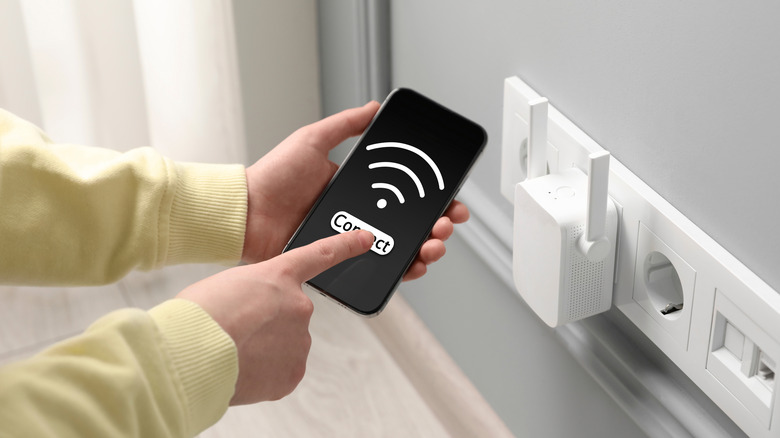
You don’t need any special apps, extra hardware or even advanced technical know-how. Android’s built-in hotspot feature lets your phone connect to your existing Wi-Fi network and act as a repeater to broadcast it as a separate signal, thus extending coverage.

Advertisement

What does an Android Wi-Fi extender actually do?

If your home has areas where the internet signal is weak, it can be quite annoying. While it’s true that some things can be done — did you know there was a right way to position your router’s antennas? — it can be a nuisance until fixed. There are things you can buy, of course. Upgrading to a mesh system or getting a new router can be quite expensive, while a Wi-Fi extender can put you back about $50, depending on model. That’s still money you could simply not spend by making use of tech you already have.

Your Android phone can connect to your existing home Wi-Fi network and rebroadcast the signal as a separate hotspot. You can then connect other devices, from laptops to tablets and smart TVs, to that Wi-Fi signal instead. Think of it as a signal relay, as the phone picks up Wi-Fi from your router and simply passes it along to other devices that need it. It’s not a mesh system, and it won’t perform as one, but it’s a free and low-effort fix for weak coverage areas.

Advertisement

How to set up your Android phone as a Wi-Fi extender

The process for this whole operation is quite straightforward and only takes a few minutes. Our starting point comes after you’ve already located your old Android phone, recharged it and run the latest updates.

  1. Open Settings, go to Network & Internet > Internet. Select your home Wi-Fi network and enter the password when prompted.

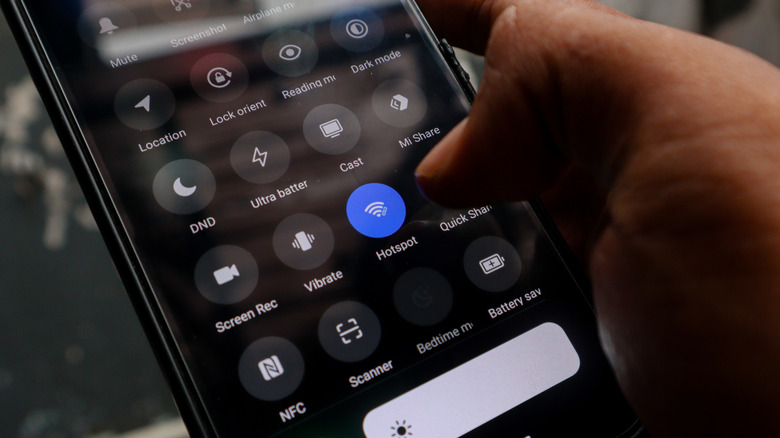
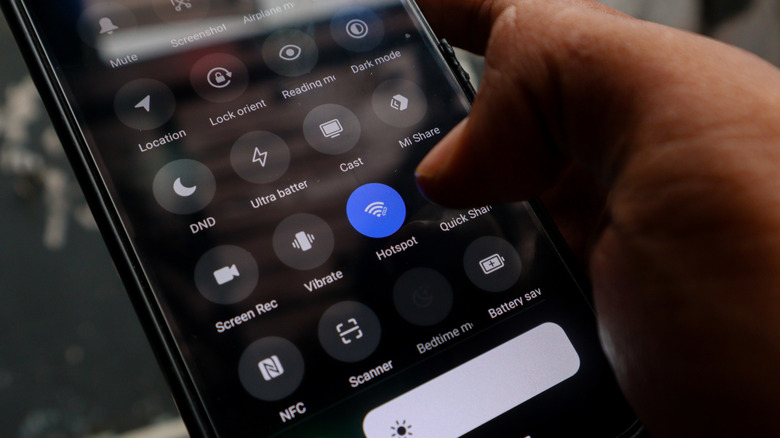
  2. Go to Settings > Hotspot and Tethering and toggle on Wi-Fi Hotspot. You can also find the Hotspot icon in the drop-down menu — you just need to know what all those Android status bar icons mean

  3. Tap the Wi-Fi hotspot to rename the network and set a strong password to secure your network and keep it easy to identify.

  4. If your phone supports it, you can select 5GHz under the speed or band settings. This will improve performance for nearby devices, but it offers a shorter range than 2.4GHz.

  5. Place your phone about halfway between your router and the dead zone you’re worried about. Make sure it’s near an outlet so you can easily keep it recharged. Old phones already have questionable battery life, and running a hotspot continuously will drain the battery fast.

The downside of this method is that the phone extends your existing Wi-Fi, but it won’t boost your internet speed in any way. If your internet is already slow, the hotspot won’t fix that. You also have to keep in mind that any commercial Wi-Fi extender or mesh node will outperform this Android-based solution.

Another thing to keep in mind when using this method is that there’s no smart home integration to speak of. Dedicated Wi-Fi extenders often support smart home ecosystems and seamless roaming, while an Android hotspot creates a separate network, so some smart home devices may not connect to it reliably. Plus, you’ll need to manually switch networks as you move around your home.

Advertisement

Android phone vs. commercial alternatives: Which is better?

The answer to this question is one only you can deliver. Do you want to invest in your network at this point? An Android phone extender costs nothing, and it’s ideal as a temporary fix or supplementary solution for a single problem area. However, you’ll get much better range and performance from a commercial Wi-Fi extender, a mesh node or a new router. Go for the Android phone option if you need a quick fix and already have an unused device on hand. You could even try the USB tethering alternative for a more stable connection. It will make a surprisingly capable Wi-Fi extender for the right situation, the setup takes minutes, the cost is zero and it keeps a device out of the recycling bin. Just understand that this is a practical workaround, not a permanent network solution.

Advertisement

Source link

Continue Reading

Tech

The Kindle Scribe Colorsoft has finally dropped to its lowest price yet

Published

on

You can now grab the Kindle Scribe Colorsoft at its lowest price since launch, saving £150 in the process.

Amazon has cut £150 off the Kindle Scribe Colorsoft, taking it from £629.99 down to £479.99, a 24% discount that makes this the cheapest way yet to own one of Amazon’s most advanced e-readers.

Amazon kindle scribe colorsoft on a green backgroundAmazon kindle scribe colorsoft on a green background

Kindle Scribe Colorsoft hits its lowest price yet at £479.99

If you have been eyeing the Colorsoft, now is the moment to grab it at that lowest recorded price, since it has bounced back to just £629.99.

Advertisement

View Deal

The Colorsoft has mostly sat at £629.99 for months. Only brief dips interrupted that pattern before this latest drop pushed the price to a new low.

Advertisement

The display itself is what makes this Scribe standout, since Amazon’s oxide-based Colorsoft screen delivers high-contrast, paper-like colour with a textured surface that avoids the flashing normally associated with e-ink refreshes when you turn a page.

This paper-like feel carries into the Premium Pen included in the box, a battery-free stylus that never needs charging and responds quickly enough to feel like writing with real ink rather than plastic on glass.

Advertisement

Every page you write becomes part of a built-in notebook that uses AI to search your handwriting, summarise long notes, and answer questions about what you wrote without needing to remember exact keywords or page numbers.

Advertisement

The Whatsapp LogoThe Whatsapp Logo

Get Updates Straight to Your WhatsApp

Join Now

Advertisement

Handwritten pages can also be refined and converted to text for sharing, while documents pulled in from Google Drive or Microsoft OneDrive can be marked up directly and exported straight back out as PDFs too.

Active Canvas takes that a step further by making space in the text itself, shifting a book or Word document to let you write directly between the lines instead of squeezing notes into a cramped margin.

All of that runs on a single charge that lasts up to eight weeks of regular reading or two weeks of daily writing, so the Colorsoft rarely needs to come off the shelf to top up.

Imagine picking up one of Amazon’s most advanced e-readers without paying full price for the privilege, because that is exactly what happens with the Kindle Scribe Colorsoft at £479.99, its lowest price since its official launch.

Advertisement

Advertisement

If you have been eyeing the Colorsoft, now is the moment to grab it at that lowest recorded price, since it has bounced back to £629.99 quickly enough before to make waiting a real risk.

SQUIRREL_PLAYLIST_10148964

Source link

Advertisement
Continue Reading

Tech

Bluesound’s new sub targets bigger bass without adding bulk

Published

on

Bluesound has introduced the Pulse Sub, a completely redesigned wireless powered subwoofer built to bring deeper bass to its BluOS multi-room system.

Inside the cabinet is a 350-watt amplifier with Smart DSP technology drives two custom 6.5-inch woofers arranged in an opposing configuration, a layout that delivers roughly 2.5 times more power than the previous generation Bluesound subwoofer.

Bluesound Pulse Home Cinema familyBluesound Pulse Home Cinema family
Image Credit (Bluesound)

The dual-opposing arrangement also cancels much of the vibration each driver creates, so the cabinet stays still while the woofers do the work to deliver bass stays deep, clean and controlled.

Built entirely around the BluOS platform, the Pulse Sub pairs wirelessly with existing Bluesound products through the BluOS Controller app, and setup mirrors the same steps Bluesound already uses for adding a second player to a system.

Advertisement

Advertisement

Pairing options include the Pulse Cinema and Pulse Cinema Mini wireless soundbars for a fuller home cinema setup, or the Powernode streaming amplifier for listeners who want deeper, more musical bass added to music playback.

Matt Simmonds, VP of Bluesound Product Development, described the goal for the design as: “Great bass shouldn’t be loud and boomy. It should bring you closer to what you are watching or listening to without calling attention to where it is coming from.”

Bluesound Pulse Sub connectionsBluesound Pulse Sub connections
Image Credit (Bluesound)

Simmonds added that the team rethought both the acoustic and industrial design of the Pulse Sub to more than double its power output while keeping the enclosure compact, controlled and easy to live with.

Soft contours and tonal-weave fabric grilles pair with a matte satin finish that matches the rest of the Bluesound line, while integrated cable management channels keep wiring routed and out of sight. Beyond wireless pairing, a low line-level analogue input lets the Pulse Sub double as a wired active subwoofer for non-BluOS systems.

Advertisement

Advertisement

The Pulse Sub will be available later in 2026 priced at £849 / €999, sold through authorised Bluesound retailers, Bluesound website and Amazon, with pre-order details to follow at a later date.

Source link

Advertisement
Continue Reading

Tech

Samsung’s new portable SSDs are blazing fast over USB4, but will torch your wallet

Published

on

Pricey Memory Potato: Samsung recently unveiled the latest models in its portable storage lineup. The “P” SSD series features unprecedented performance, but the high-end models come with truly eye-opening MSRPs that few users will be able to afford.

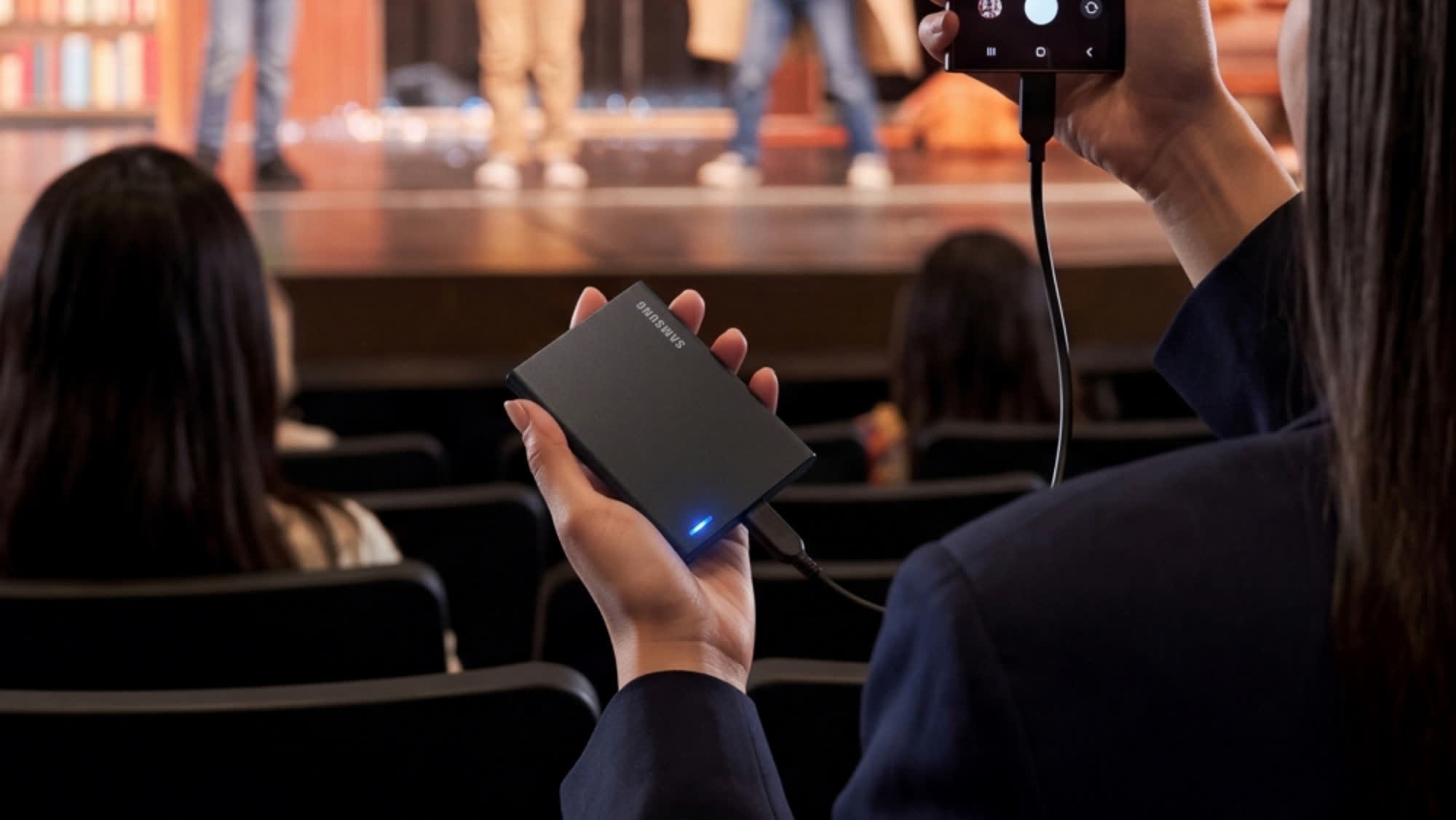
Samsung unveiled the company’s new offering for portable storage enthusiasts at Gamescom 2026 in Germany. The “P” Series of external SSDs uses USB4 connectivity to raise the performance bar considerably while offering some truly spacious units for both professional and consumer use.

The P Series includes two models: the P9, which is positioned as an ideal solution for professional users, and the P7 – designed to provide “convenient” storage for everyday users. According to the official price tags, however, it isn’t particularly convenient for most wallets.

The flagship P9 drive can deliver sequential read speeds of up to 4,000MBps, while sequential write speeds can reach 3,800MBps. This industry-leading performance is approximately twice as fast as the previous generation, with Samsung comparing the newer P9 with a 4TB T9 drive, which offers sequential read and write speeds of 2,000MBps over a USB 3.2 Gen 2×2 interface.

Advertisement

Earlier this year, the Samsung P9 received an Innovation Award at CES. Samsung said the portable SSD can sustain “12K” real-time recording, which should be more than enough for production workflows involving video capture, RAW image files, and ultra-high-definition video storage and editing.

Meanwhile, the Samsung P7 model uses the same USB4 interface to offer a more versatile storage option. The Korean company highlights the drive’s broad compatibility, noting that it can be used with desktop and laptop computers, smartphones, gaming consoles, and even USB-compatible cameras.

The P7 also offers improved durability, having successfully completed a 2-meter drop test along with additional shock and vibration tests. According to Samsung Electronics Vice President Tommy Kwon, the P Series can provide real performance benefits for “AI-powered” content creation, video production, and everything in between.

Now, here’s the hardest part of Samsung’s overenthusiastic announcement: the P Series of portable SSDs will cost a lot, because memory products have become a luxury that very few giant corporations in the world can afford to ransack.

Advertisement

The P9 will be available in four capacities (1TB, 2TB, 4TB, and 8TB), with suggested prices ranging from $340 to $2,700. Meanwhile, the “affordable” P7 drives will range from $290 for the 1TB model to $2,290 for the 8TB version. Look for them to start shipping on August 31.

Source link

Advertisement
Continue Reading

Tech

German-Japanese researchers invent electricity-free tech that could cool datacenters

Published

on

science

How come that super-smart AI of yours didn’t figure this out, frontier labs?

Datacenter cooling could get a lot more affordable, and sustainable, if a joint German-Japanese research project can be scaled beyond the laboratory. 

Advertisement

Researchers from the Karlsruhe Institute of Technology and the University of Tsukuba published a paper in Nature Energy on Friday discussing the success they had with a solid-state cooling technology that doesn’t need any electric input at all, and was still able to demonstrate temperature reductions in laboratory experiments. 

For those unfamiliar with solid-state cooling, it’s a more sustainable alternative to traditional compression cooling that relies on environmentally harmful refrigerants and lots of electricity. Instead of compressing and expanding a gas to generate cold, some solid-state systems rely on thermoelectric materials that, when supplied with electricity, can generate temperature differences. Thermoelectric solid-state cooling systems can be incredibly small, but there’s a catch: They still need energy, and they’re only a quarter as efficient as modern compression cooling systems, as the researchers noted. 

Enter elastocaloric cooling, which relies on shape-memory alloys that change temperature when mechanically loaded and unloaded through a phase transition. It’s that sort of material and methodology that the KIT and Tsukuba team experimented with.

Like other forms of solid-state cooling, elastocaloric systems have traditionally required electricity to effect change in the shape-memory alloys they use, relying on actuators that can get quite large. What the researchers wanted to develop was a miniaturized form of elastocaloric cooling that didn’t require any electricity at all, instead relying on the waste heat being generated by the objects it wanted to cool – for example, a computer processor, as they mention in their paper. Based on their demonstration, it appears to have worked. 

Advertisement

The researchers used a pair of super thin nickel-titanium foils for their elastocaloric system with opposing functions: One foil shrinks when subjected to heat, generating movement that translates into mechanical energy and acting as its own actuator. That mechanical energy is transferred to the second foil, which is loaded and unloaded to trigger a phase transition that produces the cooling effect.

Laboratory tests demonstrated that their technology isn’t only theoretically feasible, but also actually works – albeit to a limited extent. 

“Our prototype achieves a temperature span of 12.9 K at the refrigerant film level and 4.0 K at the device level under Joule-heated actuation at 86°C (187°F),” the team said in their report. When subjected to an external heat source of 130°C (266°F), the system still maintained a device-level temperature span of 2.2 K – not a lot, but it still shows the device, even at its most basic, single-pair-of-films level, works. 

“For us, the decisive moment was seeing measurable cooling for the first time, actually generated by a heat-driven system,” KIT PhD candidate and paper lead author Yi-Ting Hsiau said of the project in a release put out by the university. “This showed us that the principle doesn’t just work on paper.”

Advertisement

With the concept of electricity-free miniaturized cooling now proven, the team is planning to build larger experimental units to optimize cooling performance. 

Electricity-free and water-free cooling designs couldn’t come at a better time: Energy generation used to power and cool things like datacenters is on the rise, as is the water footprint of such facilities, in part also linked to cooling. Add climate change to the mix, and cooling electronics and people is only more of a concern – according to IRENA, heating and cooling together now account for more than 40 percent of global energy-related carbon dioxide emissions. Sorting out the datacenter energy and water problem has a lot to do with figuring out how to keep systems cool, and while this research is in its infancy, it could prove to be a valuable contribution to reducing the tech industry’s energy footprint.

“We believe this is just the beginning,” said Jingyuan Xu, head of KIT’s ZEco Thermal Lab, working on zero-emissions and eco-friendly heating and cooling tech. “By scaling up this technology, we aim to develop compact cooling systems that utilize abundant heat sources for sustainable cooling.” ®

Source link

Advertisement
Continue Reading

Trending

Copyright © 2025