TL;DR
McKinsey launched a free AI practice tool for interview case studies. It also tests candidates on how they work with its AI assistant Lilli.





McKinsey launched a free AI practice tool for interview case studies. It also tests candidates on how they work with its AI assistant Lilli.
McKinsey launched a free AI practice tool in April that gives candidates unlimited attempts at the quantitative case study they will face in their interview. The tool is available globally to applicants for entry-level business analyst and associate roles. The firm says it is designed to level the playing field for candidates who cannot afford expensive consulting coaches.
The consulting interview coaching industry charges anywhere from $200 to $500 per hour. McKinsey’s free tool lets candidates practise the same quantitative scenarios they will encounter in the real interview, as many times as they want. Marie Christine Padberg, McKinsey’s global talent attraction co-leader, told Business Insider the tool also addresses nerves: “Doing quantitative things is one thing, but doing it while somebody’s watching you is something else.”
The practice tool is one half of a broader AI integration into McKinsey’s hiring process. The other half is more consequential. Since January, the firm has been piloting the use of its internal AI assistant Lilli during final-round interviews for business school graduates.
Candidates in the pilot are asked to use Lilli to analyse a case study and refine their conclusions. Interviewers evaluate how applicants prompt the system, assess its outputs, and apply them to a specific client scenario. The test measures curiosity and judgment, not prompt engineering.
McKinsey is not testing whether candidates can avoid AI. It is testing whether they can work with it effectively. The distinction reflects how consulting work itself has changed. Consultants are now expected to move beyond analysis that clients can do internally and toward problem framing, judgment, and implementation.
The scale of AI inside McKinsey makes the hiring shift logical. CEO Bob Sternfels said at CES in January that the firm now has approximately 25,000 AI agents supporting its 60,000 human employees. Eighteen months ago, that number was 3,000. More than 75% of McKinsey employees use Lilli monthly.
McKinsey has also cut approximately 200 technology roles as AI automates non-client-facing operations. The firm shrank its overall workforce by more than 10% between 2023 and 2025. Entry-level roles have been most affected, precisely the positions the AI practice tool is designed to help candidates secure.
The tension between AI creating and eliminating jobs is playing out across the hiring market. Forward deployed engineer postings are up 19x year on year. Claude Evangelists earn $240,000. Chief AI Officers command nearly $500,000. The jobs AI creates pay more and require different skills than the jobs it replaces.
McKinsey’s approach codifies that shift into the interview itself. The firm is not asking candidates whether they can use AI. It is making AI fluency a condition of entry. CaseBasix, a consulting interview preparation firm, said BCG and Bain are likely to follow with similar AI interview components.
The broader pattern is consistent. Detroit’s automakers are cutting white-collar staff while posting AI roles. Salesforce eliminated 4,000 support jobs after deploying AI agents. McKinsey is simultaneously reducing its workforce and redesigning its hiring process to select for people who can work alongside the technology that is making others redundant.
The quantitative component is especially important, Padberg said, because “even in an AI-enabled workplace, consultants still need to understand how numbers connect and what they mean.” AI can generate analysis. It cannot yet determine whether the analysis is relevant to a specific client’s problem. That judgment gap is what McKinsey’s interview is now designed to test.
The class of 2025 and 2026 graduates are entering a job market where AI fluency is no longer a bonus skill. At McKinsey, it is now part of the entrance exam. The free practice tool makes preparation accessible. The Lilli interview makes the standard clear: if you cannot collaborate with AI under pressure, you will not get the job.
Why you can trust TechRadar
We spend hours testing every product or service we review, so you can be sure you’re buying the best. Find out more about how we test.
The Kensington SD5010T5 EQ is a 13-in-1 Thunderbolt 5 docking station announced in May 2026. It sits at the entry end of Kensington’s growing TB5 line-up and is designed to bring next-generation connectivity to a broader audience without the price tag of the flagship EQ Pro.
The key design choice here is straightforward. Kensington trades two of the three downstream Thunderbolt 5 ports found on the SD5000T5 for a pair of built-in HDMI 2.1 outputs. That is a significant swap.
Windows users gain the convenience of plugging monitors in directly, but Mac users with Apple-only displays lose access to the full TB5 daisy-chain capability offered by some of the alternatives.
What remains is still competitive, but it’s a Windows-centric choice.
Another PC-friendly inclusion is that the dock delivers 140W power delivery with KonstantCharge, meaning peripherals continue charging even when the laptop is absent. There are two USB-C Gen 2 ports that the SD5000T5 lacked, three USB-A ports across two speed grades, SD 4.0 and microSD 4.0 card readers, 2.5Gbps Ethernet, and a 3.5mm combo audio jack.
That spec pitches to Windows-based creatives who want to connect their laptop to multiple monitors and peripherals while recharging.
The issue with Kensington-branded equipment is always the asking price, and the SD5010T5 EQ is at the premium price end of the small TB5 dock offerings. That said, it’s a highly capable device, and on the cusp of being the best laptop docks for Thunderbolt 5 right now.

The Kensington SD5010T5 EQ Thunderbolt 5 Triple 4K Docking Station is currently available through Kensington’s official site and selected retail partners.
Launched at an MSRP of $349.99 / £329.99, it falls squarely within the premium pricing tier commanded by next-generation multi-display docks. The actual retail price is $299.99 on Amazon.com in the US, but it has yet to appear on European Amazon locations.
On the UK Kensington website, you are directed to ask for ‘business pricing’, hinting that Kensington want to keep this product decidedly B2B in some regions.
This investment positions it alongside competitor offerings like the Cable Matters Thunderbolt 5 Dock, yet it undercuts hyper-premium alternatives by choosing a tightly curated 13-in-1 layout over expansive, multi-device enterprise chassis. For business fleets, it’s a standard three-year limited warranty and unified hardware SKU offer tangible IT cost-reduction benefits during long-term workspace standardisation rollouts.
However, the recent Ugreen Maxidok 10-in-1 offers very similar specifications, equivalent build quality, and better availability than the SD5010T5, but it sells for $50 less.
Also cheaper is the StarTech Thunderbolt 5 Dock, which sells for around $283 on Amazon, and bears an uncanny resemblance to the Kensington product. The same spec, ports, and layout hint that one or both of these products are rebrands or derivatives.
Therefore, with this pricing, Kensington is hoping that its customer base is more trusting of its brand than Ugreen, or that the deals its B2B channel pathway can offer counter those comparisons.
What I should say is that, compared to a few Kensington docks I might mention, the SD5010T5 seems to be on the right side of affordable. But that doesn’t make it a bargain.
|
Feature |
Specification |
|
Model |
SD5010T5 EQ (K35210EU) |
|
Compatibility |
Thunderbolt 5, Thunderbolt 4, USB4 (Windows 11 23H2+, macOS 14.5) |
|
Total Ports |
13 |
|
Thunderbolt 5 (upstream) |
1x TB5 host port (80Gbps / 120Gbps Bandwidth Boost) |
|
Thunderbolt 5 (downstream) |
1x TB5 ports |
|
USB-A ports |
3x USB-A 3.2 Gen2 (1x 10Gbps, 2x 5Gbps) |
|
USB-C ports |
2 x USB-C Gen2 10Gbps (1 x 30W, 1 x 7.5W) |
|
Video |
2x HDMI 2.1 (+ 1xTB5 ports with adapters) |
|
Display Output (Windows / TB5) |
Triple 4K @ 144Hz, or Dual 8K @ 60Hz |
|
Display Output (macOS M4/M5 base, M-Pro/Max) |
Dual 4K @ 60Hz via HDMI, or 4K + 6K via HDMI + TB5 |
|
Power Delivery |
Up to 140W on upstream |
|
Power Use |
4.5W each on USB-A ports, 30W on 1x USB-C, 7.5W on 1x USB-C, 15W on TB5 downstream |
|
Storage Slot |
N/A |
|
Card Readers |
SD 4.0 + microSD 4.0 |
|
Network |
1x 2.5GbE Ethernet |
|
Audio |
1 x 3.5mm Combo Microphone & Headphone Port (front) |
|
Security |
Kensington lock slot (cable lock sold separately, (K65020EU or K65021WW)) |
|
Thermal |
Passive cooling |
|
Construction |
Aluminium |
|
Weight |
780g |
|
Size |
140 x 140 x 40mm |
|
Warranty |
3 years |

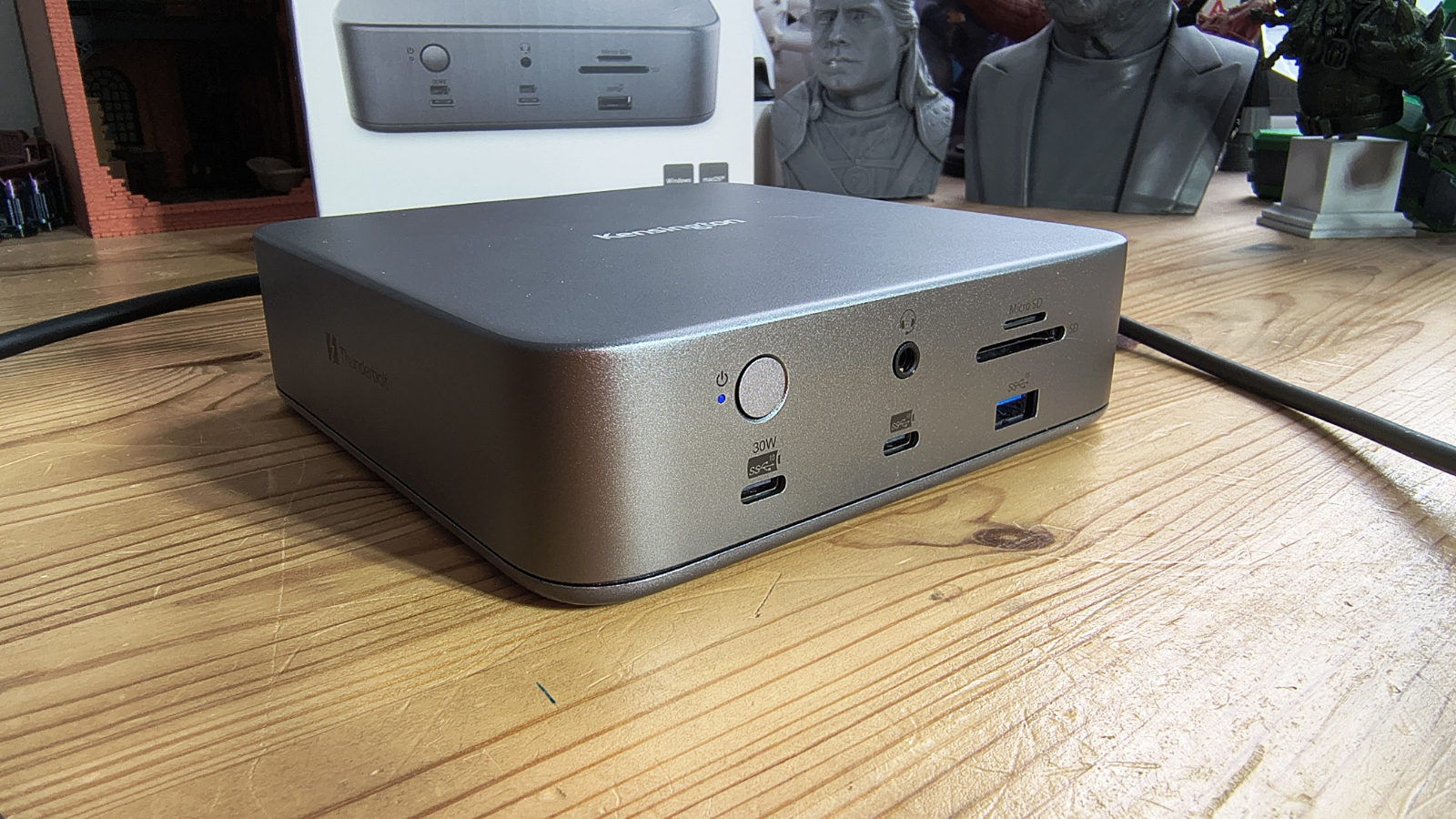
In terms of physical construction, Kensington has delivered an exceptionally solid, industrial-grade brick. The shell is sculpted from 100% post-consumer recycled (PCR) aluminium, featuring a striking milled exterior with structural ridging across its top surface that serves dual purposes: heat dissipation and minimalist styling.
Capped with sleek black impact-resistant composite faces on the front and rear, this unit sits anchored heavily on the desktop. It is a substantial, reassuringly weighted device designed to remain planted even when thick, stiff high-bandwidth cables are plugged into its rear ports.
While this is a guess on my part, I think the target audience here was undoubtedly Apple Mac Mini owners. The size is about 13mm larger, front and side, than the current Mac Mini, and therefore it would easily fit on top of the SD5010T5. I could test that assertion if I owned one, but I never have.
On this dock, the Port layout follows a logical workflow separation, though they show distinct philosophy differences from lower-tier hubs. The front face hosts immediate-access operational IO: an informative status LED, one high-speed 10Gbps USB-A port providing 7.5W of charging, a 3.5mm audio combo jack, and twin high-performance SD and MicroSD 4.0 card readers.
Wisely, the primary high-power upstream Thunderbolt 5 connection is routed safely away to the rear panel alongside the downstream expansion tree.
This layout successfully pushes trailing host cables out of sight, maximising usable desk space. The rear array includes two native HDMI 2.1 ports, a 2.5GbE LAN interface, two standard legacy USB-A ports, and two Thunderbolt 5 receptacles, one each for uplink and downlink.

Unlike competing consumer-grade products, the dock includes integrated dual security-lock slots for Kensington cables, along with an optional zero-footprint vertical-mounting bracket array tailored specifically for dense corporate desks.
The issue the port selection immediately raises is how committed is this dock to TB5. Since you can only connect a single downstream device, that doesn’t naturally translate into more direct ways to exploit its maximum performance potential.
Unsurprisingly, the Kensington Security Slot is present, as it is across the EQ range. A zero-footprint mounting bracket is also available as an optional accessory (K34050WW), allowing the dock to be hidden beneath a desk. That is a thoughtful addition for hot-desking environments where visibility and access are priorities.
Build quality across the Kensington EQ family has been consistently praised. The three-year limited warranty reflects confidence in that construction.
The core proposition of the SD5010T5 EQ centres entirely on the transformative potential of Intel’s Thunderbolt 5 standard. By doubling the bi-directional throughput of Thunderbolt 4 to a baseline of 80Gbps, it eliminates the strict interface constraints of yesteryear. Or, that’s the theory.
For complex multi-monitor tasks, its asymmetric Bandwidth Boost mechanism dynamically flexes to deliver up to 120Gbps of pure display pipeline throughput. This immense pipeline allows a Windows 11 host to comfortably drive a spectacular three 4K monitors at 144Hz or dual 8K displays at 60Hz simultaneously over native HDMI and downstream ports without sub-sampling artefacts or compression stutter.
For macOS workflows, the docking station provides comprehensive native support, although it is constrained by Apple’s architectural variations across its silicon tiers. Base M4/M5 MacBooks can confidently extend to dual 4K monitors at 60Hz via the direct dual HDMI outputs, while advanced configurations equipped with M5 Pro or M5 Max silicon can completely maximise productivity by driving a full triple-display array.
That said, for numerous reasons, I suspect that Apple fans are more likely to gravitate toward a dock with TB5 daisy-chaining as a priority than toward this layout, which has only one downlink port.

Beyond data and video, power delivery is a standout highlight. Operating under the advanced USB-C Power Delivery 3.1 architecture, the dock outputs a massive 140W over its single upstream link. That’s plenty of power to rapidly fast-charge a high-end 16-inch workstation laptop under maximum computational loads, assuming nothing else is sucking power from the dock.
I’ll talk more about this later, but a 140W output uses most of the PSU’s capacity, leading to potential deficits elsewhere.
Kensington has integrated its clever KonstantCharge engineering, which guarantees that downstream accessories and smartphones connected to the designated charging ports continue to receive stable power even when the host laptop is entirely uncoupled from the desk. Which is useful.
Power management on this dock is one of its strengths, but conversely, if you do use three monitors, you won’t have any downstream Thunderbolt ports to connect a TB5 external SSD or an adapter to run 10GbE Ethernet.


In synthetic testing and real-world deployment, the SD5010T5 EQ runs at the absolute peak of peripheral capabilities, provided you are feeding it from a native Thunderbolt 5 silicon host. Interfacing with next-generation external storage configurations reveals blistering cross-device speeds, easily saturating high-end NVMe drive enclosures well beyond old Thunderbolt 4 thresholds.
The built-in SD and MicroSD 4.0 readers operate natively on the UHS-II bus, consistently sustaining benchmarked file transfer rates up to 312MBps. This easily outpaces the built-in card readers integrated into premium notebooks, making it a highly valued asset for digital content creators, photographers, and video editors handling raw 8K video timelines.
Networking performance is similarly robust. Upgrading from standard 1GbE to an integrated 2.5Gbps RJ45 Ethernet port allows the dock to mesh perfectly with modern high-speed corporate network infrastructures, accelerating large local network backups and NAS file transfers.
However, early testing uncovers a clear hardware limitation regarding the dock’s 180W external power supply unit. While 140W is reliably allocated to feed the host laptop over the upstream cable, that leaves a slim 40W headroom to run the internal hub logic, the high-power 2.5GbE controller, and all remaining downstream ports.
When a user populates the 30W fast-charging USB-C port while simultaneously running a 15W downstream Thunderbolt accessory and drawing power from the front legacy USB-A line, the power envelope hits an absolute wall, which might lead to minor wattage throttling on the uplink or brief accessory disconnection cycles under full load.
It’s hard to say how much extra power the PSU needed to negate this possible pitfall, but some smaller docks, like the Ugreen Maxidok 10-in-1, have roughly 60W to work with above the laptop charging requirements. And, I did also notice that the Maxidok 17-to-1 promises 140W laptop charging, but has a 240W PSU.
But conversely, the Plugable TBT-UDT3 has the same 180W PSU and 140W output as the SD5010T5 EQ, but doesn’t include a 30W-enabled USB 3.2 port.
It may be that Kensington thinks that much headroom is unnecessary for the majority of customers, but evidently, other dock makers see things differently.
Overall, the SD5010T5 EQ delivers the sort of experience that encourages those who have the choice of a laptop or Mini PC with TB5 to side with that technology. For those with TB4 or USB4, there is no practical advantage to this over cheaper docks.

There is plenty to like here, if you can ignore Kensington’s temptation to make things more expensive than it can easily justify.
However, if you intend to attach three monitors to a dock, then the ports on this one are well organised, unless you use DisplayPort and not HDMI. That could save you additional expense on adapters that other docks require implicitly.
The flip side of those design choices is that there is only one TB5 downlink, so those who designed this device assumed the buyers wouldn’t have more than one TB5 high-performance peripheral. While that might not seem crazy now, in a few years’ time, TB5 or USB4v2 external SSDs might be the norm, creating a bottleneck with this arrangement
In this respect, the SD5010T5 EQ makes a guess about the future: while Thunderbolt 5 is an excellent technology for connecting a dock, it’s too expensive for external storage that isn’t premium-priced. If you agree with that prediction, the SD5010T5 EQ is likely a good fit for you. If you think differently, that faster external drives are going to dominate in the near future, a dock with more TB5 ports would probably be a better choice.
As a product in the broader Thunderbolt 5 docking market, the SD5010T5 fills a specific gap. Entry-level TB5 docks with built-in video outputs and strong USB-C provision are not yet common. If the pricing were more competitive, this dock would be easy to recommend to the right buyer.
|
Value |
High-quality product but a premium price |
4 / 5 |
|
Design |
Nice engineering and plenty of ports |
4 / 5 |
|
Features |
Works with TB5, TB4 and USB4, and the native HDMI ports avoid the need for adapters. |
4 / 5 |
|
Performance |
Native TB5 video and dual HDMI, but no DisplayLink, The 180W PSU gets stretched thin if every port is used. |
4 / 5 |
|
Overall |
The price and only a single TB5 downlink stop this device from being a go-to choice. |
4 / 5 |


Compilation Matters: Despite the meteoric rise of generative AI services, traditional image editing tools like Photoshop still dominate the creative industry. So much so that Microsoft – now largely focused on cloud services and AI models – is working hard to find new ways to make Windows-based applications run faster.
Thanks to a close collaboration with Adobe, Microsoft engineers have significantly improved performance in certain Photoshop operations. Photoshop is a large, native desktop application written in C++ and compiled with Microsoft’s Visual C++ compiler on Windows, which is why Microsoft focused on MSVC in an effort to extract additional performance from one of the world’s most widely used image editing applications.
Microsoft explained that the collaboration targeted real-world customer scenarios involving CPU-intensive operations. Many complex image processing workloads are now handled – or in some cases “accelerated” – by the GPU. However, some latency-sensitive tasks, such as brush responsiveness, stroke input, and file-opening operations, still depend heavily on a CPU’s raw performance.
The engineers explored new practical ways to improve Photoshop’s performance at compile time. First, they enabled MSVC’s “peak-performance” compilation mode, which is designed to produce highly optimized binaries on Windows.
They then experimented with profile-guided optimization to further optimize the executables. PGO uses data collected from test runs of .exe and .dll binaries to better reflect real-world usage patterns and improve performance. However, the engineers found that PGO was not an ideal fit for Photoshop’s development workflow, as it adds complexity to the build process.

After trying – and failing – with PGO, the engineers turned to Sample-based Profile Guided Optimizations as a potential alternative. Unlike traditional PGO, SPGO replaces data collected from “representative” workloads with hardware performance samples gathered from actual release binaries. SPGO is also more flexible in terms of data collection, enabling analysis across a diverse set of test and production machines, and can deliver typical performance gains of around 5% to 15%.
Microsoft said SPGO proved to be a better fit for the Photoshop collaboration. Instead of relying on manual tuning, engineers could use compiler feedback – collected with negligible runtime overhead – to improve the code generated during MSVC’s final build process.
SPGO also proved to be more compatible with Adobe’s engineering environment. By combining MSVC’s peak-performance mode with SPGO, the teams were able to improve Photoshop performance by 20% on x64 Windows systems and by 13% on Arm.
As noted by Adobe senior software developer John Fitzgerald, the optimized builds delivered better responsiveness in drawing and stroke operations, file-opening times, and filter processing. “These are among the most frequently used and latency-sensitive interactions in a professional creative workflow, where responsiveness directly affects a user’s ability to work fluidly and iteratively,” Fitzgerald said.
Microsoft said the collaboration with Adobe provides a meaningful foundation for improving performance in software designed for Windows. The company is now highlighting MSVC’s capabilities as a way to improve performance and user experience across its broader software ecosystem.

Like other popular services like Netflix and Max, Hulu is a streaming service that has exclusive series, current-season episodes, hit movies, Hulu Originals, kids shows, and more. There’s also a Hulu plan for nearly every kind of watcher, including streaming content with ads for a service on the cheap, or bundles for additional platforms like Disney+ and ESPN+ to get even more content at reduced prices. I have a Hulu plan to watch some of my favorite shows like critically-acclaimed Atlanta or my current fave wholesome comedy, Abbott Elementary. We at WIRED stay glued to our devices and round up the best movies and the best TV shows currently being streamed on Hulu. Right now, we have outlined various ways to save while streaming on Hulu, including the chance to pay just $1.99 per month with the Hulu student discount.
Students can stream a bevy of shows and movies with Hulu for just $2 per month. This deal saves you 80% off the original monthly subscription price, and is valid for new and existing Hulu subscribers enrolled in an accredited college or university who meet verification qualifications. All you need to do to get Hulu for less than two bucks is verify your student status through SheerID to save.
I love my Hulu account, but with half-a-dozen other streaming services, it’s been hard to keep them all, or even know which is worth the money at the end of every month. I’m trying to decide which to keep, and the Hulu TV free trial is an excellent way to test the plan and see if it fits my TV watching needs. There is a free 3-day trial to test it out, and the plan has a $0 Broadcast TV fee, $0 Regional Sports fee, $0 Set-top box or related rental fees, and a $0 administrative fee. The Hulu live TV plan is essentially the best of both worlds—your favorite streaming-only series, along with cable-only content like sports and news programming, including over 95 live TV channels like ABC and ESPN.
One of the things I love most about Hulu is that they are constantly adding both new original shows and old favorites. They truly have something for every type of watcher and mood. As a true crime lover (I know it’s problematic, I’m sorry), I’ve been excited to see the Twisted Tale of Amanda Knox.
Here’s what I’m also excited to watch this season. Classic crime drama The Rookie stars perennial heartthrob Nathan Fillion centers on a small-town man becoming the oldest rookie in the LAPD. I always look forward to the feel-good comedy Abbott Elementary, which focuses on a quirky cast of misfits in the public education system in Philadelphia. In R.J. Decker, the titular character is a conman and disgraced newspaper photographer who begins entering the dark underworld of private investigating in South Florida.
Plus, there’s something for everyone, from trash reality TV like The Bachelorette, to intriguing Paradise, to quirky comedy High Potential, to the classic boy cartoon-comedy Family Guy.


UK businesses find Google’s search ranking ‘neither fair nor transparent’, the CMA said.
The UK’s competition watchdog has ordered Google to tweak its search tool to help businesses better integrate with it and understand its workings. As part of the new “conduct requirements”, Google must rank search results organically and make free-of-charge data portability available to third-party businesses.
The Competition and Markets Authority (CMA) awarded Google’s general search and search advertising services with the ‘strategic market status’ (SMS) designation last year. The label is applied to businesses that hold substantial market power and significance in a digital activity, and enables the watchdog to take targeted action to improve competition.
Google has also been given the SMS designation in relation to its mobile platform, alongside Apple, while the CMA is considering its position on Microsoft.
UK businesses find Google’s search ranking “neither fair nor transparent”, the CMA said in its statement yesterday (17 June). Businesses told the watchdog that changes to Google’s search practices are made without sufficient notice, and pointed to a lack of effective ways to raise concerns with the company.
The competition watchdog is attempting to remedy the issue by having Google rank organic search results using “objective and non-discriminatory criteria”. This is to include AI Overviews, but not sponsored results.
Google has also been asked to provide greater transparency to businesses about how search rankings work, give advance notice of any significant changes and introduce clear procedures to raise concerns.
The CMA also intends to address businesses’ data portability concerns with Google. As part of the requirement, Google must provide third-party businesses with the tools to move specified types of user data free of charge.
“Third-party firms are keen to offer people new products and services based on their Google search data but need to be able to access it with confidence,” the CMA said. “Using this data would allow third parties to offer people more personalised features”.
The company has six months to comply with the fair ranking requirement and three months for the data portability requirement.
Yesterday’s orders follow just weeks after the CMA told Google to let publishers opt out of having their content used to power AI features in its search offerings. Google said it would begin testing a new toggle in its Search Console, which would allow website owners to decide whether their content appears in AI Overviews, AI Mode and related features.
“Step by step, we’re ensuring that Google’s search services work better for businesses and consumers across the UK,” said Will Hayter, the executive director for digital markets at the CMA.
“Search is a vital gateway for businesses in the UK to reach customers, and clearer, predictable and more transparent ranking systems could give them greater scope to expand and invest.
“These new measures will ensure search results are ranked fairly and objectively, with clearer information about changes and effective routes to raise concerns.
“At the same time, innovative businesses will have the confidence that they can access search data in practice, unlocking investment and innovation in new products and services for users.”
Don’t miss out on the knowledge you need to succeed. Sign up for the Daily Brief, Silicon Republic’s digest of need-to-know sci-tech news.

I can’t say I know for sure that Stephen Colbert is a Techdirt reader, but I very much believe he is. His interests align somewhat with ours, he often comments on some of the same topics we do, and, it turns out, he decided to troll his previous employer during his last show in a very Techdirt-ian manner.
After CBS decided to sacrifice Colbert at the altar of American fascism, the wind down of The Late Show culminated in a final broadcast weeks ago. During that broadcast, Colbert was covering a story about Lee Mendelson Film Productions, which owns the music catalogue for the Charlie Brown franchise, suing several targets for use of its copyrighted music. As he did so, the show band began playing the Charlie Brown theme song. Colbert mused afterwards sarcastically that he hoped that wouldn’t cost CBS any money.
Well played, if only to highlight the absurdity that such a short performance of an iconic song like that could actually result in threats, lawsuits, or demands for payment. But many speculated that the show had already gotten the rights to play the music before it aired, or that Lee Mendelson Film Productions wouldn’t actually do anything about it all to avoid inserting itself into the public spat between Colbert, CBS, and our current government.
Wrong. The company did apparently reach out to CBS, which eventually had to enter into a licensing agreement to avoid any legal issues.
The agreement will see CBS take a license for “Linus and Lucy,” the unofficial Peanuts theme that Colbert’s band played on the air during the show. The proceeds from the deal will be donated to the charity World Central Kitchen, run by Chef José Andrés.
“LMFP found the music’s use on The Late Show funny and entertaining, and is proud to support World Central Kitchen’s mission,” the group’s chairman Jason Mendelson said. A spokeswoman for CBS confirmed the agreement but declined to comment.
On the one hand, I guess it’s nice to see some of CBS’ money go to a good organization like World Central Kitchen. But I do indeed wonder if similar arrangements were struck with the other four entities against which LMFP filed lawsuits. I somehow doubt it. I would guess instead that such treatment was reserved for CBS, in order to make this story more lighthearted and warming.
It’s not, this is stupid, and none of this is as it should be. Colbert shouldn’t have been forced out of his job by a combination of a thin-skinned gibbon and a compliant CBS. It’s insanity that copyright law is in a place where such a diminutive use of a famous song could result in the requirement of a licensing arrangement, never mind actual potential lawsuits. And if it’s so necessary to protect copyright in this instance that lawsuits need to be filed against multiple parties, it should be important enough that any licensing fees and/or damages obtained shouldn’t just be given away to charities.
But as a final poke in CBS’ eye, this was a good one.
Filed Under: charlie brown, copyright, licensing, stephen colbert
Companies: cbs, lmfp, paramount, world central kitchen

In context: Unpatchable, hardware-level vulnerabilities caused a stir some years ago when they repeatedly turned up in AMD and Intel processors, but they’ve been far rarer on Apple chips. This latest discovery only affects older iPhone processors, but it still shows that even relatively recent SecureROM implementations aren’t foolproof.
Security researchers at Paradigm Shift have published the first iPhone bootROM exploit in years. The process, called usbliter8, targets a hardware-level flaw, which means upgrading to newer hardware is the only real fix.
The exploit affects the iPhone XS’s A12 chip, the Apple Watch Series 4’s S4 chip, and the iPhone 11’s A13 SoC. The S5, found in the Apple Watch Series 5, first-generation SE, and HomePod mini, is vulnerable too. Pulling it off requires physical access and a Raspberry Pi, since the flaw sits in a part of the USB controller that standard Mac and PC USB stacks can’t reach.

A12 and A13 are exposed because of how their USB controllers mishandle data packets, leaving SRAM data insecure. Earlier SoCs avoid the issue because they reset the DMA address after each packet comes through the USB controller, and A14 and newer are also safe, having corrected the underlying configuration.
Using the exploit to jailbreak devices is fairly simple on A12, S4, and S5 chips. A13 is trickier, since SecureROM’s PAC protections add extra steps, but it’s ultimately just as vulnerable as its predecessor. The flaw can’t be patched via software, and altered firmware survives reboots.
While most devices built on these chips have been considered obsolete for years, the iPhone 11 which still runs on the A13 chip happens to be the oldest iPhone that supports iOS 26. Apple isn’t dropping it for iOS 27 this fall, either, so it’s guaranteed at least another year of software updates.

The last unpatchable iPhone jailbreak, checkm8, surfaced in 2019 and covered the A5 (iPhone 4S) through A11 (iPhone X). It later resurfaced as a way to bypass the security chips on some Macs. Together, the two exploits leave every iPhone from the 4S through the 11 open to an unpatchable jailbreak.
A fundamentally similar bootROM exploit recently surfaced for Microsoft’s Xbox One, a console long considered unhackable. But getting it to work proved far harder than on iPhones, requiring a voltage-based hijack to pull off.

Google’s next-generation smart speaker is finally available to pre-order. The new Google Home Speaker launches with Gemini built in, costs $99.99/£99.99, and comes with a six-month subscription to Google Home Premium for a limited time.
The speaker was first teased last year, with Google recently hinting that more details were just around the corner. Now, pre-orders are officially live ahead of general availability from June 25.
Gemini is the headline feature here, bringing Google’s AI assistant directly to the speaker. Buyers will also get six months of Google Home Premium, which unlocks additional features including access to Gemini Live.
Google is promising a noticeable audio upgrade over the Nest Mini. The Home Speaker features a centrally positioned 58mm driver. It claims to deliver 2.5 times stronger bass than its smaller smart speaker. While it lacks the dedicated tweeter found in the larger Nest Audio, Google is clearly positioning it as a more capable option for music playback. It is more capable than the Nest Mini.
One feature that could help it stand out is its integration with the Google TV Streamer. Unlike Google’s existing smart speakers, which rely on standard Bluetooth connections, the Home Speaker can pair directly with the streaming device. As a result, it allows it to output TV audio more seamlessly.
The speaker will be available in four colours and is priced at $99.99/£99.99. Customers who place an order before the end of September will receive six months of Google Home Premium at no extra cost.
Pre-orders are now open on the Google Store, while general availability begins on June 25 through Google and other retailers.
After months of teasers, Google’s Gemini-powered smart speaker is finally ready to land. Given its focus on Gemini and the broader role it will play within Google’s smart home ecosystem, the speaker is arguably the company’s biggest smart home launch since the Nest Audio.

Long before we had Amazon or Facebook marketplace, or thousands of other online retailers, we had eBay. And now, we have an eBay coupon to help you save on basics like vacuums and phones, to even your most niche need—because eBay has everything from haunted objects to ironic landline phones to retro gaming consoles. One of the first and most enduring online shopping platforms, eBay has stood the test of time, providing us with the old-school feel of estate sales, complete with bidding wars and gently used items of quite literally every type.
eBay has rotating deals, like 20% off up-and-coming brands, so be sure to check their page often to know which deals are next. They have huge savings on essentials, like Dyson vacuums—an enduring titan in the home cleaning realm. There’s also discounts on like-new refurbished Apple MacBooks and iPads so you can work or study for so much less. It’s not only office tech they have deals on, but even kitchen essentials, like the forever-popular KitchenAid Stand Mixer. eBay has deals on everything from clothing and jewelry to power tools, so check eBay’s deals page often.
Once you’ve perused the nearly endless options of items on eBay, here’s how you can redeem the eBay discount code or offer at checkout: first, make sure your code isn’t expired (I know it sounds like a no-brainer, but you don’t want to be disappointed when that dreaded ‘invalid’ pop-up comes on the screen). Enter the code in the ‘Add coupons’ section, or check the box if the coupon is displayed. When you select ‘apply,’ you should see the discounted total, and then you’ll be prompted to pay.
Once you find the special item of your dreams, go to the “shipping and pickup” search filter and check the “free shipping” box to get free shipping. Make sure you choose eBay free shipping on a multitude of items like motor parts, books, golf clubs, Pokemon cards, haunted objects, tech, and virtually anything else you can imagine.
eBay has rotating deals, like 20% off up-and-coming brands, so be sure to check their page often to know which deals are next. They also have spotlighted, trending, and featured deals for huge savings on a myriad of products like auto parts, golf clubs, shoes, and more. eBay has a money-back guarantee to ensure you get the item you ordered or you get your money back.
Have you heard of an eBay Mastercard? I hadn’t either, but if you’re a collector or frequent eBay shopper, an eBay Mastercard is a smart way to save on purchases you were already planning to make. You’ll earn five times the amount of points for the rest of the year after you spend $1,000 on eBay in a calendar year. Until then, you’ll earn three times the points per $1 spent, up to $1,000, on eBay in a calendar year. You can also earn twice as many points per $1 spent on gas, restaurant, and groceries, and 1 times as many points per $1 spent on all other Mastercard purchases.
If you’re someone who shops or sells on eBay often, I’d suggest downloading the eBay app for even more perks. The eBay mobile app makes it easy to find the best rotating deals on various items and access to the hottest deals and discounts of the day before they leave. Through the app, you can browse everything from trendy items, to power tools, to tech gadgets, and then choose whatever price looks best. There’s also app-only discounts and special offers exclusively for eBay app users. Plus, eBay will help you figure out when’s the best time to buy, with price notifications to let you know when the price has dropped.
If you don’t know what to get the quirky fashionista or vintage collector in your life? Rather than a run-of-the-mill present, get them an eBay gift card so that they can use it to expand their rare baseball collection or get a discounted Nintendo Switch. eBay gift cards can be used to pay for almost any item online. You can get a digital gift card on eBay, or you can buy a physical eBay gift card at CVS, Walgreens, and other retailers.
eBay has expanded considerably, but it first gained popularity by being the first online auctioneer, expanding the world of trading and rarities globally. Today, it’s even more streamlined, with the eBay auction hub, where folks can catch the rarest weekly collectible drops from top vendors. Some of the most popular auction items include Pokemon, baseball cards, basketball, and football cards. If you’re looking to upgrade your collectibles collection, this is where you want to start.
You probably don’t think of eBay when you think of car parts and accessories, but eBay has a wide range of everything you need for car additions and maintenance for way less than if you bought new at a chain retailer. On eBay, you can shop by popular car and truck parts categories, like racks, cargo carriers, towing parts, exhaust and emission systems, brakes, starters, alternators, and more.
Summer is the time to get out in the wide open and get exploring while the sun is out later and temperatures rise. eBay is a great place to shop for powersport parts like wheels and tires for ATVs, UTVs, and motorcycles. And right now, you can get 10% off powersport parts with eBay coupon code Adventure10 (until June 30). There’s no minimum on this eBay coupon code, and the discount applies to the purchase price and excludes shipping, handling, and taxes.

UPS detailed AI plans including a digital twin of its full network, agentic control towers, RFID tracking, and AI customs clearance hitting 97% first-day rates.
UPS detailed a slate of AI-powered logistics initiatives on Wednesday, including a real-time digital twin of its entire global network that updates every 10 minutes. The system creates a digital replica of facilities, air and ground networks, and end-to-end package flows. It continuously tracks performance so the network can adjust and, in UPS’s words, “self-heal in real time.”
The company says its AI-driven network planning tools now complete analyses in one afternoon that previously took engineering teams several months. Forecast accuracy has improved by up to 40%, according to Supply Chain Dive, shrinking costly buffer capacity and enabling a 9.9% reduction in US labour hours during recent volume declines.
“After 118 years of reinventing logistics, we have entered a defining moment, using AI to simplify how we work across the enterprise,” said Carol B. Tomé, UPS chief executive officer. “We are pairing the deep expertise of our people with the power of AI to drive faster decisions and a better experience for our customers around the globe.”

The 💜 of EU tech
The latest rumblings from the EU tech scene, a story from our wise ol’ founder Boris, and some questionable AI art. It’s free, every week, in your inbox. Sign up now!
UPS is also deploying what it calls agentic “control tower” capabilities on-site with customers. These combine data, predictive models, and connected services to go beyond shipment tracking. They flag, prioritise, and help resolve disruptions across complex, multi-carrier networks. Agentic AI is increasingly moving from theory to production across enterprises, and UPS’s deployment is one of the largest logistics implementations announced so far.
On the tracking side, UPS has embedded RFID sensors in all US package delivery vehicles, in delivery facilities across the country, and on every package shipped through over 5,500 The UPS Store locations. The company says misloads have dropped by nearly 70% since the rollout began three years ago. Combined with AI, the RFID data delivers near real-time, package-level visibility.
UPS’s AI customs brokerage is clearing 97% of shipments on the first day of entry, according to the company. The system uses AI and cross-border data to interpret customs requirements worldwide, and the company says it is outpacing competitors on clearance speed. A separate product, UPS Export Assure, uses AI for more accurate product classifications, reducing errors and accelerating processing.
Happy Returns, the reverse logistics company UPS acquired, is using AI to combat returns fraud. The system photographs return contents and compares them against expected product images using its “Return Vision” AI tool. Happy Returns piloted the system with Everlane, Revolve, and Under Armour. Returns fraud is a $76.5 billion problem for US retailers, according to the company.
UPS reported $88.7 billion in revenue for 2025 and has approximately 460,000 employees globally. The company’s “Network of the Future” initiative is backed by a planned $9 billion investment over five years, expected to generate $3 billion in recurring annual savings. Digital twins and AI-driven operational planning are spreading across industries from motorsport to shipping, but UPS’s implementation, covering every mode of transport across more than 200 countries, is among the most ambitious in scale.

Interscope Capitol Records’ Definitive Sound Series is adding one of Marvin Gaye’s most beloved albums to its growing audiophile vinyl catalog. Let’s Get It On is the next DSS release, arriving July 17 as a limited-edition AAA 180g high-definition vinyl One Step pressing.
The release is available now for pre-order and is limited to 3,000 individually numbered copies. It is priced at $110, which puts it right in line with the rest of the DSS series and squarely in premium audiophile vinyl territory. Nobody is confusing this with a casual $29.99 reissue you grab while pretending you only came into the record store for sleeves, or that ninth copy of Disintegration you hid in the classical bins between well-worn copies of Khachaturian’s Symphony No. 3 that nobody has touched since the Carter administration.
Related Reviews:
The Definitive Sound Series edition of Let’s Get It On has been mastered by Chris Bellman at Bernie Grundman Mastering from the original analog master tapes. The record is pressed on Neotech VR900-D2 180g high-definition vinyl at Record Technology, Inc., with the One Step process handled by Dorin Sauerbier.
That AAA chain matters. In an era when “audiophile” can mean everything, nothing, or merely thicker cardboard, this release is being positioned around source, mastering, plating, pressing, and packaging. The One Step process eliminates multiple plating stages used in conventional vinyl manufacturing, with the goal of preserving more detail, depth, and immediacy from the lacquer to the finished record.
The package includes a heavyweight tip-on gatefold jacket, a custom-designed slipcase using the original album artwork, and a certificate of authenticity detailing the mastering, plating, and pressing chain.
At $110, Let’s Get It On lands in the same range as other Definitive Sound Series titles, which generally sell between $100 and $125 per copy. Existing DSS releases have included The Beach Boys’ Pet Sounds, Beck’s Morning Phase, Lionel Richie’s Can’t Slow Down, Nat King Cole’s The Christmas Song, blink-182’s Enema of the State, Dr. Dre’s The Chronic, and A Perfect Circle’s Mer de Noms.
That pricing is not inexpensive, but it is also not unusual for the current premium One Step market. Mobile Fidelity’s UltraDisc One-Step releases, which helped define this category for many collectors, commonly sell for around $100 to $125 depending on the title and format. The comparison is useful because both approaches are aimed at listeners who care about mastering chain, pressing quality, packaging, and limited availability as much as the album itself.
In other words, this is not a reissue for everyone. It is for Marvin Gaye collectors, serious soul and R&B listeners, and vinyl buyers who want a premium pressing of a foundational album and are willing to pay for it.
Originally released in August 1973 on Motown’s Tamla label, Let’s Get It On marked a major shift in Marvin Gaye’s career. Coming after What’s Going On and Trouble Man, the album moved away from overt social commentary and into something more intimate, sensual, spiritual, and emotionally exposed.
The title track became one of Gaye’s defining recordings, reaching No. 1 on the Billboard Hot 100. The album climbed to No. 2 on the Billboard 200 and became the best-selling soul album of 1973. Alongside the title track, the album includes “Please Don’t Stay (Once You Go Away),” “If I Should Die Tonight,” “Come Get to This,” “Distant Lover,” “You Sure Love to Ball,” and “Just to Keep You Satisfied.”
The estate of Marvin Gaye framed the release around that same idea, noting that Gaye “created music that was deeply personal, yet universally understood,” and that Let’s Get It On remains one of his most celebrated works.
Marvin Gaye’s Let’s Get It On is exactly the kind of title that makes sense for the Definitive Sound Series: culturally important, vocally rich, beautifully arranged, and capable of rewarding a better mastering and pressing chain.
At $110, this DSS One Step edition is not an impulse buy. But compared with MoFi’s UltraDisc One-Step releases and other premium audiophile vinyl offerings, the price sits where the market already lives. The real question is whether the mastering, pressing quality, and all analog chain deliver enough to justify the premium.
For collectors who love Marvin Gaye, classic Motown, and properly executed AAA vinyl, this one is going to be hard to ignore.
Where to pre-order: $110 at Motown Records (ships July 24, 2026)





No Jackpot Winner as $257 Million Prize Rolls Over to $269 Million Monday Draw


Weekend Open Thread: Tuckernuck – Corporette.com

Zimbabwe Requires Crypto Businesses to Register Annually Under New FIU Regulations


Bitget enters Argentina’s regulated crypto market through PSAV registration


NanoClaw integrates JFrog registries to secure AI agent downloads


This Week In Security: Microsoft On Microsoft, Register Your Domains, Linux On ARM, And FreeBSD Joins The File Cache Club


FBI searches office of Ohio voter registration group

Matt Damon’s Viral Sci-Fi Thriller Has Taken Over HBO Max


Anthropic staff to meet White House officials next week, Axios reports


As AI companies race to go public, who else is along for the ride?

Bitcoin could crash to $48,000, if this historical pattern is triggered


“Israel’s” ban on ICRC visits ruled illegal, but Knesset moves to stop them permanently

Warning of disruption as Cardiff Crossrail works to start


Financial Accounting | Last Day Revision Strategy and Booster | CMA Inter – June 2026

Tributes to former deputy head teacher at Cambridge school among death and funeral notices

Market Preview: SpaceX (SPCX) IPO Record, Federal Reserve Meeting, and Iran Nuclear Agreement

what doctors are seeing in ebike crashes


Deion Sanders Shares Powerful Post After Viral Advice To Deiondra

Kate Middleton Glare Goes Viral After Kids Booed At Royal Event


Invesco Quality Income Fund Q1 2026 Commentary



You must be logged in to post a comment Login