The terminal-based coding tool is powered by a new AI model, Muse Spark 1.2.
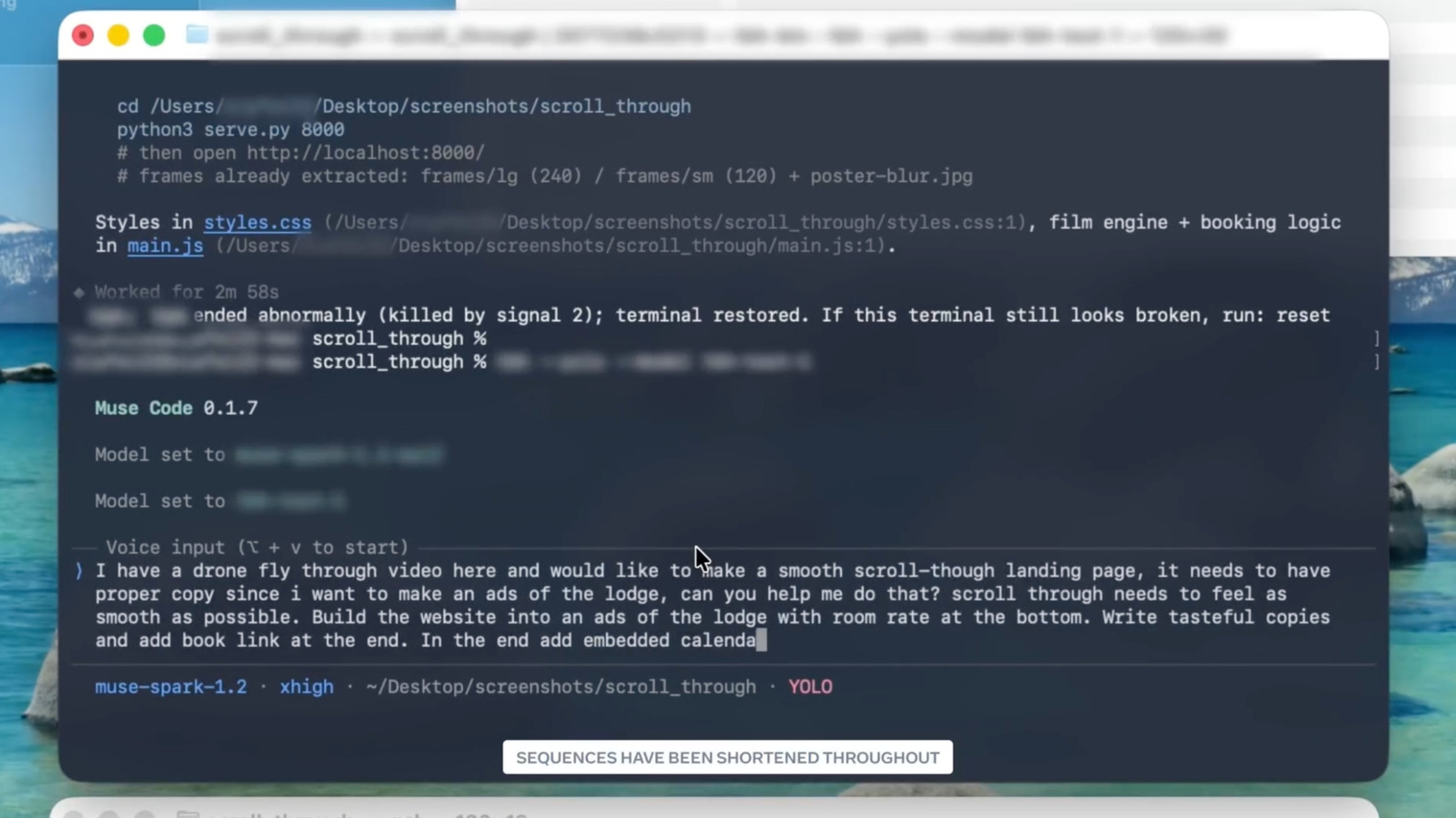
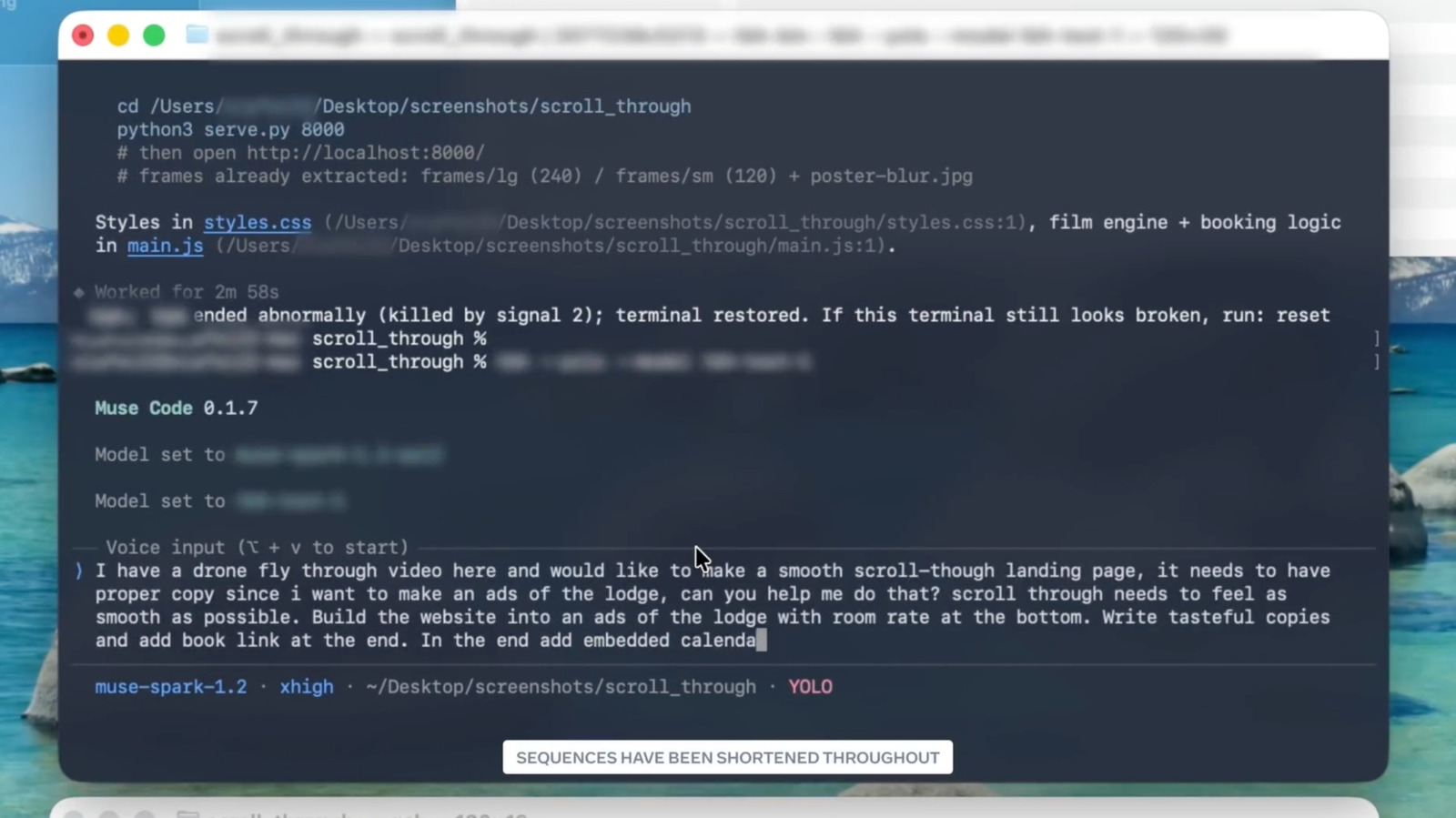
Meta has announced an early beta of Muse Code, a new coding agent meant to compete with Anthropic’s Claude Code and OpenAI’s Codex. The new terminal-based coding tool is powered by Muse Spark 1.2, a new version of Meta’s AI model which offers “improvements in code generation, complex debugging, codebase understanding, and end-to-end developer workflows.”
Like its competition, Muse Code can handle software engineering tasks like writing code, planning changes and validating results, making it possible to build working software with text prompts. It can also manage multiple sub-agents and delegate tasks to complete work more efficiently. Meta’s announcement includes sample projects like an interactive model of a photon sphere and a Plants vs. Zombies knockoff, and a demo video of the tool building a webpage based on an MP4 file.
Advertisement
Affordability is a key way Meta appears to want to differentiate Muse Code from its competitors. The company says the tool uses the same pay-as-you-go pricing as Muse Spark by default — $1.25 per million input tokens and $4.25 per million output tokens — and in an interview with CNBC, Alexander Wang, Meta’s Chief AI Officer, said the company would also offer “a contributor tier that gets you in at a significantly lower cost.” That tier would require users to agree to provide feedback to improve the coding agent, according to The Wall StreetJournal, and cost $0.10 per million input tokens and $0.20 per million output tokens.
Those prices are cheaper than Anthropic’s Sonnet 5 model, which typically costs $3 per million input tokens and $15 per million output tokens. Provided Muse Code works well, the difference could lead companies to choose Meta over its competitors. The same logic has already proven effective for Chinese AI companies: multiple companies switched to Chinese models like DeepSeek to avoid the growing cost of using US AI tools.
Built decades ago for a more predictable world in which power came mostly from centralized coal or gas plants and electricity use grew at a steady pace, the grid faces unanticipated strain due in part to growing demand from data centers. The jobs of professionals managing the infrastructure have evolved from traditional engineering tasks to complex, fast-moving challenges.
Industry reports show that millions of modern digital sensors, smart meters, and grid monitors are generating nonstop waves of information. The sheer volume of data requires instant, automated computer analysis because human operators cannot process it fast enough.
Pressure on utilities stems from two sources: a spike in electricity demand and a shift in how power is generated.
Alongside the rise in regional demand, global energy networks are absorbing an unpredictable variety of weather-dependent renewable energy such as wind and solar. The switch creates a volatile operating environment wherein supply and demand are balanced, second by second, to prevent blackouts.
The challenges are compounded by the vulnerability of the grid’s physical and digital framework.
More-frequent severe weather events cause costly disruptions, such as the devastating winter freeze that crippled the Texas grid and record-breaking heat waves that have overloaded transformers.
Advertisement
Simultaneously, the energy networks’ digital architecture faces threats. As utilities replace outdated analog equipment with smart meters and control systems, they are increasingly vulnerable to cyberattacks.
To overcome physical and digital vulnerabilities, grid reliability organizations, such as those conducting North American security simulations like GridEx, emphasize that the grid must become smarter, more agile, and completely automated. Energy researchers are noting that the key to this change lies in integrating AI across every layer of utilities’ operations.
The AI imperative
According to energy industry experts, using AI to manage power systems is no longer a futuristic research project; it has become a baseline operational necessity. Grid analysts emphasize that traditional grid-planning methods are too slow to handle rapid energy dynamics or to balance volatile renewable energy in real time within decentralized power systems such as microgrids.
AI can fill the gap by processing vast amounts of data instantly. Machine learningalgorithms can quickly analyze information from thousands of sensors, historical usage patterns, and weather forecasts to predict issues before they happen.
Advertisement
An industrial digitization study conducted by McKinsey & Co. indicated that integrating advanced data and automation across infrastructure networks could reduce system design errors, decrease equipment downtime by up to 50 percent through predictive maintenance, and extend the lifespan of power machinery by up to 40 percent.
From forecasting energy spikes to automatically fixing localized voltage drops, AI acts as the digital backbone of a self-healing grid, experts say. Deploying the complex systems requires a new workforce: power engineers who understand data science, as well as data scientists who understand electricity.
The program explores core challenges threatening modern utilities. Rather than treating AI as an unverified black box that operates without human supervision, the curriculum focuses on safety, asset preservation, and strict reliability standards.
The program breaks down the technical transition into five modules that bridge high-level theory with real-world solutions:
AI fundamentals.This module teaches engineers how basic machine learning models apply to power grids. It discusses how specialized neural networks solve complex power-flow calculations and how AI models can safely transition from computer simulations to physical, high-voltage equipment.
Physics-informed and safe AI.To address trust—a barrier to utility AI adoption—this course covers AI models hard-coded to obey the laws of physics. The approach is designed to ensure that automated algorithms never make erratic choices that damage grid equipment.
For years, as a library media specialist, I took great pride in my role as guardian of the 20,000 books in our library, meticulously cataloging and protecting our collection. But after dedicating nearly two decades to education, I came to a vital realization: The most important chapters in our school’s history weren’t on our bookshelves; they were waiting to be written by the students themselves.
I’ve seen firsthand how easily innovation can get reduced to a one-time event: a quick photo-op, a splashy press release, or the arrival of a new shipment of shiny devices. It’s frustrating because that approach never lasts; it’s a temporary buzz that leaves the core of our instructional ecosystem fundamentally unchanged. The real problem is that our students deserve more than a “device drop.” They need and deserve a long-term commitment that actually reshapes how they learn.
That shift in perspective is what drives my work today. I’ve moved from being a gatekeeper of static resources to someone who actively creates a dynamic, student-centered environment. It is no longer just about having resources; it’s about ensuring they become the backbone of a sustainable, future-ready classroom experience.
The Quiet Before the Storm
For the first 10 years of my career, my roles ranged from teaching third and fifth graders to serving as a school technology teacher and a sixth-grade pre-AP reading and math instructor. Following 10 years across multiple grade levels and content areas, I transitioned into the role of a library media specialist, which soon became my entire world. My days were defined by the ebb and flow of students coming in to check out books and learn the literacy skills necessary to develop knowledge.
Advertisement
Parents, community members, and even fellow educators often referred to me as “just a librarian,” and while I wore that title with pride, I was acutely aware of the silent burden we carried. The library was viewed as a traditional hub for books and nothing else, leaving our students tethered to the past while the world raced forward in technology and innovation. Our students possessed inherent brilliance, yet they were consistently overlooked by a STEM narrative that rarely considered our zip code.
Society often operates on an unspoken assumption that technological breakthroughs belong exclusively to affluent districts or established tech hubs. Because our community didn’t fit that traditional mold, the narrative bypassed us, systematically starving our students of the advanced tools and platforms required to translate their raw potential into tangible innovation.
Everything changed for us when I had a conversation with Beth Sanders, then vice president of Ed Farm. The nonprofit organization, headquartered right here in Birmingham, launched a strategic partnership with Birmingham City Schools (BCS). Their goal was clear: to boost educational equity by closing digital skills gaps across our district and region. While the strategic partnership between Ed Farm and BCS had already been established since 2020, I learned that my space, the South Hampton K-8 library, had recently been chosen for a complete renovation.
Beth Sanders approached me with this incredible opportunity, knowing that this project would be the first of its kind in the state of Alabama. Our discussion became the catalyst for completely reimagining the space. In addition to the physical Ed Farm spaces, educators and students benefited from specialized fellowships. Together, these initiatives pushed us beyond the status quo, ensuring we prioritized sustainable, future-ready learning over superficial technology adoption.
Advertisement
Students were also invited into the design process, and for the most part, they led the way. I sat back and watched as they traded ideas about robotics, green screens, and iPads. Witnessing them design their own future before a single wire was plugged in proved we were creating something much bigger than a state-of-the-art library — we were creating the library of innovation.
Becoming an Architect of Possibility
In 2022, we finally cut the ribbon on the first official Ed Farm space at South Hampton K-8 School, “The Library of Innovation.” Balloons were tethered to the doorways, camera crews maneuvered for the perfect angle, and city officials were buzzing with the promise of a new era. It was one of those “pinch-me” moments, seeing the last couple of years of dreaming and planning finally take physical shape for our kids. But when the local city council members, edtech partners, and school board officials headed home, the real, gritty, unglamorous labor of building capacity began. My mission shifted from being a keeper of books to an architect of possibility.
By moving past traditional keyboarding to teach coding, website architecture, and engineering principles, I equipped students to interrogate their environment and engineer solutions to the challenges they encounter in their own neighborhoods. Instead of just learning how to use software, they began leveraging creative programming workflows to design AI and Internet of Things-driven systems, such as functional tornado warning models, to address severe weather threats right here at home. Seeing them build these concepts proved that this space was doing exactly what it was meant to do: transforming students from passive digital consumers into true architects of possibility.
Over the course of the next year, the library had transformed into a dynamic laboratory. The hum of 3D printers bringing custom keychains and game remote holders to life became our soundtrack. The sharp whir of drone propellers slicing through the air replaced the static silence of the past. The intense, focused chatter of a student-led podcast recording of “Bulldog Talk on the Edge” became the new student voice. We purposefully curated this environment to break the traditional mold, challenging the students to completely redefine their expectations of the space and of themselves.
Advertisement
Defying the Narrative: From Participation to Mastery
In an urban environment, the STEM narrative is often restricted and expectations are frequently capped. This cap does not exist because of a lack of student capability but rather because of a systemic failure in how society views innovation. The narrative feels capped because the broader educational system frequently assumes urban students only need to learn how to participate in the digital world as consumers, rather than being equipped with the sophisticated coding environments and engineering principles required to master it as creators.
From the first day the library reopened, I watched the confidence of our students bloom. As they mastered the new tools, this newfound confidence translated into tangible success, resulting in a series of competition wins and vital funding for our school. They took that confidence and applied it to real-world problems.
Photo Credit: Birmingham City Schools
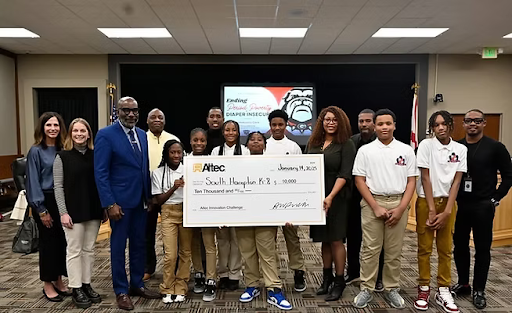
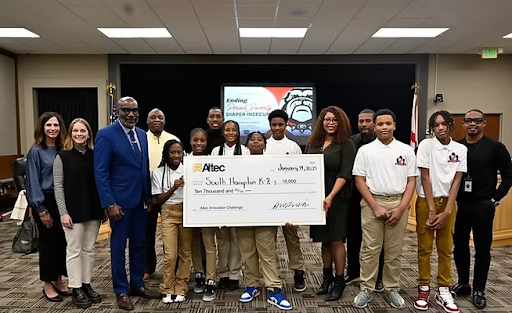
During the 2024-2025 school year, they won the ALTEC Challenge for the “Hygiene Hub,” a vending machine solution for personal care products paired with a custom community app they coded.
Next, we won $12,000 in Samsung technology representing the state of Alabama in the Samsung Solve for Tomorrow competition with an upcycling machine designed to turn old clothes into hygiene products.
Advertisement
The momentum continued when three of our seventh-grade students won the Alabama state title in the eCYBERMISSION competition, earning $500 in savings bonds each for their innovation. This all happened in the span of one school year, cementing the fact that our students weren’t just playing with STEM. They had become experts in their domain.
However, the ultimate validation of our shift came this past school year. In April, our students rose to become national finalists in Samsung Solve for Tomorrow, standing out as one of only 10 schools in the entire nation. They secured $50,000 in Samsung technology. The experience offered so much more: My students flew to Washington, D.C., and stayed on Capitol Hill to pitch an early-warning system for tornadoes they created for The Washington Post. Their presence on that stage, pitching for the $100,000 grand prize, was proof that their innovation belonged in the highest arenas of influence.
Redefining Excellence
How does a library, once defined by shelves of paper, become an incubator for national-stage innovation? It happens when you stop viewing technology as a product and start viewing it as a catalyst for human agency.
The gap between buying tech and building capacity is bridged by leadership that refuses to let the innovation end when the ribbon is cut. It is bridged by mentors who show students that their zip code does not dictate their capacity to lead. When you provide students with the right tools, these students don’t just keep up; they excel.
Advertisement
In the span of one year, my students transformed what it means to be a student in Birmingham City Schools. We proved that when students in urban, underserved neighborhoods are given the resources to match their ingenuity, the results are world-changing.
This library is no longer just a place to check out books; it is where students can rewrite their own narratives. The ribbons may be gone, but the ecosystem we built remains a living, breathing playground of innovation. We didn’t just join the STEM conversation; we changed it.
Nearly a dozen flaws, some critical, in major AI agent frameworks that enterprises use to build apps reveal a security failure that extends beyond prompt injection – or any single model – according to Check Point researchers.
“Our research shows a deeper failure: in many agentic frameworks, prompt-controlled content can cross the boundary into trusted framework logic itself,” Yarden Porat and Shahar Tal note in a write-up about a Wednesday Black Hat talk on post-injection exploitation across AI agent frameworks, which they also discussed with The Register.
“A bug in an agent framework isn’t a bug in one product – it’s a bug in the layer a whole category of AI apps runs on,” Tal told us. “And the agent needs no dangerous tools to be turned against you: reading the wrong document is enough. We’re building this layer faster than we know how to defend it.”
The researchers spent a year trying to break various frameworks that enterprises use including LangChain, LangGraph, CrewAI, AutoGen, Microsoft Agent Framework, and Google ADK. And across these frameworks, the team found and disclosed 11 vulnerabilities.
Advertisement
“Almost none of it was a completely new bug class,” Tal said. “That’s insecure deserialization, server-side request forgeries, path traversals, use-after-free. These are bugs that we learned to fix 20 years ago, and they’re sitting underneath agents that now read your inbox, or update your database.”
These are old types of threats, and the model isn’t the weak link, he added. The failure exists in the “plumbing around the model, and we think this has been overlooked,” Tal told us. “There’s a lot of research going into prompt injection and defenses, which are important, but that’s just the beginning.”
Defenders should assume prompt injection, according to the researchers. The bug is what the framework does with the injection – and in these cases, the threat hunters found that the frameworks often fail to keep attacker-controlled content in the data plane. This allows it to influence trusted orchestration, memory, state, routing, and system instructions.
For example, the duo found a critical checkpoint deserialization bug in Microsoft Agent Framework that led to remote code execution.
Advertisement
“Agents have checkpoints, which are a way for them to save their state or rewind to an earlier point,” Tal explained.
These checkpoints are saved snapshots of an agent’s state, or task progress at a specific moment, and they serialize data – such as conversation history – into persistent storage, so if an error occurs, the system reloads this saved state instead of starting from scratch.
In this case, Check Point’s team found an insecure deserialization issue where, via prompt injection, the agent loaded untrusted checkpoint data, and this could allow attackers to execute malicious code on the system. “One person’s message plants the payload, and then a different person rewinds their own session, which triggers the payload, and now the attacker has a shell on that server,” Tal said.
Microsoft recognized the researchers’ findings, paid a $10,000 bug bounty and fixed the issue. But because the framework wasn’t a generally available product when Check Point found the flaw, Microsoft did not issue a CVE.
Advertisement
Microsoft told us that it appreciated the researchers reporting the vulnerability. “We have released protections to harden the Agent Framework and prevent the concrete exploitation path demonstrated in the proof of concept,” a spokesperson told The Register. “In addition, we updated the specific checkpoint file with additional language to define the security boundary.”
The duo also found flaws in Google ADK (agent development kit). However, Google responded differently, the researchers told us, and did not completely fix the vulnerability or issue a CVE.
“ADK ships a built-in development assistant that can write files, and it stays reachable over the HTTP API even though it is hidden from the app listing,” Porat told us.
To break this trust boundary, an attacker opens a session, asks ADK to write an agent whose Python code runs at import time, and then asks the server to run the agent, he explained. The server then imports the file and executes the attacker’s code.
Advertisement
“There is no authentication on that API by default, and adk deploy cloud_run publishes the same API, so on a default Cloud Run deployment it is reachable without credentials,” Porat said. “From there it reaches the environment’s API keys and the container’s Google Cloud service account.”
Google did not respond to The Register’s inquiries. But according to Check Point, Google initially deemed the issue not a bug.
“We argued the consequence rather than the mechanism: code execution on that container reaches the environment’s API keys and the container’s Google Cloud service account, which is secret theft, not a developer inconvenience,” Porat said.
Google ultimately paid a $3,133.70 bounty and issued a partial fix, we’re told.
Advertisement
In total, the bug hunters received $17,133.70 in rewards for their efforts.
And this isn’t a story about one vendor or framework doing a “particularly bad job,” Tal said. “If one was an outlier, this would be a story about that one vendor,” he added. “Our finding is that the same bug classes turn up in all of them.” ®
My game is called VILE: Exhumed, and it is about exploring an old computer and going down the disturbing rabbit hole of entitlement.
How big is the development team?
The development team is 167cm tall (it’s just me!).
Advertisement
How long have you been working on it?
It’s hard to measure when you work on something part-time, but somewhere between six months and a year!
What’s the origin story ofVILE: Exhumed? Share what inspired you.
I made VILE because I was frustrated. I was yearning for control and agency of my own body, and so taking photos covered in blood, as grotesque as it sounds, was powerful. I was wading through difficult feelings and trauma, but it was on my terms and that was awesome. It made me feel strong.
Advertisement
I guess I was “inspired” by the things that had happened to me as well, and the people who were involved in those things. I had to pull from some of the darkest periods of my life, and package it up in VILE.
Talk about the power of discomfort and disgust, and howVILEuses these emotions to authentically examine the insidious nature of misogyny.
I think pulling from my real-life experience made the game feel grounded in reality — which is why some people found it so effective and related to it so heavily. It is a feeling that unfortunately too many people, mostly women, know all too well.
Final Girl Games
What does the game’s physical edition represent to you, and what’s your favorite aspect of it?
Getting to make a physical edition of the game felt like getting a second chance at a release for VILE: Exhumed. Sort of like the feelings behind making the game in the first place, and behind releasing it how we did — I felt like I was getting control back.
Advertisement
I also loved getting to step back into Candy and Molly’s world again, and give them a little more identity with the packaging. Getting to create a callback to Molly that wasn’t about what happened to her was a lot more emotional than I expected. I think Molly’s story in the game is quietly a lot more grounded in reality, so letting her have her moment without it being about her trauma felt really special. It felt like I was doing something nice for Molly, and for myself.
VILEbecame the face of financial censorship on Steam last summer — what do you feel was lost in the popular conversation?
This is a really hard question to answer — I hesitate because I don’t want to sound unappreciative for all the support last year after it was banned from Steam. I couldn’t be more grateful for the time anyone spent talking about VILE last year, and standing up for what happened to it, and what happened to me.
Pre-ban, I was really excited to hear reactions to the visual design choices I had made. I played every single female character in VILE that was shown on screen myself, all the gore special effects that were shown in game were created practically by me, and photographed myself. I think that is really cool!
Advertisement
I also had a lot of firsts that I think I didn’t get to fully celebrate. It was my first published game and my first game on Steam (or, well…you know). I also was really proud of the writing in the game.
Final Girl Games
Why are video games your chosen form of expression?
I think I like being able to get so specific in communicating a feeling. I can control what the player was exposed to, and when, and use that to make the experience as close to what I imagined it to be as possible.
I love the immersion of found footage films, to me they are the scariest because they place the viewer directly into the madness. I think that VILE: Exhumed takes that one step further by making players participate.
Another reason is that stories told through video games have always impacted me very profoundly, even when I was a kid, so it’s such a pleasure to create that experience for someone else.
Advertisement
What’s the biggest roadblock you’ve faced as a smaller developer?
Like every developer ever, time and money is something there is never enough of, but as a developer of smaller games, I think the real challenge is other people’s time. There are so many games coming out all of the time that it is harder to grab players’ attention.
What can larger companies and publishers do to better support developers like yourself?
I think I would like to use this question as a reason to highlight something I really appreciate about DreadXP — the publisher of VILE: Exhumed — in that they aren’t afraid of games with difficult subject matter, and believe firmly that there are many kinds of horror that deserve to be shared.
Advertisement
I think more people in general should remove the boxes placed around the genre.
Let’s bring it back home. Sell your game in one sentence:
Play an interactive video nasty.
Final Girl Games
VILE: Exhumed is available to download and play for free, with the option to pay whatever you’d like, and that money is split equally between Final Girl Games and Red Door Family Shelter, a Canadian non-profit that provides emergency housing and support. The physical edition (which, again, looks super sick) costs $9.99 and includes an eight-page booklet, classic jewel case, hand-written labels, and an archival quality CD-ROM featuring the entire game — no DRM in sight, just like the old days. Half of all proceeds still benefit Red Door.
The VILE physical edition is a limited release and the first 100 will be individually numbered. You can sign up to be notified when it goes live for purchase on the game’s website.
Routers made by the Chinese company Zbtlink are shipped with a built-in backdoor, according to a new report from cybersecurity firm VulnCheck.
VulnCheck examined 20 models made by Zbtlink and found an implant on each one’s firmware that automatically communicates with cloud servers in China. The backdoor could give the company access to other devices connected to the router’s network, says Jacob Baines, the chief technology officer at VulnCheck.
“When you take your router and you plug it into your network, it tries to reach out to a server in China that can then fully control that router,” Baines said.
The discovery is as close to a smoking gun as we’ve seen for an argument that many cybersecurity experts and lawmakers have been making for years: Routers from China can’t be trusted.
Advertisement
It’s a fear of implants like this that led the state of Texas to sue TP-Link, a router manufacturer founded in China but now headquartered in California, alleging in a February lawsuit that its routers are used by the Chinese government to launch cyberattacks in the US.
It’s also why the Federal Communications Commission instituted a blanket ban on the sale of new foreign-made routers in March, although it’s since granted exemptions to several non-Chinese manufacturers. But nothing like Zbtlink’s backdoor has ever been found in TP-Link’s routers.
“What makes this different – and I’ve never really seen it – is that this is just an implant. It just connects out. You don’t have to make the mistake of exposing it to the internet,” Baines said.
Zbtlink routers are sold around the world under both the Zbtlink and Wiflyer brand names, including on platforms like Amazon. They’re primarily used in businesses rather than home networks, Baines said. He estimates that 100,000 are currently deployed around the world, but he wrote in his report that “the true affected population might be larger than the twenty models we examined.”
Advertisement
Baines tells me that it’s common for Chinese routers to be white-labeled, or rebranded to look like they’re from somewhere else.
“They look like they’re from South Korea or Germany, but really they were made in China by this one company,” he said. “And they could be using that firmware. We just don’t know.”
Zbtlink didn’t immediately respond to CNET’s request for comment.
Joe Supan is a senior writer for CNET covering home technology, broadband, and moving. Prior to joining CNET, Joe led MyMove’s moving coverage and reported on broadband policy, the digital divide, and privacy issues for the broadband marketplace Allconnect. He has been featured as a guest columnist on Broadband Breakfast, and his work has been referenced by the Los Angeles Times, Forbes, National Geographic, Yahoo! Finance and more.
See full bio
Nikita Bier was the face of some of the platform’s biggest changes.
Donny Hery/Shutterstock
Nikita Bier, the startup founder who joined X as head of product last year, is leaving the company. In a post on X, Bier said he would continue as an advisor, but that it was “time to pass the torch and demote myself to my natural state: a poster.”
In a little over a year at the company, Bier became one of its most recognizable executives. He was the face of sometimes controversial changes, like “about this account,” which showed accounts’ country of origins and exposed a number of popular accounts that had masqueraded as US-based political influencers. More recently, Bier led the push to overhaul X’s monetization program for creators. This included crackdowns on engagement bait and creators who rip off content from others.
Ladies and gentlemen, it’s time to pass the torch and demote myself to my natural state: a poster. I’ll be stepping back from leading product for 𝕏 and will continue on as an advisor.
Serving the X community has been the privilege of a lifetime. X is, and will remain, the most… pic.twitter.com/hHpnY30L6c
Bier didn’t say what he would work on next, other than continuing to advise X. In his post on the platform, Bier said that “running this app is a 24/7 job and it’s now time for me to take a breather.” Prior to joining the company he founded two anonymous messaging apps aimed at teens. He sold polling app tbh to Facebook in 2017 and Discord bought his anonymous compliment app, Gas, in 2023. Both apps were subsequently shut down.
It’s not clear who will step into the role next. Bier shouted out some of his teammates, including Benji Taylor who became head of design earlier this year. Taylor said he would “still be focused on leading design” but that he was “excited to help continue” Bier’s work.
Die of the Amazon Fire Stick HD (2026) PMIC IC. (Credit: electronupdate, YouTube)
After the release of Google’s Chromecast so-called ‘streaming sticks’ have remained a popular form factor, even though such technology is these days part of ‘smart’ TVs. Being curious as to what kind of hardware they put into these sticks or dongles these days, [electronupdate] decided to do his typical full teardown of a 2026 model Fire Stick HD from Amazon, including the typical nekkid die shots.
Although most of the bits inside are fairly typical, being just your typical Mediatek-sourced solution, the ceramic patch antennas for Bluetooth and Wi-Fi are a rather interesting detail, as are the purported limitations that make this the ‘HD’ version of the Fire Stick, unlike its 4K brethren.
The used Mediatek MT8698D SoC isn’t so different from the SoC in those 4K versions, with the 2025-era 4K Plus using the MT8696D, but the 4K Select using basically the same SoC as the HD version, featuring the same G310V2 GPU at 500 MHz per the Amazon Developer documentation and the same decoder block (VPU), both of which are capable of 4K video decoding. This implies that the HD vs 4K distinction is purely software-based.
The Amazon Fire Stick HD PCB devoid of its metal shielding. (Credit: electronupdate, YouTube)
After popping open the device and noting the various ICs, the NAND Flash, the Mediatek MT7902 wireless IC, the PMIC and the aforementioned SoC all have their caps popped in order to take a closer look at their dies. For reference, as one of the largest ICs, the SoC die is a mere 5.2 x 6.45 mm. The PMIC die is more interesting as usual, as this one integrates USB-PD functionality, adding quite a bit of logic to what is otherwise a fairly mundane bit of power management features.
Overall not a very surprising design, though it does tickle that thought in the back of one’s mind whether it could be turned into a ‘4K stick’ with a few software tweaks, or perhaps more simply by installing plain Android onto its 8 GB of eMMC.
Another former Uber executive is joining Travis Kalanick’s robotics and industrial AI startup Atoms, just a few weeks after it raised $1.7 billion.
Gautam Gupta, the former finance chief under Kalanick, said in social media posts on Wednesday that he has has joined Atoms as chief financial officer. Gupta spent more than four years at Uber until he left in July 2017, just a few weeks after Kalanick resigned as CEO. (Gupta had announced his intention to leave that May.)
Hiring Gupta continues a trend of Kalanick getting the Uber band back together at Atoms. Earlier this year, Atoms acquired mining autonomy startup Pronto, which is run by former Uber (and former Google) self-driving engineer Anthony Levandowski. According to LinkedIn, a number of former top Uber employees who worked with Kalanick also work at Atoms, which was previously called CloudKitchens.
“On many levels, this round is a bit of unfinished business. Fuel to complete the bits-to-atoms story arc we started at Uber, continued at CloudKitchens, and will now finish at Atoms,” Kalanick wrote when he announced the $1.7 billion funding round last month.
Advertisement
Uber even joined the round as an investor, reuniting the company with the founder it pushed out in 2017 after a series of scandals and complaints of widespread sexual harassment and discrimination. Uber hasn’t disclosed how much it contributed. The Information reported $100 million, a figure that TechCrunch has also been able to confirm.
Kalanick has said he wants Atoms to work on mining, food, and transportation, though his posts to date about the startup have been less about specifics and more about wanting to “go up against the final boss, Nature and its fierce resistance to change.”
Gupta invested in Uber in 2012 when he was a vice president at Goldman Sachs, and then joined the company in 2013.
“[T]he single biggest reason I joined was – Travis. I believed he possessed a magical mix of genius and intensity that made me want to bet on the person, not the market,” Gupta wrote Wednesday. “First one in, last one out, every day. Breaking down walls of regulations, unions, city bureaucracies, etc. Had he not pioneered ridesharing, I don’t think anyone else had the fortitude to fight through one adversity after another to create a whole new market worth hundreds of billions out of nothing.”
Advertisement
Gupta wrote Wednesday that A*, the VC firm he co-founded in 2020 after three years at Opendoor, invested in Atoms in what was the “largest investment in the history of our fund.” Gupta is stepping down from A* to take on the CFO role at Atoms, according to his LinkedIn profile.
When you purchase through links in our articles, we may earn a small commission. This doesn’t affect our editorial independence.
The Nancy Grace Roman Space Telescope is set to launch from Kennedy Space Center on August 30, 2026, with a primary mission focused on studying dark matter and dark energy – the invisible forces shaping galaxies and cosmic expansion. Researchers now say its unique design also makes it unexpectedly effective at spotting dangerous asteroids headed our way (via MIT Technology Review).
An artist’s concept of the asteroid Psyche, which lies in the main asteroid belt between Mars and Jupiter.NASA/JPL-Caltech/ASU
What makes the Roman Telescope capable of hunting killer asteroids?
Roman carries a super wide-angle, 300 megapixel infrared camera capable of viewing a section of sky roughly 100 times larger than what the Hubble Space Telescope can see in a single glance. That massive field of view, meant for surveying galaxies and distant stars, happens to work just as well for scanning large stretches of space for asteroids at once.
This image, containing millions of simulated galaxies strewn across space and time, shows the areas Hubble (white) and Roman (yellow) can capture in a single snapshot. It would take Hubble about 85 years to map the entire region shown in the image at the same depth, but Roman could do it in just 63 days. Roman’s larger view and fast survey speeds will unveil the evolving universe in ways that have never been possible before.NASA’s Goddard Space Flight Center and A. Yung
Scientists say Roman could detect asteroids as small as 60 feet across, a size comparable to the asteroid that exploded over Chelyabinsk, Russia in 2013, releasing energy equal to 500,000 tons of TNT. Some software adjustments are still needed, since Roman’s system currently filters out streaks in images that could actually be asteroids.
The Roman Telescope will be a part of Earth’s defense team
NASA
Roman telescope won’t lead asteroid hunting efforts alone. NASA’s dedicated Near-Earth Object Surveyor, launching in 2027, will lead detection efforts. Roman will support it alongside the James Webb Space Telescope and the Vera Rubin Observatory. When other telescopes flag risky asteroids with uncertain orbits, Roman’s massive field of view can quickly narrow down their paths. That helps scientists decide which asteroids truly need closer study.
The timing is also notable, since Roman faced funding cut threats last year, and researchers say showcasing its planetary defense value could help secure its future with lawmakers. With over half of the largest near-Earth asteroids still undiscovered,Roman’s unplanned second job might end up being just as important as its first.
“I have no idea how they got my contact information,” says the engineer. Unlike other interviews for government jobs, the engineer says, there was no recruiter present—only Coristine was on the interview call. “Normally initial screenings are done over the phone, rather than video, to reduce bias in the process,” they say.
During the engineer’s NDS interview, they say, Coristine didn’t seem to know the skill set he was looking for. “I generally don’t know if this person is capable of evaluating a full-stack engineer,” they say, “because they themselves aren’t aware of the skill sets, tools, and things needed in this profession.” Coristine did not reply to a request for comment. (In January 2025, Coristine was one of several DOGE members who interviewed workers at the General Services Administration’s Technology Transformation Services, who were required to defend their jobs and justify their projects. At the time, employees who spoke to WIRED described meetings in which the DOGE members were not familiar with their work.)
Coristine told the engineer that the role was geared toward supporting what would become Rampart, a tool released in late June to prevent personally identifiable information (PII) from leaving a user’s browser, particularly if they’re using something like a chatbot. In an interview with the Technology Business Programming Network (TBPN) podcast, Coristine described the project as a “side quest ” and told the engineer that the NDS team of about 30 people did not include a machine-learning engineer.
The tool is similar to OpenAI’s browser-based “privacy filter,” which can detect things like a personal email, address, or account number, and mask them automatically. But exactly how this tool is meant to be used in the context of government services is unclear. In the interview with TBPN, Coristine did not offer any particular examples, though he noted the tool is significantly smaller than OpenAI’s, making it potentially more accessible in lower-bandwidth environments.
Advertisement
“It feels very counterintuitive because in most instances, when you are asking for PII, you want PII,” says the engineer, noting that in government work, a user might need to provide PII like their social security number or address in order to access government benefits. “You don’t want that information redacted.”
In many cases, developers can choose to encrypt certain fields that an API sends to the backend of a website, and websites that use HTTPS connections to communicate with their backends also encrypt their requests.
This is not the first time the Trump administration has tried to reinvent the wheel of government technology. Last year, as DOGE promised government efficiency through technology, its members fired technologists who were already working on exactly the kinds of projects it purported to want, even killing a flagship product in the Internal Revenue Service’s free tax filing tool. An OPM memo published last week instructed agencies to prioritize hiring technical talent.
“This does feel superfluous. My most optimistic speculation is that this is indicative of an organization that has no goals,” the engineer says, noting that the National Institute of Standards and Technology (NIST) regularly supports the creation of tools to solve complex technical problems around issues like privacy. “Why are these guys who are so closely associated with the White House wasting tax money on this little hacker project?”




























































You must be logged in to post a comment Login