
Tech
Meta’s $17 Billion Settlement Is A Bad Deal For Teens And All Social Media Users

from the let-us-count-the-ways dept
Meta’s settlement with 52 state attorneys general is a bad deal for all internet users, and especially for teens. That’s what we said the day the settlement was announced.
In this post, we go through the Settlement’s provisions in detail and explain why that is so, including how:
- The Settlement embeds age assurance technology and age-gates into Meta’s social media products and requires all users—minors and adults—to undergo a rights-threatening age estimation process
- The Settlement places severe restrictions on Teens that can only be modified by the Teens’ parents and only then in exchange for giving their parents a ton of information about their online community and usage;
- The Settlement seems to empower the attorneys general to enforce Meta’s content restriction on “age inappropriate content,” categories that Meta itself has had trouble administering without excluding information about sexuality, sexual and reproductive healthcare, and abortion medication;
- The Settlement actually requires Meta to collect, analyze, and retain more information about its Teen users—when the pressure should have been on Meta to diminish its surveillance capitalism.
Note: A chunk of the settlement addresses unauthorized users under age 13, and Meta’s obligations to comply with the Children’s Online Privacy Protection Act. Meta policy has banned users under 13 since the company opened to the public in 2006. Aside from the age assurance frameworks that support both those and the other parts of the Settlement, the under-13 provisions are not addressed in this post. Those provisions essentially require Meta to detect and delete all under-13 accounts.
Further note: All U.S. states are parties to the Settlement except Florida, New Mexico, and Texas. The Settlement includes D.C., American Samoa, Guam, Northern Mariana Islands, and Puerto Rico.
Age Gates Reinforced By Age Estimation Technology
In the Settlement, Meta agrees to age-gate Instagram and Facebook, thus making age gates a legal mandate. And Further, Meta will now enforce these age gates with “age assurance” technology, ditching its previous practice where the person signing up for the services self-attests to their birthdate. This concession firmly embeds deeply flawed age estimation technology into the online experience of millions of people around the world. First and foremost, the age verification setup seriously threatens online anonymity and privacy for everyone, as we’ve said before. The Technology also just adds a layer of creepiness into the user of any service. In the Settlement, Meta pledges to, within one year, apply one or more age assurance methods to each Instagram or Facebook user in the states and territories that joined the Settlement. [P. 10, §II.A.1]
1. Age Assurance Framework. Within one (1) year of the Effective Date, Meta will adopt an age assurance framework (“Age Assurance Framework”), wherein it will apply one or more age assurance methods developed by a third party and licensed to customers (“Commercially Available Age Assurance Methods”) orage assurance methods developed by Meta (“Proprietary Age Assurance Methods”) (collectively, “Age Assurance Methods”) to each Meta SMP user in the Settling States. For the purposes of this Section II.A, an age assurance method developed or acquired by Meta that uses the same or functionally identical technology and methodology to a Commercially Available Age Assurance Method shall be treated as a Commercially Available Age Assurance Method. The Age Assurance Framework must include Age Assurance Methods to evaluate whether a Meta SMP user is a Teen User or U13, as described in Section II.A.6. New users of Meta SMPs who have not yet had their age assessed by an Age Assurance Method pursuant to Meta’s Age Assurance Framework shall receive the Default Protections pursuant to Section II.A.10 of this Agreement.
Those methods might include both commercially available products, as well as proprietary age estimation process Meta might have or develop. Meta also pledges to consider age signals from Google and Apple operating systems and app stores. [§II.A.5] Meta has previously advocated for age assurance requirements to fall on Google and Apple rather than on individual services.
This age assessment essentially dumps users into one of three age-range buckets: 18+, 13-17, and under-13. Users under 13 have long been barred from Meta products, but this Settlement creates new obligations to search for and detect users who may have said they were older.
For those estimated to be over-18, the Settlement guarantees no direct benefit to you: no privacy protections, no greater user controls for your own accounts, no dent in Meta’s surveillance capitalism.
Those estimated to be 13-17 years old will be limited to Teen User accounts.
Those estimated to be under-13 will lose their accounts altogether.
Those who open new accounts will have two weeks to submit to age estimation, and if they decline to do so, Meta is now required to treat them as a Teen User by default, even if they self-identify as being 18 and older. [P. 18, §II.A.10.b]
(b) Fourteen (14) days or more after creating a Meta SMP account, Meta SMP users who have not yet had their age assessed by an Age Assurance Method pursuant to the Age Assurance Framework shall be treated as Teen Users for the purposes of this Agreement regardless of their stated age, except that Meta SMP users with a stated age of 18 years old or older shall receive the protections described in Section II.A.10.a.ii.
What about people with existing accounts, who are well past that two-week period to submit to age estimation? Will they also be defaulted to Teen User status if they decline age estimation? It seems so—the AGs would likely not have accepted a settlement that did not require Meta to take action against existing teen users who choose to forgo the age assurance process. Perhaps Meta will use its existing store of information about its current users as a type of permitted proprietary age assurance process? Thus, perhaps, an adult user whose Facebook account is itself older than 18 will be assessed as being over-18? Or a user who is identified as the spouse of a user who has been age-assured? But Meta can only rely on a proprietary process if it meets the accuracy standards set out in the Settlement Agreement.
How accurate does the age assurance process need to be?
The Settlement sets maximum false positive for both commercially available and proprietary age assurance methods [Pages 12-13, §II.A.6]. Within two years, each shall be no more 10% for ages 16-17 and 3% for ages 13-15.
6. Age Assurance Standards.
(a) U18 False Positive Rate Thresholds.
(i) Any Commercially Available Age Assurance Methods deployed by Meta for any new and existing users in the Settling States shall
meet or fall below the following U18 False Positive Rates excluding method circumvention within one year of the Effective Date: 10% for minors aged 16-17 and 3% for minors aged 13-15.
(ii) Any Proprietary Age Assurance Methods deployed by Meta for any new and existing users in the Settling States shall meet or fall below the following U18 False Positive Rates excluding method circumvention within 1 and 2 years of the Effective Date:
(A) Year 1: Within one year of the Effective Date: 14% for minors aged 16-17 and 7% for minors aged 13-15.
(B) Year 2: Within two years of the Effective Date, 10% for minors aged 16-17 and 5% for minors aged 13-15.
Notably, there is no limit indicated in the error rate for false negatives, when the process wrongly identifies an adult as being under 18. The Settlement only requires Meta to maintain an appeal process for users whose age range is wrongly assessed. [P. 17, §II.A.9]
9. Appeals Process. Users claiming to have been mis-identified as minors must be offered a Clear and Conspicuous means to appeal the decision. Decisions on all user appeals must be made in a timely manner and communicated to the user along with a basis for the decision.
The Settlement generally shows little concern for those falsely placed in its Teen User category.
Meta must also employ measures to discourage age estimation circumvention, including placing limits on the number of attempts any user might make. [P. 16, §II.A.7] As part of this, Meta agrees to proactively monitor adult accounts to determine whether a user needs to undergo additional age estimation. [P. 16, §II.A.7.c] This is just one of the ways the Settlement embeds Meta’s active surveillance of its users for the next ten years (see below for more).
(c) Incorporating a proactive monitoring system that requires users to undergo an additional Age Assurance Method where a user is determined, including based on their conduct on Meta SMPs, to have likely circumvented the Age Assurance Method and is: (A) likely a Teen User after having been previously assessed as 18 or older; or (B) likely U13 after having been previously assessed as 13 or older. Users Meta determines are likely Teen Users after having been previously assessed as at least eighteen may choose not to undergo additional age assurance but then will be treated as Teen Users; and
Any age assurance process Meta uses must be tested annually.
Data minimization
The Settlement does have data minimization requirements for the data collected during the age assurance process. [§II.A.8] But there are numerous holes. The Settlement requires that all information obtained and retained as part of the age assurance processes thereafter be “immediately enqueued for deletion, after which it shall be deleted after a reasonable period of time.” But the Settlement defines a category of “Retainable Data” that may be retained for 90 days. This includes “metadata about the age assurance method used by the user information … where required to ensure the ongoing integrity of age assurance systems, including but not limited to the ability to identify circumvention and related patterns over time, and only for as long as it is required for those purposes.” The Settlement requires at that all data collected by Meta or its vendor be stored according to industry-standard data security measures,” a standard that unfortunately does not eliminate the risk of a data breach.
8. Data minimization and security.
(a) Except as set forth herein, all data collected by Meta from users of Meta SMPs in the Settling States for the sole purpose of conducting age assurance, all data maintained from known U13s, and all data collected by a vendor for use in a Commercially Available Age Assurance Method shall be held for the minimum period required to determine a user’s age status and thereafter immediately enqueued for deletion, after which it shall be deleted in a reasonable period of time. Meta may retain (1) U13 data only to the extent required for purposes of developing, training, testing, and measuring the performance of the U13 Age Model (“U13 Data”), provided that any U13 data that constitutes Personally Identifiable Information as defined by 16 C.F.R. Part 312.2 will be protected using Meta’s highest data privacy and security standards, and (2) metadata about the age assurance method used by the user information (“Retainable Data”) only where required to ensure the ongoing integrity of age assurance systems, including but not limited to the ability to identify circumvention and related patterns over time, and only for as long as it is required for those purposes. For the avoidance of doubt, U13 Data cannot be used for purposes such as ads targeting and delivery, marketing, or algorithmic optimization efforts. Any U13 Data and Retainable Data shall be maintained at the coarsest viable granularity and cannot be used for any other purpose unless legally required. Any Retainable Data that is no longer required for the purposes set forth herein shall be deleted within 90 days. The terms above shall not pertain to the user’s stated date of birth, stated age, nor the outcome of the Age Assurance Method (e.g., “teen or adult” classification).
(b) Data collected by Meta or a vendor, or transmitted by a vendor, must be collected and stored using industry-standard data security measures and as required by law, including encryption in transit and at rest.
(c) The Parties agree to discuss in good faith potential modifications to this provision as necessary to permit Meta to improve the efficacy of its Age Assurance Framework while preserving the principles of data minimization and security set forth in this Section.
Restrictions For Teens (And Anyone Who Opts Out of Age-Gating)
Teen User Accounts are subject to time, feature, and content restrictions. These will be applied to these estimated to be 13-17 as well as any new user who declines to submit to the age assurance process and to existing users who decline to submit to age estimation and for whom Meta cannot ascertain that they are older than 17.
Time restrictions
Teen Users will be subject to the following time restrictions (§II.B). These measures seem to assume that most of teen’s social media use is frivolous and unserious (not that those are in and of themselves bad; the right to play is among young people’s human rights), ignoring the fact that teens use social media for school and personal research, conducting activism campaigns, and other endeavors that might naturally not fit within these time limits:
- Night Access Mode – no access (except messaging) to Instagram and Facebook from Midnight to 6 AM, and no push notifications from 10 PM – 7 AM.
- School mode – no push notifications from 8 AM – 3 PM Monday-Friday from Aug 15-June 15.
- Daily cumulative time limit of 2 hours per day across Instagram and Facebook, resetting at midnight, excluding video and audio content at least 22 minutes long, absent artificial prolongation, defined by the Settlement as “longform content.”
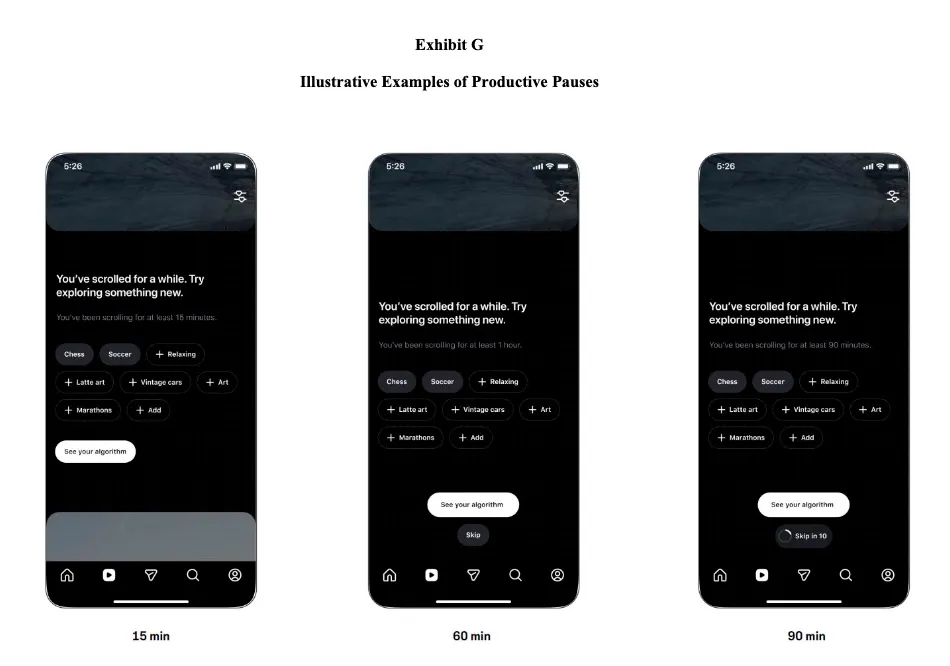
- “Productive pauses and notices” designed to “reduce or prevent excessive, mindless, or unintended teen usage.” This means that a teen’s usage will be monetarily paused after 60 and 90 minutes of daily cumulative use with notices sent every 15 minutes of continuous use. According to the Settlement, these productive pauses and notices will look like this:

To be clear, the ability to set time limits, blackout times, and scheduled pauses are all useful features that should be available and easy to implement for users of all ages. Such tools would have allowed teens, and all users, the ability to design their own safe experience, customized to their own needs, online. Such users controls would have recognized that teens have human rights, agency, and autonomy.
But that’s not what these restrictions are. They are not tools that give the teen users control. Rather, they are imposed, top-down, on teens and anyone else who declines to submit to Meta’s age assurance process.
Feature restrictions (§II.C-D)
Within four months of the effective date of the Settlement, Meta must offer teens an option for a non-personalized feed, which is defined as a feed of chronologically ordered posts from friends and follows. Teens will also be able to disable autoplay as part of an “optional protective settings” package. Each of these settings must be “viewable within three user gestures and clearly labeled, easy to notice, viewable without scrolling, and discoverable in an intuitive location within” the service.
Again, these would be useful user controls that should be offered to users of all ages.
By default, teens will not see the number of likes or other reactions to their posts.
Teens will also not have access to what the Settlement calls “Cosmetic Procedure Filters,” that is, “any digital filter or augmented reality effect that distorts, sculpts, redefines, or idealizes a user’s face in a way that cannot be achieved without cosmetic surgery or extreme make-up techniques.
X. “Cosmetic Procedure Filter” shall mean any digital filter or augmented reality (AR) effect that distorts, sculpts, redefines, or idealizes a user’s face in a way that cannot be achieved without cosmetic surgery or extreme makeup techniques. For the avoidance of doubt, “Cosmetic Procedure Filter” does not include: (1) Fantasy/Character Effects: Filters that change a user’s facial structure for the purpose of turning the user into a non-human or fictional character (e.g., an elf or cartoon) or an animal (e.g., a dragon or puppy); (2) Makeup/Smoothing Effects: Filters that smooth skin or alter appearance in ways that can be achieved by ordinary makeup techniques without altering the appearance of underlying physical facial structure or meaningfully changing skin tone; or (3) Parody and Exaggeration Effects: Effects that entertain users by distorting their appearance through parody, satire, or exaggerated forms (e.g., extreme visual distortions outside the scope of normal cosmetic procedures). To help operationalize this definition, the Settling States will provide Meta illustrative examples and guidance of AR effects that are Cosmetic Procedure Filters and AR effects that are not Cosmetic Procedure Filters in a letter to be sent within two (2) months of the Effective Date.
Meta has already had rules about cosmetic effects directed at teens since 2019. But the Settlement will give the states a major role in helping Meta identify what features are and are not Cosmetic Procedure Filters.
Content restrictions (P.1, §II.E, as defined by §I.C, E, F)
For content, Meta is basically pledging to continue its existing practices limiting Teen Users to age-appropriate content and accounts, to default Teen Users to age-appropriate experiences. This includes limiting access to accounts that “regularly share content that is inappropriate for teens” such as content from the following Meta community standards categories: Adult Nudity & Sexual Activity, Restricted Goods & Services, Suicide, Self-Harm or Eating Disorders.
C. “Age Appropriate Experiences” refers to content that is appropriate for Teen Users based on input from experts, parents, and teens. For the purposes of this Agreement, Age Appropriate Experiences shall mean content captured in Meta’s applicable Ages 13+ content setting, which is tied to policies inspired by movie ratings for ages 13+ and parent feedback.
D. “Age Assurance Methods” shall have the meaning set forth in Section II.
E. “Age Inappropriate Accounts” refers to accounts that regularly share content that is inappropriate for teens or that have account information that otherwise suggests the account is inappropriate for Teen Users. For the purposes of this Agreement, Age Inappropriate Accounts shall mean accounts that: (1) regularly share Age Inappropriate Content in the following categories: Adult Nudity & Sexual Activity, Restricted Goods & Services, Suicide, Self-Harm or Eating Disorders, or (2) have account names or profile photos or bios that suggest the account is otherwise inappropriate for minors, based on Meta’s policies for the following categories: Adult Nudity & Sexual Activity, Restricted Goods & Services, Suicide, Self-Harm or Eating Disorders.
F. “Age Inappropriate Content” refers to content that is generally perceived by U.S. parents, youth experts, and teens as not being appropriate for Teen Users. For the purposes of this Agreement, Age Inappropriate Content shall mean content prohibited by Meta’s Community Standards concerning bullying and harassment; nudity and sexual activity; child sexual exploitation, abuse, and nudity; sexually explicit language; suicide, self-harm and eating disorders; graphic violence and incitements to violence; gambling; and restricted substances or goods (including illegal drug use), as well as policies specifically focused on protections for Teen Users, including those regarding high-risk viral challenges and risky stunts.
The issue here is that some of these categories are problematic. For example, the Restricted Goods & Services standard has been used by Meta to justify removing information about abortion medication, as we detailed in our Stop Censoring Abortion campaign, and in our comment to the Meta Oversight Board. And under the Adult Nudity & Sexual Activity, Meta blocks teens from “real world art of visible genitalia … where the nudity is the focus of the image” and has a history of applying the standard inconsistently, including with respect to representations of indigenous women, breast cancer awareness posts, and posts about testicular and breast self-exams, educational posts about ovulation. And it has disproportionately applied the standard to gay and lesbian content in as compared to straight content.
And even more worrisome, even though this is just Meta continuing its existing practices, the Settlement empowers the states to enforce its provisions. [P. 40, §IV.C.1.i; §VII.C] That means that over the next ten years, the duration of the Settlement, Meta will face the threat that a state attorney general will pursue legal action against it because it disagrees with how Meta interprets these categories of community standards, and pressure Meta to eliminate Teen User access to posts about sexuality and reproductive and sexual health. And Meta will now lack the hard-earned First Amendment defenses to make its own curatorial decisions.
C. Notwithstanding anything in Sections VIII.A-B above, a Settling State may take any action, including but not limited to legal action to enforce compliance with the Agreement, without delay if the Settling State believes that a threat to the health or safety of the public requires immediate action.
The Parental Supervision Tradeoff
All of these Teen User restrictions can be modified – but only if the Teen User enrolls in the Parental Supervision that links their account to a parent’s or guardian’s account. Once their accounts are linked, Parents can modify the Teen User settings to make them less restrictive (they need the teen’s permission if they want to make them more restrictive).
And Parental Supervision comes with a huge privacy tradeoff. In exchange for designating someone as their Parent, the Parent gets a lot of information about the Teen’s use: the usernames of all of the teen’s connections, reports on how much time the Teen User spends on a Meta service, the time spent watching longform content, usernames of all those messaging with Teen User, and any evidence Meta has about suspected secondary accounts. The Supervising Parent also gets notices of the teen’s repeated searches related to suicide, self-harm and eating disorders. [P. 28, §II.G]
Parental Supervision
1. Meta agrees to provide Supervising Parents with information concerning the amount of time their Teen User is spending on Meta SMPs, including separately for time on the Meta SMP, time using the Meta SMP’s messaging features, time viewing Longform Content (to the extent excluded from the calculation of daily limits pursuant to Section II.B.3.a.i), and the usernames of the Teen User’s social connections and individuals messaging the Teen User, and usernames of any user reported by a Teen User. In addition, Instagram will notify Supervising Parents should their Teen User engage in repeated searches for terms related to suicide, self-harm, or eating disorders, and Facebook will notify Supervising Parents should their Teen User engage in repeated searches for terms related to suicide, self-harm, or eating disorders.
2. For Teen Users, Supervising Parents will be notified on a daily basis when the Teen User communicates directly with each adult user for the first time with the Teen User and shall provide a link to the adult user’s profile to provide information such as their stated hometown or city or mutual connections, to the extent the information is publicly available.
3. Upon a Teen User enrolling Parental Supervision, Meta SMPs shall prompt the Supervising Parent to review their Teen User’s settings to consider making updates to support how their Teen User spends their time on Meta SMPs. Meta shall not preselect, recommend, or encourage settings to Supervising Parents that are less restrictive than the default settings in this Agreement.
4. Meta SMPs will periodically suggest checkups for Supervising Parents to do with their Teen Users to evaluate their settings and usage.
5. Meta SMPs agree to continue to take steps designed to encourage enrollment in their Parental Supervision tools.
6. If a Teen User is enrolled in Parental Supervision, Meta shall notify the Supervising Parent if the Teen User creates or explicitly links a new secondary Meta SMP account within their Accounts Center or has been linked to a Soft Matched Account through Meta SMPs, including a link to the secondary account’s profile. Meta SMPs shall automatically apply the Supervising Parent’s approved time management settings in Section II.B and content restrictions to all explicitly linked Meta SMP accounts and all Supervised Accounts for a Teen User belonging to the same Meta SMP.
Unfortunately, Meta doesn’t have a great way to learn whether there exists a genuine parent-Teen User relationship. But it will try to get it right. [§II.G.8]
This may be workable for young people with healthy and safe relationships with their parent or guardian. But obviously not good at all for a Teen User lacking such a safe relationship.
More Surveillance, Not Less
Moreover, rather than pushing Meta away from the collection, analysis, and retention of user data, the Settlement requires Meta to do more of it for the next ten years. Several provisions of the Settlement require Meta to carefully track its users use of Instagram and Facebook for the purposes of determining whether its age assurance framework and Teen User restrictions are working as intended.
For example:
- Meta promises to review detected U13 users’ friend networks to identify other possible U13 users. [§II.A.6.(b).(i).(D)]
- Meta will incorporate a “proactive monitoring system” to identify possible Teen Users among those who were initially determined to be older than 17 by its age assurance process. [§II.7.(c)]
- Meta pledges to utilize and improve its existing “soft matching models” that track signals such as device IDs, phone numbers, and email addresses” to identify duplicate accounts. [§II.B.6.(a)]
- Meta will continue to monitor Teen Users’ activity to “regularly evaluate the prevalence of Teen User exposure to Age Inappropriate Content, and Teen User exposure to experiences that are not Age Appropriate Experiences,” [§II.E.3] and also to “regularly evaluate the prevalence of Teen User exposure to Harmful Experiences on Meta SMPs.” [§II.F.3]
- Monitor Teen Users’ messaging to identify message threads with potentially suspicious accounts. [§II.F.4]
- The Settlement also requires Meta to actively monitor use of its services so that it can supply data to the Independent Auditor that will now monitor its compliance with the Settlement. “The Independent Auditor is entitled to access the non-privileged information, personnel, systems, and records that are reasonably relevant and sufficient to evaluate Meta’s implementation of the Injunctive Relief Terms, including, but not limited to, access to raw data; aggregated data; information; internal documents and communications” plus information from its age assurance processes, data regarding Teen User responses to the Productive Pauses, data regarding its models for soft matching of secondary accounts, data regarding the prevalence of Teen User exposure to Age Inappropriate Content and Harmful Experiences, and to experiences that are not Age Appropriate Experiences. [§III.E]
Moreover, one of the chief threats of Meta’ surveillance is the honeypot of data it creates that may be accessible to governments for law enforcement and other investigations. Nowhere in the Settlement do the 52 attorneys general pledge to not try to access all of the data the Settlement requires Meta to collect and retain.
Meta Has To Pay The States — Establishing Norms Beyond Meta
The Settlement also includes annual payments from Meta to the states, apparently proportionate to the size of each state’s teen user base. Over the ten year-life of the Settlement, these annual payments will total over $11 billion plus the prospect of an additional $5 billion—if Meta competitors adopt the same measures.
This quirk of the Settlement incentivizes the States to pursue similar age assurance processes and at-least-as-restrictive teen user measures for Meta’s chief existing competitors for teen use, YouTube, TikTok, and Snap, and for any new service that may gain widespread teen use over the life of the Settlement Agreement. If the states are able to get Meta’s competitors to adopt the same measures, then the states will get an additional $5 billion in annual payments. That’s quite the incentive for the states to pursue litigation and regulatory measures against those companies. All of this will further entrench age assurance and age-gating as the norm across online services.
1. In the event the Contingent Monetary Payment Trigger has occurred in a Settling State, Meta shall be obligated to pay to such Settling State ten equal installments in the amount as set out in Exhibit B (each, a “Contingency Installment Payment”).
2. Following the date the Contingent Monetary Payment Trigger has occurred, the Contingency Installment Payments shall be made to the Settling State on January 15 in each subsequent calendar year of the Agreement Term as follows:
(a) At the next scheduled payment date, the Settling State shall be paid the Contingency Installment Payment for that payment date and all prior payment dates.
(b) For each of the remaining payment dates, the Settling State will be paid the Contingency Installment Payment for that payment date.3. If a Settling State fails to achieve the Contingent Monetary Payment Trigger during the Agreement Term, the Contingency Installment Payments shall be permanently forfeited by such Settling State and retained by Meta. For the avoidance of doubt, no Settling State will have an obligation to repay the Contingency Payment
The Settlement is thus a bad deal for all users of Facebook and Instagram. It normalizes age gating and age assurance for millions of internet users. It denies teens the tools to create their own safe experiences online and places their social media experience firmly under the control of either Meta or their parents. And rather than addressing Meta’s collection, analysis, and retention of data about teens’ use of Instagram and Facebook, it binds Meta to continued surveillance.
Republished from the EFF’s Deeplinks blog.
Filed Under: age verification, privacy, settlement, state ags, teens
Companies: meta


from the electrified-bullies-and-cowards dept
This was inevitable. ICE has billions of new money to spend, zero shame, and not a single adult in a leadership position capable (or willing!) to talk the agency off the ledge.
ICE decided the neat new tool of cruelty it absolutely had to have were gloves that behave like stun guns or low-powered Tasers. Only one company makes these: Compliant Technologies. There’s a reason for that. Prior to ICE’s devolution during Trump’s second term, no agency of any size really had any reason to buy these stun gloves.
Early adopters were prisons and (wtaf) schools. These gloves made limited sense in prisons where guards are working in confined areas and possibly don’t want to utilize any weapon that might be taken away and used against them. Why they’re being used in schools is literally unimaginable. But here we are in the 21st century, witnessing schools pleading with law enforcement agencies to stop shocking their students with Compliant Technologies G.L.O.V.E., or (brace yourself) Generated Low Output Voltage Emitter, which sounds more like an electrician’s tool than something capable of rendering minors immobile.
With only one provider available, the decision was easy. ICE finalized its threatened purchase of 6,000 G.L.O.V.E.s from Compliant Technologies late last week, ensuring officers will have even more ways to inflict pain on thousands of non-criminals, ranging from ambushed migrants to peaceful protesters who have managed to momentarily inconvenience ICE’s kidnapping squads.
Everything about this is awful, but ICE’s defense of this purchase is both bizarre and palpably evil:
“ICE does not currently have an empty hand use of force device to provide to the field amidst unprecedented levels of threats and violence against ICE officers and agents to help ensure they can de-escalate tense situations before they turn violent,” the agency wrote in procurement documents.
WTF? Do you know who else doesn’t have “empty hand use of force devices?” 99.999% of US law enforcement agencies, including federal agencies that generally face more legitimate danger from arrestees, like the FBI, ATF, and Secret Service. And do you know why? Because it’s an absolutely psychopathic use of force “option.”
Somehow, it’s ICE that desperately needs this hideous option, even though all it’s really doing at this point is doing migrant mop-up work — arresting migrants by the thousands despite almost none of these remaining migrants having ever been arrested, much less convicted, for violent crimes.
The procurement document [PDF] contains more supporting statements from ICE that make it clear these gloves aren’t really meant to help subdue violent arrestees. The gloves are being purchased to give ICE officers the means and the opportunity to basically stun anyone they run into, including people they aren’t even seeking to arrest. This paragraph suggests stun gloves are nothing more than a violent way for ICE officers to “de-stress” while at work:
ICE requires a non-lethal, de-escalation device intended to diffuse situations of high-stress environments where physical altercations are likely, such as field domestic disputes or inmate transport in jails. It will be used when a subject is actively or passively resisting and an officer needs to gain control quickly to prevent injuries to both parties.
The document doesn’t explain what the phrase “field domestic dispute” means, nor does it provide context. Reading “domestic dispute” in its usual context, the sentence seems to suggest officers should be able to stun their domestic partners into compliance when things at home get a bit heated. Obviously that’s not what that phrase means, but it’s an extremely weird grouping of words that seems to be specific to ICE and its desire for gloves that can shock people.
Further down, ICE makes it clear it’s going to allow officers to deploy the gloves against peaceful protesters or anyone else who might be considered an obstacle to officers’ kidnapping plans.
“Soft” Empty-Hand Control- Enabling officers to briefly distract a subject who is resisting or hiding their hands to secure handcuffs without transitioning to higher, more forceful levels of control.
Civil Disturbance- Assisting crowd control units in moving groups or denying access to areas without requiring lethal or high-impact munitions.
ICE makes it sound like its officers will stop shooting or beating people because of these gloves. But I can guarantee you the gloves will be used whenever possible, especially when they might facilitate a beating. Since pretty much every ICE officer wears gloves, it will be impossible to tell who’s wearing the stun version and who’s just trying to look like a Call of Duty lobby idle animation. Officers are absolutely going to love these gloves because the element of surprise will always be on their side.
There’s no way ICE seriously believes 6,000 pairs of hand-worn cruelty application devices will actually limit the use of deadly force. But it can probably assume it might reduces shootings because its thousands of under-trained officers will probably be less willing to grab a metal gun from near their waist when they’re not sure whether or not their G.L.O.V.E.s are still activated.
This is just a way for ICE officers to hurt more people while pretending stunning anyone an officer touches is synonymous with de-escalation. This is just an agency loaded from top to bottom with sadists seeking out novel ways to inflict more pain.
Filed Under: cruelty, dhs, ice, mass deportation, police violence, stun gloves, trump administration
Companies: compliant technologies

A group of ill-prepared climbers had to be rescued because Gemini told them climbing Mt. Shasta would only take 8 hours.

A group of climbers set out to climb Mount Shasta in Siskiyou County, California thinking it would only take them eight hours, because that’s what Google’s Gemini chatbot told them. Gemini ended up being very, very wrong. Specifically, they relied on the chatbot for route research and asked it for recommendations on how much food and water to take with them.
Gemini reportedly told them to prepare for an eight-hour trek and pack food with simple carbohydrates instead of fats, because fats “take too long to digest.” As a result, they carried daypacks with just enough food and water for a short climb, with no plans for shelter and no warm clothing. As you may have surmised by now, they eventually had to be rescued by the US Forest Service Climbing Rangers with the Siskiyou County Sheriff’s Office Search and Rescue team.
The climbers set up a base camp on August 29, the sheriff’s office has reported, before setting out on August 30 at 3AM. It took them 16 hours just to reach the summit. That was already 7PM on August 30, way past the recommended turnaround time of 12PM. Since it was already dark when they descended, and they were ill-prepared, they ended up wandering off-route. They were using AllTrails for navigation, but the phone with the app died before they could make it down.
While they called 911 to ask for directions, it wasn’t until around 9:30AM on August 31 that the forest rangers had finally reached them. Further, weather conditions didn’t permit a helicopter rescue, so they had to descend on foot, which took another nine hours. “We relied too much on AI rather than our own critical thinking,” the climbers reportedly told SFGate. The Siskiyou County Sheriff’s Office is advising climbers to call the Mount Shasta Ranger station ahead of their trip for the most accurate information and to “never rely solely on AI” for planning.
Tech
Dallas garbage trucks are using AI cameras to flag code violations and give homes a “blight score”

WTF?! Want another reason why there’s a big pushback against artificial intelligence? In Dallas, AI-powered cameras mounted on trash collection trucks are photographing properties and assigning them a “blight score” – a rating based on perceived code violations.
NBC 5 obtained city records showing that Dallas started testing the AI cameras on bulk trash collection trucks in April, ramping up their use over the summer.
The cameras identified at least one possible code violation on more than 21,000 properties. These include grass height, litter, debris, overgrown weeds, and structural issues.
The properties are then assigned a “blight score” based on the level of violations. A score of 1 is the least severe, while 4 is most severe.
Some homeowners whose properties appeared on the list received code enforcement “courtesy notices,” which could result in fines if the violations aren’t addressed.
One person whose property was flagged by the camera for a chimney paint violation and given a score of 2 said the rating was too severe – even a 1 seems a little harsh.

Courtesy: Edward Ayala, NBC 5 Investigates
Plenty of other locals are far from happy about the cameras. There are the obvious privacy concerns about photos being taken of someone’s home without their consent, and many are asking who has defined what counts as blight on their property.
The system consists of 100 cameras mounted in pairs on 50 brush and bulky-waste trucks, with one pointing from each side of the vehicle. The 1920 × 1080 cameras use fixed-focal-length lenses and have no optical or digital zoom. Dallas officials say they operate at street level and cannot see above fences. The city expects the trucks to provide a visual scan of Dallas roughly once every 30 days.
City Detect, which operates the cameras, said it has no say in how the city uses the data for enforcement. CEO Gavin Baum-Blake said faces and license plates are blurred.
The company configures the AI according to Dallas’s requirements. The city says its models were trained on examples covering different seasons, building styles, neighborhoods, lighting conditions, weather, and geographic areas, with the aim of reducing inconsistent or biased detections. Images and other data are kept in cloud storage located in the United States, and City Detect maintains the data for the duration of the contract.
There’s also the problem of AI getting things wrong and just hallucinating things that aren’t there. There was a case last year in which a 16-year-old high school student was swarmed by police and handcuffed after an AI camera system mistook the bag of Doritos he was carrying for a gun.
The biggest concern surrounding the Dallas trucks is that the program could increase fines for those already struggling financially in economically challenged areas. The city said it has already sent out 1,800 courtesy notices, and its goal is to issue around 5,200 per year.
The good news for locals is that the cameras might not be around for much longer. Dallas City Councilmember Chad West has proposed an amendment to the budget to stop funding the three-year, $2.5 million camera contract.
West agreed to table his request to strip funding for the cameras after he said the city manager agreed to a hearing on the issue in December. While he believes the cameras do have uses, such as detecting illegal dumping sites, there needs to be further investigation into their impact on families and who can access the images.
Image credit: Sludge G

Vodafone has launched SuperMobile, a new premium mobile plan designed to offer faster speeds, more reliable performance and added security over its standard plans.
The service is powered by VodafoneThree’s 5G+ network and promises speeds of up to four times faster than standard plans, along with a guaranteed minimum download speed.
The launch comes just over a year after the Vodafone-Three merger, with VodafoneThree positioning SuperMobile as a move away from mobile plans that primarily compete on price. It’s also part of the company’s wider £11bn, eight-year investment in its UK network.
SuperMobile uses Vodafone’s new 5G+ FastTrack technology, which is designed to maintain higher performance for activities such as streaming, live TV, gaming and immersive media, even when the network is busy. Vodafone says the service is the first globally from a mobile network operator to guarantee a minimum download speed of 15Mbps. If customers don’t receive that minimum, they can leave the plan without paying a fee.
Security is another part of the package. SuperMobile includes 5G encryption alongside Secure Net Mobile, which provides protection against malware and viruses, identity protection, scam call protection and network-level parental controls at no extra cost.
How much does it cost?
For existing contract customers, SuperMobile costs £3 per month more than full-speed Xtra plans, £8 more than 100Mbps SIM-only plans and £4 more than 100Mbps handset plans.
There’s also a rolling monthly option costing £12. The service is available to small businesses with up to nine employees, while larger enterprises can get tailored packages with specific performance commitments.

VodafoneThree says its 5G+ population coverage has grown from 46% to 60% since the merger, with the company targeting 99.96% coverage by 2034.
For businesses, Vodafone has also introduced a National Business Slice, which gives organisations dedicated capacity separate from consumer traffic. Vodafone says this can deliver up to four times faster speeds with committed performance targets. A National Critical Slice for emergency services and other critical public services is planned for next year.
With SuperMobile, Vodafone is essentially offering customers the option to pay more for a higher-priority mobile connection rather than simply buying more data. Whether that extra performance is worth the premium will depend largely on how consistently FastTrack delivers its promised benefits in busy areas.

“Enshittification of car controls [is] rapidly accelerating,” writes longtime Slashdot reader sinij, pointing to a new report from Car and Driver. From the report: Remember when iPhones used to come with free headphones and a phone charger (including the wall plug)? It didn’t feel so much like Apple giving you free goodies as it did that the company was providing you with the relevant hardware to use the device. Apple stopped including headphones and charging blocks in 2020. Now, Hyundai is pulling some of its standard hardware from the box, at least for two models.
Hyundai is charging customers extra for a driver’s display in the new Elantra generation (more specifically, the Korea-market Avante), as well as the Ioniq 3, Motor1 reported. Both models feature Pleos Connect, Hyundai’s new infotainment setup that pairs a center touchscreen with a slim 9.9-inch instrument cluster mounted above the dashboard — except where it doesn’t.
In its domestic market, the instrument cluster screen is offered as a 350,000 won ($255) option for the base trim. Not the most expensive optional extra in the world, but still kind of a slap in the face for a feature traditionally viewed as standard fare. Things are more expensive for the electric Ioniq 3. In the EV’s case, the base trim gives customers the full Tesla-screen experience, meaning if customers want the driver’s display, they’ll need to fork over the additional $5000 necessary to move up to the next-level trim. […] Hyundai plans to have the setup equipped in 20 million cars globally by the end of the decade.


Read more of this story at Slashdot.
Tech
McGraw Hill acquires Teachally, an AI startup for teachers led by Seattle tech vet Daniel Bernstein

Daniel Bernstein spent much of the past decade as an M&A advisor, selling other people’s software companies. This time the company was his own, and he found a buyer in McGraw Hill.
The education publishing giant on Wednesday announced the acquisition of Teachally, a small startup led by Bernstein in Bothell, Wash., that uses AI to help teachers build and customize lessons, assignments and assessments aligned to state standards.
Financial terms weren’t disclosed. The deal has closed, and all five employees have joined McGraw Hill, with Bernstein taking the title of senior advisor for Teachally integration and growth. He declined to say what the company sold for or how much it had raised, but said the outcome was good for him and his investors.
“We didn’t take in a pile of money,” Bernstein said, explaining that the company brought in a small group of angels and was able to stay focused and effective.
The five-person team is spread across three continents: Bernstein and a colleague in the Seattle area, co-founder and CTO Rushil Makkar in Melbourne, Australia, a customer success lead in Arizona and a developer in Ethiopia.
Bernstein is best known in Seattle tech circles for Sandlot Games, the game studio he started in a spare bedroom in Bothell in 2002 and sold to Digital Chocolate in 2011, after developing casual gaming hits including “Cake Mania” and “Tradewinds.” He later founded the mobile game startup UpTap.
Bernstein spent the following decade on the other side of deals, as a software M&A advisor at Corum Group and then at his own firm, Hemisphere Partners, which ran Teachally’s sale.
Teachally raised a small round from local angels about nine months ago, and later opted to try an M&A process. An edtech M&A specialist representing the company approached a small group of potential buyers, and Bernstein said he hit it off immediately with McGraw Hill over a shared view of what curriculum and instruction should look like in the age of AI.
Teachally focuses on teachers rather than students, developing technology for what the industry calls high-quality instructional materials, or HQIM, which is the standards-aligned curriculum that many states and districts have pushed schools to adopt.
The startup was working with about eight school districts at the time of the sale — fully commercialized, Bernstein said, but “still very much an early stage company.” It was named a top edtech product for curriculum and instruction by District Administration magazine in January.
Bernstein said he had to learn an entirely new industry after two decades in games. The M&A work helped: he’d taken other edtech companies to market before building one.
Teachally itself started as something else. The company was founded as EZ Reward, maker of EZ Stickerbook, a digital sticker chart teachers used to reward students and message parents. Bernstein pivoted the company about three years ago to focus on AI for teachers.
McGraw Hill, which went public last year and reported $2.1 billion in revenue in its most recent fiscal year, said the deal will let it develop and localize K-12 curriculum faster and put AI tools in front of teachers already using its content.
“This acquisition provides a great opportunity to accelerate our AI strategy in ways that directly support educators and strengthen how we develop and deliver our K–12 products globally,” said Jana Thompson, interim president of the company’s School group, in the announcement.
Teachally is now live as a McGraw Hill product, with its own page on the company’s site.
Bernstein said it’s a second exit both for him and for some of the angels who have backed him along the way. “It’s a good Seattle story once again,” he said.

Revenant XSpark, the team you may have seen competing in BGMI tournaments, is set to represent Southeast Asia at the Brawl Stars Challengers Finals 2026, where 12 of the world’s top regional teams will battle for the final qualification spot in the Brawl Stars Championship One Last Chance Qualifier (LCQ). The offline tournament will take place on September 5–6 at the ESA Espor Arena in Istanbul, Türkiye, with the winner earning a direct ticket to the LCQ in Guangzhou, China. Here’s everything you need to know.
Revenant XSpark lands in Group B alongside SK Gaming
The Challengers Finals feature 12 regional champions divided into four groups. Day one will consist of a round-robin group stage, with the top two teams from each group advancing to the playoffs. The tournament will then conclude with a single-elimination bracket and Grand Final on September 6.
Revenant XSpark has been drawn into Group B, where it will face SK Gaming from France and Good Game from South Korea in its opening matches. For the Indian organization, Istanbul represents the first major step toward another appearance at the Brawl Stars World Championship.
The team qualified through the Last Chance Qualifier before finishing 3rd–4th at the Brawl Stars World Finals 2025, becoming only the second Indian team to reach the World Stage Finals in the title. The roster is led by Ashmit “Sergeant Clash” Raj Singh, one of India’s most accomplished Brawl Stars players, alongside Southeast Asian veteran Jayden “X9Jay” Wong and Singaporean newcomer Walkthrough, who will make his international LAN debut in Istanbul.
Speaking on the matter, Rohit N. Jagasia, CEO of Revenant Xpark, said,
Our ambition is not simply to participate, it is to keep pushing deeper into the global competitive circuit. Istanbul is the first step, Guangzhou is the next target, and ultimately, we want to be back on the World Finals stage.
The Brawl Stars Challengers Finals will be streamed live on event.brawlstars.com, with the group stage scheduled for September 5 and the playoffs and Grand Final taking place on September 6.


Qualtrics is cutting 117 jobs connected to its Seattle headquarters, according to a state filing that provides new details of the layoffs that the experience management technology company made two weeks ago.
Engineering and product teams were hit hard. The filing lists software roles from entry-level through principal engineers, plus testing, machine learning, network and information security positions; engineering managers and directors; and product and product marketing managers.
The employees work at or report into Qualtrics Tower at 1201 Second Ave., the filing says.
The company, which has dual headquarters in Seattle and Provo, Utah, made cuts globally on Aug. 19, so the Seattle number reflects only a portion of the overall positions impacted. The company has not disclosed the total. We followed up again Wednesday to ask for an overall number.
Qualtrics employed about 900 people in Seattle as of 2023 and has not disclosed a figure since.
It’s part of a steady stream of tech layoffs in the Seattle region. Amazon disclosed 121 job cuts in Washington state on Aug. 31, T-Mobile 77 on Aug. 26, and TikTok 75 in Bellevue on Aug. 19. Zillow cut more than 500 Seattle jobs in early August.
Earlier this year, Meta cut nearly 1,400 jobs in the state, about 20% of its local workforce; Microsoft cut 605; and Oracle 491.
Qualtrics makes software that companies use to collect and analyze feedback from customers, employees, partners and others — a category that Qualtrics calls experience management. It was founded in Provo in 2002 and later added a Seattle headquarters.
The layoffs followed the company’s $6.75 billion acquisition of Press Ganey Forsta, an Indiana-based healthcare data company, which closed in May.
In a memo to employees on Aug. 19, CEO Jason Maynard said the deal brought together “two organizations, two sets of teams, two structures built independently,” and that the company had gone “function by function, team by team, to understand where we have overlap.”
Maynard became CEO in February, joining from Oracle. In April he removed five senior executives and reorganized teams across marketing, customer operations, IT and corporate development.
Qualtrics has been owned by Silver Lake and Canada Pension Plan Investment Board since they took it private for $12.5 billion in 2023. The company cut about 780 jobs, roughly 14% of its workforce, in October 2023, and about 270 earlier the same year.

Vodafone has announced Vodafone TV, a new entertainment hub that brings live television, streaming, gaming, music and apps together in one place.
The service is designed to simplify the increasingly messy experience of juggling multiple streaming subscriptions and devices. Vodafone TV will bring services including Netflix and HBO Max alongside Freely, more than 150 live channels, 300-plus cloud games and thousands of apps through the Google Play Store.
At the heart of the experience is a set-top box running Android TV. It supports 4K video, Dolby Vision and Dolby Atmos, while 3GB of RAM and 32GB of storage should give it enough power for navigating menus, streaming content and running games without feeling sluggish.
Vodafone is also putting more emphasis on discovery. Smart AI Search, Google Assistant and personalised recommendations are built into the platform, allowing users to search across different types of content without having to jump between individual services.
Freely is a great addition
Freely is particularly useful here, as it provides more than 70 live channels and thousands of hours of on-demand programming from broadcasters including the BBC, ITV, Channel 4 and Channel 5. It works over the internet, so users don’t need a traditional aerial or satellite dish.
Vodafone TV also isn’t limited to the living room. A companion app will let users start watching a programme at home and continue on the move, with profiles, recommendations, favourites and gameplay carrying across devices.
For those streaming while out and about, Vodafone says the service can be paired with its new SuperMobile offering, which uses its 5G+ FastTrack network technology to provide faster and more reliable connectivity.
Vodafone TV launch price and release date
Vodafone TV will launch in October for new and existing Vodafone customers with a home broadband, 5G Broadband or mobile plan.
At launch, Netflix and HBO Max will be included, with other services available to add. Customers will also be able to access Disney+, YouTube Premium, DAZN, Spotify and Prime through Vodafone Subscription+ on a 30-day rolling basis.
There’s also Vodafone Box Office for renting or buying films, while parental controls are handled through a secure Master PIN.
With Vodafone TV, the company is clearly aiming to make the set-top box more than just another way to watch television. By combining traditional channels, streaming services, gaming and apps, it could offer a much simpler alternative to switching between different platforms.

from the unreasonably-angry dept
Sony’s ability to generate anger lately is pretty impressive. After the company announced that there would be no more physical media versions of games made starting in 2027, to the resounding anger of many people, Sony also demonstrated yet again that it’s capable of ripping away the digital “purchases” people had made once its own licensing arrangements expire. While some folks out there understand that in the cases of some digital goods you’re not actually buying a thing, but a temporary license, many others either don’t know that or simply don’t like it, spurring on further anger against Sony across the internet. And that’s leaving aside entirely the subject of game and cultural preservation in all of this.
Sony is bad enough at this that they can manage to piss me off even when I probably agree with them when it comes to a particular lawsuit. Let’s get through the part where I’m on their side first.
There is a lawsuit going on in California, brought against Sony by a group of PlayStation gamers, that is arguing that the platform doesn’t comply with a relatively new California law for digital purchases that has strict rules around disclosing that the nature of the purchase is a license. The suit argues for non-compliance because the PlayStation Store uses the phrases “buy” and “purchase”, which is forbidden by the law.
Unfortunately for the plaintiffs, that’s not the full story. Here’s the relevant section of the law:
(b) (1) It shall be unlawful for a seller of a digital good to advertise or offer for sale a digital good to a purchaser with the terms “buy,” “purchase,” or any other term which a reasonable person would understand to confer an unrestricted ownership interest in the digital good, or alongside an option for a time-limited rental, unless either of the following occur:
(A) The seller receives at the time of each transaction an affirmative acknowledgment from the purchaser indicating all of the following:
(i) That the purchaser is receiving a license to access the digital good.
(ii) A complete list of restrictions and conditions of the license.
(iii) That access to the digital good may be unilaterally revoked by the seller if they no longer hold a right to the digital good, if applicable.
(B) The seller provides to the consumer before executing each transaction a clear and conspicuous statement that does both of the following:
(i) States in plain language that “buying” or “purchasing” the digital good is a license.
(ii) Includes a hyperlink, QR code, or similar method to access the terms and conditions that provide full details on the license.
And here’s what it looks like if you were to make a purchase for a license for a digital game on the PlayStation Store:

So let’s go back to the law. Yes, the page uses the term “purchase”. It also asks for acknowledgement via the “Confirm Purchase” button that the customer understands they’re buying a license (and it’s in plain language), links to the SPLA and TOS which outline the restrictions and conditions of the license, and details the revokable nature of that license. Sony is arguing it’s compliant and I’m compelled to agree.
And if Sony left it at that, I wouldn’t be writing this post right now. But then the company just had to further and say something really stupid.
Now, as reported by Game File, Sony recently filed its response to the lawsuit, claiming that customers are not only told “your purchase of this digital product amounts to a licence”, but that “reasonable consumers” already understand this anyway without having to be told.
Sony’s argument is that because digital copies of games are not a finite resource, and that because multiple people can buy a digital copy of the same game, that means nobody actually ‘owns’ it – if they did, nobody else would be able to have it.
“As plaintiffs admit, Section 1 of the SPLA likewise explains that ‘the Software is licensed to you, not sold’, Sony’s filing reads. “This makes sense. In the digital age, it is not plausible to allege that reasonable consumers believed they were obtaining ‘ownership’ of a digital game.
“Were that the case, then Plaintiff Edward Heycock would not have been able to obtain the game Resident Evil Requiem on February 25, 2026 for $69.99 from the PlayStation Store after Plaintiff Jason Mendoza had obtained Resident Evil Requiem on February 14, 2026, because Mr Mendoza, not Sony, would have owned it then.”
And on this, Sony can fuck all the way off. This is completely wrong on a variety of levels.
Let’s start with the fact that the internet is chockablock with discussions trying to unconfuse many people when it comes to what they bought in a digital purchase. There are Reddit posts asking this question. There are tech blogs that have put out specific articles answering the question of ownership of certain digital goods. Or, if the wider internet doesn’t suffice for you, the FTC has articles on its own website that try to help address ownership rights for the public for digital goods. Here’s a snippet that will help drive home the second reason Sony’s statement is so dumb.
When you buy a physical item, you’ve got it. It’s yours. But when you click the “buy” button on a digital product, it really depends. You may have access to it only while you have an active account with the platform or website that sold it, or only for as long as that platform or website stays in business. Another factor is Digital Rights Management (DRM) software, which is attached to many digital items and is the thing that makes it impossible, for example, for you to play a video game on a different console brand.
Another reason why you might not have full control of your digital product is that what you really got when you clicked “buy” is often merely a license to access the content. This fact is often explained only in fine print in the terms of service — terms that the seller can usually change at will. And if the seller itself has licensing issues with the content you bought, then your own license to use the digital item can become worthless. All things beyond your control.
So all of these entities putting out all of this information to try to educate the public about what the hell they bought with a digital purchase are only speaking to the unreasonable? That’s, dare I say, an unreasonable thing to say.
And in that FTC post, did you happen to notice just how many qualifiers are stuffed into those two paragraphs? It depends. May. Many. Might. Often. So why all of those qualifiers?
Because some digital purchases can and do confer ownership to the buyer. Not everyone is out here selling a license. Some digital goods are sold as permanent ownership.
So, no matter how this particular lawsuit shakes out, Sony needs to either understand their own customers’ sentiments and knowledge far better than they do, or they need to stop saying things that they know are false. I can attest that the general public does not have a firm understanding of their ownership rights and what they’re actually buying with digital purchases. Pretending otherwise is nonsense.
Filed Under: discs, license, ownership, playstation, rental, video games
Companies: sony

How sports coaching and mentoring are transforming the lives of disadvantaged young Londoners

Allspring Municipal Bond Fund Q2 2026 Commentary

An Ode to State Fairs





-

 Fashion6 days ago
Weekend Open Thread: Maeve – Corporette.com
-

 Crypto World6 days ago
Bitcoin’s 22% rally now needs real demand to outlast Treasury liquidity boost
-

 Business6 days ago
Apple Confirms September 9 Keynote and Reveals Its Full Pre-Order Schedule
-

 Business6 days ago
Salesforce Stock Soars 19% as Blowout Earnings and Agentforce AI Growth Silence Software Skeptics
-

 Crypto World11 hours ago
CLARITY Act could advance within weeks, Atkins says
-

 Business5 days ago
Onto Innovation Stock: AI’s Next Bottleneck Is Yield (NYSE:ONTO)
-

 Crypto World5 days ago
Bitcoin price tests $82K resistance as Brandt stays long
-
 Tech5 days ago
Hugging Face built a $4.5 billion empire on free AI models. Now Nvidia is buying it for $12.9 billion
-

 Business6 days ago
iPhone 18 Pro Pre-Orders Could Shift to Saturday as Apple Reportedly Avoids September 11 Anniversary
-

 Crypto World6 days ago
Truflation calls for Fed rate cut after PCE forecast
-

 News Videos4 days ago
Charlie Munger on Robinhood: No one should believe that Robinhood’s trades are free
-

 Tech5 days ago
PaperCut releases second emergency patch for exploited flaws
-

 Tech6 days ago
The fix for the AI agent that hijacked a company’s DNS: it can propose the change, but it can’t approve it
-
 Entertainment6 days ago
‘Adults’ Creators Break Down Season 2’s Most Shocking Moments and Tease a Potential Season 3
-

 Crypto World1 day ago
Elon Musk Says Grok 4.7 Lands in 10 Days and Will Beat Every Model
-

 Tech4 days ago
Tamagotchi Ring Takes the 30-Year Digital Pet and Places it on Your Finger
-

 Tech4 days ago
As the influencer economy drives retail sales, Seattle startup raises $22M to play matchmaker
-
 NewsBeat4 days ago
Trump posts AI video of ‘Lake America’ being protected by an army of bequiffed ‘Donald Ducks’
-

 Crypto World1 day ago
Bitcoin slips below $77.5K as macro pressure offsets ETF inflows
-
 Entertainment3 days ago
Taylor Swift Reportedly ‘Frustrated’ With Travis Kelce After ‘Short’ Honeymoon
You must be logged in to post a comment Login