Microsoft announced today that the Exchange Web Services (EWS) API for Exchange Online will be shut down in April 2027, after nearly 20 years.
EWS is a cross-platform API for developing apps that can access Exchange mailbox items, such as email messages, meetings, and contacts, retrieved from various sources, including Exchange Online and on-premises editions of Exchange (starting with Exchange Server 2007).
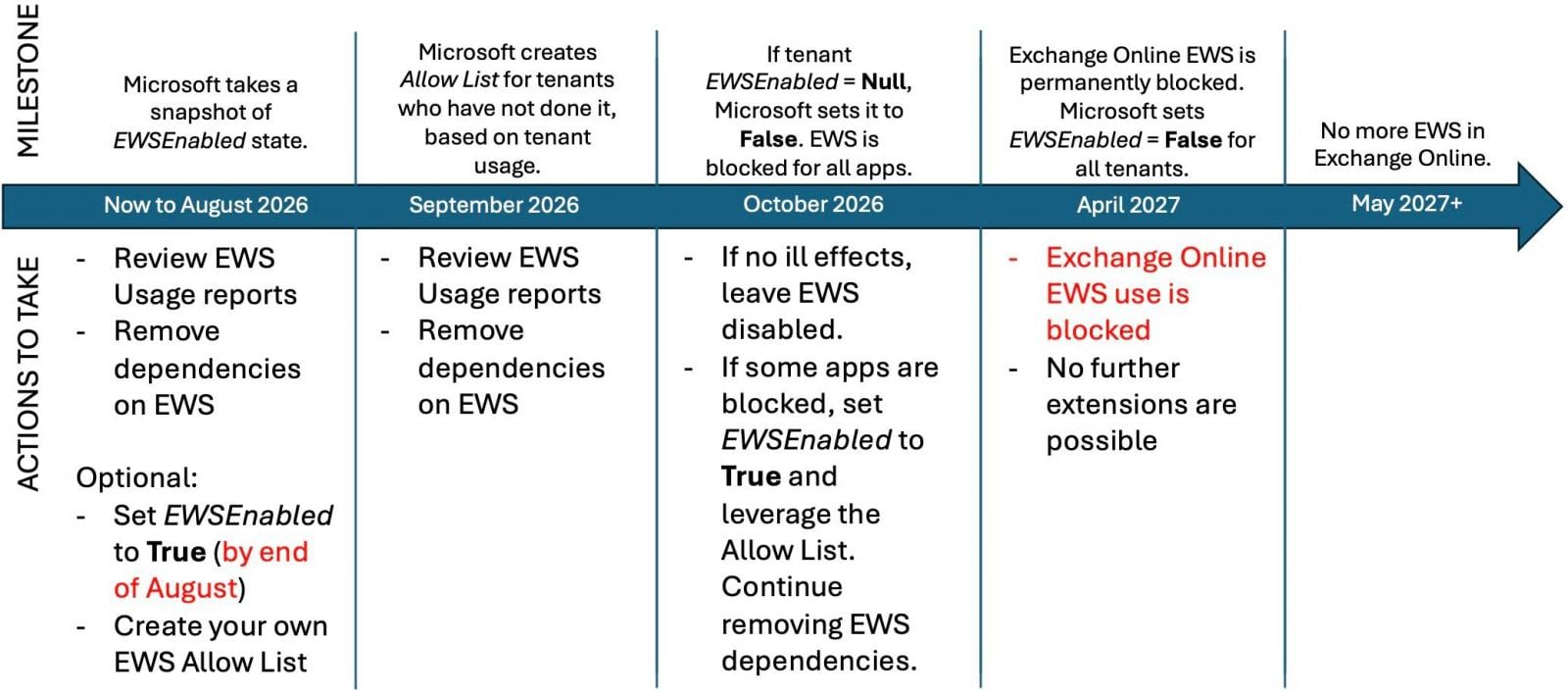
Microsoft will begin blocking Exchange Online EWS by default on October 1, 2026, but administrators can temporarily maintain access via an application allowlist. The final shutdown occurs on April 1, 2027, with no exceptions granted.
Administrators who create allow lists and configure settings by the end of August 2026 will be excluded from the automatic October blocking. Starting in September 2026, Microsoft will pre-populate allow lists for organizations that have not created their own, based on each tenant’s usage patterns.
The company may also conduct temporary “scream tests” that temporarily disable EWS to expose hidden dependencies before the final cutoff, and will keep IT admins informed via monthly Message Center notifications that provide tenant-specific reminders and usage summaries.
Advertisement
However, it’s important to note that this retirement process affects only Microsoft 365 and Exchange Online environments, and EWS will continue to function in on-premises Exchange Server installations.
EWS retirement timeline (Microsoft)
“Today we’re announcing we will use a phased, admin controllable disablement plan that starts in October 2026 and concludes with a complete shutdown of EWS in 2027,” the Exchange Team said on Thursday. “EWS was built nearly 20 years ago, and while it served the ecosystem well, it no longer aligns with today’s security, scale, or reliability requirements.”
Microsoft also advised developers using the EWS API to switch to the Microsoft Graph API until EWS is retired, since it has reached near-complete feature parity with EWS for most scenarios.
“EWS is not being retired on-prem. Hybrid scenarios vary depending on how apps access data. On-prem mailboxes may continue using EWS; cloud mailboxes must move to Graph. Autodiscover will help apps determine mailbox location automatically,” Microsoft added.
“But note that only Exchange SE will support Graph for calls to Exchange Online, so hybrid customers will have to use Exchange SE to host on-premises mailboxes.”
Advertisement
Today’s announcement comes after Microsoft revealed in September 2023 that it planned to begin retiring the EWS API in October 2026, and after a 2018 warning that EWS would stop receiving functionality updates.
Three years later, in October 2021, Microsoft revealed that it had deprecated the 25 least-used EWS APIs for Exchange Online and removed support for them in March 2022 for security reasons.
Modern IT infrastructure moves faster than manual workflows can handle.
In this new Tines guide, learn how your team can reduce hidden manual delays, improve reliability through automated response, and build and scale intelligent workflows on top of tools you already use.
President Donald Trump and top defense officials are reportedly weighing whether to send ground troops to Iran in order to retrieve the country’s highly enriched uranium. However, the administration has shared little information about which troops would be deployed, how they would retrieve the nuclear material, or where the material would go next.
“People are going to have to go and get it,” secretary of state Marco Rubio said at a congressional briefing earlier this month, referring to the possible operation.
There are some indications that an operation is close on the horizon. On Tuesday, The Wall Street Journal reported that the Pentagon has imminent plans to deploy 3,000 brigade combat troops to the Middle East. (At the time of writing, the order has not been made.) The troops would come from the Army’s 82nd Airborne Division, which specializes in “joint forcible entry operations.” On Wednesday, Iran’s government rejected Trump’s 15-point plan to end the war, and White House press secretary Karoline Leavitt said that the president “is prepared to unleash hell” in Iran if a peace deal is not reached—a plan some lawmakers have reportedly expressed concern about.
Drawing from publicly available intelligence and their own experience, two experts outlined the likely contours of a ground operation targeting nuclear sites. They tell WIRED that any version of a ground operation would be incredibly complicated and pose a huge risk to the lives of American troops.
Advertisement
“I personally think a ground operation using special forces supported by a larger force is extremely, extremely risky and ultimately infeasible,” Spencer Faragasso, a senior research fellow at the Institute for Science and International Security, tells WIRED.
Nuclear Ambitions
Any version of the operation would likely take several weeks and involve simultaneous actions at multiple target locations that aren’t in close proximity to each other, the experts say. Jonathan Hackett, a former operations specialist for the Marines and the Defense Intelligence Agency, tells WIRED that as many as 10 locations could be targeted: the Isfahan, Arak, and Darkhovin research reactors; the Natanz, Fordow, and Parchin enrichment facilities; the Saghand, Chine, and Yazd mines; and the Bushehr power plant.
According to the International Atomic Energy Agency, Isfahan likely has the majority of the country’s 60 percent highly enriched uranium, which may be able to support a self-sustaining nuclear chain reaction, though weapon-grade material generally consists of 90 percent enriched uranium. Hackett says that the other two enrichment facilities may also have 60 percent highly enriched uranium, and that the power plant and all three research reactors may have 20 percent enriched uranium. Faragasso emphasizes that any such supplies deserve careful attention.
Hackett says that eight of the 10 sites—with the exception of Isfahan, which is likely intact underground, and “Pickaxe Mountain,” a relatively new enrichment facility near Natanz—were mostly or partially buried after last June’s air raids. Just before the war, Faragasso says, Iran backfilled the tunnel entrances to the Isfahan facility with dirt.
Advertisement
The riskiest version of a ground operation would involve American troops physically retrieving nuclear material. Hackett says that this material would be stored in the form of uranium hexafluoride gas inside “large cement vats.” Faragasso adds that it’s unclear how many of these vats may have been broken or damaged. At damaged sites, troops would have to bring excavators and heavy equipment capable of moving immense amounts of dirt to retrieve them.
A comparatively less risky version of the operation would still necessitate ground troops, according to Hackett. However, it would primarily use air strikes to entomb nuclear material inside of their facilities. Ensuring that nuclear material is inaccessible in the short to medium term, Faragasso says, would entail destroying the entrances to underground facilities and ideally collapsing the facilities’ underground roofs.
Softening the Area
Hackett tells WIRED that based on his experience and all publicly available information, Trump’s negotiations with Iran are “probably a ruse” that buys time to move troops into place.
Hackett says that an operation would most likely begin with aerial bombardments in the areas surrounding the target sites. These bombers, he says, would likely be from the 82nd Airborne Division or the 11th or 31st Marine Expeditionary Units (MEU). The 11th MEU, a “rapid-response” force, and the 31st MEU, the only Marine unit continuously deployed abroad in strategic areas, have reportedly both been deployed to the Middle East.
Katherine Sizov, CEO and co-founder of Strella, was recognized this year as a 30 Under 30 leader by Forbes. (Photo courtesy of Sizov)
Almost a decade ago, a shocking statistic put Katherine Sizov on a new career path.
Sizov was doing neuroscience research at the NIH but knew the role wasn’t right for her — she wanted to see a more immediate impact than is typically possible in academic research. Then she stumbled on an article saying 40% of food in the U.S. is spoiled or tossed.
Sizov wanted to learn more. She marched down to her local grocery store to pepper a woman stocking peaches with questions about food waste, which led to inquiries with players across the supply chain.
Food, she learned, is considered a commodity. “But it’s alive — it’s a living, breathing organism,” Sizov said. “And our supply chains aren’t designed for that. So as a result, we’re treating food like an iPhone or semiconductor.”
In 2019, Sizov launched Strella, a Seattle-based ag tech startup that uses sensor-based hardware to monitor produce as it’s shipped and stored en route to consumers.
Advertisement
Strella uses IoT devices to measure gases including ethylene, a plant hormone released by ripening fruit, as well as machine vision to examine the produce. Its software interprets the fruit’s real-time conditions plus data including country of origin, packing date and varietal type to let operators of packing houses and grocery store managers know the condition of their produce.
The 21-person company has raised $22 million from investors and is close to profitability. The business started by building an expertise in monitoring apples and pears from Washington state and expanded to 26 countries. It’s now adding citrus fruits and avocados to the lineup.
Keep reading to learn more about her journey, starting as a 22-year-old CEO and working to spark systemic change across the food system. Her quotes have been edited for clarity and length.
Sizov competing in the GeekWire Elevator Pitch startup competition in Fall 2022. (GeekWire File Photo)
On launching a startup in pursuit of professional fulfillment: It’s been way harder than I thought — even though everyone tells you starting a company is hard. The hardest part about it is you have to get better yourself, personally. Your leadership style is a reflection of who you are and how you behave and stuff like that. And so I’ve just had to grow up.
Stepping into your first CEO role: It takes a degree either of ego or naivete to say, “Oh, as a 20-year-old, I want to be a CEO.” You can imagine the quality of the work when you first start out. And so it’s a constant pattern of tearing yourself down and trying to rebuild, but also teetering between the edge of not completely destroying yourself and your personality.
Advertisement
What keeps you going: I couldn’t work a job that was just purely profit motivated. If it didn’t feel useful to the world, I definitely couldn’t do this. The whole point of why I think I’m alive is to hopefully do something good for society.
I wanted to pick something that aligned with profitability, too, because I don’t think fighting an uphill battle is always the right answer. I wanted to pick something that people could sign off on in a capitalist way, but that also ended up creating the positive impact that I want to see, and that’s super important to me.
Thoughts on lasting impact or legacy: I definitely want to get our food system into a more 21st-century model. That involves a collaboration between technology and the way things have been done for a long time.
You can’t come in as a startup and be like, “We know everything you know.” A lot of the people we work with are 11th-generation growers and they know a lot. So it’s a collaboration between all of this knowledge that humans have, coupled with technology that leads to a better, more resilient supply chain.
Advertisement
On a smaller, individual level, I hope that people like working with me, working at my company, feel like they’re doing something that matters and want to come in every day.
The intersection of climate and tech solutions: These problems are really, really large, and they don’t necessarily impact one single organization. So in food, for example, you’ve got so many different — I call them guardian angels of food — as it passes from hand to hand. And the problem of waste is optimizing the whole thing.
One of the big challenges with climate is that you have dozens or hundreds of different stakeholders, and they might all have completely different interests. And the challenge is to figure out how to align everybody to this common, large goal.
From left, Aetheon co-founders: Gina Jeneroux, Marie Gill, and Mark Wayman. (LinkedIn and Aetheon Photos)
Aetheon, a new startup that helps job candidates map their real world capabilities into work opportunities, has raised $1.24 million as part of its seed round.
Founded last year, the company is building what it calls a “skills operating system” aimed at helping workers — particularly military veterans and recent graduates — translate their real-world experience into language employers can use.
“At a high level, we’re investing in becoming the trusted infrastructure layer for how skills are understood, validated, and mobilized in a rapidly changing workforce,” said co-founder and CEO Marie Gill.
The company aims to solve a problem that’s gotten worse in the age of AI-generated resumes: how do employers evaluate what candidates can actually do? Aetheon’s platform ingests data from more than 100 occupational sources and maps it against a proprietary taxonomy of more than 300 skills, generating verified profiles that workers own and can carry across job opportunities.
Aetheon is pre-revenue and is focusing on paid pilots for veteran, higher-ed, and employer populations. Gill said the company is seeing demand from both sides of the market — individuals who want clearer visibility into their skills, and organizations looking for better signal in a noisy hiring landscape.
Advertisement
Gill, who is based in the Seattle region, was an exec at Executive Networks, Concertus, and Modifi. She also leads the Green Apron Alliance of Starbucks alumni.
Her co-founders are Gina Jeneroux, a 37-year veteran of BMO Financial Group, and longtime entrepreneur and product leader Mark Wayman.
The team plans to use the funding to launch its beta, expand pilot programs with employers, nonprofits, and public-sector partners, and build out its underlying data and intelligence layer.
The company’s investors include Blue Ash Ventures, along with a France-based strategic investor and two senior HR leaders in Hong Kong.
By all indications, Bungie’s revival of its Marathon franchise should not have worked out. Despite a CEO’s departure, an indefinite delay, several controversies, and targeting a saturated genre, Marathon came out earlier this month and has become one of this year’s unexpected successes.
Marathon, developed by Bellevue, Wash.-based Bungie (Halo 2, Destiny), is a multiplayer online shooter and a follow-up to Bungie’s classic Marathon trilogy on the Mac. Originally announced in 2023, Marathon is also a competitive, player-vs-player “game as a service” (GaaS, or simply live-service), which is meant to be consistently updated so it can be played indefinitely.
That was the first warning sign. As a GaaS, Marathon was up against heavy competition from the moment it debuted, both from other online shooters such as Fortnite and Call of Duty and other “forever games” like World of Warcraft and Dead by Daylight.
A successful GaaS can be a license to print money for its publisher, which has led to many game studios adopting the model in the last few years. Bungie itself was purchased by Sony Entertainment in 2022 as part of a plan by Sony to shift its internal game development to emphasize GaaS, owing largely to Bungie’s expertise running the Destiny series.
However, that same widespread publisher interest has flooded the market, especially in the last few years. The problem with a game that’s meant to last forever is that once it gets its hooks into a player, it’s rare for them to switch away from it, due to time investments, community ties, and — let’s face it — the sunk cost fallacy. Many live-service games are even designed to reward players who consistently log in every day, so a player who uses some of their finite leisure time to check out a competitor’s product can actively harm their overall experience.
Advertisement
As a result, anyone who wants to launch any kind of GaaS (or really, any video game at all) in 2026 has an uphill battle ahead of them in order to find an audience. They not only have to reach interested consumers, but they often have to implicitly convince them to stop playing something else.
If you’re trying to market a “hero shooter,” for example, you have to be aware that almost all of your prospective players are already heavily invested in Overwatch, Marvel Rivals, or Valorant. It’s not enough to offer them a good game. You have to give them a reason to switch.
It’s a tall order. Even major publishers working with famous licenses have had difficulty getting into this market sector, which has created a bloodbath. There’s already an entire virtual graveyard for recently discontinued live-service games, featuring releases such as Anthem, Multiversus, Rumbleverse, and most recently Highguard, which was infamously shut down less than 50 days after its launch in late Jan.
Instead, Marathon has taken off. At time of writing, it has a Very Positive rating on Steam with over 33,500 simultaneous players, as well as a respectable 79 on Metacritic. Against the odds, Bungie appears to have a solid hit on its hands.
Marathon is a revival of one of Bungie’s earliest franchises. The first three Marathon games were some of the first and only exclusive games for the Mac back in the ‘90s, and can be seen as a spiritual precursor to Halo: Combat Evolved. (Both games are first-person shooters about a cyborg in power armor following an AI’s orders while they fight aliens. The finer strokes are different, but there’s some connective tissue.)
2026’s Marathon is an interquel set 99 years after the events of the first game, on the planet Tau Ceti IV. It’s been several hundred years since the UESC Marathon left Earth’s solar system on a mission to establish an offworld colony and subsequently vanished. In 2893, Earth finally receives a distress signal from the ship.
Earth reacts by sending a squad of “runners,” humans who’ve digitized their minds and can download them into cybernetic shells, to Tau Ceti IV. Once there, the runners are thrown into an ongoing struggle between UESC forces, alien invaders, rogue AIs, and each other. Each individual runner is a wild card, who can opt to work for multiple factions from both on- and offworld.
Marathon, as a game, is what’s often called an “extraction shooter.” Players team up in groups of one to three to infiltrate various locations throughout Tau Ceti IV and must take on both computer-controlled and human enemies in order to grab whatever they can find. If you’re able to survive your mission and successfully evacuate the area, you can keep what you’ve found and use those salvaged resources to improve your equipment for your next run.
Advertisement
That gives Marathon, and other extraction shooters such as Escape from Tarkov, a unique tension compared to more typical PVP action games. Your survival actually matters, as opposed to another shooter where you might die 6 times in a good match, and you have something to lose.
(Bungie screenshot)
Marathon combines that with strange dreamlike visuals that are reminiscent of ‘90s cyberpunk, particularly Ghost in the Shell. Tau Ceti’s abandoned facilities are all colorful mazes, full of strange sights and narrow corridors, and all your fellow runners are barely humanoid robots. The whole game has a feel like it’s set inside a half-corrupted archive of experimental digital artwork, all the way down to its font choices and complicated menu structure. It’s a deliberate blend of the 1990s’ vision of the future with cutting-edge 2026 graphics, and looks like nothing else that’s currently on store shelves.
That also means that it’s got a couple of different learning curves. After spending a weekend with the game, I don’t feel like I’ve got a handle on it yet, either as a shooter or as an audiovisual experience. Marathon’s menus are a deliberate riot, and while its basic mechanics will be comfortably familiar if you’ve played other recent extraction shooters, it’s a little harder to navigate them than it needs to be.
For right now, my biggest takeaway from Marathon is that it’s beaten the odds. I wouldn’t have guessed at this time last year that Marathon would have a successful launch, between Bungie’s issues and current market forces, but it seems like there’s still at least a little room for this kind of FPS in the modern market.
Anthropic won a preliminary injunction barring the US Department of Defense from labeling it a supply-chain risk, potentially clearing the way for customers to resume working with the company. The ruling on Thursday by Rita Lin, a federal district judge in San Francisco, is a symbolic setback for the Pentagon and a significant boost for the generative AI company as it tries to preserve its business and reputation.
“Defendants’ designation of Anthropic as a ‘supply chain risk’ is likely both contrary to law and arbitrary and capricious,” Lin wrote in justifying the temporary relief. “The Department of War provides no legitimate basis to infer from Anthropic’s forthright insistence on usage restrictions that it might become a saboteur.”
Anthropic and the Pentagon did not immediately respond to requests to comment on the ruling.
The Department of Defense, which under Trump calls itself the Department of War, has relied on Anthropic’s Claude AI tools for writing sensitive documents and analyzing classified data over the past couple of years. But this month, it began pulling the plug on Claude after determining that Anthropic could not be trusted. Pentagon officials cited numerous instances in which Anthropic allegedly placed or sought to put usage restrictions on its technology that the Trump administration found unnecessary.
Advertisement
The administration ultimately issued several directives, including designating the company a supply-chain risk, which have had the effect of slowly halting Claude usage across the federal government and hurting Anthropic’s sales and public reputation. The company filed two lawsuits challenging the sanctions as unconstitutional. In a hearing on Tuesday, Lin said the government had appeared to illegally “cripple” and “punish” Anthropic.
Lin’s ruling on Thursday “restores the status quo” to February 27, before the directives were issued. “It does not bar any defendant from taking any lawful action that would have been available to it” on that date, she wrote. “For example, this order does not require the Department of War to use Anthropic’s products or services and does not prevent the Department of War from transitioning to other artificial intelligence providers, so long as those actions are consistent with applicable regulations, statutes, and constitutional provisions.”
The ruling suggests the Pentagon and other federal agencies are still free to cancel deals with Anthropic and ask contractors that integrate Claude into their own tools to stop doing so, but without citing the supply-chain-risk designation as the basis.
The immediate impact is unclear because Lin’s order won’t take effect for a week. And a federal appeals court in Washington, DC, has yet to rule on the second lawsuit Anthropic filed, which focuses on a different law under which the company was also barred from providing software to the military.
Advertisement
But Anthropic could use Lin’s ruling to demonstrate to some customers concerned about working with an industry pariah that the law may be on its side in the long run. Lin has not set a schedule to make a final ruling.
‘These verdicts mark an unsurprising breaking point,’ said Forrester VP research director Mike Proulx.
A landmark legal case has found that Meta and YouTube are designed to be addictive to children. A day earlier, Meta lost a child safety lawsuit, which found that its platforms’ design features enable child sexual exploitation.
The mounting legal challenges are being heralded by some as Big Tech’s ‘Big Tobacco moment’, intending to address some of the harm caused by social media platforms to its youngest users.
A jury in Los Angeles deliberated the case across nine days and concluded that Meta and YouTube are liable to pay the 20-year-old plaintiff behind the lawsuit a total of $6m in damages. Meta has been assigned 70pc of the financial responsibility, and YouTube 30pc.
Advertisement
Half of each company’s penalties will be used to compensate the plaintiff’s losses, including for mental health support, while the other half is for punitive damages to punish the companies.
Kaley GM’s lawsuit, filed in 2022, also included TikTok and Snapchat; however, both of them have since settled outside of court.
The young plaintiff said she began using YouTube from the age of six, and Instagram from nine. One day, she spent 16 hours on Instagram, she said. The plaintiff blamed the platforms for inflicting harm, including depression and body dysmorphia.
Her lawsuit is one of thousands currently pending, which together could deliver serious financial damages to the companies involved and help change the legal landscape social media platforms function under.
Advertisement
Meta and Google said they disagreed with the verdict. Google said it plans to appeal, while Meta said it is evaluating its legal options.
“This case misunderstands YouTube, which is a responsibly built streaming platform, not a social media site,” Google added.
Attempts have been made in recent years to bolster child safety on social media, including a controversial underage social media ban which took effect in Australia, and is currently being debated in several European countries. Platforms are also beginning to self-police.
‘Traditional’ social media aside, the advent of generative AI tools has added to the difficulty of protecting users online, as seen with Grok, where users can prompt the chatbot to undress people in pictures and videos.
Advertisement
“These verdicts mark an unsurprising breaking point. Negative sentiment toward social media has been building for years, and now it’s finally boiled over,” said Forrester’s VP research director Mike Proulx.
“This problem sits at the intersection of social media companies’ platform responsibility, years of government regulatory inaction, and the role parents and educators play in helping kids build healthier digital habits.
“These verdicts aren’t just about social media’s past. They’re a dire warning about how we handle the next wave of technology.”
Don’t miss out on the knowledge you need to succeed. Sign up for the Daily Brief, Silicon Republic’s digest of need-to-know sci-tech news.
In a bipartisan team-up, Democratic Sen. Elizabeth Warren and Republican Sen. Josh Hawley are demanding more transparency regarding the energy use of data centers.
Data centers have become a major topic of debate, as tech giants like Amazon Web Services, Google, Meta and Microsoft continue to buy massive amounts of land to house artificial intelligence data centers. While some landowners are taking the payouts, others — like a Kentucky woman and her mother, who turned down $26 million to sell their land — are holding out because of their opposition to data centers.
Advertisement
The interested buyer in Kentucky remains anonymous, but the landowner told WLKY they were described as a “major artificial intelligence company.”
Not only do data centers need large plots of land for their infrastructure, but they also require substantial water and electricity to operate. The exact amounts are not always known, which is why the senators are urging the change.
The collected information would help with grid planning and “will support policymaking to prevent large companies from increasing electricity costs for American families,” Warren and Hawley’s letter stated in part.
BloombergNEF reports that by 2035, the energy demand for data centers will more than double.
“AI and robotics are creating the most sweeping technological revolution in the history of humanity,” Sanders said in a statement. “The scale, scope and speed of that change is unprecedented. Congress is way behind where it should be in understanding the nature of this revolution and its impacts.”
The move comes just weeks after social aggregator Digg, which once aimed to rival Reddit, shut down its app, citing an inability to control a surge of bots. Reddit, by contrast, appears determined to tackle the problem head-on. Read Entire Article Source link
Apple has discontinued the Mac Pro and says it has no plans for future models. “The ‘buy’ page on Apple’s website for the Mac Pro now redirects to the Mac’s homepage, where all references have been removed,” reports 9to5Mac. From the report: The Mac Pro has lived many lives over the years. Apple released the current Mac Pro industrial design in 2019 alongside the Pro Display XDR (which was also discontinued earlier this month). That version of the Mac Pro was powered by Intel, and Apple refreshed it with the M2 Ultra chip in June 2023. It has gone without an update since then, languishing at its $6,999 price point even as Apple debuted the M3 Ultra chip in the Mac Studio last year.
As AI makes inroads into the worlds of editorial and media, websites are scrambling to establish ground rules for its usage. This week, Wikipedia banned the use of AI-generated text by its editors — although it stopped short of banning AI outright from the site’s editorial processes.
In a recent policy change, the site now states that “the use of LLMs to generate or rewrite article content is prohibited.” This new language updates and clarifies previous, vaguer language that stated that LLMs “should not be used to generate new Wikipedia articles from scratch.”
AI in Wikipedia articles has become a contentious issue among the site’s sprawling, volunteer-driven community of editors. 404 Media reports that the new policy, which was put to a vote by the site’s editors, garnered majority support — 40 to 2.
That said, the new policy still makes room for continued AI use in some editorial processes.
Advertisement
“Editors are permitted to use LLMs to suggest basic copyedits to their own writing, and to incorporate some of them after human review, provided the LLM does not introduce content of its own,” the new policy states. “Caution is required, because LLMs can go beyond what you ask of them and change the meaning of the text such that it is not supported by the sources cited.”




























































You must be logged in to post a comment Login