A few minutes after the sun retreated behind the Olympic Mountains, we spotted our first satellite. It moved across the sky with an eerie persistence, like a car on cruise control.
“That’s low Earth orbit. That’s pretty standard speed,” Meredith Rawls, an astronomer at the University of Washington and my stargazing guide for the night, tells me.
The primal human experience of gazing into a dark, unblemished night sky — something we’ve been doing for at least 32,000 years, since our ancestors carved Orion onto a mammoth tusk — is vanishing. That nocturnal vista is becoming a dense, industrial field of orbiting debris.
“I tell people, go to a dark site and see the sky now, while it’s like this,” Rawls says, gesturing to the constellations above us. She lets out a laugh. “It’s like, oh my God, what are we doing?”
Advertisement
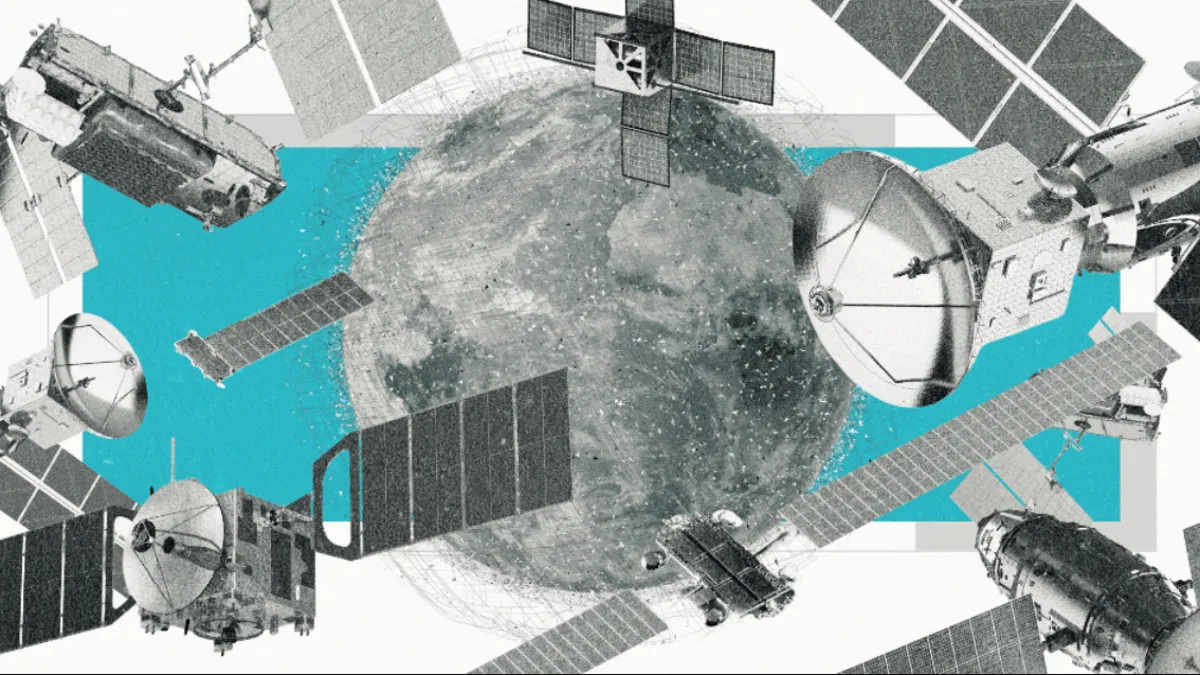
The scale is hard to overstate. At the turn of the century, there were just over 700 active satellites in space. Now, with plans for hundreds of thousands more satellites — going from 15,000 today to half a million by 2040 — the new space race is not just a visual nuisance, it’s a toxic threat to our existence.
When you look up at the night sky and wonder why the stars are moving, it’s not because you’re seeing a UFO. You’re likely looking at a satellite, and two out of every three belong to Elon Musk’s Starlink.
Starlink is capable of beaming an internet connection to a dish the size of a pizza box, virtually anywhere in the world. The company’s on track for the largest initial public offering in history, largely on the back of all those satellites cruising through the skies.
When Starlink launched its first satellite in 2019, it kicked off a gold rush in space. Amazon plans to send up 60,000 of its own satellites, Chinese companies nearly 60,000 more. Everyone across the globe, it seems, wants a piece of the sky. Rwanda alone applied for 337,320 satellites. In January, Starlink filed for a million orbital AI data centers.
Advertisement
Spacefaring countries are technically bound by the United Nations’ Outer Space Treaty of 1967, but commercial enterprises are another story. And with space increasingly seen as a new theater of war, many nation-states are racing to launch their own mega-constellations.
In this article:
The ripple effects are as far-reaching as they are uncertain.
Satellites are expected to disrupt the migratory patterns of birds, dung beetles and seals, which use the stars to navigate.
Many tons of aluminum and lithium aerosols are added to the atmosphere when satellites reach the end of their lives and burn up, eating away at the ozone layer and potentially accelerating climate change.
And, ironically, they’re also threatening to halt space exploration in its tracks, as thousands of satellites zooming at 17,000 miles per hour push us toward a chain reaction known as the Kessler syndrome, an apocalyptic feedback loop in which one collision could create thousands of pieces of debris that would then lead to more collisions.
“You cannot remove all these billions of small fragments from orbit. This will basically limit our access to space forever,” says Hanno Rein, an astrophysicist at the University of Toronto. “This is not going to go away. These small fragments will not necessarily deorbit quickly. They will stay there and make space inaccessible for future generations.”
Advertisement
As I part ways with Rawls, she seems cautiously pleased with how few satellites we saw.
“A real takeaway from our observing session is that there are not yet an overwhelming number of bright satellites,” she says. “I hope you enjoyed your relatively pristine night sky experience.”
I get the feeling that I’m being told to enjoy it while it lasts.
15,000 satellites: How we got here
The Soviet Union launched Sputnik 1, the world’s first satellite in 1957. It would take another 53 years before we passed 1,000 active satellites. Just 16 years after that, we passed 15,000.
Advertisement
Almost all of that growth is due to one company. When SpaceX launched its first batch of Starlink satellites in May 2019, there were only around 2,000 active satellites. It currently has more than 10,000 in orbit; the next closest operator is OneWeb, with 650. An average of 11 satellites have been launched every day in 2026, and with each one, the risk of collisions that generate dangerous space debris increases.
The causes for the prodigious satellite rise are complicated, but if I had to point to a single moment, I’d choose Dec. 22, 2015, the day that SpaceX landed its reusable Falcon 9 rocket for the first time.
Tharon Green/CNET/Getty Images
Before the Falcon 9, space was mostly the domain of governments, which launched bus-sized satellites for GPS and weather forecasting. Satellite internet had been around since 2003, but those earlier versions lived in geostationary orbit, around 22,000 miles above the Earth’s surface. That high altitude allowed a single satellite to cover a broader area on the ground, but slow speeds and high latency made it a last resort for most people.
Launching satellites into space is expensive. At the time the Falcon 9 first landed, Musk said it cost around $600 million to build, and another $200,000 in fuel costs to launch. Unlike all previous rocket boosters, the Falcon 9’s can be reused more than 10 times, and it doesn’t require much maintenance in between flights. That brought the launch costs down to $2,500 per kilogram, compared to $12,600 for SpaceX’s first rocket. Seemingly overnight, the economics of satellite launches became a lot more lucrative.
Advertisement
But there was a reason satellite operators had been sticking to the geostationary orbit.
“The closer you come to the Earth, the more satellites you need,” says Barry Evans, a professor of satellite communications at the University of Surrey.
Because SpaceX could reuse the Falcon 9, it was able to make use of low Earth orbit at roughly 342 miles above the ground.
Data has to travel about 60 times farther to reach GEO satellites. Starlink’s lower elevation allows it to deliver a faster connection with lower latency, but it also requires hundreds or thousands of satellites to achieve global coverage. GEO satellites can do it with just a few, though Starlink still doesn’t meet the Federal Communications Commission’s standard for minimum broadband speeds.
Starlink didn’t actually become anyone’s internet provider until 2021. By then, dozens of other companies and countries had joined the race to LEO. Amazon Leo (formerly Project Kuiper) got FCC approval for 3,236 satellites in 2020, China’s Guowang started in 2022 with a planned 13,000 satellites and OneWeb launched the first of its now complete 650-satellite constellation in 2023. So far, Amazon Leo has sent up 241 satellites and expects to start offering service in mid-2026; Guowang has 168 operational satellites in orbit.
“There’s a humongous amount of money going into these satellites,” says Jonathan McDowell, an astrophysicist who tracks satellite launches.
Advertisement
One analysis published in Science found that, between 2017 and 2022, countries collectively filed for over 1 million satellites across more than 300 separate systems.
Amazon, Google, Meta and Microsoft plan to spend $630 billion on Earth-bound data centers and AI chips in 2026 alone. But most people don’t want them — or their enormous water and electricity appetites — in their towns. One study found that electricity rates could rise 8% on average in the US through 2030 due to increased demand from data centers, along with cryptocurrency generation.
Moving them to space would solve the “not in my backyard” problem, and it would theoretically negate their massive water and energy consumption on Earth. As Musk put it recently, “Space has the advantage that it’s always sunny.”
Advertisement
SpaceX hasn’t received the green light yet for its million data centers, but FCC Chair Brendan Carr publicly voiced his approval. There’s currently no timeline for the plan, and SpaceX did not respond to my request for comment, but Musk said on a podcast in January that “in 36 months, probably closer to 30 months, the most economically compelling place to put AI will be space.”
I was met with a lot of raised eyebrows when I asked satellite experts about SpaceX’s plan for 1 million data centers.
Advertisement
“I don’t really think they’re going to do a million anyway. I think it’s going to be more at the 100,000 level. But I’m still very worried about 100,000 and whether that’s sustainable,” says McDowell. “Yes, technically, we can put them up there. But do we really want to?”
These data center satellites will be much larger than the Starlink satellites that beam internet connections back and forth from Earth. Recent comments from Musk indicate they’ll be around 560 feet long — more than five times the size of the most common Starlink satellites in the sky currently.
Tharon Green/CNET/Getty Images
“We have a couple trends happening at the same time that are concerning. Satellites are starting to get big again, and we’re getting more of them,” says Darren McKnight, senior technical fellow at LeoLabs, a company that tracks objects in orbit.
Tim Farrar, a satellite industry consultant, described the million data centers proposal as the latest in a long line of use cases SpaceX has floated for its Starship rocket, which is still in its prototype phase, from delivering military cargo to international travel via rocket. The Starship is roughly four times bigger than the Falcon 9 and capable of carrying as much as 150 tons to low Earth orbit, but in testing it has exploded on launch roughly half the time.
Advertisement
“To justify making thousands of Starships when they’re reusable, you need to launch them very, very frequently,” says Farrar. “He’s now found this very fortunate confluence of AI demand and issues associated with permitting on the ground.”
‘The new theater of defense’
In mid-2025, Musk called Starlink “the backbone of the Ukrainian army.”
Musk was urging an end to the war with Russia, and he wasn’t wrong that Starlink had been instrumental in Ukraine’s military operations. By that point, the Ukrainian army had been using Starlink for more than three years to fly drones, course-correct artillery fire and help troops communicate.
Advertisement
It was an early indicator that Starlink had grown beyond its mission of providing internet connections to rural areas. It was now one of the most coveted tools in a modern military’s arsenal.
Starlink’s involvement in wars on Earth is just the beginning. It’s going to become a military target in space, as will satellites used for GPS, reconnaissance and missile warnings.
“Space has become a new theater of defense,” says Joanna Darlington, chief communications officer at Eutelsat, the company that owns OneWeb. “You start getting terrestrial infrastructure destroyed, or submarine cables cut, or satellites jammed by your enemies. The only quick fix for that is satellite today.”
Advertisement
Musk’s involvement was unusually hands-on for an executive at a private company. In mid-2022, the SpaceX CEO denied Ukraine’s request to activate Starlink in Russian-occupied Crimea, citing concerns about escalation. Russia has also reportedly used smuggled Starlink terminals to extend the range of its drone strikes. Musk said in a Jan. 31 post that SpaceX had stopped the use of unauthorized Starlink by Russia.
Soon after, Russia reportedly began working on a missile system capable of hitting Starlink satellites in orbit and creating orbital clouds of debris that would disable multiple satellites at once.
Advertisement
“They become legitimate targets because of the geopolitical influence they have,” says Hugh Lewis, a professor of astronautics at the University of Birmingham. “It’s no longer just about providing someone in their apartment fast internet.”
It already tested one such weapon in 2021, when it intentionally destroyed one of its own defunct satellites. That event alone created more than 1,500 pieces of debris larger than a softball and likely hundreds of thousands of smaller pieces, forcing astronauts in the nearby International Space Station to shelter in capsules.
And Chinese anti-satellite technology has advanced so far that it can now threaten any US satellite in low Earth orbit, and likely also those in medium Earth orbit and geostationary orbit, one report from the Center for Strategic and International Studies determined.
What scientists are concerned about
Tharon Green/CNET/Getty Images
The causes fueling the satellite space race are many and diverse, and so are the effects. Scientists have voiced concerns about a number of unintended consequences that could spring from sending so much metal into orbit.
Advertisement
“We have concerns about the atmosphere, we have concerns about space traffic management. We have concerns about astronomy and concerns about radio interference,” McDowell says. “All of these things become significantly worse at 100,000 and really, seriously problematic.”
Some of them we’re already seeing, and some can only be calculated in a lab and projected into the future.
Earth’s atmosphere as a space dump
Space debris is nothing new, and Russia isn’t the only country that’s been turning low Earth orbit into a garbage dump.
The US destroyed a failing reconnaissance satellite of its own in 2008, and India followed suit in 2019, but those tests produced far fewer — and long-lasting — pieces of debris than Russia’s 2021 test that put ISS astronauts in jeopardy.
Advertisement
But when I talk to astronomers who spend a lot of time thinking about space debris, it’s clear that one event haunts them more than the others.
In 2007, China blew up a weather satellite, creating the largest debris cloud in history. Overnight, 3,533 pieces of softball-or-larger pieces of metal were added to low Earth orbit, and an estimated 150,000 smaller objects. Before the test, there were fewer than 8,000 tracked objects in LEO altogether.
Tharon Green/CNET/Getty Images
“That one single test increased orbital debris by one third. And that’s still up there,” says Sven Bilen, an engineering professor at Penn State University.
The Secure World Foundation estimates that 2,351 pieces of debris from that single day in 2007 are still in orbit. The Chinese satellite was in orbit 537 miles (865 kilometers) above Earth when it was blown up, compared to the roughly 310 miles (500 kilometers) at which most Starlink satellites operate. That higher altitude means the debris would take longer to be pulled into the Earth’s atmosphere, where it would burn up.
Advertisement
“It’s an exponentially varying atmosphere. By the time you get to 750 kilometers, it’s up there for decades to centuries,” says McKnight. “At 450, 500 kilometers, you’re talking weeks to months.”
It’s worth acknowledging here that space is huge, and 25,000 softball-sized objects zooming hundreds or thousands of miles above our heads doesn’t seem like such a big deal. The problem comes when those objects start occupying the same space as the 15,000 active satellites in orbit.
With space debris moving about 10 times faster than a bullet, even a softball-sized object hitting a satellite would be devastating. That impact would create many more softballs, which could take out even more satellites. This apocalyptic feedback loop is called the Kessler Syndrome, and the scientists I spoke to agree that it’s just a matter of when, not if, it happens.
“We don’t know where we are on that curve, but at some point, every piece of hardware that you put up there is going to be more likely than not to generate additional debris,” Bilen says. “It becomes a runaway phenomenon.”
Advertisement
“If we keep doing what we are doing right now, which is almost nothing, it’s very likely,” Bilen adds. “I don’t know when, but it’s very likely.”
Almost every astrophysicist I spoke with mentioned the 2013 movie Gravity, which famously dramatized a Kessler syndrome-like scenario, depicting astronauts forced to abandon their space shuttle as a debris cloud swarms them. They emphasized that it won’t manifest as a single catastrophic moment like that, but will instead take place over years, as space slowly becomes deadly for astronauts and satellites alike.
Advertisement
“We’re boiling the frog. It’s increasing slowly, and all of a sudden we’ll get to a point and go, ‘Wow, that’s really bad,’” says McKnight. “There are indicators that we’re getting closer, indicators that the timeline is shrinking.”
Satellites maneuver to avoid collisions
Despite some close calls, satellites have so far been exceptionally nimble at avoiding space debris.
When Starlink first launched in 2019, it made a “collision avoidance” maneuver if the probability of impact was greater than 1 in 100,000 — the same number that NASA uses for human spaceflight. Starlink has since moved that number to a more conservative 3 in 10 million.
But even with that more conservative threshold, its satellites still made about 300,000 maneuvers last year alone — an increase from around 200,000 in 2024. Depending on who you ask, that number is evidence of Starlink’s spotless safety record or an unsustainably high number of moving satellites.
Advertisement
If Starlink achieved its goal of 1 million orbital data centers, that would add up to 272 million maneuvers a year, or nine every second, according to Hugh Lewis, the astronautics professor.
“The very fact that you have to maneuver degrades your ability to detect whether you need to maneuver,” says Lewis. “Anybody else who wants to operate in that environment is going to be looking at this fuzzy ball of stuff that’s always moving.”
There’s also a risk of solar storms disrupting satellites’ ability to maneuver. These blasts from the sun occur when twisted magnetic fields reach their breaking point, sending bursts of energy throughout the entire solar system.
“We can predict these events sometimes, but certainly not always,” says Sascha Meinrath, professor of telecommunications at Penn State University. “They can rapidly — and by rapidly, I mean, within minutes to hours — dramatically increase the scale of atmospheric drag.”
In response, Starlink’s satellites autonomously adjust their altitude. Neighboring satellites make their own adjustments, and it can take three to four days before they’re stabilized at their original altitudes.
Advertisement
A paper published in December described this as an “orbital house of cards.” The authors estimated that it would take 5.5 days for a “catastrophic collision” to occur if maneuvers stopped or severe situational awareness loss occurred due to an event like a solar storm. In 2018, the year before Starlink launched its first satellites, that number was 164 days. In the four months since the paper was first submitted, the clock has dropped to just three days. (The paper has not been peer-reviewed.)
Three days is already an alarmingly short period of time to avoid “catastrophic outcomes.” What happens if we go from 15,000 satellites to millions?
Space junk doesn’t always stay in space
The Earth’s stratosphere acts as a great filtering system for those of us on the ground. But just as some meteors survive the trip, space debris doesn’t always stay in space. As more rockets are launched and more satellites are deorbited, the likelihood of a piece of them reaching Earth increases.
Tharon Green/CNET/Getty Images
A January 2025 paper published in Scientific Reports determined that there’s a 26% chance each year that a piece of spacecraft will pass through some of the world’s busiest airspace. When they factored in planned megaconstellations from companies like SpaceX and Blue Origin, the probability of a fatal aircraft collision with reentry debris increased to 7 in 10,000 per year by 2035.
Advertisement
“You hit what’s known as the law of truly large numbers,” says Lewis. “Even if it’s a really, really low likelihood, enough opportunities means it’s going to happen.”
And it has already happened, with alarming frequency. According to NASA, an average of one cataloged piece of debris fell back to Earth every day during the last 50 years. Most of this lands harmlessly in oceans or remote areas — NASA says that “no serious injury or significant property damage” has been confirmed — but a January study published in Science noted that the risks are growing with an increasingly crowded orbit.
A 2022 study published in Nature Astronomy put the danger in starker terms, noting that there’s a 10% chance that someone is killed by space debris over a decade. It also cautioned that this is a conservative estimate given the acceleration of rocket launches.
“It’s fairly difficult to always have a controlled re-entry. As I like to say, we want to have a splash, not a thud,” says McKnight.
In other words, operators should aim to deorbit satellites “over the open ocean, away from populated islands and heavily trafficked airline and maritime routes.” Debris from rocket launches is necessarily closer to civilization. NASA guidelines for debris re-entry say the risk of a human casualty should be less than 1 in 10,000.
Advertisement
“As you get more and more satellites up there, more and more rockets, more and bigger payloads, if this trend is going to hold true, that’s going to be more and more difficult to adhere to,” says McKnight. “If you have enough events, somebody’s going to get hurt.”
CNET/Tharon Green
Taking out the orbital trash
One way to clean up space debris is to steer satellites toward the atmosphere, where they burn up. With constant propellant needed to overcome atmospheric drag, most satellites in low Earth orbit only last around five to eight years. SpaceX deorbits its Starlink satellites after roughly five years in the sky.
“Deorbiting” is a benign word for a violent process. When a Starlink satellite hits the end of its life, SpaceX operators activate a “drag sail,” which is essentially a kite that slowly pulls the satellite closer to Earth. When it reaches the dense upper atmosphere after a few months, the satellite is incinerated. It’s a spectacular sight from the ground — a fireworks grand finale on a cosmic scale.
Starlink’s satellites weigh roughly as much as a Honda Civic, and an average of almost two were deorbited every day last year.
Advertisement
And scientists fear those burnups could be doing irreparable damage to our atmosphere. As old satellites are ignited on reentry, the plastics and carbon-fiber composites in them release particles of black carbon — the same sooty material produced by a campfire — as well as metals like aluminum and lithium.
“You’re putting a gray blanket in the stratosphere, which is absorbing and heating up aluminum,” says Rajan Chakrabarty, a chemical engineering professor at Washington University in St. Louis who researches the effects of aerosols on the atmosphere. “This extra heat is just going to cause imbalance.”
We’ve only recently started seeing them reach the end of their lives in significant numbers, but scientists are already observing the effects.
One study funded by NASA and published in Geophysical Research Letters in mid-2024 found that a 550-pound satellite releases about 66 pounds of aluminum oxide nanoparticles when it’s deorbited. These nanoparticles grew eightfold from 2016 to 2022, before the satellite space race kicked off in earnest. The most common Starlink satellites weigh 2,750 pounds each; the next generation will weigh 4,409 pounds.
“We projected a yearly excess of more than 640% over the natural level. Based on that projection, we are very worried,” Joseph Wang, one of the authors of the Geophysical Research Letters study, told me in an interview last year, referring to the presence of aluminum particles.
Samples taken in 2023 by scientists with the National Oceanic and Atmospheric Administration — before satellites started getting deorbited en masse — found aluminum and exotic metals embedded in about 10% of the stratosphere. They estimated that this could grow to 50% “based on the number of satellites being launched into low Earth orbit.”
Advertisement
The ripple effects of all this are still unclear. Huge amounts of black carbon could absorb incoming sunlight or scatter it; it could even change how heat moves around the climate system. The many tons of metallic aerosols added to the atmosphere could actually help cool the planet. (Some geoengineering scientists have even proposed this as a solution to climate change.) Another study determined that the warming effect of black carbon could raise stratospheric temperatures by as much as 1.5 degrees Celsius.
Perhaps the most worrying unknown is how this will affect the Earth’s ozone layer, a section of the stratosphere that absorbs radiation from the sun. According to the EPA, ozone depletion leads to health issues like skin cancer, cataracts and weakened immune systems, as well as reduced crop yield and disruptions in the marine food chain.
“We are shooting in the dark. We really don’t know what’s going to happen,” says Chakrabarty. “These things change slowly, and most of the changes are irreversible. It might not be tangible to our eyes, but by the time we feel the effects of a changing climate, it’s going to be too late.”
Wild West: Who is governing the satellite ecosystem?
For as long as humans have been launching objects into orbit, there’s been an effort to set up international guardrails. A year after the Soviet Union launched Sputnik 1, the United Nations established the Committee on the Peaceful Uses of Outer Space.
Advertisement
The committee’s early meetings were filled with a sense of guarded optimism about the possibilities for international cooperation that satellite communication could open up. Their grasp of the challenges ahead was equally prescient. At its third meeting in 1962, USSR ambassador Platon D. Morozov accurately charted the dilemma we’re facing today.
“As more and more satellites and other scientific instruments are being launched every year, and since the number of countries conducting such experiments is bound to increase, it becomes important to establish juridical provisions,” Morozov said. In other words, space activities need rules.
Four years later, the Outer Space Treaty was signed by the US, the USSR and the UK, with a core principle stating that “states shall avoid harmful contamination of space.”
Tharon Green/CNET/Getty Images
That spirit of international cooperation has since waned. In theory, the Outer Space Treaty sets the rules, and individual governments are responsible for enforcing them. But that obligation has often taken a backseat in the US.
Advertisement
“In practice, it’s not quite a rubber stamp, but I wouldn’t describe the FCC’s reviews as especially adversarial,” McDowell says. “Although they do talk about preserving the environment, it doesn’t seem to me to be as high a priority as making money.”
Satellite operations are coordinated globally through the UN’s International Telecommunication Union, which regulates things like spectrum allocation, frequency assignments and orbital positions. What it doesn’t do is coordinate space traffic or instill environmental guidelines.
Advertisement
“There’s no common understanding in terms of what’s right of way in space,” says Victoria Samson, chief director of space security and stability for the Secure World Foundation. “If they can both maneuver, who moves?”
When Starlink was essentially alone in low Earth orbit, this wasn’t much of an issue. They were largely self-policing, but they were widely considered to be responsible operators. But as more and more countries plan their own mega-constellations, frictions have risen to the surface.
In June last year, the European Union proposed a new Space Act, which would require satellite operators to address issues like space debris and collision avoidance. It’s not expected to be adopted until late 2028.
The US State Department responded by saying it has “deep concern” about the “unacceptable regulatory burdens” the legislation would impose on satellite operators. FCC Chair Brendan Carr went as far as to say the US would retaliate if the act is passed. Representatives from the FCC didn’t respond to my requests for comment.
Advertisement
“We just want to make sure that every satellite operator gets a fair shake in Europe,” Carr said at a telecom conference in March. “If Europe wants to go in a different direction, there are European satellite operators that do business in America, and we’ll mirror the regulatory approach that Europe wants to take.”
The tit-for-tat highlights the challenges of regulating an industry whose infrastructure lives a thousand miles above our heads. Nations can decide which companies are allowed to sell satellite services within their borders; it’s another thing to mandate that they behave a certain way in space.
“There are few industries where there’s a global regulatory body,” says Joanna Darlington, the Eutelsat communications officer. “This is the challenge of space, because it doesn’t belong to anyone.”
Why satellites are here to stay
Like it or not, satellites are here to stay, and we’re increasingly reliant on them for disaster relief, emergency response, environmental monitoring, agriculture production and everyday navigation. There’s also Starlink’s 10 million customers around the world, many of whom had never had a modern internet connection before SpaceX launched all those satellites into orbit.
Advertisement
But as wildly successful as the low Earth orbit satellite era has been, it could be creating the conditions for its own demise as space debris keeps accumulating.
“Orbital debris mitigation and cleanup is a massive, massive challenge,” says Bilen. “We can’t even clean up the great garbage patch of the Pacific Ocean, which is right here on the surface of the Earth. Now imagine trying to do that in space.”
Meredith Rawls, the University of Washington astronomer, reminded me that there is one precedent for the global community coming together to tackle a seemingly insurmountable problem: the 1987 Montreal Protocol. The landmark agreement phased out chlorofluorocarbons from household products that had opened a hole in the ozone layer, leading toward a full recovery expected by 2066. Nearly 40 years later, it’s still the only UN treaty ratified by every country on Earth.
Ironically, that recovery is now in danger of being reversed by the satellite space race.
“I actually like the ozone layer as a success story of international cooperation,” Rawls says. “We fixed a thing! Countries worked together to notice something was broken.
At AXPONA 2026, the EarGear section was filled with the usual heavyweight brands, but a smaller name managed to stand out. Audma may be a new company on paper, founded in 2024, but its story reaches back to 1978 when Cesare Mattoli began chasing a stubborn idea: getting headphones to sound more like speakers in a room.
For decades, that goal remained out of reach. Mattoli built and rebuilt designs that never quite delivered, held back more by the limits of available technology than a lack of vision. That changed in 2022 with the arrival of ELISA, the Electronic Loudspeaker Imaging Simulating Amplifier, which finally brought his concept into focus. The company later rebranded as Audma in 2024, keeping ELISA as the core technology behind its products. Since then, Audma has introduced two amplifiers, the Maestro HPA1 desktop model and the Brioso PHPA1 portable, both demonstrated at AXPONA as a different way to tackle soundstage without changing your headphones, just the signal path.
Audma Maestro HPA1
While most headphone manufacturers try to squeeze more space out of their designs by tweaking cup geometry, airflow, and damping materials, Audma takes a different route. Its approach centers on delay line processing at the amplification stage, shaping how the signal reaches each ear rather than altering the headphone itself. The idea is straightforward: keep your existing headphones and source, insert one of Audma’s amplifiers into the chain, and let the processing do the heavy lifting in creating a more speaker like presentation.
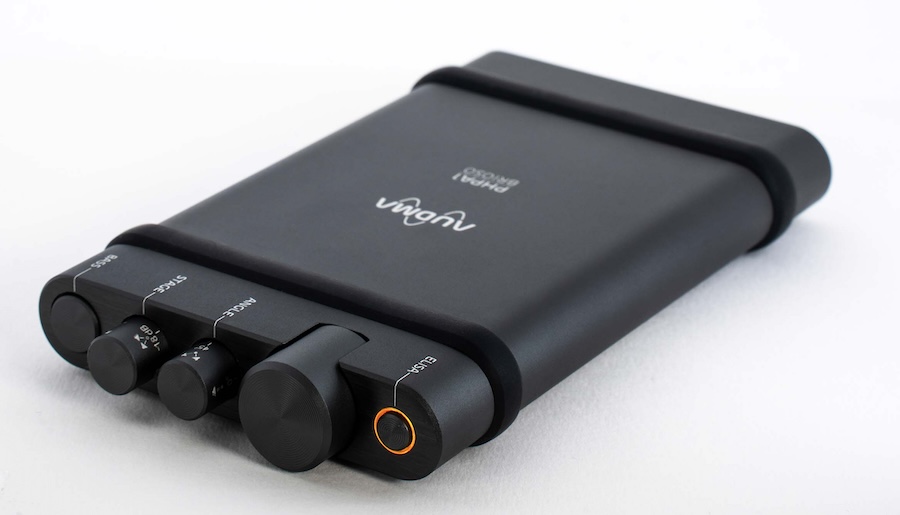
Audma Brioso PHPA1
How Audma ELISA Reworks Spatial Cues Inside Your Headphones
The ELISA circuitry uses delay line processing to create an image that more closely approximates what a listener hears with speakers or live music. One of the core issues it addresses is that headphones separate channels too well. In real world listening, the brain determines direction and distance based on the time delay between when a sound reaches each ear and the reduction in level at the farther ear.
Advertisement
With headphones, that mechanism is largely lost because each channel is delivered almost entirely to one ear. Some amplifiers and digital audio players attempt to compensate with crossfeed. Crossfeed mixes a portion of each channel into the other with reduced level and a slight delay so that both ears receive both signals, more like real listening conditions. Different implementations vary the amount of delay and level, which is why reactions to crossfeed tend to be mixed.
Audma builds on that same principle but with a more advanced approach. ELISA allows adjustment of both delay and perceived direction rather than just blending the channels. On both the desktop and portable amplifiers, listeners can control the apparent distance and angle of the sound, effectively expanding or narrowing the stage and shifting their position relative to it. In practice, that means you can move closer to the performance or further back by making a few adjustments, rather than changing headphones.
ELISA Enabled Products
Audma Maestro HPA1 rear
The Maestro was Audma’s original release and is designed to function as both a headphone amplifier and a preamp. Connectivity is extensive, with XLR, RCA, coaxial, optical, and USB inputs, along with both RCA and XLR outputs. The chassis follows a fairly standard full size footprint at 16 x 4.5 x 16 inches (W x H x D) and is available in either brushed metal or black, with weight ranging from roughly 20 to 25 pounds depending on configuration.
On the digital side, the Maestro incorporates an AKM 4499REQ DAC capable of up to 768 kHz/32-bit PCM and DSD256, making it a serious standalone DAC as well. As a headphone amplifier, it offers an output impedance of 6 ohms and six selectable gain levels at 0, +6, +12, +18, +24, and +30 dB, allowing it to accommodate a wide range of headphones. Output power is rated at 4 watts into 32 ohms and 8 watts into 300 ohms, and it had no issue driving 600 ohm headphones during the demo, including a borrowed Beyerdynamic headphones.
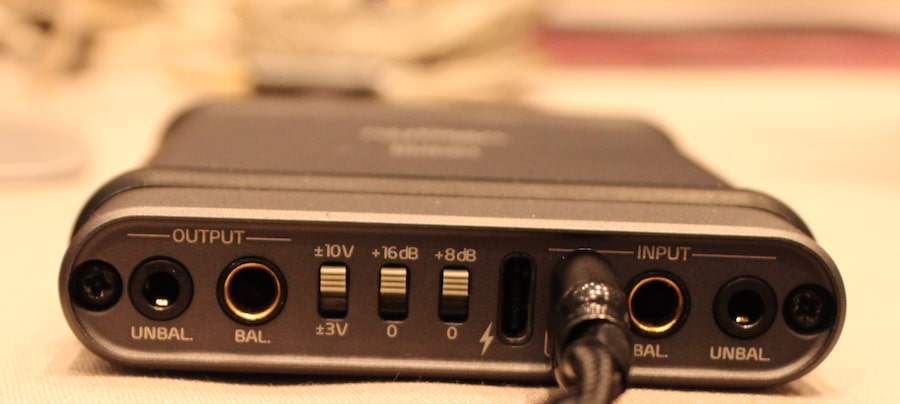
Audma Brioso PHPA1 (rear)
Along with the standard controls and ELISA stage and angle adjustments, the Maestro also includes phase control, giving the listener another layer of tuning to better match personal preference and system synergy.
Advertisement
The portable Brioso PHPA1 offers both headphone amplifier and DAC functionality but drops the preamp role in favor of battery operation. Its size and shape are roughly comparable to a Samsung Galaxy S25+, measuring about 3 inches wide, three quarters of an inch thick, and just under 6 inches tall. Weight comes in at around half a pound, making it easy enough to carry on a daily basis.
Internally, it uses the AKM 4499EXEQ DAC paired with the 4191EQ modulator, supporting up to 768 kHz PCM and DSD256. For those who prefer an external DAC, both 3.5 mm and 4.4 mm analog inputs are included. The amplifier section provides four gain settings at 0, +8, +16, and +24 dB, with output power rated at 4 watts into 32 ohms and 5.4 watts into 150 ohms, which is more than enough for the vast majority of headphones.
Advertisement. Scroll to continue reading.
Battery life is rated at up to 5 hours per charge, depending on listening levels, DAC usage, and headphone load.
Advertisement
Both Audma amplifiers are priced at approximately $5000 USD and are available directly from Audma or through select distribution partners.
The Bottom Line
Audma is chasing something most headphone brands only nibble at from the edges. By moving spatial processing into the amplification stage, ELISA offers a level of control over stage width, depth, and positioning that goes well beyond typical crossfeed. It’s clever, and in the right setup, it works.
The problem is the price of entry. At around $5000, you’re being asked to rethink your entire signal chain for an effect that some headphones, like the Grell OAE2, already attempt to deliver for well under $500. No, they don’t offer the same level of adjustability or precision, but the gap in cost is hard to ignore.
If ELISA delivers on its promise in a controlled environment, Audma might be onto something genuinely different. But at this level, different isn’t enough. It has to be indispensable.
We’ll start things off this week with a story that’s developing more than 25 billion kilometers from Earth — on Friday, NASA announced that the command had been sent to shut down Voyager 1’s Low-energy Charged Particles (LECP) instrument. As the power produced by the spacecraft’s aging radioisotope thermoelectric generator (RTG) continues to dwindle, engineers at the Jet Propulsion Laboratory have been systematically turning off various systems to extend the mission for as long as possible. It’s believed that deactivating LECP should buy them another year, during which engineers hope to implement a more ambitious power-saving routine. If this sounds a bit familiar, you’re probably thinking of Voyager 2. The plug was pulled on its LECP instrument back in March of 2025.
The JPL engineers hope that their new plan may allow them to reactivate previously disabled systems on the twin space probes, but even if everything goes according to plan, there’s no fighting the inevitable. At some point, there simply won’t be enough juice in the RTGs to keep the lights on. Although it’s going to be a sad day when we have to bring you that news, surviving a half-century in space is one hell of a run.
Speaking of ending a run, just a week after Amazon announced that pre-2012 Kindles would no longer be supported, the company is letting users know that the Kindle software for PCs will be discontinued in June. In its current form, at least. As Good e-Reader reports, Amazon is developing a new client for users who want to access the Kindle ecosystem from their computers, but it will only run on Windows 11. Since older software could be used to strip DRM from purchased ebooks, it seems likely this is another attempt to lock the platform down.
Because, of course, people post car crashes on Facebook.
We’re not fans of arbitrary limits being placed on ebooks and the devices that read them, but on the other hand, there are definitely systems out there that could stand to be tightened up a bit. For example, research out of Quarkslab has shown that the electronic control unit (ECU) from a wrecked vehicle can reveal a surprising amount of information.
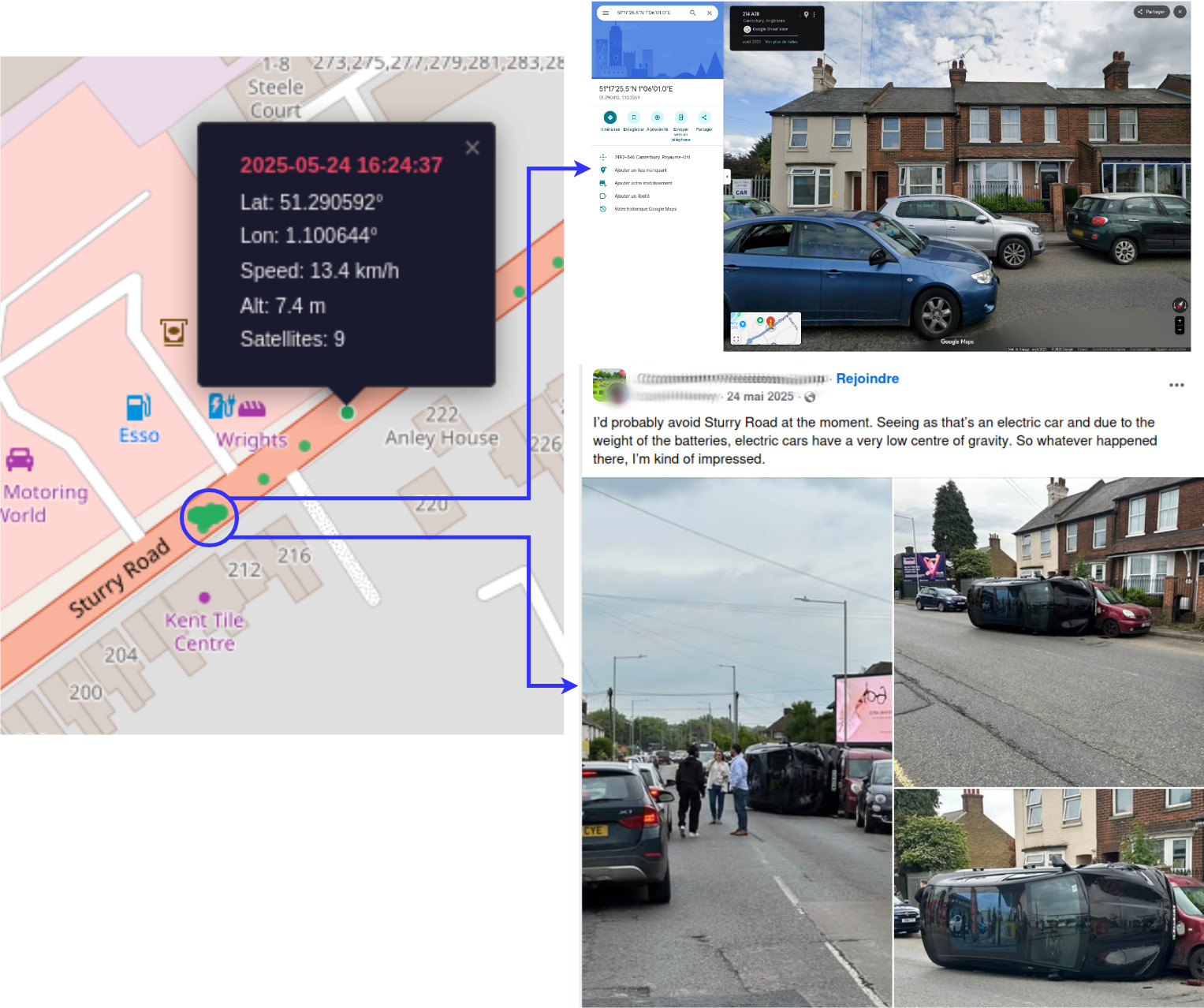
After picking up a used ECU, they were able to dump its NAND flash chip and decode the log files it contained. It turns out the car had GPS logs going back to the day it rolled off the assembly line, and the researchers were able to reconstruct every trip it ever made.
Advertisement
By cross-referencing the last recorded coordinates with social media posts, they were even able to find pictures of the crash that took the vehicle out of commission. It’s bad enough that personal information can be scraped off of secondhand hard drives; now we’ve got to worry about what happens to our cars after they get hauled off to the junkyard.
If these are the sort of stories that keep you on two wheels rather than four, you may be interested in the latest innovation from Škoda Auto. In an effort to reduce collisions with pedestrians, they’ve developed a bike bell that penetrates active noise cancellation (ANC) systems. The logic goes like this: if someone is walking around with headphones that feature ANC, they might not hear the bell of an approaching bike. So they teamed up with researchers from the University of Salford to essentially find the weaknesses in existing ANC systems.
As you might have guessed, irregular noises are harder to block out than constant tones. Researchers uncovered a gap between 750 and 780 Hz where sounds could sneak through. The mechanical bell uses both principles to defeat ANC, and in testing, it was shown to provide headphone-wearing pedestrians more time to react to an approaching bicycle.
Finally, we’ll bring this week’s post full circle by starting and ending on a space story: earlier this week, PBS released the hour-long documentary Artemis II: Return to the Moon on YouTube. Watching PBS programming on YouTube might seem a bit odd, but that’s the world we live in these days. At any rate, the video is a fascinating look into what went into the recently concluded Moon mission and has us even more excited for Artemis III and beyond.
Advertisement
See something interesting that you think would be a good fit for our weekly Links column? Drop us a line, we’d love to hear about it.
Looking for the most recent Connections answers? Click here for today’s Connections hints, as well as our daily answers and hints for The New York Times Mini Crossword, Wordle, Connections: Sports Edition and Strands puzzles.
Today’s NYT Connections puzzle is pretty tricky. It was a little unnerving to see “cannibalism” as one of the clues. Read on for clues and today’s Connections answers.
The Times has a Connections Bot, like the one for Wordle. Go there after you play to receive a numeric score and to have the program analyze your answers. Players who are registered with the Times Games section can now nerd out by following their progress, including the number of puzzles completed, win rate, number of times they nabbed a perfect score and their win streak.
Here are four hints for the groupings in today’s Connections puzzle, ranked from the easiest yellow group to the tough (and sometimes bizarre) purple group.
Anyone looking to upgrade to the next Mac Studio or MacBook Pro might have to wait a little longer, thanks to the ongoing global memory shortage. As reported by Bloomberg‘s Mark Gurman, “at least two of the company’s upcoming machines … could debut a little later than the company initially planned,” referencing the refreshes to Apple’s desktop and its laptop that’s expected to get a touchscreen.
Bloomberg reported that the upcoming Mac Studio, which follows up the current lineup in the M4 Max and M3 Ultra configurations, was first expected to release in the middle of the year. However, Apple is already dealing with shortages of its existing Mac Studio stock, likely due to the device being a popular choice for anyone running local AI models. With no stop to the shortage in sight, Gurman predicted that the refreshed Mac Studio’s release could be postponed to around October instead.
It’s not just Apple’s desktop offerings being affected. Gurman also reported that the release of the next MacBook Pro could be delayed. While Gurman said the release timeline of the touchscreen MacBook Pro could be between the end of 2026 to early 2027, he’s now predicting that it would arrive toward the later end of that timeline. Of course, Apple isn’t the only consumer tech company heavily affected by the RAM shortage. However, Apple can at least take advantage of its successful MacBook Neo release amidst the memory shortage crisis affecting all laptop makers.
Live Science spoke with physicist David Gross, who today received the $3 million “Special Breakthrough Prize in Fundamental Physics”. He was part of a trio that won the 2004 physics Nobel prize for research that helped complete the Standard Model of particle physics. But when asked if physics will reach a unified theory of the fundamental forces of nature within 50 years, Gross has a surprising answer. “Currently, I spend part of my time trying to tell people… that the chances of you living 50 [more] years are very small.”
Cold War estimates for a 1% chance of nuclear war each year seem low, Gross says. “The chances are more likely 2%. So that’s a 1-in-50 chance every year.”
David Gross: The expected lifetime, in the case of 2% [per year], is about 35 years. [The expected lifetime is the average time it would take to have had a nuclear war by then. It is calculated using similar equations as those used to determine the “half-life” of a radioactive material.]
Live Science: So what do you suggest as remedies to lower that risk?
Advertisement
Gross: We had something called the Nobel Laureate Assembly for reducing the risk of nuclear war in Chicago last year. There are steps, which are easy to take — for nations, I mean. For example, talk to each other. In the last 10 years, there are no treaties anymore. We’re entering an incredible arms race.
We have three super nuclear powers. People are talking about using nuclear weapons; there’s a major war going on in the middle of Europe; we’re bombing Iran; India and Pakistan almost went to war. OK, so that’s increased the chance [of nuclear war]. I would really like to have a solid estimate — it might be more, and I think I’m being conservative — but a 2% estimate [of nuclear war] in today’s crazy world.
Live Science: Do you think we’ll ever get to a place where we get rid of nuclear weapons?
Gross: We’re not recommending that. That’s idealistic, but yes, I hope so. Because if you don’t, there’s always some risk an AI 100 years from now [could launch nuclear weapons], but chances of [humanity] living, with this estimate, 100 years, is very small, and living 200 years is infinitesimal. So [the answer to] Fermi’s question of “Where are the civilizations, all the intelligent organisms around the galaxy, and why don’t they talk to us?” is that they’ve killed themselves…
Advertisement
There are now nine nuclear powers. Even three is infinitely more complicated than two. The agreements, the norms between countries, are all falling apart. Weapons are getting crazier. Automation, and perhaps even AI, will be in control of those instruments pretty soon… It’s going to be very hard to resist making AI make decisions because it acts so fast. He points out that with the threat of climate change, “people have done something,” even though “It’s a much harder argument to make than about nuclear weapons.
“We made them; we can stop them.”
Thanks to hwstar (Slashdot reader #35,834) for sharing the article.
There’s something to be said about brand recognition — being able to tell what one car is from another at a glance. Companies have their trademark “looks” befitting certain models, sure — Jeep Wranglers are always boxy 4x4s with the seven-slotted grille and Ford Mustangs have the triple-taillight and a fastback coupe body shape. And these trends generally carry on from one generation to the next — a modern Wrangler still bears a superficial resemblance to the old TJ Wrangler from the 1990s, for instance. But every now and then, you get manufacturers trying something new. Whether it’s reusing a name on a brand-new platform or just a total ground-up redesign, sometimes you’re simply baffled to see the same logo on two seemingly completely different cars.
This is actually way more common than one might think. Take the Dodge Challenger, for instance, which went from a pony car in the early 1970s to a rebadged Mitsubishi Galant of all things. There are a few instances of this practice rearing its head, generally when automakers are chasing trends or undergoing large platform changes. An example of the latter is the Dodge Ram, which went from a Spartan, functional pickup in the 1980s to arguably the first modern production pickup truck in 1994.
Advertisement
We don’t see it as often today, with designs focusing more on minimalism and safety. But there are a few newer cars out there that will make you go, “Wait, it looked like that just one generation ago?” Let’s dive in and have a look.
Advertisement
Chrysler 300
What’s the first thought that comes to your mind when you think of the name “Chrysler 300?” Because the answer is generally all over the place; these cars (sadly now discontinued) once began life as midsize 1950s luxury sedans. Then they evolved into 1960s luxury sedans, then 1970s luxury sedans, and so on — the trend ran right up to their ultimate demise. But while these cars never changed their intended purpose, they most certainly changed their looks. Because the modern 2005-2023 Chrysler 300’s father is actually just a fancier Sebring — identical body shape and all, to the point where you’d be forgiven for mistaking the two without the presence of the badge.
Okay, granted, that badge reads “300M,” but it’s a Chrysler 300 — a car which, like its predecessors, prides itself on being refined and luxurious. Although you won’t find a Hemi anywhere near this car (unless you’re a lunatic who swapped in a remarkably inexpensive Hemi crate engine). Instead, you’ll find that classic Pentastar V6 in 3.5L form married to a front-wheel drive setup, all housed underneath a remarkably well-rounded body shell. It was Chrysler’s thing at the time; we all know that look from the Town and Country minivans.
The mid-2000s marked a pivotal period for Chrysler (and Mopar as a whole), with the entire range undergoing massive redesigns. These included the debuts of the new Jeep Wrangler JK in 2007, the Dodge Magnum in 2005, and many others. For the 300, it meant going from FWD budget luxury to intimidating, Hemi-powered RWD aspiration piece, a move that became so iconic that the car remained nearly unchanged right up until it was discontinued.
Advertisement
Chevrolet Corvette
Jonathan Weiss/Shutterstock
This one is also fairly obvious when you look at it, especially considering this was the first time we’ve ever seen a mid-engine Corvette in dealerships. It’s a car that has arguably marred a silhouette that was well over 50 years old, with the classic front-engine, rear-drive grand tourer coupe layout solidifying in 1963 with the Stingray fastback. Those classic lines of the long hood and sweeping rear end met their demise with Chevrolet’s modern rendition, for better or worse, marking a shift in design philosophy never before seen in the lineup — going from a grand touring sports car to supercar.
Typically the Corvette filled the niche of the former: a sports car. It was less money, less hassle, more practical, and generally more common than a lot of other high-performance vehicles of its era. Even today, you’re more likely to see a Corvette cruising down the highway than, for instance, a Lamborghini that’s more than double the cost (depending on where you live). But modern “fast cars” have a new image attached to them; think of modern Ferraris, the Audi R8, and so on. These are cars which typically command six-figure sums and hit 60 in three seconds or less. But not the Corvette (at least the base model).
The original design was revolutionary for the time, being marketed as “America’s First Sports Car.” And it’s a classic template, one which could easily continue into the future. But GM chose to depart from the “sports car” label, leaving us with what is ostensibly America’s budget supercar. Recognizable in name and performance, but hardly a trace when it comes to aesthetic presentation.
Advertisement
Dodge Charger
This was probably one of the most startling and controversial redesigns of the past couple years, with the Charger going from a pure-bred modern muscle car to a two-door EV (with the Hurricane turbocharged straight six available in model year 2026 onwards). Some might call it blasphemous to release a muscle car with no V8 option available for the masses, but whatever you think about the powertrain, it still wears the Charger badge — and looks almost nothing like its predecessor, with only a passing resemblance in four-door form.
Advertisement
Granted, the Charger was never exactly a svelte sports car in terms of its looks (as you can see in each generation). It was more of a brick on wheels than anything. The original Charger was a full-size sleeper coupe, looking more like a salesman’s car from the outside but potentially hiding a massive engine under the hood. The second-gen is what we generally think of when we hear of a classic Charger, but they both share certain key traits like that iconic, stone-faced grille and fastback roof. The modern Charger takes these elements and reimagines them in a 2020s context, returning the two-door configuration, flat nose, and vintage roof line. It’s a retro-flavored design, for sure, arguably returning the Charger name to a more traditional aesthetic.
Redesigns rarely hit without backlash, as we see fairly often in website facelifts for instance. And the new Charger was met with tons of it, though that generally revolved around its powertrain, not its aesthetics. The actual look of the car is, in fact, far more in-line with vintage Charger design philosophy, which may not be to everyone’s taste. But it’s certainly more faithful than the 2000s-era four-door sedan look, which is arguably its own unique thing.
Advertisement
Toyota Supra
We have yet another sports car entering the chat, this time a Japanese-German chimera born from a BMW — and yes, the Supra has a BMW engine. The B58, to be specific, the same engine as the BMW Z4. Of course, the body is quite different from the Z4, though that doesn’t stop people from calling the MK5 Toyota Supra a BMW. It’s yet another controversial car in this regard, but aside from the question of whether or not it’s a “real” Toyota, one fact still remains consistent: This thing looks nothing like the MK4 A80 Supra, from just about any angle.
One might suggest that such a design departure is obvious enough. After all, the A80 itself looks almost nothing like its predecessor either, trading the boxy pop-up headlights look for that timeless rounded shape. Regardless of what you think about the car (it’s arguably seriously overrated for what it provides), that body shape is instantly recognizable and looks correct even in modern traffic. By contrast, the MK5 is certainly not a bad-looking car in its own right, with exceptionally sporty design language. That said, good luck finding commonality, aside from the 2-door fastback styling.
By contrast, the MK5 Supra is a car with a contemporary aggressive fascia, plenty of vents, a svelte body with bold accents, and a long nose hiding that straight six. The FT-1 concept it was based on was well-received for its looks, with the production Supra basically being a watered-down version. Is it bad? Absolutely not — neither it nor its ancestor were. But you really have to stretch the definition of “similar” to marry this car’s aesthetic language to the MK4’s.
Advertisement
Chevrolet Blazer
Typically when a car totally jumps from one segment to another, you get some sort of differentiation in the name — Ford Mustang Mach-E or Mitsubishi Eclipse Cross, for example. Other times it’s a revival of a far older nameplate banking on recognition, such as the Ford Capri or Maverick. And then there’s this thing. The Chevrolet Blazer at a glance looks like it fills a similar role to the previous S-10 Blazer. That car was produced until the mid-2000s in North America, supplanted by the TrailBlazer in the midsize segment. Neither model bear even a passing resemblance to the modern crossover, however, either in form or function.
Advertisement
The S-10 and TrailBlazer alike were both unquestionably SUVs, with the S-10 in particular being more off-road oriented with its traditional high ground clearance, optional full-time 4WD, and features on-par with competitors like the Jeep Grand Cherokee. Additionally, Chevrolet even offered it in performance truck trim, with street-oriented option packages like the Blazer Xtreme. Its versatile SUV platform suited many roles well for its day, but its design is certainly dated on modern roads.
Chevrolet’s answer wasn’t to remake it as an SUV but rather as a crossover, debuting in 2019 to mixed reception (putting it mildly). The design proved controversial with the Blazer crowd, expecting a plucky, utilitarian 4×4 to rival the Bronco and getting a decidedly road-oriented unibody instead. It is almost nothing like the Blazers of old, only sharing the rough physical footprint they take up on the road. The Blazer is essentially the reverse of the Chrysler 300, going from a RWD or 4×4 truck to a FWD or AWD midsize that blazes rental fleets nationwide.
To make up for an incredibly laughable inaugural event, Beijing is running back its humanoid robot half-marathon. Fortunately, the event that pits humanoid robots made by Chinese companies against each other across 13 miles went a lot smoother this year.
This year’s half-marathon hosted more than 100 competitors, with first place going to Honor, better known for its smartphones, and its red-clad robot named Lightning. Living up to the name, the gold medalist finished the race in 50 minutes and 26 seconds. That’s several minutes faster than the human record that was recently set by Uganda’s Jacob Kiplimo last month.
Honor swept the other podium spots, with the important caveat that they all navigated the course autonomously, according to the state-sponsored television news agency CCTV. That’s a massive improvement over last year, where the fastest time among 21 robots was achieved by Tiangong Ultra with a record of two hours and 40 minutes. Last year’s event saw many of the bipedal robots receiving assistance from human operators who ran alongside them, as well as some comical mishaps, like falling at the starting line.
However, the BBC reported that around 40 percent of the robots competed autonomously this year, while the rest were remote-controlled. Despite the rapid improvements, this year’s event still had its fair share of crashes, even from Honor’s robots.
Sometimes, as hackers and makers, we can end up with messy lashed-together gear that is neither reliable nor tidy. Rackmounting your stuff can be a great way to improve the robustness and liveability of your setup. If you find this appealing, you might like CageMaker by [WebMaka].
This parametric OpenSCAD script can generate mounts for all kinds of stuff. Maybe you have a little network switch that’s just a tangle of wires on your desk, or a few pieces of audio gear that are loosely stacked on top of each other and looking rather unkempt. It would be trivial with this tool to create some 3D printed adapters to get all that stuff laced up nice and neat in a rack instead.
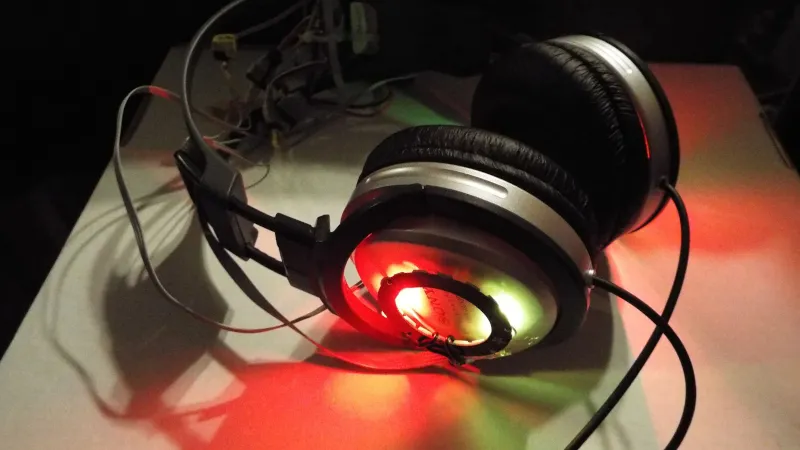
Noise cancelling headphones are a great way to insulate yourself from the bustle of the city, but due to their power requirements, continuous use means frequent recharging. [Alessandro Sgarzi] has an elegant and unique solution — powering the noise cancelling electronics by harvesting energy from the ambient noise of the city via a sheet of piezoelectric film.
This impressive feat is achieved using a LTC3588-1 power harvesting IC and a pair of supercapacitors, while an STM32L011K4T6 microcontroller processes the input from a MEMS microphone and feeds a low-power class D amplifier. This circuit consumes an astounding 1.7 nW, a power that a noisy city is amply able to supply. Audio meanwhile comes via a traditional 3.5 mm connector, which we are told is the cool kids’ choice nowadays anyway.
We like this project, and since it’s part of our 2026 Green Powered Challenge, it’s very much in the spirit of the thing. You’ve just got time to get your own entry in, so get a move on!
Looking for the most recent Wordle answer? Click here for today’s Wordle hints, as well as our daily answers and hints for The New York Times Mini Crossword, Connections, Connections: Sports Edition and Strands puzzles.



















































You must be logged in to post a comment Login