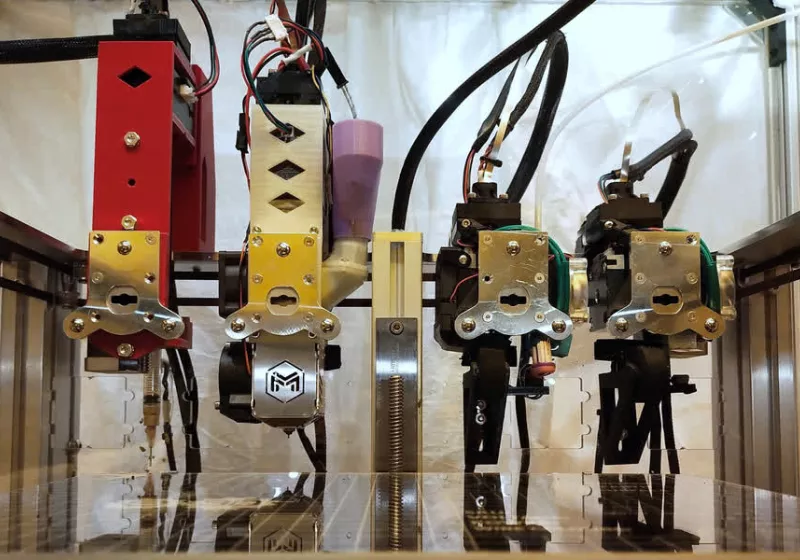
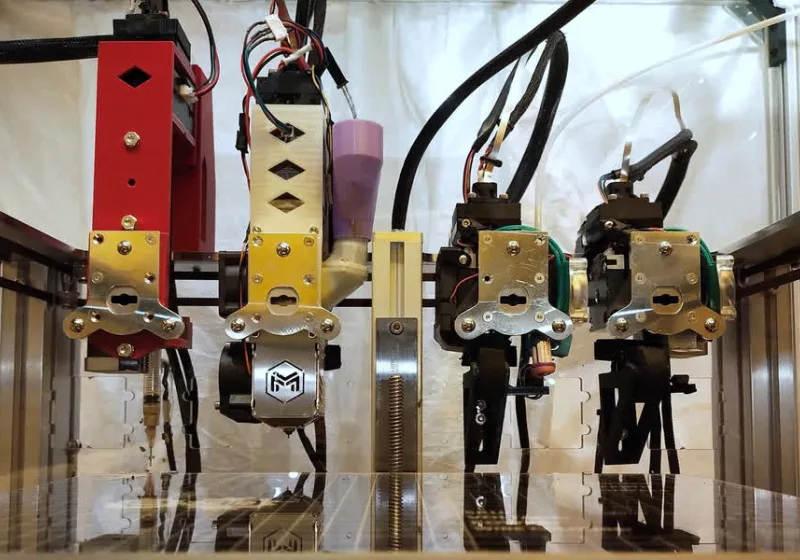
The team, based at MIT’s Microsystems Technology Laboratories, demonstrated the system by printing an electric linear motor – the type that generates straight-line motion instead of spinning a shaft. Read Entire Article Source link
The scene inside the 2025 GeekWire Awards at Showbox SoDo in Seattle on Wednesday. (GeekWire File Photo / Dan DeLong)
Time is running out to get your nominations in for the 2026 GeekWire Awards. If you want to help us recognize the outstanding tech entrepreneurs, innovators, deal makers and nonprofit leaders across the Pacific Northwest, submit a nomination today!
Community nominations will close this Wednesday, Feb. 25, for the annual event, which takes place May 7 in Seattle.
The GeekWire Awards, presented by Astound Business Solutions, will take place at Showbox SoDo and feature a VIP reception, sit-down dinner and fun entertainment mixed in. Tickets go fast, and early-bird pricing is available now on half and full tables, so contact events@geekwire.com to reserve your table.
Nominations are being accepted across 12 categories, and robot trophies will be handed out live on stage to winners for Startup of the Year, Next Tech Titan, CEO of the Year, Young Entrepreneur of the Year, AI Innovation of the Year, and more.
Pacific Northwest-based companies and individuals (Oregon, Washington, and British Columbia) are eligible to be nominated. The nominations can be submitted by GeekWire readers, and self nominations are permitted. One nomination is as good as 20, so no need to flood the ballot box. Past winners are not eligible in the same category.
A panel of judges will select five finalists per category and community voting will take place March 16 to April 17 on GeekWire.
Once again this winter, the snow is coming down with authority, and when this nor’easter winds down later today, there’ll be a new accumulation of 12 inches or more. By this time next week, we’re expecting at least another foot on top of that.
As a native New Englander, I’m prepared. We have shovels, sand and a guy who comes to plow our long driveway. But what really captures my attention is overhead. In winter, I’m obsessed with my roof — and with a simple tool that’s become an indispensable ally in maintaining my house properly during cold weather.
My roof rake.
Advertisement
Watch this: Keep Your House at This Temperature to Save Money
It’s not much to look at. Sixteen feet of aluminum pole with a perpendicular 22-inch-wide blue plastic blade at one end. But it makes all the difference in keeping melting snow from turning into streams of water that leak into the house. That’ll damage walls, ceilings, light fixtures and anything else that’s under the drip, drip, drip. Over time, it could develop into a mold problem.
Inside your house, leak detectors are handy gadgets for all kinds of water mishaps, but prevention is always the better policy.
If you live in an area that’s in the path of snowy winter weather, pay attention to the buildup on your roof. In one sense, snow on the roof is a positive thing. It indicates that you have sufficient insulation in your ceiling and attic to prevent warm air from escaping, as well as proper ventilation to help keep the roof cool.
Advertisement
But that snow will melt, producing runoff that heads downhill to your eaves and gutters. And that’s where the problem begins.
The winter of 2015 was a brutal one in Massachusetts, with roughly 90 inches of snow falling in less than a month. That year, the ice dams won.
Jon Skillings/CNET
As that water reaches the edge of your roof, it becomes more exposed to cold temperatures and it’ll refreeze, creating ice dams. Those frozen blockages will build up and prevent the next waves of meltwater from falling harmlessly off your roof. Where does that water go? It backs up under your shingles and through the roof decking, following a new gravitational pathway into your living spaces.
Advertisement
I have witnessed this leaking. I have repaired the damage. I have vowed never to let it happen again.
Which is why I’m outside right after every snowfall, raking away.
There aren’t any really compelling technological fixes for this problem. There is no Roomba for your rooftop. Whole-roof heating systems do exist, but they cost thousands of dollars and are a significant construction project. Here in New England, it’s common to see homes with a heating cable snaked along the lower portion of the roof, just above the eaves. But for my house, even that more modest option would likely run somewhere between $1,000 and $2,000 to install.
With any heating system, there’ll also be ongoing electricity costs and a potentially messy cycle of melting and refreezing.
Advertisement
A roof rake will set you back less than $200, and probably not even half that much. It’s low tech, and it works.
Watch this: I Drove an EV This Winter in Sweden to Prove It Could Be Done.
The right way to use a roof rake
I’ve been using my roof rake after every snowstorm, even the minor ones, for many a snowy winter here in central Massachusetts.
I had to learn the hard way. Before I bought my roof rake, I went after the ice dams themselves, after they’d already become way too thick, and water was dripping, sometimes fiercely, into the house. I was outside on a ladder, in the cold, whaling away with a hatchet. Not the way to go.
Advertisement
This is me, clearing the roof after a refreshingly light snowfall.
Jon Skillings/CNET
A roof rake is so much quicker and simpler — and again, it’s that all-important ounce of prevention. You stand on the ground, reach up with the rake and pull a big shovel’s worth of snow off the roof. Take a step or two and repeat the process. With light to moderate snowfall, I’ll get around my house in about 20 minutes. With heavy, icy accumulation, it takes me about twice that long.
Be aware that it can be a workout for your arms and shoulders. The rake doesn’t weigh much, but it is top-heavy, and you’re reaching up and away from your body. When the snow is thick, wet, crusty or all of the above, you’ll have to make an extra effort with each stroke.
Advertisement
But if you’re familiar with the often backbreaking work of shoveling snow, you’ll welcome the change of pace.
How much snow do you have to pull down? The guides I’ve read recommend clearing as much as 6 feet up from the eaves, and when I started raking my roof, I used to go just as far as I could reach. If I wasn’t hitting that 6-foot mark, I was getting close.
Over time, though, I’ve found that just 1 to 2 feet is generally sufficient. That’s the critical area, right past the eaves, where freezing and ice dam buildup take place.
The guides also advise going easy when scraping down to the roof shingles, so you don’t wear them out prematurely. I have to confess I’m not that fastidious — I’m usually dragging right along the shingles themselves, rather than trying to leave a thin coating of snow — and it hasn’t seemed to be a problem.
Advertisement
And for heaven’s sake, be mindful of where the power lines come into your house. You’re waving a metal pole in the air, after all.
Remember to wear heavy gloves when you’re roof-raking. The aluminum pole gets really cold to the touch.
Jon Skillings/CNET
How to shop for a roof rake
Like leaf rakes, roof rakes don’t have a lot of variety. A typicalroofrake comes with four 4-foot lengths of aluminum pole that you attach end to end to get the full length, plus the short blade attachment. (Mine has three 5-foot lengths, along with the blade segment.) The width of the blade ranges between approximately 17 and 24 inches.
Advertisement
The 16-foot length I have is enough for my house, a raised ranch, even on the side where the ground slopes away and I can get just the first foot or so of snow at the edge of the roof. If you have a taller house or you really want to clear way up high, you could always get additional sections. The blade section of my pole angles toward the roof, which is helpful.
Some rakes have little wheels on the bottom of the blade to avoid scraping directly on the shingles. Seems like a smart design.
Other roofrakes aren’t actually rakes at all. Instead of having a blade, the business end is open, with prongs holding one end of a plastic slide that runs parallel to the pole. You push into the snow, and the slide provides a slick runway for the snow to fall to the ground. I’ve never tried one of these, but having spent enough time wielding a standard roof rake, I have my doubts. It seems best suited for powder.
Prices for roof rakes typically range from $50 to $60 and can get to about $200. Years back, I bought a very basic model, and it’s still going strong — an excellent investment.
Advertisement
Gone are the days when I actually went up onto my roof and tried shoveling in addition to raking. In fairness, that was a legendary winter. In 2015, New England experienced four major snowstorms in less than a month, dumping about 90 inches of snow during that short span. No one could keep up.
But short of another “Snowmaggedon,” I know my roof rake will continue to serve me well. Whenever a snowstorm wanes, the two of us will head outside to start the clearing.
Nintendo has resurrected a 1995 oddity and incorporated it into the Switch family, literally, as the original Virtual Boy sat on a table like a curiosity, a set of goggles perched on spindly legs offering 3D gaming without the need for glasses. Three decades later, almost to the day, a near-identical recreation of that table-top oddity is accompanying your Switch or Switch 2 console, launching the same old library via Nintendo Switch Online’s expansion pack.
When you place the Switch in its $100 plastic case, a pair of red-tinted glasses split the screen into separate images for each eye. The effect, or rather the ‘depth’, stands out in stark monochrome. Pixels still dominate the view, forming a lattice of black lines over a blazing red backdrop, just like the originals. It’s the vision of Gunpei Yokoi, Nintendo’s hardware genius and the creator of the Game Boy. He and his colleagues constructed the original with a single line of LEDs reflected off oscillating mirrors. In those days, the resolution was 384 by 224, with an amazing 50 hertz flicker rate. The Switch screens now use IPS LCDs, which produce a considerably sharper and more stable image, however the higher-resolution panels on the Switch 2 make those individual dots stand out a little more.
The original hardware was a fragile beast, with a 20 MHz CPU and minimal graphics RAM held together in a frame that did not inspire confidence. As a result, several of them ended up with dried glue or snapped ribbon wires. That stand would frequently collapse under the weight of use, resulting in unsightly lines on the screens. This latest revival has skipped all of that, as there are no more oscillating mirrors to strain the eyes, and software modifications have ensured that the focus and eye spacing operate as well as they did back then. Finally, save states and the rewind capability have improved the old password system significantly. Some of the games also display a rest warning every 20 minutes, similar to how the original’s built-in timer would alert you to take a break.
In terms of controls, the Joy-Cons have replaced the original’s strange dual-D-pad controller. It can be remapped, but remains an odd fit for games designed for two analog sticks. Wario Land is a true standout, with caves twisting and turning into 3D space. Red Alarm is a Star Fox-inspired shooter through haunting corridors, Teleroboxer punches with the same beat as Punch-Out, and 3D Tetris requires you to stack blocks in floating levels. The majority of the titles are brief and experimental, and the complete catalog, with only about 24 games, isn’t exactly bursting at the seams.
However, the way the accessory is set up has not changed; players are still bent over that low stand, their necks cramping after only a few minutes. Light still leaks in around the edges, and the flicker persists, but you no longer suffer from headaches. They only sold about 770,000 units before Nintendo discontinued the console. The new model retains the tabletop design, the old stands are still compatible, and the face wipes clean easily, with a little extra space above the nose, but…it’s still a bit of a strain on the neck, and that pressure builds up quickly. However, in a dark setting, it’s much gentler on the eyes.
Fake knobs that pretend to be volume and port controls are simply ornamental, as you can still plug in your wireless headphones and the Switch delivers audio across the air. The lenses pop out so you can clean them or change them out for a different color, which was something to look forward to at launch, but none of them ever arrived. You can buy a cardboard bundle for $25 that bypasses the stand and allows you to play in your hands with Labo VR goggles, but you’ll need to use the complete Nintendo Switch Online + Expansion Pack subscription, which costs $50 per year.
Side by side, the originals and replicas are quite similar, nearly indistinguishable in silhouette, since the rubber bumpers line up neatly and the stands can be swapped over with a little fiddling, but when you get underneath the surface, everything comes apart. There are no electronics in these imitation replicas, just a cradle that centers the console with some very strong springs. The lenses are all one piece and glued in place, unlike the adjustable sliders from the 1990s, which have all gone digital now. On the plus side, Switch OLED panels glow a little brighter than the normal model, getting closer to matching the original in terms of brightness.
An anonymous reader shares a report: PayPal, the digital payments pioneer, is attracting takeover interest from potential buyers after a stock slide wiped out almost half of its value, according to people familiar with the matter.
The San Jose, California-based company has fielded meetings with banks amid unsolicited interest from suitors, the people said. At least one large rival is looking at the whole company, while some other suitors are only interested in certain PayPal assets, the people said, asking not to be identified because the information is private.
Buyer interest in PayPal is still at a preliminary stage and may not lead to a transaction, the people cautioned. Founded in the late 1990s, PayPal was an early mover in the world of digital payments. But the company now finds itself in a rut with its customers increasingly turning to alternative ways to pay for things. PayPal’s shares have fallen around 46% in New York trading over the last 12 months, giving the company a market value of about $38.4 billion.
Despite the gap, the research found that almost 70pc of Irish executives have formal technology transformation strategies in place.
New research from the latest Forvis Mazars C-suite Barometer: Outlook 2026 report has found that while Irish organisations prioritise the use of artificial intelligence (AI) in long-term growth plans, in terms of investment, companies are lagging behind their global counterparts.
Professional services firm Forvis Mazars’ research examines the views, challenges and strategic priorities of today’s C-suite leaders globally. For the purpose of the study, data was collected from 3012 C-suite leaders, including from Ireland, between October and November of 2025.
What was discovered is that Irish businesses are “investing significantly less in AI than their global counterparts, even as they acknowledge it as critical to competitive advantage, indicating a potential competitive vulnerability”.
Advertisement
Of contributing Irish executives, 68pc have technology transformation plans in place, with AI of key importance; however, only 10pc said they allocate more than 20pc of their tech budget to AI. This falls short compared to the 15pc globally who allocate more. The research suggests this raises “important questions about whether Irish businesses can sustain competitive advantage without increasing investment”.
Commenting on the findings of the report, Liam McKenna, a partner at Forvis Mazars in Ireland, said: “Irish business leaders are convinced of AI’s importance and are moving fast to implement it. What is concerning is the investment gap.
“While they express the highest confidence in AI ROI among all technology investments, their budget allocation doesn’t live up to that. With Irish businesses investing at lower rates than global peers, they risk missing the opportunity AI brings and competitive vulnerability. Now is the time for boards to align their investment with their strategy.”
Generating jobs
Forvis Mazars’ data also highlighted the potential of AI to create future career opportunities for professionals in Ireland, with 44pc of participants reporting the creation of new roles around AI. Almost a quarter of leaders, however, did report job displacement. “This suggests a workforce in transition with skills evolving rather than disappearing, though it raises questions about reskilling, talent development and education pipeline readiness,” stated the research.

Advertisement
While three-quarters of participating Ireland-based leaders expressed their ethical and societal concerns around AI, they were found to still be open to the adoption of advanced technology. The report suggests that Irish businesses are grappling with responsible AI deployment, as they try to harness a competitive advantage while managing social and governance risks.
McKenna said: “The organisations that win in the next three to five years will be those that move decisively on AI investment while managing risk and ethical and societal concerns in parallel.
“Irish businesses must bridge the investment gap while building the infrastructure, skills and governance frameworks to support responsible AI adoption. This means stronger collaboration between business, education and government to unlock the full potential of AI as a competitive advantage.”
Last week (19 February) Irish-owned global professional services company Morgan McKinley published the findings of the 2026 Morgan McKinley Irish Salary Guide. As part of its research, the organisation highlighted how, while Ireland’s labour market is active, it is becoming far more disciplined in how it hires – that is to say that hiring and improved salaries are often being reserved for those with skills considered to be critical to delivery or risk management.
Advertisement
In the technology ecosystem, for example, the most in-demand roles were found to be positions in data engineering, cybersecurity analytics and risk specialisation, machine learning engineering and data science, AI auditing and AI ethics, automation and dev-ops. The report also said that new roles for AI auditors and ethicists have emerged as a response to regulatory frameworks.
Don’t miss out on the knowledge you need to succeed. Sign up for the Daily Brief, Silicon Republic’s digest of need-to-know sci-tech news.
Can Meze’s $799 STRADA closed-back headphones stand out in a segment that eats its own? That is the real question. The $500 to $1,000 headphone market in 2026 is not polite competition. It is a knife fight with good lighting. Grado, Focal, Denon, HiFiMAN, Dan Clark Audio, Beyerdynamic, Audeze, and Sennheiser are all circling the same buyers, the same review cycles, and the same limited attention span. Nobody is short on options. Everyone claims “balanced.” We know that not to be true.
Balanced has become shorthand for “inoffensive.” Safe. Smoothed over. Tuned to offend no one and excite even fewer. In this price bracket, you are not just competing on frequency response. You are competing on durability, comfort, brand loyalty, and whether someone already owns two other pairs that do roughly the same thing. That is where the STRADA enters the room.
The harder question is this: can a brand outsmart itself? Does the market actually need another $800 headphone from Meze when the company already has a strong sub-$1,000 lineup that includes the underrated 105 AER, crowd pleasing 99 Classics Second Generation, 105 Silva, and the excellent 109 Pro?
The reality is that each of those sub-$1,000 Meze models comes with its own pros and cons, but the market has generally responded well to them. The 109 Pro are the strongest of the bunch. They strike a rare balance between openness, tonal coherence, and comfort that makes them very easy to recommend.
The 99 Classics 2nd generation are not just a cosmetic refresh of the original that launched Meze into the mainstream. They are better in almost every meaningful way: tighter low end, improved balance and clarity, refined build, and still extremely easy to drive. They remain one of the most accessible entry points into the brand and continue to make sense for those who are considering a pair of wired high-end headphones for the first time.
Advertisement
Meze Audio has also proven beyond any doubt that it knows how to build reference-caliber headphones. The LIRIC II, Empyrean II, and ELITE are not accidents. I spend more time listening to the Empyrean II than most of my loudspeakers. Why? It is simply more enjoyable, more immersive, and less complicated. And I am not convinced I have even reached the ceiling of what it can do in the right chain.
So where does the STRADA fit? Closed-back headphones almost always trade some openness and spatial air for isolation and control. They can deliver greater density and impact down low, but that often comes at the expense of natural space and a more effortless presentation.
Did Meze strike gold with the STRADA, or are we looking at silver and a stuffed animal on the flight home?
What You Actually Get in the Box with the Meze STRADA
Meze keeps the package practical. The STRADA arrives in a hard EVA carrying case with a soft velvet lining that actually protects the finish instead of just looking good in photos. Inside, you get a separate PU leather pouch for the cables, which keeps things organized and avoids the usual tangle.
Advertisement
Two 1.8 meter dual-twisted Kevlar-wrapped OFC cables are included: one terminating in 3.5 mm and another in 4.4 mm balanced. A gold-plated 3.5 mm to 6.3 mm adapter rounds it out for desktop use.
Premium Build and Green with Envy?
From a build standpoint, Meze stayed consistent with its design language but adapted it for a closed-back dynamic platform. The STRADA borrows the core structural thinking of the LIRIC, but instead of planar magnetic loading, this chassis is optimized around a dynamic driver. The focus is on low mass, rigidity, and comfort over long sessions which are likely to be key selling points for potential buyers.
Advertisement. Scroll to continue reading.
At roughly 330 grams, the STRADA sits toward the lighter end of the closed-back category, and that matters in practice. The magnesium frame keeps the structure rigid without adding unnecessary weight, and the distribution of that weight across the top of my head was very effective.
I have a larger than average head and very little tolerance for excessive clamping force. The STRADA avoids that trap. The pressure is firm enough to maintain a proper seal, which closed-backs absolutely require, but it never crosses into that vise-like squeeze that ruins longer sessions.
Advertisement
The deep green finish has divided opinion, and not quietly. It’s a saturated, metallic tone that leans closer to vintage performance car than conventional hi-fi aesthetic. I wasn’t convinced at first glance. In product photos it felt aggressive. In person, under normal light, it reads more controlled and far more refined. The finish has depth, and the execution is clean. Whether someone likes the color is subjective. Whether it’s well done is not. It is.
The ear pads attach magnetically. Simple idea, but it works. They line up the same way every time, and that matters with a closed-back. If the seal is off, the bass changes. Here, the seal is consistent without cranking up the clamping force. Isolation is strong for a passive closed-back. It blocks more outside noise than the 99 Classics 2nd Generation, and that difference shows up in normal use. HVAC hum fades into the background. Street noise softens. It’s not noise cancelling magic, but it’s enough to stay focused while listening.
I wore them during the Men’s Olympic Ice Hockey Gold Medal Game, streaming through Peacock on my iPad Pro using a dongle DAC. Between the seal and the volume headroom, I was fully locked in. I could barely hear the shouting from the rest of my family demanding to know whether I was having some kind of episode after Jack Hughes buried the golden goal. I wasn’t. I was celebrating properly. The STRADA let me stay in the moment without cranking the volume into dangerous territory. That’s the point.
The ear pads use soft PU leather on the outer contact surface, which helps maintain a consistent seal which is important for bass response and isolation. Inside, the Alcantara lining does a good job of keeping things from getting overly warm during longer sessions. They don’t turn into sweat traps after an hour, which is not always a given with closed-back designs and a situation that has turned me off from a number of high-end designs.
The Macassar ebony cups look expensive and they should for the $799 asking price. The finish and grain are very much in line with Meze’s house aesthetic; polished, tactile, and clearly meant to signal that this is not an entry-level afterthought. It is a dense, stable wood and makes sense for a closed back design, but let’s not pretend this is rustic minimalism. This is deliberate styling.
Advertisement
Each pair has slightly different grain, which gives them some individuality without screaming for attention. It feels well made and intentional, not decorative for the sake of it. Do I like the look as much as the 109 Pro? Not quite. That one clicked immediately. This feels more like an acquired taste.
Overall, the STRADA is built to a high standard, but the fit is not identical to what long-time Meze owners might expect. The suspension and headband system are different from the floating designs used on models like the 109 Pro or Empyrean II. Those tend to settle onto your head and disappear. The STRADA doesn’t quite do that. It feels more structured. More fixed.
The gimbals and adjustment rods also feel different. They’re solid, but the range adjustment is smooth rather than notched. I would have preferred small detents to make it easier to return to the exact same setting every time. As it stands, getting both sides perfectly matched takes a bit more attention than it should.
Technically, the STRADA runs a 50 mm dynamic driver rated from 5 Hz to 30 kHz, with distortion listed at under 0.1 percent at 1 kHz. On paper, that tells you two things: there’s plenty of bandwidth, and Meze is trying to keep things clean at normal listening levels.
This is the same basic dynamic platform first used in the 109 Pro, but it’s been adjusted for a closed-back enclosure. That’s not a small detail. Closed designs deal with internal pressure, reflections, and damping in ways open-backs don’t. You can’t just drop the same driver into a sealed cup and call it a day. It has to be tuned differently.
Advertisement
Advertisement. Scroll to continue reading.
The diaphragm is a carbon fiber reinforced cellulose composite, designed to stay light but controlled when the music gets demanding. Around it sits a polymer ring with a thin beryllium coating applied through a vapor process to increase stiffness and improve how quickly the driver starts and stops. The surface grooves help manage resonance, and the copper-zinc stabilizer ring works to damp small vibrations before they smear detail.
At 40 ohms and 111 dB sensitivity, the STRADA is easy to drive. You don’t need a desktop amp the size of a shoebox to make it work. A good dongle DAC, portable player, or modest desktop setup will get it to proper listening levels without running out of headroom.
Listening
I rotated the STRADA through a fairly typical mix of sources: my iMac and a MacBook Air at the desk, an iPad Pro for casual listening, and a range of DACs and amplifiers including units from Topping, FiiO, the Apos x Community Gremlin, and a Schiit Magni from Schiit Audio. I also spent time with a few dongle DACs with an iPhone 14 because that’s how a lot of people will actually use a 40 ohm, 111 dB headphone.
In other words, the STRADA had every opportunity to show what it could do — or to miss an empty net with less than ten minutes left in the third period.
Advertisement
Right off the bat, the iFi GO blu Air that worked well with the 99 Classics 2nd Gen and Beyerdynamic DT 770 PRO X wasn’t the best match here. Even running balanced, with 262mW into 32 ohms on tap, the STRADA felt slightly underfed. The sub bass lacked grip. Notes had weight, but not the kind of control that keeps things from spilling over the edge.
That matters because the STRADA has real low-end presence. The bass is full and carries impact well into the upper bass. This is not a polite, neutral closed-back. It pushes air. And when the amplifier doesn’t have enough authority, that energy can blur instead of punch.
With better amplification, the bass tightens and the overall presentation settles down. The midrange and treble benefit from that control as well. This is one of those headphones where system matching counts more than usual. If you’re looking for strong bass impact with definition, the STRADA can deliver it. But you need the right partner on the other end of the cable.
Switching over to the iFi GO bar Kensei was a different story. With 477 mW available from the 4.4 mm balanced output, the STRADA woke up. The bass tightened, the sub bass gained shape, and the upper bass stopped bleeding into the lower mids.
Advertisement
Cue up Daft Punk, deadmau5, Kraftwerk, Brian Eno, Aphex Twin, or The Orb, and the difference was obvious. The low end stopped coloring outside the lines. It stayed full, but it was more disciplined. Kick drums had impact without smearing. Synth bass lines hit hard and then got out of the way.
If you live on electronic music, there’s a lot to like here. The STRADA can move air. With the right power behind it, the bass is deep, defined, quick, and punchy. Without it, things get a little loose. This is not a set-it-and-forget-it headphone. Feed it properly and it rewards you.
So far, so good. Then I moved into the midrange and things got more complicated.
Hit the One in the Middle
Instruments and male vocals came through clean and detailed, but they sat a touch behind the bass. Not buried. Not three steps back into the drum kit starting a studio argument. Just slightly set back. Enough to notice.
Advertisement. Scroll to continue reading.
Advertisement
I listen to a lot of piano, bass guitar, acoustic guitar, and male vocals; Nick Cave, Sam Cooke, Jason Isbell, John Prine, Elvis Presley, David Bowie, and David Byrne — so that region matters to me. When the vocal center image shifts even slightly, I hear it.
I started rotating through my solid state desktop gear from Topping, FiiO, and Schiit Audio to see how much of it was source dependent. The more linear, slightly more forward presentation from the Topping and Schiit gear helped push the midrange forward a bit. It didn’t completely change the tuning, but it narrowed the gap between bass and vocal presence.
The warmer FiiO setup, though, with its thicker midband, smoothed everything out a little too much. It was like ordering medium smoked meat at Lester’s in Montreal and getting the fatty cut. Satisfying at first, but after a while, everything starts to taste the same. Too much weight, not enough edge definition.
The STRADA doesn’t need more warmth in the mids. It needs more texture, presence, and a sharper edge.
Advertisement
Illumination with a Candle or Floodlight?
Strings, upper piano registers, and female vocals fared a bit better, but I’d still describe the STRADA as slightly recessed through the core midrange. Piano didn’t quite have the weight or sustain I expect without a small EQ nudge. Notes were clean, but they didn’t bloom or hang in the air the way they can on a more linear tuning. Strings, too, lost a bit of bite. The leading edge was softened, and without adjustment, they didn’t always sound as natural as they should.
Female vocals, as the response climbed into the upper mids and lower treble, had more presence than the male vocals. Amy Winehouse, Ella Fitzgerald, Björk, Tori Amos, Nina Simone, and Brandi Carlile all had more immediacy and projection. There was more pep in their step compared to the men.
That same region is also where I began to notice some treble peaks. Not constant glare, but moments where energy jumped forward. Push the volume with a hot or poorly mastered track and the STRADA will let you know. I wouldn’t call it bright overall, but there is more energy and detail in the extreme upper mids and lower treble than in the center midrange. It’s a tuning choice. And yes, it’s fixable with EQ. How much you choose to correct it, or whether you feel compelled to, depends on your tolerance and your music library.
Soundstage is good for a closed-back. Not cavernous. Not claustrophobic either. There’s some depth and a bit of vertical space, but it doesn’t approach the openness of the 109 Pro or Empyrean II. That’s the tradeoff with a sealed design. You gain isolation, you give up some air.
Imaging is solid, just not laser etched. Instruments are placed clearly enough, but nothing hangs in space with surgical precision. You’re not getting that razor sharp, walk around it kind of presentation. It’s more cohesive than pinpoint.
Advertisement
Stereo separation is respectable. Left and right channels are distinct, and layering holds together, especially with well recorded material. For a closed-back at this price, it performs about where it should. Competent. Controlled. Not class leading in spatial tricks, but not a weakness either.
The Bottom Line
The STRADA gets a lot right. Build quality is excellent. Comfort is good once you dial in the fit. Isolation is strong for a passive closed-back. The bass is the headline feature; deep, impactful, and capable of real authority when properly amplified.
The midrange is clean and detailed but sits slightly behind the low end. It’s not hollow, just not as forward as some listeners might prefer. The treble is not etched or aggressively bright in the way some older Beyerdynamic models could be and to be fair, their newer releases have improved in that regard — but there are noticeable peaks. Poor recordings and high volume will expose them.
Advertisement. Scroll to continue reading.
Advertisement
Overall, the STRADA is resolving and engaging, but it benefits from careful system matching and, in my case, some light EQ. Once you sort that out, it becomes a very enjoyable closed-back option.
That said, I still prefer the 109 Pro for its cohesiveness, openness, and more natural balance. The STRADA is a strong entry in Meze’s lineup, but it doesn’t unseat my favorites. It’s a very good headphone that rewards attention — especially on the amplification and tuning side.
Pros:
Strong, impactful bass with good depth when properly amplified
Clean, detailed overall presentation
Solid passive isolation for a closed-back design
Excellent build quality with premium materials
Easy to drive on paper and works well with portable and desktop gear
Cons:
Midrange sits slightly behind the bass and upper mids
Noticeable treble peaks with certain recordings or higher volume
Benefits from careful amp pairing and often some EQ
Headband adjustment system lacks notches and takes dialing in
The team behind the beloved Dark Sky weather app has a new iPhone app called Acme Weather. The release comes after Apple’s 2020 , which it ultimately in 2022 after integrating much of its tech into the native iOS Weather app.
Acme Weather is primarily designed to address the uncertainty inherent in most forecasts, as different models yield disparate results and no two weather apps seem to report the same thing. Acme’s answer to this issue is “Alternate Predictions,” which shows users a range of possible outcomes alongside the app’s core forecast line throughout the day. If the lines are arranged together tightly, it means the app has high confidence in the forecast at that time. When those lines start to diverge, the app is signaling lower confidence while showing users alternate predictions for that time of day.
The app also supports community reporting, seeking to do for weather what Waymo did for traffic. Users can share real-time conditions in their area using icons or emojis, helping increase accuracy when conditions are changing quickly. Like most weather apps, there is also a map component with layers for radar, lightning, rain and snow totals, wind and more.
Acme leverages notifications to help make sure you don’t miss important changes to the forecast or weather alerts. Grossman says they are comprehensive and should help you avoid getting caught in the rain unawares. Notifications also include community reports, government weather alerts and even experimental tools from “Acme Labs” like rainbow and beautiful sunset alerts.
Advertisement
Acme offers a two-week free trial, then costs $25 a year. The iOS version is available now and an Android is forthcoming.
For years, identity has been treated as the foundation of workforce security. If an organization could reliably confirm who a user was, the assumption followed that access could be granted with confidence.
That logic worked when employees accessed corporate networks from corporate devices under predictable conditions. Today, that no longer reflects how access is actually used or abused.
The modern workforce operates across multiple locations, networks, and time zones. Employees routinely switch between corporate laptops, personal devices, and third-party endpoints.
Access is no longer anchored to a single environment or device, yet security teams are expected to support this flexibility without increasing exposure or disrupting productivity, even as the signals used to make access decisions become noisier, more fragmented, and harder to trust on their own.
Advertisement
As a result, identity is being asked to carry responsibility it was never designed to hold alone. Authentication can confirm who a user claims to be, but it does not provide sufficient insight into how risky that access may be once device condition and context are taken into account. In modern environments, the core issue is not identity failure, but the over-reliance on identity as a proxy for trust.
Identity tells us who, not how risky the access is
A legitimate user accessing systems from a secure, compliant device represents a fundamentally different risk from the same user connecting from an outdated, unmanaged, or compromised endpoint. Yet many access models continue to treat these scenarios as equivalent, granting access primarily on identity while device condition remains secondary or static.
This approach fails to account for how quickly device risk changes after authentication. Endpoints regularly shift state as configurations drift, security controls are disabled, or updates are delayed, often long after access has already been granted.
When access decisions remain tied to the conditions present at login, trust persists even as the underlying risk profile degrades.
Advertisement
These gaps are most visible across access paths that fall outside modern conditional access coverage, including legacy protocols, remote access tools, and non-browser-based workflows. In these cases, access decisions are often made with limited context, and trust is extended beyond the point where it is justified.
Attackers are increasingly exploiting these blind spots by reusing misplaced trust rather than breaking authentication, stealing session tokens, abusing compromised endpoints, or working around multi-factor authentication.
After all, it’s easier to log in than break in. A valid identity presented from the wrong device remains one of the most reliable ways to bypass modern controls and fly under the radar.
Verizon’s Data Breach Investigation Report found stolen credentials are involved in 44.7% of breaches.
Effortlessly secure Active Directory with compliant password policies, blocking 4+ billion compromised passwords, boosting security, and slashing support hassles!
Zero Trust is widely accepted as a security principle, but far less consistently applied across workforce access. While identity controls have matured, progress frequently stalls at the device layer, particularly across access paths outside browser-based or modern conditional access frameworks that inherit trust by default.
Establishing device trust introduces complexity that identity alone cannot address. Unmanaged and personal devices are difficult to assess consistently, compliance checks are often static rather than continuous, and enforcement varies depending on how access is initiated.
These challenges are compounded when identity and endpoint signals are handled by separate tools that were never designed to work together. The result is fragmented visibility and inconsistent decisions.
Over time, access policies can harden and become static, creating more opportunities for identity abuse. When access is granted without ongoing checks, traditional controls are slow to detect and respond to malicious behavior.
Advertisement
From identity checks to continuous access verification
Addressing static, identity-centric access controls requires mechanisms that remain effective after authentication and adapt as conditions change.
Solutions such as Infinipoint operationalize this model by extending trust decisions beyond identity and maintaining enforcement as conditions evolve.
Infinipoint extends trust decisions beyond identity with continuous device verification.
The following measures focus on closing the most common access failure points without disrupting how people work.
Verify both user and device continuously: This approach reduces the effectiveness of stolen credentials, session tokens, and multi-factor authentication bypass techniques by ensuring access is tied to a trusted endpoint rather than granted on identity alone.
Apply device-based access controls: Device-based access controls make it possible to enroll approved hardware, limit the number and type of devices per user, and differentiate between corporate, personal, and third-party endpoints. This prevents attackers from reusing valid credentials from untrusted devices.
Enforce security without defaulting to disruption: Proportionate enforcement allows organizations to respond to risk without unnecessarily interrupting legitimate work. This includes conditional restrictions and grace periods that give users time to resolve issues while maintaining security controls.
Enable self-service remediation to restore trust: Self-guided, one-click remediation for actions such as enabling encryption or updating operating systems allows trust to be restored efficiently, reducing support tickets and demand on IT teams while keeping security standards intact.
Specops, the Identity and Access Management division of Outpost24, delivers these controls through Infinipoint, enabling zero trust workforce access that verifies both users and devices at every access point and continuously throughout each session across Windows, macOS, Linux, and mobile platforms.
Anyone who’s scrolled social media lately knows that AI is everywhere. But we aren’t always great at spotting it when we see it. That’s a big problem, and our frustrations with AI are growing.
AI slop has infected every platform, from soulless images to bizarre videos and superficially literate text. The vast majority of US adults who use social media (94%) believe they encounter content that was created or altered by AI, but only 44% of US adults say they’re confident they can tell real photos and videos from AI-generated ones, according to an exclusive CNET survey.
There are a lot of different ways people are fighting back against AI content. Some solutions are focused on better labels for AI-created content, since it’s harder than ever to trust our eyes. Of the 2,443 respondents who use social media, half (51%) believed we need better AI labels online. Others (21%) believe there should be a total ban on AI-generated content on social media. Only a small group (11%) of respondents say they find AI content useful, informative or entertaining.
AI isn’t going anywhere, and it’s fundamentally reshaping the internet and our relationship with it. Our survey shows that we still have a long way to go to reckon with it.
Key findings
Most US adults who use social media (94%) believe they encounter AI content on social media, yet far fewer (44%) can confidently distinguish between real and fake images and videos.
Many US adults (72%) said they take action to determine if an image or video is real, but some don’t do anything, particularly among Boomers (36%) and Gen Xers (29%).
Half of US adults (51%) believe AI-generated and edited content needs better labeling.
One in five (21%) believe AI content should be prohibited on social media, with no exceptions.
Watch this: AI Is Indistinguishable From Reality. How Do We Spot Fake Videos?
US adults don’t feel they can spot AI media
Seeing is no longer believing in the age of AI. Tools like OpenAI’s Sora video generator and Google’s Nano Banana image model can create hyperrealistic media, with chatbots smoothly assembling swaths of text that sound like a real person wrote them.
So it’s understandable that a quarter (25%) of US adults say they aren’t confident in their ability to distinguish real images and videos from AI-generated ones. Older generations, including Boomers (40%) and Gen X (28%), are the least confident. If folks don’t have a ton of knowledge or exposure to AI, they’re likely to feel unsure about their ability to accurately spot AI.
Advertisement
People take action to verify content in different ways
AI’s ability to mimic real life makes it even more important to verify what we’re seeing online. Nearly three in four US adults (72%) said they take some form of action to determine whether an image or video is real when it piques their suspicions, with Gen Z being the most likely (84%) of the age groups to do so. The most obvious — and popular — method is closely inspecting the images and videos for visual cues or artifacts. Over half of US adults (60%) do this.
But AI innovation is a double-edged sword; models have improved rapidly, eliminating the previous errors we used to rely on to spot AI-generated content. The em dash was never a reliable sign of AI, but extra fingers in images and continuity errors in videos were once prominent red flags. Newer AI models usually don’t make those pedestrian mistakes. So we all have to work a little bit harder to determine what’s real and what’s fake.
You can look for discrepancies and labels to identify AI content.
Advertisement
Cole Kan/CNET/Getty Images
As visual indicators of AI disappear, other forms of verifying content are increasingly important. The next two most common methods are checking for labels or disclosures (30%) and searching for the content elsewhere online (25%), such as on news sites or through reverse image searches. Only 5% of respondents reported using a deepfake detection tool or website.
But 25% of US adults don’t do anything to determine if the content they’re seeing online is real. That lack of action is highest among Boomers (36%) and those in Gen X (29%). This is worrisome — we’ve already seen that AI is an effective tool for abuse and fraud. Understanding the origins of a post or piece of content is an important first step to navigating the internet, where anything could be falsified.
Half of US adults want better AI labels
Many people are working on solutions to deal with the onslaught of AI slop. Labeling is a major area of opportunity. Labeling relies on social media users to disclose that their post was made with the help of AI. This can also be done behind the scenes by social media platforms, but it’s somewhat difficult, which leads to haphazard results. That’s likely why 51% of US adults believe that we need better labeling on AI content, including deepfakes. Support was strongest among Millennials and Gen Z, at 56% and 55%, respectively.
Advertisement
Very few (11%) found AI content useful, informative or entertaining.
Cole Kan/CNET/Getty Images
Other solutions aim to control the flood of AI content shared on social media. All of the major platforms allow AI-generated content, as long as it doesn’t violate their general content guidelines — nothing illegal or abusive, for example. But some platforms have introduced tools to limit the amount of AI-generated content you see in your feeds; Pinterest rolled out its filters last year, while TikTok is still testing some of its own. The idea is to give every person the ability to permit or exclude AI-generated content from their feeds.
But 21% of respondents believe that AI content should be prohibited on social media altogether, no exceptions allowed. That number is highest among Gen Z at 25%. When asked if they believed AI content should be allowed but strictly regulated, 36% said yes. Those low percentages may be explained by the fact that only 11% find AI content provides meaningful value — that it’s entertaining, informative or useful — and that 28% say it provides little to no value.
How to limit AI content and spot potential deepfakes
Your best defense against being fooled by AI is to be eagle-eyed and trust your gut. If something is too weird, too shiny or too good to be true, it probably is. But there are other steps you can take, like using a deepfake detection tool. There are many options; I recommend starting with the Content Authenticity Initiative‘s tool, since it works with several different file types.
Advertisement
You can also check out the account that shared the post for red flags. Many times, AI slop is shared by mass slop producers, and you’ll easily be able to see that in their feeds. They’ll be full of weird videos that don’t seem to have any continuity or similarities between them. You can also check to see if anyone you know is following them or if that account isn’t following anyone else (that’s a red flag). Spam posts or scammy links are also indications that the account isn’t legit.
If you want to limit the AI content you see in your social feeds, check out our guides for turning off or muting Meta AI in Instagram and Facebook and filtering out AI posts on Pinterest. If you do encounter slop, you can mark the post as something you’re not interested in, which should indicate to the algorithm that you don’t want to see more like it. Outside of social media, you can disable Apple Intelligence, the AI in Pixel and Galaxy phones and Gemini in Google Search, Gmail and Docs.
Even if you do all this and still get occasionally fooled by AI, don’t feel too bad about it. There’s only so much we can do as individuals to fight the gushing tide of AI slop. We’re all likely to get it wrong sometimes. Until we have a universal system to effectively detect AI, we have to rely on the tools we have and our ability to educate each other on what we can do now.
Methodology
CNET commissioned YouGov Plc to conduct the survey. All figures, unless otherwise stated, are from YouGov Plc. The total sample size was 2,530 adults, of which 2,443 use social media. Fieldwork was undertaken Feb. 3 to 5, 2026. The survey was carried out online. The figures have been weighted and are representative of all US adults (aged 18 plus).
A 3000W power supply often conjures up images of huge metal boxes with noisy fans pumping air over massive heat sinks, but this Intel reference unit blasts that idea out of the water, or rather keeps it cool, due to a water cooling system that keeps everything nice and clean.
Intel engineers designed this beast of a device for data centers and servers, where squeezing as much power as possible into a small space is the name of the game. It accepts a large 240-volt AC and outputs a reasonable 12 volts DC at up to 250 amps, suitable for 3000 wattage.Water flows through the back of the unit via quick-release fittings, carrying heat away without the need for a noisy internal fan or traditional heat sink fins, and the entire thing remains sealed and silent with no internal moving parts, relying on external coolant to keep things from overheating.
XBOX EXPERIENCE BROUGHT TO LIFE BY ROG The Xbox gaming legacy meets ROG’s decades of premium hardware design in the ROG Xbox Ally. Boot straight into…
XBOX GAME BAR INTEGRATION Launch Game Bar with a tap of the Xbox button or play your favorite titles natively from platforms like Xbox Game Pass…
ALL YOUR GAMES, ALL YOUR PROGRESS Powered by Windows 11, the ROG Xbox Ally gives you access to your full library of PC games from Xbox and other game…
Inside, things get a little more tricky because the enclosure is a solid black box with no vents to speak of. When the screws are removed, you’ll discover two chunky circuit boards jammed together with a large cold plate crammed in between. The components all push against the cold plate using thermal pads, and the circulating fluid then transports the heat to the outside world. The configuration works well to split chores, with one board handling power factor adjustment on the input side and the other handling the primary DC-DC conversion bit.
Advertisement
Input protection is the first priority, with fuses, surge arrestors, metal oxide varistors, gas discharge tubes, and common-mode chokes all doing their part to keep unpleasant little shocks from the mains supply from causing issues. Following that, bulk capacitors are used to smooth out the rectified line voltage, ensuring that it is not unsteady or unpredictable. The power factor adjustment step, on the other hand, employs a neat technique known as an interleaved totem-pole topology to reduce ripple and enhance efficiency. The GaN transistors in that part are from Texas Instruments and have a reasonable 600 volt rating. They are also fast-switching (which is good) and low-loss, enabling it to achieve the unit’s 80 Plus Platinum certification
The power is subsequently transferred to the phase-shifted full-bridge section on the other board. Silicon carbide MOSFETs are the high-voltage switching components here, paire with a transformer that graciously lowers down the voltage for us. The litz wire on the main side is wound to reduce signal loss as the frequency increases, while synchronous rectifiers on the secondary side work their magic to provide even greater efficiency. The output filtering is then provided by a large inductor and 9000 microfarads of polymer capacitors, all working together to provide a clean 12 volts DC at the output.
Of course, there have to be some control circuits in there somewhere to keep things running smoothly; a Texas Instruments C2000 microcontroller manages the PFC stage, while a PIC24 monitors overall supervision. To keep things nice and safe, there are digital isolators (which are really brilliant, in my opinion) and auxiliary flyback converters that provide standby power as necessary.
Some of the design choices on show here are quite impressive, as the cold plate design allows the unit to chug out a respectable 2500 watts per liter, as that’s a whopping 250 times more power per liter than the average air-cooled supplies, which might only scrape in at around 800 watts per liter, but using advanced semiconductors like GaN and SiC really helps to keep losses to a minimum. However, it’s the water block that still proves essential at full load where losses total around 300 watts. [Source]