There was a time when subscriptions felt like a novelty. Those were times of (digital) peace. A seamless payment feature on cool new apps that brought unlimited access (for the month). You paid for Netflix, and maybe Spotify, and that was usually about it.
Now, it’s streaming, cloud storage, fitness apps, editing apps, AI chatbots, random free trials you forgot to kill three weeks ago, and so much more. The subscription economy didn’t just grow — it exploded, with the blast radius covering nearly every corner of the digital space.
It has become so pervasive that there’s a real subscription fatigue, which feels even worse in 2026. People thought they weren’t spending a lot, but many clearly are. The system with recurring payments has become small (in price), automatic, and easy to forget.
Screengrab / Digital Trends
People have begun treating $5.99 or $10.00 charges as harmless when, in reality, the charges are piling up into something uglier over time. Subscription hell isn’t just about greed or convenience. It is also about invisibility.
Why subscription fatigue feels worse than normal spending
You often think twice before making a big purchase, and sometimes that one-off payment can sting a little. But this feeling dissipates over time. Subscriptions do the opposite. You won’t notice as they are hidden, sitting quietly in a corner, billing you for small amounts that you’ll barely notice. So they end up feeling like a bigger drain than a single large purchase. While the pain is less dramatic, it’s always around.
Advertisement
While clearer cancellation rules can reduce the subscription traps, reports point out that behavioral habits like inertia and auto-renewal still keep people paying for services long after they’ve stopped caring. Visibility can help; people don’t need more guilt or another sermon about “being better with money.”
Rocket MoneyRocket
Making them all visible
Want to know how you can make your life easier? The answer is rather simple: round them all up. It’s like gathering your bills, but it’s more convenient with a smartphone. Once all your subscriptions live in one place, they stop feeling abstract and start looking like real financial patterns.
We’ve seen apps that track your bill payments and overall spending, but there are even dedicated apps to track all your subscriptions. These break down the walls that they hide behind, arranging them neatly for you to scrutinize.
And, you may not like what you see.
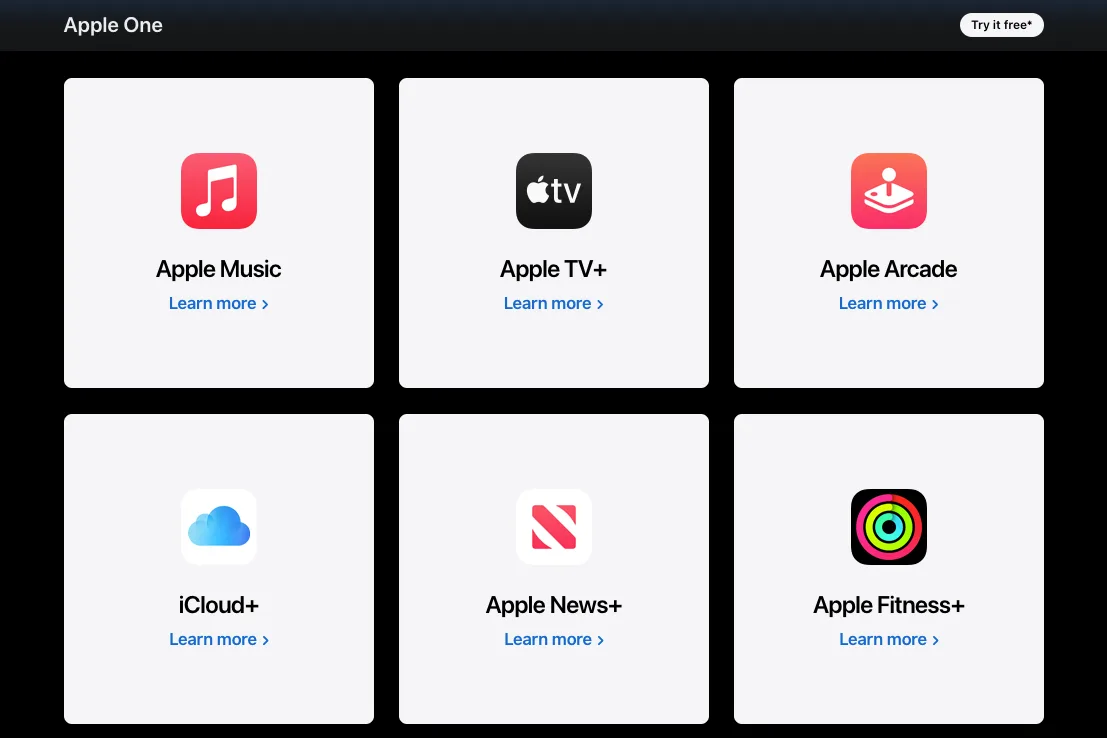
Apple offers a similar function on a basic level, allowing users to cancel any Apple Store subscriptions directly. But many of these recurring payments live outside of the App Store. So if you’re trying to clean house, you may need some professional help.
Advertisement
The best subscription apps are not the flashiest ones
Nadeem Sarwar / Digital Trends
Most people would turn away from bloated finance dashboards, so there is a real demand for simple, focused, and low-friction tools. So with that in mind, here are a few names that often pop up when talking about good subscription managers:
Subpli first got our attention for being a free app,which is also ad-free. It is available without the mandatory sign-up. It offers renewal reminders, category filters, monthly and yearly totals, and even a guest mode.
Bobby has been around for a while now and is easily one of the better-known options for iPhones. Its App Store listing highlights hundreds of built-in subscription templates, due-date notifications, and a clearer overview of fixed monthly costs.
Rocket Money, on the other hand, takes a more aggressive, finance-first approach than the simpler tracker apps. But it pitches itself as a service that will identify subscriptions for you. So you won’t need to manually log recurring payments, while also giving you a concierge-style flow to help cancel some unwanted expenses. That makes it more appealing for people who want a broader money-management tool.
Subby is another solid app if you want an Android-specific option. It is pretty straightforward, focusing on what matters, like tracking subscriptions and recurring bills in one dashboard, sending cancellation reminders before renewals, and supporting multiple currencies. There are even some extras like widgets and Google Drive backup for Pro users.
Nadeem Sarwar / Digital Trends
It’s even becoming a policy problem
The subscription fatigue isn’t just a personal finance issue anymore. In the UK, the government has already proposed tougher rules aimed at “subscription traps,” including clearer information before signing up, renewal reminders, a 14-day cooling-off period after free trials, and easier cancellation processes. The government says unwanted subscription costs UK consumers about £1.6 billion a year through nearly 10 million of the country’s 155 million active subscriptions that are deemed unwanted.
The consumer data paints a similarly familiar picture. Surveys backed by multiple other findings suggest that US adults spend about $91 a month on subscriptions, while nearly half have forgotten to cancel a free trial. Younger users are also more likely to fall into that trap.
Subscription hell isn’t going away, but it’s time to step up
Companies love the recurring-revenue model, and with consumers still hooked to the convenience, this model is here to stay. But the real question is whether users can claw back some control.
The answer is yes, and it’s only by making it harder on yourself. Taking small steps like checking Apple’s built-in subscription page, searching your inbox for renewal emails, and using a tracker app brings more power to you. Basic visibility is what subscription culture and modern apps are engineered to take away. So seeing the damage clearly might be the only real counter to it.
Tony Siu, founder of Coffee & Code Philadelphia and an AI engineer and community builder, aims to advance a model of ecosystem development that blends human connection with the thoughtful use of AI. His approach reflects a community-first, servitude-leadership philosophy where participation, shared learning, and developer advocacy evolve alongside scalable systems, offering insight into how modern tech ecosystems can grow with intention.
Coffee & Code Philadelphia reflects how these dynamics take shape locally. From informal coding sessions, it has grown into a collaborative network where developers, designers, and founders gather to build, learn, and exchange ideas. Weekly meetups, technical workshops, and community-driven events create an environment where knowledge flows organically. Siu says, “I’ve noticed that spending time building alongside others often leads to conversations that happen naturally, and those moments can open the door to ideas that don’t always come up when working alone.”
This growth aligns with a bottom-up approach to leadership. Instead of directing outcomes, Siu focuses on enabling others to contribute based on their strengths. Participation becomes self-directed, and collaboration develops through shared interest. Such an approach reframes developer relations as a form of leadership.
Advertisement
“I see developer advocates as connectors who help bridge technical teams and the broader community,” Siu remarks. “By being present and engaged, we help create space for mentorship, experimentation, and shared learning, which can support both individual growth and the adoption of new technologies.”
The 💜 of EU tech
The latest rumblings from the EU tech scene, a story from our wise ol’ founder Boris, and some questionable AI art. It’s free, every week, in your inbox. Sign up now!
AI plays a supporting role in enabling this scale. Within the community, AI systems assist with operational processes such as event coordination, sponsorship management, and reporting. These tools allow a small organizing group to sustain a growing ecosystem while maintaining consistency. Siu says, “AI can extend how much a team is able to manage, especially in coordination. The interactions between people, though, are where most of the value continues to develop.”
Advertisement
As communities expand, maintaining authenticity becomes an ongoing consideration. Growth introduces new dynamics, from varied communication styles to broader participation. In-person interaction continues to play a key role in sustaining connection, as collaborative problem-solving and shared experiences deepen engagement. Siu says, “Scaling introduces complexity, and part of the process involves finding ways to keep interactions meaningful as more people become involved.”
Coffee & Code’s recent initiative showed how this balance can extend to larger settings. According to Siu, the Philly Startup Expo at Pennovation Works brought together a wide mix of founders, builders, and community members, with participants from other major tech hubs, as well as traveling in from abroad. “What struck me most innovative is definitely not the pitches, the startups, or even the heavyweight panel. It’s the creativity and resourcefulness of the tech startups resembling the grit, innovation and entrepreneurship of the founding fathers”, he says. Partnering with OneSixOne Ventures, Coffee & Code hosted and held a panel featuring UE Ventures, alongside others, the event featured hands-on demos across AI, spatial computing, and emerging software, and the involvement of startup teams added depth to the conversations. Throughout the expo, Siu notes that there was a clear sense of Philadelphia’s growing momentum as a technology hub.
For Siu, Philadelphia represents both opportunity and personal connection. His experiences across different learning environments shaped his appreciation for accessible, community-driven spaces. This philosophy also informs his guidance for emerging developers. He encourages building in public: sharing work and ideas early as they evolve. “When you share your work, even in its early stages, you create more opportunities to learn through interaction,” Siu explains. Participation in this way can open pathways for feedback, collaboration, and connection within the broader ecosystem.
Epic Games is cutting more than 1,000 jobs as usage of its flagship title, Fortnite, falls. “The layoffs aren’t related to AI,” CEO Tim Sweeney noted. Reuters reports: The cuts, along with more than $500 million in savings from lower contracting and marketing spending and unfilled roles would put the company in “a more stable place,” Sweeney said in a note to employees. […]
“We’ve had challenges delivering consistent Fortnite magic,” Sweeney said, adding “market conditions today are the most extreme” since the early days of the company founded in 1991.
The move marks Epic’s second major round of layoffs in three years. In September 2023, the company cut about 830 jobs, or roughly 16% of its workforce. It was not immediately clear what percentage of staff would be impacted by Tuesday’s announcement.
The live music discovery platform Bandsintown’s partnership with Apple goes , but iOS 26.4 brings the deepest integration between the two companies to date. Concert listings from Bandsintown will now appear in , allowing you to find out when either a band you already love, or one you’re discovering for the first time, is next playing live.
Artists who use Bandsintown to advertise their tour dates can promote upcoming shows in a number of ways through Apple’s app. A new Concerts tab will live within Search, allowing subscribers to search for shows by their genre, location and date, while participating artists can also connect their Bandsintown dashboard to their Apple Music artist page. By doing this, their tour dates will automatically appear in an “Upcoming Concerts” section within 48 hours of connecting the two services.
Apple Music users can tap listed events to see more details about a show and will be able to buy tickets through direct links to sellers. If you follow artists, you can also set up push notifications for their announced shows.
Bandsintown’s platform is already built into a number of other Apple apps and services, with the likes of Shazam, Apple Maps, Photos and Spotlight Search all able to pull through live event data. The new Apple Music features will be available on devices running iOS 26.4 when it leaves beta.
iOS and iPadOS 26.4 are here, with a surprising number of new features for a point release. Chief among them is a new AI playlist generator, similar to one Spotify launched in 2024.
Playlist Playground is Apple’s branding for the song list generator. It works as you’d expect: Type a prompt, and it spits out tracks that match it. As MacRumorsnoted, your prompts can relate to mood, feelings, activities and more.
Also new in iOS 26.4, an ambient music widget puts background sounds on your home screen. Like the corresponding Control Center tool, it brings up (Apple-curated) sounds for sleep, chill, productivity or well-being. Yet another music feature is Bandsintown integration: upcoming concert dates in your area will appear in the Apple Music app.
Unicode’s latest emoji characters arrive in the update, too. This includes “Hairy Creature,” also known as Bigfoot. Another fun one is fight cloud. (Think old-timey cartoons beating each other up inside a puff of vapor.) Also onboard are a trombone, a treasure chest, a distorted face, an apple core, an orca, ballet dancers and a landslide.
Advertisement
The update also has fixes for some of iOS 26’s nagging bugs. In Apple’s latest attempt to stem the tide of complaints about Liquid Glass, there’s a new “Reduce Bright Effects” setting. There’s also a fix for a keyboard bug that caused errors when typing rapidly.
Engineers building browser agents today face a choice between closed APIs they cannot inspect and open-weight frameworks with no trained model underneath them. Ai2 is now offering a third option.
The Seattle-based nonprofit behind the open-source OLMo language models and Molmo vision-language family today is releasing MolmoWeb, an open-weight visual web agent available in 4 billion and 8 billion parameter sizes.
Until now, no open-weight visual web agent shipped with the training data and pipeline needed to audit or reproduce it. MolmoWeb does.
MolmoWebMix, the accompanying dataset, includes 30,000 human task trajectories across more than 1,100 websites, 590,000 individual subtask demonstrations and 2.2 million screenshot question-answer pairs — which Ai2 describes as the largest publicly released collection of human web-task execution ever assembled.
Advertisement
“Can you go from just passively understanding images, describing them and captioning them, to actually making them take action in some environment?” Tanmay Gupta, senior research scientist at Ai2, told VentureBeat. “That is exactly what MolmoWeb is.”
How it works: It sees what you see
MolmoWeb operates entirely from browser screenshots. It does not parse HTML or rely on accessibility tree representations of a page. At each step it receives a task instruction, the current screenshot, a text log of previous actions and the current URL and page title. It produces a natural-language thought describing its reasoning, then executes the next browser action — clicking at screen coordinates, typing text, scrolling, navigating to a URL or switching tabs.
The model is browser-agnostic. It requires only a screenshot, which means it runs against local Chrome, Safari or a hosted browser service. The hosted demo uses Browserbase, a cloud browser infrastructure startup.
The dataset that makes it work
The model weights are only part of what Ai2 is releasing. MolmoWebMix, the accompanying training dataset, is the core differentiator from every other open-weight agent available today.
Advertisement
“The data basically looks like a sequence of screenshots and actions paired with instructions for what the intent behind that sequence of screenshots was,” Gupta said.
MolmoWebMix combines three components.
Human demonstrations. Human annotators completed browsing tasks using a custom Chrome extension that recorded actions and screenshots across more than 1,100 websites. The result is 30,000 task trajectories spanning more than 590,000 individual subtask demonstrations.
Synthetic trajectories. To scale beyond what human annotation alone can provide, Ai2 generated additional trajectories using text-based accessibility-tree agents — single-agent runs filtered for task success, multi-agent pipelines that decompose tasks into subgoals and deterministic navigation paths across hundreds of websites. Critically, no proprietary vision agents were used. The synthetic data came from text-only systems, not from OpenAI Operator or Anthropic’s computer use API.
Advertisement
GUI perception data. A third component trains the model to read and reason about page content directly from images. It includes more than 2.2 million screenshot question-answer pairs drawn from nearly 400 websites, covering element grounding and screenshot-based reasoning tasks.
“If you are able to perform a task and you’re able to record a trajectory from that, you should be able to train the web agent on that trajectory to do the exact same task,” Gupta said.
How MolmoWeb stacks up against the competition
In Gupta’s view, there are two categories of technologies in the browser agent market.
The first is API-only systems, capable but closed, with no visibility into training or architecture. OpenAI Operator, Anthropic’s computer use API and Google’s Gemini computer use fall into this group.
Advertisement
The second is open-weight models, a significantly smaller category. Browser-use, the most widely adopted open alternative, is a framework rather than a trained model. It requires developers to supply their own LLM and build the agent layer on top.
MolmoWeb sits in the second category as a fully trained open-weight vision model. Ai2 reports it leads that group across four live-website benchmarks: WebVoyager, Online-Mind2Web, DeepShop and WebTailBench. According to Ai2, it also outperforms older API-based agents built on GPT-4o with accessibility tree plus screenshot input.
Ai2 documents several current limitations in the release. The model makes occasional errors reading text from screenshots, drag-and-drop interactions remain unreliable and performance degrades on ambiguous or heavily constrained instructions. The model was also not trained on tasks requiring logins or financial transactions.
Enterprise teams evaluating browser agents are not just choosing a model. They are deciding whether they can audit what they are running, fine-tune it on internal workflows, and avoid a per-call API dependency.
Residents in the San Francisco Bay Area can soon expect groceries and other home items delivered to their door by a large drone. Alphabet stated that Wing will expand its delivery service beginning March 24th, 2026, which has been a long time coming. Previously, this type of delivery was being tested on the Google campus in Mountain View. Office supplies were being zapped into employees’ offices, and they were frequently asking when this sort of stuff will reach their own houses. Wing is now making good on that promise by offering a residential delivery service to customers around the Bay Area.
You can place orders via the Wing app. On the app, you can order from Walmart or get meals from any of DoorDash’s restaurants. Walmart items arrive in around 10 minutes, and food from Wendy’s or Panera will follow shortly thanks to the DoorDash connection. Packages remain lightweight, weighing less than five pounds, which helps keep the drone stable in flight.
Due to platform compatibility issue, the DJI Fly app has been removed from Google Play. DJI Neo must be activated in the DJI Fly App, to ensure a…
Lightweight and Regulation Friendly – At just 135g, this drone with camera for adults 4K may be even lighter than your phone and does not require FAA…
Palm Takeoff & Landing, Go Controller-Free [1] – Neo takes off from your hand with just a push of a button. The safe and easy operation of this drone…
Deliveries launch from small hubs set up near retail locations, sometimes nothing more than a section of a Walmart parking lot serving as a charging and loading area. Each drone takes off vertically before cruising to the customer’s address, covering up to six miles in a straight line and bypassing the traffic congestion that slows conventional delivery vehicles to a crawl. On arrival a small motorized tether lowers the package to a safe spot in the yard or wherever the customer has specified, with no need for anyone to be home to receive it.
Advertisement
Wing is no stranger to residential delivery, having already logged 750,000 parcel drops across Dallas, Atlanta, Houston, and Charlotte as part of a network that currently serves close to two million customers. The Bay Area expansion is the next step in what is clearly a rapidly growing operation. Wing has also been testing a promising handoff system in partnership with Serve Robotics, where ground based robots collect food orders from restaurants and ferry them to a waiting drone for the final leg of the journey, a setup that could prove particularly valuable in dense urban areas where parking and foot traffic eat into delivery times. [Source]
Spring break travel and staffing shortages at the Transportation Security Administration have hit US airports with a devastating one-two punch this week, particularly at the security checkpoints. Personal accounts on social media have reported wait times of eight hours or more.
🚨FYI if you’re trying to fly out of IAH: my daughter has been in TSA line there for 8hours now and still not through security. Missed flight. Sleeping at airport to make sure she doesn’t miss her rebooked flight tomorrow am. Nightmare. https://t.co/VPia8a5zsx
Understaffed airports across the US are now being assisted by Immigration and Customs Enforcement. The White House deployed ICE agents on Monday to help ease the staffing shortages caused by TSA officers who have quit or stopped showing up for work. TSA employees have already missed a full paycheck as a result of the partial government shutdown, and now they could miss a second.
Advertisement
Don’t be surprised if you get to the airport and see the security line trailing out into the parking lot. It’s easy to check security wait lines before you leave for the airport, so you know how long it will take to get from check-in to your gate. If you have spring break or other planned air travel coming soon, learn how you can check security line wait times so you can better plan your trip to the airport.
Check the official TSA app
The TSA maintains an app for mobile devices called MyTSA (iOS and Android) that lists security line wait times for airports around the US. The app is fairly basic and now includes a warning that “this website is not actively managed” due to the pause in federal funding, but it does include plenty of official TSA information about airline travel.
To check the wait times for specific US airports, tap the My Airports tab at the bottom of the app, then tap “Search Airports.” You can scroll through the alphabetical list of airports or type in an airport name or code in the search bar at the top.
Advertisement
The TSA app will give you a 15-minute time range for security lines.
Screenshot by CNET
Tap through to the airport of your choice, and you’ll see the estimated security wait time at the top of the screen.
When I checked some of the major US airports Tuesday afternoon — Los Angeles (LAX), Chicago O’Hare (ORD), Hartsfield-Jackson in Atlanta (ATL), JFK in New York (JFK) and Ronald Reagan in DC (DCA) — most had relatively low wait times of 0 to 15 or 15 to 30 minutes. Only JFK had an estimate of 30 to 45 minutes.
Those estimates are a far cry from the two to four hours that airports are advising travelers to allow, but the times on the MyTSA app mostly matched the times listed on airport websites (see below). The exception was Hartsfield-Jackson in Atlanta, which showed an estimate of 0-15 minutes on the MyTSA app, but slightly longer times on the airport website.
Advertisement
The MyTSA app also includes historical averages for each airport’s security line wait times by time of day.
Check the airport website
When I tested the TSA app, it didn’t list specific terminals at any airports. It only listed a time range for “All Terminals.” If you want that sort of detailed information, your best bet is to use the official airport websites. Most major ones now offer estimated security wait times. Some airports put those estimated times front and center on their websites; others require a little more exploration.
The Hartsfield-Jackson airport website shows more detailed wait time information than the TSA app.
Advertisement
Screenshot by CNET
Most airport websites will break out the times for specific terminals. At some bigger airports, there’s often quite a disparity between the terminals. Here are the web pages for estimated security wait lines for some of the most frequently traveled airports in the US:
I wasn’t able to find security line wait times on the websites for two of the busiest airports: O’Hare (ORD) in Chicago and Harry Reid International Airport (LAS) in Las Vegas. For those, you’ll need to use the TSA app.
Save your spot in the security line
Numerous airports now allow travelers to reserve a specific time in the security line. At SeaTac Airport in Seattle, you make a Spot Saver reservation and go to a specially marked entrance to the security checkpoint listed on your reservation. An employee scans the barcode you were emailed, and you’re ushered to the front. At SeaTac, you can be up to 15 minutes before or after your Spot Saver reservation, since airport timing is tough to estimate.
Here’s a list of some of those reservation sites. You can search for your airport name and “reserve security line spot” or something similar to see if your airport also has a program.
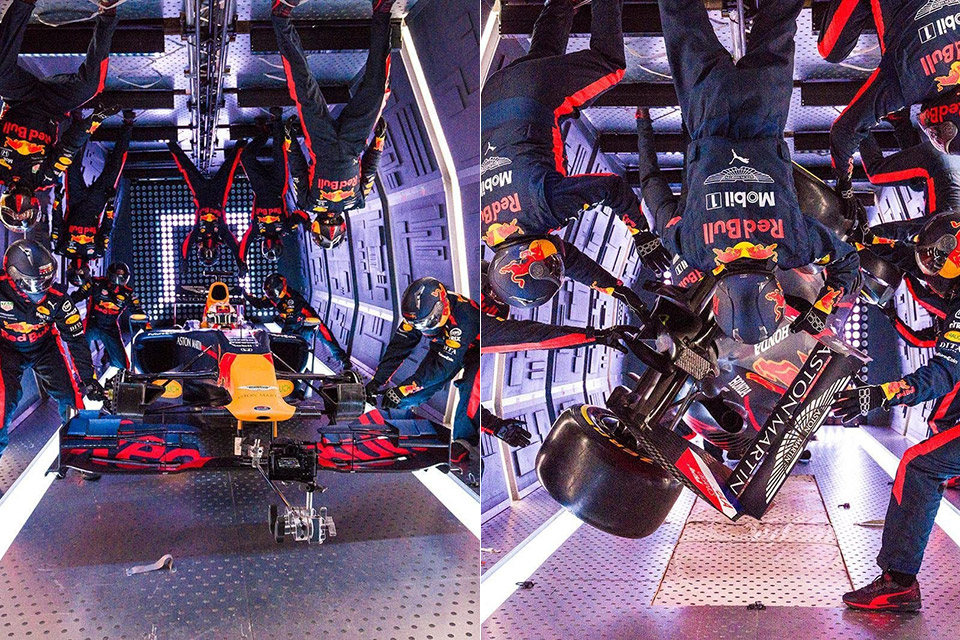
Photo credit: Red Bull Racing, Zero-G BTS stills by Denis Klero By the end of the 2019 season, Red Bull Racing set numerous world records for fastest pit stops. However, as expected, the team was still eager to push itself to new heights, literally. They decided to put their skills to the test in a completely new setting, or more specifically, changing an F1 car’s four tires while floating around in the center of an aircraft.
They chose the 2005 RB1 chassis as their test car. Its narrower form and lightweight construction made it an ideal fit for the Ilyushin Il-76 MDK, a jet that typically conducts cosmonaut training and was receiving assistance from the Russian space program. The team arrived at the Yuri Gagarin Cosmonaut Training Center just outside Star City, where the flight plans had been finalized and they were ready to go. The pilots would climb the plane at a sharp angle to around 33,000 feet before cutting power just as they reached the crest of the arc, allowing the jet to glide downward in freefall. Inside the airplane cabin, those moments spent in freefall provided the team with a whooping 22 seconds of weightlessness, a brief wonderful period in which everyone drifted around freely. To acquire as much quality time in as possible, the crew squeezed in 7 flights and around 80 of these freefall arcs over the course of many days.
RED BULL CAR – LEGO Speed Champions Oracle Red Bull Racing RB20 F1 Race Car buildable model for Red Bull and Formula 1 fans
AUTHENTIC DETAILS – This F1 race car features design details from the real-life 2024 version, including a rear wing, halo bar, and wider rear tires…
F1 MINIFIGURE – The vehicle kit includes an F1 driver minifigure wearing a Red Bull outfit and a winged helmet to place inside the F1 race car’s…
You have to remember that time was of the essence here; weightlessness lasts only a little while, so every second counts. Once the team was in place and the equipment was ready to begin, the usable window of time was reduced to roughly 15 or 20 seconds. To make matters even more difficult, a mock-up of the complete apparatus was constructed on the ground so that everyone could acquire a feel for the movements before flying to the skies. Consider how much harder it will be if you are not tethered to the floor.
Advertisement
As expected, things did not go smoothly from the start. Finally, it came down to basic physics. On the ground, the mechanics would press against the floor to offset the twisting force of the wheel cannons, but in mid-air, the anchor was removed, causing the mechanics to spin around rather than turn the nut. Add in the possibility that stray tools or wheels would float away and disrupt the following phase, and you have a formula for disaster.
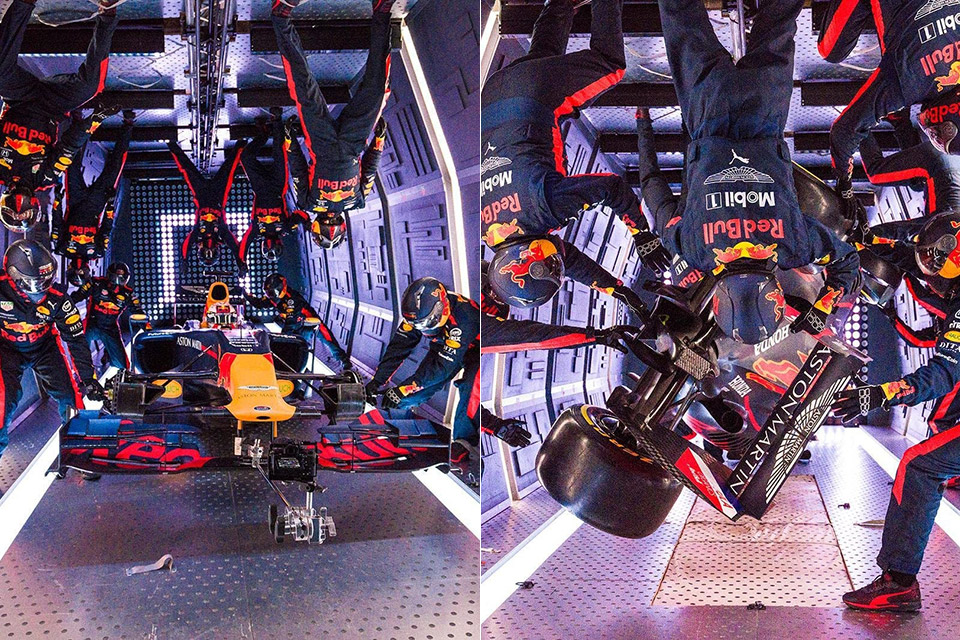
Photo credit: Denis Klero It didn’t take long for the team to realize that the only way to make this work was to divide their crew and have half of them work on the car from underneath while the other half worked from what seemed like the ceiling. The car would be inverted relative to half of the group, resulting in a balance of pushes and pulls. The only thing holding them down were their footstraps, so the mechanics had to flex their ankles to stay in place.
Photo credit: Denis Klero The execution was completed in a relatively short period of time, with 16 crew members moving into predetermined places near the car, all of which were connected to a bespoke frame built to endure the severe ascent forces and float phases. They’d operate in a planned sequence, loosening the old nuts with the wheel guns before pulling the tires off and slipping the new ones in. To avoid spinning anyone out of control, the final tightening had to be steady and gentle. Every motion stayed choreographed or something would float out of reach.
Photo credit: Denis Klero In the end, they did it, completing a full tire change in about 20 seconds, a real world record in the middle of the air, and, as if you needed to be reminded, the timing was all spot on, with the sequence matching the exact order of a track pit stop, the only difference being the constant adjustments required due to the lack of weight. [Source]
Two researchers have produced a clear nail polish that turns your nail into a stylus
It should help solve issues with ‘zombie fingers’ and for folks with long nails
It’s not yet ready for store shelves right now
If you love looking your best with long fingernails or have calloused fingertips from years of working as a musician or carpenter, you know how awkward touchscreens can be to use — and so might want to hear about this new nail polish that turns your nail into a stylus.
This coating was developed at Centenary College of Louisiana by student Manasi Desai and her research supervisor Joshua Lawrence (via LiveScience).
As Desai explained in a statement, “Our final, clear polish could be put over any manicure or even bare nails, which could help people with calluses on their fingertips too.” This means you can still enjoy your preferred nail art and use touchscreens, or if you don’t paint your nails normally, you can coat them in this polish without it being obvious.
Article continues below
(Image credit: Shuttersock)
Modern touch screens rely on a thin, imperceptible grid of wires carrying a subtle electrical charge. Because skin can slightly conduct electricity — unlike the glass of your phone screen — the electrical charge at the point your finger touches the screen sticks around on your fingertip.
Various sensors attached to the wire grid can then detect your finger’s disruption and use this information to understand precisely where your finger touched the screen, and how that touch should translate into an action on screen.
If your fingers are calloused — say from many years of being a musician or carpenter — then the conductive properties of your digits change and can mean you can’t engage with touch screens. This phenomenon is referred to as zombie fingers.
Advertisement
Meanwhile, long fingernails can make it hard to properly touch a screen with your fingertips, and your nails don’t share your skin’s conductive nature. But with this new coating, they will.
Sign up for breaking news, reviews, opinion, top tech deals, and more.
Now, there have been attempts to transform a nail into a stylus in the past, but these efforts would add metal particles or carbon to polish, which, while effective, can be hazardous if inhaled during the manufacturing process (via SciTechDaily). The other disadvantage is that these polishes have a dark or metallic finish, which can limit their appeal from a style perspective.
So the Centenary College of Louisiana pair looked for clear conductive nail polish options using trial and error — experimenting with 13 commercially available clear coat polishes and over 50 additives.
Advertisement
The end result combined polish with modified taurine — a substance you can find in various dietary supplements and in Red Bull — and ethanolamine — a simple compound with a wide range of applications across cosmetics, agricultural, and industrial processes.
(Image credit: Getty Images / kinemero)
On their own, these chemicals aren’t perfect, but combined, they are able to make your nail register as a touch on a smartphone.
Speaking with LiveScience, Lawrence revealed that it will likely be some time before their polish hits shelves. For a start, the effect only lasts a few hours as the ethanolamine evaporates quickly. The polish is also not 100% effective (meaning some touches still don’t register), and the least-toxic formulation so far isn’t as clear as the researchers would like.
Advertisement
They’re still working on the final formula, with Lawrence saying, “Right now, we have a good proof of concept material, but need to do a lot more work!”
When they do, just make sure not to press your nail too hard into your screen — on a foldable phone, you could leave a serious indent or permanent scratch, and that won’t be ideal.
When Jensen Huang told 30,000 attendees at GTC last week that the future data centre is a “token factory,” he was describing a world that a small Israeli startup has been quietly building toward for months. NeuReality, the Caesarea-based company behind the NR-NEXUS inference operating system, has appointed Shalini Agarwal, a product management director at Google Labs, as a strategic adviser charged with shaping how NR-NEXUS reaches enterprise buyers, according to a press release distributed on Monday.
The hire signals a shift in ambition for a company that began life designing custom silicon for AI inference and has since pivoted toward software that promises to turn fragmented GPU clusters into production-grade inference engines.
Agarwal brings roughly two decades of experience in product strategy across major technology companies. At Google Labs, she has directed product management for AI-focused initiatives. Before that, she spent nearly a decade at eBay, according to publicly available professional records, and holds a degree in computer science, electrical engineering, and management science from MIT. Her appointment is advisory rather than operational, but it places a recognisable Silicon Valley name alongside NeuReality’s existing leadership: co-founder and CEO Moshe Tanach and president Hiren Majmudar, a former GlobalFoundries and Intel Capital executive who joined in September 2024.
The timing is deliberate. On 12 March, NeuReality unveiled NR-NEXUS, describing it as a hardware-agnostic operating system for what the company calls AI factories. The platform disaggregates prefill and decode tasks across heterogeneous hardware, including GPUs, CPUs, and network interface cards, aiming to squeeze more useful work out of expensive accelerators that often sit partially idle. Beta customers are already running the software, according to the company, though NeuReality has not disclosed which organisations are in the programme.
Advertisement
The 💜 of EU tech
The latest rumblings from the EU tech scene, a story from our wise ol’ founder Boris, and some questionable AI art. It’s free, every week, in your inbox. Sign up now!
The product arrives at a moment when inference economics have become one of the most closely watched metrics in enterprise AI. Deloitte estimates that inference workloads accounted for half of all AI compute in 2025 and will reach two-thirds this year. Hyperscalers are responding with enormous capital expenditure, with Amazon projecting $200 billion in 2026 spending and Google budgeting between $175 billion and $185 billion, according to recent earnings disclosures. Yet much of that investment flows through a small number of vertically integrated stacks, leaving enterprises that want to run inference across mixed hardware with limited options.
That gap is where NeuReality is placing its bet. NR-NEXUS is designed to work across any CPU, GPU, or NIC, including NVIDIA’s forthcoming Vera Rubin architecture, and targets three buyer categories: neocloud providers, enterprises building their own inference capacity, and semiconductor vendors looking to offer a complete software layer atop their chips.
Advertisement
The company has raised approximately $70 million to date. A $35 million Series A in late 2022, led by Samsung Ventures with participation from OurCrowd and SK Hynix among others, was followed by a $20 million round in March 2024 anchored by the European Innovation Council Fund and existing investors. That EU backing positioned NeuReality as part of a broader European push to develop sovereign AI infrastructure, though the company’s engineering centre remains in Israel.
Agarwal’s advisory role appears focused on go-to-market strategy rather than product engineering, a recognition that building an inference operating system is only half the challenge. The other half is persuading infrastructure buyers, many of whom have deep relationships with NVIDIA’s own software ecosystem, that a startup’s orchestration layer is worth the integration effort.
Whether NR-NEXUS can gain traction will depend on execution in a market that is attracting well-funded competition. Modal Labs is raising at a reported $2.5 billion valuation. Baseten announced a $300 million round at $5 billion. Fireworks AI secured $250 million. Each approaches inference optimisation from a slightly different angle, but all are chasing the same fundamental opportunity: as AI moves from training to deployment, whoever controls the inference layer controls a growing share of the value chain.
For NeuReality, the appointment of an adviser with Google-grade product instincts may be a modest move on paper. In practice, it is a bet that the next phase of AI infrastructure will reward companies that can bridge the gap between silicon and the enterprises that need to run models at scale, efficiently, and across hardware they already own.




























































You must be logged in to post a comment Login