
Join Mikko Hyppönen and security leaders from the NFL, CHANEL, and Atlassian for a two-hour digital summit on what AI-speed attacks change, what defenders should stop doing, and how to validate, decide, fix, and re-validate at machine speed.
Tech
New Android malware encrypts files, steals data, and harasses victims


A new Android malware strain called Mantax Otax combines ransomware and spyware capabilities to encrypt files, steal sensitive data, and spam and harass victims.
Indonesian operators distribute the malware through malicious APKs hosted outside Google Play, targeting users with phishing and social engineering messages.
After installation, the malware requests permission to use the Accessibility service, which gives it extensive control over compromised devices.
Next, it retrieves its command-and-control infrastructure (C2) domain from GitHub and sends back victim details such as location, carrier, Android version, and device ID. The C2 may send commands through Firebase or WebSockets for execution.
According to Zimperium, Indonesian operators distribute the malware through malicious APKs hosted outside Google Play, Android’s official app store, using phishing and social engineering messages to target victims.
Encrypting older Androids
According to mobile security company Zimperium, Mantax Otax encrypts devices running older Android versions. It searches shared storage and encrypts targeted file types using a victim-specific AES key obtained from the C2 server.
The malware then deletes the original files and adds the ‘.enc’ extension to the encrypted copies.
Mantax Otax also replaces local images with ransom notices and opens a full-screen Firebase-hosted chat to facilitate ransom payment negotiations.
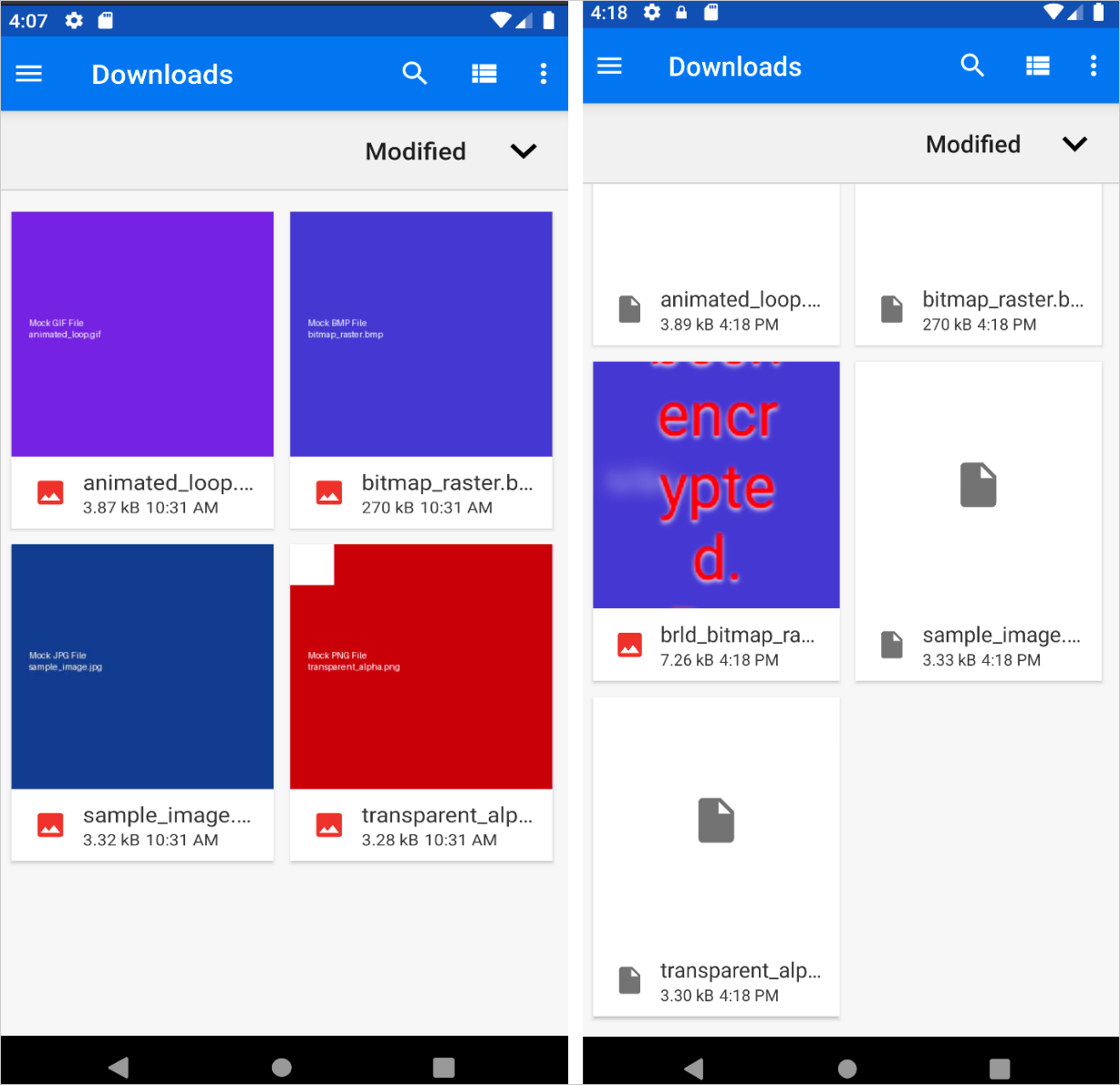
Source: Zimperium
Zimperium researchers were able to exploit a misconfiguration in the Firebase C2 server, which exposed the attackers’ chats with victims.
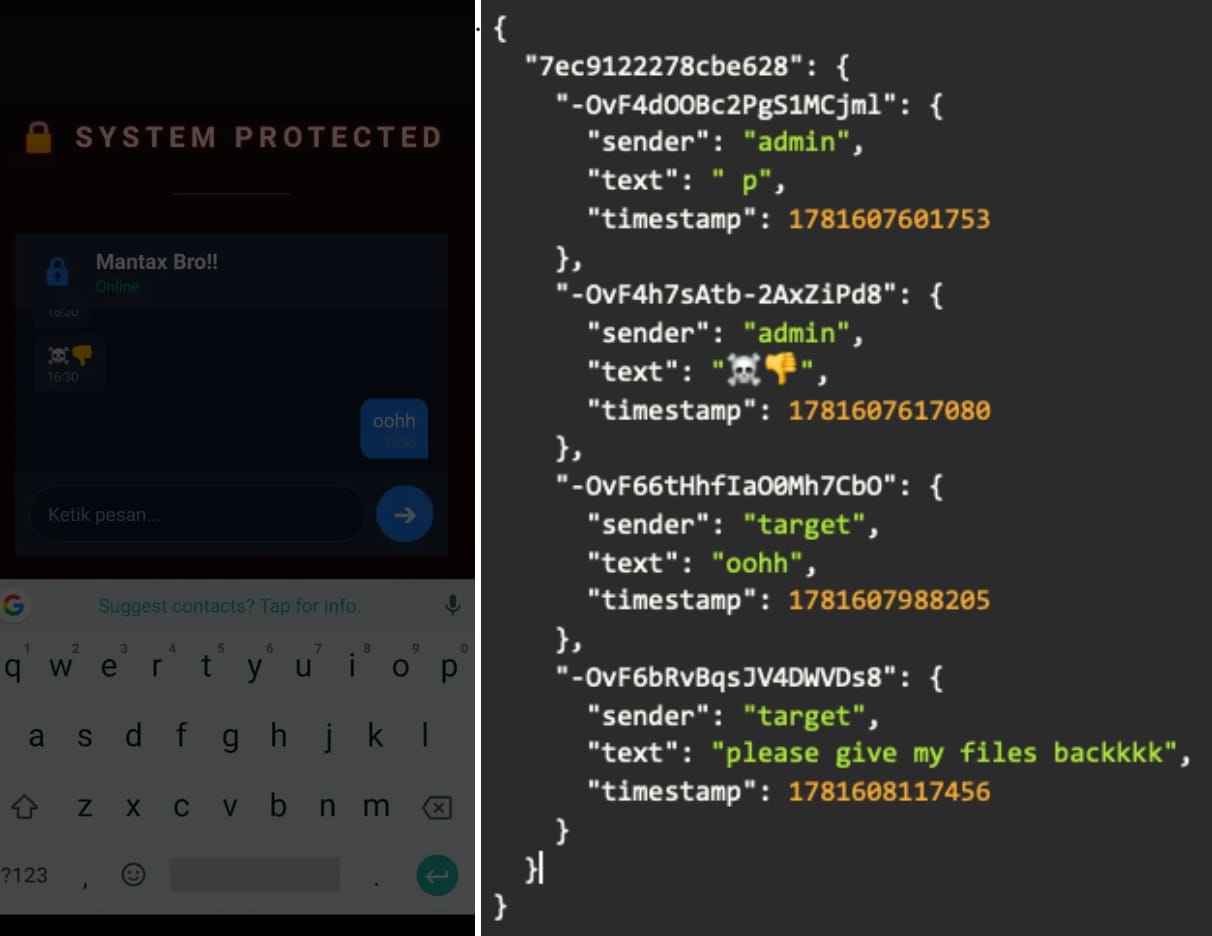
Source: Zimperium
Mantax Otax’s ransomware module only runs against Android devices running version 9 or older, as the ‘Scoped Storage’ security and privacy feature in Android 10 and later significantly restricts the encryption capability to the external-files directory.
Spying, spamming, and harassing
Apart from ransomware, Mantax Otax includes spyware, remote control, and harassment features.
The researchers note that the malware can steal lock-screen PINs to maintain persistent access, read SMS and one-time passwords, access call logs, contacts, browsing history, app lists, Google account information, and location.
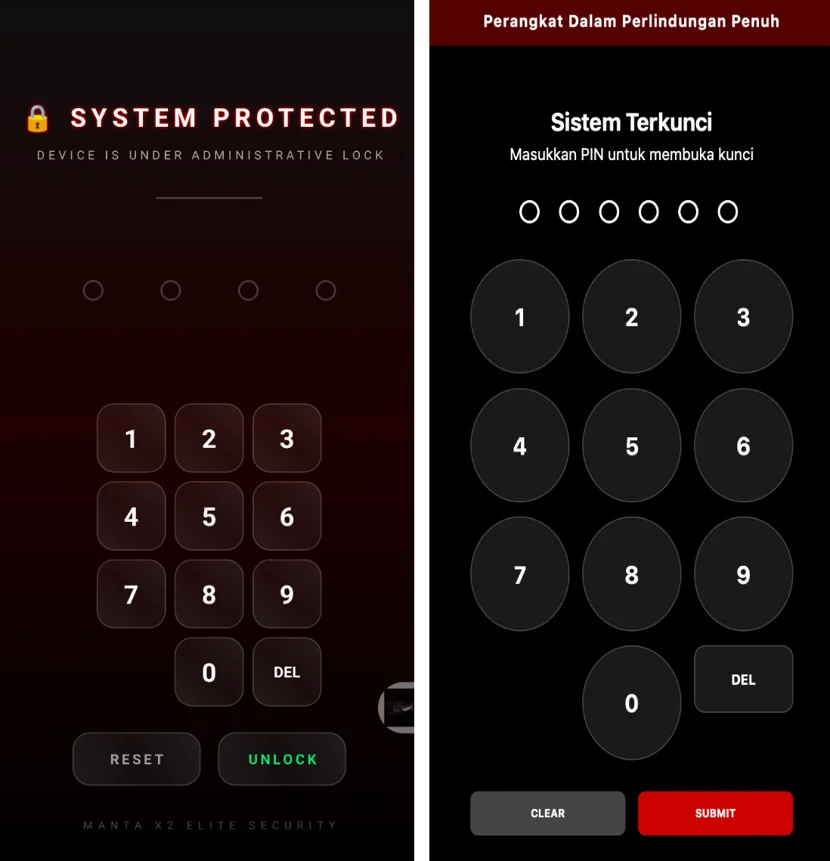
Source: Zimperium
It can also extract WhatsApp profiles and messages, as well as Telegram chats, using simulated interactions via Accessibility services.
Additionally, it abuses Android’s MediaProjection API to capture screenshots, record MP4 videos, and stream the victim’s screen in near real time via the Catbox file hosting service.
Mantax Otax can also capture photographs using the infected device’s cameras and upload them to the operator.
Version 2 of the malware added harassment functions such as repeated dialog boxes, full-screen videos, rapid “jumpscare” image overlays, and remotely controlled text-to-speech messages played through the device speakers.
These additional features add an intimidation component to the attacks, which act as a pressure mechanism for the victim to pay the ransom.
Because Zimperium is a Google security partner via the App Defense Alliance (ADA), Mantax Otax is already detected and blocked by up-to-date Android devices with an active Play Protect service.
Users are generally advised not to install APKs from outside Google Play, not to give questionable apps Accessibility permissions, and to only trust reputable publishers.


Continue Reading


ai AND ml
GPT-Live-1 makes speaking to AI models more fluid
OpenAI has launched a version of its latest real-time full-duplex voice model as an API, allowing software developers to implement more responsive voice-enabled apps and conversational workflows.
GPT-Live-1 debuted in July, offering a way to interact through spoken prompts and responses instead of through typed text. Initially available through the ChatGPT interface, the voice model can now be reached via API calls.
As a full-duplex model, GPT-Live-1 can listen and generate speech at the same time, which aids fluid communication. People often talk over one another and may find it frustrating to take turns speaking and listening as if using half-duplex handheld radios.
OpenAI says it has focused on allowing developers implementing GPT-Live-1 to customize how users of business apps experience voice interaction and associated workflows.
“A core GPT‑Live‑1 strength, smooth interruption handling, is already delivering business impact: in early evaluations, Speak found that GPT‑Live‑1 gave learners more time to think before the language tutor responded, cutting interruptions by almost 80 percent versus previous turn-based systems,” the company said.
GPT-Live-1 is designed to handle spoken conversation while a backend model (eg, GPT-6 Astra or a more affordable option for rote tasks) handles information lookup, tool usage, and task management.
It represents a step up from OpenAI’s Realtime API, which debuted in 2024. In the Tau3 voice-agent intelligence benchmark, which assesses spoken customer-service tasks relevant to airlines, retailers, and telecom companies, GPT-Live-1 scores 86.2 percent, compared to 45.7 percent for GPT-Realtime-2.1 and 42.4 percent for GPT-Realtime-2.
Citing its own evaluations, OpenAI said GPT-Live-1 performs 30 percent better than GPT-Realtime-2.1 in Full Duplex Bench performance, while also outperforming its predecessor in turn-taking latency and interactive behavior.
Yelp has been using GPT-Live-1 for the Yelp Host service, and has nice things to say about the technology as it applies to the company’s AI restaurant reservation system.
“With GPT-Live-1, every call is more conversational and responsive,” said Akhil Kuduvalli Ramesh, chief product officer at Yelp, in a statement. “Yelp Host now gives restaurants an advanced voice AI that delivers exceptional guest experiences, captures revenue opportunities they may have otherwise missed, and helps staff focus on serving guests instead of answering the phone.”
Yelp does not address whether restaurant customers making reservations welcome the more free-flowing robo-banter or simply accept it because it’s better than waiting on hold to chat with a person.
GPT-Live-1 costs $0.05 per minute of usage, on top of whatever backend model is running. Custom voices can be negotiated with the OpenAI sales team. The voice model is also available through OpenAI Presence, the company’s enterprise agent platform. ®

They’re aimed at protecting minors, but the rules are not universally supported.

California Governor Gavin Newsom has signed multiple measures aimed at protecting the state’s youth. These new laws include restrictions for potentially addictive social media features and limitations on how young users can interact with AI chatbots.
The state is enacting restrictions on how teens can interact with chatbots from AI companies, including time limits. Chatbot makers will be required to implement mental health resources, safety protocols in case a minor discusses self harm and notifications for parents if a child turns off safety settings. California will now require “independent child safety audits and annual risk assessments” by AI companies. AI companies could face legal liability under these rules if they fail to meet the new rules. Today’s developments follow measures Newsom signed yesterday that created broader frameworks for auditing AI companies for compliance with California law.
One of the more divisive measures Newsom passed centers on teen use of social media. The state now prohibits social media companies from letting users under age 16 access potentially “addictive features.” The bill’s definition of “addictive” includes wide-ranging capabilities from autoplaying videos to notifications to personalized algorithm-driven content feeds.
Critics such as the Electronic Frontier Foundation called this measure a functional ban on social media for teens. “Denying minors access to digital forums – or stripping out basic tools needed to navigate them – is not going to help make young people safer or healthier in the AI age,” EFF Associate Director of State Affairs Rindala Alajaji said. The organization added that enforcing this policy would also force all social media users to disclose more personal information to prove their age, creating additional privacy risks. This is one of the arguments many parties have long taken against other age verification laws.
Newsom signed additional measures with similar goals of protecting youth from potentially risky tech applications. Those include an expanded definition of child sexual exploitation to include generative AI-made or digitally altered images. Another bill offers new protections against targeted advertising and regulates AI systems’ use of data about K-12 students.

August was the planet’s hottest month ever recorded, capping a remarkably grim summer of heat records. With El Niño strengthening—and climate change continuing to heat things up—more records are likely in store well into next year.
Data from Copernicus, the European Union’s climate agency, shows that last month tied with July 2023 for Earth’s hottest month. (July is also usually the hottest month of the year.) This July also tied with July 2024 for the second-hottest July on record, while June 2026 was the second-hottest June ever recorded. The news comes on the heels of a separate announcement on Wednesday from the National Oceanic and Atmospheric Administration, which declared this was the hottest summer for the US, beating a previous record set during the Dust Bowl.
The sweltering summer is a grim sign of how burning fossil fuels is pushing temperatures up around the globe while unleashing more intense and longer heat waves.
“August 2026 was a remarkable month in the global climate record,” Samantha Burgess, the strategic lead for climate at the European Center for Medium-Range Weather Forecasts, said in a statement. “Combined with record global sea surface temperatures and the warmest summer on record for Western Europe, these observations show how climate change is driving extremes across both the atmosphere and the oceans. The impacts of these conditions are increasingly being felt by communities, economies, and ecosystems across the world.”
The global average temperature for August was 1.65 degrees Celsius (3 degrees Fahrenheit) above the preindustrial average, according to Copernicus. While it was hot globally this summer, the impacts played out with dangerous and sometimes deadly results locally.
Photograph: Ufuk Celal Guzel/Getty Images

Researchers estimate that as many as 35,000 people died during heat waves in Germany, France, and Spain this summer. Record-breaking fires also raged across parts of Europe, unleashing the first documented fire cloud in France and threatening a key NASA observatory in Spain. In North America, wildfires in Canada and northern parts of the US filled areas across the Northeast with smoke.
Climate change has boosted background temperatures, but the El Niño roiling the eastern Pacific Ocean has piled on more heat. El Niños usually coincide with a temporary uptick in global temperature from 0.1 to 0.2 degrees Celsius. This year’s El Niño is forecast to reach record strength and upend weather around the globe. But the full impact on the planet’s temperature won’t be felt until next year, meaning that next summer may be even hotter than the one we just lived through.
Climate scientists have warned that the world needs to prevent long-term average warming from breaching 1.5 degrees Celsius to avoid the worst impacts of climate change. While temperatures above the threshold for a single month don’t represent a permanent breach of this temperature, they’re a sign that the world is getting closer to this benchmark.
Earlier this month, the UN warned in a report that the world is likely to cross the 1.5 degrees Celsius threshold in a few years. To slow and eventually reverse the rise in global temperatures, the world needs to stop burning fossil fuels and lower carbon emissions.
“This summer’s scorching heat, raging wildfires, and deadly floods are a warning of what lies ahead,” UN Secretary-General Antőnio Guterres said in a statement. “We must make the overshoot above 1.5 degrees as small and short as possible. That demands an overshoot of ambition.”

 As FDM printers keep getting faster, we are forced to deal with a range of bottlenecks, all of which conspire to hold us back from another Benchie world record. A major physical limitation is that of flowrate, as the hotend has to be able to melt the filament that enters the nozzle before it departs said nozzle. One attempt to make a high-flow nozzle involves splitting the material path into three winding sections, which theoretically should help said flowrate. Recently [Thomas Sanladerer] took a poke at this and other types of nozzle with SLS-printed nozzles.
These printed parts still needed some finishing on the lathe, including drilling the 0.4 mm nozzle hole. The finished nozzles feature a variety of internal geometries, including the aforementioned triple-path, as well as many with various intrusions that seek to maximize the contact area.
Using a Prusa Core One these nozzles were subsequently tested to see what print quality they produced at high flow rates. A special test rig to test the nozzle pressure was also used to further characterize them, as this indicates at which flowrate the nozzle begins to struggle. Among these the Fuge design did the best, though with the big asterisk that these nozzles were printed in MS1, which is in effect tool steel and thus not great for being nozzles.

Forever Physical: In a world where gaming giants are actively trying to kill optical discs and other physical media, GOG is doing its own thing. The retro gaming store is expanding its dedicated preservation efforts, giving customers a new way to enjoy their growing collection of digital purchases.
GOG recently announced the addition of a few more titles to its Preservation Program, which was introduced to improve support for some classic games sold on the store. The program is now welcoming five new titles, which also come with their own interactive 3D boxes scanned from original packaging.
GOG’s new wave of Preservation Program titles includes Star Trek: 25th Anniversary, Armikrog, Descent, Hitman: Codename 47, and Myst. The five corresponding 3D dioramas were created after scanning the front, back, spine, and all the additional elements of the original boxes. GOG chose the GLB format to share the interactive 3D objects, which should be easy to view with native 3D viewers available on both Windows and macOS.
Furthermore, GOG entered into a partnership with Big Box Collection to offer flat, printable versions of the aforementioned 3D box art. Ideally, users should be able to print, cut, fold, and glue all the art’s elements together to create their own game box replicas. Big Box Collection is a “one-man show” started by a fan of boxed games in 2015. It now offers 3D replicas of around 890 physical games released on PC and other platforms.

As highlighted in GOG’s announcement, game boxes can be affected by the same durability and reliability issues that make optical discs, floppy disks, and other physical media so difficult to preserve. Providing printable scans of the original boxes should help game preservation from a different angle, pleasing people interested in “owning” fully tangible replicas of their favorite titles.
In fact, there is a whole community on the GOG forums that has been striving to add a “boxed” layer to the store’s digital offering since 2008. People have been designing custom “DVD covers” for GOG games for years, and the store is now contributing to this effort with its own “official” selection of printable boxes.
In 2025, I spent hundreds of euros on a brand-new Epson EcoTank ET-8500 printer just to bring my GOG collection to the shelves.
The GOG Preservation Program launched a couple of years ago to ensure that classic games would remain playable on modern systems even after their original developers had abandoned them. GOG is adding its own tweaks, mods, and compatibility improvements to the original releases. GOG has not provided any information about plans to add even more 3D and printable boxes for some of these “preserved” games.
Tech
Samsung is working with OpenAI on next-generation chips while deploying ChatGPT at massive scale

What we know so far: OpenAI is working more closely with Samsung on chip development while also deploying ChatGPT within the South Korean company, adding another major technology partner as it builds out its AI infrastructure. Harrison Kim, general manager of OpenAI Korea, pointed to the companies’ work on chip manufacturing and research as a key part of their expanding relationship.
“One of the areas where we have made the most progress and gained the most recognition with Samsung Electronics is our joint production and research on the next-generation chips we are developing,” Kim said at a press conference in Seoul. Kim did not provide details on the chips or explain Samsung’s role.
Samsung said it could not confirm information related to customers.
The work comes after OpenAI’s June announcement of Jalapeno, its first custom AI chip. OpenAI designed the chip with Broadcom for AI inference, and TSMC is set to manufacture it.
OpenAI’s interest in Samsung also reflects memory’s growing importance in AI systems. Large models need substantial memory capacity and bandwidth to run quickly, particularly in data centers serving large numbers of users. Kim said demand for advanced memory will continue to rise as AI computing becomes faster and more complex.
Samsung and SK Hynix signed letters of intent last year to supply memory chips for OpenAI’s Stargate data center project. Kim said working with South Korean semiconductor suppliers is a priority for OpenAI’s local office.
Samsung is also one of OpenAI’s biggest enterprise users. Kim said it was “one of the largest-scale deployments of ChatGPT globally,” with employees in Korea and other markets using the tool for research and development, marketing, and sales.

The company has been opening access to several generative AI products internally. In June, Samsung said employees in its Device eXperience division, which oversees phones, televisions, and home appliances, would be allowed to use ChatGPT, Google’s Gemini, and Anthropic’s Claude for work.
OpenAI said adoption among South Korean businesses has increased sharply. The number of ChatGPT Enterprise users at companies and institutions in the country was about 28 times higher at the end of August than a year earlier. It did not disclose the total number of users.
The company said businesses are increasingly using AI across departments, including legal, sales, finance, marketing, and operations, instead of limiting the technology to individual assignments.
South Korea had the highest number of paying ChatGPT subscribers outside the United States as of late last year, OpenAI said.
OpenAI expects product use to grow now that GPT-6 Astra has launched. The company said the model offers better performance in computer use, professional work, science, coding, and cybersecurity.


For the first time in more than a decade, someone other than Tim Cook ran an Apple keynote yesterday, and John Ternus saved the biggest reveal for almost an hour in.
We watched it last evening so you didn’t have to – although Apple took its time before unveiling the marquee attraction.
This was the first Apple keynote in more than a decade where Tim Cook wasn’t the one walking us through the big reveals. That job now belongs to John Ternus, and yesterday was his big debut as CEO addressing its major product launch from the company’s headquarters in Cupertino.
Cook did pop up for a cameo, in what felt like a clear passing-of-the-torch moment, but this was Ternus’s show. He set out his stall up front, emphasising that privacy is at the heart of everything Apple does – this is “personal intelligence that’s actually personal”, and private, he insisted. Whether it runs on-device or in the private cloud, there is no ambiguity about where your data goes compared to “other players”, he said. It’s clearly the line Apple wants to be recognised for under this new leadership, and it set the tone for much of the keynote.
iPhone still at Apple’s core
Two new phones anchored the event line-up: the iPhone 18 Pro and iPhone 18 Pro Max. They keep the same design language as last year’s Pro models, though this time round Apple’s added four new finishes to choose from: black, light blue, glacier (a silvery tone) and burgundy.
Under the hood, both phones get the new A20 Pro chip, which is Apple’s first built on a 2-nanometre process. It packs a 6-core CPU, split between two performance cores and four efficiency cores, alongside a 7-core GPU that Apple says delivers 40pc faster graphics, plus a second Neural Engine, all in service of what the company is billing as its most AI-capable iPhone yet.
Battery life gets a bump too; the Pro now matches what the old Pro Max managed last year, while the new Pro Max stretches to a claimed 30 hours. On price, in the US, the 18 Pro starts at $1,199 for a 256GB model, and the Pro Max starts at $1,299, also for 256GB. European pricing is to follow.
‘Digital negative’ for the AI-sceptical era
As the whole world of photojournalism becomes fraught with doubts over the veracity of photos, it was interesting that Apple introduced a ‘Reference Image’ feature in its iOS 27, which Ternus described as akin to a “digital negative” of the original image. In practice, it works by attaching metadata to a photo to certify the image hasn’t been AI-generated or altered. This feature will not initally be available in Europe and China.
On the camera lens itself, photography enthusiasts will love that variable aperture was confirmed on the iPhone 18 Pro line (although not the case on the Duo). Ternus had teased the move yesterday morning with a cryptic post on X.
The new Apple Watch line-up leaned all-in on health this year, with the Series 12 and Ultra 4 both clearly built around that theme. New watch models can use microphones and other sensors to generate an AI recap of your day, and offer a ‘readiness’ reading of what you are ready to take on, in an echo of a prominent feature of another popular wearable, the Oura ring.
The slow reveal – the foldable
It was almost an hour into the presentation before the iPhone Duo even got a mention, long enough that commentators on social media started openly wondering whether it was going to happen at all. But then it dropped almost as an afterthought – the moment everyone had been waiting for, the long-awaited iPhone Duo, Apple’s shiny new foldable phone.
Open it up and, Apple says, you’re holding the thinnest iPhone it has ever made. It has two screens sharing the same aspect ratio, so that whatever you’re looking at scales between them without distortion.
Closed, the outer display measures 5.4 inches and covers 90pc of the screen area you’d get on an iPhone 18 Pro. Open it out and the inner display covers 7.6 inches. Both screens are Super Retina XDR with ProMotion, Always On and a peak outdoor brightness of 3,000 nits. The inner display has a nano-texture finish that cuts down on glare and makes the crease down the middle less noticeable.
The body is built from grade-five titanium, with Ceramic Shield protecting the back and the tougher Ceramic Shield 2 on the front, which Apple rates as three-times more scratch-resistant than the previous generation. It’s rated IP68 for splash, water and dust resistance.
Rather than Face ID, Touch ID is built into the side button, and you can also unlock the Duo with your Apple Watch. The hinge alone is made up of more than 100 components, and there’s no physical SIM tray anywhere – so it’s eSIM-only, wherever you buy it.
It runs on the same A20 Pro chip as the 18 Pro line, on that same 2-nanometre process, with a 6-core CPU that Apple says is up to 20pc faster than the A19 Pro, a 7-core GPU that’s up to 40pc faster, and a new dual 16-core Neural Engine offering double the on-device AI compute of the previous generation.
To keep all that cool, the Duo pairs the chip with a custom vapour chamber, and it runs on a dual-battery set-up with one battery on each side, working together as a single pool. Apple claims up to 31 hours of video playback if you’re mostly using the inner display, up to 44 hours on the outer display, and up to 24 hours if you’re using both about equally.
It also charges quickly, reaching 50pc in around 20 minutes over a cable, or about 30 minutes wirelessly with MagSafe or Qi2.
On the camera, there’s a 48MP main sensor with an integrated optical-quality 2x telephoto built in, so there’s no separate telephoto lens to speak of. It can shoot at the full 48MP or default to 24MP, and it’s paired with a 48MP ultra-wide sensor, as used on the 18 Pro. A new camera sits beneath the inner display to handle FaceTime calls.
There are also a few software tricks that only make sense because of the fold. Smart Take automatically captures a photo the moment everyone in frame is posing, Duo Preview puts a live preview on the outer screen so whoever’s being photographed can check their own framing, and Duo FaceTime lets someone else join a call from the outer display.
On the software side, it runs iOS 27 – specifically, version 27.1 adapted for the Duo, with the interface rearranged to make sense of the fold and a new Split View mode that lets two apps sit side by side on an iPhone for the first time.
Apple playbook
“The foldable launch is straight out of Apple’s playbook – wait for the product to work out its kinks and for the market to offer glimpses of viability, then enter and shape the category,” said Forrester vice-president and principal analyst Dipanjan Chatterjee.
“Remember the Apple Watch? The difference is that foldables still represent a minuscule share of the smartphone market.
“The test of Apple’s ambition will be whether it can expand that niche into a meaningful new segment. Otherwise, the foldable risks becoming a premium-priced ornament in the portfolio, imparting badge value but not meaningful growth. The difference is that a foldable plugs directly into Apple’s extraordinarily well-established iPhone ecosystem, giving it a considerably better shot at commercial success.”
The Duo comes in two colours, ‘star white’ and ‘night sky’, and starts at €2,369. It will be available for pre-order on 16 October in 70 countries and regions including Ireland, the UK, the US, France and Germany.
Don’t miss out on the knowledge you need to succeed. Sign up for the Daily Brief, Silicon Republic’s digest of need-to-know sci-tech news.

Multiple social media posts from the US President suggested renaming New Mexico to “New America,” and congressional representatives have preemptively asked Apple and Google not to rename the state.
The United States President has begun using the names on the map as some kind of negotiating tactic in ongoing trade wars he started. After executive orders changed The Gulf of Mexico and Lake Ontario in the GNIS database, Apple Maps reflected that change.
According to a report from The Washington Post, Democratic congressional representatives from New Mexico have asked Apple and Google to not comply if another name change is attempted. The requests have been made after multiple social media posts from the President, but no executive order or official plans have been made.
The request appears to be as performative as the President’s social media posts, because Apple and Google have no say in the matter. The Geographic Names Information System (GNIS) is a database run by the federal government, which is affected by executive orders, and what the companies draw from for local place names.
In using the database, Apple and Google must use the names or risk being barred from access to the system. They can file formal complaints, but that’s about it.
Apple Maps didn’t update Lake Ontario until GNIS was updated and pushed the change to their backend. Google, however, made the change to Google Maps immediately following the executive order being signed.
If the congressional representatives of New Mexico want something done, they could raise the concern in Washington and utilize the powers Congress has at its disposal. Instead, they’ve pointlessly written a letter to companies that have no horse in the race.
The United States President doesn’t have the power to change the name of a state, even with executive order. While he may attempt some loophole, like forcing a map name change without an official name change, no move has been made yet.
In this particular case, these whims may just be more hot air to distract from the numerous issues plaguing the administration. All I would ask of these members of Congress is this: focus on solving the problem instead of going after those that have no control over the problem.

A physical SIM is a small removable card. An eSIM is a chip built into the phone that can’t be removed. The real difference isn’t security. It’s how easily you can switch phones or carriers.
More phones sell as eSIM-only now, and more people travel with a phone that needs a local SIM for a few weeks at a time. Both trends make this comparison worth understanding before you buy a phone or switch carriers.
The short version: an eSIM and a physical SIM do the same basic job. Both connect your phone to a carrier’s network. They just get set up and swapped differently, and the differences matter more in specific situations, like switching carriers to save money, than they do in daily use.
Quick Take
Neither type is universally better. A physical SIM is simpler if you swap phones often or need to lend your connection to another device. An eSIM is faster to activate for a new carrier or a travel plan, and it supports running two numbers on one phone. Marketing sometimes claims eSIM is meaningfully more secure. That’s only partly true, and it’s worth understanding exactly which part before you decide it matters to you. If you’re not sure which you have right now, check your phone’s settings under mobile or cellular data. Most phones list it plainly.
What Each One Actually Is
A physical SIM card is a small removable chip. You insert it into a tray on the side of the phone. It stores your phone number and account details, and carriers mail it to you or hand it over in a store. Move it to a different phone, and your service moves with it.
An eSIM does the same job, but it’s built into the phone itself. It can’t be removed. Instead of inserting a card, your carrier sends the account details to the phone digitally, a process GSMA (the industry body that sets the eSIM standard) calls remote provisioning. That’s also why eSIM technology fits into devices too small for a SIM tray, like some smartwatches.
One thing that doesn’t change either way: your phone’s IMEI number identifies the device itself, separate from whichever SIM or eSIM you’re using. Most current phones support one type or the other, and many support both. Which one your specific phone has, or needs, is worth confirming before you buy or switch.

eSIM vs. Physical SIM at a Glance
Here’s how the two compare on the things that actually affect daily use.
| What you’re doing | Physical SIM | eSIM |
|---|---|---|
| Switching to a new phone | Pop out the card, insert it in the new phone. Takes seconds. | Transfer or reactivate through the carrier or manufacturer’s process. Takes a few extra steps. |
| Switching carriers | Wait for a new card by mail, or visit a store. | Activate through the carrier’s app, often within minutes. |
| Running two numbers on one phone | Needs a dual-SIM phone with two physical trays, which is uncommon. | Common on phones that support one physical SIM plus one eSIM, or two eSIMs. |
| Lost or damaged phone | The SIM itself usually survives and can move to another phone. | The eSIM profile stays with the broken phone until the carrier reissues it. |
| Physical theft | A thief can remove and reuse the SIM. | Can’t be physically removed from the phone. |
| Carrier and device support | Works with nearly every phone and carrier. | Growing, but still inconsistent with smaller carriers and older phones. |
None of these differences make one option flatly better. They just show up in different situations, which is the point of checking the sections below against your own habits. If you swap phones often, the top row matters most. If you travel a lot, the second row does.
How It Works in Practice
Switching to a new phone
With a physical SIM, you take it out of the old phone and put it in the new one. That’s the whole process. With eSIM, Apple’s own instructions list several ways to move a number to a new iPhone, including a direct transfer between phones, scanning a carrier QR code, or activating through the carrier’s app. None of these take long, but they all take more steps than pulling out a card.
Switching carriers
Physical SIM switches usually mean waiting for a card in the mail or visiting a store. eSIM switches are typically faster. Most carriers have an app that installs the new network profile digitally, often finishing in minutes rather than days. Either way, switching only works if your phone itself isn’t locked to your old carrier. If it is, you’ll need to unlock the phone first before a new SIM or eSIM profile will connect.
Running two phone numbers on one phone
This used to require a phone with two physical SIM trays, which most phones don’t have. eSIM changed that. Google’s Pixel phones, for example, support running one physical SIM alongside one eSIM, or two eSIMs at once, with Google specifically pointing to keeping a business number and a personal number on the same device as a real use case.
Traveling internationally
An eSIM lets you add a local carrier’s plan before or right after you land, without hunting for a SIM card shop. A physical SIM means either buying one on arrival or setting up international roaming with your home carrier, which usually costs more.
Common Misconceptions
“eSIM is just more secure”
This is half true. An eSIM can’t be physically pulled out of a stolen phone, and it’s harder to clone than a physical card. But the type of fraud most people actually worry about, someone tricking your carrier into moving your number to a different device, works about the same either way. As NordVPN’s security comparison puts it, SIM-swap fraud isn’t meaningfully less common with eSIM. The security difference is real, but narrower than the marketing suggests.
“eSIM means the phone has no SIM card slot at all”
Not necessarily. Most Android phones that support eSIM still have a physical SIM tray too, so you can choose either or use both. The clear exception is recent US iPhone models, where Apple’s US versions ship eSIM-only with no tray at all, while the same phones sold outside the US keep one. Check your specific phone and region rather than assuming.
“You can’t have a backup SIM with eSIM”
You can. It’s just less convenient. A backup physical SIM can move to any spare phone in seconds. A backup eSIM profile needs the same activation process as the original, which usually needs an internet connection and cooperation from the carrier.
Limitations and Edge Cases
eSIM carrier support keeps growing, but it’s still uneven. Some MVNOs (smaller carriers that lease network access from the big ones) and some countries don’t support eSIM activation yet. This is separate from whether the phone’s network bands match your carrier, which matters regardless of SIM type. Check both with your specific carrier before assuming either will work.
Handing your connectivity to someone else is harder with eSIM. Popping a physical SIM into a family member’s phone during an emergency, or into a cheap backup phone while yours is repaired, is simple. Doing the same with an eSIM means going through carrier activation again, which isn’t always fast.
eSIM activation generally needs an internet connection, whether wifi or another device’s data. That’s a real problem if your phone is lost or dead and you’re trying to activate a replacement with no other way online.
Older phones without eSIM hardware are simply excluded from any carrier or plan that’s gone eSIM-only. If you’re buying a phone specifically to get the lowest cost on an older model, confirm it actually supports eSIM before assuming a factory-unlocked phone purchase will work with an eSIM-only plan.
Key Takeaways
- A physical SIM is a removable card. An eSIM is a chip built into the phone that gets activated digitally instead.
- Physical SIM wins for quick phone swaps and lending your connection to another device. eSIM wins for fast carrier switches and running two numbers on one phone.
- eSIM resists physical theft and cloning better, but it doesn’t meaningfully reduce SIM-swap fraud, which targets your carrier account, not the SIM itself.
- Not every eSIM phone lacks a SIM tray. Most Android phones support both. Recent US iPhones are the clear exception.
- eSIM carrier support is still inconsistent with some smaller carriers and countries. Confirm compatibility before you rely on it.
FAQ
Do I lose my phone number if I switch from a physical SIM to an eSIM?
No. Your phone number stays with your carrier account, not with the physical card or the eSIM profile. Switching from a physical SIM to an eSIM on the same carrier keeps your number. You’re just changing how the connection is stored on the phone, not changing accounts.
How do I check if eSIM will work in the country I’m visiting before I travel?
Check your carrier’s coverage and eSIM support for that specific country before you go, since support varies by carrier and by country. Many travelers instead buy a separate eSIM travel plan just for the trip, which activates locally without touching their home carrier’s line at all.
Can I move an eSIM to a new phone myself, without contacting my carrier?
Sometimes, but not always. Apple’s own transfer process lets you move an eSIM directly between two iPhones you have physical access to, without a store visit. Moving to a different brand of phone, or switching carriers, usually still needs the carrier’s app or a new activation.
What happens to my eSIM if I sell or give away my phone?
Remove it first, or do a full factory reset, which clears the eSIM profile along with everything else on the phone. An eSIM doesn’t automatically clear itself the way pulling out a physical SIM does, so skipping this step can leave your account details active on a device you no longer own.
Does eSIM work the same way on Android and iPhone?
The concept is identical, but the exact steps differ by phone maker and by carrier. iPhones use Apple’s own transfer and setup process. Android phones vary by manufacturer, though the underlying idea, a carrier profile installed digitally instead of a physical card, is the same either way.
Does using two SIMs, whether eSIM or physical, cost more each month?
That depends on your carrier’s plan, not on the SIM technology itself. Some plans include a second line at a reduced rate, others charge full price for each active line. Check your carrier’s own multi-line pricing before assuming either SIM type is cheaper to run in pairs.

from the hi-we’re-from-the-‘how-high’-department dept
There are multiple things this administration is incapable of doing: winning wars, curbing inflation, not acting like Nazis, wearing shoes that fit them, etc. But if there’s one thing it’s most known for, it’s the unwillingness to take a loss and move on.
That’s why the DOJ is still trying to imprison/jettison into a war-torn African nation its first spectacular failure: Kilmar Abrego-Garcia. And that’s why — multiple attempts and several million dollars later — Trump is still pretending what happened to the Lincoln Reflecting Pool were acts of vandalism, rather than the shoddy work of his preferred contractors. Those facts are on the permanent record, supplied by his own DOJ and his handpicked US Attorney (and former Fox News personality, natch) Jeanine Pirro.
The DOJ claimed Doug Burgum’s Interior Department lied to it when it moved to dismiss federal vandalism charges against former Olympian David Hearn. To his credit(?), Burgum has been nothing if not consistent. Burgum continued to spread the lies. And Trump has continued to double-down on his bogus “vandals” claims since the DOJ dropped the charges.
The continuing problems aren’t limited to Burgum’s and Trump’s constant lies. The main problem for David Hearn is that the DOJ can always try to run him through the court system again. While the DOJ made it clear any damage was due to poor workmanship, it refused to dismiss the charges with prejudice — something that would have prevented the DOJ from re-charging Hearn in response to White House pressure and/or a series of hirings/firings meant to replace Pirro with someone more sycophantic.
While the DOJ may have an infinite amount of time and money to blow on stroking off Trump’s revenge fantasies, its lawyers have been learning repeatedly that federal judges have a finite amount of patience for their constant bullshit.
Hearn’s legal team has refused to let this case go simply because the DOJ has refused to let this case go. It has asked the court to bring the DOJ back to explain why it won’t dismiss the charges with prejudice, even after publicly admitting any alleged “vandalism” was simply the end result of shitty pool repair work.
The DOJ still refuses to take this step, which has naturally resulted in DOJ lawyers being berated by yet another exasperated federal judge:
Superior Court Judge Todd Edelman asked assistant U.S. Attorney Michael Spence how he was supposed to look at the president’s statements about David Hearn, one of his attorneys and U.S. Attorney for the District of Columbia Jeanine Pirro as “anything other than [Trump] pressuring your office, your boss and the three of you to charge Mr. Hearn, recharge Mr. Hearn with what you had decided to be a meritless prosecution.”
“Isn’t this a unique threat of meritless re-prosecution?” Edelman said.
You’ll notice it’s US Attorney Michael Spence now handling this case, since Pirro has been sidelined (but not officially fired) for refusing to engage in a malicious prosecution on Trump’s behalf. In return for Pirro momentarily demonstrating better judgment and displaying some respect for her office, Trump has repeatedly maligned her in public comments and Truth Social posts.
That leaves Spence with nothing but the dirtiest of dirty work — ensuring the Hearn prosecution remains on life support until Oval Office pressure forces him to move forward with “meritless re-prosecution,” to quote Judge Edelman.
Spence had nowhere to go. Having been painted into the corner by the administration that currently employs him, all he could do was offer up a weak non-rebuttal that kind of throws Trump under the Truth Social bus he’s driving, while being as noncommittal as possible about the future of the Hearn prosecution:
Spence replied only that Trump’s statements “speak for themselves,” while also arguing it was premature to discuss that hypothetical notion because no further grand jury action had happened.
Bro, this discussion isn’t “premature.” Rights are there to be protected, rather than just vindicated after the fact. The court isn’t obligated to allow the DOJ to engage in a malicious re-prosecution before it can draw inferences from the administration’s actions and statements. Courts aren’t just there to clean up the messes the other branches make. They can also block the government from moving ahead with planned rights violations.
US Attorney Spence is saying as little as he can in hopes of saving a job that’s probably not worth having. The future will only hold worse things for anyone who thinks it’s possible to appease both Trump and an apparently never-ending series of annoyed federal judges. 30 seconds of boiler plate editing is all it would take to end the Hearn saga for good. But Spence — and the cowards who work with him — will never close this case because Trump won’t be happy until he’s put someone — anyone! — in jail for botching a job he’d spent months bragging about.
Filed Under: asshats, david hearn, doi, doj, doug burgum, interior department, jeanine pirro, malicious prosecution, refelecting pool, trump administration
Companies: atlantic industrial coatings, greenwater solutions

Crypto World1 minute ago
Zora Co-Founder Dee Goens Replaces Jacob Horne as CEO
Sports3 minutes ago
The Vikings’ Depth Chart Offers Up 3 Surprises Ahead of GB Game

Tech4 minutes ago
OpenAI arms devs with AI conversation tool that can talk and listen at the same time


-
 Tech3 days ago
Memory prices are slowing because buyers ran out of money
-

 Business1 day ago
Micron Stock Climbs Above $1,031 as AI Memory Crunch and a $50 Billion Outlook Fuel the Rally
-
 Crypto World2 days ago
Bitcoin price risks $76K drop as $78K support weakens
-

 Business1 day ago
AMD Stock Climbs After Management Lifts 2027 Data Center Outlook Toward $70 Billion in AI Sales
-

 Crypto World2 days ago
Ethereum price stalls below $2,500 as ADX drops to 11
-

 Crypto World2 days ago
Robinhood Stock: How To Take Advantage With Reduced Risk
-

 NewsBeat2 days ago
What went right this week: an ‘historic’ fall in violent crime, plus more
-

 Crypto World1 day ago
Bitcoin price risks $70K if $78K neckline breaks
-
 Crypto World3 days ago
Brent Crude Oil Moves Above $100 for the First Time in 3 Months
-

 Crypto World2 days ago
Bitcoin price holds near $79K as cycle drawdowns narrow
-

 NewsBeat3 days ago
England up in reading, maths and science rankings as Scotland and Wales dip
-

 Business2 days ago
Meta debuts long-awaited personal AI agent, Muse
-
 Sports3 days ago
Phones confiscated, players sent home: Pakistan’s England tour turmoil revives memories of Mohammad Amir, Salman Butt and Mohammad Asif’s 2010 Lord’s spot-fixing scandal | Cricket News
-
 Crypto World2 days ago
Intel Stock Jumps 9% on Chip Price Hike Report, US Stake Gains $36 Billion
-
 Crypto World1 day ago
Ethereum price breakout hinges on a close above $2,535
-

 Crypto World3 days ago
Pump Fun and Kraken delete Hunter Biden $LAPTOP promotion
-
 Crypto World3 days ago
Visa expands stablecoin card network to 160 programs
-
 Tech3 days ago
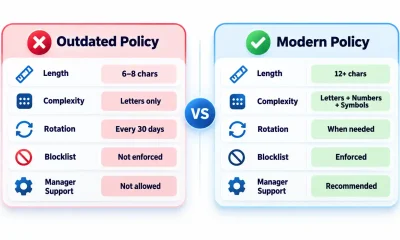
Strong Password Policy and Password Manager Guide
-

 Business3 days ago
Egyptian TV Presenter Sarah Khalifa, 11 Others Sentenced To Death In Major Drug Trafficking Case In Cairo
-

 Tech2 days ago
Meta debuts its Muse AI agent. Will consumers trust it?
You must be logged in to post a comment Login