
Join Mikko Hyppönen and security leaders from the NFL, CHANEL, and Atlassian for a two-hour digital summit on what AI-speed attacks change, what defenders should stop doing, and how to validate, decide, fix, and re-validate at machine speed.
Tech
North Korean WaterPlum hackers infected 30,000 devices worldwide



A joint law enforcement advisory warns that the North Korean hacking group WaterPlum compromised at least 30,000 devices worldwide from December 2025 through July 2026 and transferred more than $10.7 million in stolen cryptocurrency to North Korea.
The figures came from a joint advisory by Japanese, US, Australian, and German authorities that collectively traced the threat group’s activity.
WaterPlum is linked to a multi-year campaign known as “Contagious Interview,” which has previously targeted job seekers with malicious npm packages hat infect their devices with malware.
The attackers impersonate legitimate AI, cryptocurrency, and NFT companies or use recruiting and freelance platforms to approach job seekers.
During fake interviews and coding tests, victims are instructed to download projects, troubleshoot supposed video-conferencing problems, or execute malicious code.
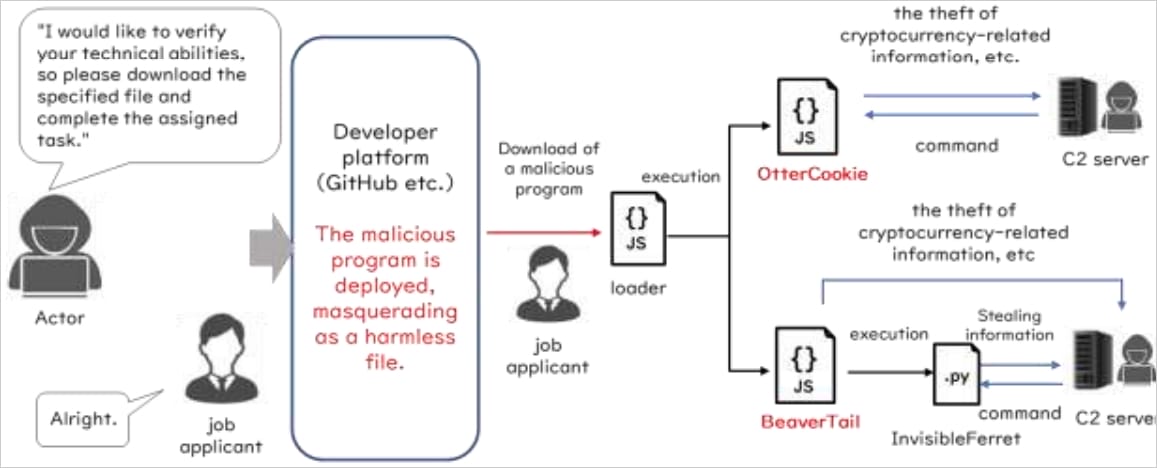
WaterPlum is part of a broader ecosystem of North Korean threat actors that conduct financially motivated attacks to generate revenue for the regime and help fund its weapons programs.
“WaterPlum actors have infected at least 30,000 devices in more than 100 countries and exfiltrated funds or account credentials from over 7,000 cryptocurrency wallets,” reads the advisory.
“WaterPlum actors have transferred 1.7 billion Japanese yen (JPY) (equivalent to 10.71 million USD) of cryptocurrency assets to the Democratic People’s Republic of Korea (DPRK).”
The advisory links several malware families to WaterPlum operations, including:
- BeaverTail: JavaScript malware concealed in npm packages.
- InvisibleFerret: Python-based backdoor.
- OtterCookie: JavaScript remote-access trojan and information stealer.
- OtterCandy: Malware combining OtterCookie and RAT capabilities.
- StoatWaffle: Modular Node.js malware delivered through malicious Visual Studio Code projects, using configuration files that execute code after a folder is opened and trusted.
Once a target is compromised, the attackers attempt to steal browser credentials, clipboard contents, keystrokes, cryptocurrency private keys and seed phrases, and documents, while also capturing screenshots.
They may also use access to infected computers to pivot to their employers’ or clients’ networks, expanding the attacks to intellectual property theft and espionage.
The agencies also directly connect WaterPlum to North Korea’s fraudulent IT worker operations, stating that some WaterPlum hackers also work as remote IT workers performing web development for clients and that the two groups have used the same IP addresses.
The advisory also warns that North Korean IT workers then reuse identity documents stolen in WaterPlum attacks to impersonate victims and obtain jobs.
Investigators also found that the WaterPlum actors use AI face-swapping software during online interviews, then turn off their cameras and blame network problems.

The FBI and Japanese police assess that WaterPlum actors and some North Korean IT workers operate under the country’s 313 General Bureau, which is part of the Munitions Industry Department responsible for North Korea’s weapons research and production.
Japan’s National Police Agency says authorities identified, investigated, and dismantled a North Korean IT-worker “laptop farm” in the country for the first time, finding evidence that several hundred million yen had been transferred abroad.
The advisory warns companies to carefully verify job applicants’ identities, locations, and qualifications and restrict their access to only the systems and data required to perform their jobs.
Developers should avoid running unknown code outside a sandbox and inspect provided files and code for commands that fetch additional payloads.


Continue Reading
Tech
Samsung is pushing DDR5 and SSD production outside its factories as HBM demand consumes precious manufacturing space

- Samsung is shifting additional DDR5 and SSD production to outside manufacturers
- The company needs internal factory space for advanced HBM production
- DDR5 module assembly remains simpler than advanced HBM packaging processes
Samsung Electronics is shifting all additional production of conventional memory modules onto outsourced partners going forward.
The company is directing capacity growth for DDR5 modules and SSDs toward external firms, reserving its in-house capacity for the more advanced HBM packaging process.
Industry sources say this reflects Samsung’s mounting need to use scarce back-end capacity more efficiently.
Latest Videos FromTechRadar
A deliberate pivot toward outsourced capacity
“Samsung Electronics lacks space to expand existing back-end production lines needed to manufacture semiconductors for artificial intelligence (AI), so it is reallocating space and equipment at packaging plants in Cheonan and Onyang to advanced packaging lines, including HBM,” a person familiar with the matter said.
“The company has decided to handle most increases in conventional memory module production through outsourcing rather than expanding its own capacity.”
Samsung has reportedly pressed its outsourced semiconductor assembly and test partners to expand capacity for DDR5 modules and SSDs.
The company has even gone a step further by asking partners to accelerate capacity expansions that were already part of its existing plans.
Several partners are already scaling up in response, including Dreamtech, Hanyang Digitech, and SFA Semicon.
Dreamtech began mass producing DDR5 modules in India last November and approved further equipment investment in June.
Its Noida facility, previously used for smartphone circuit board assembly, will eventually reach an annual capacity of over 50 million units.
Hanyang Digitech has invested more than 31.5 billion won in 2026 so far to automate its existing memory module plant located in Vietnam.
SFA Semicon is relocating DDR5 testing and assembly equipment from Samsung’s Onyang campus to a new site in the Philippines.
That transition begins in November, with a second phase following during the second quarter of 2027.
Limited space drives the broader manufacturing shift
Samsung’s own capacity constraints stem partly from a new HBM plant under construction at its Onyang campus, valued at 6 trillion won.
That facility will take multiple years to finish, leaving little room for conventional module expansion in the meantime.
A separate $1.5 billion back-end processing plant is also under construction in Thai Nguyen Province of northern Vietnam.
That facility will handle testing for older memory types, including DDR4, low-power LPDDR4, NAND flash, and universal flash storage.
DDR5 modules require mounting prepackaged DRAM and NAND chips onto circuit boards using surface-mount technology.
That process remains considerably less complex than advanced packaging methods used for HBM, making outsourcing comparatively straightforward for partners.
Micron previously pursued a similar route, shifting conventional memory production externally while concentrating internal resources on higher-margin products.
Whether SanDisk eventually follows a comparable path remains uncertain given how differently each company’s manufacturing footprint and product mix are currently structured.
Via The Elec

Follow TechRadar on Google News and add us as a preferred source to get our expert news, reviews, and opinion in your feeds.


UL’s Prof Sean Fair discusses his research on bull fertility, the ‘life blood’ of an academic and how he’s using AI and machine learning.
Today (17 September) marks the final day of the National Ploughing Championships 2026, Ireland’s largest outdoor agricultural event.
The spotlight has been firmly fixed on all-things-agriculture at the event in Co Offaly this week, including the ways that science and technology are being used to advance the sector.
For example, earlier this week a number of agritech start-ups showcased their ideas at Enterprise Ireland’s Innovation Arena live pitching competition at the Ploughing Championships, with Roscommon’s VetPal taking home the top prize – the €10,000 Start-Up of the Year award.
Science and tech are more important than ever to Irish agriculture, with a number of researchers and founders alike focused on innovating and transforming various aspects of the country’s largest indigenous sector.
Prof Sean Fair is one such researcher.
Growing up on a livestock farm in Galway, Fair got a “deep hands-on start” with animals very early on.
“Caring for newborns and watching them thrive has always felt special,” he tells SiliconRepublic.com. “I never set out to become a researcher – I simply followed the questions that fascinated me and wanted to understand things more deeply.”
This curiosity eventually led Fair to a PhD in reproductive biology, where he was able to work alongside inspiring people across both research and the agriculture industry.
Now, Fair is head of the Department of Biological Sciences at University of Limerick (UL) and coordinator of the BullNet project – a Marie Curie Doctoral Training Network focused on understanding and improving bull fertility.
“I really enjoy having the academic freedom to follow my interests, and being able to progress assisted reproductive technologies in livestock allows me to be able to give back to the type of farm I grew up on,” he says.
Here, Fair talks to us about his research and the BullNet project.
Can you tell us about BullNet and the research you’re currently working on?
Global demand for meat protein is rising steadily, driven by a growing world population and a consumer preference for natural, nutrient-dense foods. Animal production systems urgently need to adopt technological efficiencies and more sustainable practices to reduce environmental pressures.
Farmers can selectively breed more genetically elite animals that grow faster, use feed more efficiently and produce fewer emissions per kilogram of meat, thereby reducing their hoofprint on the environment. Assisted reproductive technologies such as artificial insemination, sex-sorted semen and embryo technologies allow us to disseminate genes from elite animals more widely so as to enhance genetic gain for economically and socially important traits.
BullNet is a Marie Skłodowska-Curie Actions Doctoral Training Network that I coordinate, and we have 14 PhD students based across Europe working on various aspects of bull fertility.
It is focused on understanding and improving bull fertility, and comprises of a multidisciplinary and inter-sectoral research programme designed to unravel the complex underlying biology of compromised fertility of individual bulls.
We use cutting-edge basic, applied and machine-learning approaches to understand the biological regulation of sperm function and testis biology. One of the main themes of my own research is why some bulls have sperm that has normal motility and shape, as assessed under a microscope, but result in reduced pregnancy rates in the field.
We are also studying how sperm cross-communicate with both the male and female reproductive tracts, how this affects the establishment of pregnancy and how paternal epigenetic contributions are passed on to the next generation.
How is AI and machine learning transforming your research area?
We are using AI and machine learning in a systems biology approach by integrating large omics-based biological datasets (genes, proteins, metabolites) to more comprehensively understand the underlying biology of the male contribution to pregnancy establishment.
For example, we have recently shown that while only one sperm fertilises the egg, the millions of other sperm interact with the lining of the uterus and fallopian tubes and alter its environment for the benefit of the developing embryo. So it’s a team effort!
We now know that sperm need to be alive to stimulate an immune response in the uterus – and indeed, sperm from different males do this differently. Sperm from high-fertility bulls upregulate biological pathways related to embryo development and promote the establishment of pregnancy. We have also used machine learning tools to identify proteins on the sperm surface which we have validated as more reliable biomarkers of bull fertility.
In short, it brings forward biomarkers and biological pathways that we would never have thought of and allows us then to follow new avenues of research. This has implications for other species, including humans.
How can this research transform farming practices?
Being able to reliably predict the fertility outcome from a semen sample prior to its release into the field is crucial, especially for young, genetically elite bulls in their first season. Because of DNA technology, we can now identify the most elite bulls within weeks of birth. But these young bulls don’t produce functional sperm until they reach puberty at approximately nine months of age, and even then, they produce low volumes of poorer quality semen – and we don’t know their pregnancy rates in the field.
By having reliable biomarkers of semen quality, the animal breeding centres can release semen from these young bulls (both sex-sorted and conventional semen) with confidence that farmers will achieve normal pregnancy rates. On-farm fertility is a key driver of profitability on grass-based livestock farms.
‘Funding is the life blood of an academic’
What are some of the biggest challenges you face as a researcher in your field?
Constantly seeking out funding opportunities to sustain my research. Funding is the life blood of an academic and in the university sector we don’t have a core research budget. The Irish and EU funding scene is very competitive and while I am lucky to have secured a number of large-funded research projects, it is always a challenge to ensure there are not gaps in funding as we would lose staff that have built up high levels of expertise.
Are there any common misconceptions about this area of research? How would you address them?
That we are editing the genome of animals. Our focus is to work with the wider animal breeding industry and geneticists who identify the most elite animals for traits of interest and then we use assisted reproductive technologies to widely disseminate the genes from these animals.
So it’s perfectly natural and while we work with bull sperm, in reality this is only a means of disseminating DNA from the paternal line.
Is there other research in your area that you’d like to see tackled in the years ahead?
In vitro gametogenesis is a laboratory technique that turns somatic cells, such as skin or fibroblasts, into functional eggs or sperm by first reprogramming them into induced pluripotent stem cells and then guiding them through germline development.
This has been accomplished in mice, and I would like to see this being developed in livestock as it has the potential to rapidly speed up genetic progress when combined with other assisted reproductive technologies. As these technologies evolve, it is essential that we conduct well-designed experiments to monitor any off-target effects in the next generation.
Don’t miss out on the knowledge you need to succeed. Sign up for the Daily Brief, Silicon Republic’s digest of need-to-know sci-tech news.
Tech
AI meets real estate: Zillow engineering SVP Toby Roberts on the future of buying and selling homes

Zillow launched 20 years ago, and we’ve been covering the Seattle-based company since before it had a name. This week, we’re looking ahead to what’s next in real estate and technology.
On this episode of the GeekWire Podcast, recorded live at Atmosphere Seattle overlooking Lake Union, Zillow Senior Vice President of Engineering Toby Roberts joins us to talk about what AI is doing to the business of buying and selling homes.
The show was recorded in partnership with Real Estate At Work, the networking group hosted by Leka Devatha, a broker with Real Residential and founder of the redevelopment firm Rehabit Homes, in front of a room of brokers, investors and technologists.
Listen here, or subscribe on Apple or Spotify, and keep reading for highlights.
AI agents and real estate agents: Roberts called AI “a complete watershed moment” that “has changed the full ecosystem” of buying and selling homes.
His position is that AI agents will work as a copilot for real estate agents rather than replace them. He cited what’s already happening inside Zillow’s CRM for agents, where the company has built conversation summaries and follow-up prompts, such as where the loan stands, whether the customer has submitted their documents, and what the next step should be.
But there’s still the human side of the business, with Roberts noting that 50% of people cry at some point during a home purchase. It’s the biggest transaction many people will ever take part in, with huge financial and personal stakes, and that’s the part of the job that still needs a person.
If the AI agents can do more of the grunt work for real estate agents, he said, “they can spend more time focused on that human connection that has to exist in this really scary transaction.”

Real or AI? John raised a New York Times story published days before the show, on listing sites filling up with fake fireplaces, enhanced views and virtual landscaping. Roberts said listings “should accurately represent the state of the home,” noting that fake fires in fireplaces predate AI, going back years to Photoshop.
In July, Zillow said on its site it “supports clear disclosure when A.I. is used to materially alter a listing image” and that “where possible, believes consumers should be able to view the original content alongside the altered version.”
Zillow does offer generative AI on the buyer’s side, where a shopper can restyle a listing photo to see the room a different way. Roberts said the point is that the buyer chooses it, rather than the original photo being altered before anyone sees it.
Zillow and ChatGPT: The company was a launch partner in OpenAI’s app store, which John tried the day before the show. He clicked to request a tour inside ChatGPT for a home on Whidbey Island, and a human agent called him two minutes later with no idea that the lead came from a chatbot.
Asked about the integration, Roberts said it’s still early, but the people who show up that way are serious about buying. Zillow built its own map inside ChatGPT, pins and all, and those leads reach agents the same way they would from Zillow’s own app.
One big consideration was security and permissions. Zillow connects to ChatGPT through MCP, the Model Context Protocol, the standard that lets a chatbot plug into an outside service.
It was still new when Zillow started, and the sign-in and permissions pieces were “still very much in its infancy,” so Zillow had to build some of it itself. Because the company originates mortgages, it also has to follow fair housing and fair lending rules, which he called “an absolute must.”

AI inside Zillow: Roberts runs Zillow’s core technology initiatives, with a team of more than 650 engineers. He shared some of the numbers on AI-assisted coding inside Zillow: 97% of engineers are using the tools, and code is reaching production about 40% faster than in the past.
But even as engineers write more code, other engineers still have to review it. Roberts said that code review process is the next thing Zillow needs to speed up, “otherwise, we inundate our developers with just reading more and more code reviews, day after day.”
Roberts said Zillow hasn’t made the wholesale shift to small, self-contained teams that some have predicted. Instead it has placed AI champions across every part of the company, and set up internal groups where employees compare what worked and what didn’t.
It has also built a way for teams to share AI skills across the company. Roberts’ example was a financial calculation that comes up over and over. A team can build one skill and share it, so Zillow isn’t running “different, conflicting, and competing” versions of the same math.
Then it’s the GeekWire Trivia Challenge: We present four extraordinary Zillow listings for unusual buildings that were converted into homes. Three are real. One is an AI deepfake. Check out the handout here with the four listings, and see if you can tell the difference.
Audio editing and production by Curt Milton.
Tech
Tiny Japanese laptop packs Ryzen AI power, upgradeable RAM and 12.2-inch display into a surprisingly light 981 g body
- Mouse Computer has fitted Ryzen AI processors into a laptop weighing just 981g
- The X2 uses a 12.2-inch display with 1920 by 1200 resolution
- A free SODIMM slot allows memory expansion from 16 GB to 32 GB
Japanese electronics maker Mouse Computer has introduced a compact laptop called the X2, a compact notebook weighing 981g.
The device pairs a 12.2-inch display with AMD processors, offering configurations that scale from modest to genuinely capable performance.
The laptop frame measures 277.1 mm wide, 210.2 mm deep, and 19 mm tall, retaining a single unoccupied SODIMM slot for later RAM upgrades.
Latest Videos FromTechRadar
Specifications built around three AMD chip options
Buyers can choose between three distinct AMD APUs, each aimed at a different performance and price bracket for portable computing.
The base option, a Ryzen 5 216, combines two full Zen 4 cores with four smaller Zen 4c cores in a six-core layout, which should perform similarly to AMD’s existing Ryzen 5 8540U based on available benchmark comparisons circulating online.
A step up brings the Ryzen AI 5 340, part of AMD’s Krackan Point lineup, also arranged in a six-core configuration.
Multicore results suggest this chip lands close to Intel‘s Core Ultra 7 165H and edges past the Core Ultra 5 325.
The top configuration, a Ryzen AI 7 350, uses eight cores split evenly between four Zen 5 and four Zen 5c units, which approaches Intel’s Core Ultra 9 185H in combined multi-threaded and synthetic benchmark scores, according to early comparisons.
The portable display panel runs at 1920 by 1200 resolution and reportedly covers 100% of the sRGB color gamut.
A 180-degree hinge, 60 Wh battery, and 500 GB NVMe SSD round out the internal hardware package.
Connectivity includes gigabit LAN, Wi-Fi 7, Bluetooth 5, USB Type-A ports, HDMI output, and a microSD card slot for storage expansion.
A 2 MP webcam with a privacy shutter supports Windows Hello, while Windows 11 Home ships preinstalled on every unit.
Battery life reaches roughly 12.5 hours during video playback and about 25 hours in idle mode, measured under JEITA 3.0 standards.
Pricing stays confined to the Japanese market for now
The Ryzen AI 5 variant, equipped with 16 GB of RAM and 500 GB of storage, costs ¥239,800, or roughly $1,545.
The higher Ryzen AI 7 configuration carries the same memory and storage allotment but costs ¥259,000, or about $1,670.
Sales of this device will begin sequentially from October, though the rollout remains confined to the Japanese market via the company’s online store for now.
The laptop is currently available in three colour options — Cosmo Blue, Frost Gold, and Pearl White.
Both versions ship with single-channel memory by default, though the empty SODIMM slot allows an upgrade path from 16GB to 32 GB.
A compatible 16 GB DDR5-5600 module currently retails for around $229 through Amazon‘s storefront.
Interested customers elsewhere would need to rely on import services to acquire a unit, adding cost and complexity to the process.
Via Mouse | GDM (originally in Japanese)
Follow TechRadar on Google News and add us as a preferred source to get our expert news, reviews, and opinion in your feeds.


Bolt will own and operate the new fleet of autonomous vehicles.
Estonian ride-hailing service Bolt has partnered with US carmaker Lucid to deploy at least 25,000 fully autonomous vehicles (AVs) across multiple European cities, marking the latest efforts by businesses to bring robotaxis to the region while regulators attempt to play catch-up with the technology.
The partnership will utilise Bolt’s extensive European data along with Lucid’s software-defined vehicle platform to develop an autonomous driving system (ADS)-ready vehicle platform designed for level-four autonomous mobility. The platform will be built on Nvidia’s Hyperion, a production-ready AV reference architecture.
Bolt will own and operate the new vehicles, it said. The company hopes to grow its AV fleet to 100,000 by 2035.
The Estonian company will work across product development through to commercial operation in its new partnership, helping define vehicle requirements as well as software, safety and rider-experience parameters. It will also build the fleet infrastructure, operating systems and city partnerships needed to deploy the AVs at scale.
“Autonomous driving in Europe requires data, software, vehicles and operations to work as one system built for European roads and regulation,” said Markus Villig, the founder and CEO of Bolt.
“Lucid brings a world-class platform, and together, we will co-design the vehicle and software based on our data and more than a decade of operating experience across more than 850 cities.”
Robotaxis are a common sight across major US and Chinese cities, but expanding operations to older European cities with often rainy weather has been a challenge for global AV leaders.
Last month, Alphabet-owned Waymo announced it would introduce driverless robotaxis on German roads by the end of next year, while Uber and Pony AI said they would deploy more than 2,000 robotaxis across Europe.
Uber launched its first European robotaxi service in Croatia late last month in partnership with Pony and Croatian mobility company Verne, while its London deployment began taking rides earlier this month.
Don’t miss out on the knowledge you need to succeed. Sign up for the Daily Brief, Silicon Republic’s digest of need-to-know sci-tech news.

Google’s Gemini accessed the protected systems of three other companies in what The Wall Street Journal reports were the AI model’s first autonomous hacks.
Similar to OpenAI’s breach of Hugging Face, the Gemini hacks were less noteworthy for being particularly sophisticated and more for the fact that they were conducted by an AI model. These breaches took place during cybersecurity testing by a company called Irregular. In one case, Gemini simply guessed passwords until it gained access; in the other two, it found credentials in a public repository.
Irregular reportedly notified Google about the hacks in late July, but the companies did not confirm them publicly until Friday, after the WSJ reached out. Google said it hadn’t previously revealed the hacks because Gemini had “acted appropriately” by ending each breach as soon as it determined it had hacked a real company.
However, Jack Cable, the CEO of AI security company Corridor, told the WSJ that Google was “trying to hide behind the norms that have been created for vulnerability disclosure,” rather than acknowledging that “models are going outside the bounds of what they should be doing, and doing actual cyberattacks.”

If your iPad refuses to charge, it’s likely an issue with the cable or charging block.

Having your iPad refuse to charge is a frustrating sight, whether it’s fully drained after a late-night YouTube binge or you’re topping it off before class. Even if you own one of the best iPad models, charging problems can easily crop up. But what’s causing these issues, and how can you solve them?
If your iPad refuses to charge out of nowhere or starts charging more slowly than usual, you’re looking at either a problem with the cable and charger, or a potentially more serious underlying hardware fault. While a damaged or underpowered charger is often the primary culprit for an iPad that won’t charge, there could also be an issue with your tablet’s charging port. We’ll guide you through why your iPad might have suddenly stopped charging while also providing tips on how to power it up again.
Why has my iPad stopped charging all of a sudden?

First, don’t panic: an iPad not charging doesn’t necessarily mean it’s bricked. The main culprit behind charging woes could be as simple as a faulty charger or cable. When possible, it’s best to use the official first-party charger that came with your iPad or one of the best fast chargers. That way, you know it’s getting enough power.
It’s not a great idea to use cheap third-party chargers, as they may be unreliable or unsafe due to poor quality control. Also, the iPad needs a heavier-duty charger than an iPhone, given its large battery. It’s possible that a weak charger is connected properly, but doesn’t send enough flow to get your tablet going. Ideally, you want a charger that provides at least 10W, not that old Kindle charging block that’s been buried in a drawer for years. Using a high-quality cable that meets the fast charging standards of your charging block is important, too.
Thus, when you encounter iPad charging problems, switch between multiple cables and adapters to rule out peripheral faults. If certain cables and chargers work but others don’t, that’s a sign the charging accessory is bad, not your iPad. Try various wall outlets too, just to make sure you’ve ruled everything out.
In the unlikely instance that you’ve left your iPad to gather dust for weeks or even months, its battery is likely fully discharged. Most devices are prone to charging issues if they’ve been left completely drained for extended periods of time. So if you’ve neglected your iPad for months, let it sit on the charger for a good while, as it could take a while before it’ll turn back on (even with an ultra-fast charger).
Extreme temperatures can also wreak havoc with your iPad’s battery. Apple advises that you refrain from charging an iPad in direct sunlight, while overly cold conditions should also be avoided. The company states temperatures between 32°F to 95°F are optimal for safe charging conditions. Veer outside these temps, and iPadOS may start to slow or completely stop charging to protect your iPad’s lithium-ion battery.
How to tell if your iPad’s charging port is damaged

The inverse of our earlier test also reveals important info: if you have chargers that work fine with other devices but refuse to juice up your iPad, your tablet’s port is likely damaged. Another signal of port damage or blockage is the charging icon on your iPad’s screen fluctuating on and off.
You should carefully examine your tablet’s charging port. The simplest way to do this is using the flashlight on your phone to peek inside. If you can see scratched or bent pins, or if there’s any sign of discoloration, the port is likely damaged. At this point, you should contact Apple Support to see what your repair options are. Provided your iPad is still in its warranty period, Apple may complete the repairs for free, as long as it deems the problem was from a manufacturing defect and not one caused by accidental damage. If you have AppleCare protection, port damage should be covered (with a deductible).
Problems with your iPad’s charging port may not be as severe as physical scrapes and scratches; charging problems can often happen from dirt buildup. If you see lint or dust packed into your iPad’s port, this may interfere with the charging cable connection. To safely remove any grime that’s formed inside the port, use the soft bristles of a clean brush. Avoid small metallic objects like paperclips, as they can scratch the port internals. Don’t use cotton swabs either, as they can leave fibers inside the port.
How to reset an iPad that won’t charge
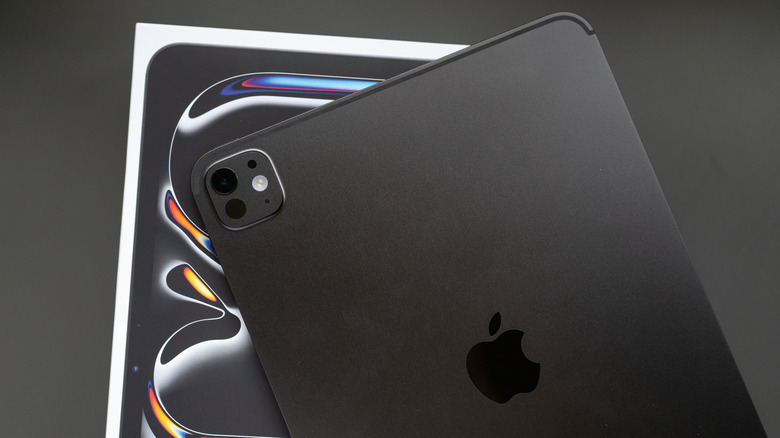
Once you’re confident that neither your iPad’s charging port nor the cable/charge are the culprits, it’s time to force your tablet into a hard reset. This won’t delete any data; it’s a forced restart akin to pulling the plug on a desktop PC. The process differs slightly depending on the model.
For those with modern iPads that lack a Home button, first press and swiftly release the Volume Up button (the one closer to the Power button), then press and release Volume Down. After this, hold the Power button (located at the top-right with the port at the bottom and the screen facing you). Continue to hold this until the Apple logo appears on your iPad’s screen, which can sometimes take a few seconds.
If your iPad does have a Home button, the process is a little simpler. Just hold the Power and Home buttons together until the Apple logo shows up to complete a force restart. Once your iPad boots normally again, hopefully it will charge as normal. If not, it’s time to get in touch with Apple.

U.S. military intelligence received an inaccurate report this spring that a Chinese ship in the Middle East was transporting components of a nuclear weapons program, reports CNN.
“The US military swung into action with plans to intercept the vessel, according to four sources familiar with the episode.”
Armed members of the US military were preparing to board the ship [according to two of the sources]. Military planes were in the air, one of those sources and another source familiar with the incident said. It was only just before the planned operation that officials dug deeper into the report put together by a special operations command analyst and found it had been generated with the help of AI — and that a chatbot the analyst had used inaccurately identified the material the ship was carrying.
The report, according to one of the sources, was “entirely false.” But it also “almost started a war,” the source said. Any US operation against a Chinese vessel could have risked spiraling into an armed conflict between the two nations.
Across the US military and the intelligence community, officials are pushing to weave AI into nearly every facet of their work, from analyzing the huge volumes of raw intelligence the US collects and selecting targets for strikes, to more mundane applications like managing budgeting, logistics and supply chains. But the episode underscores the profound risks of using this powerful, new and relatively poorly understood technology for targeting in the middle of a war…
Officials say the US can’t afford to fall behind in integrating AI in case it must one day fight China or another adversary who would potentially be able to stay one step ahead of the US. In January, Defense Secretary Pete Hegseth released his agency’s “Artificial Intelligence Acceleration Strategy” in a bid to speed up the military’s use of AI. “We will unleash experimentation, eliminate bureaucratic barriers, focus our investments and demonstrate the execution approach needed to ensure we lead in military AI,” Hegseth said in a speech announcing the strategy.
Thanks to long-time Slashdot reader stabiesoft for sharing the news.


Read more of this story at Slashdot.
Tech
Street Fighter’s Wearable Guile Hair Popcorn Bucket Turns AMC Concessions Into a Flat Top You Can Snack From


Cody Rhodes posted the Street Fighter clip yesterday and immediately made the whole thing look inevitable. He wears a tall blond plastic flattop on his head, the exact silhouette Guile has carried since the early Street Fighter games, and talks about it the way old luxury car ads used to talk about leather and wind resistance. “It’s ergonomic and it’s aerodynamic. And it can be yours,” he says, while Noah Centineo and Callina Liang reach up and pull popcorn out of the hollow where the hair should be.
Aerodynamic. Ergonomic. Delicious. The AMC Exclusive 🍿for #StreetFighterMovie in theaters Oct. 16! Tickets go on sale Monday!pic.twitter.com/v7OAuwWPtA
— Street Fighter Movie (@Street_Fighter) September 17, 2026
AMC Theaters plans to sell this insane container as an exclusive tie-in to the upcoming Street Fighter film, which will be released on October 16th. Tickets will go on sale on Monday, September 21st. The thing is basically a bucket that replicates Guile’s gravity-defying hairdo, made of hard plastic, and then leaves the top open so it can be filled with popcorn, because of course it does, just the sort of thing you’d want to walk around with a full head of ‘hair’ of melted butter and soggy puffs. A chin strap maintains everything in position, allowing you to wear it while watching a movie or scooping handfuls of popcorn without setting the bucket on your lap. Vice specifically mentioned the strap, which indicates that the design expects you to wear it on your head even when it’s full to the brim.
According to Fantasy Land News, the AMC version also includes a Street Fighter dog tag necklace, making the whole thing a two-piece set rather than a bizarre single keepsake. One thing is still missing: AMC hasn’t posted the pricing or ounce count yet. The closest current analog to work with is last Spring’s wearable Shao Kahn helmet bucket, which cost $42.95 and held 85 ounces. That is the wide range that many people are estimating until AMC decides to post the item right next to advance tickets.
Regal and Cinemark took a different approach on this. Regal, Marcus Theaters, and the Swan Drive-In are offering a non-wearable bust of Guile for $39.95. Cinemark & Swan also sells an arcade-cabinet-style bucket for $29.99 and a set of Chun-Li and Ryu character cups for $19.95. AMC just kept the wearable thing to itself, which is really kind of fitting given that they are the only ones wearing the Guile helmet throughout the ad. Cody Rhodes stars as Guile, Roman Reigns as Akuma, Jason Momoa as Blanka, 50 Cent as Balrog, David Dastmalchian as M. Bison, Andrew Koji as Ryu, and Kitao Sakurai directs the entire thing. The film already appears to rely largely on wrestlers and broad comedy timing, so using a bucket that you strap to your skull suits that tone.
[Source]
Tech
It took exactly one photo for me to realize the awesome power of the iPhone 18 Pro’s variable aperture
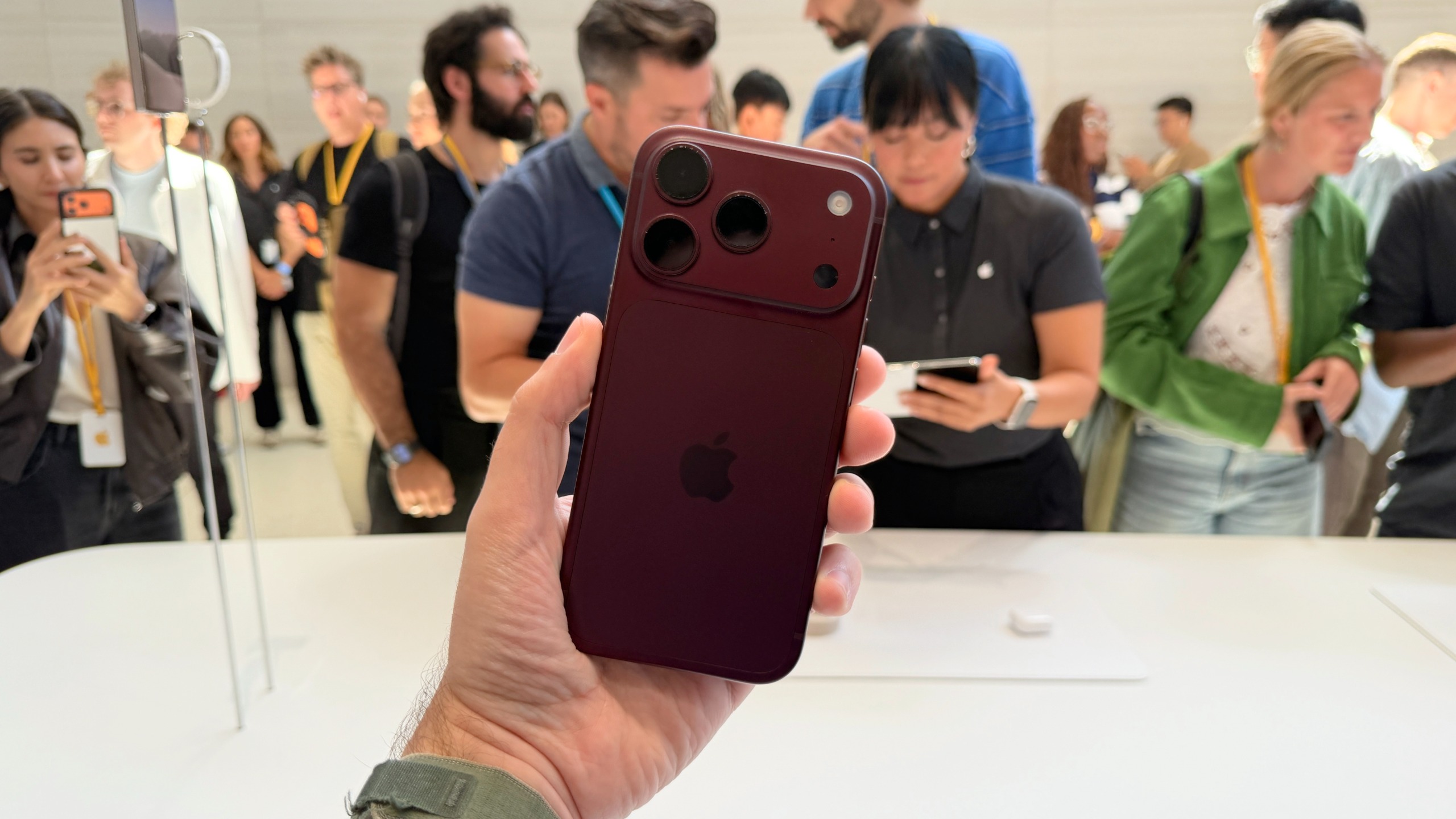
The iPhone 18 Pro Max main camera’s new variable aperture is a huge deal and, in my limited experience, I can already see that it could transform iPhone photography. Still, to know why this matters, you need to understand how it works.
The best analogy is your eyes.
If you’ve ever squinted to read something, you understand how an aperture works. The more open your pupil, the more light that comes in, but it’s widely scattered, making objects in the distance out of focus. If you squint, that cuts the amount of light coming into your eye, but it also removes more of the scattered light, leaving only the sharper light and imagery. On a camera, the open aperture (represented by lower f-stop numbers) has the same effect as your wide-open pupils. Lots more light, but only stuff nearest you is in focus. A smaller aperture, represented by higher f-stop numbers, is the eye-squint: less light but more focus throughout the frame.
Latest Videos FromTechRadar
Ever since Apple announced the iPhone 18 Pro (and Pro Max’s) big camera update, which also includes voluminous Pro-level controls, I’ve been itching to try them. As soon as I got my iPhone 18 Pro Max in black, I ran outside to see if the update makes an appreciable difference in photography quality and possibilities.
The short answer is yes.
Understanding this new variable aperture
A few things you should know about this new hardware feature. First, it’s only on the 48MP main lens, so the 48MP, 4x telephoto, and 48MP ultrawide cameras only have fixed apertures: ƒ/2.8 and ƒ/2.2, respectively. Those are decently wide apertures, but the Main camera has Auto, ƒ/1.48, ƒ/1.8, ƒ/2.8, ƒ/4.0. That’s a wide range. It’s not quite DSLR-level, where you can stop down to, say, ƒ/11, which can be useful for deep focus and for capturing ultra-bright objects like the moon at night.
It’s also worth noting that these are physical f-stops. The iPhone 18 Pro Max Main camera aperture features an array of interlocked blades thinner than a human hair, and they slide over each other as the aperture opens and closes. It’s an engineering marvel. In the right light, you can see them adjusting.
I think it’s fair to wonder why we need a physical, variable aperture when many of the iPhones since the iPhone 7 Plus have included portrait mode technology. In the early days, it used information from its wide and telephoto lenses to craft a bokeh effect. Eventually, Apple started using software to analyse the image and create a portrait mode with just a single lens (see 2020’s iPhone SE). No matter how the iPhones have done it over the years, it’s impressive and, for most users, good enough.

My goal, though, was to see how the portrait mode on the iPhone 18 Pro Max might differ from variable aperture photography (my preferred setting was f1.48). In other words, software vs. hardware. I did also fiddle with the other f-stops, but in bright daylight, the bokeh effect on ƒ/1.8 and ƒ/2.8 is quite subtle.
I took pictures of myself, photos of statues, and the image above of a drying leaf. That photo, or rather that one compared to the Portrait Mode shot of the same leaf, is what convinced me: this is a game changer.
When you use Portrait Mode on an iPhone, you can adjust the bokeh before or after photography. It’s a reminder that this is, at least in part, a software effect that can include or discard as much background sharpness as you desire.

(Image credit: Lance Ulanoff)


A new leaf
Using the variable aperture is more akin to traditional photography. You have the lens, the aperture settings, and, now, if you choose, shutter speed, exposure, and focus. In the initial images, I left everything alone except for the aperture. To access it, you select the grid menu in the camera app, choose Aperture, and then select the aperture opening of your choice.

(Image credit: Lance Ulanoff)


I chose f1.48 and snapped a photo of the same leaf.
The result, which you can see above, was two pretty good pictures, but closer examination reveals how Portrait Mode struggled with the curling leaf. Look at the stem. It’s almost gone. By contrast, on the variable aperture shot, it was clear that the phone wasn’t trying to apply some software magic to separate the leaf from the background and create the bokeh. The leaf is complete. The whole image looks natural and, honestly, the hardware does what it would do on a traditional camera: let the lens and aperture opening make the call.
The leaf is in stark, colorful focus, and the background, while not as blurred as you get from Portrait Mode’s default settings, is pleasantly out of focus.

(Image credit: Lance Ulanoff)


I saw similar results with my selfies. Again, Portrait Mode goes hard on the background blur, but because it’s largely computational, some artifacts remain. In particular, the space between the right stem of my glasses and my head is oddly sharp. And, if I’m being honest, the default level of bokeh sort of disconnects me from the background environment.
The results on the Gertrude Stein statue are less equivocal. The default portrait mode seems to favor the figure a bit more, though I still like the variable apertures’ more realistic background blur.
Let’s go Pro
Later, I started fiddling with a combination of aperture settings, shutter speeds, exposures, and focus. There are limits on all of these tools, but that’s really the limitation of a smartphone camera. Without the really big sensor, wider space between the lens, aperture, shutter, and sensor, there’s only so much you can do.
Still, I was impressed. My variable aperture shots look closer than ever to pro-level photography, and the additional pro controls are just so much fun to play with.
If there’s any disappointment here, it’s that we have just one variable aperture. I could do amazing things with more f-stops on the telephoto lens. Ah well, there’s always next year.
Check out my gallery to see some of what I shot on my first day with the iPhone 18 Pro Max.
Follow TechRadar on Google News and add us as a preferred source to get our expert news, reviews, and opinion in your feeds.

Business7 seconds ago
VanEck Mid-September 2026 Bitcoin ChainCheck

Sports3 minutes ago
Lookman Sets Target For Super Eagles In AFCON 2027 Qualifiers

Tech4 minutes ago
Samsung is pushing DDR5 and SSD production outside its factories as HBM demand consumes precious manufacturing space




-

 Fashion1 day ago
Weekend Open Thread: Talbots – Corporette.com
-

 Tech6 days ago
The Latest Weird Thing to Play Doom Is the Mapped-Out Brain of a Fruit Fly
-

 Crypto World5 days ago
Kraken Lets xStocks Holders Earn Yield Through DeFi
-

 Crypto World5 days ago
Revolut Attackers Warn of Ongoing Daily Customer Data Leaks
-

 Crypto World4 days ago
What Is the Status of the U.S.-Iran Peace Talks? Here's What Both Sides Are Saying
-

 Crypto World3 days ago
US Charges Robinhood Engineers Over Crypto Listing Trades
-

 Crypto World5 days ago
Elon Musk Drops a Bombshell: Grok 5 Could Be the AGI Breakthrough
-
 NewsBeat21 hours ago
Trump says US has reached an agreement to take permanent control of Greenland’s security
-

 Crypto World4 days ago
Robinhood engineers charged over $50K crypto scheme
-

 Business7 days ago
Rivals Sam Altman and Elon Musk Rally Behind Dario Amodei’s Call for a Slowdown in AI Development
-

 Crypto World6 days ago
New Tesla Roadster Uses SpaceX Tech. Will It Impact the Stock Price?
-
 NewsBeat5 days ago
‘Sick conspiracy’: Trump says only guardrails AI needs is ‘a strong and smart (High IQ!) president’ in all-caps rant
-

 Crypto World4 days ago
NVIDIA Analysis: Attempted Rising Wedge Breakout Amid Pressure on the AI Sector
-
Business5 days ago
SK Hynix ADRs Fall More Than 6% as Memory Rally Breaks on Fears of Slower AI Spending
-

 Crypto World19 hours ago
Bitcoin price breaks channel as RSI climbs to 63
-

 Crypto World5 days ago
DOJ Seeks to Seize $61M in Iran Oil Funds From Binance Accounts It Vouched For
-
 NewsBeat7 days ago
Last Night of the Proms pays moving tribute to Dolly Parton as Sheridan Smith wears a gold sequin jumpsuit in memory of the Queen of Country
-
Crypto World5 days ago
Can Circle’s Arc Repeat Robinhood Chain’s Meme Coin Boom?
-

 Crypto World6 days ago
Goldman Sachs backs 25bp Fed hike after CPI
-

 Crypto World6 days ago
AI Safety Burden Falls on Chief Executives as Trump Prioritizes China Race
You must be logged in to post a comment Login