Like the Phone 3a before it, the Nothing Phone 4a offers a very appealing option for those in the market for a more affordable device. The design and software are unique, and offer an experience that won’t leave you feeling you’ve got a budget device. While performance hasn’t improved all that much over last year, the solid battery life and reliable camera systems and better zoom lens all add up to a slightly more mature device.
Attractive, unique design
Lightweight but delightful software experience
Reliable battery and camera performance
Affordable price – There’s a pink one!
Not the most powerful phone around
Display is a little dark at times
Glyph Light bars are gone
Not a big jump on the Phone 3a
Key Features
Review Price: £349
Design
Distinctive Nothing design with transparency
Unique software approach
Advertisement
Software matches the style of the phone
Big battery and fast charging
50w charging and sizable battery
Introduction
Nothing is taking a slightly different approach in 2026 than it did last year.
Advertisement
The company has said we’re not getting a ‘proper’ flagship model to replace the Nothing Phone 3. Still, because it’s been so popular – and because the 3a was such a good phone – the brand opted to upgrade that series and give us a new model.
Enter the Nothing Phone 4a. Still very much a Nothing phone, but with a few changes and upgrades under the hood. But is it closer to being a flagship like Nothing says it is?
Advertisement
Design
Four colour choices, including pink
Classic Nothing looks
Glass back, plastic frame
Since its inception, Nothing has been a company with a very clear design philosophy. And unlike most other tech companies, it is one that clearly cares quite deeply about the aesthetic of its products. They all tend to have that same retro futuristic look, that wouldn’t look out of place anthropomorphised as a character in Portal 2.
The phones have long had character to them, and while the transparent back doesn’t technically allow you to see the internals of the phone, the layers of texture, patterns and exposed screws all help create a very distinctive look.
Advertisement
Image Credit (Trusted Reviews)
With the Nothing Phone 4a in particular, it’s not that far off the look and feel of the Nothing Phone 3a that came out last year. There are some different colours, though. Or, at least one new colour. Alongside the black, white and blue models this year is a pink one, which is the best looking of the bunch. It almost reminds me of the transparent-backed iMacs from the turn of the century.
Advertisement
Image Credit (Trusted Reviews)
It’s glass on the front and back this year too, with the only plastic being the frame around the edges.
As for the elephant in the room, or at least the obvious change to any Nothing phone, or anyone familiar with Nothing’s first few phones: yes, the Glyph Light bars are gone. And with that, it appears those LED strips have been consigned to history.
Image Credit (Trusted Reviews)
That doesn’t mean there are no lights at all, but the makeup of them is very different. Instead of several curved strips, there’s one vertical stacked line of square LEDs that make up one pulsing, flashing light system to the right of the camera.
Just like before, you can have it pulse and animate when notifications come in, or use it as a visual countdown timer, and the bottom, red LED will light up when recording video or audio. It even has integration with third-party apps like Uber and Google Calendar, to act as a live visual for updates and events.
Advertisement
Advertisement
Display
6.78-inch OLED display
Gorilla Glass 7i
30-120Hz adaptive
For the most part, the display on the 4a offers a solid experience. There are ways in which it’s beaten by the much more expensive devices, but for a screen in this price category, it’s solid.
It doesn’t have the super-bright display you’d find on something like the Pixel 10 Pro XL, or the superb anti-reflective qualities of the Galaxy S26 Ultra. But for a device that’s half the price, you wouldn’t expect it to.
What that means is that at times it feels as though the display is a little dark, especially when not viewed directly head-on and watching HDR shows and movies.
Image Credit (Trusted Reviews)
Still, it’s generally quite a vibrant and colour-rich display with deep contrast that offers a solid media experience with the brightness cranked up and viewed directly.
Advertisement
On that note, there were a few times during travel and phone testing where the bright sun was glaring and reflecting off the screen, and the Nothing Phone’s auto brightness kicked in to ramp it right up, making it clear, vivid and easily visible in harsh daylight. There was no awkward jumping or a delayed response. It was quick and smooth.
Advertisement
Image Credit (Trusted Reviews)
Software
Software follows the look of the hardware
Deep integration with Nothing’s audio products
AI features don’t get in the way
Nothing’s software and the way it’s integrated into the phone, the themes, the widgets, haptic feedback and smart features are some of the biggest reasons to buy the Phone 4a. Just like it was the phones that came before it.
It’s rare to find a company with such a clear, distinct and laser-focused software approach. All the layers, widgets, icons and elements are not only consistently applied through every part of the interface, but also look like it belongs with the hardware. The font styles, stylised widgets and graphics all match the hardware aesthetics perfectly.
The fact that it feels both light and feature-rich is great. It’s not cluttered or bloated with additional apps and features. Nothing, unlike other companies, hasn’t gone down the route of copying Apple’s ‘Liquid Glass’ transparencies and effects random parts of the software like Oppo, Honor and Vivo have.
Advertisement
Image Credit (Trusted Reviews)
Because it’s light, it gives it the feeling that it’s responsive and effortless to use, but does it in a way that’s not plain or boring.
I enjoy the little things, like when you tap on the virtual keyboard to type. There’s a subtle tap from the haptic engine, not a cheap buzzy vibration that you often get on the more affordable devices. That just helps elevate the experience somewhat and means I actively keep that feedback on instead of switching it off.
Advertisement
You get deep integration with Nothing’s audio products with custom widgets for headphone battery levels, and a fun music player window widget which shows album art and play/pause/skip controls on your Home Screen. This effectively is just mirroring the music player notification widget.
There are a few AI features loaded, but they don’t feel like they’ve been overloaded or shoehorned in just because it’s 2026 and it must have lots of AI features. And, you can largely ignore them if you want. But there is a custom ChatGPT widget designed to match Nothing’s OS design and make it easier to interact with OpenAI’s popular agent.
Image Credit (Trusted Reviews)
Advertisement
Essential space is there again this year, with its dedicated button that allows you to quickly capture voice notes or screenshots and save them directly to what is effectively a digital corkboard to help you remember things that have inspired you. I quite like it, but I never found myself using it all that often.
Cameras
50MP main camera
50MP periscope zoom
8MP ultrawide
Being a mid-range phone means it’s always best to temper expectations somewhat for how good the cameras are going to be. And while it’s true that Nothing’s triple camera system won’t match up to the best camera phones, it’s an all-round solid system that is more than good enough for daily use and is pretty good at night time too.
Image Credit (Trusted Reviews)
What I like most about the camera is actually the experience of shooting with it. You can just point, tap to focus and shoot, and your image will be captured quickly with the appropriate exposure and the right area in focus.
In the daytime, if this phone cost more, I would criticise the overall texture and treatment of colours, highlights and shadows. But it’s hard to find too much fault with it. Sure, sometimes the HDR treatment of bright colourful spots leaves it looking a little artificial, but for the most part, I’m pleased with how well it contains those super bright points in the photos.
Advertisement
Advertisement
I sometimes found the blues were a little unrealistic, not quite matching what I saw with my eye, especially when looking at blue skies. But again, it wasn’t horrendous, and the treatment and saturation of colour meant most pictures had a pleasing vibrancy that I’d be happy to post on social media without any filters.
There’s a new zoom lens this year, the same one that’s in the Nothing Phone 3, which means better light capture and stabilisation when you kick into 3.5x zoom, adding a bit more zoom range but at the same time adding to that consistent, solid camera performance across multiple focal lengths.
Nothing also has a bunch of its own preset filters loaded, which can be fun to play with if you want to get creative with looks. You can shoot black and white, or add a cool, grainy texture, add soft focus for portraits, and all manner of other presets.
Advertisement
At night, shooting urban scenes in the lit streets of Barcelona, I was pretty happy with the results from all three cameras for the most part. Clearly, the primary lens is the one that captures cleaner, crisper images with better detail and colour, but the others aren’t awful.
That main sensor is also more sensitive to light than the other two and more capable of drawing it in quickly, and so when using the night mode setting, it usually takes less than a second to capture the scene, whereas the ultrawide might take a second and a half, or two seconds.
The perk of that delay though, is that if you just happen to catch a moving vehicle at just the right moment, you can get a pretty effective motion blur that adds a bit of movement to the picture, without needing to dive into any manual controls or needing a tripod.
Advertisement
Advertisement
Being critical, the zoom lens often produced results where you can tell that machine learning or image processing is doing a lot of work to smooth it out. To the point where, at times, surfaces lose natural texture and detail, and so don’t quite look like a faithful reproduction of the real thing.
So clearly, the main camera is still the best one – particularly in low light, with the second and third lenses not quite matching it in terms of ability to capture light, or reproducing detail quite as cleanly.
Performance
Qualcomm Snapdragon 7s Gen 4 chip
8 and 12GB memory
LPDDR4X RAM, UFS3.1 storage
Whether or not you’d be happy with the performance of the Phone 4a very much depends on how you use your phone. But if you’re after the best phone in this section of the market, it’s safe to say the 4a is not it.
For the most part, doing casual tasks and swiping around, moving between different layers of the interface is pretty responsive and smooth. But if you were to try to load demanding games with high visual fidelity and fast frame rates, it would soon start to struggle if you put those games into their highest settings.
It’s just not the super-powerful type of phone. But I suspect those people who buy the phone aren’t buying it to crunch through hours of Call of Duty or Genshin Impact in ultra visual settings. You can get more powerful devices in and around this price range, but it typically means compromising on things like good software, camera performance and getting a good-looking device.
Advertisement
Advertisement
Test Data
Nothing Phone 4a
Nothing Phone 3
Nothing Phone 3a
Geekbench 6 single core
1236
2073
1164
Geekbench 6 multi core
3312
6531
3273
Still, cranking through more casual games like Mario Kart Tour is a breeze thanks to the Qualcomm Snapdragon 7s Gen 4 chip and up to 12GB RAM. It’s responsive and quick enough to cope with the less demanding, but still fast-paced games. And if there’s any resolution dropping to keep frame rates smooth, that’s kept to a minimum.
Image Credit (Trusted Reviews)
It doesn’t seem to struggle with poor download speeds too much either, which is often a telltale sign of a cheaper device. I was never left waiting ages for news pages and images to download and game/app downloads were about the same as usual.
In short, I think the performance is fast and efficient enough that virtually anyone but the most demanding of users is well catered for.
Battery Life
5080 mAh battery, although in India it is 5400mAh
50w fast charging
Advertisement
The battery capacity might not completely blow you away when read on a spec sheet. Especially not with brands like Oppo and Vivo pushing towards the 7000mAh mark.
Advertisement
Still, there was never a concern for me that I wouldn’t make it through the day. In fact, it was virtually a two-day phone for me in most of my testing. And this was including a day when I did some of the stress testing benchmarks and camera tests we perform for all of our reviews.
Image Credit (Trusted Reviews)
Even on that day, having taken it off charge at around 7 am, I started the next morning with 54% left. Included in those tests was an hour-long session watching Sweet Tooth on Netflix at 50% brightness, which only drained 5% of the battery.
Just guessing based on my experience and what I know about the device – I suspect the battery efficiency has a lot to do with the fact that the Snapdragon chipset inside isn’t the most power hungry on the market. That helps the phone easily get through days. And I suspect that even power users should at least make a full day on a full battery quite comfortably.
Advertisement
Should you buy it?
Advertisement
You want a fun, unique Android phone
The design here is great, and in a sea of fairly dull phones the Phone 3a looks great. Nothing has also done a great job of keeping the software and hardware uniform.
Advertisement
This is an affordable phone, and as such it doesn’t with a chipset that can rival even the better mid-range phone.
Final Thoughts
I think in the end, the feeling I’m left with about the Nothing Phone 4a is that it’s a very usable phone. And I don’t mean that in a negative way. At all.
Advertisement
It’s one of those phones I love to have in my daily life, that I can pick up and use, and its software doesn’t get in the way, it looks good, works well and has solid battery life.
There’s not much more you can ask from a phone that costs less than half what the very best phones on the market would set you back.
How We Test
We test every mobile phone we review thoroughly. We use industry-standard tests to compare features properly and we use the phone as our main device over the review period. We’ll always tell you what we find and we never, ever, accept money to review a product.
Used as a main phone for a week
Thorough camera testing in a variety of conditions
Tested and benchmarked using respected industry tests and real-world data
For more than a decade, Drop, born as Massdrop in 2012, was one of the most important community-driven marketplaces in enthusiast tech. It wasn’t just another storefront. It was where headphone obsessives, keyboard nerds, and gear junkies pooled their buying power to will products into existence. Some of the most talked-about collaborations in personal audio came out of that model, including limited-run headphones with brands like Sennheiser that delivered genuine performance at prices the traditional retail channel couldn’t touch.
That chapter is now closing.
Following its 2023 acquisition by Corsair, Drop has confirmed it will cease operating as a standalone e-commerce store. The final day to place orders on Drop.com is March 25, with the site officially transitioning away from direct retail on March 31. Going forward, Drop.com will function as a brand and collaboration hub inside the broader Corsair ecosystem, spotlighting licensed partnerships tied to franchises like The Lord of the Rings, Cyberpunk 2077, and Fallout Nuka Cola.
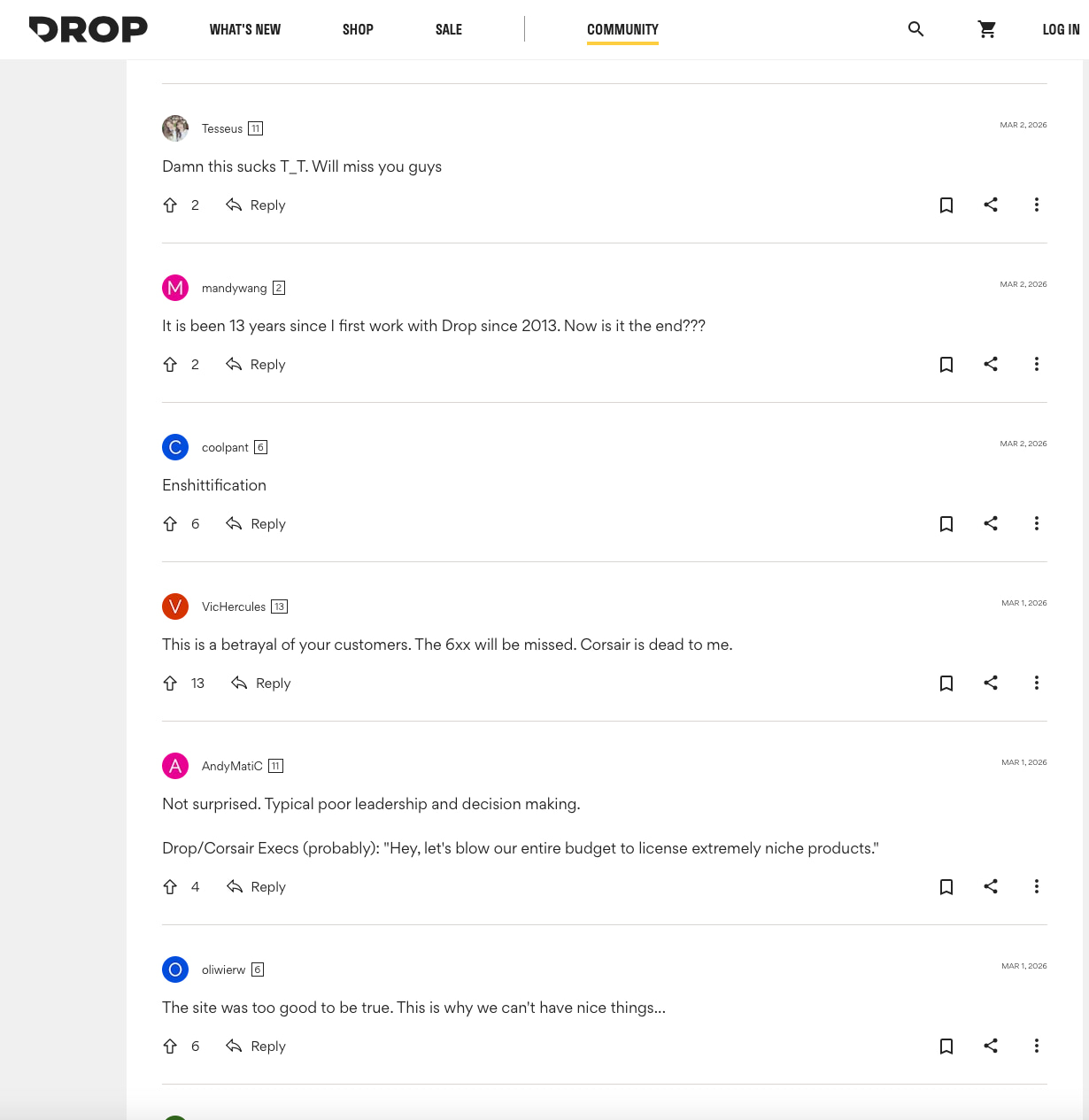
On paper, this is an “evolution.” In practice, it marks the end of the Massdrop model; the community voting, the group buys, the feeling that enthusiasts were steering the ship. And if you’ve spent any time in the forums or comment sections this week, it’s clear the reaction isn’t nostalgic gratitude. It’s frustration. For many longtime members, the independent storefront wasn’t just a place to shop. It was the point.
Advertisement
What the Shutdown Means for Orders, Rewards, Warranties, and Future Availability
Drop’s transition away from operating as a standalone ecommerce store comes with some important deadlines and structural changes that customers need to understand.
The final day to place an order on Drop.com is March 25 at 11:59 PM PT. After that, direct purchasing through the site ends. The good news is that all existing orders, including preorders, will be fulfilled as previously scheduled. There is no disruption to shipments already in the system.
Drop Rewards, however, come with a hard stop. Any unused rewards must be redeemed by March 25. After that date, remaining balances will expire and will no longer be redeemable. If you have credits sitting in your account, this is the moment to use them.
As for products, this is not a complete disappearance. Many Drop designed items will continue to live on through Corsairand partner retail channels. That includes models like the CSTM80 and a range of licensed collaborations. The difference is where and how they are sold. Instead of a centralized community driven storefront, distribution shifts into the broader Corsair retail ecosystem.
Advertisement
Warranties remain intact. All existing product warranties will continue to be honored, and customer service and support will now route through Corsair.
Going forward, select Drop products will be available through Corsair.com as well as major retail partners such as Amazon and Best Buy. In practical terms, Drop transitions from being an independent marketplace powered by its community to becoming a collaboration and product label operating inside a much larger corporate framework.
The Bottom Line
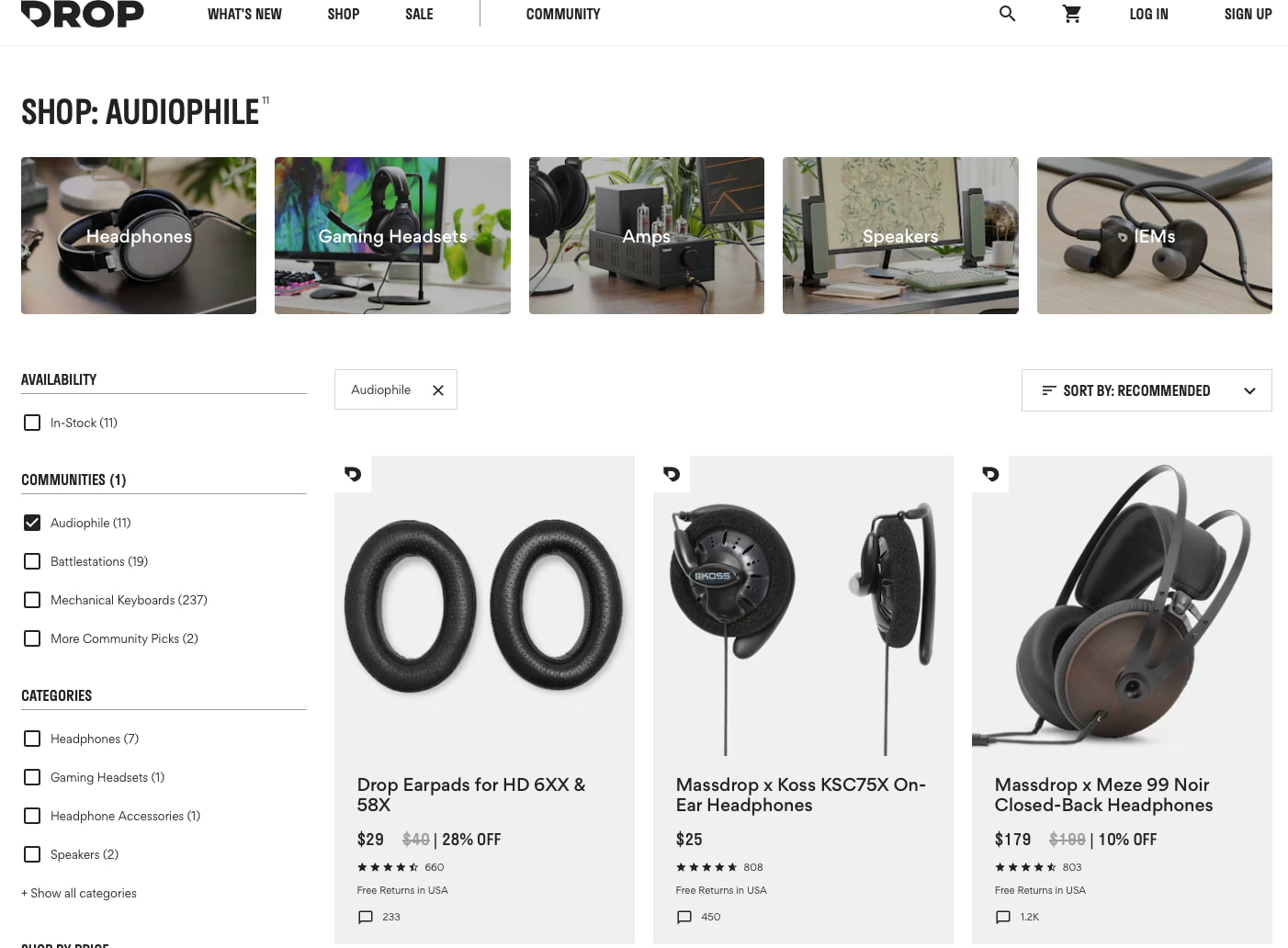
Drop had a real run. At its peak, the platform reshaped how enthusiast audio products came to market. The Drop plus collaborations with Sennheiser, Dan Clark Audio, Meze Audio, HiFiMAN, Beyerdynamic, Koss, and Axel Grell delivered some of the most popular enthusiast headphones of the past decade. These were not gimmicks. Many were category defining products that offered serious performance at prices that disrupted the traditional retail model.
Advertisement. Scroll to continue reading.
Advertisement
Now most of those headline products are sold out or permanently out of stock. The amplifiers and speakers are gone. The group buys are gone. The voting is gone. What remains is a brand being folded into the larger machinery of Corsairdistribution.
The products are not vanishing. The platform that built them is.
It is hard to imagine this new structure fostering the same level of risk taking or enthusiast driven innovation. Community driven product development does not scale easily inside a publicly traded hardware ecosystem. The backlash online is real. Longtime members feel betrayed. At the same time, once the acquisition happened in 2023, this trajectory was not exactly shocking. Consolidation tends to smooth edges. It rarely sharpens them.
For consumers, this is a loss. Drop lowered prices, pushed brands to experiment, and gave enthusiasts a voice that actually influenced final products. It was messy at times. It was also effective. Thirteen years is a respectable lifespan in ecommerce. It was a good run. But when growth, margins, and corporate alignment take priority, the community experiment is usually the first thing to go.
Asha Sharma, who recently replaced Phil Spencer as the head of Microsoft’s Xbox division, provided a short update on the company’s next-generation console. Revealing the codename “Project Helix,” she confirmed that the upcoming device aims to lead in horsepower and will support both Xbox and PC games. Read Entire Article Source link
Platform reviewed: PS5 Pro Available on: PS5, Xbox Series X|S, PC Release date: February 17, 2026
Advertisement
Similar to those titles, Obsidian Entertainment’s fantasy action role-playing game isn’t just sloppy seconds on the PS5 and PS5 Pro, but rather the definitive edition of an already fantastic experience.
Avowed’s arrival on Sony‘s consolesnot only benefits from a year’s worth of additional polish and bug fixes, but also plenty of fresh content and PlayStation-specific bells and whistles, like brilliant DualSense Wireless Controller integration.
Advertisement
DuelSense-fueled fighting
(Image credit: Microsoft / Obsidian Entertainment)
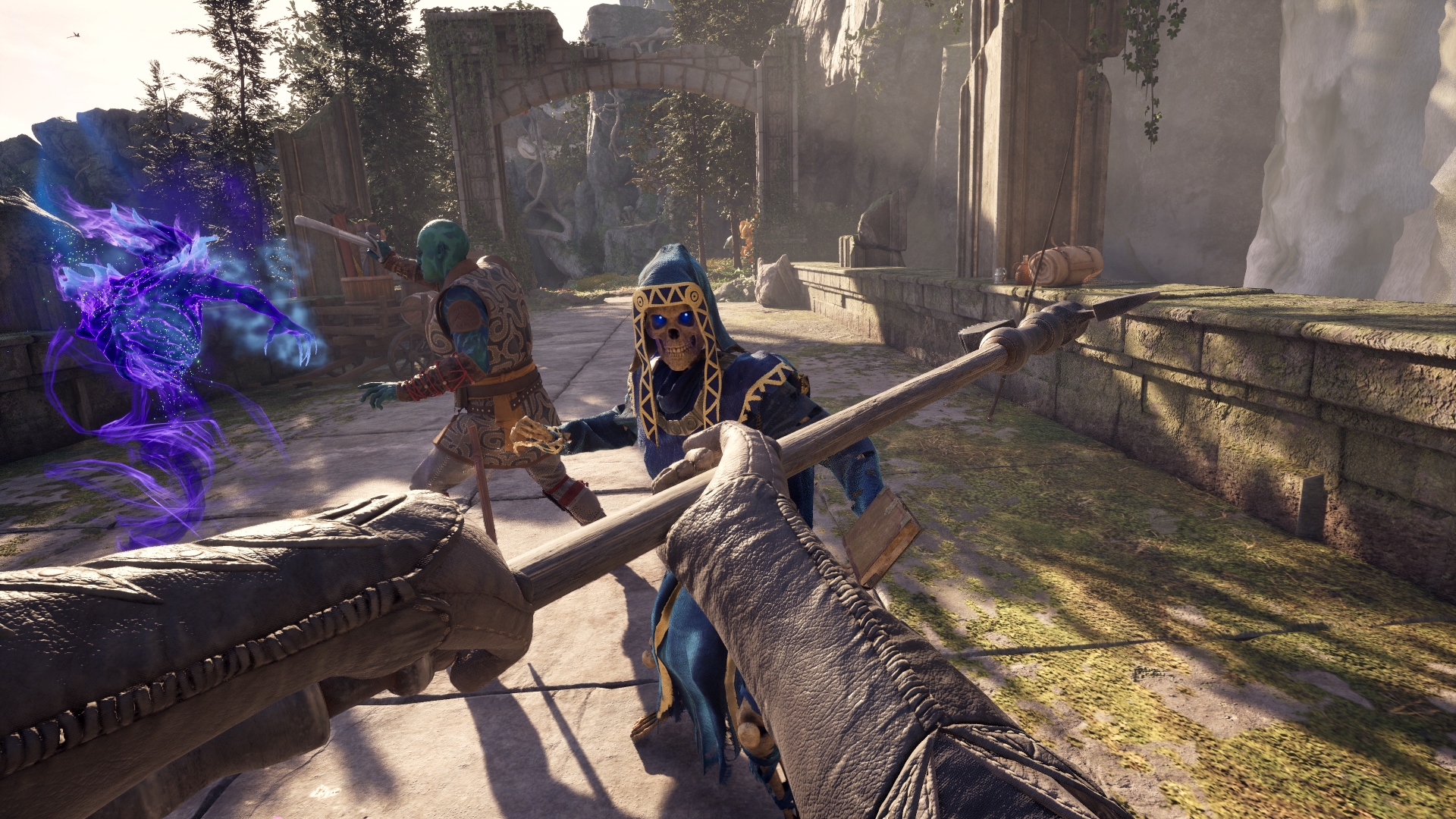
While I began an Avowed playthrough on my Xbox Series X a year ago, I didn’t get to dig very deep into its rich, potential-packed universe. What I remember most from my brief time braving the Living Lands as an envoy of the Aedyr Empire is the game’s rewarding combat, which feels better than ever on the PS5.
Fast, fluid, and superbly supported by weighty impacts of blades, bullets, and arcane abilities, the monster-slaying action was already satisfying as hell. But the combat’s been amped up significantly thanks to the DualSense‘s immersion-ratcheting capabilities.
Obsidian didn’t sleep on the gamepad’s proprietary tech, fully leveraging its adaptive triggers and haptic feedback to make every input – from meaty melee strikes to slow simmering spells – feel as fantastic in your hands as they look on the screen.
Of course, this also folds in that fresh content I mentioned above, as the game’s massive anniversary update introduces a new Quarterstaff for wizard builds. No mere reskin of an existing melee weapon, this two-handed tool of destruction allows mages to crack skulls up-close – as well as unleash powerful spells – in an epic fashion that’d make Gandalf proud.
Advertisement
Sign up for breaking news, reviews, opinion, top tech deals, and more.
Coupled with its next-level DualSense effects, it’s quickly become my favorite way to bring death to the Living Lands.
An update worthy of the gods
(Image credit: Microsoft / Obsidian Entertainment)
While the Quarterstaff is my personal favorite addition, this sorcerer’s best friend barely scratches the surface of the brimming update.
Advertisement
A deep photo mode – with plenty of options for customizing effects, filters, and color gradients – as well as a New Game+ option, will keep both existing envoys and new recruits busy. Beyond that, a trio of new races – Orlans, Aumaua, and Dwarves – join the Humans and Elves, bringing more character customization, perks, and fresh personality and lore to this already layered fantasy universe.
A slew of new difficulty modifiers also invite adventurers of all skill levels to tweak and tailor their experience to their hearts’ content. Factor in the past year of smaller updates – adding everything from polish, bug fixes, and quality of life touches – and PlayStation fans are getting yet another definitive take on a title that was born on Xbox.
If the PlayStation version stumbles at all, it’s in its lack of PS5 Pro-specific enhancements. It packs the now-standard quality (30 frames per second) and performance (60 frames per second) options, as well as a more in-the-middle setting for those with 120Hz displays. You can also chase faster performance by unlocking the frame rate, a welcome inclusion for sure. But there are no meaty ray-tracing features or other enhancements that allow you to truly harness everything under the Pro’s hood.
And what is offered didn’t seem to make much of an impact during my testing. In terms of both visuals and performance, my time playing on the Pro looked and felt pretty comparable to my Xbox Series X experience. Similarly, the standard PS5 and Pro seem to offer near-identical visual quality and performance, with no notable differences between the two.
Advertisement
Don’t sleep on it a second time
(Image credit: Microsoft)
While Pro owners might pine for more features to justify their pricey hardware purchase, the finger can be partially pointed at the fact that Avowed already played smoothly and impressed visually upon its release a year ago. That same sentiment translates to many other elements of the game, including its fantastic storytelling, colorful character interactions, and vibrant, varied world, covered extensively in TechRadar Gaming’s original review of the game.
Unsurprisingly, upon its release, Avowed was another compelling, polished action-RPG from a studio that’s been honing and perfecting its craft for over two decades, starting with 2004’s Star Wars Knights of the Old Republic II: The Sith Lords. Sadly, it got somewhat lost in the sea of last year’s acclaimed genre entries.
Thankfully, that oversight can now be remedied with its PS5 release, which not only reintroduces everything that was great the first time we faced its fungal plague but also brings a brimming treasure chest of fresh features, enhancements, and content.
Advertisement
Whether you’re a PlayStation owner craving the most immersive experience from behind the DualSense or an existing envoy ready to wield the Quarterstaff as one of the new races, Avowed’s second coming is as impressive as a Living Lands sunset…which you’ll definitely want to capture in photo mode.
Should you play Avowed on PS5?
Play it if…
Advertisement
Don’t play it if…
(Image credit: Microsoft)
Accessibility features
Prior to its PS5 release, Avowed already offered an admirable slate of accessibility options for camera adjustments, subtitle settings, difficulty levels, and even an arachnophobia mode for those averse to creepy crawlies. But the game’s new version builds further on this solid foundation, especially in the difficulty department.
A new “custom” difficulty setting allows players to tweak over two dozen modifiers, adjusting everything from player damage and stamina to carrying capacity, enemy attack speed, and much more. But while Avowed more than delivers in most accessibility areas, it still doesn’t offer the suite of colorblind options that have become pretty standard in other games.
Advertisement
How I reviewed Avowed on PS5
I explored The Living Lands for just over 40 hours, adventuring primarily on my PlayStation 5 Pro, but also putting plenty of time into my standard PS5 and Xbox Series X for visual and performance comparisons. I found the best, most balanced experience playing on my Pro in quality mode with the framerate unlocked.
I focused on testing the game’s anniversary update additions, specifically its custom difficulty settings, new Quarterstaff weapon, races, and photo mode. I played primarily on my budget TCL4K display, with HDR enabled and using its built-in stereo speakers, paying particular attention to the game’s DualSense controller integration for vibration and audio effects. I also played a few hours on my PlayStation Portal with PlayStation Pulse Explore earbuds.
On Wednesday, the Trump administration announced that a large collection of tech companies had signed on to what it’s calling the Ratepayer Protection Pledge. By agreeing, the initial signatories—Amazon, Google, Meta, Microsoft, OpenAI, Oracle, and xAI—are saying they will pay for the new generation and transmission capacities needed for any additional data centers they build. But the agreement has no enforcement mechanism, and it will likely run into issues with hardware supplies. It also ignores basic economics.
Other than that, it seems like a great idea.
What’s being agreed to
The agreement is quite simple, laying out five points. The key ones are the first three: that the companies building data centers pledge to pay for new generating capacity, either building it themselves or paying for it as part of a new or expanded power plant. They’ll also pay for any transmission infrastructure needed to connect their data centers and the new supply to the grid and will cover these costs whether or not the power ultimately gets used by their facilities.
The companies also pledge to consider allowing the local grid to use on-site backup generators to handle emergency power shortages affecting the community. They will also hire and train locally when they build new data centers.
Advertisement
The agreement suggests that these promises will protect American consumers from price hikes due to the expansion of data centers and will somehow “lower electricity costs for consumers in the long term.” How that will happen is not specified.
Also missing from the agreement is any sort of enforcement mechanism. If a company decides to ignore the agreement, the worst it is guaranteed to suffer is bad publicity, something these companies already have experience handling. That said, Trump has been known to resort to blatantly illegal tactics to pressure companies to conform to his wishes, so ignoring the agreement carries risks.
That’s important because the companies will struggle to live up to the agreement. (Though Google, for its part, told Ars that it has typically followed the guidelines as a normal part of its process for building new data centers.)
A China-linked advanced persistent threat actor tracked as UAT-9244 has been targeting telecommunication service providers in South America since 2024, compromising Windows, Linux, and network-edge devices.
According to Cisco Talos researchers, the adversary is closely associated with the FamousSparrow and Tropic Trooper hacker groups, but is tracked as a separate activity cluster.
This assessment has high confidence and is based on similar tooling, tactics, techniques, and procedures (TTPs), and victimology observed in attacks attributed to the threat actors.
The researchers note that while UAT-9244 shares the same target profile as Salt Typhoon, they could not establish a solid connection between the two activity clusters.
Advertisement
New malware targeting telco networks
The researchers found that the campaign used three previously undocumented malware families: TernDoor, a Windows backdoor; PeerTime, a Linux backdoor that uses BitTorrent; and BruteEntry, a brute-force scanner that builds proxy infrastructure (ORBs).
TernDoor is deployed through DLL side-loading, using the legitimate executable wsprint.exe to load malicious code from BugSplatRc64.dll, which decrypts and executes the final payload in memory (injected into msiexec.exe).
The malware contains an embedded Windows driver, WSPrint.sys, which is used to terminate, suspend, and resume processes.
Persistence is achieved via scheduled tasks and Windows Registry modifications, which are also used to hide the scheduled task.
Advertisement
Additionally, TernDoor can execute commands via remote shell, run arbitrary processes, read/write files, collect system information, and self-uninstall.
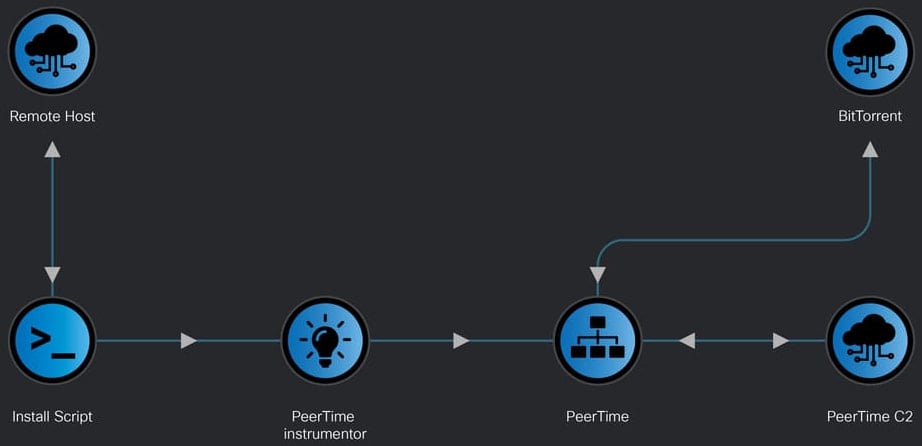
PeerTime is an ELF Linux backdoor that targets multiple architectures (ARM, AARCH, PPC, MIPS), suggesting it was designed to compromise a broad range of embedded systems and network devices used in telecom environments.
PeerTime installation flow Source: Cisco Talos
Cisco Talos documented two versions for PeerTime. One variant is written in C/C++ and the other is based on Rust. The researchers also noticed Simplified Chinese debug strings in the instrumentor binary, an indicator of its origin.
Its payload is decrypted and loaded in memory, and its process is renamed to appear legitimate.
PeerTime, an ELF-based peer-to-peer (P2P) backdoor, uses the BitTorrent protocol for command-and-control (C2) communications, downloads and executes payloads from peers, and uses BusyBox to write the files on the host.
Advertisement
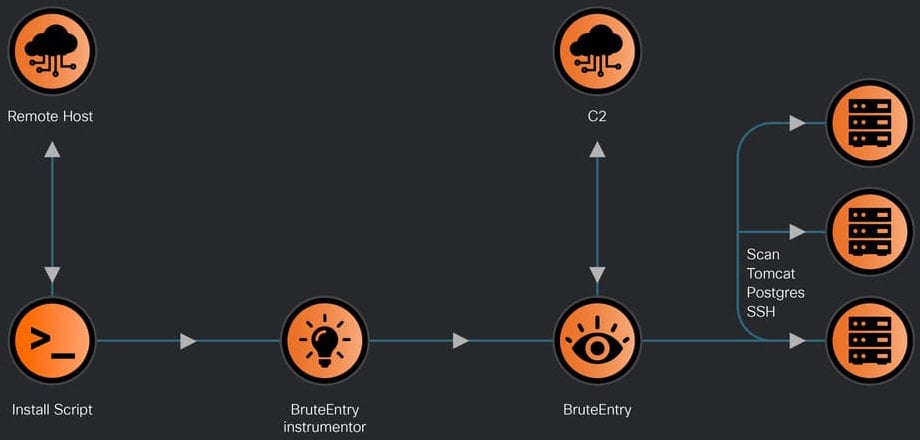
Finally, there’s BruteEntry, which consists of a Go-based instrumentor binary and a brute-forcing component. Its role is to turn compromised devices into scanning nodes, known as Operational Relay Boxes (ORBs).
BruteEntry infection chain Source: Cisco Talos
The attacker uses the machines running BruteEntry to scan for new targets and brute-force access to SSH, Postgres, and Tomcat. Login attempt results are sent back to the C2 with task status and notes.
In a technical report today, Cisco Talos researchers provide details on the capabilities of the three pieces of malware, how they are deployed, and achieve persistence.
Cisco Talos researchers have listed indicators of compromise (IoCs) associated with the observed UAT-9244 activity, which defenders can use to detect and block these attacks early.
Malware is getting smarter. The Red Report 2026 reveals how new threats use math to detect sandboxes and hide in plain sight.
Download our analysis of 1.1 million malicious samples to uncover the top 10 techniques and see if your security stack is blinded.
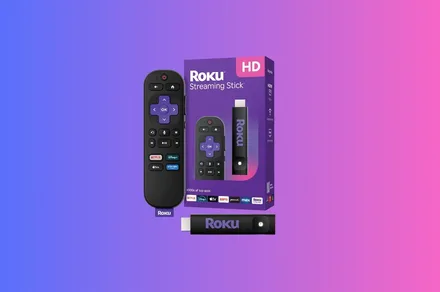
This is one of those simple deals that’s hard to argue with. The Roku Streaming Stick HD is down to $15.99 from $29.99. If you’ve got an older TV in a bedroom, kitchen, dorm, or guest room that’s missing apps (or just runs painfully slow), this is the quick fix. You plug it in, connect to Wi-Fi, and you’ve got a modern streaming setup without buying a whole new TV.
It’s also a great “keep in a drawer” gadget. If you travel, bounce between rentals, or visit family and end up stuck with a clunky TV interface, a cheap Roku stick can save the night.
What you’re getting
This is an HD streaming stick that plugs into your TV’s HDMI port and comes with a Roku voice remote. Roku’s big advantage is that it’s simple and consistent. You get access to the usual major streaming apps, plus free and live TV options through Roku’s platform.
No fancy specs here, and that’s fine. The point is getting reliable streaming with minimal hassle for very little money.
Advertisement
Why it’s worth it
At $15.99, you’re basically paying impulse-buy pricing for something you’ll probably use for years. This is perfect if:
your TV is older, and the built-in apps are outdated or slow
you want streaming in a second room without spending much
you’re setting up a kid’s room, dorm, or guest space
you just want a clean interface that doesn’t fight you
If you’ve got a 4K TV and you care about the highest resolution, you’d look at a 4K streaming stick instead. But for basic HD streaming and a smoother experience on an older set, this is a great deal.
The bottom line
For $15.99, the Roku Streaming Stick HD is an easy upgrade that fixes a lot of annoyances fast. If you’ve got any TV in your house that feels “behind,” this is the cheap, simple way to bring it up to date.
The CPRight team, from left: Shubham Bansal, Deeya Sharma, Prisha Hemani, and Atharv Dixit with their Holloman Health Innovation Challenge winnings at the University of Washington in Seattle this week. (UW Buerk Center for Entrepreneurship Photo / Matt Hagen)
A team of students from the University of Washington took home the top prize in the Hollomon Health Innovation Challenge on Wednesday as the UW swept the 11th annual competition.
CPRight won the $15,000 Holloman Family grand prize as well as the $2,500 Naturacur Wound Healing Best Idea for a Medical Device prize in the student competition.
CPRight is a real-time CPR feedback device that provides data on compression rate and depth to ensure bystanders perform high-quality, life-saving chest compressions during an emergency.
The company was co-developed alongside ReviveHer, the 2025 Best Idea for Patient Safety prize winner.
The team consists of Shubham Bansal, a neuroscience undergraduate student; Deeya Sharma, a graduate student in the UW School of Medicine; Prisha Hemani, a computer science and engineering undergrad; and Atharv Dixit, an engineering undergrad.
Advertisement
The Hollomon Health Innovation Challenge, hosted by the UW’s Buerk Center for Entrepreneurship in the Foster School of Business, gives students the opportunity to create meaningful solutions to big health-related problems. The competition is open to undergrads and grad students at accredited colleges and universities across the Cascadia Corridor — Washington, Oregon, Idaho, and British Columbia, as well as Alaska.
Other prize winners:
$10,000 WRF Capital Second Place Prize:
TheraT, a drinkable, non-invasive therapy that removes toxins in the gut before they reach the bloodstream, allowing chronic kidney disease patients to lower their reliance on dialysis.
$5,000 Scale LLP Third Place Prize
LegUp Prosthetics, a low-cost system that uses smartphone-based 3D scanning to enable accurate fitting from home, reducing costs and expanding access to prosthetic care for underserved and rural patients. Developed by a UW team of molecular engineering, bioengineering, biochemistry, and mechanical engineering students. They also won the $2,500 Population Health Initiative Best Idea for Addressing Health Access and Disparities prize for their focus on expanding care to underserved and rural patients through a point-of-care healthcare service.
$2,500 Mindful Therapy Group Best Idea in Digital Health Prize
ShiftSpark, a workflow-embedded support platform that helps nurses process stress in real time during a shift. Developed by a team of UW public health students who became the first-ever to win the digital health prize in the challenge after also winning the pitch contest as part of the Buerk’s Digital Health Workshop series.
SoundBio Lab Ignite Prize
TPT-Finder, a handheld, AI-powered surgical tool that helps surgeons instantly distinguish parathyroid tissue during thyroid surgery to prevent costly and life-altering complications. Developed by a UW team of computer science and electrical and computer engineering students. The prize is a six-month membership to the SoundBio Lab biomakerspace in the U-District.
$1,000 Connie Bourassa-Shaw Spark Award
ColoGuide, an AI-powered colonoscopy navigation system building its proprietary data set to automate scope insertion with real-time visual guidance. Developed by UW Medicine students.
This year’s competition attracted 67 participants, two shy of the record set in 2025. Students represented seven schools in the opening round: UW, UW-Bothell, Edmonds College, UW Global Innovation Exchange, University of Idaho, Portland State University, and Seattle University.
There have been 509 participating teams and more than 1,725 students over the 11 years of the challenge and $424,000 awarded.
A €345,000 employment grant from Údarás na Gaeltachta will support the recruitment.
Minister for Rural and Community Development and the Gaeltacht Dara Calleary, TD has approved €12m in funding from his department and its agencies for a range of projects. Calleary also revealed plans for 23 new jobs at Net Feasa, a technology company based in Daingean Uí Chúis, Kerry.
The 23 new full-time positions will double the company’s workforce over the course of the next three years and will be in software development and engineering, artificial intelligence engineering, wireless network operations and customer support. A €345,000 employment grant from Údarás na Gaeltachta will support the recruitment.
Net Feasa, which comes from the Irish language for “network of knowledge”, is a digital transformation company dedicated to “revolutionising” the global supply chain landscape.
Advertisement
“Our mission is to enhance safety, security and visibility, ensuring that every link in the chain is connected and performing seamlessly,” read a statement on the company’s website.
Commenting on the jobs announcement Calleary said: “I am delighted to be here to celebrate this success story. The jobs at Net Feasa are high-quality well-paid roles in an exciting technology company. Net Feasa was founded in a rural Gaeltacht town, but it has a global reach with offices in Singapore, Hong Kong, Taiwan and the United States.
“With the wealth of talent available in rural areas and the support of my department, and agencies like Údarás na Gaeltachta, we are working hard to create more opportunities like this.”
Calleary today (5 March) began a two-day visit to Kerry where he is opening and visiting projects that have been approved for funding.
Advertisement
Among other engagements, he will also visit the site of the new housing project in Baile an Fheirtéaraigh that seeks to address the accommodation shortage for Irish language summer colleges in the area and attend the official opening of GTEIC, a working hub which has had investment of more €2.5m.
The Cathaoirleach of Kerry County Council, Cllr Michael Foley said: “I warmly welcome Minister Dara Calleary to Kerry for a series of important engagements. The Department of Rural and Community Development and the Gaeltacht has supported many projects and initiatives in Kerry in recent years, and I am pleased that the Minister will have the opportunity to see first-hand the very positive work being done across the county.”
Don’t miss out on the knowledge you need to succeed. Sign up for the Daily Brief, Silicon Republic’s digest of need-to-know sci-tech news.
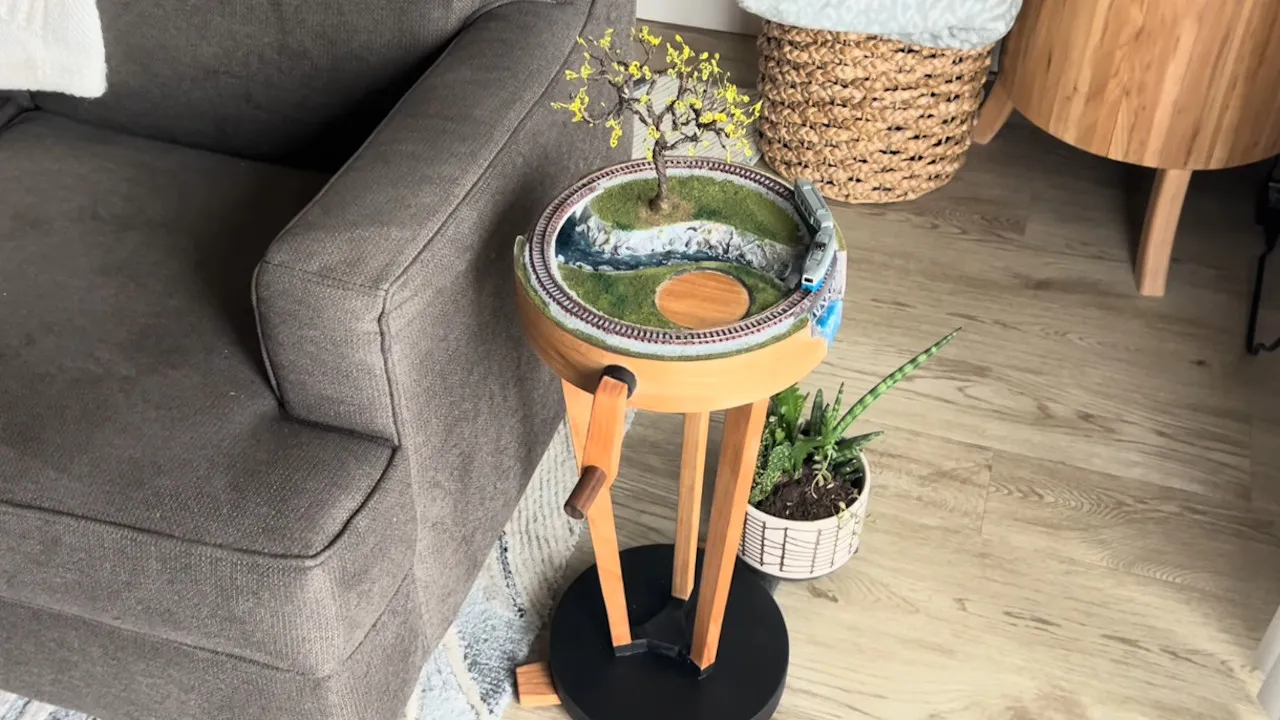
The end table was built from scratch, with [Peter] going through all the woodworking steps required to assemble the piece. The three-legged wooden table is topped with a tiny N-scale model railway layout, and you get to see it put together including the rocks, the grass, and a beautiful epoxy river complete with a bridge. The railway runs a Kato Pocket Line trolley, but the really neat thing is how it’s powered.
[Peter] shows us how a small gearmotor generator was paired with a bridge rectifier and a buck converter to fill up a super capacitor that runs the train and lights up the tree on the table. Just 25 seconds of cranking will run the train anywhere from 4 to 10 minutes depending on if the tree is lit as well. To top it all off, there’s even a perfect coaster spot for [Peter]’s beverage of choice.
People are losing their minds over Apple’s decision to put an iPhone chip in the MacBook Neo. All it shows is that they really don’t understand the engineering of Apple Silicon.
Apple’s A18 Pro is more than an iPhone chip
After years of rumors, the budget MacBook was revived on March 4, 2026. The MacBook Neo is its name, and people are already losing their minds over one key cost-cutting decision. The MacBook Neo has the A18 Pro at its heart, the same chip that powered the iPhone 16 Pro. It’s something that had been rumored, yet still seems to have blindsided some of those looking to create a fuss on social media. Continue Reading on AppleInsider | Discuss on our Forums