Nvidia announced plans to bring GeForce Now to Linux at CES 2026 a few weeks ago. The service was already available on Linux-powered handhelds like the Steam Deck, but it is now also supported on general Linux distributions for desktops and laptops. Read Entire Article Source link
alternative_right quotes a report from the New York Post: The CIA used a futuristic new tool called “Ghost Murmur” to find and rescue the second American airman who was shot down in southern Iran, The Post has learned. The secret technology uses long-range quantum magnetometry to find the electromagnetic fingerprint of a human heartbeat and pairs the data with artificial intelligence software to isolate the signature from background noise, two sources close to the breakthrough said. It was the tool’s first use in the field by the spy agency — and was alluded to Monday afternoon by President Trump and CIA Director John Ratcliffe at a White House briefing. “It’s like hearing a voice in a stadium, except the stadium is a thousand square miles of desert,” a source briefed on the program told The Post. “In the right conditions, if your heart is beating, we will find you.” The relatively barren landscape made for “an ideal first operational use” of Ghost Murmur, the first source noted.
“Normally this signal is so weak that it can only be measured in a hospital setting with sensors pressed nearly against the chest,” the source said. “But advances in a field known as quantum magnetometry — specifically sensors built around microscopic defects in synthetic diamonds — have apparently made it possible to detect these signals at dramatically greater distances.”
“The capability is not omniscient. It works best in remote, low-clutter environments and requires significant processing time,” this person added.
OnePlus has been everywhere in the news lately, and not always for the calmest reasons. Reports recently suggested the brand was pulling back from several major markets, right after the exit of its India CEO, which is a pretty big deal considering how important India is for the company. And yet, here it is, doing the exact opposite of slowing down.
Just this month, OnePlus dropped the Nord 6, and now fresh reports hint that it’s stepping into the handheld gaming space as well. It’s an interesting move, especially in a year that already feels like a turning point for the brand. If anything, this new direction makes it clear that OnePlus isn’t retreating, it’s reshuffling and trying something bold.
OnePlus just teased something that refuses to be boring
A well-known tipster, Digital Chat Station, has shared what appears to be the first look at OnePlus’s upcoming gaming handheld on Weibo. And from that single image, there’s already quite a bit to unpack. The device seems to lean into a clean, almost boxy design, with a square-ish profile that makes it stand out from the usual rounded handhelds. Interestingly, there’s also a rear camera module on the back panel, which adds a bit of curiosity to the mix.
Digital Chat Station on Weibo
Another tipster, Bald Panda, also on Weibo, claims the handheld could feature an 8-inch display and run on a MediaTek Dimensity chipset. While the exact processor hasn’t been confirmed yet, all signs point towards MediaTek being the brains behind it. As for the design, it’s got a sleek black finish paired with a contrasting purple hand rest, which honestly sounds like a bit of a flex. It gives the device a premium, slightly playful look, rather than going all-in on the usual serious gamer aesthetic.
I’m genuinely excited to see OnePlus step into a completely new space. It’s not an easy category to crack, and building credibility here will take time. That said, OnePlus doesn’t exactly have a history of doing things halfway. When it commits to something, it usually brings a certain level of polish and thoughtfulness to the table. So while this handheld might be new territory for the brand, there’s a good chance it won’t feel like a first attempt. If anything, this could be OnePlus testing its limits a little, and that’s where things tend to get interesting.
The Sennheiser Momentum 4 has earned a reputation as one of the most capable over-ear headphones at its price point, and this discount makes a strong case for picking one up right now.
The 42mm dynamic drivers are a meaningful part of that story, delivering a frequency range of 6Hz to 22kHz that captures both the deep sub-bass rumble in electronic music and the fine harmonic detail in acoustic recordings that smaller drivers tend to smear.
Advertisement
AptX Adaptive Bluetooth helps maintain that audio quality wirelessly, adjusting the bitrate dynamically so that the signal holds up even when you are moving through environments with heavy wireless interference, like a crowded commuter train or a busy airport.
Adaptive noise cancellation handles the environmental side of things, and the transparency mode lets you flip back into the world around you without removing the headphones, which matters when you are navigating a city or need to catch a platform announcement.
Advertisement
Four beamforming microphones handle calls with enough directional precision to suppress wind and ambient noise independently, so the person on the other end hears your voice rather than the background of wherever you happen to be.
Advertisement
Battery life is where the 4.5-star Momentum 4 genuinely separates itself from the competition in this category, with 60 hours of playback on a single charge, meaning most users will go weeks between top-ups under realistic daily use patterns.
The foldable design and included carry case make the headphones practical for travel as well, and the package also includes a USB-C cable and a 3.5mm to 2.5mm audio cable for wired listening when Bluetooth is not an option.
Sennheiser’s Smart Control Plus app rounds out the experience, giving you access to a parametric equaliser, preset sound modes, and granular controls over noise cancellation and transparency levels.
For commuters and frequent travellers who will lean on both the ANC and the battery capacity daily, the Momentum 4 at $199.95 represents one of the strongest value propositions currently available in the premium over-ear headphone market.
Advertisement
Advertisement
An excellent pair of wireless headphones that deliver a balanced, neutral presentation, long battery life and very good noise cancellation. The Sennheiser Momentum 4 Wireless all-round performance is excellent though the Sony WH-1000XM5 are better in most respects, and available for similar money
AI agents run on file systems using standard tools to navigate directories and read file paths.
The challenge, however, is that there is a lot of enterprise data in object storage systems, notably Amazon S3. Object stores serve data through API calls, not file paths. Bridging that gap has required a separate file system layer alongside S3, duplicated data and sync pipelines to keep both aligned.
The rise of agentic AI makes that challenge even harder, and it was affecting Amazon’s own ability to get things done. Engineering teams at AWS using tools like Kiro and Claude Code kept running into the same problem: Agents defaulted to local file tools, but the data was in S3. Downloading it locally worked until the agent’s context window compacted and the session state was lost.
Amazon’s answer is S3 Files, which mounts any S3 bucket directly into an agent’s local environment with a single command. The data stays in S3, with no migration required. Under the hood, AWS connects its Elastic File System (EFS) technology to S3 to deliver full file system semantics, not a workaround. S3 Files is available now in most AWS Regions.
Advertisement
“By making data in S3 immediately available, as if it’s part of the local file system, we found that we had a really big acceleration with the ability of things like Kiro and Claude Code to be able to work with that data,” Andy Warfield, VP and distinguished engineer at AWS, told VentureBeat.
The difference between file and object storage and why it matters
S3 was built for durability, scale and API-based access at the object level. Those properties made it the default storage layer for enterprise data. But they also created a fundamental incompatibility with the file-based tools that developers and agents depend on.
“S3 is not a file system, and it doesn’t have file semantics on a whole bunch of fronts,” Warfield said. “You can’t do a move, an atomic move of an object, and there aren’t actually directories in S3.”
Previous attempts to bridge that gap relied on FUSE (Filesystems in USErspace), a software layer that lets developers mount a custom file system in user space without changing the underlying storage. Tools like AWS’s own Mount Point, Google’s gcsfuse and Microsoft’s blobfuse2 all used FUSE-based drivers to make their respective object stores look like a file system.
Advertisement
Warfield noted that the problem is that those object stores still weren’t file systems. Those drivers either faked file behavior by stuffing extra metadata into buckets, which broke the object API view, or they refused file operations that the object store couldn’t support.
S3 Files takes a different architecture entirely. AWS is connecting its EFS (Elastic File System) technology directly to S3, presenting a full native file system layer while keeping S3 as the system of record. Both the file system API and the S3 object API remain accessible simultaneously against the same data.
How S3 Files accelerates agentic AI
Before S3 Files, an agent working with object data had to be explicitly instructed to download files before using tools. That created a session state problem. As agents compacted their context windows, the record of what had been downloaded locally was often lost.
“I would find myself having to remind the agent that the data was available locally,” Warfield said.
Advertisement
Warfield walked through the before-and-after for a common agent task involving log analysis. He explained that a developer was using Kiro or Claude Code to work with log data, in the object only case they would need to tell the agent where the log files are located and to go and download them. Whereas if the logs are immediately mountable on the local file system, the developer can simply identify that the logs are at a specific path, and the agent immediately has access to go through them.
For multi-agent pipelines, multiple agents can access the same mounted bucket simultaneously. AWS says thousands of compute resources can connect to a single S3 file system at the same time, with aggregate read throughput reaching multiple terabytes per second — figures VentureBeat was not able to independently verify.
Shared state across agents works through standard file system conventions: subdirectories, notes files and shared project directories that any agent in the pipeline can read and write. Warfield described AWS engineering teams using this pattern internally, with agents logging investigation notes and task summaries into shared project directories.
For teams building RAG pipelines on top of shared agent content, S3 Vectors — launched at AWS re:Invent in December 2024 — layers on top for similarity search and retrieval-augmented generation against that same data.
Advertisement
What analysts say: this is not just a better FUSE
AWS is positioning S3 Files against FUSE-based file access from Azure Blob NFS and Google Cloud Storage FUSE. For AI workloads, the meaningful distinction is not primarily performance.
“S3 Files eliminates the data shuffle between object and file storage, turning S3 into a shared, low-latency working space without copying data,” Jeff Vogel, analyst at Gartner, told VentureBeat. “The file system becomes a view, not another dataset.”
With FUSE-based approaches, each agent maintains its own local view of the data. When multiple agents work simultaneously, those views can potentially fall out of sync.
“It eliminates an entire class of failure modes including unexplained training/inference failures caused by stale metadata, which are notoriously difficult to debug,” Vogel said. “FUSE-based solutions externalize complexity and issues to the user.”
Advertisement
The agent-level implications go further still. The architectural argument matters less than what it unlocks in practice.
“For agentic AI, which thinks in terms of files, paths, and local scripts, this is the missing link,” Dave McCarthy, analyst at IDC, told VentureBeat. “It allows an AI agent to treat an exabyte-scale bucket as its own local hard drive, enabling a level of autonomous operational speed that was previously bottled up by API overhead associated with approaches like FUSE.”
Beyond the agent workflow, McCarthy sees S3 Files as a broader inflection point for how enterprises use their data.
“The launch of S3 Files isn’t just S3 with a new interface; it’s the removal of the final friction point between massive data lakes and autonomous AI,” he said. “By converging file and object access with S3, they are opening the door to more use cases with less reworking.”
Advertisement
What this means for enterprises
For enterprise teams that have been maintaining a separate file system alongside S3 to support file-based applications or agent workloads, that architecture is now unnecessary.
For enterprise teams consolidating AI infrastructure on S3, the practical shift is concrete: S3 stops being the destination for agent output and becomes the environment where agent work happens.
“All of these API changes that you’re seeing out of the storage teams come from firsthand work and customer experience using agents to work with data,” Warfield said. “We’re really singularly focused on removing any friction and making those interactions go as well as they can.”
The case for AI prescription renewals is real. So is the case against trusting a state sandbox to catch the risks.
In January, a security research firm called Mindgard sat down with a chatbot. The chatbot had been built by Doctronic, a health technology startup that had just become the first company in American history to receive state approval to autonomously renew medical prescriptions using artificial intelligence.
Doctronic and Utah’s Office of Artificial Intelligence Policy were quick to clarify that the vulnerable chatbot was Doctronic’s public-facing tool, not the hardened system running the actual prescription pilot. That distinction matters, and it is worth taking seriously.
But it does not resolve the deeper question that the exchange raises, which is not whether this particular system was compromised, but whether a 12-month state sandbox programme, run by a commerce department with a mandate to encourage AI innovation, is the right mechanism for answering that question at all.
Advertisement
Start with what is genuinely true about the problem Utah is trying to solve. Prescription renewal is, for enormous numbers of Americans, a bureaucratic obstacle that serves no clinical purpose. About half of all people with chronic conditions do not take their medications as prescribed, according to the CDC. The broader challenge of making healthcare accessible and preventative, rather than reactive, is one the tech industry has been grappling with for years.
A significant portion of that non-adherence traces directly to the renewal process: the two-week wait for a primary care appointment, the missed call from the surgery, the lapsed prescription that means starting over. Managed Healthcare Executive reported that Doctronic’s co-founder Matt Pavelle puts the figure at around 30% of all non-adherence.
That is a large number attached to a concrete and fixable problem. Medication non-adherence costs the American healthcare system somewhere between $100 billion and $300 billion annually, depending on which set of studies you consult, and is associated with around 125,000 preventable deaths per year. Those are not made-up numbers from a startup’s pitch deck. They come from peer-reviewed literature and from the CDC.
The access argument for AI prescription renewals is therefore not trivial. It is strongest precisely where the care system is thinnest: rural areas, low-income patients, older Americans who struggle to attend in-person appointments.
Advertisement
Adam Oskowitz, the vascular surgeon who co-founded Doctronic, put it plainly in January: patients are waiting weeks for an appointment to renew a prescription for a medication they have been taking for years, for a condition that has not changed. That wait is not a feature of the system. It is a failure of it. If AI can fix that failure safely, it should.
The problem is the word safely. Doctronic’s benchmark for safety is that its AI matched human clinicians’ treatment plans 99.2% of the time across 500 urgent-care cases. The company shared those figures with Utah regulators, and they were persuasive enough.
But 500 cases is a small number for a system that will eventually process prescriptions at scale. And the 0.8% that did not match represents, at any meaningful volume, a meaningful number of patients receiving something other than what a clinician would have recommended.
More fundamentally, matching what a clinician recommends in a structured evaluation is not the same as being robust against the full range of real-world inputs, including the adversarial ones.
Advertisement
The Mindgard test was not a stress test of the live system; it was a demonstration that the company’s publicly accessible AI could be manipulated with a fabricated press release. That the live system is different is reassuring. It is not conclusive.
What makes the Utah arrangement specifically worth scrutinising is the regulatory mechanism it uses. The state’s Office of Artificial Intelligence Policy, created in 2024, has the authority to waive its own unprofessional conduct laws for companies that enter its regulatory sandbox. That is what it did for Doctronic.
The three-phase pilot begins with physician review of every renewal, which sounds rigorous. Phase three, the operational phase, involves physician review of between five and ten per cent of renewals. The rest proceed autonomously. STAT News raised the question of whether an AI system that evaluates clinical information and issues prescriptions should be regulated as a medical device by the FDA.
That question remains unanswered. Utah does not have the authority to answer it, and its agreement with Doctronic does not require the FDA to be satisfied before the system scales.
Advertisement
The American Medical Association and the Utah Academy of Family Physicians both raised formal objections. The AMA’s CEO, Dr John Whyte, said in a statement that removing physicians from clinical decisions puts patients at risk. The Utah Academy said the programme demonstrated an apparent willingness to move forward with AI without the necessary guardrails.
Those are physician groups, and physician groups are not always disinterested observers when it comes to AI that might reduce demand for their services. But the concern about guardrails is separable from guild interest. A state commerce department has different incentives from a regulator whose primary mandate is patient safety.
Utah’s OAIP is explicitly tasked with encouraging AI adoption. That is fine as a policy goal. It should not be the primary lens through which prescription safety is evaluated. The WHO warned in 2021 that existing policies and regulations were insufficient to protect patients from AI in healthcare. Four years later, that gap has not closed.
None of this means the Doctronic pilot is wrong. It might turn out to be genuinely valuable and genuinely safe. The phased approach, the monthly reporting requirements, the exclusion of controlled substances and injectables, the malpractice insurance holding the AI to the standard of a physician: these are serious design choices, not window dressing.
Advertisement
If the programme runs for 12 months and the data shows clean outcomes, that evidence will matter for every state considering whether to follow.
But evidence is the point. The question is not whether AI can help with prescription renewals. It probably can. The question is who is responsible for generating the evidence that would let us know. A state commerce office running a 12-month pilot with a startup founded in 2023 is not obviously that entity.
The FDA exists precisely because the history of American medicine is full of innovations that seemed obviously beneficial until, at scale, they were not.
The thalidomide that never made it to the US market did not fail because a startup’s pilot showed worrying results. It failed because the FDA’s Frances Kelsey demanded the kind of evidence that a sandbox programme is not designed to produce.
Advertisement
Patients waiting weeks for a prescription renewal deserve a better system. They also deserve to know that the AI renewing their prescription has been tested by someone whose job is safety, not innovation.
In the first days after Pam Bondi was appointed attorney general last year, the Department of Justice began shutting down pending criminal cases at a record pace.
The cases included an investigation into a Virginia nursing home with a recent record of patient abuse; probes of fraud involving several New Jersey labor unions, including one opened after a top official of a national union was accused of embezzlement; and an investigation into a cryptocurrency company suspected of cheating investors.
Advertisement
In total, the DOJ quietly closed more than 23,000 criminal cases in the first six months of President Donald Trump’s administration, abandoning hundreds of investigations into terrorism, white-collar crime, drugs and other offenses as it shifted resources to pursue immigration cases, according to an analysis by ProPublica.
The bulk of these cases, which were closed without prosecution and known as declinations, had been referred to the DOJ by law enforcement agencies under prior administrations that believed a federal crime may have been committed. The DOJ routinely declines to prosecute cases for any number of reasons, including insufficient evidence or because a case is not a priority for enforcement.
But the number of declinations under Bondi marks a striking departure not only from the Biden administration but also the first Trump term, according to the ProPublica analysis, which examined two decades of DOJ data, including the first six months of Trump’s second term. ProPublica determined the increase is not the result of inheriting a larger caseload or more referrals from law enforcement.
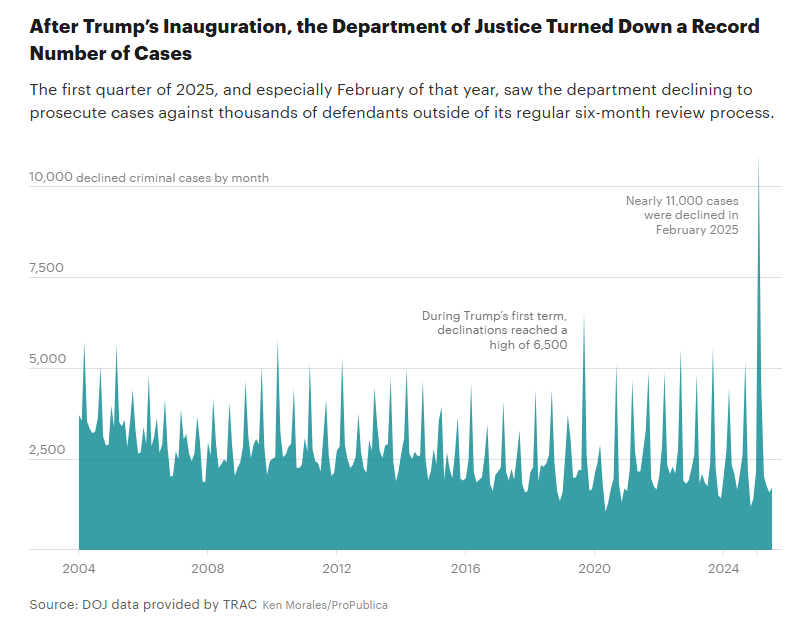
In February 2025 alone, which included the first weeks of Bondi’s tenure, nearly 11,000 cases were declined, the most in a month since at least 2004. The previous high was just over 6,500 cases in September 2019, during Trump’s first administration.
Advertisement
Some of the cases shut down were the result of yearslong investigations by federal agencies such as the FBI and the Drug Enforcement Administration. For complex cases, the DOJ can take years before deciding whether to bring charges.
The shift comes as the DOJ has undergone an extraordinary overhaul under the Trump administration, with entire units shuttered, directives to abandon pursuit of certain crimes and thousands of lawyers quitting or, in some cases, being forced out of the agency.
In doing so, the DOJ is retreating from its mission to impartially uphold the rule of law, keep the country safe and protect civil rights, according to interviews with a dozen prosecutors and an open letter from nearly 300 DOJ employees who have left the department under Trump. The Trump DOJ, the employees wrote, is “taking a sledgehammer” to long-standing work to “protect communities and the rule of law.”
The change in priorities was outlined in a series of memos sent to attorneys early last year. Trump’s DOJ has said it is “turning a new page on white-collar and corporate enforcement” and emphasizing the pursuit of drug cartels, illegal immigrants and institutions that promote “divisive DEI policies.” Trump, in an address last March at the department, said the changes were necessary after a “surrender to violent criminals” during the past administration and would result in a restoration of “fair, equal and impartial justice under the constitutional rule of law.”
Advertisement
The department prosecuted 32,000 new immigration cases in the first six months of the administration, which was nearly triple the number under the Biden administration and a 15% increase from the first Trump term. It has pursued fewer prosecutions of nearly every other type of crime — from drug offenses to corruption — than new administrations in their first six months dating back to 2009.
The DOJ has also closed hundreds of cases involving alleged crimes that the administration has publicly emphasized as enforcement priorities. Even as the Trump administration unleashed Elon Musk’s Department of Government Efficiency operatives to root out waste, fraud and abuse in the federal government, the DOJ declined over 900 cases of federal program or procurement fraud. About three times as many cases of major fraud against the U.S. were declined under Trump compared with the average of similar time periods under prior administrations. And while the Trump administration has promised to “make America safe again,” its DOJ has declined more than 1,000 terrorism cases, also more than prior administrations.
Federal prosecutor Joseph Gerbasi had spent years in the department’s Narcotic and Dangerous Drug Section helping build cases against major suppliers of fentanyl ingredients in India and China. After Bondi came in, he was left bewildered when his team was ordered to abandon its work.
“All of the building blocks of what would become successful prosecutions were pulled out,” said Gerbasi, who retired as the section’s acting deputy chief for policy in March 2025 after 28 years with the department.
Advertisement
The move had an “overwhelming deflating effect on morale,” he said.
Barbara McQuade, who worked as a federal prosecutor in Michigan for two decades until 2017 during Republican and Democratic administrations, said it was not unusual for new administrations to come to office with a few “pet priorities” — such as a focus on violent crime or drug trafficking. But she said those changes usually involved modest adjustments in policy and that most of the decisions on what crimes to focus on were typically made at the local level by the district U.S. attorney in coordination with the FBI or other agencies.
“We would revise those about every five years, not having anything to do with any administration, just because it made sense,” she said.
A DOJ spokesperson, in an emailed response to questions about the spike in declinations, said that in “an effort to clean, remediate, and validate data in U.S. Attorneys’ case management system,” the department reviewed all pending criminal matters opened prior to the 2023 fiscal year, which included updating the status of closed cases. “This Department of Justice remains committed to investigating and prosecuting all types of crime to keep the American people safe, and the number of declinations is a direct result of our efforts to run the agency in a more efficient manner.”
The agency did not respond to questions about the types of cases declined.
Advertisement
The spike of declined cases began in February 2025 when the department ordered prosecutors to review every open case launched prior to October 2022 and determine whether to close it. Such a review would typically take months, according to one attorney tasked with reviewing cases. A memo, which was described to ProPublica reporters, ordered the review to be completed within 10 days.
Former DOJ prosecutors told ProPublica that they typically reviewed caseloads every six months with supervisors and that closing out languishing cases wouldn’t ordinarily be cause for concern. They said the February directive, however, was unusual. None could recall a similar order.
The directive came as higher-ups in the department had begun making frequent demands for data about specific types of cases and charging decisions, such as the outcome of fentanyl cases, according to former prosecutor Michael Gordon. Gordon, who helped prosecute Jan. 6 cases before moving to white-collar crime prosecutions, said the “fire drills” from officials in Washington became so regular that he grew used to the forlorn look on his supervisor’s face when he showed up at Gordon’s door, apologetically delivering yet another frantic request.
“It was either ‘give us stats we can use to make ourselves look good’ or ‘give us the stats to show how bad things are in this area,’” Gordon said. “It was never productive fact-finding.”
Advertisement
Though Gordon didn’t see the memo, he remembered getting the request to review all cases that had been open for more than two years and report back on their status, entering into a master spreadsheet basic information about any that he wanted to keep pursuing.
“The office was pushing us to close everything by a certain date so that when they had to report up to D.C. they had a low number of open cases,” he said. “You really had to go to bat to keep open a case that was more than two years old.”
Gordon said he was fired by the DOJ last June. He has filed a lawsuit alleging his termination was politically motivated. The department did not respond to questions about Gordon’s comments or his lawsuit. The government filed a motion to dismiss the case late last year, arguing that the federal court did not have jurisdiction over the matter. The court has not yet ruled on that motion, and the case is still pending.
Investigations into individuals or corporations declined for prosecution are generally not reported to courts and usually only disclosed in summary form by the DOJ in annual reports. To conduct its analysis, ProPublica obtained declination data from the DOJ and the Transactional Records Access Clearinghouse, a center that obtains data through Freedom of Information Act requests.
Advertisement
Here are some of the areas most impacted by the spike in declinations.
Drugs
As president, Trump has spoken frequently about the “scourge” of drugs coming into the country. At the same time, the Justice Department has declined to prosecute nearly 5,000 cases of federal drug law violations, including trafficking and money laundering. The number of declinations were 45% higher than the average of the prior three new administrations.
Gerbasi, the counternarcotics prosecutor, declined to comment on specific cases that might have been declined in his office. But, he said, once Bondi was appointed, the priority in the office became building cases against Tren de Aragua, a Venezuelan group that the Trump administration has labeled a foreign terrorist organization.
“Tren de Aragua was not anywhere close to the scale or impact of the cartels we were focused on,” Gerbasi said. “But we were told to generate those cases.”
He said his office had to scramble to fly people to investigate local gangs in small towns that were reportedly affiliated with Tren de Aragua. “They never would have merited a full-scale federal investigation,” he said.
Advertisement
“It told me that decisions were going to be based on political appearances and not based on the merits of where investigative resources should be placed.”
The DOJ declined to comment on Gerbasi’s remarks.
National Security
Under Bondi, the DOJ declined more than 1,300 cases involving terrorism and national security, nearly twice what was typical at the start of the most recent new administrations. While domestic terrorism was the hardest-hit program, just over 300 cases involving charges of providing material support to foreign terrorist organizations were also dropped.
The DOJ program handling matters relating to national internal security — which considers cases of alleged spy activity and the security of classified information — saw over 200 declinations, which is four times as many as typical in the first six months of a new administration. Some of the cases related to serving as an unregistered foreign agent, a charge Bondi ordered prosecutors to stop pursuing unless they involved “conduct similar to more traditional espionage by foreign government actors.”
Jimmy Gurulé, a former federal prosecutor and George W. Bush appointee to the U.S. Treasury Department who investigated the financing of terrorism, said the decline in terrorism cases was troubling.
Advertisement
“The Trump DOJ has been used as a political weapon,” he said. “It’s a question of prioritizing resources. Are they going to be used for national security threats or to prosecute his political enemies and critics?” The DOJ did not respond to a request for comment on Gurulé’s remarks.
Labor
The DOJ shut down over 60 union corruption and labor racketeering cases, 2.5 times the number in Trump’s first term. Nearly half of the cases turned down for those offenses were out of the New Jersey U.S. attorney’s office, which in the past has aggressively pursued alleged union corruption. All were noted as declined for insufficient evidence.
Most of those cases had been opened by Grady O’Malley, an assistant U.S. attorney who oversaw several prosecutions of union corruption while working in the New Jersey office over four decades. He retired in 2023 and was disturbed to learn from former colleagues that the office was shutting down the open union probes.
A Trump supporter, O’Malley said that while he doesn’t blame the president, he worries the decision to drop so many cases could embolden unions that he and his colleagues spent years working to hold accountable. “No one is assigned to do labor union cases, and the unions have every reason to believe no one is looking.”
Advertisement
The New Jersey U.S. attorney’s office said it had no comment on the declination of labor cases.
White-Collar Crime
The Trump administration has pledged to root out “rampant” fraud in federal benefit programs like food stamps and welfare. The controversial surging of federal agents to Minnesota in January began as a stated crackdown on noncitizens allegedly ripping off nutrition and child care programs.
The DOJ, however, shut down more than 900 cases of federal program or procurement fraud in the first six months of the administration, including one targeting a mortgage lender accused by several state regulators of defrauding the Federal Housing Administration. The case was dropped due to “prioritization of federal resources and interests.” The U.S. attorney’s office for the Northern District of Alabama, which declined the case, did not reply to a request for comment. The number of fraud cases closed was about double that in the same time period of the Biden and first Trump administrations.
The agency also closed over 100 health care fraud cases as a result of “prioritization of resources and interests” even though the Trump administration has said it is making this area of enforcement a priority.
Advertisement
Among other cases the DOJ determined weren’t a priority: the probe into the Virginia nursing home accused of abuse, as well as investigations in Tennessee into fraud at a national hospital chain and one of the largest Medicaid managed care companies.
The Western District of Virginia U.S. attorney’s office, through a spokesperson, declined to comment on the nursing home case. A spokesperson for the U.S. attorney in the Middle District of Tennessee said the office does not comment on investigations that do not result in public charges.
The DOJ’s Antitrust Division, which focuses on preventing big businesses from creating harmful monopolies, also declined an unusually high number of cases in Trump’s second term. More than 40 cases were dropped within the first six months of Bondi’s tenure. That’s more than double the number declined in the same time period by the prior three new administrations.
Despite the declinations, the department said it charged slightly more people with fraud in 2025 compared with the final year of the Biden administration, and those cases alleged larger financial losses.
Advertisement
Promises Kept
The DOJ under Bondi has also rapidly pursued many of the priorities laid out in Trump’s early executive orders and her own “first day” directives to staff.
Trump in February 2025 issued an executive order pausing new investigations under the Foreign Corrupt Practices Act, which prohibits citizens and companies from bribing foreign entities to advance their business interests. The order asked the attorney general to review and “take appropriate action” on any existing probes to “preserve Presidential foreign policy prerogatives.”
In the first six months, Bondi’s DOJ shut down 25 such cases, which is more than the combined number dropped by the prior three new administrations over the same time period. One of the cases declined for prosecution involved a major car manufacturer, which had reported possible anti-bribery violations to federal investigators involving a foreign subsidiary. The DOJ declined the case for prosecution last June, citing the “prioritization of federal resources and interests.”
On her first day, Bondi ordered a review of criminal prosecutions under the Freedom of Access to Clinic Entrances, or FACE Act, which prohibits people from illegally blocking access to abortion clinics and places of worship. The department dropped as many cases under the act in its first six months as the past three new administrations combined, over the same time frame. Bondi’s order focused on “non-violent protest activity,” although at least one of the closed cases was being investigated as a violent crime. The DOJ has since charged protesters against Immigration and Customs Enforcement and journalists in Minneapolis under the FACE Act. The defendants in the case have pleaded not guilty.
Advertisement
The agency closed three times the number of cases alleging environmental crimes as the Biden administration did and one-and-a-half times as many as compared with Trump’s first term. The declinations came as the DOJ reassigned and cut prosecutors working on environmental cases. One-fifth of all of the dropped environmental protection cases were shut down for “prioritization of federal resources and interests.”
Don’t be blue: Google is releasing an Isai blue edition of the Pixel 10A to celebrate the Android phone line’s 10th anniversary, setting it apart with its own sticker set, specialized wallpaper and custom icons. But it’ll only be available in Japan.
The Isai blue Pixel 10A’s wallpaper was created by an artist contracted by the Japanese design company Heralbony.
Advertisement
Google
Announced Tuesday on the Google Japan blog, the Isai blue Pixel 10A has a dark blue look and includes bonus decorations designed in collaboration with Japan’s Heralbony art company. These include an exclusive bumper case and stickers for customization.
The stickers have a hand-drawn look.
Google
This edition of the Pixel 10A will arrive in Japan on May 20, following the April 14 release of the Pixel 10A in its original colors of lavender, berry, fog and obsidian. The Isai blue model costs 94,900 yen, which roughly translates to $595, and includes 256GB of storage.
Advertisement
This makes it slightly less expensive than the US model’s 256GB edition, but it comes with a number of fun extras at no additional cost.
Google’s creation of a country-specific model for Japan may also reflect strong sales in that market. In 2023, the IDC analytics firm (via 9to5Google) reported that the Pixel 7 series accounted for 10.7% of the country’s market share, a 527% increase from 2022.
Half of IT professionals say they’re pestered with simple, everyday tech problems
AI at the helpdesk could troubleshoot and potentially fix without distracting IT teams
Cross-department collaboration could also iron out frequent issues
New research has claimed most companies still lack the right IT tools to get work done efficiently, leading to huge losses in time for workers at all levels.
More than half (53%) of UK IT professionals surveyed by TOPdesk admit they’re frequently asked to fix everyday tech problems that employees could probably resolve themselves with the right tools and resources.
A lack of self-service systems in particular is pushing employees to rely on IT teams for even the most minor disruptions, pulling them away from more meaningful work.
Article continues below
Advertisement
IT teams are wasting time on trivial issues
At the same time, there’s a clear mismatch in terms of responsibility – 52% of IT workers think employees cause most issues, but 64% agree that employees don’t understand IT well enough to fix them even if they are relatively simple fixes.
As for the fix, more than half (55%) believe AI could improve IT helpdesks by adding automation and self-service support to reduce some of the unnecessary workload. However at this stage, only around one in three use automation in service desk tickets (36%) or first-line IT support (34%). A fifth (19%) of IT workers also cite outdated service management tools and processes holding them back.
Advertisement
“Businesses need to recognise that investment in the right tools will enable employees to resolve many of the disruptions they face autonomously,” TOPdesk Head of Customer Enablement Hannah Salt wrote.
Besides getting access to the right tools, human connection is a clear demand too. The majority (84%) believe improved cross-department collaboration could further reduce disruptions.
Sign up to the TechRadar Pro newsletter to get all the top news, opinion, features and guidance your business needs to succeed!
The right tools “will repair fractured relationships, improve internal culture and leave IT more time for higher value work and increased collaboration,” Salt concluded.
This year at CES 2026 everybody was pretty confused about the new “Micro RGB” and “RGB Mini LED” TVs that use similar technology but carry different names. Now, Sony has come up with another label for its own Mini LED TVs with RGB backlighting: True RGB. The idea is to emphasize that the individual red, green and blue LED backlights allow for “purer color, greater brightness, and the largest color volume ever achieved in Sony’s home TV history,” the company said.
To be clear, this is not some new technology that Sony just came up with — it’s the same Micro RGB tech we saw earlier this year from Samsung, LG, HiSense and others. These TVs use pure red, green and blue LED backlights along with an LCD layer (rather than solid blue LEDs and quantum dots like Mini LED TVs) to produce the final picture. This display tech is supposed to deliver better color accuracy and more brightness than regular Mini LED TVs. (It’s not the same as OLED tech, in which each pixel acts as a light source.)
Sony’s True RGB backlight tech (right) compared to current Mini LED TVs (Sony)
However, Sony says that the way it processes the image makes its True RGB TVs stand out from rivals. To control the LEDs more precisely, it borrowed algorithms from its wildly expensive professional reference monitors. That supposedly allows for more precise color control and higher brightness that allow movies and series to look more like the creators intended. It also reduces the “blooming” that occurs when light leaks into neighboring pixels, while improving color accuracy when viewing the TVs from an angle.
Every TV maker claims to have the best technology, but Sony has a lot of credibility due to its history with cinema cameras, Hollywood productions and reference monitors. We’ll have to wait until spring this year to see the new Bravia True RGB TVs for ourselves, but prior to that, the company has promised to release “additional details” about them in the near future.
Thousands of men are members of Telegram groups and channels that advertise and sell hacking and surveillance services that can be used to harass friends, wives and girlfriends, and former partners, new research has uncovered. The findings, from a European nonprofit group, also say that the communities are involved in extensive trading, selling, and promotion of a huge variety of abusive content, including nonconsensual intimate images of women, so-called nudifyingservices, plus folders of images that sellers claim include child sexual abuse material and depictions of incest and rape.
Over six weeks earlier this year, researchers at the algorithmic auditing group AI Forensics analyzed nearly 2.8 million messages sent across 16 Italian and Spanish Telegram communities that are regularly posting abusive content targeting women and girls. More than 24,000 members of the Telegram groups and channels took part in posting 82,723 images, videos, and audio files over the course of the study, the analysis says. Many posts target celebrities and influencers, but men in the groups also frequently victimize women they know.
“We tend to forget that most victims are ordinary women who sometimes don’t even know that their pictures are shared or manipulated in these types of channels,” says Silvia Semenzin, a researcher at AI Forensics who previously exposed Italian Telegram channels engaging in similar behavior as far back as 2019. “The majority of this violence is directed towards people who the perpetrators know,” she says, suggesting that Telegram, which has over 1 billion monthly active users, according to company founder Pavel Durov, should be subject to stricter regulation and classed as a “very large online platform” under Europe’s online safety rules.
The findings come as Durov is fightingback against Russia’s efforts to block the messaging app in that country, which has long positioned itself as a messaging app that allows free speech but has simultaneously been used by some to share terrorist, sexual abuse, and cybercrime materials. Durov is under criminal investigation in France relating to alleged criminal activity taking place on Telegram, although he has consistently denied the allegations.
Advertisement
A Telegram spokesperson tells WIRED that the company removes “millions” of pieces of content per day using “custom AI tools” and has policies in Europe that do not allow the promotion of violence, illegal sexual content including nonconsensual imagery, and other content such as doxing and selling illegal goods and services.
Among the extensive types of abusive content and services observed by the AI Forensics researchers were frequent references to the access, publishing, and doxing of women’s private information, sharing their Instagram or TikTok content, as well as references to spying or hacking. “Victims are often named, tagged, and locatable via shared profile links,” the group’s report says.
One translated post on Telegram titled “Professional hacking on commission” claimed to be able to give customers “access to phone gallery and extraction of photos and videos,” as well as “anonymous social media hacking.” Another message says: “I hack and recover any type of social media service. I can spy on your partner’s account. Send me a private message.”
Across the dataset there were more than 18,000 references to spying or spy content. One post reads: “Hi, do you have the desire to spy on a girl’s gallery? We sell a bot that does it for info DM.” Meanwhile, users were observed asking if people could find phone numbers connected to Instagram accounts and other requests, “who exchanges spy photos and videos?”























![*SOLO* GTA ONLINE CAR DUPE MONEY GLITCH! [XBOX/PS/PC]](https://wordupnews.com/wp-content/uploads/2026/04/1775646733_hqdefault-80x80.jpg)




































You must be logged in to post a comment Login