





Connect with us

Tech

OpenAI launches centralized agent platform as enterprises push for multi-vendor flexibility

Published

on

OpenAI launched Frontier, a platform for building and governing enterprise AI agents, as companies increasingly question whether to commit to single-vendor systems or maintain multi-model flexibility.

The platform offers integrated tools for agent execution, evaluation, and governance in one place. But Frontier also reflects OpenAI’s push into enterprise AI at a moment when organizations are actively moving toward multi-vendor architectures — creating tension between OpenAI’s centralized approach and what enterprises say they want.

Tatyana Mamut, CEO of the agent observability company Wayfound, told VentureBeat that enterprises don’t want to be locked into a single vendor or platform because AI strategies are ever-evolving. 

“They’re not ready to fully commit. Everybody I talk to knows that eventually they’ll move to a one-size-fits-all solution, but right now, things are moving too fast for us to commit,” Mamut said. “This is the reason why most AI contracts are not traditional SaaS contracts; nobody is signing multi-year contracts anymore because if something great comes out next month, I need to be able to pivot, and I can’t be locked in.”

Advertisement

How Frontier compares to AWS Bedrock

OpenAI is not the first to offer an end-to-end platform for building, prototyping, testing, deploying, and monitoring agents. AWS launched Bedrock AgentCore with the idea that there will be enterprise customers who don’t want to assemble an extensive collection of tools and platforms for their agentic AI projects. 

However, AWS offers a significant advantage: access to multiple LLMs for building agents. Enterprises can choose a hybrid system in which an agent selects the best LLM for each task. OpenAI has not made it clear if it will open Frontier to models and tools from other vendors.

OpenAI did not say whether Frontier users can bring any third-party tools they already use to the platform, and it didn’t comment on why it chose to release Frontier now when enterprises are considering more hybrid systems.

But the company is working with companies including Clay, Abridge, Harvey, Decagon, Ambience, and Sierra to design solutions within Frontier. 

Advertisement

What is Frontier

Frontier is a single platform that offers access to different enterprise-grade tools from OpenAI. The company told VentureBeat that Frontier will not replace offerings such as the Agents SDK, AgentKit, or its suite of APIs. 

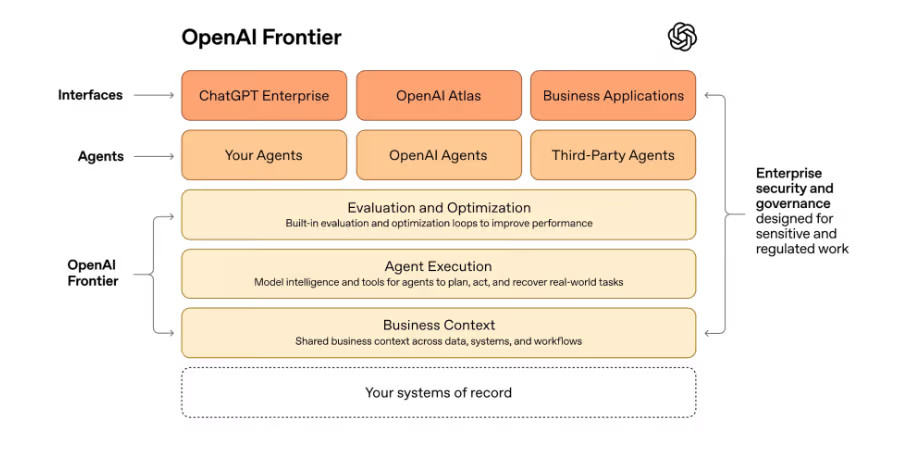
OpenAI said Frontier helps bring context, agent execution, and evaluation into a single platform rather than multiple systems and tools.

OpenAI Frontier flow chart

“Frontier gives agents the same skills people need to succeed at work: shared context, onboarding, hands-on learning with feedback, and clear permissions and boundaries. That’s how teams move beyond isolated use cases to AI co-workers that work across the business,” OpenAI said in a blog post.

Users can connect their data sources, CRM tools, and other internal applications directly to Frontier, effectively creating a semantic layer that normalizes permissions and retrieval logic for agents built on the platform to pull information from. Frontier has an agent executive environment, which can run on local environments, cloud infrastructures, or “OpenAI-hosted runtimes without forcing teams to reinvent how work gets done.”

Built-in evaluation structures, security, and governance dashboards allow teams to monitor agent behavior and performance. These give organizations visibility into their agents’ success rates, accuracy, and latency. OpenAI said Frontier incorporates its enterprise-grade data security layer, including the option for companies to choose where to store their data at rest.

Advertisement

Frontier launched with a small group of initial customers, including HP, Intuit, Oracle, State Farm, Thermo Fisher, and Uber.

Security and governance concerns

Frontier is available only to a select group of customers with wider availability coming soon. Enterprise providers are already weighing what the platform needs to address.

Ellen Boehm, senior vice president for IoT and AI Identity Innovation at Keyfactor, told VentureBeat that companies will still need to focus their agents on security and identity. 

“Agent platforms like OpenAI’s Frontier model are critical for democratizing AI adoption beyond the enterprise,” she said. “This levels the playing field — startups get enterprise-grade capabilities without enterprise-scale infrastructure, which means more innovation and healthier competition across the market. But accessible doesn’t mean you skip the fundamentals.” 

Advertisement

Salesforce AI executive vice president and GM Madhav Thattai, who is overseeing an agent builder and library platform at his company, noted that no matter the platform, enterprises need to focus agents on value.

“What we’re finding is that to build an agent that actually does something at scale that creates real ROI is pretty challenging,” Thattai said. “The true business value for enterprises doesn’t reside in the AI model alone — it’s in the ‘last mile.’”

“That is the software layer that translates raw technology into trusted, autonomous execution. To traverse this last mile, agents must be able to reason through complexity and operate on trusted business data, which is exactly where we are focusing.” 

Source link

Advertisement
Continue Reading
Click to comment

Leave a Reply

Your email address will not be published. Required fields are marked *

Tech

3D Modeling Made Accessible for Blind Programmers

Published

on

Most 3D design software requires visual dragging and rotating—posing a challenge for blind and low-vision users. As a result, a range of hardware design, robotics, coding, and engineering work is inaccessible to interested programmers. A visually-impaired programmer might write great code. But because of the lack of accessible modeling software, the coder can’t model, design, and verify physical and virtual components of their system.

However, new 3D modeling tools are beginning to change this equation. A new prototype program called A11yShape aims to close the gap. There are already code-based tools that let users describe 3D models in text, such as the popular OpenSCAD software. Other recent large-language-model tools generate 3D code from natural-language prompts. But even with these, blind and low-vision programmers still depend on sighted feedback to bridge the gap between their code and its visual output.

Blind and low-vision programmers previously had to rely on a sighted person to visually check every update of a model to describe what changed. But with A11yShape, blind and low-vision programmers can independently create, inspect, and refine 3D models without relying on sighted peers.

A11yShape does this by generating accessible model descriptions, organizing the model into a semantic hierarchy, and ensuring every step works with screen readers.

Advertisement

The project began when Liang He, assistant professor of computer science at the University of Texas at Dallas, spoke with his low-vision classmate who was studying 3D modeling. He saw an opportunity to turn his classmate’s coding strategies, learned in a 3D modeling for blind programmers course at the University of Washington, into a streamlined tool.

“I want to design something useful and practical for the group,” he says. “Not just something I created from my imagination and applied to the group.”

Re-imagining Assistive 3D Design With OpenSCAD

A11yShape assumes the user is running OpenSCAD, the script-based 3D modeling editor. The program adds OpenSCAD features to connect each component of modeling across three application UI panels.

OpenSCAD allows users to create models entirely through typing, eliminating the need for clicking and dragging. Other common graphics-based user interfaces are difficult for blind programmers to navigate.

Advertisement

A11yshape introduces an AI Assistance Panel, where users can submit real-time queries to ChatGPT-4o to validate design decisions and debug existing OpenSCAD scripts.

AllyShape's 3-D modeling web interface, featuring a code editor panel with programming capabilities, an AI assistance panel providing contextual feedback, and a model panel displaying hierarchical structure and rendering of the resulting model. A11yShape’s three panels synchronize code, AI descriptions, and model structure so blind programmers can discover how code changes affect designs independently.Anhong Guo, Liang He, et al.

If a user selects a piece of code or a model component, A11yShape highlights the matching part across all three panels and updates the description, so blind and low-vision users always know what they’re working on.

User Feedback Improved Accessible Interface

The research team recruited 4 participants with a range of visual impairments and programming backgrounds. The team asked the participants to design models using A11yShape and observed their workflows.

One participant, who had never modeled before, said the tool “provided [the blind and low-vision community] with a new perspective on 3D modeling, demonstrating that we can indeed create relatively simple structures.”

Advertisement

Participants also reported that long text descriptions still make it hard to grasp complex shapes, and several said that without eventually touching a physical model or using a tactile display, it was difficult to fully “see” the design in their mind.

To evaluate the accuracy of the AI-generated descriptions, the research team recruited 15 sighted participants. “On a 1–5 scale, the descriptions earned average scores between about 4.1 and 5 for geometric accuracy, clarity, and avoiding hallucinations, suggesting the AI is reliable enough for everyday use.”

A failed all-at-once attempt to construct a 3-D helicopter shows incorrect shapes and placement of elements. In contrast, when the user journey allows for completion of each individual element before moving forward, results significantly improve. A new assistive program for blind and low-vision programmers, A11yShape, assists visually disabled programmers in verifying the design of their models.Source: Anhong Guo, Liang He, et al.

The feedback will help to inform future iterations—which He says could integrate tactile displays, real-time 3D printing, and more concise AI-generated audio descriptions.

Beyond its applications in the professional computer programming community, He noted that A11yShape also lowers the barrier to entry for blind and low-vision computer programming learners.

Advertisement

“People like being able to express themselves in creative ways. . . using technology such as 3D printing to make things for utility or entertainment,” says Stephanie Ludi, director of DiscoverABILITY Lab and professor of the department of computer science and engineering at the University of North Texas. “Persons who are blind and visually impaired share that interest, with A11yShape serving as a model to support accessibility in the maker community.”

The team presented A11yshape in October at the ASSETS conference in Denver.

From Your Site Articles

Related Articles Around the Web

Advertisement

Source link

Continue Reading

Tech

Applications are now open for the 2026 Swift Student Challenge — but hurry

Published

on

Aiming to encourage app development and celebrate the most creative participants, Apple’s Swift Student Challenge is back and the winners will get to visit Apple Park.

Colorful circular Swift logo showing an orange bird silhouette over blue programming code, with a vibrant gradient background of teal, purple, and pink on a light gray backdrop
Apple’s 2026 Swift Student Challenge is open for applications — image credit: Apple

As it has done now every year since 2020, Apple is running a Swift Student Challenge. Applications for the contest to find innovative new app developers are open now and close on February 28, 2026.
Applications are sought from students working with Swift Playground 4.6 or Xcode 26, or later. As well as only around two weeks to apply, there are many eligibility requirements.
Continue Reading on AppleInsider | Discuss on our Forums

Source link

Continue Reading

Tech

Anthropic spent millions on Super Bowl ads to roast OpenAI

Published

on


Everyone knows Super Bowl commercials are expensive, bombastic, and designed to be talked about. What we didn’texpect was an AI startup using the biggest ad stage of the year to throw shade at a rival’s advertising strategy. That’s exactly what Anthropic has done. The company bought Super Bowl airtime to broadcast a simple message: “Ads are coming to AI, but not to Claude.” Its ads depict a chatbot spitting product pitches mid-conversation, ending with a clear contrast to its own ad-free promise. Even ads these days aren’t what they used to be. Video: Can I get a six pack quickly?, uploaded…
This story continues at The Next Web

Source link

Continue Reading

Tech

Patriots vs. Seahawks time, where to watch and more

Published

on

The 2026 Super Bowl between the New England Patriots and the Seattle Seahawks will air on NBC this Sunday, Feb. 8. The game will also stream on Peacock. If you don’t have NBC over the air and don’t subscribe to Peacock, there are still ways to watch Super Bowl LX — and Bad Bunny’s history-making Halftime Show — for free. Here’s how to tune in.

How to watch Super Bowl LX free:

Image for the mini product module

Date: Sunday, Feb. 8

Time: 6:30 p.m. ET

Location: Levi’s Stadium in Santa Clara, Calif.

TV channel: NBC, Telemundo

Advertisement

Streaming: Peacock, DirecTV, NFL+ and more

2026 Super Bowl game channel

Super Bowl LX will air on NBC. A Spanish-language broadcast is available on Telemundo.

How to watch the 2026 Super Bowl for free

You can stream NBC and Telemundo on platforms like DirecTV and Hulu + Live TV; both offer free trials and are among Engadget’s choices for best streaming services for live TV. (Note that Fubo and NBC are currently in the midst of a contract dispute and NBC channels are not available on the platform.)

Image for the small product module

In addition to hosting NBC’s Super Bowl broadcast, DirecTV’s Entertainment tier gets you access to loads of channels where you can tune in to college and pro sports throughout the year, including ESPN, TNT, ACC Network, Big Ten Network, CBS Sports Network, and, depending on where you live, local affiliates for ABC, CBS, Fox and NBC.

Whichever package you choose, you’ll get unlimited Cloud DVR storage and access to ESPN Unlimited.

Advertisement

DirecTV’s Entertainment tier package is $89.99/month. But you can currently try all this out for free for 5 days. If you’re interested in trying out a live-TV streaming service for football, but aren’t ready to commit, we recommend starting with DirecTV.

Image for the mini product module
Image for the small product module

Peacock is the streaming home of the 2026 Super Bowl.

While a regular Peacock subscription begins at $10.99 a month for a Premium Plan and goes up to $16.99 for the ad-free Premium Plus plan, you can get an ad-supported subscription for free if you’re a Walmart+ subscriber. 

Walmart+ members actually get their choice between Paramount+ or Peacock included in their membership at no additional cost. A monthly subscription to Walmart+ costs $12.99, and an annual plan usually costs $98. But you can try the service out totally free. Beyond free Peacock, Walmart+ has additional perks like five free months of Apple Music, discounts on Cinemark movie theater memberships, free shipping and delivery on Walmart purchases, discounts on gas and much more.

Advertisement
Image for the small product module

Instacart+ subscribers are able to get an annual Peacock Premium plan (a $109.99 value) for free. After a free 14-day trial, Instacart+ plans cost $99/year, meaning you’ll save more on Peacock simply by subscribing to the delivery service, but you’ll get tons of extras, like free grocery and restaurant delivery and a free subscription to the New York Times Cooking app.

What time is the 2026 Super Bowl?

The 2026 Super Bowl kicks off at 6:30 p.m. ET/3:30 p.m. PT on Sunday, Feb. 8. Green Day will be performing a pre-game special starting at 6 p.m. ET.

Who is playing in the Super Bowl?

The AFC champions, the New England Patriots, will play the NFC champions, the Seattle Seahawks.

Advertisement

Where is the 2026 Super Bowl being played?

The 2026 Super Bowl will be held at Levi’s Stadium in Santa Clara, Calif., home of the San Francisco 49ers.

Who is performing at the 2026 Super Bowl halftime show?

Bad Bunny is headlining the 2026 Super Bowl halftime performance. You can expect that show to begin after the second quarter, likely between 8-8:30 p.m. ET. Green Day will perform a pre-game show starting at 6 p.m. ET. If you’re tuning in before the game, singer Charlie Puth will perform the National Anthem, Brandi Carlile is scheduled to sing “America the Beautiful,” and Grammy winner Coco Jones will perform “Lift Every Voice and Sing.”

More ways to watch Super Bowl LX

Image for the mini product module

Source link

Continue Reading

Tech

CASO Design HW 770 Turbo Hot Water Dispenser Review

Published

on

Verdict

Hot water delivered at the precise volume and temperature that you want, the CASO Design HW 770 Turbo Hot Water Dispenser is a brilliant alternative to a kettle. It’s a little fiddly to get a full water tank, but that’s a minor complaint about a device that’s cheaper and more convenient than a kettle.


  • Precise flow control

  • Simple to use

  • Heats fast

  • Water tank is fiddly to fill

Key Features

Introduction

Kettles aren’t a particularly efficient way of heating water, as it’s hard to only heat the exact amount of water that you want. Far easier is a product like the CASO Design HW 770 Turbo Hot Water Dispenser, which dispenses the level of water you want at the temperature you want.

This model is simple to use and heats well, but it has only basic water filtration, and the tank is a touch fiddly to fill.

Advertisement

Advertisement

Design and features

  • 5°C temperature increments
  • 50ml volume selection
  • Water filter

Neat looking and slim, the CASO Design HW 770 Turbo Hot Water Dispenser doesn’t take up any more counter space than a regular kettle, so it’s easy to do a like-for-like swap. All you really need is enough space at the back to lift out the 2.7-litre water tank.

Once plugged in, there’s not too much setup. The CASO Design HW 770 Turbo Hot Water Dispenser does need rinsing through with hot and cold water, but that’s a one-time job. 

A universal filter is provided in the box, which needs commissioning by soaking it in water before it can be used. This then drops into the filter holder that splits the 2.7-litre water tank in two.

While the design is easy to use, the way the filter works means that you have to fill the top part of the reservoir first, let water drain through the filter to the bottom, and then top up with tap water. Then, as water is pulled from the tank, the water at the top slowly filters through.

It’s a slightly more laborious process than being able to just fill the entire tank in one go, so you need a bit of planning when refilling. I find that it’s best to keep an eye on the tank, and top up as it gets half-empty or so.

Advertisement

Advertisement

CASO Design HW 770 Turbo Hot Water Dispenser water tankCASO Design HW 770 Turbo Hot Water Dispenser water tank
Image Credit (Trusted Reviews)

With the Milky Plant The Watery, which is much bigger, the entire tank at the back is filled, and then the water is automatically filtered into the jug at the front, providing a larger reservoir, making the machine slightly more convenient to use.

Water filters typically need replacing every four to six weeks, and bulk packs are available for about £5 per filter.

Lastly, don’t forget to adjust the water hardness control. Setting it accurately is essential because it determines when the descale indicator will activate.

On top is a control panel. There are buttons for temperature, which can be set to 0°C for room temperature water, or between 40°C and 100°C in 5°C increments for hot water.

Advertisement
CASO Design HW 770 Turbo Hot Water Dispenser control panelCASO Design HW 770 Turbo Hot Water Dispenser control panel
Image Credit (Trusted Reviews)

Advertisement

There’s a favourites button that you can use to quickly recall a preset, which is handy if you, for example, always have a tea at a set temperature and amount.

There’s also a volume control that you tap to cycle through the options: 50ml to 400ml in 50ml increments.

Hit the Play button when you’re done, and the CASO Design HW 770 Turbo Hot Water Dispenser starts dispensing water: instantly for cold water and with a short delay for hot water, while its thermoblock is heated.

All cups and mugs will fit under the spout, but you’d struggle to get a saucepan under there, so you may want to keep a kettle for cooking, or just boil water directly on a hob.

Advertisement

Performance

  • Precise amounts of water dispensed
  • Heats fast
  • Accurate heating

Putting a measuring jug underneath, I dispensed 200ml of boiling water. There was a short heat-up time before the water started to pour, but the final result was within a few ml of what I’d selected.

Advertisement

I also measured the temperature of the output. Set to 100°C, the final temperature in a warmed mug was 95°C, which is very similar to what I’d get from a regular kettle.

CASO Design HW 770 Turbo Hot Water Dispenser dispensing waterCASO Design HW 770 Turbo Hot Water Dispenser dispensing water
Image Credit (Trusted Reviews)

At full temperature, the CASO Design HW 770 Turbo Hot Water Dispenser drew a maximum of 2400W. However, as it’s only heating the amount of water you want to dispense, and there’s a very low minimum, you’re only ever heating the water you’ll actually use. With a kettle, you’ll often have to boil more water than you want to use.

The filters are designed to remove chlorine and pollutants, prevent bacterial growth and increase the life of the hot water dispenser. Using a Total Dissolved Solids (TDS) meter I found that my tap water gave me a reading of 307ppm; after filtering it was 293ppm.

A more powerful water filter will remove even more, but here the focus is on specific things in the water. And, the final water does taste better than tap water.

Advertisement

Advertisement

Should you buy it?

You want precise amounts of hot water fast

Hot water at the temperature and volume that you want, delivered at the touch of a button makes this cheaper and more convenient than a kettle.

Advertisement

You want better water filtration

Advertisement

There’s just a basic water filter here. If you want more removed from your source water, you’ll want a water heater with a reverse osmosis filter.

Final Thoughts

The CASO Design HW 770 Turbo Hot Water Dispenser provides more temperature control than the slightly cheaper, but otherwise very similar, CASO Design HW 660 Turbo Hot Water. If you regularly have drinks that like specific temperatures, then the HW 770 is well worth buying.

Advertisement

If you’d rather have a kettle, then check out my guide to the best kettles.

How We Test

We test every kettle we review thoroughly over an extended period of time. We use standard tests to compare features properly. We’ll always tell you what we find. We never, ever, accept money to review a product.

Find out more about how we test in our ethics policy.

  • Used as our main kettle for the review period
  • We measure the temperature of the water for different settings
  • We test water purity with a TDS meter for any device that has a filter

FAQs

How long do the CASO Design HW 770 Turbo Hot Water Dispenser’s filters last?

They should last between four and six weeks each.

Advertisement
Can you fill a saucepan from the CASO Design HW 770 Turbo Hot Water Dispenser?

There’s not enough space to get anything other than cups and mugs under the spout.

Advertisement

Test Data

  CASO Design HW 770 Turbo Hot Water Dispenser

Full Specs

  CASO Design HW 770 Turbo Hot Water Dispenser Review
Manufacturer
Size (Dimensions) x x INCHES
Release Date 2021

Advertisement

Source link

Advertisement
Continue Reading

Tech

3D-printed batteries aim to reshape energy storage in small devices

Published

on


Material won a $1.25 million contract from the US Air Force to validate the 3D-printing technology earlier this year. The 18-month project aims to demonstrate how printed, conformable batteries could transform design freedom for defense and aerospace hardware.
Read Entire Article
Source link

Continue Reading

Tech

More Than Half of Child Care Providers Have Gone Hungry, New Report Finds

Published

on

An early childhood center director in Washington re-draws the weekly menu to contend with the rising cost of food. A home-based provider in Arkansas stays up late crunching the budget numbers, stretched thin between food and health insurance. A provider who watches children of her friends, family members and neighbors has a sleepless night worrying about if the growing children have enough to eat.

Discussions have long swirled around children’s food insecurity, most recently peaking with the paused Supplemental Nutrition Assistance Program (SNAP), formerly known as the food stamps program. That program is reinstated, though its requirements are changing by the end of next year.

Now, a new study has found that children’s caretakers, too, are struggling with hunger more than ever.

According to a survey from the RAPID Survey Project at the Stanford Center on Early Childhood, more than half (58 percent) of child care providers surveyed experienced hunger in June 2025 — which is one of the highest percentages the organization has seen since it began collecting data in 2021. Some respondents – including the providers from Washington and Arkansas mentioned previously – shared personal experiences with hunger, such as those mentioned above.

Advertisement

“I think most people think we’re in a very prosperous country and with hunger, there’s something of a mindset around it of abject poverty,” says Philip Fisher, director of the Stanford Center for Early Childhood and founder of the RAPID Project. “But we’re starting to talk about these issues as a canary in the coal mine; there’s signals it’s starting to spread to a much wider swath of population.”

The latest findings are a bump from June 2021 to May 2025, when an average of 44 percent of the surveyed child care providers reported experiencing hunger. The spike, while alarming to Fisher, was not surprising. The cost of groceries is rising, and there have also been cuts to programs that provide food for food banks.

“It’s likely people are seeking free food where it’s available, but that is becoming harder and harder to access,” Fisher says, adding his son, who runs a food bank in rural Washington state, has seen an increased demand.

“Food insecurity” is defined by the U.S. Department of Agriculture as a household’s access to adequate food. The RAPID Project considered a respondent “hungry” if they experienced at least two of the five food insecurity scenarios:

Advertisement
  • If the food you bought went bad, could you not afford to replace it?
  • Can you not afford to eat balanced meals?
  • Did you or other adults in your household ever cut the size of your meal or skip meals because there wasn’t enough money for food? If yes, how often did this happen?
  • Did you ever eat less than you felt you should because there wasn’t enough money for food?
  • Were you ever hungry but didn’t eat because there wasn’t enough money for food?

Poonam Gupta, a research associate at the Urban Institute in the Tax and Income Supports division, says while “hunger” is an immediate condition, the usage of the “food insecurity” label showcases a longer-term issue.

“Even if you’re not currently hungry in the moment while taking the survey, you can still be food insecure,” she says.

The reported food insecurity spanned across all types of child care providers. Fisher said center-based directors had the lowest rates of food insecurity among the group, followed by home-based providers, with center-based teachers and providers of family, friends and neighbor care seeing the highest rates.

“There’s been a ton of reporting on how broken the child care system is and a lot has to do with low wages,” he says. “So it’s not surprising it’s across the board.”

Gupta added early childhood education teachers, and other low-income workers with hourly wages, are in a particularly tough spot because of the instability that comes with weekly schedules.

Advertisement

“A lot of attention is paid in general to the low-income workforce, but folks that have non-traditional or inconsistent hours tend to be at the highest risk,” she says. “There’s a type of instability in not being able to predict when your hours are. And if you’re an early childhood education provider and have children of your own, it’s difficult for you to afford child care and even more difficult to meet the work requirements to get SNAP benefits.” The program requires recipients to work at least 80 hours per month.

Early childhood care providers’ schedules can be particularly volatile, where workers can get sent home if, for example, not enough children are in attendance on a given day.

Hunger is widespread for children and adults, with 1 in 4 households experiencing food insecurity in 2024, according to the Urban Institute. But Fisher and Gupta believe the general public isn’t well aware of hunger among adults. They pointed out that most efforts — both from organizations and in research projects — largely focus on children’s food insecurity.

“I think the images they show perpetuate these ideas that the people who are hungry are in an extreme margin,” Fisher says, rather than the reality that much of the general public is at risk for going without adequate food.

Advertisement

The issue points to an irony at the heart of how child care works in the U.S. Child care costs families more than ever, with Child Care Aware of America finding that parents in most states pay more for child care each month than for rent or mortgages. However, according to the Bureau of Labor Statistics, the average pay for a child care worker is below $12.25 per hour. Child care workers with a college degree get roughly $14.70 per hour.

Gupta estimates that food insecurity, including among early childhood care providers, will get worse. Upcoming changes to SNAP are slated for October 2026 and include an increased age limit and removing exemptions for veterans, those experiencing homelessness and those aging out of the foster care system. According to 2024 data from the Center for the Study of Child Care Employment at the University of California at Berkeley, roughly 43 percent of child care workers receive some form of public assistance, including SNAP and Medicaid.

“If anything, we only expect this to get worse in the coming year because of all the disruptions being made, mainly to the SNAP program,” she says.

Source link

Advertisement
Continue Reading

Tech

Why I Can’t Pretend Teacher Learning Doesn’t Matter Anymore

Published

on

This story was published by a Voices of Change fellow. Learn more about the fellowship here.

I’ve attended my share of professional development sessions as an educator. Too often, I’ve walked away asking the same question: Is this really how we expect teachers to learn?

I still remember one session on trauma-informed teaching held in a school cafeteria. The tables and attached seats were too small for most of us, while the lights hummed overhead. For two and a half hours, the facilitator read from an endless slide deck about the importance of connection and empathy. There was minimal context building, limited discussion and no reflection. By the end, the facilitator smiled and said, “Now you are all trauma-informed teachers!” I think my eyes rolled so far back they almost stayed there.

Sitting and listening to someone talk for 45 to 60 minutes is not learning, let alone two and a half hours. My body knows it before my brain does. I get restless, my mind drifts, I check the time and take a walk to refill my water bottle. In that first hour, disappointment sets in fast.
Minimal conditions for adult learning have become the norm. I used to resent that; now I fear it. Because the longer I sat in those breakout rooms, the quieter I became. My curiosity dulled, the topic’s urgency faded and I started doing what was expected: showing up, signing in and leaving seemingly unchanged. That terrified me. I could feel myself becoming the kind of learner I never wanted my students to be. Even the most dedicated teachers can wilt in the wrong conditions.

Advertisement

And here’s what often goes unspoken: teachers already give so much of their time to these sessions, spending hours after school on professional days and during planning periods. That investment deserves more than compliance-based sessions that leave teachers unchanged or walking away with a checklist of “next steps” that never take root.

After experiences like that, I find myself returning to familiar questions: Why do we accept for ourselves what we would never accept for our students? What if we taught students the way we teach teachers? We’d call it ineffective, parents would complain and administrators would intervene. Yet, the same approach is accepted for teachers’ professional development: lecture-heavy, one-size-fits-all and compliance-driven. I knew better for my students and kept accepting less for myself. That contradiction began to haunt me.

As a high school English teacher, I built lessons around engagement, differentiation and relevance so students could connect learning to their lives. They deserved instruction that met them where they were and balanced support with challenge. When it comes to teaching teachers, we need the same shift — from professional development done to us, to professional learning created by, for and with us.

A Different Way Exists

I remember one of the first times I felt what real professional learning could be. Around 2013, when Edcamp was spreading across schools, my administrators used this format for one of our PD days. These grassroots “unconferences” turned the familiar model upside down. There were no pre-approved presenters or hour-by-hour agendas. Teachers built the schedule on the spot and moved freely between conversations. If one wasn’t helpful, you left and found another. The emphasis was on curiosity and choice.

Advertisement

I led two sessions that day: one on digital tools for learning and another on equitable grading. I didn’t stand in front of the group; I sat in the circle. We tested tools in real time, pried into long-held grading beliefs and argued about what being fair really means in high school grading. What I remember most wasn’t the content but the energy in the room and the buzz of teachers thinking, building, disagreeing and learning together.

It was the first time I realized how much trust professional learning requires: trust in teachers’ intelligence, instincts and creativity. We talk so much about empowering students, but rarely about empowering teachers. Edcamp, brief as it was, made me wonder what would happen if we trusted educators the way we expect them to trust their students.

That lesson deepened through the Rhode Island Writing Project at Rhode Island College, where “teachers teaching teachers” wasn’t a slogan but a practice. During the summer institute, I joined a community of educators from across the state. We wrote together, shared feedback and listened, really listened, to each other’s classroom stories and the complex and messy overlap between personal and professional life.

That summer changed me. I saw what it meant to honor teacher knowledge, and to treat professional learning as a dialogue, not delivery. It ruined me, in the best way. Once you’ve experienced learning that is alive, reciprocal and demanding, it’s hard to sit quietly again while someone reads from slides.

Advertisement

But here’s what I know: those moments were rare. Outliers.

Most professional development since that summer has looked more like paperwork than pedagogy. Neatly packaged, disconnected and efficient to a fault. For many educators, PD is still something that happens to them, not with them. I’ve seen what that does. It breeds cynicism and convinces brilliant teachers that their professional growth is optional, even disposable. Novice and veteran teachers alike found ways to get through or get by during especially disconnected sessions. Not out of defiance, but self-preservation.

As a district administrator, I find myself in a very different position where I receive more structured opportunities for professional learning than I ever did in the classroom. I attend multi-day workshops on leadership frameworks, statewide coaching institutes and even regional conferences focused on instructional design. They’re well-planned, reflective, energizing and respectful of participants’ needs. Nothing like the one-off PowerPoints teachers sit through during the school day or after school.

That contrast is hard to ignore. It reminds me just how uneven our systems can be. The higher up you go, the more development you’re offered; the closer you are to students, the less you get.

Advertisement

I carry that discomfort with me every day. I think about the teachers in sessions I once led or attended who expressed their skepticism and tiredness of being told what to value or what new requirement to add to their already stacked list of classroom responsibilities. My job now is to make sure the professional learning I help design never repeats that pattern — that it respects their time, their expertise and their humanity. I don’t want them to feel the quiet resignation I once did.

This problem runs deeper than any one district or leader. A recent report from the Annenberg Institute at Brown University affirmed Rhode Island’s commitment to investing in professional learning. The report highlights state-level efforts such as expanding instructional coaching, building in common planning time and fostering cross-district collaboration. These are the supports I wish I’d had years ago.

The report also reminded me of what I’ve seen firsthand: resources and structures only work when the design honors teachers’ time and trust.

How We Teach Teachers

How we design professional learning makes visible the value we place on teachers. When PD is treated as a formality, the message is that teacher growth is optional. But when it’s treated as authentic learning, the message is clear: adult learning matters, and investing in teachers is investing in students.

Advertisement

If we want professional learning that serves educators and the students they teach, we must move beyond seat time and toward structures that honor teacher expertise and foster continuous improvement. The elements of strong professional learning aren’t mysteries; they mirror the same principles of good teaching.

A few approaches that work include teacher-led inquiry cycles that invite educators to identify problems of practice and design solutions together; offering choice and voice in sessions that make learning relevant and personalized; building in time for application and reflection; and creating job-embedded opportunities where teachers can learn in context alongside their colleagues and students.

The future of our profession will be defined by what we choose right now and whether we can model the kind of learning we say we want for our students.

Source link

Advertisement
Continue Reading

Tech

Claude Code is the Inflection Point

Published

on

About 4% of all public commits on GitHub are now being authored by Anthropic’s Claude Code, a terminal-native AI coding agent that has quickly become the centerpiece of a broader argument that software engineering is being fundamentally reshaped by AI.

SemiAnalysis, a semiconductor and AI research firm, published a report on Friday projecting that figure will climb past 20% by the end of 2026. Claude Code is a command-line tool that reads codebases, plans multi-step tasks and executes them autonomously. Anthropic’s quarterly revenue additions have overtaken OpenAI’s, according to SemiAnalysis’s internal economic model, and the firm believes Anthropic’s growth is now constrained primarily by available compute.

Accenture has signed on to train 30,000 professionals on Claude, the largest enterprise deployment so far, targeting financial services, life sciences, healthcare and the public sector. On January 12, Anthropic launched Cowork, a desktop-oriented extension of the same agent architecture — four engineers built it in 10 days, and most of the code was written by Claude Code itself.

Source link

Advertisement
Continue Reading

Tech

Week in Review: Most popular stories on GeekWire for the week of Jan. 25, 2026

Published

on

Get caught up on the latest technology and startup news from the past week. Here are the most popular stories on GeekWire for the week of Jan. 25, 2026.

Sign up to receive these updates every Sunday in your inbox by subscribing to our GeekWire Weekly email newsletter.

Most popular stories on GeekWire

Source link

Continue Reading

Trending

Copyright © 2025