Connect with us

Tech

Orchard Audio Starkrimson HT Ultra Takes GaN Class D Into Home Theater With Up to 500W Per Channel

Published

on

Class D amplification has spent the better part of two decades trying to convince audiophiles that small, efficient and cool-running are not synonyms for cheap, sterile and disposable.

We have covered that evolution rather extensively at eCoustics, including the rise of Hypex, Purifi and GaN-based designs that have made some of the old complaints about Class D sound increasingly like arguments over whether CDs can ever replace cassettes.

Orchard Audio has been part of that conversation for years with its Starkrimson amplifiers. Now the New Jersey manufacturer is moving the technology into home theater with the Starkrimson HT Ultra Series, available in three, four and five-channel configurations.

The last part is relevant because this is not our first encounter with Orchard Audio in a theater system. At Capital Audiofest 2025, we heard an SVS 5.2.4 system powered by Orchard amplification and came away impressed by its dynamics, control and value. The HT Ultra simply turns that concept into a purpose-built product rather than an audiophile science project involving a small mountain of separate amplifiers.

Advertisement

Related: Fear And Loathing In Class D Amplifiers: What $130 To $50K Actually Buys

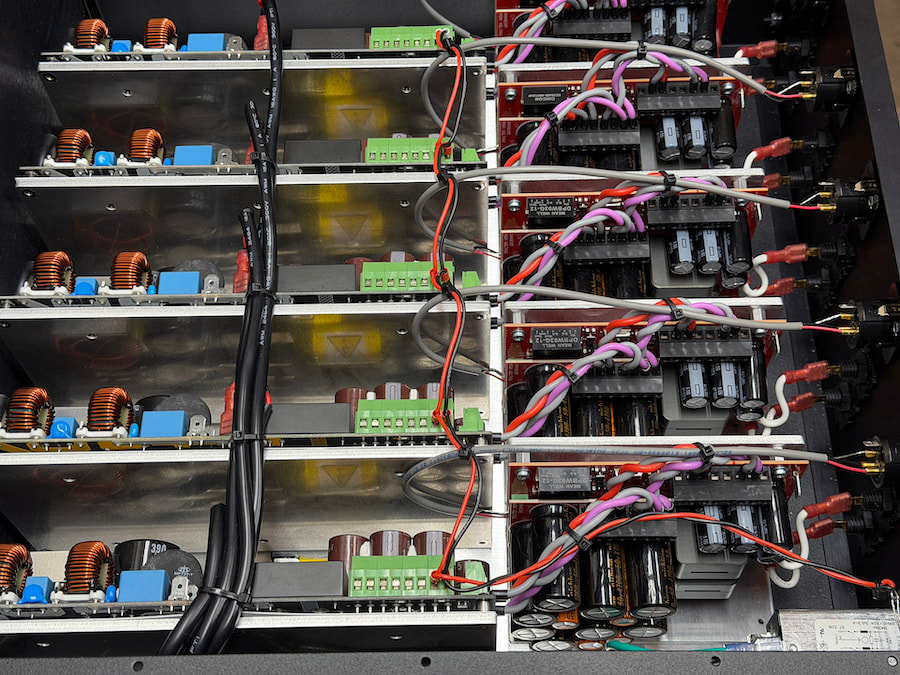
orchard-audio-starkrimson-ht-ultra-inside

What Exactly Is GaN?

GaN stands for gallium nitride, a wide-bandgap semiconductor material used here in place of the silicon MOSFETs found in most Class D amplifiers.

GaN transistors can switch faster with lower switching losses than conventional silicon devices. That does not automatically make every GaN amplifier sound better; circuit topology, feedback, power supply, PCB layout and output filtering still matter enormously, but it gives designers considerably more room to work at higher switching frequencies while controlling heat and efficiency.

Orchard’s Starkrimson Ultra circuitry switches at approximately 800kHz, which the company says is three to four times faster than traditional silicon-based Class D designs. Its modulation is performed entirely in the analog domain, using Orchard founder Leo Ayzenshtat’s proprietary DC-coupled, fully balanced dual-feedback modulator and bridged GaN output stages.

Advertisement

And no, the “D” in Class D still does not mean digital. We have been over this.

The Power Supplies Are the More Interesting Part

The HT Ultra uses Orchard’s Starkrimson Ultra 500W amplifier modules and 1200W power supplies, but buyers can determine how those resources are distributed.

The five-channel model can be configured with one, three or five 1200W supplies. The four-channel version offers one, three or four, while the three-channel model uses one shared supply. Higher-performance configurations add 43,600µF capacitor boards to channels that receive dedicated supplies.

Advertisement. Scroll to continue reading.
Advertisement

That allows someone building a hybrid music/home-theater system, for example, to give the front left and right channels dedicated power supplies and capacitor reserves while the center and surrounds share another supply.

That is considerably more interesting than simply putting five identical amplifier modules in a box and hoping nobody asks what happens when all of them get hungry at once.

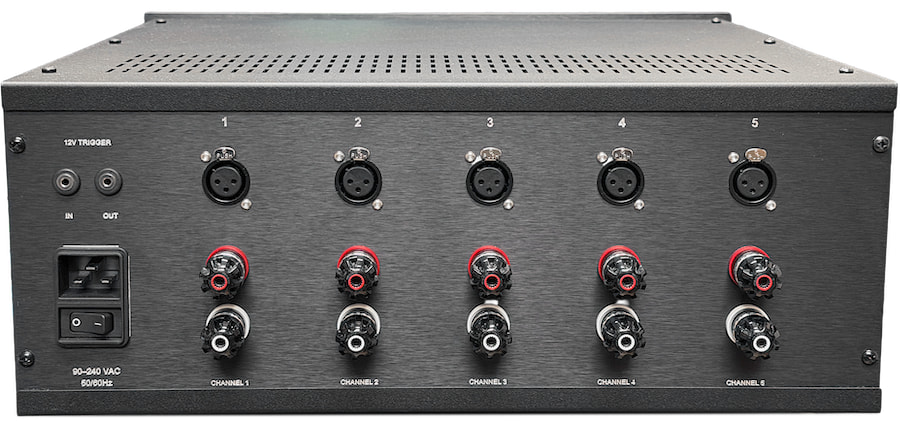
orchard-audio-starkrimson-ht-ultra-rear

Starkrimson HT Ultra Specifications:

  • Channels: 3, 4 or 5
  • Output: 250W into 8 ohms / 500W into 4 ohms*
  • Gain: 19dB
  • Amplifier topology: GaN Class D
  • Switching frequency: approximately 800kHz
  • Signal path: fully balanced
  • Power supplies: 1200W each, configuration dependent
  • Capacitor boards: 43,600µF each on selected configurations
  • Load capability: 2-ohm capable; Orchard specifies stability down to 1 ohm
  • Inputs: Balanced XLR
  • Power-on: Front-panel control or trigger input

*The 250W/500W rating applies when a channel has its own power supply or when two channels share one. That qualification matters rather more than the number printed in 72-point type on an amplifier brochure.

One installation detail also deserves attention. Orchard specifies that the five-channel/five-power-supply configuration requires a 20A circuit in 110/120V countries. Your electrician may therefore become part of the upgrade path.

Price & Availability

The Orchard Audio Starkrimson HT Ultra Series is available for preorder now, with current discounted pricing ranging from $3,199.95 to $6,399.95, depending on configuration. Orchard says the preorder pricing represents 20% off MSRP, with initial shipments expected in December 2026 or January 2027.

Advertisement

The Bottom Line

GaN itself is no longer enough to make an amplifier unusual. What makes the Starkrimson HT Ultra interesting is Orchard Audio taking the same amplifier architecture it developed for serious two-channel systems and allowing home-theater buyers to decide where the expensive power-supply hardware actually goes.

A five-channel amplifier with five independent 1200W supplies is very different from one asking all five channels to drink from the same trough.

Class D already won the argument over whether it belongs in high-end audio. Orchard Audio now wants to know whether your home theater has been paying attention.

For more information: orchardaudio.com

Advertisement

Source link

Continue Reading
Click to comment

You must be logged in to post a comment Login

Leave a Reply

Tech

Veradigm warns of patient data breach after ransomware gang claims attack

Published

on

Veradigm warns of patient data breach after ransomware gang claims attack

Healthcare technology company Veradigm disclosed a data breach after a cybersecurity incident at one of its third-party vendors exposed patients’ personal data.

The company says the incident did not cause operational disruptions but affected a small number of customers.

Formerly known as Allscripts Healthcare Solutions, Veradigm is a Chicago-based healthcare technology company that supplies medical practices with electronic health records, e-prescribing, patient-engagement, practice-management, and revenue-cycle software.

Thousands of hospitals, clinics, and biopharmaceutical firms across the United States use its solutions.

Advertisement

The company says in a filing with the U.S. Securities and Exchange Commission (SEC) that an attacker obtained credentials from a vendor’s environment for a Veradigm API reserved for customer services. The threat actor then used their access to copy patient data.

Veradigm’s disclosure notes that the stolen data includes personal details and Social Security numbers (SSNs) for some of the patients. Clinical or medical information remained safe.

“The vendor’s compromised credentials provided access only through that limited interface and did not provide access to any other part of the Company’s environment, including the Company’s broader network, servers, databases, or other systems,” the company says in the SEC filing.

After discovering the breach, Veradigm initiated its incident-response procedures, notified law enforcement, and is currently investigating to determine the scope.

Advertisement

Affected customers and individuals are being notified, with credit-monitoring services offered where applicable.

The investigation is ongoing, but based on current information, Veradigm does not believe the incident is reasonably likely to materially affect its business, operations, financial condition, or results.

The Gentlemen ransomware claims the attack

Although Veradigm’s disclosure did not identify the attacker, The Gentlemen ransomware group has claimed the intrusion on September 5 and listed the company on its data leak site.

The threat actor alleges to be holding 3.5 million patient records that include full names, home addresses, SSNs, email addresses, phone numbers, and personally identifiable information or guarantors.

Advertisement

The ransomware actor threatens to leak the stolen data by Friday, September 11, if the company doesn’t engage in a ransom payment negotiation.

The Gentlemen
The Gentlemen extortion page
Source: BleepingComputer.com

The Gentlemen threat actor emerged around mid-2025 and operates as a double-extortion group, combining data theft with data encryption on Windows, Linux, NAS, BSD, and ESXi systems.

On its data leak site, the gang listed more than 800 victims from 86 countries and various sectors, including manufacturing, technology, healthcare, transportation, and financial services, indicating opportunistic attacks that rely only on access availability.

In April 2026, Check Point reported that it discovered a SystemBC proxy malware botnet with more than 1,500 hosts and linked it to an affiliate of The Gentlemen ransomware gang.

In June 2026, ESET said that The Gentlemen was employing a new endpoint detection and response (EDR) killer called GentleKiller.

Advertisement

article image

Overall prevention scores can hide what happens after initial access. Once attackers are using valid credentials, prevention drops sharply.

The Blue Report 2026 measures defenses technique by technique across 338 million simulations run in customer production environments.

Get the report

Source link

Continue Reading

Tech

Fake Consumer Group Using AI To Generate Fake Support For Paramount Merger

Published

on

from the phony-business dept

In addition to the $111 billion Paramount/Warner Bros merger just being foundationally bad for creatives, labor, and consumers, the Ellison family-owned company’s executives just keep demonstrating why they’re not really the kind of folks you want dominating the lion’s share of U.S. media.

That’s included calling deal critics “antisemitic,” cozying up to foreign authoritarians, constantly threatening to take Paramount out of California, or, more recently, using a fake consumer group (dubbed the “Neighbors for Strong Communities“) to try and create bogus public support for what’s a pretty broadly unpopular deal.

Neighbors for Strong Communities doesn’t disclose its funding donors and insists it’s not being “directly funded” by Paramount, but it has all the telltale signs of “astroturf,” or fake public interest advocacy. One of the things the group does is generate comments to California AG Rob Bonta urging him to drop the 12-state antitrust lawsuit against the merger. You know… for the children.

Rachel Antell at The Contrarian took a closer look at the Neighbors for Strong Communities website, and tried to fill out a letter to Rob Bonta opposing the merger, only to see something curious happen: The website’s AI-assisted letter system simply changed her writing to not only express support for the merger, but make up an entire fake backstory about her. This is not what she told it:

Advertisement

Antell notes the astroturf group’s letters leverage Influent, an AI vendor founded by a guy named Tanner Kelly, who registered as a California lobbyist last year. Antell herself is an archival producer who founded the Archival Producers Alliance and has crafted guidelines for the use of generative AI aimed at more transparently disclosing when it’s being used.

U.S. corporations have a very long history of flooding regulatory comment proceedings (or the press) with completely artificial support for what’s almost always bad policy few people actually support. You may recall how the telecom industry was caught using fake and dead people to support the Trump administration’s destruction of net neutrality rules and other consumer protections.

This stuff was bad before AI, now everything’s been taken to the next level. There’s no meaningful effort afoot to stop or identify it anywhere in the U.S. government. It exists as an effective way to drum out genuine public interest opinion and replace it with lazy cack that supports whatever shitty policy companies drum up (gaining merger approvals, gutting oversight).

In this case, that means creating fake workers who are super excited about a merger that’s going to result in thousands of layoffs as the bigger company’s executives offload their massive new debt obligations to labor and consumers. How do we know this? It’s what happens literally every time regulators rubber stamp more media consolidation — particularly when Warner Brothers is involved.

Filed Under: ai, antitrust, astroturf, consumers, david ellison, lawsuit, media consolidation, mergers

Companies: neighbors for strong communities, paramount, warner bros.

Advertisement

Source link

Continue Reading

Tech

FLOSS Weekly Episode 881: Eating Its Own Tail

Published

on

This week Jonathan chats with Olivier Vernin of Updatecli, the tool that helps you update everything! Need to roll out dependency updates intelligently? Or even automatically deploy to a server on changes? Updatecli can help!

Did you know you can watch the live recording of the show right on our YouTube Channel? Have someone you’d like us to interview? Let us know, or have the guest contact us! Take a look at the schedule here.

Advertisement

Direct Download in DRM-free MP3.

If you’d rather read along, here’s the transcript for this week’s episode.


Theme music: “Newer Wave” Kevin MacLeod (incompetech.com)

Advertisement

Licensed under Creative Commons: By Attribution 4.0 License

Source link

Advertisement
Continue Reading

Tech

Corsair made a $200 gaming chair and then tested it like it was going into battle

Published

on

Gaming Comfort: Gaming chairs are often one of the most overlooked pieces of furniture in a gaming setup. While luxury “thrones” can be left to customers with truly deep pockets, most gamers should at least consider investing in a somewhat expensive chair to ease the discomfort that comes with long gaming sessions.

Corsair recently launched the TC80 Gaming Chair, a new armchair designed to provide a durable and comfortable seating option for PC-focused gaming setups. The Fremont-based corporation highlights how its new chair has undergone more than 30 durability and safety tests, suggesting that it should accommodate gamers with a wide range of body types.

The TC80 Gaming Chair meets the BIFMA X5.1 and EN 1335 standards for office chairs, Corsair said. The chair underwent a series of demanding durability, stability, and weight-load tests, with Corsair particularly proud of how its new product survived the onslaught.

These tests included dropping a 136kg load onto the center of the seat, applying a 1,001N load to the backrest for 60 seconds, and placing 13 heavy discs against the backrest. Furthermore, the chair survived 100,000 cycles of a 57kg weight falling onto the seat, 60,000 cycles of 400N being applied to each armrest, and 120,000 swivel-test cycles with 122kg placed on the seat at both its maximum and minimum height.

Advertisement

The TC80 Gaming Chair provides a “generously” wide and flat seat with plush padding, breathable fabric upholstery, and 100mm of adjustable seat height. There is even a detachable neck pillow for people who like to alternate between office work sessions and more relaxing activities. The chair’s stability comes from a steel five-star base, 50mm casters, and a Class 4 steel gas lift that should last for years.

Talking about comfort, Corsair’s new chair offers a recline range of 90° to 115°. Users can adjust and lock the chair at their preferred angle, so there is no need to settle for a fixed position straight out of the box.

Corsair is already selling the TC80 Gaming Chair through its own store and other major retailers. The chair costs $200 in the US, while customers in Europe and the UK can get it for €180 and £170, respectively. The company’s official announcement provides a full list of regional launch prices.

Corsair also highlights the TC80 as an entry-level product in its growing lineup of gaming chairs. The company already offers more expensive models, such as the TC100 Relaxed and the premium TC500 Luxe.

Advertisement

The TC500 comes with a €550 price tag in Europe, which is still a relatively affordable purchase compared with some truly expensive chairs, such as the obscenely priced Herman Miller x Logitech Embody. For now, I think I’ll stick with my cheap Songmics gaming chair.

Source link

Advertisement
Continue Reading

Tech

Apple Unveils the iPhone Duo, Its First Foldable iPhone

Published

on

At its September event today, Apple unveiled the iPhone Duo, its first foldable iPhone and one of the biggest changes to the device’s form factor since its debut. Starting at $1,999 and available for preorder beginning October 16th, the device is roughly the size of a passport when closed and pairs a 5.4-inch outer screen with a 7.6-inch Super Retina XDR inner display. Apple says the inner screen offers 50% more display area than the iPhone 18 Pro Max, while the exterior display provides about 90% of the screen area of an iPhone 18 Pro. Apple Pencil support for both displays is coming later this year.

Apple redesigned parts of iOS around the folding form factor. Users can run two apps side by side, launch two instances of the same app, save app pairings, and partially fold the phone to prop it up on a table without a stand. The interface automatically adapts as the device is opened, rotated or folded, while apps including Zoom and Slack are already being redesigned to take advantage of the larger canvas.

There are more than 100 components in its hinge, along with carbon-fiber support plates and a titanium layer beneath the folding display. Apple says the multilayer screen structure allows its components to move relative to one another while folding to reduce distortion over time. The phone is IP68 rated and uses Ceramic Shield on the rear and Ceramic Shield 2 on the exterior display.

As for battery life, Apple claims up to 31 hours of video playback using the inner display or 44 hours on the outer screen, although using both displays equally is rated for up to 24 hours per charge. Fast charging can bring the battery to roughly 50% in 20 minutes, though. The device is eSIM-only worldwide and includes Apple’s new C2 modem, which the company says is up to 50% faster than the C1X while consuming up to 15% less power.

Advertisement

What about the camera system? There’s a 48-megapixel ultrawide, along with cameras on both the inner and outer displays. Because the phone can stand partially folded on its own, Apple is pitching new shooting modes including hands-free 4K Dolby Vision HDR time lapses, dual-camera capture and an outer-screen preview that lets subjects see themselves while being photographed.

Developing…

Read more of this story at Slashdot.

Advertisement

Source link

Continue Reading

Tech

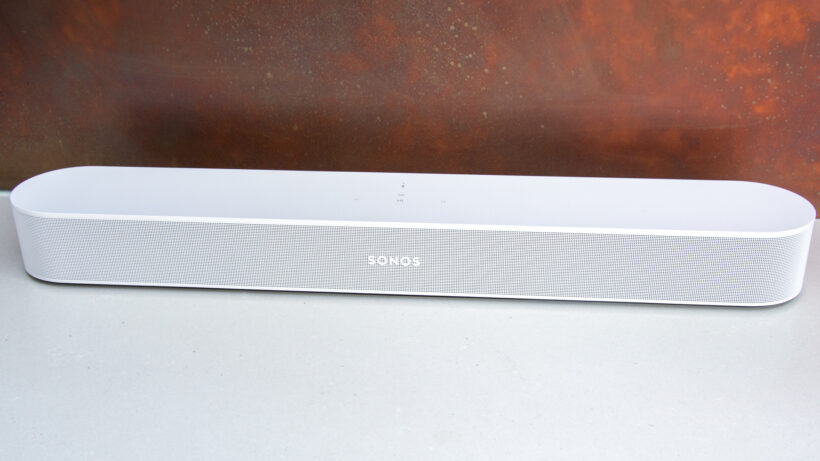
Sonos Beam Ultra vs Beam (Gen 2): Which Sonos soundbar is better for you?

Published

on

Sonos is known for offering some of the best speakers and best soundbars on the market. With that in mind, we’re excited by the recent Beam Ultra launch.

Sonos promises that the Beam Ultra “represents a major step forward in size-defying sound”, but how does it measure up to the Beam (Gen 2)? Is it worth upgrading if you’re sporting the older soundbar?

We’ve compared the specs of the Sonos Beam Ultra to the Beam (Gen 2) and noted the key differences alongside their similarities below. Read on to see what’s new with the Beam Ultra and whether you think it’ll join our best soundbar guide. 

Price and Availability

The Sonos Beam Ultra is currently available for pre-order and will launch alongside the Sonos Ace Ultra at the end of September. The soundbar is available in a choice of two colours (Black and White) and has an RRP of £699.

Advertisement

SQUIRREL_PLAYLIST_10208751

Advertisement

In comparison, the Sonos Beam (Gen 2) also comes in a choice between Black or White, but has a cheaper RRP of £499. Plus as it’s been around for a few years, you can also find the Beam (Gen 2) with a decent price cut too.

SQUIRREL_PLAYLIST_10208752

Advertisement

Sonos Beam Ultra is fitted with nine drivers

While the Sonos Beam (Gen 2) is equipped with a total of five drivers, the Beam Ultra boasts nine drivers. Sonos explains it has added front-facing drivers to make for a “more powerful and dynamic sound in the left, right and centre channels” while the new upward-firing drivers “add height as a third dimension of sound”. 

That’s not to say the Beam (Gen 2) doesn’t sound great. In fact, we concluded that considering its small size, the Beam (Gem 2) sounds “exceptionally good”. Although there are some limitations with its surround sound and bass performance, these can be improved by adding extra Sonos components into the mix. 

Sonos Beam (2nd Gen) heroSonos Beam (2nd Gen) hero
Sonos Beam (Gen 2). Image Credit (Trusted Reviews)

However, that’s where the Sonos Beam Ultra takes the lead, as Sonos explains there’s “no need” to pair separate front speakers with the soundbar as it “generates spacious, precise audio”. With that in mind, the Beam Ultra looks set to be a more complete device than the Beam (Gen 2) – though remember we haven’t reviewed the soundbar ourselves, so we can’t verify this just yet.

Advertisement

Sonos Beam Ultra is designed for mid-sized rooms

Sonos explains that the Beam Ultra is designed for mid-sized living rooms between 23 and 32.5 m2. In comparison, the Beam (Gen 2) is designed for rooms up to 250 square feet, which roughly equates to around 23m2 – putting it towards the smaller scale of the Beam Ultra.

Advertisement

That means if you have a larger living room, then you’ll benefit from the Beam Ultra while smaller rooms do better with the more compact Beam (Gen 2). 

Sonos Beam Ultra private listeningSonos Beam Ultra private listening
Image Credit (Trusted Reviews)

Sonos Beam Ultra creates a 7.1.2 surround sound experience

Thanks to its architecture, the Beam Ultra promises to create a genuine 7.1.2 surround sound experience that’s made up of seven crisp ear-level channels, one deep bass and two height channels. The result, according to Sonos, is a detailed and spacious listening experience that’s made possible with Dolby Atmos support.

However, we should disclaim that Dolby Atmos experiences require Dolby Atmos-encoded content and a compatible HDMI eARC connection. 

The Beam (Gen 2) on the other hand creates a 5.1.2 surround sound and also supports Dolby Atmos content too.

Advertisement

Advertisement

Both weigh the same

Despite their prowess, both the Beam Ultra and Beam (Gen 2) weigh just 2.88kg. Both share a similar design too, however the Beam Ultra is slightly lower and 3.9-inches wider than the Gen 2. Plus, as it now sports upward-firing drivers, the Beam Ultra is equipped with an upper grille too.

Either way, both soundbars can either sit comfortably underneath a TV or can be wall mounted.

Sonos Beam Ultra lifestyleSonos Beam Ultra lifestyle
Sonos Beam Ultra. Image Credit (Sonos)

Early Verdict 

We’ll have to wait until we review the Sonos Beam Ultra to provide a conclusive verdict. However, with the inclusion of upward-firing and front-facing drivers, the Beam Ultra seems like a more complete soundbar that may not require any additional equipment. If you have a larger room and don’t want to splurge on more speakers, then the Sonos Beam Ultra looks like a better option than the Beam (Gen 2).

Having said that, the Beam (Gen 2) is a brilliant and more affordable way to improve your TV’s audio quality – especially if it’s in a smaller room.

Advertisement

Advertisement

Source link

Continue Reading

Tech

Stitching the Future: Technology as a Sacred Trust

Published

on

In an era where artificial intelligence promises to archive human culture at the touch of a button, Indigenous communities face a vital question: Who has the right to own, shape and digitize sacred knowledge? 

Long before AI became a headline in education, this question fundamentally reshaped my work as the instructional technology coordinator at Indian Community School. But understanding how to protect our community’s digital future didn’t start in a computer lab; it began in a quiet valley in Wisconsin, with my grandmother’s unfinished quilt and a ribbon skirt workshop that changed everything I knew about knowledge itself.

I grew up in a small rural village tucked into Wisconsin’s Driftless Area, where winding roads disappear between steep bluffs and deep valleys, and every hill seems to reveal another breathtaking view. It was a place shaped not by glaciers, but by time. A landscape as rugged as it was beautiful. 

It was also home to my grandmother — a strong cheesemaker’s wife who was, in some ways, the quintessential grandmother figure. She hosted Sunday family dinners, baked fresh bread, volunteered at the local food pantry and quilted with the other ladies from church twice a week. She also cursed like a sailor and wasn’t stingy with her love or hugs. 

Advertisement

In my teen years, she became my shelter — a quiet refuge from a chaotic home and a reminder that love exists even in the hardest seasons. When I went away to college, she sent me away with a quilt made just for me, a special gift we all only receive once. As an adult, she became the reason we visited the Driftless Area and was the glue that kept our families together. During that time, she showed that love to my children, who adored her. 

After a long stay in a nursing home and years of declining health, my grandmother passed away last year. After her passing, my twin sister and I discovered her last unfinished quilt tucked away in a forgotten storage bin. Her hands hadn’t been able to hold the material or work the sewing machine for a long time, and we thought all the quilts had been claimed. Finding one more, even unfinished, felt like a blessing. 

Around the same time, my twin sister and I both signed up for a staff ribbon skirt class where members of the Indigenous community would teach us not only how to make ribbon skirts, but also share teachings about how to wear them respectfully and as true allies. Carrying pieces of our grandmother’s unfinished quilt with us, we set out to create ribbon skirts in her honor. 

Before that class, I knew very little about ribbon skirts beyond seeing them worn at school celebrations and community events. I quickly learned they are not tied to a single tribe, but are worn by Indigenous women across many Nations, each with their own traditions, teachings and stories. I also learned that a ribbon skirt is much more than a beautiful piece of clothing. It represents identity, resilience, and the enduring strength of Indigenous women. 

Advertisement

Today, communities across North America celebrate Ribbon Skirt Day each January, recognizing not only the skirts themselves, but the right of Indigenous people to wear them with pride after generations of policies that sought to erase their cultures.

What surprised me most was that our class wasn’t really about making skirts. It was about learning the responsibility that comes with them. We learned when it was appropriate to wear a ribbon skirt, what it meant to wear one as an ally, and why those teachings mattered as much as the sewing itself. Anyone can buy a ribbon skirt online, but creating one alongside community members who generously shared their knowledge transformed it into something entirely different. Every stitch became part of a relationship built on trust, respect and a willingness to learn. 

That experience changed the way I thought about knowledge itself. I realized that some things are valuable not because they can be owned, bought, or preserved, but because they carry stories, relationships and responsibilities that extend far beyond any one individual. They belong to the communities that shaped them and to the generations who will inherit them.

The tension between owning knowledge and stewarding it sits at the very heart of my work as the instructional technology coordinator at Indian Community School. If knowledge is built on trust and community relationships, then technology cannot simply be an instrument to extract, scale, or monetize data. That conviction was tested in 2021, well before generative AI became a household conversation, when a company approached our language and culture department with an extraordinary proposal.

Advertisement

They offered innovation. A way to immortalize language and culture through “virtual ancestors” — artificial intelligence trained on the stories, voices, and wisdom of living tribal elders. As the instructional technology coordinator, I was initially excited about what an extraordinary opportunity it would be to place our school at the forefront of modern technology! 

However, the more my colleagues and I analyzed the pitch, the more our excitement gave way to deep alarm. The offer was riddled with deep red flags: vague promises around intellectual property, zero accountability for data privacy and a predatory push to extract sacred community knowledge. But recognizing those red flags was only half the battle. 

Facing a tool this complex also exposed the gaps in my own understanding of artificial intelligence at the time. I realized that properly vetting this proposal and ensuring our school’s technology program moved forward in a good, grounded way required more than just caution. It demanded that I build my own AI literacy so I could stand as an informed guardian for our community’s data.  

That 2021 proposal became the catalyst for a journey that has defined my work ever since. Recognizing gaps in my own understanding, I immersed myself in AI literacy, digital ethics and Indigenous data sovereignty frameworks. As we start the 2026-27 school year, AI is no longer a distant possibility; it is actively shaping how stories are told, how knowledge is created and how data is harvested. 

Advertisement

In response, my role has evolved from simply managing technology infrastructure to helping our school build an ethical digital sanctuary. We began facilitating professional development sessions that empower our teachers to critically evaluate AI tools through a lens of cultural safety and data privacy. In the classroom, we reaffirmed our dedication to active digital stewardship over passive consumption. 

Rather than allowing third-party algorithms to dictate or summarize Native experiences, our students now engage in hands-on digital storytelling, learning how to protect their personal and cultural data while using modern tools to amplify their authentic voices on their own terms.  

The core lesson I learned in that ribbon skirt class remains my guiding principle: technology, like knowledge, is only as valuable as the relationships and trust behind it. For educators, leaders, and communities navigating this fast-shifting landscape, maintaining agency over our stories requires asking hard questions before we ever sign a contract or adopt a tool:

  • Who owns the data being used to train this system? In my school, we actively reject software platforms that do not explicitly provide full intellectual property rights to the school.

  • Does this tool respect the sovereignty and living culture of the community it serves? I work with stakeholders to ensure that software and platforms do not train on student or staff data, and I prioritize tools with the least environmental impact.

  • Are we adopting technology to enhance human relationships, or replace them? We prioritize tools that bring elders, teachers and students together in real-world dialogue, using technology as a bridge for connection rather than a substitute for human presence.

When my sister and I stitched pieces of our grandmother’s unfinished quilt into our ribbon skirts, we weren’t just preserving her memory; we were continuing a relationship rooted in love, honor and continuity. That is the true essence of stewardship. When we approach technological innovation not as a rush to extract the future, but as a solemn duty to protect what was handed down to us, we ensure that modern tools honor where we came from. In the age of AI, our responsibility remains unchanged: to stitch technology into the living fabric of our communities in a good way, ensuring our stories remain whole, authentic and undeniably our own.

Advertisement

Source link

Continue Reading

Tech

The iPhone 18 Pro gets Apple’s first 2nm chip, bigger batteries, and a surprisingly restrained price

Published

on

It’s that time of year again. At Apple Park’s “Surprise and Shine” event in Cupertino, John Ternus took the stage to unveil two new flagship iPhones: the iPhone 18 Pro and the iPhone 18 Pro Max.

With the standard iPhone 18 not arriving until spring next year, the iPhone 18 Pro is left to cover the smaller end of Apple’s flagship lineup on its own, at least for now. The iPhone 18 Pro Max, meanwhile, is the larger, more battery-forward sibling, and now the most expensive non-folding iPhone Apple sells, unless you’ve got your eye on the new iPhone Duo, Apple’s first foray into foldables.

A familiar silhouette with a few telling changes

Starting with design, both models carry over the same “candy bar” silhouette introduced with last year’s iPhone 17 Pro. That unmistakable camera plateau on the back, the triangular lens arrangement, and the dual-tone glass-and-metal rear panel all return virtually unchanged.

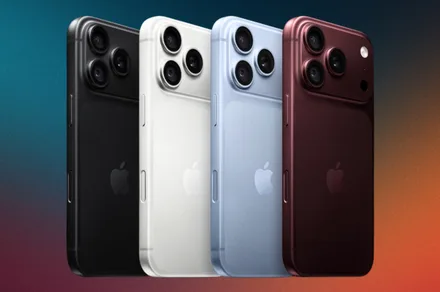
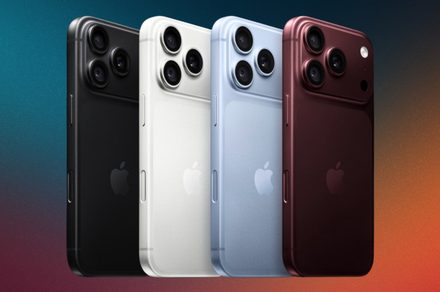
That said, you can still pick the iPhone 18 Pro out of a lineup by its signature new color, a deep burgundy, joining black, silver, and glacier, and by a noticeably smaller Dynamic Island up front. Speaking of which, the Dynamic Island now supports three simultaneous Live Activities instead of two, while still handling Face ID.

Advertisement

Turn your attention to the front of the iPhone 18 Pro models, and you’ll find the same Super Retina XDR ProMotion displays in two familiar sizes — 6.3 inches on the Pro and 6.9 inches on the Pro Max — with peak brightness climbing higher than before.

Under the hood, Apple’s latest flagships run on the new A20 Pro chip. Beyond the expected generational bump, headlined by 50 percent more memory bandwidth and a 7-core GPU that’s up to 40 percent faster than the A19 Pro, the real story is its 2-nanometer process node, Apple’s first.

Samsung may have technically won that race first with the Exynos 2600 earlier this year, but I’d still bet on Apple squeezing out bigger real-world efficiency gains, largely thanks to how tightly its hardware and software are woven together.

Say hello to the A20 Pro
Based on a 2nm process
New super cores. Fastest in any smartphone out there
And a new GPU architecture.
And an updated neural engine, as well. #apple pic.twitter.com/00kJ5jssPq

— Digital Trends (@DigitalTrends) September 9, 2026

Advertisement

A 2nm Chipset, iOS 27, and new camera tech

Alongside a redesigned vapor chamber with three times the surface area of the iPhone 17 Pro’s, the new phones also debut Apple’s in-house C2 modem, delivering meaningfully faster uploads than the outgoing C1X on 15 percent less power, plus mmWave support in the U.S. Out of the box, the iPhone 18 Pro lineup runs iOS 27, ushering in the next chapter of Apple Intelligence, centered on Siri AI, an entirely new version of Siri that’s noticeably more personal, capable, and conversational.

The 48MP Fusion Main sensor now pairs with a genuine physical variable-aperture mechanism, reportedly ranging from f/1.6 to f/4.0. Like a professional camera, this lets you directly control how much light reaches the sensor and how shallow or deep your depth of field looks in a shot, and it’s standard across both the Pro and Pro Max, not exclusive to the bigger model.

Beyond that, the Camera app itself now offers genuine Pro controls, letting you dial in aperture, shutter speed, and white balance manually, plus a live histogram to check exposure, capabilities Android phones have quietly offered for years. Still, arguably the most consequential upgrade this year shows up somewhere far less glamorous: battery life.

Both the iPhone 18 Pro and iPhone 18 Pro Max pack substantially larger batteries than their predecessors, and paired with the efficiency of that new 2nm chipset, Apple rates the eSIM-only models for up to 36 and 45 hours of video playback, respectively, two hours less on versions with a physical SIM tray (via Apple Newsroom). For context, last year’s iPhone 17 Pro and Pro Max topped out at 33 and 39 hours.

Advertisement

Pricing and Availability

Despite months of rumors warning of a $200 to $300 price hike, Apple actually held the pricing line reasonably well this year. The iPhone 18 Pro (256GB) starts at $1,199, while the iPhone 18 Pro Max (256GB) starts at $1,299.

Even accounting for that $100 bump, both Pro models still launch within striking distance of their closest rivals, the Galaxy S26 Ultra and the Pixel 11 Pro XL. In fact, the iPhone 18 Pro Max lands at the exact same starting price as both flagships: $1,299.

Pre-orders open Saturday, September 12, 2026, with the new iPhones officially hitting shelves the following Friday, September 18, across a first wave of more than 65 countries, including India.

Advertisement

Source link

Continue Reading

Tech

US says Chinese firms extracted billions of tokens from frontier AI models

Published

on

US says Chinese firms extracted billions of tokens from frontier AI models

U.S. cybersecurity and intelligence agencies say that six Chinese AI companies conducted industrial-scale distillation attacks on American frontier AI models since at least late 2024.

A joint advisory from CISA, NSA, and the FBI  states that DeepSeek, Moonshot AI, Alibaba, MiniMax, StepFun, and Z.AI extracted billions of tokens through millions of requests from frontier AI models from Anthropic, OpenAI, Google, and xAI.

The agencies assess that the scale and sophistication of the operations indicate Chinese government awareness, mentioning that this approach is likely a core development strategy for the offending firms.

AI model distillation is a legitimate technique in which a “student” model learns from the outputs of a well-trained model, helping researchers and developers reduce training costs and speed up AI deployment.

Advertisement

However, as Google warned in February, distillation attacks can occur outside these companies’ controlled environments, abusing API access to extract the knowledge and logic of powerful models and compete with them at a fraction of the training cost.

CISA’s advisory explains that Chinese firms distribute API requests across fraudulent or shared accounts, APIs, cloud services, aggregators, and “transfer station” proxies to bypass geographic restrictions, usage limits, and detection.

Some of the prompts used attempted to expose restricted chain-of-thought reasoning, while automated systems switched providers and checked whether defenders had degraded the responses.

“Advanced industrial-scale distillation tactics include chain-of-thought (CoT) reasoning extraction, automated failover between pathways during blocking attempts, and sophisticated quality evaluation frameworks to detect defensive countermeasures,” the advisory explains.

Advertisement

“China-based AI companies that conduct industrial-scale distillation against U.S. AI models see significantly shorter AI development timelines and reduced financial expenditures in training a frontier model.”

DeepSeek and MoonShot AI were marked as the top offenders involved in distilling multiple Claude, GPT, Gemini, and Grok models, followed by MiniMax, which targeted Claude, Gemini, and GPT models.

Alibaba and StepFun are accused of targeting Claude and GPT models to improve their products, while Z.AI allegedly targeted GPT-5.5 and Claude Opus 4.8.

The advisory recommends that AI companies improve behavioral and infrastructure-level detection, modify responses when distillation operations are suspected, and share intelligence about these campaigns with all stakeholders.

Advertisement

Potential indicators include new accounts immediately reaching maximum usage, continuous activity without normal human idle periods, shared accounts accessed from numerous IP addresses or user agents, identical prompts across multiple providers, unusually high subscription-to-usage ratios, and coordinated switching between access routes.

BleepingComputer has contacted all six Chinese AI firms for a statement, and we will add their statements if we get them.


article image

Overall prevention scores can hide what happens after initial access. Once attackers are using valid credentials, prevention drops sharply.

The Blue Report 2026 measures defenses technique by technique across 338 million simulations run in customer production environments.

Get the report

Source link

Advertisement
Continue Reading

Tech

John Coltrane’s Ascension Review: Both 1966 Versions Come Together on Verve’s Superb 2LP Vault Edition

Published

on

How would you follow up after making one of the most influential recordings in jazz history? If you were John Coltrane, you would confound all expectations, releasing one of the most challenging, complex pieces of music to date in his career one year after January 1965’s A Love Supreme.

His first “free jazz”-leaning release, February 1966’s Ascension, was far from an unstructured free-for-all, but it inevitably divided audiences. Add in the fact that Coltrane decided he preferred an earlier take, resulting in a remastered repress being rushed to market, and a wonderfully confusing legacy of jazz collecting and listening ensued.

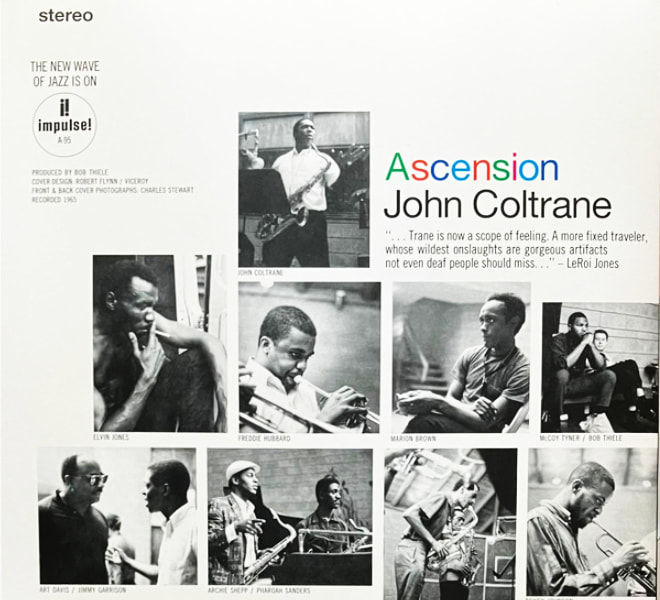
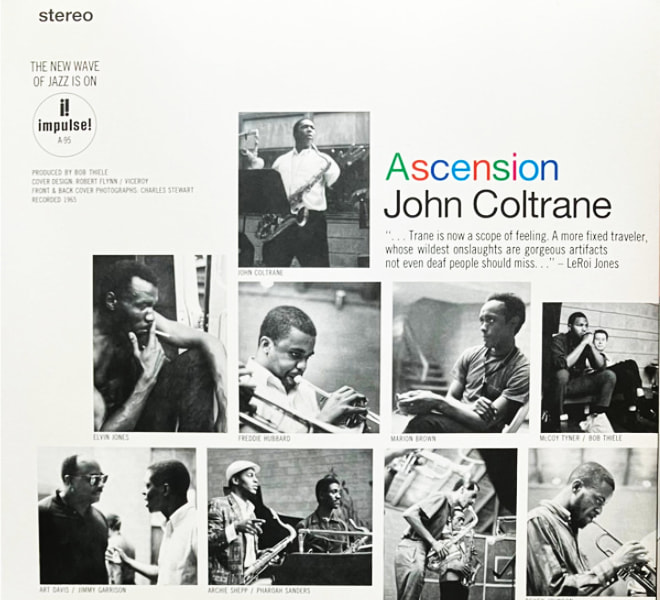
coltrane-ascension-2lp-back-cover

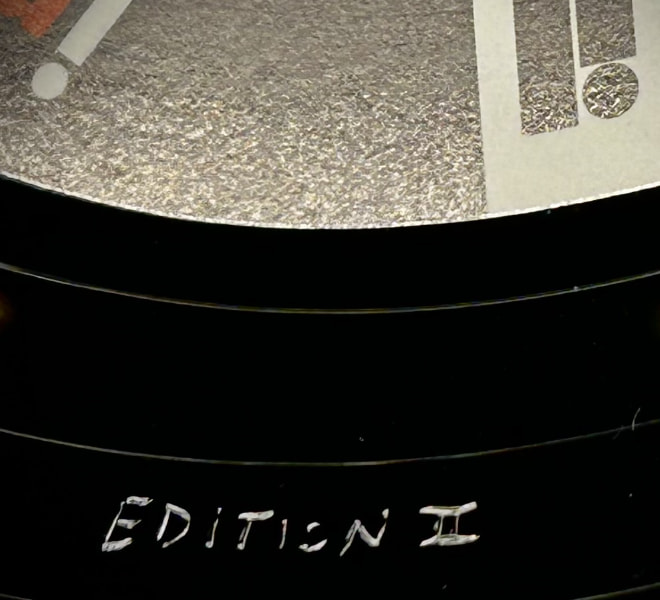
My introduction to the free jazz universe was, in fact, through Ascension (and I thank one of my older brothers for turning me on to it and explaining how to listen to/appreciate it). It wasn’t until years later that I learned of the different versions. Thus far, I only own a very clean 2nd press from that initial rollout (with “Edition II” etched in the deadwax) and a pretty nice monaural pressing of “Edition I” (which has no etching in the deadwax at all!).

If all this sounds confusing, don’t worry: it is! But fortunately, there are fine liner notes by writer (and former professor of music at Rutgers University in Newark, NJ) Lewis Porter in the fine-sounding new 2LP “Verve Vault” edition of Ascension, which explain everything. Apparently, this is the first time both versions are being presented together on vinyl (a complete CD edition was released back in 2000, which I also own).

coltrane-ascension-2lp-cover

This is a good-sounding reissue, arguably better than my originals due to sympathetic remastering and quiet vinyl. It is an almost all-analog production, pressed on 180-gram vinyl at Optimal in Germany from new lacquers cut from original sources by Ryan K. Smith at Sterling Sound. I used the term “almost” intentionally, as we learn from the liner notes that Side 2 of “Edition II” features a new digital reassembly of a key performance moment.

While the packaging features the original album art, it is not the same sort of laminated deluxe sleeve presentation that we’ve become accustomed to from Universal Music’s Acoustic Sounds and Tone Poet reissues. This flat, matte-style cover is nice but crafted in a simpler, more modern aesthetic, which no doubt helps keep costs down.

Advertisement
coltrane-ascension-etching-edition-ii

Do you need this new 2LP edition? If you are a “completist” collector who already owns Editions I and II on original vinyl, the answer is probably yes. If you always wanted both versions on vinyl but have grown weary of trying to find a reasonably priced, good-condition copy (the album doesn’t show up frequently in used stores), this is a perfectly fine reissue, which recreates the original labels (in not quite the right orange color, but that is a nitpick) and even includes an “Edition II” etching in the Disc 2 deadwax.

You can order then new 2LP edition of John Coltrane’s Ascension at Amazon for $37.99.

Our Ratings

★★★★★★★★★★ Music

★★★★★★★★★★ Sound

★★★★★★★★★★ Packaging

Advertisement
Advertisement. Scroll to continue reading.

Where to Buy


Mark Smotroff is a deep music enthusiast / collector who has also worked in entertainment oriented marketing communications for decades supporting the likes of DTS, Sega and many others. He reviews vinyl for Analog Planet and has written for Audiophile Review, Sound+Vision, Mix, EQ, etc.  You can learn more about him at LinkedIn.

Source link

Advertisement
Continue Reading

Trending

Copyright © 2025