

Tech
Paramount Wins Warner Bros Battle, Purim, Qobuz Goes to War on AI, Robert Duvall, and Empire Ears Goes Kaput: Editor’s Round-up


At sundown on Monday, Purim begins; a holiday rooted in survival, marking the Jewish people’s narrow escape from annihilation in ancient Persia. The story, told in the Book of Esther, is not subtle. A Persian court insider, named Haman convinces the king that the Jews must be wiped out. A young queen named Esther risks everything, steps forward, and turns the tide. Hamantaschen for everyone and don’t even think about handing me one that isn’t filled with poppy seed.

Two and a half millennia later, history has a way of sounding uncomfortably familiar.
With hostilities resuming between Israel, the United States, and the Islamic regime in Tehran, the rhetoric stopped being theoretical and the missiles started flying. As Iran’s retaliation unfolded on Sunday, a ballistic missile struck Beit Shemesh, just west of Jerusalem, and in that instant, the war was no longer a headline scrolling past. It was immediate. It was personal. I put the pen down. I stopped writing. I called family. Nine neighbours were murdered in that strike. Politics disappears when your phone starts ringing and you’re counting names.
Believe what you believe about governments and geopolitics. But no people should live under the shadow of missiles or under a regime that exports death. May the Iranian people one day live in freedom and without fear. They deserve better than this nightmare.
And yet here we are, covering Paramount swallowing Warner Bros, Qobuz drawing a line in the sand over AI, Empire Ears going dark, AMC and indie theaters fighting for oxygen. The media and hi-fi worlds keep spinning. Deals get signed. Products launch. CEOs posture. But this week is a reminder that none of it exists in a vacuum. Not the mergers. Not the music. Not the movies. Not us.
Paramount Wins Warner Bros While Netflix Walks

For the past few months, the future of Warner Bros. Discovery was negotiated behind closed doors; over private dinners in Los Angeles, New York, and Washington, with lawyers murmuring, investors hovering, and regulators quietly keeping score. That maneuvering is over. Paramount has secured the company, with the board approving the deal late on February 26, 2026. David Ellison stayed in the fight. Netflix’s CEO chose not to counter within the allotted window rather than ignite a bidding war.
All of it unfolded under the watchful gaze of the Trump administration, where antitrust scrutiny and political leverage made clear that no media empire moves without federal gravity. Paramount won. Netflix stepped aside. Now the real battle for your wallet begins.
Control of Warner Bros. Discovery means control of one of the deepest libraries in modern entertainment — films, franchises, cable networks, news divisions, and streaming platforms that have defined multiple generations. The dollars matter. The regulators matter. The politics matter. But beneath all of that is a larger shift: power in Hollywood is consolidating fast, and the streaming hierarchy is being rewritten in real time.
Now comes the part nobody puts in the press release. HBO Max, TNT, CNN, Warner Bros. Television, DC, and a sprawl of international assets have to be folded into a single operating strategy. Tens of thousands of jobs sit under that umbrella. Overlap will be cut. Billions in costs will be slashed. Paramount has made it clear this must turn profitable quickly and before its own board starts asking hard questions. With more than $110 billion in enterprise value and obligations tied up in this ecosystem, there is no room for sentimental restructuring.
Hollywood is not easing into a new era. It’s being forced into one.
Consolidation at this scale doesn’t lead to kumbaya town halls and better consumer bundles. It leads to layoffs. Platform convergence. Redundancies circled in red ink. Expect overlap to be cut aggressively and quickly. If HBO Max survives as a standalone brand under Paramount’s roof, it will be a minor miracle. The far more likely outcome is a folding into Paramount+, some Frankenstein hybrid pitched as “value.” As for the rest of the television portfolio under the umbrella; TNT, TBS, legacy cable properties, their long-term fate is anything but secure.
And then there’s CNN. That’s the real live wire. Owning CBS News and CNN hands one studio extraordinary influence over the tone, framing, and velocity of national news coverage. That level of concentration will not go unnoticed. CNN’s ratings are soft even on a good week. Its on-air talent is expensive. Very expensive. Does Paramount maintain two separate news divisions? Do they merge them into something unified with a very prominent “C” at the beginning? No one at CNN is sleeping particularly well right now.
It’s difficult to imagine that decision unfolding quietly or without casualties; Bari Weiss has every reason to be smiling right now, knowing that after selling The Free Press to Paramount and stepping into control at CBS News, she now holds the professional fate of many who once lined up to attack her.
The ripple effects extend to theaters. Both Netflix and Paramount made promises during the bidding process about theatrical commitments, windowing strategies, and respect for exhibition. We’ll see. The length of theatrical runs before titles shift to streaming is now a corporate lever, not a creative one. If windows shrink below three weeks, exhibitors, especially chains like AMC are going to feel it fast. Theaters are already operating on thin margins. Compress the window and you accelerate the decline.
Then there’s physical media — the part enthusiasts still care about. As buyers of discs, many of us felt marginally safer with Paramount controlling Warner’s catalog. But let’s not kid ourselves. What was once a multi-billion-dollar category is now a thin, diminished version of itself. Outside of specialty labels like The Criterion Collection, Arrow Video, and Kino Lorber, mainstream studio releases in 2026 are lucky to hit low six figures in unit sales. Low. Six. Figures. For companies the size of Paramount and Warner, that’s a rounding error tolerated, not prioritized.
Talent is the final pressure point. Do we really believe someone like James Gunn who has been openly critical of President Trump — remains comfortably in place at DC when Ellison did not win this fight without political gravity on his side? Maybe. But Hollywood loyalty lasts exactly as long as leverage does. Don’t be shocked if Gunn finds his way back to Marvel or under the Disney umbrella where the corporate alignment is cleaner.
This is what monumental change actually looks like. Jobs will disappear. Platforms will merge. Newsrooms will consolidate. Theatrical windows will compress. Physical media will shrink further into boutique territory. And consumers? They won’t be the primary beneficiaries. Power has concentrated. Now we find out what that concentration costs and don’t expect the bill to be lower than what you’re paying now.
Qobuz Cracks Down on AI Content to Protect Artists
AI music is no longer some nerdy weird science experiment in a lab. It is a content factory running three shifts before its workers head out to Waffle House for eggs, grits, and fisticuffs.
Streaming platforms are getting buried under machine generated tracks. Endless ambient playlists by artists who have never seen a sunrise. Jazz trios that have never boozed it up and fought backstage over a set list. Singer songwriters with flawless pitch and the emotional range of a toaster. Upload by the truckload. Tweak the metadata. Scoop up fractions of a penny at industrial scale.
If that sounds familiar, it should. It is basically the subplot of Office Space. Skim a microscopic amount from each transaction and hope nobody notices until the money adds up. Except this time it is not Initech. And there are no conjugal visits. It is the global music ecosystem. And the people getting screwed over are real musicians trying to pay the rent and afford health insurance. Spotify has been playing whack a mole with this stuff for a while now and they’re not winning. When the system rewards sheer output, you get a flood. Not art. A flood. Quality gets shoved to the curb and the consumer gets stuck listening to garbage they really didn’t want to pay for.
That is the mess Qobuz is stepping into.
Earlier this month Qobuz rolled out its AI Charter, which was easy to applaud and just as easy to ignore. Instead of leaving it as a mission statement, they built a proprietary detection system to scan the catalog and flag music that is one hundred percent AI generated. Not “possibly.” Not “we think so.” Tagged. Labeled. Out in the open. Those identifiers will begin showing up across the apps in the coming months so you actually know what you are listening to.

Qobuz is also tightening the screws on fraud. Impersonation attempts. Streaming patterns that look like they were engineered in a basement server farm in Tehran. The company is expanding its detection tools so if something smells off, it does not get the benefit of the doubt. It gets flagged, refused, or removed. And those fake streams do not count toward royalty reports. Good luck getting Spotify to offer up something like that.
On the editorial side, Qobuz is keeping actual humans in the driver’s seat. Real editors picking Albums of the Week. Real teams building playlists and Qobuzissimes. No content mill dumping twenty thousand tracks into the hopper and hoping the algorithm gets bored enough to promote one. The Discover page will lean on curated data from in-house teams and trusted music labels.
And here is the line that will make certain tech executives roll their eyes. Qobuz says it will not generate audio for its catalog. It will not replace human curation with AI systems and not use customer data to train external AI models. That almost feels like open rebellion against the Emperor.
Why should you care?
Because the money is not theoretical. A 2024 CISAC study projected that by 2028 music creators could lose around ten billion euros over five years due to AI competition and unlicensed use of their work. At the same time, generative AI companies could be pulling in billions annually from that same ecosystem. None of that sounds like a win for the artists who create real music and don’t be surprised when that becomes an even uglier fight for screenwriters, actors, and cinematographers.
The WGA and SAG have already gone on strike to fight against these practices and if you think studios undergoing acquisition and consolidation will continue to spend hundreds of millions on individual films when they can produce 10 for the same price using AI — you’re about to find out that profits matter more than quality.
For artists, this is survival. If machine output floods playlists and crowds out real musicians, visibility collapses and compensation shrinks even further. For listeners, it is about knowing whether the song you love was written by someone with rent due or generated by a prompt and a power bill.
Qobuz Deputy CEO, Georges Fornay explained that “the hyperinflation of AI content is creating distrust across the industry.” He is not wrong. When everything looks and sounds polished, authenticity becomes the differentiator.
Qobuz is betting some of you still care who made the music. In a business chasing endless content like it is oxygen, backing humans is slower and messier. You didn’t sign up for synthetic background noise pretending to be art so it will be interesting to see if the rest of the market follows or bends the knee.
Empire Ears Shuts Down After 10 Years in the High End IEM Market
Empire Ears, a name that meant something in the boutique, high-end IEM world — is gone. After a decade of carving out a reputation for sonic excellence and obsessive craftsmanship, the brand quietly shut its doors on February 27, citing health challenges, rising costs, and an increasingly inhospitable market. For enthusiasts who watched Empire’s cables and custom monitors become fixtures on enthusiast wish lists, this is not a footnote. It’s a sign.
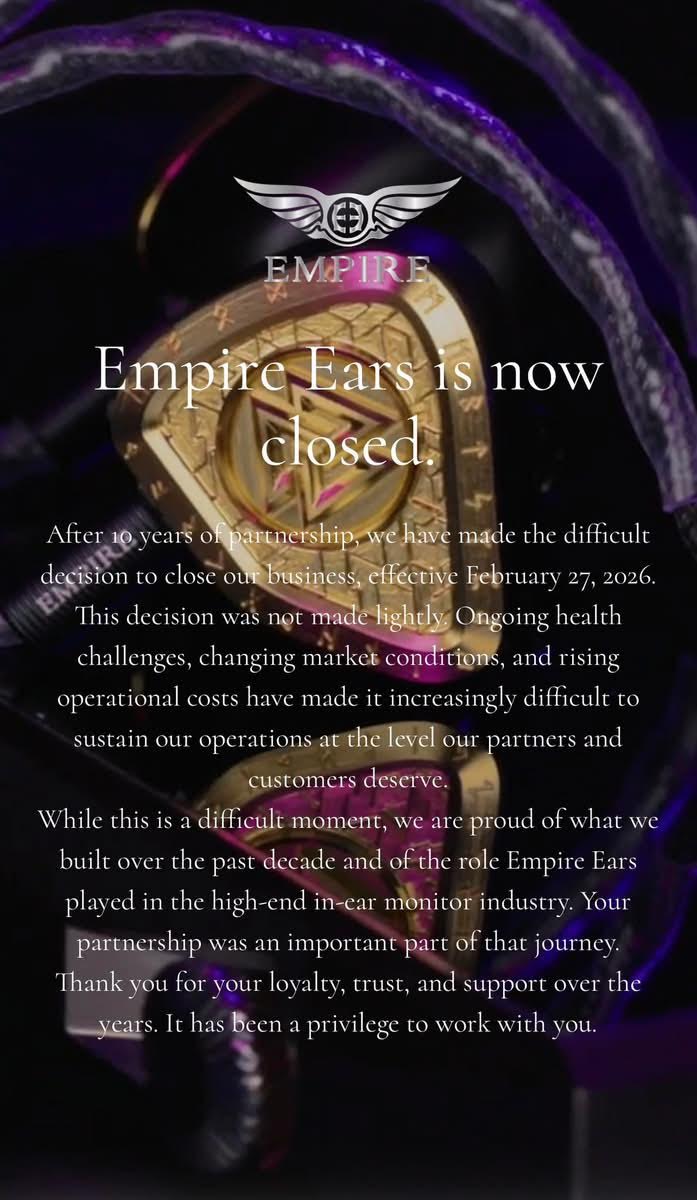
And let’s be honest: not all is well in the high-end wired IEM market.
Brands like FiiO, Campfire Audio, and other smaller Asian boutiques are still shipping products and carving out niches, but Empire’s departure forces a hard question: have we hit saturation with ultra-premium wired IEMs in a world that has moved on to wireless? Four-figure cables and hand-crafted shells feel increasingly like boutique curiosities next to the convenience and everyday usability of wireless. The market that once justified artisanal attention has shrunk, shifted, and in some corners evaporated.
That tension will be on full display this weekend at CanJam NYC 2026, and yes, we will be there covering it. If wired IEMs still have gas in the tank, this is where the next spark of innovation should show up: new driver tech, refreshed tuning philosophies, perhaps unexpected form factors that justify carrying wires in the age of Bluetooth dominance. We already know that one of our favorite European headphone and IEM manufacturers plans to unveil a new $1,000 wired IEM this weekend, and it will be very interesting to see how the market reacts.
But the departure of Empire cannot be ignored. It underscores a larger industry truth that many in audio enthusiast circles are quietly wrestling with: excellence does not guarantee survival. Passion does not pay rent. And even the most covetable products can find themselves adrift when consumer priorities shift faster than product cycles.
Smells Like Victory

Robert Duvall died on February 15 at 95, and with him goes the kind of actor Hollywood does not turn out anymore.
Duvall did not arrive in Hollywood fully formed. He earned it the old way. He started on stage in 1952, grinding through summer stock at the Gateway Playhouse in Bellport on Long Island, taking a year off to serve in the United States Army before returning to the boards. Those early contacts opened the door to television in the 1960s, with appearances on serious dramas like The Defenders, Playhouse 90, and Armstrong Circle Theatre, where actors were expected to act, not pose.
He made his Broadway debut in Wait Until Dark in 1966. More than a decade later, already a film star, he went back to the stage for David Mamet’s American Buffalo in 1977 and earned a Drama Desk nomination. That tells you something. He did not see theater as a stepping stone. It was part of the craft.
His film debut came quietly but memorably as Boo Radley in To Kill a Mockingbird in 1962. No grand speech. Barely any lines. Just presence. Then the run started. Bullitt. True Grit. M*A*S*H. THX 1138. He slipped into supporting roles and made them stick. You might not have walked into the theater for Robert Duvall in those early years, but you walked out remembering him.
Everything changed with The Godfather. Tom Hagen. Quiet consigliere. The man in the room who did not need to raise his voice because he already understood the temperature. It was a supporting role that felt like a lead. Duvall did that a lot. He made space feel heavier. He made silence do the talking.

Apocalypse Now is the obvious landmark. Lieutenant Colonel Kilgore, sunburned and unhinged, delivering lines about napalm with a grin that told you everything about war and madness in a single breath. But go deeper and you see the range that defined him. The Apostle, which he wrote and directed, was raw and fearless. Tender Mercies earned him an Academy Award and showed how much power he could summon by barely moving at all. Lonesome Dove on television turned him into Augustus McCrae, all warmth and steel, reminding Hollywood that the small screen could still carry epic performances if you put the right actor in the saddle.
He was also a better dancer than anyone remembers. Watch him in Tender Mercies or The Apostle. Loose hips. Total commitment. No vanity. He moved like a man who did not care who was watching. He understood rhythm. Not just musical rhythm. Emotional rhythm. Scene rhythm. He could charm you in one beat and terrify you in the next.
Duvall belonged to the old guard. The Clint Eastwood school. The Al Pacino and Gene Hackman generation. Actors who showed up prepared, knew their lines, respected the craft, and did not spend their days refreshing social feeds to see how the discourse was trending. He was not shy about his political views. He did not tailor them for applause. He also did not make them the centerpiece of his career. The work came first.
That is the difference. Today too many performers treat acting like branding. The right cause. The right quote. The right viral moment. Duvall did not need any of that. He was about the scene. About the truth inside it. He could be gentle and disarming. He could be solemn and wounded. And when the role demanded it, he could be cold, manipulative, and downright evil without blinking.
Even late in his career he could walk into a scene and own it. In Thank You for Smoking, he played tobacco tycoon Captain, half mischievous uncle, half corporate warlord, dancing around the moral hypocrisy of Washington with a grin and a glass in hand.
Every film or television project he joined improved simply because he was in it. He raised the standard in the room. Directors trusted him. Co-stars leaned on him. Audiences believed him.
He was not flashy. He was not desperate to be liked. He was a professional in the purest sense of the word. And in an industry that increasingly rewards noise over depth, Robert Duvall felt like something rarer each year. A craftsman. A grown up. A cut above what too often passes for acting today.
We will not see many more like him.
Related Reading:
- Audiophile Excess Runs Wild In Denmark, Qobuz Fixes CarPlay, Wes Montgomery’s Timeless Groove, And The Marantz M1: Editor’s Round-Up
- Culture Wars At The Super Bowl, Meze STRADA’s Curious Tuning, Record Store Day 2026, Hi-Fi Show Overload?: Editor’s Round-Up
- Jazz Dispensary At 10, Integrators In The Keys, Wireless Headphones On The Road, Catherine O’Hara, And Sinners Leading The Pack: Editor’s Round-Up
- Steve Cropper, FiiO Air Link, Wharfedale Diamond 12.3 & Other War Stories — An Editor’s Round-Up From A Hospital Bed


alternative_right shares a report from ScienceAlert: According to a study of 38 adult human brains donated to science, superagers — people who retain exceptional memory as they age — have roughly twice as many immature neurons as their peers who age more typically. Moreover, people with Alzheimer’s disease show a marked reduction in neurogenesis compared to a normal baseline. […]
Led by researchers at the University of Illinois Chicago, the team set out to examine a variety of postmortem hippocampal tissue samples to see if they could identify markers of neurogenesis — and if different groups had any notable differences. The brain samples were donated from five groups: eight healthy young adults, aged between 20 and 40; eight healthy agers, aged between 60 and 93; six superagers, aged between 86 and 100; six individuals with preclinical Alzheimer’s pathology, aged between 80 and 94; and 10 individuals with an Alzheimer’s diagnosis, aged between 70 and 93. The young healthy adult brain tissue was first analyzed to establish the neurogenesis pathways in the adult brain. Then, they analyzed 355,997 individual cell nuclei isolated from the hippocampus, searching for three different stages of cell development: Stem cells, which can develop into neurons; neuroblasts, which are stem cells in the process of that development; and immature neurons, on the verge of functionality. The results were striking.
“Superagers had twice the neurogenesis of the other healthy older adults,” [says neuroscientist Orly Lazarov of the University of Illinois Chicago]. “Something in their brains enables them to maintain a superior memory. I believe hippocampal neurogenesis is the secret ingredient, and the data support that.” That’s an interesting result on its own, but the data from the individuals with preclinical Alzheimer’s pathology and Alzheimer’s diagnoses is where the real meat of the study sits. In the preclinical group, subtle molecular changes hinted that the system supporting new neuron growth was beginning to falter. In the Alzheimer’s group, a clear drop in immature neurons was evident. A genetic analysis of the nuclei also showed that superager neural cells have increased gene activity linked to stronger synaptic connections, greater plasticity, and brain-derived neurotrophic factor, a critical protein for neural survival, growth, and maintenance. Taken together, these three things can be interpreted as resilience. The research has been published in the journal Nature.

Joe Gebbia, cofounder of Airbnb and the US chief design officer appointed by President Trump, was spotted in San Francisco today using a mysterious metallic device. In a social media post on X viewed more than 500,000 times, a man who looks like Gebbia sits with an espresso at a coffee shop. He’s wearing metallic buds that bisect his ears, with a matching clamshell-shaped disc in front of him on the counter.
After the video was posted Monday morning, social media users were quick to suggest that this could be some kind of prototype from OpenAI’s upcoming line of hardware devices designed in partnership with famed Apple designer Jony Ive. An OpenAI spokesperson declined to comment on the potential Gebbia video after WIRED reached out. Gebbia also did not respond to a request for comment.
The device Gebbia appears to be wearing looks quite similar to the hardware seen in a fake OpenAI ad that was widely circulated on Reddit and social media in February. That video seemingly showed Pillion actor Alexander Skarsgård interacting with an AI device that had a similar-looking pair of earbuds and a circular disc. At the time, OpenAI denounced the widely seen video as not real. “Fake news,” wrote OpenAI President Greg Brockman at the time, responding to a social media post.
The earbuds seen in the video of Gebbia on Monday also look quite similar in shape to the Huawei FreeClip 2, a pair of open earbuds released earlier this year. However, the clamshell seen on the coffee counter next to Gebbia is different from Huawei’s most recent headphone case. It would also be quite surprising if a government official were seen using Huawei tech, considering the Chinese company is effectively banned from selling its phones in the US due to security concerns.
WIRED’s audio experts say he’s most likely wearing open earbuds, as Gebbia’s pair share some similarities with Soundcore’s AeroClips or Sony’s LinkBuds Clip, though the cases for those buds don’t match what’s on the table in front of Gebbia. WIRED also ran the photo and video through software that attempts to identify AI-generated outputs and other deepfakes. The detection software, from a company called Hive, says the odds are low that this imagery of Gebbia was generated by AI. Still, AI detectors are not always reliable and can include false outputs. It’s possible that the entire post could be a synthetic hoax.
Could this be some kind of soft launch teaser for OpenAI’s hardware? The timing of this trickle-out would make sense, since the company may ship devices to consumers sometime early in 2027. Still, OpenAI denied any involvement with the previous pseudo-ad for the metallic AI hardware, with its shiny earbuds and matching disc.
Tech
Alibaba’s small, open source Qwen3.5-9B beats OpenAI’s gpt-oss-120B and can run on standard laptops
Despite political turmoil in the U.S. AI sector, in China, the AI advances are continuing apace without a hitch.
Earlier today, e-commerce giant Alibaba’s Qwen Team of AI researchers, focused primarily on developing and releasing to the world a growing family of powerful and capable Qwen open source language and multimodal AI models, unveiled its newest batch, the Qwen3.5 Small Model Series, which consists of:
-
Qwen3.5-0.8B & 2B: Two models, both ptimized for “tiny” and “fast” performance, intended for prototyping and deployment on edge devices where battery life is paramount.
-
Qwen3.5-4B: A strong multimodal base for lightweight agents, natively supporting a 262,144 token context window.
-
Qwen3.5-9B a compact reasoning model that outperforms the 13.5x larger U.S. rival OpenAI’s open soruce gpt-oss-120B on key third-party benchmarks including multilingual knowledge and graduate-level reasoning
To put this into perspective, these models are on the order of the smallest general purpose models lately shipped by any lab around the world, comparable more to MIT offshoot LiquidAI’s LFM2 series, which also have several hundred million or billion parameters, than the estimated trillion parameters (model settings) reportedly used for the flagship models from OpenAI, Anthropic, and Google’s Gemini series.
The weights for the models are available right now globally under Apache 2.0 licenses — perfect for enterprise and commercial use, including customization as needed — on Hugging Face and ModelScope.
The technology: hybrid efficiency and native multimodality
The technical foundation of the Qwen3.5 small series is a departure from standard Transformer architectures. Alibaba has moved toward an Efficient Hybrid Architecture that combines Gated Delta Networks (a form of linear attention) with sparse Mixture-of-Experts (MoE).
This hybrid approach addresses the “memory wall” that typically limits small models; by using Gated Delta Networks, the models achieve higher throughput and significantly lower latency during inference.
Furthermore, these models are natively multimodal. Unlike previous generations that “bolted on” a vision encoder to a text model, Qwen3.5 was trained using early fusion on multimodal tokens. This allows the 4B and 9B models to exhibit a level of visual understanding—such as reading UI elements or counting objects in a video—that previously required models ten times their size.
Benchmarking the “small” series: performance that defies scale
Newly released benchmark data illustrates just how aggressively these compact models are competing with—and often exceeding—much larger industry standards. The Qwen3.5-9B and Qwen3.5-4B variants demonstrate a cross-generational leap in efficiency, particularly in multimodal and reasoning tasks.

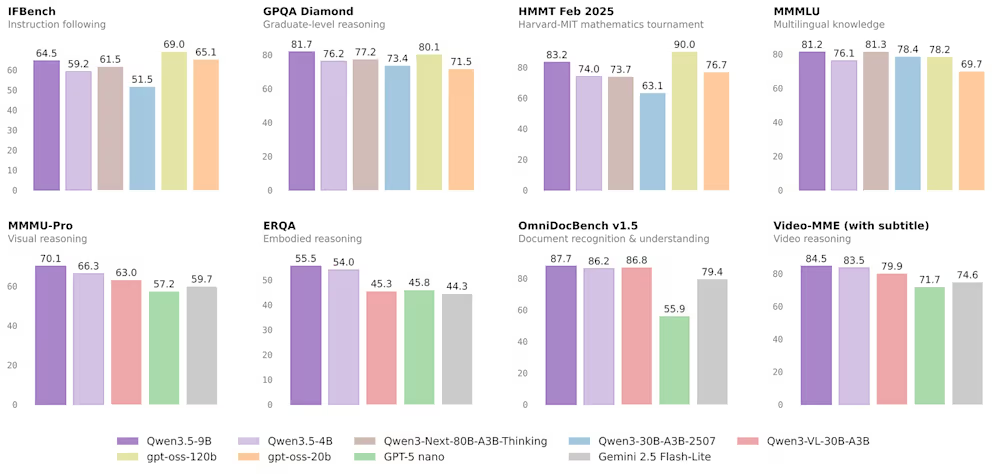
Multimodal dominance: In the MMMU-Pro visual reasoning benchmark, Qwen3.5-9B achieved a score of 70.1, outperforming Gemini 2.5 Flash-Lite (59.7) and even the specialized Qwen3-VL-30B-A3B (63.0).
Graduate-level reasoning: On the GPQA Diamond benchmark, the 9B model reached a score of 81.7, surpassing gpt-oss-120b (80.1), a model with over ten times its parameter count.
Video understanding: The series shows elite performance in video reasoning. On the Video-MME (with subtitles) benchmark, Qwen3.5-9B scored 84.5 and the 4B scored 83.5, significantly leading over Gemini 2.5 Flash-Lite (74.6).
Mathematical prowess: In the HMMT Feb 2025 (Harvard-MIT mathematics tournament) evaluation, the 9B model scored 83.2, while the 4B variant scored 74.0, proving that high-level STEM reasoning no longer requires massive compute clusters.
Document and multilingual knowledge: The 9B variant leads the pack in document recognition on OmniDocBench v1.5 with a score of 87.7. Meanwhile, it maintains a top-tier multilingual presence on MMMLU with a score of 81.2, outperforming gpt-oss-120b (78.2).
Community reactions: “more intelligence, less compute”
Coming on the heels of last week’s release of an already pretty small, powerful open source Qwen3.5-Medium capable of running on a single GPU, the announcement of the Qwen3.5-Small Models Series and their even smaller footprint and processing requirements sparked immediate interest among developers focused on “local-first” AI.
“More intelligence, less compute” resonated with users seeking alternatives to cloud-based models.
AI and tech educator Paul Couvert of Blueshell AI captured the industry’s shock regarding this efficiency leap.
“How is this even possible?!” Couvert wrote on X. “Qwen has released 4 new models and the 4B version is almost as capable as the previous 80B A3B one. And the 9B is as good as GPT OSS 120b while being 13x smaller!”
Couvert’s analysis highlights the practical implications of these architectural gains:
-
“They can run on any laptop”
-
“0.8B and 2B for your phone”
-
“Offline and open source”
As developer Karan Kendre of Kargul Studio put it: “these models [can run] locally on my M1 MacBook Air for free.”
This sentiment of “amazing” accessibility is echoed across the developer ecosystem. One user noted that a 4B model serving as a “strong multimodal base” is a “game changer for mobile devs” who need screen-reading capabilities without high CPU overhead.
Indeed, Hugging Face developer Xenova noted that the new Qwen3.5 Small Model series can even run directly in a user’s web browser and perform such sophisticated and previously higher-compute demanding operations like video analysis.
Researchers also praised the release of Base models alongside the Instruct versions, noting that it provides essential support for “real-world industrial innovation.”
The release of Base models is particularly valued by enterprise and research teams because it provides a “blank slate” that hasn’t been biased by a specific set of RLHF (Reinforcement Learning from Human Feedback) or SFT (Supervised Fine-Tuning) data, which can often lead to “refusals” or specific conversational styles that are difficult to undo.
Now, with the Base models, those interested in customizing the model to fit specific tasks and purposes an easier starting point, as they can now apply their own instruction tuning and post-training without having to strip away Alibaba’s.
Licensing: a win for the open ecosystem
Alibaba has released the weights and configuration files for the Qwen3.5 series under the Apache 2.0 license. This permissive license allows for commercial use, modification, and distribution without royalty payments, removing the “vendor lock-in” associated with proprietary APIs.
-
Commercial use: Developers can integrate models into commercial products royalty-free.
-
Modification: Teams can fine-tune (SFT) or apply RLHF to create specialized versions.
-
Distribution: Models can be redistributed in local-first AI applications like Ollama.
Contextualizing the news: why small matters so much right now
The release of the Qwen3.5 Small Series arrives at a moment of “Agentic Realignment.” We have moved past simple chatbots; the goal now is autonomy. An autonomous agent must “think” (reason), “see” (multimodality), and “act” (tool use). While doing this with trillion-parameter models is prohibitively expensive, a local Qwen3.5-9B can perform these loops for a fraction of the cost.
By scaling Reinforcement Learning (RL) across million-agent environments, Alibaba has endowed these small models with “human-aligned judgment,” allowing them to handle multi-step objectives like organizing a desktop or reverse-engineering gameplay footage into code. Whether it is a 0.8B model running on a smartphone or a 9B model powering a coding terminal, the Qwen3.5 series is effectively democratizing the “agentic era.”
The Qwen3.5 series shift from “chatbits” to “native multimodal agents” transforms how enterprises can distribute intelligence. By moving sophisticated reasoning to the “edge”—individual devices and local servers—organizations can automate tasks that previously required expensive cloud APIs or high-latency processing.
Strategic enterprise applications and considerations
The 0.8B to 9B models are re-engineered for efficiency, utilizing a hybrid architecture that activations only the necessary parts of the network for each task.
-
Visual Workflow Automation: Using “pixel-level grounding,” these models can navigate desktop or mobile UIs, fill out forms, and organize files based on natural language instructions.
-
Complex Document Parsing: With scores exceeding 90% on document understanding benchmarks, they can replace separate OCR and layout parsing pipelines to extract structured data from diverse forms and charts.
-
Autonomous Coding & Refactoring: Enterprises can feed entire repositories (up to 400,000 lines of code) into the 1M context window for production-ready refactors or automated debugging.
-
Real-Time Edge Analysis: The 0.8B and 2B models are designed for mobile devices, enabling offline video summarization (up to 60 seconds at 8 FPS) and spatial reasoning without taxing battery life.
The table below outlines which enterprise functions stand to gain the most from local, small-model deployment.
|
Function |
Primary Benefit |
Key Use Case |
|
Software Engineering |
Local Code Intelligence |
Repository-wide refactoring and terminal-based agentic coding. |
|
Operations & IT |
Secure Automation |
Automating multi-step system settings and file management tasks locally. |
|
Product & UX |
Edge Interaction |
Integrating native multimodal reasoning directly into mobile/desktop apps. |
|
Data & Analytics |
Efficient Extraction |
High-fidelity OCR and structured data extraction from complex visual reports. |
While these models are highly capable, their small scale and “agentic” nature introduce specific operational “flags” that teams must monitor.
-
The Hallucination Cascade: In multi-step “agentic” workflows, a small error in an early step can lead to a “cascade” of failures where the agent pursues an incorrect or nonsensical plan.
-
Debugging vs. Greenfield Coding: While these models excel at writing new “greenfield” code, they can struggle with debugging or modifying existing, complex legacy systems.
-
Memory and VRAM Demands: Even “small” models (like the 9B) require significant VRAM for high-throughput inference; the “memory footprint” remains high because the total parameter count still occupies GPU space.
-
Regulatory & Data Residency: Using models from a China-based provider may raise data residency questions in certain jurisdictions, though the Apache 2.0 open-weight version allows for hosting on “sovereign” local clouds.
Enterprises should prioritize “verifiable” tasks—such as coding, math, or instruction following—where the output can be automatically checked against predefined rules to prevent “reward hacking” or silent failures.
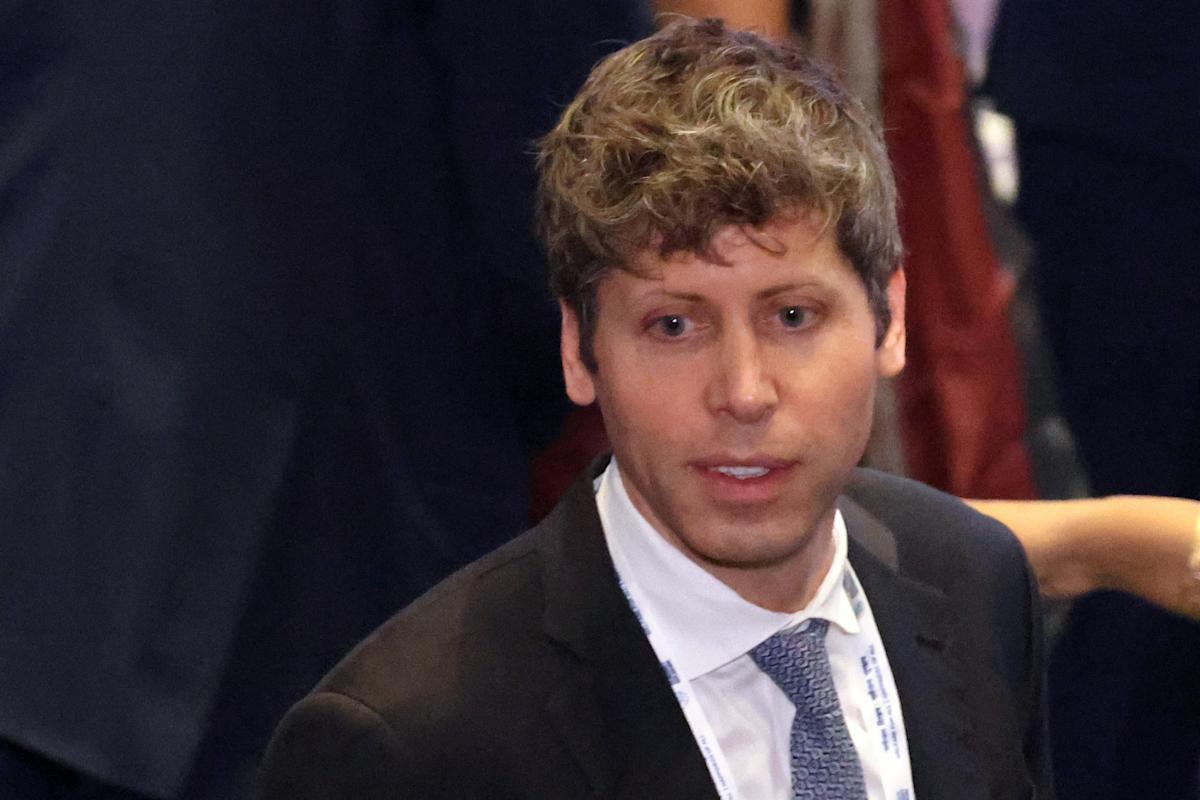
OpenAI’s Sam Altman said the company will amend its deal with the Defense Department (or the Department of War) to explicitly prohibit the use of its AI system on mass surveillance against Americans. Altman has published an internal memo previously sent to employees on X, telling them that the company will tweak the agreement to add language to make that point especially clear. Specifically, it says:
“Consistent with applicable laws, including the Fourth Amendment to the United States Constitution, National Security Act of 1947, FISA Act of 1978, the AI system shall not be intentionally used for domestic surveillance of U.S. persons and nationals.
For the avoidance of doubt, the Department understands this limitation to prohibit deliberate tracking, surveillance, or monitoring of U.S. persons or nationals, including through the procurement or use of commercially acquired personal or identifiable information.”
Altman has also claimed in the memo that the agency affirmed that its services will not be used by its intelligence agencies, including the NSA, without a modification to their contract. He added that if he received what he believed was an unconstitutional order, he would rather go to jail than follow it.
In addition, the OpenAI CEO has admitted in the memo that the company shouldn’t have rushed to get the deal out on Friday, February 27, since the issues were “super complex and demand clear communication.” Altman explained that the company was “trying to de-escalate things and avoid a much worse outcome” but it “looked opportunistic” in the end. If you’ll recall, OpenAI announced the partnership shortly after President Trump ordered all US government agencies to stop using Claude and any other Anthropic services. To note, Anthropic started working with the US government in 2024.
The Defense Department and Secretary Pete Hegseth had been pressuring Anthropic with to remove its AI’s guardrails so that it can be used for all “lawful” purposes. Those include mass surveillance and the development of fully autonomous weapons. Anthropic refused to bow down to Hegseth’s demands and in a statement said that “no amount of intimidation or punishment” will change its “position on mass domestic surveillance or fully autonomous weapons.” Trump issued the order as a result. The Defense Department had also taken the first steps to designate Anthropic as a “supply chain risk,” which is typically reserved for Chinese companies believed to be working with their country’s government.
Altman said that in his conversations with US officials, he reiterated that Anthropic shouldn’t be designated as a supply chain risk and that he hoped the Defense Department would offer it the same deal OpenAI agreed to. In an AMA session on X over the weekend, Altman clarified that he didn’t know the details of Anthropic’s agreement and how it differed from the one OpenAI signed. But if it had been the same, he thought Anthropic should have agreed to it.
After the news broke out about OpenAI’s deal, Anthropic climbed its way to the number one spot of the App Store’s Top Free Apps leaderboard, beating out both ChatGPT and Google Gemini. Anthropic, capitalizing on Claude’s sudden popularity, launched a memory import tool to make switching to its chatbot from another company’s easier. Meanwhile, uninstalls for ChatGPT’s jumped by 295 percent day-over-day, according to Sensor Tower.

L.L. Bean is infamous for its outdoorsy appeal, ranging from outerwear and supplies to withstand the elements to laid-back lifestyle products. The company was established in 1912 by Leon Leonwood Bean in Maine. It remains headquartered there today, continually rolling out revered classics and updated essentials for today’s nature lovers. Take the Bean Boots: what started as L.L. Bean’s premier product ultimately helped shape the brand into what it is today. This definitive shoe, which can be worn on hiking trails and rain-slicked city streets alike, has remained true to the original version. If you’ve ever wanted to capture the essence of being a rugged Mainer or recreate a cozy cabin at home, here are plenty of L.L. Bean promo code options at your fingertips.
Get 10% Off Your First Order With an L.L.Bean Promo Code
You may bemoan email updates, but in terms of sales, this L.L. Bean coupon is a pretty low lift. Sign up for email updates from the company, and you get 10% off your first order. This offer is valid only once per email address, so choose your purchase wisely.
Take Up to 75% Off Outdoor Gear in the L.L.Bean Sale Section
Sales mean stocking up, especially on outdoor equipment and camping supplies ahead of your next adventure. Whether you’re about to take up fishing and need supplies, or have Noah Kahan concert tickets in sight and want extras from his L.L. Bean collaboration collection for the event, all of that is available to you. You can save 75% off these L.L. Bean sale items, no promo code needed.
This is a different sort of two-for-one special: twice a day, L.L. Bean posts new sales at 6 AM and 2 PM sharp, Eastern time. While the two-a-day daily markdown is not super expansive in terms of inventory up for grabs, what is posted for sale usually comes at a heavily discounted price akin to deals you’d see on Black Friday.
This L.L. Bean sale is like an online treasure hunt. The daily markdown sale involves a new deal posted daily from 6 AM to midnight Eastern time. Inventory leans toward gear, such as backpacks, blankets, and shoes.
Score Free Shipping on Orders Over $75
We’ve all abandoned our online shopping carts at one point or another once we saw how much shipping was going to cost. Shipping usually costs $8 for a standard L.L. Bean order—that is, if you are under $75. If you hit that threshold or more, you immediately score free shipping on your order.
Military, First Responders, Medical Workers, and Students Can Save an Additional 10%
Being in the medical field or a first responder can often be a tough, thankless job. But, there’s a special L.L. Bean sale for medical workers and first responders so that you can stock up on supplies for when you rest and recharge in your down time. Use the L.L. Bean first responder discount for 10% off—be sure to verify your license status through SheerID.
L.L. Bean military discount offers 10% for military personnel, current or former. This discount also applies to family members—if you or a family member would like to partake, verify your status via SheerID.
Teachers deserve their (wild)flowers. To make sure you have what you need for your next outdoor adventure and say thanks, you can get 10% off with the special L.L. Bean teacher discount. College students, there’s also the L.L. Bean student discount where you 10% off, too. To redeem either of these discounts, make sure to verify your teaching or student (or both!) status via SheerID.
Earn 20% Off With the L.L.Bean Mastercard
If you’re hunting for a potential credit card candidate, and already are an avid L.L. Bean fan, this is the opportunity for you. You can earn 20% off once approved for an L.L. Bean Mastercard, along with free shipping on all orders when you use it—no minimum purchase necessary.


Intuit has lost around a third of its market cap since the beginning of the year. It’s not alone. Many established SaaS players have seen their stock prices fall in recent months, including Adobe and IBM — the latter experiencing its most significant one-day drop (roughly $40 billion) with Anthropic’s announcement that Claude could now read, analyze and translate legacy COBOL into modern languages like Java and Python. The market has a name for it: the SaaSpocalypse.
The argument from investors and market watchers: AI agents can now do bookkeeping, file taxes and reconcile accounts — without a human ever touching software. For instance, instead of a human using QuickBooks to categorize transactions, Claude Cowork can access financial data, apply tax logic and autonomously prepare documents. Rather than using TurboTax, agentic AI tools can handle complex tax logic and even file taxes. In lieu of QuickBooks, automated agents can handle multi-step bookkeeping tasks (like lining up receipts).
Why investors are repricing SaaS
Intuit has been among the hardest-hit, with its market capitalization now sitting at around $114 billion.
The catalyst has been the emergence of fully agentic, no-code AI assistants like Claude Cowork and open-source tools like OpenClaw, whose founder was recently acqui-hired by OpenAI. Fears are that these cheaper service-as-a-service offerings (or service-as-software, or results-as-a-service, depending on who you ask) will upend pay-per-seat subscriptions; whereas traditional SaaS delivers a tool (software) for users to complete a task, service-as-a-service delivers a fully-automated outcome.
For instance, Anthropic’s Cowork platform includes finance capabilities that allow the agent to read financial files and turn them into structured models, tables and reports.
“The advantage is that I am abstracting away the complexity of my business operations,” said Brian Jackson, principal research director at Info-Tech Research Group (who prefers to call it “service-as-software”). “To hear about a model where you only pay when you get the outcome that you want, that’s very appealing.”
This emerging capability is in line with past technological advancements, he pointed out: IT departments used to be in charge of running infrastructure, but cloud computing came along to abstract away that management. Then, SaaS tools emerged to orchestrate the application layer. Now users manage their work — inputting data, filling out forms, creating analytics dashboards — within SaaS apps.
“So the next step is automated intelligence,” Jackson said. “Instead of having people do those things, we’ll just have AI do them.” Essentially, it could become a headless system without a UI; users simply let it run and don’t think about it.
This new concept comes at a time when enterprises are becoming fed up with the SaaS business model, he noted. Lock-in is frustrating, fees continue to go up, seats expand, and “it becomes this unwieldy operating cost,” Jackson said. “And it’s not always guaranteed to drive value, it doesn’t guarantee ROI at all.”
Why Intuit got hit the hardest
Intuit, which was founded in 1983, now serves around 100 million customers with a suite of products that, in addition to QuickBooks and TurboTax, include Mailchimp and Credit Karma. But these core offerings are now considered low-hanging fruit for AI, potentially endangering the company whose revenue model relies heavily on per-seat/per-user subscriptions.
Intuit’s CEO Sasan Goodarzi has recently shrugged off SaaSpocalypse claims, calling data the “most important moat” in a Semafor interview.
Marianna Tessel, EVP and GM for Intuit’s small business group, takes the same stance. Yes, Claude Cowork and similar agentic tools are “robust” tools, she noted, but Intuit has “persistent” and “durable” advantages.
Notably: First-party data. Customers generate various types of data on Intuit’s systems, whether it’s by creating an invoice, importing ledgers or performing various finance projects. Then there’s third-party data, which is generated through Intuit’s connections with 24,000-plus banks, e-commerce sites and other entities, Tessel pointed out.
AI agents simply do not have access to this “vastness” of data, she contended. Further, Intuit knows how to organize and use data, such as stitching together information across customer segments to provide market snapshots. “We understand this data, we know how to turn it into action,” Tessel argued.
She also doubled down on Intuit’s deep understanding of its customers. Rather than a chatbot that can process and act on numbers and figures, “we know what small businesses face,” she said, whether it’s their concerns around bookkeeping and payroll, or their struggles with hiring.
“We’ve been in business for over 40 years,” Tessel noted. “We have a lot of know-how that is very specific.”
Other SaaS companies stand staunchly behind this argument. Jon Aniano, Zendesk’s SVP of product and CRM applications, pointed out that his company serves 80,000 customers and deeply understands their needs. “We actually see [general purpose agentic tools] at a disadvantage because they’ve gotta go customer by customer and learn things that we’ve learned over the course of 20 years,” he said at a recent VentureBeat event.
The data moat argument does hold up, noted Info-Tech’s Jackson. He also pointed out that, realistically, the SaaS market is projected to grow at a “pretty good clip” in the years ahead. “Could that change very quickly? It’s possible, but it’s unlikely,” he said.
Also, SaaS is so entrenched in modern business, and pivoting to something entirely new can be a challenge. Even disruptive and compelling technologies like AI can take time to deploy at scale because enterprises have to recraft their workflows, Jackson noted.
“You have workers in place. You have departments in place. It just takes effort and time to change the processes and the expectations around these things,” he said, although “the appetite will definitely be there.”
How Intuit is betting on what agents can’t replicate
To get ahead of this, Intuit recently signed a multi-year partnership with Anthropic to bring AI agents to mid-market businesses. Using Anthropic’s Claude Agent SDK on the Intuit platform, enterprises will be able to build and customize agents. On the other end, Intuit’s tools can be surfaced directly inside Anthropic products such as Cowork, Claude for Enterprise, and Claude.ai through Model Context Protocol (MCP) integrations with TurboTax, Credit Karma, QuickBooks and Mailchimp.
This builds on Intuit’s previous rollout of Intuit Intelligence, which features specialized AI agents for sales, tax, payroll, accounting and project management. Users can query and interact with their financial data in natural language, automate tasks and generate dynamic reports or KPI scorecards.
“They have the data, they have the interface, and now they’re introducing themselves as an orchestration layer,” Jackson said of moves like this by large SaaS players. “We can be the place where you build your agents and manage them.”
To this point, Tessel calls Intuit “a well-run company” that can react with speed. Her team keeps up with orchestration advancements, reads academic papers and is “constantly learning” about new technologies. “We’re on it,” she said.”
Ultimately, companies must be “awake and aware right now,” she emphasized. As she put it: “What’s the pivot of the day? How many times did you pivot? Are you experimenting?”
Zendesk’s Aniano agreed that there are “cool new ways of developing software,” and acknowledged that he “lives” 90 to 120 minutes of his day inside Claude Code. Companies that can make the “mental shift” to building software in new ways can create a level playing field between incumbents and startups.
One thing that’ll be interesting to see is how quickly SaaS providers offer MCP plugins or build their own within their software suites, Jackson noted. “How good will these SaaS providers be at supporting AI interoperability?” he said. “And what ways will they try to create friction or make it harder for enterprises to abandon their interface?”
Editor’s note: This article has been updated to reflect Intuit’s current market cap decline of approximately 33% year-to-date.


We may receive a commission on purchases made from links.
As the largest online retailer, it’s no surprise that Amazon’s listings are filled with great deals on useful items. However, there are some things to avoid buying from Amazon, so it’s a good idea to do some research before making a purchase. While Amazon Basics socket sets are cheap, whether they’re any good is a different question.
Shopping at Amazon is fast, convenient, and typically budget-friendly, but buying tools from relatively unknown brands, like Amazon Basics, online can be a gamble. Amazon lists itself as the manufacturer of Amazon Basics socket sets. Amazon Basics, formerly the Denali brand, is Amazon’s store-branded tool line made for Amazon by suppliers in Asia. This is a similar approach to other retailer-owned brands like many of those sold by Harbor Freight, Lowe’s Kobalt, or Home Depot’s Husky brands. So while the brand name is recognizable to customers, it doesn’t necessarily tell us a lot about the quality of the tools.
What you should know about the quality of Amazon Basics socket sets
Trying to determine the quality of the Amazon Basics tools we’re looking at online starts with viewing the glossy images and reading any specifications provided on the product page. While the tools are often backed by the self-promoting “Amazon’s Choice” label, it’s often better to look for user reviews and independent product tests before clicking the “Buy Now” button.
As with most things in life, there are some Amazon Basics tools worth buying and others we should avoid. Amazon Basics socket sets are generally highly rated on Amazon, with reviews for various mechanic’s tool sets containing sockets apparently lumped together as each have 12.6K reviews and 4.7-star ratings.
Project Farm tested an Amazon Basics tool kit (alongside other kits) that included a ⅜-inch-drive socket set among other tools designed for household use. The video host notes that the tool kit is “Made in China” before putting the sockets and ratchet to the test. Using an impact wrench to test the failure point of sockets up to 200 ft-lbs, the Amazon Basics socket was failure-free up to 203.7 foot-pounds. The included ratchet handle only withstood 100 ft-lbs before starting to bend and the internal ratcheting mechanism failed at 160 ft-lbs. While the Amazon Basics ratchet failed under less load than Kobalt or Pittsburgh ratchets, it surpassed the Craftsman ratchet.
What types of Amazon Basics socket sets does Amazon sell?
Most of Amazon’s Amazon Basics socket sets are offered as part of a mechanic tool set that often include wrenches, hex-keys, and other tools. One such item, marked as “Amazon’s Choice: Overall Pick,” is the 201-piece mechanics socket tool set with case, priced at $53.98 with free two-day Prime shipping available.
While you shouldn’t rely exclusively on the Amazon “Overall Pick” label when shopping online, especially for socket sets, it’s not a bad sign for tools. Amazon’s criteria for a product earning the label indicates it must hold at least a 4-star rating, be purchased often, and have a low rate of returns. Just don’t be fooled into thinking an Amazon employee is rating these products based on how they perform.
Another “Amazon Choice” option is the Amazon Basics 19-piece ½-inch-drive 6-point shallow impact socket set for $55.99. The set only includes SAE-sized impact-rated sockets, no metric sizes, ratchets, or extensions. Socket sizes range from ⅜-inch up to 1-½-inches in 1/16-inch intervals without skips. They feature chrome molybdenum alloy steel (Cr-Mo) construction and come in a fitted carrying case measuring 10.2 by 8.5 by 2.4 inches.
Amazon Basics socket set options also include specialty sockets, like the 14-piece external Torx socket set ranging from E4 to E24 sizes in ¼-, ⅜-, and ½-inch drives. While the set comes in a storage case for $11.60 and earns a 4.6-star rating on Amazon, it’s not labeled as an “Amazon Choice” since it is frequently returned.


A phishing campaign is using a fake Google Account security page to deliver a web-based app capable of stealing one-time passcodes, harvesting cryptocurrency wallet addresses, and proxying attacker traffic through victims’ browsers.
The attack leverages Progressive Web App (PWA) features and social engineering to deceive users into believing they are interacting with a legitimate Google Security web page and inadvertently installing the malware.
PWAs run in the browser and can be installed from a website, just like a standalone regular application, which is displayed in its own window without any visible browser controls.
Victim browser becomes attacker’s proxy
The campaign relies on social engineering to obtain the necessary permissions from the user under the guise of a security check and increased protection for devices.
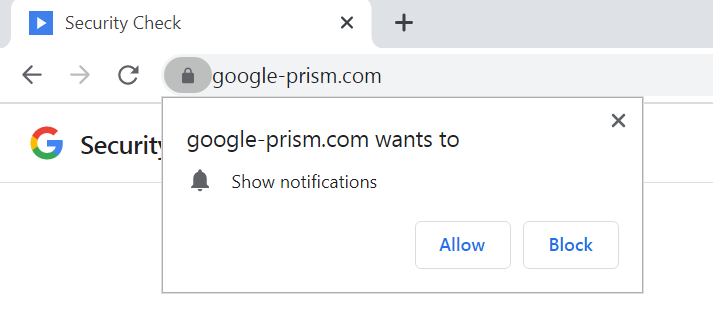
The cybercriminals use the domain google-prism[.]com, which poses as a legitimate security-related service from Google, showing a four-step setup process that includes giving risky permissions and installing a malicious PWA app. In some instances, the site will also promote a companion Android app to “protect” contacts.
According to researchers at cybersecurity company Malwarebytes, the PWA app can exfiltrate contacts, real-time GPS data, and clipboard contents.
Additional functionality observed includes acting as a network proxy and internal port scanner, which allows the attacker to route requests through the victim’s browser and identify live hosts on the network.
The website also requests permissions to access text and images copied to the clipboard, which can occur only when the app is open.

source: BleepingComputer
However, the fake website also asks for permission to show notifications, which allows the attacker to push alerts, new tasks, or trigger data exfiltration.
Additionally, the malware uses the WebOTP API on supported browsers in an attempt to intercept SMS verification codes, and checks the /api/heartbeat every 30 seconds for new commands.
As the PWA app can only steal the contents of the clipboard and OTP codes when it is open, notifications can be used to send fake security alerts that prompt the user to open the PWA again.
source: BleepingComputer
Malwarebytes says that the focus is on stealing one-time passwords (OTP) and cryptocurrency wallet addresses, and that the malware also “builds a detailed device fingerprint.”
Another component in the malicious PWA is a service worker that is responsible for push notifications, running tasks from received payloads, and preparing stolen data locally for exfiltration.
The researchers say that the most concerning component is the WebSocket relay that allows the attacker to pass web requests through the browser as if they were on the victim’s network.
“The malware acts as an HTTP proxy, executing fetch requests with whatever method, headers, credentials, and body the attacker specifies, then returns the full response including headers” – Malwarebytes
Because the worker includes a handler for Periodic Background Sync, which allows web apps in Chromium-based browsers to periodically synchronize data in the background, the attacker can connect to a compromised device for as long as the malicious PWA app is installed.
Malware Android companion
Users who choose to activate all the security features for their account also receive an APK file for their Android devices that promises to extend protection to the list of contacts.

source: BleepingComputer
The payload is described as a “critical security update, ”claims to be verified by Google, and requires 33 permissions that include access to SMS texts, call logs, the microphone, contacts, and the accessibility service.
These alone are high-risk permissions that enable data theft, full device compromise, and financial fraud.
The malicious APK file includes multiple components, such as a custom keyboard to capture keystrokes, a notification listener for access to incoming notifications, and a service to intercept credentials filled automatically.
“To enhance persistence, the APK registers as a device administrator (which can complicate uninstallation), sets a boot receiver to execute on startup, and schedules alarms intended to restart components if terminated,” the researchers say.
Malwarebytes observed components that could be used for overlay-based attacks, which indicate plans for potential credential phishing in certain apps.
By combining legitimate browser features with social engineering, the attacker does not need to exploit any vulnerability. Instead, they trick the victim into providing all the needed permissions for malicious activity to occur.
The researchers warn that even if the Android APK is not installed, the web app can collect contacts, intercept one-time passwords, track location, scan internal networks, and proxy traffic through the victim’s device.
Users should be aware that Google does not run security checks through pop-ups on web pages or request any software installation for enhanced protection features. All security tools are available through the Google Account at myaccount.google.com.
To remove the malicious APK file, Malwarebytes recommends users look for a “Security Check” entry in the list of installed apps and prioritize uninstalling it.
If an app called “System Service” with a package name com.device.sync is present and has device administrator access, users should revoke it under Settings > Security > Device admin apps and then uninstall it.
Malwarebytes researchers also provide detailed steps for removing the malicious web app from both Chromium-based Windows, such as Google Chrome and Microsoft Edge, as well as from Safari.
They note that on Firefox and Safari browsers, many of the malicious app’s capabilities are severely restricted, but push notifications still work.

Malware is getting smarter. The Red Report 2026 reveals how new threats use math to detect sandboxes and hide in plain sight.
Download our analysis of 1.1 million malicious samples to uncover the top 10 techniques and see if your security stack is blinded.

Looking for the most recent regular Connections answers? Click here for today’s Connections hints, as well as our daily answers and hints for The New York Times Mini Crossword, Wordle and Strands puzzles.
Today’s Connections: Sports Edition is a tough one. If you’re struggling with today’s puzzle but still want to solve it, read on for hints and the answers.
Connections: Sports Edition is published by The Athletic, the subscription-based sports journalism site owned by The Times. It doesn’t appear in the NYT Games app, but it does in The Athletic’s own app. Or you can play it for free online.
Read more: NYT Connections: Sports Edition Puzzle Comes Out of Beta
Hints for today’s Connections: Sports Edition groups
Here are four hints for the groupings in today’s Connections: Sports Edition puzzle, ranked from the easiest yellow group to the tough (and sometimes bizarre) purple group.
Yellow group hint: Deal me in.
Green group hint: Football fun.
Blue group hint: GOAAAAAL!
Purple group hint: Name game.
Answers for today’s Connections: Sports Edition groups
Yellow group: Card games.
Green group: NFL teams, on scoreboards.
Blue group: Premier League nicknames, minus the S.
Purple group: Athletes who changed their name.
Read more: Wordle Cheat Sheet: Here Are the Most Popular Letters Used in English Words
What are today’s Connections: Sports Edition answers?
The completed NYT Connections: Sports Edition puzzle for March 3, 2026.
The yellow words in today’s Connections
The theme is card games. The four answers are rummy, Skip-Bo, solitaire and Uno.
The green words in today’s Connections
The theme is NFL teams, on scoreboards. The four answers are CAR, DEN, JAX and TEN.
The blue words in today’s Connections
The theme is Premier League nicknames, minus the S. The four answers are cottager, magpie, seagull and toffee.
The purple words in today’s Connections
The theme is athletes who changed their name. The four answers are Abdul-Jabbar, Ali, Ochocinco and World Peace.

Looking for the most recent Mini Crossword answer? Click here for today’s Mini Crossword hints, as well as our daily answers and hints for The New York Times Wordle, Strands, Connections and Connections: Sports Edition puzzles.
Today’s NYT Mini Crossword was pretty tough! I was stumped on 1-Across and 1-Down, and it took me a while to figure them out. Read on for all the answers. And if you could use some hints and guidance for daily solving, check out our Mini Crossword tips.
If you’re looking for today’s Wordle, Connections, Connections: Sports Edition and Strands answers, you can visit CNET’s NYT puzzle hints page.
Read more: Tips and Tricks for Solving The New York Times Mini Crossword
Let’s get to those Mini Crossword clues and answers.
The completed NYT Mini Crossword puzzle for March 3, 2026.
Mini across clues and answers
1A clue: When tripled, “That’s correct!”
Answer: DING
5A clue: “F1” or “One Battle After Another”
Answer: MOVIE
6A clue: Make up for one’s sins
Answer: ATONE
7A clue: Title film character who says “That’ll do, Donkey. That’ll do”
Answer: SHREK
8A clue: Pocket janglers
Answer: KEYS
Mini down clues and answers
1D clue: Words before “math” or “honors”
Answer: DOTHE
2D clue: What the world’s first chess set was carved from
Answer: IVORY
3D clue: Highest digits in Sudoku
Answer: NINES
4D clue: Nerd
Answer: GEEK
5D clue: Cover up
Answer: MASK
Superagers’ ‘Secret Ingredient’ May Be the Growth of New Brain Cells

Motorists warned to ‘plan ahead’ over main road closure in Ramsbottom

Australian shares drop as conflict realities set in


-

 Politics4 days ago
ITV enters Gaza with IDF amid ongoing genocide
-

 Fashion4 days ago
Weekend Open Thread: Iris Top
-

 Tech2 days ago
Unihertz’s Titan 2 Elite Arrives Just as Physical Keyboards Refuse to Fade Away
-

 Business6 days ago
True Citrus debuts functional drink mix collection
-
Sports3 days ago
The Vikings Need a Duck
-

 NewsBeat5 days ago
Cuba says its forces have killed four on US-registered speedboat | World News
-
 NewsBeat3 days ago
Dubai flights cancelled as Brit told airspace closed ’10 minutes after boarding’
-

 Tech7 days ago
Unsurprisingly, Apple's board gets what it wants in 2026 shareholder meeting
-
 NewsBeat5 days ago
Manchester Central Mosque issues statement as it imposes new measures ‘with immediate effect’ after armed men enter
-
 NewsBeat3 days ago
The empty pub on busy Cambridge road that has been boarded up for years
-

 NewsBeat2 days ago
‘Significant’ damage to boarded-up Horden house after fire
-

 NewsBeat2 days ago
Abusive parents will now be treated like sex offenders and placed on a ‘child cruelty register’ | News UK
-
 NewsBeat6 days ago
Police latest as search for missing woman enters day nine
-

 Entertainment23 hours ago
Baby Gear Guide: Strollers, Car Seats
-

 Business5 days ago
Discord Pushes Implementation of Global Age Checks to Second Half of 2026
-

 Business4 days ago
Only 4% of women globally reside in countries that offer almost complete legal equality
-
 Tech4 days ago
NASA Reveals Identity of Astronaut Who Suffered Medical Incident Aboard ISS
-

 Crypto World6 days ago
Entering new markets without increasing payment costs
-
Politics2 days ago
FIFA hypocrisy after Israel murder over 400 Palestinian footballers
-
 NewsBeat2 days ago
Emirates confirms when flights will resume amid Dubai airport chaos