

Big changes are happening at OpenAI. On Wednesday, the company announced that it would be shutting down their AI video creation app Sora only a couple months after its launch. In October, OpenAI completed a massive restructure of its organization that shakes the very foundations it was built on.
Tech
Python ‘Chardet’ Package Replaced With LLM-Generated Clone, Re-Licensed


Ancient Slashdot reader ewhac writes: The maintainers of the Python package `chardet`, which attempts to automatically detect the character encoding of a string, announced the release of version 7 this week, claiming a speedup factor of 43x over version 6. In the release notes, the maintainers claim that version 7 is, “a ground-up, MIT-licensed rewrite of chardet.” Problem: The putative “ground-up rewrite” is actually the result of running the existing copyrighted codebase and test suite through the Claude LLM. In so doing, the maintainers claim that v7 now represents a unique work of authorship, and therefore may be offered under a new license. Version 6 and earlier was licensed under the GNU Lesser General Public License (LGPL). Version 7 claims to be available under the MIT license.
The maintainers appear to be claiming that, under the Oracle v. Google decision, which found that cloning public APIs is fair use, their v7 is a fair use re-implementation of the `chardet` public API. However, there is no evidence to suggest their re-write was under “clean room” conditions, which traditionally has shielded cloners from infringement suits. Further, the copyrightability of LLM output has yet to be settled. Recent court decisions seem to favor the view that LLM output is not copyrightable, as the output is not primarily the result of human creative expression — the endeavor copyright is intended to protect. Spirited discussion has ensued in issue #327 on `chardet`s GitHub repo, raising the question: Can copyrighted source code be laundered through an LLM and come out the other end as a fresh work of authorship, eligible for a new copyright, copyright holder, and license terms? If this is found to be so, it would allow malicious interests to completely strip-mine the Open Source commons, and then sell it back to the users without the community seeing a single dime.
Continue Reading
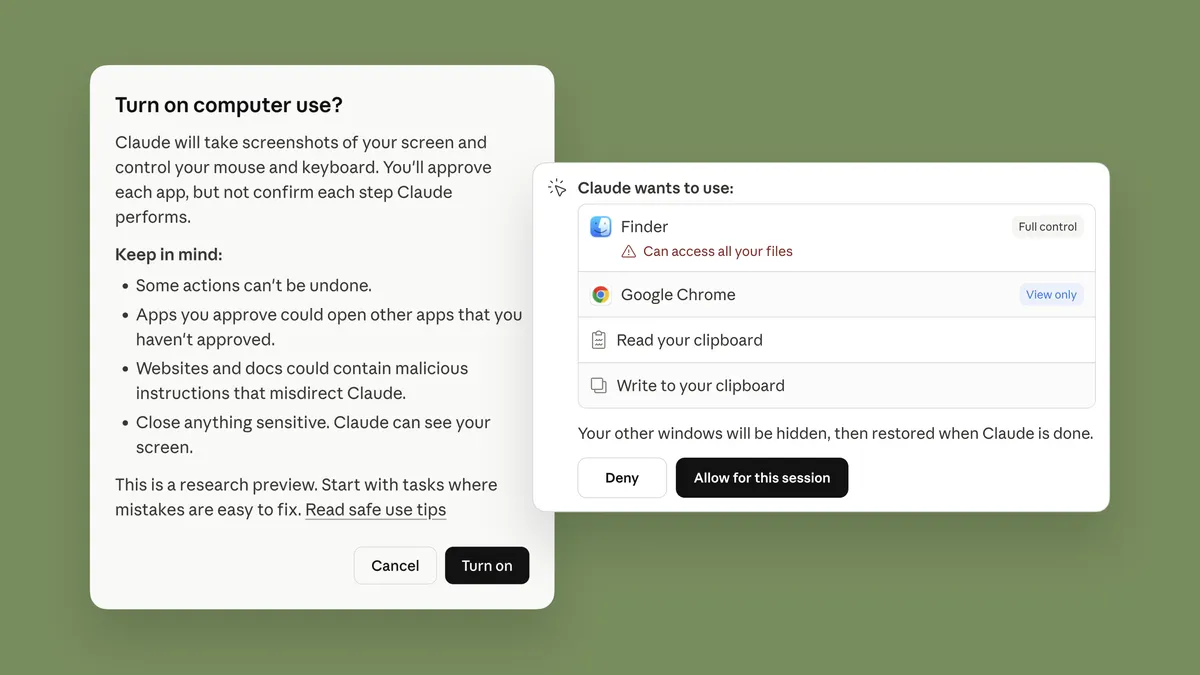
You can now let Claude take control of your computer to perform tasks like sending you a file you left on your hard drive, the AI’s developer Anthropic announced Monday. For the feature to work, you just need to be on a qualifying subscription plan.
In the wake of the viral explosion of the open-source OpenClaw framework earlier this year, Anthropic is the latest developer to deliver a tool that enables an AI model to act more independently.
OpenClaw has spawned an entire ecosystem of “claws,” or AI tools that can take simple commands and perform them somewhat autonomously on your computer or with your tools or systems. Nvidia last week debuted NemoClaw, its framework for easily setting up and installing OpenClaw, with some security settings.
Anthropic says that Claude will look for the right tools to complete the task at hand via connectors with apps like Google Calendar or Slack. If the tool or connector isn’t available, Claude can manually perform the task by typing or moving the cursor, as if it were using the keyboard and mouse. It can use programs like your web browser, dev tools and open files.
When it’s performing these tasks, it can use a computer as you normally would — by scrolling and clicking around. The only difference is that Claude will always ask for permission beforehand. You can stop Claude from performing a task at any time.
Giving your chatbot the keys to your computer can be convenient for certain tasks, but it can leave your computer vulnerable to attacks. Experts told us one major worry with agentic AI is that it can take major, sometimes dramatic actions quickly and with little warning. Claws can also be hijacked by malicious actors, who can use your personal data and systems in ways you don’t want.
Anthropic says it implemented safeguards to minimize risks like prompt injections. The system will automatically scan for this and more vulnerabilities as they are implemented.
Despite some of its efforts to keep Claude’s computer use safe, Anthropic also provides a warning to users. The feature is new and may contain errors, and the company suggests not using apps that handle sensitive data — so much so that some of these apps are disabled by default.
The research preview is available now for Claude Pro and Claude Max subscribers and limited to computers running MacOS.
Anthropic says the new computer-use feature works well with Dispatch, which allows you to assign tasks to Claude using your phone. Such tasks include checking your email every morning or opening up a Claude Cowork or Claude Code session.
The combination of computer use for Claude and Dispatch enables you to do even more while you’re not even around. Anthropic says the feature combo can create a morning briefing or run tests, for example.
Given that both features are new, some complex tasks might not work the first time. Anthropic said it’s releasing this research preview to gain early insight on where it needs the most attention to become an even more powerful tool.
OpenAI, which powers ChatGPT, among other AI products, was originally founded purely as a nonprofit. Now it has a for-profit arm. According to OpenAI CEO Sam Altman, the nonprofit will still guide the work of the for-profit side to ensure that artificial intelligence works for the “benefit of all humanity.” On top of that, the OpenAI Foundation, would be in charge of (theoretically) $180 billion, making it one of the largest charitable organizations in the world.
Catherine Bracy, founder of the nonprofit Tech Equity, thinks this restructuring is a blatant attempt to free up the for-profit wing to act like any other AI company. She argues that OpenAI’s for-profit wing will only ever act for the benefit of its investors. Bracy believes the OpenAI Foundation is merely a glorified and toothless corporate social responsibility arm. We reached out to OpenAI for comment and did not receive a response.
Bracy spoke with Today, Explained host Sean Rameswaram about the legality of OpenAI’s new structure and her concerns about how this all might shake out. An excerpt of their conversation, edited for length and clarity, is below.
There’s much more in the full podcast, so listen to Today, Explained wherever you get your podcasts, including Apple Podcasts, Pandora, and Spotify.
(Disclosure: Vox Media is one of several publishers that have signed partnership agreements with OpenAI. Our reporting remains editorially independent.)
You used to chat with Sam Altman?
We worked together back in the day and then kind of went out of touch with each other for a few years. Then, when I was writing a book about venture capital, I was really interested in open AI’s nonprofit model. Sam had been very explicit that the reason they founded OpenAI as a nonprofit was to put the technology at arm’s length from investors because they knew investors would exploit it in a way that would make this technology — which they thought was very dangerous — actually live up to that potential danger.
So I wanted to talk to him about the decision-making process behind that. And he was very forthcoming about that being the explicit reason why OpenAI was founded as a nonprofit. They put a lot of thought and capacity and energy into creating this [nonprofit] governance structure that would protect the technology from the whims of investors, the [profit-generating] imperatives that investors put on technology companies.
And a few months later, I saw that all come crashing down.
And when you found out that Open AI was restructuring and going to try to have it both ways — mission-driven nonprofit, but also money-driven for-profit — what was your reaction?
Disappointment. I would say that was my initial reaction. And then the secondary response was, Well, what can we do about this? And many of us came together into this coalition that really started asking questions about the responsibility of the nonprofit and the responsibility of the attorney general of California to enforce nonprofit law. And things kind of went from there.
Tell me more about that. What’s nonprofit law look like as it pertains to, say, OpenAI?
I run a nonprofit. In the tax code, that means that my organization does not need to pay taxes, but in return for that tax exemption, we are required to operate in service of a public service mission. Our mission is to ensure that the tech industry is creating opportunity for everybody. OpenAI’s nonprofit mission is to ensure that AI develops for the benefit of all of humanity. And legally, Sam Altman is required to prioritize OpenAI’s mission above all else.
So when they decided they were going to split the nonprofit from the for-profit, they found that actually legally they could not do that without divesting the intellectual property that the nonprofit owned, including all of the intellectual property that was created that underlies the ChatGPT model, and the equity stake that the nonprofit owned in the for-profit company.
I think they looked at that price tag and they said, That’s not a price we’re willing to pay. And so instead of splitting the nonprofit from the for-profit, they decided to continue down this path of nonprofit ownership, which in my mind is completely untenable, unsustainable, and irreconcilable.
Basically, every day that OpenAI exists, they are violating the law.
And actually what they’re doing is just daring the attorney general to hold them accountable for it. I think they think they’re too big to be held accountable and they need the AG [of California] to assume that he will not win a case. And that’s what they’ve done. They’ve loaded up on lawyers and they are making a bet that the AG will not pursue this in any way that’s actually meaningful.
Okay. So if I’m following you, despite the fact that OpenAI has split itself into a for-profit arm and a not-for-profit arm, their not-for-profit mission still overrides everything they do. And because of that, they are violating California law — because there’s no way that the nonprofit interests are ever going to be primary in their business.
Right. I think, as the kids would say, they’re playing in our faces. They expect us to take their word that as they operate, as they make deals with the Defense Department to develop autonomous weapons and surveillance systems on American citizens, as they battle parents in court whose children have committed suicide due to conversations that these kids were having with their chatbots, they expect us to believe that the nonprofit mission is being prioritized over the profit motivation of the company.
We all know that OpenAI’s overriding priority is to “win” the AI race. It’s to beat out the competition in the marketplace, and it’s to establish the biggest AI company they can create. To the extent that the nonprofit mission ever comes into tension with that, the company will always prioritize profits over the mission.
A law is only as good as its enforcement. And I think if there’s one rule of Silicon Valley, it is to ask forgiveness and not permission. I think they said, You know, this is worth it. There’s enough money on the line for us to just break the law and do the PR work and the lobbying work and the other work that we need to do to ensure that these laws will never be enforced against us.
And when you talk about PR work, lobbying work, are you talking about, like, saying we’re going to give away this $180 billion eventually?
Well, here’s the thing. They announced this week a list of priorities that the foundation would be investing in. They listed as one of their priorities, Alzheimer’s research. My mother is currently dying of Alzheimer’s. I have one copy of the gene that puts me at extreme risk of developing Alzheimer’s when I’m older. So I pray every day that AI helps us find a solution to Alzheimer’s fast enough that I can benefit from it, that my family can benefit from it.
But let me ask you a question. What happens, do you think, if the research that’s funded by OpenAI’s Foundation finds that actually Anthropic’s models are better at drug discovery or scientific breakthroughs than ChatGPT or any of OpenAI’s other models? What does it mean for the independence of scientific research, if all of this research is funded by an entity that has an irreconcilable conflict of interest?
“We do not have to take these companies at their word that they know best how to govern this technology. We should have bigger imaginations about what’s possible.”
We would not accept the science around nicotine that tobacco companies were funding. We do not accept the science around alcohol addiction that the alcohol companies fund. We do not accept the science around sugared beverages from the soda industry. And we should not accept that this scientific research is funded by an entity that has a vested financial interest in the outcome.
And that is why it is so critically important that the OpenAI Foundation actually be independent, that it have an independent board, that it can deploy its resources independently, that the research that it is funding is independent.
Do you still think that we’re maybe better off that OpenAI says that they want to give billions away to better society — than say Anthropic, Google, maybe having some pledges to give money away, but not nearly as much?
Well, Google has a corporate foundation. It’s called Google.org. And I expect in this structure with the tension and the conflict of interest that the OpenAI Foundation has, that it will operate much more like Google.org, which is essentially an arm of the marketing department, a corporate social responsibility program that gives money to innocuous groups — but will never do anything that undercuts Google’s priorities.
I think if you read between the lines of open AI’s press release, the work they say they want to continue doing with community funding is all about convincing people about the importance and value and benefit in using AI. I mean, that’s a market building opportunity for them. That’s not actually anything that’s going to ensure that AI is developed for the benefit of humanity. And so, no, I don’t think that they’re going to operate any differently than any of the other companies’ corporate social responsibility arms. That’s essentially what they have built here.
This is the fight of our time. AI is not inevitable. The way it develops is not inevitable. And we do not have to take these companies at their word that they know best how to govern this technology. We should have bigger imaginations about what’s possible. And if anything, this should give us more energy and motivation to fix what’s broken about our democracy than to just sit back and let billionaires control our future.
Do you ever talk to Sam Altman anymore?
He doesn’t return my calls.
Well, thanks for talking to us.

There’s an old saying that goes: when life gives you lemons, make lemonade. [lds133] must have heard that saying, because when life took the magic liquid out of his Magic 8 Ball, [lds133] made not eight-ball-aide, but an electronic replacement with a Raspberry Pi Pico and a round TFT display.
In case the Magic 8 Ball is unknown in some corners of the globe, it is a toy that consists of a twenty-sided die with a set of oracular messages engraved on it, enclosed in a magical blue liquid — and by magical, we mean isopropyl alcohol and dye. The traditional use is to ask a question, shake the eight-ball, and then ignore its advice and do whatever you wanted to do anyway.
[lds133]’s version replicates the original behavior exactly by using the accelerometer to detect the shaking, the round display to show an icon of the die, and a Raspberry Pi Pico to do the hard work. There’s also the obligatory lithium pouch cell for power, which is managed by one of the usual TP4056 breakout boards. One very nice detail is that instead of a distracting battery indicator, the virtual die changes color as the battery wears out.
We’ve seen digital 8 Balls before, like this one that used an STM32, or another that used a Raspberry Pi to display reaction GIFs. Some projects are just perennial.

I also tested movies using the Mubi app because I’m a fuddy-duddy film fanatic, as well as a screener for Marty Supreme. Here’s where the upscaling, matte display, and AI truly shine: Marty Supreme is like an old ’70s flick, and The Frame Pro made me think I was in a movie theater. The matte display gave the Mubi films a more cinematic look.

On an Xbox Series X, I watched the entire Predator: Badlands film using the 4K Blu-ray version. It’s worth noting that though the colors look great, Samsung models don’t support Dolby Vision HDR, instead going for standard HDR10+.
For a more pure movie experience that disables any optimizations or AI enhancements, I tested the Filmmaker picture setting. In one scene, you can see the individual scales of the main character, which is awesome.
The Frame Pro has plenty of built-in cloud gaming features beyond any consoles you connect locally. I tested Cyberpunk 2077 using the Steam app and also fired up Senua’s Saga: Hellblade II on the Xbox app with no issues. One slight glitch is that, when I connected my Xbox controller to the TV it worked fine, but then I had to pair it again to the Xbox Series X later. It gave me a reason to buy an extra controller. When I tried a Sony Dualsense Wireless Controller with Cyberpunk 2077, it worked flawlessly. Forza Horizon 5 on my Xbox looked ultra-smooth, showing a Ford Bronco sliding around in the mud in a realistic way.
The Frame Pro supports up to a 144-Hz refresh rate from either the Connect One box or a Micro HDMI port, which makes it awesome for really smooth gaming. I tested Crimson Desert on an Acer Nitro 60 gaming desktop, and the colors, scenery, and overall clarity over the higher refresh rate looked stunning. If you have a stylish living room where you also want to game, this isn’t a bad choice.
During a chaotic battle, with snowy mountains off in the distance, I felt like I had jumped into one of the paintings. In the end, The Frame Pro is a fantastic TV for art—and just about everything else, as long as you don’t want the best backlighting around.


According to the affidavit, the FBI sought information during a probe into a threatening message received by Alexis Wilkins, the girlfriend of FBI Director Kash Patel. The email, sent from the address peaty_terms_1o@icloud.com, reads, “Do you know how happy I’ll be when your c**t ass face is canoed by an…
Read Entire Article
Source link

Despite preorders selling out at other retailers, AirPods Max 2 are on sale now at Walmart, with a $20 weekend discount and a preorder price guarantee.

AirPods Max 2 are on sale now with a preorder price guarantee – Image credit: Apple
Pick up Apple’s new over-ear headphones in Midnight for $529 at Walmart, a $20 discount off MSRP. With retailers like Amazon showing a “currently unavailable” message on its product page, ordering from Walmart allows you to snap up the lowest price on the 2026 release while securing a preorder price guarantee ahead of the early April launch.
Save $20 on AirPods Max 2
Continue Reading on AppleInsider | Discuss on our Forums


The arrival of spring means longer and warmer days. It’s one of those bittersweet connections we have with wanting a greener lawn but dreading the relentless maintenance under the scorching sun. Every weekend ultimately turns into a tug-of-war between wanting a good-looking yard and a simple, relaxing weekend. If you are a homeowner looking to keep your yard sharper without breaking a sweat, the limited-time Spring Sale on Lymow’s latest robotic lawn mower is the perfect chance to upgrade.
With sales running from March 27th to April 5th, the ongoing Spring deal presents exclusive pricing with special bonuses, making the Lymow One Plus Robotic Lawn Mower a compelling choice for hands-free landscaping. Designed to transform what used to be a tedious chore into an almost luxurious experience, this offer is ideal for homeowners ready to adopt an easier way to upkeep their outdoor routine.
What Smarter Lawn Care Has For You
The true value of a robotic lawn mower is in its ability to simplify time-consuming routines. One of the standout features of the Lymow One Plus Robotic Lawn Mower is its wire-free setup. Personally, not having to bury miles-long boundary wire by hand in the dirt is the most appealing part of the experience. Instead, you simply map your yard in the app, and the rest is all taken care of.
The Lymow One Plus also excels in avoiding obstacles and handling uneven terrains, including slopes up to 45°, thanks to its smart navigation system. Whether you have a complex or a square landscape, it maintains a uniform cut — something many traditional robotic mowers struggle with.
Ultimately, it saves you from shoveling and mowing the weekend away, letting you enjoy the perks of an automated lawn mower working quietly in the backyard. The result is a consistent and well-maintained green space that seamlessly fits the idea of a modern lifestyle worthy of your aspirations.
Automating Yard Care with Spring Deals
This Spring sale provides the perfect opportunity for a homeowner to make the shift to hands-free lawn care. The Lymow One Plus Robotic Lawn Mower comes in two variants, based on their battery capacity. The Lymow One Plus 5A can cover about 1.1 acres per day and is currently available for $2,699, down from its original price of $2,999. The 5A model uses standard “overnight” charging, making it a solid fit for small to medium properties.
When it comes to larger yards, the break for recharging sessions may slow down the progress if the battery runs out mid-cycle. For households requiring powerful performance, the Lymow One Plus 10A fits the bill perfectly, covering around 1.73 acres per day. The fast-charging upgrade included with this model reduces downtime and gives you more coverage in a single run for bigger properties. Furthermore, the shorter recharging cycle helps homeowners with tight schedules in covering the large yards without needing frequent supervision. This one is also up for grabs this spring at just $2,899, a generous notch lower than its original price of $3,199.
Beyond the valuable discounts, the Lymow One Plus Spring Sales include exclusive bonuses. With each purchase, homeowners will receive 3 extra sets of rotary blades, promising peak cutting performance without making constant hardware store runs. Plus, the 1 Year Accidental Protection plan is bundled as a complimentary perk this season. In a nutshell, Lymow delivers top-tier performance, unparalleled convenience, and added hardware security to go with it. Overall, the combination of spring savings with accessible automation reflects the aim of Lymow to simply reduce the manual effort of lawn care and help homeowners enjoy a tidy yard without the constant burden of maintenance.
Last week, Senator Eric Schmitt of Missouri got into a heated exchange during a Senate hearing with Stanford’s Daphne Keller. Schmitt, who, as Missouri’s Attorney General, originally filed the Missouri v. Biden lawsuit, was berating Keller over Stanford’s supposed role in helping the Biden administration censor social media during the 2020 election (see if you can spot the time-space continuum problem with that sentence). When Keller pushed back on his characterization of events, Schmitt got increasingly agitated and told her she could “read all about it in Missouri v. Biden.” Keller’s response was instant and devastating: “The one you lost?“
He did not take it well, immediately throwing an embarrassing Senatorial temper tantrum.
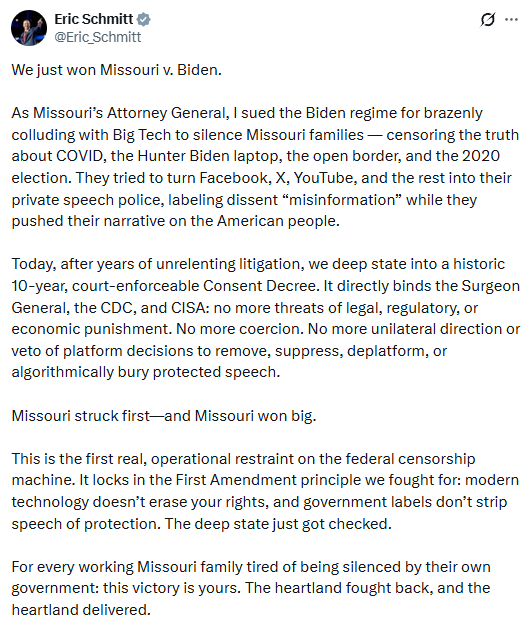
And so maybe it’s not surprising that just a week later, Schmitt was doing a victory lap over a “settlement” that his friends in the Trump administration very conveniently worked out with the remaining plaintiffs in the case. The framing, of course, was triumphant. From his post on social media:

Shorter version:
We just won Missouri v. Biden.
As Missouri’s Attorney General, I sued the Biden regime for brazenly colluding with Big Tech to silence Missouri families — censoring the truth about COVID, the Hunter Biden laptop, the open border, and the 2020 election. They tried to turn Facebook, X, YouTube, and the rest into their private speech police, labeling dissent “misinformation” while they pushed their narrative on the American people.
Missouri struck first—and Missouri won big.
And the New Civil Liberties Alliance, which represented many of the plaintiffs, was even more grandiose in its description of the settlement:
The federal government’s social media censorship was the most massive suppression of speech in the nation’s history, it was profoundly important to resist it.
Even the Washington Post editorial board got taken in, writing about the settlement as a “forceful affirmation of First Amendment principles.” Reclaim the Net went even further, claiming the decree represented a “formal, court-enforceable admission: the federal government pressured social media platforms to silence protected speech.”
There’s just one fairly big problem. None of this is true. The case was a dud. While it is true that the district court hyped it up as (what the NCLA repeated) “the most massive attack against free speech in United States’ history,” literally no one else found the same. The Fifth Circuit saw that most of the claims were flimsy and cut back nearly the entire injunction, and the Supreme Court threw it out completely (“the one that you lost”) not only pointing out five separate times that there was “no evidence” to support the claims of censorship, but also calling out the district court’s findings, noting that they “appear to be clearly erroneous.”
It’s quite a misleading victory lap to quote the judge who both higher courts called out for misreading the evidence to say things that the evidence clearly did not say (it was actually worse: the judge fabricated quotes to make it sound like there was evidence when there was not).
As for this “settlement,” anyone who actually reads it would realize that it doesn’t support any of the claims making the rounds.
Now the reason Schmitt claims he didn’t “lose” the case is because, technically, the Supreme Court rejected the case on “standing” grounds — meaning the plaintiffs hadn’t shown they had a legal right to bring the case. But the reason they didn’t have standing was devastating to the plaintiffs’ entire theory. The opinion methodically dismantled the conspiracy theory at the heart of the case:
We reject this overly broad assertion. As already discussed, the platforms moderated similar content long before any of the Government defendants engaged in the challenged conduct. In fact, the platforms, acting independently, had strengthened their pre-existing content-moderation policies before the Government defendants got involved. For instance, Facebook announced an expansion of its COVID–19 misinformation policies in early February 2021, before White House officials began communicating with the platform. And the platforms continued to exercise their independent judgment even after communications with the defendants began. For example, on several occasions, various platforms explained that White House officials had flagged content that did not violate company policy.
The Court further called out how the lower courts had built their case on lies and misrepresentations:
The District Court found that the defendants and the platforms had an “efficient report-and-censor relationship.”… But much of its evidence is inapposite. For instance, the court says that Twitter set up a “streamlined process for censorship requests” after the White House “bombarded” it with such requests. The record it cites says nothing about “censorship requests.” Rather, in response to a White House official asking Twitter to remove an impersonation account of President Biden’s granddaughter, Twitter told the official about a portal that he could use to flag similar issues. This has nothing to do with COVID–19 misinformation.
In other words, the Supreme Court looked at the actual record, found a pile of conspiratorial nonsense, and told the lower courts they got played. This was a loss. A clear, unambiguous loss.
But of course, with Trump back in office and the same crew of ideologues now running the government, it was time to manufacture a win. And so we get this “consent decree.”
On paper, it sounds dramatic. The NCLA breathlessly announced that the settlement “prohibits the U.S. Surgeon General, Centers for Disease Control and Prevention (CDC), and Cybersecurity and Infrastructure Security Agency (CISA) from threatening social media companies into removing or suppressing constitutionally protected speech.” Schmitt claimed the decree means “no more threats of legal, regulatory, or economic punishment. No more coercion. No more unilateral direction or veto of platform decisions.”
But if you actually read the consent decree (and I encourage you to do so, because clearly many of the people celebrating it haven’t), you find something remarkable: the decree prohibits conduct that the Supreme Court found no evidence was happening, while explicitly carving out everything that actually was happening.
First (and most importantly), the decree only applies to three remaining individual plaintiffs (Dr. Aaron Kheriaty, Jill Hines, and Jim Hoft) and two states, and only on five specific platforms. It doesn’t protect anyone else. If you’re a random American whose content gets moderated on social media, this decree does absolutely nothing for you. That certainly doesn’t match what Schmitt claimed.
Second, and more importantly, paragraph 24 of the decree is where the whole thing collapses:
This prohibition does not extend to providing Social-Media Companies with information that the companies are free to use as they wish. Nor does it extend to statements by government officials that posts on Social Media Companies’ platforms are inaccurate, wrong, or contrary to the Administration’s views, unless those statements are otherwise coupled with a threat of punishment within the meaning of the above provision.
That paragraph basically describes exactly what the Biden administration was actually doing — and declares it fine. The government can still share information with social media companies. It can still tell companies that content on their platforms is wrong or inaccurate. It can still express displeasure. It just can’t couple those statements with threats of punishment.
Which is… exactly what the First Amendment already requires. And exactly what the Supreme Court found was not happening in the first place. The consent decree literally codifies the Biden administration’s actual conduct as permissible while grandly prohibiting a phantom version of events that the Supreme Court found no evidence of.
Even better, paragraph 17 of the decree says the quiet part out loud:
The parties acknowledge that this Agreement is entered into solely for the purpose of settling and compromising any remaining claims in this action without further litigation, and, except as stated explicitly in the text of the Agreement, it shall not be construed as evidence or as an admission regarding any issues of law or fact, or regarding the truth or validity of any allegation or claim raised in this action or in any other action.
So the decree is explicitly not an admission of anything. It cannot be construed as evidence of any wrongdoing. The government didn’t admit to censorship. Reclaim the Net’s headline — “US Government Admits Pressuring Social Media Platforms to Censor Protected Speech” — is directly contradicted by the text of the document they’re supposedly celebrating. Did they not read it?
Yes, the preamble quotes Trump’s executive order making grand accusations about Biden-era censorship. But that’s a political document, not a finding of fact. The Trump administration saying the Biden administration did bad things is hardly the same as the Biden administration admitting it did bad things, or a court finding that it did bad things. In fact, the only court to substantively examine the evidence — the Supreme Court — found no evidence to support these claims.
So what we have here is a neat little trick: the Trump administration negotiates a settlement with friendly plaintiffs (some of whom had to drop out of the case because they joined the Trump administration), quotes Trump’s own executive order as if it were established fact, and everyone involved pretends this vindicates the original claims — despite the Supreme Court (and a clean reading of the evidence) having rejected them.
Speaking of those former plaintiffs, let’s talk about the delicious absurdity of how this case ate itself. Dr. Jay Bhattacharya, one of the original individual plaintiffs who claimed he was censored by the Biden administration, had to drop out of the case because he was confirmed as Director of the National Institutes of Health — the agency he claimed (without evidence) had “censored him” even though his lawyers somehow forgot to add NIH as a defendant. Dr. Martin Kulldorff similarly withdrew because of his new role within the Department of Health and Human Services. The supposed victims of government censorship are now running the very agencies they accused of censoring them. And, again, I have to reinforce, that the Supreme Court called out the lack of actual “censorship” for either of these guys.
Both Bhattacharya and Kulldorff were mad that Facebook restricted access to the Great Barrington Declaration, a document they co-authored. But they fail to mention that the person running the Great Barrington Declaration website has publicly revealed that the reason Facebook blocked it was anti-vaxxers mass reporting the site — because they misread the declaration as supporting “forced vaccinations.” (There are more details at the link above).

So naturally, despite all this, the fact that they became top officials in the Trump administration should raise questions about how suddenly the administration worked out a friendly settlement with their friends who were still plaintiffs. What a coincidence.
But the real tell is what’s happening right now, while MAGA is celebrating: the Trump admin is doing far worse than anything Biden was even accused of. Yes, while the Trump administration and its gullible friends are busy patting themselves on the back for supposedly defending free speech from the horrors of the Biden administration sharing information with social media companies, it is engaged in conduct that is far, far worse than anything alleged in Missouri v. Biden.
As you’ll certainly recall, the Trump administration’s FCC Chair Brendan Carr went on a podcast and explicitly threatened Disney with regulatory retaliation over Jimmy Kimmel’s monologues, telling them “we can do this the easy way or the hard way.” Hours later, the show was pulled. That’s textbook coercion — exactly the kind that the Supreme Court in both Murthy and Vullo said would violate the First Amendment if proven. Unlike the conduct in the case that just settled, where the Supreme Court found no such proof.
And then we have the even clearer violation: Pam Bondi’s Department of Justice demanded that Apple and Google remove the ICEBlock app from their stores… and bragged about it! That’s the federal government literally ordering private companies to suppress an application. Not sending mean emails. Not sharing information platforms are free to use as they wish. An explicit demand for removal.
“We reached out to Apple today demanding they remove the ICEBlock app from their App Store—and Apple did so,” Bondi added according to the Fox report.
Where’s Schmitt’s outrage? Where’s the NCLA lawsuit? Where’s Philip Hamburger’s condemnation of “the most massive suppression of speech in the nation’s history”?
Nowhere. Because this was never really about free speech. This was about building a narrative that the Biden administration censored conservatives, manufacturing a legal document that appears to vindicate that claim (despite explicitly saying it doesn’t), and then using it as political cover while engaging in an even more extreme version of the conduct you claimed to oppose.
This perfectly matches the pattern Renee DiResta documented in her Lawfare review of Schmitt’s book — which he subtitled “how to beat the left in court” — where she noted his habit of presenting cases he lost as if he won them. The book apparently describes multiple lawsuits where Schmitt failed to achieve his stated legal objectives but then spun the results as massive victories for the narrative benefit. Missouri v. Biden is the crown jewel of this approach: lose at the Supreme Court, negotiate a meaningless consent decree with a friendly administration, declare total victory.
Even the Washington Post editorial board, which gave the decree far more credit than it deserved, couldn’t quite look away from the obvious:
The unfortunate catch is that the settlement only applies to the specific plaintiffs in this particular case. In other words, only the people who initially sued the Biden administration, and public officials from Louisiana and Missouri, will enjoy the court-ordered protections from government censorship. It’s unlikely the current administration would target right-leaning individuals or states, but the consent decree will apply for 10 years.
The settlement also applies only to government pressure on five companies: Facebook, Instagram, X (formerly Twitter), Linkedln and YouTube. That means, for example, Federal Communications Commission Chairman Brendan Carr’s efforts to bully broadcasters to toe the administration’s political line will be unaffected.
So even the Post recognizes that the decree does nothing about actual, current, obvious government coercion of media companies. But somehow this is still a “forceful affirmation of First Amendment principles”? How so? A consent decree that protects three specific people from conduct that wasn’t happening, while the government signing the decree is actively coercing media companies in ways that obviously violate the First Amendment?
The consent decree is a press release disguised as a legal document. It prohibits First Amendment violations the Supreme Court found no evidence of, permits everything the evidence shows the Biden administration was actually doing, and was signed by an administration currently engaged in the exact conduct the decree pretends to prohibit.
The one you lost, indeed.
Filed Under: 1st amendment, aaron kheriaty, brendan carr, daphne keller, donald trump, eric schmitt, free speech, jay bhattacharya, jill hines, jim hoft, martin kulldorff, missouri, missouri v. biden, murthy v. missouri, pam bondi, settlement, supreme court
Companies: ncla

Recently [ETA Prime] felt a bit underwhelmed by the raw performance of his MacBook Neo when it came to running for extended periods under full load, such as when gaming. Thus the obvious solution is to mildly over-engineer a cooling solution that takes care of issues like thermal throttling.
The Apple MacBook Neo with its repurposed iPhone 16 SoC seems to have leaned hard into answering the question whether a smartphone can be a good general purpose personal computer. Ignoring the lack of I/O, it’s overall not a bad SoC for a laptop, but like when you try to push the CPU and GPU on a smartphone, they do get pretty toasty. Due to the minimalistic cooling solution in the MacBook Neo it’ll easily hit the 105°C thermal throttle limit.
Technically the ‘heatsink’ for this laptop is the aluminium case, as the SoC is coupled via a thermal pad to the case. This doesn’t leave a lot of space and the case will heat soak pretty fast, while also making retrofitting a cooling solution a challenge.
 Amusingly, replacing the existing thermal pad with a thin copper plate already massively reduced the thermal throttling of the A18 Pro SoC by about 20 degrees. In Geekbench 6 this bumped multi-core scores up by 9.7% and single-core by 15.2%. Definitely a promising glimpse at how much performance could still be extracted from this SoC.
For the next step a thermo-electric cooler (TEC) with built-in water cooling loop was used, which happened to be one of those overkill smartphone cooling systems that you’d stick to the back of the phone. Here the cooler was attached similarly, directly to the bottom aluminium of the case.
With this solution in place Geekbench 6 results mostly showed a solid bump for single-core results, while multi-core results showed diminishing returns. For Cinebench results this gave a 19% increase over stock cooling in multi-core and 23.5% for single-core.
Perhaps most interesting of all was that playing a video game for a while without thermal throttling meant framerates of over 80 FPS instead of hitting that thermal wall with 30 FPS. This shows just how much performance is left on the table due to the cooling choices for the system, even with this still rather inefficient cooling solution.
That said, this probably isn’t some kind of nefarious scheme by Apple, but rather the result of designing the thermal solution to not heat the case up to temperatures that are deemed to be unsafe or uncomfortable for the user. After all, if the case if the heatsink, then you don’t want to feel like you’re literally handling one. This is sadly the compromise when venting out hot air is deemed to be an unacceptable solution.

UK startup Pulsar Fusion says it has achieved the first plasma ignition inside a nuclear fusion rocket engine prototype — a huge step for space travel that could cut missions to Mars “from months-long journeys to just a few weeks,” reports Euronews. From the report: Pulsar Fusion revealed the milestone during a live stream at Amazon’s MARS Conference, hosted by Jeff Bezos in California this week, with CEO Richard Dinan calling it an “exceptional moment” for the company. The team successfully created plasma – an intensely hot, electrically charged state of matter, often described as the fourth state of matter – using electric and magnetic fields inside its experimental and early prototype “Sunbird fusion exhaust system.” […] The company now plans further testing of its Sunbird system to improve performance. Upcoming upgrades include more powerful superconducting magnets designed to better contain and control plasma.

Sports4 minutes ago
Pakistan cricketer in big trouble! PCB cracks down after ‘Queen’ jibe at Maryam Nawaz | Cricket News

News Videos5 minutes ago
Ripple XRP ANY! MINUTE! NOW!!!

NewsBeat5 minutes ago
Zelenskyy visits the UAE as Russia launches new attacks on Ukraine


-
 NewsBeat3 days ago
Manchester United reach agreement with Casemiro over contract clause amid transfer speculation
-

 News Videos2 days ago
Parliament publishes latest register of MPs’ financial interests
-

 Crypto World7 days ago
Best Crypto to Buy Now: Strategy Just Spent $1.57 Billion on Bitcoin During Fear While Early Investors Quietly Enter Pepeto for 150x Potential
-

 Crypto World7 days ago
Bitcoin Price News: Bhutan Sells $72 Million in BTC Under Fiscal Pressure, but the Smart Money Entering Pepeto Sees What the Market Does Not
-

 Sports5 days ago
Remo Stars and Kano Pillars Strengthen Survival Hopes in NPFL
-

 Sports5 days ago
Gary Kirsten Accuses Pakistan Cricket Board Of ‘Interference’, Mohsin Naqvi Responds
-

 Business6 days ago
No Winner in March 21 Drawing as Prize Rolls to $133 Million for Next
-

 Tech6 days ago
Give Your Phone a Huge (and Free) Upgrade by Switching to Another Keyboard
-

 Tech6 days ago
AI enters the chat: New Seattle dating app relies on tech to facilitate meaningful human connections
-

 News Videos5 days ago
Ch 9 Financial Management Part 1 | Detailed One Shot | Class 12 Business Studies Boards 2026
-

 Tech6 days ago
Today’s NYT Connections Hints, Answers for March 22 #1015
-

 Business2 days ago
Instagram, YouTube Found Responsible for Teen’s Mental Health Struggle in Historic Ruling
-

 Business6 days ago
Will Duke Basketball Win It All? Duke Basketball Enters Second Round as Third Favorite to Claim NCAA Title
-

 Sports5 days ago
2026 Kentucky Derby horses, odds, futures, preview, date: Expert who hit 12 Derby-Oaks Doubles enters picks
-

 NewsBeat14 hours ago
The Story hosts event on Durham’s historic registers
-
 NewsBeat6 days ago
Update on Wisbech river crash as search for teenage boy enters fifth day
-
 Entertainment5 days ago
Cynthia Bailey Dishes on ‘RHOA’ Season 17, Discusses Kandi
-

 Tech5 days ago
Samsung will soon let you control smart home devices from your car’s dashboard
-
 NewsBeat3 days ago
Tesco is selling new Cadbury Dairy Milk bar and people can’t wait to try it
-

 Tech6 days ago
SteamOS update adds support for Steam Machine and other non-Valve hardware
You must be logged in to post a comment Login