Connect with us
DAPA Banner

Tech

The Missouri v. Biden ‘Settlement’ Is A Fake Victory For A Case They Lost

Published

on

Last week, Senator Eric Schmitt of Missouri got into a heated exchange during a Senate hearing with Stanford’s Daphne Keller. Schmitt, who, as Missouri’s Attorney General, originally filed the Missouri v. Biden lawsuit, was berating Keller over Stanford’s supposed role in helping the Biden administration censor social media during the 2020 election (see if you can spot the time-space continuum problem with that sentence). When Keller pushed back on his characterization of events, Schmitt got increasingly agitated and told her she could “read all about it in Missouri v. Biden.” Keller’s response was instant and devastating: “The one you lost?

He did not take it well, immediately throwing an embarrassing Senatorial temper tantrum.

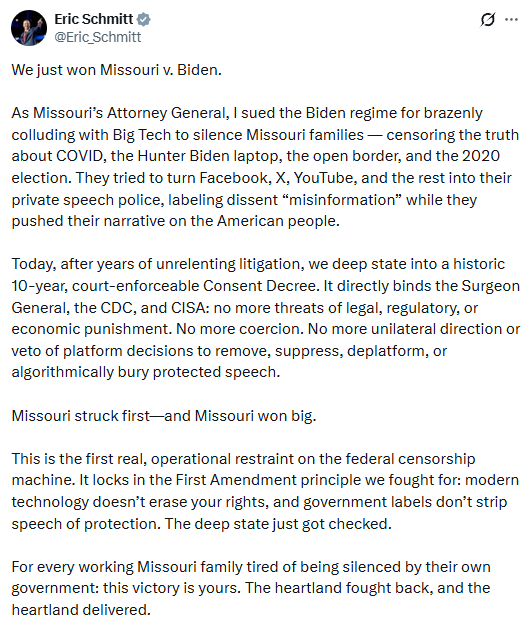
And so maybe it’s not surprising that just a week later, Schmitt was doing a victory lap over a “settlement” that his friends in the Trump administration very conveniently worked out with the remaining plaintiffs in the case. The framing, of course, was triumphant. From his post on social media:

Shorter version:

We just won Missouri v. Biden.

As Missouri’s Attorney General, I sued the Biden regime for brazenly colluding with Big Tech to silence Missouri families — censoring the truth about COVID, the Hunter Biden laptop, the open border, and the 2020 election. They tried to turn Facebook, X, YouTube, and the rest into their private speech police, labeling dissent “misinformation” while they pushed their narrative on the American people.

Advertisement

Missouri struck first—and Missouri won big.

And the New Civil Liberties Alliance, which represented many of the plaintiffs, was even more grandiose in its description of the settlement:

The federal government’s social media censorship was the most massive suppression of speech in the nation’s history, it was profoundly important to resist it.

Even the Washington Post editorial board got taken in, writing about the settlement as a “forceful affirmation of First Amendment principles.” Reclaim the Net went even further, claiming the decree represented a “formal, court-enforceable admission: the federal government pressured social media platforms to silence protected speech.”

There’s just one fairly big problem. None of this is true. The case was a dud. While it is true that the district court hyped it up as (what the NCLA repeated) “the most massive attack against free speech in United States’ history,” literally no one else found the same. The Fifth Circuit saw that most of the claims were flimsy and cut back nearly the entire injunction, and the Supreme Court threw it out completely (“the one that you lost”) not only pointing out five separate times that there was “no evidence” to support the claims of censorship, but also calling out the district court’s findings, noting that they “appear to be clearly erroneous.”

Advertisement

It’s quite a misleading victory lap to quote the judge who both higher courts called out for misreading the evidence to say things that the evidence clearly did not say (it was actually worse: the judge fabricated quotes to make it sound like there was evidence when there was not).

As for this “settlement,” anyone who actually reads it would realize that it doesn’t support any of the claims making the rounds.

Now the reason Schmitt claims he didn’t “lose” the case is because, technically, the Supreme Court rejected the case on “standing” grounds — meaning the plaintiffs hadn’t shown they had a legal right to bring the case. But the reason they didn’t have standing was devastating to the plaintiffs’ entire theory. The opinion methodically dismantled the conspiracy theory at the heart of the case:

We reject this overly broad assertion. As already discussed, the platforms moderated similar content long before any of the Government defendants engaged in the challenged conduct. In fact, the platforms, acting independently, had strengthened their pre-existing content-moderation policies before the Government defendants got involved. For instance, Facebook announced an expansion of its COVID–19 misinformation policies in early February 2021, before White House officials began communicating with the platform. And the platforms continued to exercise their independent judgment even after communications with the defendants began. For example, on several occasions, various platforms explained that White House officials had flagged content that did not violate company policy.

The Court further called out how the lower courts had built their case on lies and misrepresentations:

Advertisement

The District Court found that the defendants and the platforms had an “efficient report-and-censor relationship.”… But much of its evidence is inapposite. For instance, the court says that Twitter set up a “streamlined process for censorship requests” after the White House “bombarded” it with such requests. The record it cites says nothing about “censorship requests.” Rather, in response to a White House official asking Twitter to remove an impersonation account of President Biden’s granddaughter, Twitter told the official about a portal that he could use to flag similar issues. This has nothing to do with COVID–19 misinformation.

In other words, the Supreme Court looked at the actual record, found a pile of conspiratorial nonsense, and told the lower courts they got played. This was a loss. A clear, unambiguous loss.

But of course, with Trump back in office and the same crew of ideologues now running the government, it was time to manufacture a win. And so we get this “consent decree.”

On paper, it sounds dramatic. The NCLA breathlessly announced that the settlement “prohibits the U.S. Surgeon General, Centers for Disease Control and Prevention (CDC), and Cybersecurity and Infrastructure Security Agency (CISA) from threatening social media companies into removing or suppressing constitutionally protected speech.” Schmitt claimed the decree means “no more threats of legal, regulatory, or economic punishment. No more coercion. No more unilateral direction or veto of platform decisions.”

But if you actually read the consent decree (and I encourage you to do so, because clearly many of the people celebrating it haven’t), you find something remarkable: the decree prohibits conduct that the Supreme Court found no evidence was happening, while explicitly carving out everything that actually was happening.

Advertisement

First (and most importantly), the decree only applies to three remaining individual plaintiffs (Dr. Aaron Kheriaty, Jill Hines, and Jim Hoft) and two states, and only on five specific platforms. It doesn’t protect anyone else. If you’re a random American whose content gets moderated on social media, this decree does absolutely nothing for you. That certainly doesn’t match what Schmitt claimed.

Second, and more importantly, paragraph 24 of the decree is where the whole thing collapses:

This prohibition does not extend to providing Social-Media Companies with information that the companies are free to use as they wish. Nor does it extend to statements by government officials that posts on Social Media Companies’ platforms are inaccurate, wrong, or contrary to the Administration’s views, unless those statements are otherwise coupled with a threat of punishment within the meaning of the above provision.

That paragraph basically describes exactly what the Biden administration was actually doing — and declares it fine. The government can still share information with social media companies. It can still tell companies that content on their platforms is wrong or inaccurate. It can still express displeasure. It just can’t couple those statements with threats of punishment.

Which is… exactly what the First Amendment already requires. And exactly what the Supreme Court found was not happening in the first place. The consent decree literally codifies the Biden administration’s actual conduct as permissible while grandly prohibiting a phantom version of events that the Supreme Court found no evidence of.

Advertisement

Even better, paragraph 17 of the decree says the quiet part out loud:

The parties acknowledge that this Agreement is entered into solely for the purpose of settling and compromising any remaining claims in this action without further litigation, and, except as stated explicitly in the text of the Agreement, it shall not be construed as evidence or as an admission regarding any issues of law or fact, or regarding the truth or validity of any allegation or claim raised in this action or in any other action.

So the decree is explicitly not an admission of anything. It cannot be construed as evidence of any wrongdoing. The government didn’t admit to censorship. Reclaim the Net’s headline — “US Government Admits Pressuring Social Media Platforms to Censor Protected Speech” — is directly contradicted by the text of the document they’re supposedly celebrating. Did they not read it?

Yes, the preamble quotes Trump’s executive order making grand accusations about Biden-era censorship. But that’s a political document, not a finding of fact. The Trump administration saying the Biden administration did bad things is hardly the same as the Biden administration admitting it did bad things, or a court finding that it did bad things. In fact, the only court to substantively examine the evidence — the Supreme Court — found no evidence to support these claims.

So what we have here is a neat little trick: the Trump administration negotiates a settlement with friendly plaintiffs (some of whom had to drop out of the case because they joined the Trump administration), quotes Trump’s own executive order as if it were established fact, and everyone involved pretends this vindicates the original claims — despite the Supreme Court (and a clean reading of the evidence) having rejected them.

Advertisement

Speaking of those former plaintiffs, let’s talk about the delicious absurdity of how this case ate itself. Dr. Jay Bhattacharya, one of the original individual plaintiffs who claimed he was censored by the Biden administration, had to drop out of the case because he was confirmed as Director of the National Institutes of Health — the agency he claimed (without evidence) had “censored him” even though his lawyers somehow forgot to add NIH as a defendant. Dr. Martin Kulldorff similarly withdrew because of his new role within the Department of Health and Human Services. The supposed victims of government censorship are now running the very agencies they accused of censoring them. And, again, I have to reinforce, that the Supreme Court called out the lack of actual “censorship” for either of these guys.

Both Bhattacharya and Kulldorff were mad that Facebook restricted access to the Great Barrington Declaration, a document they co-authored. But they fail to mention that the person running the Great Barrington Declaration website has publicly revealed that the reason Facebook blocked it was anti-vaxxers mass reporting the site — because they misread the declaration as supporting “forced vaccinations.” (There are more details at the link above).

So naturally, despite all this, the fact that they became top officials in the Trump administration should raise questions about how suddenly the administration worked out a friendly settlement with their friends who were still plaintiffs. What a coincidence.

But the real tell is what’s happening right now, while MAGA is celebrating: the Trump admin is doing far worse than anything Biden was even accused of. Yes, while the Trump administration and its gullible friends are busy patting themselves on the back for supposedly defending free speech from the horrors of the Biden administration sharing information with social media companies, it is engaged in conduct that is far, far worse than anything alleged in Missouri v. Biden.

As you’ll certainly recall, the Trump administration’s FCC Chair Brendan Carr went on a podcast and explicitly threatened Disney with regulatory retaliation over Jimmy Kimmel’s monologues, telling them “we can do this the easy way or the hard way.” Hours later, the show was pulled. That’s textbook coercion — exactly the kind that the Supreme Court in both Murthy and Vullo said would violate the First Amendment if proven. Unlike the conduct in the case that just settled, where the Supreme Court found no such proof.

Advertisement

And then we have the even clearer violation: Pam Bondi’s Department of Justice demanded that Apple and Google remove the ICEBlock app from their stores… and bragged about it! That’s the federal government literally ordering private companies to suppress an application. Not sending mean emails. Not sharing information platforms are free to use as they wish. An explicit demand for removal.

We reached out to Apple today demanding they remove the ICEBlock app from their App Store—and Apple did so,” Bondi added according to the Fox report.

Where’s Schmitt’s outrage? Where’s the NCLA lawsuit? Where’s Philip Hamburger’s condemnation of “the most massive suppression of speech in the nation’s history”?

Nowhere. Because this was never really about free speech. This was about building a narrative that the Biden administration censored conservatives, manufacturing a legal document that appears to vindicate that claim (despite explicitly saying it doesn’t), and then using it as political cover while engaging in an even more extreme version of the conduct you claimed to oppose.

This perfectly matches the pattern Renee DiResta documented in her Lawfare review of Schmitt’s book — which he subtitled “how to beat the left in court” — where she noted his habit of presenting cases he lost as if he won them. The book apparently describes multiple lawsuits where Schmitt failed to achieve his stated legal objectives but then spun the results as massive victories for the narrative benefit. Missouri v. Biden is the crown jewel of this approach: lose at the Supreme Court, negotiate a meaningless consent decree with a friendly administration, declare total victory.

Advertisement

Even the Washington Post editorial board, which gave the decree far more credit than it deserved, couldn’t quite look away from the obvious:

The unfortunate catch is that the settlement only applies to the specific plaintiffs in this particular case. In other words, only the people who initially sued the Biden administration, and public officials from Louisiana and Missouri, will enjoy the court-ordered protections from government censorship. It’s unlikely the current administration would target right-leaning individuals or states, but the consent decree will apply for 10 years.

The settlement also applies only to government pressure on five companies: Facebook, Instagram, X (formerly Twitter), Linkedln and YouTube. That means, for example, Federal Communications Commission Chairman Brendan Carr’s efforts to bully broadcasters to toe the administration’s political line will be unaffected.

So even the Post recognizes that the decree does nothing about actual, current, obvious government coercion of media companies. But somehow this is still a “forceful affirmation of First Amendment principles”? How so? A consent decree that protects three specific people from conduct that wasn’t happening, while the government signing the decree is actively coercing media companies in ways that obviously violate the First Amendment?

The consent decree is a press release disguised as a legal document. It prohibits First Amendment violations the Supreme Court found no evidence of, permits everything the evidence shows the Biden administration was actually doing, and was signed by an administration currently engaged in the exact conduct the decree pretends to prohibit.

Advertisement

The one you lost, indeed.

Filed Under: 1st amendment, aaron kheriaty, brendan carr, daphne keller, donald trump, eric schmitt, free speech, jay bhattacharya, jill hines, jim hoft, martin kulldorff, missouri, missouri v. biden, murthy v. missouri, pam bondi, settlement, supreme court

Companies: ncla

Advertisement

Source link

Continue Reading
Click to comment

You must be logged in to post a comment Login

Leave a Reply

Tech

Brave Browser Introduces ‘Origin’, a Pay-Once ‘Minimalist’ Browser

Published

on

The Brave browser “has introduced Brave Origin, a stripped-down version of its browser that removes built-in monetization features like Rewards and other extras tied to its business model,” writes Slashdot reader BrianFagioli

The stripped-down browser is available either as a separate browser download or as an upgrade to the existing Brave install, unlocked through a one-time purchase that can be activated across multiple devices. The idea is simple on paper: pay once, and you get a cleaner, more minimal browsing experience without the add-ons that fund Brave’s ecosystem. What makes the move unusual is the pricing model itself. While paying to support a browser is not controversial, charging users specifically to remove features raises questions about whether those additions are seen as value or clutter.

The situation gets even stranger on Linux, where Brave Origin is reportedly available at no cost, creating an uneven experience across platforms and leaving some users wondering why they are being asked to pay for something others get for free.

Source link

Advertisement
Continue Reading

Tech

Quordle hints and answers for Monday, April 20 (game #1547)

Published

on

Looking for a different day?

A new Quordle puzzle appears at midnight each day for your time zone – which means that some people are always playing ‘today’s game’ while others are playing ‘yesterday’s’. If you’re looking for Sunday’s puzzle instead then click here: Quordle hints and answers for Sunday, April 19 (game #1546).

Quordle was one of the original Wordle alternatives and is still going strong now more than 1,400 games later. It offers a genuine challenge, though, so read on if you need some Quordle hints today – or scroll down further for the answers.

Advertisement

Source link

Advertisement
Continue Reading

Tech

NYT Strands hints and answers for Monday, April 20 (game #778)

Published

on

Looking for a different day?

A new NYT Strands puzzle appears at midnight each day for your time zone – which means that some people are always playing ‘today’s game’ while others are playing ‘yesterday’s’. If you’re looking for Sunday’s puzzle instead then click here: NYT Strands hints and answers for Sunday, April 19 (game #777).

Strands is the NYT’s latest word game after the likes of Wordle, Spelling Bee and Connections – and it’s great fun. It can be difficult, though, so read on for my Strands hints.

Advertisement

Source link

Advertisement
Continue Reading

Tech

‘No more excuses’ as EU launches free age verification app

Published

on

European Commission President Ursula von der Leyen says the app is technically ready and will be available to citizens soon.

The European Commission yesterday (15 April) unveiled a digital age verification app aimed at shielding children from harmful content online, with European Commission president Ursula von der Leyen declaring there are “no more excuses” for platforms that fail to act.

Announcing the tool in Brussels on Wednesday (15 April), von der Leyen painted a stark picture of the risks children face in the digital world. “One child in six is bullied online. One child in eight is bullying another child online,” she said, warning that social media platforms use “highly addictive designs” that damage young minds and leave children vulnerable to predators.

Users set up the app using a passport or ID card, after which they can confirm their age anonymously. The free app, which the Commission says is technically ready and will soon be available to citizens, allows users to verify their age when accessing online platforms “without revealing any other personal data”, according to von der Leyen. “Users cannot be tracked,” von der Leyen stressed, adding that the app is fully open source and compatible with any device.

Advertisement

Drawing a comparison with the EU’s Covid certificate – adopted in record time and used across 78 countries – von der Leyen said the age verification tool follows “the same principles, the same model.” Seven member states, including France, Italy, Spain and Ireland, are already planning to integrate the app into their national digital wallets.

The announcement comes ahead of the second meeting of the Commission’s Special Panel on Children’s Safety Online, which is due to deliver its recommendations by summer. Von der Leyen was unambiguous about the Commission’s direction of travel on enforcement. “Children’s rights in the European Union come before commercial interest. And we will make sure they do.”

Platforms were put on notice that voluntary compliance alone will not suffice. “We will have zero tolerance for companies that do not respect our children’s rights,” she said, adding that the Commission is “moving ahead with full speed and determination on the enforcement of our European rules”.

Don’t miss out on the knowledge you need to succeed. Sign up for the Daily Brief, Silicon Republic’s digest of need-to-know sci-tech news.

Advertisement

Source link

Continue Reading

Tech

The Mac Mini is no longer a niche product, it's local AI infrastructure

Published

on


Consumer Intelligence Research Partners estimates the Mac Mini accounted for roughly 3% of Apple’s US Mac unit sales last year. That position has shifted quickly.
Read Entire Article
Source link

Continue Reading

Tech

Blue Origin’s New Glenn put a customer satellite in the wrong orbit during its third launch

Published

on

Jeff Bezos’ space company Blue Origin successfully re-used one of its New Glenn rockets for the first time ever on Sunday, but the company failed at its primary mission: delivering a communications satellite to orbit for customer AST SpaceMobile.

AST SpaceMobile issued a statement Sunday afternoon that the upper stage of the New Glenn rocket placed BlueBird 7 satellite into an orbit that was “lower than planned.” The satellite successfully separated from the rocket and powered on, the company said, but the altitude is too low “to sustain operations” and will now have to be de-orbited — left to burn up in the atmosphere of Earth.

The cost of the loss of the satellite is covered by AST SpaceMobile’s insurance policy, according the company, and there are successive BlueBird satellites that will be completed in around a month. AST SpaceMobile has contracts with more than just Blue Origin, and the company said it expects to be able to launch 45 more to space by the end of 2026.

But this represents the first major failure for Blue Origin’s New Glenn program, which only made its first flight in January 2025 after more than a decade in development. This was the second mission where New Glenn carried a customer payload to space, after launching twin spacecraft bound for Mars on behalf of NASA last November. The company did not immediately respond to a request for comment.

Advertisement

The apparent failure of New Glenn’s second stage could have wider implications beyond Blue Origin’s near-term commercial ambitions. The company is pushing hard to become one of the main launch providers for NASA’s Artemis missions to the moon and beyond. The space agency — and the Trump administration — has put pressure on Blue Origin and SpaceX to be able to put landers on the moon by the end of President Donald Trump’s second term, before advancing to returning humans to the lunar surface.

Blue Origin CEO Dave Limp has even said his company “will move heaven and Earth” to help NASA get back to the moon faster.

Blue Origin recently completed testing its first version of its own lunar lander, which the company is expected to try and launch at some point this year (without any crew). Blue Origin had suggested last year that it was considering launching this lander on New Glenn’s third mission, but ultimately decided to launch the AST SpaceMobile satellite instead.

Techcrunch event

Advertisement

San Francisco, CA
|
October 13-15, 2026

The third New Glenn launch seemed to start just fine on Sunday, with the the mega-rocket lifting off at 7:35 a.m. local time from Cape Canaveral, Florida. It was the first time Blue Origin re-used a previously-flown New Glenn booster — the same one that flew during New Glenn’s second mission. Roughly 10 minutes after liftoff, the booster came back down and landed on a drone ship in the ocean, just like it had last November. Jeff Bezos even shared drone footage of the booster’s landing on X, the social media site owned by his rival Elon Musk. (Musk offered congratulations.)

Advertisement

Roughly two hours after the launch, though, Blue Origin announced in its own post that the New Glenn upper stage placed AST SpaceMobile satellite in an “off-nominal orbit.” The company has not released any more information since that post.

Blue Origin spent a long time developing New Glenn, and it has been taken as a sign of confidence in that process that the company decided to start launching commercial payloads during these early missions. By comparison, SpaceX has spent the last few years flying test versions of its massive Starship, but has stuck with using dummy payloads as it works out the rocket’s kinks.

SpaceX did lose payloads deeper into its Falcon 9 program. In 2015, on the 19th Falcon 9 mission, the rocket blew up mid-flight and lost an entire International Space Station cargo spacecraft. In 2016, a Falcon 9 exploded on the launch pad during testing, causing the loss of an internet satellite for Meta.

Source link

Advertisement
Continue Reading

Tech

NYT Connections hints and answers for Monday, April 20 (game #1044)

Published

on

Looking for a different day?

A new NYT Connections puzzle appears at midnight each day for your time zone – which means that some people are always playing ‘today’s game’ while others are playing ‘yesterday’s’. If you’re looking for Sunday’s puzzle instead then click here: NYT Connections hints and answers for Sunday, April 19 (game #1043).

Good morning! Let’s play Connections, the NYT’s clever word game that challenges you to group answers in various categories. It can be tough, so read on if you need Connections hints.

Advertisement

Source link

Advertisement
Continue Reading

Tech

What Is The ‘Green Wave’ When It Comes To Traffic Lights?

Published

on


There are many drivers who often bemoan the very existence of traffic lights. Despite incurring the daily ire of commuters who are running late for work, even those haters have to acknowledge the traffic signal’s invaluable function in helping to keep our roadways safe.

Traffic signals have, of course, evolved considerably since they were first pressed into use in the late-1860s, with the first electric lights coming into play sometime around 1912. It wasn’t long until those signals started using colored lights, and have since evolved into the red, yellow, and green modes we are all too familiar with today. Even as safety remains the primary purpose of the hundreds of thousands of traffic lights currently employed throughout the United States, some theorize that the life-saving devices may one day cease to exist

Until that fateful day, getting stuck at red lights when you’re in a rush will remain a constant source of commuter frustration. On some occasions, however, a stream of greens opens up on the road ahead like the parting of the Red Sea. That stream of green has a name, with researchers dubbing it the “Green Wave.” While they may seem rare, the “Green Wave” is a common occurrence in certain parts of the world, and it serves a very important purpose.

Advertisement

What is the purpose of a traffic light Green Wave?

While it might seem like a weird sort of karmic intervention, that “Green Wave” of traffic lights was actually programmed for a specific purpose by whatever government organization is in charge of maintaining the traffic signals in your city, state or township. They are, however, far more commonly utilized on high-volume roads in urban areas. The purpose of a “Green Wave” is to improve the flow of traffic in those areas, particularly during times with increased traffic volume. 

At its core, the concept is very simple. The idea is to keep traffic flowing during peak volume times by simply reducing the number of stops at concurrent traffic signals. To enact a “Green Wave,” planners and engineers simply synchronize the traffic lights in congested areas to all turn green at the same time and stay that way for a specified period that ensures a steady flow of traffic in one direction. The method is, naturally, easier to manage on one-way streets with no turning lanes, though some cities have attempted to aid traffic flow further by simply outlawing left turns in metropolitan areas. Some have even taken to banning right turns too

Advertisement

In any case, on top of aiding the flow of traffic in congested areas, “Green Wave” traffic patterns are also believed to have a positive effect on the environment. After all, the reduction in stop-and-go traffic also reduces a vehicle’s idling time, which, in turn, leads to reduced greenhouse gas emissions.


Advertisement

Source link

Continue Reading

Tech

Digit Humanoid Nails a 65-Pound Deadlift and Reveals How Agility Trains Its Robots

Published

on

Agility Digit Humanoid Robot Deadlifting Weightlifting
Digit is seen performing deadlifts with a 65-pound weight in the center of a lab. Agility Robotics shared the video a few days ago, and to be honest, the robot maintains a fairly steady balance and completes the task from beginning to end. Someone mentions that the new version can lift significantly more weight than the previous one, while another laughs about how it can run all day without stopping.


The engineers designed the test so that Digit had to work harder than usual. Every additional pound it must lift causes the robot to modify its entire body at simultaneously, including its arms, legs, torso, and everything else. The system must keep the weight centered and avoid tipping over, therefore the legs, arms, and rest of the robot must all function together. These actuators and joints can withstand repeated load without breaking down. Digit’s video simply shows the robot grasping the weight, rising up, then effortlessly placing it down repeatedly in a standard indoor location built for people.


Unitree G1 Humanoid Robot(No Secondary Development)
  • Sleek & Durable Design: Standing at 132cm tall and weighing only approx. 35kg, the G1 is constructed with aerospace-grade aluminum alloy and carbon…
  • High Flexibility & Safe Movement: Boasting 23 joint degrees of freedom (6 per leg, 5 per arm), it offers an extensive range of motion. For safety, it…
  • Smart Interaction & Connectivity: Powered by an 8-core high-performance CPU and equipped with a depth camera and 3D LiDAR. It supports Wi-Fi 6 and…

Simulation is where all of the training takes place, because before it touches a real weight, an engineer creates a digital copy of the same thing in a virtual world. Then they anticipate what will happen when the weight shifts. The grip pressure remains constant, with no slipping or lowering. Any changes to the robot’s equilibrium are registered extremely instantly. The policy learns the perfect lift in the simulated environment with no complications before being transmitted directly to the real robot. When you see the real robot perform it, it looks fairly natural because it has already handled every potential variable thousands of times in the simulation.

Agility Digit Humanoid Robot Deadlifting Weightlifting
Engineers chose deadlifts for the test because the movement requires complete body control. A simple arm raise would not put the hardware under the same level of stress. By incorporating weight into the simulation loop, the team is able to handle balancing changes that a pre-programmed script cannot handle alone. As a result, Digit lifts consistently, with no wobbling or resets. This method is easily adaptable to other objects or larger loads in future tests.

Digit was built by Agility to manage long, repetitive jobs that wear people out, such as working in factories or warehouses where you must squeeze into tight spaces, pick up oddly shaped goods, and continue without taking a break. This deadlift test demonstrates Digit’s ability to lift weight on ordinary floors while remaining steady, which is ideal for picking up boxes, carrying tools, and stacking things in human-designed places.

Advertisement

It also illustrates how far they’ve come in teaching robots to perform physical tasks. Whole-body synchronization was originally a nightmare, with hand-tuned code for each joint angle. But now they can simply train a policy in simulation that adapts on the go. Digit detects weight using its sensors, corrects itself in real time, and completes the lift without assistance, while the hardware can keep up because the training has already taught the actuators and joints to be more durable.
[Source]

Source link

Advertisement
Continue Reading

Tech

Is the Iran War Driving a Surge of Interest in Electric Cars?

Published

on

In October and through November, America’s EV sales reached their lowest point since 2022 after government subsidies expired, remembers Time. “But first-quarter data for 2026 shows that used EV sales were 12% higher than the same time last year and 17% higher than the previous quarter.

“One factor likely helping push buyers toward these cars is high gas prices, which recently topped $4.00 a gallon for the first time in four years,” they write — but it’s not just in the U.S. Instead, they argue the conflict “is driving a global surge of interest in electric vehicles…”


In the U.K., electric car sales reached a record high, with 86,120 vehicles sold in March… The French online used-car retailer Aramisauto reported its share of EV sales nearly doubled from February 16 to March 9, rising to 12.7% from 6.5%, while sales of fueled models dropped to 28% of sales from 34%, and sales of diesel models dropped to 10% from 14%. Germany’s largest online car market, mobile.de, told Reuters that the share of EV searches on its website has tripled since the start of March — from 12% to 36%, with car dealers receiving 66% more enquiries for used EVs than in February.

South Korea reported that registrations for electric vehicles more than doubled in March compared to the prior year, due in part to rising fuel prices and government subsidies… In New Zealand, more than 1,000 EVs were registered in the week that ended on March 22, close to double the week before, making it the country’s biggest week for electric vehicle registrations since the end of 2023, according to the country’s Transport Minister, Chris Bishop.

In America, Bloomberg also reports 605 high-speed EV charging stations switched on in just the first three months of 2025, “a 34% increase over the year-earlier period,” according to their analysis of federal data. A data platform focused on EV infrastructure tells Bloomberg that speedier and more reliable chargers are convincing more drivers to go electric and use public plugs.

Advertisement

Source link

Continue Reading

Trending

Copyright © 2025