Tech
Q Acoustics Q SUB100 Review: A Powerful 10-Inch Subwoofer for Music and Home Theater You Can Afford

Q Acoustics has spent the past three years methodically rebuilding its loudspeaker lineup, and the new Q SUB100 subwoofer is the long overdue final piece of that puzzle. The 5000 series raised the company’s game in the affordable high end category, while the newer 3000c series brought genuine refinement to the budget end of the market. The excellent 3020c proved that a compact standmount can still deliver real musical substance without forcing a yard sale of older hi-fi purchases or a sternly worded note from the HOA.
Please, Mrs. Cohen, do not make me pace the patio in a Speedo while listening to Aphex Twin outdoors; the neighbourhood has already endured enough.
The Q Acoustics M40 also earned our Editor’s Choice Award as one of the better wireless speaker systems available, and it remains an appealing foundation for a compact 2.1 system in rooms where space is at a premium. Add a capable subwoofer, however, and that modest-looking system can become something far more complete for music, movies, television, and late-night sessions; right until the neighbours respond by banging on the wall like Keith Moon has risen from the dead and taken up residence next door. Keep your bass handy for the Entwistle comeback.
That missing low-frequency component has been the one obvious hole in the Q Acoustics catalog. The new Q SUB Series finally addresses it with three active subwoofers: the 8-inch Q SUB80 ($1,099), 10-inch Q SUB100 ($1,199), and flagship 12-inch Q SUB120 ($1,399).
The Q SUB100 is likely to be the sweet spot of the range. Its 10-inch driver, compact sealed enclosure, and 300-watt amplification promise enough authority for medium-sized rooms and properly assembled 2.1 or home-theater systems, without requiring the floor space, financial commitment, or structural reinforcement associated with a larger subwoofer.
It is the model most likely to appeal to Q Acoustics owners who want deeper, more convincing bass but have no desire to turn the living room into a local World Cup watch party, complete with 14 people shouting at the referee and one bloke treating every corner kick like the Normandy landings.
Specifications & Technology
The Q Acoustics Q SUB100 uses a sealed, or “infinite baffle,” enclosure rather than a ported cabinet. That matters because a properly executed sealed design generally favors tighter, more controlled bass, while giving the onboard DSP a more predictable platform from which to work. It is also a more forgiving approach for real rooms, where subwoofers often end up near a wall or corner out of necessity.
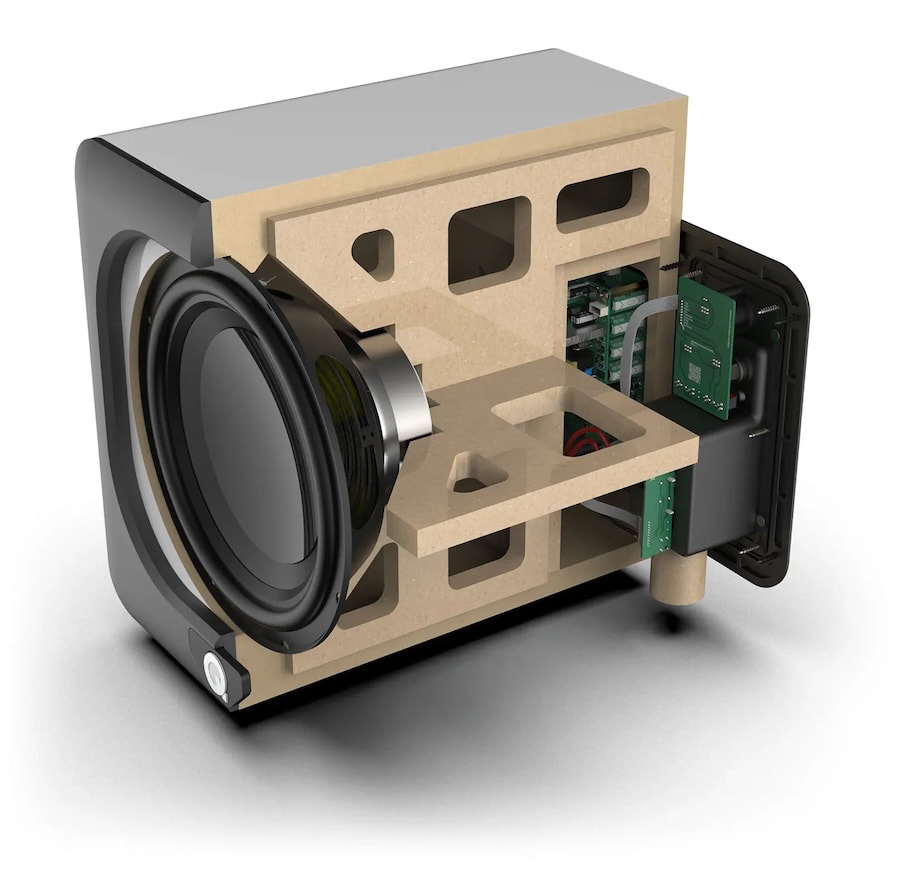

The Q SUB100’s 23.5-litre cabinet is constructed from 18mm high-density MDF, with a 36mm double-thickness front baffle to keep the enclosure from adding its own low-frequency commentary. Internal dart bracing further stiffens the structure and helps reduce cabinet “ballooning” under pressure. Q Acoustics has also paid attention to the less glamorous details: airtight amplifier mounting, a tightly secured 15mm MDF grille, and adjustable locking spikes with protective cups for leveling on hard floors.
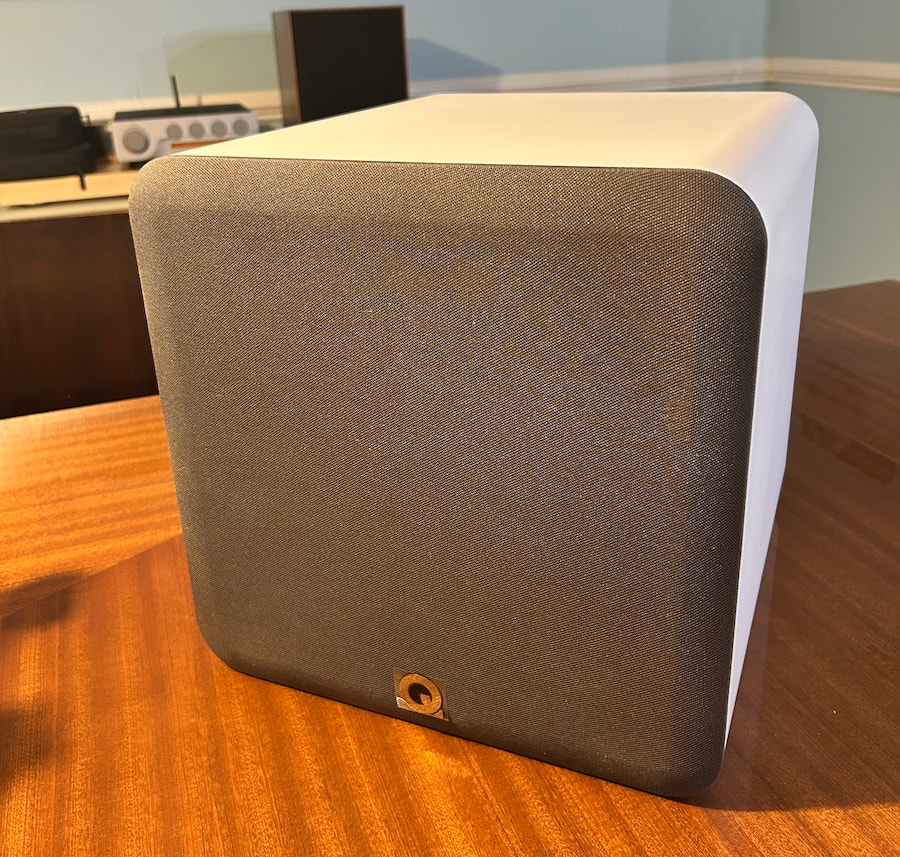
The Q SUB100 is available in Satin Black or Satin White, both of which suit its understated, clean-lined cabinet design and make it easier to integrate into a living room without looking like a misplaced PA speaker.
At 13.7 x 13.7 x 15 inches and 36.8 pounds, the Q SUB100 is not tiny, but it remains manageable enough for medium-sized rooms where a 12-inch subwoofer might start looking like a misplaced piece of airport infrastructure. Not looking at you Wilson Audio or McIntosh. Maybe just a little
A 10-Inch Driver Built for Control
The Q SUB100 employs a 254mm (10-inch) driver with a heavy-duty steel chassis, paper cone, and rubber surround. Paper remains an entirely sensible material for a subwoofer cone when properly engineered, combining low mass with the rigidity and damping needed for controlled, articulate bass.

A 38mm voice coil and aluminium demodulation ring are part of the design, with the latter intended to reduce distortion caused by changes in inductance as the driver moves through its travel. The goal is not simply more bass, but cleaner bass when the driver is working hard.
Q Acoustics rates the Q SUB100 down to 32Hz at -6dB, with a maximum SPL of 111dB at one metre. Those numbers suggest genuine low-frequency authority for music, television, and home theater in appropriately sized rooms, without promising that a compact 10-inch cabinet will recreate the seismic activity of Shore traffic driving through your living room.
DSP, Serious Power, and Easier System Integration
The Q SUB100’s custom amplifier module delivers 250 watts of continuous power and up to 500 watts peak. It uses four digital amplifier stages in a parallel bridge-tied load configuration, a design intended to reduce output impedance, improve driver control, and limit heat dissipation. Q Acoustics specifies total harmonic distortion at 0.09% at rated power.
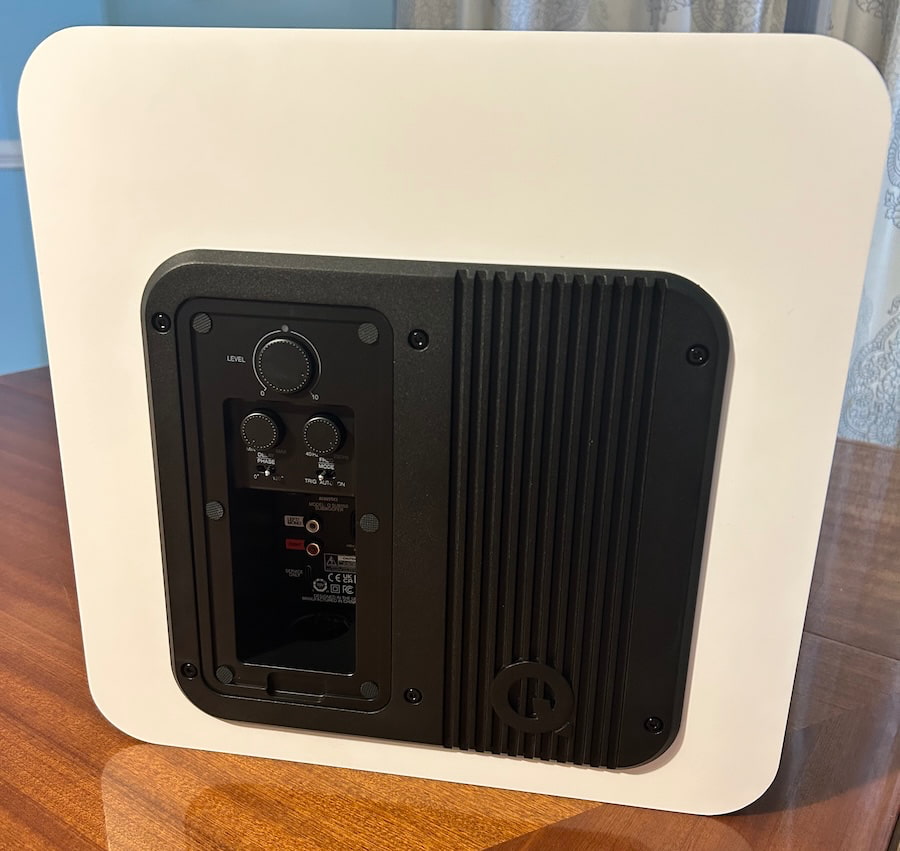
The DSP handles more than basic housekeeping. Along with helping shape the sealed enclosure’s response, it offers fine delay adjustment and a phase inversion switch to help the Q SUB100 integrate more cleanly with the main speakers. Its adjustable low-pass filter spans 40Hz to 250Hz, allowing it to work with everything from compact standmounts to active wireless speakers and home theater systems. Q Acoustics has also included source detection that identifies whether the incoming signal is stereo or mono and automatically adjusts gain accordingly.

What’s Missing: Room Correction, Wireless, and App Control
For all of the useful engineering inside the Q SUB100, there are a few omissions worth noting. The big one is automated room correction. Q Acoustics gives users DSP, phase inversion, fine delay adjustment, and a wide 40Hz to 250Hz low-pass filter range, but there is no supplied microphone-based calibration system to measure the room and smooth out bass peaks. In fairness, most subwoofers at this level still depend on the user, AVR, streaming amplifier, or external room correction platform to handle that job. Bass remains rude like that. Dirac to the rescue.
There is also no built-in wireless connectivity, which means the Q SUB100 still needs to be connected the old-fashioned way. That is hardly a tragedy, especially for users building a 2.1 or home theater system, but anyone hoping to hide the subwoofer across the room without running a cable will need to plan accordingly.
The other missing piece is deeper app-based control. A subwoofer with this much DSP potential would benefit from a proper control app with preset storage, parametric EQ, room-position presets, and easier fine tuning from the listening seat. Having to crouch behind a subwoofer while adjusting bass is one of those hi-fi rituals that makes non-audio people wonder if we have joined a small but expensive cult that enjoys arguing online about measurements and pretending that we have friends.

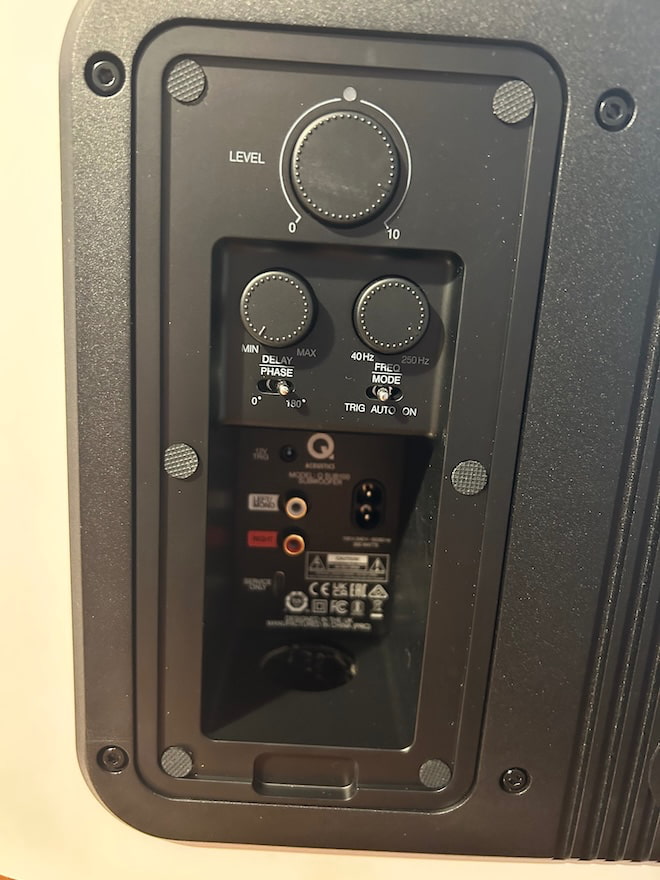
The Q SUB100 also omits high-level, or speaker-level, inputs of the type used by many of REL’s music-first subwoofers. REL’s approach uses a Neutrik Speakon connection tapped from the amplifier’s left and right speaker terminals, feeding the subwoofer the same signal received by the main speakers while placing virtually no additional load on the amplifier. REL argues that this preserves more of the system’s tonal character and timing cues, which is why the connection remains popular with two-channel listeners using integrated amplifiers without a dedicated subwoofer output.
Setup and Listening: Toronto, Two Subwoofers, and the First Complaint
My education in proper subwoofer setup began in the early 1990s, shortly after college, in my first apartment: a pre-war building in midtown Toronto with a 16 x 19 x 9-foot living room that was not acoustically disastrous, which already put it ahead of most rental properties and several respected listening rooms. The system was built around NHT’s original SuperZero mini-monitors and a pair of passive SW2 subwoofers driven by NHT’s MA-1 amplifier — the arrangement marketed as the SW2P powered subwoofer system.
I was also friends with Corey Greenberg, then of Stereophile, who sent me a pair of his homemade “Aunt Corey” high-pass filters. Inserted into the system, they kept the bottom octaves away from the tiny two-way NHTs and let the subwoofers handle the heavy lifting. That was not some occult audiophile ritual involving quartz blocks and a magical clock; it was simple, sensible bass management.
The difference was immediate. The SuperZeros sounded more open, the soundstage grew appreciably larger, and the system gained the weight and balance that my largely non-audiophile music collection required. Two subwoofers felt like the intelligent choice for a young man beginning his audiophile journey and already convinced that accurate bass mattered as much as a convincing midrange.
The flaw in this otherwise splendid plan was that bass does not respect property lines. It leaked into the flat next door, for which I still owe an apology to the former Minister of Justice, and annoyed the elderly gentleman downstairs, who had little patience for electronic music, new wave, or 11 p.m. sessions of 2112. Learning how to position, level-match, and properly integrate a subwoofer became less an audio hobby than an essential survival skill.
Jump ahead to 2026, and while subwoofers have remained part of my home theater systems for years, an aging REL T Series model has been my only regular partner for two-channel listening. It has survived moves from Toronto to New Jersey, down to Florida, and back to New Jersey again, which is more relocation experience than most touring bands and considerably more than I ever intended to inflict on a subwoofer.
That is about to change. Two of REL’s latest subwoofers, including one of the new Planar on-wall models, are scheduled to arrive for review in August. The timing is rather good, as I am moving into a new home office with enough flexibility to experiment properly with a smaller subwoofer positioned discreetly along a wall or mounted to it, without turning the room into a shrine to black boxes, power cords, and making it a target for Tyrion the Westie.
The Q SUB100 is also the sort of subwoofer that makes sense in that context. Its compact sealed cabinet should be easier to accommodate than a larger ported design, but the real question is whether it can provide the scale, weight, and integration that make a two-channel system sound more complete without announcing its existence every time the kick drum arrives.
Listening with the Q Acoustics 5040, M40, and 3020c

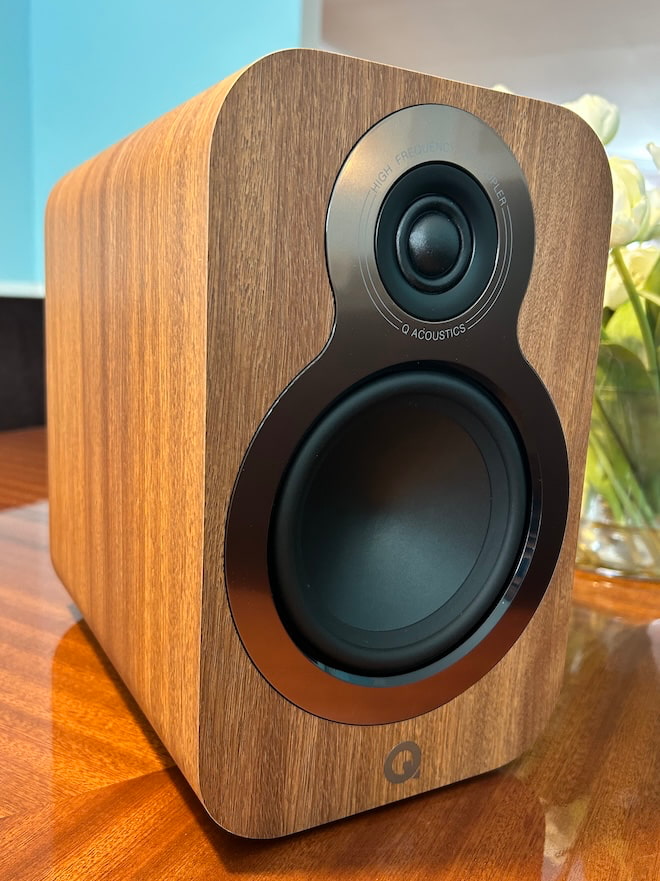
The Q SUB100 is not lightweight, and I put a small amount of Blu Tack beneath its feet and cup before placing it on the hardwood floor. My 16 x 13 x 9-foot den offers enough space to position a subwoofer two to three feet from the wall and clear of the corners, which matters. Experience has taught me that corner placement can overload this room rather quickly, especially with a subwoofer of this size.
The room also opens into the front foyer at one end and the kitchen at the other, adding a few more variables to the bass equation. Rooms, as ever, refuse to read the manual.
Before replacing my Magnepan LRS with the Q Acoustics speakers that I use daily, I spent some time moving the Q SUB100 forward and back in small increments until the balance finally locked in. The sweet spot was 24 inches from the wall behind it to the rear of the cabinet, and roughly 30 inches from the nearest sidewall.
That placement delivered the best balance of impact, speed, and integration with the main speakers. I went back and forth between the 5040, M40, and 3020c to find the most convincing blend; not because I enjoy moving a 37-pound subwoofer around the room for sport, but because subwoofer placement remains one of those things that either clicks or stubbornly refuses to.
Crossover settings were not identical across the three Q Acoustics systems. I settled on 80Hz with both the 3020c and 5040, which gave the Q SUB100 enough room to add real foundation without drawing attention to itself or thickening the midbass.


The M40 worked best with a lower 60Hz setting. Its dual 5-inch drivers already produce more bass weight than their compact micro tower proportions suggest, so crossing over any higher began to add more overlap than the system needed in my room. At 60Hz, the M40 retained its own quick, satisfying bass character, while the Q SUB100 handled the lowest octaves with greater authority and no obvious handoff between the speakers and subwoofer.
That is not a universal prescription. Room dimensions, placement, and the distance from the nearest wall still get the final vote, because bass remains the one part of hi-fi most likely to ignore both specifications and common decency.
The M40 offers a dedicated subwoofer input on the rear of its primary speaker, and there were moments when the move from 2.0 to 2.1 made the system considerably more engaging. That said, the M40 is not remotely lightweight in the bass department for a compact active speaker, and the Q SUB100 never felt as though it was trying to correct a deficiency. It simply gave the system more scale, weight, and low-end confidence when the recording called for it.
The tonal match with all three Q Acoustics models was exceptionally seamless. That matters because the newer 5040 and 3020c do bass differently from the older 3000 series: leaner, faster, and more clearly defined, with better control and less midbass warmth doing the heavy lifting. The Q SUB100 complemented that character rather than smothering it, adding impact and extension without turning the presentation into a thick mess.
From a cost perspective, the M40 and Q SUB100 feel like a slight mismatch; they strike me as products aimed at somewhat different buyers. The smaller and less expensive Q SUB80 is probably the more natural partner for Q Acoustics’ active wireless speaker, particularly in a compact room where the M40’s own surprising bass output already carries much of the load.
The 3020c is more affordable than the M40, but its likely owner is not necessarily the same customer. Paired with the Q SUB100, the 3020c sounds far more authoritative, gaining scale and low-frequency weight without losing the clarity and imaging that make it such a strong compact standmount. The 5040 benefits in a different way. Its wall-to-wall soundstage remains intact, but the system takes on the authority of a more powerful mid-level floorstander.
The subwoofer does not suddenly blow the soundstage through the walls, which would be awkward to explain to the insurance company and family, but it gives both speakers a greater sense of physical presence while allowing the midbass and upper bass to retain their impressive clarity, detail, and resolution.
Listening to Nick Cave’s “Avalanche” and “Comancheria” from Hell or High Water, a great film, the Q SUB100 added real weight to Cave’s piano. You could feel the instrument’s low register, while its natural decay remained intact. Just as importantly, his gravelly voice was never overwhelmed by the added bass below 80Hz.
The same held true with Jason Isbell, Bryan Ferry, and Roxy Music. Percussion and synthesizer lines hit with greater force, but there was no loss of definition or separation. The presentation sounded properly full range in the room rather than merely louder and thicker.
Electronic music had considerably more presence and definition. Deadmau5, Aphex Twin, The Orb, Kraftwerk, and Boards of Canada all benefited from the Q SUB100’s ability to deliver greater low end weight without blurring the rhythmic pulse or layering of the recordings. Synth lines reached some interesting club levels, briefly taking me back to Washington, D.C. in the 1990s, when I was a college student and certain establishments, along with certain nocturnal activities, are best left unnamed.
Talking Heads and Peter Gabriel were equally revealing. The bass lines hit harder, percussion gained more physical presence, and the system still retained the clarity that makes these recordings worth revisiting. I did not even bother reading my text messages from upstairs. Nothing you could say to the Rabbi.
Switching to movies and television, I have become slightly obsessed with The Pitt, A Knight of the Seven Kingdoms, and the latest season of Fauda. It is remarkable how much some shows leave on the table without a properly integrated subwoofer. The impact of weapons landing against a knight’s chest, charging horses, gunshots, frantic runs through hospital corridors, machine gun bursts, and cars racing down narrow streets all gained convincing weight and physical force.
The Q SUB100 did not turn every scene into a multiplex trailer mixed by someone with unresolved childhood issues. It simply filled in the low frequency information that smaller speakers cannot fully reproduce, making each sequence feel more immediate, tense, and involving.


The Bottom Line
Subwoofers are strange products. They have to reproduce the lowest octaves already present in the music or soundtrack without making a mess of everything else. Some do that far better than others. The Q SUB100 fills a major need within Q Acoustics’ own speaker lineup, and it does so very well.
Its sealed cabinet, useful DSP controls, compact footprint, and substantial 10-inch driver make it an especially effective match for the 3020c and 5040, adding scale, impact, and low frequency extension without clouding their excellent imaging or midbass clarity. It also works well in a home theater or television system, where its 250 watts of continuous power and 32Hz extension add genuine weight to action sequences without calling attention to themselves.
What it does not offer is equally clear: no automated room correction, app based EQ, wireless connectivity, or REL style high level input. Those omissions will matter to listeners with older two channel amplifiers, difficult rooms, or a strong preference for adjusting everything from the sofa.
The Q SUB100 is for Q Acoustics owners who want a serious, well controlled subwoofer for music, television, and movies, but do not need a larger 12-inch cabinet or a more elaborate calibration ecosystem. It is not inexpensive, but it sounds like a proper component rather than an obligatory black cube purchased to make explosions louder.
You might want to put your text messages on silent mode before using it. The people around you may become rather animated once the walls begin contributing to the conversation.
Pros:
- Deep, controlled bass with strong definition and convincing impact
- Seamless tonal match with the Q Acoustics 3020c, 5040, and M40
- Sealed cabinet offers easier placement than many ported alternatives
- Excellent blend of speed, scale, and low frequency weight for music
- Adds real authority to movies, television, and gaming without muddying dialogue
- Solid construction, useful DSP controls, and adjustable crossover settings
- Compact enough for medium sized rooms without looking like a small appliance
Cons:
- No high level speaker inputs for REL style two channel integration
- No app control, parametric EQ, or automated room correction
- No built in wireless option
- Heavy enough to make repeated placement experiments less charming
- Q SUB80 may be the more sensible match for the less expensive M40
- Premium price places it above many buyers’ expected subwoofer budget
Our Ratings
★★★★★★★★★★ Bass Quality
★★★★★★★★★★ Build Quality
★★★★★★★★★★ Features
★★★★★★★★★★ Value
You must be logged in to post a comment Login