
TL;DR
Anthropic is discussing a custom AI chip with Samsung, though the project is early-stage and no design has been finalized.



Q Acoustics has spent the past three years methodically rebuilding its loudspeaker lineup, and the new Q SUB100 subwoofer is the long overdue final piece of that puzzle. The 5000 series raised the company’s game in the affordable high end category, while the newer 3000c series brought genuine refinement to the budget end of the market. The excellent 3020c proved that a compact standmount can still deliver real musical substance without forcing a yard sale of older hi-fi purchases or a sternly worded note from the HOA.
Please, Mrs. Cohen, do not make me pace the patio in a Speedo while listening to Aphex Twin outdoors; the neighbourhood has already endured enough.
The Q Acoustics M40 also earned our Editor’s Choice Award as one of the better wireless speaker systems available, and it remains an appealing foundation for a compact 2.1 system in rooms where space is at a premium. Add a capable subwoofer, however, and that modest-looking system can become something far more complete for music, movies, television, and late-night sessions; right until the neighbours respond by banging on the wall like Keith Moon has risen from the dead and taken up residence next door. Keep your bass handy for the Entwistle comeback.
That missing low-frequency component has been the one obvious hole in the Q Acoustics catalog. The new Q SUB Series finally addresses it with three active subwoofers: the 8-inch Q SUB80 ($1,099), 10-inch Q SUB100 ($1,199), and flagship 12-inch Q SUB120 ($1,399).
The Q SUB100 is likely to be the sweet spot of the range. Its 10-inch driver, compact sealed enclosure, and 300-watt amplification promise enough authority for medium-sized rooms and properly assembled 2.1 or home-theater systems, without requiring the floor space, financial commitment, or structural reinforcement associated with a larger subwoofer.
It is the model most likely to appeal to Q Acoustics owners who want deeper, more convincing bass but have no desire to turn the living room into a local World Cup watch party, complete with 14 people shouting at the referee and one bloke treating every corner kick like the Normandy landings.
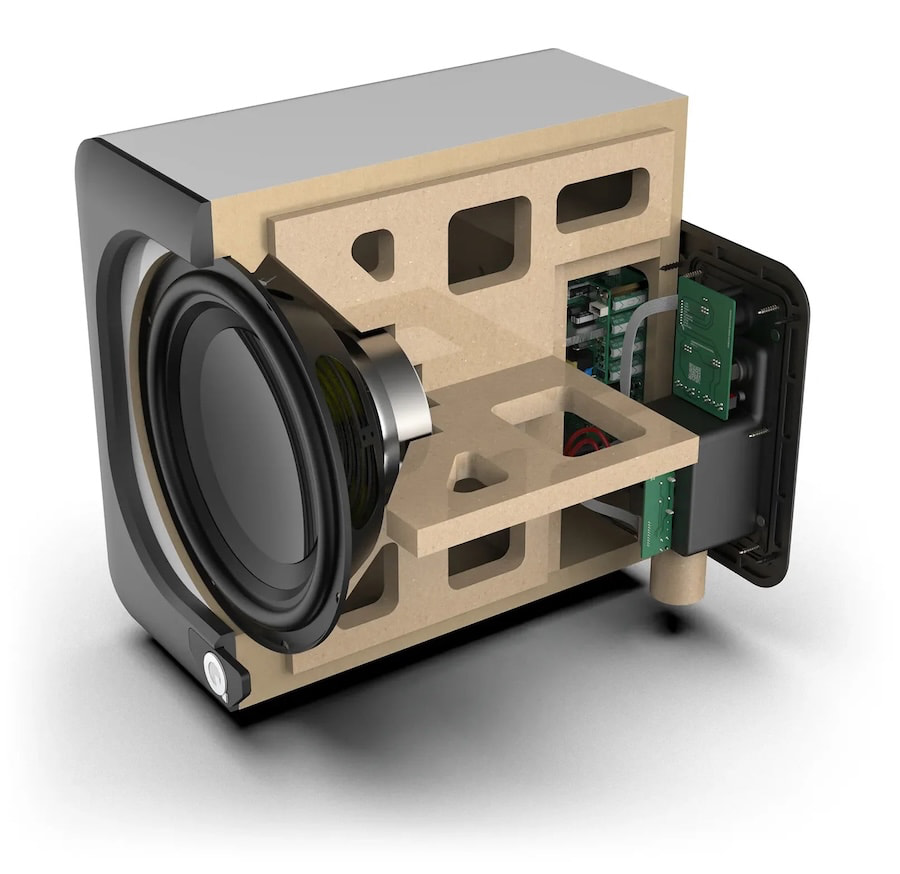
The Q Acoustics Q SUB100 uses a sealed, or “infinite baffle,” enclosure rather than a ported cabinet. That matters because a properly executed sealed design generally favors tighter, more controlled bass, while giving the onboard DSP a more predictable platform from which to work. It is also a more forgiving approach for real rooms, where subwoofers often end up near a wall or corner out of necessity.
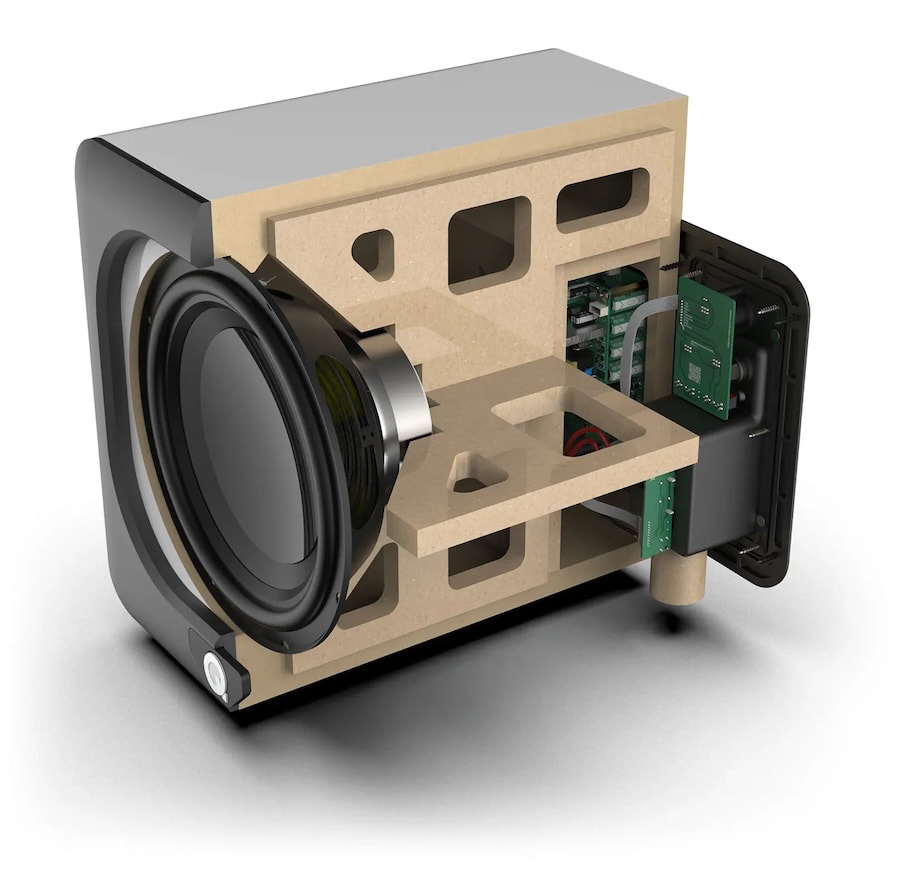
The Q SUB100’s 23.5-litre cabinet is constructed from 18mm high-density MDF, with a 36mm double-thickness front baffle to keep the enclosure from adding its own low-frequency commentary. Internal dart bracing further stiffens the structure and helps reduce cabinet “ballooning” under pressure. Q Acoustics has also paid attention to the less glamorous details: airtight amplifier mounting, a tightly secured 15mm MDF grille, and adjustable locking spikes with protective cups for leveling on hard floors.
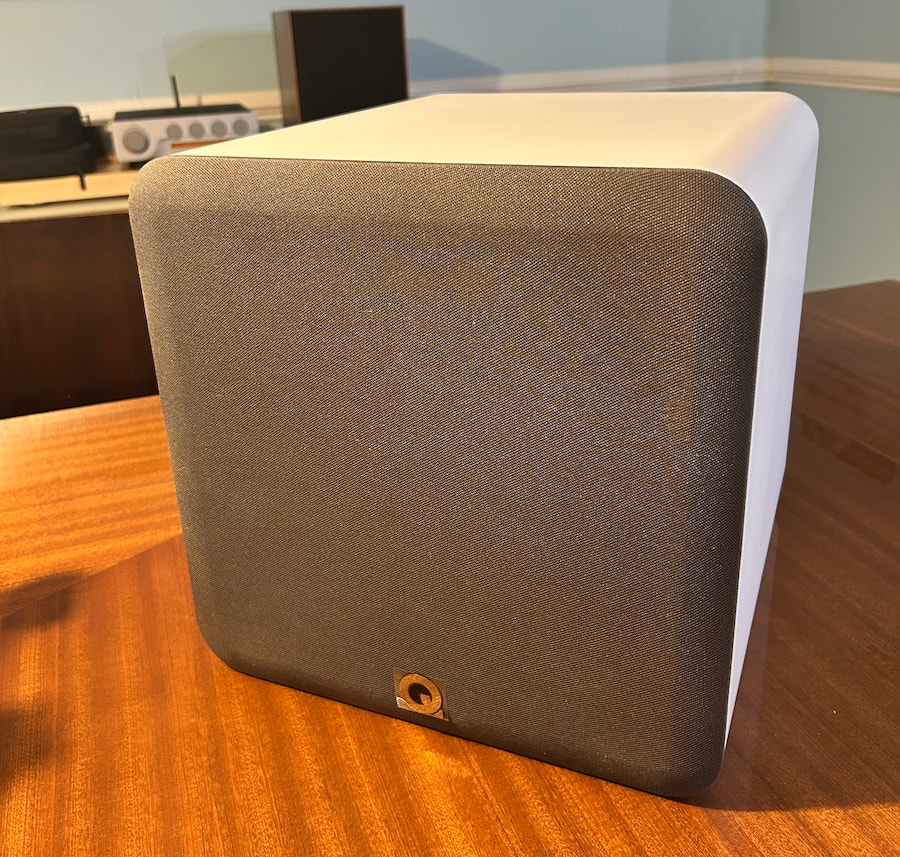
The Q SUB100 is available in Satin Black or Satin White, both of which suit its understated, clean-lined cabinet design and make it easier to integrate into a living room without looking like a misplaced PA speaker.
At 13.7 x 13.7 x 15 inches and 36.8 pounds, the Q SUB100 is not tiny, but it remains manageable enough for medium-sized rooms where a 12-inch subwoofer might start looking like a misplaced piece of airport infrastructure. Not looking at you Wilson Audio or McIntosh. Maybe just a little
The Q SUB100 employs a 254mm (10-inch) driver with a heavy-duty steel chassis, paper cone, and rubber surround. Paper remains an entirely sensible material for a subwoofer cone when properly engineered, combining low mass with the rigidity and damping needed for controlled, articulate bass.
A 38mm voice coil and aluminium demodulation ring are part of the design, with the latter intended to reduce distortion caused by changes in inductance as the driver moves through its travel. The goal is not simply more bass, but cleaner bass when the driver is working hard.
Q Acoustics rates the Q SUB100 down to 32Hz at -6dB, with a maximum SPL of 111dB at one metre. Those numbers suggest genuine low-frequency authority for music, television, and home theater in appropriately sized rooms, without promising that a compact 10-inch cabinet will recreate the seismic activity of Shore traffic driving through your living room.
The Q SUB100’s custom amplifier module delivers 250 watts of continuous power and up to 500 watts peak. It uses four digital amplifier stages in a parallel bridge-tied load configuration, a design intended to reduce output impedance, improve driver control, and limit heat dissipation. Q Acoustics specifies total harmonic distortion at 0.09% at rated power.
The DSP handles more than basic housekeeping. Along with helping shape the sealed enclosure’s response, it offers fine delay adjustment and a phase inversion switch to help the Q SUB100 integrate more cleanly with the main speakers. Its adjustable low-pass filter spans 40Hz to 250Hz, allowing it to work with everything from compact standmounts to active wireless speakers and home theater systems. Q Acoustics has also included source detection that identifies whether the incoming signal is stereo or mono and automatically adjusts gain accordingly.
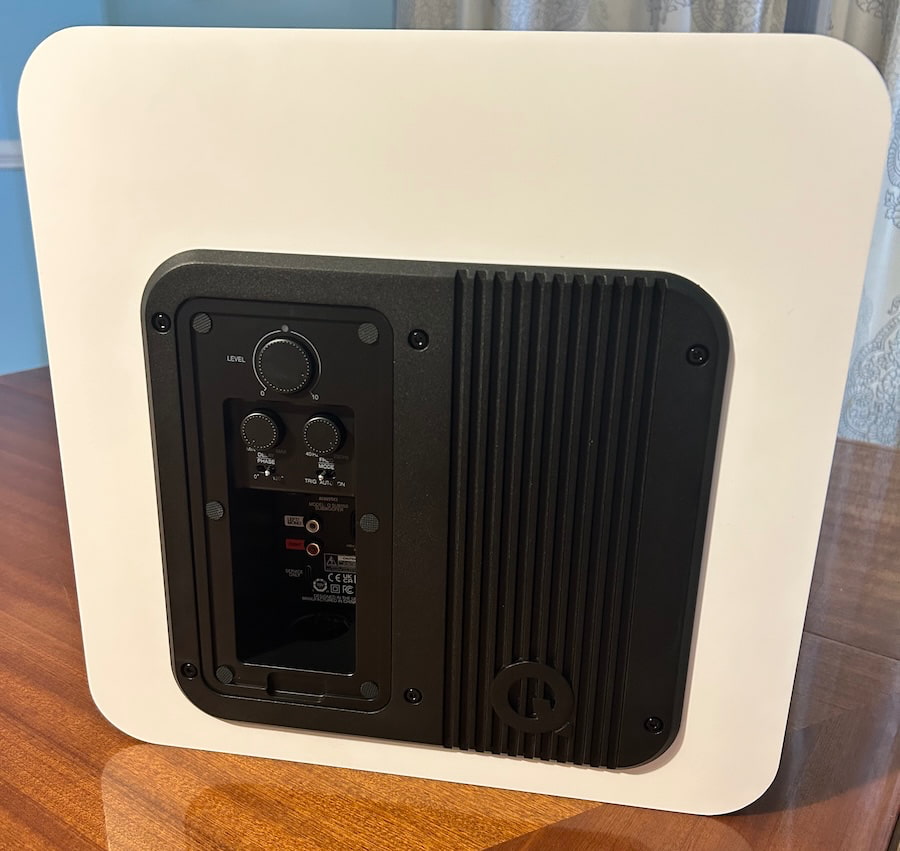
For all of the useful engineering inside the Q SUB100, there are a few omissions worth noting. The big one is automated room correction. Q Acoustics gives users DSP, phase inversion, fine delay adjustment, and a wide 40Hz to 250Hz low-pass filter range, but there is no supplied microphone-based calibration system to measure the room and smooth out bass peaks. In fairness, most subwoofers at this level still depend on the user, AVR, streaming amplifier, or external room correction platform to handle that job. Bass remains rude like that. Dirac to the rescue.
There is also no built-in wireless connectivity, which means the Q SUB100 still needs to be connected the old-fashioned way. That is hardly a tragedy, especially for users building a 2.1 or home theater system, but anyone hoping to hide the subwoofer across the room without running a cable will need to plan accordingly.
The other missing piece is deeper app-based control. A subwoofer with this much DSP potential would benefit from a proper control app with preset storage, parametric EQ, room-position presets, and easier fine tuning from the listening seat. Having to crouch behind a subwoofer while adjusting bass is one of those hi-fi rituals that makes non-audio people wonder if we have joined a small but expensive cult that enjoys arguing online about measurements and pretending that we have friends.
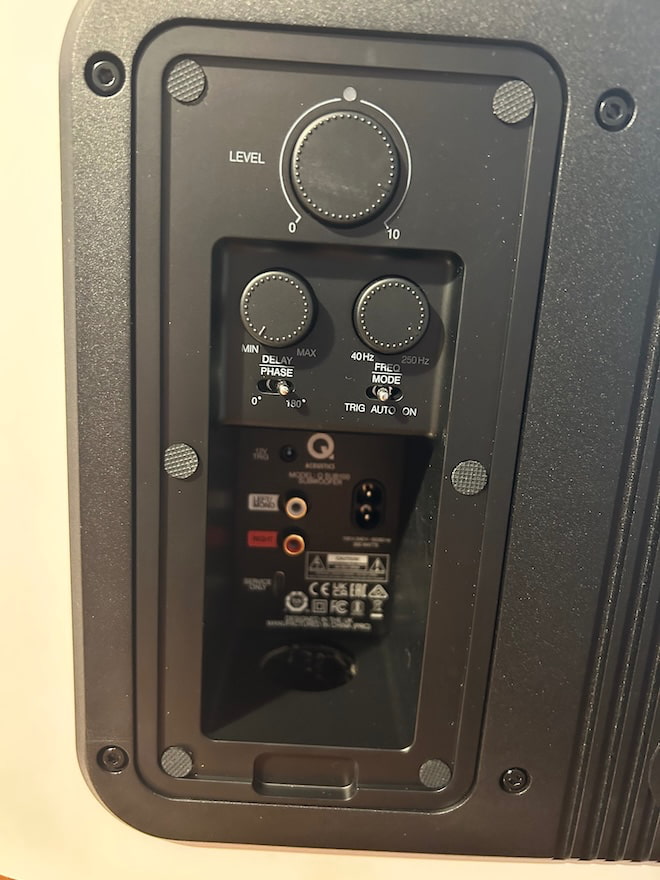
The Q SUB100 also omits high-level, or speaker-level, inputs of the type used by many of REL’s music-first subwoofers. REL’s approach uses a Neutrik Speakon connection tapped from the amplifier’s left and right speaker terminals, feeding the subwoofer the same signal received by the main speakers while placing virtually no additional load on the amplifier. REL argues that this preserves more of the system’s tonal character and timing cues, which is why the connection remains popular with two-channel listeners using integrated amplifiers without a dedicated subwoofer output.
My education in proper subwoofer setup began in the early 1990s, shortly after college, in my first apartment: a pre-war building in midtown Toronto with a 16 x 19 x 9-foot living room that was not acoustically disastrous, which already put it ahead of most rental properties and several respected listening rooms. The system was built around NHT’s original SuperZero mini-monitors and a pair of passive SW2 subwoofers driven by NHT’s MA-1 amplifier — the arrangement marketed as the SW2P powered subwoofer system.
I was also friends with Corey Greenberg, then of Stereophile, who sent me a pair of his homemade “Aunt Corey” high-pass filters. Inserted into the system, they kept the bottom octaves away from the tiny two-way NHTs and let the subwoofers handle the heavy lifting. That was not some occult audiophile ritual involving quartz blocks and a magical clock; it was simple, sensible bass management.
The difference was immediate. The SuperZeros sounded more open, the soundstage grew appreciably larger, and the system gained the weight and balance that my largely non-audiophile music collection required. Two subwoofers felt like the intelligent choice for a young man beginning his audiophile journey and already convinced that accurate bass mattered as much as a convincing midrange.
The flaw in this otherwise splendid plan was that bass does not respect property lines. It leaked into the flat next door, for which I still owe an apology to the former Minister of Justice, and annoyed the elderly gentleman downstairs, who had little patience for electronic music, new wave, or 11 p.m. sessions of 2112. Learning how to position, level-match, and properly integrate a subwoofer became less an audio hobby than an essential survival skill.
Jump ahead to 2026, and while subwoofers have remained part of my home theater systems for years, an aging REL T Series model has been my only regular partner for two-channel listening. It has survived moves from Toronto to New Jersey, down to Florida, and back to New Jersey again, which is more relocation experience than most touring bands and considerably more than I ever intended to inflict on a subwoofer.
That is about to change. Two of REL’s latest subwoofers, including one of the new Planar on-wall models, are scheduled to arrive for review in August. The timing is rather good, as I am moving into a new home office with enough flexibility to experiment properly with a smaller subwoofer positioned discreetly along a wall or mounted to it, without turning the room into a shrine to black boxes, power cords, and making it a target for Tyrion the Westie.
The Q SUB100 is also the sort of subwoofer that makes sense in that context. Its compact sealed cabinet should be easier to accommodate than a larger ported design, but the real question is whether it can provide the scale, weight, and integration that make a two-channel system sound more complete without announcing its existence every time the kick drum arrives.
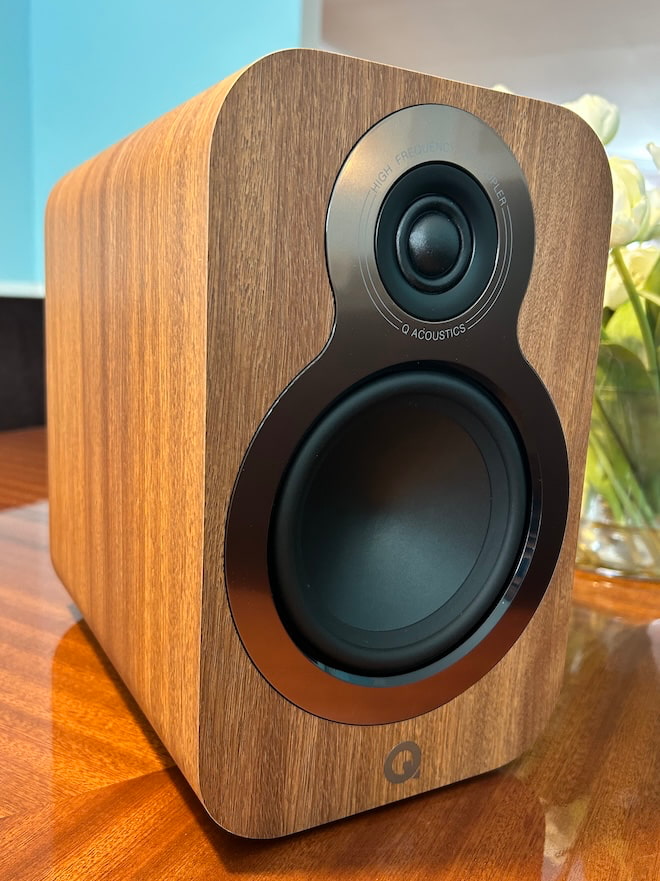
The Q SUB100 is not lightweight, and I put a small amount of Blu Tack beneath its feet and cup before placing it on the hardwood floor. My 16 x 13 x 9-foot den offers enough space to position a subwoofer two to three feet from the wall and clear of the corners, which matters. Experience has taught me that corner placement can overload this room rather quickly, especially with a subwoofer of this size.
The room also opens into the front foyer at one end and the kitchen at the other, adding a few more variables to the bass equation. Rooms, as ever, refuse to read the manual.
Before replacing my Magnepan LRS with the Q Acoustics speakers that I use daily, I spent some time moving the Q SUB100 forward and back in small increments until the balance finally locked in. The sweet spot was 24 inches from the wall behind it to the rear of the cabinet, and roughly 30 inches from the nearest sidewall.
That placement delivered the best balance of impact, speed, and integration with the main speakers. I went back and forth between the 5040, M40, and 3020c to find the most convincing blend; not because I enjoy moving a 37-pound subwoofer around the room for sport, but because subwoofer placement remains one of those things that either clicks or stubbornly refuses to.
Crossover settings were not identical across the three Q Acoustics systems. I settled on 80Hz with both the 3020c and 5040, which gave the Q SUB100 enough room to add real foundation without drawing attention to itself or thickening the midbass.

The M40 worked best with a lower 60Hz setting. Its dual 5-inch drivers already produce more bass weight than their compact micro tower proportions suggest, so crossing over any higher began to add more overlap than the system needed in my room. At 60Hz, the M40 retained its own quick, satisfying bass character, while the Q SUB100 handled the lowest octaves with greater authority and no obvious handoff between the speakers and subwoofer.
That is not a universal prescription. Room dimensions, placement, and the distance from the nearest wall still get the final vote, because bass remains the one part of hi-fi most likely to ignore both specifications and common decency.
The M40 offers a dedicated subwoofer input on the rear of its primary speaker, and there were moments when the move from 2.0 to 2.1 made the system considerably more engaging. That said, the M40 is not remotely lightweight in the bass department for a compact active speaker, and the Q SUB100 never felt as though it was trying to correct a deficiency. It simply gave the system more scale, weight, and low-end confidence when the recording called for it.
The tonal match with all three Q Acoustics models was exceptionally seamless. That matters because the newer 5040 and 3020c do bass differently from the older 3000 series: leaner, faster, and more clearly defined, with better control and less midbass warmth doing the heavy lifting. The Q SUB100 complemented that character rather than smothering it, adding impact and extension without turning the presentation into a thick mess.
From a cost perspective, the M40 and Q SUB100 feel like a slight mismatch; they strike me as products aimed at somewhat different buyers. The smaller and less expensive Q SUB80 is probably the more natural partner for Q Acoustics’ active wireless speaker, particularly in a compact room where the M40’s own surprising bass output already carries much of the load.
The 3020c is more affordable than the M40, but its likely owner is not necessarily the same customer. Paired with the Q SUB100, the 3020c sounds far more authoritative, gaining scale and low-frequency weight without losing the clarity and imaging that make it such a strong compact standmount. The 5040 benefits in a different way. Its wall-to-wall soundstage remains intact, but the system takes on the authority of a more powerful mid-level floorstander.
The subwoofer does not suddenly blow the soundstage through the walls, which would be awkward to explain to the insurance company and family, but it gives both speakers a greater sense of physical presence while allowing the midbass and upper bass to retain their impressive clarity, detail, and resolution.
Listening to Nick Cave’s “Avalanche” and “Comancheria” from Hell or High Water, a great film, the Q SUB100 added real weight to Cave’s piano. You could feel the instrument’s low register, while its natural decay remained intact. Just as importantly, his gravelly voice was never overwhelmed by the added bass below 80Hz.
The same held true with Jason Isbell, Bryan Ferry, and Roxy Music. Percussion and synthesizer lines hit with greater force, but there was no loss of definition or separation. The presentation sounded properly full range in the room rather than merely louder and thicker.
Electronic music had considerably more presence and definition. Deadmau5, Aphex Twin, The Orb, Kraftwerk, and Boards of Canada all benefited from the Q SUB100’s ability to deliver greater low end weight without blurring the rhythmic pulse or layering of the recordings. Synth lines reached some interesting club levels, briefly taking me back to Washington, D.C. in the 1990s, when I was a college student and certain establishments, along with certain nocturnal activities, are best left unnamed.
Talking Heads and Peter Gabriel were equally revealing. The bass lines hit harder, percussion gained more physical presence, and the system still retained the clarity that makes these recordings worth revisiting. I did not even bother reading my text messages from upstairs. Nothing you could say to the Rabbi.
Switching to movies and television, I have become slightly obsessed with The Pitt, A Knight of the Seven Kingdoms, and the latest season of Fauda. It is remarkable how much some shows leave on the table without a properly integrated subwoofer. The impact of weapons landing against a knight’s chest, charging horses, gunshots, frantic runs through hospital corridors, machine gun bursts, and cars racing down narrow streets all gained convincing weight and physical force.
The Q SUB100 did not turn every scene into a multiplex trailer mixed by someone with unresolved childhood issues. It simply filled in the low frequency information that smaller speakers cannot fully reproduce, making each sequence feel more immediate, tense, and involving.

Subwoofers are strange products. They have to reproduce the lowest octaves already present in the music or soundtrack without making a mess of everything else. Some do that far better than others. The Q SUB100 fills a major need within Q Acoustics’ own speaker lineup, and it does so very well.
Its sealed cabinet, useful DSP controls, compact footprint, and substantial 10-inch driver make it an especially effective match for the 3020c and 5040, adding scale, impact, and low frequency extension without clouding their excellent imaging or midbass clarity. It also works well in a home theater or television system, where its 250 watts of continuous power and 32Hz extension add genuine weight to action sequences without calling attention to themselves.
What it does not offer is equally clear: no automated room correction, app based EQ, wireless connectivity, or REL style high level input. Those omissions will matter to listeners with older two channel amplifiers, difficult rooms, or a strong preference for adjusting everything from the sofa.
The Q SUB100 is for Q Acoustics owners who want a serious, well controlled subwoofer for music, television, and movies, but do not need a larger 12-inch cabinet or a more elaborate calibration ecosystem. It is not inexpensive, but it sounds like a proper component rather than an obligatory black cube purchased to make explosions louder.
You might want to put your text messages on silent mode before using it. The people around you may become rather animated once the walls begin contributing to the conversation.
★★★★★★★★★★ Bass Quality
★★★★★★★★★★ Build Quality
★★★★★★★★★★ Features
★★★★★★★★★★ Value


Researchers from LayerX recently unveiled BioShocking, a new type of vulnerability designed to target AI-powered browsers capable of executing autonomous tasks on the open web. The security firm explained that BioShocking can “game” an AI-based browser, causing the system to execute malicious instructions after effectively bypassing its intended security guardrails.
Read Entire Article
Source link

In the wake of the Sprint T-Mobile merger, wireless carriers immediately stopped trying to compete on price (exactly what deal critics had warned would happen when you reduce sector competition). T-Mobile, which once tried to differentiate itself as the consumer-friendly “uncarrier,” almost immediately began behaving just like AT&T and Verizon, starting with firing 9,000+ people.
It’s how mindless and harmful consolidation always works. We know this, there’s endless evidence of this, and somehow it never seems to matter in a country too corrupt to function.
In the last few years, T-Mobile’s been facing lawsuits and consumer blowback because it’s constantly jacking up the price for customers who believed they were under a “price lock” guarantee thanks to a 7-year-old promotion promising that their price would never change.
More recently, T-Mobile announced it would be kicking roughly 8 million subscribers off of their traditional (and often cheaper plans), and onto more expensive and shittier new T-Mobile plans. These new price hikes have joined a bunch of other price hikes to make everybody’s bills significantly more expensive and all of their connections less feature rich and useful:
T-Mobile frames the current migration as an average $4-per-line adjustment, according to CNET. That sounds modest until you stack it on the $5-per-line hike that already hit many legacy smartphone plans back in April 2025. PhoneArena reports some customers on older grandfathered plans face total increases approaching 60% compared to their original rates. Meanwhile, administrative fees for voice lines climbed from $3.99 to $4.49 per month — raised twice within a single year, according to tmo.report — with mobile internet line fees moving from $1.60 to $2.10.
This must be more of that deregulatory, consolidative innovation my Libertarian friends at “non profit” “free market” “think tanks” have spent years telling me about.
This was, of course, something merger critics warned about, very vocally, for a long time. I wrote repeatedly, at multiple outlets, about how this deal’s pre-merger promises were utterly worthless. It didn’t matter, because the federal government is too corrupt to function in the public interest, antitrust reform no longer exists, and the electorate very clearly has a head full of cottage cheese.
Meanwhile all the folks responsible — whether corrupt politicians, shitty Libertarian free market think tanks, or cocky executives — have long-since moved on to other terrible ideas and memory holed the entire thing, while consumers and labor — as always — are forced to eat all of the real-world costs.
Anyway, remember when T-Mobile bribed Trump to get the merger approved, eliminated all of its “DEI” requirements like an obedient poodle, or that time they hired Corey Lewandowski as a consultant just days after he mocked a Down Syndrome kid on cable TV? Great stuff. So many memories.
Filed Under: competition, consolidation, enshittification, john legere, layoffs, mergers, price hikes, prices, telecom, wireless
Companies: t-mobile


Anthropic is discussing a custom AI chip with Samsung, though the project is early-stage and no design has been finalized.
Anthropic is in talks with Samsung Electronics to explore manufacturing a custom AI chip, The Information reported on Thursday. The project remains at an early stage, and Anthropic has not yet decided what the chip would be used for, how powerful it would be, or how it would fit into a server, according to the report. The company could still abandon the effort entirely.
When asked for comment, Anthropic told TechCrunch that a diversified hardware stack including chips from Google, Amazon, and Nvidia will continue to be central to its compute strategy, and said it had nothing further to add on the Samsung discussions. Samsung already plays a significant role in the AI chip supply chain as a major manufacturing partner for Nvidia, producing chips that power AI training and inference workloads. The two companies are also building an AI chip factory together in South Korea.
The talks follow a Reuters report in April that Anthropic was exploring the idea of building its own chips as Claude’s compute demands outpaced available supply. At the time, the effort was described as preliminary, with no dedicated team assembled and no commitment to a specific design. What has changed since April is that Anthropic has hired Clive Chan, who previously helped build OpenAI’s custom chip programme, a signal that the company is moving from exploration to active development.
The timing also coincides with a move by Anthropic’s main competitor. Last week, OpenAI unveiled its first custom chip, a Broadcom-built inference processor it calls the “Intelligence Processor,” designed to reduce the company’s dependence on Nvidia hardware. Amazon and Google both already offer their own custom silicon through their cloud platforms, and Anthropic currently runs Claude across all three chip families.
Anthropic’s annualized revenue run rate surpassed 30 billion dollars earlier this year, more than tripling from roughly nine billion dollars at the end of 2025, a growth rate that makes the economics of custom silicon increasingly attractive. The company signed a long-term deal with Google and Broadcom in April for roughly three and a half gigawatts of TPU compute starting in 2027, but designing its own chips would give it an additional layer of control over the hardware that runs its models. Whether Samsung or another manufacturer ultimately builds a chip for Anthropic remains an open question, but the direction of travel across the industry, away from total reliance on Nvidia, is now unmistakable.


Nick Parker, a 26-year Microsoft veteran who led the company’s worldwide commercial sales business, is leaving to become Nvidia’s new sales chief — a high-profile talent shift between two of the biggest players in the AI boom.
Parker will join Nvidia as executive vice president of worldwide field operations, effective Aug. 24, according to a regulatory filing. He succeeds Jay Puri, who is retiring after 21 years running Nvidia’s global sales operation and will stay on as a senior adviser.
“Microsoft and NVIDIA are great partners and I look forward to continuing to nurture that fantastic relationship,” Parker wrote in a LinkedIn post announcing the move.
The regulatory filing by Nvidia sets Parker’s base salary in the new role at $1 million, with a $5 million signing bonus and equity grants targeted at $40 million. The bulk of that, $35 million in restricted stock units, vests over roughly four years, while the additional $5 million in shares is tied to Nvidia outperforming the S&P 500 over three years.
The new role puts him in charge of global sales and customer relationships at the center of the AI boom, reporting directly to Nvidia CEO Jensen Huang — one of the most consequential commercial roles in the industry, overseeing the operation that sells Nvidia’s chips to the world’s largest companies.
Parker, 55, rose through OEM, device and partner sales roles at Microsoft before being named president of industry and partner sales in 2022. After a promotion this year, he served most recently as executive vice president and chief business officer of Microsoft Worldwide Sales & Solutions, reporting to Judson Althoff, CEO of Microsoft’s commercial business.
Puri, 71, is credited with helping transform Nvidia from a consumer gaming brand into an AI infrastructure giant, building the enterprise sales operation Parker will now inherit.
On Thursday, Microsoft unveiled a $2.5 billion initiative called the Microsoft Frontier Company, which will embed AI engineers inside customers. It will be led by Rodrigo Kede Lima, a longtime Microsoft sales and enterprise leader, most recently president of Microsoft Asia.

Samsung has unveiled what it says is the industry’s first look at UFS 5.0, a new storage standard for its customers.
The memory and storage giant unveiled its new storage chip on the 23rd of June while positioning its embedded storage standard as an important breakthrough for localized, or on-device, AI solutions.
Samsung claims its chips are based on the standard feature a sequential read speed of up to 10.8 GB/s and a sequential write speed of up to 9.5 GB/s, making them more than twice as fast as the previously mainstream UFS standard, which clocks in at 4.2 GB/s and 2.8GB/s respectively.
Samsung’s latest offering isn’t just an iterative upgrade in raw speeds compared to past generations; it sets the stage for devices that have yet to come as the world grapples with the need for on-device AI solutions, even as demand for more localized solutions dwarfs expectations among many manufacturers.
With generative AI often leveraging fast NAND flash as a substitute for relatively more expensive DRAM even as smartphones and computers are increasingly hit by rising prices for both components, Samsung’s UFS 5.0-based offering fills an important gap for many of its OEM customers as well as its own smart devices lineup.
“In the era of on-device AI, storage devices are evolving into a key driver defining AI experiences,” noted Jangseok Choi, head of Memory Product Planning at Samsung Electronics.
“As we successfully move beyond the development stage of the industry’s first UFS 5.0 solution, Samsung is setting a new standard for storage on the go and will continue to drive innovation for the next-generation mobile platform market.”
As AI solutions range from hyperscalers to things smaller than smartwatches, Samsung’s offering becomes even more important. The package for its solution is 16.7% smaller than its previous-generation offering, measuring just 7.5mm x 13mm x 0.9mm, or smaller than most people’s fingernails.
Samsung’s most important achievement, however, might be the 40% power efficiency it claims to offer compared to its new chip’s predecessor, while delivering speeds that effectively make its solution viable for most local models to run on.
With Samsung touting 5x faster random read speeds, it is clear that it is aiming to position its upcoming UFS module as a de facto solution for downstream AI inference, and it could pose a very real threat to some of the most powerful NVMe SSD drives out there.

Follow TechRadar on Google News and add us as a preferred source to get our expert news, reviews, and opinion in your feeds.


Right before crowds across the country prepare to mark the Fourth of July with displays of light and sound, NASA’s James Webb Space Telescope offered a view from far beyond Earth that carries a similar sense of energy and new activity. Two protostars in the FS Tau system sit near the center of the frame. Both remain young enough that they still draw in gas and dust while pushing excess material outward through strong flows.

One of the two shoots off large orange streams that fan out and become entangled in the surrounding cloud. These streams compress the gas and dust, resulting in ridges visible in lighter blue where the material has been pushed together like a big cosmic bulldozer. Looking at the stars in near infrared light (thanks to Webb) provides insight into what is truly going on. The activity was invisible in visible light because of the dust, but infrared allows us to discern the form of the flows and textures in the cloud surrounding the primary stars in much greater detail.

In the background, you can see faraway galaxies of various colors. Some are jumbled and appear redder because there is a lot of dust in their path. Others have a clear path to the camera and sparkle in yellow or white tones. They appear to be dispersed around the area, with brilliant spots sporadically appearing.

The decision to release the image on July 2 was wise, as it coincides with a holiday in a year when the country is commemorating a significant milestone of its founding. Many people will be staring up at the sky soon, watching all of the amazing fireworks and bursts, as it is a perfect moment to reflect on the history of the area. Systems like this one are extremely beneficial for researchers because they allow them to observe how lower mass stars originate in a non-overwhelming manner. Everything stays clean and clear, allowing you to observe what’s going on and track changes over time.

The obvious gaps in the orange streams are quite telling, as it appears that the material is dragged in and then blown out in stages rather than all at once. Webb continues to return to places like FS Tau because each encounter adds another brick to the understanding wall that transforms simple clouds into stars and planets.


For most Singaporeans, Raffles Medical is a familiar name. The healthcare group has built a reputation as one of Singapore’s most established private medical providers.
But behind the scenes, the company has spent the last decade chasing a much bigger ambition.
Rather than remaining a Singapore-focused healthcare operator, Raffles Medical wanted to become a regional healthcare brand—one with hospitals and clinics stretching across Asia.
It was a bold strategy. And an expensive one.
In 2016, the group announced plans to pour around S$600 million into expanding overseas, building hospitals and clinics overseas with China as its biggest bet.
Today, however, that investment still hasn’t translated into equally impressive financial returns. While its Singapore operations are well-established and consistently profitable, its sizeable investment in China continues to lag behind.

Back in the mid-2010s, expanding into China seemed like the logical move.
The country’s population was ageing, disposable incomes were rising, and healthcare reforms were gradually opening the door to private healthcare providers.
For firms like Raffles Medical, the opportunity looked enormous.
The company wasn’t rushing into an unfamiliar market either.
According to management, senior executives had spent more than 30 years observing China’s healthcare reforms before deciding the timing was finally right to enter the country.
Rather than stopping at outpatient clinics, Raffles Medical doubled down on its China ambitions by investing in full-service hospitals.

It opened a 700-bed international tertiary hospital in Chongqing in 2019, followed by a 400-bed tertiary hospital in Shanghai in 2021. Around the same time, it also upgraded its existing Beijing medical centre into Raffles Hospital Beijing, expanding its services to include inpatient and emergency care.
Together, the projects required years of planning, construction, regulatory approvals, specialist recruitment and investment in medical equipment before they could even begin seeing patients.
Unlike retail stores or restaurants, hospitals can’t simply open their doors and expect customers to flood in.
Patients need to trust the brand. Doctors need to establish referral networks. Insurance partnerships have to be secured. Operating theatres, diagnostic equipment and inpatient wards all have to be utilised before a hospital starts generating meaningful profits.
In other words, healthcare is a long game.

That long game is becoming increasingly visible in Raffles Medical’s financials.
Ahead of its 2026 AGM, shareholders questioned why China’s business had grown so slowly despite years of investment. Between FY2018 and FY2025, revenue from China increased by only S$25.4 million, reaching S$65.4 million.
The disparity becomes even more striking when compared with the group’s asset base. China accounts for around 30% of Raffles Medical’s total assets, yet contributes only 10% of group revenue.
By comparison, Singapore’s asset base is only about 2.2 times larger than China’s, but generates more than 10 times the revenue.
The figures suggest that while Raffles Medical has built a sizeable presence in China, its overseas assets have yet to achieve the same level of utilisation and productivity as its mature Singapore operations.
Raffles Medical doesn’t dispute that its overseas operations are taking time. Instead, management argues that’s simply how hospital investments work.
Building a hospital isn’t the hardest part—building patient volumes is.

The group says overseas operations typically require years to develop clinical capabilities, improve utilisation and reach sufficient scale before becoming meaningfully profitable.
China has also become a tougher operating environment than many expected. The company cited geopolitical tensions, technological restrictions and broader economic challenges as factors weighing on its performance.
Even so, management continues to view China as a strategic market, pointing out that around 30% of the country’s population can already afford higher-quality healthcare, giving it a sizeable addressable market.
More importantly, Raffles Medical has gradually secured access to China’s public insurance system, allowing it to treat more local patients instead of relying primarily on expatriates—a key milestone that could improve patient volumes over time.

Despite more than a decade of overseas expansion, Singapore still remains Raffles Medical’s financial backbone. In FY2025, the group’s local operations generated nearly 90% of its revenue, effectively funding its regional ambitions while newer markets continue to mature.
Not all of its overseas markets, however, have followed the same playbook.
While China saw Raffles Medical invest heavily in building full-fledged tertiary hospitals, its expansion elsewhere has been far more measured.
In markets such as Vietnam, Cambodia and Japan, the group has focused on outpatient clinics, specialist centres and partnerships with local healthcare providers instead of embarking on similarly capital-intensive hospital projects.
That more cautious approach is reflected in its balance sheet. As at FY2025, Raffles Medical’s non-current assets in Greater China stood at about S$304 million, compared with just S$13.4 million across the rest of Asia.
This makes China the group’s biggest regional bet and the market that will likely determine whether its international expansion ultimately pays off.

Hospital investments are unlike most businesses. They take years to generate sustainable returns, but there are signs that Raffles Medical’s China operations are beginning to gain traction.
In FY2025, both its Shanghai and Chongqing hospitals reported higher patient volumes, while Shanghai also recorded revenue and profit growth. The group has also expanded partnerships with leading public hospitals and secured access to China’s National Health Insurance Programme for its Shanghai hospital, moves aimed at broadening its local patient base.
Still, there’s no denying that its financials are still catching up.
If Raffles Medical succeeds in improving utilisation and profitability, years of investment could prove worthwhile. If not, its China expansion could become a costly reminder that succeeding overseas is much harder than replicating a proven business model.
For now, Raffles Medical appears committed to seeing the strategy through.
After spending a decade—and hundreds of millions of dollars—building its regional footprint, turning back is no longer really an option.
Featured Image Credit: Raffles Medical Group
Anthropic and Micron Technology have announced a new strategic agreement which will see the latter use Claude AI models to better oversee parts of its infrastructure stack.
However the move does have a curious aspect to it versus most other deals: generally, buyers tend to invest in their suppliers to support them financially while also benefiting in turn from the business they bring in.
We often see capital flowing the other way here, with Micron essentially investing in one of its largest customers for the foreseeable future.
Anthropic runs some of the largest and most memory-hungry inference fleets in existence, and its telemetry on how HBM bandwidth, DRAM capacity, and SSD latency actually bottleneck real frontier-model serving is data Micron cannot generate internally, but it could learn how to work around these limitations while leveraging Claude to process said data to generate actionable optimizations across its organization.
Anthropic painted this as a solution to its scaling needs, noting that the agreement allowed it to work closer with Micron across two major segments: memory and storage.
“Our compute strategy depends on getting every layer of the stack right, and memory and storage are central to how efficiently we can train and serve Claude. Partnering with Micron means we collaborate closely on optimizing these systems for our workloads and secure the supply we need. As demand for Claude grows, this is how we scale our compute for the long term,” noted Tom Brown, co-founder and chief compute officer at Anthropic.

The arguably more interesting part of this agreement is not what Micron already mentions, but what it chooses to gloss over. Not only do both companies fail to elaborate on the financial terms of their multifaceted agreement, but they also choose to skip mentioning what is increasingly becoming a core theme in AI inference workloads: Computational storage.
A growing share of Anthropic’s needs is inference-based, and that share is increasingly bound by memory bandwidth rather than computing power. Nvidia is already a few steps ahead in this department: at CES 2026, it announced the Inference Context Memory Storage Platform, which uses BlueField-4 DPUs to extend GPU KV cache into NVMe SSDs, a solution it calls CMX.
Other solutions are also emerging, with some spearheaded by storage manufacturers and others by chip designers looking to take a chunk of an increasingly lucrative AI datacenter market in the coming years.
Micron’s (and by proxy, Anthropic’s) silence on the matter feels deliberate: the former benefits considerably from selling HBM to the highest bidder, and such solutions directly undercut or invite unfavorable comparisons to its most lucrative product lineup.
The latter simply has far too many options to tie itself to one particular supplier for all its inference needs; Anthropic currently has deals with AWS, Google, SpaceX, Broadcom, Microsoft, and CoreWeave to guarantee it compute, and by proxy, memory and storage needs, even as it has made strategic commitments with Nvidia to ensure it has access to its solutions.
With Anthropic’s most ambitious consumer-grade AI model, Fable 5, now back on the table, its route seems to be clear-cut: securing as much of Micron’s memory and storage supply as is possible while also making it a stakeholder in its success.
This is even as it turns to a mix of data center companies to address its short-term compute needs for a growing, and increasingly capable suite of AI models it offers to a diverse set of consumers, including governments. Its agreement with Micron is simply one of the strategic stepping stones the AI juggernaut had to take, even as it could look sideways for its computational storage needs.
The agreement, which has multiple facets, has been received well by investors, propped up the stock post-announcement by about 6%, with many factoring in Micron’s stake in one of the world’s most prolific AI companies positively.
Neither of the two companies mentioned the financial nitty-gritty of Micron’s investment or the supply agreement between the two even as they outlined how the planned to co-operate in the future.
This kind of deal, however, is not unique in the AI space, with Microsoft, which provided compute and cash to OpenAI in exchange for a stake in the company, and Nvidia making similar commitments with Anthropic’s rival in addition to a mix of data center and infrastructure companies, many of which are also direct customers of the world’s biggest AI hardware company.
Follow TechRadar on Google News and add us as a preferred source to get our expert news, reviews, and opinion in your feeds.
Back in June, the UK government announced that it would ban those under 16 years old from accessing social media platforms.
While details are yet to be officially confirmed, the government has stated that under-16s won’t be able to use Instagram, YouTube, TikTok, Snapchat, Facebook and X. If you’re surprised to see YouTube included there, then visit our guide which explains all you need to know about the video-sharing platform’s social media ban.
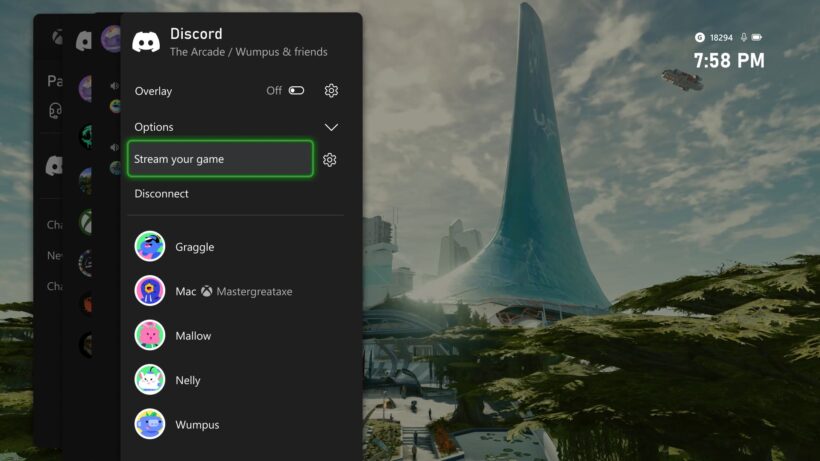
However, one platform that’s missing from the government’s initial round-up is Discord. At the time of writing, we don’t know whether the government will eventually add Discord to the ban list or not.
In the meantime, we explain everything you need to know about Discord including whether it is classed as a social media, what safety measures it takes for younger users and more.
Otherwise, visit our UK social media ban explainer for more information on the upcoming rule-change for under-16s.
We’ll start with a refresher on what Discord actually is. Discord is designed for gamers and allows its users to communicate with others online, using either video or voice calls and instant messaging.
At the heart of Discord are “servers” which are a collection of chat rooms and voice channels that can be accessed either through private invite links or simply by searching. Each server can hold up to a massive 25 million users at once, though you can also create smaller and private servers for chatting with friends.
For more information, our dedicated what is Discord explainer goes into more detail on the platform.

Discord is described as being a “communications platform” that enables users to build connections around the “joy of playing games through voice, video and text features”.
So, although it does enable communication and sharing with friends, it isn’t technically classified as social media.
At the time of writing, Discord is not included in the list of platforms that will be banned by the UK governments for under-16s. However, the government hasn’t confirmed whether this list is exhaustive or not, so there’s potential for more platforms to be added.
The government has also disclaimed that it doesn’t intend for “messaging services like Whatsapp and Signal” to be included in the ban. Considering Discord is classed as a communications platform, this could suggest that the government may not see it as a social media platform.
Plus, the UK government has said that it plans to use the “same model for a social media ban as Australia”, who doesn’t include Discord in its own ban. However, many critics have since called for Australia to include Discord in its ban, as the platform allows for video chatting and live streaming.
The minimum age you need to be to join Discord is 13 years old, however this varies depending on where you are in the world. For example, while UK residents can join when they’re 13, some European countries like Spain and Italy require users to be 14 years old. In fact, countries including Ireland, Germany and Poland have a minimum age requirement of 16 years old.
Discord hasn’t disclosed whether it plans to change the UK’s minimum age in-line with the upcoming social media ban. That means for now, we can assume its minimum age will remain at 13 years old.
So far, the apps included in the ban are: X, Snapchat, Facebook, Instagram, YouTube and TikTok. Messaging apps are “not intended” to be included in the ban, with the government explicitly referencing Whatsapp and Signal. At the time of writing, those are all the apps that we know about.
The UK’s social media ban for under-16s should be implemented in Spring 2027, after the first set of regulations are laid out by the end of 2026.

Take advantage of holiday savings in the U.S. on AirTags, MacBooks, iPads, and more. Many of these 4th of July deals could sell out after Apple’s recent price hikes.
Holiday deals are in effect in the U.S. and Apple products are now up to $650 off. Highlights can be found below, with even more discounts in our Apple Price Guides.

Get 4 AirTags for just $89 for July 4th.
Apple’s newest AirTags are still at the lowest price seen since release when you opt for the 4-pack that’s on sale for $89.

AirPods 4 prices are as low as $99 heading into the weekend.
AirPods 4 without ANC are still available for $99 at Amazon, matching Prime Day pricing.

iPad Pro and iPad Air models are heavily discounted at Amazon.
Amazon’s iPad discounts of up to $400 off are worth checking out, as Apple’s recent price hikes may result in these deals expiring or selling out soon.

Save up to $650 on current MacBook Pro and MacBook Air models.
Steep discounts are in effect on Apple MacBook Air and MacBook Pro models, with Amazon knocking up to $650 off M5, M5 Pro, and M5 Max models.




Weekend Open Thread: Staud – Corporette.com


The House | Manchesterism won’t survive the painful trade-offs unless it gets citizens on board


Strategy authorizes up to $1.25B in Bitcoin sales under new capital plan


Potential 2028er World Cup attendee leaderboard


Asia stock markets slide as tech shares slump


MAJOR BITCOIN & MARKET UPDATE!!!! (MUST WATCH ASAP!!!)


Coinbase, Circle Deepen Crypto Stock Losses Despite Resilient S&P 500


Anonymous researcher drops 0-day ‘exploitarium’ repo


Australia treasurer says alleged access of prime minister’s bank data ’incredibly concerning’


Kraken's xStocks Opens Bending Spoons IPO Registration to EEA Retail


Bitcoin Sparks $600M Hourly Liquidations With $65,000 Set To Become Resistance


FIH Pro League: India defeat Pakistan 7-1, register biggest win of campaign | Other Sports News


Bluekit phishing kit adopts browser-in-the-middle for login theft


Russian hackers now target Signal backup recovery keys

Hyperliquid Named on Singapore MAS Investor Alert Register


RTX holders must register wallets before token distribution begins


Tether (USDT) Passes Ether in Market Cap as ETH Drops Toward $1.5K


Broncos roster: OL Ben Powers (No. 74) entering final year of contract

The AI boom won’t burst all at once. It will pop in ‘rolling bubbles’: Macquarie


Silicon Valley paid to kill AI regulation, now it wants the rules back




You must be logged in to post a comment Login