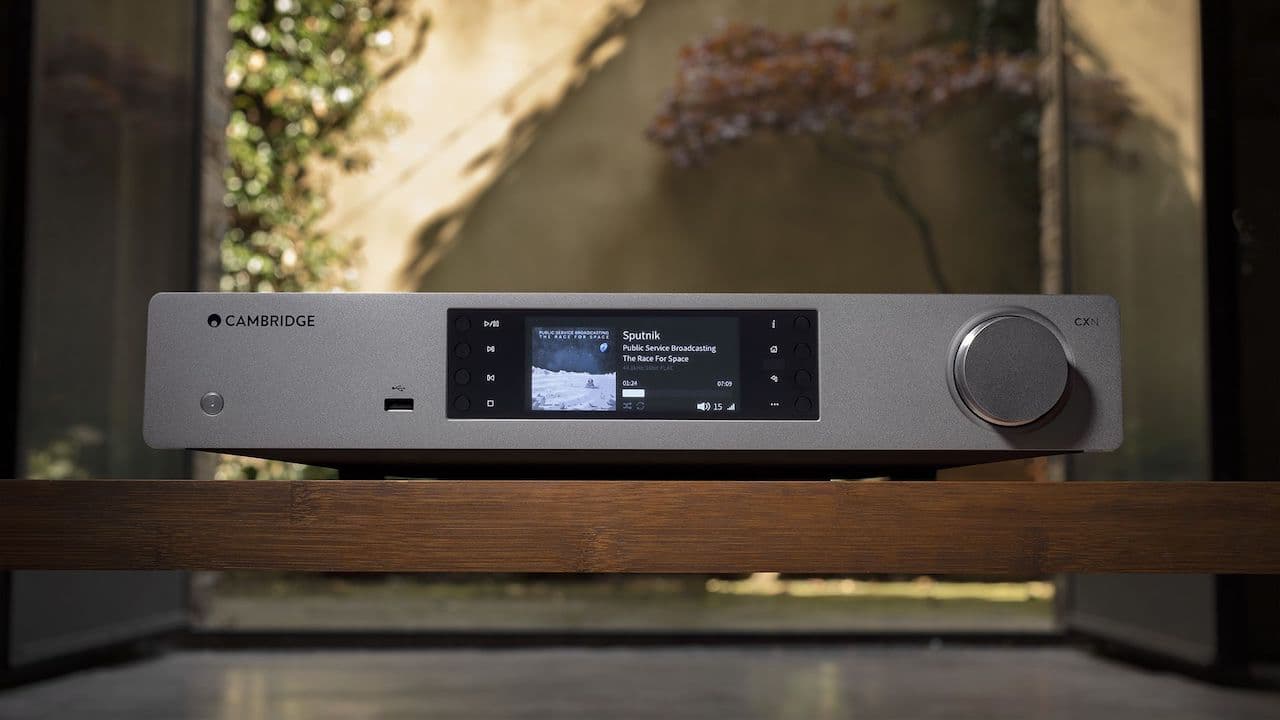
In an era where “new model” usually means “time to replace the old one,” Cambridge Audio just did something refreshingly unglamorous and important. The company has rolled out Qobuz Connect to its legacy StreamMagic Gen 2 and Gen 3 platforms, extending modern streaming control to products that have been sitting in racks and on shelves for years.
That means owners of the StreamMagic 6 V2, CXN, CXR, Azur 851N, CXN V2, and Edge NQ can now control playback directly from the Qobuz app via an OTA update; no new hardware, no forced upgrade cycle. Qobuz still works through the StreamMagic app as before, but Connect adds a more direct, native control path that many subscribers prefer.
It’s good to see a brand remember that its customer base didn’t magically appear in the last 24 months. Supporting Gen 2 and Gen 3 after rolling out Qobuz Connect to Gen 4 isn’t flashy, but it sends a clear message: what you bought still matters. Your streamer didn’t just age out because a new box showed up with a higher number on it.
Cambridge Audio CXN V2 Music Streamer
It also proves something else; customers aren’t shouting into the void. The questions, feature requests, and yes, the complaints that show up on Instagram, Facebook, Audiogon, and the forums? They do get seen. Sometimes they even lead to action. That kind of accountability shouldn’t be rare in the hi-fi category, but too often it is.
Advertisement
There are plenty of alternatives out there. Some cost less. Some arguably do more. In a crowded field, long-term support isn’t just goodwill on the part of the manufacturer but smart business strategy. It’s also hard not to wonder whether Cambridge’s recent decision to appoint Fidelity Imports as its new U.S. distributor played a role here. Distribution shifts aren’t just about logistics and dealer networks, they’re about market responsiveness. If you’re trying to rebuild momentum and reinforce trust in a crowded category, showing existing owners that their gear still has a future is a smart place to start.
This update follows Cambridge’s recent additions of Spotify Lossless, Amazon Music, and QPlay to the StreamMagic platform. Rather than introducing new hardware, the company has continued expanding service support across existing models.
What Is Qobuz Connect and Why Should Cambridge Audio Owners Care?
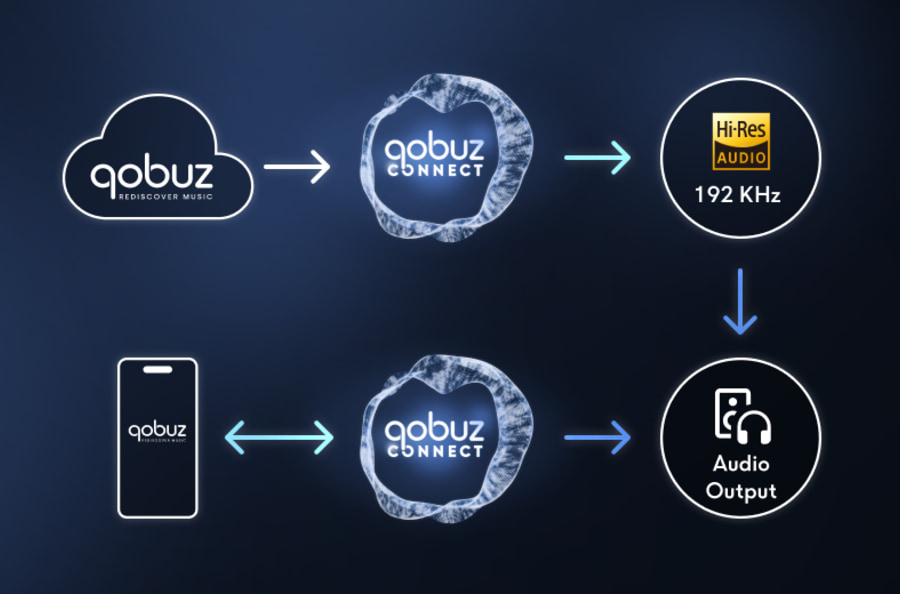
Qobuz Connect lets subscribers stream directly from the Qobuz app to compatible devices over Wi-Fi or Ethernet, turning the app into the primary control interface. Your Cambridge streamer (or other supported hardware) becomes the playback endpoint, while your phone or tablet functions as the remote. The result is native control with full lossless and high-resolution streaming up to 24-bit/192 kHz. So no Bluetooth, no compressed handoffs, and no need to route playback through a secondary app.
Launched on May 15, 2025, Qobuz Connect has expanded quickly. In less than a year, support has grown to more than 100 hardware partners, covering A/V receivers, network streamers, powered speakers, and integrated amplifiers. That broader compatibility keeps control centralized inside the Qobuz app while giving subscribers more flexibility across systems and brands.
Advertisement
The Bottom Line
The biggest winner here is the existing Cambridge Audio owner. Adding Qobuz Connect to StreamMagic Gen 2 and Gen 3 extends the useful life of hardware that, in many cases, is still performing at a very high level. It removes friction, adds native app control, and keeps those products aligned with how people actually stream music in 2026. No new box required. No forced upgrade cycle.
In 2026, StreamMagic isn’t just a control app, it’s Cambridge’s full streaming ecosystem. It supports major services including Qobuz, TIDAL, Spotify (including Lossless where available), Amazon Music, QPlay, AirPlay 2, Chromecast built-in, Roon Ready integration, and local UPnP playback.
With Qobuz Connect now folded into that framework across multiple generations, Cambridge has strengthened the platform’s long-term relevance. In a crowded streaming market where alternatives are plentiful and often cheaper, sustained software support is what separates a product you replace from one you keep.
Full Circle, the developer behind the new Skate game, has announced that it is restructuring and laying off staff. It’s not yet clear how many roles will be impacted by the changes, but the restructuring is happening less than six months after skate. launched in early access on September 15, 2025.
“We’re reshaping Full Circle to better support skate.’s long-term future,” Full Circle says. “These shifts mean making changes to our team structure, and some roles will be impacted. The teammates affected are talented colleagues and friends who helped build the foundation of skate. Their creativity and dedication are deeply ingrained in what players experience today. This decision is not a reflection of their impact and we’re committed to supporting them through this transition.”
Engadget has contacted Full Circle’s owner EA for more information about the layoffs. We’ll update this article if we hear back.
EA originally formed Full Circle in 2021 with a staff of development talent from the original Skate team. Skate was often positioned as a more realistic competitor to the Tony Hawk’s Pro Skater series, but the new studio has ultimately taken the franchise in a slightly different direction than fans may have expected. Previous Skate games were paid experiences with single-player and multiplayer modes, while skate. is a free-to-play live-service game supported with microtransactions.
Advertisement
Recent history, both the failure of Concord and the ongoing struggles of Highguard, serves as a testament to how hard it is to launch a live service game in the 2020s. Full Circle’s announcement notes the “tens of millions” of players that have tried the new game, but it’s possible a struggle to keep players interested and spending on microtransactions could be why it’s restructuring.
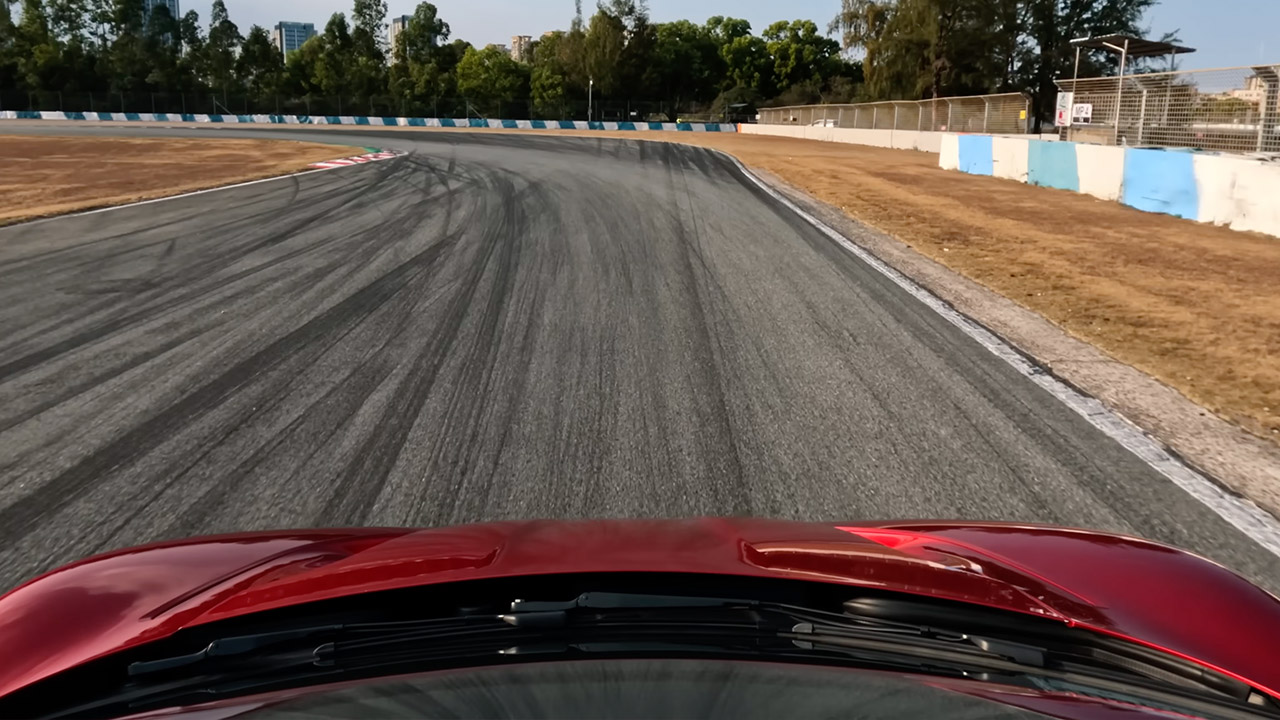
Richard Hammond slid into the driver’s seat of BYD’s Yangwang U9 Xtreme with a good mix of caution and exhilaration. With a top speed of 308 miles per hour, this Chinese hypercar had already broken the manufacturing speed record. Its four electric motors together produced an astounding nearly 3,000 horsepower. He was well-versed in the specification sheet, which included a 1,200-volt battery system, torque vectoring, adaptive suspension capable of lifting the vehicle over obstacles, and much more.
Without a wind-up or crescendo, the hypercar went from being motionless to warp speed in an instant. The strange thing was that the 200 mph didn’t even feel that significant. With such great power, you would think the U9 Xtreme would be a monster, but instead it just drove smoothly without any hiccups.
F1 CAR BUILDING KIT – Race to glory with this detailed LEGO Technic McLaren MCL39 F1 Car (42228) model kit for adults ages 18 years old and up
AUTHENTIC FEATURES & FUNCTIONS – Explore the car’s realistic details, including push-rod and pull-rod suspension, steering and differential as you…
V6 ENGINE & DRS ACTIVATOR – Remove the engine cover to examine the F1 car model’s V6 engine, then check out the 2-speed gearbox and DRS activator…
Hammond was surprised when a new aspect of the vehicle emerged in the cornering arena. The U9 Xtreme was quite sharp and kept its body flat in the turns, contrary to his belief that it would be best suited for driving in a straight line. He questioned his function in operating the vehicle because the active systems handled the weight transfer and grip so efficiently. Was he pushing something that could already handle the tough sections, or merely directing the car? Even under some very harsh corners, the chassis refused to roll or pitch too much.
Every time he floored it, the pull and response were immediate and unrelenting, making the power addictive in a positive way. He was thrilled by the car’s accuracy and composed application of force, yet he was constantly on edge due to its immense power. He acknowledged that he was afraid, which was probably rather common. There’s a problem if you’re not a little afraid in a car like this.
Ultimately, the U9 Xtreme left him both unnerved by its potential and genuinely impressed by its ingenuity. The fastest production automobile in the world is made in China, and it’s actually rather astonishing how confidently they’ve done it. The U9 Xtreme quietly gave its unadulterated performance instead of being all show and no substance. After everything was said and done, Hammond left with a smile on his face, his nerves unharmed, and a fresh appreciation for what BYD had accomplished.
At the beginning of the year, The Cut kicked off a brief discourse cycle by declaring a new lifestyle trend: “friction-maxxing.”
The idea, in a nutshell, is that people have overconvenienced themselves with apps, AI, and other means of near-instant gratification—and would be better off with increased friction in their daily lives, which is to say those mundane challenges that ask some minor effort of them.
Whatever your feelings on that philosophy, the use of “maxxing” as a suffix assumed to be familiar or at least intelligible to most readers of a mainstream news outlet is evidence of another trend: the assimilation of incel terminology across the broader internet. The online ecosystem of incels, or “involuntarily celibate” men, is saturated with this sort of clinical jargon; its aggrieved participants insulate, isolate, and identify themselves through in-group codespeak that is meant to baffle and repel outsiders. So how did non-incels (“normies,” as incels would label them) end up adopting and recontextualizing these loaded words?
Slang, no matter its origins, has a viral nature. It tends to break containment and mutate. The buzzword “woke,” as it pertains to our current politics, comes from African American Vernacular English and once referred to an awareness of racial and social injustice—this usage dates to the middle of the 20th century, preceding even the civil rights movement. But the culture wars of this century have turned “woke” into a favorite pejorative of right-wingers, who wield it as a catchall term for anything that threatens their ideology, such as Black pilots or gender-neutral pronouns.
Advertisement
Back in 2014, the eruption of the Gamergate harassment campaign set the stage for a different linguistic realignment. An organized backlash to women working in the video game industry, and eventually any sort of diversity or progressivism within the medium, it exposed a vein of reactionary anger that would gain a fuller voice during Donald Trump’s 2016 presidential campaign. This was a period when many in the digital mainstream got their first taste of the trollish nihilism and invective that fuels toxic message boards such as 4chan and gave rise to a network of anti-feminist manosphere sites collectively known as the “PSL” community: PUAHate (a board for venting about pickup artists, it was shut down soon after the 2014 Isla Vista killing spree carried out by Elliot Rodger, who frequented the forum), SlutHate (a straightforward misogyny hub), and Lookism (where incels viciously critique each other’s appearance).
Lookism, named for the idea that prejudice against the less attractive is as common and pernicious as sexism or racism, is the only forum of the PSL trifecta that survives today, and while we don’t know who coined the “maxxing” idiom, it’s the likeliest source for the first verb with this construction. “Looksmaxxing,” which borrows from the role-playing game concept of “min-maxing,” or elevating a character’s strengths while limiting weaknesses, became the preferred expression for attempts to improve one’s appearance in pursuit of sex. This could mean something as simple as a style makeover or as extreme as “bonesmashing,” a supposed technique of achieving a more defined jaw by tapping it with a hammer.
If the 2000s introduced people to pickup lingo like “game” and “negging,” the 2010s ushered in language that extended the Darwinian vision of the dating pool as a cutthroat and strictly hierarchical marketplace. “AMOG,” an initialism for “alpha male of the group,” gave us “mogging,” a display where one man flexes his physical superiority over a rival. An ideally masculine specimen might also be recognized as a “Chad,” who allegedly enjoys his pick of attractive partners, while a Chad among Chads is, of course, a “Gigachad.” Women were disparaged as “female humanoids,” then “femoids,” and finally just “foids.”
It seems like any and every industry can have its own awards show these days. And why not? Most of us appreciate a chance to bust out the sequins and satin from time to time. If you can celebrate excellent work or make some extra biz dev bucks at the same time, all the better. Snap is the latest social media company to launch its own take on the glitz and glam. The Snappy Awards Show will be held at the company’s headquarters on March 31. Comedian and content creator Matt Friend will host the event.
Snapchat has been adding more tools for influencers to build audiences, most recently launching individual creator subscriptions. An awards show seems to be part of that same agenda, spotlighting popular personalities from many different fields. There will be Snappys handed out for categories such as Spotlight MVP, Best Storyteller and Breakout Creator of the Year, plus awards for collaboration, cultural impact and success in single subjects.
Snapchat isn’t the first social media platform to honor the personalities using it. TikTok hosted its inaugural awards show in the US last year.
Random numbers are very important to us in this computer age, being used for all sorts of security and cryptographic tasks. [Theory to Thing] recently built a device to generate random numbers using nothing more complicated than simple camera noise.
The heart of the build is an ESP32 microcontroller, which [Theory to Thing] first paired with a temperature sensor as a source of randomness. However, it was quickly obvious that a thermocouple in a cup of tea wasn’t going to produce nice, jittery, noisy data that would make for good random numbers. Then, inspiration struck, when looking at vision from a camera with the lens cap on. Particularly at higher temperatures, speckles of noise were visible in the blackness—thermal noise, which was just what the doctor ordered.
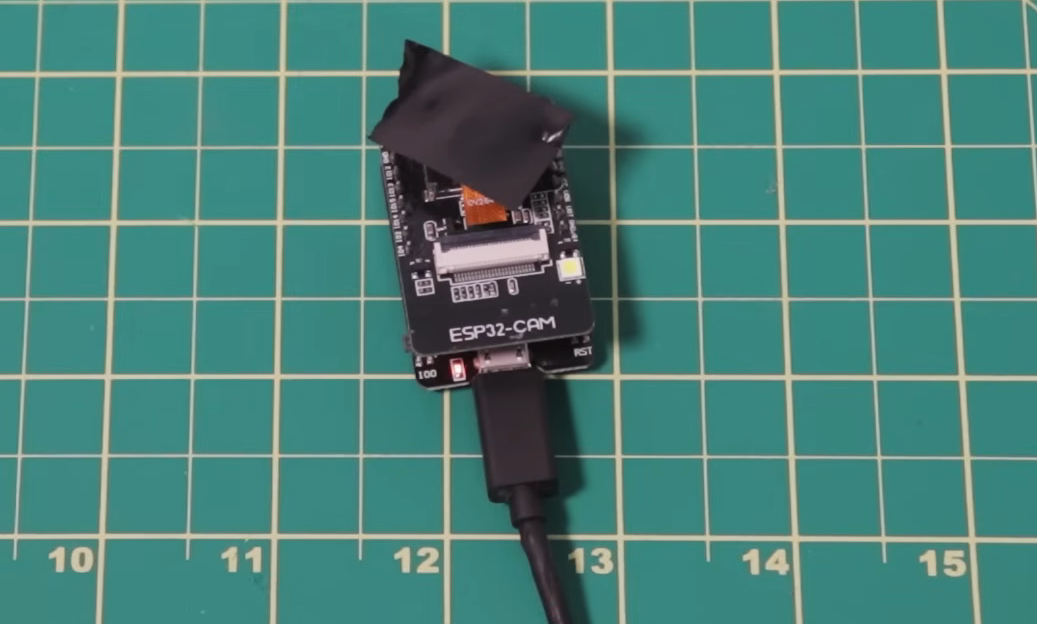
Thus, the ESP32 was instead hooked up to an OV3660 camera, which was then covered up with a piece of black electrical tape. By looking at the least significant bits of the pixels in the image, it was possible to pick up noise when the camera should have been reporting all black pixels. [Theory to Thing] then had the ESP32 collate the noisy data and report it via a web app that offers up randomly-generated answers to yes-or-no questions.
Advertisement
[Theory to Thing] offers up a basic statistical exploration of bias in the system, and shows how it can be mitigated to some degree, but we’d love a deeper dive into the maths to truly quantify how good this system is when it comes to randomness. We’ve featured deep dives on the topic before. Video after the break.
Apple has cultivated a reputation for its meticulous attention to detail, both in software design and hardware polish. But not all the big swings taken by the company have quite landed as the company had expected. Over a decade ago, Scott Forstall was famously fired from Apple following a disastrous Apple Maps launch. In 2025, Apple divided opinions with its ecosystem-wide Liquid Glass design. The new design language, inspired by the clarity of glass and motion of liquid, was criticized for inconsistencies and legibility problems, forcing the company to make multiple changes and eventually offer dedicated controls to minimize the glass effect on the UI.
But it seems the whole Liquid Glass makeover was an exercise that preps the Apple hardware for the future, especially for the MacBook and its highly-anticipated OLED refresh with a touchscreen display. According to Bloomberg, Apple’s overhauled MacBook Pro should arrive towards the end of 2027, rocking a touch-sensitive panel with an iPhone-inspired Dynamic Island cutout at the top. Now, there are two ways to look at it. The ugly and mostly unused notch is going away. Its place will be taken by a pill-shaped camera cutout that will now become interactive, expanding to show activity progress and offering a whole host of functionalities woven around it.
If you take a look at the Mac developer community, there are plenty of apps out there that have turned the notch into a calendar hub, a playback zone, a clipboard slot, and a lot more. But fundamentally, you can only do so much with a mouse click or trackpad. Imagine the level of interactivity that can be baked into it if it supports long and short finger presses or swipe-based gestures, similar to widget stacking. Both these ideas have been implemented on iPhones and iPads already.
Advertisement
It’s already here in spirit
Nadeem Sarwar/SlashGear
A touch-sensitive screen on MacBooks is going to be a lot more than just a showcase of Dynamic Island interactions. And it seems the Liquid Glass design was merely a preparatory phase in gradually shifting macOS away from a vanilla keyboard and mouse input to a hybrid format. “The update includes more padding around some icons and notifications, as well as sliders in the control center menu that look optimized for touch,” reports Bloomberg. I’ve repeatedly felt this in my own time spent across Apple’s laptops and tablets.
I use my iPad Pro nearly as much as my trusty Apple laptop, and I prefer the Liquid Glass look on it far more than the MacBook Air, and it’s not just because the tablet has a better OLED screen. The mix of touch and keyboard-based inputs actually feels more productive, especially when I am editing design assets for my sister’s garments website or editing videos. In iPadOS 26, Apple actually ported plenty of macOS elements, such as the Menu Bar, and they feel pretty much at home on the iPad.
Advertisement
That’s not a coincidence. Apple will likely never let the iPad dual-boot macOS, but the recent makeover of its design with desktop-grade utilities such as Stage Manager is a clear sign that Apple is using the increasingly computer-like iPad (Air and Pro) as a testbed for transitioning macOS to a touch-friendly operating system. Just take a look at the pro-grade apps that have recently landed on the iPad, including Apple’s Creator Studio bundle in 2026, to see how well they integrate traditional keyboard and touch-based inputs. I strongly believe there won’t be a functional shock or learning curve when Macs become touchscreen-friendly. On the contrary, it will be a redemption for Liquid Glass.
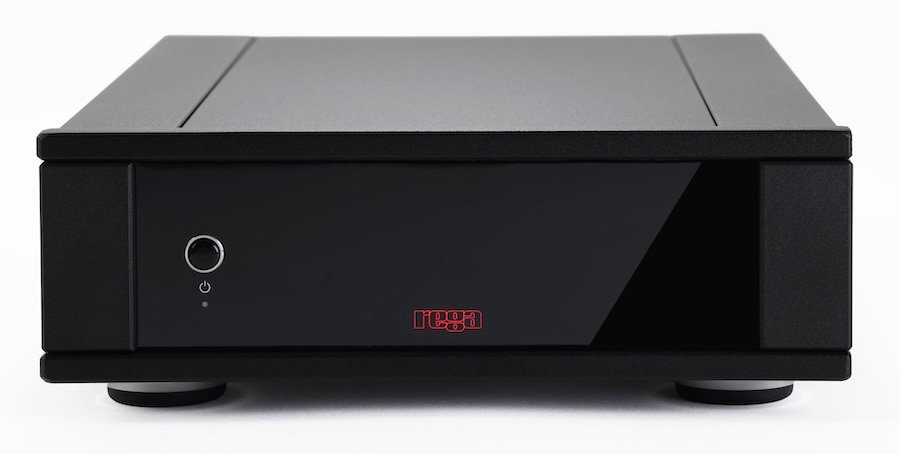
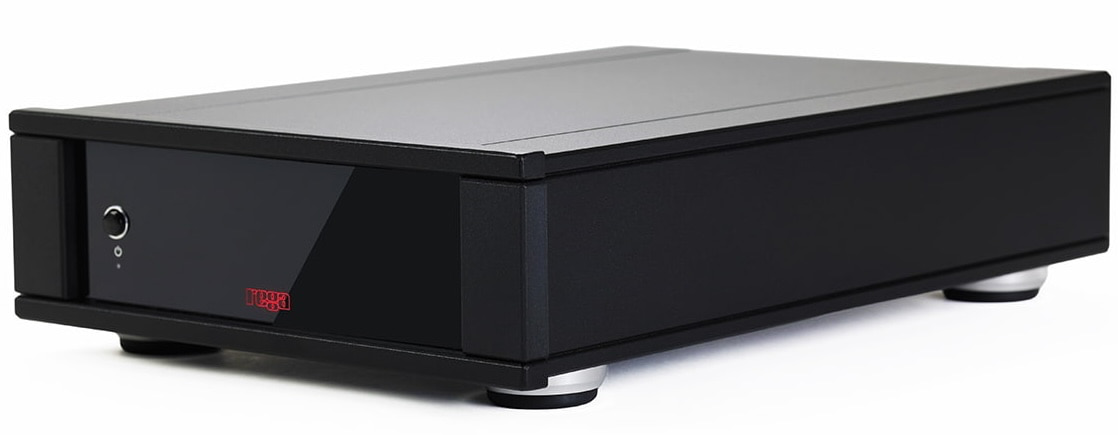
Rega has been on a quiet tear lately. First it shocked its traditionally sensible customer base with a flagship preamplifier and power amplifier combo that wanders deep into five-figure territory. Now it pivots back toward vinyl loyalists with something far more on brand, but still firmly premium. Enter the new Aos MC, a moving coil only phono stage derived directly from the company’s reference Aura.
First shown at the Bristol Hi-Fi Show 2026, the Aos MC borrows heavily from the £4620 Aura MC stage in both circuit topology and layout, with the stated goal of bringing listeners closer to that reference level performance without crossing into cost-no-object insanity. U.S. pricing has not been finalized, but expectations place it in the $2300 to $2500 range when it lands stateside; a bracket packed with serious competition from MOON by Simaudio, Pro-Ject, Musical Fidelity, EAT, EAR, MoFi Electronics and others.
Rega promises exceptional definition and greater realism, and the Aos MC is designed to partner with a wide range of moving coil cartridges thanks to flexible gain and loading options. The question is not whether Rega knows how to build a phono stage — it clearly does. The question is whether Aura-inspired circuitry at roughly one third the price can dominate one of the most competitive segments in high performance analog right now.
Rega Aos MC
Aura Inspired Circuitry Targets $3,000 High End Market
The Rega Aos MC is a two stage, all analogue moving coil phono preamplifier with no digital control circuitry in the signal path. The layout is deliberately simple and tightly organized to avoid unnecessary components that could compromise performance. At its core is a symmetrical, complementary Class A amplifier using parallel low noise FETs configured as compound pairs.
Advertisement
That choice is not cosmetic. FET devices ensure that no bias current flows into the cartridge coil, which protects the cartridge’s magnetic geometry and avoids altering its behavior. The input circuit also minimizes coupling components between the cartridge and the first gain stage, further reducing opportunities for signal degradation.
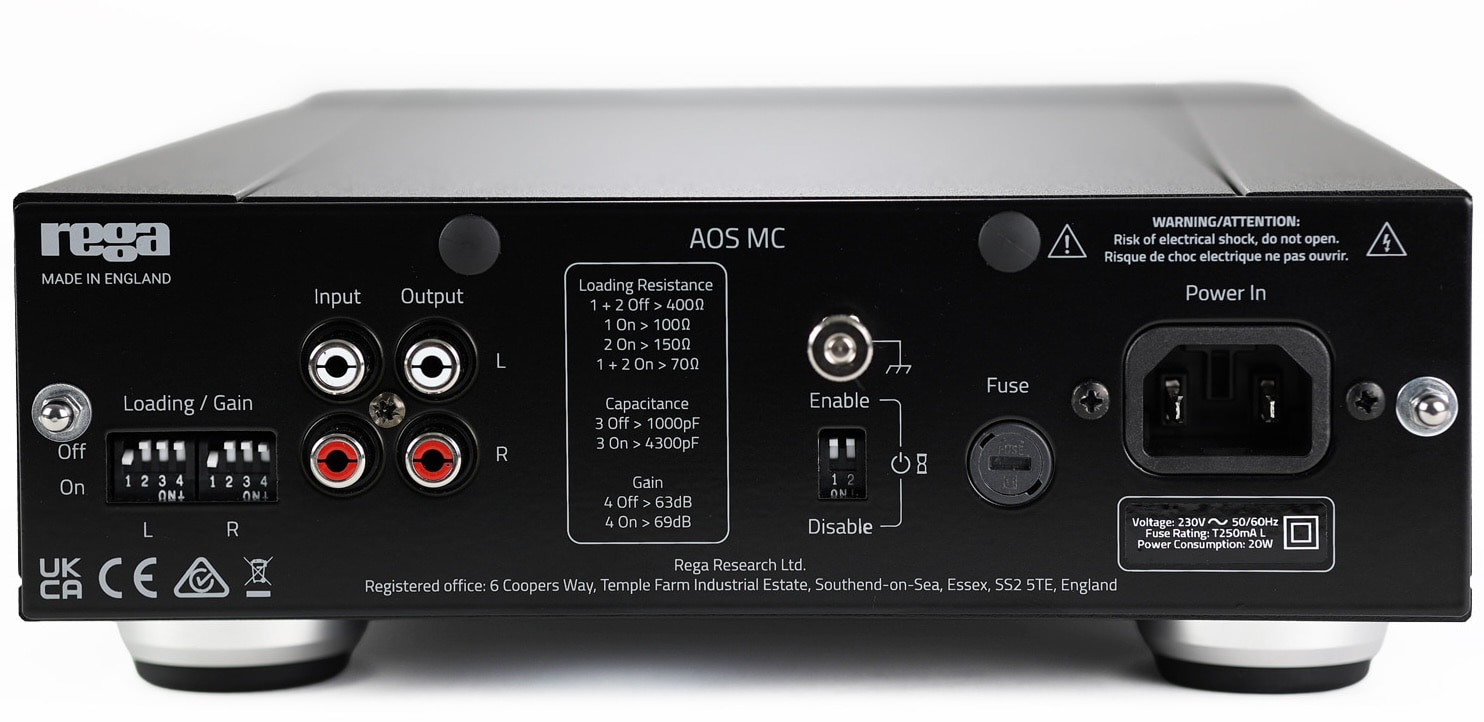
Loading and gain flexibility are handled in a straightforward, hardware based way. Users can select resistive loading at 70, 100, 150, or 400 ohms, and capacitive loading at 1000 or 4300 pF, allowing the Aos MC to accommodate a broad range of moving coil cartridges.
Gain can be switched between 69.3 dB and 63.5 dB, a 6 dB difference accessible from the rear panel, where you will also find RCA inputs and outputs. RIAA equalization accuracy is rated at better than ±0.2 dB from 65 Hz to 70 kHz, with a frequency response extending from 17.5 Hz to 100 kHz. THD is specified at 0.03 percent.
The half width aluminum enclosure is not just about aesthetics. It provides shielding against stray RFI while keeping the footprint compact at 220 x 80 x 330 mm and 2.9 kg. A self adjusting servo control compensates for temperature variations to maintain stable operation, and an automatic standby mode reduces power consumption to 0.4 W when idle, though it can be disabled via rear panel dip switches. In short, the Aos MC focuses on careful analogue execution, sensible adjustability, and measured performance rather than feature creep.
Advertisement
The Bottom Line
The Aos MC stands out because it keeps the signal path strictly analogue, uses parallel low noise FETs to avoid bias current in the cartridge coil, and offers meaningful loading and gain flexibility without drifting into feature overload. It is clearly aimed at serious moving coil users who care about circuit integrity, RIAA precision, and long term cartridge compatibility rather than app control or digital displays.
At an expected $2,300 to $2,500 in the U.S., it walks straight into competition from the MoFi UltraPhono Pro, EAT E-Glo 2, and Cyrus Audio 40 PPA — three fully featured and well engineered options in the same performance bracket.
If you are running a quality MC cartridge and want something derived from Rega’s Aura platform without stepping into five figure territory, the Aos MC makes a clear case for itself. And for MM users feeling left out, relax. An Aos MM version is on the way.
Stripe has hit a $159bn valuation, according to a recent letter from company founders.
Irish fintech giant Stripe is considering acquiring some or all of PayPal, reports Bloomberg, citing insiders.
According to the publication, Stripe has already expressed preliminary interest in a potential acquisition of the US payments company or some of its assets. Stripe declined to respond to queries put forth by SiliconRepublic.com. PayPal has not yet responded.
PayPal share prices shot up by around 6.74pc since Bloomberg first reported the story yesterday (24 February).
Advertisement
The US company, which went public in 2002, has a market capitalisation of $43.2bn. The 2010-founded Stripe was valued at $159bn earlier this week. Stripe’s co-founders are seemingly in no rush to take the company public.
Founded in the late 1990s, PayPal has struggled to modernise against emerging rivals in the payments space such as Apple and Google.
However, the executive switch-up did not sway investor confidence after the company missed revenue expectations in the quarter past, sending share prices down by 20pc. Company shares have dropped more than 80pc over the last five years.
Advertisement
Stripe, however, has remained “robustly profitable”, according to a letter from the founding brother-duo Patrick and John Collison. The company is investing heavily in product development and making strategic acquisitions that include programmable wallet company Privy, stablecoin orchestration platform Bridge and Metronome, which “powers the intricate usage-based billing models used by companies like OpenAI, Anthropic, Confluent and Nvidia”.
Sam Altman describes current proposals for orbiting data centers as entirely unrealistic for this decade
Modern AI chips cannot survive space radiation, making orbital data centers currently unfeasible
Radiation-hardened semiconductor nodes lag behind advanced fabrication processes required for AI workloads
Sam Altman has publicly dismissed proposals to place large-scale data centers in orbit, describing the idea as unrealistic under current technological and economic conditions.
The OpenAI chief executive argued space-based computing infrastructure will not operate at a meaningful scale within this decade.
His comments come as the likes of Elon Musk and Jeff Bezos have spoken about the long-term potential of orbital facilities powered by abundant solar energy and freed from terrestrial constraints.
Hardware not built for space
Altman’s remarks directly challenge that optimism and draw attention to the practical limitations facing such projects.
“I honestly think the idea with the current landscape of putting data centers in space is ridiculous,” said Sam Altman at a press conference hosted by The Indian Express.
“It will make sense someday, but if you just do the very rough math of launch costs relative to the cost of power we can produce on Earth, not to mention how you are going to fix a broken GPU in space, and they still break a lot, unfortunately, we are not there yet.”
Advertisement
Modern AI accelerators and high-performance processors are manufactured using advanced fabrication nodes such as 4nm-class process technologies.
Sign up to the TechRadar Pro newsletter to get all the top news, opinion, features and guidance your business needs to succeed!
These cutting-edge chips are not radiation-hardened and therefore cannot withstand the harsh conditions of space.
Radiation-resistant semiconductor technologies do exist, although they rely on much older manufacturing nodes that lack the performance required for today’s large AI workloads.
Advertisement
Before orbiting facilities can handle meaningful computational demand, new fabrication approaches would need to combine advanced performance with radiation tolerance.
Beyond processing hardware, orbital data centers would require cooling systems and reliable power generation capable of sustaining millions of accelerators.
Launch providers such as SpaceX and Blue Origin are developing reusable rockets and space infrastructure, yet the supporting ecosystem for operating massive computing facilities in orbit remains incomplete.
Advertisement
Terrestrial data centers already depend on complex arrangements involving power grids, cooling systems, SSD arrays, HDD backups, and cloud storage integration, all of which would require adaptation for space environments.
Cost remains a central barrier to orbital deployment. Launching 800kg into low Earth orbit can cost several million dollars using current commercial rockets.
A single Nvidia NVL72 GB200 rack-scale solution weighs well over a metric ton without additional cooling or connectivity systems.
Scaling such infrastructure into orbit would multiply launch requirements and associated expenses.
Advertisement
Even if launch prices decline for larger payloads, the cumulative cost of transporting and assembling full-scale facilities would remain high under current conditions.
Altman has acknowledged that space will eventually support certain industries, although he maintains that orbiting data centers do not appear viable at scale this decade.
There has never been a “casual” way into Nagra. The Swiss manufacturer’s components are engineered like laboratory instruments and priced accordingly, which has historically placed the brand well beyond the reach of anyone not prepared to treat audio as a long term capital investment. Even so called entry level and mid-tier offerings such as the Compact Phono and PREAMP II-S demand serious financial commitment.
With the $7,500 Compact Player, Audio Technology Switzerland SA is addressing a long standing reality: for many listeners, Nagra has been admired from a distance. This model appears designed to narrow that gap without diluting the formula.
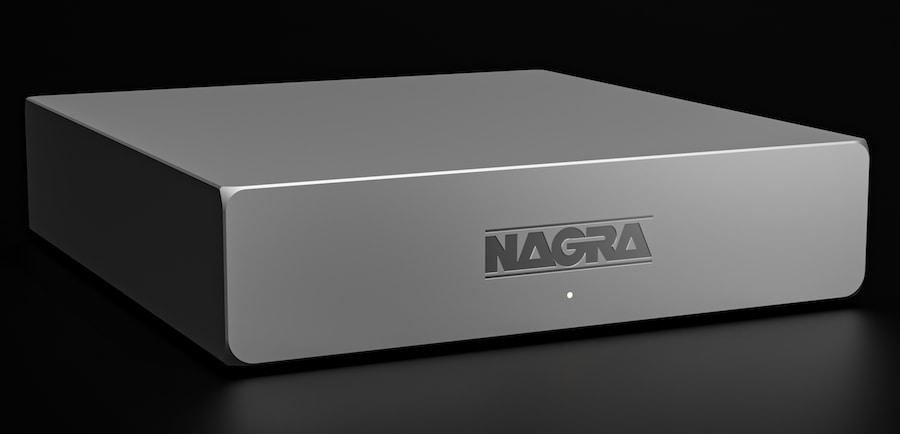
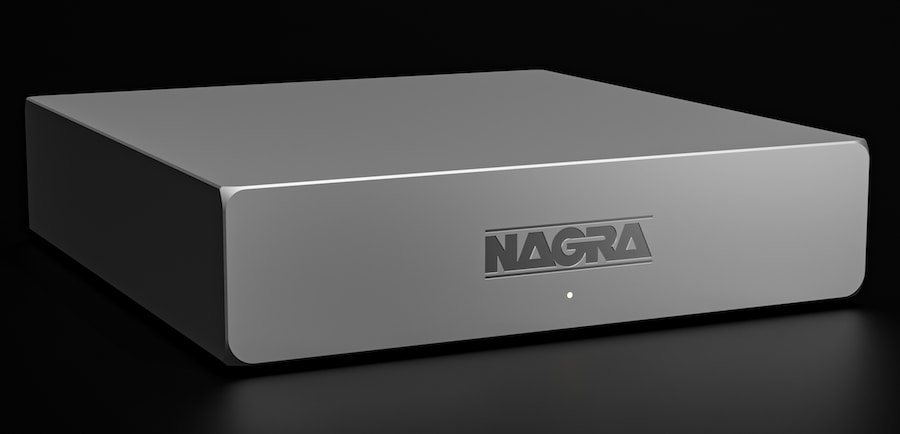
Nagra Compact Player
It is also important not to confuse it with the Compact Streamer. That unit relies on an external DAC, while the Compact Player is a complete digital front-end with its own internal conversion stage and analog output section. In practical terms, this makes it a far more self contained solution for systems that are not already built around a separate Nagra DAC.
What the Compact range does not yet include is a dedicated Compact preamplifier or power amplifier. Whether those arrive later remains to be seen. For now, the direction seems clear: these components function as a gateway. They allow owners to introduce a more attainable slice of Nagra into an existing system rather than requiring a full top to bottom commitment from day one.
Advertisement
But make no mistake, should a complete Nagra Compact Series emerge, the final system price is likely to be in the $25,000 to $30,000 range and that’s before adding loudspeakers, cables, and a turntable or CD player.
The Compact Player, however, is not positioned as a compromise piece. It is a deliberate entry point into the ecosystem, and from personal experience, Nagra components tend to reward those who keep things in the family; which is unlikely to make your accountant very happy.
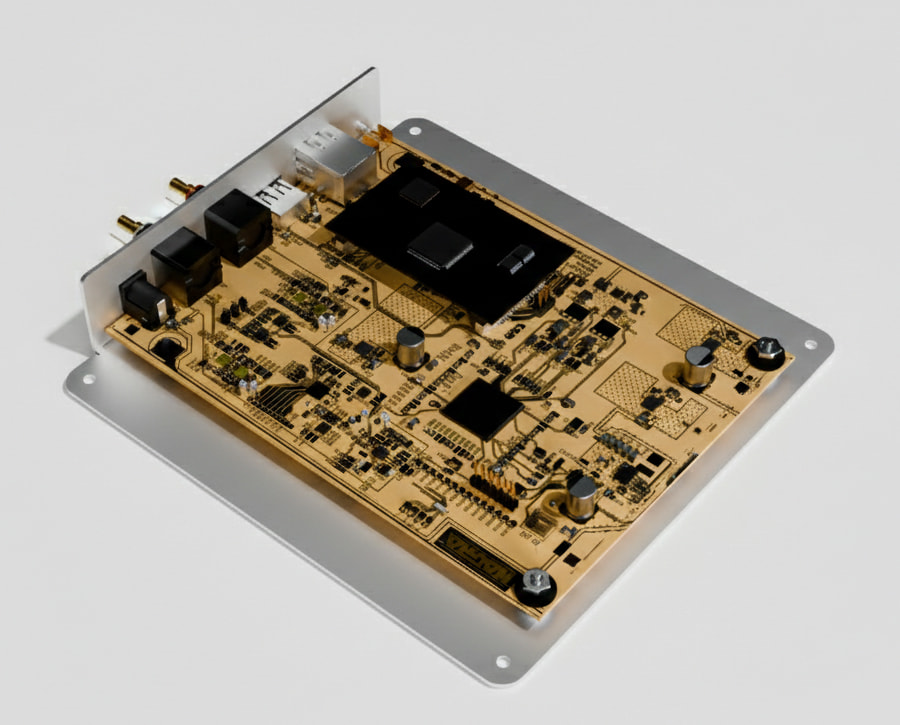
Nagra Compact Player (internal)
Lower Barrier to Entry, Full Swiss Engineering Inside
The Nagra Compact Player is a fully integrated network player and DAC built around the company’s established engineering priorities rather than feature chasing. It combines a modern streaming platform with a dedicated D/A conversion stage and a true dual mono analog output section, with separate circuitry for each channel to improve separation and reduce crosstalk.
The digital architecture centers on a high performance DAC followed by a carefully implemented analog stage. Nagra has paid close attention to clock design, power supply regulation, and PCB layout to keep jitter and noise low and preserve signal integrity through the entire conversion path. This is not unusual for the brand, but it matters in a product designed to serve as a primary source.
Advertisement
Format support is comprehensive. The Compact Player handles PCM up to 384 kHz 32 bit and DSD256, whether streaming from supported services or playing locally stored files via UPnP DLNA or USB storage. Measured performance includes a noise floor of -140 dB A weighted and a 14 ohm output impedance, which makes it easy to integrate with a wide range of preamplifiers and integrated amplifiers. It can also be connected directly to a power amplifier or active loudspeakers if system design calls for it.
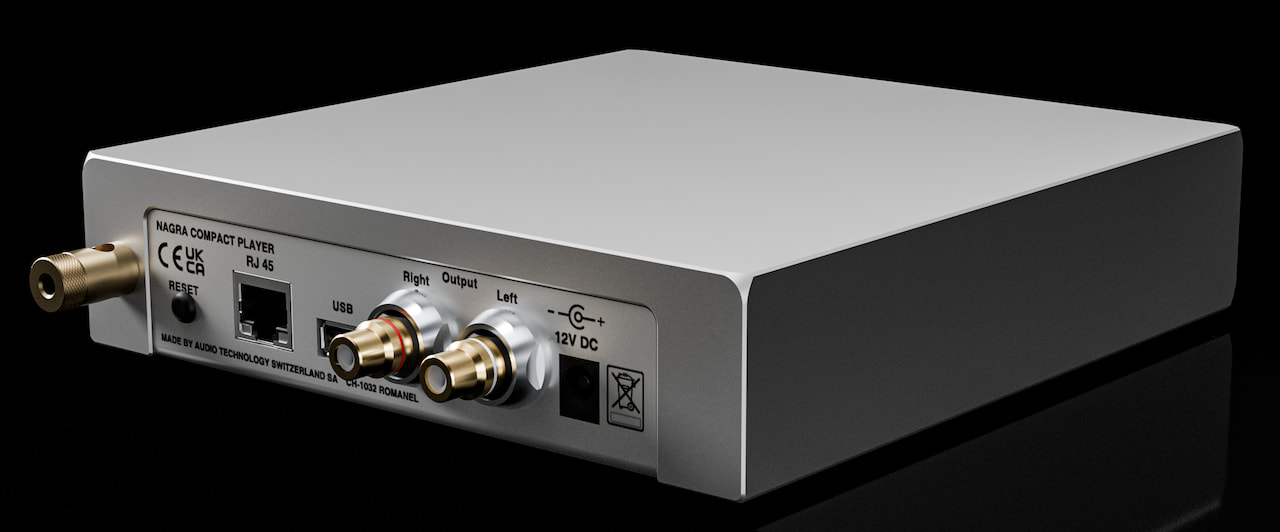
Nagra Compact Player (rear)
Control is handled through the free mConnect app, available for iOS and Android phones and tablets. The app manages local file playback, network streaming, and firmware updates, keeping day to day operation centralized in a single interface.
Streaming support is comprehensive and current. The Compact Player supports Qobuz Connect, TIDAL Connect, and Spotify Connect for direct in app control, along with AirPlay 2 for Apple devices. It is both Roon Ready and Roon Tested, integrates with Audirvana, and provides access to thousands of internet radio stations via vTuner. Local music libraries can be accessed over UPnP DLNA or through attached USB storage.
Advertisement. Scroll to continue reading.
Advertisement
It connects to your network via Ethernet and can also access music stored on a USB hard drive or memory stick. Analog output is via standard RCA connectors, so it will work with most preamplifiers and integrated amplifiers without any special requirements.
Power draw is modest. It runs on an external 12V DC supply and consumes about 10 watts, which is low enough for continuous operation without concern. That figure can rise slightly if a USB hard drive is attached, but not in a way that materially affects ownership.
Physically, it lives up to its name. Measuring 185 x 166 x 41 mm (7.2 x 6.5 x 1.6 inches) and weighing 1.9 kg (4.1 lbs), it is compact enough to fit easily on a standard shelf or rack without demanding extra space.
The chassis is CNC machined from solid aluminum, providing the rigidity and mechanical stability expected at this level. It is compact by Nagra standards, which makes it easier to integrate into real world systems without sacrificing build quality.
Advertisement
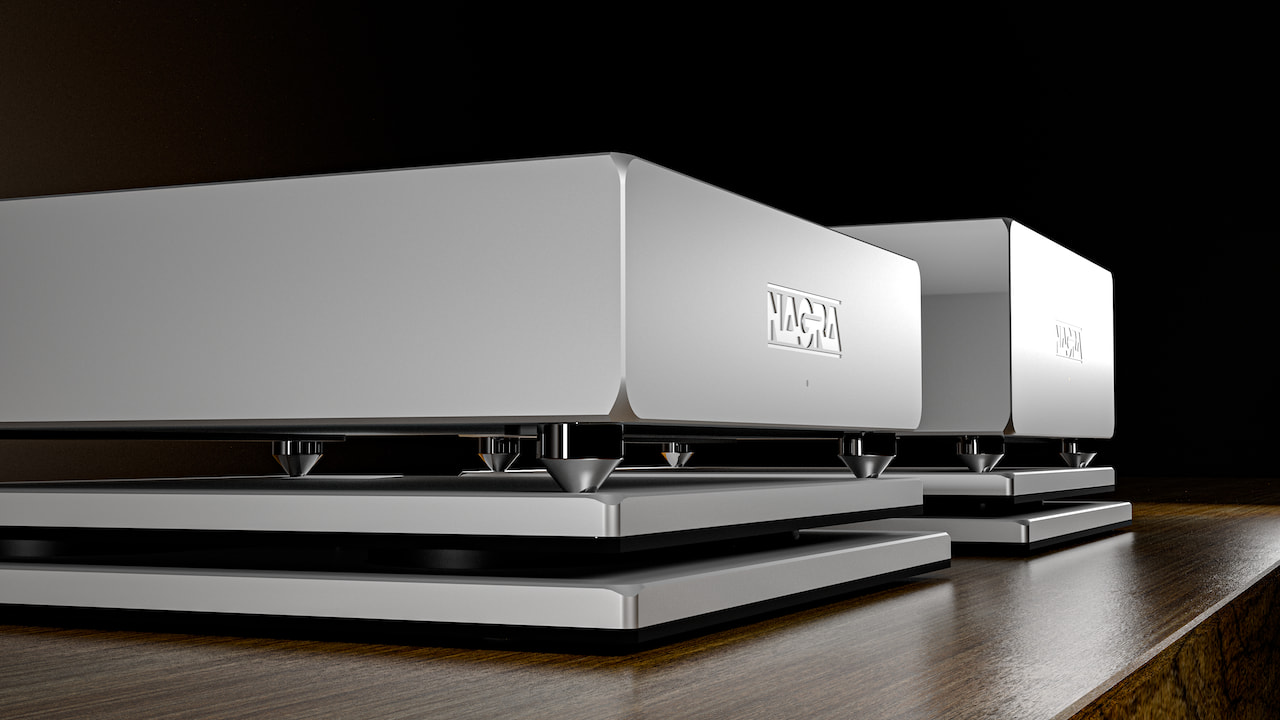
For those who want to take it further, the optional Compact PSU offers improved regulation and current delivery. Nagra also supports additional mechanical isolation and vibration control accessories aimed at refining resolution and spatial precision.
Nagra Compact Player with optional PSU and VFS (vibration free base)
The Bottom Line
The Compact Player is for listeners who want an integrated network player and DAC built to Nagra’s standards, but who may not be ready to commit to a full reference stack. It makes the most sense for existing Nagra owners, or for serious two channel listeners looking to anchor a high performance system with a compact, all in one digital front end.
That said, context matters. Below $1,000, brands like WiiM, Bluesound, Eversolo, and Cambridge Audio offer network players and DACs with extensive feature sets and strong measured performance at a fraction of the cost. On the other end, companies such as Aurender and Innuos sit closer to this price tier with more elaborate server based solutions.
The Compact Player does not try to win on price or feature count. It competes on execution, integration, and long term system building within the Nagra ecosystem. For buyers who value that approach and are comfortable with the investment, it is a deliberate and logical entry point.