Tech
Qobuz Starts Labeling AI Generated Music and the Fraud Numbers Are Ugly

Artificial intelligence has spent the past year learning how to write songs, create fake artists, imitate real ones, manufacture album covers, and upload music at a rate that would make Prince during his vault years look lazy. Qobuz would now like its subscribers to know when some of that music was made by a machine.
The French streaming service has officially rolled out an in-app tag identifying music that its proprietary system determines was generated by AI. That fulfills a promise Qobuz made earlier this year when it published its AI Charter and began scanning both new releases and its existing catalog for synthetic content.
The label itself is useful, but the numbers behind it are far more interesting. Qobuz says just 0.38% of streams on its service currently come from tracks identified as AI-generated, while 60% of streams from those tracks are deemed fraudulent by its anti-fraud systems and excluded from royalty payments.
Qobuz has also removed more than one-third of AI-generated albums with no listening activity from its search engine, representing roughly four million tracks. Those recordings have not necessarily been deleted from the catalog; Qobuz specifically says they have been removed from search.
That difference matters because the AI music problem is increasingly not about somebody using generative software to help finish a song. It is about enormous quantities of synthetic material being uploaded cheaply and rapidly, sometimes accompanied by artificial streams designed to siphon money away from the royalty pool.
Related Reading:


Why Qobuz Is Doing This
Qobuz has been heading in this direction since February. Its AI Charter states that editorial recommendations including playlists, Albums of the Week and Qobuzissimes remain selected by human editors, while its personalized discovery tools are designed to prioritize music drawn from those editorial selections and other trusted sources.
That philosophy now extends directly to AI-generated recordings. When Qobuz identifies music as AI-generated, subscribers can see that information instead of having to investigate whether the singer suddenly appearing in front of them has ever actually inhaled oxygen.
More importantly, Qobuz says identified AI-generated material is excluded from its editorial recommendations. That helps put the remarkably low 0.38% share of listening into context because synthetic content may exist on Qobuz, but the service is not deliberately placing it alongside human artists in its curated discovery channels.
That approach says a lot about how Qobuz views its role. It is not simply offering access to a gigantic catalog and leaving listeners to sort out the mess themselves; it is making an editorial decision about what deserves active promotion.
The 60% Number Is The Real Story
The most troubling figure is not how much AI music Qobuz subscribers are actually listening to. It is what appears to be happening around those streams.
Qobuz says 60% of streams associated with tracks it has identified as AI-generated are currently considered fraudulent by its systems. Those plays are excluded from royalty reporting and payouts, and Qobuz says content can also be removed when it detects fraudulent practices.
That suggests the immediate threat is not that listeners are abandoning musicians for endless AI-generated albums. On Qobuz, at least, the available data suggests almost the opposite.
The larger problem is scale because generative systems can produce enormous quantities of music at almost no marginal cost. Upload enough tracks, manufacture enough plays, and even tiny payments can become meaningful when multiplied across millions of recordings.
Streaming was not designed for an environment where someone can effectively operate an automated record label containing more releases than entire generations of musicians could create. Qobuz is trying to prevent that volume from distorting discovery and pulling money away from legitimate rights holders.
For listeners, that makes the AI tag more than an ethical warning sticker. It is one visible part of a much larger effort to stop streaming catalogs from turning into digital landfill.
How Is Qobuz Different From TIDAL?
TIDAL has arguably taken the harder line when it comes to money. As we reported previously, the service labels recordings it determines are wholly AI-generated and does not attribute royalties to them.
Subscribers can also disable AI-labeled recordings entirely in Settings. Once enabled, that control prevents those recordings from playing and gradually removes them from personalized recommendations as those recommendations refresh.
TIDAL can also remove synthetic music tied to impersonation, deceptive behavior, high-volume uploads or fraudulent streaming. That gives its subscribers something Qobuz has not publicly announced: a direct “I don’t want AI music”switch.
Qobuz takes a somewhat different approach by combining its own detection technology with editorial curation, search controls and fraud enforcement. TIDAL gives listeners more explicit control over whether AI music enters their experience, while Qobuz is attempting to keep much of the questionable material from becoming prominent in the first place.
Neither service is simply banning AI. The distinction is how aggressively each one separates synthetic content from the normal machinery of discovery and payment.
Spotify Has A Different AI Problem

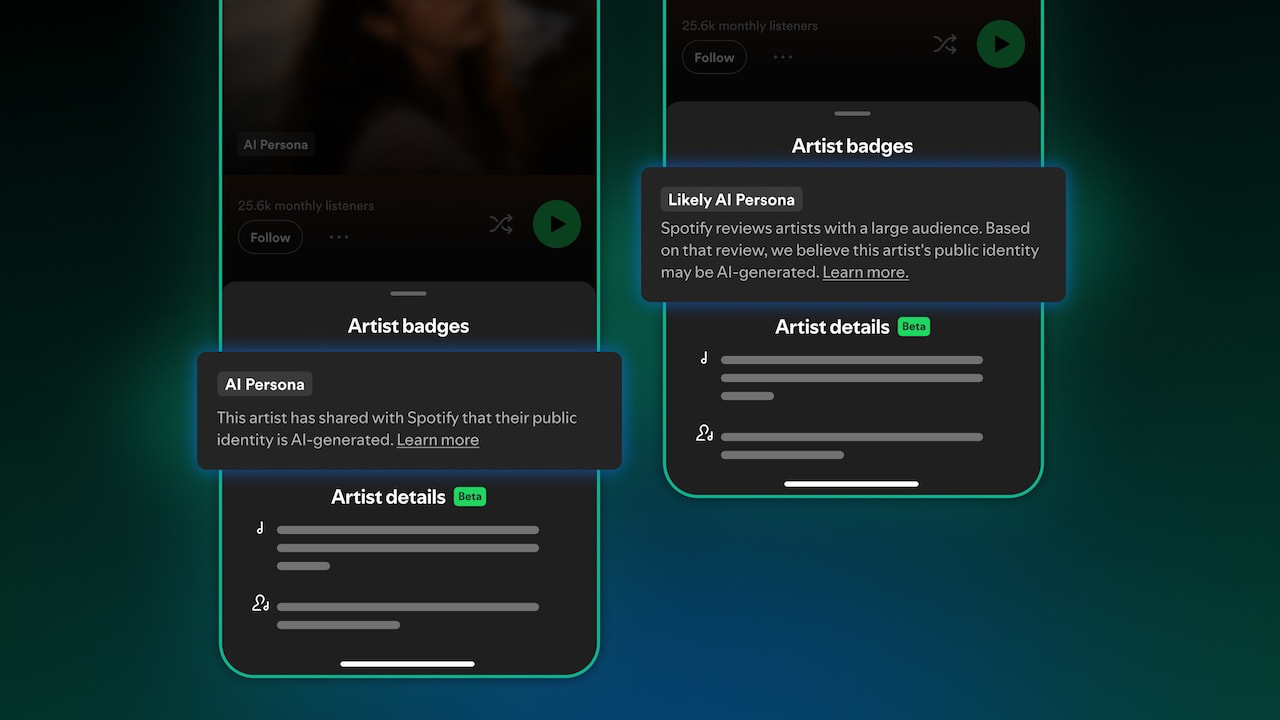
Spotify’s approach has focused heavily on identity and disclosure. Its AI Persona system is designed to identify artist profiles whose public identity may represent an AI-generated person rather than an actual human being, while those profiles can be excluded from editorial and algorithmic recommendations unless listeners deliberately engage with them.
That is not quite the same thing as what Qobuz is doing. Spotify’s badge tells listeners something about who or what the artist supposedly is, whereas Qobuz is identifying the recording itself as AI-generated.
Spotify has also supported richer AI credits so artists, labels and distributors can disclose whether artificial intelligence contributed to vocals, lyrics, instrumentation or production. At the same time, it has tightened policies around impersonation, spam and other deceptive uses of generative technology.
We have already covered the tension inside that strategy. Spotify wants stronger protection against synthetic impersonation and AI spam while continuing to explore licensed generative tools that could allow subscribers to manipulate commercially released music.
That makes Spotify’s position increasingly about authorization rather than opposition to AI itself. Synthetic deception is the problem; transparent, licensed and commercially useful AI remains very much on the table.
Apple Music Is Relying More On The Supply Chain
Apple Music is approaching the problem from another direction by leaning heavily on metadata supplied by labels and distributors. Its AI transparency framework can indicate when artificial intelligence materially contributed to artwork, a sound recording, a composition or a music video.
That model potentially provides more nuance than a single AI-generated label because Apple can distinguish where the technology was used. A recording created entirely by software is obviously a different proposition from an album where AI was used only for artwork or some element of post-production.
The weakness is equally obvious: much of that information depends on the people delivering the content reporting it accurately. Qobuz, by comparison, has built its own detection system rather than relying entirely on disclosure from the supply chain.
Apple’s approach may ultimately provide the most detailed metadata if everybody behaves. History suggests that last part deserves an asterisk the size of a record store.
Why Should Listeners Care?
Nobody should need a forensic-audio degree to determine whether the artist being recommended to them exists. Streaming services already exercise enormous influence over how music is discovered through playlists, recommendations, search placement and editorial promotion.
When synthetic music can be generated almost infinitely, allowing it to flow into those systems unchecked creates a basic mathematical problem. Human artists cannot release 10,000 albums before lunch, while software certainly can.
That makes transparency important, but discovery policy may matter even more. Qobuz’s most significant decision is not adding a small AI tag beside a recording; it is keeping identified synthetic content outside its editorial ecosystem while using fraud detection to prevent suspicious streams from entering royalty calculations.
That distinction matters directly to listeners because discovery is part of what they are paying for. A streaming service filled with endless automated uploads is not inherently more useful just because the catalog number keeps getting larger.
There is also a trust issue. If a recommendation engine places something in front of you, knowing whether it came from an actual artist or a synthetic production should not require investigative work after the fact.
The Bottom Line
Qobuz is not banning artificial intelligence from music, nor is it claiming that every use of AI is inherently fraudulent. It is drawing a much clearer distinction between AI used as a creative tool and synthetic content generated at industrial scale, while giving subscribers more information about what they are hearing.
The most revealing statistic remains 0.38% because, despite the enormous volume of AI material being added to streaming catalogs, Qobuz subscribers appear to spend very little time listening to it. At the same time, the company says 60% of streams attached to identified AI-generated tracks are being flagged as fraudulent.
Those figures only describe activity on Qobuz, so they should not be treated as evidence for the entire streaming market. They do, however, raise an obvious question about the narrative that consumers are demanding an endless supply of machine-generated music.
If the listeners are barely listening and a large percentage of the plays are fraudulent, perhaps the machines are not only making the music.
They may be its biggest fans as well.
You must be logged in to post a comment Login