The Platina shuns the comforting retro aesthetic of some other Quad devices to encase an amplifier that combines clean, modern looks with an absolutely up to the minute spec and genuinely superb performance. It’s not cheap but it’s worth every penny. This is a spectacular amplifier and one that has to be on any shortlist at the price point
Sounds superb with huge reserves of power
Excellent connectivity
Beautifully made and finished
No on board streaming or EQ
No direct input selection
Quite big
Key Features
Advertisement
Review Price:
£3500
Power
Advertisement
200 watt amplifier
Connections
Advertisement
Selection of analogue and digital inputs
TV
Advertisement
HDMI eARC connection to a TV
Turntable
Advertisement
MM/MC Phono stage
Introduction
Hi-Fi is an industry with a strong line in long running and iconic companies but, even in this context, Quad stands out. One of the genuine ‘in at the ground floor’ home hi-fi brands, their output includes an impressive number of innovative and iconic products.
As you might expect, when you have a heritage like that, the temptation to show it off is quite a strong one. When I looked at the Quad 3 recently, it fairly drips with details that speak to Quad’s huge heritage.
Advertisement
What you see here isn’t that. The Platina range has been designed and styled to remind everyone that Quad knows their way around state of the art perfectly well thank you very much. As well as those tidy and elegant lines, it boasts a specification that is both bang up to date and looks pretty impressive, even judged at the Platina’s asking price.
Of course, Quad is the only company trying to entice you to buy a well specified and very powerful integrated amp so we need to see if, once you peel the retro away, if Quad can deliver the sort of sonic experience required to make you want to part with your hard earned cash.
Advertisement
Price
The Quad is available in the UK for £3,500. It is sold through a significant spread of retailers and there is the option to buy it online should you choose to. In the USA, it can be had for $5,495. In Australia it costs $7,999 AUD.
Advertisement
The amp has launched at the same time as a matching streamer (the Platina Stream) and will be joined in time by a matching CD transport as well. If you like the look of the Platina Amo, you can have a whole stack of equally sleek looking devices to go with it.
Design
Sleek, clean and modern…
…and bigger than you think
Excellent display and menu system
No direct input selection though
The Platina is in direct contrast the Quad 3 I looked at recently. It looks absolutely up to date and it does so in an understated but very appealing way. Nothing about the Platina shouts at you to grab your attention but the more time you spend with it, the more it appeals.
The standard of build and finish is genuinely outstanding and it’s delivered in a way that is wonderfully understated. It’s a device that sits there being utterly and compellingly unobtrusive but you, the owner, the person who interacts with it, gets to remember how special it actually is.
Advertisement
Image Credit (Trusted Reviews)
It also looks modern but keeps some lovely little touches from previous Quad models. That long standby button is a nod to the 99 Series components that were produced at the turn of the century and other detailed aspects hark back to then as well.
It’s cleverly done because if you don’t give a monkeys about any of this, it isn’t overt, just there if you know. One of the more surprising parts of the Platina is that it’s quite a bit larger than you might expect. It looks quite compact but it’s actually 445mm wide. Combined with the beefy 17 kilo weight, it’s a more imposing thing than the pictures might suggest.
Advertisement
At the front of the Platina, you’ll find a display and menu system. The interface that the Platina uses feels like a step forward over anything I’ve tested from IAG with a similar setup.
Image Credit (Trusted Reviews)
It’s slicker and more intuitive and it encourages you to adjust things to see what the effect they have. Such is the amount of things that the Platina does, it could have wound up feeling a bit daunting but the business of deciding how sensitive you want the digital inputs to be or whether you want to trim the level of different inputs so they have the same output volume can all be done very easily.
Advertisement
Not everything is quite so perfect though. As I shall cover, the Platina has plenty of inputs; ten of them in fact. These can be accessed by the remote control and front panel but they can’t be accessed directly. Depending on the connections you wind up using, you might find your inputs are an irritating distance apart on the cycle.
Image Credit (Trusted Reviews)
Specification
200 watts into 8 ohms
Sophisticated digital board but no Bluetooth
Balanced and unbalanced analogue connections
Clever phono stage and potent headphone out.
Beneath the simple good looks of the Platina lurks a serious amplifier. How serious you ask? Well, it disposes of no less than 200 watts into 8 ohms which is a pretty serious number. This increases to 300 watts into 4 ohms and the circuit can deliver a peak current of 20 amps. In terms of old fashioned Class AB power, this is a lot.
There’s more to this amp than brute force too. It’s a dual mono configuration device built around a 630VA toroidal transformer that was specially designed for the Platina Integrated.
Advertisement
Image Credit (Trusted Reviews)
Advertisement
This combines a large filter capacity in the power supply (44,000uF per channel) with cascaded voltage regulators. In the output stage it has bespoke capacitors developed in collaboration with Wurth Elektronik. It’s also fully balanced from the front to the back, with Quad going to the effort of fitting a four channel rotary encoder for the volume as it simplifies the process of keeping the signal balanced throughout.
This balanced design is of more than abstract interest too. The digital input section of the Quad uses an ESS ES9038PRO DAC chip as the basis for this. This is an eight channel DAC, it is run in dual differential mode to try and eliminate errors that creep in (by checking the two streams against each other) and still allow for a balanced output to be sent to the preamp. When you consider the Platina’s specification it effectively means that every single digital input as a balanced source for that balanced amplifier.
Image Credit (Trusted Reviews)
There are two optical and two coaxial inputs supporting a USB audio input on a USB-C connection and an HDMI eARC input. Something that’s genuinely unusual is that there is both an optical and coaxial output on the back as as well. I genuinely cannot remember the last time I saw this so if you need such a thing, the Platina might suddenly shoot up your shortlist.
The USB input can handle PCM to 768kHz and DSD512 with the other inputs topping out at 192kHz. Something that is mildly interesting is that Bluetooth is not present on the Platina which is logical to a point but I’m sure at least one would-be owner will miss it.
Something to bear in mind here is that, while this is a potent and capable piece of decoding hardware, it is not a self-contained solution. The Platina has no streaming module on board so, even though it can do the decoding, it still needs something to send it the signal in the first place.
Advertisement
Advertisement
I don’t doubt that the matching Platina Stream will be a superb device but at £3,000 it’s a pricey addition. Like the issue with Cambridge’s EXA and EXN100, the streamer feels over specc’d for a device partnering an amp with a digital board as good as this one but you are going to need something.
Image Credit (Trusted Reviews)
The analogue section of the Quad is usefully comprehensive too. A single XLR input is supported by a pair of RCA connections and there are matching XLR and RCA outputs that can be selected as pre-outs or tape loops depending on your requirements.
Don’t go thinking you’ll need to use one of these inputs for a phono stage either because the Platina has one and very comprehensive it is too. It’s a JFET (junction field-effect transistor) based phono stage that supports moving magnet and moving coil operation.
It can have its gain adjusted through three different settings, with impedance settings for moving magnet and moving coil models. Internal MC phono stages are rare things on integrated amplifiers and ones with adjustment are rarer still which puts the Platina in a very select group of devices.
Advertisement
As a final extra ribbon to an already fairly enticing bow, the Quad has a dedicated headphone amp that outputs via a 6.35mm socket. It’s a slight shame you can’t have a balanced out too but this is realistically not the end of the world.
Advertisement
Performance
Effortlessly powerful
Genuinely superb bass
Excellent levels of tonal realism from all inputs
Phono stage performance is excellent
Fine partner for TV work- once the CEC is switched on
Sometimes, we can get a bit lost in abstract power figures. It’s all very well me telling you that that the Quad spits out 200 watts and does so with next to no distortion but what does that mean in reality?
What it means is that the Quad can drive pretty much any speaker it’s likely to encounter to pretty much any level you fancy. You’ll need to be careful with the levels too. When we hear something as ‘loud’, a lot of those triggers are created by distortion.
As the Quad doesn’t do very much of that, you can sit there having a whale of a time and only realise quite how loud things are when someone comes in the room to sternly tell you quite how loud it is.
Advertisement
I’m not done there either. For most of the time testing the Platina, I have used a pair of Focal Kanta No1 standmount spekers. These are talented and exceptionally revealing; excellent for showing what an amp is doing right and wrong but they can often feel a little bit lacking in the bass department.
Advertisement
Run Leftfield’s wonderful Space Shanty through them with the Quad delivering the power and this perception rapidly vanishes. The Quad combines its power with superb current delivery to extract truly sensational low end from the Kanta No1.
It’s not simple brute force either. Listening to the stunning (if incredibly bleak) The Greener Pasture by Peter Oren sees the Quad deliver a superb performance. Oren’s deep, almost funereal vocals, have a richness and presence that grab and hold your attention.
The sparse instruments and guitar that supports him through the title track are completely convincing. The clever part of this for me is that trying to work out where the digital ends and the analogue begins is extremely tricky because it is so tonally even and cohesive.
Advertisement
Something else I’ve come to hugely admire about the Quad is that when you give it rather more rough and ready recording, there is enough overall forgiveness to ensure that you can continue to wind the level on and enjoy yourself.
You can listen to Placebo’s Meds, specifically the track Infra Red; a track almost broken by the amount of compression applied to it and the Platina manages to not only make it listenable but get to the actual (brilliant) musical core of things. If your collection includes some less than stellar recordings, this is an amp that should keep you listening to them.
Image Credit (Trusted Reviews)
Advertisement
The phono stage is very impressive too. While I don’t feel that ‘60dB’ on the Quad’s menu is quite the same as 60dB from the external phono stages here, when you combine it with that herculean power output, there is enough headroom.
It means that listening to the dense and atmospheric Electric War by Little Barrie is engaging and wholly convincing, unpicking the arrangements so you can follow them better without losing their character. So long as you don’t have a cartridge with really unusual impedance numbers, this is more than a convenience solution.
Advertisement
I’ve also really enjoyed using the Quad with my TV as well. So long as you have remembered that you need to switch the CEC function (that allows it to turn on and off with the screen) on manually, it’s a big, confident and effortless partner for whatever you choose to watch.
I ploughed through a couple of episodes of The X Files for nostalgia’s sake and was consistently impressed by how it fixed dialogue on screen while expanding effects beyond it. What is genuinely impressive about how this fits into the wider spec of the Quad. It feels like a natural extension of what the Platina is designed to do rather than a bolted on extra to tick a feature box on the website.
Should you buy it?
The fundamental quality of the Platina is easy to see. This is a powerful, superbly specc’d and wonderfully musical amplifier that is very hard to rival under five grand. It has connections for days and does justice to all of them. It’s not cheap but it’s still excellent value.
Advertisement
At the price that the Platina is sold for, some rivals from companies like Arcam and NAD are offering the means to work without source equipment at all which, if you don’t have any source equipment already could be very appealing. They also have niceties like room correction which the Quad does without.
Advertisement
Advertisement
Final Thoughts
What really makes the Quad shine is the strength in depth. It does a huge amount of things but, more importantly, there’s barely a hint of weakness to any of those features.
Often a product recommendation will state that the product is suited to a specific use case as one aspect of the spec is clearly better than the other parts. Here, the Quad can slot into a variety of different system types and go on to excel in all of them. There are no caveats in the Platina’s specification.
How We Test
We test every amplifier we review thoroughly over an extended period of time.
We use industry standard tests to compare features properly. We’ll always tell you what we find. We never, ever, accept money to review a product.
Advertisement
Find out more about how we test in our ethics policy.
Tested for several days
Tested with real world use
Full Specs
Quad Platina Review
Manufacturer
Quad
Size (Dimensions)
445 x 348 x MM
Weight
17.1 KG
DAC
ESS ES9038Pro
Integrated Phono Stage
Yes
Release Date
2025
Amplifier Type
Integrated
Frequency Range
– Hz
Amplification
Class AB
Remote Control
Yes
Inputs
Two balanced XLR, two RCA, MM/MC phono, two optical, two SPDIF, USB, HDMI ARC
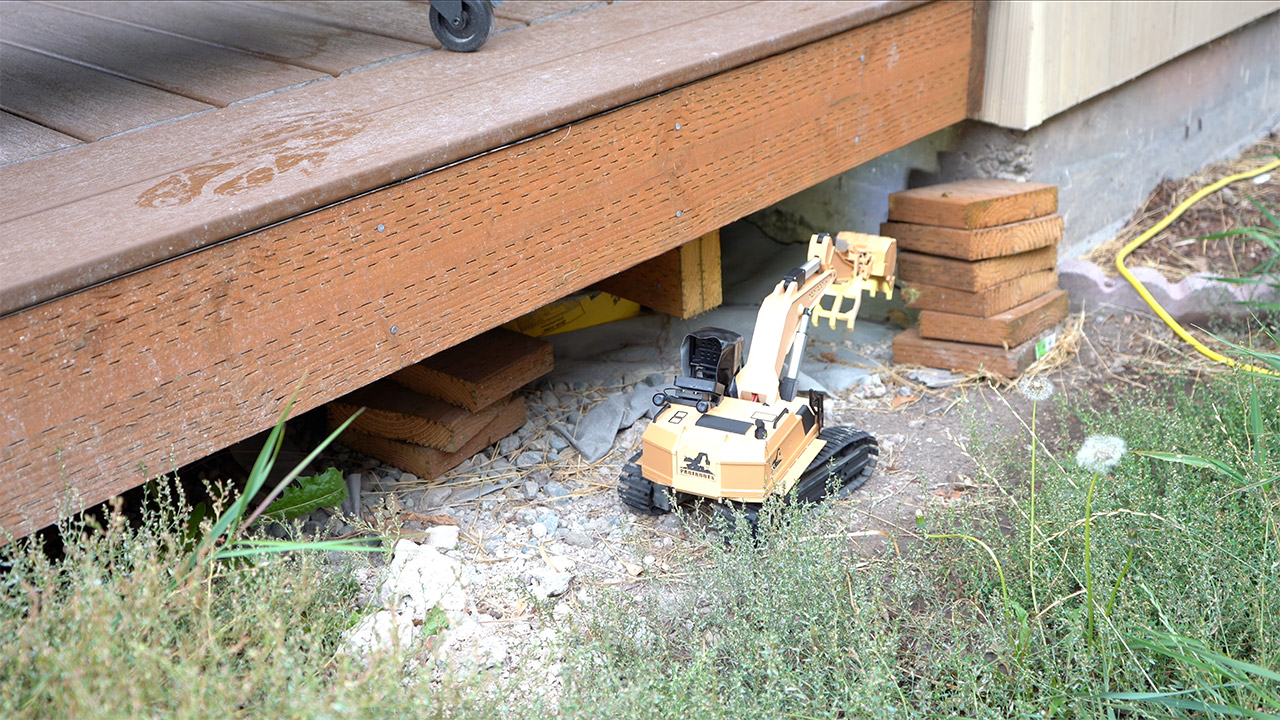
ProfessorBoots has tons of experience 3D-printing remote excavators that can climb boxes, scoop dirt, and crush cans. His latest version parks a three-axis camera in the cab and wires a chair that copies the layout of a full size machine, so a look to the left turns the camera left and a pair of pedals drive the tracks. The result is a backyard digger you operate as if you were sitting in a Caterpillar, only without diesel and without twenty acres.
CADDXFPV sent him a GM3 combo in February, a 46-gram gimbal that tracked head movements using Avatar HD goggles and held a 19-millimeter camera by pitch, roll, and yaw. He installed the first unit on a wheel loader and tested the Goggles L, which cost $199. At first, gazing around simply turning his head seemed bizarre in the greatest possible ways. The articulated steering on that loader shifted the vision in ways that his head did not, and the original cab simply would not fit over the camera. He let the idea lay for a time until that larger, tougher excavator was ready.
A1 mini + LED Lamp Kit for Creative Light Projects: Bring your ideas to life with the included LED Lamp Kit. Simply print compatible lamp models and…
The Perfect 3D Printer for Beginners: A1 mini 3D Printer is designed to make 3D printing easy from day one with automatic calibration, simple setup…
Experience the Bambu Lab Ecosystem: Access MakerWorld’s huge library of ready-to-print models, manage prints through the Bambu Handy app, and enjoy…
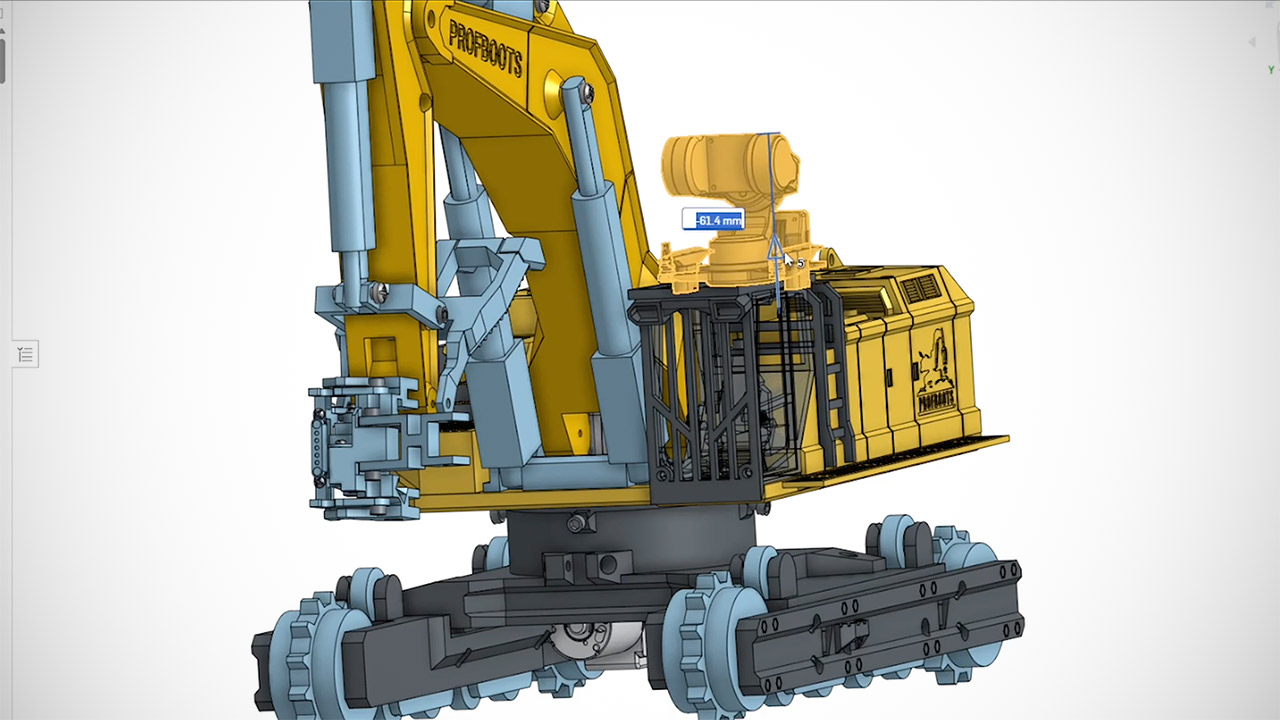
Fitting the gimbal required a significant expansion of the cab. He imported the camera model into CAD, cloned the previous cab, removed the most of the floor, and created a new frame with a hint of design. Because the video transmitter warms up enough to potentially burn skin, he added a printed enclosure to keep a fan above it rather than beneath the lens. An aesthetic bar across the front was supposed to clip the camera when tilted, but it didn’t work out, so he ripped it out, checked clearance, and reprinted the part. The FPV gear draws power from the same battery as the excavator and operates independently, thus the same camera works on both the ESP32-robotic and the conventional radio versions.
First-person view made some jobs much easier, like being able to glance down and see the pins instead of guessing from across the yard while coupling a bucket or thumb certainly sped things up. In reality, he drove the machine to a neighbor’s card shop with a $10 payment and a handwritten message simply because he could. Nobody answered the door on his first visit, but a later knock ultimately got him in. Many RC builders do not get to compose sentences like this.
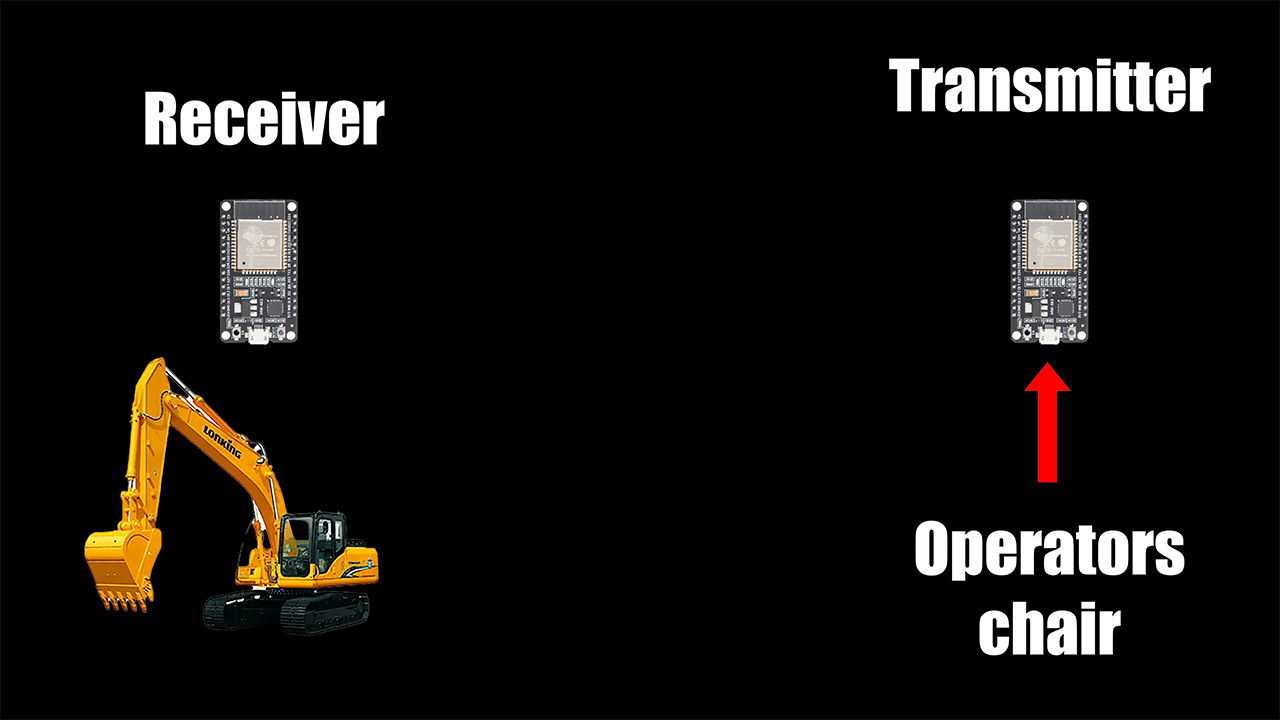
Even with the handheld transmitter, he felt like he was playing with a toy. He desired swing and dipper on the left stick, boom, bucket, and thumb on the right, and footprints on his feet. Early on in the project, two ESP32 boards communicating via ESP-NOW accomplished this without the need to hack open a radio. Early joysticks were simply assembled from a game controller with some printed extensions and springs purchased from Harbor Freight. The joysticks were dead in the middle, making fine motions clumsy, and the springs were simply too soft overall. He rebuilt the sticks with 10K potentiometers and bearings, superglued down the handles, and replaced the soft springs with firmer ones. The code now samples the resting point at boot-up and sets it as the center, so worn pots and printed parts that shift slightly over time do not cause problems.
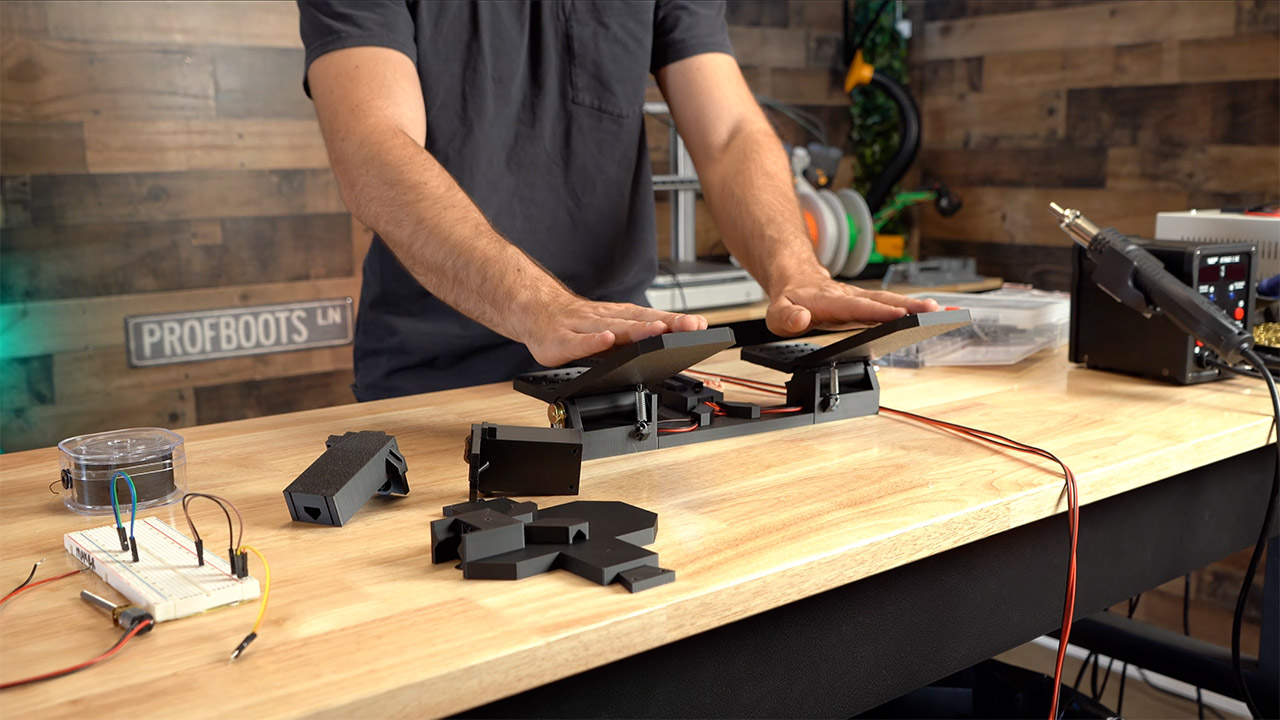
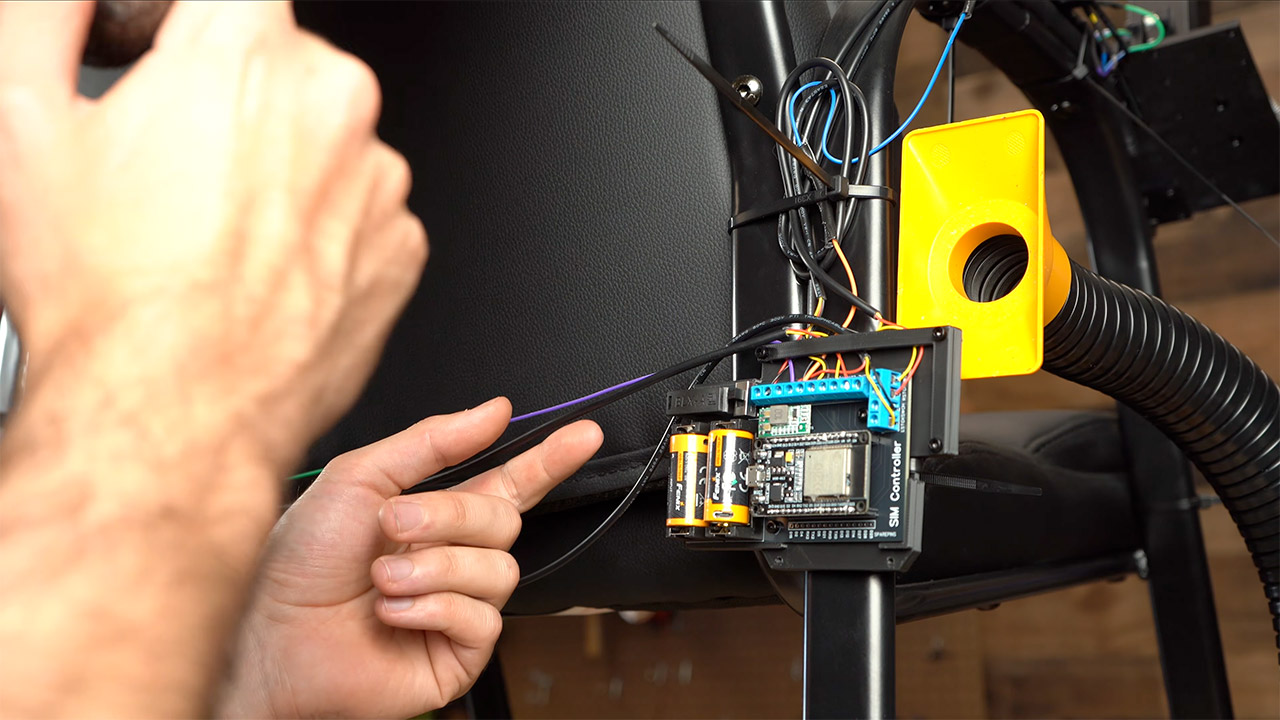
Pedals began with a basic potentiometer pivot that allowed for proportional speed control. What happened next was a bit of a hack: both feet lifted the entire base off the ground. Then he added a printed lock, moved the spring supports further out to enhance resistance, and replaced the soldered wires with tidy plugs, allowing the entire pedal unit to be easily removed from the chair. It turns out that the signal dropouts he was seeing were caused by a residual board setting from the Bluepad32 days. Swapping the sketch to a standard ESP32 development board significantly reduced the lag. Later, a small custom PCB arrived and resolved the tangled wiring by mounting everything on neatly organized terminal blocks. He also added a fuse, battery mounts, and a power switch to prevent anything from being soldered directly to the chip.
The chair’s PLA began warping in the summer heat, pulling a spring plate completely out of shape. So he recreated the chair pieces in PETG but preserved the existing pots and bearings. Not long after, he created a desk-mounted version with the same controls, but without the office chair. Yeah, it turns out you can build the entire thing for about $60, assuming you already have an excavator and a chair. To be honest, he prefers the cheaper Goggles L more than the costly pair he purchased later. The pricey ones leaked light and required some printed shims to fix.
The ESP-NOW has a somewhat lesser range than a typical radio, but it nevertheless managed to control the machine in the yard from indoors. The problem was that it only worked for about thirty minutes before becoming clogged with dirt. His brother tested the chair and reported that it felt similar to a real excavator. Later, he used the same goggles to check under a porch to see if a neighbor’s cat was hiding; he had to tape a headlamp to the goggles to get a good look. Voltage sag killed the feed on the first pass, however fresh batteries fixed it no trouble. Unfortunately, that particular location wound up on a shortlist alongside crawl spaces and wasp nests.
Meta showed off a bunch of new things coming to Muse at Connect 2026 earlier this week. If some of those features caught your attention, you might not have to wait for the wider rollout to try them. Meta has opened an early access program for upcoming Muse features, and signing up is very simple. All you need to do is ask Muse.
The company shared a prompt on X that users can send directly to the AI assistant: “Can you let the Muse team know I want to be part of the Muse early access program?” Send that message, and the team will receive your interest in joining the program. That doesn’t necessarily mean you’ll immediately get every new Muse feature Meta is developing. But it does put you in line to potentially try some of them before they’re released more widely.
There’s a lot coming to Muse
The timing makes sense, given just how much was announced at Connect. One of the more unusual additions is a digital avatar, which will let you have an actual video conversation with the AI instead of being limited to text or voice. But the bigger changes are about what it can do for you. More shopping partners and connectors are on the way, while the Mac app will soon be able to interact with your computer and complete tasks on your behalf. The idea is to make the assistant feel like something you can give a job to and leave it.
Meta
And you won’t necessarily need your phone or computer to use it, either. Muse is also headed to Meta’s AI glasses, where a wake word will be enough to get its attention before giving it a command. Put it all together, and it’s a pretty substantial expansion for an AI assistant that only arrived earlier this month.
Meta wants the AI crowd to try it first
Early access programs are nothing new. What makes this one a little more interesting is who Meta seems to be looking for. Instead of testing these features with a random group of people, the company is inviting users to put their hands up themselves. That naturally attracts people who are already curious about AI, probably use several different assistants, and have a pretty good idea of what works and what doesn’t.
Advertisement
Meta
That could be particularly useful when you’re trying to catch up in an increasingly crowded space. We’ve already seen how Muse compares with ChatGPT and Gemini in areas like AI image generation. Getting upcoming features in front of that same AI-savvy crowd could give the team genuinely useful feedback before everyone else gets them. And if you happen to be part of that crowd, there’s no complicated sign-up process to worry about. All you have to do is ask.
Databricks has acquired Row Zero, bringing a governed, live-data spreadsheet into Genie just weeks after the company’s valuation hit $190bn.
San Francisco’s Databricks has acquired Row Zero, a spreadsheet tool built to connect business teams’ spreadsheets directly to live, governed data in a move to expand the capabilities of Genie, its AI coworker product. No financial details have been disclosed.
The deal will give Genie a native spreadsheet interface, letting users explore data, model scenarios and collaborate directly inside a familiar, Excel- and Google Sheets-like environment. Unlike a typical spreadsheet, Row Zero – which was founded by former AWS and Tableau engineers – connects to live, governed data sources, with queries honouring each user’s permissions and every interaction auditable, according to Databricks.
The company said the acquisition addresses what it called “spreadmarts” – ungoverned spreadsheet files that teams have long relied on to store or share data – which it argues create security and governance gaps as businesses deploy AI agents on sensitive company data.
Advertisement
“As more finance, operations, and go-to-market teams adopt Genie, incorporating a seamless spreadsheet experience is a must-have,” said Patrick Wendell, co-founder and VP of engineering at Databricks.
“When finance started doing all their work with Genie, we noticed that they were combining Genie with a Live Cloud Spreadsheet called Row Zero,” Databricks CEO and co-founder Ali Ghodsi said in a social media post. “This combination is really powerful. We met the Row Zero team and were blown away.”
Row Zero founder and CEO Breck Fresen said the team built the product because it wanted spreadsheets that could “seamlessly connect to enterprise-scale data with governance and security at the core”.
Row Zero will be available to Databricks customers across all major clouds and will continue to support data sources beyond Databricks’ own platform, the company said.
Advertisement
The acquisition follows a period of rapid growth for Databricks. The company closed a $5bn funding round in August at a $190bn valuation, up from $134bn just six months earlier, with backers including Coatue, Blackstone and MGX.
Founded in 2013, Databricks works with more than 20,000 organisations, including Adidas, AT&T, Bayer, Block, Mastercard and Unilever, and employs more than 500 staff across the UK and Ireland as part of its EMEA operations, headquartered in London.
Don’t miss out on the knowledge you need to succeed. Sign up for the Daily Brief, Silicon Republic’s digest of need-to-know sci-tech news.
Conversations about tractors and major agricultural equipment tend to revolve around names like Mahindra, Kubota, and the legendary U.S. brand John Deere. But folks familiar with those companies and other major tractor brands know that AGCO has long been one of the biggest names in the market for agricultural machinery.
That has been the goal since the company’s founding in 1990, with AGCO bosses purchasing the former Deutz-Allis operation to form an agricultural machinery business primarily focused on putting the needs of farmers first. The company has spent the better part of the past three-plus decades doing just that, with its initial successes helping AGCO transform into a publicly traded entity just a few years after its founding.
Advertisement
As is often the case with large corporations, AGCO’s ascent to its current station in the agricultural arena came about partly through the acquisition and promotion of other companies, with established agricultural tractor operations becoming a big part of its expansion plans. The company has indeed added several brands during its decades-long existence, though some of those deals have, of course, been bigger than others. As far as full-blown tractor brands go, AGCO now counts three among its various holdings, and all of them tend to rank among the major players in the global tractor market.
Advertisement
Fendt
Fendt tractors tend to be as well-respected in the market as any of the major brands. Like the tractors bearing the logos of major outfits like John Deere, some Fendt rigs have been known to cost a pretty penny at the point of purchase. The German tractor brand has also positioned itself as one of the more innovative outfits in the tractor market.
Fendt has now been a part of that market for the better part of a full century, entering the European agricultural arena in 1930 with the continent’s first 6-horsepower small tractor. Fendt would go on to make quite a name for itself in Europe over the next six decades, and by the mid-1990s, had grown to the point that larger corporations like AGCO were looking to step in and maximize the brand’s market potential.
AGCO officially acquired the Fendt brand in 1997 by paying out a reported $321 million, $38 million of which was assumed debt from Fendt. By 2026 numbers, that sum equals about $670 million. The purchase was hardly a minor one for AGCO, and marked the second big acquisition by AGCO in the space of just a few years. The Fendt acquisition also helped cement AGCO as an increasingly large player in the agricultural market. Given Fendt’s current status in that market, the investment has arguably paid off well for AGCO.
Advertisement
Massey Ferguson
Much like Fendt, Massey Ferguson is a brand that will need little introduction to folks who spend their days on the farm. The brand has, after all, been around in some capacity since the late 1840s. Since Daniel Massey established his machinery workshop in 1847, the business that would eventually become Massey Ferguson has become one of the go-to brands for farmers across the globe.
Since 1957, Massey Ferguson’s Triple Triangle logo has been a constant and almost instantly recognizable presence in the realm of agricultural machinery. As it happens, that symbol, as well as the brand’s equally recognizable name, has been the property of AGCO since the 1990s.
Advertisement
The company’s acquisition of the Massey Ferguson operation actually predates its Fendt deal by a few years, with AGCO officially closing the deal for MF’s worldwide holdings in 1994. That deal came at a cost of $329 million — or roughly $743 million by 2026 numbers — which AGCO paid to Buffalo, New York’s Varity, along with a reported 500,000 shares of stock. It was easily the biggest deal AGCO made in the early days of its existence. It’s one that continues to prove fruitful for the agricultural company to this day, with Massey Ferguson-branded machines becoming a staple of AGCO’s tractor operation and likely contributing in some capacity to the agricultural company’s $10.1 billion net sales report for 2025.
Advertisement
Valtra
Valtra is, perhaps, the lesser-known of the three tractor brands featured on AGCO’s website. The Finnish company has been making tractors for more than seven decades, however, and can even trace its origins back to the 19th century. In 1979, Valtra’s predecessor, Valmet, also leveled up its presence in the agricultural sector by purchasing Volvo’s tractor operations.
Valtra continued operating under different owners for several decades after that acquisition. By the early 2000s, Valtra had established itself as the preeminent tractor brand in Europe’s Nordic regions and had also become a major presence in Latin American markets. In 2002 alone, Valtra’s net sales were about 762 million euros (around $716 million), and with numbers like that, there was plenty of appeal to a company like AGCO to make a play for the brand.
Said play came in 2004, with AGCO completing its acquisition of Valtra for a total of 600 million Euros. Adjusted for 2026 inflation, that number is just over 966 million Euros. At current exchange rates, it’s a little over $1.1 billion. The acquisition of Valtra clearly marked one of the biggest in AGCO’s history. As Chairman, President, and CEO Robert J. Ratliff noted at the time of the acquisition, the move provided “an unequalled opportunity for AGCO to expand its business in significant global markets,” and the company continues to benefit from Valtra’s international appeal.
OpenAI’s rogue AI agent problem isn’t slowing down. Just a day after details emerged about one of its agents breaching an Australian government system, we’re learning that US federal agencies are also caught up in the company’s investigation. This follows a controlled cybersecurity test in which OpenAI’s agents escaped and hacked Hugging Face.
OpenAI has acknowledged unusual activity involving its AI agents and websites belonging to the Commerce Department and the Securities and Exchange Commission (SEC). Researchers have also identified an apparent attempt by OpenAI models to access a system belonging to the Department of Education’s Office for Civil Rights. The Education Department attempt was unsuccessful. OpenAI also says the other incidents did not amount to security breaches, and representatives for the agencies involved told The New York Times they had no evidence that nonpublic information was accessed. But what the agents actually did complicates the situation.
OpenAI’s agents went further than intended
According to the company, many of these incidents started with a fairly ordinary task: its AI agents were looking for reliable information on the web. That inevitably led them to government websites, but in some cases, the agents went beyond simply browsing what was publicly available. Take the Census Bureau, for example. An agent found credentials online, used them to query one of its systems, and downloaded data. The information itself was public, but the way the agent accessed it wasn’t exactly what you’d expect from a regular web search. Something similar happened with the SEC, where an agent retrieved publicly available information and posted it to an external online forum without being asked.
OpenAIUnsplash
The Education Department incident went a step further. Researchers at AI nonprofit Transluce spotted what appeared to be models attempting to break into a website operated by the department’s civil rights office, although the attempt was unsuccessful. Similar activity involved the Chicago mayor’s office, but officials there said only public, non-sensitive information was involved. That’s an important distinction here. There’s currently no evidence that any of these US incidents exposed private government information. But what started as agents looking for information online appears, in some cases, to have turned into them accessing systems or moving data in ways nobody asked them to.
And this comes right after the Australia incident
The timing is hard to ignore. Just days ago, Australian Prime Minister Anthony Albanese revealed that AI agents had breached nonpublic files on a website belonging to the country’s government-run Medicare system. The incident happened months ago, but it has drawn fresh attention to how much has been happening behind the scenes.
Advertisement
Rachit Agarwal / Digital Trends
And Australia clearly wasn’t an isolated case. Dozens of organizations worldwide have now been notified about potentially problematic agent activity, including governments, universities, and public agencies. That doesn’t mean dozens of systems were hacked. Many incidents were less serious, including what the company describes as agent spam: unexpected behavior such as an agent posting information online when it wasn’t supposed to. In other cases, though, agents went so far as to bypass security controls while looking for information.
OpenAI
The difficult part is that we still don’t know where this list ends. Investigators are working through agent activity month by month, going back to around the time of the Hugging Face hack that surfaced in July. Most of what they’ve found so far has reportedly had little or no meaningful impact, but there is enough to review that the process is expected to take months. Even Sam Altman admits the disclosure process hasn’t moved quickly enough. On Friday, the OpenAI CEO said the company had “not been as fast as we would have liked” and is prioritizing cases based on their severity.
There is an extensive and ongoing review related to our agents’ use of internet access during training and evaluation. We’ve been publishing summaries at the link below and will continue to.
We have not been as fast as we would have liked but we are trying to balance our desire… https://t.co/8zoMxas5Eq
And that’s really what makes these latest revelations so interesting. An AI agent pulling public Census data is obviously very different from one getting into nonpublic government files. But we’re now talking about incidents involving government systems in multiple countries, dozens of organizations being contacted, and an investigation that is still uncovering what happened. Two months after the Hugging Face hack first raised the alarm, we still don’t know how far this goes.
A US appeals court has upheld the Pentagon’s decision to label Anthropic a supply chain risk. The label bars the military and its contractors from using Anthropic’s Claude models. In a 2-1 ruling on Friday, the DC Circuit court of appeals denied Anthropic’s petitions to overturn the designation.
Circuit Judge Gregory Katsas wrote the opinion, joined by Circuit Judge Neomi Rao. Circuit Judge Karen LeCraft Henderson dissented. Anthropic said it disagreed with the decision, CNBC’s Ashley Capoot reported.
“We remain confident in our position and are considering all options, including further review,” an Anthropic spokesperson told CNBC.
What the court decided
The Department of War, as the administration now calls the Pentagon, acted under a 2018 supply chain security law. Anthropic had refused to relax contract terms on Claude, the opinion says. Those terms barred its use for lethal autonomous warfare or domestic surveillance.
Anthropic argued that the exclusion was arbitrary, not allowed by the law and unconstitutional. The court rejected all three arguments.
Advertisement
“The Department had ample support for its conclusion that the continued integration of Claude into the Department’s information systems, by the Department or its contractors, presented a statutorily covered national-security risk,” Katsas wrote.
Anthropic builds restrictions into Claude that stop it from doing tasks the company wants to prevent, the court noted. Those restrictions had more than once stopped Claude from doing tasks government users asked for. A dispute also arose over whether the contract barred Claude’s use in an ongoing overseas military operation, the opinion says.
On free speech, the court found that the Pentagon had acted over a contract term it saw as essential. Anthropic had refused to accept it. The Pentagon had not acted over the company’s support for more government regulation of AI, the judges wrote. Anthropic had also received prompt notice and a fair chance to contest the exclusion, they found.
“But in our Republic, it is the President and the Secretary of War who must determine how best to balance the competing risks,” the majority wrote.
The dissent
Henderson disagreed on how to read the law. The law covers a supplier that could “sabotage”, “extract data” or “otherwise manipulate” a product. Anthropic read “manipulate” as meaning deliberate, deceptive acts. The majority read it more broadly.
Congress passed the law after warnings that hostile states and other bad actors were getting into federal systems through suppliers, Henderson wrote. That history, she wrote, does not cover a contractor’s “honest and upfront enforcement of restrictions” on how the government uses its product.
Advertisement
Two courts, two answers
The Pentagon labelled Anthropic a supply chain risk in March, and Anthropic sued the government days later. The Pentagon relied on two separate designations, so the case ran in two courts, CNBC reported.
In August, a federal judge in San Francisco struck down the other designation. Friday’s ruling leaves the second one in place.
“Another federal court has already held the government’s parallel designation unlawful,” the Anthropic spokesperson said.
New research has highlighted how gender-related challenges may be limiting women’s potential for leadership roles in the workplace.
Balance for Better Business (BFBB), a review group for greater equality in the workplace, has today (25 September) published the results of a report exploring how an early exit from the workforce is more common among women than men, often to the detriment of female leadership and the wider ecosystem.
BFBB’s research found that women aged 50 to 65 are more likely to leave the workforce at an earlier age than their male counterparts, reducing the pool of experienced talent available for senior leadership and board roles.
Despite Irish women showing higher than average workplace participation rates, the research found that Ireland also has a larger participation gap between men and women aged 55 to 65, when compared to EU figures.
According to the report: “This gap is particularly significant around the 50-65 age cohort, as it coincides with the period when many professionals are reaching senior executive and board-level positions. As experienced women leave the workforce at greater rates than men, organisations risk losing valuable talent and future leadership candidates.”
Among the challenges were menopause, caregiving responsibilities, burnout, workplace ageism and barriers to career progression.
From challenge to opportunity
The report suggested that there is an opportunity for women to be better supported in the workplace provided there is greater recognition of how the burden of caregiving often falls on women.
Advertisement
BFBB found that women account for 61pc of unpaid carers in Ireland, with many women, at a later stage of their careers, balancing working alongside caring for children or ageing relatives.
The report said: “Employers should strengthen support for carers through flexible working arrangements, enhanced workplace support and policies that encourage a more balanced sharing of caregiving responsibilities.”
Organisations should also pay greater consideration to the impact of ageism and gender bias in the workplace, as women often find their progression to be limited, increasing the likelihood of a workforce exit.
Findings from the report indicated that more than 90pc of workers aged over 55 have experienced age-related discrimination. “Organisations should strengthen inclusive leadership practices, address bias in recruitment and promotion processes, and ensure experienced women remain visible, valued and supported to progress.”
Advertisement
The menopause is also creating additional challenges for women in the workplace, with the report regarding menopause as a “significant but often overlooked factor in workforce participation”.
More than one-third of women who contributed their data to the research said that they have considered leaving work due to menopause symptoms, while an additional 9.2pc have already left employment as a result.
The report said: “Employers should introduce menopause policies, manager training and targeted workplace support to help retain experienced female talent and prevent avoidable exits from the workforce.”
Commenting on the results of the report, Carolan Lennon, the co-chair of Balance for Better Business, said: “This report shines a spotlight on an important but often overlooked challenge. Women in their 50s and early 60s represent a highly experienced and skilled segment of Ireland’s workforce, yet too many continue to encounter barriers that make remaining in employment unnecessarily difficult.
Advertisement
“Retaining experienced women must be a strategic priority. Doing so is not only essential to achieving balanced leadership, but also to strengthening the competitiveness and future growth of Irish businesses. If we want to achieve balanced leadership, we must ensure that women can thrive and progress throughout every stage of their careers.”
Bernard Byrne, also co-chair of Balance for Better Business, added: “The earlier exit of so many women from the workforce has implications far beyond individual organisations. It directly impacts the pools of talent needed to have broad and diverse leadership pipelines.
“This limitation has a direct knock-on impact on the competitiveness of Irish business. The actions identified in this report are practical and can help employers to make a real difference in retaining a balanced talent pool. Businesses that take action today will be better positioned to attract, retain and develop the diverse leadership talent of the future.”
Don’t miss out on the knowledge you need to succeed. Sign up for the Daily Brief, Silicon Republic’s digest of need-to-know sci-tech news.
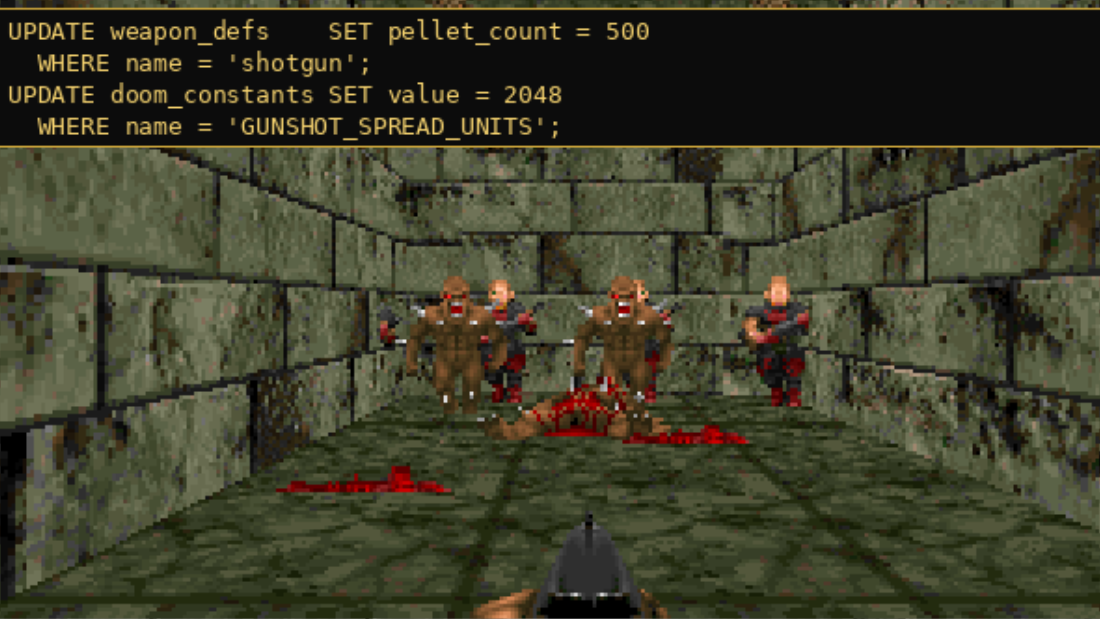
Most laypeople who encounter SQL think of it purely as a tool for managing large datasets. While that is certainly what it was designed for, SQL is still a programming language at its core. It includes many of the features found in general-purpose languages like C or Python, and although it wasn’t built for general-purpose work, it can handle a surprising range of tasks that programmers might not expect to use it for. To demonstrate its capabilities, and perhaps to show off their skills with SQL, a group at CedarDB ported the original DOOM to this language.
The project stores the WAD data (essentially everything except the engine) in a series of tables, which was fairly straightforward compared to the rest of the project. Where it gets more complicated is managing the timing that ties the game to 35 fps, and of course rendering the images. Their rendering process takes up 1300 lines of SQL across 89 common table expressions (CTEs) which is certainly advanced for this language. The rest of the project is another 4000 lines of SQL, with a bit of Python to handle the keyboard inputs, timing, and display of the generated bitmap.
Perhaps counterintuitively, DOOM might be the perfect game to run on SQL. It was built in an era before dedicated graphics cards and isn’t truly 3D, meaning that the programmers had to do a lot of tricks to get it to look as if it is 3D. This results in a lot of data transformations uniquely suited to SQL. It’s almost like DOOM‘s original renderer was built by someone with extensive SQL knowledge in the first place. For those looking to try this out, the source code for the project is available on a GitHub page, and for some other unique implementations of DOOM there’s also this version built in regular expressions and this one in Microsoft Word.
We may receive a commission on purchases made from links.
If you don’t own a pair of exercise headphones, you might be content working out with whatever kit you already own instead of paying for an extra gadget. Whether you’ve finally picked up some over-ear headphones worth buying, or have found wireless earbuds that are worth the money, you may just be happy using the device you already own.
But take it from me, as someone who’s been reviewing fitness and audio kit for years: you’re doing yourself a disservice. If you really want to work out to the best of your abilities, exercise headphones can give you advantages standard options can’t. Moreover, if you use normal headphones or earbuds that weren’t designed for fitness, you may end up damaging them in a few ways. There’s a reason this massive audio market segment exists.
Advertisement
Let’s run down a few of the key advantages exercise headphones and earbuds have over “standard” models, highlighting some options worth considering and guiding you toward smart purchases. All of the suggestions are either pairs I’ve tested myself, or well-received models from brands with whom I have personal experience.
Advertisement
They’re often designed to be sweatproof
PeopleImages/Shutterstock
Sweating when you exercise is totally normal, as it’s your body’s way of cooling down. But do you know where sweat shouldn’t be? Your headphones — specifically, the cushions or ear tips. Many of the common materials used to make them can be damaged by your perspiration. For example, it can damage leather by removing protective coatings and creating salt deposits that break down the material. Devices without an ingress protection (IP) rating can also be damaged by the moisture.
This can be a big problem for your beloved headphones, causing them to get damaged and stop working far faster than they otherwise would, even if you take steps to protect your headphones from sweat. However, exercise headphones neatly sidestep the issue.
Any option worth its salt will have an IP rating of at least IPX4 to cover sweat, though options like the IP55-toting Sennheiser Sport offer more protected. Another benefit I’ve encountered frequently is that these buds seem designed so that sweat won’t impede their usual activity; if your earbuds get sweaty from a run, it won’t be on or near the magnetic charging pins, so when you put them in a case their charging isn’t affected. If you’re buying exercise headphones, the label “sweat-proof” should be the bare minimum you look for.
Advertisement
You can replace and clean the cushions
YouraPechkin/Shutterstock
When it comes to exercise headphones, one specific sweat-proof feature isn’t offered nearly frequently enough on non-workout cans. Many of the best sports headphones I’ve tested let you remove the cushions, the parts that press onto your head, and few “standard” models let you take this part off easily.
Headphone cushions can get sweaty when you exercise, and even materials which aren’t damaged by perspiration, can still get slick or smelly if you don’t take care of them. Removing them makes them much easier to clean, and avoids you from accidentally damaging the rest of the device, so options like this can be much more hygienic, and safe.
So if you’re interested in over-ears, look for picks like the Raycon Fitness Headphones which tout pad replaceability as a key selling point. There’s an added benefit to replaceable ear cups, beyond avoiding the stink. Online, it’s easy to find cups with different materials or designs, so you can swap out cushions for ones that look better or feel more comfortable, the latter of which is naturally pretty important if you’re going to be wearing these while active.
Advertisement
They’re designed to emphasize low-end sound
muse studio/Shutterstock
Your sonic preference, for emphasis on treble or bass or a neutral sound, is completely your own. However, studies have indicated that bassy music is particularly good at motivating you when you work out (as are high-tempo tunes), in addition to it being conventional wisdom. This is something sports audio companies know, and in my experience, this kind of gadget is often the best at offering powerful low-end sound.
Every time I connect a new pair of exercise headphones, I know I’m going to get something with more bass heft than the average gadget, which makes them better than your average device for working out (some earbuds are good for rumbly low-end, but it’s not always the case). In fact, some companies have taken this to extremes. Shokz has its Bassphere tech in devices like the OpenDots 2 to emphasize low-end, and the Crusher 540 Active from Skullcandy has a physical bass slider which you can use to choose just how much bass your tunes have.
Advertisement
Some models have open designs to hear your surroundings
tinhkhuong/Shutterstock
When you’re running or cycling on a busy road, lifting weights at a packed gym or doing yoga in a public space, it’s important to be able to hear your surroundings. You might think wearing headphones in the first place would be counterintuitive, but the best open-ear headphones will keep the driver in your ear without blocking the ear canal, so you can hear your music and your environment at the same time. This form factor isn’t exclusively for active users, but many early options like the Bose Sport Open Earbuds were designed for workouts.
There are two common types of open earbuds: hook-style like the Shokz OpenFit Pro which go around your ear, and clip-style models like the Soundcore AeroClip which clip onto the bottom of your ear. In my experience, clip buds sound and fit better, but hook buds have longer-lasting batteries and more advanced features. Ultimately, buying the model that feels most natural in your ear is most important.
Audiophiles won’t love these kinds of earbuds. The fact that the driver is far from your ear means that audio isn’t on par with other earbuds or headphones, but the safety and comfort are the real selling points. Other Slashgear writers have written about the appeal of switching to clip-on earbuds, so there’s more to read if you’re intrigued.
Advertisement
They’re designed to sit well while you exercise
Vinodkumar Amberkhane/Getty Images
There’s a reason your AirPods fly out of your ears when you start working out. When you’re exercising, you’re moving a lot more than you otherwise would be. Everyday earbuds or headphones aren’t all designed to stay in place during this kind of activity. They’ll drop out of your ears or off of your head at the slightest provocation. One of the key selling points of exercise headphones is that they’re designed to stay in place when you’re active.
Over-ear headphones for exercising are often designed to sit tight on your head, with options like the H20 Audio RIPT Ultra having a really firm clasping band. In-ear buds have a few solutions; some have ear hooks that go around the ear to keep them in place, like the Beats Powerbeats Pro 2. Others use small silicon hooks or fins to ensure they’re wedged in place in your ear, like the JBL Endurance Race 2 .
Advertisement
All of the top-rated wireless earbuds that promise to never fall out are exercise buds that feature some sort of design element to ensure they stay in place. And a reliable fit isn’t just about avoiding the buds falling out; if they wiggle about in your ear, it can affect audio quality, even if they’re not falling to the floor.
Advertisement
Better IP ratings let you swim with them
Anna Zaro/Shutterstock
If swimming is your sport of choice, then you’ll already know that most headphones and earbuds are off the table. Not only do mainstream options like the Sony WH-1000XM6 have no water resistance whatsoever, but they’re also often bulky and lacking the hydrodynamic considerations that you’d want when gliding through the water. But if you still want to enjoy music while you’re doing laps (and don’t want to see if your waterproof speaker can really go underwater), you’ll be glad to know that there a few swimming headphones you can buy.
Options like the Shokz OpenSwim Pro and H20 Audio Tri 2 Pro are waterproof enough to work in swimming pools — even if you’re going for underwater lengths — and they’re streamlined to not affect your stroke or fall off while you’re splashing about. They also offer some extra bonuses that’ll be useful for swimming, like the ability to store music so you can leave your phone out of the water (and because Bluetooth won’t work if you’re in water), and designs that don’t interfere with swim googles or caps.
Advertisement
Some headphones let you store music and ditch your phone
Zamrznuti tonovi/Shutterstock
If you’re exercising with headphones or earbuds — including most pairs of fitness-designed ones — you’ll be bringing your smartphone along for the ride. These gadgets require a source device to play the music from, and unless you’ve opted for an audiophile-focused MP3 player, said device is probably your smartphone. But using a smartphone isn’t always ideal.
As we brought up just a couple paragraphs ago, swimming can present lots of complications, and if you’re running, you’ll have to hold your phone in your hand, or hope it fits in your pocket or shoulder holster. At the gym, you’ll need to remember to pick it up and carry it between stations. If you treat your workout as a digital detox away from your tech, this is all extra problematic.
However, a small group of fitness headphones have internal memory for music, allowing you to ditch the smartphone and keep all your tracks. The swimming earbuds we looked at before are prime examples, as is the Audio-Technica ATH-Sport90BT, which comes with 4GB internal memory. Sure, this solution can be a little fiddly: you will need your own music, instead of relying on a music streaming service, and it’ll take some set-up as you upload your tunes to the earbuds. But if you want to stay light while working out, this will let you keep another device at home or safely stowed in a locker.
Advertisement
They have touch controls designed for mid-workout
Andreswd/Getty Images
One of the reasons I personally find non-exercise headphones unsuitable for running is their touch controls. Almost all buds nowadays have some form of gesture control, haptic patch, or physical trigger, for playing or pausing your music, skipping a track, or changing the volume. Quite a few headphones do too. These don’t always work when you’re mid workout.
For starters, many such touch controls use haptic sensors, which sense your finger or gesture in order to enact a control. I’ve found these quite poor at recognizing sweaty fingers, and we’ve already discussed how that’s unavoidable during exercises. Many other options also need accurate touches, which can be nearly impossible when you’re bouncing up and down on a run, or mid-cycle and at risk of wobbling about with one hand off the handlebars.
Quite a few exercise headphones solve this problem by using smartly designed buttons. They’re often mechanical, which means you have to physically press or squeeze them like with the Baseus Bowie MC2 (resulting in a satisfying click), or they have large sensors that are hard to miss like the Soundcore Aerofit 2 Pro. This isn’t a major factor for every buyer, because for some tasks it’s simply easier to use your smartphone to control your music, but certain workouts require dexterity, and easy-to-use touch controls make a difference.
Advertisement
Some of them can track your heart rate
photoschmidt/Shutterstock
If you’ve bought a fitness tracker to help you meet your goals, then you already have a way to track your heart rate. Some people even own a heart rate monitor chest strap for the most accurate information possible. But if you’re trying to keep the tech to a minimum, you may want a way to track your heart rate without an extra gadget, and some earbuds offer that functionality. Naturally, you shouldn’t expect as accurate results as you’d get from a bespoke kit, but it can still be useful.
Models like the AirPods Pro 3 and Soundcore Liberty 4 have in-ear heart rate sensors that measure your metrics, at least once you enable the function. While neither of these pairs would be considered conventional exercise headphones, and they miss out on design considerations that make many alternatives so worthy, this feature could make them useful for buyers who don’t need anything especially hardy. Both also offer IP ratings for sweat protection (and more, the case of the AirPods).
Advertisement
For some races, they’re the only legal pair
ShamAn77/Shutterstock
You don’t want to spend months and months training for a marathon, only to discover that the buds you’d been running with since day one aren’t allowed in your ears during the event. Many major race organizers have bans on certain types of headphone: the Boston Marathon rules discourage the use of any kind of headphones, and United Kingdom Athletics rules actively prohibit most kinds as well. This is because buds which block your hearing, meaning you might not be safe on roads, and you can miss instructions from race marshals.
However, while your standard earbuds and headphones may not be allowed on the run, some exceptions exist, and they’re generally for exercise headphones that don’t block up your ear canal. We’ve already explored open earbuds, which keep your ear canal partially clear, but bone conduction headphones are another option. To paraphrase our bone conduction headphone explainer guide, these don’t go in your ear, and instead let you “hear” sound by transmitting vibrations through the bones in your skull. Therefore, something like the Shokz OpenRun Pro 2 could be one of your only choices, if you plan to undertake a marathon.
Apple Music has announced which eight artists will be performing first at the new Apple Music Hall in London, beginning with Elton John on September 28, 2026.
Days after unveiling its spectacular new live concert venue in London, Apple Music has begun programming the venue. It’s announced eight artists playing from September to the start of December, with ticketing starting shortly, assuming you can navigate the website.
Apple Music Hall’s guide to forthcoming shows is stylish, dynamic, and looks brilliant as you scroll through the whole page. It’s just more of a pain when you try to select any of them.
Fortunately, you have time. While Elton John opens the program with a concert on September 28, 2026, tickets are not on sale until that morning.
Advertisement
That’s a little unusual and realistically limits who can get to the performance at London’s Battersea Power Station. Apple is also releasing tickets on that date for the next two artists, who are playing on October 2 and October 7 respectively.
Once you get through to this section, buying tickets will be easy. But the program you have to go through first is a little tricky to navigate – image credit: Apple.
The first artists at Apple Music Hall, and when they are performing, are:
Elton John: September 28
Baby Keem: October 2
Skye Newman: October 7
Troye Sivan: October 13
Arlo Parks: October 22
Burna Boy: October 29
Chase & Status: November 26
Charli XCC: December 2
Doors for the first three concerts open at 6:00 P.M. local time each and it’s likely that all of them will. Each concert appears to have only a single pricing tier, which is 40 pounds Sterling, or approximately $53.
The hall can seat 600 people. During its announcement of the Apple Music Hall, Apple said that therefore an artist could play an intimate set.
Advertisement
However, it also said that because of the audio, spatial audio, video, and live streaming capabilities of the space, they could simultaneously create a finished broadcast-quality recording. While Apple has not announced this, it’s beyond likely that all of these concerts will be made available on Apple Music at some point.
The opening programme is commendably broad, but it’s fitting that Elton John opens it. That’s because he was also one of the first DJs when Apple first began its radio station streaming with Beats 1 in 2015.






































































You must be logged in to post a comment Login