









Connect with us

Tech

Rare Access Inside SK Hynix’s Vertical Memory Push Teases Six Stories of Silicon

Published

on

SK Hynix Factory Tour Korea
South Korea’s hills once stood where steel skeletons now climb toward the sky. On a July morning last month, a small group of visitors stepped onto ground that crews had flattened from mountains. What rose around them was the first section of what SK Hynix calls the largest memory factory complex on Earth. Walls already reached halfway up a structure planned to match a 50-story apartment tower. Six cleanrooms will stack inside that single building, connected floor to floor. Production is set to begin in February.


The Yongin Cluster is where corporate representatives gave reporters a behind-the-scenes tour of the unfinished floors while presenting a somewhat ambitious $720 billion plan to increase overall capacity by 2034. Four factories will eventually occupy a large location of approximately 45 million square feet, which is roughly comparable to 600 soccer fields. The fundamental reason for the vertical form is more than just esthetics; roughly 70% of the country is mountainous, making it unfeasible to spread out like some chip facilities in the Arizona desert.

SK Hynix Factory Tour Korea
Myeong-jae Park, SK Hynix’s Head of HBM Design, conducted this tour and pointed out the steel and concrete taking shape, recounting the story of how the company placed an early bet on high-bandwidth memory about 7 years before AI processors came up and there was a race for it. They introduced the first commercial version of the technology in 2013, despite the fact that relatively few devices required this stacked design at the time, but they had a strong belief, which propelled the project forward. Fast forward to today, and such stacks now feed the processors that power the large AI models.

SK Hynix Factory Tour Korea
Two hours south of Seoul, they rolled out the red carpet for media to have a closer look at a site where work had already been completed. The M15X fab in Cheongju is a 33-floor building that opened in 2025. Visitors must first use an air shower to remove all outside dust before donning a full cleanroom suit. Once inside, the space is like to entering into a chamber the size of 13 football fields. Woo-jin Choi, head of packaging and testing, showed them the ropes as they strolled by these overhead hoist systems that shuttle wafer carriers thru the air; in this one building alone, there are 700 of these machines in use, with each costing up to $70,000. They can transport 25 wafers at once, and the company claims this is the world’s longest cleanroom track, at least in relation to the adjacent Icheon complex.

SK Hynix Factory Tour Korea
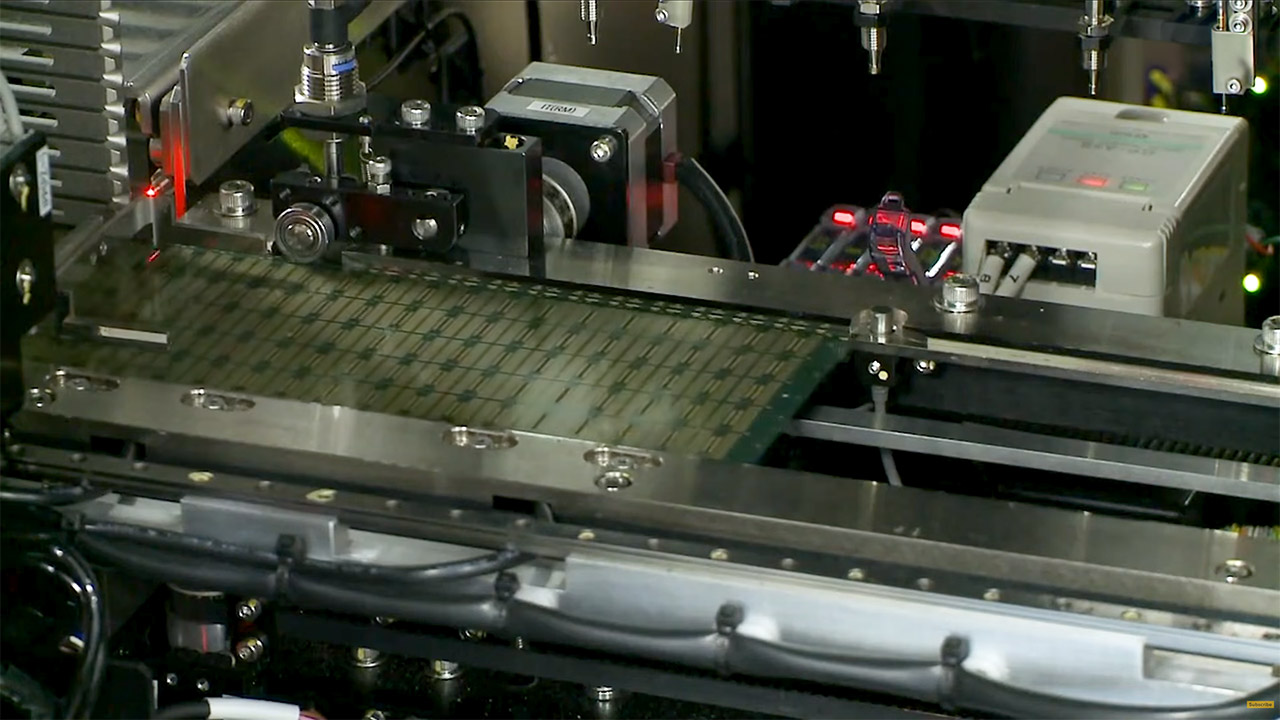
Choi came to a station where the layers of DRAM are all linked together to form finished high-bandwidth memory, and the process of producing the latest HBM4 takes four months and more than a thousand distinct processes. Now one of those procedures, called bulk reflow mold under fill, is truly unique to SK Hynix. Multiple dies are connected simultaneously under low pressure, and a protective liquid fills the spaces between the layers. Result? A stack that’s around 40 percent thinner than what they used to do it and better at managing heat, and you do that by squeezing in 380 billion tranistors into a single module. The same plant is already running HBM3E alongside the newer generation, and the next chip on the horizon is HBM5, which has been designed with specific clients in mind. Now, NVIDIA and Google have each requested customized versions that match their own processors. This shift is what is causing memory to become less interchangeable and generic than it was previously.

SK Hynix Factory Tour Korea
At SK Group headquarters in Seoul the following day, Chairman Chey Tae-won held up a finished HBM4 chip and a wafer that carried a handwritten note from Nvidia’s Jensen Huang: “Please make more.” Chey described the current demand in simple terms. “It’s like a war. Everybody wants the memory chips. Without that, they cannot produce their AI computing and AI chips.”

Source link

Advertisement
Continue Reading
Click to comment

You must be logged in to post a comment Login

Leave a Reply

Tech

3 overlooked TV series on Prime Video you should watch this weekend (August 14-16)

Published

on

Prime Video‘s library goes far beyond the algorithm-driven hits everyone already knows about. I dug through some older, quieter gems this week, ranging from the chaotic world of a New York orchestra to a burnt-out lawyer taking down corporate giants and a slice-of-life comedy that deserved a much longer run. Whether you are looking for something dramatic, funny, or deeply human, these Prime Video titles worth adding to your watchlist this weekend.

We also have guides to the best new movies to stream, the best movies on Netflix, the best movies on Hulu, the best free movies, and the best movies on Amazon Prime Video.

Mozart in the Jungle (2014 – 2018)

Genre: Comedy, drama, music
IMDb: 8.1/10
Rotten Tomatoes: 95%

Advertisement

This Prime TV series takes you behind the curtain of the New York classical music world to show the backstage chaos. Hailey Rutledge (Lola Kirke), a talented young oboist chasing her big break, gets pulled into the orbit of Rodrigo (Gael García Bernal), a flamboyant and unpredictable conductor shaking up the city’s legacy orchestra. Together they navigate ego clashes, wild parties, and financial stress.

The writing strips away all the pretension around orchestra halls. My favorite aspect is how the show captures the unhinged hustle of low-paid musicians chasing artistic perfection. Gael García Bernal is magnetic in this show, playing Rodrigo with a passion that makes every scene he is in feel alive. Lola Kirke grounds the show as its emotional center, playing Hailey’s ambition and self-doubt with real sincerity. Its half-hour episodes fly by, making it so easy to binge in a single sitting.

Stream Mozart in the Jungle on Prime Video.

Goliath (2016 to 2021)

Genre: Legal drama, crime
IMDb: 8.2/10
Rotten Tomatoes: 86%

Advertisement

Billy McBride (Billy Bob Thornton), once a powerful founding partner at a major law firm, has spiraled into alcoholism after a case he won on a technicality ended in tragedy. When he reluctantly takes on a wrongful death lawsuit against the very firm he helped build, a much larger and deadlier conspiracy starts to surface around him. The show shifts its central case and villain each season, keeping the format fresh with four separate stories across each run. Beneath the courtroom battles, this Prime TV series is really about redemption, addiction, and what it costs a person to finally fight for something again.

The story moves quickly, but the real pull is watching a burnt-out underdog fight corporate monsters. I recommend this one for Billy Bob Thornton’s role, which he carries with a charm that makes every courtroom victory feel well earned. Meanwhile, William Hurt brings a cold, calculating menace as Billy’s former partner and rival. The show also isn’t afraid to get genuinely strange in later seasons, leaning into surreal, almost noir-like sequences that some viewers loved and others found jarring.

Stream Goliath on Prime Video.

Advertisement

As We See It (2022)

Genre: Comedy, drama
IMDb: 8.1/10
Rotten Tomatoes: 90%

Jack (Rick Glassman), Harrison (Albert Rutecki), and Violet (Sue Ann Pien), three roommates in their twenties who are all on the autism spectrum, navigate jobs, friendships, and romance with the help of their behavioral aide Mandy. Created by Jason Katims and based on the Israeli series On the Spectrum, the show gives its central trio real personalities, flaws, and contradictions, rather than reducing them to lessons about autism.

What sets this series apart is the brilliant casting of neurodivergent actors in the lead roles, giving every performance a level of authenticity rarely seen on television. As a result, they bring their unfiltered reality to the comedic timing, which makes the show even more enjoyable. I was really disappointed when the show was canceled after just one season despite strong reviews. Even so, its eight episodes are totally worth watching.

Advertisement

Stream As We See It on Prime Video.

Source link

Advertisement
Continue Reading

Tech

Zoox has shown its safety workings, three weeks after recalling every robotaxi it owns

Published

on

Zoox has published the reasoning behind its claim to be safer than human drivers. Everything reduces to one number, the predicted rate of collision, injury and fatality events, expressed as miles per event. Risk from driving software, from the vehicle itself and from fleet operations is added together into that single estimate.

It functions as a gate. Before any safety-relevant software release, hardware change or revision to operating procedure, Zoox updates the case and checks the combined figure still clears its target.

The target is anchored in human data. Zoox builds its benchmark from NHTSA’s crash sampling and fatality reporting systems and two Federal Highway Administration datasets, then parses them by road speed and weights them to match the mix of roads its robotaxis actually use.

What it does not publish is the answer. Zoox sets its target by comparison to that benchmark and says it aims to be significantly safer than a human driver, but never defines how much safer counts as significant. Nor does it give the figure its fleet currently reaches.

Advertisement

The engineering underneath is specific enough to argue with. Zoox names the hazard analyses it runs, follows ISO 26262 with integrity ratings on the platform, and uses simulation that deliberately searches for the conditions where a collision is most likely, weighted afterwards by real fleet exposure.

Some of it is genuinely unusual. A separate collision checker runs its own perception and can veto a trajectory the main system has planned, and Zoox concedes that a likelihood-based metric cannot capture rare avoidance scenarios, so it keeps a test set where the robotaxi must at least match a competent human.

Remote staff are inside the model rather than outside it. TeleGuidance tacticians never drive, offering route guidance while the vehicle keeps responsibility, and the risk of them making a mistake or their tools failing is priced into the same estimate.

The framework also reserves the right to restrict, pause or ground the fleet. Three weeks before publishing it, Zoox recalled all 105 of its robotaxis after one failed to detect heavy smoke and drove into an active fire scene in Las Vegas.

Advertisement

That was the fourth software recall in roughly 13 months, and it followed the regulator demanding fixes for vehicles interfering with first responders. NHTSA had logged 123 collisions involving Zoox vehicles in autonomous mode as of March.

The analytical approach exists because the mileage does not. Zoox has around three million autonomous miles, Waymo passed a hundred million more than a year ago, and Zoox now has a paid service to protect while it closes that gap.

Source link

Advertisement
Continue Reading

Tech

How to watch Australia vs Japan: Free streams & TV channels

Published

on

Watch Australia vs Japan live streams as the Wallabies look to follow up their hard-fought 35-32 victory over the Brave Blossoms with a more comprehensive victory on home soil in Townsville, Queensland.

The first game in the post-Joe Schmidt era proved to be a tough one for Australia as they were forced to hang on for a narrow win in Osaka. Surviving a first-half red card for Miles Amatosero and a second-half onslaught from Japan, new head coach Les Kiss would have been nervy on the touchline. He’ll hope for a more convincing display on home soil and has opted for Carter Gordon at fly-half instead of Declan Meredith.

Source link

Advertisement
Continue Reading

Tech

OpenAI CFO tells shareholders enterprise revenue has overtaken ChatGPT

Published

on

OpenAI’s enterprise business now generates more revenue than its consumer business, finance chief Sarah Friar told shareholders on Friday, months earlier than the company had forecast. Its annualised run rate has reached $40bn, roughly double a year ago.

OpenAI now makes more money from businesses than from ChatGPT subscribers. Finance chief Sarah Friar told shareholders on Friday that the two lines have crossed, according to a person at the meeting. “We entered the year at 60-40, but enterprise has accelerated much faster than expected,” she said.

That is early. Friar had said earlier this year that the two sides of the business would reach parity by the end of 2026.

The underlying numbers are moving quickly. OpenAI’s annualised run rate has reached $40bn, roughly double a year ago, and July revenue rose 20% month on month, with business customers up 32%.

Advertisement

More interesting is what enterprise buyers have started doing. “Enterprise customers have moved from tokenmaxxing to focusing on cost per unit of intelligence,” Friar said, meaning companies have stopped letting staff run up open-ended AI bills without showing what came of them.

OpenAI is answering on price rather than resisting. Friar pointed to recent cuts across its model range and to the newest model being 54% more efficient on agentic coding tasks.

Advertising has quietly become a business too. It is approaching a $1bn run rate, six months after OpenAI began testing ads in ChatGPT in February.

The meeting itself was scheduled before the week went wrong. It came a day after revenue chief Denise Dresser left after eight months and three days after longtime executive Brad Lightcap announced his departure.

Advertisement

President Greg Brockman thanked Dresser for building the enterprise foundation, the attendee said. He also praised her replacement, Dali Rajic, who was introduced to OpenAI by Thrive founder Josh Kushner, according to a person familiar with the recruiting.

Asked about Chinese open-source models, Brockman was dismissive. There is a misunderstanding that open source is cheaper, he said.

On the listing, nothing. Executives told shareholders they could not discuss timing because of the confidential filing with the SEC.

Advertisement

Source link

Continue Reading

Tech

Talks to sell PayPal to Stripe and Advent are heating up

Published

on

PayPal CEO Enrique Lores’ turnaround plan for the fintech company could include a sale — of itself.

The prospect first popped in July when Stripe and private equity giant Advent offered to buy PayPal for $60.50 a share in a deal that would have valued it at $53 billion, the Wall Street Journal reported at the time.

PayPal balked. But apparently, negotiations never stopped and a deal could come together in the coming weeks, according to new reporting by the WSJ, which cited unnamed sources.

PayPal declined to comment on the report. A Stripe spokesperson said the company doesn’t “comment on rumors or speculation.”

Advertisement

The negotiations are taking place as Lores attempts to save the company from its lagging trajectory.

Lores joined PayPal in March, after spending years at HP. In April, Lores made the first moves in his turnaround plan, including an executive shuffle and splitting the business into three operating models: checkout solutions and PayPal, consumer financial services (and Venmo), and payment services and crypto. A month later, Lores told investors that PayPal would recommit to the fundamentals,” which included “becoming a technology company again.”

PayPal’s turnaround will also include a cost-saving plans, which is expected to reduce its workforce by 20% over the next two to three years.

PayPal was founded in 1998 by a number of men who went on to be Silicon Valley luminaries, including Peter Thiel, Elon Musk, Max Levchin, Luke Nosek, and others. The company has struggled in recent years, after ballooning during the pandemic due to an e-commerce boom.

Advertisement

Source link

Continue Reading

Tech

Manus splits from Meta after China orders reversal of $2bn deal

Published

on

Last December’s acquisition faced near immediate scrutiny from Chinese authorities.

AI start-up Manus is going back to being an independent business after Meta’s $2bn-plus acquisition of the company was ordered in April by Chinese authorities to be unwound over national security concerns.

“We must take this step to comply with regulatory requirements in specific parts of the world,” Manus said in a blogpost yesterday (11 August). As part of these changes, it said that some of its users may lose the data they generated using Manus’s AI.

As we look to the future, we’re already preparing a series of new features that will push the boundaries of what’s possible for general AI agents once again.”

Advertisement

Meta acquired the Singapore-headquartered Manus (developed by China’s Butterfly Effect) late last December as part of its continued push into agentic AI.

The acquisition faced near-immediate scrutiny from Chinese authorities, who launched a probe shortly following the deal’s announcement. Meta said that the deal “complied fully with applicable law”.

“Manus has built one of the leading autonomous general-purpose agents that can independently execute complex tasks like market research, coding and data analysis,” the Facebook parent said at the time of its purchase. Manus’s general-purpose AI agent, previewed last year, offered users capabilities similar to those of the likes of OpenAI’s Deep Research.

In February, Manus launched personal agents in messaging apps, allowing users to conduct research, structure data and make requests entirely through chat. It launched the agents on Telegram despite being owned by Meta at the time, but said that it planned to expand to WhatsApp, Line, Slack and Discord “very soon”.

Advertisement

The acquisition deal was formally struck down in April by China’s National Development and Reform Commission, which said that the deal was not in accordance with state laws. The country is increasingly protective of its AI technology and talent, and has been making concerted efforts to build out its own infrastructure to back the technology.

Reversing the acquisition was difficult for Meta, which had reportedly already assimilated Manus employees, executives and technology with its own at the time of the ruling.

Investors – including Tencent Holdings, ZhenFund and Hongshan – had also received their proceeds from the acquisition by the time the two companies proceeded to break up. Tencent is now reportedly set to become Manus’s largest external shareholder.

Don’t miss out on the knowledge you need to succeed. Sign up for the Daily Brief, Silicon Republic’s digest of need-to-know sci-tech news.

Advertisement

Source link

Continue Reading

Tech

Marvel’s Wolverine arrives complete on disc, just as physical gaming fades

Published

on

In a nutshell: Marvel’s Wolverine is scheduled for release in a month’s time, and X-Men fans are eager to play Insomniac Games’ new title on their PlayStation 5 consoles. According to the project’s director, Wolverine will also be one of the last PS5 games designed as a complete experience that works out of the box.

During a recent interview, Insomniac’s Senior Project Director Jess Reiner-Reed confirmed that Marvel’s Wolverine will bring a pleasant surprise to fans of physical game releases. The upcoming action game will be fully playable from the disc, meaning user will be able to enjoy the experience straight out of the box with no mandatory day-one download.

Marvel’s Wolverine will come in both physical and digital editions, Reiner-Reed said. Insomniac developers are working on a day-one patch designed to further polish the experience, but there appears to be no requirement to download the update before customers can start playing the game from the get-go.

While confirming that the game will offer a complete on-disc experience, Reiner-Reed is encouraging gamers to download the patch anyway. Insomniac’s perfectionistic approach to development means the update could tweak and improve the game considerably, as the developers are still busy polishing it just a month before its official release.

Advertisement

Physical releases are suddenly all the rage among gamers after Sony shared plans to stop making physical games starting in 2028. A few studios have expressed their support for disc-based gaming, and even major corporations such as Amazon are apparently willing to throw disc lovers a bone with specific campaigns.

Asked about Sony’s decision to abandon the disc format for future game releases, Insomniac representatives chose to avoid the question altogether. Insomniac’s head of technology, Mike Fitzgerald, said the studio simply wanted to talk about the game it had been working on for years, leaving other concerns to its owner, Sony Interactive Entertainment.

Wolverine will retell the story of the eponymous Marvel character during his amnesiac phase. While trying to regain his long-lost memories, Logan will help Jean Grey and other characters from the X-Men mythos free mutants abducted by Trask Industries.

Advertisement

The game will be significantly more violent than the PS5 Spider-Man series Insomniac has worked on in the past, which seems like an apt choice considering Wolverine’s traditionally brutal ways of dealing with threats and enemy forces. Despite featuring many recurring characters from the franchise, Marvel’s Wolverine will not include a proper rendition of the X-Men collective just yet.

Source link

Advertisement
Continue Reading

Tech

Lenovo Idea Tab Delivers Everyday Utility Without the Premium Price Tag

Published

on

Lenovo Idea Tab 2026 Tablet
Students and casual users looking for a basic Android tablet are usually forced to choose between bare-bones devices that seem limiting and more expensive models filled with capabilities they may never use. Lenovo’s Idea Tab, priced at $149.99 (was $218), sits squarely in the middle of that range, offering a useful combination of screen quality, battery life, and accessories that make it functional right out of the box.


At almost 10-inches across and just shy of an inch thick, the metal-bodied tablet feels reassuringly sturdy without adding bulk. It weighs more than a pound, so it fits neatly into a backpack or can sit comfortably on a desk all day. Available in Luna Gray or Polar Blue, the simple and robust external design is great for daily use, and the IP52 classification provides some basic resistance to dust and mild water exposure, making it ideal for a school or a kitchen setting.

Sale


Lenovo Idea Tab – College Tablet – 11″ 2.5K IPS Touchscreen Display – 90Hz – MediaTek Dimensity…
  • POWER YOUR STUDY, FUEL YOUR PLAY – Discover smarter learning with the Lenovo Idea Tab. Stay campus-ready with all-day battery life, AI-powered apps…
  • SMOOTH, POWERFUL, IMMERSIVE – The MediaTek Dimensity 6300 processor is more powerful than ever, with the AI-enhanced multitasking you need to stay…
  • CIRCLE IT, SEARCH IT – Use your Lenovo Tab Pen or fingertip to circle items for instant search results or to translate other languages without…

The 11-inch IPS panel is one of the tablet’s most notable features. With a resolution of 2560 by 1600, it produces a sharp 2.5K image that comes to life owing to a 90Hz refresh rate that ensures scrolling and video playback go smoothly. The screen’s peak brightness of 500 nits is more than adequate for any lighting circumstances, and the anti-fingerprint coating eliminates the possibility of smudges disturbing your view. In addition, it has TÜV Rheinland certifications for low blue light and flicker-free operation, which is important for anyone who watches a lot of video. Color coverage is a reasonable 72 percent NTSC, and the 16:10 aspect ratio is ideal for maximizing vertical space for papers and multimedia. If that wasn’t enough, four Dolby Atmos-tuned speakers lie around the edges, producing far superior sound than you’d expect at this price. Even in busy situations, dialog sounds clear as a bell, and the overall volume is adequate for a small room without adding too much distortion.

Advertisement


Power comes from a reasonably powerful MediaTek Dimensity 6300 CPU, which is paired with 4GB of LPDDR4X memory and a handy 128GB of UFS storage – all of which are very normal for the price. In reality, it effortlessly handles online browsing, note-taking apps, video calls, and light multitasking. Try pushing it with hard games or intensive creative work, and it will begin to struggle. It is completely responsive for normal college or home tasks, and if you need more storage capacity, a microSD slot allows you to add cards up to 2TB, making it ideal for anyone who collects a large number of PDFs, lecture recordings, or offline media. Connectivity is uncomplicated, with Wi-Fi 5 and Bluetooth 5.2 on board, as well as a regular USB-C connection and headphone jack.

Lenovo Idea Tab 2026 Tablet
According to Lenovo, the battery can last up to 12 hours of YouTube viewing or 14 hours of online browsing, assuming optimal conditions. In practice, it’ll probably last you the entire day, even if you’re switching between courses and study sessions. Charging supports 20W input, but be aware that the adaptor is not always included, depending on the location or merchant package. Android 15 lies on top of Lenovo’s interface, with promised compatibility for two major OS upgrades and security patches to 2029. Circle to Search, which allows you to highlight text or images for quick lookups and translations, and a slew of preloaded tools like Lenovo AI Note, Squid, Nebo, and MyScript Calculator support handwriting, diagram sketching, and equation solving. There is also Smart Connect, which allows you to smoothly transfer jobs between this tablet and other Lenovo or compatible devices.

Lenovo Idea Tab 2026 Tablet
This bundle includes two valuable extras: a folio case and a Lenovo Tab Pen. The cover not only protects the screen and body, but it also serves as a handy stand, allowing you to put it up at almost any viewing angle you like – and it even includes a small pocket for the pen. The pen itself is very slick, with 4096 distinct levels of pressure sensitivity, tilt recognition, and a palm rejection feature that ensures you don’t lay your hand on the screen while writing.

Source link

Advertisement
Continue Reading

Tech

Ex-Cambridge Professor At Center of Plagiarism Row Found Dead

Published

on

Former Cambridge professor Jason Arday, who resigned last week amid allegations of plagiarism and questions about his academic record, has been found dead at age 41 in London. The BBC reports: Jason Arday was found “unresponsive” at an address in Battersea, south London, on Friday afternoon, emergency services said. Metropolitan Police officers were called by the London Ambulance Service. A 41-year-old man was pronounced dead at the scene and his next of kin have been informed, the force said.
Arday resigned as a Cambridge professor of sociology of education last week after allegations of plagiarism and questions about some of his achievements. He had denied the claims.

In a statement, the Met Police said: “At this time his death is being treated as unexpected, but is not believed to be suspicious.” The 41-year-old academic had denied any plagiarism – but admitted errors in his work – and last week said the recent furore had led to “an unrelenting level of public scrutiny and personal attack.” The row first erupted after another academic — self-defined “race realist” Nathan Cofnas, who was sacked from his Cambridge role in 2024 — said he found numerous instances of plagiarism in Prof Arday’s work and questioned some of his stated achievements.

[…] Announcing his resignation last week, Arday said the “personal cost” of the scrutiny had become “too great.” He said: “While criticism is an inevitable part of academic life, what I have experienced has gone far beyond scholarly disagreement. “The relentless accusations, speculation and public commentary have taken a profound toll on me and on those I love.” He stressed that his resignation should not “be mistaken for an acceptance of the narratives that have surrounded me.”

Read more of this story at Slashdot.

Advertisement

Source link

Continue Reading

Tech

JSW MG Hector Tomahawk Teased in India: 7-Seater EV Launching August 26

Published

on

MG Motors has quietly been doing great in the EV space with its Windsor, which is now one of the best-selling EVs in India. And to further bite into Mahindra and Tata’s share, JSW MG Motor India has teased its upcoming 7-seater electric SUV, which is expected to launch in India as the Hector Tomahawk. The company has confirmed that the SUV will be the first product based on its new ADAPT (Advanced Drive Architecture Platform Technology) platform and will make its India debut on August 26.

According to reports, the upcoming SUV is based on the Wuling Eksion, which is already sold in Indonesia. The Hector Tomahawk will initially launch in India as a fully electric model, with a plug-in hybrid version expected to follow at a later date. JSW MG has also opened pre-reservations for the SUV. Customers can reserve it on the company’s website for ₹21,000.

JSW MG Hector Tomahawk Design and Interior

The latest teaser reveals several design details of the upcoming SUV while keeping most of its exterior hidden. The Hector Tomahawk features rectangular LED headlamps with twin-element LED DRLs, along with prominent fenders, roof rails, pull-type door handles, and wraparound LED taillamps. The SUV also gets two-tone alloy wheels, black cladding along the lower doors, and a relatively flat roofline leading to a roof spoiler. The charging port appears to be positioned on the rear-left side.

Advertisement

Some India-specific design changes are also expected compared with the Wuling Eksion. These include different artwork on the C-pillars and a knurled finish on the front grille. Based on the dimensions of the Indonesia-spec Eksion, the Hector Tomahawk could measure around 4,745mm in length, 1,850mm in width, and 1,755mm in height, with a 2,810mm wheelbase. However, JSW MG has not yet confirmed the final dimensions for the Indian model.

The teaser also confirms a seven-seat layout with a bench-style second row. The cabin shown in the teaser features a beige color theme and a panoramic sunroof. More details are yet to be confirmed, but the India-spec SUV could share several features with the Eksion. These may include a powered tailgate, powered and ventilated front seats, a 12.8-inch infotainment display, an 8.8-inch digital driver’s display, wireless charging, automatic climate control with vents for the second and third rows, a 360-degree camera, an electronic parking brake, six airbags, and ADAS.

Expected Powertrain & Pricing

The ADAPT platform can support different powertrain configurations, including strong-hybrid, range-extender, and plug-in hybrid systems. In India, however, the Hector Tomahawk will be an EV first. While the specific details are still under wraps, the Indonesia-spec Wuling Eksion makes 201hp and 310Nm of torque with a single front motor. Everything is powered by a 69.2kWh LFP battery and has a claimed CLTC range of up to 530km. A plug-in hybrid version is also expected to arrive later.

The JSW MG Hector Tomahawk is expected to be priced between ₹18 lakh and ₹25 lakh (ex-showroom), although the company has not announced the official pricing yet. If true, it’ll go head-to-head with the Mahindra XEV 9S and the Harrier EV.

Advertisement

Source link

Continue Reading

Trending

Copyright © 2025