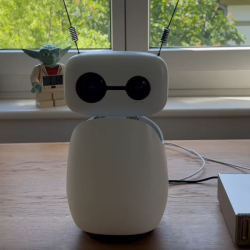
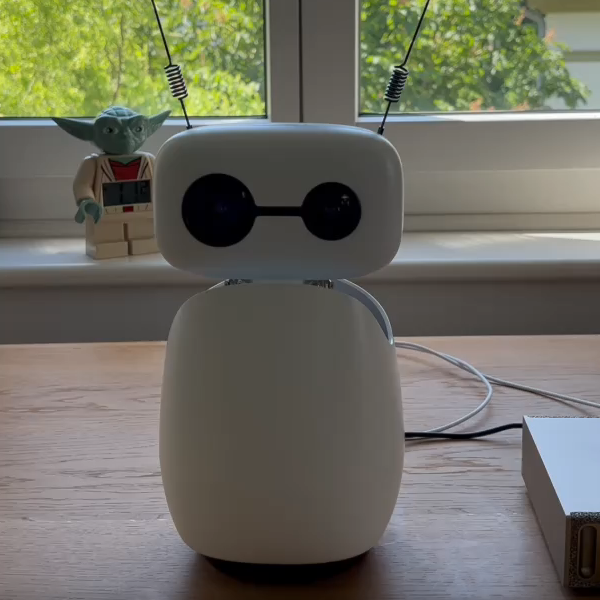
Reachy Mini is a limbless desktop robot from Hugging Face made for human interaction experiments, and to give you an idea of what it’s like is a guide on how to implement expressive, local conversational AI complete with head movements and antenna wiggles. It’s conversational in the sense that it aims to feel natural, with low-latency responses and the ability to interrupt, with everything running on local hardware if one so wishes.
Reachy Mini can use remote services, or work in tandem with a desktop machine or laptop.
The software stack is essentially VAD (voice activity detection) → STT (speech-to-text) → LLM (large language model) → TTS (text-to-speech) which allows users to tweak things to their liking, or independently swap or modify pieces as things evolve.
This also allows users to tailor the services to match whatever their hardware is capable of. For example, one could easily use a frontier AI model via remote API for the LLM while keeping everything else local.
The local models in the example configuration are effective and relatively modest (Qwen3-4B-Instruct for the LLM, and even smaller models for the rest) but it’s nice to have the option to offload parts to remote providers if necessary.
Advertisement
Reachy Mini looked very interesting when it was launched as a kit last year, and since then Hugging Face has built up an impressive software suite and infrastructure through which users can easily share their applications. If you’re curious, there’s a simulator for Reachy Mini which should give you an idea of what it can do.
Apple has lost yet another upper-level executive to OpenAI, this time Paul Meade from its Vision Products Group.
Longtime Apple executive Paul Meade, known for his work on the Apple Vision Pro, is reportedly leaving Cupertino for Mission Bay. There, he’ll join OpenAI alongside fellow Apple alumni Jony Ive, Tang Tan, and Evans Hankey.
According toBloomberg, the vice president of hardware engineering for the Vision Products Group is set to depart for OpenAI at some point in the next week. He’ll start working at OpenAI’s hardware unit on OpenAI’s upcoming line of AI-powered devices.
Meade’s tenure at Apple lasted over 15 years. He first joined in 2010 as an iPad manager. Two years later, he oversaw program management for the iPhone.
Advertisement
In 2017, he joined the Vision Products Group. Then, in 2019, after a notable shift in Apple’s management, he overtook all hardware engineering for the Apple Vision Pro.
Meade is just another in a long line of departures. In October 2025, Apple lost Head of the Apple Intelligence Answers, Knowledge, and Information team, Ke Yang, to Meta.
Apple’s VP of Human Interface Design, Alan Dye, also left for Meta two months later.
OpenAI, who acquired Jony Ive’s AI startup in 2025, seems to have a special interest in poaching Apple veterans. Tang Tan, who formerly worked at Apple, was instrumental in recruiting Cyrus Daniel Irani from Apple’s human interface design team and Erik de Jong from Apple Watch hardware.
Mazda has become one of the most recognizable automotive brands in the United States, and the sales numbers back that up. In 2024, Mazda sold a record 424,382 vehicles in the U.S., a 16.8 percent increase over 2023. The brand sold more cars than brands such as BMW and Mercedes-Benz, but not as good as Subaru, Kia, or Nissan.
Larger vehicles drove the overwhelming majority of that volume, accounting for 377,402 of those sales. The CX-5 led the charge as Mazda’s top-selling model, with the CX-30 and CX-50 also selling well — though Mazda deliberately tanked CX-30 SUV sales in 2025 to limit tariff exposure. But Mazda has never been just about crossovers. The brand earned its reputation on driver-focused cars — most notably with the MX-5 Miata, the world’s best-selling two-seat roadster. That philosophy carries through to every model in the lineup.
Many Mazda vehicles earn praise for their balance of engaging dynamics, cool interiors, and daily practicality, often offering an experience akin to a more expensive badge. That combination of qualities has a natural side effect: strong resale value. Cars that are well-built, reliable, and broadly desirable tend to hold their value longer than average, and Mazda has made a habit of producing exactly that kind of vehicle. Here are five Mazda models that stand out for their ability to retain value over time.
Advertisement
Mazda MX-5
As previously mentioned, the Mazda MX-5 Miata is the world’s best-selling two-seat sports car — a Guinness World Records first certified in May 2000 and that Mazda has continued to extend since. That sustained global demand shows up directly in resale data because the MX-5 retains it better than any other Mazda out there. According to iSeeCars, the MX-5 Miata retains 69.2 percent of its value after 5 years. The best part is, the Mazda MX-5 RF is ranked second at 67.9 percent.
Advertisement
Low ownership costs are part of the equation. RepairPal gives the MX-5 Miata a reliability rating of 4.0 out of 5.0 and puts its average annual repair cost at $429, compared to $652 for all vehicle models. The Miata’s $429 annual maintenance cost is lower than that of the Nissan 370Z ($504), Toyota Supra ($561), and Subaru BRZ ($672) -– all notable Mazda MX-5 alternatives. The MX-5 is powered by a 2.0-liter Skyactiv-G four-cylinder producing 181 horsepower and 151 lb-ft of torque, with a standard six-speed manual or an optional six-speed automatic.
Then there is the cult status the MX-5 cultivated throughout the years. It is an enthusiast’s vehicle, not a family crossover SUV like the CX-5. This means that it is likely bought by someone who knows everything about it, and is likely to take decent care of it. All in all, the MX-5 is the Mazda to get if you want superior value retention.
Advertisement
Mazda CX-5
The Mazda CX-5 is Mazda’s best-selling model and one of the most popular compact SUVs in the U.S. According to iSeeCars, the CX-5 depreciates 37.9% after 5 years, compared to 39.9 percent for the compact SUV category and 44.9 percent for all SUVs. CarEdge also places the CX-5’s 5-year depreciation rate at 39 percent. That said, it doesn’t lead its class; the Toyota RAV4 — the world’s best-selling car — depreciates just 28 percent after 5 years. Meanwhile, the Honda CR-V clocks in at at 29 percent, putting both vehicles ahead of the CX-5.
The CX-5 does, however, beat out the Hyundai Tucson (47 percent), Chevrolet Equinox (52 percent), and Ford Escape (55 percent). As is the case with most cars and value, reliability plays a pivotal role. RepairPal gives the CX-5 a reliability rating of 4.5 out of 5.0, ranking it 1st out of 26 midsize SUVs, with an average annual repair cost of $447. That figure compares favorably to $573 for midsize SUVs and $652 across all vehicle models.
The chance of the CX-5 suffering from a major reliability problem is just 8% for the CX-5, compared to 13percent for midsize SUVs and 12 percent for all vehicle models. Not long ago, Mazda announced that cumulative global sales of the CX-5 reached 5 million units as of the end of 2025 — only the third model in the automaker’s history to reach that milestone, after the Mazda 323 and the Mazda3.
Advertisement
Mazda3
The Mazda3 is available in two body styles — sedan and hatchback. Good news is that both hold their value reasonably well for the compact car segment. According to CarEdge, the Mazda3 Sedan depreciates 38 percent after 5 years, with a resale value of $19,620. The Hatchback depreciates slightly more at 41 percent after 5 years. For context, iSeeCars puts the Mazda3 Sedan’s 5-year depreciation at 34 percent, compared to 27.4 percent for the Toyota Corolla.
Advertisement
Reliability is consistently good, just like with the rest of Mazda’s lineup. RepairPal gives the Mazda3 a reliability rating of 4.0 out of 5.0. This translates into it being ranked 9th out of 36 compact cars, with an average annual repair cost of $433. The average annual repair cost for compact cars in the same category is $526, while the average for all vehicles is $652.
The Mazda3 is also the cheapest 2026 Mazda you can buy, and its recent sales numbers have suggested that there is life for compact hatchbacks/sedans in the world of crossover SUVs. For those looking for a compact car footprint with enough space, amenities, and a dynamic driving experience at a budget, the Mazda3 truly is hard to beat.
Advertisement
Mazda CX-30
The Mazda CX-30 sits between the Mazda3 and CX-5 in Mazda’s lineup. According to iSeeCars, the CX-30 depreciates 35.6 percent after 5years, compared to 38.4 percent for the subcompact SUV category and 44.9 percent for all SUVs. CarEdge puts the 5-year depreciation at a near-identical 36 percent, with a resale value of $21,764. When stacked against its rivals, the CX-30 holds its own.
The Subaru Crosstrek depreciates 34 percent after 5 years and the Honda HR-V depreciates 31 percent across the same period — both slightly ahead of the CX-30 on paper, though all three comfortably beat the segment average. On the maintenance side, estimates place the CX-30’s total maintenance and repair costs over its first 10 years at $7,837, beating the industry average for SUV models by $675.
The chances that the CX-30 is going to need a major repair during its first 10 years of ownership is 22.65 percent. Although it does fare slightly worse than its competitors in outright resale value, these repair cost projections are 1.32 percent better than similar vehicles in its segment. When we compared the Mazda CX-30 to the Mazda3, we noted that the CX-30 serves the more utilitarian buyer, thanks to its bigger size and AWD, but the Mazda3 is more fuel efficient.
Advertisement
Mazda CX-50
The Mazda CX-50 is the newest model on this list, having launched for the 2022 model year. According to iSeeCars, the CX-50 depreciates 39.3 percent after 5 years, compared to 39.9 percent for the compact SUV category and 44.9 percent for all SUVs. CarEdge puts the 5-year resale value at a slightly less favorable 37 percent, or in other words, $25,035 on an average new price of $39,979. After 3 years on the market, the CX-50 depreciates 25.9 percent, with a resale value of $22,145.
Advertisement
Maintaining a CX-50 costs $506 per year on average through the first 5 years of ownership. Across all Mazda models, the 10-year maintenance and repair brand average is at $7,381, which is $1,590 less than the industry. However, the CX-50 is still a fairly new model, meaning that long-term cost projections are merely estimates, and that we will have to wait to check whether they are correct.
Still, the market perception of the Mazda CX-50 remains fairly positive. Existing owners deem the Mazda CX-50 a good car, with the hybrid powertrain, the styling, comfort, and driving feel all getting lots of praise. Long-term reliability data remains limited, though some owner reports have mentioned issues not typically associated with Mazda’s reputation for dependability.
Advertisement
How we made the list
Heritage Images/Getty Images
Every model on this list was selected based on depreciation data from iSeeCars and CarEdge and then cross-referenced with reliability data from RepairPal. iSeeCars analyzes over 15 million vehicles to calculate 5-year depreciation rates from MSRP, while CarEdge builds its depreciation curves from historical pricing data. RepairPal’s reliability ratings are based on the cost, frequency, and severity of unscheduled repairs across all model years.
The 5-year window is the industry standard for depreciation comparisons, which is why it is the primary metric used throughout. Models were selected where the data consistently showed depreciation rates below the segment average, combined with low annual maintenance costs. Sales data referenced throughout comes from Mazda’s official press releases and Good Car Bad Car.
Maintenance cost projections from CarEdge assume vehicles in good condition averaging 13,500 miles per year. It is worth noting that depreciation figures represent trends, not guarantees for individual vehicles. A car’s real-world resale value depends on a ton of factors, including mileage, condition, trim, history, and regional demand at the time of sale.
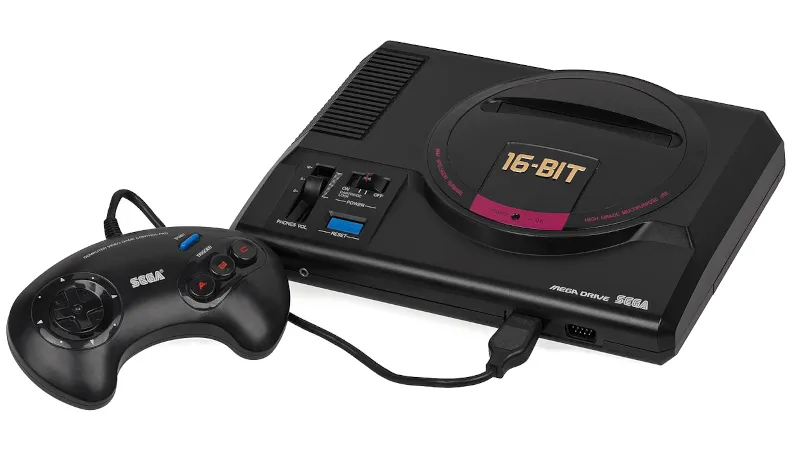
If you were in the market for a games console in 1990, the chances are that the object of your desire was either a Super Nintendo with its 16-bit 6502 derivative, or the Sega Megadrive, sold as the Genesis in North America, with its Motorola 68000. Both machines featured impressive graphics and sound for their time, but they remain firmly in the 16-bit era. Which makes it a surprise to see LinuxMD. It’s Linux, for the Sega Megadrive, with the latest mainline kernel.
The Motorola 68000 series of chips was the first porting target for Linux, and is still maintained in 2026. This build runs from an SD card in a modern Megadrive storage peripheral, and is reported to run on the original hardware. The lowly 68000 in the Sega doesn’t have a memory management unit required for the full Linux experience, so what’s really running here is a kernel compiled with the -nommu option. That in itself is a feat, on this architecture. On it you get smolutils, a cut down coreutils, and that seems to be it.
We like this project, for pushing both console and kernel to the limit, even though we see that maybe it’s not the most practical Linux machine. Meanwhile though, this isn’t the only UNIX-like OS for this console.
OPINION Microsoft is making massive progress in quantum computing, says Microsoft. Oh no they’re not, say researchers. Anthropic’s frontier models are too powerful for general use, says the US government. No, it’s just Anthropic being punished for not doing what the US government tells them, say critics. Humans-in-the-loop are a pain-in-the-neck, says Amazon exec. Go do one, says this human.
Three tech news stories from last week, six interpretations. You can probably decide between Microsoft PR and a peer-reviewed paper in Nature. Likewise, whether vindictiveness or virtue is at work with Anthropic. Amazon or a Reg hack? Harder to call.
Advertisement
In all these cases, as in all cases, prior knowledge is the best context in which to judge media reports. Most citizens don’t know much about most news, an eternal truth that is causing the UK government to fret about the future of public service broadcasting – or as it has become, public service media (PSM). With fewer people, especially that dread tribe, Young People, watching the wholesome fare of highly regulated broadcasters but feeding instead on firehoses of algo-spew, public service media risks suffocating on insignificance.
That’s a reasonable fear, if you feel that public service media deserves to be heard. It is a complicated argument where great forces have clashed since the birth of broadcasting, but if you know that the rhetoric of “fake news” has an antecedent in the German slur “Lügenpresse,” you’ll know the answer is yes, and yes, with a side order of yes. Vivat Reith.
Having identified the problem, the brains of Britgov propose exactly the wrong solution. Get the algorithms that drive content consumption on social media to rank the quality PSM product higher. All those lost eyeballs will be brought back into the fold. This won’t work for reasons both obvious and subtle. Forcing a quota of state-mandated media into the stream, even with the best of intentions, is a hostage to fortune. It’s probably unenforceable, will be deeply unpopular with users and companies alike, and will poison PSM across the board.
It also amplifies two falsehoods about PSM: that it’s about news, and that it’s about numbers. Both are important, but neither is anywhere near enough to argue for PSM’s right to life. One of PSM’s primary roles is to provide content that isn’t commercially viable or is otherwise invisible. That reflects culture, art, science, all the human stuff that enriches life. It’s where new ideas and new people come from, and some of those will become box-office hits.
Advertisement
Putting numbers first, as parts of the BBC are moving toward, kills diversity and gives the commercial sector the killer argument that PSM is just unfair competition. PSM has always had the tension between being popular enough to matter to lots of people and broad enough to do the things that only it can do, but it does need both. That has been very expensive, but arguably worth it. High-quality news is one pillar of that, but only one.
The one thing that keeps PSM alive is the editorial process, the decision-making that understands the purpose, constituent parts, and audiences, and applies that equation to the resources available. Those resources have changed, but they haven’t gone away. What’s needed now isn’t a public service tweak to secret commercial algorithms, but a public service algorithm with humans in the loop, amplifying the good stuff on the platforms by driving traffic through exposure. How to design channels that do that and are compatible with the platforms themselves is an interesting challenge begging to be explored.
However realized, it would be entirely compatible with providing natively sourced news, entertainment, sport, and everything else that keeps a brand current. It adapts seamlessly to multiple platforms, all of which have PSM-worthy content in quantity, if you filter out the toxins. It’s a model that scales up and down, provided only that there are sufficient motivated and trained editorial staff who know who they’re serving and why.
There have to be ethical standards, transparency, training and support, and just the right level of management. That would turn the threat of the new media environment into a huge promise, all the techniques of distributed, diverse digital content from adversary to amplification.
Advertisement
Public service broadcasting, at least in the UK, has been moving in this direction for decades, in the name of efficiency, outsourcing more and more programming to independent production companies – usually staffed by ex-BBC employees. You can’t move very far in TV, radio, film, or digital media in the UK without tripping over ex-BBC bodies. That’s another role of PSM, creating a huge pool of talent that irrigates an entire economic sector. A PSM strategy that encourages content creators to align with production and editorial standards would have invigorating effects in the new landscape.
Public service media deserves to survive and thrive in an attention economy driven by so many forces designed to exploit rather than enlighten the public. Done well, it gives voice to the voiceless, describes a nation to itself, and sets standards that inspire trust and quench cynicism. All of this is there to be had, even today, even in the future. We just need to keep the right humans in the loop. Sorry, Amazon. ®
General Fusion’s Lawson Machine 26, its fusion demo device. (General Fusion Photo)
British Columbia-based General Fusion announced Wednesday a partnership with energy infrastructure company Renexia to begin planning the deployment of a commercial version of its clean energy technology in Italy.
In January, the company disclosed a $1 billion Special Purpose Acquisition Company, or SPAC, agreement to go public through a merger with Spring Valley Acquisition Corp. III.
General Fusion is operating its Lawson Machine 26, a magnetized target fusion demonstration device that’s about half the size of its planned commercial‑scale machine. Earlier this week, it announced that LM26 had reached a new temperature milestone of approximately 8.4 million degrees Celsius.
The agreement with Renexia establishes a milestone-based framework covering site identification in Italy, development, funding, construction and commissioning of one or more fusion power plants. General Fusion aims to deploy a commercial fusion machine by around 2035.
The Canadian company is among roughly 50 contenders in a global race to commercialize fusion, though none has yet managed to produce more energy from a fusion reaction than it takes to initiate one.
Advertisement
The sector continues to draw significant attention and investment as tech companies and others scramble for carbon-free energy sources. Fusion startups aim to replicate the physics that power the sun and stars, generating energy by fusing light atoms together.
General Fusion launched in 2002 and has raised $400 million from investors, industry partners and government grants. The company has hit some roadblocks in recent years. In 2023, it put plans on hold to build a larger demonstration machine in the United Kingdom, pivoting to construction of the LM26 device. Last year, it laid off employees and its CEO made a public plea for new investment.
The SPAC deal continues to progress, and Spring Valley has a shareholder meeting scheduled for July 6. If shareholders and General Fusion security holders approve the SPAC, the deal could close shortly after.
California-based TAE Technologies has similarly made plans to go public. The fusion startup is pursuing a $6 billion merger with Trump Media & Technology Group, the publicly traded parent of Truth Social. With the merger and new funding, TAE said it aims to select a site and begin building a utility-scale fusion plant this year.
For the first time in its nine-year history, Syndio has made an acquisition.
The Seattle-based pay equity startup announced Tuesday that it acquired Embrace.ai, an agentic AI startup whose founders and technology will help Syndio build out its AI-powered compensation platform.
Austin, Texas-based Embrace.ai was built to deploy AI-driven automation across business workflows, with a focus on governance and explainability in enterprise settings. The full team, led by co-founders Derek Butts and Seth Halpern, will join Syndio’s product and go-to-market organization, according to a news release.
Terms of the deal were not revealed.
Syndio, which works with nearly 400 global enterprises including more than half the Fortune 100, has been pushing beyond pay equity compliance reporting into what it calls “Decision Intelligence for Pay” — helping companies govern compensation decisions in real time, from job offers to merit cycles.
Advertisement
“Pay decisions are among the most important decisions a company makes, and they require AI that understands the domain, data, and governance expectations of the enterprise,” Syndio CEO Maria Colacurcio said in a statement. “That expertise will help us move significantly faster as we build the next generation of pay intelligence.”
In a post on LinkedIn on Tuesday, Colacurcio called the acquisition a “bold bet,” noting that the Embrace.ai team has spent three years deploying agentic AI inside real enterprises.
“You do not hire that one role at a time,” she wrote. “When you find a whole team that already has it, you move.”
She also said that she’s spent the year digging into tools, sitting alongside engineers and understanding what it actually takes to move faster, noting, “It has changed how I show up in every product conversation we have.”
Advertisement
The addition of the Embrace.ai team is expected to accelerate Syndio’s agentic AI roadmap, expand its AI-native technical depth, and strengthen governance and explainability for complex compensation decisions — areas that Syndio says are increasingly in demand from large employers.
Advertisement
Syndio was founded in 2017 by data scientist and law professor Zev Eigen to help companies analyze and address pay equity. Colacurcio, who previously co-founded workplace collaboration company Smartsheet, joined in 2018. The company raised $50 million in a Series C round in 2021, bringing its total funding to $83 million.
Syndio, which employs 140 people now, is ranked No. 48 on the GeekWire 200 index of the Pacific Northwest’s top startups.
Both Embrace.ai founders are veterans of Workday, the enterprise human capital management giant. Butts spent 13 years there in product marketing, corporate strategy and M&A, and will join Syndio as SVP of product strategy. Halpern led global sales operations at Workday and WP Engine, and will join as a strategic advisor.
“Every pay decision carries consequences for the employee and the employer,” Butts said in a statement, “so AI has to be accurate, understand deep context, and support, not replace, human judgment.”
Bill Gates speaks in Seattle in early 2020. (GeekWire File Photo / Todd Bishop)
The U.S. House Oversight Committee on Tuesday released the transcript of a closed-door interview in which Microsoft co-founder Bill Gates answered lawmakers’ questions about his ties to the late convicted sex offender Jeffrey Epstein.
Gates sat for the voluntary interview on June 10 in Washington, D.C., as part of the committee’s ongoing investigation into Epstein and his crimes.
In a statement Wednesday morning, a spokesperson for Gates said he appreciated the chance to appear before the House Oversight Committee and, as several committee members acknowledged, answered every question put to him over the nearly six-hour interview.
“With the full, unredacted transcript now publicly available, everyone can review the details for themselves,” the statement continued, reiterating that Gates “supports the full release of the files and hopes the Oversight Committee’s investigation will lead to justice for the victims.”
See the full transcript here and below, and continue reading for a summary of key points.
Gates described his association with Epstein as “one of the larger mistakes I’ve made,” saying he was foolish to spend time with him and that their interactions, from 2011 to 2014, were a “complete dead end.”
He said Epstein “certainly wasn’t a friend,” and that he declined Epstein’s social invitations — including to Epstein’s island — as Epstein tried to deepen the relationship.
Advertisement
Asked how often he saw Epstein, Gates gave this breakdown: three times in 2011, twice in 2012, and “five or six” times in each of 2013 and 2014, noting some of the 2013 contacts were Skype calls. He described the meetings as generally substantive rather than social.
Gates said that when he first met Epstein, at a January 2011 dinner in New York arranged by his former science adviser Boris Nikolic, he was aware Epstein had been convicted of a sex-related crime but had not looked into the specifics, acknowledging he “probably should have.”
He said it was not until 2018, when the Miami Herald detailed the extent of Epstein’s crimes, that he grasped their scope and learned Epstein had registered as a sex offender.
Gates said the primary reason he met with Epstein was Epstein’s claim that he could raise billions of dollars for global health from wealthy clients — money that never materialized. He acknowledged he also dealt with Epstein over a separate matter, the exit of his adviser Nikolic.
Advertisement
Gates said he was surprised to learn from the released files how extensive Nikolic’s own relationship with Epstein had been, and that reports Nikolic was named in Epstein’s will surprised him “a lot.”
He said he never witnessed Epstein engage in any sexual misconduct, was never offered any young women or girls, and never visited Epstein’s island, ranch, or Florida home.
He did acknowledge he “may have been in the presence of victims,” citing Epstein assistants he was photographed with and two who sat in the front cabin during a private New York-to-Palm Beach flight he took with Epstein — the one time, he said, that he flew with him. Gates said it was not Epstein’s 727, and he didn’t know who owned or chartered it.
Gates said neither he nor his representatives ever asked any victim to sign a nondisclosure agreement, secured any settlement, or held NDA discussions with victims or their lawyers regarding Epstein or Ghislaine Maxwell, the longtime Epstein associate who was convicted in 2021 of helping him sexually abuse underage girls.
Advertisement
Gates testified that Epstein flew to Seattle and visited his Gates Ventures office for a meeting focused on Nikolic’s departure — an encounter the committee dated to Aug. 8, 2013. Gates called it “kind of a worthless meeting.”
The next day, Gates emailed that Epstein had been “quite helpful,” but he told the committee he only “went along with the narrative” to close the deal, insisting Epstein’s involvement actually accomplished nothing.
Gates acknowledged making a $2 million donation to MIT during the period he knew Epstein, and said he told Epstein about it hoping to end Epstein’s requests that Gates give money in his name. He said MIT later investigated and found the gift was not Epstein-related.
He acknowledged three extramarital affairs — with a competitive bridge player, a nuclear scientist, and a doctor — and said Epstein had become aware of two of them, apparently through Nikolic.
Advertisement
However, Gates said, “I was not blackmailed,” characterizing Epstein’s notes as “emails to himself” that mixed true and false information and that he said he did not see until the Justice Department released the files. He allowed that the drafts looked like Epstein’s “brainstorming” heading toward blackmail.
Microsoft connections
Gates said the name Epstein “never came up” in his conversations with former Windows chief Steven Sinofsky, and that he learned of Epstein’s reported dealings with Sinofsky only through the press this year. (Sinofsky has declined to comment on the revelations and has not been accused of any wrongdoing.)
Regarding other Microsoft-connected figures, Gates said he never discussed Epstein with former CTO Nathan Myhrvold, though he had a “vague awareness of some connection” beforehand.
(Documents released in 2025 included an apparent letter and other materials from Myhrvold in Epstein’s 2003 “birthday book.” A spokesperson has said Myhrvold knew Epstein from TED conferences and as a donor to scientific research, doesn’t remember the letter, and regrets that he ever met him.)
Advertisement
As for LinkedIn co-founder and Microsoft board member Reid Hoffman, Gates said Epstein “may have come up” in conversation, that he’d had some prior awareness of a link through “some MIT connection,” and that both Hoffman and Epstein attended his final meeting with Epstein, a December 2014 breakfast. Hoffman has said he deeply regrets interacting with Epstein after his conviction and has called for full release of the files.
Other items
Rep. Lauren Boebert pressed Gates on Epstein’s interest in eugenics, transhumanism, and genetic engineering, asking whether Epstein ever discussed “genetic ambitions,” “population engineering,” or CRISPR-related DNA research with him, or tried to tie any of it to the Gates Foundation’s work. Gates said none of it ever came up and that Epstein had no influence on those initiatives.
At another point, pressed on whether he would support higher taxes on billionaires, Gates said he has paid “over $14 billion” in taxes and that the U.S. “has to find a way of taxing very rich people at a far higher level,” including himself.
Defending his foundation’s work, Gates said GAVI’s vaccine purchasing is “the primary reason childhood death has gone from 10 million a year down to below 5 million a year.” Separately, Gates said the foundation’s work “will be the focus the rest of my life.”
It is a shift that comes as Ford returns to the top of J.D. Power’s initial quality rankings among mainstream brands. The improvement reflects changes not only in its processes but also in how the company uses AI – and where it draws the line between automation and human expertise. Read Entire Article Source link
For some of us, there was a time — however long ago — when we would actually answer a call without knowing who was on the other end. For those of a certain age, answering the phone when it rang was just what you did, a behavior that stemmed from spending time around a landline — a now “ancient” technology, according to the kids. Thanks to the internet and the stunning transformation of cellphones that would eventually give us the smartphones that sit in our pockets today, the way we communicate has drastically changed.
According to a recent YouGov poll, 42% of people don’t answer calls from numbers they don’t recognize, while only 5% claim to answer calls regardless of the number that’s calling. The reasoning for unanswered phone calls is a bit of a nuanced topic, with different age groups having different preferences on what they consider to be the norm. However, one common thread among them is the growing problem of spam.
Advertisement
Spam communications are no longer just limited to calls, but increasingly moving to text messages, as Consumer Reports found that scam text messages have increased by 50%. The FCC has been battling robocalls and spam texts in a number of ways, and network carriers have also introduced their own tools in an effort to stem the tide of unwanted calls and texts. For T-Mobile customers, the company has Scam Shield with both free and premium benefits, and a report spam feature — here’s what you should know.
Advertisement
T-Mobile customers can forward spam messages to 7726
Piotr Swat/Shutterstock
T-Mobile, as well as most major carriers, allow customers to forward suspected spam messages to 7726 — which spells “spam” on most keypads. According to T-Mobile’s support documentation, “We automatically forward the message to the Security Center for analysis. The Security Center is a global system, run by a vendor on our behalf, that helps protect mobile phone subscribers from spam, fraud, and malware.”
T-Mobile also notes that its Security Center is linked to a global database to track and cross reference potential spam messages, and that those messages may be shared with government agencies in an effort to combat spam and fraud. Carriers also use this information to calibrate spam filters and improve other tools, which could include training machine learning, as carriers are relying more on AI to identify potential scam and fraud activity.
Scam Shield is T-Mobile’s flagship service for blocking fraudulent calls and robocalls. T-Mobile uses its own network data and machine learning in an attempt to identify and block spam, which includes spoofing, robo-dialers, and anything else that the network deems as “Scam Likely.” T-Mobile’s Scam Shield has been brought in under the company’s T-Life app, and costs $4/line to activate if you want all the benefits. Depending on your service plan, Scam Shield may be included in the price. Many of Scam Shield’s basic features are free to customers, including Scam ID, Scam Block, Caller ID, and Scam Reporting, and Callback Protection. Scam Shield primarily relies on the STIR/SHAKEN caller ID protocol, which has proven to be a major milestone for spam prevention.
The Scam Shield Premium features include the ability to block categories of callers (like telemarketers), a reverse number look up, and a voicemail-to-text service. Customer satisfaction with the service is mixed: some report a reduction in unwanted calls or texts, while others claim little has changed. Many seem to find the app itself unintuitive, with certain features buried in the user interface. Some people have also reported false positives, causing them to miss legitimate calls they needed to take. The overall sentiment seems to suggest that it’s better to stick what whatever plan T-Mobile provides for free rather than upgrading to a paid plan.
A new NYT Connections puzzle appears at midnight each day for your time zone – which means that some people are always playing ‘today’s game’ while others are playing ‘yesterday’s’. If you’re looking for Sunday’s puzzle instead then click here: NYT Connections hints and answers for Sunday, June 28 (game #1113).
Good morning! Let’s play Connections, the NYT’s clever word game that challenges you to group answers in various categories. It can be tough, so read on if you need Connections hints.
What should you do once you’ve finished? Why, play some more word games of course. I’ve also got daily Strands hints and answers and Quordle hints and answers articles if you need help for those too, while Marc’s Wordle today page covers the original viral word game.
Advertisement
SPOILER WARNING: Information about NYT Connections today is below, so don’t read on if you don’t want to know the answers.
Latest Videos From
NYT Connections today (game #1114) – today’s words
(Image credit: New York Times)
Today’s NYT Connections words are…
WOOFER
RUFFIAN
INHALE
GROOT
EMBARK
MAGNET
SNARF
CONE
ROGUE
CRUSH
CABINET
STRUNK
NUDIBRANCH
MISCREANT
GUZZLE
SCOUNDREL
NYT Connections today (game #1114) – hint #1 – group hints
What are some clues for today’s NYT Connections groups?
Advertisement
YELLOW: Hooligans of yesteryear
GREEN: Eat quickly
BLUE: Parts of a device for musical volume
PURPLE: Don’t bark up the wrong one
Need more clues?
We’re firmly in spoiler territory now, but read on if you want to know what the four theme answers are for today’s NYT Connections puzzles…
Sign up for breaking news, reviews, opinion, top tech deals, and more.
Advertisement
NYT Connections today (game #1114) – hint #2 – group answers
What are the answers for today’s NYT Connections groups?
YELLOW: OLD TIMEY TROUBLEMAKERS
GREEN: CONSUME WITH GUSTO
BLUE: PARTS OF A SPEAKER
PURPLE: ENDING IN PARTS OF A TREE
Right, the answers are below, so DO NOT SCROLL ANY FURTHER IF YOU DON’T WANT TO SEE THEM.
Advertisement
NYT Connections today (game #1114) – the answers
(Image credit: New York Times)
The answers to today’s Connections, game #1114, are…
YELLOW: OLD TIMEY TROUBLEMAKERS MISCREANT, ROGUE, RUFFIAN, SCOUNDREL
GREEN: CONSUME WITH GUSTO CRUSH, GUZZLE, INHALE, SNARF
BLUE: PARTS OF A SPEAKER CABINET, CONE, MAGNET, WOOFER
PURPLE: ENDING IN PARTS OF A TREE EMBARK, GROOT, NUDIBRANCH, STRUNK
My rating: Hard
My score: 1 mistake
I wasted some time looking at parts of words and convinced myself that there must be some canine-themed collection thanks to WOOFER and EMBARK, but ENDING IN PARTS OF A TREE passed me by.
My mistake was a stupid one. I knew that we were threading OLD TIMEY TROUBLEMAKERS, but I included GROOT instead of ROGUE based on some half-remembered slang rather than the Marvel character.
Meanwhile, did anyone else experience deja vu from the green group CONSUME WITH GUSTO? I’m sure we have had this quartet before.
Advertisement
Yesterday’s NYT Connections answers (Sunday, June 28, game #1113)
YELLOW: HIGH-QUALITY CHOICE, FINE, PRIME, SELECT
GREEN: SIGNALS TO COMMENCE BEGIN, GO, NOW, START
BLUE: ACCESSORIES FOR A GUITARIST CAPO, PICK, SLIDE, STRAP
PURPLE: THEY HAVE BOARDS CHESS, CORPORATION, DARTS, SURFER
What is NYT Connections?
NYT Connections is one of several increasingly popular word games made by the New York Times. It challenges you to find groups of four items that share something in common, and each group has a different difficulty level: green is easy, yellow a little harder, blue often quite tough and purple usually very difficult.
On the plus side, you don’t technically need to solve the final one, as you’ll be able to answer that one by a process of elimination. What’s more, you can make up to four mistakes, which gives you a little bit of breathing room.
It’s a little more involved than something like Wordle, however, and there are plenty of opportunities for the game to trip you up with tricks. For instance, watch out for homophones and other word games that could disguise the answers.
It’s playable for free via the NYT Games site on desktop or mobile.





















































You must be logged in to post a comment Login