Connect with us

Tech

Real LED TVs Are Finally Becoming A Thing

Published

on

Once upon a time, the cathode ray tube was pretty much the only type of display you’d find in a consumer television. As the analog broadcast world shifted to digital, we saw the rise of plasma displays and LCDs, which offered greater resolution and much slimmer packaging. Then there was the so-called LED TV, confusingly named—for it was merely an LCD display with an LED backlight. The LEDs were merely lamps, with the liquid crystal doing all the work of displaying an image.

Today, however, we are seeing the rise of true LED displays. Sadly, decades of confusing marketing messages have polluted the terminology, making it a confusing space for the modern television enthusiast. Today, we’ll explore how these displays work and disambiguate what they’re being called in the marketplace.

The Rise Of Emissive Displays

When it comes to our computer monitors and televisions, most of us have got used to the concept of backlit LCD displays. These use a bright white backlight to actually emit light, which is then filtered by the liquid crystal array into all the different colored pixels that make up the image. It’s an effective way to build a display, with a serious limitation on contrast ratio because the LCD is only so good at blocking out light coming from behind. Over time, these displays have become more sophisticated, with manufacturers ditching cold-cathode tube backlights for LEDs, before then innovating with technologies that would vary the brightness of parts of the LED backlight to improve contrast somewhat. Some companies even started using arrays of colored LEDs in their backlights for further control, with the technology often referred to as “RGB mini LED” or “micro RGB.” This still involves an LCD panel in front of the backlight, limiting contrast ratios and response times.

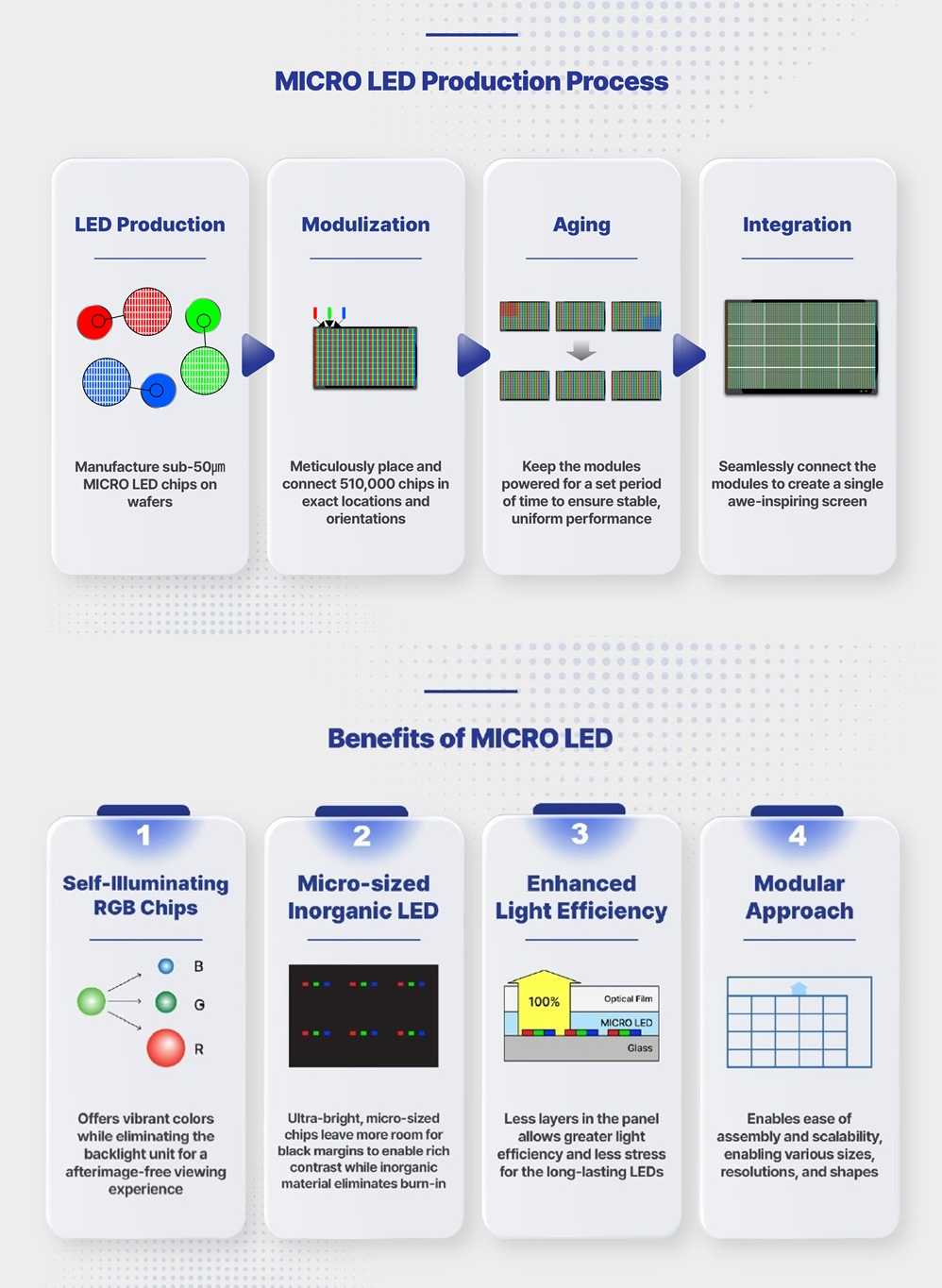
The holy grail, though, would be to ditch the liquid crystal entirely, and just have a display fully made of individually addressable LEDs making up the red, green, and blue subpixels. That is finally coming to pass, with manufacturers launching new television lines under the “Micro LED” name. These are true “emissive” displays, where the individual red, blue, and green subpixels are themselves emitting light, not just filtering it from a backlight source behind them.
Advertisement
The challenge behind making pure LED TVs was figuring out how to get the LEDs small enough and to put them in scalable arrays. Credit: Samsung

These displays promise greater contrast than backlit LCDs, because individual pixels can be turned completely off to create blacker blacks. Response times are also fast because LEDs switch on and off much more quickly than liquid crystals can react. They’re also relatively power efficient, as there’s no need to supply electrons to pixels that are off. Contrast this to LCDs, which are always spending power on turning some pixels black in front of a  glowing backlight which is also drawing power. Viewing angles of emissive displays are also top-notch. Inorganic LEDs also have long lifetimes, which makes them far more desirable than OLED displays (discussed further below). Their high brightness also makes them ideal for us in bright conditions, particularly where sunlight is concerned.

Given the many boons of this technology, you might question why it’s taken true LED displays this long to hit the market. The ultimate answer comes down to cost and manufacturability. If you’ve ever built your own LED array, you’ve probably noted the engineering challenges in reducing pixel size and increasing resolution. When it comes to producing a 4K display, you’re talking about laying down 8,294,400 individual RGB LEDs, all of which need to work flawlessly and be small enough to not show up as individually visible pixels from typical viewing ranges. Other technologies like LCDs and OLEDs have the benefit that they can be easily produced with lithographic techniques in great sizes, but the technology to produce pure LED displays on this scale is only just coming into fruition.
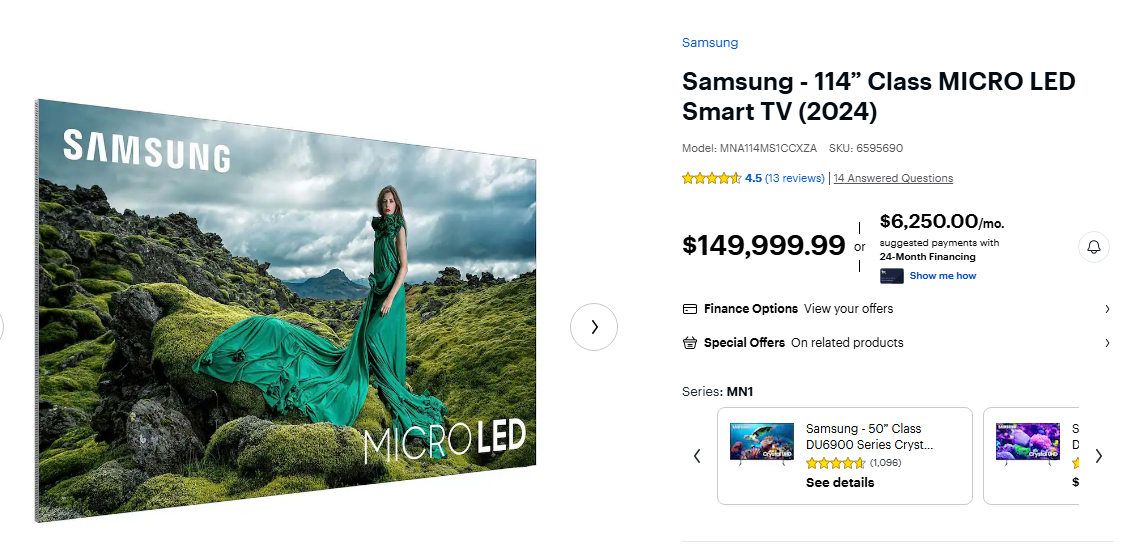
There are very few Micro LED TVs on the market right now. The price is why. Credit: Best Buy via screenshot

You can purchase an all-LED TV today, if you so desire. Just note that you’ll pay through the nose for it. Few models are on the market, but Best Buy will sell you a 114″ Micro LED set from Samsung for the charming price of $149,999.99. If that’s a bit big for your house, condo, or apartment, you might consider the 89″ model for a more acceptable $109,999.99. Meanwhile, LG has demonstrated a 136″ model of a micro LED TV, but there have been no concrete plans to bring it to market. Expect it to land somewhere firmly in the six-figure range, too.

If you’re not feeling so flush, you can get a lesser “Micro RGB” TV if you like, which combines a fancy RGB matrix backlight with LCD technology as discussed above. Even then, a Samsung R95 television with Micro RGB technology will set you back $29,999.99 at Best Buy, or you can purchase it on a payment plan for $1,250 a month. In fact, with the launch of these comparatively affordable TVs, Samsung has gone somewhat quiet on its Micro LED line since initially crowing about it in 2024. Still, whichever way you go, these fancy TVs don’t come cheap.

But What About OLED?

OLEDs have many benefits as an emissive display technology, however the organic materials used come with limits to brightness and lifespan. Fabrication cost is, however, far cheaper than pure inorganic LED displays. Credit: author

It’s true that emissive LED displays have existed in the market for some time, but not using traditional light-emitting diodes. These are the popular “OLED” displays, with the acronym standing for “organic light emitting diode.” Unlike standard LEDs, which use inorganic semiconductor crystals to emit light, OLEDs instead use special organic compounds in a substrate between electrodes, which emit light when electricity is applied. They can readily be fabricated in large arrays to create displays, which are used in everything from tiny smartwatches to full-sized televisions.

You might question why the advent of “proper” LED displays is noteworthy given that OLED technology has been around for some time. The problem is that OLEDs are somewhat limited in their performance versus traditional inorganic LEDs. The main area in which they suffer is longevity, as the organic compounds are susceptible to degradation over time. The brightness of individual pixels in an OLED display tends to drop off very quickly compared to inorganic LEDs. A display can diminish to half of its original brightness in just a few years of moderate to heavy use. In particular, blue OLED subpixels tend to degrade faster than red or green subpixels, forcing manufacturers to take measures to account for this over the lifetime of a display. Peak brightness is also somewhat limited, which can make OLED displays less attractive for use in bright rooms with lots of natural light. Dark spots and burn in are also possible, at rates greater than those seen in contemporary LCD displays.

The limitations of OLED displays have not stopped them gaining a strong position in the TV marketplace. However, the technology will be unlikely to beat true LED displays in terms of outright image quality, brightness, and performance. Cost will still be a factor, and OLEDs (and LCDs) will still be relevant for a long time to come. However, for now at least, the pure LED display promises to become the prime choice for those looking for a premium viewing experience at any cost.

Advertisement

Featured image: “Micro LED” displays. Credit: Samsung

Source link

Advertisement
Continue Reading
Click to comment

Leave a Reply

Your email address will not be published. Required fields are marked *

Tech

AI panic grips Wall Street as software stocks sink, yet AWS chief says investors are wildly overreacting to disruption fears

Published

on


  • Growing AI fears recently triggered a sharp sell-off across software stocks
  • SaaS valuations dropped as disruption narratives gained momentum
  • AWS revenue growth outpaced broader tech market performance, and CEO looks to allay fears

Technology stocks have struggled in 2026 as investors reassess the commercial impact of rapidly advancing AI tools.

The pullback has been especially sharp among software-as-a-service companies, where some analysts now describe the downturn as an “SaaS apocalypse.”

Advertisement

Source link

Continue Reading

Tech

Eurail says stolen traveler data now up for sale on dark web

Published

on

Eurail says stolen traveler data now up for sale on dark web

Eurail B.V., the operator that provides access to 250,000 kilometers of European railways, confirmed that data stolen in a breach earlier this year is being offered for sale on the dark web.

The company said that a threat actor also published a sample of the data on the Telegram messaging platform but it is still trying to determine the type of records and number of customers affected.

Eurail B.V. is a Netherlands-based firm that manages and sells passes (Eurail and Interrail) for train travel across Europe, offering flexibility for multi-country trips.

Wiz

Its passes are also very popular among young European travelers participating in the EU’s DiscoverEU program.

Last month, the company disclosed that it suffered a data breach when threat actors gained unauthorized access to its customer database, compromising sensitive information, including full names, passport details, ID numbers, bank account IBANs, health information, and contact details (email addresses, phone numbers).

Advertisement

“We have become aware that the data has been offered for sale on the dark web and a sample data set has been published on Telegram.

“We are currently investigating which specific data records or how many of the affected customers this concerns,” reads Eurail’s update.

Eurail states that it continues the investigation to determine exactly what data was compromised for each affected customer, and will send individual notifications for those impacted.

Meanwhile, concerned data protection authorities have been notified in accordance with the GDPR requirements, and authorities outside the EU will be alerted soon.

Advertisement

Customers who may have had their information exposed in this incident should be vigilant to potential phishing and scam attempts.

Eurail suggests that customers update their Rail Planner app account passwords and reset them on any other platform where they use the same credentials.

Also, customers should monitor their bank account activity closely and report any suspicious transactions to their bank immediately.

A FAQ page has been published to support customers, and any concerns may also be addressed directly via email to privacyhelp@eurail.com.

Advertisement

Modern IT infrastructure moves faster than manual workflows can handle.

In this new Tines guide, learn how your team can reduce hidden manual delays, improve reliability through automated response, and build and scale intelligent workflows on top of tools you already use.

Source link

Continue Reading

Tech

X goes quiet again

Published

on

If you checked X today expecting the usual stream of hot takes, memes, and AI spats, you probably saw… nothing. A widespread outage hit the platform today, leaving feeds blank, timelines unresponsive, and users staring at the digital equivalent of an empty room. Outage trackers such as Downdetector logged a dramatic surge in problem reports […]

This story continues at The Next Web

Source link

Advertisement
Continue Reading

Tech

Alibaba unveils Qwen3.5 with visual agentic abilities

Published

on

Qwen3.5 is 60pc cheaper to use and eight times better at processing large workloads than its predecessor, the company said.

Alibaba has unveiled its latest AI model, Qwen3.5, as newer launches from Chinese companies catch up to their US counterparts in the race for AI dominance.

The first open weight model in the Qwen3.5 series demonstrates “outstanding results across a full range” of benchmarks, the company said. It ranks higher than OpenAI’s GPT-5.2, Anthropic’s Claude Opus 4.5 and Google’s Gemini 3 Pro in several of the tests.

The model is built on a hybrid architecture that allows only 17bn parameters to activate per forward pass, while comprising a total of 397bn parameters. This, Alibaba said, optimises speed without sacrificing its capability.

Advertisement

According to the company, Qwen3.5 is 60pc cheaper to use and eight times better at processing large workloads than its immediate predecessor. The new model comes with “visual agentic capabilities”, Alibaba said – the ability to take actions across phone and computer apps.

“Built for the agentic AI era, Qwen3.5 is designed to help developers and enterprises move faster and do more with the same compute, setting a new benchmark for capability per unit of inference cost,” the company said in a statement, as reported by Reuters.

Alibaba’s latest launch follows ByteDance releasing an upgraded version of its Doubao chatbot app over the weekend. The agentic chatbot service has close to 200m users.

The TikTok parent also recently launched the latest version of its AI video generator, Seedance 2.0, which garnered praise for its capability while also receiving criticism for potential copyright theft.

Advertisement

Other Chinese AI leaders launched their own new models recently, including Zhipu, which unveiled GLM-5, trained entirely using Chinese chips; MiniMax, which released M2.5; and the Alibaba-backed Moonshot AI, which came out with Kimi K2.5.

These new launches come ahead of DeepSeek’s new V4 model, expected to come out later this month. According to reports, the new DeepSeek model could outperform rivals ChatGPT and Claude, particularly on tasks that involve long coding prompts.

Don’t miss out on the knowledge you need to succeed. Sign up for the Daily Brief, Silicon Republic’s digest of need-to-know sci-tech news.

Advertisement

Source link

Continue Reading

Tech

Logistics stocks tumble after tiny AI firm claims massive freight efficiency gains

Published

on


  • Freight AI claims triggered a sharp market sell-off across trucking logistics shares
  • Investors reacted strongly to automation fears as small AI firm surged in value
  • Market anxiety around AI disruption spread beyond trucking into healthcare and publishing

Shares in trucking and logistics companies plunged after investors reacted sharply to claims made by a tiny AI firm about automation in freight operations.

Wall Street Journal reported the selloff “is one of the most extreme examples yet of the sell-now, ask-later ethos sweeping financial markets in the artificial-intelligence era.”

Advertisement

Source link

Continue Reading

Tech

Western Digital's HDD production for 2026 is already sold out

Published

on


Western Digital has already sold out its entire HDD manufacturing capacity for the year, and it’s only February. According to CEO Irving Tan, 2026 is effectively fully booked. AI companies are purchasing storage drives that have yet to be manufactured, and relief for traditional customers is unlikely anytime soon –…
Read Entire Article
Source link

Continue Reading

Tech

Washington Hotel in Japan discloses ransomware infection incident

Published

on

Washington Hotel

The Washington Hotel brand in Japan has announced that that its servers were compromised in a ransomware attack, exposing various business data.

The hospitality group has established an internal task force and engaged external cybersecurity experts to assess the impact of the intrusion, determine whether customer data was compromised, and coordinate recovery efforts.

Washington Hotel, a brand operating under Fujita Kanko Inc. (WHG Hotels), is a business-focused hospitality chain with 30 locations across Japan. WHG has 11,000 rooms over its properties and has nearly 5 million guests every year.

Wiz

According to the company’s disclosure, hackers breached its network on Friday, February 13, 2026, at 22:00 (local time). The IT staff immediately disconnected servers from the internet to prevent the attack from spreading on the network.

The organization states that it started consulting with the police and external cybersecurity experts.

Advertisement

Although an investigation is ongoing, Washington Hotel can confirm that the attacker gained access to various business data stored on the affected servers.

Customer data is unlikely to be exposed because the company stores this information on servers managed by a separate company, for which no unauthorized access has been confirmed.

The incident is impacting operations at some Washington Hotel brand properties, including the temporary unavailability of credit card terminals. Besides that, the firm says it recorded no significant operational disruption.

The financial impact of the incident is currently under review. Washington Hotel promised to provide updates if any additional relevant details emerge.

Advertisement

As of writing, no ransomware groups have claimed the Washington Hotel on known dark-web-based extortion portals that BleepingComputer monitors.

Multiple companies in Japan have been targeted by hackers lately. Some of the recent incidents include global automaker Nissan, retail giant Muji, the largest brewer in the country, Asahi, and telecom giant NTT.

Although not necessarily related to the breach at Washington Hotel, JPCERT/CC disclosed late last week that hackers were exploiting an arbitrary command injection flaw in Soliton Systems’ FileZen products, tracked under CVE-2026-25108.

The file-sharing appliance is widely used by Japanese companies and was also targeted in 2021.

Advertisement

Modern IT infrastructure moves faster than manual workflows can handle.

In this new Tines guide, learn how your team can reduce hidden manual delays, improve reliability through automated response, and build and scale intelligent workflows on top of tools you already use.

Source link

Continue Reading

Tech

The Best Michelin Tires For SUVs, According To Consumer Reports

Published

on


If you are in need of new tires for your vehicle, chances are pretty good that one of the brand names that you will be considering is Michelin. The French company has been a mainstay of the tire industry for over a century, and the tires it produces are generally regarded among the best in the world. Michelin even took the top spot in SlashGear’s own ranking of tire brands. Another publication that agrees is Consumer Reports, which also ranked Michelin as the best overall tire brand on the market.

Consumer Reports tested eight different Michelin tires to determine how they brake, how much noise they make, how they handle various surfaces, and more. Several of these are designed with SUVs in mind, either specifically or to be used on cars too. While all of the tires tested earned very good ratings and a “CR Recommended” indicator from Consumer Reports, there is one Michelin tire for SUVs that ranks the highest of them all: the Michelin CrossClimate 2.

These are all-season tires specifically made for SUVs, and not only does it sit at the top of the list for Michelin SUV tires, Consumer Reports has it ranked at the top among tires of its kind from every brand. This is thanks to an incredibly high owner satisfaction score and that it performed either well or excellently in every single testing area, be it wet and dry braking, ride comfort, or rolling resistance. One of the more impressive things is that these tests were based on a 95,000-mile tread life, which is 35,000 more than the number two-ranked tire of this class, the Vredestein HiTrac. 

Advertisement

All-season tires actually for all seasons

Whenever you see the phrase “all-season tires,” you always hope that the tires can actually deliver on that promise. It’s one thing to drive down an open road on a hot July afternoon, bur it’s another to be in mid-January and trudging your SUV through the snow. Knowing what goes into a good snow tire is important for those in colder climates, and many of these people opt to buy tires specifically with snow, ice, and winter in mind, which is exactly how snow tires are different from all-season ones. Michelin even has options for that, like the highly rated and aptly named Michelin X-Ice Snow tires. For performance SUVs, you can opt instead for Michelin Pilot Alpin PA4 tires. Both of these have received top marks from Consumer Reports for snow traction and ice braking.

Some just want to have those all-season tires, though; according to Consumer Reports, choosing the Michelin CrossClimate 2 instead of a specifically designed snow tire provides plenty of performance. These tires received the exact same top marks in testing for snow traction and ice braking as the winter-focused tires. In fact, these are the two areas of all that were tested where the CrossClimate 2 earned the highest score possible. An all-season tire should be able to handle these things just as well as it does braking on a dry road or hydroplaning, and these pass with flying colors. For those wanting Michelin tires on their SUV, Consumer Reports really does find little to no fault with the performance that the CrossClimate 2 provides.

Advertisement


Source link

Advertisement
Continue Reading

Tech

La Liga Soccer: Stream Girona vs. Barcelona Live From Anywhere

Published

on

When to watch Girona vs. Barcelona

  • Monday, Feb.16, at 3 p.m. ET (noon PT)

Where to watch

  • Girona vs. Barcelona will air in the US on ESPN Select.

Barcelona will seek to avoid a second straight defeat when they take on Catalan neighbors Girona on Monday.

Advertisement

It’s been a difficult week for the visitors, with Barça crashing to a chastening 4-0 thrashing at the hands of Atlético Madrid in Thursday’s Copa del Rey semifinal. Meanwhile, title rivals Real Madrid’s emphatic 4-1 La Liga victory on Saturday pushed the Blaugrana down to second place in the standings.

They now face a Girona side also badly in need of points, with Míchel’s Blanquivermells entering the match just two points above the relegation zone in 15th place and on a three-game winless run.

Girona takes on Barcelona at the Estadi Montilivi in Catalonia on Monday, Feb. 16. Kickoff is set for 9 p.m. CET local time, which is 3 p.m. ET or noon PT in the US and Canada, 8 p.m. GMT in the UK and 7 a.m. AEDT in Australia on Tuesday morning.

Advertisement
Michel, head coach of Girona FC

Michel’s Barcelona have won just three times at home so far this season. 

Denis Doyle/Getty Images

Watch Girona vs. Barcelona in the US without cable 

This match is available to stream in the US through ESPN Select, which has live English and Spanish-language broadcast rights for La Liga in the US.

ESPN’s streaming platforms now offer two tiers with its new direct-to-consumer setup: ESPN Select and ESPN Unlimited. ESPN Select is essentially what ESPN Plus used to be, with the same content available to subscribers, including La Liga soccer, for $12 a month. If you want full access to ESPN’s networks and services, such as ESPN, ESPN2, ESPN3, ESPNews and ESPN Deportes, as well as all of ESPN Select’s content, then ESPN Unlimited is the way to go. It costs $30 a month.

Livestream Girona vs. Barcelona in the UK

Premier Sports is the home for the lion’s share of live Spanish top-flight match broadcasts this season in the UK. The network is showing 340 matches live, including this game, which will be shown exclusively live on its Premier Sports 1 TV channel and Premier Sports Player.

Advertisement

Premier Sports

A subscription to the dedicated Premier Sports La Liga channel costs £8 a month. You can also access the channel through a full subscription to Premier Sports, which provides access to all of the network’s channels. These channels hold the UK broadcast rights to Scottish Premiership matches, the BKT United Rugby Championship, the Investec Champions Cup, as well as NHL and Nascar. A full Premier Sports subscription costs £10 per month for Sky and Virgin TV customers. You can also get Premier Sports through Prime Video as an add-on for £15 a month.

Livestream Girona vs. Barcelona in Canada

TSN is the rights-holder for live coverage of La Liga matches in the region. Select games are shown on its linear channels, and a wider selection is shown on its TSN Plus streaming platform. This match is set to be shown on TSN 5 and TSN Plus.

TSN Plus is a streaming service that costs CA$8 a month and also offers coverage of PGA Tour Live golf, NFL games, F1, Nascar and the four Grand Slam tennis tournaments.

Livestream Girona vs. Barcelona in Australia

Soccer fans Down Under can watch La Liga matches live on BeIN Sports, which holds the live broadcast rights in Australia for Spanish top-flight matches. This match is set to be shown on BeIN Sports Connect.

Advertisement

BeIn Sports

BeIN Sports is available in Australia for AU$16 a month or a yearly commitment of AU$160.

Source link

Advertisement
Continue Reading

Tech

Amazon Props Up Misleading, Junky Laptops No One Should Buy

Published

on

Beyond the outdated Acer Nitro, I also spotted this Samsung Galaxy Book4. This is not a terrible laptop on its own, but at $565, there are better options. There’s the Asus Vivobook 14 (or 16), which costs $650 and occasionally dips down to $550. It comes with the 8-core Qualcomm Snapdragon X, providing it with much more battery life than the Galaxy Book4. There’s also the Lenovo IdeaPad Slim 3X, which has the same chip but comes in even cheaper at $584.

If you want great deals on laptops that are actually worth buying, check out our Best Budget Laptops, Best Budget Gaming Laptops, and Best Chromebooks recommendations, which I frequently update.

Unknown Brands

You always know it’s bad when the brand of the laptop isn’t mentioned in the title of the product. Oh, you’ve never heard of the well-known, reliable laptop manufacturer Jumper? Or Nimo? Yeah, I haven’t either. Yet, Amazon seems to think these are appropriate to recommend as some of the best laptops.

Like the HP laptops above, these are extremely cheap Windows 11 laptops—all under $300. The Jumper laptop suffers from some of the same problems, such as the eMMC storage and Intel Celeron processor, even if the company at least manages to include a 1080p display. The large touchpad and edge-to-edge keyboard look nice, too. Yet, I would never recommend a laptop that isn’t from a reputable manufacturer. It’s not that it’s impossible that these laptops could be decent, but buying some that have almost no independent reviews isn’t a good idea.

Advertisement

You’ll also see the brand Nimo pop up, specifically around the topic of gaming laptops. Marketing these as gaming laptops is very misleading, as they don’t come with a discrete graphics card—or any other notable gaming features. This Nimo laptop is no more a gaming device than any other $600 Windows laptop you can buy. You can’t actually buy a worthwhile gaming laptop for this much, and these off-brand companies are preying on that fact.

It’s Not All Bad

There are a couple of laptops that appeared on page one of the Amazon results that were promising. Amazon put the 13-inch M4 Apple MacBook Air high up, which is also our top pick for the best laptop you can buy. Amazon also recommended the Dell 15 Laptop, which is a budget device that looks solid. I haven’t tested it yet myself, but it’s a 2025 laptop for $530 that comes with decent specs, such as a 120-Hz refresh rate, 16 GB of RAM, and 512 GB of storage. But that’s really it. The rest of the results are flooded with sponsored results of varying degrees of quality.

Walmart, which has become another popular online laptop retailer, does an even worse job, appealing to the lowest common denominator. It falls into the same traps as Amazon, surfacing ultra-cheap, outdated HP laptops under $300, and tons of unknown knock-off brands like “RNRUO” and “Coolby.” This problem is even worse at Walmart; 24 out of the 40 laptops offered on page one are from these mystery brands, and most of the rest are from HP. It’s really a shame, as Walmart and Amazon both have great deals on some of my favorite laptops, but they’re often buried unless you’re specifically searching or filtering for them.

Source link

Advertisement
Continue Reading

Trending

Copyright © 2025