One thing that we’ve heard for many years in covering a variety of ridiculous civil and criminal court cases is the belief that when a crazy case is filed, the person accused of wrongdoing should “just walk into court and tell the judge what really happened.” While that might feel right, it’s really not how these things work. There is a procedure, and having an actual lawyer who understands how things work is incredibly valuable.
When we first wrote about “Reckless” Ben Schneider and his valiant attempt to help Bryan Mansell get back the Lego sets (and/or money) he was owed from the company Bricks & Minifigs, we mentioned that almost everyone in the dispute should have talked to lawyers earlier in the process than they did. We had a lot of people get mad at us for making that claim, but I stand by it. Especially after Schneider has dropped Part 3 (after a federal court fixed the extremely problematic injunction from a state court that had blocked him from releasing it originally), and it again shows why Schneider really needs to hire a lawyer.
As lots of people are rightly noting, the video itself shows a ton of pretty sketchy behavior by Bricks & Minifigs and the cops — police walking a witness through how to invent charges while mocking Schneider, and Bricks & Minifigs caught telling wildly different stories depending on who was listening. And then, right on schedule, after the video came out Bricks & Minifigs followed it up with a new blog post on Friday that somehow makes things worse.
Advertisement
Schneider certainly knows how to make pretty viral video content, but representing himself in court seems particularly stupid, especially as he’s doing it here in a criminal case. He is right that the deck is stacked against him and that the prosecutors and the judge don’t seem to be listening to him or taking his claims seriously, but that’s in large part because he’s bumbling into court without a lawyer, and when he’s being asked fundamental procedural questions is telling the judge “have you looked at the evidence we submitted?”
Again, this might feel like the right way to handle a case where you feel you’re being railroaded, but procedurally, the court isn’t supposed to be looking at the evidence at this stage of the case, so Schneider making out like the court is treating him unfairly just misses the point that basically any lawyer could have told him regarding how cases like this proceed.
That’s not to defend the prosecutors, the police, or Bricks & Minifigs. While the video is (again) only showing Schneider’s side of the story, there are a whole bunch of things in the video that are incredibly damning to all three.
Let’s go through a few key points: First up: what the cops told Schneider about the charges against him, and what they were actually hiding.
Advertisement
Schneider plays some audio from one of the criminal cases against him (it’s a little unclear which one, since he suggests it’s the case in American Fork, but a screenshot he shows briefly suggests it may be the other case in Provo), where he says that the prosecutor and the court won’t even share what he’s being charged with, though the video clips don’t show that. Rather they show prosecutors trying to get out of providing body cam footage in discovery to Schneider, claiming that they’re upset he’ll make video commentary out of it. Discovery of evidence is not the same as knowing what the charges are, even if the evidence is related to the charges.
Even so, the claim is bullshit. The fact that Schneider might create public commentary with the videos is no excuse for not providing discovery. If that’s the concern, prosecutors can seek to have a protective order put over how the discovery materials are used, and if Schneider violates that order, then he could face contempt charges. Simply denying discovery is ridiculous.
But it’s the second case, out of Provo, where the bodycam footage stops looking like sloppy policing and starts looking like something much more problematic. Schneider was able to obtain bodycam footage from the police who were handling the charges against him based on statements from Bricks & Minifigs’ CEO Ammon McNeff. Again, we’re only seeing the evidence as selected and edited by Schneider, but it’s difficult to see how there’s anything else that would exonerate how the Provo police acted here.
They literally have one police officer talking to McNeff (repeatedly), talking about how McNeff’s original claim of extortion isn’t supported by the evidence but offering to help him find some other charges, and then asking McNeff to confirm specific elements to turn it into commercial obstruction. The police officer’s quote here is deeply problematic:
Advertisement
“We agree that there really was no extortion code that would fit your situation, however, you know, at the end of the day, we do want to help you guys so you’re not having to deal with this fool… [sigh]… all his issues. We did find that there was another code that fit and it’s called aggravated commercial obstruction….”
Having the police call Schneider a “fool” and saying they want to help find charges that will stick is not great. They then walk McNeff through what they need him to say/do to get such charges, including claiming that he asked Schneider to leave the Bricks & Minifigs premises multiple times and Schneider refused. Schneider shows his own video recordings (and security footage) that appears to directly contradict this — specifically showing that when asked to leave they did so.
There is one point where McNeff asks them to leave but then keeps talking to them anyway, so that almost certainly doesn’t count as a legitimate request to leave. And none of the footage Schneider shares matches even remotely what McNeff told the police. There is footage of Schneider (stupidly) saying “we can do this the easy way or the hard way,” which is not fatal to Schneider’s argument, but can certainly be read as a threat. In all these videos, that’s the one point that isn’t great for Schneider, though in the full context it’s pretty clearly a threat to release more videos and publicly shame Bricks & Minifigs. Still, that line hurts Schneider’s argument a bit.
McNeff also tells the police that Schneider threatened to burn the offices down, even though in their own civil lawsuit against him they admit that various threats have not come from Schneider directly but from some of his fans online. If Schneider had directly threatened them, you’d think they would have included that in the civil complaint. While most of the video evidence has only been selectively released, at this point not a single bit of evidence shows Schneider actually threatening any sort of violence towards Bricks & Minifigs (indeed, it seems that his whole schtick is to sort of do the dopey, hapless, inquisitor thing).
Based on the current evidence, it sure looks like McNeff just lied to the cops, and the cops not only took his side, but helped nudge McNeff about what he should say or do to give them enough to charge Schneider.
Advertisement
Not great!
Even worse, when the same cop figures out what they can charge them with, the body cam footage shows her laughing with glee. You kinda have to watch the clip directly (starting at 16:15) where the cop gets kinda gleeful that McNeff told her enough to charge Schneider with a second degree felony (Schneider falsely calls it a “secondary” felony). This is actually two separate clips from Schneider’s video, though it sounds like they’re directly connected to one another:
Cop: However, the tricky thing is is that we have to prove that this individual either entered or remains unlawfully on the premise. When he came to the property, did you have to ask him more than once to leave?
McNeff: Yes.
Cop: Okay.
McNeff: You know, ‘we’re not leaving until we we get it.’ …
[other video interspersed before cutting back to this exchange]
McNeff (trying to reconstruct the scene for the cop): ‘Guys, at this point, I’ve asked you to leave. Please leave.’ ‘Well, we we you know, like you have to listen to us. You have to pay us this money.’ ‘No, guys, you need to leave and you’re not leaving.’ Like, but I asked multiple times. They did not leave.
Cop: Looks like that might be a second degree felony. [laughs joyfully] He’s facing felony charges. It is a felony…
That is all… pretty damning. Later the same cop mocks Schneider’s first video: “I’m really curious if this fool makes any money doing this YouTube stuff?” Even later, she says to McNeff “well, I’ll keep my fingers crossed for you. Hopefully no more issues” and “there’s so many other things that this guy could be talking about, right?” Just completely supporting McNeff and dismissing Schneider’s side entirely.
Though I will note that Schneider also has a misunderstanding that “reporting a crime” (as he tries to do with McNeff) is “opening a case.” While police can investigate claims of a crime, until a prosecutor charges it, there is no actual “case.”
Advertisement
But it does seem overwhelmingly clear, from what’s presented in this video at least, that the police immediately believed and sided with McNeff and dismissed/ignored everything Schneider presents in response… to the point that they sent a subpoena to Google seeking a bunch of Schneider’s emails, communications, and other documents. There’s a suggestion in the video that McNeff got Schneider to email him just to get his email for the sake of the subpoena, though it seems clear that McNeff had other means of getting Schneider’s email address. Schneider points out that he emailed via the website contact form and had received a reply from someone at Bricks & Minifigs. And while McNeff acts like he’s never heard of that email address and it has nothing to do with him, that’s clearly bullshit, and he could easily talk to whatever employee manages that account to get Schneider’s email address.
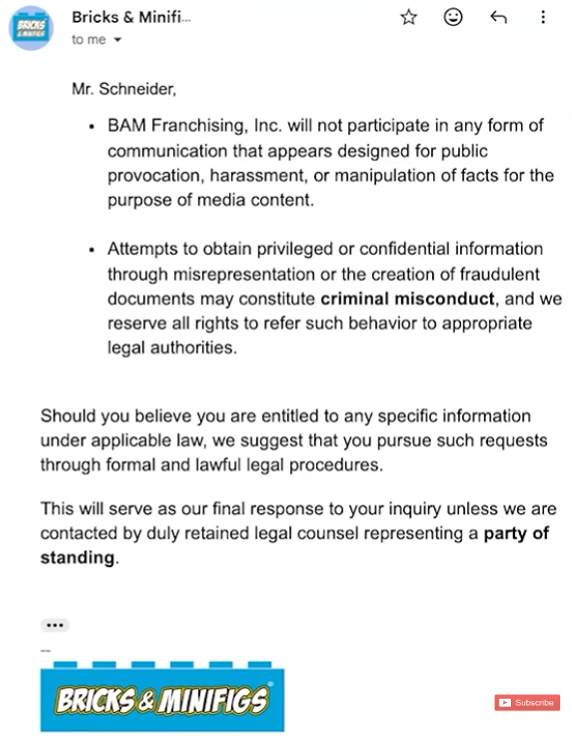
Set the criminal case aside for a second, because there’s a parallel thread here that’s just as bad for the company: McNeff’s own claims about the inventory list don’t survive contact with reality. McNeff tells Schneider that he’ll happily share the inventory they did of the store they took over if he sends an email to the one specific address, and says he told Mansell the same thing. However, when Schneider emails that address and follows up, he receives this reply:
If you can’t read that, it says:
Mr. Schneider,
BAM Franchising, Inc. will not participate in any form of communication that appears designed for public provocation, harassment, or manipulation of facts for the purpose of media content.
Attempts to obtain privileged or confidential information through misrepresentation or the creation of fraudulent documents may constitute criminal misconduct, and we reserve all rights to refer such behavior to appropriate legal authorities.
Should you believe you are entitled to any specific information under applicable law, we suggest that you pursue such requests through formal and lawful legal procedures.
This will serve as our final response to your inquiry unless we are contacted by duly retained legal counsel representing a party of standing.
That shows pretty clearly that McNeff was full of shit when he said he’d be happy to email Schneider a copy of the inventory. And, sure, you can say that between Schneider visiting them and the time this email was sent they decided that they didn’t like how they were going to be portrayed, but there’s a pattern here. In the video Schneider releases, he shows McNeff saying “I think we have sent it to Bryan” in reference to the inventory list, and later says that if Schneider and Mansell get on an email thread together he’ll send it to both of them.
They also show McNeff going on TV news interviews claiming that they had told Mansell and Mansell’s lawyer that they were happy to work on going through the inventory list, but that Mansell’s lawyer stopped responding. McNeff said: “we’ve tried to share those with Mr. Mansell in hopes that he can see that we were not attempting — in any shape or form — to withhold anything. Those were then offered to him, and the initial offer was rejected.”
Advertisement
Except that Mansell has the receipts in the form of the email thread between his lawyer and Bricks & Minifigs, which seems to show pretty clearly a very different story. Even as we only see snippets of the emails, it’s hard to square this with what McNeff keeps claiming. The emails show Mansell’s lawyer asking multiple times how to get the money owed or the sets back and finally getting a stiff arm email saying that the two guys who Bricks & Minifigs handed the store to, “Brandon Best and Joshua Johnson, have no legal obligation to return any of the LEGO product.”
And then, even more damning is the closing of the email, saying “We consider this matter closed and will not be returning any LEGO products to you.”
That, uh, does not seem like a company that claims that it has no problem trying to work with Mansell to resolve this issue. Last week we mocked Bricks & Minifigs for having their crisis comms person send us an email about how the company was so eager to help make Mansell whole. That already seemed ridiculous since they’re suing Mansell for $1.3 million claiming RICO. But also, that was before we’d seen this email where the company basically says “shove it.”
Anyway, even as this is just coming from Schneider’s side, it’s hard to see how there’s any additional info that would acceptably square the claims made by McNeff with what’s been presented. There’s now plenty of discussion about how Schneider likely has civil claims he could bring against McNeff. Arguably he could also claim that the police in both American Fork and Provo violated his rights, but that’s likely an extreme longshot (not because the cops are in the right, but because it’s next to impossible to sue the cops for violating your rights).
Either way, we now know that Schneider has legal representation for the civil case, and hopefully that means he can also secure legal representation for the criminal case as well, because that would clearly be helpful. Yes, all of this is tremendous content, but your strategy in court when facing felony charges and your strategy for making viral content can (and should) be somewhat different.
Honestly, given how much attention this has gotten, and the legal help that has started to step up, there’s a decent chance that the criminal cases will go away, but that’s very much not the norm. Planning to go viral is not a strategy any lawyer would recommend for fighting criminal charges.
Advertisement
Anyway, while Schneider’s legal troubles play out, it’s worth remembering that Bricks & Minifigs certainly was not blindsided by Schneider’s Part III. They knew it was coming and that it was blocked by the broader injunction they had obtained in court. They knew that they had negotiated a pared back injunction, which meant Part III would be released soon. They basically had weeks to prepare a PR response to all the damning stuff that video was going to show.
And this is what they came up with.
The company released yet another tone deaf blog post on Friday, which talks about all the “changes” they’re making to respond to some of the criticism they’re getting. Half of them basically read as admissions of how badly run the company is. They admit that they’re going to work more closely with franchises (apparently they’ve recently jacked up franchise fees) and have put in place a “standardized inventory and trade system” effectively admitting that they had nothing before.
There are also some comments on the lawsuit that look written by the world’s worst crisis comms team. I mean, this is embarrassing:
Advertisement
Some have asked why Bricks & Minifigs hasn’t simply dropped the pending litigation connected to this matter. The answer is that accountability and integrity must run both ways. We remain open to a mediated, amicable resolution, and we don’t view litigation as the preferred path. We’re also not willing to submit to manipulation, threats and unsupported accusations.
That… doesn’t answer the question. And sure, fine, accountability and integrity should run both ways, but you’re the one out there claiming that you’re trying to make Mansell whole… while telling him you won’t give him any of his stuff back and then suing him for $1.3 million.
The blog post also suggests they have to keep the lawsuit going because Schneider’s conduct “has crossed the line from fair criticism into harassment, misrepresentation, and targeted harm.” But that’s Schneider, not Mansell. It’s also laughable given the footage that’s been shown so far.
And of course they try to avoid the fact that all the presented evidence makes them look terrible with this favorite line:
We will not try this matter on social media, and we will not use this statement to relitigate every disputed detail. Those issues belong in mediation and, if necessary, the legal process.
Again, that makes sense in certain contexts, but here where you’ve been running your mouth off constantly on TV show after TV show with claims that directly contradict what corporate actions and emails have said, it does the opposite of building credibility.
Advertisement
At basically every turn where Bricks & Minifigs could have made the situation better, they’ve dug in and made it worse. It seems like a bad strategy. So bad it’s even worse than going to court and trying to defend yourself from criminal charges without a lawyer.
Rumor mill: Apple is overhauling its Mac chip roadmap to place artificial intelligence at the center of its hardware strategy. Instead of completing the M6 lineup with the usual Pro, Max, and Ultra variants, the company is reportedly moving directly to the M7 generation and planning significantly larger Neural Engine upgrades, according to people familiar with the plans.
This fall’s Macs are still expected to debut with a base M6 chip. Under Apple’s traditional release pattern, that chip would be followed by M6 Pro and M6 Max variants for higher-end laptops, along with an M6 Ultra for desktop-class machines.
This time, that sequence will reportedly stop after the entry-level chip. The company has already moved on to the M7 design, taping it out only about six months after the M6 reached the same stage. The compressed timeline highlights how urgently Apple wants its Macs to handle increasingly demanding AI workloads.
According to the internal roadmap, the first M7 Macs are scheduled to launch in the first half of 2027. Higher-end M7 Pro and M7 Max systems are expected later that year, while the M7 Ultra is targeted for 2028.
Advertisement
Apple has skipped an Ultra chip before – the M4 family did not include one – but abandoning every high-end M6 variant at once would mark a first. People briefed on the plans say Apple determined that the M7’s AI-focused upgrades were significant enough to justify skipping further M6 development.
At the center of those changes is the Neural Engine, Apple’s dedicated on-chip AI hardware that powers on-device generative models, accelerated inference, and Apple Intelligence features. Apple has refined the Neural Engine with every Mac chip generation since the M1 debuted in 2020, and the M4 represented one of the biggest improvements to date.
The company now wants the M7, particularly the M7 Ultra, to approach the level of performance developers expect from dedicated AI accelerators rather than traditional general-purpose desktop processors.
Memory support is a major part of that effort. The M7 Ultra is being designed to support up to 1.5 terabytes of unified memory. That is roughly double the capacity planned for the upcoming M5 Ultra server chip and matches the maximum RAM configuration available on Apple’s 2019 Intel-based Mac Pro.
Advertisement
With that much memory, significantly larger AI models can remain in memory, reducing bottlenecks and limiting the need to rely on external storage or cloud-based compute. Whether Apple ships Macs with the full 1.5TB configuration will depend on memory availability, as supply constraints and elevated prices remain concerns.
These desktop plans tie directly into Apple’s server strategy. The company is preparing a more powerful AI server based on the M5 Ultra, known internally as J246. Engineers are already working on a successor built around an M7 Ultra-derived server chip, with a launch window targeted for around 2029.
In other words, the same architecture expected to power Apple’s highest-end Macs could also underpin the next generation of servers running Apple Intelligence in the cloud.
Beyond the M7 family, Apple is developing an M8 generation with even more AI-focused silicon. The lineup reportedly includes a processor code-named Soko, targeted for 2028, along with other chips for high-end Macs under the Cardinal name.
The 2028 chips are planned for a 1.4-nanometer process, which should deliver another leap in efficiency. The shift comes as AI chips encounter increasing power and cooling constraints, pushing Apple to prioritize more transistors for neural processing units and memory bandwidth rather than simply expanding CPU and GPU cores.
Advertisement
All of this hardware development comes alongside a more mixed picture on the software side. Apple has struggled to deliver AI-powered services at the pace many expected. Apple Intelligence and the redesigned Siri have rolled out more slowly than planned, forcing the company to adjust expectations along the way.
Still, Apple’s hardware teams have spent more than a decade building the foundation for this moment, often through projects that never reached consumers.
The most notable example is the company’s abandoned self-driving car initiative. From the beginning, Apple targeted full Level 5 autonomy and invested heavily in machine learning and custom silicon capable of processing massive amounts of AI workloads in real time.
The car project never reached the market, but the chip development work directly contributed to the Neural Engine architecture that first appeared in the iPhone X in 2017 before expanding to Macs and other devices. That same hardware foundation now sits at the center of Apple’s AI strategy.
Advertisement
With the M7 and M8 families, Apple is treating AI as the primary driver of its chip designs rather than simply an additional feature. AI workloads are now shaping which chips get developed, when they launch, and how their architectures are built.
I think I’ve extensively explained at this point why the $111 billion merger between Paramount/CBS and Warner Brothers is a gargantuan pile of shit that will indisputably harm labor, consumers, markets, creatives, and potentially even national security. It doesn’t matter the company names; every single major media merger of this type ends badly for everyone but the trust fund brunchlords at the top.
Not only that, every single merger involving this particular company (Time Warner, Warner Brothers) in the last quarter century has resulted in nothing but layoffs, price hikes, shittier product, and a lot of whimpering. And there are ample signs that the Paramount folks are even less competent than past suitors, including the AT&T executives, who quickly got too far out over their skis.
While the Trump DOJ has unsurprisingly rubber stamped Larry Ellison’s clumsy effort to dominate what’s left of U.S. corporate media, states keep hinting at the fact they’ll file a collective antitrust lawsuit.
That’s certainly the case in Oregon, where Attorney General Dan Rayfield is asking for a 60 day pause in deal finalization while his office investigates both the deal — and apparently the Trump cronyism that has helped enable it. Rayfield, for one, accuses Paramount of refusing to adequately respond to state AG requests for information about the deal’s impact:
Advertisement
“We’re not going to let Paramount Skydance play hide the ball so they can rush through their massive merger. Oregonians have a real stake in this deal – in our film industry, in our economy, in the choices they’ll have as consumers. Paramount had every opportunity to hand over records and answer a few basic questions. Instead, it is trying to run out the clock and evade scrutiny. We’re asking the court to make sure Oregonians get the answers they’re owed before this deal closes, not after.”
Rayfield says that Paramount has been particularly cagey when asked for data on its interactions with the Trump administration and Trump DOJ. Including details on a federal government influence campaign Paramount internally calls “project warrior”:
“Paramount has not complied. According to court papers, the company declined to accept service of the request, waited weeks to respond, and ultimately sent objections on the day its documents were due – objections the state dismisses as a baseless tactic to avoid turning over the records. Paramount has told Oregon it does not intend to close the deal before July 16 but has not agreed to hold off any longer while the state’s investigation continues.”
So while the $111 billion deal is abjectly terrible, it’s not quite yet a done deal yet. I’d suspect that a joint antitrust lawsuit featuring the handful of states that still care about such a thing will arrive sometime in the next month or two. While it might not succeed in scuttling the deal, it could extend the timeline in a way that could prove costly for Larry Ellison, David Ellison, and their debt-riddled proposal.
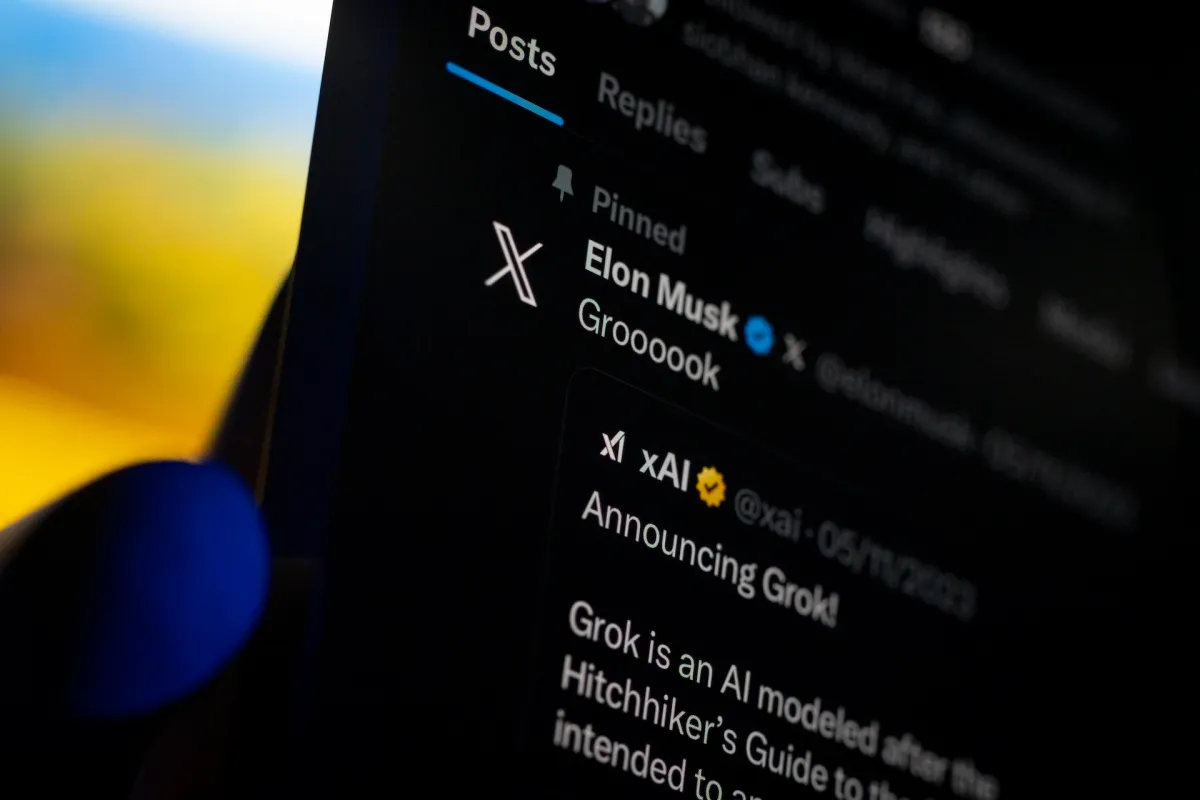
X has made a “tweak” to its algorithm to boost the visibility of posts to users’ “mutuals” — the people they follow who follow them back, head of product, Nikita Bier, said Monday.
“We noticed this data was missing from the algo and it made your friends appear less in your replies. This resulted in the reply section feeling more like a battleground with people you don’t recognize.”
The change may not drastically revamp the site’s user experience, but may make X feel a little bit more like a community rather than a torrent of disparate voices shouting into the digital abyss.
Bier noted that the change would also “help clusters form around interests more easily, which many people have asked for.”
Advertisement
X has introduced a number of changes lately — many of which seem designed to make the site a bigger hub for creators. Earlier this year, the site changed how it compensates accounts in an effort to incentivize original content rather than mere aggregation, and, earlier this month, it also introduced a video editor designed to make it easier for users to work on the platform.
This tweak follows changes that Meta’s Threads has been making to its algorithm aimed at creating communities, largely as a differentiation from its main rival X. For instance, last month Threads rolled out a Your Algo feature, which lets users privately control what they see in their feed. It also reached 500 million monthly active users.
Singapore-based video-generation startup PixVerse said today that it has closed its Series C extension, with a total of $439 million raised in the round. The company told TechCrunch that, with the new tranche of funding, its valuation has crossed over $2 billion. With the cash, the company aims to expand its world model offering and reach customers across geographies.
The company closed its initial Series C round in March, led by CDH Investments. While it didn’t disclose the funding amount, Bloomberg reported it to be in the range of $300 million. PixVerse said that investors in the extension round include Alibaba, Lollapalooza Capital, Ivy Capital, Grand Mount Capital, Eastern Bell Capital, Mirae Asset, BlueFocus, and CloudAlpha, joining returning investors iGlobe Partners and OCBC’s Lion X Ventures.
The company was founded by Wang Changhu and Jaden Xie in 2023. Changhu previously worked at ByteDance on computer vision, and Xie was an executive director at investment firm Lighthouse Capital.
PixVerse offers multiple models, including a V-Series video model for consumer and API use, a C-Series video model for professional film and commercial workflows, and an R-Series of world models for game development and world building, which was released earlier this year.
Advertisement
Through its tool, users can generate videos in up to 4k resolution with audio baked in. The startup said that its consumer product has over 150 million registered users and over 15 million monthly active users. The company declined to specify how many of them are paying users but it offers a competitive rate of $4.80 per minute of generation for image-to-video.
Xie believes that despite the huge opportunity for video generation to succeed, only a few companies are making progress in the market.
“OpenAI exited the business when they shut down Sora 2. Other companies like Meta and Tencent are not able to create high-quality video models. So there are only a few companies that can meet the quality bar,” he told TechCrunch.
He said that there is equal opportunity in the consumer and enterprise markets as users are creating videos for fun and also consuming short video content made with AI, while enterprises are using video generation for creative, learning, and marketing use cases.
Advertisement
However, saying that the startup’s model produces a “high-quality” output is hardly a unique qualifier. Xie mentioned that its core strength lies in labeling.
“We think the key difference is not in data, but how you label it, because data is available everywhere. My co-founder worked at ByteDance, where he built core visual understanding technology behind TikTok using AI. Using this tech, TikTok was able to label data accurately and build a strong recommendation algorithm. This experience comes in handy when building a video-generation platform,” Xie said.
The company has big ambitions this year. It wants to expand its enterprise outreach across the globe. The startup already has a deal with its investor Alibaba to deploy the video-generation features.
In terms of product rollout, it plans to launch a new V-Series model for video generation and release a new version of its world model this year. It has 150 employees across offices in Singapore, Beijing, and Shanghai. With the new funding, PixVerse aims to hire more researchers and people in go-to-market function.
Advertisement
Despite its confidence in its own models and products, the video market is heating up. There are players like ByteDance with its Seedance model, former Tencent AI head Dr. Wei Liu’s Video Rebirth, and Kling AI from Asia. In the West, there are competitors like Midjourney, Runway, and Luma. Multiple companies, including Yann LeCun’s and Fei-Fei Li’s startups, are building world models.
When you purchase through links in our articles, we may earn a small commission. This doesn’t affect our editorial independence.
Many older hackers will have at some point gotten rid of an old piece of hardware that they later ended up regretting. All those ISA cards were next to useless back in 2006, but now their relative rarity plus the popularity of retrocomputing makes them sought-after. But if it’s a sound card you’re after then never fear! [Schlae] has got you covered, with the Beavis Ultrasound. It may have a name reminiscent of a ’90s cartoon series, but it’s a clone of the Gravis Ultrasound from back in the day.
There is of course a snag, to build one you need an AMD AM78C201. Assuming you’ve found one in a surplus supplier though, the rest of the card is analogue, some glue logic, and a ROM for samples. There is also a GAL for driving the IDE CD-ROM interface, from the days when sound cards came with such things.
The hardest problem in AI is no longer the chip but the megawatt.
For much of the past three years, the global AI race has focused on semiconductors, with governments competing for advanced chips, technology outfits scrambling to secure GPUs, and investors pouring billions into ever larger datacenters. Yet the binding constraint has shifted from compute to the power required to run it.
For anyone trying to energize a new AI cluster today, the bottleneck is rarely silicon; it is grid access, interconnection delays, and aging infrastructure. That was the central message from Envision founder and CEO Lei Zhang at VivaTech in Paris this June, where he argued that AI amounts to an energy revolution as much as a computing one.
The steam engine transformed the industrial age by converting coal into motion, and the GPU now transforms the AI age by converting electricity into intelligence. History offers another lesson: James Watt changed industry through the efficient use of energy rather than by producing more steam. AI faces the same problem today, because the binding constraint has shifted from how many chips can be built to how they can be powered.
Advertisement
The real risk: AI competing with society for energy
The numbers behind the argument are stark. Goldman puts US datacenter power demand at 31 GW in 2025, rising to 66 GW by 2027, while assuming only about 72 percent of scheduled facilities arrive on time because electricity, not construction, is what typically slips. The IEA estimates that datacenters consumed roughly 1.5 percent of world electricity in 2024, a share rising to 3 percent by 2030 as AI-specific demand triples.
The structural mismatch sits at the heart of the problem: AI models iterate every six months and chips refresh annually, while power grids have changed little in decades. Rack densities that sat at 5 kW are climbing toward 200 kW, and the IEA notes that AI server power density rose elevenfold between 2020 and 2025, with a further fourfold rise expected by 2027, straining the supply chains for power electronics and transformers that keep a cluster stable. The growing gap raises broader questions about where the energy will come from and who will bear the cost.
Around the world, communities are asking whether AI infrastructure should draw on electricity that households, factories, hospitals, and public services also depend upon, with familiar concerns surfacing about consumer bills, manufacturer access to limited grid capacity, and the burden that ever-larger models place on public infrastructure.
Those questions have moved beyond the purely technical into the societal, because the future of AI cannot rest on a model in which humanity competes with AI for power.
Advertisement
Mission Gobi: Let AI follow energy
Envision’s answer, Mission Gobi, unveiled at VivaTech, aims to develop 5 GW of green AI computing capacity across deserts and arid regions by 2030. For decades energy followed computing, and Mission Gobi reverses that logic on the premise that in the AI era, computing may need to follow energy.
The logic is grounded in geography, because deserts offer some of the world’s richest solar and wind resources alongside vast expanses of low-cost land, with the additional advantage of little competing residential or industrial demand. Rather than drawing power from homes, factories, and public services, Mission Gobi seeks to build entirely new renewable energy systems dedicated to AI, expanding the available supply instead of asking society to share a fixed pie.
The philosophy reduces to a single idea: compute should chase power, not the other way around.
The economics matter because electricity determines whether a facility is viable, with power consistently accounting for the single largest operating cost at a datacenter and some estimates placing it at as much as 60 percent of the operational budget.
Advertisement
Building energy-native AI infrastructure
Envision splits the system into three layers: an intelligent operating hub, Physical AI powered by its Tianji Weather Foundation Model and Dubhe Energy Foundation Model, and advanced power infrastructure. Together they integrate generation, storage, grid, power electronics, computing, and large-scale AI models into a unified architecture.
The challenge lies in coordinating renewable power rather than merely generating it, because AI facilities require stable, high-quality electricity while solar and wind output fluctuate continuously. Envision argues that large-scale predictive models can help balance generation, storage, and demand in real time.
The concept has already moved beyond theory. In Chifeng, Inner Mongolia, Envision runs a 2 GW system on 100 percent renewable energy, coordinating wind, solar, storage, hydrogen, and compute in real time, while a gigawatt-scale AI and computing campus in Ulanqab is being developed as a demonstration of what energy-native computing infrastructure could look like.
A 5 GW pledge is ambitious, but the underlying read is sound: retrofitting decades-old city grids for gigawatt AI loads is a difficult undertaking, and purpose-built renewable compute, sited where power is cheapest, offers a credible alternative.
Advertisement
SpaceX looks up, Mission Gobi looks out
Envision is not alone in recognizing energy as AI’s defining constraint. Elon Musk’s SpaceX has explored concepts for orbital datacenters powered by uninterrupted solar energy in space, and the vision rests on the same recognition: the future bottleneck of AI may lie in energy rather than silicon. Both approaches seek to place computing where energy is most abundant.
The two visions diverge in geography, with one reaching upward beyond Earth’s atmosphere and the other outward toward deserts and Gobi regions, though both start from the same premise: AI should not compete with humanity for power.
A new blueprint for AI infrastructure
If the industrial age was built around coal and the electrical age around power grids, the AI age may be built around energy abundance. The success of future AI infrastructure will not be measured by GPU counts and model sizes alone. It will also depend on whether the industry creates new energy supply, eases pressure on communities, and enables technological progress without reducing others’ access to power.
Whether deserts become the preferred destination for future computing remains to be seen. What is becoming clear is that the next phase of the AI race will be defined not only by who builds the most powerful models, but by who can build the energy systems capable of sustaining them.
Advertisement
The path forward runs through creating new energy supply rather than reallocating existing capacity away from households, factories, and public services.
The Jscrambler client-side web security company disclosed that a threat actor published a malicious version of its npm package that has been downloaded almost 1,500 times.
The malicious Jscrambler package spanned releases 8.14, 8.16, 8.17, and 8.20 and included information-stealing malware that executed during the ‘preinstall’ hook.
“Today, we identified the unauthorized publication of a malicious version of our jscrambler npm package, which is used with our Code Integrity product,” Jscrambler says in a warning on Saturday.
“This incident was limited to that package and did not affect any other Jscrambler products, including Webpage Integrity,” the company said.
Although Jscrambler reacted quickly, the malicious package lasted for two hours before the developer deprecated it and released the safe version 8.22.
Advertisement
The affected package was a dependency for four other Jscrambler packages, which the vendor has also deprecated and replaced with new versions.
Statistical data from Node Package Manager (npm) shows that the malicious package was downloaded 1,479 times during the two-hour window.
Jscrambler is a commercial platform for protecting web and mobile JavaScript applications from reverse engineering and tampering.
Its npm package has 17,000 weekly downloads and enables app developers to upload their JavaScript to Jscrambler’s service to protect the code from alteration. This helps defend against real-time modifications like injecting malicious code.
Advertisement
Application-security company Socket detected the compromise and analyzed the unauthorized Jscrambler release. The researchers say that the package included an infostealer that targeted multiple types of sensitive data:
Source code and project files
Developer credentials and secrets (Git, SSH, environment variables, CI/CD tokens)
Cloud credentials and secret managers (AWS, Azure, GCP, Kubernetes)
AI coding tools and MCP configurations (Claude, Cursor, Windsurf, VS Code, Zed)
Messaging and collaboration apps (Slack, Discord, Telegram)
Socket reports that the malware used strong per-string obfuscation via the ChaCha20-Poly1305 encryption algorithm, which made it difficult to reverse-engineer the code.
According to Jscrambler, the compromise was possible due to compromised npm publishing credentials, which the company has revoked.
Following the incident, additional security controls have been implemented for the publishing pipeline.
Developers who have used the malicious npm packages should treat their environments as compromised, rotate all secrets, and restore from safe backups.
Advertisement
Jscrambler recommends that customers make sure that they are using the latest version of the product.
Security teams log 54% of successful attacks and alert on just 14%. The rest move through your environment unseen.
The Picus whitepaper shows how breach and attack simulation tests your SIEM and EDR rules so threats stop slipping by detection.
Criterion has announced The Complete Kubrick, a 30-disc 4K UHD plus Blu-ray collector’s set arriving on October 20, 2026, with a listed price of $599.95. That is not casual movie-night money. That is “I may need to explain this charge to another adult” money. But if any filmmaker was going to justify this kind of physical media overkill, Stanley Kubrick is on the very short list.
Kubrick has always been one of those directors I return to when I want to be reminded that cinema can be cold, furious, absurd, beautiful, cruel, and technically obsessive all at once. Paths of Glory, Dr. Strangelove, or: How I Learned to Stop Worrying and Love the Bomb, and Full Metal Jacket are not films I merely admire on the shelves in my film collection. I have watched them dozens of times. They shaped how I think about war films, political satire, military authority, moral cowardice, and the specific terror of men in rooms making decisions that ruin other people’s lives.
Paths of Glory remains one of the most devastating antiwar films ever made because it does not need battlefield sprawl to make its point. Dr. Strangelove is still horrifying because it is funny in exactly the wrong way. Full Metal Jacket never lets you get comfortable with its structure, its violence, or its view of how institutions break people before sending them somewhere worse.
That is the appeal of this set. Kubrick is not a casual background viewing director, unless you are the kind of person who folds laundry to A Clockwork Orange, in which case we should probably alert someone.
Advertisement
His films are built for repeat viewing because the details keep changing on you. The framing. The sound. The silence. The faces. The rooms. The way a joke in Dr. Strangelove starts out funny and then turns into a mushroom cloud. Presentation quality is not some luxury add-on with Kubrick. It is part of the experience, right up there with existential dread, institutional cruelty, bad men in sealed rooms, and the uncomfortable suspicion that somebody may ask you to surrender bodily fluids if you stop posting cheerful messages about how wonderful it is that New York City is being run by a Communist.
Related Reviews:
What You Get in The Complete Kubrick
Criterion says the set brings together Kubrick’s thirteen features and three shorts, all restored in 4K, with their original soundtracks alongside restored and remastered 5.1 mixes. The package also includes more than 25 hours of interviews, documentaries, and behind-the-scenes materials.
Criterion’s listed feature lineup includes Killer’s Kiss, The Killing, Paths of Glory, Spartacus, Lolita, Dr. Strangelove, or: How I Learned to Stop Worrying and Love the Bomb, 2001: A Space Odyssey, A Clockwork Orange, Barry Lyndon, The Shining, Full Metal Jacket, and Eyes Wide Shut. Criterion’s special-features listing also specifies that Fear and Desire is included among the thirteen features restored in 4K.
The short films include Kubrick’s early documentary work, and outside coverage of the set lists Day of the Fight, Flying Padre, and The Seafarers, with Day of the Fight included in both its original and RKO versions.
The major technical and collector details are:
Advertisement
Release date: October 20, 2026
Format: 4K UHD plus Blu-ray
Disc count: 30 discs
SRP: $599.95 USD
Films included: 13 features and 3 shorts
Restoration: all features and shorts restored in 4K
Audio: original soundtracks plus restored and remastered 5.1 mixes
Supplements: more than 25 hours of interviews, documentaries, and behind-the-scenes materials
Packaging: deluxe box inspired by Kubrick’s archive, with rare photographs, artwork, and annotated documents
Criterion has not yet published a detailed per-film technical breakdown for every disc, so buyers should not assume that every title has the same HDR format, audio configuration, or supplement loadout beyond what Criterion has explicitly listed. The confirmed umbrella detail is that the films are restored in 4K, with original soundtracks and restored/remastered 5.1 mixes included in the set.
The Supplements Are a Big Part of the Price
The headline number is the $599.95 price, but the extras are where Criterion is trying to justify the scale of the release.
Advertisement. Scroll to continue reading.
The set includes Kubrick’s international version of The Shining, a new 4K restoration of Vivian Kubrick’s behind-the-scenes documentary Making “The Shining”, newly recorded commentary tracks with filmmaker Lee Unkrich and author Michael Benson, rare films from Graphic Films and computer-animation pioneer John Whitney that inspired the special effects in 2001: A Space Odyssey, unseen Lolita screen tests with James Mason and Sue Lyon, and rare Full Metal Jacket behind-the-scenes footage.
Criterion also lists a newly recorded conversation with novelist Jonathan Lethem and film historian Kevin Wynter on Kubrick and authorship, plus an essay by author and critic Nathaniel Rich.
Advertisement
That is not filler. For Kubrick, the context matters. These films have been examined, argued over, imitated, worshipped, misunderstood, parodied, and dissected for decades. A serious box set needs more than transfers. It needs production history, alternate perspectives, archival material, and enough scholarly weight to make this feel like the early Chanukah present I will absolutely justify buying for myself in December instead of the new winter boots my children probably need.
Why the Price Might Make Sense
$599.95 is a lot of money. There is no point pretending otherwise. But the math is not completely insane once you break it down.
At the listed Criterion price, the set works out to about $20 per disc across 30 discs, or roughly $38 per included film or short if you divide the price across the 16 works. If you count only the 13 features, it comes to about $46 per feature.
That does not make it cheap. It does make it less ridiculous than the sticker shock suggests, especially if you are someone who would eventually buy most of these titles individually on 4K anyway.
Advertisement
The real question is whether you want Kubrick as a unified collection. If you only care about 2001: A Space Odyssey, The Shining, and A Clockwork Orange, this is probably not the smartest buy. But if you care about the full arc from the early independent work through Eyes Wide Shut, the value proposition changes and you get to see Nicole Kidman when she still had those curly locks and before she made those annoying AMC Movie trailers.
That is why a complete set has a stronger case than another loose pile of individual UHDs.
Who Should Buy It
This is for Kubrick collectors, Criterion completists, film students with irresponsible credit cards, and anyone who wants a single archival-style edition of the director’s entire feature output.
Advertisement
It is also for home theater owners who understand that Kubrick’s films are not merely “content.” They are image, sound, rhythm, geometry, silence, and discomfort.
Be honest with yourself: if you are seriously considering this set, you are not buying movies. You are reporting for inspection. Full Metal Jacket people know the drill: R. Lee Ermey is screaming, Vincent D’Onofrio is unraveling in real time, and somewhere in the room a $599.95$479.96 Criterion preorder is sitting there like the world’s most expensive jelly doughnut.
The Bottom Line
Criterion’s The Complete Kubrick is expensive, but it is not a lazy cash grab. The set includes 30 discs, 13 features, 3 shorts, 4K restorations, original soundtracks, restored and remastered 5.1 mixes, more than 25 hours of extras, rare archival material, new commentary tracks, and deluxe archive-inspired packaging.
Advertisement. Scroll to continue reading.
Advertisement
That is the right kind of excessive.
For casual viewers, this is overkill. For serious Kubrick collectors, it may be one of the biggest physical media releases of 2026. Start saving.
A dozen states have sued to block Paramount Skydance’s takeover of Warner Bros. Discovery. The suit, led by California attorney general Rob Bonta, was filed in federal court in California’s Northern District, CNBC reports.
The timing is pointed. The Justice Department approved the roughly $110bn deal last month without conditions or divestitures, after an eight-month review.
The states are, in effect, doing what the federal government declined to do. It was flagged as a possibility last week, and now it has happened.
What the states are actually claiming
The complaint alleges a violation of the Clayton Act, which bars mergers likely to substantially lessen competition. It identifies three markets.
Advertisement
The 💜 of EU tech
The latest rumblings from the EU tech scene, a story from our wise ol’ founder Boris, and some questionable AI art. It’s free, every week, in your inbox. Sign up now!
Those are wide-release theatrical distribution, top-grossing or blockbuster theatrical distribution, and basic cable licensing. The states put the combined company at 27% of wide-release distribution, 30% of anticipated blockbusters, and 27% of the basic cable bundle.
Bonta framed the harm in consumer terms. The merger would mean higher prices, lower quality, and less content, he said, hurting cinemas, cable distributors, and audiences.
Advertisement
He also reached for a political register. America has no kings in government or in its economy, he said.
Paramount’s defence is not weak
The company called the suit fundamentally flawed and wrong on both the facts and the law. That is boilerplate, but the underlying argument is more serious than the rhetoric.
Paramount contends the market has been redrawn by Netflix, Amazon, and Apple, making a share of theatrical distribution a poor measure of power. On this reading, the states are litigating a business that is already dying.
There is precedent on its side, too. Disney absorbed most of Fox’s Hollywood assets in 2019 on much the same reasoning, and regulators let it.
Advertisement
The irony is that the challenger Paramount beat is the strongest exhibit for its case. Netflix had a deal for Warner’s studios and HBO Max, walked away rather than be outbid, and authorised a $25bn buyback instead.
Why this is a tech story
Strip away the studio lots and this is about the Ellisons. Paramount is chaired by David Ellison, but the bid was financed and guaranteed by his father Larry, the Oracle co-founder.
Larry Ellison is a Trump supporter and adviser who has sat on a White House board advising on artificial intelligence. Last year the administration granted him and Oracle a controlling stake in TikTok’s US operations.
Consider what that assembles. Oracle supplies infrastructure that a large share of American commerce and government runs on, and the same family would now control TikTok’s US arm, CBS News, CNN, two major streamers, and a wall of cable channels.
Advertisement
That concentration of distribution on top of infrastructure is the part that should interest anyone who covers technology. It is not a claim of wrongdoing, and Bonta’s complaint does not rest on it, but it is the reason this deal is bigger than Hollywood.
The process questions
The DOJ’s approval has itself become contested. The Wall Street Journal reported that senior officials fast-tracked clearance before career attorneys weighing a challenge could intervene, a characterisation the outgoing antitrust chief has denied.
Paramount’s chief legal officer is Makan Delrahim, who ran the DOJ’s antitrust division in Trump’s first term. He led the failed attempt to block AT&T’s takeover of Time Warner, the same assets now in play.
Trump has been publicly supportive of the Ellisons and has openly discussed CNN’s future. The president’s willingness to comment on a pending media transaction is a break with the convention that antitrust regulators operate at arm’s length.
Advertisement
The FCC has still not signed off, because Paramount holds licences for 28 local stations. Chairman Brendan Carr, a Trump appointee, has already called it a good deal that should get through quickly.
The money is on the clock
Delay is expensive, which is the point of suing. From October, Paramount owes Warner shareholders roughly $650m for every 90 days the deal slips.
Miss June next year and the bill is $7bn. The financing already involves $80bn of new debt and non-voting stakes from Saudi, Qatari, and Emirati sovereign funds, which makes the combined company a near-certain candidate for deep cuts.
All twelve attorneys general are Democrats, and Paramount will say so loudly. But the states cleared a federal review that imposed no conditions at all, and a court, not a press release, will now decide whether 27% of the blockbuster market is a problem.
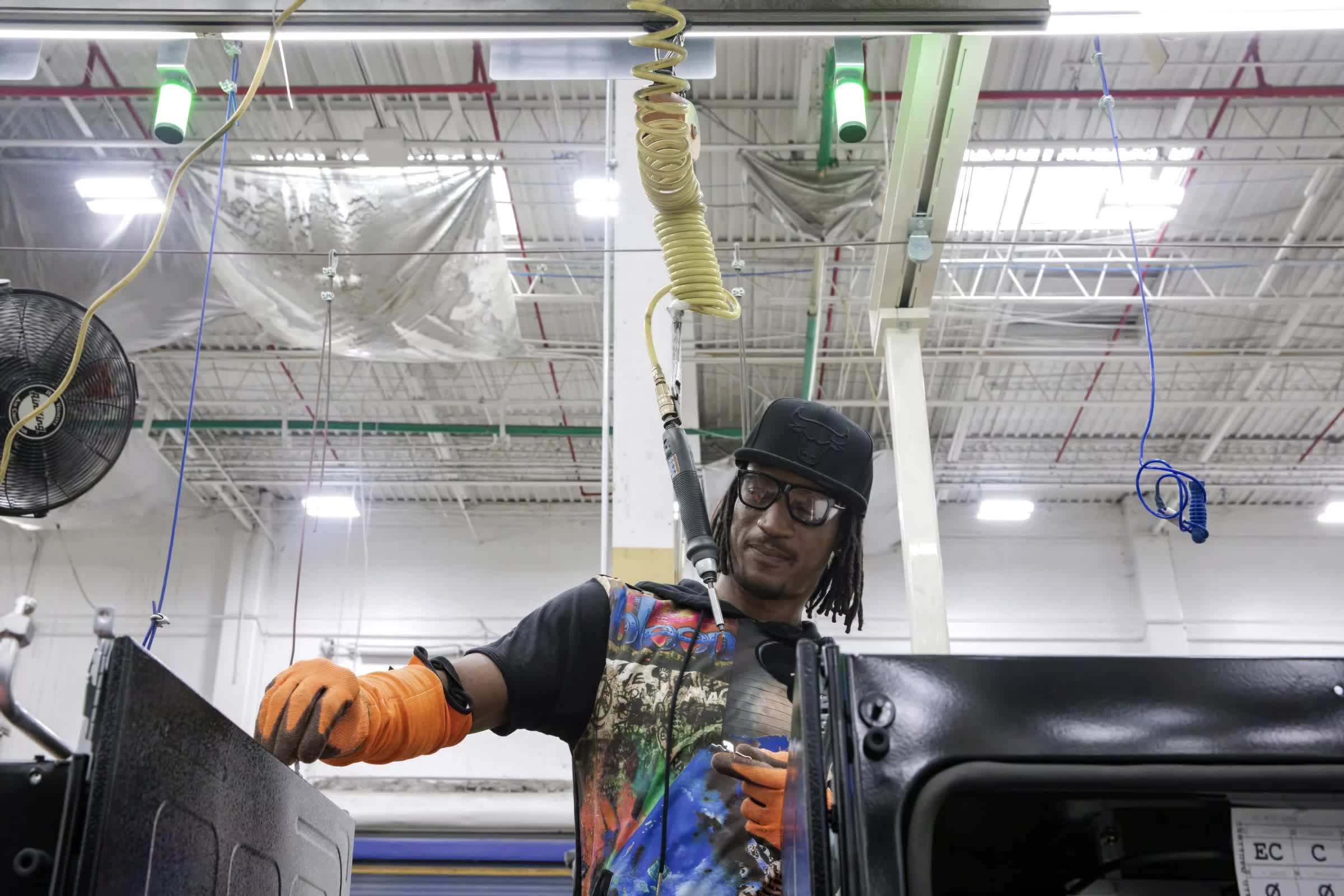
The takeaway: Manufacturing jobs have long been built around fixed schedules and predictable shifts. At a GE Appliances plant in northwest Georgia, that structure is starting to loosen, replaced by a system where workers pick their hours through an app. The setup is run through staffing firm MyWorkChoice, which maintains a pool of more than 900 people trained to handle different roles across the plant.
The employees log in to an app and choose when to work, signing up for four-hour blocks that fit their schedules. In a typical week, roughly half the pool – around 450 workers – pick up shifts, averaging about 24 hours.
The model took shape during the pandemic, when demand for appliances surged, but the company struggled to keep its lines staffed. “People were buying appliances in record numbers, because they were staying at home and they were cooking,” Tony Gabbert, the plant’s director of manufacturing operations, told NPR. “It was a great time, great problem to have when you’re just selling product so fast that you can’t hardly make them quick enough.”
The bigger issue was labor. Absences and resignations left the plant short by hundreds of workers on some days, forcing salaried staff to step in to keep production moving. That pressure pushed the company to consider alternatives, including MyWorkChoice’s app-based staffing model.
Advertisement
The idea was not an easy sell. “I did say this is crazy,” says Bill Good, vice president of manufacturing. After decades in the industry, he was used to a system built on consistency. Letting workers sign up for short shifts, sometimes just a few hours at a time, raised concerns about stability. “The two-hour increments scared the heck out of me, because I was envisioning people coming and going at a rate that we could not control,” Good says. The company ultimately landed on four-hour shifts and rolled the program out gradually.
The system now operates more like a gig platform than a traditional factory schedule. Workers choose shifts, build their own schedules and are rated on reliability. Those with stronger ratings get first access to available hours. “This is like the Uber of manufacturing,” says Darcy Duvall, the plant’s director of human resources operations.
Their contributions have been key to GE Appliances’ $180 million expansion of the Georgia plant, completed last year, which added 600 new jobs. It has also changed who the jobs appeal to.
Some workers are not looking for full-time roles at all. Ruth Ransom, 68, had considered herself retired before joining the program. She now picks shifts that fit her schedule, often choosing quality-control work over more physically demanding assembly-line roles. “It’s your choice,” she says. “I love it.”
Advertisement
Others use the flexibility to balance multiple jobs. Kwame Crockett started picking up shifts to supplement his work managing and remodeling properties in a mobile home park. He now often works close to full-time at the plant but has chosen not to convert to a permanent role with benefits. “I’ve thought about it,” he says. “But I never know when my other remodeling or anything might kick up. So I might need a vacation or a little time off, you know?”
The trade-off is lower pay and almost no benefits, though MyWorkChoice employees can opt into a group healthcare plan. Duvall says many workers prize flexibility, even with those trade-offs.
The system has also helped retain experienced workers who might otherwise leave. Doris Hamby, who spent 35 years at the plant, shifted to part-time work after her husband died. Now 62, she works three to four days a week while helping care for family members.
What started as a stopgap during a labor crunch has stayed in place. The plant now relies on the app to fill shifts, rather than relying solely on fixed schedules.





















































You must be logged in to post a comment Login