For more than two decades, digital businesses have relied on a simple assumption: When someone interacts with a website, that activity reflects a human making a conscious choice. Clicks are treated as signals of interest. Time on page is assumed to indicate engagement. Movement through a funnel is interpreted as intent. Entire growth strategies, marketing budgets, and product decisions have been built on this premise.
Today, that assumption is quietly beginning to erode.
As AI-powered tools increasingly interact with the web on behalf of users, many of the signals organizations depend on are becoming harder to interpret. The data itself is still accurate — pages are viewed, buttons are clicked, actions are recorded — but the meaning behind those actions is changing. This shift isn’t theoretical or limited to edge cases. It’s already influencing how leaders read dashboards, forecast demand, and evaluate performance.
The challenge ahead isn’t stopping AI-driven interactions. It’s learning how to interpret digital behavior in a world where human and automated activity increasingly overlap.
Advertisement
A changing assumption about web traffic
For decades, the foundation of the internet rested on a quiet, human-centric model. Behind every scroll, form submission, or purchase flow was a person acting out of curiosity, need, or intent. Analytics platforms evolved to capture these behaviors. Security systems focused on separating “legitimate users” from clearly scripted automation. Even digital advertising economics assumed that engagement equaled human attention.
Over the last few years, that model has begun to shift. Advances in large language models (LLMs), browser automation, and AI-driven agents have made it possible for software systems to navigate the web in ways that feel fluid and context-aware. Pages are explored, options are compared, workflows are completed — often without obvious signs of automation.
This doesn’t mean the web is becoming less human. Instead, it’s becoming more hybrid. AI systems are increasingly embedded in everyday workflows, acting as research assistants, comparison tools, or task completers on behalf of people. As a result, the line between a human interacting directly with a site and software acting for them is becoming less distinct.
The challenge isn’t automation itself. It’s the ambiguity this overlap introduces into the signals businesses rely on.
Advertisement
What do we mean by AI-generated traffic?
When people hear “automated traffic,” they often think of the bots of the past — rigid scripts that followed predefined paths and broke the moment an interface changed. Those systems were repetitive, predictable, and relatively easy to identify.
AI-generated traffic is different.
Modern AI agents combine machine learning (ML) with automated browsing capabilities. They can interpret page layouts, adapt to interface changes, and complete multi-step tasks. In many cases, language models guide decision-making, allowing these systems to adjust behavior based on context rather than fixed rules. The result is interaction that appears far more natural than earlier automation.
Importantly, this kind of traffic is not inherently problematic. Automation has long played a productive role on the web, from search indexing and accessibility tools to testing frameworks and integrations. Newer AI agents simply extend this evolution — helping users summarize content, compare products, or gather information across multiple sites.
Advertisement
The issue is not intent, but interpretation. When AI agents interact with a site successfully on behalf of users, traditional engagement metrics may no longer reflect the same meaning they once did.
Why AI-generated traffic is becoming harder to distinguish
Historically, detecting automated activity relied on spotting technical irregularities. Systems flagged behavior that moved too fast, followed perfectly consistent paths, or lacked standard browser features. Automation exposed “tells” that made classification straightforward.
AI-driven systems change this dynamic. They operate through standard browsers. They pause, scroll, and navigate non-linearly. They vary timing and interaction sequences. Because these agents are designed to interact with the web as it was built — for humans — their behavior increasingly blends into normal usage patterns.
As a result, the challenge shifts from identifying errors to interpreting behavior. The question becomes less about whether an interaction is automated and more about how it unfolds over time. Many of the signals that once separated humans from software are converging, making binary classification less effective.
Advertisement
When engagement stops meaning what we think
Consider a common e-commerce scenario.
A retail team notices a sustained increase in product views and “add to cart” actions. Historically, this would be a clear signal of growing demand, prompting increased ad spend or inventory expansion.
Now imagine that a portion of this activity is generated by AI agents performing price monitoring or product comparison on behalf of users. The interactions occurred. The metrics are accurate. But the underlying intent is different. The funnel no longer represents a straightforward path toward purchase.
Nothing is “wrong” with the data — but the meaning has shifted.
Advertisement
Similar patterns are appearing across industries:
Digital publishers see spikes in article engagement without corresponding ad revenue.
SaaS companies observe heavy feature exploration with limited conversion.
Travel platforms record increased search activity that doesn’t translate into bookings.
In each case, organizations risk optimizing for activity rather than value.
Why this is a data and analytics problem
At its core, AI-generated traffic introduces ambiguity into the assumptions underlying analytics and modeling. Many systems assume that observed behavior maps cleanly to human intent. When automated interactions are mixed into datasets, that assumption weakens.
Behavioral data may now include:
Advertisement
Exploration without purchase intent
Research-driven navigation
Task completion without conversion
Repeated patterns driven by automation goals
For analytics teams, this introduces noise into labels, weakens proxy metrics, and increases the risk of feedback loops. Models trained on mixed signals may learn to optimize for volume rather than outcomes that matter to the business.
This doesn’t invalidate analytics. It raises the bar for interpretation.
Data integrity in a machine-to-machine world
As behavioral data increasingly feeds ML systems that shape user experience, the composition of that data matters. If a growing share of interactions comes from automated agents, platforms may begin to optimize for machine navigation rather than human experience.
Over time, this can subtly reshape the web. Interfaces may become efficient for extraction and summarization while losing the irregularities that make them intuitive or engaging for people. Preserving a meaningful human signal requires moving beyond raw volume and focusing on interaction context.
Advertisement
From exclusion to interpretation
For years, the default response to automation was exclusion. CAPTCHAs, rate limits, and static thresholds worked well when automated behavior was clearly distinct.
That approach is becoming less effective. AI-driven agents often provide real value to users, and blanket blocking can degrade user experience without improving outcomes. As a result, many organizations are shifting from exclusion toward interpretation.
Rather than asking how to keep automation out, teams are asking how to understand different types of traffic and respond appropriately — serving purpose-aligned experiences without assuming a single definition of legitimacy.
Behavioral context as a complementary signal
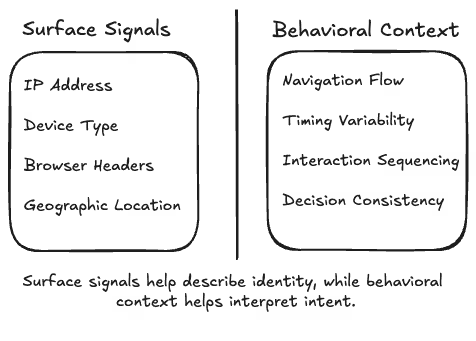
One promising approach is focusing on behavioral context. Instead of centering analysis on identity, systems examine how interactions unfold over time.
Advertisement
Human behavior is inconsistent and inefficient. People hesitate, backtrack, and explore unpredictably. Automated agents, even when adaptive, tend to exhibit a more structured internal logic. By observing navigation flow, timing variability, and interaction sequencing, teams can infer intent probabilistically rather than categorically.
This allows organizations to remain open while gaining a more nuanced understanding of activity.
Ethics, privacy, and responsible interpretation
As analysis becomes more sophisticated, ethical boundaries become more important. Understanding interaction patterns is not the same as tracking individuals.
The most resilient approaches rely on aggregated, anonymized signals and transparent practices. The goal is to protect platform integrity while respecting user expectations. Trust remains a foundational requirement, not an afterthought.
The future: A spectrum of agency
Looking ahead, web interactions increasingly fall along a spectrum. On one end humans are browsing directly, in the middle users are assisted by AI tools, on the other end agents are acting independently on a user’s behalf.
Advertisement
This evolution reflects a maturing digital ecosystem. It also demands a shift in how success is measured. Simple counts of clicks or visits are no longer sufficient. Value must be assessed in context.
What business leaders should focus on now
AI-generated traffic is not a problem to eliminate — it’s a reality to understand.
Leaders who adapt successfully will:
Reevaluate how engagement metrics are interpreted
Separate activity from intent in analytics reviews
Invest in contextual and probabilistic measurement approaches
Preserve data quality as AI participation grows
Treat trust and privacy as design principles
The web has evolved before, and it will evolve again. The question is whether organizations are prepared to evolve how they read the signals it produces.
Shashwat Jain is a senior software engineer at Amazon.
Advertisement
Welcome to the VentureBeat community!
Our guest posting program is where technical experts share insights and provide neutral, non-vested deep dives on AI, data infrastructure, cybersecurity and other cutting-edge technologies shaping the future of enterprise.
Read more from our guest post program — and check out our guidelines if you’re interested in contributing an article of your own!
The Artemis II crew is almost at the moon, and the astronauts spent this weekend carrying out preparations for their lunar flyby on Monday. That included manual piloting demonstrations, reviewing their science objectives for the six-hour observation period and evaluating their space suits, which are there for life support in the event of an emergency and for their return home. But, they’ve had plenty of time to take in the views, too — and those views sure are spectacular. In the latest series of images shared by the space agency, the astronauts are seen gazing at Earth through the windows of the Orion spacecraft.
Orion will reach the moon’s vicinity shortly after midnight on Monday, April 6. Later that day, the crew is expected to reach a point farther than any humans have traveled from Earth, surpassing the record of 248,655 miles from Earth set by the Apollo 13 astronauts in 1970.
Mission specialist Christina Koch takes in the view. (NASA)
The lunar observation period will start at 2:45PM ET, and a few hours later, they’ll be behind the moon and briefly drop out of communication. The spacecraft’s closest approach to the moon is expected to occur at 7:02PM, when it will be 4,066 miles from the surface. “From that distance, the crew will see the entire disk of the Moon at once, including regions near the north and south poles,” according to NASA. The crew will later get a chance to see a solar eclipse “as Orion, the Moon, and the Sun align in such a way that the astronauts will see our star disappear behind the Moon for about an hour.” NASA will have coverage of the flyby starting at 1PM ET.
When taking macro photographs, you often need just a tiny bit of controlled motion — so little that it’s tough to pull off by hand. To address this, [Salveo] designed a small open-source macro photography slider featuring an anti-backlash handle.
Macro photography gives you an extremely shallow field of view, sometimes under 1 mm of depth, in which subjects stay in focus. To combat this, it’s common to capture multiple images while sliding the camera forward or backward, then combine them for a much larger depth of field than a single shot provides. [Salveo]’s slider gives fine control over this focus-stacking process, with the knob even marked to show every 1 mm of linear travel.
The slider is built around a 150 mm linear rail, though it could easily be lengthened or shortened to suit your needs. A T8 leadscrew, paired with anti-backlash nuts, translates the knob’s rotation into smooth linear motion. The knob itself uses a custom-designed anti-backlash mechanism to ensure the slider works cleanly in either direction.
Advertisement
You can grab all the 3D-printable files as well as the full bill of materials from the project page. Be sure to check out [Salveo]’s build video below. Thanks [Tim L.] for sending in this awesome open-source slider. Be sure to check out some of the other macro photography projects we’ve covered, too.
In short:The Court of Rome has ruled that Netflix’s repeated price increases between 2017 and 2024 violated Italian consumer law and EU Directive 93/13/EEC on unfair contract terms. The ruling voids the relevant contract clauses, orders current prices rolled back to 2015 launch levels, and requires Netflix to notify millions of current and former Italian subscribers of their right to a refund, up to €500 for Premium subscribers and up to €250 for Standard subscribers. Netflix has said it will appeal.
A Roman court has given Netflix the bill for nearly a decade of price increases. In a ruling published on 1 April 2026, the Court of Rome found that Netflix had imposed repeated and unjustified price increases on its Italian subscribers in violation of the Italian Consumer Code and EU Directive 93/13/EEC, which prohibits unfair terms in standard consumer contracts. The action was brought by Movimento Consumatori, one of Italy’s largest consumer associations. The ruling, catalogued as sentence 4993/2026, affects up to 5.4 million current Italian subscribers and an unquantified number of former subscribers who cancelled during the relevant period.
Netflix launched in Italy in 2015 with a Premium plan priced at €11.99 per month. It raised prices in 2017, again in 2019, again in 2021, and most recently in November 2024, bringing the Premium plan to €19.99, an increase of €8 per month from its original price. The Standard plan reached €13.99 over the same period. The court found that none of the price changes were accompanied by justified reasons in the contract, and that offering subscribers 30 days’ notice alongside the option to cancel was not a meaningful substitute for genuine consent. Under the directive, contract terms that impose a significant imbalance between a business and a consumer, without the consumer’s substantive agreement, are void from the outset.
What the court has ordered
The ruling imposes several specific obligations on Netflix. The price-hike clauses in its standard contracts are void and unenforceable. Current subscription prices must be reduced: the Premium plan to €11.99 and the Standard plan to €9.99, the levels that applied before the first unlawful increase. Netflix must notify all current and former Italian subscribers, by email, postal mail, its own website, and notices placed in Italian national newspapers, within 90 days of the ruling, or face a daily penalty of €700 for non-compliance. Future contracts must specify the conditions under which prices may change. Eligible subscribers could receive approximately €500 in refunds if they have been on the Premium plan since 2017, and approximately €250 if they have been on the Standard plan.
Advertisement
Not an isolated ruling
The Court of Rome’s decision does not stand alone. In Germany, the federation of consumer organisations vzbv has brought a parallel action against Netflix on the same legal basis, and courts in Berlin and Cologne have already found that Netflix’s price-change clauses are void under German contract law. In Spain, the consumer association FACUA is pursuing a comparable challenge. Each case rests on EU Directive 93/13/EEC as its shared legal foundation, a regulatory tradition that Europe has been strengthening across its digital marketsfor years. A defeat in Germany, where the vzbv case continues, would expose Netflix to liability across a subscriber base considerably larger than Italy’s.
The timing of the Italian ruling adds another layer of complexity. It was published on 1 April 2026, three days after Netflix had announced a global price increase on 26 March 2026, raising subscription costs across every major market. In Italy, that announcement arrived into a legal environment that had just ruled in the opposite direction. Netflix’s revised terms of service, updated in April 2025, already include conditions specifying the grounds on which prices may change, citing technical and regulatory factors as potential justifications. Whether those revised terms arrived in time to limit the company’s exposure, or were drafted in direct anticipation of mounting litigation, is likely to feature prominently in the appeal.
Netflix’s position
Netflix has said it will contest the ruling. The company has not confirmed publicly whether it will comply with the notification and price-reduction obligations while the appeal is pending. Netflix indicated that the revised terms of service introduced in April 2025 already address the transparency concerns the court identified.The expectation that platforms disclose the basis for changes to the terms of a paid serviceis not limited to any single jurisdiction or sector; it has become a baseline assumption in European and increasingly global regulatory frameworks. The counterargument from Movimento Consumatori is that the obligation to provide justified reasons for price changes has existed in EU law since 1993, and that revising a contract after litigation has commenced does not retroactively cure the clauses that applied during the years of the increases.
What it means for streaming in Europe
Italy is Netflix’s fourth-largest market in Europe, with approximately 5.4 million subscribers as of October 2025 and 8 million unique users recorded during 2024.Europe’s digital market has long been the site of the most consequential tests of how much latitude technology platforms have to set their own commercial terms, and the Rome ruling is among the most direct verdicts yet on the specific question of subscription pricing. Every major streaming service operating in the EU, including Disney Plus, Amazon Prime Video, and Apple TV Plus, uses a structurally similar mechanism: notify by email, offer a cancellation option, and proceed. If the Rome court’s interpretation of Directive 93/13/EEC is upheld on appeal or replicated by German and Spanish courts, the commercial model underlying a decade of streaming growth would require fundamental redesign across the sector.
Subscription pricing has been one of the defining revenue levers of the past decade, built on the assumption that inertia, the gap between receiving a price-notification email and actually cancelling, functions, in practice, as consent. European courts are now testing that assumption against the text of a consumer protection directive that has been in force since 1993. Italy’s answer, issued in the first week of April 2026, is that the freedom to cancel is not the same thing as the freedom to agree.The commercial models that scaled through 2025are increasingly arriving in front of courts equipped with three decades of consumer protection law, and the outcomes are starting to accumulate.
Submissions to the App Store have jumped by 84% year-over-year, with the growth of vibe coding believed to be behind the surge.
Vibe coding has led to more apps being submitted to the App Store in 2025
The continuing growth of AI services like ChatGPT and Anthropic’s Claude has helped fuel productivity in many fields, including coding. While developers have been assisted by automated tools before, AI has led to even novice coders to create bigger things beyond their capabilities. It now seems that the increased use of AI in development has resulted in more work for the App Store. Continue Reading on AppleInsider | Discuss on our Forums
It’s a move that breaks with decades of tradition (or at least consumer expectations) and is undoubtedly a blow for anyone hoping for a discount, five years into the current console generation. However, it’s also a sign that the current generation is likely to stick around for a while yet—and that may be a good thing, for the industry and players alike.
Historically, at this point in a console generation, incumbent hardware sees steep discounts. For example, the PS4, which launched for $400 in 2013, was retailing for $300 by 2018, a 25 percent decrease. Even if hardware is loss-leading, it’s a pricing trajectory that’s usually win-win for manufacturers and customers alike. Production and component costs will typically have dropped over that half-decade, allowing companies to drop the retail price, often alongside slimmed-down hardware revisions. At the same time, players who weren’t won over at a console’s launch have a cheaper entry point and years of games to catch up on. But this generation has been anything but typical.
Generational Abnormalities
The AI bubble has seen RAM and SSD storage prices skyrocket in the last few months, impacting the entire global tech sector. Sony as a whole has been hit hard by this, with the recent announcement that it was suspending its memory card business, while the PlayStation corner of the fiefdom just confirmed long-standing rumors of price increases for its console family.
Advertisement
The new MSRPs went into effect on April 2, and there’s no sugarcoating that they mark significant increases. The “entry-level” digital edition PS5 console—the one without a disc drive—is the worst hit, leaping to $600. That’s $100 higher than its previous US retail price (which was already up following an earlier hike back in August 2025, driven by Trump’s tariffs) and a staggering 50 percent higher than its $400 launch price back in 2020.
The base PS5 with a disc drive is up 30 percent on its original $500 price, now costing $650, while the PS5 Pro “only” goes up around 29 percent from its $700 launch price, setting buyers back $900—though it also doesn’t come with a disc drive, so prepare to shell out another $80 to play physical games or Blu-ray movies. Elsewhere, the PlayStation Portal, Sony’s handheld that allows users to stream games from their PS5 or the cloud, has also increased by $50, from $200 to $250.
PlayStation is far from alone in increasing its prices. Xbox increased its hardware and GamePass subscription costs multiple times in 2025, eventually bringing the MSRP of the top-end 2-TB Xbox Series X to its current $800, and is rumored to be considering another hike. The Switch 2 dodged tariff-induced price hikes at launch but is also reportedly “contemplating raising the price of that device in 2026,” per Bloomberg—and the same report suggests Sony may be delaying the inevitable PlayStation 6 to as far off as 2029, all due to the AI-induced parts crisis.
Even Valve’s handheld Steam Deck isn’t immune—while prices have so far only risen in Japan, South Korea, and Taiwan, the manufacturer has announced that the original 256 GB, LCD-screen model (the cheapest) “is no longer in production, and once sold out will no longer be available” while the newer OLED models, available with either 512 GB or 1 TB of storage “may be out-of-stock intermittently in some regions due to memory and storage shortages.”
Meet the “journalist” who “uploads press releases or analyst notes into AI tools and prompts them to spit out articles that he can edit and publish quickly,” according to the Wall Street Journal.
“AI-assisted stories accounted for nearly 20% of Fortune‘s web traffic in the second half of 2025.” And most were written by 42-year-old Nick Lichtenberg, who has now written over 600 AI-assisted stories, producing “more stories in six months than any of his colleagues at Fortune delivered in a year.”
One Wednesday in February, he cranked out seven. “I’m a bit of a freak,” Lichtenberg said… A story by Lichtenberg sometimes starts with a prompt entered into Perplexity or Google’s NotebookLM, asking it to write something based on a headline he comes up with. He moves the AI tools’ initial drafts into a content-management system and edits the stories before publishing them for Fortune’s readers… A piece from earlier that morning about Josh D’Amaro being named Disney CEO took 10 minutes to get online, he said…
Like other journalists, Lichtenberg vets his stories. He refers back to the original documents to confirm the information he’s reporting is correct. He reaches out to companies for comment. But he admits his process isn’t as thorough as that of magazine fact-checkers.
While Lichtenberg started out saying his stories were co-authored with “Fortune Intelligence”, he now typically signs his own name, according to the article, “because he feels the work is mostly his own.” (Though his stories “sometimes” disclose generative AI was used as a research tool…) The article asks with he could be “a bellwether for where much of the media business is headed…”
Advertisement
“Much of the content people now consume online is generated by artificial intelligence, with some 9% of newly published newspaper articles either partially or fully AI-generated, according to a 2025 study led by the University of Maryland. The number of AI-generated articles on the web surpassed human-written ones in late 2024, according to research and marketing agency Graphite.”
Some executives have made full-throated declarations about the threat posed by AI. New York Times publisher A.G. Sulzberger said AI “is almost certainly going to usher in an unprecedented torrent of crap,” referencing deepfakes as an example. The NewsGuild of New York, the union representing Fortune employees and journalists at other media outlets, said the people are what makes journalism so powerful. “You simply can’t replicate lived experiences, human judgment and expertise,” said president Susan DeCarava.
For Chris Quinn, the editor of local publications Cleveland.com and the Plain Dealer, AI tools have helped tame other torrents facing the industry. AI has allowed the outlets to cover counties in Ohio that otherwise might go ignored by scraping information from local websites and sending “tips” to reporters, he said. It has also edited stories and written first drafts so the newsrooms’ journalists can focus on the calls, research and reporting needed for their stories…. Newsrooms from the New York Times to The Wall Street Journal are deploying AI in various ways to help reporters and editors work more efficiently….
Not all newsrooms disclose their use of AI, and in some cases have rolled out new tools that resulted in errors or PR gaffes. An October study from the European Broadcasting Union and the BBC, which relied on professional journalists to evaluate the news integrity of more than 3,000 AI responses, found that almost half of all AI responses had at least one significant issue. Last week the New York Times even issued a correction when a freelance book reviewer using an AI tool unknowingly included “language and details similar to those in a review of the same book published in The Guardian.” But it was actually “the second time in a few days that the Times was called out for potential AI plagiarism,” according to the American journalist writing The Handbasket newsletter. We must stem the idea being pushed by tech companies and their billionaire funders who’ve sunk too much into their products to admit defeat that the infiltration of AI into journalism is inevitable; because from my perch as an independent journalist, it simply is not…
Some AI-loving journalists appear to believe that if they’re clear enough with the AI program they’re using, it will truly understand what they’re seeking and not just do what it’s made to do: steal shit… If you want to work with machines, get a job that requires it. There are a whole lot more of those than there are writing jobs, so free up space for people who actually want to do the work. You’re not doing the world a favor by gifting it your human/AI hybrid. Journalism will not miss you if you leave…
But meanwhile, USA Today recently tried hiring for a new position: AI-Assisted reporter. (The lucky reporter will “support the launch and scaling of AI-assisted local journalism in a major U.S. metro,” working with tools including Copilot and Perplexity, pioneering possible future expansions and “AI-enabled newsroom operations that support and augment human-led journalism.”) And Google is already sponsoring a “publishing innovation award“…
Developed by a consortium including Nextcloud, Ionos, and Proton, Euro-Office builds directly on the open-source OnlyOffice codebase. It offers a word processor, spreadsheet editor, presentation tool, and PDF editor, all supporting Microsoft formats (docx, pptx, xlsx) and open standards such as ODF. Its preview version is already available on GitHub,… Read Entire Article Source link
In this week’s “Sunday Reboot,” Apple’s gift bags and artifacts get a close look, China briefly gets Apple Intelligence ahead of schedule, and iPhones go to the Moon.
The iPhone 17 Pro Max is in space.
Sunday Reboot is a weekly column covering some of the lighter stories within the Apple reality distortion field from the past seven days. All to get the next week underway with a good first step. This week, Apple Ireland was fined by UK regulators for seemingly breaking sanctions on Russia, an AI porn startup sued Apple over its App Store rules, and the Apple Fitness+ chief prepares to retire amid claims he introduced a toxic mental health work environment. Continue Reading on AppleInsider | Discuss on our Forums
Camille Bouget discusses how artificial intelligence is impacting innovation in the treatment of diseases affecting the immune system.
“Immuno-inflammatory diseases are often described as niche. They are not,” Camille Bouget, the CEO and co-founder of healthcare start-up Scienta Lab, explained to SiliconRepublic.com.
With as many as one out of every 10 people in Western countries potentially impacted by an immuno-inflammatory condition, she noted, symptoms are often debilitating and the available therapeutic options frequently deeply inadequate for a significant proportion of patients.
This is why, in 2021, Bouget co-founded Scienta Lab, a biotechnology company that aims to advance research within immunology via modern technologies such as artificial intelligence and EVA, the organisation’s multimodal AI model purpose-built for translational research in immunology and inflammation.
Advertisement
“It was designed to answer the concrete questions that R&D teams face throughout drug development: which therapeutic targets are worth pursuing, which preclinical biological signals are robust enough to carry forward into clinical trials, and which patients are most likely to respond to a given candidate drug,” said Bouget.
Applied across multiple stages of the pipeline, she explained, early on EVA can estimate therapeutic efficacy prior to a patient beginning treatment. As the programme advances, EVA can evaluate whether molecular signals observed in animal subjects are likely to translate to humans. And at the clinical stage, it can support the identification of patient subgroups for more precisely designed trials.
“The primary beneficiaries are biopharmaceutical and biotech companies working in immunology and inflammation,” she said.
“Ultimately, however, the downstream beneficiary is the patient: better-designed trials, fewer failed programmes and faster access to treatments that genuinely address unmet needs in diseases like rheumatoid arthritis, lupus and inflammatory bowel disease.”
Advertisement
Why AI?
A persistent challenge for Bouget and the industry she operates within has been in properly communicating the complexity of what they do in a manner that is accessible for all of the major stakeholders, be they investors, partners or the broader public.
“Immune diseases are notoriously difficult to characterise”, she noted, as often even the experts don’t always know how to measure them, what might prompt a flare-up, or why a treatment is effective for one patient but fails to work for another.
“Convincing people that AI can meaningfully navigate that complexity without overpromising requires constant effort,” she said, especially as a young deep-tech company in an industry that is currently dominated by what she referred to as larger key players.
She is of the opinion that the implication of AI for patients is significant, not least because the immunology drug development pipeline has historically suffered from high late-stage attrition, with programmes failing at phase II or phase III after years of investment and work.
Advertisement
“Each of those failures represents not only a financial cost, but delayed or denied access to potentially effective therapies,” said Bouget.
“AI that genuinely improves the translational accuracy of preclinical decision-making can meaningfully shorten that timeline and shift more resources toward candidates that are more likely to succeed.”
Sturdy foundations
But it isn’t simply a matter of having access to advanced technologies. For Bouget, multidisciplinary teams of scientists and engineers are critical to the overall success of any organisation attempting to transform immunology research and development.
She said: “Multidisciplinary teams are the entire foundation of doing this well. The failure mode we see most often in the application of AI to drug development is a disconnect between the computational sophistication of a model and its biological relevance.
Advertisement
“A model trained without deep immunological understanding may optimise for the wrong signal. Conversely, a team with outstanding biological expertise but limited machine learning capability will struggle to extract meaningful structure from the scale of data that modern multiomics generates.”
At Scienta Lab, the co-founding team consists of a pharmacist and former industry strategist, a biomedical engineer, and a mathematician with deep AI expertise.
“Day-to-day, our team spans immunology, bioinformatics, machine learning and clinical pharmacology,” Bouget explained.
“The ability to build bridges between those disciplines, to have a conversation where a wet-lab immunologist and a transformer architect are genuinely learning from each other, is what allows us to build models that are both technically rigorous and biologically meaningful.”
Advertisement
She added: “Organisations that try to solve this problem with either pure data science or pure biology will hit a ceiling. The translational gap in drug development is not fundamentally a data problem or a computing problem alone, but one of understanding that requires genuinely integrated teams.”
Don’t miss out on the knowledge you need to succeed. Sign up for the Daily Brief, Silicon Republic’s digest of need-to-know sci-tech news.
One crime ring scammed 2,000 elderly people of more than $27 million between 2021 and 2023 using tech support/bank impersonation/refund scams. “Victims were in their 70s and 80s,” reports the U.S. Attorney’s office for California’s southern district. Victims were first told they’d received a refund (either online or via phone), but then told they’d been “over-refunded” a massive amount, and asked to return that amount.
But 42-year-old Jiandong Chen just admitted Thursday in a U.S. federal court that he was involved in the fraud and money laundering via cryptocurrency — pleading guilty to two charges with maximum penalties of 40 years in prison and a $1 million fine, plus 20 years in prison with a maximum fine of $500,000 or twice the amount laundered. “Chen, a Chinese national, is the second defendant charged in a five-defendant indictment.” And what tripped him up seems to be that “Certain members of the conspiracy also did in-person pickups of money directly from victims…”
And so YouTube enters the story — when the scammers called pranksters with 1,790,000 subscribers to their “Trilogy Media” channel. In an elaborate three-hour video, the team of pranksters lured the scammer to a rented Airbnb where they’re staging a fake funeral with a nun. (One of the men acting in the video remembers “we start doing a prayer… I’m holding the scammer’s hand in my nun outfit…”)
They convince the scammer to collect the cash from a dead man — “Is there anything you’d like to say to him?” Then there’s demon voices. The scammer’s victim resurrects from the dead. Did the cash mule bring holy water?
Advertisement
The end result was a video titled “CONFRONTING SCAMMERS WITH A FAKE FUNERAL (EPIC REACTIONS)“. But two and a half years later, their “cash mule sting house” video has racked up over 1.3 million views, 22,000 likes, and 2,979 comments. (“This video is longer than Oppenheimer. Thanks for the laughs fellas.”)






















































You must be logged in to post a comment Login