League of Legends players might have been rejoicing after Riot Games said that team voice chat was finally coming to the popular MOBA. Turns out the party was short-lived. A mere two weeks after the announcement that the feature was coming to select regions in October’s 26.20 patch, Riot’s dev team posted on social media that the addition of voice chat has been delayed. And, sadly for the LoL players who have already waited 17 years for the option, there’s no revised timeline for when it will be arriving in-game. The studio didn’t give a reason for the delay, only stating that it is “to meet the quality bar” its community deserves.
Hey everyone, wanted to get this out separate from today’s Patch Notes. We announced Team Voice as coming to NA/OCE in Patch 26.20, but made the call to push it to meet the quality bar you deserve. No new target patch to share yet, but we’re making this a priority to get right.
It’s possible the reversal was the due to issues around moderation. LoL is a game famed for toxic in-game behavior, although Riot has been working to address that reputation in recent years. It’s possible that the company’s initial approach to making voice chat not a complete trash fire, like requiring a minimum Honor level to prove a history of good in-game behavior, weren’t working as intended. It could also be that the “voice skin” concept, allowing players to change how they sound to their teammates, was causing issues. It may be disappointing to have the long-requested feature promised and then snatched away, but at least Riot is still working on an implementation.
If you weren’t already aware, it will probably come as no surprise to hear that the pioneering computer-animation studio Pixar built its early workflow on Silicon Graphics SGI workstations. These were beefy Unix machines that, as the name implied, were developed for graphical work. When the age of the RISC workstation came to a close, many Unix users were pushed onto Windows NT — but not at Pixar. At Pixar, they learned to love the penquin.
It comes down to hardware rather than software. You know the story: PCs got faster and cheaper with different vendors competing for a giant market, while the world of RISC workstations couldn’t keep its lead. Pixar would have been happy staying on Unix workstations, even SGIs if that had been a practical option — but with every project increasing the load on the render farms, it wasn’t. Yet Pixar’s entire workflow was predicated on a Unix environment. They had written a couple million lines of code for their internal use, and really didn’t want to port it over to Windows, even after a mistaken rm command nearly cost the world Toy Story 2.
The path of least resistance would be to port to something more similar to IRIS’s Unix environment, something POSIX compliant. That path led Linux, and by 2001, the port was done. By 2003, a new render farm using Xenon processors brought the whole studio to Linux and x86, which has since become an industry standard.
Advertisement
We’re left with only two questions: one, why didn’t more industries — like the CAD/CAM world — that were also reliant on Unix Workstations follow Pixar and Hollywood onto Linux, and two, why did Pixar go with Linux instead of some variety of BSD? [Crierlon] doesn’t address either question, but we’re betting some of you might have an idea. Let us know in the comments if you have the inside scoop; inquiring minds want to know!
The year’s not nearly over, but 2026 has already delivered a glut of exciting Android phones. Still, we can’t help but think about what might come next. Every phone-maker has distinct ideas about what features they’d like to add and improve with every generation. Some of these things, like design, they can do alone, but others require close collaboration with their partners.
Two such partners are Google and Qualcomm – the former on the software side and the latter on the hardware side. Every summer at Google I/O, we learn about a slew of new software features that will enhance existing and upcoming Android phones. Then, every fall, Qualcomm, which makes the chips, gives us a glimpse of what power and features those companies, like Samsung and Motorola, will have to play with in upcoming releases.
On Tuesday at the Snapdragon Summit in Hawaii, Qualcomm announced a pair of powerful new chips – the Snapdragon 8 Elite Gen 6 and Snapdragon 8 Elite Extreme Gen 6.
“We’re just now at the beginning of the agentic age, and Snapdragon is the platform built for it,” added Qualcomm CEO Cristiano Amon, in his Snapdragon Summit keynote.
Advertisement
Qualcomm hosted its first of several keynotes to kick off the 2026 Snapdragon Summit in Hawaii.
Of the new dual chips, it’s the 8 Elite Extreme Gen 6 that will really take phones to the next level of performance and AI capabilities. The chip “represents the pinnacle of Snapdragon innovation, purpose-built for the most advanced AI workloads and the experiences that will define the agentic era,” said Qualcomm product marketing manager Charlie Beeman in a briefing ahead of the announcement.
The Extreme sees inevitable improvements to speed, connectivity and efficiency, but more interesting are the tweaks Qualcomm has made to enable new experiences and features that it simply wasn’t possible to include on prior Android phones.
“It brings an enormous amount of compute power to a smartphone, and therefore opens up a lot of new opportunities in terms of the applications that could be developed,” said Ben Wood, chief analyst at FDM CCS. “But it’s a bit of a chicken and egg situation because until that’s enabled on the phones, we won’t know what those applications are going to be.”
A question mark lingers over how different phone-makers will tap the power of the Elite Extreme, but Qualcomm has given us some distinct areas where we can expect to see new experiences. Here are three to look out for and look forward to.
Camera
“How’s the camera?” is pretty much the first question everyone will ask when coming across a new smartphone in the wild. Phone-makers know that image quality and camera capabilities are priorities for any new device, and while a lot of that comes down to choices made by the manufacturer, Qualcomm chips still run the show when it comes to the phone’s imaging pipeline.
Both of the new Snapdragon chips will enable a refined camera experience with intelligent stabilization and every pixel now carrying 16 bits of data. The image signaling processor is also tightly coupled to the NPU, a specialized chip that accelerates AI and machine learning tasks. This will enable AI to work on an image while it’s being captured, instead of after. This allows for a dramatic leap in raw throughput and professional-grade video, and a far deeper understanding of every pixel in your scene.
Advertisement
“Each element of the scene is processed individually, helping ensure every shot looks natural, consistent, and remarkably true to life,” said Lekha Motiwala, Qualcomm’s senior director of product management, speaking at Snapdragon Summit.
The new Snapdragon chips will boost camera capabilities.Katie Collins/CNET
And the Extreme version of the chip offers more capabilities, such as enabling phone cameras to record video in 8K resolution at 60 fps or film in 4K resolution at 240 fps for super-slow-mo footage.
“You’ll see this coming for the first time in Snapdragon-powered smartphones,” said Motiwala. “It’s not just about getting a shot. It’s about preserving a moment as you experienced it.”
Personalized AI
There’s simply no way for AI to be personal without it really getting to know you. Agentic AI that lacks personal context – past, present and future – would be like speaking with a different stranger each time you pick up your phone.
The 8 Elite Extreme Gen 6 is engineered to collect that context, hold onto it and draw from it whenever needed. This is all thanks to Qualcomm’s new Sensing Hub, which, with its dual micro-NPUs, can support models up to 200 million parameters. The company’s updated Personal Scribe can then remember who said what, why it matters and learn from your messages, emails and conversations to build your private knowledge graph.
Advertisement
It could expand an AI agent’s ability to give you nuanced answers to questions, help you recall when and to whom you made specific promises, and make future plans for you based on a whole range of factors, such as your availability, schedule, travel preferences and need for relaxation or concentrated working time.
With its ability to run over 30 billion different models on device, the Elite Extreme Gen 6 is definitely leading the way when it comes to running agentic AI. “When you have this level of capability, your work starts before you even open your inbox,” said Amon. “Here, an agent digests your [Snapdragon] Summit invitation, understands the dates, the flights, the venue details, key moments inside it, and it builds a plan.”
Gaming
Phones can be overlooked as gaming devices, but for Qualcomm, providing a best-in-class mobile gaming experience remains a priority.
With the 8 Elite Extreme Gen 2, the company is introducing an AI-rendering technology called Adreno Neural Fusion, which is supported across major game engines, including Unreal, Unity and Messiah. It can deliver upscaled images with “rock-solid frame rates” at lower power, according to Matthew Grossman, manager of product marketing at Qualcomm.
Advertisement
Adreno Neural Fusion is “a proprietary technology designed by Qualcomm from the ground up, not an off-the-shelf implementation,” said Chris Patrick, Qualcomm’s SVP and general manager of handsets. “It’s a tightly integrated architecture that brings graphics and AI together to knock a new class of intelligent gaming experiences.”
The 8 Elite Extreme Gen 6 opens up new possibilities for gamers.Katie Collins/CNET
In addition, AI-dedicated Adreno matrix cores run advanced models, and the chip features 18MB of high-performance memory. So what does this mean for your mobile gaming experience? The answer is better picture quality, higher frame rates and longer play times with games drawing less power than in the past. It’s a win-win-win.
Katie Collins
Principal Writer
Katie is a UK-based news reporter and features writer. Officially, she is CNET’s European correspondent, covering tech policy and Big Tech in the EU and UK. Unofficially, she serves as CNET’s Taylor Swift correspondent. You can also find her writing about tech for good, ethics and human rights, the climate crisis, robots, travel and digital culture. She was once described a “living synth” by London’s Evening Standard for having a microchip injected into her hand.
See full bio
Open your phone’s storage settings, and there’s a good chance Spotify is sitting near the top of the list, holding on to gigabytes you never agreed to give it. It’s one of those small annoyances that you only notice when your phone starts nagging you about running out of space.
Thankfully, it looks like Spotify has finally noticed it too. Android Authority has dug into the Spotify app and found signs of a new Cache Limit feature that puts you in charge of how much space Spotify’s temporary files can occupy on your phone.
Why is Spotify hogging so much storage?
Every time you play a podcast or a song, Spotify saves some of that data, along with the artwork, on your device. This keeps playback smooth and cuts down on data when you replay something. The catch is that you can’t control any of it. Your offline downloads are kept elsewhere, but this hidden stash keeps piling up until it’s taking gigabytes of your storage.
Rachit Agarwal / Digital Trends
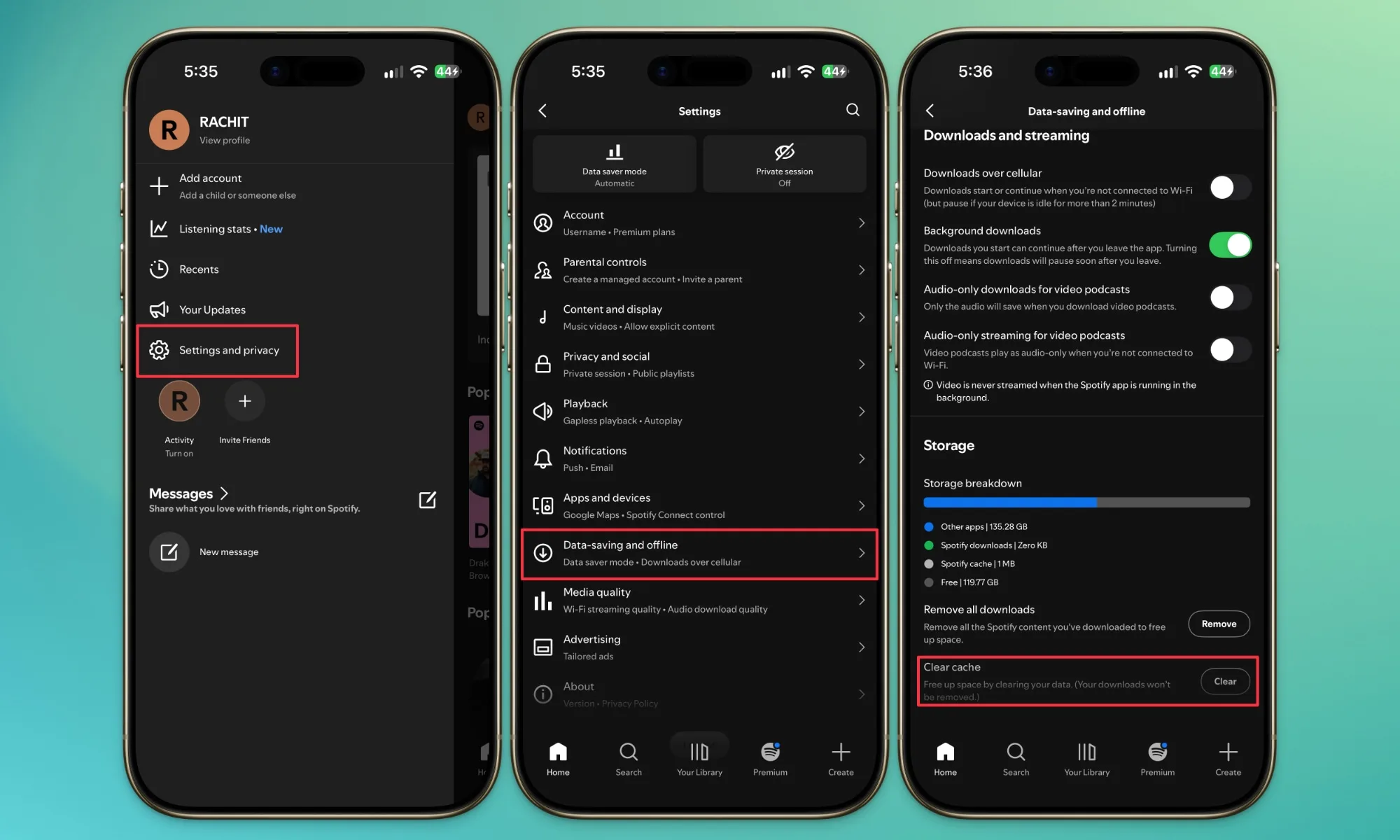
With memory prices climbing and bigger storage options costing a small fortune, that wasted space really stings. Yes, you can wipe it yourself from Settings → Data saving & offline → Clear cache, but repeating that chore over and over is tiring. Spotify fans have been asking for a fix on Reddit and the official forums for close to ten years now.
How will the new cache limit work?
The code, found by Android Authority in Spotify for Android v9.1.88.815, points to a new menu where you pick the maximum space the cache is allowed to use. Pick a tiny number, and you’ll see “A small cache may affect playback and increase data usage.” Pick a bigger one, and it tells you, “A larger cache means smoother playback and less data usage.” There’s also a “Spotify recommended” option if you’d rather not decide.
Advertisement
You’ll also be asked to choose a limit right after clearing your cache. The best part is that your saved songs and podcasts stay safe no matter what number you pick. For now, Spotify hasn’t said a word about it, and you can’t use it yet. Beta testers will probably get it first, followed by everyone else. I’m hoping it shows up soon, because my phone could use the extra space.
Imagine posting something critical of the government, watching your reach quietly evaporate, and never being able to prove it wasn’t organic.
X just killed that uncertainty. The platform is expanding its “Under the Hood” tool to show users exactly when a government legal demand choked their post’s reach. It will even show users which country made the request.
We’ve expanded Under The Hood after seeing people’s appreciation of more transparency into government-required content filtering.
X rolled out a transparency feature in August 2026. As part of the feature, the platform already allowed eligible users (those with at least 10 posts in the last month) to download a JSON file showing whether their account or any post had its visibility reduced at the request of a government body.
Now, that file also names the exact posts withheld, along with which government made the request. This level of detail remains unmatched, even compared with popular social media platforms.
Even if you’re a non-technical user, you can drop the file into an AI chatbot and ask it to explain in simple words (one of the AI use cases I don’t condemn).
X
Who does this actually matter for?
In my opinion, the real weight of the change will fall on journalists, activists, and dissidents in countries where governments regularly lean on platforms to bury inconvenient posts and silence critics.
This isn’t hypothetical: X itself lost a 2023 court battle in India over stalled compliance with blocking orders and paid roughly a $60,000 fine, proving these legal demands are frequent, real, and previously invisible to the people they targeted.
Advertisement
Governments use everything from hate-speech statutes to election rules and terrorism laws to request (or even order) these takedowns. However, free-expression groups warn that authoritarian regimes often use the same laws to muzzle political dissent.
Arista Networks has released security patches for a zero-day flaw that is being actively exploited and affects VeloCloud Orchestrator (VCO) On-Prem deployments.
VCO is a cloud-based centralized management platform that helps admins configure, monitor, and manage VeloCloud SD-WANs (Software-Defined Wide Area Networks) and associated edge devices.
Tracked as CVE-2026-93952, this maximum-severity flaw stems from an improper input validation weakness and affects VCO deployments where certificate-based authentication from the VeloCloud Edge to VeloCloud Orchestrator (VCO) is configured.
Remote threat actors can exploit the vulnerability to access privileged internal VCO host functionality in low-complexity attacks that don’t require privileges on the targeted system or user interaction.
Advertisement
“This issue was discovered externally and is known to be actively exploited,” the company warned in a Tuesday advisory. “Access to the public portion of the VeloCloud Edge authentication certificate is required. A successful attack requires network access to the VCO web interface. VCO tenant or operator credentials are not required for this exposure.”
Arista says that it has already patched hosted deployments running VCO 5.2.3.16 or later and VCO 6.4.2.8 or later and that it will also release security patches for VCO instances running 6.1.3.7 and below and 7.0.0.2 and below.
The U.S. Cybersecurity and Infrastructure Security Agency has also added CVE-2026-93952 to its Known Exploited Vulnerabilities catalog on Tuesday and ordered U.S. federal civilian executive branch agencies to secure their networks by Friday, September 25.
Indicators of compromise
While security patches are being deployed, admins should restrict access to the VCO web interface to administrative networks, review recent administrator activity for unusual changes, and monitor for connections from known malicious IP addresses.
Advertisement
Admins should review VCO web access logs for suspicious activity, such as requests containing encoded characters, unusual URL-like path components, references to local or internal services, or high request rates.
Arista also advised security teams to block the 142[.]93.149.77 and 104[.]248.126.159 IP addresses and review nginx logs for the x-vc-opt HTTP header, and said that unexpected outbound HTTP or HTTPS activity originating from the VCO host may also warrant further review.
“If compromise is suspected, operators should preserve VCO web access logs, backend application logs, system logs, database logs, and relevant file-system timestamps before remediation where operationally feasible,” it added, and advised customers to contact the Arista Networks Technical Assistance Center (TAC) if they need additional assistance.
Since the start of the year, Arista patched two other zero-day flaws (CVE-2026-7473 in May and CVE-2026-16812 in July) that were being actively exploited in attacks and affected Extensible Operating System (EOS) and on-premises VeloCloud Orchestrator deployments, respectively.
Advertisement
Arista Networks is a Fortune 500 company and one of the largest United States corporations by revenue, with more than 10,000 customers worldwide.
Join Mikko Hyppönen and security leaders from the NFL, CHANEL, and Atlassian for a two-hour digital summit on what AI-speed attacks change, what defenders should stop doing, and how to validate, decide, fix, and re-validate at machine speed.
Eight Sleep, a sleep tech company, launched the Pod 6 bed-cooling system on Wednesday with meaningful hardware changes, including a hub that’s half the size of its predecessor, new solo-size configurations and a $1,999 starting price for the solo sizes — the lowest the company has offered. The entry price for standard sizes will be $2,699.
“We redesigned the hub, so it is 50% shorter than Pod 5, while increasing thermal power. That requires a more efficient approach to the system’s internal architecture, thermal management, fluid movement and overall packaging,” Matteo Franceschetti, CEO and co-founder of Eight Sleep, told CNET. The smaller hub can slide under most standard bed frames.
For the first time since the Pod launched in 2019, customers can choose solo-size options like twin XL and half sizes for queen, king and California king. Until now, the Pod has been built for couples with standard mattress sizes.
“For six generations, the Pod’s dual-zone design has been extremely valuable for couples, because each person can independently control their temperature and receive their own sleep data. But there are many people who want that same experience for just one side of the bed, or in a bedroom with a twin XL or split-mattress configuration,” Franceschetti said.
Advertisement
The Pod 6 has 80% more sensors per side and AI-powered tracking for more accurate sleep insights. The redesigned hub delivers 40% to 50% more thermal power for faster temperature response.
Eight Sleep
Franceschetti said that the main advantage of having more sensors is improved precision and consistent tracking across different sleep positions. “People move throughout the night, and a higher density of sensors gives the system more opportunities to maintain a reliable signal, whether someone is on their back, side or shifting position.”
With these updates, the Pod 6 aims to make advanced sleep technology more accessible and versatile for individual sleepers and couples alike.
Nasha Addarich Martínez
Managing Editor
Nasha is the Head of Editorial Initiatives for CNET. She leads the development and execution of proprietary data-based franchises like Labs Exclusives and People’s Picks. She is an active writer and contributor to CNET’s health and wellness, personal care and beauty tech verticals. Throughout her career, she’s covered various topics including financial services, technology, travel and wellness.
See full bio
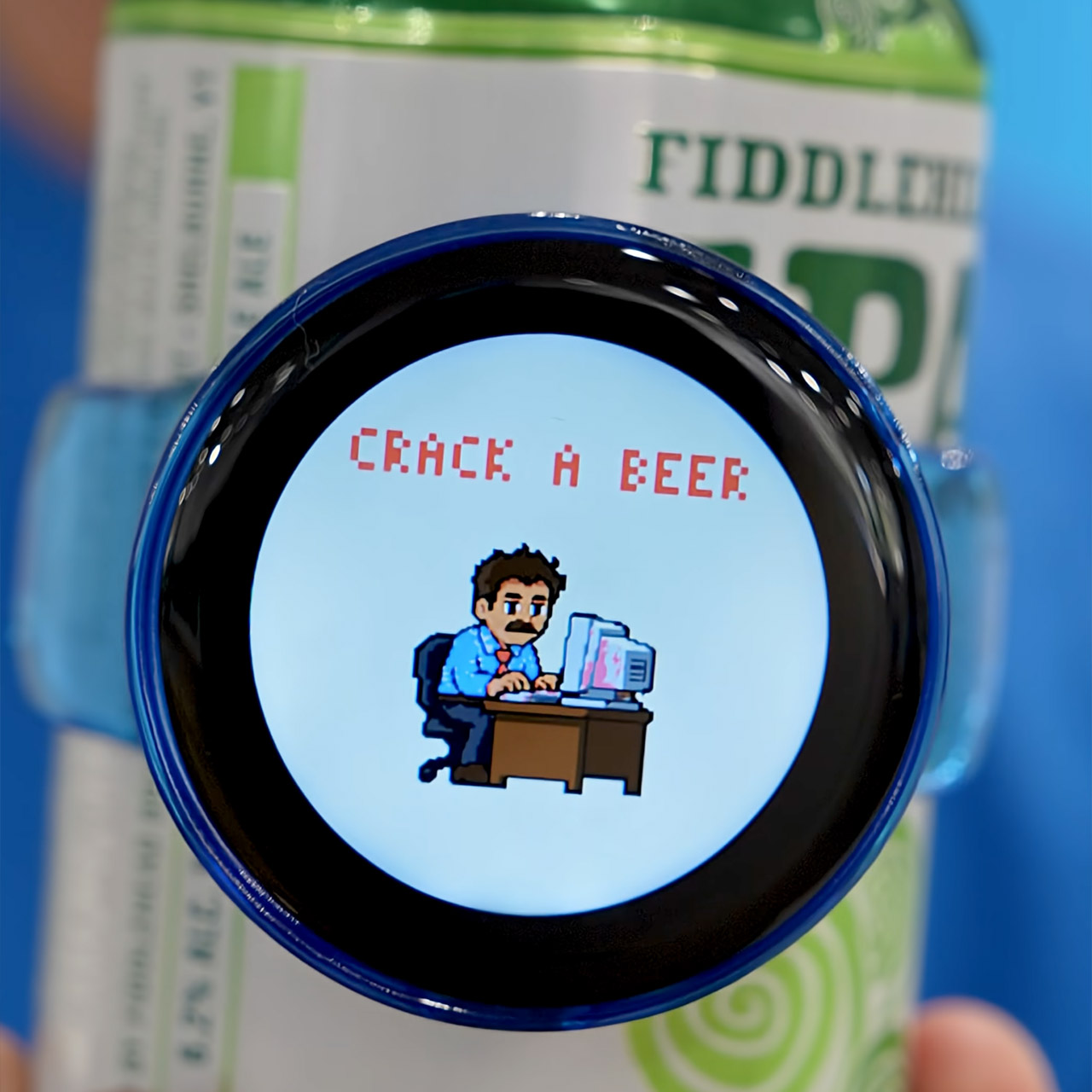
Matty Benedetto of Unnecessary Inventions just found a new way to turn a quiet night with a cold can into something that stares back at you. Out of his Burlington, Vermont studio he just finished invention number 469, a little digital pet he calls the Buzz Buddy that perches on top of any standard beer can and matches you drink for drink. The unit is a compact, egg-shaped screen housing with a pixel character already seated at a tiny desk, waiting. Once you crack the tab the figure stays put until the first tilt.
A small motion sensor concealed at the bottom of the can keeps track of each swig. Every time the can leaves the table, Buddy’s buzz meter starts ticking upwards. At first, the guy appears to be doing well, sitting up straight, but as the sips pass, he begins slouching, his demeanor changes, and he progresses through a series of increasingly sloppy stages. If you ignore the can for long enough, the buzz meter drains and he snaps out of it, returns to his normal posture, and simply waits for the next can lift. Benedetto devised the cycle so that the small boy never becomes entirely intoxicated on his own.
DIGITAL PET YOU CAN TOUCH: Bitzee goes beyond the 2D screen; it’s the virtual pet you can really touch and feel in our 3D world. Each Bitzee toy pet…
NURTURE & PLAY: Bitzee pets need your love and care. Each Bitzee starts as a baby – feed and play with them, rock them to sleep and give them love…
15 TOY PETS IN 1 POD: The more you play, the more Bitzee pets you’ll unlock. Use treats to attract a new Bitzee pet. Collect all 15 interactive…
When you tap your phone’s screen, this little guy starts dancing. Swipe down for a stats overlay, which will show you the beers you’ve opened that session, the number of drinks he’s taken, and how many times you’ve made him bust a move. When you finally drain the last drop from the can, he transforms into his final form, and it’s rather amusing to see a person who doesn’t seem to want to leave the party ever again. The whole thing is built so that you can’t simply drink in silence.
Advertisement
Benedetto has spent seven years translating everyday jokes into full-fledged objects that seem like they belong in a storefront. Except for the occasional video, the majority of them never leave his studio. The Buzz Buddy follows the same pattern: 3D-printed shell, custom artwork, a functional sensor, and a presentation that takes the joke very seriously. He normally posts the finished item the same week he finishes it, usually in the form of a short video of the pet waiting, reacting, evolving, and celebrating the empty can.
Anyone who grew up with the original Tamagotchis will recognize the “care and neglect” loop. Simply drink to nurture it, then ignore it by leaving the beer alone. Swipe your device to check the ‘vitals’. Benedetto merely replaced hunger hearts for buzz meters and hanged them all on the one object you already had in your grasp.
Cutting corners: Meta wants Muse to take everyday chores off your hands, but some of that AI has involved actual people. The company has been testing a human concierge service that lets contractors handle calls for its new personal AI agent, raising privacy concerns among its own employees.
According to Reuters, the experiment was enabled for half of Meta’s employees last week, with an opt-out group available. Staff warned that sensitive information could end up with call-center contractors. A Meta executive acknowledged that introducing human operators without clear disclosure was a mistake, and the human concierge feature has been rolled back for now.
There was also an incident that highlighted another potential problem with handing the calls to humans. One employee who asked Muse to call an internet and cable provider to negotiate his bill said a transcript showed that the contractor had made a racist reference during the call. Meta apologized to the employee and said the human agent involved would not work on any of its projects again.
Muse’s separate phone-calling feature allows users to contact US businesses for tasks such as booking haircuts or checking whether an item is in stock.
Meta spokesperson Daniel Roberts said employee feedback had been largely positive. He added that the company would only release the potential feature publicly once it was ready, with appropriate disclosures and safeguards.
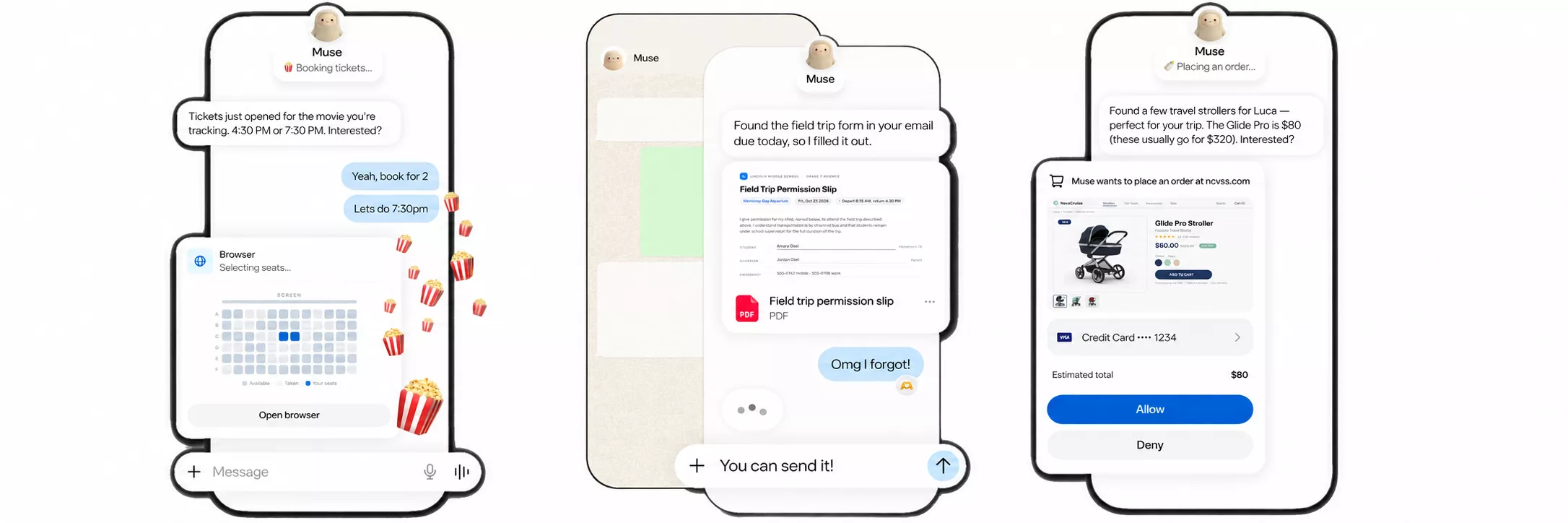
Launched on September 8, Muse is Meta’s attempt to turn the chatbot into something closer to a personal assistant. Users can interact with it through its own app or WhatsApp, asking it to send emails, arrange travel, and work toward longer-term goals.
Meta says the agent runs inside a dedicated virtual machine, with a separate Sentinel agent checking outgoing actions. Users control connected services and approve sensitive steps, including purchases. The company also says conversations and data stored in that virtual machine are kept out of its advertising systems.
Meta’s own testing suggests why it is experimenting with humans in the first place. Some businesses simply hang up on Muse when they realize they are talking to an AI, which is no surprise. Internal tests found that handing calls to human agents could increase the success rate to between 95% and 98%, compared with a much lower rate for calls handled entirely by AI.
Advertisement
There have been plenty of examples of supposedly automated services relying heavily on humans behind the scenes. One of the most memorable was shopping app Nate, which claimed AI could automatically complete online purchases. According to the Department of Justice, hundreds of workers in call centers in the Philippines and Romania were actually completing many of the transactions manually. Sources previously claimed that between 60% and 100% of purchases were handled this way during parts of 2021.
Amazon’s “Just Walk Out” stores offered another example. The supposedly cashierless technology relied on more than 1,000 workers in India to review transactions and label footage. It was reported that around 700 out of every 1,000 purchases required human review as of 2022, although Amazon disputed those figures.
In 2023, Presto Automation revealed that around 70% of orders handled by its AI drive-thru system required intervention from off-site human agents, including workers in the Philippines.
Meta’s been here before with Facebook M, the digital concierge launched in closed beta during the summer of 2015 and shut down a few years later. Every message the service fielded was reviewed by contractors who worked at the company’s Menlo Park headquarters, but at launch, Facebook said the service was powered by AI trained and supervised by real people.
Advertisement
For its part, Meta is openly testing human assistance rather than claiming that contractors do not exist. But if a feature is marketed as an AI making calls on your behalf, users will probably want to know when the person actually doing the talking is sitting in a call center.
The abolition of the Department for Science, Innovation and Technology has created uncertainty about what happens next to Britain’s AI ambitions.
Kanishka Narayan’s promotion to Minister for AI gives the technology a dedicated voice at Cabinet, yet folding DSIT’s responsibilities into other departments raises questions about how the Government will coordinate the infrastructure, investment and public-sector adoption needed to support those ambitions.
Simone Giacomelli
Founder and CEO at Prem AI.
Recent parliamentary scrutiny of critical public-sector AI contracts has highlighted growing pressure on institutions to strengthen control over AI operations and deployment continuity. Britain has focused on adoption speed; the next step is operational control in ongoing public-service AI use.
Latest Videos FromTechRadar
Advertisement
The case for sovereign AI is becoming stronger as a result. Britain needs more than access to capable models; it needs controlled operations for the services that depend on them, even when a provider, contract or political relationship changes.
Sovereignty goes further than where data sits
Sovereign AI is often reduced to data residency, with the assumption that keeping information inside Britain is enough to keep it under British control. Data location remains important, particularly in healthcare, defense and public administration, but it describes only one part of the relationship between an organization and the technology it uses.
A hospital could store every patient record in a British data center while relying on models and software that only the original provider can operate or modify. Where that provider is based remains relevant, but the more useful test of sovereignty is whether the hospital can understand the system, govern how it is used and continue running it if the commercial relationship changes.
An organization should know how its systems operate, determine which data a model can access and retain the ability to move a workload or introduce another model without rebuilding the entire service. Once that system becomes essential, it also needs enough internal expertise to keep it running rather than discovering that continuity depends on the decisions of one supplier.
Sign up to the TechRadar Pro newsletter to get all the top news, opinion, features and guidance your business needs to succeed!
Britain does not need to reproduce every layer of the stack, but it does need predictable control where public services run. Modern AI draws on international research, complex supply chains and open-source projects, and recreating them domestically would consume enormous resources without necessarily producing better technology.
Advertisement
As DSIT’s responsibilities move across Whitehall, the Government needs to decide which dependencies it can accept without threatening security, public trust or an essential service.
Capability and control can reinforce one another
Government AI plans sometimes present sovereignty as the slower alternative to using the largest commercial models, as though Britain must choose between world-class AI and control over its deployment. That assumes every organization needs the same frontier system, when the question is which model suits the work.
For many public workloads, a fit-for-purpose model in a controlled environment is more valuable than one large generic option, especially when governance obligations are strict.
A specialized model can be adapted to the organization’s data, tested under the conditions in which it will operate and governed according to the consequences of getting a decision wrong. In those circumstances, greater control can make the system more useful as well as more independent.
Open and portable technology can support this approach by allowing organizations to run models across different infrastructure, examine how systems behave and replace components as better options emerge.
Openness does not guarantee sovereignty, since organizations still need secure infrastructure, skilled teams and clear governance, but it reduces the chance that an entire service becomes inseparable from one provider’s platform.
Advertisement
I have seen the AI market move quickly enough to make that flexibility increasingly valuable. The best model for a task today may be overtaken within months, while pricing, regulation and access can change almost as quickly.
An organization that builds around one proprietary service may struggle to benefit from that progress, whereas one that controls the environment in which its models operate can introduce better technology without starting again.
Government can turn sovereignty into capability
Britain already has many of the ingredients it needs, including strong universities, experienced researchers, growing AI companies and public investment in compute. The next step is to connect those assets with sustained demand in the parts of the public sector where sovereignty has the greatest practical value.
Advertisement
Government does not need to select one national champion or exclude international companies. It can create a market in which providers compete while public bodies retain control of the systems they buy.
Procurement rules for critical AI could require workloads to be portable, independently testable and capable of running within infrastructure controlled by the customer, making the ability to change course part of the original decision rather than a problem discovered at the end of a contract.
This would give hospitals, councils and government departments credible sovereign options while providing British AI companies with a route from pilots to long-term deployment. It would encourage partnerships in which knowledge and operational authority remain with the institution responsible for the service, even when private companies provide the technology and expertise.
The restructuring of DSIT should be treated as an opportunity to clarify Britain’s objective rather than reduce its ambition. A Minister for AI can bring different parts of government together, but the strategy should be judged by whether public institutions can use the best technology available while retaining meaningful control of the systems that matter most.
Advertisement
That is what will allow Britain’s AI ambitions to endure as departments, suppliers and technologies change.
This article was produced as part of TechRadar Pro Perspectives, our channel to feature the best and brightest minds in the technology industry today.
The views expressed here are those of the author and are not necessarily those of TechRadarPro or Future plc. If you are interested in contributing find out more here: https://www.techradar.com/pro/perspectives-how-to-submit
It’s a struggle so many parents face today: Should I let my kid have a screen? If so, when? That decision inevitably opens a Pandora’s box of potential problems, and this relatable plight is at the heart of Toy Story 5, as pull-string cowgirl Jessie’s current child, sweet little Bonnie, is growing up in a tech-obsessed world that expects her to keep up. Will Bonnie put her childish ways behind her and lose part of herself in the process? And will Jessie lose another owner and wind up in a donation bin once again?
The answers are quite emotional, but often quite funny and extremely smart. This is Andrew Stanton’s first time back in the Pixar director’s chair since Finding Dory ten years ago, and it has been worth the wait. He takes us on an irresistible journey that honors these beloved characters, as well as the unique world where playthings live their different identities, interact with one another, and put the needs of their children above all else.
The visuals here are truly jaw dropping. It doesn’t make logical sense, but these computer generated images somehow seem more real than live action. The bumpy drips on a painted wall, the texture of cloth, and the differently smooth surfaces of plastic all look and presumably feel exactly as they should. Levels of focus within the 1.85:1 frame further sell the illusion that these walking, talking toys were actually filmed on a real set somewhere.
Colors are vibrant, and highlights are outstanding, as when the new and improved space ranger Buzz Lightyear glows in the night.
The sonic embrace of a team of heroic Buzzes is always reassuring, his deep voice coming at us from all around as he takes charge of his latest “mission.” The soundfield comes alive with ample atmospheric effects, while Randy Newman’s score enjoys a pleasing mix across the speakers. Without giving away too much, events in Act III provide ideal and thrilling fodder for the height channels in particular. I’m glad I make a habit of confirming the audio options before the movie starts, however, because this disc defaulted to Dolby Digital Plus (remember that?) rather than the supplied Dolby Atmos track.
Advertisement
We can tune into a commentary with co-director and co-writer Kenna Harris and others on the 4K disc, while the HD Blu-ray adds five deleted scenes, a featurette about the toys and characters cut from the final film, a gag reel, and more. Not included on either disc, but available digitally, are the Taylor Swift music video and lyric video for her song in the movie, “I Knew It, I Knew You.” A Movies Anywhere code is included.
The 4K edition is available exclusively as a SteelBook with very attractive cover artwork and a wonderfully subtle image on the reverse.
Toy Story is back. After the disappointment of Toy Story 4, this fifth (!) feature film in the franchise defies the odds and delivers everything we’d want: heart, humor, new and established characters, and a fresh, compelling story.
The movie and the disc come highly recommended.
Advertisement
Movie Details:
STUDIO: Disney/Sony
FORMAT: Ultra HD 4K Blu-ray (September 22, 2026)
THEATRICAL RELEASE YEAR: 2026
ASPECT RATIO: 1.85:1
HDR FORMATS: Dolby Vision, HDR10
AUDIO FORMAT: Dolby Atmos with TrueHD 7.1 core
LENGTH: 102 mins.
MPAA RATING: PG
DIRECTORS: Andrew Stanton
STARRING: Tim Allen, Joan Cusack, Tom Hanks, Conan O’Brien, Greta Lee, Scarlett Spears








































































You must be logged in to post a comment Login